
El tifus epidémico es una enfermedad febril causada por la bacteria Bacteria Bacteria are prokaryotic single-celled microorganisms that are metabolically active and divide by binary fission. Some of these organisms play a significant role in the pathogenesis of diseases. Bacteriology gramnegativa intracelular obligada Rickettsia prowazekii Rickettsia prowazekii A species of gram-negative, aerobic bacteria that is the etiologic agent of epidemic typhus fever acquired through contact with lice as well as brill's disease. Rickettsia. El tifus epidémico también se conoce como tifus transmitido por los LOS Neisseria piojos o fiebre de la cárcel, y sus síntomas incluyen fiebre alta, cefalea, mialgias, tos TOS Thoracic outlet syndrome (TOS) is a broad term used for a spectrum of syndromes related to the general region of the thoracic outlet, which involves the compression or irritation of elements of the brachial plexus, subclavian artery, or subclavian vein. Thoracic Outlet Syndrome seca, delirio, estupor y erupción. El tifus epidémico no tratado puede provocar hipotensión, shock Shock Shock is a life-threatening condition associated with impaired circulation that results in tissue hypoxia. The different types of shock are based on the underlying cause: distributive (↑ cardiac output (CO), ↓ systemic vascular resistance (SVR)), cardiogenic (↓ CO, ↑ SVR), hypovolemic (↓ CO, ↑ SVR), obstructive (↓ CO), and mixed. Types of Shock y muerte. R. prowazekii puede transmitirse por las picaduras de ácaros, pulgas o piojos infectados. La desnutrición, las enfermedades crónicas, el hacinamiento y la falta de higiene son factores que conducen a la propagación del tifus epidémico. La mejora de la nutrición y la higiene puede ayudar a prevenir la propagación, disminuyendo así el riesgo de infecciones por tifus. El principal método de tratamiento es el uso del antibiótico doxiciclina.
Last updated: Dec 15, 2025
El tifus epidémico es una enfermedad febril potencialmente letal causada por la bacteria Bacteria Bacteria are prokaryotic single-celled microorganisms that are metabolically active and divide by binary fission. Some of these organisms play a significant role in the pathogenesis of diseases. Bacteriology gram-negativa intracelular obligada Rickettsia prowazekii Rickettsia prowazekii A species of gram-negative, aerobic bacteria that is the etiologic agent of epidemic typhus fever acquired through contact with lice as well as brill’s disease. Rickettsia.
Transmisión:
Factores de riesgo:
Geografía:
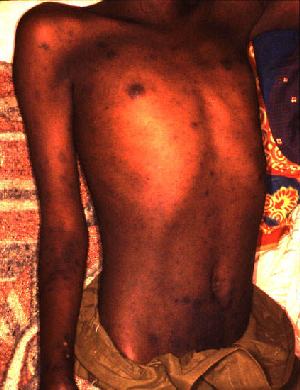
Erupción en un paciente con tifus epidémico
Imagen: “Tifus epidémico Burundi” por D. Raoult, V. Roux, J.B. Ndihokubwayo, G. Bise, D. Baudon, G. Martet y R. Birtles. Licencia: Dominio PúblicoAntibióticos:
Prevención:
Pronóstico: