Domina Conceptos Médicos

Estudia para la escuela de medicina y tus examenes con Lecturio.

Terapia de Reposición de Líquidos en Niños

Los LOS Neisseria niños son especialmente vulnerables a desarrollar deshidratación porque tienen una mayor pérdida insensible de agua y un ritmo metabólico más elevado que los LOS Neisseria adultos. Además, la incapacidad de los LOS Neisseria niños para comunicar sus necesidades se agrava con las grandes pérdidas de líquidos (e.g., diarrea, vómitos), lo que les hace HACE Altitude Sickness correr un riesgo aún mayor. La deshidratación se define como una disminución del agua corporal total, y puede caracterizarse como leve, moderada o grave. El tratamiento de reposición de líquidos se basa en EN Erythema nodosum is an immune-mediated panniculitis (inflammation of the subcutaneous fat) caused by a type IV (delayed-type) hypersensitivity reaction. It commonly manifests in young women as tender, erythematous nodules on the shins. Erythema Nodosum la gravedad. Los LOS Neisseria médicos deben estar preparados para administrar una terapia de rehidratación óptima, además de las otras medidas necesarias para la enfermedad causante. Cuando se trata con prontitud, la deshidratación empieza a resolverse clínicamente en EN Erythema nodosum is an immune-mediated panniculitis (inflammation of the subcutaneous fat) caused by a type IV (delayed-type) hypersensitivity reaction. It commonly manifests in young women as tender, erythematous nodules on the shins. Erythema Nodosum las primeras horas.

Last updated: Dec 15, 2025

Editorial responsibility: Stanley Oiseth, Lindsay Jones, Evelin Maza

Descripción General

Definición

La deshidratación es una disminución del agua corporal total, tanto intracelular como extracelular.

Epidemiología

La deshidratación en EN Erythema nodosum is an immune-mediated panniculitis (inflammation of the subcutaneous fat) caused by a type IV (delayed-type) hypersensitivity reaction. It commonly manifests in young women as tender, erythematous nodules on the shins. Erythema Nodosum los LOS Neisseria niños a nivel mundial es causada principalmente por la diarrea:

  • La diarrea sigue siendo una de las principales causas de morbilidad y mortalidad infantil a nivel mundial, aunque la mortalidad ha HA Hemolytic anemia (HA) is the term given to a large group of anemias that are caused by the premature destruction/hemolysis of circulating red blood cells (RBCs). Hemolysis can occur within (intravascular hemolysis) or outside the blood vessels (extravascular hemolysis). Hemolytic Anemia disminuido considerablemente en EN Erythema nodosum is an immune-mediated panniculitis (inflammation of the subcutaneous fat) caused by a type IV (delayed-type) hypersensitivity reaction. It commonly manifests in young women as tender, erythematous nodules on the shins. Erythema Nodosum la última década.
  • En EN Erythema nodosum is an immune-mediated panniculitis (inflammation of the subcutaneous fat) caused by a type IV (delayed-type) hypersensitivity reaction. It commonly manifests in young women as tender, erythematous nodules on the shins. Erythema Nodosum países de altos ingresos como Estados Unidos, las muertes infantiles relacionadas con la diarrea son ahora poco frecuentes.
  • La mayoría de las diarreas son infecciosas:
    • Virales (75–90%): rotavirus Rotavirus A genus of Reoviridae, causing acute gastroenteritis in birds and mammals, including humans. Transmission is horizontal and by environmental contamination. Seven species (rotaviruses A through G) are recognized. Rotavirus, norovirus Norovirus Norovirus is a nonenveloped, single-stranded, positive-sense RNA virus belonging to the Caliciviridae family. Norovirus infections are transmitted via the fecal-oral route or by aerosols from vomiting. The virus is one of the most common causes of nonbacterial gastroenteritis epidemic worldwide. Symptoms include watery and nonbloody diarrhea, nausea, vomiting, and low-grade fever. Norovirus y enterovirus Enterovirus A genus of the family picornaviridae whose members preferentially inhabit the intestinal tract of a variety of hosts. The genus contains many species. Newly described members of human enteroviruses are assigned continuous numbers with the species designated ‘human enterovirus’. Coxsackievirus
    • Bacterianas (< 20%): Salmonella Salmonella Salmonellae are gram-negative bacilli of the family Enterobacteriaceae. Salmonellae are flagellated, non-lactose-fermenting, and hydrogen sulfide-producing microbes. Salmonella enterica, the most common disease-causing species in humans, is further classified based on serotype as typhoidal (S. typhi and paratyphi) and nontyphoidal (S. enteritidis and typhimurium). Salmonella, Shigella Shigella Shigella is a genus of gram-negative, non-lactose-fermenting facultative intracellular bacilli. Infection spreads most commonly via person-to-person contact or through contaminated food and water. Humans are the only known reservoir. Shigella y Escherichia coli Escherichia coli The gram-negative bacterium Escherichia coli is a key component of the human gut microbiota. Most strains of E. coli are avirulent, but occasionally they escape the GI tract, infecting the urinary tract and other sites. Less common strains of E. coli are able to cause disease within the GI tract, most commonly presenting as abdominal pain and diarrhea. Escherichia coli (10% de las bacterianas)
    • Parasitarias (< 5%): Giardia Giardia A genus of flagellate intestinal eukaryotes parasitic in various vertebrates, including humans. Characteristics include the presence of four pairs of flagella arising from a complicated system of axonemes and cysts that are ellipsoidal to ovoidal in shape. Nitroimidazoles y Cryptosporidium Cryptosporidium A genus of coccidian parasites of the family cryptosporidiidae, found in the intestinal epithelium of many vertebrates including humans. Hyper-IgM Syndrome

Etiología

  • Pérdida excesiva de agua
    • Gastrointestinal:
      • Diarrea
      • Vómitos
    • Urinaria: micción excesiva por estados hiperosmolares (e.g., diabetes Diabetes Diabetes mellitus (DM) is a metabolic disease characterized by hyperglycemia and dysfunction of the regulation of glucose metabolism by insulin. Type 1 DM is diagnosed mostly in children and young adults as the result of autoimmune destruction of β cells in the pancreas and the resulting lack of insulin. Type 2 DM has a significant association with obesity and is characterized by insulin resistance. Diabetes Mellitus)
    • Aumento de la pérdida insensible por evaporación:
      • Enfermedades febriles
      • Quemaduras
      • Aumento de las pérdidas respiratorias por enfermedad respiratoria (e.g., bronquiolitis)
  • Disminución de la ingesta
    • Anorexia Anorexia The lack or loss of appetite accompanied by an aversion to food and the inability to eat. It is the defining characteristic of the disorder anorexia nervosa. Anorexia Nervosa por enfermedad
    • Falta de acceso al AL Amyloidosis agua potable
    • Descuido

Diagnóstico

En EN Erythema nodosum is an immune-mediated panniculitis (inflammation of the subcutaneous fat) caused by a type IV (delayed-type) hypersensitivity reaction. It commonly manifests in young women as tender, erythematous nodules on the shins. Erythema Nodosum la mayoría de los LOS Neisseria casos, una buena toma de antecedentes y el examen físico son suficientes para diagnosticar la deshidratación y su etiología. Las pruebas de laboratorio se reservan para los LOS Neisseria casos graves y para monitorizar la rehidratación.

Antecedentes

  • Equilibrio de líquidos:
    • Número de pañales mojados/micciones por día
    • Aumento de la cantidad de agua bebida o solicitada
  • Enfermedad reciente:
    • Fiebre
    • Episodios de diarrea (se puede estimar la cantidad y calidad de la pérdida de heces)
  • Cambios en EN Erythema nodosum is an immune-mediated panniculitis (inflammation of the subcutaneous fat) caused by a type IV (delayed-type) hypersensitivity reaction. It commonly manifests in young women as tender, erythematous nodules on the shins. Erythema Nodosum el comportamiento:
    • Letargo
    • Irritabilidad

Examen físico

Tabla: Examen físico para reconocer el grado de deshidratación en EN Erythema nodosum is an immune-mediated panniculitis (inflammation of the subcutaneous fat) caused by a type IV (delayed-type) hypersensitivity reaction. It commonly manifests in young women as tender, erythematous nodules on the shins. Erythema Nodosum niños
Leve Moderada Severa
Pérdida de peso < 5% en EN Erythema nodosum is an immune-mediated panniculitis (inflammation of the subcutaneous fat) caused by a type IV (delayed-type) hypersensitivity reaction. It commonly manifests in young women as tender, erythematous nodules on the shins. Erythema Nodosum lactantes, < 3% en EN Erythema nodosum is an immune-mediated panniculitis (inflammation of the subcutaneous fat) caused by a type IV (delayed-type) hypersensitivity reaction. It commonly manifests in young women as tender, erythematous nodules on the shins. Erythema Nodosum niños mayores 5%–10% en EN Erythema nodosum is an immune-mediated panniculitis (inflammation of the subcutaneous fat) caused by a type IV (delayed-type) hypersensitivity reaction. It commonly manifests in young women as tender, erythematous nodules on the shins. Erythema Nodosum lactantes, 3%–9% en EN Erythema nodosum is an immune-mediated panniculitis (inflammation of the subcutaneous fat) caused by a type IV (delayed-type) hypersensitivity reaction. It commonly manifests in young women as tender, erythematous nodules on the shins. Erythema Nodosum niños mayores > 10% en EN Erythema nodosum is an immune-mediated panniculitis (inflammation of the subcutaneous fat) caused by a type IV (delayed-type) hypersensitivity reaction. It commonly manifests in young women as tender, erythematous nodules on the shins. Erythema Nodosum lactantes, > 9% en EN Erythema nodosum is an immune-mediated panniculitis (inflammation of the subcutaneous fat) caused by a type IV (delayed-type) hypersensitivity reaction. It commonly manifests in young women as tender, erythematous nodules on the shins. Erythema Nodosum niños mayores
Mucosas secas (primer signo) +/-, se ven secas +, se ven muy secas
Turgencia cutánea (último signo) + +/- -, signo del pliegue cutáneo
Depresión de la fontanela anterior + +/++
Estado mental Normal Fatigado/irritable Apatía/letargia
Enoftalmos + +
Respiración Normal Profunda, puede ser taquipneica Profunda y taquipneica
Frecuencia cardíaca Normal Aumentada Muy aumentada
Hipotensión + +
Perfusión distal Normal Sensación fría, 3–4 segundos Acrocianótico, > 4 segundos
Gasto urinario Disminuido Oliguria Oliguria Decreased urine output that is below the normal range. Oliguria can be defined as urine output of less than or equal to 0. 5 or 1 ml/kg/hr depending on the age. Renal Potassium Regulation Oliguria Oliguria Decreased urine output that is below the normal range. Oliguria can be defined as urine output of less than or equal to 0. 5 or 1 ml/kg/hr depending on the age. Renal Potassium Regulation/ anuria Anuria Absence of urine formation. It is usually associated with complete bilateral ureteral (ureter) obstruction, complete lower urinary tract obstruction, or unilateral ureteral obstruction when a solitary kidney is present. Acute Kidney Injury

Pruebas de laboratorio

  • El panel metabólico básico (CHEM-7) en EN Erythema nodosum is an immune-mediated panniculitis (inflammation of the subcutaneous fat) caused by a type IV (delayed-type) hypersensitivity reaction. It commonly manifests in young women as tender, erythematous nodules on the shins. Erythema Nodosum casos de deshidratación severa puede mostrar:
    • ↓ glucosa
    • ↑ nitrógeno ureico en EN Erythema nodosum is an immune-mediated panniculitis (inflammation of the subcutaneous fat) caused by a type IV (delayed-type) hypersensitivity reaction. It commonly manifests in young women as tender, erythematous nodules on the shins. Erythema Nodosum sangre (BUN, por sus siglas en EN Erythema nodosum is an immune-mediated panniculitis (inflammation of the subcutaneous fat) caused by a type IV (delayed-type) hypersensitivity reaction. It commonly manifests in young women as tender, erythematous nodules on the shins. Erythema Nodosum inglés)
    • Sodio y cloruro anormales (altos o bajos, según la deshidratación)
    • ↓ bicarbonato
    • ↑ creatinina
  • Creatinina quinasa:
    • Cuando se sospeche de rabdomiólisis
    • Elevado en EN Erythema nodosum is an immune-mediated panniculitis (inflammation of the subcutaneous fat) caused by a type IV (delayed-type) hypersensitivity reaction. It commonly manifests in young women as tender, erythematous nodules on the shins. Erythema Nodosum la deshidratación severa
  • Análisis de heces: para identificar la etiología en EN Erythema nodosum is an immune-mediated panniculitis (inflammation of the subcutaneous fat) caused by a type IV (delayed-type) hypersensitivity reaction. It commonly manifests in young women as tender, erythematous nodules on the shins. Erythema Nodosum casos de diarrea prolongada

Tratamiento

Deshidratación leve a moderada

  • Tratamiento de 1ra línea: terapia de rehidratación oral
  • Deben utilizarse soluciones de rehidratación oral con contenidos electrolíticos similares a los LOS Neisseria del líquido perdido:
  • El objetivo es proporcionar 50–100 cc/kg de líquidos durante 2–4 horas. La vía de administración depende de la edad y la fragilidad del paciente:
    • Alimentación con jeringa o cuchara
    • Sonda nasogástrica
  • +/- ondansetrón para prevenir los LOS Neisseria vómitos
  • El estado clínico de la hidratación debe ser monitorizado frecuentemente.
  • Si no se mejora con la terapia de rehidratación oral, se debe iniciar hidratación intravenosa.

Deshidratación severa

La deshidratación severa puede causar hipoperfusión del cerebro y de los LOS Neisseria órganos vitales y se considera una emergencia médica que debe ser atendida rápidamente.

  • Fase de reanimación aguda
    • Objetivo: corregir o prevenir el shock Shock Shock is a life-threatening condition associated with impaired circulation that results in tissue hypoxia. The different types of shock are based on the underlying cause: distributive (↑ cardiac output (CO), ↓ systemic vascular resistance (SVR)), cardiogenic (↓ CO, ↑ SVR), hypovolemic (↓ CO, ↑ SVR), obstructive (↓ CO), and mixed. Types of Shock hipovolémico
    • Expansión rápida de volumen mediante bolos de líquido:
      • 20 cc/kg administrados en EN Erythema nodosum is an immune-mediated panniculitis (inflammation of the subcutaneous fat) caused by a type IV (delayed-type) hypersensitivity reaction. It commonly manifests in young women as tender, erythematous nodules on the shins. Erythema Nodosum 20 minutos
      • Puede repetirse hasta 3 veces
      • Monitorizar los LOS Neisseria signos vitales entre cada bolo.
    • Elección del líquido de sustitución:
      • Solo líquidos isotónicos
      • El Ringer lactato o la solución fisiológica son adecuados.
    • Control de la glucosa:
      • Monitorización de la hipoglucemia a la cabecera del paciente
      • Debe administrarse glucosa intravenosa.
      • 5–10 ml/kg de dextrosa al AL Amyloidosis 10% con solución fisiológica O 2-4 ml/kg de dextrosa al AL Amyloidosis 25% con solución fisiológica
  • Fase de reanimación
    • Reposición más lenta de los LOS Neisseria líquidos perdidos durante 24 horas
    • Líquido total de la fase de reanimación = líquidos de mantenimiento + (rehidratación – bolo ya administrado)
    • La rehidratación se divide en EN Erythema nodosum is an immune-mediated panniculitis (inflammation of the subcutaneous fat) caused by a type IV (delayed-type) hypersensitivity reaction. It commonly manifests in young women as tender, erythematous nodules on the shins. Erythema Nodosum 2 fases:
      • 50% en EN Erythema nodosum is an immune-mediated panniculitis (inflammation of the subcutaneous fat) caused by a type IV (delayed-type) hypersensitivity reaction. It commonly manifests in young women as tender, erythematous nodules on the shins. Erythema Nodosum las primeras 8 horas
      • 50% en EN Erythema nodosum is an immune-mediated panniculitis (inflammation of the subcutaneous fat) caused by a type IV (delayed-type) hypersensitivity reaction. It commonly manifests in young women as tender, erythematous nodules on the shins. Erythema Nodosum las siguientes 16 horas
    • La dextrosa al AL Amyloidosis 5% con cloruro de sodio al AL Amyloidosis 0,2% compensa las necesidades de mantenimiento de sodio en EN Erythema nodosum is an immune-mediated panniculitis (inflammation of the subcutaneous fat) caused by a type IV (delayed-type) hypersensitivity reaction. It commonly manifests in young women as tender, erythematous nodules on the shins. Erythema Nodosum la mayoría de los LOS Neisseria niños
  • Después de 24 horas, si está clínicamente estable → continuar con líquidos de mantenimiento

Cálculos de sustitución de volumen

  • Bolo estándar:
    • 20 cc/kg/20 min
    • Hasta 3 veces
    • Monitorización de signos vitales.
  • Cálculos de mantenimiento:
    • Regla 4-2-1:
    • Ejemplo: un niño que pesa 37 kg
      • (10 kg x 4 cc/kg/h) + (10 kg x 2 cc/kg/h) + (17 kg x 1 cc/kg/h) = (40 cc/h) + (20 cc/h) + (17 cc/h) = 77 cc/h
  • La rehidratación se calcula según el peso y la gravedad de la deshidratación:
    • La cantidad calculada se añade a la cantidad de mantenimiento, repartida a lo largo del día.
    • < 10 kg:
      • Leve: 50 cc/kg/día
      • Moderado: 100 cc/kg/día
      • Grave: 150 cc/kg/día
    • > 10 kg:
      • Leve: 30 cc/kg/día
      • Moderado: 60 cc/kg/día
      • Grave: 90 cc/kg/día

Ejemplo de tratamiento completo

Un niño que pesa 25 kg con deshidratación severa:
  • Fase de reanimación aguda:
    • 3 bolos de 20 cc/kg = 1 500 cc
  • Fase de reanimación:
    • Líquido total = líquidos de mantenimiento + (rehidratación – bolo ya administrado)
    • Mantenimiento: (10 kg x 4 cc/kg/hora) + (10 kg x 2 cc/kg/hora) + (5 kg x 1 cc/kg/hora) = 65 cc/hora → 1 560 cc/día
    • Rehidratación: 25 kg x 90 cc/kg/día = 2 250 cc/día
    • Rehidratación – bolo ya administrado: 2 250 cc/día – 1 500 cc = 750 cc/día
    • Reposición total de líquidos: 1 560 cc/día + 750 cc/día = 2 310 cc/día
    • Rehidratación dividida en EN Erythema nodosum is an immune-mediated panniculitis (inflammation of the subcutaneous fat) caused by a type IV (delayed-type) hypersensitivity reaction. It commonly manifests in young women as tender, erythematous nodules on the shins. Erythema Nodosum 2 fases de tratamiento: 2 310 cc / 2 = 1 155 cc
    • Volumen para las primeras 8 horas: 1 155 cc/8 horas
    • Volumen para las próximas 16 horas: 1 155 cc/16 horas
    • Después de 24 horas → continuar con los LOS Neisseria líquidos de mantenimiento

Monitorización de la respuesta

  • Gasto urinario: óptimo > 1 cc/kg/hr
  • Mejoría clínica de los LOS Neisseria signos de deshidratación:
    • Aumento de la turgencia de la piel
    • Mejor pulso
    • Mejor llenado capilar
    • Mejor estado mental
    • Resolución del enoftalmos
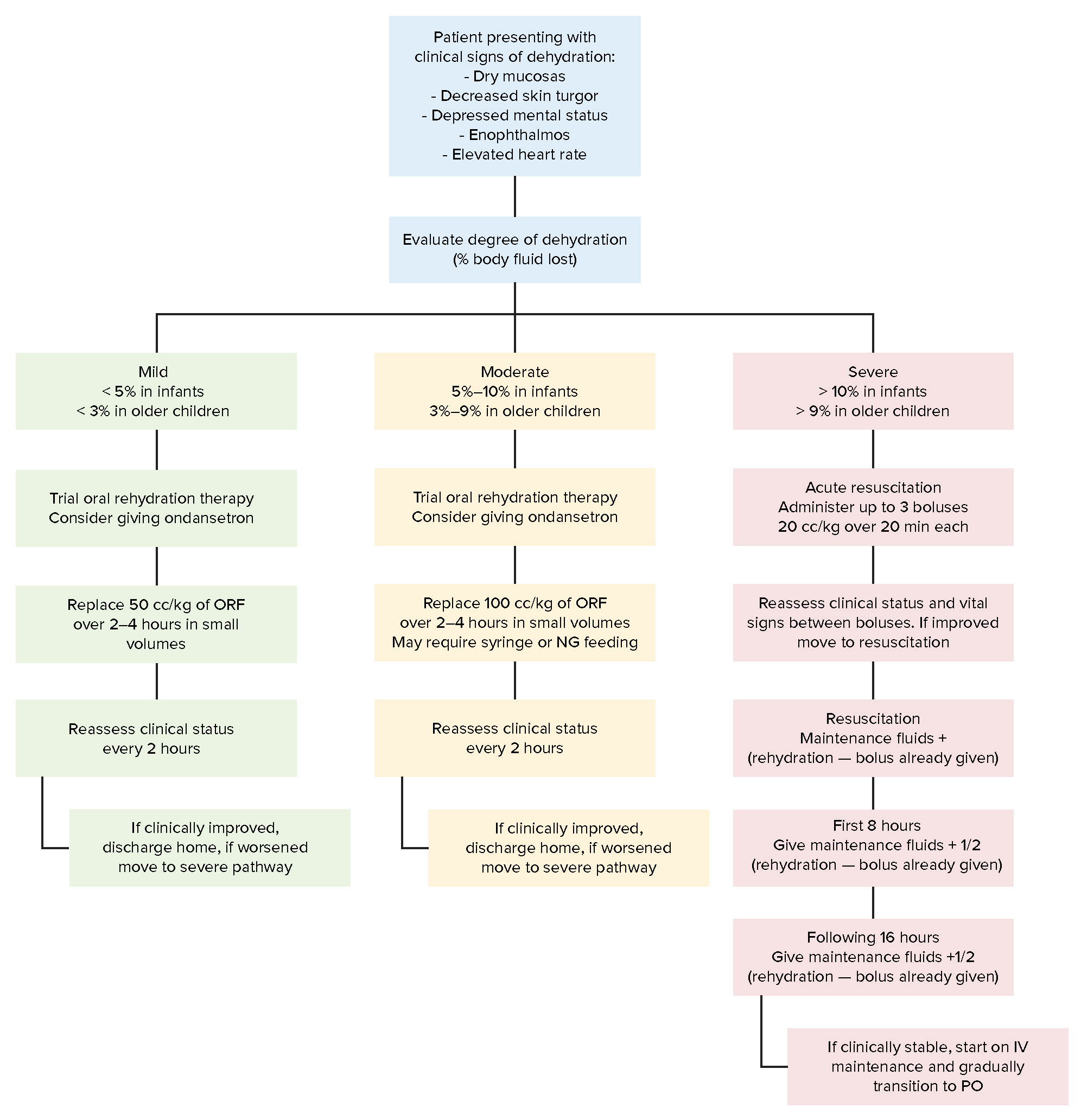
Diagrama de flujo sobre el tratamiento de reposición de líquidos en niños

Abordaje de la evaluación y el tratamiento con soluciones de reposición oral o líquidos intravenosos de los niños con deshidratación en función de la gravedad de los síntomas

Imagen por Lecturio.

Poblaciones Especiales (Neonatos)

Necesidades diarias = líquidos de mantenimiento + líquidos de crecimiento:

  • Neonatos a término:
    • Día 1 = 80 cc/kg/día (líquidos de mantenimiento)
    • Aumento diario en EN Erythema nodosum is an immune-mediated panniculitis (inflammation of the subcutaneous fat) caused by a type IV (delayed-type) hypersensitivity reaction. It commonly manifests in young women as tender, erythematous nodules on the shins. Erythema Nodosum incrementos de 20 cc/kg/día (líquidos de crecimiento) hasta alcanzar el objetivo
  • Neonatos pretérmino:
    • Día 1 = 70 cc/kg/día
    • Aumento diario en EN Erythema nodosum is an immune-mediated panniculitis (inflammation of the subcutaneous fat) caused by a type IV (delayed-type) hypersensitivity reaction. It commonly manifests in young women as tender, erythematous nodules on the shins. Erythema Nodosum incrementos de 10 cc/kg/día (líquidos de crecimiento)
    • Los LOS Neisseria bebes pretérmino tardan más en EN Erythema nodosum is an immune-mediated panniculitis (inflammation of the subcutaneous fat) caused by a type IV (delayed-type) hypersensitivity reaction. It commonly manifests in young women as tender, erythematous nodules on the shins. Erythema Nodosum alcanzar la meta.
  • La cantidad alimentada se aumenta progresivamente cada día hasta alcanzar un aporte diario superior a 150 cc/kg/día.
  • Los LOS Neisseria líquidos de crecimiento deben asegurar un aumento de peso diario de 30–40 g.
  • La entrada diaria debe ser mayor que la pérdida para apoyar el crecimiento.

Referencias

  1. World Health Organization. (2024, March 7). Diarrhoeal disease. https://www.who.int/news-room/fact-sheets/detail/diarrhoeal-disease
  2. Managing Acute Gastroenteritis Among Children Oral Rehydration, Maintenance, and Nutritional Therapy. Prepared by Caleb K. King, M.D., Roger Glass, M.D., Ph.D., Joseph S. Bresee, M.D., Christopher Duggan, M.D., University of North Carolina, Chapel Hill, North Carolina Division of Viral and Rickettsial Diseases, National Center for Infectious Diseases, CDC, Children’s Hospital Bostom, Boston, Massachusetts https://www.cdc.gov/mmwr/preview/mmwrhtml/rr5216a1.htm
  3. Kight BP, Waseem M. Pediatric Fluid Management. [Updated 2023 Feb 28]. In: StatPearls [Internet]. Treasure Island (FL): StatPearls Publishing; 2025 Jan-. Available from: https://www.ncbi.nlm.nih.gov/books/NBK560540/

¡Crea tu cuenta gratis o inicia una sesión para seguir leyendo!

Regístrate ahora y obtén acceso gratuito a Lecturio con páginas de concepto, videos médicos y cuestionarios para tu educación médica.

User Reviews

Que tengas una sesión de estudio alegre y navideña 🎁 Ahorra 50% en todos los planes >>

Details