
Domina Conceptos Médicos

Estudia para la escuela de medicina y tus examenes con Lecturio.

Síndrome de Williams

El síndrome de Williams, también conocido como síndrome de Williams-Beuren, es una enfermedad genética causada por una microdeleción en EN Erythema nodosum is an immune-mediated panniculitis (inflammation of the subcutaneous fat) caused by a type IV (delayed-type) hypersensitivity reaction. It commonly manifests in young women as tender, erythematous nodules on the shins. Erythema Nodosum el cromosoma 7. Los LOS Neisseria individuos afectados tienen una característica facies de elfo y baja estatura. Los LOS Neisseria problemas cognitivos, de desarrollo y de comportamiento son comunes. Además, puede haber anomalías cardiovasculares, del tejido conectivo, endócrinas y renales. Las pruebas genéticas confirman el diagnóstico. El tratamiento se basa en EN Erythema nodosum is an immune-mediated panniculitis (inflammation of the subcutaneous fat) caused by a type IV (delayed-type) hypersensitivity reaction. It commonly manifests in young women as tender, erythematous nodules on the shins. Erythema Nodosum las manifestaciones clínicas. La afectación cardiovascular debe seguirse de cerca porque es la principal causa de mortalidad.

Last updated: Jan 24, 2025

Editorial responsibility: Stanley Oiseth, Lindsay Jones, Evelin Maza

Epidemiología y Genética

Epidemiología

La incidencia del síndrome de Williams es de 1 por cada 7 500–20 000 nacidos vivos.
Genética

  • El patrón de herencia es autosómico dominante.
  • La mayoría de los LOS Neisseria casos son resultado de mutaciones de novo sin antecedentes familiares de la enfermedad.
  • Resultado de una microdeleción en EN Erythema nodosum is an immune-mediated panniculitis (inflammation of the subcutaneous fat) caused by a type IV (delayed-type) hypersensitivity reaction. It commonly manifests in young women as tender, erythematous nodules on the shins. Erythema Nodosum la pequeña región del q11.23 del cromosoma 7
  • La región eliminada incluye aproximadamente 25 genes Genes A category of nucleic acid sequences that function as units of heredity and which code for the basic instructions for the development, reproduction, and maintenance of organisms. DNA Types and Structure:
    • La pérdida del gen de la elastina, ELN, provoca anomalías cardiovasculares y del tejido conectivo.
    • La pérdida del gen GTF2IRD1 puede contribuir a los LOS Neisseria rasgos faciales distintivos que suelen asociarse al AL Amyloidosis síndrome de Williams.
    • La pérdida de los LOS Neisseria genes Genes A category of nucleic acid sequences that function as units of heredity and which code for the basic instructions for the development, reproduction, and maintenance of organisms. DNA Types and Structure CLIP2, LIMK1, GTF2I y GTF2IRD1 puede contribuir a las anomalías de comportamiento, a las dificultades cognitivas y a los LOS Neisseria problemas de aprendizaje ( en EN Erythema nodosum is an immune-mediated panniculitis (inflammation of the subcutaneous fat) caused by a type IV (delayed-type) hypersensitivity reaction. It commonly manifests in young women as tender, erythematous nodules on the shins. Erythema Nodosum particular de las capacidades visoespaciales).

Related videos

Presentación Clínica

Apariencia externa

  • Rasgos faciales distintivos descritos como “facies élficas” (parecida a la de los LOS Neisseria elfos):
    • Frente ancha
    • Nariz corta con un puente nasal aplanado
    • Largo surco nasolabial
    • Boca ancha con labios carnosos
    • Mejillas prominentes
    • Ensanchamiento medial de las cejas (pelo anormalmente distribuido más medialmente)
  • Estrabismo
  • Baja estatura
  • Anomalías dentales como la hipodoncia (falta de 1 o más dientes), el diastema (espacio entre los LOS Neisseria dientes) y la maloclusión (desalineación de los LOS Neisseria dientes)
  • Voz ronca
  • Bajo tono muscular
  • Retraso en EN Erythema nodosum is an immune-mediated panniculitis (inflammation of the subcutaneous fat) caused by a type IV (delayed-type) hypersensitivity reaction. It commonly manifests in young women as tender, erythematous nodules on the shins. Erythema Nodosum el desarrollo (falta de crecimiento y aumento de peso adecuados) observado en EN Erythema nodosum is an immune-mediated panniculitis (inflammation of the subcutaneous fat) caused by a type IV (delayed-type) hypersensitivity reaction. It commonly manifests in young women as tender, erythematous nodules on the shins. Erythema Nodosum los LOS Neisseria primeros años
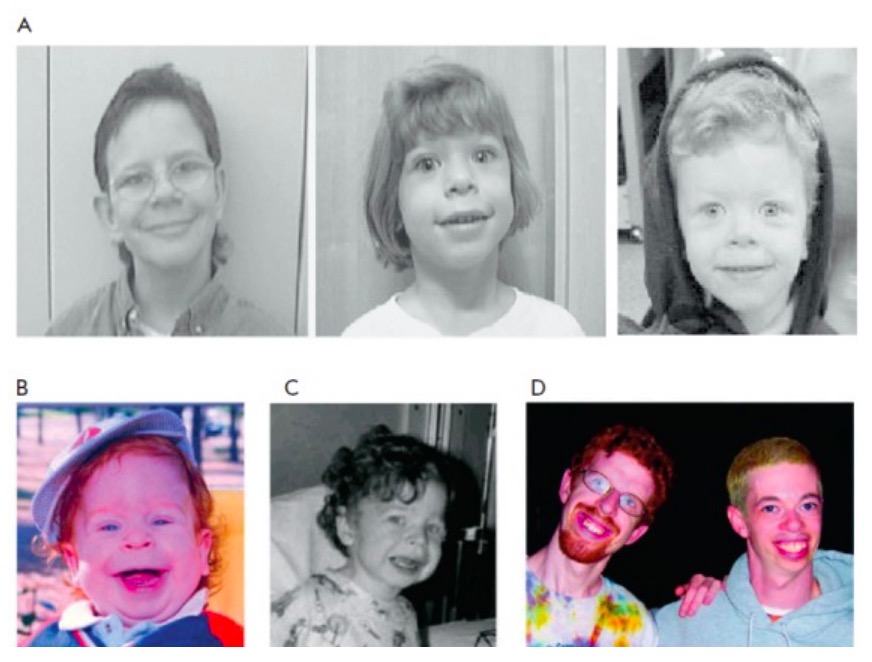
Fenotipo del síndrome de Williams

Rasgos faciales del síndrome de Williams
A: aspecto facial distintivo de los individuos con el síndrome de Williams
B y C: un niño pequeño con síndrome de Williams a la edad de 15 meses y 3 años (nótese los sutiles rasgos faciales característicos, como la boca ancha, las mejillas prominentes, el largo surco nasolabial, la nariz pequeña y el delicado mentón)
El mismo paciente se muestra en las Figs. B, C y D (izquierda; a los 21 años de edad); otro individuo con sindrome de Williams de 28 años se muestra en la Fig. D a la derecha.

Imagen: “Distinctive facial appearance of persons with WBS” por Park-media Ltd. Licencia: CC BY 4.0.

Características cognitivas

  • Retraso en EN Erythema nodosum is an immune-mediated panniculitis (inflammation of the subcutaneous fat) caused by a type IV (delayed-type) hypersensitivity reaction. It commonly manifests in young women as tender, erythematous nodules on the shins. Erythema Nodosum el desarrollo
  • Discapacidad intelectual (de leve a moderada)
  • Dificultades con la escritura, las matemáticas y la capacidad de visualización espacial (e.g., para resolver rompecabezas y dibujar)
  • Habilidad en EN Erythema nodosum is an immune-mediated panniculitis (inflammation of the subcutaneous fat) caused by a type IV (delayed-type) hypersensitivity reaction. It commonly manifests in young women as tender, erythematous nodules on the shins. Erythema Nodosum el lenguaje y la memorización

Características conductuales

  • Personalidad tipo “cóctel de fiesta”: sociable, extrovertida y atractiva
  • Habladores excesivos
  • Trastorno por déficit de atención
  • Ansiedad no social y fobias
  • Afinidad con la música

Características cardiovasculares

Las cardiopatías congénitas están presentes en EN Erythema nodosum is an immune-mediated panniculitis (inflammation of the subcutaneous fat) caused by a type IV (delayed-type) hypersensitivity reaction. It commonly manifests in young women as tender, erythematous nodules on the shins. Erythema Nodosum el 80%–90% de los LOS Neisseria casos de síndrome de Williams y son una de las principales causas de morbilidad y mortalidad en EN Erythema nodosum is an immune-mediated panniculitis (inflammation of the subcutaneous fat) caused by a type IV (delayed-type) hypersensitivity reaction. It commonly manifests in young women as tender, erythematous nodules on the shins. Erythema Nodosum los LOS Neisseria pacientes con síndrome de Williams. El riesgo de muerte súbita cardíaca es entre 25–100 veces mayor en EN Erythema nodosum is an immune-mediated panniculitis (inflammation of the subcutaneous fat) caused by a type IV (delayed-type) hypersensitivity reaction. It commonly manifests in young women as tender, erythematous nodules on the shins. Erythema Nodosum los LOS Neisseria pacientes con síndrome de Williams.

  • Estenosis aórtica supravalvular:
    • Es la anomalía cardíaca más común en EN Erythema nodosum is an immune-mediated panniculitis (inflammation of the subcutaneous fat) caused by a type IV (delayed-type) hypersensitivity reaction. It commonly manifests in young women as tender, erythematous nodules on the shins. Erythema Nodosum el sindrome de Williams, presente en EN Erythema nodosum is an immune-mediated panniculitis (inflammation of the subcutaneous fat) caused by a type IV (delayed-type) hypersensitivity reaction. It commonly manifests in young women as tender, erythematous nodules on the shins. Erythema Nodosum el 35%–65% de los LOS Neisseria casos
    • El estrechamiento de la aorta Aorta The main trunk of the systemic arteries. Mediastinum and Great Vessels: Anatomy se produce justo por encima de la válvula aórtica.
    • El tipo menos común de estenosis aórtica
    • Se produce por la pérdida del gen ELN
    • Aproximadamente el 25% de los LOS Neisseria niños con estenosis aórtica supravalvular tienen el síndrome de fatiga crónica.
    • Sin tratamiento, la estenosis aórtica supravalvular puede causar insuficiencia cardíaca.
  • Estenosis del tronco o rama periférica de la arteria pulmonar: típicamente leve y/o mejora espontáneamente
  • Estenosis pulmonar supravalvular: mejora espontáneamente y/o se resuelve
  • Estenosis en EN Erythema nodosum is an immune-mediated panniculitis (inflammation of the subcutaneous fat) caused by a type IV (delayed-type) hypersensitivity reaction. It commonly manifests in young women as tender, erythematous nodules on the shins. Erythema Nodosum otras estructuras vasculares:
    • Aorta Aorta The main trunk of the systemic arteries. Mediastinum and Great Vessels: Anatomy torácica o abdominal
    • Arterias renales
    • Arterias intracraneales
    • Los LOS Neisseria vasos en EN Erythema nodosum is an immune-mediated panniculitis (inflammation of the subcutaneous fat) caused by a type IV (delayed-type) hypersensitivity reaction. It commonly manifests in young women as tender, erythematous nodules on the shins. Erythema Nodosum otros sitios como el cuello y las extremidades
  • Defectos estructurales cardíacos adicionales:
    • Defectos septales
    • Prolapso de la válvula mitral + regurgitación
    • Válvula aórtica bicúspide
    • Estenosis valvular aórtica o insuficiencia aórtica
  • Síndrome de QTc largo congénito: se observa en EN Erythema nodosum is an immune-mediated panniculitis (inflammation of the subcutaneous fat) caused by a type IV (delayed-type) hypersensitivity reaction. It commonly manifests in young women as tender, erythematous nodules on the shins. Erythema Nodosum aproximadamente el 15% de los LOS Neisseria casos
  • Hipertensión: se desarrolla en EN Erythema nodosum is an immune-mediated panniculitis (inflammation of the subcutaneous fat) caused by a type IV (delayed-type) hypersensitivity reaction. It commonly manifests in young women as tender, erythematous nodules on the shins. Erythema Nodosum la infancia en EN Erythema nodosum is an immune-mediated panniculitis (inflammation of the subcutaneous fat) caused by a type IV (delayed-type) hypersensitivity reaction. It commonly manifests in young women as tender, erythematous nodules on the shins. Erythema Nodosum casi el 50% de los LOS Neisseria enfermos de síndrome de Williams

Características endócrinas

  • Hipercalcemia neonatal transitoria:
    • Típicamente leve a moderado ↑ Ca CA Condylomata acuminata are a clinical manifestation of genital HPV infection. Condylomata acuminata are described as raised, pearly, flesh-colored, papular, cauliflower-like lesions seen in the anogenital region that may cause itching, pain, or bleeding. Condylomata Acuminata (Genital Warts)+ sérico
    • La hipercalcemia sintomática, si está presente, suele producirse en EN Erythema nodosum is an immune-mediated panniculitis (inflammation of the subcutaneous fat) caused by a type IV (delayed-type) hypersensitivity reaction. It commonly manifests in young women as tender, erythematous nodules on the shins. Erythema Nodosum los LOS Neisseria dos primeros años de vida:
      • Clínicamente, se presenta con irritabilidad, vómitos, calambres musculares, estreñimiento
      • La mayoría de las veces se resuelve espontáneamente durante la infancia
  • Hipotiroidismo o hipotiroidismo subclínico:
    • 5%–10% con hipotiroidismo manifiesto
    • Aproximadamente el 33% con hipotiroidismo subclínico
  • El inicio temprano de la pubertad puede observarse hasta en EN Erythema nodosum is an immune-mediated panniculitis (inflammation of the subcutaneous fat) caused by a type IV (delayed-type) hypersensitivity reaction. It commonly manifests in young women as tender, erythematous nodules on the shins. Erythema Nodosum el 20% de las niñas con síndrome de Williams.
  • ↑ Prevalencia de diabetes Diabetes Diabetes mellitus (DM) is a metabolic disease characterized by hyperglycemia and dysfunction of the regulation of glucose metabolism by insulin. Type 1 DM is diagnosed mostly in children and young adults as the result of autoimmune destruction of β cells in the pancreas and the resulting lack of insulin. Type 2 DM has a significant association with obesity and is characterized by insulin resistance. Diabetes Mellitus tipo 2 en EN Erythema nodosum is an immune-mediated panniculitis (inflammation of the subcutaneous fat) caused by a type IV (delayed-type) hypersensitivity reaction. It commonly manifests in young women as tender, erythematous nodules on the shins. Erythema Nodosum adultos con síndrome de Williams

Características renales y del tracto urinario

  • Las anomalías renales y del tracto urinario congénitas se observan hasta en EN Erythema nodosum is an immune-mediated panniculitis (inflammation of the subcutaneous fat) caused by a type IV (delayed-type) hypersensitivity reaction. It commonly manifests in young women as tender, erythematous nodules on the shins. Erythema Nodosum un 30% de los LOS Neisseria casos:
    • Riñón ectópico o en EN Erythema nodosum is an immune-mediated panniculitis (inflammation of the subcutaneous fat) caused by a type IV (delayed-type) hypersensitivity reaction. It commonly manifests in young women as tender, erythematous nodules on the shins. Erythema Nodosum herradura
    • Aplasia Aplasia Cranial Nerve Palsies o hipoplasia renal (falta o es más pequeña de lo habitual)
    • Divertículos vesicales (salida del revestimiento de la vejiga a través de una pared vesical debilitada)
  • ↑ Prevalencia de disfunciones miccionales como ↑ frecuencia urinaria y enuresis Enuresis Involuntary discharge of urine after expected age of completed development of urinary control. This can happen during the daytime (diurnal enuresis) while one is awake or during sleep (nocturnal enuresis). Enuresis can be in children or in adults (as persistent primary enuresis and secondary adult-onset enuresis). Elimination Disorders nocturna ( enuresis Enuresis Involuntary discharge of urine after expected age of completed development of urinary control. This can happen during the daytime (diurnal enuresis) while one is awake or during sleep (nocturnal enuresis). Enuresis can be in children or in adults (as persistent primary enuresis and secondary adult-onset enuresis). Elimination Disorders)
  • ↑ Riesgo y frecuencia de infecciones del tracto urinario
  • También puede tener ↑ calcio urinario y nefrocalcinosis (depósitos de Ca CA Condylomata acuminata are a clinical manifestation of genital HPV infection. Condylomata acuminata are described as raised, pearly, flesh-colored, papular, cauliflower-like lesions seen in the anogenital region that may cause itching, pain, or bleeding. Condylomata Acuminata (Genital Warts)+ en EN Erythema nodosum is an immune-mediated panniculitis (inflammation of the subcutaneous fat) caused by a type IV (delayed-type) hypersensitivity reaction. It commonly manifests in young women as tender, erythematous nodules on the shins. Erythema Nodosum los LOS Neisseria riñones)
  • La función renal suele mantenerse, salvo en EN Erythema nodosum is an immune-mediated panniculitis (inflammation of the subcutaneous fat) caused by a type IV (delayed-type) hypersensitivity reaction. It commonly manifests in young women as tender, erythematous nodules on the shins. Erythema Nodosum casos excepcionales.

Características gastrointestinales

  • Estreñimiento
  • Dificultad para la alimentación
  • Hernias umbilicales e inguinales
  • Divertículos

Características otológicas/auditivas

  • Pérdida auditiva neurosensorial de leve a moderada
  • Hiperacusia (sensibilidad intensa a los LOS Neisseria sonidos)
  • Otitis media recurrente

Características oculares

  • Hipermetropía (dificultad para ver de cerca)
  • Obstrucción del conducto nasolagrimal

Características musculoesqueléticas

  • Laxitud articular/hipermovilidad en EN Erythema nodosum is an immune-mediated panniculitis (inflammation of the subcutaneous fat) caused by a type IV (delayed-type) hypersensitivity reaction. It commonly manifests in young women as tender, erythematous nodules on the shins. Erythema Nodosum la infancia
  • Limitaciones y contracturas articulares en EN Erythema nodosum is an immune-mediated panniculitis (inflammation of the subcutaneous fat) caused by a type IV (delayed-type) hypersensitivity reaction. It commonly manifests in young women as tender, erythematous nodules on the shins. Erythema Nodosum la edad adulta
  • Curvatura anormal de la columna vertebral (e.g., cifosis)
  • Ataxia Ataxia Impairment of the ability to perform smoothly coordinated voluntary movements. This condition may affect the limbs, trunk, eyes, pharynx, larynx, and other structures. Ataxia may result from impaired sensory or motor function. Sensory ataxia may result from posterior column injury or peripheral nerve diseases. Motor ataxia may be associated with cerebellar diseases; cerebral cortex diseases; thalamic diseases; basal ganglia diseases; injury to the red nucleus; and other conditions. Ataxia-telangiectasia de la marcha (dificultad para caminar)

Diagnóstico

  • Antecedente clínico y examen físico
  • Las pruebas genéticas confirman el diagnóstico.
  • Laboratorios:
    • Niveles de calcio sérico y urinario: se revisan al AL Amyloidosis nacer (↑) y seguidos de cerca durante los LOS Neisseria primeros meses de vida
    • Pruebas de la función tiroidea:
      • ↑ Hormona estimulante de la tiroides (TSH), ↓ triyodotironina ( T3 T3 A T3 thyroid hormone normally synthesized and secreted by the thyroid gland in much smaller quantities than thyroxine (T4). Most T3 is derived from peripheral monodeiodination of T4 at the 5′ position of the outer ring of the iodothyronine nucleus. The hormone finally delivered and used by the tissues is mainly t3. Thyroid Hormones) y tiroxina ( T4 T4 The major hormone derived from the thyroid gland. Thyroxine is synthesized via the iodination of tyrosines (monoiodotyrosine) and the coupling of iodotyrosines (diiodotyrosine) in the thyroglobulin. Thyroxine is released from thyroglobulin by proteolysis and secreted into the blood. Thyroxine is peripherally deiodinated to form triiodothyronine which exerts a broad spectrum of stimulatory effects on cell metabolism. Thyroid Hormones) en EN Erythema nodosum is an immune-mediated panniculitis (inflammation of the subcutaneous fat) caused by a type IV (delayed-type) hypersensitivity reaction. It commonly manifests in young women as tender, erythematous nodules on the shins. Erythema Nodosum el hipotiroidismo.
      • ↑ Hormona estimulante de la tiroides (TSH) con niveles normales de T3 T3 A T3 thyroid hormone normally synthesized and secreted by the thyroid gland in much smaller quantities than thyroxine (T4). Most T3 is derived from peripheral monodeiodination of T4 at the 5′ position of the outer ring of the iodothyronine nucleus. The hormone finally delivered and used by the tissues is mainly t3. Thyroid Hormones y T4 T4 The major hormone derived from the thyroid gland. Thyroxine is synthesized via the iodination of tyrosines (monoiodotyrosine) and the coupling of iodotyrosines (diiodotyrosine) in the thyroglobulin. Thyroxine is released from thyroglobulin by proteolysis and secreted into the blood. Thyroxine is peripherally deiodinated to form triiodothyronine which exerts a broad spectrum of stimulatory effects on cell metabolism. Thyroid Hormones en EN Erythema nodosum is an immune-mediated panniculitis (inflammation of the subcutaneous fat) caused by a type IV (delayed-type) hypersensitivity reaction. It commonly manifests in young women as tender, erythematous nodules on the shins. Erythema Nodosum el hipotiroidismo subclínico
    • Pruebas de función renal
    • Análisis de orina
  • Pruebas de tamizaje adicionales una vez confirmado el diagnóstico:
    • Evaluación cardiológica pediátrica con electrocardiograma ( ECG ECG An electrocardiogram (ECG) is a graphic representation of the electrical activity of the heart plotted against time. Adhesive electrodes are affixed to the skin surface allowing measurement of cardiac impulses from many angles. The ECG provides 3-dimensional information about the conduction system of the heart, the myocardium, and other cardiac structures. Electrocardiogram (ECG)) y ecocardiograma para evaluar las anomalías cardíacas
    • Ultrasonidos renales y vesicales para evaluar anomalías
    • Ultrasonido de tiroides para evaluar una posible hipoplasia
    • Evaluación nutricional/alimentación
    • Evaluación oftalmológica
    • Examen auditivo
    • Evaluaciones/exámenes neuropsicológicos, de desarrollo, educativos y de comportamiento

Tratamiento

El tratamiento se basa en EN Erythema nodosum is an immune-mediated panniculitis (inflammation of the subcutaneous fat) caused by a type IV (delayed-type) hypersensitivity reaction. It commonly manifests in young women as tender, erythematous nodules on the shins. Erythema Nodosum las manifestaciones clínicas presentes y está dirigido a mejorar la calidad de vida y a tratar las afecciones asociadas.

Cardiovasculares

  • Aproximadamente el 20% requiere una intervención quirúrgica o con catéter en EN Erythema nodosum is an immune-mediated panniculitis (inflammation of the subcutaneous fat) caused by a type IV (delayed-type) hypersensitivity reaction. It commonly manifests in young women as tender, erythematous nodules on the shins. Erythema Nodosum los LOS Neisseria primeros años de vida.
  • Seguimiento cardiológico anual
  • Evaluación preoperatoria por parte de un cardiólogo pediatra y de anestesiología antes de cualquier procedimiento que requiera sedación o anestesia por ↑ riesgo de muerte súbita cardíaca
  • Control rutinario de la presión arterial en EN Erythema nodosum is an immune-mediated panniculitis (inflammation of the subcutaneous fat) caused by a type IV (delayed-type) hypersensitivity reaction. It commonly manifests in young women as tender, erythematous nodules on the shins. Erythema Nodosum todas las extremidades:
    • Hipertensión tratada con bloqueadores de los LOS Neisseria canales de calcio o betabloqueadores
    • Ultrasonido renal con estudios de flujo Doppler Doppler Ultrasonography applying the doppler effect, with frequency-shifted ultrasound reflections produced by moving targets (usually red blood cells) in the bloodstream along the ultrasound axis in direct proportion to the velocity of movement of the targets, to determine both direction and velocity of blood flow. Ultrasound (Sonography) para evaluar la estenosis de la arteria renal como causa de la hipertensión

Endocrinológicas

  • Hipercalcemia:
    • Controlar mensualmente con pruebas de laboratorio hasta que se resuelva.
    • Evitar los LOS Neisseria suplementos de vitamina D.
  • Hipotiroidismo: tratado con levotiroxina
  • Prueba de tolerancia a la glucosa oral a partir de los LOS Neisseria 20 años
  • Pubertad precoz en EN Erythema nodosum is an immune-mediated panniculitis (inflammation of the subcutaneous fat) caused by a type IV (delayed-type) hypersensitivity reaction. It commonly manifests in young women as tender, erythematous nodules on the shins. Erythema Nodosum niñas: tratamiento con un agonista de la hormona liberadora de gonadotropina

Sistema digestivo y nutrición

  • Control esporádico de la ingesta calórica y de cualquier dificultad de la alimentación
  • Puede ser necesaria una sonda de alimentación.
  • Evaluaciones rutinarias del estreñimiento con tratamiento agresivo, si es necesario, para evitar la diverticulosis Diverticulosis A pathological condition characterized by the presence of a number of colonic diverticula in the colon. Its pathogenesis is multifactorial, including colon aging, motor dysfunction, increases in intraluminal pressure, and lack of dietary fibers. Diverticular Disease, las hemorroides y el prolapso rectal

Otológico

  • Auxiliares auditivos
  • Tubos de timpanostomía para la otitis media recurrente

Ocular

  • Corrección del estrabismo
  • Lentes correctoras para la hipermetropía

Otro

  • Fisioterapia
  • Terapia del habla y del lenguaje
  • Terapia conductual
  • Intervenciones educativas
  • Asesoramiento genético

Diagnóstico Diferencial

  • Síndrome de Smith-Magenis: condición genética no heredada debida a una región suprimida de genes Genes A category of nucleic acid sequences that function as units of heredity and which code for the basic instructions for the development, reproduction, and maintenance of organisms. DNA Types and Structure en EN Erythema nodosum is an immune-mediated panniculitis (inflammation of the subcutaneous fat) caused by a type IV (delayed-type) hypersensitivity reaction. It commonly manifests in young women as tender, erythematous nodules on the shins. Erythema Nodosum el cromosoma 17. Los LOS Neisseria pacientes también presentan baja estatura, anomalías cardíacas, hiperacusia y discapacidad intelectual. Los LOS Neisseria pacientes con el síndrome de Smith-Magenis muestran además patrones de comportamiento autolesivo. Las pruebas genéticas confirman el diagnóstico. El tratamiento se adapta a las manifestaciones clínicas presentes.
  • Síndrome de Noonan: enfermedad genética autosómica dominante causada por varias mutaciones genéticas potenciales. Los LOS Neisseria hombres y las mujeres pueden verse afectados. La presentación clínica incluye baja estatura, retraso en EN Erythema nodosum is an immune-mediated panniculitis (inflammation of the subcutaneous fat) caused by a type IV (delayed-type) hypersensitivity reaction. It commonly manifests in young women as tender, erythematous nodules on the shins. Erythema Nodosum el desarrollo y defectos cardíacos congénitos. Los LOS Neisseria pacientes con síndrome de Noonan también presentan hematomas y hemorragias anormales. Las pruebas genéticas confirman el diagnóstico. El tratamiento se adapta a los LOS Neisseria síntomas presentes.

Referencias

  1. Waz, W. R., & Lee, T. M. (2023, December 1). Williams syndrome. UpToDate. Retrieved January 24, 2025, from https://www.uptodate.com/contents/williams-syndrome
  2. U.S. National Library of Medicine. (2012, May 1). Supravalvular aortic stenosis. MedlinePlus. Retrieved January 24, 2025, from https://medlineplus.gov/genetics/condition/supravalvular-aortic-stenosis/#resources
  3. Collins, R. T., 2nd (2018). Cardiovascular disease in Williams syndrome. Current opinion in pediatrics, 30(5), 609–615. https://doi.org/10.1097/MOP.0000000000000664
  4. Tassabehji M. (2003). Williams-Beuren syndrome: a challenge for genotype-phenotype correlations. Human molecular genetics12 Spec No 2, R229–R237. https://doi.org/10.1093/hmg/ddg299
  5. Morris CA. Williams Syndrome. 1999 Apr 9 [Updated 2023 Apr 13]. In: Adam MP, Feldman J, Mirzaa GM, et al., editors. GeneReviews® [Internet]. Seattle (WA): University of Washington, Seattle; 1993-2025. Available from: https://www.ncbi.nlm.nih.gov/books/NBK1249/

¡Crea tu cuenta gratis o inicia una sesión para seguir leyendo!

Regístrate ahora y obtén acceso gratuito a Lecturio con páginas de concepto, videos médicos y cuestionarios para tu educación médica.

User Reviews

Que tengas una sesión de estudio alegre y navideña 🎁 Ahorra 50% en todos los planes >>

Details