Domina Conceptos Médicos

Estudia para la escuela de medicina y tus examenes con Lecturio.

Regurgitación Aórtica

La regurgitación aórtica (RA) es una afección cardíaca que se caracteriza por el reflujo de sangre desde la aorta Aorta The main trunk of the systemic arteries. Mediastinum and Great Vessels: Anatomy hacia el ventrículo izquierdo durante la diástole. La regurgitación aórtica esta asociada con una válvula aórtica y/o una raíz aórtica anormales originadas por múltiples causas, principalmente la cardiopatía reumática, así como trastornos valvulares congénitos y degenerativos. La insuficiencia valvular aguda, la cual rápidamente progresa a shock Shock Shock is a life-threatening condition associated with impaired circulation that results in tissue hypoxia. The different types of shock are based on the underlying cause: distributive (↑ cardiac output (CO), ↓ systemic vascular resistance (SVR)), cardiogenic (↓ CO, ↑ SVR), hypovolemic (↓ CO, ↑ SVR), obstructive (↓ CO), and mixed. Types of Shock cardiogénico, es una emergencia que requiere cirugía valvular aórtica inmediata. La RA crónica evoluciona de forma gradual, permitiendo que el ventrículo izquierdo se adapte al AL Amyloidosis aumento del volumen sistólico. De esta manera, el ecocardiograma muestra hipertrofia y dilatación del ventrículo izquierdo acompañado de anomalías valvulares. Eventualmente, ocurre una insuficiencia cardíaca cuando el ventrículo izquierdo no es capaz de soportar la sobrecarga hemodinámica. El reemplazo de la válvula aórtica es el pilar del tratamiento para la RA con disfunción ventricular izquierda.

Last updated: Jan 16, 2024

Editorial responsibility: Stanley Oiseth, Lindsay Jones, Evelin Maza

Descripción General

Definición

Regurgitación aórtica (RA) o insuficiencia aórtica:
  • Ocurre reflujo de sangre al AL Amyloidosis ventrículo izquierdo (VI) a través de la válvula aórtica durante la diástole
  • Es causado por el cierre incompleto de las valvas de la válvula (que normalmente facilitan el flujo unidireccional de sangre desde el ventrículo izquierdo)
  • Las anomalías involucran la raíz aórtica y/o las válvulas aórticas.
  • La presentación puede ser aguda o crónica.

Epidemiología

  • Cardiopatía reumática: causa más frecuente de RA a nivel mundial
  • Hombres > mujeres
  • En EN Erythema nodosum is an immune-mediated panniculitis (inflammation of the subcutaneous fat) caused by a type IV (delayed-type) hypersensitivity reaction. It commonly manifests in young women as tender, erythematous nodules on the shins. Erythema Nodosum los LOS Neisseria países desarrollados, las causas más comunes son:
    • Dilatación de la raíz aórtica
    • Válvula aórtica bicúspide congénita
    • Enfermedad de la válvula aórtica calcificada
  • La prevalencia aumenta en EN Erythema nodosum is an immune-mediated panniculitis (inflammation of the subcutaneous fat) caused by a type IV (delayed-type) hypersensitivity reaction. It commonly manifests in young women as tender, erythematous nodules on the shins. Erythema Nodosum pacientes > 50 años de edad.

Etiología

  • Insuficiencia aórtica aguda
    • 2 causas más comunes (válvula nativa):
      • Endocarditis Endocarditis Endocarditis is an inflammatory disease involving the inner lining (endometrium) of the heart, most commonly affecting the cardiac valves. Both infectious and noninfectious etiologies lead to vegetations on the valve leaflets. Patients may present with nonspecific symptoms such as fever and fatigue. Endocarditis infecciosa
      • Disección aórtica tipo A
    • Otras:
      • Trauma torácico
      • Infarto de miocardio
      • Deterioro de válvula aórtica protésica
      • Iatrogénica (valvulotomía aórtica con globo o implante percutáneo de válvula aórtica)
  • Regurgitación aórtica crónica
    • Válvula bicúspide (causa congénita más común de RA)
    • Cardiopatía reumática
    • Hipertensión
    • Trastorno del tejido conectivo: síndrome de Marfan, síndrome de Ehlers-Danlos
    • Sífilis terciaria (debido a aneurisma expansivo)
    • Vasculitis Vasculitis Inflammation of any one of the blood vessels, including the arteries; veins; and rest of the vasculature system in the body. Systemic Lupus Erythematosus: arteritis de células gigantes, arteritis de Takayasu
    • Espondilitis anquilosante ( aortitis Aortitis Inflammation of the wall of the aorta. Ankylosing Spondylitis)
    • Artritis reumatoide
    • Medicamentos: fenfluramina y dexfenfluramina (inducen la degeneración valvular)

Fisiopatología

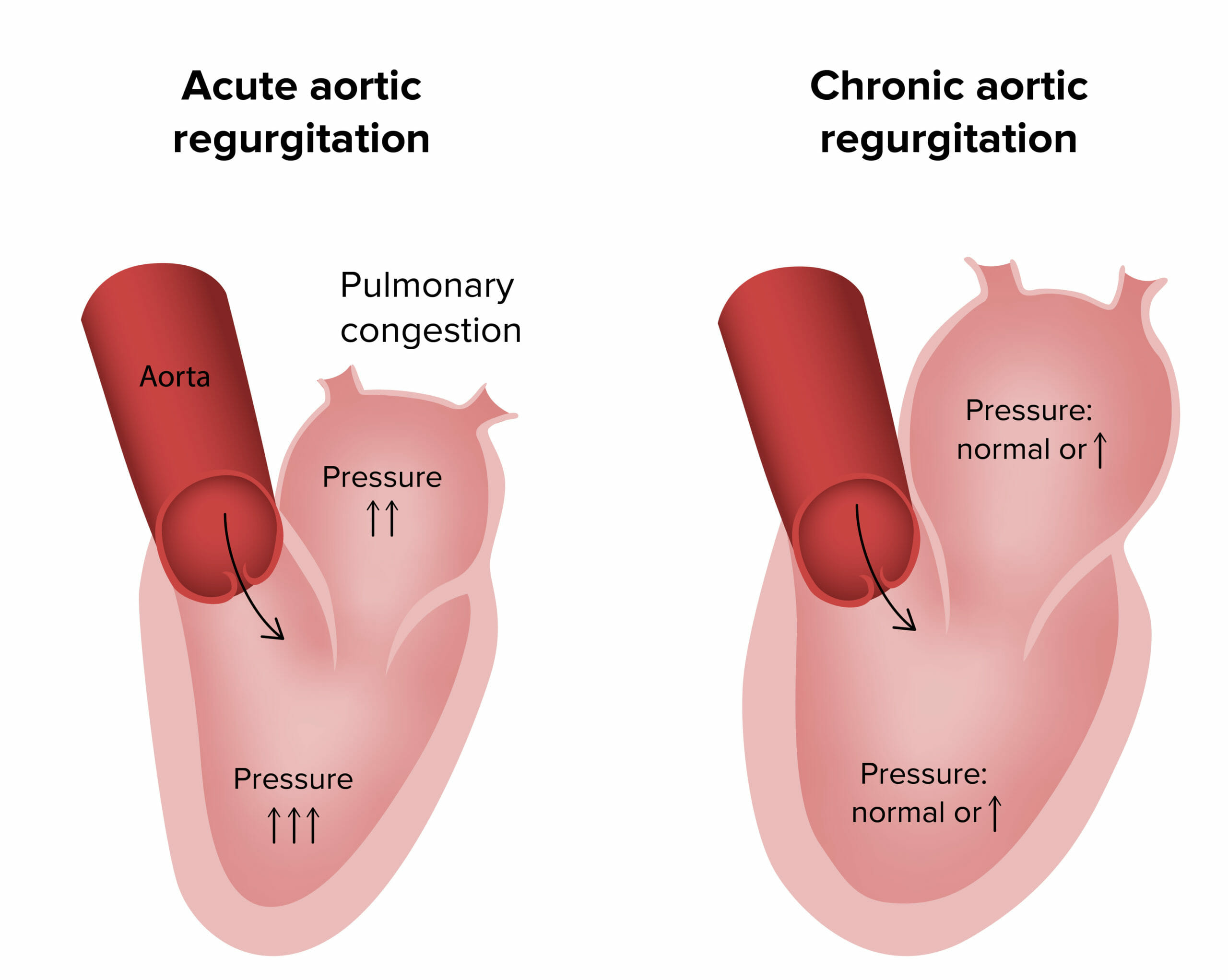
RA aguda

  • Disfunción abrupta de la válvula aórtica → falla de la válvula para coaptarse
  • Aumento repentino del reflujo de sangre hacia el VI → aumento de la presión diastólica del VI
  • VI no preparado para el aumento de volumen → disminución del gasto cardíaco → taquicardia compensatoria
  • El aumento rápido de la presión diastólica del VI cierra prematuramente la válvula mitral → ↑ presión venosa pulmonar → edema Edema Edema is a condition in which excess serous fluid accumulates in the body cavity or interstitial space of connective tissues. Edema is a symptom observed in several medical conditions. It can be categorized into 2 types, namely, peripheral (in the extremities) and internal (in an organ or body cavity). Edema pulmonar y shock Shock Shock is a life-threatening condition associated with impaired circulation that results in tissue hypoxia. The different types of shock are based on the underlying cause: distributive (↑ cardiac output (CO), ↓ systemic vascular resistance (SVR)), cardiogenic (↓ CO, ↑ SVR), hypovolemic (↓ CO, ↑ SVR), obstructive (↓ CO), and mixed. Types of Shock cardiogénico

RA crónica

  • La válvula aórtica es incapaz de cerrarse → una parte del volumen sistólico ingresa de nuevo al AL Amyloidosis VI
  • Flujo regurgitante → aumenta el volumen diastólico final y el estrés de la pared del ventrículo
  • El VI se adapta a la sobrecarga de volumen al AL Amyloidosis realizar hipertrofia excéntrica y dilatación → permite mayor volumen sistólico
  • Con el tiempo, el aumento del volumen sistólico → distiende las arterias periféricas y ↑ la presión sistólica
  • En EN Erythema nodosum is an immune-mediated panniculitis (inflammation of the subcutaneous fat) caused by a type IV (delayed-type) hypersensitivity reaction. It commonly manifests in young women as tender, erythematous nodules on the shins. Erythema Nodosum la enfermedad avanzada, el VI alcanza su diámetro máximo y no puede seguir el ritmo de la carga hemodinámica → La FEVI disminuye gradualmente → Síntomas de insuficiencia cardíaca izquierda
  • Aumento de la masa del VI → aumenta los LOS Neisseria requerimientos de oxígeno del miocardio → isquemia miocárdica y dolor Dolor Inflammation torácico por esfuerzo
Aortic regurgitation

Fisiopatología de la regurgitación aórtica aguda y crónica

Imagen por Lecturio.

Presentación Clínica

RA aguda

  • ¡Emergencia médica!
  • Signos y síntomas de edema Edema Edema is a condition in which excess serous fluid accumulates in the body cavity or interstitial space of connective tissues. Edema is a symptom observed in several medical conditions. It can be categorized into 2 types, namely, peripheral (in the extremities) and internal (in an organ or body cavity). Edema pulmonar y shock Shock Shock is a life-threatening condition associated with impaired circulation that results in tissue hypoxia. The different types of shock are based on the underlying cause: distributive (↑ cardiac output (CO), ↓ systemic vascular resistance (SVR)), cardiogenic (↓ CO, ↑ SVR), hypovolemic (↓ CO, ↑ SVR), obstructive (↓ CO), and mixed. Types of Shock cardiogénico → disnea, dolor Dolor Inflammation torácico
  • El examen físico muestra:
    • Hipotensión, taquipnea, taquicardia, diaforesis
    • S1 S1 Heart Sounds suave debido al AL Amyloidosis cierre temprano de la válvula mitral
    • Soplo sistólico suave (por aumento del volumen de sangre) + soplo diastólico RA temprano de tono bajo → soplo “de ida y vuelta” en EN Erythema nodosum is an immune-mediated panniculitis (inflammation of the subcutaneous fat) caused by a type IV (delayed-type) hypersensitivity reaction. It commonly manifests in young women as tender, erythematous nodules on the shins. Erythema Nodosum la base cardíaca

RA crónica

Síntomas:

  • Inicialmente asintomático (cuando el VI es capaz de compensar)
  • Los LOS Neisseria síntomas comienzan con la función reducida del VI.
    • Palpitaciones (taquicardia)
    • Disnea de esfuerzo
    • Ortopnea, disnea paroxística nocturna
    • Dolor Dolor Inflammation torácico (angina nocturna debido a ↓ frecuencia cardíaca durante el sueño = ↓ presión diastólica)

Signos:

  • Inspección: latido del ápex cardiaco hiperdinámico desplazado lateral e inferiormente
  • Auscultación:
    • Soplo RA:
      • Soplo diastólico temprano, agudo; sostenido o decreciente
      • Se vuelve holodiastólico en EN Erythema nodosum is an immune-mediated panniculitis (inflammation of the subcutaneous fat) caused by a type IV (delayed-type) hypersensitivity reaction. It commonly manifests in young women as tender, erythematous nodules on the shins. Erythema Nodosum la RA severa
      • Se escucha mejor en EN Erythema nodosum is an immune-mediated panniculitis (inflammation of the subcutaneous fat) caused by a type IV (delayed-type) hypersensitivity reaction. It commonly manifests in young women as tender, erythematous nodules on the shins. Erythema Nodosum el borde esternal izquierdo, 3er y 4to espacio intercostal
      • ↑ Con sentadilla, ↓ con maniobra de Valsalva
    • Soplo Austin Flint:
      • Soplo diastólico retumbante de tono bajo (grave) en EN Erythema nodosum is an immune-mediated panniculitis (inflammation of the subcutaneous fat) caused by a type IV (delayed-type) hypersensitivity reaction. It commonly manifests in young women as tender, erythematous nodules on the shins. Erythema Nodosum el vértice
      • Cierre prematuro de la válvula mitral (efecto del jet de la RA)
    • Galope S3 S3 Heart Sounds en EN Erythema nodosum is an immune-mediated panniculitis (inflammation of the subcutaneous fat) caused by a type IV (delayed-type) hypersensitivity reaction. It commonly manifests in young women as tender, erythematous nodules on the shins. Erythema Nodosum disfunción del VI
  • Diferencial de la presión de pulso ampliada (hipertensión sistólica, ↓ presión diastólica)
    • Signo de Hill:
      • Fuerte especificidad
      • La presión sistólica del manguito poplíteo supera la presión del manguito braquial en EN Erythema nodosum is an immune-mediated panniculitis (inflammation of the subcutaneous fat) caused by a type IV (delayed-type) hypersensitivity reaction. It commonly manifests in young women as tender, erythematous nodules on the shins. Erythema Nodosum > 20 mm Hg en EN Erythema nodosum is an immune-mediated panniculitis (inflammation of the subcutaneous fat) caused by a type IV (delayed-type) hypersensitivity reaction. It commonly manifests in young women as tender, erythematous nodules on the shins. Erythema Nodosum posición reclinada
    • Pulso de Corrigan:
      • “Golpe de ariete” o “pulso colapsado” en EN Erythema nodosum is an immune-mediated panniculitis (inflammation of the subcutaneous fat) caused by a type IV (delayed-type) hypersensitivity reaction. It commonly manifests in young women as tender, erythematous nodules on the shins. Erythema Nodosum arterias radial/braquial/carótida
      • Distensión abrupta de las arterias periféricas (aumento rápido del pulso arterial) con colapso rápido
    • Pulso bisferiens: pulso bifásico del reflujo de sangre (diástole temprana)
    • Signo de Becker: pulsación sistólica visible en EN Erythema nodosum is an immune-mediated panniculitis (inflammation of the subcutaneous fat) caused by a type IV (delayed-type) hypersensitivity reaction. It commonly manifests in young women as tender, erythematous nodules on the shins. Erythema Nodosum las arteriolas retinianas
    • Signo de Landolfi: constricción y dilatación de las pupilas con los LOS Neisseria latidos del corazón
    • Signo de Traube:
      • Pulso de “tiro de pistola”
      • Sonidos sistólicos y diastólicos bajos resonantes en EN Erythema nodosum is an immune-mediated panniculitis (inflammation of the subcutaneous fat) caused by a type IV (delayed-type) hypersensitivity reaction. It commonly manifests in young women as tender, erythematous nodules on the shins. Erythema Nodosum las arterias femorales
    • Signo de Muller: pulsaciones sistólicas de la úvula
    • Signo de Duroziez:
      • Soplo sistólico por compresión proximal de arteria femoral
      • Soplo diastólico por compresión distal de arteria femoral
    • Signo de Mayne: caída de al AL Amyloidosis menos 15 mm Hg en EN Erythema nodosum is an immune-mediated panniculitis (inflammation of the subcutaneous fat) caused by a type IV (delayed-type) hypersensitivity reaction. It commonly manifests in young women as tender, erythematous nodules on the shins. Erythema Nodosum la presión arterial diastólica cuando se levanta el brazo
    • Pulso de Quincke: pulsaciones visibles en EN Erythema nodosum is an immune-mediated panniculitis (inflammation of the subcutaneous fat) caused by a type IV (delayed-type) hypersensitivity reaction. It commonly manifests in young women as tender, erythematous nodules on the shins. Erythema Nodosum el lecho ungueal al AL Amyloidosis comprimir la uña
    • Signo de Musset: la cabeza se mueve con los LOS Neisseria latidos del corazón
    • Signo de Rosenbach: pulsaciones sistólicas del hígado
    • Signo de Gerhard: pulsaciones sistólicas del bazo
Soplos cardíacos después de la corrección

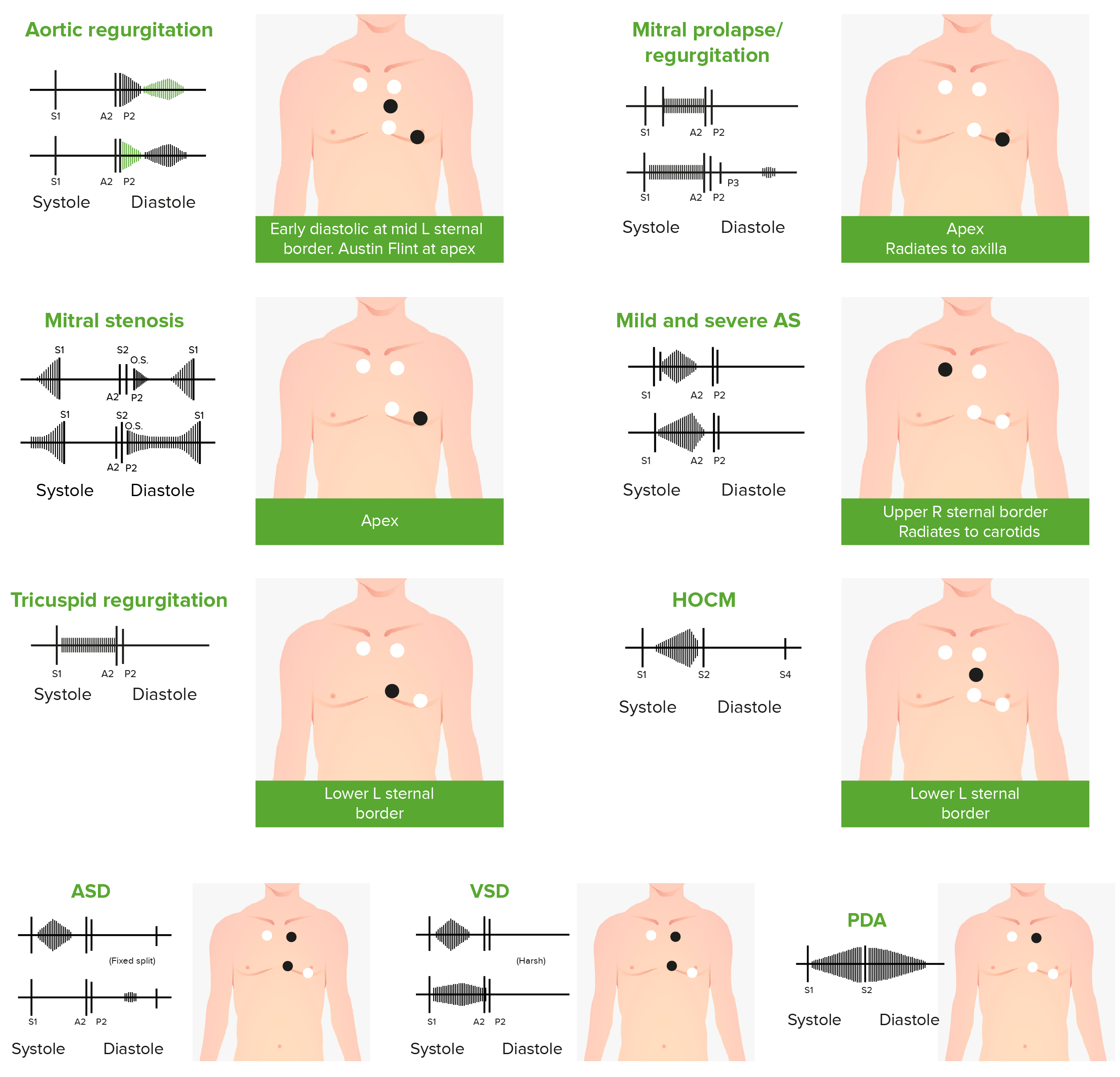
Fonocardiogramas de sonidos cardíacos anormales causados por los siguientes defectos cardíacos:
insuficiencia aórtica, prolapso de la válvula mitral, estenosis mitral (EM), estenosis aórtica (EA), insuficiencia tricuspídea, miocardiopatía hipertrófica obstructiva (MHTO), comunicación interauricular (CIA), comunicación interventricular (CIV) y conducto arterioso persistente (CAP)

Imagen por Lecturio.

Audio:

Este clip de audio es un ejemplo de insuficiencia aórtica. La cual se caracteriza por un soplo decrescendo que aparece justo después de S2 S2 Heart Sounds.
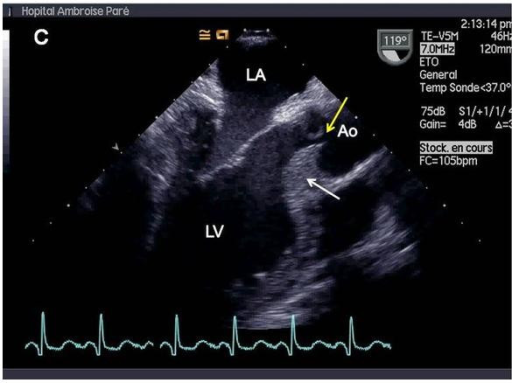
Heart sound por The Regents of the University of Michigan. Licencia: CC BY-SA 3.0

Diagnóstico

Ecocardiografía transtorácica (ETT)

  • Confirma el diagnóstico y la gravedad del RA; también se utiliza para el monitoreo en EN Erythema nodosum is an immune-mediated panniculitis (inflammation of the subcutaneous fat) caused by a type IV (delayed-type) hypersensitivity reaction. It commonly manifests in young women as tender, erythematous nodules on the shins. Erythema Nodosum serie
  • Evalúa la raíz aórtica y la anatomía de la válvula aórtica
  • Evalúa el VI:
    • Tamaño
    • Fracción de eyección (FEVI)
  • Doppler Doppler Ultrasonography applying the doppler effect, with frequency-shifted ultrasound reflections produced by moving targets (usually red blood cells) in the bloodstream along the ultrasound axis in direct proportion to the velocity of movement of the targets, to determine both direction and velocity of blood flow. Ultrasound (Sonography): evalúa el ancho del flujo central y el volumen/flujo/área del orificio regurgitante
  • Hallazgos en EN Erythema nodosum is an immune-mediated panniculitis (inflammation of the subcutaneous fat) caused by a type IV (delayed-type) hypersensitivity reaction. It commonly manifests in young women as tender, erythematous nodules on the shins. Erythema Nodosum RA tanto aguda como crónica:
    • Válvula anormal o normal pero ensanchada
    • RA severa: ↑ anchura del flujo central/↑ volumen regurgitante/↑ área del orificio regurgitante/flujo holodiastólico revertido en EN Erythema nodosum is an immune-mediated panniculitis (inflammation of the subcutaneous fat) caused by a type IV (delayed-type) hypersensitivity reaction. It commonly manifests in young women as tender, erythematous nodules on the shins. Erythema Nodosum aorta Aorta The main trunk of the systemic arteries. Mediastinum and Great Vessels: Anatomy descendente
    • Válvula mitral: la valva mitral anterior muestra aleteo diastólico
  • Hallazgos en EN Erythema nodosum is an immune-mediated panniculitis (inflammation of the subcutaneous fat) caused by a type IV (delayed-type) hypersensitivity reaction. It commonly manifests in young women as tender, erythematous nodules on the shins. Erythema Nodosum RA aguda:
    • Se realiza al AL Amyloidosis pie de la cama
    • El tamaño del VI suele ser normal
  • Hallazgos en EN Erythema nodosum is an immune-mediated panniculitis (inflammation of the subcutaneous fat) caused by a type IV (delayed-type) hypersensitivity reaction. It commonly manifests in young women as tender, erythematous nodules on the shins. Erythema Nodosum RA crónica:
    • Tamaño y volumen del VI aumentados inicialmente, FEVI sin cambios
    • En EN Erythema nodosum is an immune-mediated panniculitis (inflammation of the subcutaneous fat) caused by a type IV (delayed-type) hypersensitivity reaction. It commonly manifests in young women as tender, erythematous nodules on the shins. Erythema Nodosum estado avanzado o descompensado, ↓ FEVI
    • Monitoreo seriado con ETT (guía de tratamiento terapéutico)

Ecocardiografía transesofágica (ETE)

  • Realizado si el ETT es subóptimo
  • Otras indicaciones:
    • Endocarditis Endocarditis Endocarditis is an inflammatory disease involving the inner lining (endometrium) of the heart, most commonly affecting the cardiac valves. Both infectious and noninfectious etiologies lead to vegetations on the valve leaflets. Patients may present with nonspecific symptoms such as fever and fatigue. Endocarditis infecciosa
    • Disección aórtica (ayuda a determinar las opciones quirúrgicas)

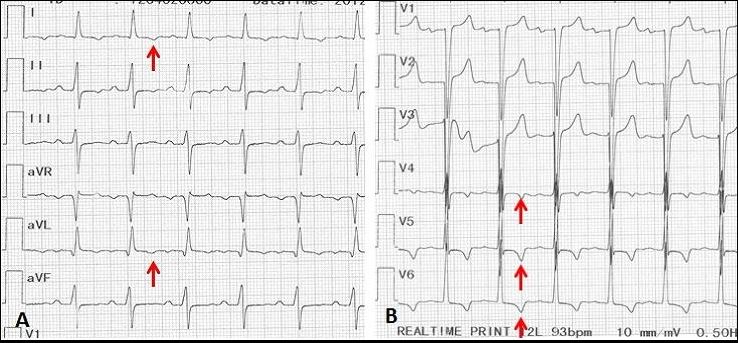
Electrocardiograma ( ECG ECG An electrocardiogram (ECG) is a graphic representation of the electrical activity of the heart plotted against time. Adhesive electrodes are affixed to the skin surface allowing measurement of cardiac impulses from many angles. The ECG provides 3-dimensional information about the conduction system of the heart, the myocardium, and other cardiac structures. Electrocardiogram (ECG))

  • RA aguda: cambios inespecíficos en EN Erythema nodosum is an immune-mediated panniculitis (inflammation of the subcutaneous fat) caused by a type IV (delayed-type) hypersensitivity reaction. It commonly manifests in young women as tender, erythematous nodules on the shins. Erythema Nodosum onda ST-T
  • RA crónica:
    • Hipertrofia ventricular izquierda
    • Desviación del eje cardiaco a la izquierda
    • Cambios isquémicos en EN Erythema nodosum is an immune-mediated panniculitis (inflammation of the subcutaneous fat) caused by a type IV (delayed-type) hypersensitivity reaction. It commonly manifests in young women as tender, erythematous nodules on the shins. Erythema Nodosum la enfermedad avanzada

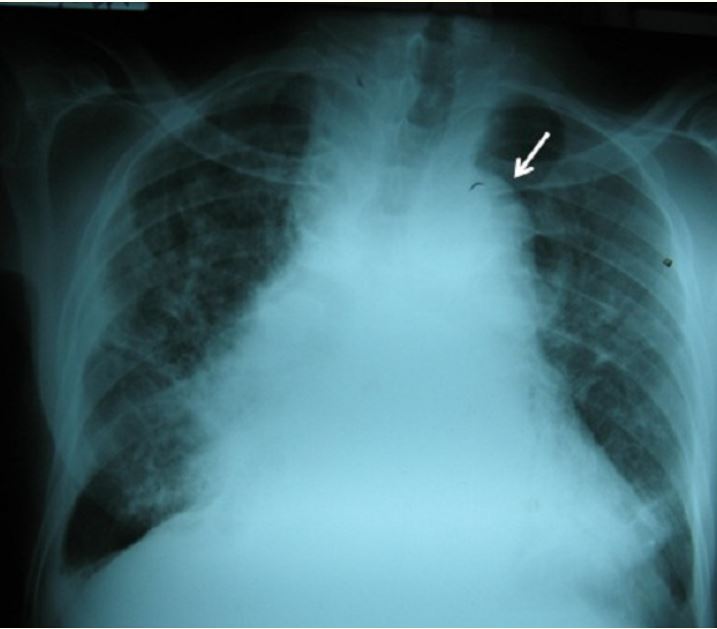
Radiografía de tórax

  • RA aguda:
    • Raíz aórtica prominente
    • Silueta cardíaca agrandada ( en EN Erythema nodosum is an immune-mediated panniculitis (inflammation of the subcutaneous fat) caused by a type IV (delayed-type) hypersensitivity reaction. It commonly manifests in young women as tender, erythematous nodules on the shins. Erythema Nodosum disección aórtica + derrame pericárdico)
    • Edema Edema Edema is a condition in which excess serous fluid accumulates in the body cavity or interstitial space of connective tissues. Edema is a symptom observed in several medical conditions. It can be categorized into 2 types, namely, peripheral (in the extremities) and internal (in an organ or body cavity). Edema pulmonar
  • RA crónica:
    • Dilatación/calcificación aórtica
    • Cardiomegalia

Resonancia magnética cardíaca (RMC)

  • Se usa si la ETT es subóptima en EN Erythema nodosum is an immune-mediated panniculitis (inflammation of the subcutaneous fat) caused by a type IV (delayed-type) hypersensitivity reaction. It commonly manifests in young women as tender, erythematous nodules on the shins. Erythema Nodosum RA crónica
  • Evalúa la gravedad de la RA
  • Es la técnica no invasiva más precisa para los LOS Neisseria volúmenes telesistólicos y diastólicos del VI
  • No esta recomendada para uso generalizado debido a los LOS Neisseria gastos y la disponibilidad limitada
  • Es incompatible con herrajes metálicos
Clasificación cualitativa de la insuficiencia aórtica

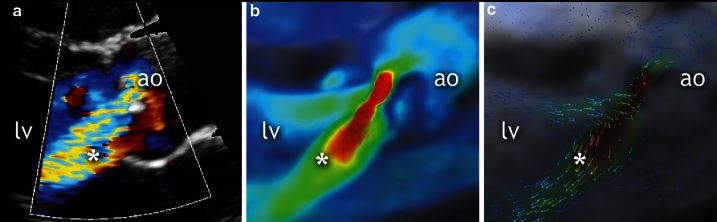
Ecocardiografía de un paciente de 19 años. La vista del eje largo paraesternal de la válvula aórtica en diástole (a) muestra una regurgitación moderada (*). Imágenes correspondientes de resonancia magnética cardiovascular de flujo en cuatro dimensiones (4D flow CMR, en inglés) que muestran la insuficiencia aórtica moderada (b y c). *: Jet regurgitante.

Imagen: “Qualitative grading of aortic regurgitation” by Chelu RG, et al. Licencia: CC BY 4.0

Cateterización cardiaca

  • Utilizada para evaluar la anatomía coronaria antes de la cirugía (para RA crónica)
  • Proporciona información adicional si hay resultados clínicos contradictorios:
    • Tamaño del VI y FE
    • Número de valvas
    • Gravedad de la RA
    • Tamaño de la raíz aórtica

Tratamiento y Pronóstico

RA aguda

  • Reemplazo o reparación de emergencia de la válvula aórtica
  • Mientras se espera la cirugía, se hace HACE Altitude Sickness uso provisional de:
    • Vasodilatadores intravenosos como nitroprusiato (reducción de la poscarga)
    • Agentes inotrópicos como la dobutamina (↑ gasto cardíaco)
  • Retraso temporal en EN Erythema nodosum is an immune-mediated panniculitis (inflammation of the subcutaneous fat) caused by a type IV (delayed-type) hypersensitivity reaction. It commonly manifests in young women as tender, erythematous nodules on the shins. Erythema Nodosum la cirugía para que se puedan administrar antibióticos en EN Erythema nodosum is an immune-mediated panniculitis (inflammation of the subcutaneous fat) caused by a type IV (delayed-type) hypersensitivity reaction. It commonly manifests in young women as tender, erythematous nodules on the shins. Erythema Nodosum la endocarditis Endocarditis Endocarditis is an inflammatory disease involving the inner lining (endometrium) of the heart, most commonly affecting the cardiac valves. Both infectious and noninfectious etiologies lead to vegetations on the valve leaflets. Patients may present with nonspecific symptoms such as fever and fatigue. Endocarditis infecciosa
    • Si el paciente está estable
    • Cirugía inmediata de haber inestabilidad hemodinámica o formación de abscesos
  • Evitar el balón de contrapulsación intraaórtico (empeora la RA)
  • Evitar betabloqueadores (↓ taquicardia compensatoria, ↓ gasto cardíaco)

RA crónica

  • Monitorear el curso de la enfermedad (ETT):
    • La frecuencia del examen físico depende de los LOS Neisseria síntomas, la gravedad de la RA, el tamaño y la función del VI
    • En EN Erythema nodosum is an immune-mediated panniculitis (inflammation of the subcutaneous fat) caused by a type IV (delayed-type) hypersensitivity reaction. It commonly manifests in young women as tender, erythematous nodules on the shins. Erythema Nodosum caso de válvula aórtica bicúspide: También monitorice el aneurisma si está presente.
  • Actividad física:
    • Se recomienda lo siguiente para atletas con RA:
      • Antecedentes anuales y examen físico con ecocardiograma Doppler Doppler Ultrasonography applying the doppler effect, with frequency-shifted ultrasound reflections produced by moving targets (usually red blood cells) in the bloodstream along the ultrasound axis in direct proportion to the velocity of movement of the targets, to determine both direction and velocity of blood flow. Ultrasound (Sonography)
      • Prueba de esfuerzo ( al AL Amyloidosis nivel de competencia): para confirmar el estado asintomático y la respuesta de la presión arterial a la actividad
  • Profilaxis de endocarditis Endocarditis Endocarditis is an inflammatory disease involving the inner lining (endometrium) of the heart, most commonly affecting the cardiac valves. Both infectious and noninfectious etiologies lead to vegetations on the valve leaflets. Patients may present with nonspecific symptoms such as fever and fatigue. Endocarditis (para realización de procedimiento):
    • No recomendado en EN Erythema nodosum is an immune-mediated panniculitis (inflammation of the subcutaneous fat) caused by a type IV (delayed-type) hypersensitivity reaction. It commonly manifests in young women as tender, erythematous nodules on the shins. Erythema Nodosum valvulopatías nativas
    • Indicado en EN Erythema nodosum is an immune-mediated panniculitis (inflammation of the subcutaneous fat) caused by a type IV (delayed-type) hypersensitivity reaction. It commonly manifests in young women as tender, erythematous nodules on the shins. Erythema Nodosum válvula cardiaca protésica o endocarditis Endocarditis Endocarditis is an inflammatory disease involving the inner lining (endometrium) of the heart, most commonly affecting the cardiac valves. Both infectious and noninfectious etiologies lead to vegetations on the valve leaflets. Patients may present with nonspecific symptoms such as fever and fatigue. Endocarditis infecciosa previa
  • Tratamiento médico:
    • Para pacientes sintomáticos con RA grave (candidatos quirúrgicos y no quirúrgicos), los LOS Neisseria medicamentos incluyen:
      • Diuréticos
      • Inhibidores de la enzima convertidora de angiotensina (IECA) o antagonistas de los LOS Neisseria receptores de angiotensina II (ARAII)
      • Betabloqueadores
      • Antagonistas de los LOS Neisseria receptores de mineralocorticoides
      • Digoxina
    • Para pacientes asintomáticos con disfunción grave de RA + VI (candidatos no quirúrgicos): IECA o ARAII
    • Control de la hipertensión: IECA, ARAII o bloqueadores de los LOS Neisseria canales de calcio
  • Tratamiento quirúrgico (reemplazo de válvula aórtica o RVA):
    • RA grave sintomática
    • Asintomático:
      • RA severa FEVI < 50%
      • RA grave con FEVI normal (≥ 50 %) pero con una dimensión telesistólica > 50 mm
      • RA grave con FEVI normal (≥ 50 %) pero con dilatación progresiva grave del VI (dimensión telediastólica del VI > 65 mm); con bajo riesgo quirúrgico
      • RA grave en EN Erythema nodosum is an immune-mediated panniculitis (inflammation of the subcutaneous fat) caused by a type IV (delayed-type) hypersensitivity reaction. It commonly manifests in young women as tender, erythematous nodules on the shins. Erythema Nodosum pacientes que se someten a cirugía cardíaca por otras indicaciones
      • RA moderada en EN Erythema nodosum is an immune-mediated panniculitis (inflammation of the subcutaneous fat) caused by a type IV (delayed-type) hypersensitivity reaction. It commonly manifests in young women as tender, erythematous nodules on the shins. Erythema Nodosum pacientes que se someten a otra cirugía cardíaca

Pronóstico

  • Pacientes con RA aguda: alto riesgo operatorio
  • Pacientes con RA crónica asintomática:
    • Pronóstico favorable
    • Cuando se monitorea, la disfunción del VI se detecta temprano, incluso antes de que se presenten los LOS Neisseria síntomas.
  • RA crónica sintomática:
    • Síntomas de clase II de la New York Heart Association (NYHA, por sus siglas en EN Erythema nodosum is an immune-mediated panniculitis (inflammation of the subcutaneous fat) caused by a type IV (delayed-type) hypersensitivity reaction. It commonly manifests in young women as tender, erythematous nodules on the shins. Erythema Nodosum inglés): 6% de mortalidad por año
    • Síntomas clase III o IV de la NYHA: 25% de mortalidad por año

Diagnóstico Diferencial

Los LOS Neisseria diagnósticos diferenciales de la RA incluyen las siguientes condiciones:

  • Estenosis aórtica (EA): una de las enfermedades valvulares del corazón más comunes; caracterizada por el estrechamiento de la emergencia aórtica. Este estrechamiento conduce a la restricción del flujo sanguíneo desde el VI a la aorta Aorta The main trunk of the systemic arteries. Mediastinum and Great Vessels: Anatomy. La estenosis aórtica se escucha como un soplo sistólico en EN Erythema nodosum is an immune-mediated panniculitis (inflammation of the subcutaneous fat) caused by a type IV (delayed-type) hypersensitivity reaction. It commonly manifests in young women as tender, erythematous nodules on the shins. Erythema Nodosum crescendo-decrescendo en EN Erythema nodosum is an immune-mediated panniculitis (inflammation of the subcutaneous fat) caused by a type IV (delayed-type) hypersensitivity reaction. It commonly manifests in young women as tender, erythematous nodules on the shins. Erythema Nodosum el segundo espacio intercostal. El diagnóstico es por ecocardiografía. Los LOS Neisseria pacientes con EA crónica desarrollan disnea de esfuerzo, angina y síncope.
  • Insuficiencia mitral: una patología de la válvula mitral que conduce a la filtración de sangre desde el VI hacia la aurícula izquierda durante la sístole. A la evaluación se evidencia un soplo holosistólico en EN Erythema nodosum is an immune-mediated panniculitis (inflammation of the subcutaneous fat) caused by a type IV (delayed-type) hypersensitivity reaction. It commonly manifests in young women as tender, erythematous nodules on the shins. Erythema Nodosum el vértice (quinto espacio intercostal izquierdo en EN Erythema nodosum is an immune-mediated panniculitis (inflammation of the subcutaneous fat) caused by a type IV (delayed-type) hypersensitivity reaction. It commonly manifests in young women as tender, erythematous nodules on the shins. Erythema Nodosum la línea medioclavicular). El diagnóstico se confirma mediante ecocardiografía. Los LOS Neisseria síntomas de presentación son con frecuencia disnea de esfuerzo y fatiga.
  • Disección aórtica: un desgarro en EN Erythema nodosum is an immune-mediated panniculitis (inflammation of the subcutaneous fat) caused by a type IV (delayed-type) hypersensitivity reaction. It commonly manifests in young women as tender, erythematous nodules on the shins. Erythema Nodosum la íntima de la aorta Aorta The main trunk of the systemic arteries. Mediastinum and Great Vessels: Anatomy que puede expandirse hacia el corazón, ocasionando dilatación e insuficiencia de la válvula aórtica. La disección aórtica en EN Erythema nodosum is an immune-mediated panniculitis (inflammation of the subcutaneous fat) caused by a type IV (delayed-type) hypersensitivity reaction. It commonly manifests in young women as tender, erythematous nodules on the shins. Erythema Nodosum la aorta Aorta The main trunk of the systemic arteries. Mediastinum and Great Vessels: Anatomy ascendente o la raíz aórtica se manifiestan como un dolor Dolor Inflammation torácico intenso y desgarrador. La angiografía por TC establece el diagnóstico.
  • Aneurisma aórtico: una dilatación anormal de la aorta Aorta The main trunk of the systemic arteries. Mediastinum and Great Vessels: Anatomy, generalmente causada por una enfermedad aórtica degenerativa; puede conducir a la dilatación progresiva de la raíz aórtica. El aneurisma aórtico a menudo es asintomático y se encuentra de manera incidental en EN Erythema nodosum is an immune-mediated panniculitis (inflammation of the subcutaneous fat) caused by a type IV (delayed-type) hypersensitivity reaction. It commonly manifests in young women as tender, erythematous nodules on the shins. Erythema Nodosum la TC o en EN Erythema nodosum is an immune-mediated panniculitis (inflammation of the subcutaneous fat) caused by a type IV (delayed-type) hypersensitivity reaction. It commonly manifests in young women as tender, erythematous nodules on the shins. Erythema Nodosum el ecocardiograma. Los LOS Neisseria síntomas se notan cuando el aneurisma comprime las estructuras circundantes. La ruptura de un aneurisma es una emergencia potencialmente mortal.
  • Infarto agudo de miocardio: obstrucción aguda de las arterias coronarias que irrigan el corazón, que puede predisponer a una insuficiencia valvular estructural. La condición comúnmente se presenta con dolor Dolor Inflammation torácico y se diagnostica con ECG ECG An electrocardiogram (ECG) is a graphic representation of the electrical activity of the heart plotted against time. Adhesive electrodes are affixed to the skin surface allowing measurement of cardiac impulses from many angles. The ECG provides 3-dimensional information about the conduction system of the heart, the myocardium, and other cardiac structures. Electrocardiogram (ECG) y enzimas cardíacas.
  • Endocarditis Endocarditis Endocarditis is an inflammatory disease involving the inner lining (endometrium) of the heart, most commonly affecting the cardiac valves. Both infectious and noninfectious etiologies lead to vegetations on the valve leaflets. Patients may present with nonspecific symptoms such as fever and fatigue. Endocarditis infecciosa: una infección del revestimiento del corazón, que afecta con mayor frecuencia a las válvulas cardíacas. La condición es causada con frecuencia por estafilococos, estreptococos y enterococos. A la evaluación se evidencia fiebre con aparición de un nuevo soplo cardíaco. El diagnóstico se basa en EN Erythema nodosum is an immune-mediated panniculitis (inflammation of the subcutaneous fat) caused by a type IV (delayed-type) hypersensitivity reaction. It commonly manifests in young women as tender, erythematous nodules on the shins. Erythema Nodosum los LOS Neisseria antecedentes, hemocultivos y ecocardiografía.
  • Fibrilación auricular: una forma de arritmia supraventricular. El diagnóstico se realiza mediante ECG ECG An electrocardiogram (ECG) is a graphic representation of the electrical activity of the heart plotted against time. Adhesive electrodes are affixed to the skin surface allowing measurement of cardiac impulses from many angles. The ECG provides 3-dimensional information about the conduction system of the heart, the myocardium, and other cardiac structures. Electrocardiogram (ECG), que muestra latidos cardíacos “irregulares” sin ondas P definidas y complejos QRS estrechos. La regurgitación mitral crónica puede conducir a la dilatación de la aurícula izquierda, lo que puede conllevar al AL Amyloidosis desarrollo de fibrilación auricular.
  • Insuficiencia cardiaca con disfunción sistólica: una afección crónica y progresiva caracterizada por la disfunción ventricular izquierda por alteración de la contractilidad de los LOS Neisseria miocitos, que conduce a una posterior sobrecarga de volumen. Los LOS Neisseria factores de riesgo incluyen hipertensión, enfermedad arterial coronaria y diabetes Diabetes Diabetes mellitus (DM) is a metabolic disease characterized by hyperglycemia and dysfunction of the regulation of glucose metabolism by insulin. Type 1 DM is diagnosed mostly in children and young adults as the result of autoimmune destruction of β cells in the pancreas and the resulting lack of insulin. Type 2 DM has a significant association with obesity and is characterized by insulin resistance. Diabetes Mellitus mellitus. La insuficiencia cardiaca puede desarrollarse con o sin anomalías valvulares.

Referencias

  1. Dewaswala, N.; Chait, R. (2020). Aortic Regurgitation. https://www.ncbi.nlm.nih.gov/books/NBK555944/
  2. Gaasch, W.; Otto, C.; Yeon, S. (2018). Natural history and management of chronic aortic regurgitation in adults. UpToDate. Retrieved Sept 10, 2020, from https://www.uptodate.com/contents/natural-history-and-management-of-chronic-aortic-regurgitation-in-adults
  3. Gaasch, W.; Otto, C.; Yeon, S. (2019). Clinical manifestations and diagnosis of chronic aortic regurgitation in adults. UpToDate. Retrieved 10 Sept 2020, from https://www.uptodate.com/contents/clinical-manifestations-and-diagnosis-of-chronic-aortic-regurgitation-in-adults
  4. Otto, C.; Gaasch, W.; Yeon, S. (2020). Acute aortic regurgitation in adults. UpToDate. Retrieved 10 Sept 2020, from https://www.uptodate.com/contents/acute-aortic-regurgitation-in-adults
  5. Wang, S.; O’Brien, T. (2018, Nov). Aortic Regurgitation. Medscape. https://emedicine.medscape.com/article/150490-overview

¡Crea tu cuenta gratis o inicia una sesión para seguir leyendo!

Regístrate ahora y obtén acceso gratuito a Lecturio con páginas de concepto, videos médicos y cuestionarios para tu educación médica.

User Reviews

¡Flash Sale Doble! ⚡ Ahorra 30% en todos planes y cursos acreditados!

Details