
Domina Conceptos Médicos

Estudia para la escuela de medicina y tus examenes con Lecturio.

Reacciones Transfusionales

Las complicaciones relacionadas con la transfusión ocurren durante o después de que se administra un hemoderivado. Estas complicaciones se pueden clasificar como inmunológicas o no inmunológicas y como agudas o tardías. Las reacciones no inmunológicas son causadas por la transmisión de enfermedades en EN Erythema nodosum is an immune-mediated panniculitis (inflammation of the subcutaneous fat) caused by a type IV (delayed-type) hypersensitivity reaction. It commonly manifests in young women as tender, erythematous nodules on the shins. Erythema Nodosum los LOS Neisseria hemoderivados, y las reacciones inmunológicas son mediadas por antígenos y anticuerpos. Los LOS Neisseria síntomas pueden variar desde prurito leve, escalofríos y urticaria Urticaria Urticaria is raised, well-circumscribed areas (wheals) of edema (swelling) and erythema (redness) involving the dermis and epidermis with associated pruritus (itch). Urticaria is not a single disease but rather is a reaction pattern representing cutaneous mast cell degranulation. Urticaria (Hives) hasta fiebre alta, dificultad para respirar grave, ictericia, hipotensión o hemoglobinuria Hemoglobinuria The presence of free hemoglobin in the urine, indicating hemolysis of erythrocytes within the vascular system. After saturating the hemoglobin-binding proteins (haptoglobins), free hemoglobin begins to appear in the urine. Transfusion Reactions. Las reacciones graves pueden conducir a la muerte.

Last updated: Dec 15, 2025
Editorial responsibility: Stanley Oiseth, Lindsay Jones, Evelin Maza

Reacciones Hemolíticas

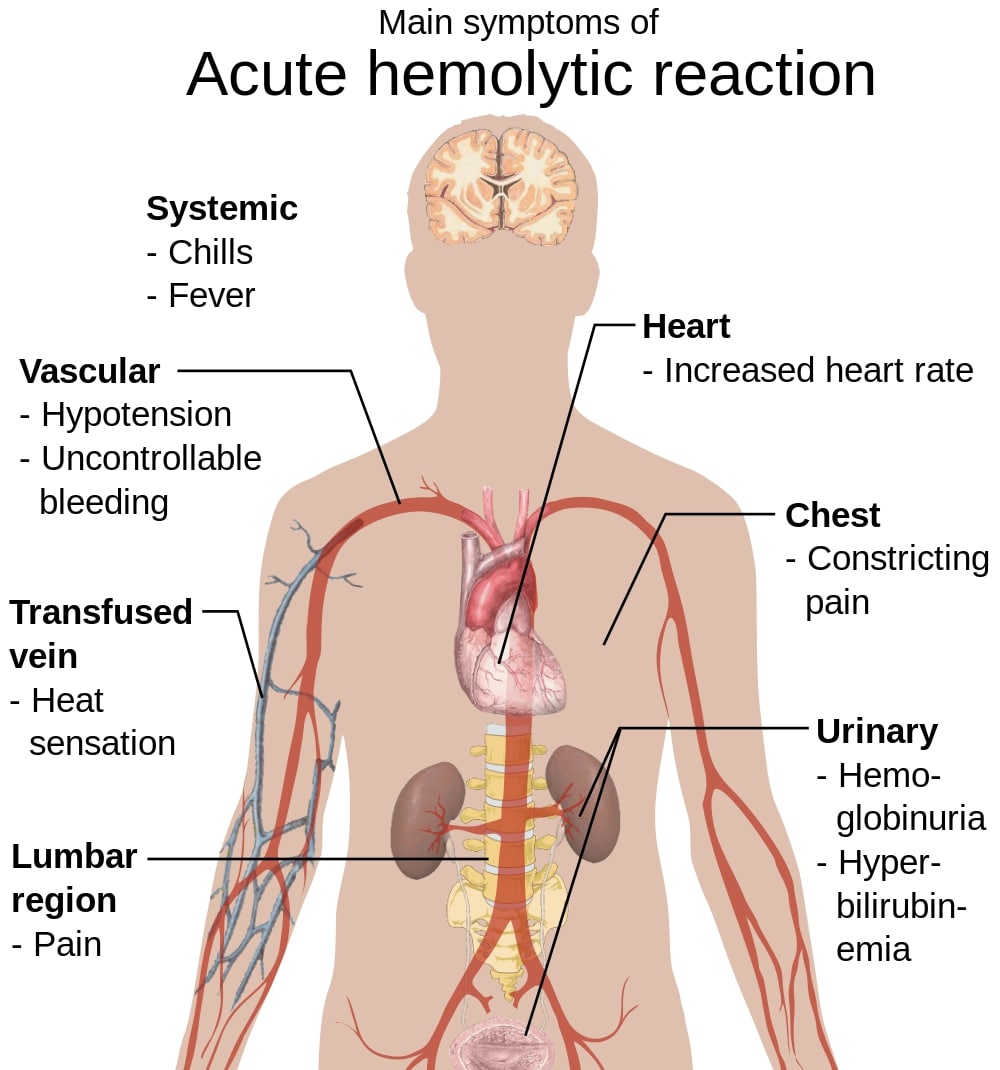
Reacción transfusional hemolítica aguda

  • Definición: reacción transfusional hemolítica que se produce durante la transfusión o en EN Erythema nodosum is an immune-mediated panniculitis (inflammation of the subcutaneous fat) caused by a type IV (delayed-type) hypersensitivity reaction. It commonly manifests in young women as tender, erythematous nodules on the shins. Erythema Nodosum las 24 horas siguientes a la misma
  • Etiología:
    • Reacción de hipersensibilidad tipo II → se ataca a los LOS Neisseria eritrocitos transfundidos
    • La incompatibilidad del grupo sanguíneo ABO causa hemólisis intravascular.
    • Los LOS Neisseria propios anticuerpos del huésped (inmunoglobulina G ( IgG IgG The major immunoglobulin isotype class in normal human serum. There are several isotype subclasses of igg, for example, igg1, igg2a, and igg2b. Hypersensitivity Pneumonitis)) detectan y se unen a antígenos de los LOS Neisseria eritrocitos del donante, lo que provoca hemólisis extravascular.
  • Signos y síntomas:
    • Comienza durante la transfusión o hasta 1 hora después
    • Taquicardia
    • Taquipnea
    • Hipotensión
    • Dolor Dolor Inflammation de costado
    • Síntomas de CID (i.e., sangrado de mucosas, sangrado en EN Erythema nodosum is an immune-mediated panniculitis (inflammation of the subcutaneous fat) caused by a type IV (delayed-type) hypersensitivity reaction. It commonly manifests in young women as tender, erythematous nodules on the shins. Erythema Nodosum sitios de punción IV)
    • Hemoglobinuria Hemoglobinuria The presence of free hemoglobin in the urine, indicating hemolysis of erythrocytes within the vascular system. After saturating the hemoglobin-binding proteins (haptoglobins), free hemoglobin begins to appear in the urine. Transfusion Reactions por hemólisis intravascular
    • Ictericia debida a la hemólisis extravascular (coloración amarillenta de la esclerótica y la piel)
    • Fiebre y escalofríos
  • Tratamiento:
    • Suspensión inmediata de la transfusión
    • Repita la tipificación y las pruebas cruzadas para identificar la causa y regístrelo para evitar futuras reacciones.
    • Cuidados de soporte:
      • Infusión de líquidos intravenosos para ayudar a la diuresis
      • Hipotensión tratada con líquidos intravenosos y vasopresores
      • En EN Erythema nodosum is an immune-mediated panniculitis (inflammation of the subcutaneous fat) caused by a type IV (delayed-type) hypersensitivity reaction. It commonly manifests in young women as tender, erythematous nodules on the shins. Erythema Nodosum caso de coagulación intravascular diseminada (CID): realizar estudios de coagulación y administrar plasma Plasma The residual portion of blood that is left after removal of blood cells by centrifugation without prior blood coagulation. Transfusion Products fresco congelado (PFC) y plaquetas.
  • Complicaciones:
    • La hemoglobinuria Hemoglobinuria The presence of free hemoglobin in the urine, indicating hemolysis of erythrocytes within the vascular system. After saturating the hemoglobin-binding proteins (haptoglobins), free hemoglobin begins to appear in the urine. Transfusion Reactions puede provocar necrosis Necrosis The death of cells in an organ or tissue due to disease, injury or failure of the blood supply. Ischemic Cell Damage tubular renal e insuficiencia renal.
    • CID: la hemólisis grave puede conducir a una acumulación de citocinas en EN Erythema nodosum is an immune-mediated panniculitis (inflammation of the subcutaneous fat) caused by a type IV (delayed-type) hypersensitivity reaction. It commonly manifests in young women as tender, erythematous nodules on the shins. Erythema Nodosum la sangre → hipercoagulación → microtrombos y hemorragia → alteración de la perfusión de los LOS Neisseria órganos y necrosis Necrosis The death of cells in an organ or tissue due to disease, injury or failure of the blood supply. Ischemic Cell Damage tisular → insuficiencia orgánica multisistémica
Síntomas de reacción hemolítica

Signos y síntomas de reacciones transfusionales hemolíticas agudas

Imagen:Main symptoms of acute hemolytic reaction” por Mikael Häggström. Licencia: Dominio Público, editada por Lecturio.
Reacción transfusional hemolítica tardía

  • Definición: reacción transfusional hemolítica que se produce más de 24 horas después de la transfusión
  • Etiología:
    • Ocurre en EN Erythema nodosum is an immune-mediated panniculitis (inflammation of the subcutaneous fat) caused by a type IV (delayed-type) hypersensitivity reaction. It commonly manifests in young women as tender, erythematous nodules on the shins. Erythema Nodosum pacientes que han sido sensibilizados a antígenos específicos de eritrocitos (transfusiones previas, embarazo o trasplantes)
    • La reexposición estimula la producción rápida de anticuerpos y conduce a la hemólisis extravascular.
  • Signos y síntomas:
    • Puede comenzar días o semanas después de la transfusión
    • Fiebre y escalofríos
    • Ictericia
    • Anemia Anemia Anemia is a condition in which individuals have low Hb levels, which can arise from various causes. Anemia is accompanied by a reduced number of RBCs and may manifest with fatigue, shortness of breath, pallor, and weakness. Subtypes are classified by the size of RBCs, chronicity, and etiology. Anemia: Overview and Types
    • Hemoglobinuria Hemoglobinuria The presence of free hemoglobin in the urine, indicating hemolysis of erythrocytes within the vascular system. After saturating the hemoglobin-binding proteins (haptoglobins), free hemoglobin begins to appear in the urine. Transfusion Reactions
  • Tratamiento:
    • No requiere tratamiento al AL Amyloidosis menos que haya evidencia de hemólisis rápida:
      • Terapia de soporte mediante tratamiento sintomático
      • Hidratación en EN Erythema nodosum is an immune-mediated panniculitis (inflammation of the subcutaneous fat) caused by a type IV (delayed-type) hypersensitivity reaction. It commonly manifests in young women as tender, erythematous nodules on the shins. Erythema Nodosum caso de hemólisis rápida para proteger los LOS Neisseria riñones
    • Se deben realizar pruebas de anticuerpos para prevenir futuras reacciones.

Reacción No Hemolítica

Reacción transfusional no hemolítica febril

  • Definición: fiebre de 38oC y/o escalofríos/rigores desde el final de la transfusión hasta 4 horas después de la misma
  • Etiología:
    • Reacción de hipersensibilidad tipo II en EN Erythema nodosum is an immune-mediated panniculitis (inflammation of the subcutaneous fat) caused by a type IV (delayed-type) hypersensitivity reaction. It commonly manifests in young women as tender, erythematous nodules on the shins. Erythema Nodosum la que los LOS Neisseria anticuerpos del huésped atacan a los LOS Neisseria leucocitos del donante
    • La acumulación de citocinas (IL-1, IL-6, IL-8 y factor de necrosis Necrosis The death of cells in an organ or tissue due to disease, injury or failure of the blood supply. Ischemic Cell Damage tumoral) en EN Erythema nodosum is an immune-mediated panniculitis (inflammation of the subcutaneous fat) caused by a type IV (delayed-type) hypersensitivity reaction. It commonly manifests in young women as tender, erythematous nodules on the shins. Erythema Nodosum la sangre del donante durante el almacenamiento produce una reacción inmunitaria en EN Erythema nodosum is an immune-mediated panniculitis (inflammation of the subcutaneous fat) caused by a type IV (delayed-type) hypersensitivity reaction. It commonly manifests in young women as tender, erythematous nodules on the shins. Erythema Nodosum el receptor Receptor Receptors are proteins located either on the surface of or within a cell that can bind to signaling molecules known as ligands (e.g., hormones) and cause some type of response within the cell. Receptors.
  • Signos y síntomas:
    • Comienza dentro de 1–6 horas después de la transfusión
    • Fiebre y escalofríos
    • Cefaleas
    • Enrojecimiento
    • Malestar general
  • Tratamiento:
    • Suspensión de la transfusión
    • Hemograma para descartar una reacción hemolítica aguda ( anemia Anemia Anemia is a condition in which individuals have low Hb levels, which can arise from various causes. Anemia is accompanied by a reduced number of RBCs and may manifest with fatigue, shortness of breath, pallor, and weakness. Subtypes are classified by the size of RBCs, chronicity, and etiology. Anemia: Overview and Types, hiperbilirrubinemia, trombocitopenia)
    • Acetaminofén para ayudar con la fiebre
    • Prevención con leucorreducción de hemoderivados

Reacciones Alérgicas

  • Definición: reacción de hipersensibilidad de tipo 1 caracterizada por urticaria Urticaria Urticaria is raised, well-circumscribed areas (wheals) of edema (swelling) and erythema (redness) involving the dermis and epidermis with associated pruritus (itch). Urticaria is not a single disease but rather is a reaction pattern representing cutaneous mast cell degranulation. Urticaria (Hives) y prurito en EN Erythema nodosum is an immune-mediated panniculitis (inflammation of the subcutaneous fat) caused by a type IV (delayed-type) hypersensitivity reaction. It commonly manifests in young women as tender, erythematous nodules on the shins. Erythema Nodosum respuesta a una transfusión de productos sanguíneos
  • Etiología:
    • Reacción de hipersensibilidad tipo I contra proteínas plasmáticas en EN Erythema nodosum is an immune-mediated panniculitis (inflammation of the subcutaneous fat) caused by a type IV (delayed-type) hypersensitivity reaction. It commonly manifests in young women as tender, erythematous nodules on the shins. Erythema Nodosum sangre del donante
    • En EN Erythema nodosum is an immune-mediated panniculitis (inflammation of the subcutaneous fat) caused by a type IV (delayed-type) hypersensitivity reaction. It commonly manifests in young women as tender, erythematous nodules on the shins. Erythema Nodosum caso de deficiencia de IgA IgA Represents 15-20% of the human serum immunoglobulins, mostly as the 4-chain polymer in humans or dimer in other mammals. Secretory iga is the main immunoglobulin in secretions. Immunoglobulins: Types and Functions: los LOS Neisseria anticuerpos IgG IgG The major immunoglobulin isotype class in normal human serum. There are several isotype subclasses of igg, for example, igg1, igg2a, and igg2b. Hypersensitivity Pneumonitis anti-IgA del receptor Receptor Receptors are proteins located either on the surface of or within a cell that can bind to signaling molecules known as ligands (e.g., hormones) and cause some type of response within the cell. Receptors detectan la IgA IgA Represents 15-20% of the human serum immunoglobulins, mostly as the 4-chain polymer in humans or dimer in other mammals. Secretory iga is the main immunoglobulin in secretions. Immunoglobulins: Types and Functions en EN Erythema nodosum is an immune-mediated panniculitis (inflammation of the subcutaneous fat) caused by a type IV (delayed-type) hypersensitivity reaction. It commonly manifests in young women as tender, erythematous nodules on the shins. Erythema Nodosum la superficie de los LOS Neisseria eritrocitos en EN Erythema nodosum is an immune-mediated panniculitis (inflammation of the subcutaneous fat) caused by a type IV (delayed-type) hypersensitivity reaction. It commonly manifests in young women as tender, erythematous nodules on the shins. Erythema Nodosum la sangre del donante, desencadenando una liberación masiva de citoquinas → anafilaxia
  • Signos y síntomas:
    • Comienza durante la transfusión o dentro de las 2 horas posteriores
    • Reacciones alérgicas menores: urticaria Urticaria Urticaria is raised, well-circumscribed areas (wheals) of edema (swelling) and erythema (redness) involving the dermis and epidermis with associated pruritus (itch). Urticaria is not a single disease but rather is a reaction pattern representing cutaneous mast cell degranulation. Urticaria (Hives) o prurito
    • Reacción potencialmente mortal (anafilaxia):
      • Hipotensión
      • Broncoespasmo, sibilancias o estridor
      • Náuseas y/o vómitos
      • Shock Shock Shock is a life-threatening condition associated with impaired circulation that results in tissue hypoxia. The different types of shock are based on the underlying cause: distributive (↑ cardiac output (CO), ↓ systemic vascular resistance (SVR)), cardiogenic (↓ CO, ↑ SVR), hypovolemic (↓ CO, ↑ SVR), obstructive (↓ CO), and mixed. Types of Shock
      • Paro cardíaco y/o respiratorio
  • Tratamiento:
    • Reacciones alérgicas menores: antihistamínicos (e.g., difenhidramina)
    • Anafilaxia:
      • Epinefrina
      • Estabilización hemodinámica
      • Manejo de la vía aérea

Otros Tipos de Reacciones Transfusionales

Lesión pulmonar aguda producida por transfusión

  • Etiología:
    • Mecanismo de dos golpes:
      • Antes de la transfusión, las condiciones preexistentes (p. ej., lesión endotelial) provocan el secuestro de las células endoteliales y el cebado de los LOS Neisseria neutrófilos
      • Los LOS Neisseria factores ya existentes en EN Erythema nodosum is an immune-mediated panniculitis (inflammation of the subcutaneous fat) caused by a type IV (delayed-type) hypersensitivity reaction. It commonly manifests in young women as tender, erythematous nodules on the shins. Erythema Nodosum la sangre transfundida (por ejemplo, anticuerpos contra antígenos del receptor Receptor Receptors are proteins located either on the surface of or within a cell that can bind to signaling molecules known as ligands (e.g., hormones) and cause some type of response within the cell. Receptors o lípidos bioactivos) activan a los LOS Neisseria neutrófilos → liberación de citoquinas, especies reactivas de oxígeno y enzimas proteolíticas que dañan el endotelio vascular
    • Provoca un edema Edema Edema is a condition in which excess serous fluid accumulates in the body cavity or interstitial space of connective tissues. Edema is a symptom observed in several medical conditions. It can be categorized into 2 types, namely, peripheral (in the extremities) and internal (in an organ or body cavity). Edema pulmonar inflamatorio (no cardiogénico)
    • Puede conducir a hipoxemia aguda
  • Signos y síntomas:
    • Comienza durante la transfusión o dentro de las 6 horas posteriores
    • Dificultad respiratoria o disnea
    • Hipotonía
    • Fiebre
    • Hipotensión (hipovolemia debido a la acumulación de líquido en EN Erythema nodosum is an immune-mediated panniculitis (inflammation of the subcutaneous fat) caused by a type IV (delayed-type) hypersensitivity reaction. It commonly manifests in young women as tender, erythematous nodules on the shins. Erythema Nodosum los LOS Neisseria pulmones)
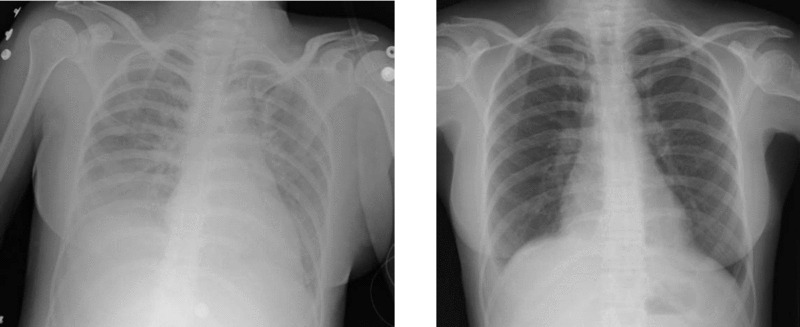
    • La radiografía muestra infiltrados bilaterales que sugieren edema Edema Edema is a condition in which excess serous fluid accumulates in the body cavity or interstitial space of connective tissues. Edema is a symptom observed in several medical conditions. It can be categorized into 2 types, namely, peripheral (in the extremities) and internal (in an organ or body cavity). Edema pulmonar.
    • Si está intubado, puede ser visible un esputo espumoso y rosado en EN Erythema nodosum is an immune-mediated panniculitis (inflammation of the subcutaneous fat) caused by a type IV (delayed-type) hypersensitivity reaction. It commonly manifests in young women as tender, erythematous nodules on the shins. Erythema Nodosum el tubo endotraqueal.
  • Tratamiento:
    • Suspensión de la transfusión
    • Cuidados de soporte
      • Ventilación asistida o administración de oxígeno
      • Monitorización y regulación de parámetros hemodinámicos
      • Esteroides intravenosos para ayudar con la inflamación (controversial)
Radiografía de tórax de lesión pulmonar aguda relacionada con transfusiones

Radiografía de tórax de una lesión pulmonar aguda producida por transfusión que muestra infiltrados difusos bilaterales (izquierda); radiografía de tórax del mismo sujeto después del tratamiento (derecha)

Imagen: “Two chest X-rays”” por Altaf Gauhar Haji et al. Licencia: CC BY 2.0, editada por Lecturio.

Enfermedad de injerto contra huésped

  • Etiología:
    • Reacción transfusional retardada
    • Los LOS Neisseria linfocitos T del donante se dirigen al AL Amyloidosis antígeno leucocitario humano (HLA), que expresa los LOS Neisseria tejidos del receptor Receptor Receptors are proteins located either on the surface of or within a cell that can bind to signaling molecules known as ligands (e.g., hormones) and cause some type of response within the cell. Receptors → reacción inflamatoria sistémica
    • Órganos más comúnmente afectados: médula ósea, piel, intestinos e hígado
    • Factores de riesgo para desarrollar EICH
      • Personas inmunodeprimidas
      • Coincidencia parcial de HLA entre el donante y el receptor Receptor Receptors are proteins located either on the surface of or within a cell that can bind to signaling molecules known as ligands (e.g., hormones) and cause some type of response within the cell. Receptors
      • Puede presentarse de forma aguda (< 100 días después de la transfusión/trasplante) o crónica (> 100 días después de la transfusión/trasplante)
  • Signos y síntomas:
    • Reacción aguda
      • Comienza 4-30 días después de la transfusión/trasplante
      • Erupción maculopapular Maculopapular Dermatologic Examination dolorosa y pruriginosa
      • Náuseas y/o vómitos
      • Diarrea y cólicos abdominales
      • Ictericia
    • Reacción crónica
      • Comienza > 100 días después de la transfusión/trasplante
      • Todos los LOS Neisseria síntomas vistos en EN Erythema nodosum is an immune-mediated panniculitis (inflammation of the subcutaneous fat) caused by a type IV (delayed-type) hypersensitivity reaction. It commonly manifests in young women as tender, erythematous nodules on the shins. Erythema Nodosum la reacción aguda pueden ocurrir.
      • Cambios en EN Erythema nodosum is an immune-mediated panniculitis (inflammation of the subcutaneous fat) caused by a type IV (delayed-type) hypersensitivity reaction. It commonly manifests in young women as tender, erythematous nodules on the shins. Erythema Nodosum la piel similares a la esclerodermia (cambios en EN Erythema nodosum is an immune-mediated panniculitis (inflammation of the subcutaneous fat) caused by a type IV (delayed-type) hypersensitivity reaction. It commonly manifests in young women as tender, erythematous nodules on the shins. Erythema Nodosum la piel liquenoides)
      • Xerostomía (boca seca) y xeroftalmía (ojos secos)
      • Diarrea sanguinolenta ( enteritis Enteritis Inflammation of any segment of the small intestine. Lactose Intolerance crónica similar a la enfermedad inflamatoria intestinal)
      • Pérdida de peso
      • Dolor Dolor Inflammation muscular y debilidad
      • Bronquiolitis obliterante ( tos TOS Thoracic outlet syndrome (TOS) is a broad term used for a spectrum of syndromes related to the general region of the thoracic outlet, which involves the compression or irritation of elements of the brachial plexus, subclavian artery, or subclavian vein. Thoracic Outlet Syndrome crónica/persistente, sibilancias y disnea)
  • Diagnóstico:
    • El hemograma muestra anemia Anemia Anemia is a condition in which individuals have low Hb levels, which can arise from various causes. Anemia is accompanied by a reduced number of RBCs and may manifest with fatigue, shortness of breath, pallor, and weakness. Subtypes are classified by the size of RBCs, chronicity, and etiology. Anemia: Overview and Types, trombocitopenia y/o leucopenia (reacción aguda).
    • La espirometría puede mostrar enfermedad pulmonar obstructiva (reacción crónica).
    • La biopsia del tejido trasplantado, lesión cutánea o de hígado puede confirmar el diagnóstico
  • Tratamiento:
    • 1ra línea: corticoides
      • Tópicos en EN Erythema nodosum is an immune-mediated panniculitis (inflammation of the subcutaneous fat) caused by a type IV (delayed-type) hypersensitivity reaction. It commonly manifests in young women as tender, erythematous nodules on the shins. Erythema Nodosum caso de afectación cutánea < 50%
      • Sistémicos en EN Erythema nodosum is an immune-mediated panniculitis (inflammation of the subcutaneous fat) caused by a type IV (delayed-type) hypersensitivity reaction. It commonly manifests in young women as tender, erythematous nodules on the shins. Erythema Nodosum el caso de afectación cutánea > 50%, afectación gastrointestinal, afectación hepática
    • 2da línea: aumento de la dosis de corticoides + inmunosupresores (e.g., ciclosporina)
    • El único tratamiento curativo es el trasplante de médula ósea.

Sobrecarga circulatoria asociada a la transfusión

  • Etiología:
    • Gran volumen de transfusión
    • Tasa de infusión rápida
    • Enfermedad renal o cardiovascular subyacente
    • Peso corporal bajo
    • Pacientes lactantes o ancianos
  • Signos y síntomas:
    • Comienza durante la transfusión o dentro de las 6 horas posteriores
    • Signos de hipervolemia
      • Galope de S3 S3 Heart Sounds
      • Dificultad para respirar
      • Ingurgitación yugular
      • Hipertensión repentina
      • Taquicardia
      • Presión de pulso ampliada
      • Tos TOS Thoracic outlet syndrome (TOS) is a broad term used for a spectrum of syndromes related to the general region of the thoracic outlet, which involves the compression or irritation of elements of the brachial plexus, subclavian artery, or subclavian vein. Thoracic Outlet Syndrome y/o disnea
    • La radiografía muestra infiltrados bilaterales que sugieren edema Edema Edema is a condition in which excess serous fluid accumulates in the body cavity or interstitial space of connective tissues. Edema is a symptom observed in several medical conditions. It can be categorized into 2 types, namely, peripheral (in the extremities) and internal (in an organ or body cavity). Edema pulmonar.
  • Tratamiento:
    • Diuréticos (único método para contrarrestar el elevado volumen de sangre)
    • Oxígeno suplementario o ventilación asistida si es necesario

Referencias

  1. Davenport, R. D. (2005). Pathophysiology of hemolytic transfusion reactions. Seminars in Hematology, 42(3), 165–168. https://doi.org/10.1053/j.seminhematol.2005.04.006
  2. Strobel, E. (2008). Hemolytic transfusion reactions. Transfusion Medicine and Hemotherapy, 35(5), 346–353. https://doi.org/10.1159/000154811
  3. Vargas-Díez, E., García-Díez, A., Marín, A., & Fernández-Herrera, J. (2005). Life-threatening graft-vs-host disease. Clinics in Dermatology, 23(3), 285–300. https://doi.org/10.1016/j.clindermatol.2004.06.005
  4. Kopolovic, I., Ostro, J., Tsubota, H., Lin, Y., Cserti-Gazdewich, C. M., Messner, H. A., Keir, A. K., DenHollander, N., Dzik, W. S., & Callum, J. (2015). A systematic review of transfusion–associated graft–versus–host disease. Blood, 126(3), 406–414. https://doi.org/10.1182/blood-2015-01-620872

¡Crea tu cuenta gratis o inicia una sesión para seguir leyendo!

Regístrate ahora y obtén acceso gratuito a Lecturio con páginas de concepto, videos médicos y cuestionarios para tu educación médica.

User Reviews

Que tengas una sesión de estudio alegre y navideña 🎁 Ahorra 50% en todos los planes >>

Details