
Domina Conceptos Médicos

Estudia para la escuela de medicina y tus examenes con Lecturio.

Pruebas de Coagulación

Las pruebas de coagulación son un grupo de estudios de laboratorio hematológicos que reflejan la función de los LOS Neisseria vasos sanguíneos, plaquetas y factores de coagulación, que interactúan entre sí para lograr la hemostasia. Las pruebas de coagulación generalmente se solicitan para evaluar pacientes con trastornos hemorrágicos o de hipercoagulación.

Last updated: Dec 15, 2025

Editorial responsibility: Stanley Oiseth, Lindsay Jones, Evelin Maza

Descripción General

Definición

Las pruebas de coagulación son un grupo de estudios hematológicos que reflejan la función de los LOS Neisseria vasos sanguíneos, plaquetas y factores de coagulación, que funcionan en EN Erythema nodosum is an immune-mediated panniculitis (inflammation of the subcutaneous fat) caused by a type IV (delayed-type) hypersensitivity reaction. It commonly manifests in young women as tender, erythematous nodules on the shins. Erythema Nodosum armonía para lograr la hemostasia.

Usos de las pruebas de coagulación

  • Evaluación de hemorragia anormal o trombosis
  • Pruebas preoperatorias
  • Manejo de la terapia anticoagulante
  • Asistir en EN Erythema nodosum is an immune-mediated panniculitis (inflammation of the subcutaneous fat) caused by a type IV (delayed-type) hypersensitivity reaction. It commonly manifests in young women as tender, erythematous nodules on the shins. Erythema Nodosum el manejo de la reanimación durante transfusiones masivas

Repaso: fases del proceso hemostático

A continuación un resumen del proceso hemostático:
  • Contracción del vaso sanguíneo: limita el flujo de sangre al AL Amyloidosis área
  • Formación del tapón plaquetario: el tapón temporal inicial, formado a través de los LOS Neisseria siguientes pasos:
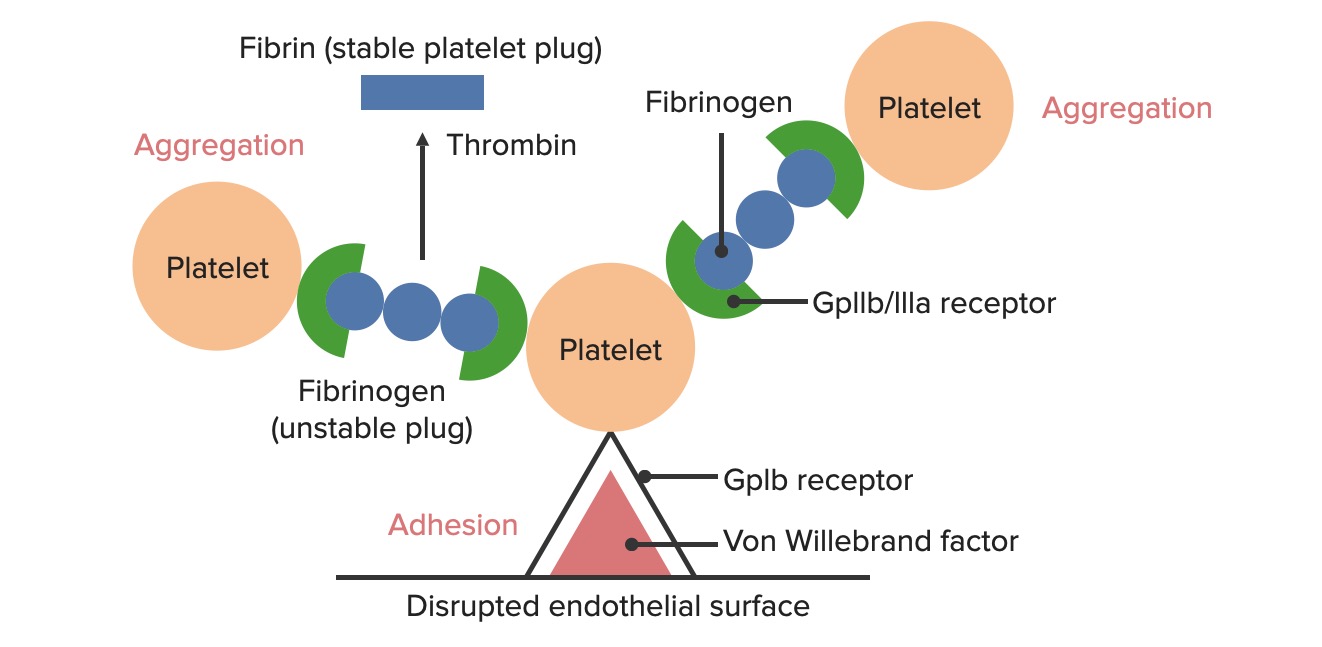
    • Adhesión: el factor de von Willebrand expuesto se une a los LOS Neisseria receptores de glicoproteína (Gp) Ib en EN Erythema nodosum is an immune-mediated panniculitis (inflammation of the subcutaneous fat) caused by a type IV (delayed-type) hypersensitivity reaction. It commonly manifests in young women as tender, erythematous nodules on the shins. Erythema Nodosum las plaquetas
    • Agregación: los LOS Neisseria receptores Gp IIb/IIIa en EN Erythema nodosum is an immune-mediated panniculitis (inflammation of the subcutaneous fat) caused by a type IV (delayed-type) hypersensitivity reaction. It commonly manifests in young women as tender, erythematous nodules on the shins. Erythema Nodosum las plaquetas se unen al AL Amyloidosis fibrinógeno
    • Secreción: se liberan sustancias que estimulan una mayor activación y agregación plaquetaria e inician la cascada de la coagulación.
  • Activación de la cascada de la coagulación: forma un coágulo de fibrina más estable
    • Vía extrínseca:
      • Principal responsable del inicio de la cascada
      • Involucra ( en EN Erythema nodosum is an immune-mediated panniculitis (inflammation of the subcutaneous fat) caused by a type IV (delayed-type) hypersensitivity reaction. It commonly manifests in young women as tender, erythematous nodules on the shins. Erythema Nodosum orden): factor tisular, factor VII Factor VII Heat- and storage-stable plasma protein that is activated by tissue thromboplastin to form factor viia in the extrinsic pathway of blood coagulation. The activated form then catalyzes the activation of factor X to factor Xa. Hemostasis y factor X Factor X Storage-stable glycoprotein blood coagulation factor that can be activated to factor Xa by both the intrinsic and extrinsic pathways. A deficiency of factor X, sometimes called stuart-prower factor deficiency, may lead to a systemic coagulation disorder. Hemostasis
    • Vía intrínseca:
      • Principalmente involucrada en EN Erythema nodosum is an immune-mediated panniculitis (inflammation of the subcutaneous fat) caused by a type IV (delayed-type) hypersensitivity reaction. It commonly manifests in young women as tender, erythematous nodules on the shins. Erythema Nodosum la amplificación de la cascada
      • Puede ser activada directamente por una lesión en EN Erythema nodosum is an immune-mediated panniculitis (inflammation of the subcutaneous fat) caused by a type IV (delayed-type) hypersensitivity reaction. It commonly manifests in young women as tender, erythematous nodules on the shins. Erythema Nodosum el vaso sanguíneo
      • Involucra ( en EN Erythema nodosum is an immune-mediated panniculitis (inflammation of the subcutaneous fat) caused by a type IV (delayed-type) hypersensitivity reaction. It commonly manifests in young women as tender, erythematous nodules on the shins. Erythema Nodosum orden): factores XII, XI, IX, VIII y X
    • Vía común:
      • Las vías extrínseca e intrínseca se unen cuando el factor X Factor X Storage-stable glycoprotein blood coagulation factor that can be activated to factor Xa by both the intrinsic and extrinsic pathways. A deficiency of factor X, sometimes called stuart-prower factor deficiency, may lead to a systemic coagulation disorder. Hemostasis se activa para formar la vía final común.
      • Involucra ( en EN Erythema nodosum is an immune-mediated panniculitis (inflammation of the subcutaneous fat) caused by a type IV (delayed-type) hypersensitivity reaction. It commonly manifests in young women as tender, erythematous nodules on the shins. Erythema Nodosum orden): factores X, V, II (trombina), I (fibrina) y XIII
  • Inhibición de la coagulación y fase fibrinolítica:
    • Detiene la coagulación y desintegra el coágulo una vez que ya no es necesario
    • Involucra:
      • Plasmina
      • Antitrombina
      • Proteínas C y S
Formación del tapón hemostático temporal

Formación del tapón hemostático temporal:
La superficie endotelial rota expone el factor de von Willebrand a la sangre circulante. Las plaquetas se unen al factor de von Willebrand a través de sus receptores GpIb y se activan. La activación de las plaquetas hace que secreten difosfato de adenosina (ADP, por sus siglas en inglés), que estimula la expresión de los receptores GpIIb/IIIa en las plaquetas. Los receptores GpIIb/IIIa se unen al fibrinógeno, que puede unirse a una plaqueta en cada extremo, lo que hace que las plaquetas se agreguen. A medida que se unen más plaquetas entre sí, se genera el tapón plaquetario. A medida que se activa la cascada de coagulación, la trombina convierte el fibrinógeno más débil en fibrina más fuerte, creando un coágulo mucho más estable.
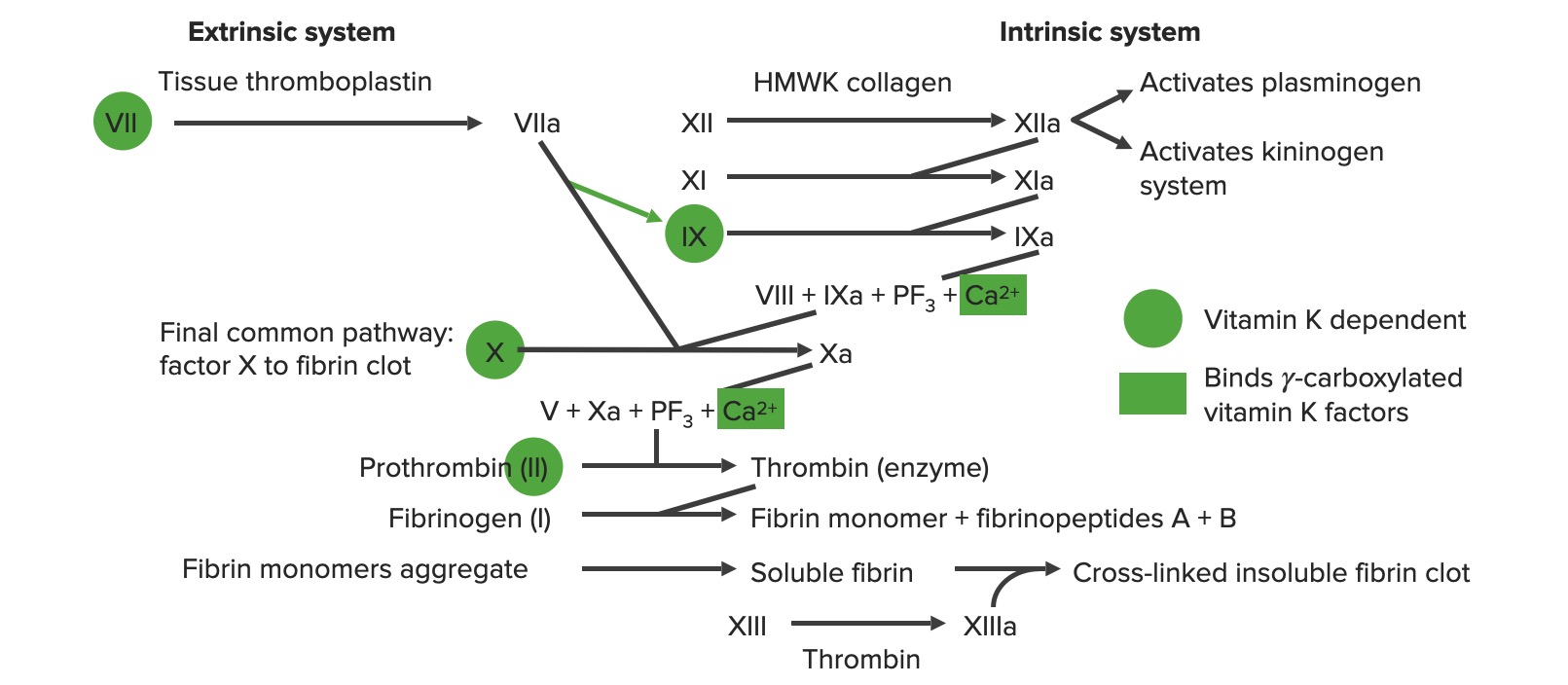
Imagen por Lecturio.
Resumen de la cascada de la coagulación

Descripción general de la cascada de la coagulación
a: forma activada
PF3: factor plaquetario 3 (fosfolípidos)

Imagen por Lecturio.

Related videos

Pruebas de Coagulación

Las siguientes pruebas pueden ayudar a diagnosticar problemas relacionados con la hemostasia.

Evaluación de las plaquetas

Recuento plaquetario:

  • Mide el número/concentración de plaquetas
  • Rango normal: 150 000–450 000
  • en EN Erythema nodosum is an immune-mediated panniculitis (inflammation of the subcutaneous fat) caused by a type IV (delayed-type) hypersensitivity reaction. It commonly manifests in young women as tender, erythematous nodules on the shins. Erythema Nodosum la trombocitosis, que puede ser causada por:
    • Pérdida aguda de sangre/ anemia Anemia Anemia is a condition in which individuals have low Hb levels, which can arise from various causes. Anemia is accompanied by a reduced number of RBCs and may manifest with fatigue, shortness of breath, pallor, and weakness. Subtypes are classified by the size of RBCs, chronicity, and etiology. Anemia: Overview and Types por deficiencia de hierro
    • Cáncer metastásico
    • Condiciones inflamatorias:
      • Trastornos reumatológicos
      • Enfermedad inflamatoria intestinal
      • Enfermedad de Kawasaki
      • Síndrome nefrótico
    • Infecciones
    • Traumatismos y quemaduras
  • en EN Erythema nodosum is an immune-mediated panniculitis (inflammation of the subcutaneous fat) caused by a type IV (delayed-type) hypersensitivity reaction. It commonly manifests in young women as tender, erythematous nodules on the shins. Erythema Nodosum la trombocitopenia:
    • Púrpura trombocitopénica inmune
    • Púrpura trombocitopénica trombótica
    • Trombocitopenia gestacional
    • Virus Virus Viruses are infectious, obligate intracellular parasites composed of a nucleic acid core surrounded by a protein capsid. Viruses can be either naked (non-enveloped) or enveloped. The classification of viruses is complex and based on many factors, including type and structure of the nucleoid and capsid, the presence of an envelope, the replication cycle, and the host range. Virology de inmunodeficiencia humana (VIH)
    • Trombocitopenia inducida por medicamentos

Tiempo de sangrado:

  • Mide el tiempo que tarda en EN Erythema nodosum is an immune-mediated panniculitis (inflammation of the subcutaneous fat) caused by a type IV (delayed-type) hypersensitivity reaction. It commonly manifests in young women as tender, erythematous nodules on the shins. Erythema Nodosum detenerse el sangrado después de una incisión con lanceta
  • Medición indirecta de la función plaquetaria
  • Rango normal: 2–7 minutos
  • Prolongado en EN Erythema nodosum is an immune-mediated panniculitis (inflammation of the subcutaneous fat) caused by a type IV (delayed-type) hypersensitivity reaction. It commonly manifests in young women as tender, erythematous nodules on the shins. Erythema Nodosum:
    • Trombocitopenia
    • Coagulación intravascular diseminada (CID)
    • Enfermedad de von Willebrand
    • Enfermedad de Bernard–Soulier
    • Trombastenia de Glanzmann
    • Insuficiencia renal
    • Uso de antiinflamatorios no esteroideos (AINE) y/o aspirina

Tiempos de coagulación

Estos estudios se utilizan para evaluar la cantidad de tiempo que tarda el plasma Plasma The residual portion of blood that is left after removal of blood cells by centrifugation without prior blood coagulation. Transfusion Products en EN Erythema nodosum is an immune-mediated panniculitis (inflammation of the subcutaneous fat) caused by a type IV (delayed-type) hypersensitivity reaction. It commonly manifests in young women as tender, erythematous nodules on the shins. Erythema Nodosum coagularse cuando se agregan varias sustancias.
  • Tiempo de protrombina (TP):
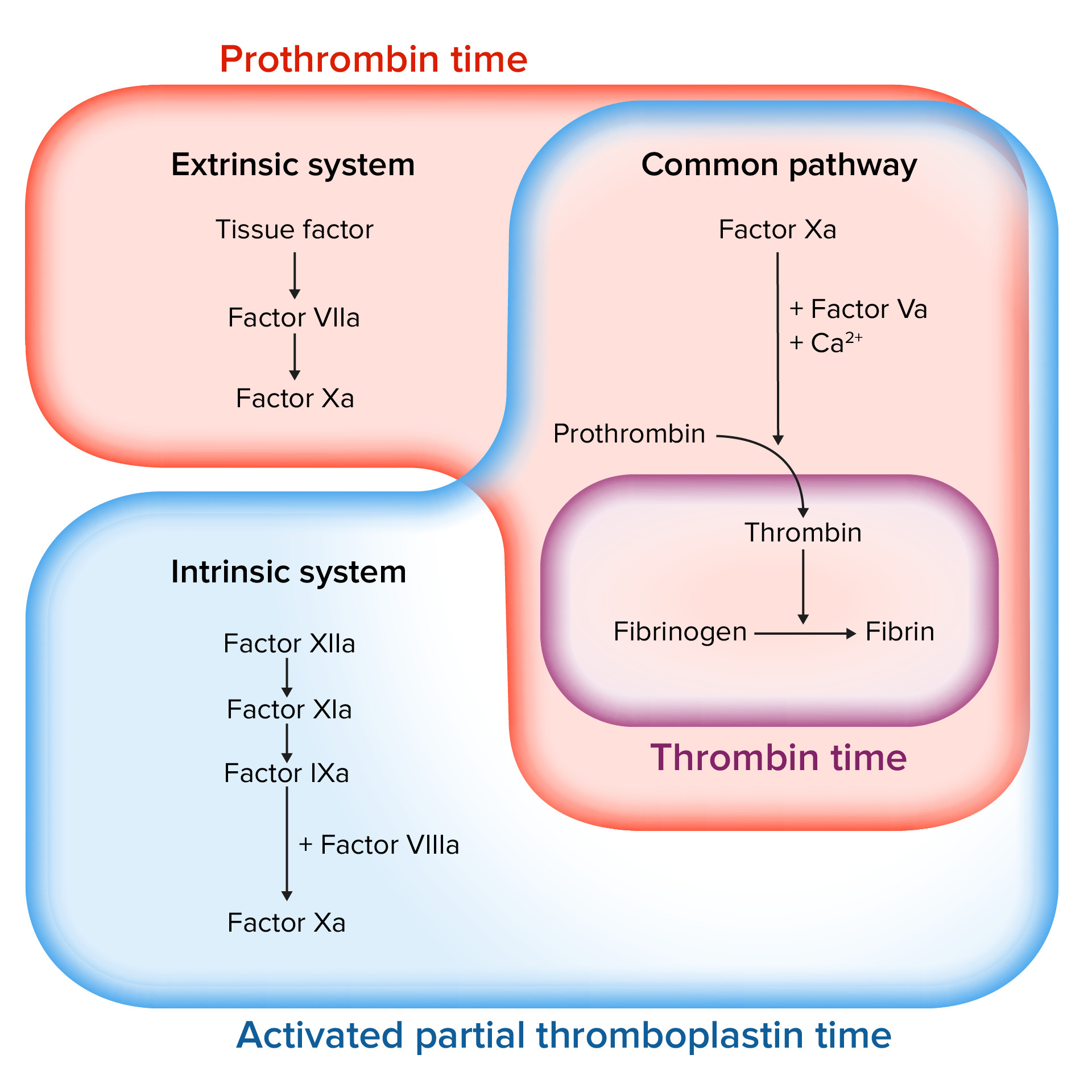
    • Mide el tiempo que tarda el plasma Plasma The residual portion of blood that is left after removal of blood cells by centrifugation without prior blood coagulation. Transfusion Products en EN Erythema nodosum is an immune-mediated panniculitis (inflammation of the subcutaneous fat) caused by a type IV (delayed-type) hypersensitivity reaction. It commonly manifests in young women as tender, erythematous nodules on the shins. Erythema Nodosum coagularse cuando se expone al AL Amyloidosis factor tisular
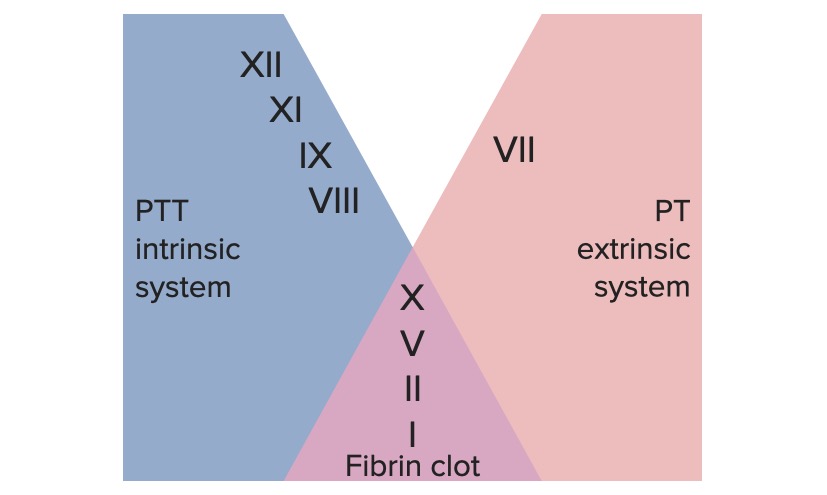
    • Mide la función de las vías extrínseca y común
    • Rango normal: aproximadamente 11–13 segundos
    • Prolongado en EN Erythema nodosum is an immune-mediated panniculitis (inflammation of the subcutaneous fat) caused by a type IV (delayed-type) hypersensitivity reaction. It commonly manifests in young women as tender, erythematous nodules on the shins. Erythema Nodosum:
      • Terapia con warfarina
      • Deficiencia de vitamina K
      • Deficiencia de factores: II, V, VII o X
      • Enfermedad hepática
      • Coagulación intravascular diseminada
  • Índice internacional normalizado (INR, por sus siglas en EN Erythema nodosum is an immune-mediated panniculitis (inflammation of the subcutaneous fat) caused by a type IV (delayed-type) hypersensitivity reaction. It commonly manifests in young women as tender, erythematous nodules on the shins. Erythema Nodosum inglés):
    • Un índice que compara el TP del paciente con un TP de referencia establecido por la World Health Organization (WHO, por sus siglas en EN Erythema nodosum is an immune-mediated panniculitis (inflammation of the subcutaneous fat) caused by a type IV (delayed-type) hypersensitivity reaction. It commonly manifests in young women as tender, erythematous nodules on the shins. Erythema Nodosum inglés)
    • Mide la función de las vías extrínseca y común.
    • Rango normal: aproximadamente 0,8–1,1
  • Tiempo de tromboplastina parcial activada (TTPa):
    • Mide el tiempo que tarda el plasma Plasma The residual portion of blood that is left after removal of blood cells by centrifugation without prior blood coagulation. Transfusion Products en EN Erythema nodosum is an immune-mediated panniculitis (inflammation of the subcutaneous fat) caused by a type IV (delayed-type) hypersensitivity reaction. It commonly manifests in young women as tender, erythematous nodules on the shins. Erythema Nodosum coagularse cuando se expone a una sustancia cargada negativamente (que activa la vía intrínseca):
      • Celite
      • Sílice
    • Mide la función tanto de la vía intrínseca como de la vía común
    • Rango normal: 25–40 segundos
    • Prolongado en EN Erythema nodosum is an immune-mediated panniculitis (inflammation of the subcutaneous fat) caused by a type IV (delayed-type) hypersensitivity reaction. It commonly manifests in young women as tender, erythematous nodules on the shins. Erythema Nodosum:
      • Terapia con heparina
      • Hemofilia ( factor VIII Factor VIII Factor VIII of blood coagulation. Antihemophilic factor that is part of the factor viii/von Willebrand factor complex. Factor VIII is produced in the liver and acts in the intrinsic pathway of blood coagulation. It serves as a cofactor in factor X activation and this action is markedly enhanced by small amounts of thrombin. Hemostasis o IX anormal)
      • Enfermedad de von Willebrand
      • Enfermedad hepática
      • CID
  • Tiempo de trombina (TT):
    • Tiempo de coagulación del plasma Plasma The residual portion of blood that is left after removal of blood cells by centrifugation without prior blood coagulation. Transfusion Products después de la exposición a la trombina
    • Mide el paso final de la vía común: la conversión de fibrinógeno en EN Erythema nodosum is an immune-mediated panniculitis (inflammation of the subcutaneous fat) caused by a type IV (delayed-type) hypersensitivity reaction. It commonly manifests in young women as tender, erythematous nodules on the shins. Erythema Nodosum fibrina
    • Rango normal: 14–19 segundos
    • Prolongado en EN Erythema nodosum is an immune-mediated panniculitis (inflammation of the subcutaneous fat) caused by a type IV (delayed-type) hypersensitivity reaction. It commonly manifests in young women as tender, erythematous nodules on the shins. Erythema Nodosum:
      • ↓ Fibrinógeno
      • Uso de anticoagulantes que inhiben la trombina: heparina, inhibidores directos de la trombina (e.g., Argatroban Argatroban Anticoagulants)
      • CID
      • Enfermedad hepática
Evaluación de la cascada de la coagulación

Evaluación de la cascada de la coagulación

Imagen por Lecturio.
Pruebas de los LOS Neisseria factores de la coagulación

Las pruebas de los LOS Neisseria factores de la coagulación se utilizan principalmente para diagnosticar deficiencias de factores específicos. Las pruebas se utilizan para evaluar la concentración o el nivel de actividad de factores individuales.

  • Los LOS Neisseria métodos basados en EN Erythema nodosum is an immune-mediated panniculitis (inflammation of the subcutaneous fat) caused by a type IV (delayed-type) hypersensitivity reaction. It commonly manifests in young women as tender, erythematous nodules on the shins. Erythema Nodosum coagulación utilizan pruebas de TP o TTPa calibradas para factores individuales.
  • Los LOS Neisseria métodos cromogénicos utilizan la escisión de un sustrato cromogénico (coloreado) para medir la actividad del factor.
  • Ensayos antigénicos: los LOS Neisseria ensayos por inmunoabsorción ligados a enzima ( ELISA ELISA An immunoassay utilizing an antibody labeled with an enzyme marker such as horseradish peroxidase. While either the enzyme or the antibody is bound to an immunosorbent substrate, they both retain their biologic activity; the change in enzyme activity as a result of the enzyme-antibody-antigen reaction is proportional to the concentration of the antigen and can be measured spectrophotometrically or with the naked eye. Many variations of the method have been developed. St. Louis Encephalitis Virus, por sus siglas en EN Erythema nodosum is an immune-mediated panniculitis (inflammation of the subcutaneous fat) caused by a type IV (delayed-type) hypersensitivity reaction. It commonly manifests in young women as tender, erythematous nodules on the shins. Erythema Nodosum inglés) se utilizan para medir los LOS Neisseria niveles de los LOS Neisseria factores de la coagulación.
  • Fibrinógeno:
    • El precursor de la fibrina
    • Los LOS Neisseria niveles anormalmente bajos pueden aumentar el riesgo de hemorragia.
    • Rango normal: 200–400 mg/dL
    • El sangrado anormal típicamente ocurre a niveles < 100 mg/dL.

Estudios mezclados

Los LOS Neisseria estudios mezclados se utilizan para evaluar más a fondo una prolongación inexplicable de una prueba de coagulación, incluidos un TP, TTPa o TT prolongados.

  • Puede determinar si un TP/TTPa anormal se debe a:
    • Deficiencia de un factor O
    • Presencia de inhibidor:
      • Autoanticuerpo contra un factor específico
      • Heparinas
      • Proteína C reactiva elevada
  • Mide el tiempo de coagulación del plasma Plasma The residual portion of blood that is left after removal of blood cells by centrifugation without prior blood coagulation. Transfusion Products del paciente cuando se diluye en EN Erythema nodosum is an immune-mediated panniculitis (inflammation of the subcutaneous fat) caused by a type IV (delayed-type) hypersensitivity reaction. It commonly manifests in young women as tender, erythematous nodules on the shins. Erythema Nodosum serie con plasma Plasma The residual portion of blood that is left after removal of blood cells by centrifugation without prior blood coagulation. Transfusion Products normal
  • El plasma Plasma The residual portion of blood that is left after removal of blood cells by centrifugation without prior blood coagulation. Transfusion Products normal:
    • Contiene todos los LOS Neisseria factores
    • No contiene suficientes factores para superar la presencia de inhibidores
  • Resultados: el tiempo de coagulación se corregirá con la adición de plasma Plasma The residual portion of blood that is left after removal of blood cells by centrifugation without prior blood coagulation. Transfusion Products normal o no se corregirá.
    • Si el tiempo de coagulación (TP o TTPa) corrige:
      • Diagnóstico: deficiencia de algún factor
      • Próximo paso: identificar el factor específico mediante pruebas de factores de la coagulación.
    • Si el tiempo de coagulación (TP o TTPa) no corrige:
      • Diagnóstico: presencia de un factor inhibidor
      • Próximos pasos:
        • Consulta con hematología.
        • Revisar medicamentos como causa potencial.
        • Determinar el título de anticuerpo presente utilizando más diluciones en EN Erythema nodosum is an immune-mediated panniculitis (inflammation of the subcutaneous fat) caused by a type IV (delayed-type) hypersensitivity reaction. It commonly manifests in young women as tender, erythematous nodules on the shins. Erythema Nodosum serie.

Relevancia Clínica: Condiciones Hipocoagulables

Las condiciones hipocoagulables son un grupo de enfermedades que resultan en EN Erythema nodosum is an immune-mediated panniculitis (inflammation of the subcutaneous fat) caused by a type IV (delayed-type) hypersensitivity reaction. It commonly manifests in young women as tender, erythematous nodules on the shins. Erythema Nodosum una hemostasia anormal. Se manifiestan con hemorragia menor (petequias, hemorragia mucocutánea) o hemorragia interna más severa (hemartrosis, hemorragia intracraneal).

Trastornos de la formación del tapón plaquetario

Lo más probable es que los LOS Neisseria pacientes con estos trastornos tengan un mayor tiempo de sangrado, pero un TP y un TTPa normales.

  • Trombastenia de Glanzmann: un síndrome hemorrágico autosómico recesivo caracterizado por una deficiencia del receptor Receptor Receptors are proteins located either on the surface of or within a cell that can bind to signaling molecules known as ligands (e.g., hormones) and cause some type of response within the cell. Receptors GpIIb/IIIa, lo que resulta en EN Erythema nodosum is an immune-mediated panniculitis (inflammation of the subcutaneous fat) caused by a type IV (delayed-type) hypersensitivity reaction. It commonly manifests in young women as tender, erythematous nodules on the shins. Erythema Nodosum una falta de agregación plaquetaria
  • Síndrome de BernardSoulier: un síndrome hemorrágico autosómico recesivo caracterizado por la deficiencia del receptor Receptor Receptors are proteins located either on the surface of or within a cell that can bind to signaling molecules known as ligands (e.g., hormones) and cause some type of response within the cell. Receptors GpIb, lo que resulta en EN Erythema nodosum is an immune-mediated panniculitis (inflammation of the subcutaneous fat) caused by a type IV (delayed-type) hypersensitivity reaction. It commonly manifests in young women as tender, erythematous nodules on the shins. Erythema Nodosum una falla de la adhesión plaquetaria: el síndrome de Bernard–Soulier se puede diagnosticar con una prueba de ristocetina. La ristocetina activa el factor de von Willebrand para permitir la unión al AL Amyloidosis receptor Receptor Receptors are proteins located either on the surface of or within a cell that can bind to signaling molecules known as ligands (e.g., hormones) and cause some type of response within the cell. Receptors plaquetario GpIb; sin embargo, en EN Erythema nodosum is an immune-mediated panniculitis (inflammation of the subcutaneous fat) caused by a type IV (delayed-type) hypersensitivity reaction. It commonly manifests in young women as tender, erythematous nodules on the shins. Erythema Nodosum el síndrome de Bernard–Soulier, las plaquetas no se adhieren en EN Erythema nodosum is an immune-mediated panniculitis (inflammation of the subcutaneous fat) caused by a type IV (delayed-type) hypersensitivity reaction. It commonly manifests in young women as tender, erythematous nodules on the shins. Erythema Nodosum la prueba.
  • Trombocitopenia: cuando los LOS Neisseria niveles de plaquetas son bajos, la formación del tapón plaquetario puede verse afectada. La trombocitopenia generalmente se diagnostica con un hemograma con recuento plaquetario y evaluación de la morfología. Las causas pueden incluir púrpura trombocitopénica inmune, púrpura trombocitopénica trombótica, VIH, trombocitopenia inducida por medicamentos u otros trastornos de la médula ósea (incluyendo malignidad).

Trastornos de la cascada de la coagulación

Hemofilia: un raro trastorno de la coagulación de la sangre en EN Erythema nodosum is an immune-mediated panniculitis (inflammation of the subcutaneous fat) caused by a type IV (delayed-type) hypersensitivity reaction. It commonly manifests in young women as tender, erythematous nodules on the shins. Erythema Nodosum el que el cuerpo carece de factores de coagulación ( factor VIII Factor VIII Factor VIII of blood coagulation. Antihemophilic factor that is part of the factor viii/von Willebrand factor complex. Factor VIII is produced in the liver and acts in the intrinsic pathway of blood coagulation. It serves as a cofactor in factor X activation and this action is markedly enhanced by small amounts of thrombin. Hemostasis en EN Erythema nodosum is an immune-mediated panniculitis (inflammation of the subcutaneous fat) caused by a type IV (delayed-type) hypersensitivity reaction. It commonly manifests in young women as tender, erythematous nodules on the shins. Erythema Nodosum la hemofilia A y factor IX Factor IX Storage-stable blood coagulation factor acting in the intrinsic pathway of blood coagulation. Its activated form, ixa, forms a complex with factor VIII and calcium on platelet factor 3 to activate factor X to Xa. Hemostasis en EN Erythema nodosum is an immune-mediated panniculitis (inflammation of the subcutaneous fat) caused by a type IV (delayed-type) hypersensitivity reaction. It commonly manifests in young women as tender, erythematous nodules on the shins. Erythema Nodosum la hemofilia B). Los LOS Neisseria individuos afectados presentan hemorragia anormal que ocurre espontáneamente o después de un traumatismo menor. Los LOS Neisseria pacientes pueden presentar sangrado en EN Erythema nodosum is an immune-mediated panniculitis (inflammation of the subcutaneous fat) caused by a type IV (delayed-type) hypersensitivity reaction. It commonly manifests in young women as tender, erythematous nodules on the shins. Erythema Nodosum los LOS Neisseria espacios articulares y desarrollar una hemorragia interna potencialmente mortal. Los LOS Neisseria estudios de coagulación típicamente revelan un TTPa prolongado debido a anomalías en EN Erythema nodosum is an immune-mediated panniculitis (inflammation of the subcutaneous fat) caused by a type IV (delayed-type) hypersensitivity reaction. It commonly manifests in young women as tender, erythematous nodules on the shins. Erythema Nodosum la vía intrínseca, pero el TP y los LOS Neisseria recuentos plaquetarios son normales. Los LOS Neisseria estudios mezclados corregirán, y el nivel de actividad del factor específico en EN Erythema nodosum is an immune-mediated panniculitis (inflammation of the subcutaneous fat) caused by a type IV (delayed-type) hypersensitivity reaction. It commonly manifests in young women as tender, erythematous nodules on the shins. Erythema Nodosum el que el paciente es deficiente será bajo.

Trastornos mixtos que afectan tanto a las plaquetas como a los LOS Neisseria factores de coagulación

  • Enfermedad de von Willebrand: el trastorno hereditario más común de la hemostasia, causado por una deficiencia cualitativa o cuantitativa de factor de von Willebrand: los LOS Neisseria tres tipos principales de enfermedad de von Willebrand difieren en EN Erythema nodosum is an immune-mediated panniculitis (inflammation of the subcutaneous fat) caused by a type IV (delayed-type) hypersensitivity reaction. It commonly manifests in young women as tender, erythematous nodules on the shins. Erythema Nodosum gravedad, aunque todos tienden a presentarse con anomalías hemorrágicas. El factor de von Willebrand es necesario tanto para la adhesión plaquetaria inicial como para ayudar a estabilizar el factor VIII Factor VIII Factor VIII of blood coagulation. Antihemophilic factor that is part of the factor viii/von Willebrand factor complex. Factor VIII is produced in the liver and acts in the intrinsic pathway of blood coagulation. It serves as a cofactor in factor X activation and this action is markedly enhanced by small amounts of thrombin. Hemostasis en EN Erythema nodosum is an immune-mediated panniculitis (inflammation of the subcutaneous fat) caused by a type IV (delayed-type) hypersensitivity reaction. It commonly manifests in young women as tender, erythematous nodules on the shins. Erythema Nodosum la vía intrínseca. Las pruebas muestran un recuento de plaquetas normal, pero el TTPa puede estar prolongado (dependiendo de la reducción de la actividad del factor VIII Factor VIII Factor VIII of blood coagulation. Antihemophilic factor that is part of the factor viii/von Willebrand factor complex. Factor VIII is produced in the liver and acts in the intrinsic pathway of blood coagulation. It serves as a cofactor in factor X activation and this action is markedly enhanced by small amounts of thrombin. Hemostasis). Una prueba de antígeno del factor de von Willebrand, ensayos funcionales específicos y pruebas genéticas pueden ayudar en EN Erythema nodosum is an immune-mediated panniculitis (inflammation of the subcutaneous fat) caused by a type IV (delayed-type) hypersensitivity reaction. It commonly manifests in young women as tender, erythematous nodules on the shins. Erythema Nodosum el diagnóstico.
  • Coagulación intravascular diseminada: una afección médica grave en EN Erythema nodosum is an immune-mediated panniculitis (inflammation of the subcutaneous fat) caused by a type IV (delayed-type) hypersensitivity reaction. It commonly manifests in young women as tender, erythematous nodules on the shins. Erythema Nodosum la que la cascada de la coagulación se activa sistémicamente, lo que da lugar a múltiples coágulos que pueden ocasionar daños permanentes en EN Erythema nodosum is an immune-mediated panniculitis (inflammation of the subcutaneous fat) caused by a type IV (delayed-type) hypersensitivity reaction. It commonly manifests in young women as tender, erythematous nodules on the shins. Erythema Nodosum los LOS Neisseria órganos diana y, en EN Erythema nodosum is an immune-mediated panniculitis (inflammation of the subcutaneous fat) caused by a type IV (delayed-type) hypersensitivity reaction. It commonly manifests in young women as tender, erythematous nodules on the shins. Erythema Nodosum el proceso, se consumen los LOS Neisseria factores de coagulación: la coagulación intravascular diseminada siempre tiene una causa secundaria. Las infecciones, quemaduras y tumores malignos se encuentran entre las causas más comunes, pero la CID también puede ocurrir durante una hemorragia posparto grave. Los LOS Neisseria hallazgos de laboratorio incluyen trombocitopenia, prolongación del TP y TTPa y elevación del dímero D.
  • Cirrosis: el hígado es el sitio principal de síntesis de la mayoría de los LOS Neisseria factores de coagulación. Además de la síntesis alterada de los LOS Neisseria factores de la coagulación, la cirrosis también puede provocar de forma independiente trombocitopenia debido al AL Amyloidosis secuestro de plaquetas en EN Erythema nodosum is an immune-mediated panniculitis (inflammation of the subcutaneous fat) caused by a type IV (delayed-type) hypersensitivity reaction. It commonly manifests in young women as tender, erythematous nodules on the shins. Erythema Nodosum el bazo y a la disminución de la producción de trombopoyetina. Las propias plaquetas también pueden ser disfuncionales. El recuento plaquetario puede ser bajo y tanto el TP como el TTPa pueden estar prolongados.

Referencias

  1. Longo, D., Fauci, A., Kasper, D., Hauser, S., Jameson, J., Loscalzo, J. Harrison’s Manual of Medicine, 18th ed. McGraw-Hill Professional, 2012, pp 2159–2238.
  2. Zehnder, J. (2020).  Clinical use of coagulation tests. In Tirnauer, J.S. (Ed.), UpToDate. Retrieved March 8, 2021, from https://www.uptodate.com/contents/clinical-use-of-coagulation-tests
  3. Arnold, D.M. (2021). Diagnostic approach to the adult with unexplained thrombocytopenia. In Tirnauer, J.S. (Ed.), UpToDate. Retrieved March 30, 2021, from https://www.uptodate.com/contents/diagnostic-approach-to-the-adult-with-unexplained-thrombocytopenia

¡Crea tu cuenta gratis o inicia una sesión para seguir leyendo!

Regístrate ahora y obtén acceso gratuito a Lecturio con páginas de concepto, videos médicos y cuestionarios para tu educación médica.

User Reviews

Que tengas una sesión de estudio alegre y navideña 🎁 Ahorra 50% en todos los planes >>

Details