Domina Conceptos Médicos

Estudia para la escuela de medicina y tus examenes con Lecturio.

Leucemia Mieloide Aguda

La leucemia mieloide aguda es una neoplasia maligna hematológica caracterizada por la proliferación descontrolada de células precursoras mieloides. Se observa predominantemente en EN Erythema nodosum is an immune-mediated panniculitis (inflammation of the subcutaneous fat) caused by a type IV (delayed-type) hypersensitivity reaction. It commonly manifests in young women as tender, erythematous nodules on the shins. Erythema Nodosum adultos mayores, la leucemia mieloide aguda incluye una acumulación de mieloblastos y un reemplazo de la médula ósea normal por células malignas, lo que conduce a una alteración en EN Erythema nodosum is an immune-mediated panniculitis (inflammation of the subcutaneous fat) caused by a type IV (delayed-type) hypersensitivity reaction. It commonly manifests in young women as tender, erythematous nodules on the shins. Erythema Nodosum la hematopoyesis. La presentación clínica que consiste en EN Erythema nodosum is an immune-mediated panniculitis (inflammation of the subcutaneous fat) caused by a type IV (delayed-type) hypersensitivity reaction. It commonly manifests in young women as tender, erythematous nodules on the shins. Erythema Nodosum fatiga, hemorragia, fiebre e infección que están relacionados con anemia Anemia Anemia is a condition in which individuals have low Hb levels, which can arise from various causes. Anemia is accompanied by a reduced number of RBCs and may manifest with fatigue, shortness of breath, pallor, and weakness. Subtypes are classified by the size of RBCs, chronicity, and etiology. Anemia: Overview and Types, trombocitopenia y falta de leucocitos funcionales. La aparición de los LOS Neisseria síntomas tarda días o semanas. Hallazgos adicionales en EN Erythema nodosum is an immune-mediated panniculitis (inflammation of the subcutaneous fat) caused by a type IV (delayed-type) hypersensitivity reaction. It commonly manifests in young women as tender, erythematous nodules on the shins. Erythema Nodosum la leucemia mieloide aguda pueden incluir hipertrofia gingival e infiltración de la piel (leucemia cutis). El diagnóstico se realiza a través de un frotis de sangre periférica y un examen de biopsia de médula ósea (muestra los LOS Neisseria mieloblastos). Las células precursoras contienen bastones de Auer. La inmunofenotipificación, la histoquímica y el análisis genético ayudan a identificar y guiar el tratamiento de la leucemia mieloide aguda. El tratamiento es quimioterapia administrada en EN Erythema nodosum is an immune-mediated panniculitis (inflammation of the subcutaneous fat) caused by a type IV (delayed-type) hypersensitivity reaction. It commonly manifests in young women as tender, erythematous nodules on the shins. Erythema Nodosum fases (inducción, consolidación y mantenimiento) según los LOS Neisseria subtipos. El pronóstico varía según la edad de aparición y el tipo de leucemia.

Last updated: Sep 16, 2022

Editorial responsibility: Stanley Oiseth, Lindsay Jones, Evelin Maza

Descripción General

Definición

La leucemia mieloide aguda es una neoplasia maligna hematológica caracterizada por la proliferación patológica de células precursoras mieloides en EN Erythema nodosum is an immune-mediated panniculitis (inflammation of the subcutaneous fat) caused by a type IV (delayed-type) hypersensitivity reaction. It commonly manifests in young women as tender, erythematous nodules on the shins. Erythema Nodosum la médula ósea y el posterior desplazamiento de otros precursores de células sanguíneas.

Clasificación

El sistema de clasificación de la Organización Mundial de la Salud (OMS) se basa en EN Erythema nodosum is an immune-mediated panniculitis (inflammation of the subcutaneous fat) caused by a type IV (delayed-type) hypersensitivity reaction. It commonly manifests in young women as tender, erythematous nodules on the shins. Erythema Nodosum múltiples factores, que incluyen la morfología, la genética y las características clínicas:

  • Leucemia mieloide aguda con anomalías genéticas recurrentes
  • Leucemia mieloide aguda con cambios relacionados con mielodisplasia
  • Leucemia mieloide aguda relacionada con la terapia y síndrome mielodisplásico
  • Leucemia mieloide aguda no especificada de otra manera
  • Sarcoma mieloide
  • Proliferaciones mieloides relacionadas con el síndrome de Down

Epidemiología y Etiología

Epidemiología

  • La leucemia mieloide aguda se observa principalmente en EN Erythema nodosum is an immune-mediated panniculitis (inflammation of the subcutaneous fat) caused by a type IV (delayed-type) hypersensitivity reaction. It commonly manifests in young women as tender, erythematous nodules on the shins. Erythema Nodosum adultos:
    • Edad media de inicio: 65 años
    • Tasa de incidencia de Estados Unidos: 20 casos por cada 100 000 en EN Erythema nodosum is an immune-mediated panniculitis (inflammation of the subcutaneous fat) caused by a type IV (delayed-type) hypersensitivity reaction. It commonly manifests in young women as tender, erythematous nodules on the shins. Erythema Nodosum pacientes > 65 años de edad
  • Se observa en EN Erythema nodosum is an immune-mediated panniculitis (inflammation of the subcutaneous fat) caused by a type IV (delayed-type) hypersensitivity reaction. It commonly manifests in young women as tender, erythematous nodules on the shins. Erythema Nodosum niños, pero con menor frecuencia (representa el 10% de las leucemias infantiles agudas)
  • Representa el 1% de las muertes relacionadas con el cáncer en EN Erythema nodosum is an immune-mediated panniculitis (inflammation of the subcutaneous fat) caused by a type IV (delayed-type) hypersensitivity reaction. It commonly manifests in young women as tender, erythematous nodules on the shins. Erythema Nodosum adultos en EN Erythema nodosum is an immune-mediated panniculitis (inflammation of the subcutaneous fat) caused by a type IV (delayed-type) hypersensitivity reaction. It commonly manifests in young women as tender, erythematous nodules on the shins. Erythema Nodosum los LOS Neisseria Estados Unidos
  • Incidencia ligeramente mayor en EN Erythema nodosum is an immune-mediated panniculitis (inflammation of the subcutaneous fat) caused by a type IV (delayed-type) hypersensitivity reaction. It commonly manifests in young women as tender, erythematous nodules on the shins. Erythema Nodosum hombres y blancos no hispanos

Etiología

  • Puede ser primaria (neoplasia maligna nueva) o secundaria (que ocurre después de la quimioterapia o la radioterapia para un tipo diferente de cáncer)
  • Mayor riesgo en EN Erythema nodosum is an immune-mediated panniculitis (inflammation of the subcutaneous fat) caused by a type IV (delayed-type) hypersensitivity reaction. It commonly manifests in young women as tender, erythematous nodules on the shins. Erythema Nodosum las siguientes afecciones:
    • Síndrome de Down
    • Anemia Anemia Anemia is a condition in which individuals have low Hb levels, which can arise from various causes. Anemia is accompanied by a reduced number of RBCs and may manifest with fatigue, shortness of breath, pallor, and weakness. Subtypes are classified by the size of RBCs, chronicity, and etiology. Anemia: Overview and Types de Fanconi
    • Síndrome de Bloom
  • Radiación ionizante
  • Exposición química (e.g., benceno, agentes alquilantes para otro cáncer)
  • Trastornos hematopoyéticos preleucémicos:
    • Síndromes mielodisplásicos
    • Anemia Anemia Anemia is a condition in which individuals have low Hb levels, which can arise from various causes. Anemia is accompanied by a reduced number of RBCs and may manifest with fatigue, shortness of breath, pallor, and weakness. Subtypes are classified by the size of RBCs, chronicity, and etiology. Anemia: Overview and Types aplásica
    • Trastornos mieloproliferativos

Fisiopatología

Hematopoyesis

La hematopoyesis comienza con una célula madre hematopoyética, que se incita a dividirse y diferenciarse con estímulos químicos apropiados (factores de crecimiento hematopoyéticos).
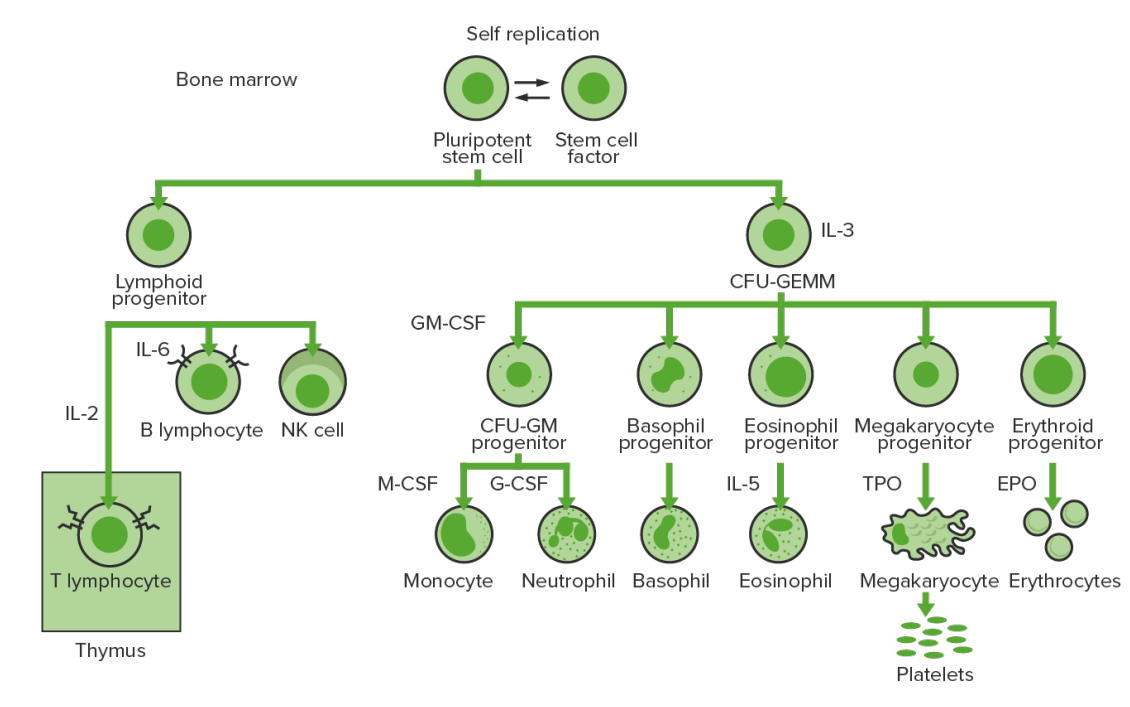
  • Las células madre linfoides dan lugar a los LOS Neisseria linfocitos:
    • Célula T
    • Célula B
    • Células asesinas naturales
  • Las células madre mieloides se diferencian en EN Erythema nodosum is an immune-mediated panniculitis (inflammation of the subcutaneous fat) caused by a type IV (delayed-type) hypersensitivity reaction. It commonly manifests in young women as tender, erythematous nodules on the shins. Erythema Nodosum plaquetas, eritrocitos, granulocitos (neutrófilos, basófilos, eosinófilos) y monocitos:
    • IL-3 estimula la diferenciación de células madre hematopoyéticas multipotentes en EN Erythema nodosum is an immune-mediated panniculitis (inflammation of the subcutaneous fat) caused by a type IV (delayed-type) hypersensitivity reaction. It commonly manifests in young women as tender, erythematous nodules on the shins. Erythema Nodosum células progenitoras mieloides.
    • Factor estimulante de colonias de granulocitos y macrófagos ( GM-CSF GM-CSF An acidic glycoprotein of mw 23 kda with internal disulfide bonds. The protein is produced in response to a number of inflammatory mediators by mesenchymal cells present in the hemopoietic environment and at peripheral sites of inflammation. GM-CSF is able to stimulate the production of neutrophilic granulocytes, macrophages, and mixed granulocyte-macrophage colonies from bone marrow cells and can stimulate the formation of eosinophil colonies from fetal liver progenitor cells. GM-CSF can also stimulate some functional activities in mature granulocytes and macrophages. White Myeloid Cells: Histology) → diferenciación de progenitores mieloides a granulocitos (neutrófilos) y monocitos
    • IL-5 → diferenciación a eosinófilos
    • Trombopoyetina → diferenciación a trombocitos (plaquetas)
    • EPO EPO Glycoprotein hormone, secreted chiefly by the kidney in the adult and the liver in the fetus, that acts on erythroid stem cells of the bone marrow to stimulate proliferation and differentiation. Erythrocytes: Histology → diferenciación a eritrocitos
Hematopoyesis de la médula ósea

Hematopoyesis de la médula ósea: proliferación y diferenciación de los elementos formes de la sangre.
CFU-GEMM: unidad formadora de colonias: granulocitos, eritrocitos, monocitos, megacariocitos
CFU-GM: unidad formadora de colonias de granulocitos y macrófagos
GM-CSF: factor estimulante de colonias de granulocitos y macrófagos
M-CSF: factor estimulante de colonias de macrófagos
G-CSF: factor estimulante de colonias de granulocitos
NK: células asesinas naturales
TPO: trombopoyetina

Imagen por Lecturio. Licencia: CC BY-NC-SA 4.0

Patogénesis

  • En EN Erythema nodosum is an immune-mediated panniculitis (inflammation of the subcutaneous fat) caused by a type IV (delayed-type) hypersensitivity reaction. It commonly manifests in young women as tender, erythematous nodules on the shins. Erythema Nodosum la leucemia mieloide aguda, la diferenciación mieloide se ve VE Ventilation: Mechanics of Breathing obstaculizada por mutaciones que afectan el desarrollo de células precursoras.
  • La leucemia mieloide aguda se asocia con alteraciones cromosómicas específicas como:
    • Translocación: interrupción t(8;21) del gen RUNX1 , que se requiere para la hematopoyesis normal
    • Inversión: disrupción inv(16) del gen CBFB
    • Supresión: del(5q)
  • Las células anormales proliferan, pero no pueden diferenciarse en EN Erythema nodosum is an immune-mediated panniculitis (inflammation of the subcutaneous fat) caused by a type IV (delayed-type) hypersensitivity reaction. It commonly manifests in young women as tender, erythematous nodules on the shins. Erythema Nodosum células sanguíneas maduras:
    • Las células leucémicas monoclonales ocupan el espacio de la médula ósea y suprimen la hematopoyesis normal → leucopenia, trombocitopenia y anemia Anemia Anemia is a condition in which individuals have low Hb levels, which can arise from various causes. Anemia is accompanied by a reduced number of RBCs and may manifest with fatigue, shortness of breath, pallor, and weakness. Subtypes are classified by the size of RBCs, chronicity, and etiology. Anemia: Overview and Types
    • Los LOS Neisseria blastos disfuncionales e inmaduros ingresan al AL Amyloidosis torrente sanguíneo e infiltran otros órganos.

Presentación Clínica

Características clínicas generales

  • Algunos pacientes son asintomáticos y presentan solo irregularidades en EN Erythema nodosum is an immune-mediated panniculitis (inflammation of the subcutaneous fat) caused by a type IV (delayed-type) hypersensitivity reaction. It commonly manifests in young women as tender, erythematous nodules on the shins. Erythema Nodosum las pruebas de laboratorio.
  • Signos y síntomas relacionados con anomalías hematológicas:
    • Anemia Anemia Anemia is a condition in which individuals have low Hb levels, which can arise from various causes. Anemia is accompanied by a reduced number of RBCs and may manifest with fatigue, shortness of breath, pallor, and weakness. Subtypes are classified by the size of RBCs, chronicity, and etiology. Anemia: Overview and Types:
      • Fatiga, taquicardia
      • Palidez
    • Trombocitopenia:
      • Hemorragias
      • Petequias
      • Equimosis
    • Neutropenia Neutropenia Neutrophils are an important component of the immune system and play a significant role in the eradication of infections. Low numbers of circulating neutrophils, referred to as neutropenia, predispose the body to recurrent infections or sepsis, though patients can also be asymptomatic. Neutropenia:
      • Fiebre
      • Infecciones recurrentes
    • Leucostasis o hiperleucocitosis:
      • Leucemia mieloide aguda con manifestaciones neurológicas y problemas respiratorios o mieloblastos > 50 000/μL, O
      • Leucemia mieloide aguda y mieloblastos > 100 000/μL
  • Signos adicionales de la leucemia mieloide aguda:
    • Leucemia cutis (lesiones cutáneas papulares o nodulares de color púrpura/gris azulado) y sarcoma mieloide: representan infiltración cutánea leucémica
    • Síndrome de Sweet: nódulos y placas sensibles
    • Hipertrofia gingival: infiltración observada en EN Erythema nodosum is an immune-mediated panniculitis (inflammation of the subcutaneous fat) caused by a type IV (delayed-type) hypersensitivity reaction. It commonly manifests in young women as tender, erythematous nodules on the shins. Erythema Nodosum la leucemia monocítica aguda y leucemia mielomonocítica aguda
    • Hemorragias o hematomas: signos de CID en EN Erythema nodosum is an immune-mediated panniculitis (inflammation of the subcutaneous fat) caused by a type IV (delayed-type) hypersensitivity reaction. It commonly manifests in young women as tender, erythematous nodules on the shins. Erythema Nodosum la leucemia promielocítica aguda
    • Cambios en EN Erythema nodosum is an immune-mediated panniculitis (inflammation of the subcutaneous fat) caused by a type IV (delayed-type) hypersensitivity reaction. It commonly manifests in young women as tender, erythematous nodules on the shins. Erythema Nodosum el campo visual, papiledema, infiltrados retinianos y parálisis de los LOS Neisseria nervios craneales: observados en EN Erythema nodosum is an immune-mediated panniculitis (inflammation of the subcutaneous fat) caused by a type IV (delayed-type) hypersensitivity reaction. It commonly manifests in young women as tender, erythematous nodules on the shins. Erythema Nodosum la leucemia mieloide aguda que invade el SNC
  • Organomegalia (hepatomegalia y esplenomegalia) observada en EN Erythema nodosum is an immune-mediated panniculitis (inflammation of the subcutaneous fat) caused by a type IV (delayed-type) hypersensitivity reaction. It commonly manifests in young women as tender, erythematous nodules on the shins. Erythema Nodosum aproximadamente el 10 % de los LOS Neisseria pacientes
  • Linfadenopatía: rara

Leucemia linfoblástica aguda vs. leucemia mieloide aguda

Tabla: LLA vs. LMA
Características LLA LMA
Población Más común en EN Erythema nodosum is an immune-mediated panniculitis (inflammation of the subcutaneous fat) caused by a type IV (delayed-type) hypersensitivity reaction. It commonly manifests in young women as tender, erythematous nodules on the shins. Erythema Nodosum niños Más común en EN Erythema nodosum is an immune-mediated panniculitis (inflammation of the subcutaneous fat) caused by a type IV (delayed-type) hypersensitivity reaction. It commonly manifests in young women as tender, erythematous nodules on the shins. Erythema Nodosum adultos
Características comunes
  • Síntomas de anemia Anemia Anemia is a condition in which individuals have low Hb levels, which can arise from various causes. Anemia is accompanied by a reduced number of RBCs and may manifest with fatigue, shortness of breath, pallor, and weakness. Subtypes are classified by the size of RBCs, chronicity, and etiology. Anemia: Overview and Types, trombocitopenia, neutropenia Neutropenia Neutrophils are an important component of the immune system and play a significant role in the eradication of infections. Low numbers of circulating neutrophils, referred to as neutropenia, predispose the body to recurrent infections or sepsis, though patients can also be asymptomatic. Neutropenia (por función medular deprimida)
  • Inicio brusco (días a semanas)
  • Afectación del SNC
Hallazgos clínicos
  • Hepato y esplenomegalia
  • Linfadenopatía
  • Dolor Dolor Inflammation óseo, más común
  • Puede afectar los LOS Neisseria testículos
  • Puede tener masa mediastínica
  • La organomegalia es menos frecuente
  • Linfadenopatía es rara
  • Leucemia cutis
  • Hipertrofia gingival
  • CID

Diagnóstico

Hallazgos diagnósticos

  • Hemograma con diferencial:
    • Anemia Anemia Anemia is a condition in which individuals have low Hb levels, which can arise from various causes. Anemia is accompanied by a reduced number of RBCs and may manifest with fatigue, shortness of breath, pallor, and weakness. Subtypes are classified by the size of RBCs, chronicity, and etiology. Anemia: Overview and Types, trombocitopenia
    • Variación en EN Erythema nodosum is an immune-mediated panniculitis (inflammation of the subcutaneous fat) caused by a type IV (delayed-type) hypersensitivity reaction. It commonly manifests in young women as tender, erythematous nodules on the shins. Erythema Nodosum los LOS Neisseria leucocitos
  • Frotis periférico:
    • Mieloblastos:
      • Citoplasma más voluminoso
      • Núcleos grandes
      • Nucléolos prominentes
      • Cromatina nuclear delgada/fina
      • Gránulos azurófilos positivos para peroxidasa
    • Bastones de Auer:
      • Estructuras rosadas/rojas, en EN Erythema nodosum is an immune-mediated panniculitis (inflammation of the subcutaneous fat) caused by a type IV (delayed-type) hypersensitivity reaction. It commonly manifests in young women as tender, erythematous nodules on the shins. Erythema Nodosum forma de aguja o bastón o gránulos en EN Erythema nodosum is an immune-mediated panniculitis (inflammation of the subcutaneous fat) caused by a type IV (delayed-type) hypersensitivity reaction. It commonly manifests in young women as tender, erythematous nodules on the shins. Erythema Nodosum el citoplasma
      • Están presente en EN Erythema nodosum is an immune-mediated panniculitis (inflammation of the subcutaneous fat) caused by a type IV (delayed-type) hypersensitivity reaction. It commonly manifests in young women as tender, erythematous nodules on the shins. Erythema Nodosum muchas formas de leucemia mieloide aguda, especialmente en EN Erythema nodosum is an immune-mediated panniculitis (inflammation of the subcutaneous fat) caused by a type IV (delayed-type) hypersensitivity reaction. It commonly manifests in young women as tender, erythematous nodules on the shins. Erythema Nodosum la leucemia promielocítica aguda t(15;17)
      • Ricos en EN Erythema nodosum is an immune-mediated panniculitis (inflammation of the subcutaneous fat) caused by a type IV (delayed-type) hypersensitivity reaction. It commonly manifests in young women as tender, erythematous nodules on the shins. Erythema Nodosum enzimas lisosomales/mieloperoxidasa ( MPO MPO Acute Myeloid Leukemia)
    • La mayoría de los LOS Neisseria mieloblastos son positivos para MPO MPO Acute Myeloid Leukemia, lo que confirman el linaje mieloide, pero algunas leucemias mieloides aguda son negativas.
  • Examen de médula ósea:
    • Habitualmente hipercelular: > 20% mieloblastos (algunas formas son excepcionales)
    • Una punción seca indica fibrosis Fibrosis Any pathological condition where fibrous connective tissue invades any organ, usually as a consequence of inflammation or other injury. Bronchiolitis Obliterans extensa o médula ósea hipercelular (compactada).
  • Citoquímica:
  • Inmunofenotipificación: los LOS Neisseria antígenos comunes incluyen CD13, CD33, CD117, HLA-DR.
  • Análisis genético: identifica mutaciones
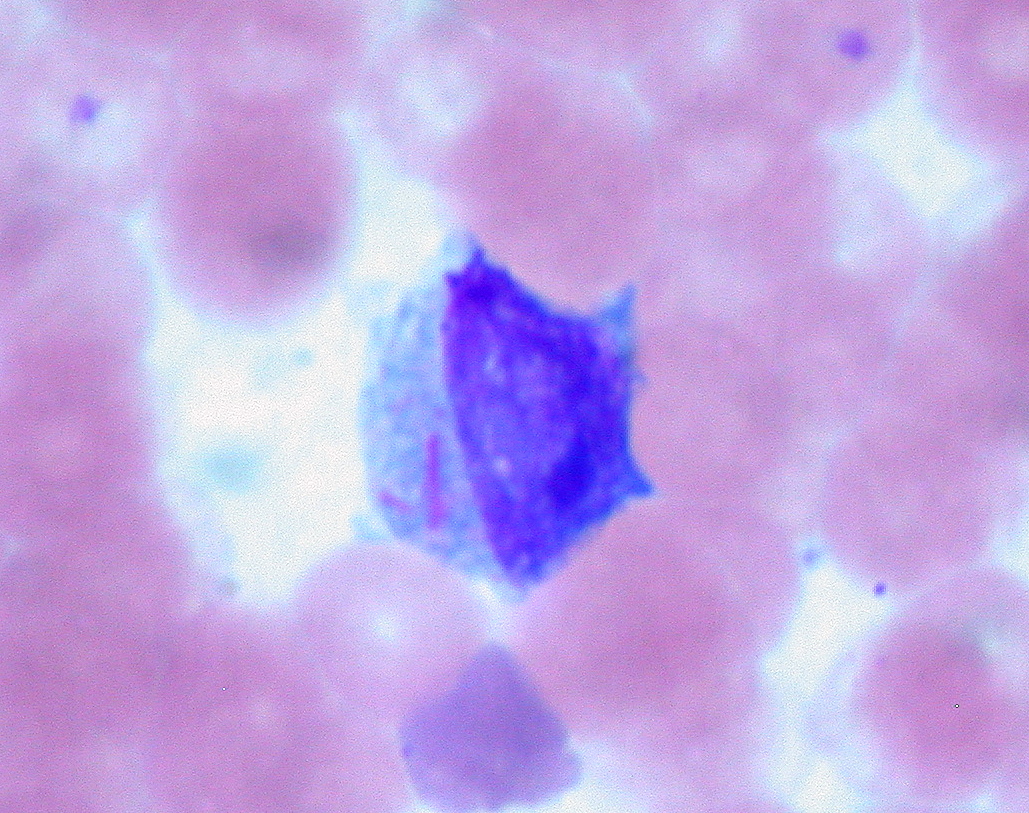
Hallazgos de AML en la médula ósea de las varillas de Auer

Leucemia mieloide aguda: hallazgos en la médula ósea de bastones de Auer (estructuras rosadas en forma de aguja en el citoplasma) en un mieloblasto

Imagen: “Auer Rods in Leukemic Blast” por Ed Uthman. Licencia: CC BY 2.0

Leucemia linfoblástica aguda vs. leucemia mieloide aguda

Tabla: LLA v. LMA
Características LLA LMA
Hallazgos de laboratorio Anemia Anemia Anemia is a condition in which individuals have low Hb levels, which can arise from various causes. Anemia is accompanied by a reduced number of RBCs and may manifest with fatigue, shortness of breath, pallor, and weakness. Subtypes are classified by the size of RBCs, chronicity, and etiology. Anemia: Overview and Types, trombocitopenia, variación en EN Erythema nodosum is an immune-mediated panniculitis (inflammation of the subcutaneous fat) caused by a type IV (delayed-type) hypersensitivity reaction. It commonly manifests in young women as tender, erythematous nodules on the shins. Erythema Nodosum los LOS Neisseria leucocitos
Frotis periférico o examen de médula ósea (morfología) Linfoblastos:
  • Núcleos grandes
  • Cromatina condensada
  • Nucléolos discretos
  • Citoplasma basófilo escaso
Mieloblastos:
  • Cromatina nuclear fina
  • Nucléolos prominentes (2–4)
  • Citoplasma más voluminoso
  • Gránulos finos de citoplasma azurofílico
  • Bastones de Auer
Citoquímica
Inmunofenotipificación
  • LLA-B/LBL: CD10, CD19, CD20, CD24, CD22 citoplasmático y CD-79a
  • LLA-T/LBL: CD2–8
CD13, CD33, CD117, HLA-DR

Tratamiento

Tratamiento

La quimioterapia requiere una evaluación previa al AL Amyloidosis tratamiento, incluidos los LOS Neisseria objetivos y preferencias del paciente, las comorbilidades, el funcionamiento físico y los LOS Neisseria factores pronósticos relacionados con el tipo de leucemia mieloide aguda.

  • Inducción intensiva a la remisión:
    • Objetivo: remisión
    • Citarabina + daunorrubicina o idarrubicina
    • Agente dirigido adicional según la mutación específica (e.g., midostaurina para leucemia mieloide aguda con mutación FLT3)
    • Asociada a múltiples efectos secundarios, que pueden requerir hospitalización prolongada:
      • Hemorragia
      • Infección
      • Citopenias
      • Síndromes de lisis tumoral
      • Alteraciones electrolíticas
    • Los LOS Neisseria pacientes delicados pueden recibir un tratamiento de menor intensidad.
  • Consolidación:
    • Objetivo: reducir el riesgo de recaída
    • Ciclos adicionales de quimioterapia (citarabina en EN Erythema nodosum is an immune-mediated panniculitis (inflammation of the subcutaneous fat) caused by a type IV (delayed-type) hypersensitivity reaction. It commonly manifests in young women as tender, erythematous nodules on the shins. Erythema Nodosum dosis altas)
    • Trasplante de células hematopoyéticas para enfermedades de alto riesgo o mal pronóstico
  • Mantenimiento:
    • Objetivo: mantener la remisión
    • Quimioterapia de dosis baja (no mielosupresora) y/o un agente dirigido
  • Tratamiento diferente para la leucemia promielocítica aguda (anteriormente conocida como M3):
    • La leucemia promielocítica aguda es la forma de presentación más maligna de la leucemia mieloide aguda (una emergencia médica):
      • Sin tratamiento, la mediana de supervivencia es < 1 mes.
      • Se presenta con hemorragia (CID) y leucopenia y blastos
      • Distinguida por su capacidad de respuesta al AL Amyloidosis tratamiento con ácido holo-trans retinoico
      • La translocación cromosómica t(15;17) conduce a una proteína de fusión, que funciona como receptor Receptor Receptors are proteins located either on the surface of or within a cell that can bind to signaling molecules known as ligands (e.g., hormones) and cause some type of response within the cell. Receptors ( receptor Receptor Receptors are proteins located either on the surface of or within a cell that can bind to signaling molecules known as ligands (e.g., hormones) and cause some type of response within the cell. Receptors de ácido retinoico alfa)
    • La terapia de inducción incluye ácido holo-trans retinoico + trióxido de arsénico
  • Trasplante de células hematopoyéticas alogénicas: preferido para pacientes con mal pronóstico, especialmente < 60 años de edad

Terapia de soporte y seguimiento

  • Vigilar la respuesta de la médula ósea.
  • Controlar los LOS Neisseria efectos secundarios de la quimioterapia (e.g., vómitos) y en EN Erythema nodosum is an immune-mediated panniculitis (inflammation of the subcutaneous fat) caused by a type IV (delayed-type) hypersensitivity reaction. It commonly manifests in young women as tender, erythematous nodules on the shins. Erythema Nodosum consecuencia tratarlos
  • Transfusiones de eritrocitos y plaquetas para la anemia Anemia Anemia is a condition in which individuals have low Hb levels, which can arise from various causes. Anemia is accompanied by a reduced number of RBCs and may manifest with fatigue, shortness of breath, pallor, and weakness. Subtypes are classified by the size of RBCs, chronicity, and etiology. Anemia: Overview and Types y la trombocitopenia
  • Factor estimulante de colonias de granulocitos (G-CSF) para la neutropenia Neutropenia Neutrophils are an important component of the immune system and play a significant role in the eradication of infections. Low numbers of circulating neutrophils, referred to as neutropenia, predispose the body to recurrent infections or sepsis, though patients can also be asymptomatic. Neutropenia
  • Modificación dietética (dieta neutropénica)
  • La Sociedad Estadounidense de Oncología Clínica recomienda:
    • Tratamiento profiláctico antibacteriano y antifúngico
    • Terapia antiviral Antiviral Antivirals for Hepatitis B profiláctica (para el anticuerpo core de la hepatitis B Hepatitis B Hepatitis B virus (HBV) is a partially double-stranded DNA virus, which belongs to the Orthohepadnavirus genus and the Hepadnaviridae family. Most individuals with acute HBV infection are asymptomatic or have mild, self-limiting symptoms. Chronic infection can be asymptomatic or create hepatic inflammation, leading to liver cirrhosis and hepatocellular carcinoma (HCC). Hepatitis B Virus y el VHS)
  • Monitoreo de vigilancia para:
    • Recaída: la leucemia mieloide aguda reaparece después de la remisión completa
    • Leucemia mieloide aguda refractaria: sin respuesta completa con terapia de inducción a la remisión

Pronóstico

  • Tasa de supervivencia de la leucemia mieloide aguda en EN Erythema nodosum is an immune-mediated panniculitis (inflammation of the subcutaneous fat) caused by a type IV (delayed-type) hypersensitivity reaction. It commonly manifests in young women as tender, erythematous nodules on the shins. Erythema Nodosum niños: aproximadamente 65%–70% (inferior a la leucemia linfocitica aguda)
  • Tasa de supervivencia de la leucemia mieloide aguda en EN Erythema nodosum is an immune-mediated panniculitis (inflammation of the subcutaneous fat) caused by a type IV (delayed-type) hypersensitivity reaction. It commonly manifests in young women as tender, erythematous nodules on the shins. Erythema Nodosum adultos (la supervivencia a 5 años disminuye a medida que aumenta la edad):
    • 25–39 años: 49%
    • 40–59 años: 33%
    • 60–69 años: 13%
    • 70–79 años: 3%
    • > 80 años: 0%
  • Mejor pronóstico:
    • < 50 años
    • Buena capacidad funcional/estado funcional (puntuación de Karnofsky > 60 %)
    • Resistencia a múltiples fármacos (MDR1) – fenotipo negativo
    • Sin trastornos hematológicos previos, radioterapia o quimioterapia.
    • t(8;21), inversión(16)/t(16;16), t(15;17)
    • Mutación NPM1, mutación CEBPA
  • Peor pronóstico:
    • Edad > 60 años
    • Baja capacidad funcional/estado funcional (puntuación de Karnofsky < 60%)
    • Fenotipo positivo para MDR1
    • Trastornos hematológicos previos o LMA relacionada con la terapia
    • Anomalías cariotípicas complejas (e.g., aberraciones 3q26, t(6;9), -5, -7)
    • Ciertas mutaciones: duplicación interna en EN Erythema nodosum is an immune-mediated panniculitis (inflammation of the subcutaneous fat) caused by a type IV (delayed-type) hypersensitivity reaction. It commonly manifests in young women as tender, erythematous nodules on the shins. Erythema Nodosum tándem de FLT3

Leucemia linfoblástica aguda vs. leucemia mieloide aguda

Tabla: LLA vs. LMA
Tratamiento LLA LMA
Inducción
  • Vincristina, corticoides, asparaginasa
  • ± Antraciclina (doxorrubicina o daunorrubicina)
  • Citarabina + daunorrubicina o idarrubicina
  • Agente dirigido adicional (basado en EN Erythema nodosum is an immune-mediated panniculitis (inflammation of the subcutaneous fat) caused by a type IV (delayed-type) hypersensitivity reaction. It commonly manifests in young women as tender, erythematous nodules on the shins. Erythema Nodosum la mutación)
Consolidation Consolidation Pulmonary Function Tests Opciones:
  • Citarabina
  • Metotrexato
  • Antraciclinas
  • Agentes alquilantes
  • Epipodofilotoxinas
Quimioterapia adicional (citarabina)
Mantenimiento
  • 6-MP 6-MP An antimetabolite antineoplastic agent with immunosuppressant properties. It interferes with nucleic acid synthesis by inhibiting purine metabolism and is used, usually in combination with other drugs, in the treatment of or in remission maintenance programs for leukemia. Antimetabolite Chemotherapy oral diario
  • Metotrexato semanal
  • Vincristina periódica, prednisona y terapia intratecal
Quimioterapia no mielosupresora y/o un agente dirigido
Tratamiento adicional
  • Inhibidores de la tirosina quinasa (e.g., imatinib Imatinib A tyrosine kinase inhibitor and antineoplastic agent that inhibits the bcr-abl kinase created by chromosome rearrangements in chronic myeloid leukemia and acute lymphoblastic leukemia, as well as pdg-derived tyrosine kinases that are overexpressed in gastrointestinal stromal tumors. Targeted and Other Nontraditional Antineoplastic Therapy) administrados para la translocación t(9;22) (cromosoma Filadelfia)
  • Terapia preventiva del SNC
Leucemia promielocítica aguda:
  • ¡Emergencia médica!
  • Administrar ácido holo-trans retinoico + trióxido de arsénico.
Trasplante de células hematopoyéticas Para aquellos con mal pronóstico
Pronóstico
  • Mejor pronóstico si <50 años
  • Pronóstico afectado por mutaciones asociadas

Diagnóstico Diferencial

  • Leucemia linfoblástica aguda: neoplasia hematológica caracterizada por la proliferación descontrolada de precursores linfocíticos. La leucemia linfoblástica aguda es el cáncer infantil más común. La médula normal es reemplazada por células malignas, seguida por la circulación de leucocitos inmaduros. La presentación clínica consiste en EN Erythema nodosum is an immune-mediated panniculitis (inflammation of the subcutaneous fat) caused by a type IV (delayed-type) hypersensitivity reaction. It commonly manifests in young women as tender, erythematous nodules on the shins. Erythema Nodosum fatiga, hemorragia, fiebre e infección (relacionada con anemia Anemia Anemia is a condition in which individuals have low Hb levels, which can arise from various causes. Anemia is accompanied by a reduced number of RBCs and may manifest with fatigue, shortness of breath, pallor, and weakness. Subtypes are classified by the size of RBCs, chronicity, and etiology. Anemia: Overview and Types, trombocitopenia y falta de leucocitos funcionales), que ocurren en EN Erythema nodosum is an immune-mediated panniculitis (inflammation of the subcutaneous fat) caused by a type IV (delayed-type) hypersensitivity reaction. It commonly manifests in young women as tender, erythematous nodules on the shins. Erythema Nodosum días o semanas. Los LOS Neisseria efectos de masa de la infiltración maligna ( en EN Erythema nodosum is an immune-mediated panniculitis (inflammation of the subcutaneous fat) caused by a type IV (delayed-type) hypersensitivity reaction. It commonly manifests in young women as tender, erythematous nodules on the shins. Erythema Nodosum hueso, hígado, bazo) son comunes. El diagnóstico se realiza mediante frotis de sangre periférica y biopsia de médula ósea que muestran linfoblastos. Por el contrario, la leucemia mieloide aguda es la proliferación de mieloblastos. El tratamiento es principalmente quimioterapia. La leucemia linfoblástica aguda generalmente conlleva un mejor pronóstico que la leucemia mieloide aguda.
  • Síndromes mielodisplásicos (SMD): grupo de neoplasias clonales con defectos de maduración, caracterizados por displasia, citopenias y precursores inmaduros de la médula ósea. Los LOS Neisseria pacientes se presentan cerca de los LOS Neisseria 70 años de edad con síntomas de anemia Anemia Anemia is a condition in which individuals have low Hb levels, which can arise from various causes. Anemia is accompanied by a reduced number of RBCs and may manifest with fatigue, shortness of breath, pallor, and weakness. Subtypes are classified by the size of RBCs, chronicity, and etiology. Anemia: Overview and Types, neutropenia Neutropenia Neutrophils are an important component of the immune system and play a significant role in the eradication of infections. Low numbers of circulating neutrophils, referred to as neutropenia, predispose the body to recurrent infections or sepsis, though patients can also be asymptomatic. Neutropenia o trombocitopenia. La evaluación de la médula ósea muestra citopenia, displasia en EN Erythema nodosum is an immune-mediated panniculitis (inflammation of the subcutaneous fat) caused by a type IV (delayed-type) hypersensitivity reaction. It commonly manifests in young women as tender, erythematous nodules on the shins. Erythema Nodosum 1 o más linajes y células blásticas en EN Erythema nodosum is an immune-mediated panniculitis (inflammation of the subcutaneous fat) caused by a type IV (delayed-type) hypersensitivity reaction. It commonly manifests in young women as tender, erythematous nodules on the shins. Erythema Nodosum < 20% de la celularidad de la médula, lo que ayuda a distinguir los LOS Neisseria SMD. El mayor riesgo acumulativo de transformación a leucemia mieloide aguda varía según el subtipo del síndrome mielodisplásico. La leucemia mieloide aguda que se desarrolla a partir de síndrome mielodisplásico lo que conlleva un mal pronóstico.
  • Mielofibrosis primaria: una neoplasia caracterizada por mieloproliferación crónica con depósito no clonal de fibroblastos, lo que resulta en EN Erythema nodosum is an immune-mediated panniculitis (inflammation of the subcutaneous fat) caused by a type IV (delayed-type) hypersensitivity reaction. It commonly manifests in young women as tender, erythematous nodules on the shins. Erythema Nodosum fibrosis Fibrosis Any pathological condition where fibrous connective tissue invades any organ, usually as a consequence of inflammation or other injury. Bronchiolitis Obliterans de la médula ósea. La afección está asociada con una mutación genética (típicamente mutación JAK2). Los LOS Neisseria hallazgos clínicos incluyen fatiga intensa, pérdida de peso y hepatoesplenomegalia. Los LOS Neisseria estudios de laboratorio incluyen citopenia y estudios de médula ósea con punción seca (lo que representa una fibrosis Fibrosis Any pathological condition where fibrous connective tissue invades any organ, usually as a consequence of inflammation or other injury. Bronchiolitis Obliterans extensa) y pueden parecerse a la leucemia mieloide aguda. La mielofibrosis primaria puede transformarse en EN Erythema nodosum is an immune-mediated panniculitis (inflammation of the subcutaneous fat) caused by a type IV (delayed-type) hypersensitivity reaction. It commonly manifests in young women as tender, erythematous nodules on the shins. Erythema Nodosum leucemia mieloide aguda, que suele ser la causa de la muerte.
  • Reacción leucemoide: un recuento leucocitario > 50 000/μL por causas distintas a la leucemia. Son típicas la neutrofilia y la desviación prominente a la izquierda, por lo general en EN Erythema nodosum is an immune-mediated panniculitis (inflammation of the subcutaneous fat) caused by a type IV (delayed-type) hypersensitivity reaction. It commonly manifests in young women as tender, erythematous nodules on the shins. Erythema Nodosum respuesta a una infección. Los LOS Neisseria hallazgos incluyen granulación tóxica en EN Erythema nodosum is an immune-mediated panniculitis (inflammation of the subcutaneous fat) caused by a type IV (delayed-type) hypersensitivity reaction. It commonly manifests in young women as tender, erythematous nodules on the shins. Erythema Nodosum los LOS Neisseria neutrófilos y (lo más importante) la presencia de una causa obvia de la neutrofilia. Las pruebas citogenéticas o moleculares también lo distinguen de la leucemia mieloide aguda. El tratamiento es de soporte con el tratamiento de la etiología subyacente y leucaféresis si hay hiperviscosidad.

Referencias

  1. Arber, D.A., et al. (2016). The 2016 revision to the World Health Organization classification of myeloid neoplasms and acute leukemia. Blood. 127(20), 2391–2405. Retrieved April 26, 2021, from https://doi.org/10.1182/blood-2016-03-643544
  2. Blum, W., Bloomfield, C.D. (2018). Acute myeloid leukemia. In Jameson, J., et al. (Eds.), Harrison’s Principles of Internal Medicine, 20e. McGraw-Hill. https://accessmedicine.mhmedical.com/content.aspx?bookid=2129&sectionid=192017732
  3. Weir, E. G., & Borowitz, M. J. (2001). Flow cytometry in the diagnosis of acute leukemia. Seminars in Hematology, 38(2), 124–138. https://doi.org/10.1016/S0037-1963(01)90046-0
  4. Hoelzer, D. (2018). Acute lymphoid leukemia. In Jameson J., et al. (Eds.), Harrison’s Principles of Internal Medicine, 20e. McGraw-Hill. https://accessmedicine.mhmedical.com/content.aspx?bookid=2129&sectionid=192017841
  5. Horton, T.M., Steuber, P., Aster, J.C. (2021). Overview of the clinical presentation and diagnosis of acute lymphoblastic leukemia/lymphoma in children. UpToDate. Retrieved April 27, 2021, from https://www.uptodate.com/contents/overview-of-the-clinical-presentation-and-diagnosis-of-acute-lymphoblastic-leukemia-lymphoma-in-children
  6. Atallah, E. (2025). Chronic myeloid leukemia: Pathogenesis, clinical manifestations, and diagnosis. In R. A. Larson (Ed.), UpToDate. Wolters Kluwer. Retrieved June 3, 2025, from https://www.uptodate.com/contents/chronic-myeloid-leukemia-pathogenesis-clinical-manifestations-and-diagnosis
  7. Larson, R. (2021). Initial treatment of acute promyelocytic leukemia in adults. UpToDate. Retrieved June 9, 2021, from https://www.uptodate.com/contents/initial-treatment-of-acute-promyelocytic-leukemia-in-adults
  8. Larson, R. (2021). Induction therapy for acute myeloid leukemia in medically-fit adults. UpToDate. Retrieved June 9, 2021, from https://www.uptodate.com/contents/induction-therapy-for-acute-myeloid-leukemia-in-medically-fit-adults
  9. Larson, R., Klepin, H. (2021). Pretreatment evaluation and prognosis of acute myeloid leukemia in older adults. UpToDate. Retrieved June 9, 2021, from https://www.uptodate.com/contents/pretreatment-evaluation-and-prognosis-of-acute-myeloid-leukemia-in-older-adults
  10. Roberts, K. G. (2018). Genetics and prognosis of ALL in children vs. adults. Hematology. American Society of Hematology. Education Program. 2018(1), 137–145. https://doi.org/10.1182/asheducation-2018.1.137
  11. Schiffer, C. (2021). Prognosis of acute myeloid leukemia. UpToDate. Retrieved June 9, 2021, from https://www.uptodate.com/contents/prognosis-of-acute-myeloid-leukemia

¡Crea tu cuenta gratis o inicia una sesión para seguir leyendo!

Regístrate ahora y obtén acceso gratuito a Lecturio con páginas de concepto, videos médicos y cuestionarios para tu educación médica.

User Reviews

Que tengas una sesión de estudio alegre y navideña 🎁 Ahorra 50% en todos los planes >>

Details