Domina Conceptos Médicos

Estudia para la escuela de medicina y tus examenes con Lecturio.

Hormonas: Generalidades y Tipos

Las hormonas son moléculas mensajeras que se sintetizan en EN Erythema nodosum is an immune-mediated panniculitis (inflammation of the subcutaneous fat) caused by a type IV (delayed-type) hypersensitivity reaction. It commonly manifests in young women as tender, erythematous nodules on the shins. Erythema Nodosum una parte del cuerpo y se mueven a través del torrente sanguíneo para ejercer efectos reguladores específicos en EN Erythema nodosum is an immune-mediated panniculitis (inflammation of the subcutaneous fat) caused by a type IV (delayed-type) hypersensitivity reaction. It commonly manifests in young women as tender, erythematous nodules on the shins. Erythema Nodosum otra parte del cuerpo. Las hormonas juegan un papel fundamental en EN Erythema nodosum is an immune-mediated panniculitis (inflammation of the subcutaneous fat) caused by a type IV (delayed-type) hypersensitivity reaction. It commonly manifests in young women as tender, erythematous nodules on the shins. Erythema Nodosum la coordinación de las actividades celulares en EN Erythema nodosum is an immune-mediated panniculitis (inflammation of the subcutaneous fat) caused by a type IV (delayed-type) hypersensitivity reaction. It commonly manifests in young women as tender, erythematous nodules on the shins. Erythema Nodosum todo el cuerpo en EN Erythema nodosum is an immune-mediated panniculitis (inflammation of the subcutaneous fat) caused by a type IV (delayed-type) hypersensitivity reaction. It commonly manifests in young women as tender, erythematous nodules on the shins. Erythema Nodosum respuesta a los LOS Neisseria cambios constantes en EN Erythema nodosum is an immune-mediated panniculitis (inflammation of the subcutaneous fat) caused by a type IV (delayed-type) hypersensitivity reaction. It commonly manifests in young women as tender, erythematous nodules on the shins. Erythema Nodosum los LOS Neisseria entornos interno y externo. El trabajo de las hormonas permite que el cuerpo mantenga la homeostasis Homeostasis The processes whereby the internal environment of an organism tends to remain balanced and stable. Cell Injury and Death y regule el crecimiento y el desarrollo. Las hormonas generalmente se fabrican a partir de aminoácidos o se derivan del colesterol (este último grupo se conoce como hormonas esteroideas). Las hormonas ejercen sus efectos uniéndose a receptores en EN Erythema nodosum is an immune-mediated panniculitis (inflammation of the subcutaneous fat) caused by a type IV (delayed-type) hypersensitivity reaction. It commonly manifests in young women as tender, erythematous nodules on the shins. Erythema Nodosum la superficie celular (la mayoría de las hormonas basadas en EN Erythema nodosum is an immune-mediated panniculitis (inflammation of the subcutaneous fat) caused by a type IV (delayed-type) hypersensitivity reaction. It commonly manifests in young women as tender, erythematous nodules on the shins. Erythema Nodosum aminoácidos) o dentro del citosol (hormonas esteroideas). En EN Erythema nodosum is an immune-mediated panniculitis (inflammation of the subcutaneous fat) caused by a type IV (delayed-type) hypersensitivity reaction. It commonly manifests in young women as tender, erythematous nodules on the shins. Erythema Nodosum última instancia, la unión a los LOS Neisseria receptores desencadena cambios en EN Erythema nodosum is an immune-mediated panniculitis (inflammation of the subcutaneous fat) caused by a type IV (delayed-type) hypersensitivity reaction. It commonly manifests in young women as tender, erythematous nodules on the shins. Erythema Nodosum la expresión génica o la actividad enzimática dentro de la célula.

Last updated: Dec 15, 2025

Editorial responsibility: Stanley Oiseth, Lindsay Jones, Evelin Maza

Hormonas y Glándulas Endocrinas

Definición

Las hormonas son moléculas mensajeras que se sintetizan en EN Erythema nodosum is an immune-mediated panniculitis (inflammation of the subcutaneous fat) caused by a type IV (delayed-type) hypersensitivity reaction. It commonly manifests in young women as tender, erythematous nodules on the shins. Erythema Nodosum una parte del cuerpo y se mueven a través del torrente sanguíneo para ejercer efectos reguladores específicos en EN Erythema nodosum is an immune-mediated panniculitis (inflammation of the subcutaneous fat) caused by a type IV (delayed-type) hypersensitivity reaction. It commonly manifests in young women as tender, erythematous nodules on the shins. Erythema Nodosum otra parte del cuerpo.

Funciones generales de las hormonas

Las principales funciones de las hormonas incluyen:

  • Respondiendo a los LOS Neisseria entornos internos y externos:
    • Estrés físico (e.g., lesión, ejercicio)
    • Estrés bioquímico (e.g., ↓ azúcar en EN Erythema nodosum is an immune-mediated panniculitis (inflammation of the subcutaneous fat) caused by a type IV (delayed-type) hypersensitivity reaction. It commonly manifests in young women as tender, erythematous nodules on the shins. Erythema Nodosum sangre, hiperpotasemia, hipercalcemia)
    • Estrés mental (e.g., miedo/peligro)
  • Coordinación de respuestas celulares y tisulares entre múltiples sistemas de órganos
  • Regulación de las funciones corporales:
    • Crecimiento y desarrollo
    • Ritmos biológicos (e.g., ciclos de sueño circadianos, ciclo menstrual)
    • Digestión

Glándulas y órganos endocrinos

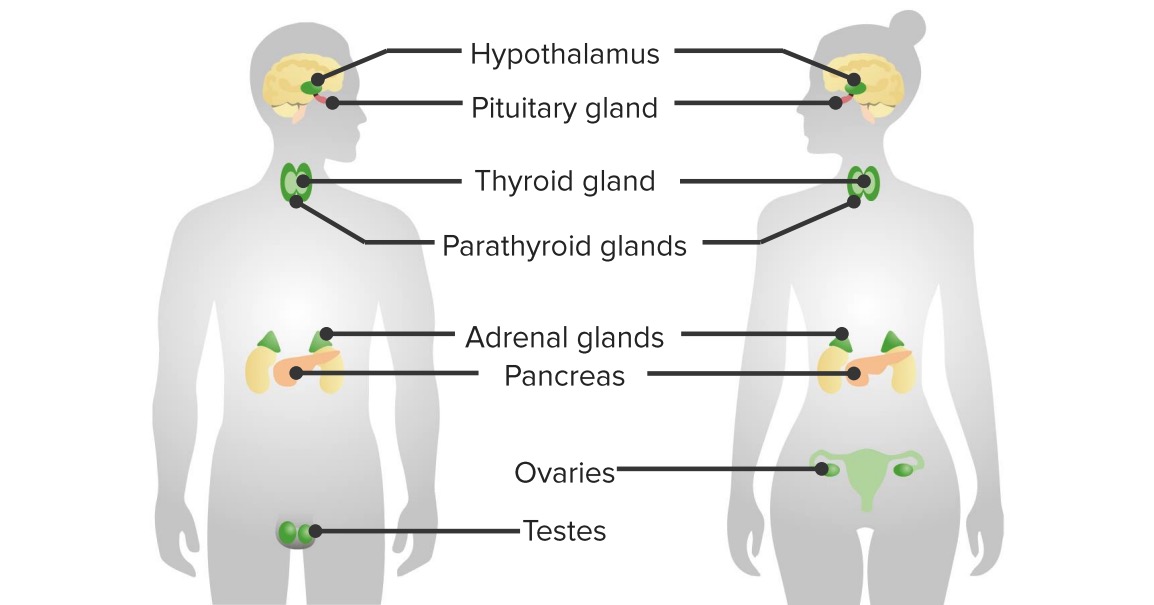
Las principales glándulas endocrinas del cuerpo incluyen:

  • Hipotálamo
  • Hipófisis:
    • Anterior
    • Posterior
  • Glándula pineal
  • Glándula tiroidea
  • Glándula paratiroidea
  • Sistema gastrointestinal:
    • Páncreas
    • Estómago
    • intestinos
  • Glándulas suprarrenales:
    • Corteza suprarrenal
    • Médula suprarrenal
  • Gónadas:
    • Testículos
    • Ovarios
  • Placenta Placenta A highly vascularized mammalian fetal-maternal organ and major site of transport of oxygen, nutrients, and fetal waste products. It includes a fetal portion (chorionic villi) derived from trophoblasts and a maternal portion (decidua) derived from the uterine endometrium. The placenta produces an array of steroid, protein and peptide hormones (placental hormones). Placenta, Umbilical Cord, and Amniotic Cavity
Tabla: Principales órganos endocrinos y sus hormonas primarias
Glándula/órgano Hormona secretada por la glándula/órgano Efecto primario de la hormona
Hipotálamo Hormona liberadora de tirotropina Estimula los LOS Neisseria tirotropos hipofisarios para secretar hormona estimulante de la tiroides
Hormona liberadora de corticotropina Estimula a los LOS Neisseria corticotropos hipofisarios para que secreten la hormona adrenocorticotropa (ACTH, por sus siglas en EN Erythema nodosum is an immune-mediated panniculitis (inflammation of the subcutaneous fat) caused by a type IV (delayed-type) hypersensitivity reaction. It commonly manifests in young women as tender, erythematous nodules on the shins. Erythema Nodosum inglés)
Hormona liberadora de gonadotropina Estimula a los LOS Neisseria gonadotropos hipofisarios para que secreten hormona foliculoestimulante y hormona luteinizante
Hormona liberadora de la hormona del crecimiento Estimula los LOS Neisseria somatotropos hipofisarios para secretar hormona del crecimiento
Somatostatina Inhibe la liberación de hormona del crecimiento y hormona estimulante de la tiroides de la hipófisis
Dopamina Inhibe la liberación de prolactina de los LOS Neisseria lactotropos hipofisarios
Hipófisis anterior Hormona estimulante de la tiroides Estimula la secreción de las hormonas tiroideas
ACTH Estimula la secreción de hormonas por la corteza suprarrenal
Hormona foliculoestimulante Estimula la producción de gametos en EN Erythema nodosum is an immune-mediated panniculitis (inflammation of the subcutaneous fat) caused by a type IV (delayed-type) hypersensitivity reaction. It commonly manifests in young women as tender, erythematous nodules on the shins. Erythema Nodosum las gónadas
Hormona luteinizante Estimula la producción de andrógenos gonadales
Hormona de crecimiento Promueve el crecimiento de los LOS Neisseria tejidos del cuerpo
Prolactina Favorece la producción de leche materna
Hipófisis posterior Hormona antidiurética Estimula la absorción de agua por los LOS Neisseria riñones
Oxitocina Estimula:
  • Contracciones uterinas durante el parto
  • Liberación de leche materna durante la lactancia
Glándula pineal Melatonina Regula los LOS Neisseria ciclos de sueño
Glándula tiroidea Hormonas tiroideas:
  • Tiroxina (T4)
  • Triyodotironina (T3)
Estimula el metabolismo celular
Calcitonina ↓ Ca2+ sérico
Glándula paratiroidea Hormona paratiroidea (PTH, por sus siglas en EN Erythema nodosum is an immune-mediated panniculitis (inflammation of the subcutaneous fat) caused by a type IV (delayed-type) hypersensitivity reaction. It commonly manifests in young women as tender, erythematous nodules on the shins. Erythema Nodosum inglés) Ca CA Condylomata acuminata are a clinical manifestation of genital HPV infection. Condylomata acuminata are described as raised, pearly, flesh-colored, papular, cauliflower-like lesions seen in the anogenital region that may cause itching, pain, or bleeding. Condylomata Acuminata (Genital Warts)2+ sérico
Corteza suprarrenal Mineralocorticoides: aldosterona
  • ↑ Presión arterial (↑ reabsorción de agua de los LOS Neisseria riñones)
  • ↑ Na+ sérico (↓ excreción urinaria de Na+)
  • ↓ K+ sérico (↑ excreción urinaria de K+)
  • pH pH The quantitative measurement of the acidity or basicity of a solution. Acid-Base Balance sérico (↑ excreción urinaria de H+)
Glucocorticoides:
  • ↑ Energía disponible inmediata a través de:
    • Catabolismo de grasas y proteínas
    • Gluconeogénesis
    • Estimula el apetito
  • ↑ Resorción ósea al AL Amyloidosis Ca CA Condylomata acuminata are a clinical manifestation of genital HPV infection. Condylomata acuminata are described as raised, pearly, flesh-colored, papular, cauliflower-like lesions seen in the anogenital region that may cause itching, pain, or bleeding. Condylomata Acuminata (Genital Warts)2+ sérico
  • Efectos antiinflamatorios
Andrógenos Estimula las características sexuales secundarias
Médula suprarrenal Catecolaminas:
  • Epinefrina
  • Noradrenalina
Estimula la reacción de lucha o huida
Gónadas Testosterona Estimula:
  • El desarrollo de las características sexuales masculinas primarias y secundarias
  • Espermatogénesis
  • ↑ Crecimiento óseo y muscular
Estrógeno y progesterona
  • Estimular el desarrollo de las características sexuales femeninas secundarias
  • Preparar el útero para el embarazo
  • ↑ Densidad ósea
Inhibina Inhibe selectivamente la liberación de hormona foliculoestimulante
Placenta Placenta A highly vascularized mammalian fetal-maternal organ and major site of transport of oxygen, nutrients, and fetal waste products. It includes a fetal portion (chorionic villi) derived from trophoblasts and a maternal portion (decidua) derived from the uterine endometrium. The placenta produces an array of steroid, protein and peptide hormones (placental hormones). Placenta, Umbilical Cord, and Amniotic Cavity Estrógeno Apoya la fisiología materna durante el embarazo
Progesterona
  • Inhibe la contractilidad uterina durante el embarazo
  • Funciones antiinflamatorias
Gonadotropina coriónica humana (hCG, por sus siglas en EN Erythema nodosum is an immune-mediated panniculitis (inflammation of the subcutaneous fat) caused by a type IV (delayed-type) hypersensitivity reaction. It commonly manifests in young women as tender, erythematous nodules on the shins. Erythema Nodosum inglés) Mantiene la actividad endocrina del cuerpo lúteo
Lactógeno placentario humano Altera la secreción de insulina materna para ↑ glucosa para el feto
Factor de crecimiento similar a la insulina Regula el crecimiento fetal
Hormona liberadora de ACTH placentaria y glucocorticoides Regular Regular Insulin el desarrollo y la maduración de los LOS Neisseria órganos
Tabla: Otros órganos con función endocrina
Glándula/órgano Hormona secretada por la glándula/órgano Efecto primario de la hormona
Estómago Gastrina, histamina Estimula la secreción de ácido clorhídrico ( HCl HCL Hairy cell leukemia (HCL) is a rare, chronic, B-cell leukemia characterized by the accumulation of small mature B lymphocytes that have “hair-like projections” visible on microscopy. The abnormal cells accumulate in the peripheral blood, bone marrow (causing fibrosis), and red pulp of the spleen, leading to cytopenias. Hairy Cell Leukemia) en EN Erythema nodosum is an immune-mediated panniculitis (inflammation of the subcutaneous fat) caused by a type IV (delayed-type) hypersensitivity reaction. It commonly manifests in young women as tender, erythematous nodules on the shins. Erythema Nodosum el estómago
Serotonina Estimula la motilidad gástrica
Páncreas Insulina ↓ Niveles de azúcar en EN Erythema nodosum is an immune-mediated panniculitis (inflammation of the subcutaneous fat) caused by a type IV (delayed-type) hypersensitivity reaction. It commonly manifests in young women as tender, erythematous nodules on the shins. Erythema Nodosum la sangre al AL Amyloidosis mover la glucosa a través de las membranas celulares hacia el espacio intracelular
Glucagón ↑ Niveles de azúcar en EN Erythema nodosum is an immune-mediated panniculitis (inflammation of the subcutaneous fat) caused by a type IV (delayed-type) hypersensitivity reaction. It commonly manifests in young women as tender, erythematous nodules on the shins. Erythema Nodosum sangre al AL Amyloidosis estimular la gluconeogénesis y la glucogenólisis
Intestinos Secretina
  • Inhibe la liberación de HCl HCL Hairy cell leukemia (HCL) is a rare, chronic, B-cell leukemia characterized by the accumulation of small mature B lymphocytes that have “hair-like projections” visible on microscopy. The abnormal cells accumulate in the peripheral blood, bone marrow (causing fibrosis), and red pulp of the spleen, leading to cytopenias. Hairy Cell Leukemia
  • Estimula las secreciones pancreáticas
Colecistoquinina
  • ↑ Secreciones de enzimas gastrointestinales
  • Estimula la contracción de la vesícula biliar
Polipéptido insulinotrópico dependiente de la glucosa
  • Hormona incretina que estimula la secreción de insulina dependiente de la glucosa
  • Inhibe la liberación de glucagón
Péptido similar al AL Amyloidosis glucagón-1 ( GLP-1 GLP-1 A peptide of 36 or 37 amino acids that is derived from proglucagon and mainly produced by the intestinal l cells. Glp-1(1-37 or 1-36) is further n-terminally truncated resulting in glp-1(7-37) or glp-1-(7-36) which can be amidated. These glp-1 peptides are known to enhance glucose-dependent insulin release, suppress glucagon release and gastric emptying, lower blood glucose, and reduce food intake. Insulinomas)
  • Hormona incretina que aumenta la secreción de insulina dependiente de la glucosa
  • Retarda el vaciamiento gástrico
  • Promueve la saciedad
Timo Timopoyetina Regula la función inmunológica
Tejido adiposo Leptina Suprime la ingesta de alimentos
Corazón Péptido natriurético auricular (ANP, por sus siglas en EN Erythema nodosum is an immune-mediated panniculitis (inflammation of the subcutaneous fat) caused by a type IV (delayed-type) hypersensitivity reaction. It commonly manifests in young women as tender, erythematous nodules on the shins. Erythema Nodosum inglés) Reduce el volumen plasmático al AL Amyloidosis estimular la diuresis
Hígado Angiotensinógeno Un precursor de la angiotensina II, un potente vasoconstrictor que estimula la aldosterona
Órganos principales del sistema endocrino

Órganos principales del sistema endocrino

Imagen por Lecturio.

Tipos de Hormonas

Hormonas a base de aminoácidos

La mayoría de las hormonas están basadas en EN Erythema nodosum is an immune-mediated panniculitis (inflammation of the subcutaneous fat) caused by a type IV (delayed-type) hypersensitivity reaction. It commonly manifests in young women as tender, erythematous nodules on the shins. Erythema Nodosum aminoácidos.

  • Las hormonas pueden ser:
    • Derivadas de aminoácidos simples:
      • Más comúnmente derivadas de la tirosina
      • Ejemplo: epinefrina
    • Péptidos:
      • Cadenas cortas de aminoácidos
      • Ejemplo: insulina
    • Proteínas:
      • Largas cadenas de aminoácidos
      • Ejemplo: factor de crecimiento epidérmico
  • Pueden tener un componente carbohidrato → glicoproteínas
  • Disolverse en EN Erythema nodosum is an immune-mediated panniculitis (inflammation of the subcutaneous fat) caused by a type IV (delayed-type) hypersensitivity reaction. It commonly manifests in young women as tender, erythematous nodules on the shins. Erythema Nodosum plasma Plasma The residual portion of blood that is left after removal of blood cells by centrifugation without prior blood coagulation. Transfusion Products:
    • Viajan libremente al AL Amyloidosis lugar de la acción
    • Vida media relativamente más corta en EN Erythema nodosum is an immune-mediated panniculitis (inflammation of the subcutaneous fat) caused by a type IV (delayed-type) hypersensitivity reaction. It commonly manifests in young women as tender, erythematous nodules on the shins. Erythema Nodosum comparación con las hormonas esteroideas
  • Se unen a los LOS Neisseria receptores en EN Erythema nodosum is an immune-mediated panniculitis (inflammation of the subcutaneous fat) caused by a type IV (delayed-type) hypersensitivity reaction. It commonly manifests in young women as tender, erythematous nodules on the shins. Erythema Nodosum la superficie de la membrana celular
    • Excepción: hormonas tiroideas → hormonas derivadas de aminoácidos que tienen receptores intracelulares

Hormonas esteroideas

  • Sintetizadas a partir de colesterol → lipofílicas
  • Unidas a proteínas plasmáticas en EN Erythema nodosum is an immune-mediated panniculitis (inflammation of the subcutaneous fat) caused by a type IV (delayed-type) hypersensitivity reaction. It commonly manifests in young women as tender, erythematous nodules on the shins. Erythema Nodosum la sangre:
    • Las proteínas funcionan como un reservorio.
    • Vida media relativamente más larga, en EN Erythema nodosum is an immune-mediated panniculitis (inflammation of the subcutaneous fat) caused by a type IV (delayed-type) hypersensitivity reaction. It commonly manifests in young women as tender, erythematous nodules on the shins. Erythema Nodosum comparación con las hormonas de aminoácidos
  • Pueden moverse a través de la bicapa lipídica de la membrana celular → las hormonas esteroideas se unen a los LOS Neisseria receptores dentro de las células
  • Principalmente incluyen:
    • Hormonas suprarrenales
    • Hormonas gonadales

Señalización Hormonal

La mayoría de las hormonas se unen a los LOS Neisseria receptores, que luego transmiten su mensaje a través de mensajeros secundarios y/o cascadas de señales. Las hormonas esteroideas, cuando se unen a sus receptores, pueden unirse directamente al AL Amyloidosis ácido desoxirribonucleico (ADN) y afectar la expresión génica.

Modos de comunicación

Hay varias formas en EN Erythema nodosum is an immune-mediated panniculitis (inflammation of the subcutaneous fat) caused by a type IV (delayed-type) hypersensitivity reaction. It commonly manifests in young women as tender, erythematous nodules on the shins. Erythema Nodosum que las hormonas envían mensajes por todo el cuerpo:

  • Hormonas endocrinas: liberadas por células especializadas y viajan a través de la sangre a un sitio de acción distante (hormonas verdaderas)
  • Hormonas paracrinas: liberadas en EN Erythema nodosum is an immune-mediated panniculitis (inflammation of the subcutaneous fat) caused by a type IV (delayed-type) hypersensitivity reaction. It commonly manifests in young women as tender, erythematous nodules on the shins. Erythema Nodosum el líquido intersticial para actuar sobre las células vecinas
  • Hormonas autocrinas: las células liberan hormonas para regularse a sí mismas.
  • Hormonas neuroendocrinas: las neuronas liberan una neurohormona que se lleva a través de la sangre a su sitio de acción distante.

Señalización a través de receptores de hormonas de membrana plasmática

Los LOS Neisseria receptores de membrana plasmática suelen ser necesarios para las hormonas basadas en EN Erythema nodosum is an immune-mediated panniculitis (inflammation of the subcutaneous fat) caused by a type IV (delayed-type) hypersensitivity reaction. It commonly manifests in young women as tender, erythematous nodules on the shins. Erythema Nodosum aminoácidos y utilizan sistemas de 2do mensajero y cascadas de señales:

  • 2dos mensajeros:
    • Una hormona que se une a su receptor Receptor Receptors are proteins located either on the surface of or within a cell that can bind to signaling molecules known as ligands (e.g., hormones) and cause some type of response within the cell. Receptors desencadena la liberación de los LOS Neisseria 2dos mensajeros, que luego ejercen un efecto dentro de la célula.
    • Típicamente, moléculas pequeñas (a menudo no son proteínas)
    • Los LOS Neisseria 2dos mensajeros comunes incluyen:
      • Inositol-1,4,5-trifosfato ( IP3 IP3 Intracellular messenger formed by the action of phospholipase C on phosphatidylinositol 4, 5-bisphosphate, which is one of the phospholipids that make up the cell membrane. Inositol 1, 4, 5-trisphosphate is released into the cytoplasm where it releases calcium ions from internal stores within the cell’s endoplasmic reticulum. These calcium ions stimulate the activity of B kinase or calmodulin. Second Messengers)
      • Adenosín monofosfato cíclico
      • Guanosín monofosfato cíclico
      • Ca CA Condylomata acuminata are a clinical manifestation of genital HPV infection. Condylomata acuminata are described as raised, pearly, flesh-colored, papular, cauliflower-like lesions seen in the anogenital region that may cause itching, pain, or bleeding. Condylomata Acuminata (Genital Warts)2+
  • Cascadas de señalización:
    • Unión de la hormona a su receptor Receptor Receptors are proteins located either on the surface of or within a cell that can bind to signaling molecules known as ligands (e.g., hormones) and cause some type of response within the cell. Receptors → desencadena un cambio conformacional dentro del receptor Receptor Receptors are proteins located either on the surface of or within a cell that can bind to signaling molecules known as ligands (e.g., hormones) and cause some type of response within the cell. Receptors → desencadena una reacción en EN Erythema nodosum is an immune-mediated panniculitis (inflammation of the subcutaneous fat) caused by a type IV (delayed-type) hypersensitivity reaction. It commonly manifests in young women as tender, erythematous nodules on the shins. Erythema Nodosum la siguiente proteína en EN Erythema nodosum is an immune-mediated panniculitis (inflammation of the subcutaneous fat) caused by a type IV (delayed-type) hypersensitivity reaction. It commonly manifests in young women as tender, erythematous nodules on the shins. Erythema Nodosum la cascada → desencadena una reacción en EN Erythema nodosum is an immune-mediated panniculitis (inflammation of the subcutaneous fat) caused by a type IV (delayed-type) hypersensitivity reaction. It commonly manifests in young women as tender, erythematous nodules on the shins. Erythema Nodosum la siguiente proteína, y así sucesivamente
    • Las cascadas de señales pueden incluir:
      • Modificación covalente secuencial de proteínas aguas abajo (a menudo agregando o eliminando fosfatos de las proteínas)
      • Liberación de 2dos mensajeros
  • Los LOS Neisseria resultados finales de la señalización suelen incluir:
    • Expresión genética alterada
    • Cambio de actividades enzimáticas

Señalización a través de receptores de hormonas intracelulares

Los LOS Neisseria receptores intracelulares generalmente provocan la activación directa de genes Genes A category of nucleic acid sequences that function as units of heredity and which code for the basic instructions for the development, reproduction, and maintenance of organisms. DNA Types and Structure:
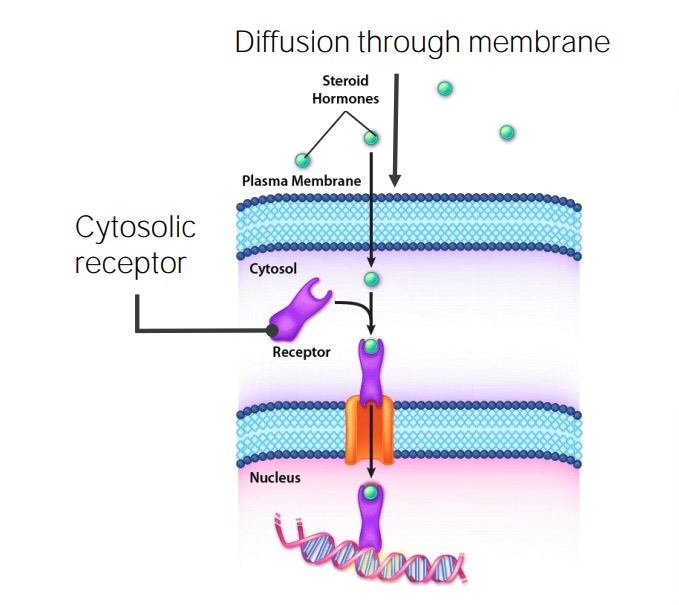
  • Las hormonas esteroideas y tiroideas pueden difundirse directamente en EN Erythema nodosum is an immune-mediated panniculitis (inflammation of the subcutaneous fat) caused by a type IV (delayed-type) hypersensitivity reaction. It commonly manifests in young women as tender, erythematous nodules on the shins. Erythema Nodosum la célula.
  • Se unen a los LOS Neisseria receptores intracelulares
  • Los LOS Neisseria complejos hormona-receptor se unen directamente a los LOS Neisseria elementos de respuesta hormonal dentro del ADN.
  • La unión altera (típicamente estimula) la transcripción de genes Genes A category of nucleic acid sequences that function as units of heredity and which code for the basic instructions for the development, reproduction, and maintenance of organisms. DNA Types and Structure diana → afecta qué proteínas se están produciendo en EN Erythema nodosum is an immune-mediated panniculitis (inflammation of the subcutaneous fat) caused by a type IV (delayed-type) hypersensitivity reaction. It commonly manifests in young women as tender, erythematous nodules on the shins. Erythema Nodosum la célula
Señalización de hormonas esteroides

Señalización de hormonas esteroideas

Imagen por Kevin Ahern, MD.

Relevancia Clínica

Prácticamente, todas las hormonas enumeradas en EN Erythema nodosum is an immune-mediated panniculitis (inflammation of the subcutaneous fat) caused by a type IV (delayed-type) hypersensitivity reaction. It commonly manifests in young women as tender, erythematous nodules on the shins. Erythema Nodosum las tablas pueden secretarse en EN Erythema nodosum is an immune-mediated panniculitis (inflammation of the subcutaneous fat) caused by a type IV (delayed-type) hypersensitivity reaction. It commonly manifests in young women as tender, erythematous nodules on the shins. Erythema Nodosum niveles anormales, lo que da como resultado una amplia gama de afecciones clínicas. Algunas de estas afecciones incluyen:

  • Hipopituitarismo: afección caracterizada por una deficiencia de todas las hormonas hipofisarias. Debido a que las hormonas hipofisarias regulan múltiples órganos, los LOS Neisseria efectos de la hipofunción hipofisaria son multisistémicos. Las causas del hipopituitarismo incluyen masas hipofisarias, síndromes congénitos, traumatismos, infecciones y daño vascular. El tratamiento incluye el reemplazo hormonal y el abordaje de la etiología subyacente.
  • Acromegalia y gigantismo: causados por producción excesiva de GH hipofisaria. Típicamente, la acromegalia es el resultado del exceso de GH después del cierre de la placa de crecimiento que conduce a extremidades grandes y facies características, y el gigantismo es la estatura alta que se observa en EN Erythema nodosum is an immune-mediated panniculitis (inflammation of the subcutaneous fat) caused by a type IV (delayed-type) hypersensitivity reaction. It commonly manifests in young women as tender, erythematous nodules on the shins. Erythema Nodosum estados de exceso de GH en EN Erythema nodosum is an immune-mediated panniculitis (inflammation of the subcutaneous fat) caused by a type IV (delayed-type) hypersensitivity reaction. It commonly manifests in young women as tender, erythematous nodules on the shins. Erythema Nodosum niños antes del cierre de la placa de crecimiento.
  • Hiperprolactinemia: niveles elevados de prolactina en EN Erythema nodosum is an immune-mediated panniculitis (inflammation of the subcutaneous fat) caused by a type IV (delayed-type) hypersensitivity reaction. It commonly manifests in young women as tender, erythematous nodules on the shins. Erythema Nodosum la sangre. La causa más común de hiperprolactinemia es un adenoma hipofisario secretor de prolactina conocido como prolactinoma Prolactinoma A pituitary adenoma which secretes prolactin, leading to hyperprolactinemia. Clinical manifestations include amenorrhea; galactorrhea; impotence; headache; visual disturbances; and cerebrospinal fluid rhinorrhea. Hyperprolactinemia. Las presentaciones pueden incluir galactorrea (secreción lechosa), oligomenorrea, disfunción eréctil y, en EN Erythema nodosum is an immune-mediated panniculitis (inflammation of the subcutaneous fat) caused by a type IV (delayed-type) hypersensitivity reaction. It commonly manifests in young women as tender, erythematous nodules on the shins. Erythema Nodosum el caso de tumores grandes, cefaleas y cambios visuales. El tratamiento suele incluir agonistas de la dopamina como tratamiento de 1era línea, aunque es posible que se requiera cirugía y/o radiación.
  • Diabetes Diabetes Diabetes mellitus (DM) is a metabolic disease characterized by hyperglycemia and dysfunction of the regulation of glucose metabolism by insulin. Type 1 DM is diagnosed mostly in children and young adults as the result of autoimmune destruction of β cells in the pancreas and the resulting lack of insulin. Type 2 DM has a significant association with obesity and is characterized by insulin resistance. Diabetes Mellitus insípida central: afección en EN Erythema nodosum is an immune-mediated panniculitis (inflammation of the subcutaneous fat) caused by a type IV (delayed-type) hypersensitivity reaction. It commonly manifests in young women as tender, erythematous nodules on the shins. Erythema Nodosum la que los LOS Neisseria riñones no pueden concentrar la orina debido a la falta de hormona antidiurética circulante. Estos niveles bajos de hormona antidiurética se deben a una menor producción dentro del hipotálamo o a una menor liberación de la glándula hipofisaria posterior. La presentación es con poliuria, nicturia y polidipsia. La diabetes Diabetes Diabetes mellitus (DM) is a metabolic disease characterized by hyperglycemia and dysfunction of the regulation of glucose metabolism by insulin. Type 1 DM is diagnosed mostly in children and young adults as the result of autoimmune destruction of β cells in the pancreas and the resulting lack of insulin. Type 2 DM has a significant association with obesity and is characterized by insulin resistance. Diabetes Mellitus insípida central y nefrogénica se diferencian sobre la base de los LOS Neisseria niveles medidos de hormona antidiurética y la respuesta a la prueba de privación de agua.
  • Hipertiroidismo e hipotiroidismo: niveles anormalmente altos o bajos de producción de hormona tiroidea en EN Erythema nodosum is an immune-mediated panniculitis (inflammation of the subcutaneous fat) caused by a type IV (delayed-type) hypersensitivity reaction. It commonly manifests in young women as tender, erythematous nodules on the shins. Erythema Nodosum la glándula tiroides. Las personas con estas afecciones mostrarán signos y síntomas relacionados con el metabolismo celular elevado o suprimido resultante, incluidos cambios en EN Erythema nodosum is an immune-mediated panniculitis (inflammation of the subcutaneous fat) caused by a type IV (delayed-type) hypersensitivity reaction. It commonly manifests in young women as tender, erythematous nodules on the shins. Erythema Nodosum el nivel de energía, peso, deposiciones y frecuencia cardíaca.
  • Diabetes Diabetes Diabetes mellitus (DM) is a metabolic disease characterized by hyperglycemia and dysfunction of the regulation of glucose metabolism by insulin. Type 1 DM is diagnosed mostly in children and young adults as the result of autoimmune destruction of β cells in the pancreas and the resulting lack of insulin. Type 2 DM has a significant association with obesity and is characterized by insulin resistance. Diabetes Mellitus mellitus: ↓ producción de insulina en EN Erythema nodosum is an immune-mediated panniculitis (inflammation of the subcutaneous fat) caused by a type IV (delayed-type) hypersensitivity reaction. It commonly manifests in young women as tender, erythematous nodules on the shins. Erythema Nodosum el páncreas o ↓ sensibilidad a la insulina en EN Erythema nodosum is an immune-mediated panniculitis (inflammation of the subcutaneous fat) caused by a type IV (delayed-type) hypersensitivity reaction. It commonly manifests in young women as tender, erythematous nodules on the shins. Erythema Nodosum tejidos periféricos. Sin una función normal de la insulina, la glucosa no puede transportarse a los LOS Neisseria tejidos y permanece atrapada en EN Erythema nodosum is an immune-mediated panniculitis (inflammation of the subcutaneous fat) caused by a type IV (delayed-type) hypersensitivity reaction. It commonly manifests in young women as tender, erythematous nodules on the shins. Erythema Nodosum la sangre, lo que provoca hiperglucemia. La diabetes Diabetes Diabetes mellitus (DM) is a metabolic disease characterized by hyperglycemia and dysfunction of the regulation of glucose metabolism by insulin. Type 1 DM is diagnosed mostly in children and young adults as the result of autoimmune destruction of β cells in the pancreas and the resulting lack of insulin. Type 2 DM has a significant association with obesity and is characterized by insulin resistance. Diabetes Mellitus mellitus se trata con agentes sensibilizantes a la insulina o con la propia insulina.
  • Síndrome de Cushing: afección resultante de la exposición crónica a un exceso de glucocorticoides. Las etiologías incluyen ingesta crónica de glucocorticoides, aumento de la secreción suprarrenal de cortisol Cortisol Glucocorticoids o aumento de la secreción hipofisaria o ectópica de ACTH. Las características típicas incluyen obesidad central; piel delgada y amoratada; estrías abdominales; hipertensión secundaria; hiperglucemia; y debilidad muscular proximal.
  • Insuficiencia suprarrenal: producción inadecuada de hormonas adrenocorticales (glucocorticoides, mineralocorticoides y andrógenos suprarrenales). El tratamiento implica terapia de reemplazo de glucocorticoides y mineralocorticoides.
    • Enfermedad de Addison (insuficiencia suprarrenal primaria): debido a una patología dentro de la propia corteza suprarrenal. Las etiologías incluyen enfermedades autoinmunes, infecciones y malignidad (entre otras).
    • Insuficiencia suprarrenal secundaria y terciaria: debido a la disminución de la producción de ACTH dentro de la hipófisis o trastornos hipotalámicos. Estos niveles de insuficiencia también pueden ocurrir debido a una terapia prolongada con glucocorticoides.
  • Hipogonadismo: afección caracterizada por una producción reducida o nula de hormonas sexuales por parte de los LOS Neisseria testículos o los LOS Neisseria ovarios. El hipogonadismo puede deberse a una falla de las propias gónadas o a defectos en EN Erythema nodosum is an immune-mediated panniculitis (inflammation of the subcutaneous fat) caused by a type IV (delayed-type) hypersensitivity reaction. It commonly manifests in young women as tender, erythematous nodules on the shins. Erythema Nodosum la secreción estimuladora hipotalámica o hipofisaria (hormona foliculoestimulante/hormona luteinizante). Los LOS Neisseria síntomas incluyen infertilidad, mayor riesgo de osteoporosis Osteoporosis Osteoporosis refers to a decrease in bone mass and density leading to an increased number of fractures. There are 2 forms of osteoporosis: primary, which is commonly postmenopausal or senile; and secondary, which is a manifestation of immobilization, underlying medical disorders, or long-term use of certain medications. Osteoporosis, disfunción eréctil, disminución de la libido y regresión (o ausencia) de las características sexuales secundarias. El tratamiento es con terapia de reemplazo hormonal.
  • Hiperparatiroidismo: afección asociada con niveles sanguíneos elevados de paratohormona. El hiperparatiroidismo puede deberse a una enfermedad inherente dentro de la glándula paratiroides o anomalías del metabolismo del calcio. Los LOS Neisseria individuos con hiperparatiroidismo clásicamente se presentan con cálculos (nefrolitiasis), huesos (↓ densidad mineral ósea), molestias abdominales ( dolor Dolor Inflammation abdominal inespecífico) y connotaciones psiquiátricas (síntomas neuropsiquiátricos). El tratamiento suele ser quirúrgico y tratar cualquier afección subyacente.
  • Raquitismo y osteomalacia Osteomalacia Disorder caused by an interruption of the mineralization of organic bone matrix leading to bone softening, bone pain, and weakness. It is the adult form of rickets resulting from disruption of vitamin d; phosphorus; or calcium homeostasis. Osteomalacia and Rickets: trastornos de disminución de la mineralización ósea. El raquitismo afecta el cartílago de las placas de crecimiento epifisario en EN Erythema nodosum is an immune-mediated panniculitis (inflammation of the subcutaneous fat) caused by a type IV (delayed-type) hypersensitivity reaction. It commonly manifests in young women as tender, erythematous nodules on the shins. Erythema Nodosum niños, mientras que la osteomalacia Osteomalacia Disorder caused by an interruption of the mineralization of organic bone matrix leading to bone softening, bone pain, and weakness. It is the adult form of rickets resulting from disruption of vitamin d; phosphorus; or calcium homeostasis. Osteomalacia and Rickets afecta los LOS Neisseria sitios de recambio óseo en EN Erythema nodosum is an immune-mediated panniculitis (inflammation of the subcutaneous fat) caused by a type IV (delayed-type) hypersensitivity reaction. It commonly manifests in young women as tender, erythematous nodules on the shins. Erythema Nodosum niños y adultos. Estos trastornos son causados más comúnmente por la deficiencia de vitamina D. El raquitismo comúnmente se presenta con deformidades esqueléticas y anomalías del crecimiento, mientras que la osteomalacia Osteomalacia Disorder caused by an interruption of the mineralization of organic bone matrix leading to bone softening, bone pain, and weakness. It is the adult form of rickets resulting from disruption of vitamin d; phosphorus; or calcium homeostasis. Osteomalacia and Rickets puede presentarse con dolor Dolor Inflammation óseo, dificultad para caminar y fracturas patológicas. El tratamiento incluye suplementos de vitamina D, calcio y fósforo.

Referencias

  1. Brent, G.A. (2024, May 28). Thyroid hormone action. In UpToDate. Retrieved June 27, 2025, from https://www.uptodate.com/contents/thyroid-hormone-action 
  2. Rosner J., Samardzic T. (2024, March 20). Physiology, female reproduction. In StatPearls. Retrieved June 27, 2025, from https://www.statpearls.com/articlelibrary/viewarticle/771/ 
  3. Gurung P., Yetiskul E. (2023, Jan 5). Physiology, male reproductive system. In StatPearls. Retrieved June 27, 2025, from https://www.statpearls.com/articlelibrary/viewarticle/770/ 
  4. Williams, G. H., and Dluhy, R.G. (2008). Disorders of the adrenal cortex. In Fauci, A. S., Braunwald, E., Kasper, D.L., et al. (Eds.) Harrison’s Internal Medicine (17th Ed., p. 2266).
  5. Khan M., Jose A. (2022, Oct 29) Physiology, parathyroid hormone. In StatPearls. Retrieved June 27, 2025, from https://www.statpearls.com/articlelibrary/viewarticle/26662/ 
  6. Aref, Y., Fat, S. C., & Ray, E. (2024). Recent insights into the role of hormones during development and their functional regulation. Frontiers in Endocrinology, 15, 1340432. https://doi.org/10.3389/fendo.2024.1340432
  7. Dungan, K., & DeSantis, A. (2025, June 13). Glucagon-like peptide 1-based therapies for the treatment of type 2 diabetes mellitus. In UpToDate. Retrieved June 13, 2025, from https://www.uptodate.com/contents/glucagon-like-peptide-1-based-therapies-for-the-treatment-of-type-2-diabetes-mellitus#H19
  8. Melmed, S., Auchus, R. J., Goldfine, A. B., Rosen, C. J., & Kopp, P. A. (Eds.). (2024). Williams textbook of endocrinology (15th ed.). Elsevier.
  9. Friedman, J.M. (2024, September 19). The discovery and development of GLP-1 based drugs that have revolutionized the treatment of obesity. Proceedings of the National Academy of Sciences, 121(39), e2415550121. https://doi.org/10.1073/pnas.2415550121
  10. Koeppen, B. M., Stanton, B. A., Hall, J. M., & Swiatecka-Urban, A. (2023). Berne & Levy physiology (8th ed.). Elsevier.
  11. Welt, C. K. (2025, June 3). Hypothalamic-pituitary axis. In UpToDate. Retrieved June 13, 2025, from https://www.uptodate.com/contents/hypothalamic-pituitary-axis
  12. Zheng, Z., Zong, Y., Ma, Y. et al. Glucagon-like peptide-1 receptor: mechanisms and advances in therapy. Sig Transduct Target Ther 9, 234 (2024). https://doi.org/10.1038/s41392-024-01931-z

¡Crea tu cuenta gratis o inicia una sesión para seguir leyendo!

Regístrate ahora y obtén acceso gratuito a Lecturio con páginas de concepto, videos médicos y cuestionarios para tu educación médica.

User Reviews

Que tengas una sesión de estudio alegre y navideña 🎁 Ahorra 50% en todos los planes >>

Details