Domina Conceptos Médicos

Estudia para la escuela de medicina y tus examenes con Lecturio.

Hipotiroidismo

El hipotiroidismo es una condición caracterizada por una deficiencia de hormonas tiroideas. La deficiencia de yodo es la causa más común a nivel mundial, pero la enfermedad de Hashimoto (tiroiditis autoinmune) es la causa principal en EN Erythema nodosum is an immune-mediated panniculitis (inflammation of the subcutaneous fat) caused by a type IV (delayed-type) hypersensitivity reaction. It commonly manifests in young women as tender, erythematous nodules on the shins. Erythema Nodosum las regiones sin deficiencia de yodo. El hipotiroidismo primario ocurre cuando existen trastornos de la glándula tiroides, mientras que el tipo central surge de afecciones hipofisarias e hipotalámicas. Las hormonas tiroideas son integrales en EN Erythema nodosum is an immune-mediated panniculitis (inflammation of the subcutaneous fat) caused by a type IV (delayed-type) hypersensitivity reaction. It commonly manifests in young women as tender, erythematous nodules on the shins. Erythema Nodosum los LOS Neisseria procesos metabólicos y en EN Erythema nodosum is an immune-mediated panniculitis (inflammation of the subcutaneous fat) caused by a type IV (delayed-type) hypersensitivity reaction. It commonly manifests in young women as tender, erythematous nodules on the shins. Erythema Nodosum el desarrollo del cerebro y otros órganos. El hipotiroidismo congénito puede provocar una discapacidad mental significativa debido a la pérdida de hormonas tiroideas. Las características del hipotiroidismo adquirido también reflejan los LOS Neisseria efectos de la función orgánica más lenta, como fatiga, bradicardia, intolerancia al AL Amyloidosis frío y disnea de esfuerzo. El diagnóstico se realiza mediante pruebas de función tiroidea. Se observan niveles elevados de hormona estimulante de la tiroides y niveles bajos de tiroxina libre (T4). El tratamiento es con T4 sintética.

Last updated: Jan 27, 2026

Editorial responsibility: Stanley Oiseth, Lindsay Jones, Evelin Maza

Descripción general

Definición

El hipotiroidismo es un trastorno endocrino resultante de la deficiencia de hormona tiroidea.

Epidemiología

  • Prevalencia: 0,1%–2%
  • Más común en EN Erythema nodosum is an immune-mediated panniculitis (inflammation of the subcutaneous fat) caused by a type IV (delayed-type) hypersensitivity reaction. It commonly manifests in young women as tender, erythematous nodules on the shins. Erythema Nodosum mujeres que en EN Erythema nodosum is an immune-mediated panniculitis (inflammation of the subcutaneous fat) caused by a type IV (delayed-type) hypersensitivity reaction. It commonly manifests in young women as tender, erythematous nodules on the shins. Erythema Nodosum hombres: rango, 5-8 veces mayor
  • Hipotiroidismo congénito:
    • Incidencia anual: 1 en EN Erythema nodosum is an immune-mediated panniculitis (inflammation of the subcutaneous fat) caused by a type IV (delayed-type) hypersensitivity reaction. It commonly manifests in young women as tender, erythematous nodules on the shins. Erythema Nodosum 4000 nacimientos en EN Erythema nodosum is an immune-mediated panniculitis (inflammation of the subcutaneous fat) caused by a type IV (delayed-type) hypersensitivity reaction. It commonly manifests in young women as tender, erythematous nodules on the shins. Erythema Nodosum los LOS Neisseria Estados Unidos
    • Alta incidencia en EN Erythema nodosum is an immune-mediated panniculitis (inflammation of the subcutaneous fat) caused by a type IV (delayed-type) hypersensitivity reaction. It commonly manifests in young women as tender, erythematous nodules on the shins. Erythema Nodosum síndrome de Down (trisomía 21)
  • Hipotiroidismo secundario: 1 en EN Erythema nodosum is an immune-mediated panniculitis (inflammation of the subcutaneous fat) caused by a type IV (delayed-type) hypersensitivity reaction. It commonly manifests in young women as tender, erythematous nodules on the shins. Erythema Nodosum 20 000–80 000 en EN Erythema nodosum is an immune-mediated panniculitis (inflammation of the subcutaneous fat) caused by a type IV (delayed-type) hypersensitivity reaction. It commonly manifests in young women as tender, erythematous nodules on the shins. Erythema Nodosum la población general

Clasificación

Con relación al AL Amyloidosis inicio:

  • Congénito
  • Adquirida

Por órganos afectados con enfermedad:

  • Hipotiroidismo primario (glándula tiroides involucrada):
    • Tiroxina baja/tetrayodotironina (T4 )
    • Triyodotironina ( T3 T3 A T3 thyroid hormone normally synthesized and secreted by the thyroid gland in much smaller quantities than thyroxine (T4). Most T3 is derived from peripheral monodeiodination of T4 at the 5′ position of the outer ring of the iodothyronine nucleus. The hormone finally delivered and used by the tissues is mainly t3. Thyroid Hormones) baja o normal
  • Hipotiroidismo central:
    • Secundario (hipófisis afectada): hormona estimulante de la tiroides (TSH) baja o inadecuadamente normal
    • Terciario (hipotálamo involucrado): hormona liberadora de tirotropina (TRH, por sus siglas en EN Erythema nodosum is an immune-mediated panniculitis (inflammation of the subcutaneous fat) caused by a type IV (delayed-type) hypersensitivity reaction. It commonly manifests in young women as tender, erythematous nodules on the shins. Erythema Nodosum inglés) baja

Etiología del hipotiroidismo congénito

  • Hipotiroidismo primario:
    • Disgenesia tiroidea (agenesia, hipoplasia o ectopia): aproximadamente el 85% de los LOS Neisseria casos; la mayoría son esporádicos
    • Falta de respuesta de TSH:
      • Mutación del gen del receptor Receptor Receptors are proteins located either on the surface of or within a cell that can bind to signaling molecules known as ligands (e.g., hormones) and cause some type of response within the cell. Receptors de TSH
      • Defecto de señalización de TSH ( en EN Erythema nodosum is an immune-mediated panniculitis (inflammation of the subcutaneous fat) caused by a type IV (delayed-type) hypersensitivity reaction. It commonly manifests in young women as tender, erythematous nodules on the shins. Erythema Nodosum pseudohipoparatiroidismo 1A)
    • Defectos hereditarios en EN Erythema nodosum is an immune-mediated panniculitis (inflammation of the subcutaneous fat) caused by a type IV (delayed-type) hypersensitivity reaction. It commonly manifests in young women as tender, erythematous nodules on the shins. Erythema Nodosum la síntesis o secreción de hormonas
  • Hipotiroidismo central:
    • Raro
    • Asociado a síndromes congénitos
  • Otras causas raras (fuera del eje hipotálamo-hipófisis-tiroides):
    • Trastorno del transporte de hormonas tiroideas: mutación en EN Erythema nodosum is an immune-mediated panniculitis (inflammation of the subcutaneous fat) caused by a type IV (delayed-type) hypersensitivity reaction. It commonly manifests in young women as tender, erythematous nodules on the shins. Erythema Nodosum el gen transportador
    • Resistencia tisular a la hormona tiroidea
  • Hipotiroidismo transitorio:
    • Detectado durante la evaluación del recién nacido
    • Disminución temporal de la función tiroidea durante semanas o meses, luego se produce la recuperación en EN Erythema nodosum is an immune-mediated panniculitis (inflammation of the subcutaneous fat) caused by a type IV (delayed-type) hypersensitivity reaction. It commonly manifests in young women as tender, erythematous nodules on the shins. Erythema Nodosum el curso natural o con tratamiento hasta cierta edad
    • Causas:
      • Deficiencia de yodo
      • Exposición a altas dosis de yodo
      • Glándula in situ: glándula de tamaño normal en EN Erythema nodosum is an immune-mediated panniculitis (inflammation of the subcutaneous fat) caused by a type IV (delayed-type) hypersensitivity reaction. It commonly manifests in young women as tender, erythematous nodules on the shins. Erythema Nodosum ubicación normal con algún grado de dishormonogénesis
      • Ingesta materna de fármacos antitiroideos (que atraviesan la placenta Placenta A highly vascularized mammalian fetal-maternal organ and major site of transport of oxygen, nutrients, and fetal waste products. It includes a fetal portion (chorionic villi) derived from trophoblasts and a maternal portion (decidua) derived from the uterine endometrium. The placenta produces an array of steroid, protein and peptide hormones (placental hormones). Placenta, Umbilical Cord, and Amniotic Cavity)
      • Enfermedad tiroidea autoinmune materna ( los LOS Neisseria anticuerpos atraviesan la placenta Placenta A highly vascularized mammalian fetal-maternal organ and major site of transport of oxygen, nutrients, and fetal waste products. It includes a fetal portion (chorionic villi) derived from trophoblasts and a maternal portion (decidua) derived from the uterine endometrium. The placenta produces an array of steroid, protein and peptide hormones (placental hormones). Placenta, Umbilical Cord, and Amniotic Cavity)
      • Hemangiomas hepáticos
      • Mutaciones con pérdida de función

Etiología del hipotiroidismo adquirido

  • Hipotiroidismo primario:
    • Tiroiditis de Hashimoto: causa más común en EN Erythema nodosum is an immune-mediated panniculitis (inflammation of the subcutaneous fat) caused by a type IV (delayed-type) hypersensitivity reaction. It commonly manifests in young women as tender, erythematous nodules on the shins. Erythema Nodosum los LOS Neisseria Estados Unidos y en EN Erythema nodosum is an immune-mediated panniculitis (inflammation of the subcutaneous fat) caused by a type IV (delayed-type) hypersensitivity reaction. It commonly manifests in young women as tender, erythematous nodules on the shins. Erythema Nodosum áreas con ingesta adecuada de yodo
    • Deficiencia de yodo: causa más común en EN Erythema nodosum is an immune-mediated panniculitis (inflammation of the subcutaneous fat) caused by a type IV (delayed-type) hypersensitivity reaction. It commonly manifests in young women as tender, erythematous nodules on the shins. Erythema Nodosum todo el mundo
    • Exceso de yodo: inhibe la síntesis de hormonas y la organificación del yodo (efecto Wolff-Chaikoff)
    • Procedimientos:
      • Tiroidectomía
      • Radioterapia
      • Tratamiento con yodo radiactivo (I-131)
    • Drogas:
      • Fármacos antitiroideos: propiltiouracilo, metimazol
      • Litio
      • Etionamida
      • Amiodarona (que contiene yodo)
      • Inhibidores de la tirosina quinasa como sunitinib
    • Infiltración tiroidea:
      • Tiroiditis de Riedel
      • Amiloidosis
      • Hemocromatosis
      • Sarcoidosis Sarcoidosis Sarcoidosis is a multisystem inflammatory disease that causes noncaseating granulomas. The exact etiology is unknown. Sarcoidosis usually affects the lungs and thoracic lymph nodes, but it can also affect almost every system in the body, including the skin, heart, and eyes, most commonly. Sarcoidosis
      • Esclerodermia
    • Tiroiditis posparto
    • Exposición ambiental: retardantes de llama
  • Hipotiroidismo central:
    • Trastornos hipofisarios (secundarios) como adenoma, síndrome de Sheehan
    • Trastornos hipotalámicos (terciarios) como tumores, traumatismos

Fisiopatología

Eje hipotálamo-hipófisis-tiroideo

  • Hormonas involucradas:
    • TRH del hipotálamo
    • TSH de la hipófisis anterior
    • T4 y T3 de la glándula tiroides:
      • T4 > T3 liberado
      • La T4 se convierte en EN Erythema nodosum is an immune-mediated panniculitis (inflammation of the subcutaneous fat) caused by a type IV (delayed-type) hypersensitivity reaction. It commonly manifests in young women as tender, erythematous nodules on the shins. Erythema Nodosum T3 en EN Erythema nodosum is an immune-mediated panniculitis (inflammation of the subcutaneous fat) caused by a type IV (delayed-type) hypersensitivity reaction. It commonly manifests in young women as tender, erythematous nodules on the shins. Erythema Nodosum la periferia, predominantemente en EN Erythema nodosum is an immune-mediated panniculitis (inflammation of the subcutaneous fat) caused by a type IV (delayed-type) hypersensitivity reaction. It commonly manifests in young women as tender, erythematous nodules on the shins. Erythema Nodosum el hígado (pero también en EN Erythema nodosum is an immune-mediated panniculitis (inflammation of the subcutaneous fat) caused by a type IV (delayed-type) hypersensitivity reaction. It commonly manifests in young women as tender, erythematous nodules on the shins. Erythema Nodosum otros tejidos).
      • Hormonas tiroideas totales = ligadas + T3 libre /T4 libre (FT3 /FT4 )
    • Límite T3 y T4 :
      • Unido a las globulinas fijadoras de tiroxina ( TBG TBG A thyroid hormone transport protein found in serum. It binds about 75% of circulating thyroxine and 70% of circulating triiodothyronine. Thyroid Hormones, por sus siglas en EN Erythema nodosum is an immune-mediated panniculitis (inflammation of the subcutaneous fat) caused by a type IV (delayed-type) hypersensitivity reaction. It commonly manifests in young women as tender, erythematous nodules on the shins. Erythema Nodosum inglés) (no puede difundirse libremente en EN Erythema nodosum is an immune-mediated panniculitis (inflammation of the subcutaneous fat) caused by a type IV (delayed-type) hypersensitivity reaction. It commonly manifests in young women as tender, erythematous nodules on the shins. Erythema Nodosum las células)
      • 99% de las hormonas liberadas a la circulación
    • FT4 y FT3 :
      • Biodisponible
      • Puede unirse a los LOS Neisseria receptores tisulares de la tiroides y ejercer sus efectos.
  • Regulación de hormonas:
    • El hipotálamo libera TRH → la glándula hipófisis libera TSH (también se estimula la liberación de prolactina) → la glándula tiroides produce T3 /T4 :
    • Nivel de FT3 /FT4 → ↓ TSH y TRH
    • ↓ Nivel de FT3 /FT4 → ↑ TSH y TRH
  • Función normal de las hormonas tiroideas:
    • Aumento del metabolismo:
      • Aumento de la transcripción de la membrana celular Na+ /K+ adenosina trifosfatasa (ATPasa) → consumo de oxígeno
      • Oxidación mejorada de ácidos grasos y generación de calor Calor Inflammation.
      • Gluconeogénesis, glucólisis, lipólisis
    • Crecimiento y desarrollo:
      • Síntesis de proteínas
      • Regula el metabolismo del colesterol y los LOS Neisseria triglicéridos
      • Afecta el cerebro, el sistema reproductivo y el desarrollo y crecimiento óseo.
    • Acciones interrelacionadas con las catecolaminas:
      • Las hormonas tiroideas aumentan la capacidad de respuesta a las catecolaminas (produciendo efectos cardíacos inotrópicos y cronotrópicos)
      • ↑ Expresión de receptores de catecolaminas
    • Regula la síntesis de hormonas hipofisarias (bucle de retroalimentación)
Eje hipotálamo-pituitario-tiroideo

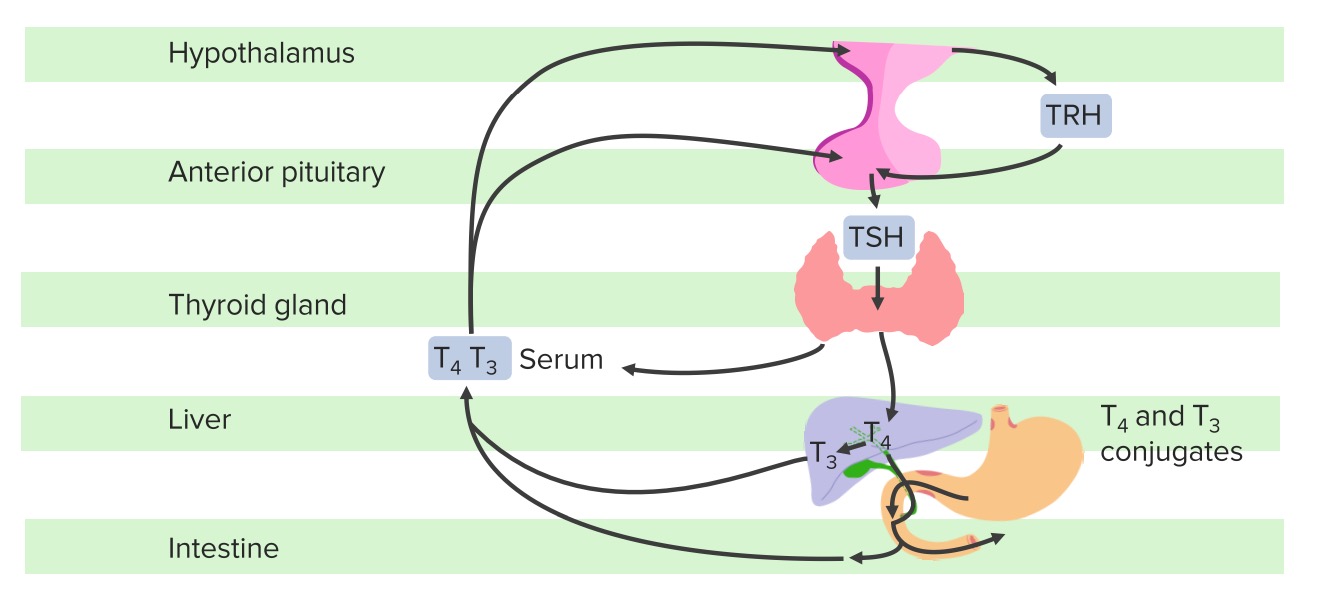
Diagrama esquemático del eje hipotálamo-hipófisis-tiroides:
El hipotálamo produce TRH, que estimula la glándula hipófisis para sintetizar y secretar TSH, que luego estimula la síntesis y secreción de T3 y T4 por parte de la glándula tiroides. La T4 se convierte en T3 en el hígado y otros tejidos. Una fracción de T4 y T3 se conjuga con glucurónido y sulfato en el hígado, se excreta en la bilis y se hidroliza parcialmente en el intestino; parte de esta fracción en el intestino puede ser reabsorbida. Si el hipotálamo detecta niveles bajos de FT3 y FT4, habrá un aumento de la TRH y, posteriormente, de la TSH; por el contrario, en este ciclo de retroalimentación negativa, T3 y T4 inhiben la liberación de TSH del hipotálamo y la hipófisis una vez que se alcanzan los niveles normales.
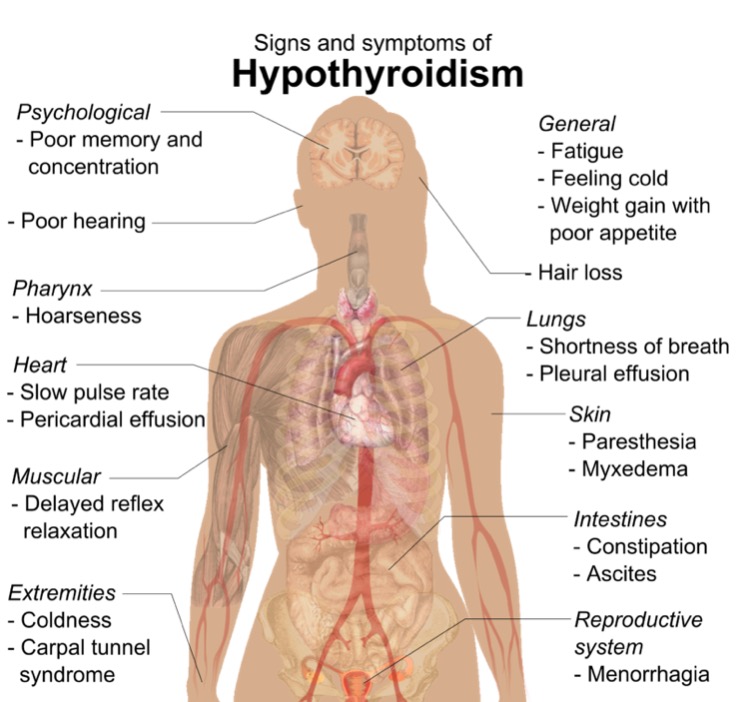
Imagen por Lecturio.

Formas de hipotiroidismo

  • Primario:
    • Enfermedad tiroidea → ↓ FT3 /FT4 de la glándula tiroides → ↑ TSH y TRH compensatoria
    • Tipos:
      • Subclínica: TSH elevada, pero FT3/FT4 normal
      • Evidente: TSH elevada, FT4 bajo/FT3 bajo-normal
  • Secundario: trastornos hipofisarios (incapaz de producir TSH; ↓ TSH → ↓ niveles de FT3/FT 4)
    • Los LOS Neisseria adenomas hipofisarios son la causa más común de hipotiroidismo central.
      • Puede interferir con la producción de TSH por su efecto de masa/compresión en EN Erythema nodosum is an immune-mediated panniculitis (inflammation of the subcutaneous fat) caused by a type IV (delayed-type) hypersensitivity reaction. It commonly manifests in young women as tender, erythematous nodules on the shins. Erythema Nodosum las células productoras de TSH y/o por la interrupción del flujo sanguíneo portal hipotálamo-hipófisis y el bloqueo de la señal de TRH del hipotálamo.
      • Los LOS Neisseria adenomas hipofisarios también pueden interferir con la producción de TSH si presentan hemorragia o infarto.
    • Lesiones masivas diferentes al AL Amyloidosis adenoma hipofisario: quistes, abscesos, meningiomas y disgerminomas, tumores metastásicos y craneofaringiomas
    • Efectos de la cirugía o la radioterapia para los LOS Neisseria adenomas hipofisarios u otras masas
    • Causas infiltrativas o inflamatorias: tuberculosis Tuberculosis Tuberculosis (TB) is an infectious disease caused by Mycobacterium tuberculosis complex bacteria. The bacteria usually attack the lungs but can also damage other parts of the body. Approximately 30% of people around the world are infected with this pathogen, with the majority harboring a latent infection. Tuberculosis spreads through the air when a person with active pulmonary infection coughs or sneezes. Tuberculosis, sífilis, sarcoidosis Sarcoidosis Sarcoidosis is a multisystem inflammatory disease that causes noncaseating granulomas. The exact etiology is unknown. Sarcoidosis usually affects the lungs and thoracic lymph nodes, but it can also affect almost every system in the body, including the skin, heart, and eyes, most commonly. Sarcoidosis, infecciones fúngicas, toxoplasmosis Toxoplasmosis Toxoplasmosis is an infectious disease caused by Toxoplasma gondii, an obligate intracellular protozoan parasite. Felines are the definitive host, but transmission to humans can occur through contact with cat feces or the consumption of contaminated foods. The clinical presentation and complications depend on the host’s immune status. Toxoplasma/Toxoplasmosis, histiocitosis, hemocromatosis, hipofisitis linfocítica
    • Traumatismo craneoencefálico con lesión del tallo hipofisario
    • Accidente cerebrovascular, hemorragia subaracnoidea
    • Síndrome de Sheehan ( necrosis Necrosis The death of cells in an organ or tissue due to disease, injury or failure of the blood supply. Ischemic Cell Damage hipofisaria posparto).
    • Hipofisitis inducida por inhibidores de puntos de control u otra causa inducida por fármacos
  • Terciario:
    • Trastorno hipotalámico (incapaz de producir TRH): ↓ TRH → ↓ TSH → ↓ FT3/FT4
    • Anomalías del desarrollo
    • Aneurismas, tumores (primarios o secundarios)
    • Efectos de la cirugía o la radioterapia para tumores cerebrales u otros trastornos
    • Accidente cerebrovascular isquémico o hemorrágico; lesión cerebral traumática

Presentación Clínica

Síntomas del hipotiroidismo

Diagrama de los signos y síntomas más comunes del hipotiroidismo

Imagen : “Symptoms and signs of hypothyroidism” por Mikael Häggström. Licencia: CC0
Procesos subyacentes de las manifestaciones.

  • ↓ Tasa metabólica: funcionamiento lento de los LOS Neisseria órganos y procesos metabólicos
  • Mixedema: depósito y acumulación de elementos del tejido conjuntivo, como los LOS Neisseria glucosaminoglucanos, con retención de agua.

Hipotiroidismo congénito

  • Inicialmente asintomático:
    • Debido a las hormonas tiroideas maternas
    • Peso y longitud dentro del rango normal, en EN Erythema nodosum is an immune-mediated panniculitis (inflammation of the subcutaneous fat) caused by a type IV (delayed-type) hypersensitivity reaction. It commonly manifests in young women as tender, erythematous nodules on the shins. Erythema Nodosum parte debido al AL Amyloidosis mixedema
  • Síntomas generales:
    • Crecimiento deficiente y aumento de peso.
    • Baja ingesta
    • Disminución de la actividad/sueño excesivo
    • Estreñimiento
    • Llanto ronco
  • Signos físicos:
    • Generales:
      • Hipotonía
      • Palidez
      • Piel seca
      • Ictericia prolongada
    • Cabeza y cuello:
      • Fontanelas grandes
      • Macroglosia
      • Rasgos faciales toscos
      • Puede notarse bocio.
    • Abdomen:
      • Hernia Hernia Protrusion of tissue, structure, or part of an organ through the bone, muscular tissue, or the membrane by which it is normally contained. Hernia may involve tissues such as the abdominal wall or the respiratory diaphragm. Hernias may be internal, external, congenital, or acquired. Abdominal Hernias umbilical
      • Abdomen protuberante
    • Mixedema
    • El hipotiroidismo central puede presentarse con microgenitales.
  • Cretinismo:
    • Discapacidad intelectual severa resultante de hipotiroidismo materno relacionado con la deficiencia de yodo
    • La ingesta materna de yodo, especialmente en EN Erythema nodosum is an immune-mediated panniculitis (inflammation of the subcutaneous fat) caused by a type IV (delayed-type) hypersensitivity reaction. It commonly manifests in young women as tender, erythematous nodules on the shins. Erythema Nodosum las primeras 12 semanas de gestación, es necesaria para el desarrollo del cerebro.
    • Cretinismo mixedematoso:
      • Discapacidad intelectual
      • Baja estatura
      • hipotiroidismo
    • Cretinismo neurológico:
      • Discapacidad intelectual
      • Sordomutismo
      • Espasticidad y problemas de la marcha.
      • Sin hipotiroidismo (cuando se aumenta la ingesta de yodo en EN Erythema nodosum is an immune-mediated panniculitis (inflammation of the subcutaneous fat) caused by a type IV (delayed-type) hypersensitivity reaction. It commonly manifests in young women as tender, erythematous nodules on the shins. Erythema Nodosum el recién nacido)
    • Cretinismo, recuerda las 6 Ps PS Invasive Mechanical Ventilation (Por su mnemotecnia en EN Erythema nodosum is an immune-mediated panniculitis (inflammation of the subcutaneous fat) caused by a type IV (delayed-type) hypersensitivity reaction. It commonly manifests in young women as tender, erythematous nodules on the shins. Erythema Nodosum inglés):
      • Pale (pálido)
      • Puffy face (cara hinchada)
      • Protuberant tongue Tongue The tongue, on the other hand, is a complex muscular structure that permits tasting and facilitates the process of mastication and communication. The blood supply of the tongue originates from the external carotid artery, and the innervation is through cranial nerves. Lips and Tongue: Anatomy (lengua protuberante)
      • Poor brain Brain The part of central nervous system that is contained within the skull (cranium). Arising from the neural tube, the embryonic brain is comprised of three major parts including prosencephalon (the forebrain); mesencephalon (the midbrain); and rhombencephalon (the hindbrain). The developed brain consists of cerebrum; cerebellum; and other structures in the brain stem. Nervous System: Anatomy, Structure, and Classification development (pobre desarrollo cerebral)
      • Pot-bellied (abdomen abultado)
      • Protruding umbilicus (ombligo protuberante)
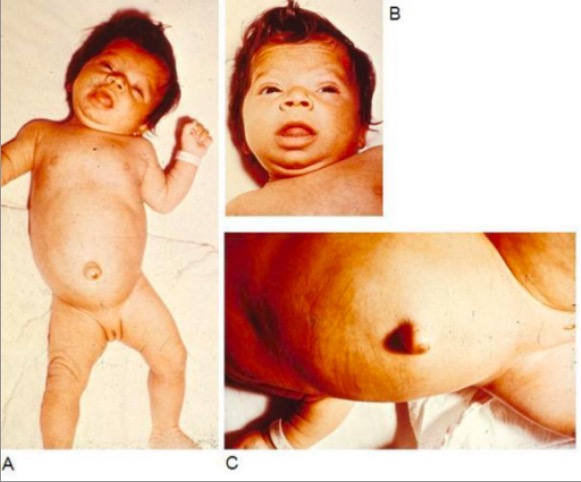
Lactante con hipotiroidismo congénito

Bebé con hipotiroidismo congénito que muestra signos y síntomas típicos, como hipotonía (A), facies mixedematosa y macroglosia (B), y una hernia umbilical (C)

Imagen :  “Infant with congenital hypothyroidism” por Department of Pediatrics, Division of Endocrinology, Oregon Health & Science University, 707 SW Gaines Street, Portland, OR, USA. Licencia: CC BY 2.0

Hipotiroidismo adquirido

Signos y síntomas comunes:

  • Generales:
    • Cansancio, debilidad
    • Aumento de peso con falta de apetito.
    • Intolerancia al AL Amyloidosis frío
    • Movimiento lento
  • Integumentario:
    • Piel seca
    • Perdida de cabello
    • Disminución de la sudoración
  • Neurológicos y musculoesqueléticos:
    • Dificultad para concentrarse y mala memoria.
    • Parestesia
    • Relajación retardada de los LOS Neisseria reflejos tendinosos profundos
    • Síndrome del túnel carpiano
  • Cardíacos:
    • Bradicardia
    • Derrame pericárdico
    • Disminución del gasto cardíaco
  • Pulmonar:
    • Disnea de esfuerzo
    • Derrame pleural
  • Gastrointestinal:
    • Estreñimiento
    • Disminución del gusto
  • Reproductivo:
    • Menorragia (luego, oligomenorrea o amenorrea)
    • Esterilidad
    • Disminución de la libido
    • Disfunción eréctil
  • Otros:
    • Edema Edema Edema is a condition in which excess serous fluid accumulates in the body cavity or interstitial space of connective tissues. Edema is a symptom observed in several medical conditions. It can be categorized into 2 types, namely, peripheral (in the extremities) and internal (in an organ or body cavity). Edema sin fóvea (mixedema)
    • Edema Edema Edema is a condition in which excess serous fluid accumulates in the body cavity or interstitial space of connective tissues. Edema is a symptom observed in several medical conditions. It can be categorized into 2 types, namely, peripheral (in the extremities) and internal (in an organ or body cavity). Edema periorbitario
    • Macroglosia
    • Voz ronca
    • Discapacidad auditiva
    • Aumento de triglicéridos
  • Debido a que la prolactina también puede aumentar, los LOS Neisseria efectos pueden incluir:
    • Galactorrea y amenorrea (mujeres)
    • Disfunción sexual e infertilidad (hombres)

En EN Erythema nodosum is an immune-mediated panniculitis (inflammation of the subcutaneous fat) caused by a type IV (delayed-type) hypersensitivity reaction. It commonly manifests in young women as tender, erythematous nodules on the shins. Erythema Nodosum la vejez:

  • Depresión
  • Psicosis/delirios/alucinaciones

Coma Coma Coma is defined as a deep state of unarousable unresponsiveness, characterized by a score of 3 points on the GCS. A comatose state can be caused by a multitude of conditions, making the precise epidemiology and prognosis of coma difficult to determine. Coma mixedematoso:
  • El hipotiroidismo severo se caracteriza por una función más lenta de múltiples órganos.
  • Una emergencia médica:
    • Puede provocar shock Shock Shock is a life-threatening condition associated with impaired circulation that results in tissue hypoxia. The different types of shock are based on the underlying cause: distributive (↑ cardiac output (CO), ↓ systemic vascular resistance (SVR)), cardiogenic (↓ CO, ↑ SVR), hypovolemic (↓ CO, ↑ SVR), obstructive (↓ CO), and mixed. Types of Shock y muerte.
    • Tasa de mortalidad hasta el 50%
  • Las mujeres mayores son las más afectadas
  • Presentación:
    • Enfermedad (e.g., infección, cirugía, infarto de miocardio)
    • Disminución del estado mental
    • Hipotermia
    • Hipoglucemia
    • Hiponatremia
    • Hipotensión
    • Hipoventilación
    • Bradicardia
Ascitis por cirrosis hepática

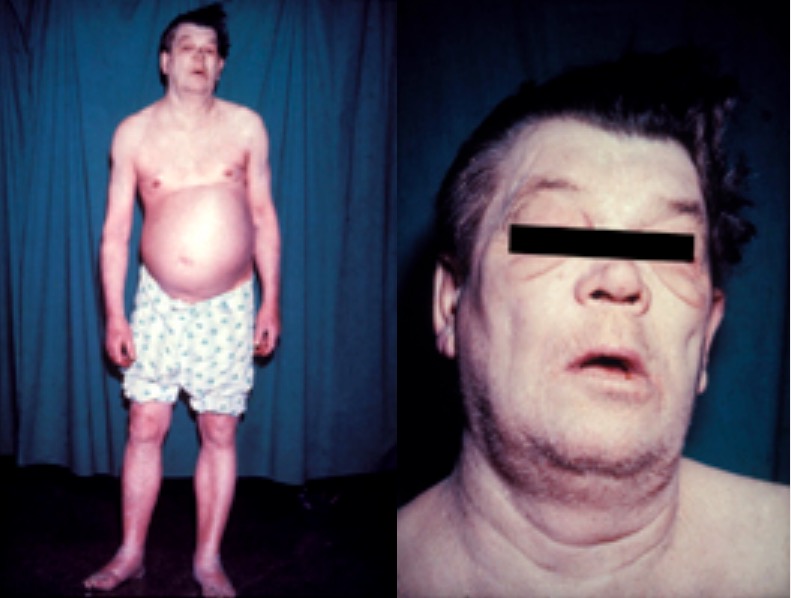
Un hombre con mixedema debido a hipotiroidismo:
Obsérvese la cara inexpresiva, la hinchazón periorbitaria, la palidez, el edema periférico y la ascitis masiva. Debido a que es curable, el mixedema debe considerarse en todos los pacientes con ascitis notoria, excepto quizás en aquellos con malignidad generalizada o terminal. El paciente que se muestra recibió terapia de reemplazo de tiroides y todas sus anomalías físicas se resolvieron. Si la ascitis persiste después del tratamiento, se debe buscar una causa coexistente.

Imagen : “57-year-old bartender” por Herbert L. Fred, MD and Hendrik A. van Dijk.Licencia: CC BY 2.0

Diagnóstico

Hipotiroidismo congénito

Tamizaje obligatorio en EN Erythema nodosum is an immune-mediated panniculitis (inflammation of the subcutaneous fat) caused by a type IV (delayed-type) hypersensitivity reaction. It commonly manifests in young women as tender, erythematous nodules on the shins. Erythema Nodosum todos los LOS Neisseria recién nacidos:

  • Medición de TSH y/o T4 24–48 horas después del nacimiento
  • Muestra obtenida mediante punción en EN Erythema nodosum is an immune-mediated panniculitis (inflammation of the subcutaneous fat) caused by a type IV (delayed-type) hypersensitivity reaction. It commonly manifests in young women as tender, erythematous nodules on the shins. Erythema Nodosum el talón
  • TSH elevada → confirmar con TSH venosa y T4
  • ↑ TSH, ↓ FT4 : confirma diagnóstico

Imágenes:

  • No es rutina
  • La ecografía o la captación de radionúclidos son opciones.
  • Se realiza si los LOS Neisseria resultados están en EN Erythema nodosum is an immune-mediated panniculitis (inflammation of the subcutaneous fat) caused by a type IV (delayed-type) hypersensitivity reaction. It commonly manifests in young women as tender, erythematous nodules on the shins. Erythema Nodosum el límite y la indicación para el tratamiento no está clara (e.g., si las imágenes muestran agenesia tiroidea, se inicia el tratamiento)
  • Se realiza si se sospecha hipotiroidismo transitorio

El diagnóstico y el tratamiento tempranos pueden prevenir la discapacidad mental a largo plazo.

Hipotiroidismo adquirido

Pruebas de función tiroidea:

  • Prueba inicial:
    • Obtener TSH
    • Si está elevado, repita y verifique FT4
  • Hipotiroidismo primario:
    • ↑ TSH
    • ↓ FT3/FT4 (FT3 puede ser normal)
  • Hipotiroidismo secundario/terciario:
    • ↓TSH
    • ↓ FT3/FT4
  • Hipotiroidismo subclínico:
    • ↑ TSH
    • Normal FT3/FT4

Prueba de anticuerpos:

  • Anticuerpos contra la tiroglobulina y la peroxidasa tiroidea (TPO, por sus siglas en EN Erythema nodosum is an immune-mediated panniculitis (inflammation of the subcutaneous fat) caused by a type IV (delayed-type) hypersensitivity reaction. It commonly manifests in young women as tender, erythematous nodules on the shins. Erythema Nodosum inglés):
    • Compatible con hipotiroidismo autoinmune
    • No se mide de forma rutinaria en EN Erythema nodosum is an immune-mediated panniculitis (inflammation of the subcutaneous fat) caused by a type IV (delayed-type) hypersensitivity reaction. It commonly manifests in young women as tender, erythematous nodules on the shins. Erythema Nodosum casos típicos de hipotiroidismo, a menos que se sospeche tiroiditis activa, ya que > 90% de los LOS Neisseria casos de hipotiroidismo se deben a tiroiditis de Hashimoto “agotada” en EN Erythema nodosum is an immune-mediated panniculitis (inflammation of the subcutaneous fat) caused by a type IV (delayed-type) hypersensitivity reaction. It commonly manifests in young women as tender, erythematous nodules on the shins. Erythema Nodosum regiones sin deficiencia de yodo.
  • Útil en EN Erythema nodosum is an immune-mediated panniculitis (inflammation of the subcutaneous fat) caused by a type IV (delayed-type) hypersensitivity reaction. It commonly manifests in young women as tender, erythematous nodules on the shins. Erythema Nodosum hipotiroidismo subclínico o bocio:
    • Los LOS Neisseria anticuerpos (que indican enfermedad mediada inmunológicamente) pueden predecir la progresión a hipotiroidismo manifiesto.
    • La monitorización periódica de la TSH en EN Erythema nodosum is an immune-mediated panniculitis (inflammation of the subcutaneous fat) caused by a type IV (delayed-type) hypersensitivity reaction. It commonly manifests in young women as tender, erythematous nodules on the shins. Erythema Nodosum estos casos ayuda a evaluar la necesidad de farmacoterapia.

Estudios de imagen:

  • Ecografía: rara vez se usa, pero puede ayudar a distinguir el bocio asimétrico en EN Erythema nodosum is an immune-mediated panniculitis (inflammation of the subcutaneous fat) caused by a type IV (delayed-type) hypersensitivity reaction. It commonly manifests in young women as tender, erythematous nodules on the shins. Erythema Nodosum la tiroiditis de Hashimoto de un bocio nodular/multinodular
  • Imagen mental:
    • TC o RM
    • Parte del estudio para el hipotiroidismo central
    • Evalúe la glándula pituitaria, el hipotálamo y las áreas circundantes.

Exámenes complementarios:

  • Además de TSH y T4, en EN Erythema nodosum is an immune-mediated panniculitis (inflammation of the subcutaneous fat) caused by a type IV (delayed-type) hypersensitivity reaction. It commonly manifests in young women as tender, erythematous nodules on the shins. Erythema Nodosum coma Coma Coma is defined as a deep state of unarousable unresponsiveness, characterized by a score of 3 points on the GCS. A comatose state can be caused by a multitude of conditions, making the precise epidemiology and prognosis of coma difficult to determine. Coma mixedematoso:
    • Obtenga el nivel de cortisol Cortisol Glucocorticoids (ya que la insuficiencia suprarrenal debe tratarse).
    • Obtenga un panel metabólico (puede mostrar bajo nivel de sodio) y un electrocardiograma (bradicardia).
  • En EN Erythema nodosum is an immune-mediated panniculitis (inflammation of the subcutaneous fat) caused by a type IV (delayed-type) hypersensitivity reaction. It commonly manifests in young women as tender, erythematous nodules on the shins. Erythema Nodosum hipotiroidismo central: Obtener otros niveles de hormonas hipofisarias, especialmente en EN Erythema nodosum is an immune-mediated panniculitis (inflammation of the subcutaneous fat) caused by a type IV (delayed-type) hypersensitivity reaction. It commonly manifests in young women as tender, erythematous nodules on the shins. Erythema Nodosum casos sospechosos de hipopituitarismo.

Tratamiento

Hipotiroidismo congénito

  • Terapia de reemplazo de tiroides:
    • L-tiroxina: forma sintética de T4 que se convierte periféricamente en EN Erythema nodosum is an immune-mediated panniculitis (inflammation of the subcutaneous fat) caused by a type IV (delayed-type) hypersensitivity reaction. It commonly manifests in young women as tender, erythematous nodules on the shins. Erythema Nodosum T3
    • Dosis: inicialmente 10-15 µg/kg/día
    • Absorción reducida por antiácidos, hierro, calcio, fórmula de soya
  • Para el hipotiroidismo subclínico:
    • Supervisar las pruebas de función tiroidea
    • Tratar si la TSH es > 10 mU/L después de 4 semanas
  • Para el hipotiroidismo central:
    • Reemplazo de tiroides
    • Tratar otras deficiencias hormonales concomitantes, si están presentes.
  • En EN Erythema nodosum is an immune-mediated panniculitis (inflammation of the subcutaneous fat) caused by a type IV (delayed-type) hypersensitivity reaction. It commonly manifests in young women as tender, erythematous nodules on the shins. Erythema Nodosum áreas endémicas, donde la deficiencia de yodo es común, se recomienda suplementar con yodo; la sal yodada se usa comúnmente en EN Erythema nodosum is an immune-mediated panniculitis (inflammation of the subcutaneous fat) caused by a type IV (delayed-type) hypersensitivity reaction. It commonly manifests in young women as tender, erythematous nodules on the shins. Erythema Nodosum los LOS Neisseria Estados Unidos, pero no es obligatoria, como en EN Erythema nodosum is an immune-mediated panniculitis (inflammation of the subcutaneous fat) caused by a type IV (delayed-type) hypersensitivity reaction. It commonly manifests in young women as tender, erythematous nodules on the shins. Erythema Nodosum algunos otros países.

Hipotiroidismo adquirido

  • Objetivos:
    • Alcanzar el estado eutiroideo
    • Corregir alteraciones metabólicas
    • Mejorar los LOS Neisseria síntomas
    • Reducir el tamaño del bocio (si está presente)
  • Terapia de reemplazo de tiroides:
    • L-tiroxina
    • Dosis:
      • 1,6 µg/kg de peso corporal al AL Amyloidosis día en EN Erythema nodosum is an immune-mediated panniculitis (inflammation of the subcutaneous fat) caused by a type IV (delayed-type) hypersensitivity reaction. It commonly manifests in young women as tender, erythematous nodules on the shins. Erythema Nodosum pacientes jóvenes y sanos
      • Dosis inicial de 25 µg al AL Amyloidosis día en EN Erythema nodosum is an immune-mediated panniculitis (inflammation of the subcutaneous fat) caused by a type IV (delayed-type) hypersensitivity reaction. It commonly manifests in young women as tender, erythematous nodules on the shins. Erythema Nodosum ancianos
    • Mida la TSH después de 6 semanas y ajuste la dosis según sea necesario.
  • Coma Coma Coma is defined as a deep state of unarousable unresponsiveness, characterized by a score of 3 points on the GCS. A comatose state can be caused by a multitude of conditions, making the precise epidemiology and prognosis of coma difficult to determine. Coma mixedematoso:
    • Hormona tiroidea (T3 y T4 por vía IV) con seguimiento de las pruebas de función tiroidea
    • Glucocorticoides (administrar antes de la hormona tiroidea para descartar/tratar la insuficiencia suprarrenal)
    • Terapia de soporte

Tratamientos para casos específicos

  • Suspender el uso de medicamentos en EN Erythema nodosum is an immune-mediated panniculitis (inflammation of the subcutaneous fat) caused by a type IV (delayed-type) hypersensitivity reaction. It commonly manifests in young women as tender, erythematous nodules on the shins. Erythema Nodosum el hipotiroidismo inducido por fármacos.
  • Cirugía de tumores hipofisarios-hipotalámicos en EN Erythema nodosum is an immune-mediated panniculitis (inflammation of the subcutaneous fat) caused by a type IV (delayed-type) hypersensitivity reaction. It commonly manifests in young women as tender, erythematous nodules on the shins. Erythema Nodosum hipotiroidismo secundario y terciario

Diagnóstico diferencial

  • Síndrome del enfermo eutiroideo: pruebas anormales de la función tiroidea en EN Erythema nodosum is an immune-mediated panniculitis (inflammation of the subcutaneous fat) caused by a type IV (delayed-type) hypersensitivity reaction. It commonly manifests in young women as tender, erythematous nodules on the shins. Erythema Nodosum el contexto de una enfermedad no tiroidea en EN Erythema nodosum is an immune-mediated panniculitis (inflammation of the subcutaneous fat) caused by a type IV (delayed-type) hypersensitivity reaction. It commonly manifests in young women as tender, erythematous nodules on the shins. Erythema Nodosum pacientes clínicamente eutiroideos: se observa comúnmente T3 baja con FT4 y TSH normales. Hay alteración de la conversión de T4 a T3 (la eliminación del átomo de yodo normalmente en EN Erythema nodosum is an immune-mediated panniculitis (inflammation of the subcutaneous fat) caused by a type IV (delayed-type) hypersensitivity reaction. It commonly manifests in young women as tender, erythematous nodules on the shins. Erythema Nodosum el anillo exterior ocurre en EN Erythema nodosum is an immune-mediated panniculitis (inflammation of the subcutaneous fat) caused by a type IV (delayed-type) hypersensitivity reaction. It commonly manifests in young women as tender, erythematous nodules on the shins. Erythema Nodosum el anillo interior). Esto produce T3 inversa (rT3), que es una forma inactiva de T3. Se recomienda monitorear la función tiroidea hasta la recuperación.
  • Resistencia a la TSH o a la hormona tiroidea: tendrá un nivel elevado de TSH en EN Erythema nodosum is an immune-mediated panniculitis (inflammation of the subcutaneous fat) caused by a type IV (delayed-type) hypersensitivity reaction. It commonly manifests in young women as tender, erythematous nodules on the shins. Erythema Nodosum suero: este trastorno puede estar asociado con 1 o más anomalías en EN Erythema nodosum is an immune-mediated panniculitis (inflammation of the subcutaneous fat) caused by a type IV (delayed-type) hypersensitivity reaction. It commonly manifests in young women as tender, erythematous nodules on the shins. Erythema Nodosum los LOS Neisseria receptores de TSH, y el paciente puede ser eutiroideo o hipotiroideo. La glándula tiroides no está agrandada. El diagnóstico se hace HACE Altitude Sickness en EN Erythema nodosum is an immune-mediated panniculitis (inflammation of the subcutaneous fat) caused by a type IV (delayed-type) hypersensitivity reaction. It commonly manifests in young women as tender, erythematous nodules on the shins. Erythema Nodosum la infancia si un niño es sintomático, especialmente si otros miembros de la familia están afectados. Encontrar una mutación inactivante en EN Erythema nodosum is an immune-mediated panniculitis (inflammation of the subcutaneous fat) caused by a type IV (delayed-type) hypersensitivity reaction. It commonly manifests in young women as tender, erythematous nodules on the shins. Erythema Nodosum el receptor Receptor Receptors are proteins located either on the surface of or within a cell that can bind to signaling molecules known as ligands (e.g., hormones) and cause some type of response within the cell. Receptors de TRH confirma el diagnóstico.
  • Recuperación de una enfermedad no tiroidea: tendrá un nivel elevado de TSH en EN Erythema nodosum is an immune-mediated panniculitis (inflammation of the subcutaneous fat) caused by a type IV (delayed-type) hypersensitivity reaction. It commonly manifests in young women as tender, erythematous nodules on the shins. Erythema Nodosum suero, pero solo elevado durante el período de recuperación: se debe repetir la medición de TSH y FT4 4 a 6 semanas después de la recuperación; raramente hipotiroidismo verdadero.
  • Adenoma hipofisario secretor de TSH: tendrá un nivel elevado de TSH sérica, pero esta es una enfermedad rara: Sospeche adenoma hipofisario secretor de TSH cuando T4 y T3 también estén altos.
  • Insuficiencia suprarrenal (AI, por sus siglas en EN Erythema nodosum is an immune-mediated panniculitis (inflammation of the subcutaneous fat) caused by a type IV (delayed-type) hypersensitivity reaction. It commonly manifests in young women as tender, erythematous nodules on the shins. Erythema Nodosum inglés): tendrá un nivel elevado de TSH en EN Erythema nodosum is an immune-mediated panniculitis (inflammation of the subcutaneous fat) caused by a type IV (delayed-type) hypersensitivity reaction. It commonly manifests in young women as tender, erythematous nodules on the shins. Erythema Nodosum suero, generalmente causado por un tratamiento prolongado con corticosteroides exógenos: la insuficiencia suprarrenal puede coexistir con hipotiroidismo, pero debe sospecharse si los LOS Neisseria síntomas (letargo, hipotensión) persisten después del tratamiento con tiroxina y/o si hay hallazgos de laboratorio asociados de AI, como hiponatremia, hiperpotasemia o hipoglucemia. El diagnóstico implica un enfoque de varios pasos, que incluye la determinación de los LOS Neisseria niveles bajos de cortisol Cortisol Glucocorticoids, la medición de la hormona adrenocorticotropa (ACTH, por sus siglas en EN Erythema nodosum is an immune-mediated panniculitis (inflammation of the subcutaneous fat) caused by a type IV (delayed-type) hypersensitivity reaction. It commonly manifests in young women as tender, erythematous nodules on the shins. Erythema Nodosum inglés) y la determinación de si es primaria o secundaria.

Referencias

  1. Jameson J, et al. (Eds.). (2018). Harrison’s Principles of Internal Medicine, 20th ed. New York: McGraw-Hill.
  2. LaFranchi S. (2025). Clinical features and detection of congenital hypothyroidism. UpToDate. Retrieved January 27, 2026, from https://www.uptodate.com/contents/clinical-features-and-detection-of-congenital-hypothyroidism
  3. Molina P. (2013). Thyroid gland. Endocrine Physiology, 4th ed. Chapter 4. New York: McGraw-Hill.
  4. Orlander P, Varghese J. (2025) Hypothyroidism. Medscape. Retrieved January 27, 2026, from https://emedicine.medscape.com/article/122393-overview
  5. Ross D. (2025). Central hypothyroidism. UpToDate. Retrieved January 27, 2026, from https://www.uptodate.com/contents/central-hypothyroidism
  6. Ross D. (2025). Disorders that cause hypothyroidism. UpToDate. Retrieved January 27, 2026, from https://www.uptodate.com/contents/disorders-that-cause-hypothyroidism
  7. Ross D. (2025). Myxedema coma. UpToDate. Retrieved January 27, 2026, from https://www.uptodate.com/contents/myxedema-coma

¡Crea tu cuenta gratis o inicia una sesión para seguir leyendo!

Regístrate ahora y obtén acceso gratuito a Lecturio con páginas de concepto, videos médicos y cuestionarios para tu educación médica.

User Reviews

Details