Domina Conceptos Médicos

Estudia para la escuela de medicina y tus examenes con Lecturio.

Hemocromatosis Hereditaria

La hemocromatosis hereditaria es un trastorno autosómico recesivo asociado con mayor frecuencia a mutaciones del gen HFE. Los LOS Neisseria pacientes tienen aumentada la absorción intestinal de hierro y el depósito de hierro en EN Erythema nodosum is an immune-mediated panniculitis (inflammation of the subcutaneous fat) caused by a type IV (delayed-type) hypersensitivity reaction. It commonly manifests in young women as tender, erythematous nodules on the shins. Erythema Nodosum varios órganos, como el hígado, el corazón, la piel y el páncreas. La presentación clínica incluye la tríada de cirrosis, diabetes Diabetes Diabetes mellitus (DM) is a metabolic disease characterized by hyperglycemia and dysfunction of the regulation of glucose metabolism by insulin. Type 1 DM is diagnosed mostly in children and young adults as the result of autoimmune destruction of β cells in the pancreas and the resulting lack of insulin. Type 2 DM has a significant association with obesity and is characterized by insulin resistance. Diabetes Mellitus y bronceado de la piel. Otros hallazgos dependen del órgano u órganos involucrados. El diagnóstico consiste en EN Erythema nodosum is an immune-mediated panniculitis (inflammation of the subcutaneous fat) caused by a type IV (delayed-type) hypersensitivity reaction. It commonly manifests in young women as tender, erythematous nodules on the shins. Erythema Nodosum estudios de hierro, que muestran elevación de transferrina y ferritina. Se recomienda el tamizaje genético entre los LOS Neisseria miembros de la familia. Se realiza imagenología y estudios invasivos dependiendo de las complicaciones asociadas. El tratamiento requiere flebotomía (o terapia de quelación de hierro en EN Erythema nodosum is an immune-mediated panniculitis (inflammation of the subcutaneous fat) caused by a type IV (delayed-type) hypersensitivity reaction. It commonly manifests in young women as tender, erythematous nodules on the shins. Erythema Nodosum algunos casos) para prevenir la progresión de la enfermedad. El pronóstico es bueno para los LOS Neisseria pacientes que se encuentran en EN Erythema nodosum is an immune-mediated panniculitis (inflammation of the subcutaneous fat) caused by a type IV (delayed-type) hypersensitivity reaction. It commonly manifests in young women as tender, erythematous nodules on the shins. Erythema Nodosum las etapas tempranas de la enfermedad y que están bajo tratamiento. La presencia de fibrosis Fibrosis Any pathological condition where fibrous connective tissue invades any organ, usually as a consequence of inflammation or other injury. Bronchiolitis Obliterans hepática es un factor de mal pronóstico.

Last updated: Dec 15, 2025

Editorial responsibility: Stanley Oiseth, Lindsay Jones, Evelin Maza

Descripción General

Definición

La hemocromatosis hereditaria es:

  • El trastorno autosómico recesivo más común en EN Erythema nodosum is an immune-mediated panniculitis (inflammation of the subcutaneous fat) caused by a type IV (delayed-type) hypersensitivity reaction. It commonly manifests in young women as tender, erythematous nodules on the shins. Erythema Nodosum los LOS Neisseria caucásicos.
  • Causa más frecuente de sobrecarga severa de hierro
  • Causada por diferentes mutaciones genéticas que finalmente conducen a una baja producción de hepcidina, lo que da como resultado una mayor absorción de hierro

Etiología

  • Gen HFE:
    • Específico para hemocromatosis hereditaria
    • Dentro de la región del antígeno leucocitario humano (HLA, por sus siglas en EN Erythema nodosum is an immune-mediated panniculitis (inflammation of the subcutaneous fat) caused by a type IV (delayed-type) hypersensitivity reaction. It commonly manifests in young women as tender, erythematous nodules on the shins. Erythema Nodosum inglés) en EN Erythema nodosum is an immune-mediated panniculitis (inflammation of the subcutaneous fat) caused by a type IV (delayed-type) hypersensitivity reaction. It commonly manifests in young women as tender, erythematous nodules on the shins. Erythema Nodosum el cromosoma 6
    • Mutaciones terminadoras comunes en EN Erythema nodosum is an immune-mediated panniculitis (inflammation of the subcutaneous fat) caused by a type IV (delayed-type) hypersensitivity reaction. It commonly manifests in young women as tender, erythematous nodules on the shins. Erythema Nodosum el gen HFE:
      • C282Y (sustitución de cisteína por tirosina en EN Erythema nodosum is an immune-mediated panniculitis (inflammation of the subcutaneous fat) caused by a type IV (delayed-type) hypersensitivity reaction. It commonly manifests in young women as tender, erythematous nodules on the shins. Erythema Nodosum la posición del aminoácido 282)
      • H63D (sustitución de histidina por ácido aspártico en EN Erythema nodosum is an immune-mediated panniculitis (inflammation of the subcutaneous fat) caused by a type IV (delayed-type) hypersensitivity reaction. It commonly manifests in young women as tender, erythematous nodules on the shins. Erythema Nodosum la posición del aminoácido 63)
    • Genotipos comunes de hemocromatosis hereditaria:
      • Homocigosidad para C282Y (C282Y/C282Y)
      • Heterocigosidad compuesta (C282Y/H63D)
  • Gen no HFE:
    • Mutaciones en EN Erythema nodosum is an immune-mediated panniculitis (inflammation of the subcutaneous fat) caused by a type IV (delayed-type) hypersensitivity reaction. It commonly manifests in young women as tender, erythematous nodules on the shins. Erythema Nodosum otros genes Genes A category of nucleic acid sequences that function as units of heredity and which code for the basic instructions for the development, reproduction, and maintenance of organisms. DNA Types and Structure implicados en EN Erythema nodosum is an immune-mediated panniculitis (inflammation of the subcutaneous fat) caused by a type IV (delayed-type) hypersensitivity reaction. It commonly manifests in young women as tender, erythematous nodules on the shins. Erythema Nodosum el metabolismo del hierro
    • Rara
    • Se encuentra en EN Erythema nodosum is an immune-mediated panniculitis (inflammation of the subcutaneous fat) caused by a type IV (delayed-type) hypersensitivity reaction. It commonly manifests in young women as tender, erythematous nodules on the shins. Erythema Nodosum la hemocromatosis juvenil
  • Efectos de las mutaciones genéticas:
    • ↑ Absorción de hierro en EN Erythema nodosum is an immune-mediated panniculitis (inflammation of the subcutaneous fat) caused by a type IV (delayed-type) hypersensitivity reaction. It commonly manifests in young women as tender, erythematous nodules on the shins. Erythema Nodosum el intestino: hasta 2–4 mg de hierro dietético/día (normal: 1–2 mg/día)
    • ↑ Depósito de hierro en EN Erythema nodosum is an immune-mediated panniculitis (inflammation of the subcutaneous fat) caused by a type IV (delayed-type) hypersensitivity reaction. It commonly manifests in young women as tender, erythematous nodules on the shins. Erythema Nodosum diferentes órganos (e.g., hígado)

Sobrecarga de hierro

Es importante tener en EN Erythema nodosum is an immune-mediated panniculitis (inflammation of the subcutaneous fat) caused by a type IV (delayed-type) hypersensitivity reaction. It commonly manifests in young women as tender, erythematous nodules on the shins. Erythema Nodosum cuenta que las causas de la sobrecarga de hierro pueden superponerse u ocurrir al AL Amyloidosis mismo tiempo.

Trastornos de sobrecarga de hierro secundarios (adquiridos):

  • Causas comunes:
    • Aumento del aporte de hierro (transfusiones)
    • Eritropoyesis ineficaz (talasemia)
    • Pérdida de masa de hepatocitos que resulta en EN Erythema nodosum is an immune-mediated panniculitis (inflammation of the subcutaneous fat) caused by a type IV (delayed-type) hypersensitivity reaction. It commonly manifests in young women as tender, erythematous nodules on the shins. Erythema Nodosum hepcidina reducida (enfermedad hepática crónica)
  • Los LOS Neisseria depósitos de hierro que afectan a diferentes órganos presentan características clínicas y patológicas similares a las de la hemocromatosis hereditaria.

Epidemiología

  • 1 en EN Erythema nodosum is an immune-mediated panniculitis (inflammation of the subcutaneous fat) caused by a type IV (delayed-type) hypersensitivity reaction. It commonly manifests in young women as tender, erythematous nodules on the shins. Erythema Nodosum cada 200–500 personas
  • Más común en EN Erythema nodosum is an immune-mediated panniculitis (inflammation of the subcutaneous fat) caused by a type IV (delayed-type) hypersensitivity reaction. It commonly manifests in young women as tender, erythematous nodules on the shins. Erythema Nodosum personas de origen celta o nórdico
  • Variante C282Y:
    • Hallazgo más común en EN Erythema nodosum is an immune-mediated panniculitis (inflammation of the subcutaneous fat) caused by a type IV (delayed-type) hypersensitivity reaction. It commonly manifests in young women as tender, erythematous nodules on the shins. Erythema Nodosum pacientes con hemocromatosis hereditaria
    • El 85% de los LOS Neisseria pacientes con hemocromatosis hereditaria son homocigotos para la mutación C282Y.
  • Menos común en EN Erythema nodosum is an immune-mediated panniculitis (inflammation of the subcutaneous fat) caused by a type IV (delayed-type) hypersensitivity reaction. It commonly manifests in young women as tender, erythematous nodules on the shins. Erythema Nodosum personas de ascendencia africana.
  • Los LOS Neisseria hombres se ven afectados 2–3 veces más que las mujeres
  • Edad de inicio:

Fisiopatología

Homeostasis Homeostasis The processes whereby the internal environment of an organism tends to remain balanced and stable. Cell Injury and Death del hierro

  1. Hierro dietético sufre captación intestinal en EN Erythema nodosum is an immune-mediated panniculitis (inflammation of the subcutaneous fat) caused by a type IV (delayed-type) hypersensitivity reaction. It commonly manifests in young women as tender, erythematous nodules on the shins. Erythema Nodosum el duodeno.
  2. El hierro se mueve desde el duodeno a través del transportador de hierro, la ferroportina, y entra a la circulación a través de la transferrina.
  3. La transferrina lleva al AL Amyloidosis hierro a la médula ósea para la síntesis de hemoglobina.
  4. A medida que los LOS Neisseria eritrocitos envejecen, son fagocitados por macrófagos ( en EN Erythema nodosum is an immune-mediated panniculitis (inflammation of the subcutaneous fat) caused by a type IV (delayed-type) hypersensitivity reaction. It commonly manifests in young women as tender, erythematous nodules on the shins. Erythema Nodosum el bazo), liberando hierro nuevamente a la circulación a través de ferroportina.
  5. El hierro que no se utiliza para procesos bioquímicos se almacena en EN Erythema nodosum is an immune-mediated panniculitis (inflammation of the subcutaneous fat) caused by a type IV (delayed-type) hypersensitivity reaction. It commonly manifests in young women as tender, erythematous nodules on the shins. Erythema Nodosum ferritina.

Regulación del hierro por la vía de la hepcidina

Ciertas condiciones requieren una disminución o aumento en EN Erythema nodosum is an immune-mediated panniculitis (inflammation of the subcutaneous fat) caused by a type IV (delayed-type) hypersensitivity reaction. It commonly manifests in young women as tender, erythematous nodules on the shins. Erythema Nodosum la absorción de hierro y el hierro circulante, una vía regulada por la hepcidina:
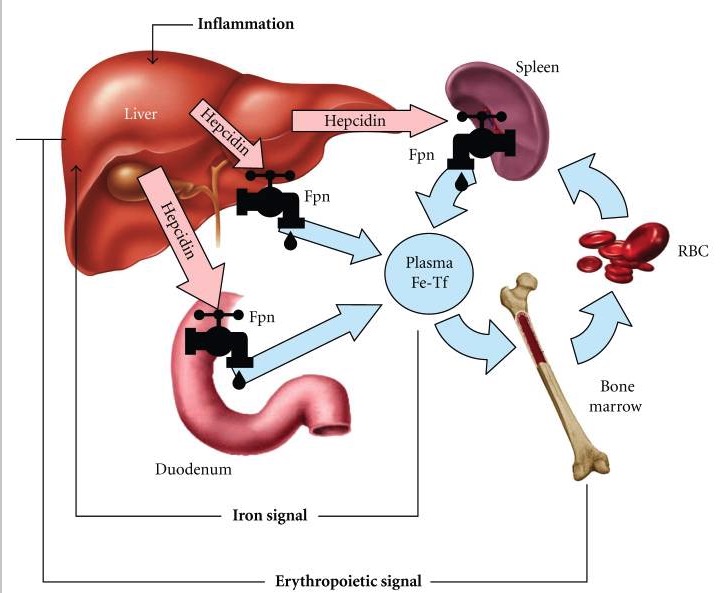
  • Péptido producido en EN Erythema nodosum is an immune-mediated panniculitis (inflammation of the subcutaneous fat) caused by a type IV (delayed-type) hypersensitivity reaction. It commonly manifests in young women as tender, erythematous nodules on the shins. Erythema Nodosum el hígado que regula la concentración de hierro en EN Erythema nodosum is an immune-mediated panniculitis (inflammation of the subcutaneous fat) caused by a type IV (delayed-type) hypersensitivity reaction. It commonly manifests in young women as tender, erythematous nodules on the shins. Erythema Nodosum plasma Plasma The residual portion of blood that is left after removal of blood cells by centrifugation without prior blood coagulation. Transfusion Products
  • Acciones (mediante su unión a la ferroportina):
    • Inhibe la absorción intestinal de hierro
    • Inhibe la liberación de hierro desde los LOS Neisseria macrófagos con eritrocitos envejecidos
  • La detección de hierro está mediada por diferentes proteínas:
    • HFE
    • Receptor Receptor Receptors are proteins located either on the surface of or within a cell that can bind to signaling molecules known as ligands (e.g., hormones) and cause some type of response within the cell. Receptors de la transferrina tipo 2
    • Hemojuvelina
  • Afectada por:
    • ↑ Hierro: ↑ hepcidina para reducir el hierro
    • ↑ Inflamación: ↑ hepcidina para limitar la disponibilidad de hierro para los LOS Neisseria microorganismos
    • ↑ Eritropoyetina: ↓ hepcidina para aumentar el hierro para la hematopoyesis

Mutaciones en EN Erythema nodosum is an immune-mediated panniculitis (inflammation of the subcutaneous fat) caused by a type IV (delayed-type) hypersensitivity reaction. It commonly manifests in young women as tender, erythematous nodules on the shins. Erythema Nodosum la vía de la hepcidina

  • Hemocromatosis hereditaria:
    • Mutaciones genéticas que involucran la proteína HFE y proteínas no HFE ( receptor Receptor Receptors are proteins located either on the surface of or within a cell that can bind to signaling molecules known as ligands (e.g., hormones) and cause some type of response within the cell. Receptors de la transferrina tipo 2, hemojuvelina, ferroportina y hepcidina) → disminución de la liberación de hepcidina y aumento de la absorción de hierro
    • Aumento de la absorción de hierro → saturación de transferrina y aumento progresivo de ferritina → sobrecarga de hierro → depósito de hierro
  • ↑ De hierro provoca un exceso de estrés oxidativo → inflamación y daño celular → daño a los LOS Neisseria órganos

Tipos de hemocromatosis hereditaria

  • Tipo 1 (relacionado con HFE): forma clásica de hemocromatosis hereditaria
  • Tipo 2: hemocromatosis juvenil:
    • Tipo 2a: mutaciones del gen de la hemojuvelina
    • Tipo 2b: mutaciones del gen de la hepcidina
  • Tipo 3: mutaciones del gen del receptor Receptor Receptors are proteins located either on the surface of or within a cell that can bind to signaling molecules known as ligands (e.g., hormones) and cause some type of response within the cell. Receptors de la transferrina tipo 2
  • Tipo 4: mutaciones del gen de la ferroportina

Presentación Clínica

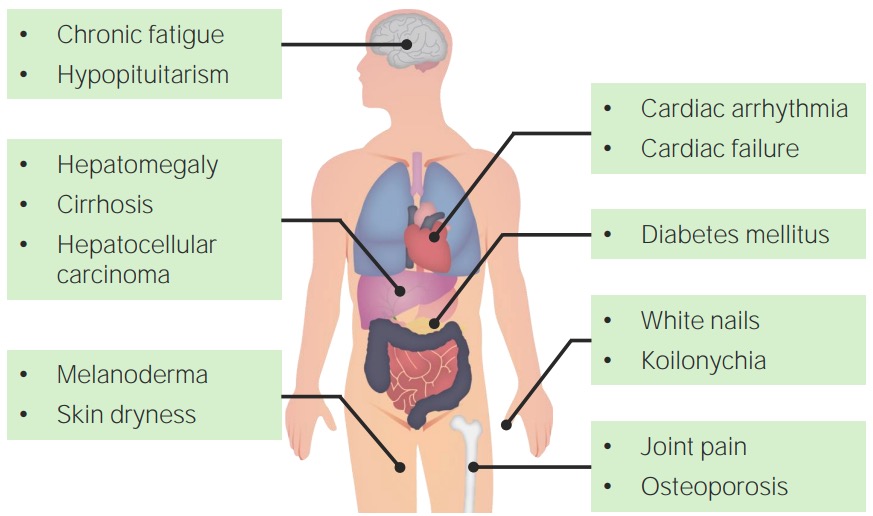
Hallazgos generales

  • Las manifestaciones dependen del grado de acumulación de hierro.
  • A menudo asintomático; diagnosticado incidentalmente en EN Erythema nodosum is an immune-mediated panniculitis (inflammation of the subcutaneous fat) caused by a type IV (delayed-type) hypersensitivity reaction. It commonly manifests in young women as tender, erythematous nodules on the shins. Erythema Nodosum análisis de sangre o en EN Erythema nodosum is an immune-mediated panniculitis (inflammation of the subcutaneous fat) caused by a type IV (delayed-type) hypersensitivity reaction. It commonly manifests in young women as tender, erythematous nodules on the shins. Erythema Nodosum un examen familiar
  • Hígado: 1er órgano en EN Erythema nodosum is an immune-mediated panniculitis (inflammation of the subcutaneous fat) caused by a type IV (delayed-type) hypersensitivity reaction. It commonly manifests in young women as tender, erythematous nodules on the shins. Erythema Nodosum ser afectado
  • Tríada clásica (encontrada tardíamente en la enfermedad):
    1. Cirrosis
    2. Diabetes (“diabetes de bronce” debido a la decoloración asociada)
    3. Bronceado de la piel/aumento de la pigmentación

Hallazgos específicos y complicaciones

  • Hígado:
    • Pruebas de funciones hepáticas anormales
    • Hepatomegalia ( en EN Erythema nodosum is an immune-mediated panniculitis (inflammation of the subcutaneous fat) caused by a type IV (delayed-type) hypersensitivity reaction. It commonly manifests in young women as tender, erythematous nodules on the shins. Erythema Nodosum el 95% de los LOS Neisseria pacientes), dolor Dolor Inflammation abdominal
    • Enfermedad hepática crónica/cirrosis: eritema palmar, telangiectasias Telangiectasias Ataxia-telangiectasia, esplenomegalia
    • Insuficiencia hepática: encefalopatía, ictericia, ascitis
    • Carcinoma hepatocelular
  • Páncreas:
    • Diabetes Diabetes Diabetes mellitus (DM) is a metabolic disease characterized by hyperglycemia and dysfunction of the regulation of glucose metabolism by insulin. Type 1 DM is diagnosed mostly in children and young adults as the result of autoimmune destruction of β cells in the pancreas and the resulting lack of insulin. Type 2 DM has a significant association with obesity and is characterized by insulin resistance. Diabetes Mellitus: glucosa elevada
    • Fatiga, poliuria, polidipsia, pérdida de peso, infecciones recurrentes
  • Piel:
    • Coloración de la piel bronce/gris pizarra (melanodermia)
    • Principalmente en EN Erythema nodosum is an immune-mediated panniculitis (inflammation of the subcutaneous fat) caused by a type IV (delayed-type) hypersensitivity reaction. It commonly manifests in young women as tender, erythematous nodules on the shins. Erythema Nodosum la cara, el cuello, los LOS Neisseria antebrazos y la región genital
    • Coiloniquia (uñas en EN Erythema nodosum is an immune-mediated panniculitis (inflammation of the subcutaneous fat) caused by a type IV (delayed-type) hypersensitivity reaction. It commonly manifests in young women as tender, erythematous nodules on the shins. Erythema Nodosum forma de cuchara)
  • Corazón:
    • Miocardiopatía dilatada, insuficiencia cardíaca congestiva
    • Arritmias
  • Articulaciones:
    • Artralgia: pequeñas articulaciones de las manos, especialmente la 1ra, 2da y 3ra articulación metacarpofalángica
    • Otras: rodillas, muñecas
    • Sin calor Calor Inflammation, enrojecimiento o deformidad en EN Erythema nodosum is an immune-mediated panniculitis (inflammation of the subcutaneous fat) caused by a type IV (delayed-type) hypersensitivity reaction. It commonly manifests in young women as tender, erythematous nodules on the shins. Erythema Nodosum las articulaciones
    • Osteoporosis Osteoporosis Osteoporosis refers to a decrease in bone mass and density leading to an increased number of fractures. There are 2 forms of osteoporosis: primary, which is commonly postmenopausal or senile; and secondary, which is a manifestation of immobilization, underlying medical disorders, or long-term use of certain medications. Osteoporosis
  • Glándula hipófisis:
    • Hipogonadismo (disfunción hipofisiaria más común): infertilidad, pérdida de la libido, amenorrea
    • Insuficiencia suprarrenal
    • Hipotiroidismo
    • Hipoparatiroidismo
  • Disminución de las defensas del huésped:
    • Deterioro de la fagocitosis y reducción de la proliferación de linfocitos, con hierro fácilmente disponible para los LOS Neisseria microorganismos
    • ↑ Riesgo de infección por Listeria Listeria Listeria spp. are motile, flagellated, gram-positive, facultative intracellular bacilli. The major pathogenic species is Listeria monocytogenes. Listeria are part of the normal gastrointestinal flora of domestic mammals and poultry and are transmitted to humans through the ingestion of contaminated food, especially unpasteurized dairy products. Listeria Monocytogenes/Listeriosis monocytogenes, Yersinia enterocolitica Yersinia enterocolitica A species of the genus yersinia, isolated from both man and animal. It is a frequent cause of bacterial gastroenteritis in children. Yersinia spp./Yersiniosis y Vibrio vulnificus Vibrio vulnificus A species of halophilic bacteria in the genus vibrio, which lives in warm seawater. It can cause infections in those who eat raw contaminated seafood or have open wounds exposed to seawater. Vibrio
Características clínicas de la hemocromatosis.

Características clínicas de la hemocromatosis.

Imagen por Lecturio.
Diagnóstico

Pruebas de laboratorio

  • Saturación de transferrina: relación entre el hierro sérico y la capacidad total de unión al AL Amyloidosis hierro:
    • Si > 45% → tamizaje para hemocromatosis
    • Si > 60% (hombres) y > 50% (mujeres) → muy específico para hacer el diagnóstico
  • Hierro sérico: > 150 mcg/dL
  • Capacidad total de unión al AL Amyloidosis hierro: 200–300 mcg/dL
  • Ferritina sérica:
    • Reactivo de fase aguda
    • Menos sensible, porque la ferritina sérica puede ser ↑ en EN Erythema nodosum is an immune-mediated panniculitis (inflammation of the subcutaneous fat) caused by a type IV (delayed-type) hypersensitivity reaction. It commonly manifests in young women as tender, erythematous nodules on the shins. Erythema Nodosum otras enfermedades hepáticas e inflamatorias.
    • Indicativo de enfermedad cuando:
      • > 200 mcg/L en EN Erythema nodosum is an immune-mediated panniculitis (inflammation of the subcutaneous fat) caused by a type IV (delayed-type) hypersensitivity reaction. It commonly manifests in young women as tender, erythematous nodules on the shins. Erythema Nodosum mujeres premenopáusicas
      • > 300 mcg/L en EN Erythema nodosum is an immune-mediated panniculitis (inflammation of the subcutaneous fat) caused by a type IV (delayed-type) hypersensitivity reaction. It commonly manifests in young women as tender, erythematous nodules on the shins. Erythema Nodosum hombres y en EN Erythema nodosum is an immune-mediated panniculitis (inflammation of the subcutaneous fat) caused by a type IV (delayed-type) hypersensitivity reaction. It commonly manifests in young women as tender, erythematous nodules on the shins. Erythema Nodosum mujeres postmenopáusicas
      • Si > 1 000 mcg/L → mayor riesgo de daño orgánico
  • Pruebas de función hepática anormales: ↑ alanina transaminasa ( ALT ALT An enzyme that catalyzes the conversion of l-alanine and 2-oxoglutarate to pyruvate and l-glutamate. Liver Function Tests), ↑ aspartato transaminasa ( AST AST Enzymes of the transferase class that catalyze the conversion of l-aspartate and 2-ketoglutarate to oxaloacetate and l-glutamate. Liver Function Tests)
  • Exámenes adicionales:
    • Pruebas hormonales en EN Erythema nodosum is an immune-mediated panniculitis (inflammation of the subcutaneous fat) caused by a type IV (delayed-type) hypersensitivity reaction. It commonly manifests in young women as tender, erythematous nodules on the shins. Erythema Nodosum casos compatibles con trastornos hipofisarios
    • Hemoglobina glicosilada y panel metabólico en EN Erythema nodosum is an immune-mediated panniculitis (inflammation of the subcutaneous fat) caused by a type IV (delayed-type) hypersensitivity reaction. It commonly manifests in young women as tender, erythematous nodules on the shins. Erythema Nodosum personas con diabetes Diabetes Diabetes mellitus (DM) is a metabolic disease characterized by hyperglycemia and dysfunction of the regulation of glucose metabolism by insulin. Type 1 DM is diagnosed mostly in children and young adults as the result of autoimmune destruction of β cells in the pancreas and the resulting lack of insulin. Type 2 DM has a significant association with obesity and is characterized by insulin resistance. Diabetes Mellitus

Pruebas genéticas

  • Mutaciones C282Y y H63D en EN Erythema nodosum is an immune-mediated panniculitis (inflammation of the subcutaneous fat) caused by a type IV (delayed-type) hypersensitivity reaction. It commonly manifests in young women as tender, erythematous nodules on the shins. Erythema Nodosum el gen HFE
  • Homocigoto para C282Y o heterocigoto para C282Y/H63D: indicativo de hemocromatosis hereditaria
  • Evaluar a todos los LOS Neisseria familiares de 1er grado.

Imagenología

  • Radiografías: puede verse cardiomegalia y vascularización pulmonar
  • RM del hígado:
    • Evalúa el daño hepático o el desarrollo de tumores
    • Forma no invasiva de estimar las reservas de hierro
  • Resonancia magnética cardíaca: realizada para personas con insuficiencia cardíaca
  • Ecocardiograma: muestra miocardiopatía dilatada, disfunción diastólica

Biopsia

  • Piel: puede muestrear cualquier sitio excepto las piernas (puede ser inespecífico debido a la estasis)
  • Biopsia de hígado:
    • Se realiza cuando el enfoque inicial produce resultados inciertos
    • Indicaciones:
      • Pruebas de función hepática anormales
      • Ferritina > 1 000 mcg/L
      • Se sospecha otra enfermedad hepática.
    • Ayuda a determinar la extensión del daño hepático y la concentración de hierro
    • Fibrosis Fibrosis Any pathological condition where fibrous connective tissue invades any organ, usually as a consequence of inflammation or other injury. Bronchiolitis Obliterans hepática: factor pronóstico más importante
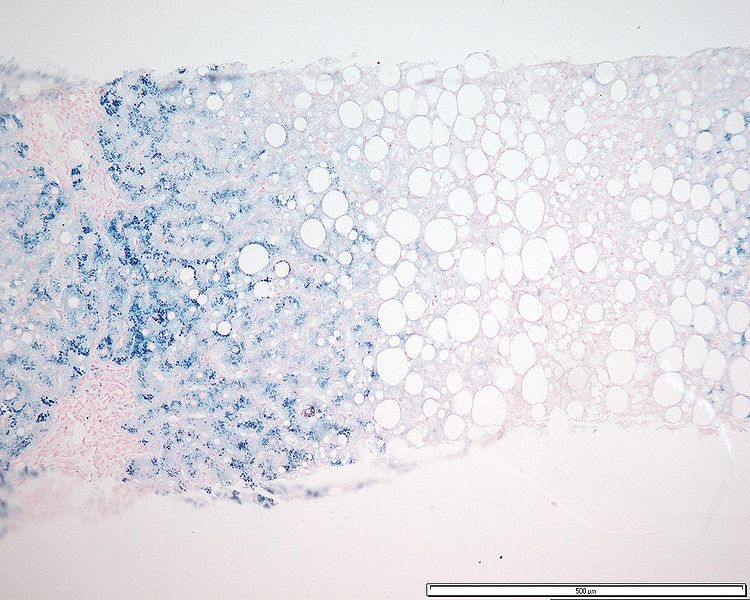
Biopsia hepática para hemocromatosis férrica

Acumulación de hierro en hepatocitos en un paciente con hemocromatosis (teñido con azul de Prusia de Perls)

Imagen: “Grade 3 hepatocyte iron accumulation” por Mathew, J. et al. Licencia: CC BY 3.0.

Tratamiento y Pronóstico

Tratamiento

  • Objetivos:
    • Eliminar el exceso de hierro del cuerpo.
    • Reducir la progresión de la enfermedad y las complicaciones, incluido el riesgo de enfermedad hepática crónica.
  • Flebotomía:
    • Tratamiento de elección
    • Se realiza semanalmente o dos veces por semana, extrayendo 500 mL y continúa hasta que el nivel de ferritina sérica sea de aproximadamente 50 a 100 mcg/L
    • Después de que la ferritina desciende al AL Amyloidosis nivel objetivo, se mantiene con flebotomía (la frecuencia depende de los LOS Neisseria estudios de hierro sérico y hemograma).
    • Puede mejorar o retrasar la progresión natural de la enfermedad.
  • Agentes quelantes de hierro:
    • Opciones de tratamiento para pacientes con enfermedad cardíaca, anemia Anemia Anemia is a condition in which individuals have low Hb levels, which can arise from various causes. Anemia is accompanied by a reduced number of RBCs and may manifest with fatigue, shortness of breath, pallor, and weakness. Subtypes are classified by the size of RBCs, chronicity, and etiology. Anemia: Overview and Types o acceso intravenoso difícil
    • Opciones:
      • Deferoxamina: intravenosa/intramuscular/subcutánea
      • Deferiprona: quelante oral (↓ sobrecarga cardíaca de hierro)
      • Deferasirox Deferasirox A triazole and benzoate derivative that acts as a selective iron chelator. It is used in the management of chronic iron overload due to blood transfusion or non-transfusion dependent thalassemia. Hereditary Hemochromatosis: quelante de hierro oral
  • Restricciones de la dieta:
    • Sin suplementos de hierro
    • Limitar los LOS Neisseria suplementos de vitamina C (↑ absorción de hierro).
    • Sin consumo de alcohol para disminuir el daño hepático
    • No consumir mariscos crudos (contaminación por Vibrio vulnificus Vibrio vulnificus A species of halophilic bacteria in the genus vibrio, which lives in warm seawater. It can cause infections in those who eat raw contaminated seafood or have open wounds exposed to seawater. Vibrio sepsis Sepsis Systemic inflammatory response syndrome with a proven or suspected infectious etiology. When sepsis is associated with organ dysfunction distant from the site of infection, it is called severe sepsis. When sepsis is accompanied by hypotension despite adequate fluid infusion, it is called septic shock. Sepsis and Septic Shock)
  • Tratamientos específicos de complicaciones:
    • Terapia convencional para diabetes Diabetes Diabetes mellitus (DM) is a metabolic disease characterized by hyperglycemia and dysfunction of the regulation of glucose metabolism by insulin. Type 1 DM is diagnosed mostly in children and young adults as the result of autoimmune destruction of β cells in the pancreas and the resulting lack of insulin. Type 2 DM has a significant association with obesity and is characterized by insulin resistance. Diabetes Mellitus, cirrosis e insuficiencia cardíaca/arritmia
    • Reemplazo hormonal o terapia con gonadotropinas para los LOS Neisseria efectos hipofisarios
    • Tamizaje por enfermedad hepática crónica para personas con alto riesgo
  • Tratamiento quirúrgico de complicaciones mayores:
    • Trasplante hepático: para insuficiencia hepática
    • Artroplastia: para infiltración articular severa

Pronóstico

  • Con tratamiento:
    • Tasa de supervivencia a 5 años: 89%
    • Pacientes sin fibrosis Fibrosis Any pathological condition where fibrous connective tissue invades any organ, usually as a consequence of inflammation or other injury. Bronchiolitis Obliterans hepática: se espera que tengan una esperanza de vida normal
  • Efectos del tratamiento/flebotomía sobre las complicaciones:
    • La insuficiencia cardíaca puede revertirse.
    • La función hepática y la pigmentación de la piel mejoran.
    • El 40% de los LOS Neisseria pacientes con diabetes Diabetes Diabetes mellitus (DM) is a metabolic disease characterized by hyperglycemia and dysfunction of the regulation of glucose metabolism by insulin. Type 1 DM is diagnosed mostly in children and young adults as the result of autoimmune destruction of β cells in the pancreas and the resulting lack of insulin. Type 2 DM has a significant association with obesity and is characterized by insulin resistance. Diabetes Mellitus alcanzan un mejor control de la glucosa.
    • Efecto mínimo sobre la artropatía y el hipogonadismo
  • Una vez que aparece la cirrosis hepática, es irreversible; la enfermedad hepática crónica es una secuela tardía.
  • Principales causas de muerte:
    • Falla cardíaca
    • Falla hepática
    • Carcinoma hepatocelular

Diagnóstico Diferencial

  • Enfermedad hepática alcohólica: Los LOS Neisseria pacientes con antecedentes de alcoholismo crónico y que han desarrollado enfermedad hepática crónica y cirrosis pueden manifestar niveles elevados de hierro. El tratamiento es la cesación del consumo de alcohol.
  • Transfusiones múltiples: En EN Erythema nodosum is an immune-mediated panniculitis (inflammation of the subcutaneous fat) caused by a type IV (delayed-type) hypersensitivity reaction. It commonly manifests in young women as tender, erythematous nodules on the shins. Erythema Nodosum pacientes que requieren muchas transfusiones de sangre (pacientes con talasemia, síndrome mielodisplásico), puede haber un aumento del nivel de hierro, comparable a los LOS Neisseria pacientes con hemocromatosis. Los LOS Neisseria niveles vuelven a la normalidad después de que se suspenden las transfusiones.
  • Anemia Anemia Anemia is a condition in which individuals have low Hb levels, which can arise from various causes. Anemia is accompanied by a reduced number of RBCs and may manifest with fatigue, shortness of breath, pallor, and weakness. Subtypes are classified by the size of RBCs, chronicity, and etiology. Anemia: Overview and Types crónica: una condición de recuentos de eritrocitos crónicamente bajos. Debido a que el cuerpo se adapta a la anemia Anemia Anemia is a condition in which individuals have low Hb levels, which can arise from various causes. Anemia is accompanied by a reduced number of RBCs and may manifest with fatigue, shortness of breath, pallor, and weakness. Subtypes are classified by the size of RBCs, chronicity, and etiology. Anemia: Overview and Types crónica, aumenta la eritropoyesis eficiente y la absorción de hierro. El tratamiento es el reemplazo de hierro además de tratar la causa subyacente.

Referencias

  1. Phatak, P., & Girelli, D. (2025). Clinical manifestations and diagnosis of hereditary hemochromatosis. UpToDate. In K. D. Lindor & R. T. Means Jr. (Eds.), J. S. Tirnauer & H. Li (Deputy Eds.). Retrieved April 23, 2025, from https://www.uptodate.com/contents/clinical-manifestations-and-diagnosis-of-hereditary-hemochromatosis
  2. Duchini, A., Sfier, H., & Klachko, D. (2023). Hemochromatosis. In Roy, P. Medscape. Retrieved April 23, 2025, from https://emedicine.medscape.com/article/177216-overview
  3. Friedman, L.S. (2021). Hemochromatosis. In Papadakis M.A., & McPhee S.J., & Rabow M.W. (Eds.), Current Medical Diagnosis & Treatment 2021. McGraw-Hill.
  4. Kelley, M., Joshi, N., Xie, Y., & Borgaonkar, M. (2014). Iron overload is rare in patients homozygous for the H63D mutation. Canadian Journal of Gastroenterology and Hepatology, 28(4), 198–202. https://doi.org/10.1155/2014/468521
  5. Nemeth, E., & Ganz, T. (2009). The role of hepcidin in iron metabolism. Acta Haematologica, 122(2–3), 78–86. https://doi.org/10.1159/000243791
  6. Porter, J. L., & Rawla, P. (2024). Hemochromatosis. In StatPearls. StatPearls Publishing. Retrieved April 23, 2025, from https://www.ncbi.nlm.nih.gov/books/NBK430862/
  7. Powell, L.W. (2018). Hemochromatosis. In Jameson J., Fauci A.S., Kasper D.L., Hauser S.L., Longo D.L., & Loscalzo, J. (Eds.), Harrison’s Principles of Internal Medicine, 20e. McGraw-Hill.

¡Crea tu cuenta gratis o inicia una sesión para seguir leyendo!

Regístrate ahora y obtén acceso gratuito a Lecturio con páginas de concepto, videos médicos y cuestionarios para tu educación médica.

User Reviews

Que tengas una sesión de estudio alegre y navideña 🎁 Ahorra 50% en todos los planes >>

Details