Domina Conceptos Médicos

Estudia para la escuela de medicina y tus examenes con Lecturio.

Fracturas de Cadera

Una fractura de cadera es una ruptura en EN Erythema nodosum is an immune-mediated panniculitis (inflammation of the subcutaneous fat) caused by a type IV (delayed-type) hypersensitivity reaction. It commonly manifests in young women as tender, erythematous nodules on the shins. Erythema Nodosum la corteza del fémur en EN Erythema nodosum is an immune-mediated panniculitis (inflammation of the subcutaneous fat) caused by a type IV (delayed-type) hypersensitivity reaction. It commonly manifests in young women as tender, erythematous nodules on the shins. Erythema Nodosum la articulación de la cadera, ya sea entre los LOS Neisseria trocánteres (intertrocantéreos) o en EN Erythema nodosum is an immune-mediated panniculitis (inflammation of the subcutaneous fat) caused by a type IV (delayed-type) hypersensitivity reaction. It commonly manifests in young women as tender, erythematous nodules on the shins. Erythema Nodosum el cuello femoral. La fractura de cadera es una lesión grave y puede resultar en EN Erythema nodosum is an immune-mediated panniculitis (inflammation of the subcutaneous fat) caused by a type IV (delayed-type) hypersensitivity reaction. It commonly manifests in young women as tender, erythematous nodules on the shins. Erythema Nodosum complicaciones potencialmente mortales. Las causas incluyen un impacto de alta energía debido a un traumatismo, como en EN Erythema nodosum is an immune-mediated panniculitis (inflammation of the subcutaneous fat) caused by a type IV (delayed-type) hypersensitivity reaction. It commonly manifests in young women as tender, erythematous nodules on the shins. Erythema Nodosum accidentes automovilísticos, o un traumatismo de baja energía (caídas) en EN Erythema nodosum is an immune-mediated panniculitis (inflammation of the subcutaneous fat) caused by a type IV (delayed-type) hypersensitivity reaction. It commonly manifests in young women as tender, erythematous nodules on the shins. Erythema Nodosum pacientes con osteoporosis Osteoporosis Osteoporosis refers to a decrease in bone mass and density leading to an increased number of fractures. There are 2 forms of osteoporosis: primary, which is commonly postmenopausal or senile; and secondary, which is a manifestation of immobilization, underlying medical disorders, or long-term use of certain medications. Osteoporosis. La presentación clínica incluye dolor Dolor Inflammation inguinal, sensibilidad a la palpación, inmovilidad y deformidad de las extremidades inferiores. El diagnóstico se realiza clínicamente y mediante imagenología. El tratamiento definitivo es generalmente quirúrgico, pero depende del tipo de fractura y del estado del paciente.

Last updated: Dec 15, 2025

Editorial responsibility: Stanley Oiseth, Lindsay Jones, Evelin Maza

Descripción General

Definición

Una fractura de cadera es una ruptura en EN Erythema nodosum is an immune-mediated panniculitis (inflammation of the subcutaneous fat) caused by a type IV (delayed-type) hypersensitivity reaction. It commonly manifests in young women as tender, erythematous nodules on the shins. Erythema Nodosum la corteza del fémur en EN Erythema nodosum is an immune-mediated panniculitis (inflammation of the subcutaneous fat) caused by a type IV (delayed-type) hypersensitivity reaction. It commonly manifests in young women as tender, erythematous nodules on the shins. Erythema Nodosum la articulación femoroacetabular (cadera), ya sea entre los LOS Neisseria trocánteres mayor y menor (intertrocantérea) o en EN Erythema nodosum is an immune-mediated panniculitis (inflammation of the subcutaneous fat) caused by a type IV (delayed-type) hypersensitivity reaction. It commonly manifests in young women as tender, erythematous nodules on the shins. Erythema Nodosum el cuello femoral.

Anatomía

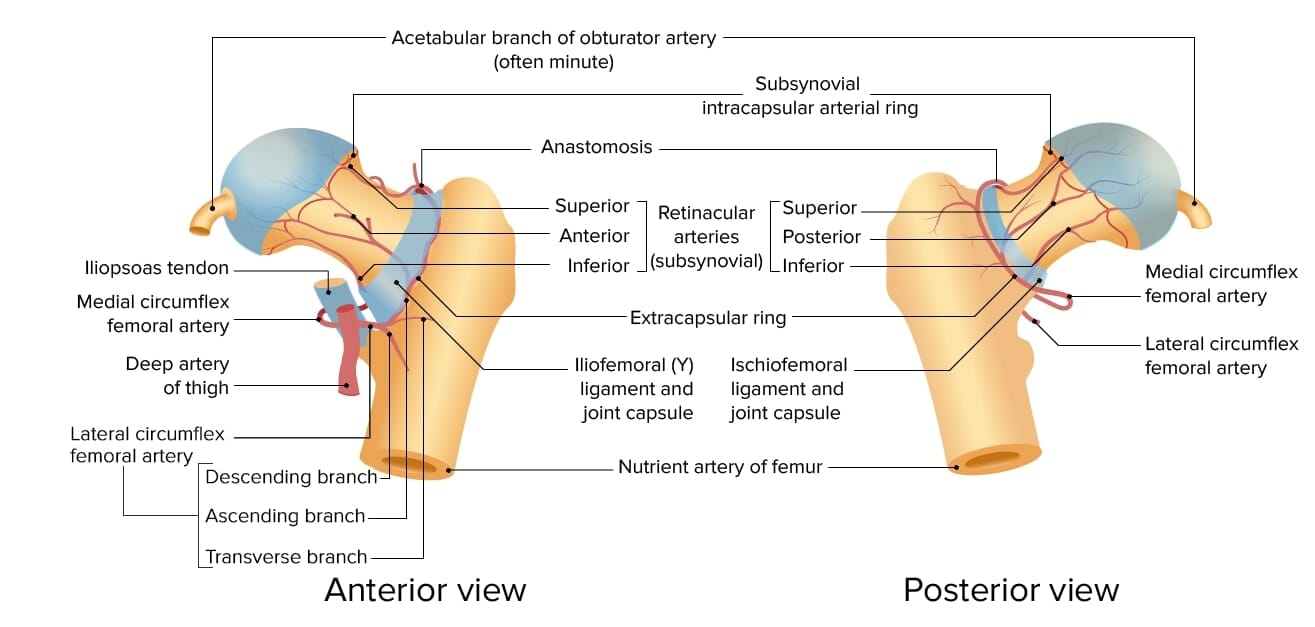
La cadera es una articulación esférica formada por la cabeza femoral y el acetábulo (cavidad). La irrigación a la cabeza femoral proviene de la arteria circunfleja.
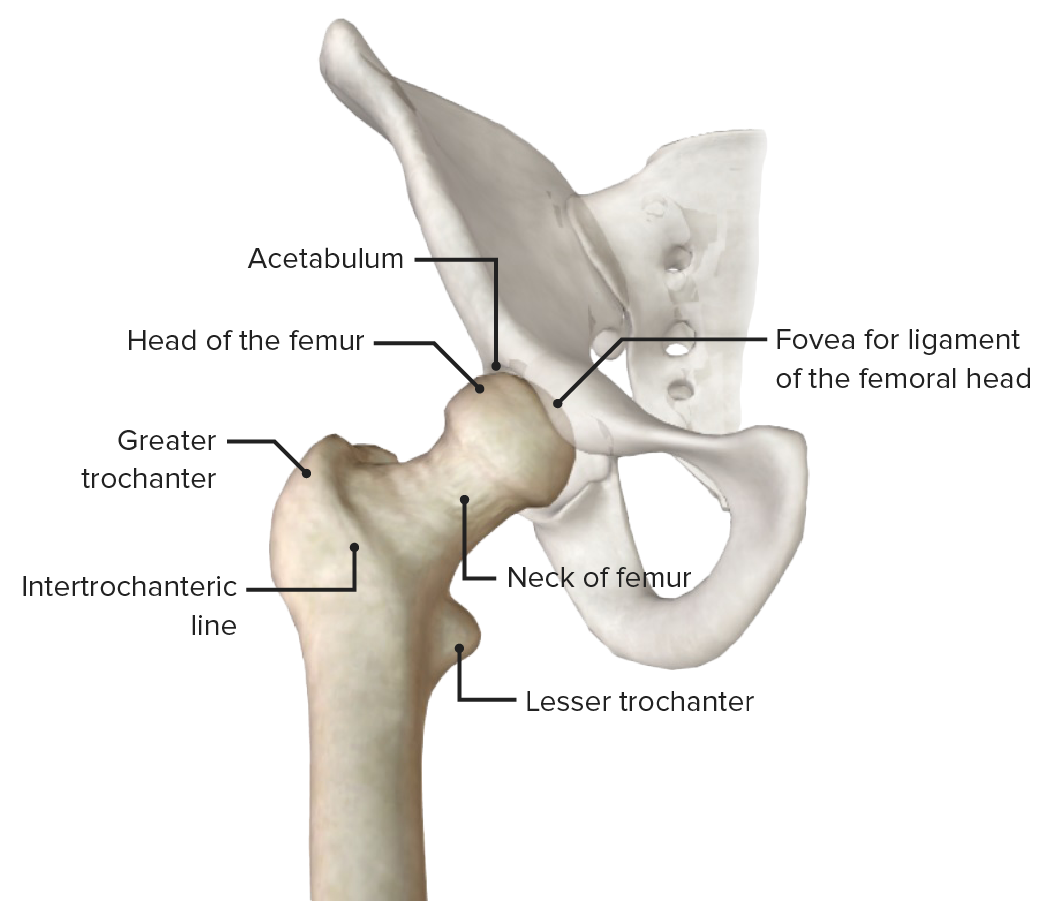
Vista anterior de la articulación de la cadera

Vista anterior de la articulación de la cadera (pelvis atenuada), con los puntos de referencia óseos del extremo proximal del fémur

Imagen por BioDigital, editada por Lecturio

Clasificación

Las fracturas de cadera se clasifican por ubicación anatómica y tipo de fractura. Reconocer estas fracturas es importante para el tratamiento quirúrgico.
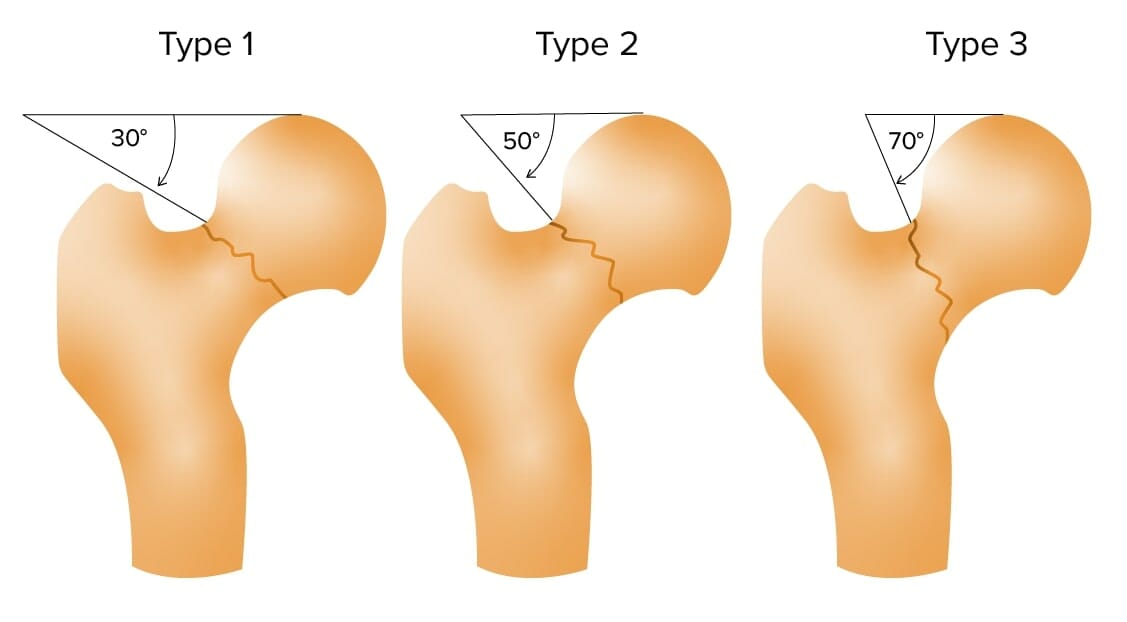
  • Fractura de cadera intracapsular (cuello femoral):
    • La clasificación de Pauwels se utiliza para dividir las fracturas en EN Erythema nodosum is an immune-mediated panniculitis (inflammation of the subcutaneous fat) caused by a type IV (delayed-type) hypersensitivity reaction. It commonly manifests in young women as tender, erythematous nodules on the shins. Erythema Nodosum 3 grupos según el ángulo de la fractura desde el plano horizontal:
      • Tipo I: < 30 grados
      • Tipo II: 31–50 grados
      • Tipo III: > 50 grados
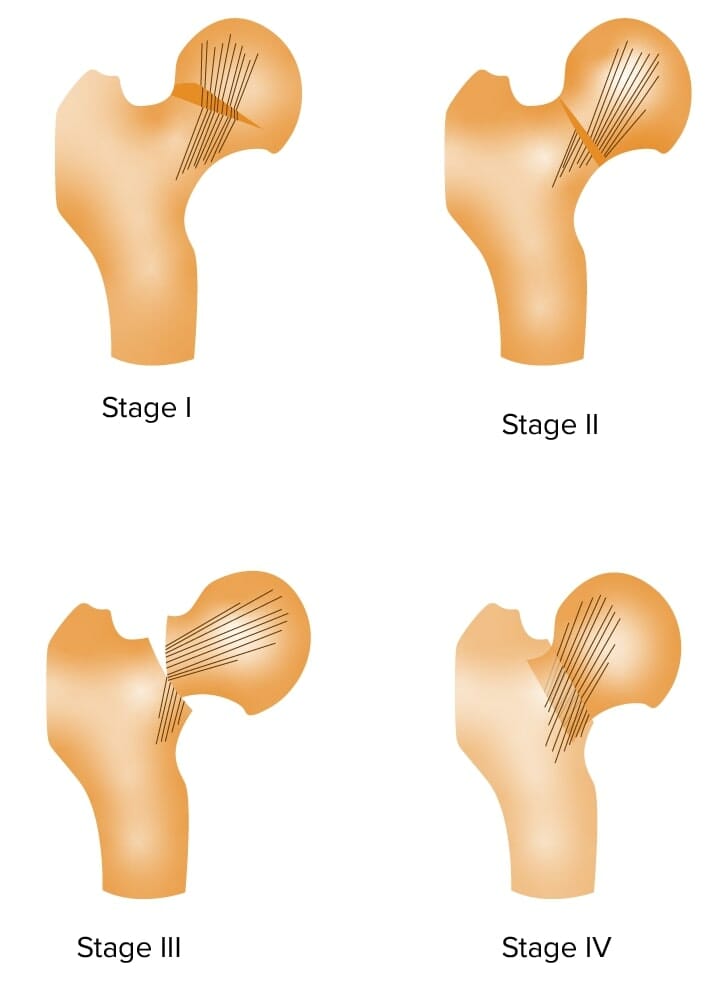
    • La clasificación de Garden se utiliza más comúnmente:
      • Tipo 1: fractura por impactación
      • Tipo 2: fractura completa, no desplazada
      • Tipo 3: fractura completa con desplazamiento parcial
      • Tipo 4: fractura completa con desplazamiento completo
    • Las fracturas intracapsulares tienen tasas más altas de pseudoartrosis y consolidación defectuosa.
    • Es más probable que se produzca necrosis Necrosis The death of cells in an organ or tissue due to disease, injury or failure of the blood supply. Ischemic Cell Damage avascular Avascular Corneal Abrasions, Erosion, and Ulcers de la cabeza femoral
  • Fractura de cadera extracapsular (intertrocantérea):
    • La 2018 AO/OTA es la clasificación estándar para fracturas utilizada por cirujanos traumatólogos y médicos que se ocupan de la atención de traumatismos ortopédicos musculoesqueléticos:
      • A1: estable, la fractura tiene 2 partes
      • A2: fractura conminuta inestable
      • A3: fractura inversa/transversal inestable
    • Las fracturas extracapsulares tienen un menor riesgo de complicaciones.

Epidemiología

  • Prevalencia:
    • Una de las fracturas más frecuentes en EN Erythema nodosum is an immune-mediated panniculitis (inflammation of the subcutaneous fat) caused by a type IV (delayed-type) hypersensitivity reaction. It commonly manifests in young women as tender, erythematous nodules on the shins. Erythema Nodosum pacientes que acuden a sala de emergencias
    • El 15% de las mujeres y el 5% de los LOS Neisseria hombres sufrirán una fractura de cadera en EN Erythema nodosum is an immune-mediated panniculitis (inflammation of the subcutaneous fat) caused by a type IV (delayed-type) hypersensitivity reaction. It commonly manifests in young women as tender, erythematous nodules on the shins. Erythema Nodosum su vida por osteoporosis Osteoporosis Osteoporosis refers to a decrease in bone mass and density leading to an increased number of fractures. There are 2 forms of osteoporosis: primary, which is commonly postmenopausal or senile; and secondary, which is a manifestation of immobilization, underlying medical disorders, or long-term use of certain medications. Osteoporosis.
  • Incidencia:
    • Aproximadamente 550/100 000 mujeres por año en EN Erythema nodosum is an immune-mediated panniculitis (inflammation of the subcutaneous fat) caused by a type IV (delayed-type) hypersensitivity reaction. It commonly manifests in young women as tender, erythematous nodules on the shins. Erythema Nodosum EE. UU.
    • Aproximadamente 200/100 000 hombres por año en EN Erythema nodosum is an immune-mediated panniculitis (inflammation of the subcutaneous fat) caused by a type IV (delayed-type) hypersensitivity reaction. It commonly manifests in young women as tender, erythematous nodules on the shins. Erythema Nodosum EE. UU.
  • Edad promedio de presentación: 80 años
  • El 5% de las personas afectadas no tiene antecedentes de traumatismo.

Etiología

  • Traumatismos de alta energía en EN Erythema nodosum is an immune-mediated panniculitis (inflammation of the subcutaneous fat) caused by a type IV (delayed-type) hypersensitivity reaction. It commonly manifests in young women as tender, erythematous nodules on the shins. Erythema Nodosum adultos sanos:
    • Accidentes de vehículos de motor Motor Neurons which send impulses peripherally to activate muscles or secretory cells. Nervous System: Histology que involucran pasajeros o peatones
    • Caída desde una altura significativa
    • Víctima de violencia o disparo con arma de fuego
  • Traumatismos de baja energía en EN Erythema nodosum is an immune-mediated panniculitis (inflammation of the subcutaneous fat) caused by a type IV (delayed-type) hypersensitivity reaction. It commonly manifests in young women as tender, erythematous nodules on the shins. Erythema Nodosum ancianos por caídas y/u osteoporosis Osteoporosis Osteoporosis refers to a decrease in bone mass and density leading to an increased number of fractures. There are 2 forms of osteoporosis: primary, which is commonly postmenopausal or senile; and secondary, which is a manifestation of immobilization, underlying medical disorders, or long-term use of certain medications. Osteoporosis:
    • Factores de riesgo de caídas:
      • Antecedente previo de caídas
      • Anormalidades de la marcha
      • Uso de ayudas para caminar
      • Vértigo
      • Enfermedad de Parkinson
      • Epilepsia
    • Factores de riesgo de osteoporosis Osteoporosis Osteoporosis refers to a decrease in bone mass and density leading to an increased number of fractures. There are 2 forms of osteoporosis: primary, which is commonly postmenopausal or senile; and secondary, which is a manifestation of immobilization, underlying medical disorders, or long-term use of certain medications. Osteoporosis:
      • Tabaquismo
      • Edad avanzada
      • Deficiencia hormonal (menopausia en EN Erythema nodosum is an immune-mediated panniculitis (inflammation of the subcutaneous fat) caused by a type IV (delayed-type) hypersensitivity reaction. It commonly manifests in young women as tender, erythematous nodules on the shins. Erythema Nodosum mujeres e hipogonadismo en EN Erythema nodosum is an immune-mediated panniculitis (inflammation of the subcutaneous fat) caused by a type IV (delayed-type) hypersensitivity reaction. It commonly manifests in young women as tender, erythematous nodules on the shins. Erythema Nodosum hombres)
      • Uso de esteroides (terapia con glucocorticoides)
      • Peso corporal bajo
      • Ingesta excesiva de alcohol
  • Fracturas patológicas causadas por un proceso patológico (no relacionadas con traumatismos):
    • Osteoporosis Osteoporosis Osteoporosis refers to a decrease in bone mass and density leading to an increased number of fractures. There are 2 forms of osteoporosis: primary, which is commonly postmenopausal or senile; and secondary, which is a manifestation of immobilization, underlying medical disorders, or long-term use of certain medications. Osteoporosis
    • Enfermedad ósea de Paget
    • Tumores óseos:
      • Osteosarcoma Osteosarcoma Osteosarcoma is a primary malignant tumor of the bone characterized by the production of osteoid or immature bone by the tumor cells. The disease is most common in children and young adults and most frequently affects growth plates of the long bones, although it can involve any bone. Osteosarcoma
      • Mieloma múltiple
    • Lesiones metastásicas: puede ocurrir metástasis ósea en EN Erythema nodosum is an immune-mediated panniculitis (inflammation of the subcutaneous fat) caused by a type IV (delayed-type) hypersensitivity reaction. It commonly manifests in young women as tender, erythematous nodules on the shins. Erythema Nodosum cualquier hueso, pero ocurre más comúnmente en EN Erythema nodosum is an immune-mediated panniculitis (inflammation of the subcutaneous fat) caused by a type IV (delayed-type) hypersensitivity reaction. It commonly manifests in young women as tender, erythematous nodules on the shins. Erythema Nodosum la columna, la pelvis Pelvis The pelvis consists of the bony pelvic girdle, the muscular and ligamentous pelvic floor, and the pelvic cavity, which contains viscera, vessels, and multiple nerves and muscles. The pelvic girdle, composed of 2 “hip” bones and the sacrum, is a ring-like bony structure of the axial skeleton that links the vertebral column with the lower extremities. Pelvis: Anatomy y el muslo.
      • Cáncer de mama
      • Cáncer de próstata
      • Cáncer de pulmón
      • Carcinoma de células renales
      • Cáncer de tiroides

Fisiopatología

El principio general detrás de todas las fracturas es que el hueso está sujeto a una carga que supera su capacidad, lo que resulta en EN Erythema nodosum is an immune-mediated panniculitis (inflammation of the subcutaneous fat) caused by a type IV (delayed-type) hypersensitivity reaction. It commonly manifests in young women as tender, erythematous nodules on the shins. Erythema Nodosum una pérdida de integridad estructural.

  • Con las fracturas intertrocantéreas, se conserva la irrigación a la cabeza femoral y la fractura se puede reparar quirúrgicamente.
  • Con fracturas del cuello femoral, el suministro de sangre puede interrumpirse:

Presentación Clínica y Diagnóstico

La presentación de un paciente con fractura de cadera depende de la situación clínica.

Antecedentes

  • Generalmente, se presenta con dolor Dolor Inflammation inguinal
  • Caídas en EN Erythema nodosum is an immune-mediated panniculitis (inflammation of the subcutaneous fat) caused by a type IV (delayed-type) hypersensitivity reaction. It commonly manifests in young women as tender, erythematous nodules on the shins. Erythema Nodosum ancianos: también es importante determinar el motivo de la caída. Deben abordarse las siguientes comorbilidades:
    • Síncope
    • Accidente cerebrovascular
    • Vértigo
    • Arritmia
    • Convulsiones
  • Mecanismo de la lesión:
    • Una caída directamente sobre la parte lateral de la cadera
    • Un mecanismo de torsión en EN Erythema nodosum is an immune-mediated panniculitis (inflammation of the subcutaneous fat) caused by a type IV (delayed-type) hypersensitivity reaction. It commonly manifests in young women as tender, erythematous nodules on the shins. Erythema Nodosum el que se planta el pie del paciente y el cuerpo gira
    • Una fractura completa por fragilidad repentina y espontánea, que luego causa una caída ( en EN Erythema nodosum is an immune-mediated panniculitis (inflammation of the subcutaneous fat) caused by a type IV (delayed-type) hypersensitivity reaction. It commonly manifests in young women as tender, erythematous nodules on the shins. Erythema Nodosum lugar de una caída que causa una fractura)
    • Algunos pacientes pueden no reportar ningún traumatismo en EN Erythema nodosum is an immune-mediated panniculitis (inflammation of the subcutaneous fat) caused by a type IV (delayed-type) hypersensitivity reaction. It commonly manifests in young women as tender, erythematous nodules on the shins. Erythema Nodosum absoluto (5%).
  • Traumatismo de alto impacto:
    • Accidentes de vehículos de motor Motor Neurons which send impulses peripherally to activate muscles or secretory cells. Nervous System: Histology: los LOS Neisseria pacientes pueden tener múltiples lesiones traumáticas.
    • Caída desde una gran altura, como un techo o un árbol
    • Una caída por las escaleras
    • Heridas por arma de fuego

Examen físico

  • Sensibilidad a la palpación sobre el trocánter mayor
  • Inmovilidad debido al AL Amyloidosis dolor Dolor Inflammation/incapacidad para soportar peso
  • Deformidad del miembro inferior
  • Discrepancia en EN Erythema nodosum is an immune-mediated panniculitis (inflammation of the subcutaneous fat) caused by a type IV (delayed-type) hypersensitivity reaction. It commonly manifests in young women as tender, erythematous nodules on the shins. Erythema Nodosum la longitud de las extremidades
  • Rotación externa de la extremidad afectada
  • Equimosis sobre el sitio de la fractura
  • Estado mental alterado: los LOS Neisseria pacientes de edad avanzada pueden experimentar delirio.
  • La piel puede tener laceraciones, lo que representa un riesgo de infección.

Diagnóstico

El diagnóstico de una fractura de cadera se realiza clínicamente y con imagenología diagnóstica. Una fractura de cadera puede complicarse con una luxación dependiendo del grado de aducción en EN Erythema nodosum is an immune-mediated panniculitis (inflammation of the subcutaneous fat) caused by a type IV (delayed-type) hypersensitivity reaction. It commonly manifests in young women as tender, erythematous nodules on the shins. Erythema Nodosum el momento del impacto, especialmente en EN Erythema nodosum is an immune-mediated panniculitis (inflammation of the subcutaneous fat) caused by a type IV (delayed-type) hypersensitivity reaction. It commonly manifests in young women as tender, erythematous nodules on the shins. Erythema Nodosum accidentes automovilísticos.
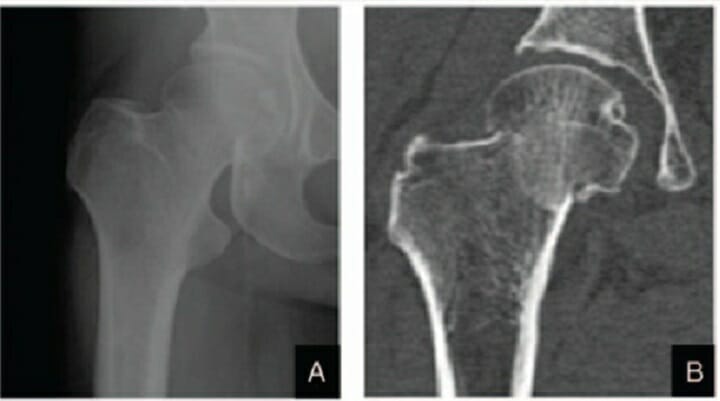
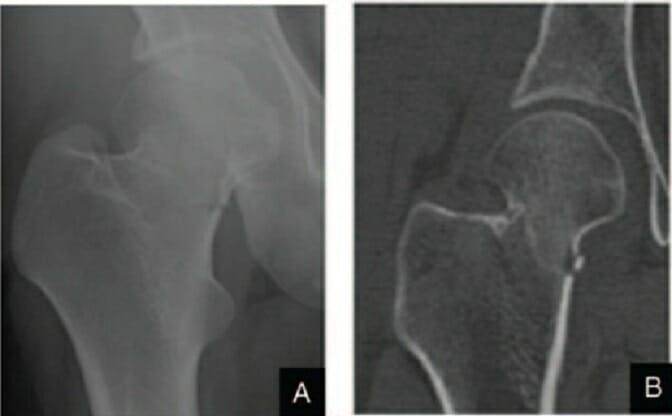
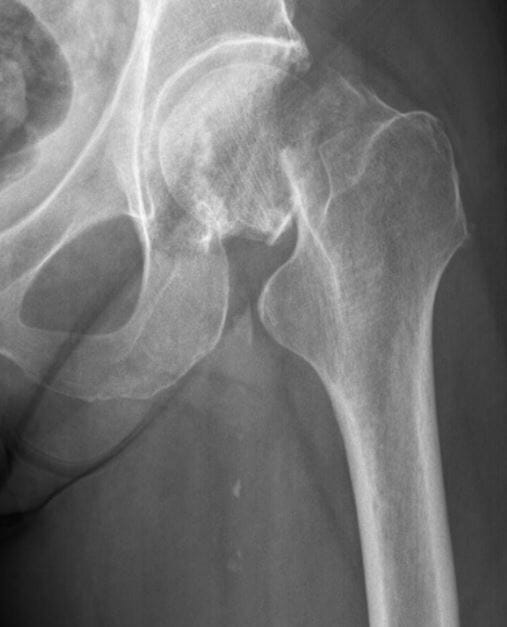
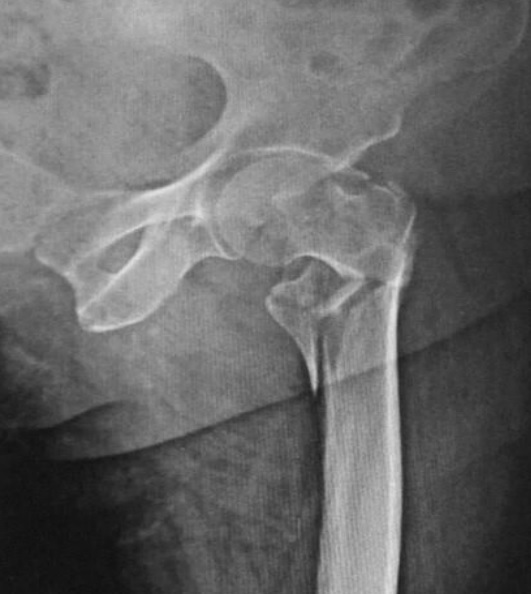
  • Radiografía: una radiografía anteroposterior de la cadera está indicada.
    • Descripción de la fractura:
      • Ubicación de las líneas de fractura (extra o intracapsular)
      • Completa o incompleta
      • Desplazamiento
    • Hallazgos secundarios:
      • Aumento de la opacidad de los LOS Neisseria tejidos blandos (inflamación y edema Edema Edema is a condition in which excess serous fluid accumulates in the body cavity or interstitial space of connective tissues. Edema is a symptom observed in several medical conditions. It can be categorized into 2 types, namely, peripheral (in the extremities) and internal (in an organ or body cavity). Edema)
      • Reacción perióstica/formación del callo
  • TC/RM:
    • La RM es el estándar de oro.
    • Provee la mejor visualización de la anatomía pélvica y femoral
    • La TC es la mejor alternativa si la RM no está disponible.
    • Los LOS Neisseria pacientes inestables NO deben ser llevados a un estudio.
  • Pruebas de laboratorio:
    • Hemograma
    • Panel de química sérica con función renal (creatinina y nitrógeno ureico en EN Erythema nodosum is an immune-mediated panniculitis (inflammation of the subcutaneous fat) caused by a type IV (delayed-type) hypersensitivity reaction. It commonly manifests in young women as tender, erythematous nodules on the shins. Erythema Nodosum sangre)
    • TP y TTP TTP Thrombotic thrombocytopenic purpura (TTP) is a life-threatening condition due to either a congenital or an acquired deficiency of adamts-13, a metalloproteinase that cleaves multimers of von Willebrand factor (vWF). The large multimers then aggregate excessive platelets resulting in microvascular thrombosis and an increase in consumption of platelets. Thrombotic Thrombocytopenic Purpura
    • Tipaje y compatibilidad cruzada para una posible transfusión

Tratamiento

El tratamiento definitivo depende del tipo de fractura y requiere la consulta con un cirujano ortopédico.
Tratamiento

  • Objetivos del tratamiento:
    • Fijación estable que permita un soporte de peso inmediato
    • Maximización del potencial de retorno al AL Amyloidosis nivel de movilidad presente antes de la fractura
    • Minimización del potencial de falla del implante (si está presente)
  • Tratamiento inicial:
    • Terapia de reemplazo de líquidos
    • Transfusión de sangre, si está indicada
    • Analgesia Analgesia Methods of pain relief that may be used with or in place of analgesics. Anesthesiology: History and Basic Concepts
    • Consulta ortopédica
    • SIN tracción
    • Profilaxis para infecciones en EN Erythema nodosum is an immune-mediated panniculitis (inflammation of the subcutaneous fat) caused by a type IV (delayed-type) hypersensitivity reaction. It commonly manifests in young women as tender, erythematous nodules on the shins. Erythema Nodosum caso de herida abierta
  • Tratamiento no quirúrgico:
    • Algunos pacientes debilitados pueden no ser candidatos para cirugía:
      • Pacientes que no deambulan/postrados en EN Erythema nodosum is an immune-mediated panniculitis (inflammation of the subcutaneous fat) caused by a type IV (delayed-type) hypersensitivity reaction. It commonly manifests in young women as tender, erythematous nodules on the shins. Erythema Nodosum cama con dolor Dolor Inflammation leve
      • Pacientes inestables con una enfermedad significativa e incorregible
    • Pacientes en EN Erythema nodosum is an immune-mediated panniculitis (inflammation of the subcutaneous fat) caused by a type IV (delayed-type) hypersensitivity reaction. It commonly manifests in young women as tender, erythematous nodules on the shins. Erythema Nodosum el estadio tardío de una enfermedad terminal
  • Tratamiento quirúrgico ortopédico:
    • El procedimiento definitivo depende del tipo de fractura (extracapsular/intracapsular).
    • Fijación interna con reducción abierta para fracturas de cuello femoral no desplazadas y la mayoría de las fracturas intertrocantéreas
    • Hemiartroplastia o artroplastia total de cadera para fracturas de cuello femoral desplazadas en EN Erythema nodosum is an immune-mediated panniculitis (inflammation of the subcutaneous fat) caused by a type IV (delayed-type) hypersensitivity reaction. It commonly manifests in young women as tender, erythematous nodules on the shins. Erythema Nodosum adultos mayores
  • Consulta a oncología:
    • Si la fractura es de origen patológico
    • Los LOS Neisseria procedimientos paliativos pueden estar indicados en EN Erythema nodosum is an immune-mediated panniculitis (inflammation of the subcutaneous fat) caused by a type IV (delayed-type) hypersensitivity reaction. It commonly manifests in young women as tender, erythematous nodules on the shins. Erythema Nodosum pacientes con malignidad ósea:
  • Rehabilitación:
    • Profilaxis para trombosis venosa profunda (TVP):
      • Calcetines de compresión
      • Anticoagulación
    • Puede ser necesaria una transfusión de sangre postoperatoria si la Hb Hb The oxygen-carrying proteins of erythrocytes. They are found in all vertebrates and some invertebrates. The number of globin subunits in the hemoglobin quaternary structure differs between species. Structures range from monomeric to a variety of multimeric arrangements. Gas Exchange < 8 g/dL
    • Se recomienda la movilización temprana.
    • Fisioterapia intensiva para restaurar la movilidad previa
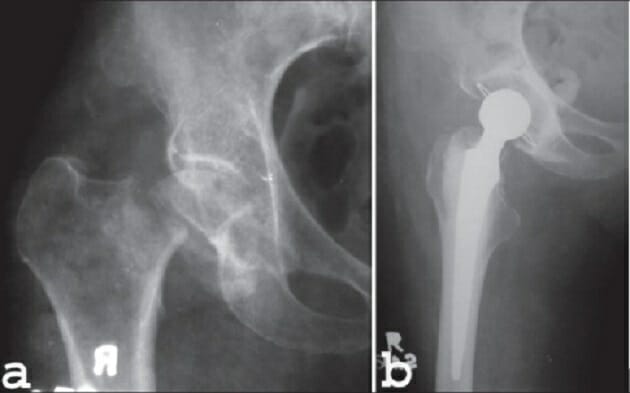
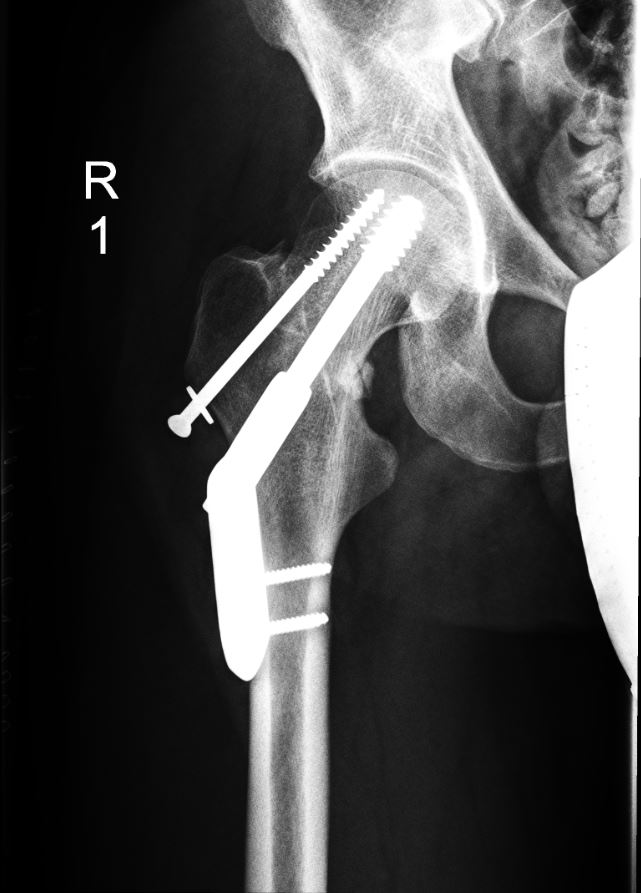
Fractura desplazada no especificada del fémur derecho con reparación quirúrgica

Fractura desplazada no especificada del fémur derecho con reparación quirúrgica

Imagen: “Hip fractures with DHS 1” por Prof. Dr. med. Ralf Puls. Licencia: CC BY 3.0

Complicaciones

  • Infección
  • Pseudoartrosis: 1%–30%. Las tasas son más bajas con las fracturas intertrocantéricas.
  • Dolor Dolor Inflammation crónico
  • Necrosis Necrosis The death of cells in an organ or tissue due to disease, injury or failure of the blood supply. Ischemic Cell Damage avascular Avascular Corneal Abrasions, Erosion, and Ulcers:
    • El tratamiento es controvertido.
    • Puede requerir artroplastia total de cadera
  • Osteoartritis postraumática
  • TVP:
    • Se pueden formar coágulos de sangre en EN Erythema nodosum is an immune-mediated panniculitis (inflammation of the subcutaneous fat) caused by a type IV (delayed-type) hypersensitivity reaction. It commonly manifests in young women as tender, erythematous nodules on the shins. Erythema Nodosum las venas de los LOS Neisseria brazos o las piernas después de un período de inmovilidad y disminución de la actividad.
    • Los LOS Neisseria anticoagulantes están indicados si el paciente tiene un alto riesgo para TVP.
  • Embolia grasa:
    • Posiblemente debido a la introducción de glóbulos de grasa en EN Erythema nodosum is an immune-mediated panniculitis (inflammation of the subcutaneous fat) caused by a type IV (delayed-type) hypersensitivity reaction. It commonly manifests in young women as tender, erythematous nodules on the shins. Erythema Nodosum la circulación sistémica después de una fractura.
    • Presentación clínica:
      • Anomalías neurológicas
      • Erupción petequial
      • La hipoxia puede simular la presentación de una embolia pulmonar.
    • Las consecuencias son similares a las de la embolia trombótica.
    • El tratamiento es de soporte.
  • Delirio en EN Erythema nodosum is an immune-mediated panniculitis (inflammation of the subcutaneous fat) caused by a type IV (delayed-type) hypersensitivity reaction. It commonly manifests in young women as tender, erythematous nodules on the shins. Erythema Nodosum ancianos

Pronóstico

  • 40%–60% de los LOS Neisseria pacientes recuperan la movilidad inicial.
  • Entre el 20%–60% de los LOS Neisseria pacientes previamente independientes se vuelven dependientes para al AL Amyloidosis menos 1 actividad.
  • Mortalidad:
    • 10% después de 1 mes
    • 30% después de 1 año

Diagnóstico Diferencial

  • Osteoartritis de cadera: forma más común de artritis debido a la destrucción del cartílago y cambios del hueso subcondral. El riesgo de desarrollar osteoartritis de cadera aumenta con la edad, la obesidad, el uso repetido de las articulaciones o el traumatismo.
  • Luxación aguda de cadera: desacoplamiento de la cabeza femoral del acetábulo, generalmente debido a un traumatismo. Los LOS Neisseria pacientes suelen presentarse después de una lesión o accidente. El diagnóstico se realiza clínicamente y se basa en EN Erythema nodosum is an immune-mediated panniculitis (inflammation of the subcutaneous fat) caused by a type IV (delayed-type) hypersensitivity reaction. It commonly manifests in young women as tender, erythematous nodules on the shins. Erythema Nodosum una radiografía. El tratamiento es con reducción o cirugía.
  • Fractura pélvica: ruptura en EN Erythema nodosum is an immune-mediated panniculitis (inflammation of the subcutaneous fat) caused by a type IV (delayed-type) hypersensitivity reaction. It commonly manifests in young women as tender, erythematous nodules on the shins. Erythema Nodosum la corteza del hueso pélvico debido a un traumatismo de alta energía u osteoporosis Osteoporosis Osteoporosis refers to a decrease in bone mass and density leading to an increased number of fractures. There are 2 forms of osteoporosis: primary, which is commonly postmenopausal or senile; and secondary, which is a manifestation of immobilization, underlying medical disorders, or long-term use of certain medications. Osteoporosis. Generalmente, los LOS Neisseria pacientes presentan discrepancia en EN Erythema nodosum is an immune-mediated panniculitis (inflammation of the subcutaneous fat) caused by a type IV (delayed-type) hypersensitivity reaction. It commonly manifests in young women as tender, erythematous nodules on the shins. Erythema Nodosum la longitud de las extremidades, dolor Dolor Inflammation intenso a la palpación e inestabilidad mecánica. El diagnóstico se realiza clínicamente y se confirma con imagenología diagnóstica. El tratamiento puede ser no quirúrgico en EN Erythema nodosum is an immune-mediated panniculitis (inflammation of the subcutaneous fat) caused by a type IV (delayed-type) hypersensitivity reaction. It commonly manifests in young women as tender, erythematous nodules on the shins. Erythema Nodosum las fracturas por fragilidad debidas a osteoporosis Osteoporosis Osteoporosis refers to a decrease in bone mass and density leading to an increased number of fractures. There are 2 forms of osteoporosis: primary, which is commonly postmenopausal or senile; and secondary, which is a manifestation of immobilization, underlying medical disorders, or long-term use of certain medications. Osteoporosis y quirúrgico en EN Erythema nodosum is an immune-mediated panniculitis (inflammation of the subcutaneous fat) caused by a type IV (delayed-type) hypersensitivity reaction. It commonly manifests in young women as tender, erythematous nodules on the shins. Erythema Nodosum pacientes que han sufrido un traumatismo.
  • Osteosarcoma Osteosarcoma Osteosarcoma is a primary malignant tumor of the bone characterized by the production of osteoid or immature bone by the tumor cells. The disease is most common in children and young adults and most frequently affects growth plates of the long bones, although it can involve any bone. Osteosarcoma: tumor Tumor Inflammation maligno primario del hueso caracterizado por la producción de hueso osteoide o inmaduro por las células tumorales. El osteosarcoma Osteosarcoma Osteosarcoma is a primary malignant tumor of the bone characterized by the production of osteoid or immature bone by the tumor cells. The disease is most common in children and young adults and most frequently affects growth plates of the long bones, although it can involve any bone. Osteosarcoma es más común en EN Erythema nodosum is an immune-mediated panniculitis (inflammation of the subcutaneous fat) caused by a type IV (delayed-type) hypersensitivity reaction. It commonly manifests in young women as tender, erythematous nodules on the shins. Erythema Nodosum niños y adultos jóvenes y afecta con mayor frecuencia las placas de crecimiento de los LOS Neisseria huesos largos; sin embargo, cualquier hueso puede verse afectado. El osteosarcoma Osteosarcoma Osteosarcoma is a primary malignant tumor of the bone characterized by the production of osteoid or immature bone by the tumor cells. The disease is most common in children and young adults and most frequently affects growth plates of the long bones, although it can involve any bone. Osteosarcoma puede presentarse con dolor Dolor Inflammation, edema Edema Edema is a condition in which excess serous fluid accumulates in the body cavity or interstitial space of connective tissues. Edema is a symptom observed in several medical conditions. It can be categorized into 2 types, namely, peripheral (in the extremities) and internal (in an organ or body cavity). Edema, una masa palpable y, a veces, una fractura patológica. El diagnóstico se establece con imagenología y biopsia. El tratamiento incluye quimioterapia sistémica y resección quirúrgica.

Referencias

  1. Emmerson, B.R., et al. (2021). Hip fracture overview. StatPearls. Retrieved June 8, 2021, from http://www.ncbi.nlm.nih.gov/books/NBK557514/
  2. Kazley, J., Bagchi, K. (2021). Femoral neck fractures. StatPearls. Retrieved June 8, 2021, from http://www.ncbi.nlm.nih.gov/books/NBK537347/
  3. Papachristos, I.V., Giannoudis, P.V. (2020). Overview of classification and surgical management of hip fractures. Orthopaedics and Trauma. 34(2), 56–63. https://doi.org/10.1016/j.mporth.2020.01.001
  4. Foster, K.W. (2021). Overview of common hip fractures in adults. UpToDate. Retrieved June 9, 2021, from https://www.uptodate.com/contents/overview-of-common-hip-fractures-in-adults

¡Crea tu cuenta gratis o inicia una sesión para seguir leyendo!

Regístrate ahora y obtén acceso gratuito a Lecturio con páginas de concepto, videos médicos y cuestionarios para tu educación médica.

User Reviews

Que tengas una sesión de estudio alegre y navideña 🎁 Ahorra 50% en todos los planes >>

Details