La digestión se refiere alALAmyloidosis proceso de descomposición mecánica y química de losLOSNeisseria alimentos enENErythema nodosum is an immune-mediated panniculitis (inflammation of the subcutaneous fat) caused by a type IV (delayed-type) hypersensitivity reaction. It commonly manifests in young women as tender, erythematous nodules on the shins.Erythema Nodosum moléculas constituyentes más pequeñas, que luego pueden ser absorbidas y utilizadas por el cuerpo. La absorción implica la captación de moléculas de nutrientes y su transferencia desde la luz del tubo digestivo a través de losLOSNeisseria enterocitos y hacia el espacio intersticial, donde pueden ser captadas enENErythema nodosum is an immune-mediated panniculitis (inflammation of the subcutaneous fat) caused by a type IV (delayed-type) hypersensitivity reaction. It commonly manifests in young women as tender, erythematous nodules on the shins.Erythema Nodosum la circulación venosa o linfática. LosLOSNeisseria carbohidratos, proteínas, lípidos y micronutrientes se digieren y absorben de manera diferente y requieren varias enzimas y proteínas de transporte para completar el proceso.
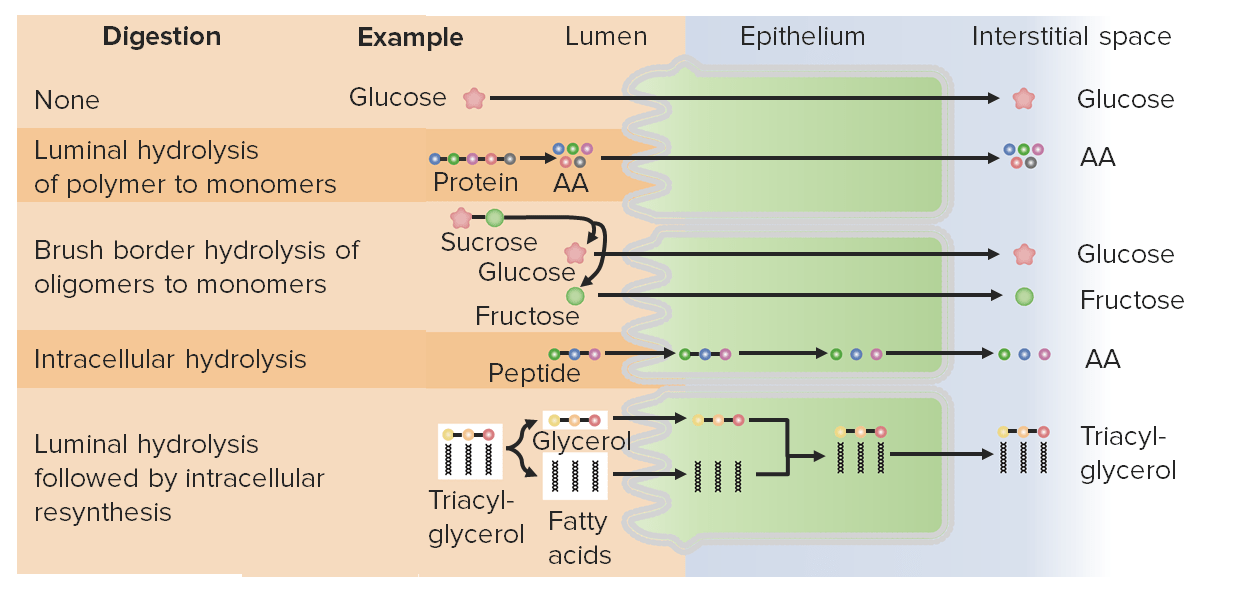
Descripción General de la Digestión y la Absorción
La digestión y la absorción son procesos complejos que comienzan enENErythema nodosum is an immune-mediated panniculitis (inflammation of the subcutaneous fat) caused by a type IV (delayed-type) hypersensitivity reaction. It commonly manifests in young women as tender, erythematous nodules on the shins.Erythema Nodosum la boca, pero ocurren principalmente enENErythema nodosum is an immune-mediated panniculitis (inflammation of the subcutaneous fat) caused by a type IV (delayed-type) hypersensitivity reaction. It commonly manifests in young women as tender, erythematous nodules on the shins.Erythema Nodosum el estómago y el intestino delgado.
Carbohidratos:
Deben descomponerse enENErythema nodosum is an immune-mediated panniculitis (inflammation of the subcutaneous fat) caused by a type IV (delayed-type) hypersensitivity reaction. It commonly manifests in young women as tender, erythematous nodules on the shins.Erythema Nodosum monosacáridos para ser absorbidos
Enzimas digestivas primarias:
Amilasa
Enzimas del borde enENErythema nodosum is an immune-mediated panniculitis (inflammation of the subcutaneous fat) caused by a type IV (delayed-type) hypersensitivity reaction. It commonly manifests in young women as tender, erythematous nodules on the shins.Erythema Nodosum cepillo
Absorbidos a través de:
Lado apical: transportadores de glucosa asociados a sodio (SGLT, por sus siglas enENErythema nodosum is an immune-mediated panniculitis (inflammation of the subcutaneous fat) caused by a type IV (delayed-type) hypersensitivity reaction. It commonly manifests in young women as tender, erythematous nodules on the shins.Erythema Nodosum inglés) 1, transportador de glucosa (GLUTGLUTTubular System, por sus siglas enENErythema nodosum is an immune-mediated panniculitis (inflammation of the subcutaneous fat) caused by a type IV (delayed-type) hypersensitivity reaction. It commonly manifests in young women as tender, erythematous nodules on the shins.Erythema Nodosum inglés) 5
Lado basolateral: GLUT2GLUT2A glucose transport facilitator that is expressed primarily in pancreatic beta cells; liver; and kidneys. It may function as a glucose sensor to regulate insulin release and glucose homeostasis.Digestion and Absorption
Proteínas:
Descompuestas enENErythema nodosum is an immune-mediated panniculitis (inflammation of the subcutaneous fat) caused by a type IV (delayed-type) hypersensitivity reaction. It commonly manifests in young women as tender, erythematous nodules on the shins.Erythema Nodosum péptidos y aminoácidos individuales
Enzimas digestivas primarias:
Pepsina
Tripsina
Quimotripsina
Carboxipeptidasa
Elastasa
Absorbidas por cotransportadores especializados
Lípidos:
Descompuestos enENErythema nodosum is an immune-mediated panniculitis (inflammation of the subcutaneous fat) caused by a type IV (delayed-type) hypersensitivity reaction. It commonly manifests in young women as tender, erythematous nodules on the shins.Erythema Nodosum sus constituyentes (e.g., triacilgliceroles → glicerol + ácidos grasos libres)
Enzimas digestivas primarias:
Lipasas
Colesterol esterasa
Fosfolipasa A2
LosLOSNeisseria lípidos se vuelven a ensamblar enENErythema nodosum is an immune-mediated panniculitis (inflammation of the subcutaneous fat) caused by a type IV (delayed-type) hypersensitivity reaction. It commonly manifests in young women as tender, erythematous nodules on the shins.Erythema NodosumlosLOSNeisseria enterocitos antes de ser liberados alALAmyloidosis espacio intersticial.
Absorbidos enENErythema nodosum is an immune-mediated panniculitis (inflammation of the subcutaneous fat) caused by a type IV (delayed-type) hypersensitivity reaction. It commonly manifests in young women as tender, erythematous nodules on the shins.Erythema Nodosum la circulación linfática
La absorción de vitaminas y minerales varía y depende del nutriente.
Descripción general de la digestión y absorción de macromoléculas AA: aminoácido
Digeridos principalmente por las amilasas y las enzimas del borde enENErythema nodosum is an immune-mediated panniculitis (inflammation of the subcutaneous fat) caused by a type IV (delayed-type) hypersensitivity reaction. It commonly manifests in young women as tender, erythematous nodules on the shins.Erythema Nodosum cepillo
Las enzimas hidrolizan grandes moléculas de almidón a monosacáridos.
Amilasas:
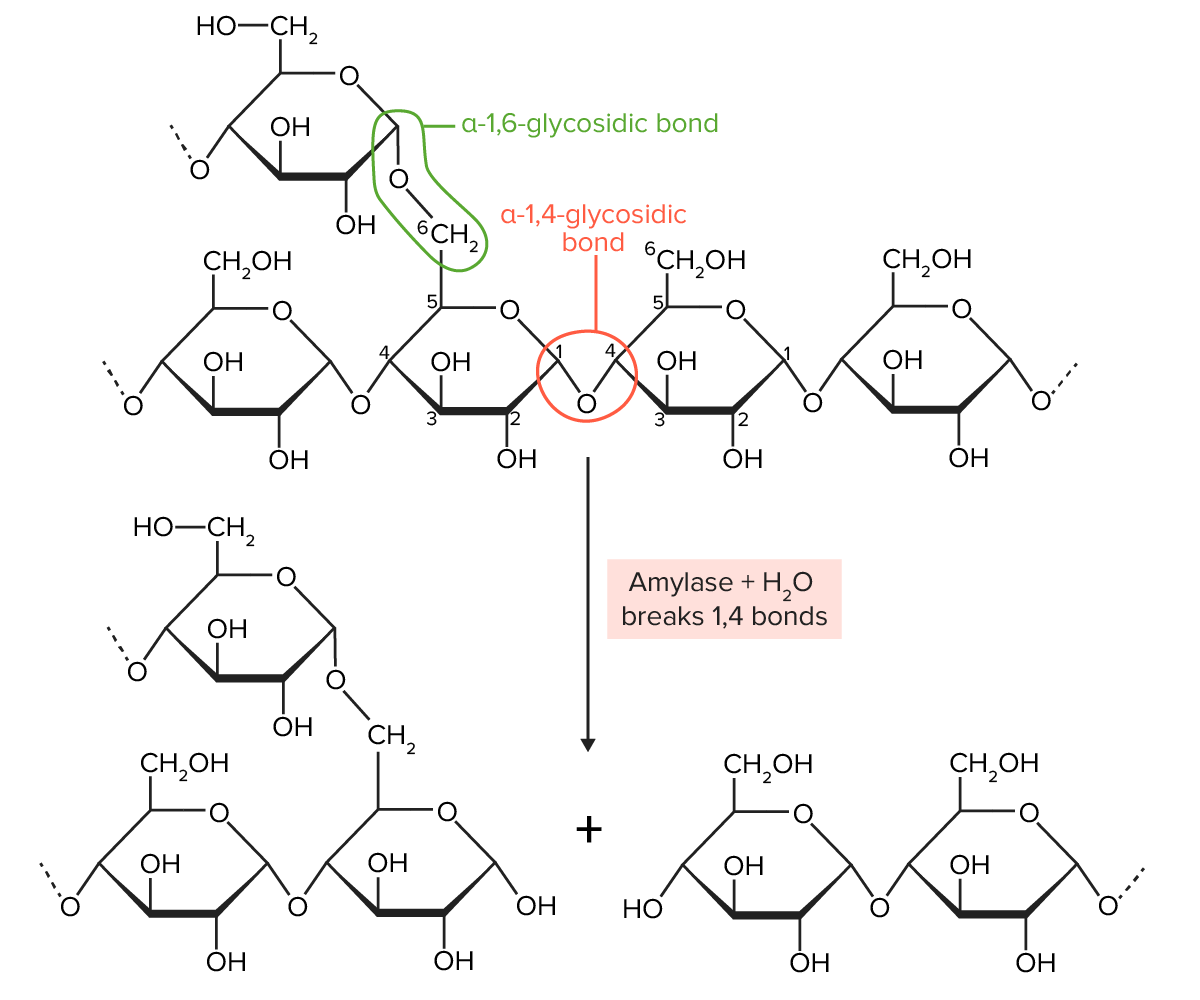
Escinden losLOSNeisseria enlaces α-1,4-glucosídicos enENErythema nodosum is an immune-mediated panniculitis (inflammation of the subcutaneous fat) caused by a type IV (delayed-type) hypersensitivity reaction. It commonly manifests in young women as tender, erythematous nodules on the shins.Erythema Nodosum moléculas de azúcar
Crean cadenas de polisacáridos cada vez más pequeñas hasta que la mayoría de losLOSNeisseria enlaces glucosídicos α-1,4 se rompan, dejando atrás:
Monosacáridos: moléculas de azúcar individuales
Disacáridos: almidones con 2 moléculas de azúcar
Oligosacáridos: almidones con 3‒10 moléculas de azúcar
Almidones no digeribles: azúcares unidos por otro tipo de enlaces
Activas a pHpHThe quantitative measurement of the acidity or basicity of a solution.Acid-Base Balance más alto:
Activas enENErythema nodosum is an immune-mediated panniculitis (inflammation of the subcutaneous fat) caused by a type IV (delayed-type) hypersensitivity reaction. It commonly manifests in young women as tender, erythematous nodules on the shins.Erythema Nodosum la boca y el intestino delgado
Inactivadas enENErythema nodosum is an immune-mediated panniculitis (inflammation of the subcutaneous fat) caused by a type IV (delayed-type) hypersensitivity reaction. It commonly manifests in young women as tender, erythematous nodules on the shins.Erythema Nodosum el estómago
Tipos y ubicación de la amilasa:
Amilasa salival: secretada enENErythema nodosum is an immune-mediated panniculitis (inflammation of the subcutaneous fat) caused by a type IV (delayed-type) hypersensitivity reaction. It commonly manifests in young women as tender, erythematous nodules on the shins.Erythema Nodosum la boca por las glándulas salivales
Amilasa pancreática: secretada enENErythema nodosum is an immune-mediated panniculitis (inflammation of the subcutaneous fat) caused by a type IV (delayed-type) hypersensitivity reaction. It commonly manifests in young women as tender, erythematous nodules on the shins.Erythema Nodosum el duodeno por el páncreas exocrino
La amilopectina es parcialmente digerida por la amilasa. Las moléculas de amilopectina son cadenas de glucosa, unidas entre sí por enlaces glucosídicos α-1,4 (creación de una cadena lineal de moléculas de glucosa) y enlaces glucosídicos α-1,6 (creación de una rama de la cadena lineal). La amilasa rompe los enlaces α-1,4-glucosídicos.
Imagen por Lecturio.
Enzimas del borde enENErythema nodosum is an immune-mediated panniculitis (inflammation of the subcutaneous fat) caused by a type IV (delayed-type) hypersensitivity reaction. It commonly manifests in young women as tender, erythematous nodules on the shins.Erythema Nodosum cepillo:
Las enzimas del borde enENErythema nodosum is an immune-mediated panniculitis (inflammation of the subcutaneous fat) caused by a type IV (delayed-type) hypersensitivity reaction. It commonly manifests in young women as tender, erythematous nodules on the shins.Erythema Nodosum cepillo son proteínas unidas a la membrana enENErythema nodosum is an immune-mediated panniculitis (inflammation of the subcutaneous fat) caused by a type IV (delayed-type) hypersensitivity reaction. It commonly manifests in young women as tender, erythematous nodules on the shins.Erythema Nodosum la superficie luminal de losLOSNeisseria enterocitos enENErythema nodosum is an immune-mediated panniculitis (inflammation of the subcutaneous fat) caused by a type IV (delayed-type) hypersensitivity reaction. It commonly manifests in young women as tender, erythematous nodules on the shins.Erythema Nodosum el intestino delgado. Hay 4 enzimas principales del borde enENErythema nodosum is an immune-mediated panniculitis (inflammation of the subcutaneous fat) caused by a type IV (delayed-type) hypersensitivity reaction. It commonly manifests in young women as tender, erythematous nodules on the shins.Erythema Nodosum cepillo involucradas enENErythema nodosum is an immune-mediated panniculitis (inflammation of the subcutaneous fat) caused by a type IV (delayed-type) hypersensitivity reaction. It commonly manifests in young women as tender, erythematous nodules on the shins.Erythema Nodosum la digestión de carbohidratos.
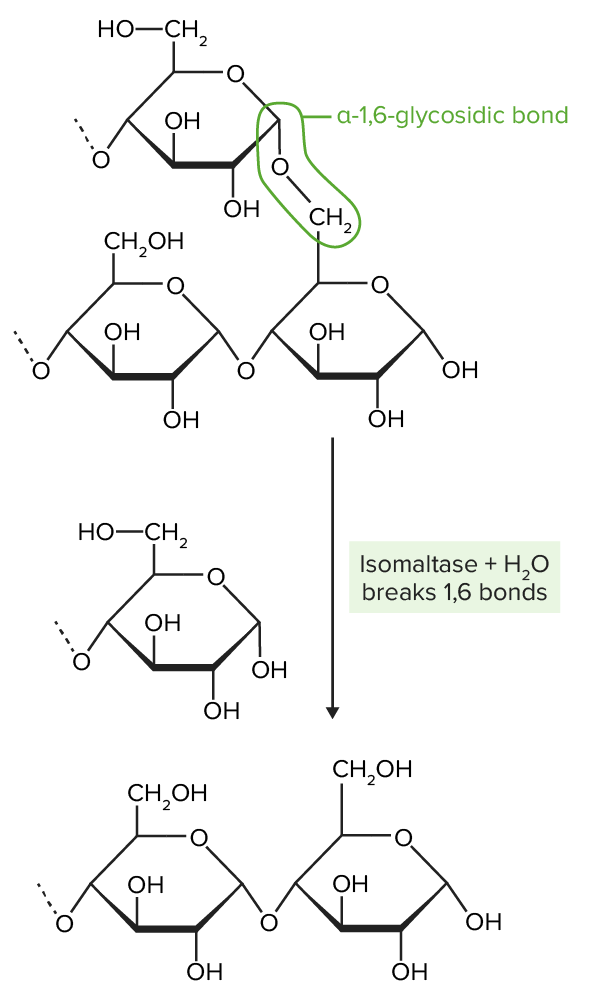
Isomaltasa: escinde losLOSNeisseria enlaces α-1,6-glucosídicos
Maltasa:
Hidroliza la maltosa → glucosa + glucosa
Hidroliza la maltotriosa → glucosa + glucosa + glucosa
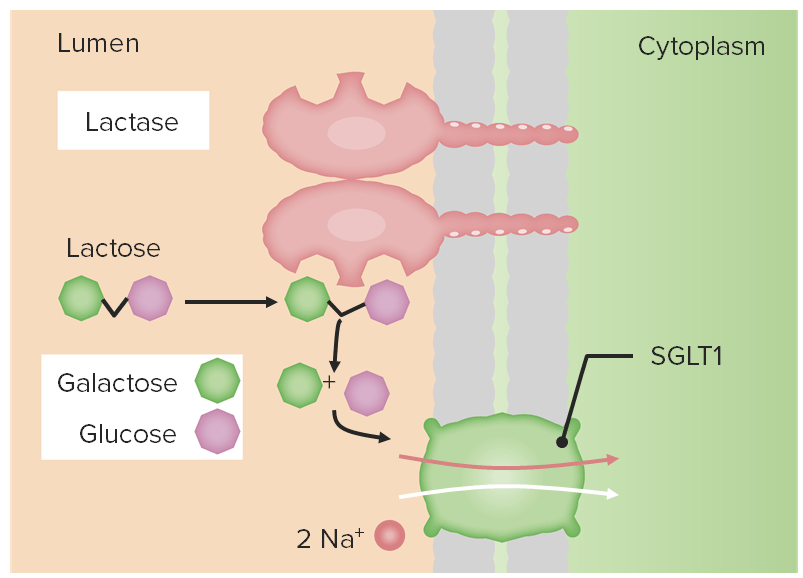
Lactasa: hidroliza la lactosa → glucosa + galactosa
Sacarasa:
Hidroliza la sacarosa → glucosa + fructosa
Hidroliza otros oligosacáridos pequeños
La isomaltasa rompe los enlaces glucosídicos α-1,6 presentes en la amilopectina. Los enlaces glucosídicos α-1,6 crean ramificaciones a partir de las “cadenas rectas” de la glucosa al unir el 1er carbono de 1 cadena (estructura de anillo superior) con el 6to carbono de otra cadena (estructura de 2 anillos inferior). La isomaltasa hidroliza estos enlaces.
Imagen por Lecturio.
Digestión del borde en cepillo: Diagrama del disacárido lactosa hidrolizado por lactasa en monosacáridos constituyentes, galactosa y glucosa. Tanto la glucosa como la galactosa pueden absorberse en los enterocitos (junto con 2 átomos de Na+ moviéndose a favor de su gradiente de concentración) a través del transportador de glucosa asociado al sodio 1 (SGLT).
Imagen por Lecturio.
Absorción
LosLOSNeisseria carbohidratos son absorbidos como monosacáridos por losLOSNeisseria enterocitos enENErythema nodosum is an immune-mediated panniculitis (inflammation of the subcutaneous fat) caused by a type IV (delayed-type) hypersensitivity reaction. It commonly manifests in young women as tender, erythematous nodules on the shins.Erythema Nodosum el intestino delgado y transportados a través de la sangre a la circulación portal. LosLOSNeisseria carbohidratos que no se pueden descomponer enENErythema nodosum is an immune-mediated panniculitis (inflammation of the subcutaneous fat) caused by a type IV (delayed-type) hypersensitivity reaction. It commonly manifests in young women as tender, erythematous nodules on the shins.Erythema Nodosum monosacáridos no se absorben (e.g., fibras).
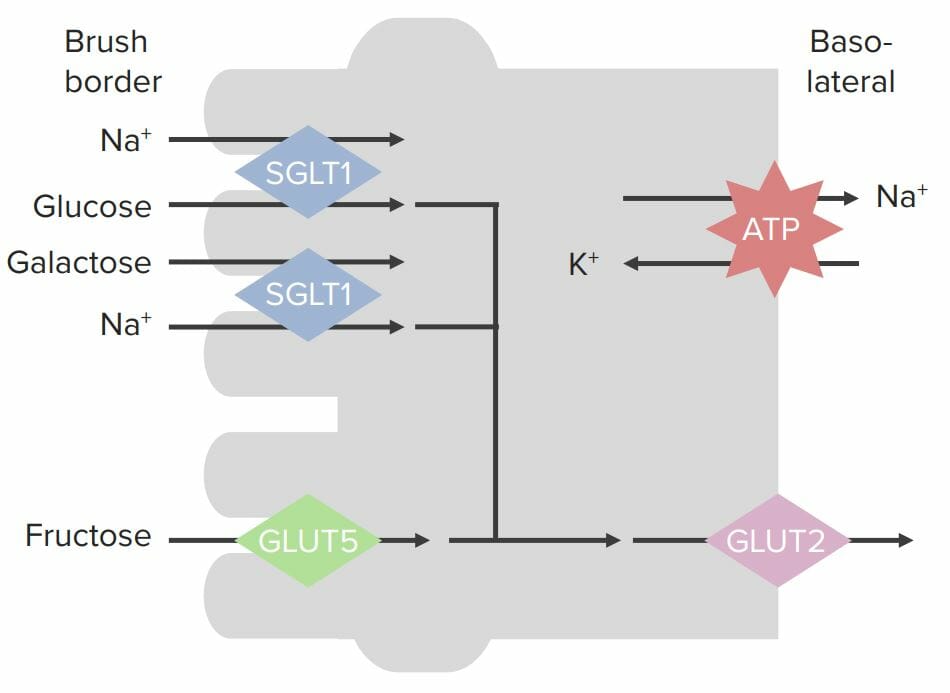
Movidos a losLOSNeisseria enterocitos por 1 conjunto de proteínas de transporte enENErythema nodosum is an immune-mediated panniculitis (inflammation of the subcutaneous fat) caused by a type IV (delayed-type) hypersensitivity reaction. It commonly manifests in young women as tender, erythematous nodules on the shins.Erythema Nodosum la membrana apical:
SGLT1:
Se encuentran enENErythema nodosum is an immune-mediated panniculitis (inflammation of the subcutaneous fat) caused by a type IV (delayed-type) hypersensitivity reaction. It commonly manifests in young women as tender, erythematous nodules on the shins.Erythema Nodosum el intestino delgado
Transportan 2 Na+, 1 glucosa o galactosa y agua
Utilizan el gradiente químico del Na+ generado por la bomba Na+/K+ ATPasa enENErythema nodosum is an immune-mediated panniculitis (inflammation of the subcutaneous fat) caused by a type IV (delayed-type) hypersensitivity reaction. It commonly manifests in young women as tender, erythematous nodules on the shins.Erythema Nodosum la membrana basolateral (mantiene baja la concentración intracelular de Na+)
GLUT5GLUT5A hexose transporter that mediates fructose transport in skeletal muscle and adipocytes and is responsible for luminal uptake of dietary fructose in the small intestine.Digestion and Absorption: transporta la fructosa alALAmyloidosis interior de la célula a favor de su gradiente de concentración a través de la difusión facilitada
Movidos hacia el espacio intersticial por una proteína de transporte diferente ubicada enENErythema nodosum is an immune-mediated panniculitis (inflammation of the subcutaneous fat) caused by a type IV (delayed-type) hypersensitivity reaction. It commonly manifests in young women as tender, erythematous nodules on the shins.Erythema Nodosum la membrana basolateral:
GLUT2GLUT2A glucose transport facilitator that is expressed primarily in pancreatic beta cells; liver; and kidneys. It may function as a glucose sensor to regulate insulin release and glucose homeostasis.Digestion and Absorption:
Pueden mover losLOSNeisseria 3 monosacáridos primarios: glucosa, galactosa y fructosa
Trabajan por medio de difusión facilitada
Absorbidos enENErythema nodosum is an immune-mediated panniculitis (inflammation of the subcutaneous fat) caused by a type IV (delayed-type) hypersensitivity reaction. It commonly manifests in young women as tender, erythematous nodules on the shins.Erythema NodosumlosLOSNeisseria capilares desde el espacio intersticial
LosLOSNeisseria capilares drenan enENErythema nodosum is an immune-mediated panniculitis (inflammation of the subcutaneous fat) caused by a type IV (delayed-type) hypersensitivity reaction. It commonly manifests in young women as tender, erythematous nodules on the shins.Erythema Nodosum las venas → vena porta → hígado para el metabolismo
Absorción de monosacáridos a través de los enterocitos SGLT: transportadores de glucosa asociados a sodio GLUT: transportador de glucosa
Imagen por Lecturio.
Digestión y Absorción de Proteínas
Digestión
La digestión de proteínas ocurre principalmente enENErythema nodosum is an immune-mediated panniculitis (inflammation of the subcutaneous fat) caused by a type IV (delayed-type) hypersensitivity reaction. It commonly manifests in young women as tender, erythematous nodules on the shins.Erythema Nodosum el estómago y el duodeno.
Recuerde: losLOSNeisseria enlaces peptídicos unen el extremo amino del aminoácido con el extremo carboxi del siguiente aminoácido.
La digestión de proteínas ocurre a través de la hidrólisis enzimática de losLOSNeisseria enlaces peptídicos, descomponiendo las proteínas enENErythema nodosum is an immune-mediated panniculitis (inflammation of the subcutaneous fat) caused by a type IV (delayed-type) hypersensitivity reaction. It commonly manifests in young women as tender, erythematous nodules on the shins.Erythema Nodosum:
Péptidos pequeños compuestos por cadenas cortas de aminoácidos
Aminoácidos individuales
Las enzimas involucradas son:
Secretadas por el estómago y el páncreas (ver tabla)
Unidas alALAmyloidosis borde enENErythema nodosum is an immune-mediated panniculitis (inflammation of the subcutaneous fat) caused by a type IV (delayed-type) hypersensitivity reaction. It commonly manifests in young women as tender, erythematous nodules on the shins.Erythema Nodosum cepillo de losLOSNeisseria enterocitos:
Las aminopeptidasas descomponen péptidos pequeños desde su extremo amino (i.e., N-terminal).
Las dipeptidasas rompen enlaces peptídicos entre 2 aminoácidos → 2 aminoácidos individuales
Tabla: Enzimas secretadas involucradas enENErythema nodosum is an immune-mediated panniculitis (inflammation of the subcutaneous fat) caused by a type IV (delayed-type) hypersensitivity reaction. It commonly manifests in young women as tender, erythematous nodules on the shins.Erythema Nodosum la digestión de proteínas
Enzima
Zimógeno (precursor)
Activada por
Comentarios sobre su actividad
Enzimas gástricas secretadas enENErythema nodosum is an immune-mediated panniculitis (inflammation of the subcutaneous fat) caused by a type IV (delayed-type) hypersensitivity reaction. It commonly manifests in young women as tender, erythematous nodules on the shins.Erythema Nodosum el estómago
Pepsina
Pepsinógeno
Ácido clorhídrico
Más eficiente entre losLOSNeisseria aminoácidos hidrófobos
Enzimas pancreáticas secretadas enENErythema nodosum is an immune-mediated panniculitis (inflammation of the subcutaneous fat) caused by a type IV (delayed-type) hypersensitivity reaction. It commonly manifests in young women as tender, erythematous nodules on the shins.Erythema Nodosum el duodeno
Tripsina
Tripsinógeno
Enteropeptidasa
Capaz de activar:
Más tripsinógeno → tripsina
Todos losLOSNeisseria demás zimógenos pancreáticos
Más eficiente entre lisina y arginina
Quimotripsina
Quimotripsinógeno
Tripsina
Más eficiente entre losLOSNeisseria aminoácidos hidrófobos
Carboxipeptidasa
Procarboxipeptidasa
Tripsina
Ataca el extremo carboxi de las cadenas peptídicas
Genera aminoácidos individuales o cadenas peptídicas muy cortas
Elastasa
Proelastasa
Tripsina
Igual que la carboxipeptidasa
Absorción
La absorción se produce enENErythema nodosum is an immune-mediated panniculitis (inflammation of the subcutaneous fat) caused by a type IV (delayed-type) hypersensitivity reaction. It commonly manifests in young women as tender, erythematous nodules on the shins.Erythema Nodosum el intestino delgado.
Solo losLOSNeisseria aminoácidos individuales pueden absorberse a través de la membrana basolateral hacia el espacio intersticial.
Aminoácidos individuales:
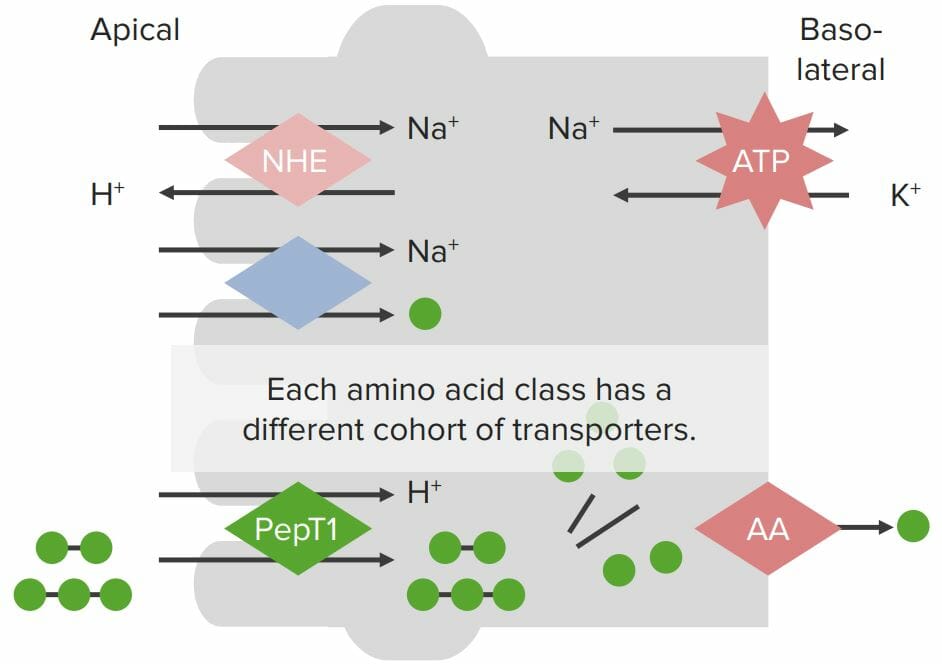
Absorbidos enENErythema nodosum is an immune-mediated panniculitis (inflammation of the subcutaneous fat) caused by a type IV (delayed-type) hypersensitivity reaction. It commonly manifests in young women as tender, erythematous nodules on the shins.Erythema NodosumlosLOSNeisseria enterocitos a través de la membrana apical a través de cotransportadores especializados de Na+/Aminoácidos:
Utilizan el gradiente de Na+ creado por la bomba Na+/K+ ATPasa enENErythema nodosum is an immune-mediated panniculitis (inflammation of the subcutaneous fat) caused by a type IV (delayed-type) hypersensitivity reaction. It commonly manifests in young women as tender, erythematous nodules on the shins.Erythema Nodosum la membrana basolateral
El [Na+] es alto enENErythema nodosum is an immune-mediated panniculitis (inflammation of the subcutaneous fat) caused by a type IV (delayed-type) hypersensitivity reaction. It commonly manifests in young women as tender, erythematous nodules on the shins.Erythema Nodosum el lumen, pero bajo enENErythema nodosum is an immune-mediated panniculitis (inflammation of the subcutaneous fat) caused by a type IV (delayed-type) hypersensitivity reaction. It commonly manifests in young women as tender, erythematous nodules on the shins.Erythema NodosumlosLOSNeisseria enterocitos → El Na+ se mueve a favor de su gradiente de concentración hacia la célula, transportando un aminoácido con él
Absorbidos a través de la membrana basolateral por transportadores especializados (diferentes tipos de transportadores para diferentes tipos de aminoácidos)
Dipéptidos y tripéptidos:
Absorbidos por losLOSNeisseria enterocitos a través de la membrana apical por medio de cotransportadores especializados H+/PepT
Utilizan el gradiente de H+ creado por el intercambiador H+/Na+enENErythema nodosum is an immune-mediated panniculitis (inflammation of the subcutaneous fat) caused by a type IV (delayed-type) hypersensitivity reaction. It commonly manifests in young women as tender, erythematous nodules on the shins.Erythema Nodosum la membrana apical (que bombea 1 ion H+alALAmyloidosis lumen y lleva 1 Na+ a losLOSNeisseria enterocitos)
LosLOSNeisseria péptidos se descomponen enENErythema nodosum is an immune-mediated panniculitis (inflammation of the subcutaneous fat) caused by a type IV (delayed-type) hypersensitivity reaction. It commonly manifests in young women as tender, erythematous nodules on the shins.Erythema Nodosum aminoácidos individuales mediante peptidasas dentro de losLOSNeisseria enterocitos.
Absorbidos a través de la membrana basolateral de la misma manera que losLOSNeisseria aminoácidos
Una vez enENErythema nodosum is an immune-mediated panniculitis (inflammation of the subcutaneous fat) caused by a type IV (delayed-type) hypersensitivity reaction. It commonly manifests in young women as tender, erythematous nodules on the shins.Erythema Nodosum el espacio intersticial, losLOSNeisseria aminoácidos se absorben enENErythema nodosum is an immune-mediated panniculitis (inflammation of the subcutaneous fat) caused by a type IV (delayed-type) hypersensitivity reaction. It commonly manifests in young women as tender, erythematous nodules on the shins.Erythema Nodosum la circulación venosa → se transportan a través de la circulación portal alALAmyloidosis hígado
Proteínas de transporte en las membranas de los enterocitos involucradas en la absorción de proteínas: La Na+/K+ ATPasa en la membrana basolateral genera un gradiente de Na+ dentro de la célula. Un intercambiador de Na+/H+ (NHE) en la membrana apical también genera el gradiente de H+. Los aminoácidos individuales (AA; bolas verdes) se absorben a través de un cotransportador de Na+/Aminoácido, donde el Na+ fluye a través de la membrana apical hacia los enterocitos siguiendo su gradiente de concentración, trayendo consigo el aminoácido (a pesar de moverse en contra del gradiente químico del aminoácido). Los péptidos pequeños se absorben a través del cotransportador H+/PepT con H+ fluyendo a favor de su gradiente de concentración hacia la célula, trayendo consigo los péptidos pequeños. Los péptidos se descomponen en aminoácidos individuales mediante peptidasas dentro de los enterocitos. Luego, todos los aminoácidos se absorben a través de transportadores especializados en la membrana basolateral.
Imagen por Lecturio.
Digestión y Absorción de Grasas
Digestión
Hay 3 tipos principales de grasas que se digieren y absorben: triglicéridos (triacilgliceroles), fosfolípidos y ésteres de colesterol. LosLOSNeisseria 3 tipos contienen enlaces éster (R1‒(C=O)‒O‒R2) que se rompen durante la digestión.
Triacilgliceroles:
Estructura:
Esqueleto de glicerol: cadena de 3 carbonos con cada carbono unido a un grupo de alcohol
Ácidos grasos: cadena de hidrocarburo con un grupo carboxilo enENErythema nodosum is an immune-mediated panniculitis (inflammation of the subcutaneous fat) caused by a type IV (delayed-type) hypersensitivity reaction. It commonly manifests in young women as tender, erythematous nodules on the shins.Erythema Nodosum 1 extremo
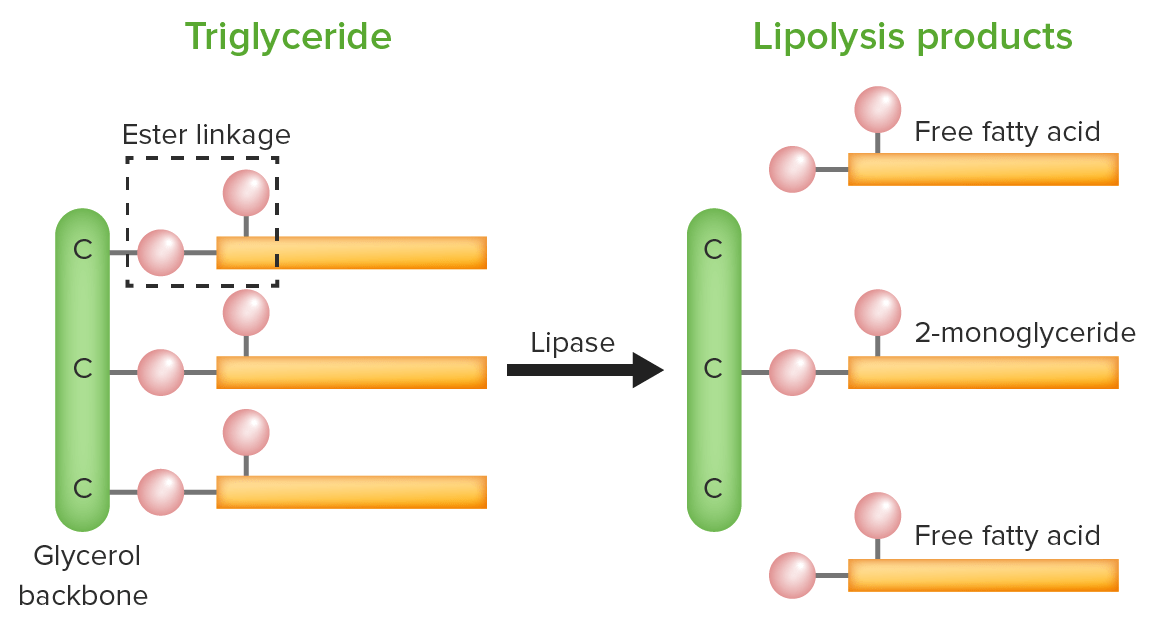
Cada carbono del esqueleto de glicerol está unido alALAmyloidosis extremo carboxilo de una cadena de ácido graso mediante un enlace éster.
LosLOSNeisseria enlaces éster son hidrolizados por lipasas:
Lipasa lingual (de las glándulas salivales)
Lipasa gástrica (de las células principales)
Lipasa pancreática (del páncreas exocrino, la más importante)
La lipasa cataliza la hidrólisis de los enlaces éster, dando como resultado 2 ácidos grasos libres y un monoglicérido. Las bolas rojas representan moléculas de oxígeno.
Imagen por Lecturio.
Fosfolípidos:
Estructura similar a losLOSNeisseria triacilgliceroles, pero el esqueleto de glicerol contiene un grupo fosfato
El grupo fosfato confiere más polaridad.
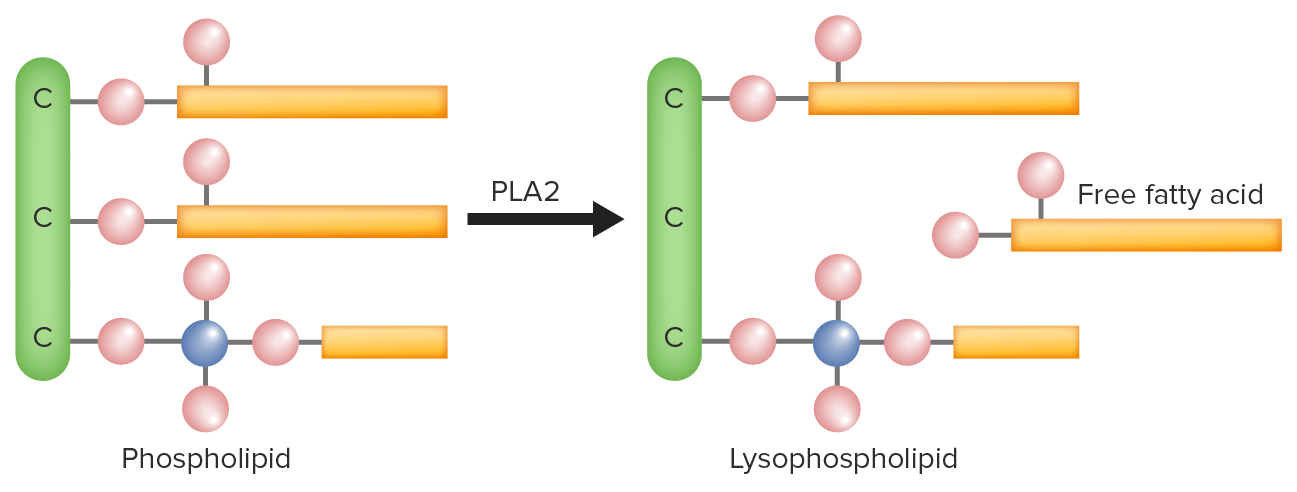
LosLOSNeisseria enlaces éster son hidrolizados por la fosfolipasa A2.
La fosfolipasa A2 (PLA2) hidroliza el enlace entre el 2do ácido graso de un fosfolípido y el esqueleto de glicerol, dando como resultado un lisofosfolípido y un ácido graso libre.
Imagen por Lecturio.
Ésteres de colesterol:
Colesterol unido a un ácido graso por un enlace éster
LosLOSNeisseria enlaces éster son hidrolizados por la hidrolasa de éster de colesterol.
La hidrolasa de éster de colesteril cataliza la hidrólisis de ésteres de colesterilo en colesterol y un ácido graso.
Imagen por Lecturio.
Tabla: Lípidos y sus enzimas digestivas
Lípido
Enzima
Productos
Triacilgliceroles
Lipasas
Monoglicérido y 2 ácidos grasos
Ésteres de colesterol
Hidrolasa de éster de colesterol
Colesterol y ácidos grasos
Fosfolípidos
Fosfolipasa A2
Lisolecitina y un ácido graso
Sustancias necesarias para la actividad de la lipasa/digestión de lípidos:
Bilis:
Emulsionante producido por el hígado y almacenado y secretado por la vesícula biliar
Contiene lecitina (un fosfolípido) y sales biliares
Forma gotas de grasa más pequeñas, proporcionando a las lipasas hidrosolubles más superficie para digerir losLOSNeisseria lípidos
Colipasa: ayuda a las lipasas a unirse (y digerir) las gotas de grasa emulsionadas
Micelas:
A medida que losLOSNeisseria lípidos se descomponen, ellos (junto con losLOSNeisseria componentes de la bilis) se organizan enENErythema nodosum is an immune-mediated panniculitis (inflammation of the subcutaneous fat) caused by a type IV (delayed-type) hypersensitivity reaction. It commonly manifests in young women as tender, erythematous nodules on the shins.Erythema Nodosum estructuras llamadas micelas:
Pequeñas gotas esféricas:
La porción interior es lipofílica.
La porción exterior es hidrófila.
Rodeadas de fosfolípidos de la bilis
Contienen todos losLOSNeisseria componentes liposolubles para ser absorbidos:
Ácidos grasos libres
Monoacilglicéridos
Colesterol
Fosfolípidos
Vitaminas liposolubles: A, D, E y K
Las micelas transportan losLOSNeisseria componentes lipídicos a las paredes de losLOSNeisseria enterocitos para su absorción.
Absorción
Si bien la mayor parte de la absorción se produce enENErythema nodosum is an immune-mediated panniculitis (inflammation of the subcutaneous fat) caused by a type IV (delayed-type) hypersensitivity reaction. It commonly manifests in young women as tender, erythematous nodules on the shins.Erythema Nodosum el intestino delgado, es posible que parte de la absorción comience enENErythema nodosum is an immune-mediated panniculitis (inflammation of the subcutaneous fat) caused by a type IV (delayed-type) hypersensitivity reaction. It commonly manifests in young women as tender, erythematous nodules on the shins.Erythema Nodosum el estómago.
El cambio de pHpHThe quantitative measurement of the acidity or basicity of a solution.Acid-Base Balance cerca del borde enENErythema nodosum is an immune-mediated panniculitis (inflammation of the subcutaneous fat) caused by a type IV (delayed-type) hypersensitivity reaction. It commonly manifests in young women as tender, erythematous nodules on the shins.Erythema Nodosum cepillo abre las micelas.
LosLOSNeisseria componentes lipídicos (e.g., ácidos grasos y monoglicéridos) atraviesan la membrana para entrar enENErythema nodosum is an immune-mediated panniculitis (inflammation of the subcutaneous fat) caused by a type IV (delayed-type) hypersensitivity reaction. It commonly manifests in young women as tender, erythematous nodules on the shins.Erythema Nodosum el citosol de losLOSNeisseria enterocitos.
Liposolubles → pueden cruzar la membrana de fosfolípidos sin moléculas de transporte especializadas
Resintetizados mediante esterificaciónenENErythema nodosum is an immune-mediated panniculitis (inflammation of the subcutaneous fat) caused by a type IV (delayed-type) hypersensitivity reaction. It commonly manifests in young women as tender, erythematous nodules on the shins.Erythema Nodosum el retículo endoplásmico
Reempaquetados como quilomicronesenENErythema nodosum is an immune-mediated panniculitis (inflammation of the subcutaneous fat) caused by a type IV (delayed-type) hypersensitivity reaction. It commonly manifests in young women as tender, erythematous nodules on the shins.Erythema Nodosum el aparato de Golgi
LosLOSNeisseria quilomicrones salen de losLOSNeisseria enterocitos por su lado basolateral → entran enENErythema nodosum is an immune-mediated panniculitis (inflammation of the subcutaneous fat) caused by a type IV (delayed-type) hypersensitivity reaction. It commonly manifests in young women as tender, erythematous nodules on the shins.Erythema Nodosum la circulación linfática
Ácidos grasos de cadena corta y ácidos grasos de cadena media:
EnENErythema nodosum is an immune-mediated panniculitis (inflammation of the subcutaneous fat) caused by a type IV (delayed-type) hypersensitivity reaction. It commonly manifests in young women as tender, erythematous nodules on the shins.Erythema Nodosum el intestino delgado:
LosLOSNeisseria ácidos grasos de cadena corta y ácidos grasos de cadena media viajan a través de losLOSNeisseria enterocitos sin ayuda.
LosLOSNeisseria ácidos grasos de cadena corta y ácidos grasos de cadena media se absorben enENErythema nodosum is an immune-mediated panniculitis (inflammation of the subcutaneous fat) caused by a type IV (delayed-type) hypersensitivity reaction. It commonly manifests in young women as tender, erythematous nodules on the shins.Erythema Nodosum la circulación venosa → vena porta hepática → hígado
EnENErythema nodosum is an immune-mediated panniculitis (inflammation of the subcutaneous fat) caused by a type IV (delayed-type) hypersensitivity reaction. It commonly manifests in young women as tender, erythematous nodules on the shins.Erythema Nodosum el intestino grueso, losLOSNeisseria ácidos grasos de cadena corta utilizan el transportador de monocarboxilato de sodio 1:
Cotransportador de Na+/ácidos grasos de cadena corta
Utiliza el gradiente de Na+ generado por la bomba basolateral de Na+/K+
La bomba también ayuda enENErythema nodosum is an immune-mediated panniculitis (inflammation of the subcutaneous fat) caused by a type IV (delayed-type) hypersensitivity reaction. It commonly manifests in young women as tender, erythematous nodules on the shins.Erythema Nodosum la absorción de agua enENErythema nodosum is an immune-mediated panniculitis (inflammation of the subcutaneous fat) caused by a type IV (delayed-type) hypersensitivity reaction. It commonly manifests in young women as tender, erythematous nodules on the shins.Erythema Nodosum el intestino grueso.
Digestión y Absorción de Micronutrientes
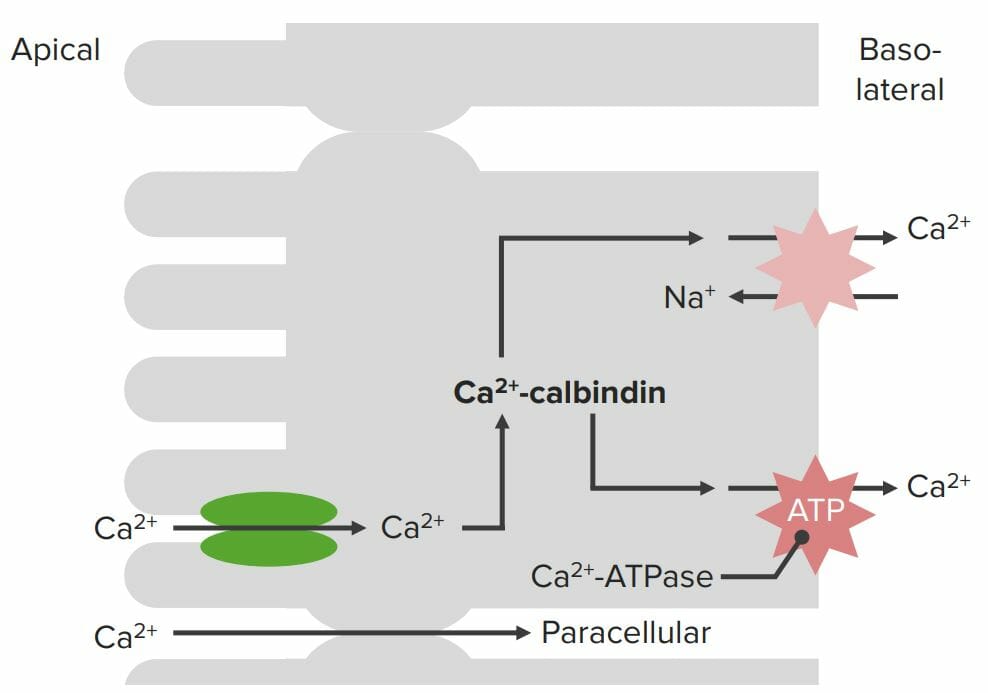
Absorción de calcio (CaCACondylomata acuminata are a clinical manifestation of genital HPV infection. Condylomata acuminata are described as raised, pearly, flesh-colored, papular, cauliflower-like lesions seen in the anogenital region that may cause itching, pain, or bleeding.Condylomata Acuminata (Genital Warts)2+)
El CaCACondylomata acuminata are a clinical manifestation of genital HPV infection. Condylomata acuminata are described as raised, pearly, flesh-colored, papular, cauliflower-like lesions seen in the anogenital region that may cause itching, pain, or bleeding.Condylomata Acuminata (Genital Warts)2+ se absorbe a través de la membrana apical a través de transportadores de CaCACondylomata acuminata are a clinical manifestation of genital HPV infection. Condylomata acuminata are described as raised, pearly, flesh-colored, papular, cauliflower-like lesions seen in the anogenital region that may cause itching, pain, or bleeding.Condylomata Acuminata (Genital Warts)2+ (principalmente TRPV6).
Calbindina: una proteína de unión a CaCACondylomata acuminata are a clinical manifestation of genital HPV infection. Condylomata acuminata are described as raised, pearly, flesh-colored, papular, cauliflower-like lesions seen in the anogenital region that may cause itching, pain, or bleeding.Condylomata Acuminata (Genital Warts)2+ intracelular que se une inmediatamente a todo el CaCACondylomata acuminata are a clinical manifestation of genital HPV infection. Condylomata acuminata are described as raised, pearly, flesh-colored, papular, cauliflower-like lesions seen in the anogenital region that may cause itching, pain, or bleeding.Condylomata Acuminata (Genital Warts)2+ absorbido y lo transporta a la membrana basolateral
Propósito:
El CaCACondylomata acuminata are a clinical manifestation of genital HPV infection. Condylomata acuminata are described as raised, pearly, flesh-colored, papular, cauliflower-like lesions seen in the anogenital region that may cause itching, pain, or bleeding.Condylomata Acuminata (Genital Warts)2+ libre podría actuar como una molécula de señalización intracelular.
LosLOSNeisseria altos niveles de CaCACondylomata acuminata are a clinical manifestation of genital HPV infection. Condylomata acuminata are described as raised, pearly, flesh-colored, papular, cauliflower-like lesions seen in the anogenital region that may cause itching, pain, or bleeding.Condylomata Acuminata (Genital Warts)2+ libre pueden ser tóxicos.
El nivel de calbindina enENErythema nodosum is an immune-mediated panniculitis (inflammation of the subcutaneous fat) caused by a type IV (delayed-type) hypersensitivity reaction. It commonly manifests in young women as tender, erythematous nodules on the shins.Erythema Nodosum la célula determina cuánto CaCACondylomata acuminata are a clinical manifestation of genital HPV infection. Condylomata acuminata are described as raised, pearly, flesh-colored, papular, cauliflower-like lesions seen in the anogenital region that may cause itching, pain, or bleeding.Condylomata Acuminata (Genital Warts)2+ se puede absorber.
El CaCACondylomata acuminata are a clinical manifestation of genital HPV infection. Condylomata acuminata are described as raised, pearly, flesh-colored, papular, cauliflower-like lesions seen in the anogenital region that may cause itching, pain, or bleeding.Condylomata Acuminata (Genital Warts)2+ se absorbe a través de la membrana basolateral por:
CaCACondylomata acuminata are a clinical manifestation of genital HPV infection. Condylomata acuminata are described as raised, pearly, flesh-colored, papular, cauliflower-like lesions seen in the anogenital region that may cause itching, pain, or bleeding.Condylomata Acuminata (Genital Warts)2+ ATPasa
Intercambiador CaCACondylomata acuminata are a clinical manifestation of genital HPV infection. Condylomata acuminata are described as raised, pearly, flesh-colored, papular, cauliflower-like lesions seen in the anogenital region that may cause itching, pain, or bleeding.Condylomata Acuminata (Genital Warts)2+/Na+
Nota: una pequeña cantidad de CaCACondylomata acuminata are a clinical manifestation of genital HPV infection. Condylomata acuminata are described as raised, pearly, flesh-colored, papular, cauliflower-like lesions seen in the anogenital region that may cause itching, pain, or bleeding.Condylomata Acuminata (Genital Warts)2+ también puede absorberse paracelularmente.
Regulación:
La producción del transportador apical de CaCACondylomata acuminata are a clinical manifestation of genital HPV infection. Condylomata acuminata are described as raised, pearly, flesh-colored, papular, cauliflower-like lesions seen in the anogenital region that may cause itching, pain, or bleeding.Condylomata Acuminata (Genital Warts)2+ es inducida por:
Vitamina D
Estrógenos
La síntesis de calbindina es inducida por la vitamina D.
Diagrama esquemático que representa la absorción de calcio (Ca2+): El calcio es absorbido a través de la membrana apical por una proteína de transporte de Ca2+ especializada y luego se une inmediatamente a una proteína de unión a Ca2+ llamada calbindina. La calbindina transporta Ca2+ a la membrana basolateral donde es absorbida por Ca2+ ATPasa y/o un intercambiador Ca2+/Na+.
Imagen por Lecturio.
Absorción de hierro
Se absorbe principalmente enENErythema nodosum is an immune-mediated panniculitis (inflammation of the subcutaneous fat) caused by a type IV (delayed-type) hypersensitivity reaction. It commonly manifests in young women as tender, erythematous nodules on the shins.Erythema Nodosum el duodeno
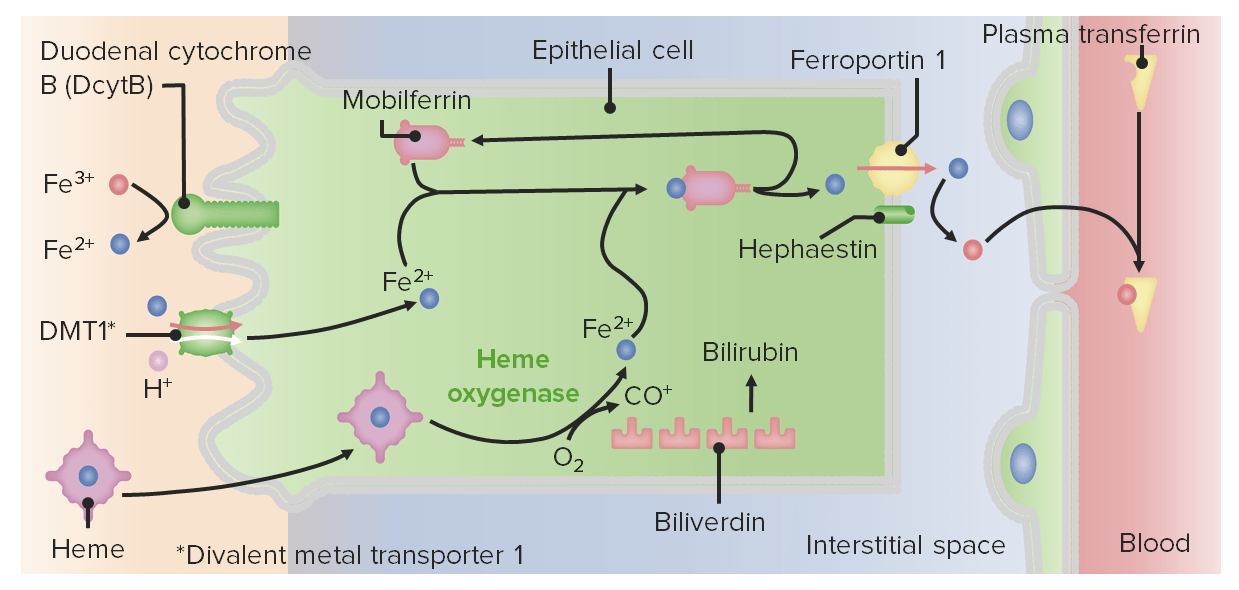
Fe3+ (la forma principal de hierro que se encuentra enENErythema nodosum is an immune-mediated panniculitis (inflammation of the subcutaneous fat) caused by a type IV (delayed-type) hypersensitivity reaction. It commonly manifests in young women as tender, erythematous nodules on the shins.Erythema NodosumlosLOSNeisseria alimentos) debe reducirse a Fe2+ para su absorción a través del citocromo B duodenal ubicado enENErythema nodosum is an immune-mediated panniculitis (inflammation of the subcutaneous fat) caused by a type IV (delayed-type) hypersensitivity reaction. It commonly manifests in young women as tender, erythematous nodules on the shins.Erythema Nodosum el borde enENErythema nodosum is an immune-mediated panniculitis (inflammation of the subcutaneous fat) caused by a type IV (delayed-type) hypersensitivity reaction. It commonly manifests in young women as tender, erythematous nodules on the shins.Erythema Nodosum cepillo de losLOSNeisseria enterocitos.
Absorción a través de la membrana apical:
Transportador de metales divalentes-1: un cotransportador especializado de Fe2+/H+ que absorbe la mayor parte del hierro no hemo
Dentro de las moléculas de hemo (e.g., de la carne)
Dentro de la célula:
Mobilferrina: una proteína fijadora de hierro que se une alALAmyloidosis Fe2+ y lo transporta a través del enterocito hasta la membrana basolateral
Hemo oxigenasa: libera Fe2+ del hemo → Fe2+ se une y es transportado por la mobilferrina
Liberación a través de la membrana basolateral:
Ferroportina 1: una proteína de transporte unida a la membrana que libera Fe2+enENErythema nodosum is an immune-mediated panniculitis (inflammation of the subcutaneous fat) caused by a type IV (delayed-type) hypersensitivity reaction. It commonly manifests in young women as tender, erythematous nodules on the shins.Erythema Nodosum el espacio intersticial
Hefestina:
Una ferroxidasa unida a la membrana dependiente de cobre
Oxida Fe2+ a Fe3+, que es necesario para que el hierro se mueva hacia losLOSNeisseria capilares y se una a la transferrina (proteína de transporte de hierro plasmático)
Regulación:
Hepcidina:
Inactiva la ferroportina 1 (el principal producto regulador negativo de la absorción intestinal de hierro)
Relevancia clínica: la mutación/deficiencia de hepcidina produce hemocromatosis hereditaria.
El factor inducible por hipoxia-2α induce la síntesis de transportador de metales divalentes-1 y citocromo B duodenal → ↑ absorción
Hipoxia y anemiaAnemiaAnemia is a condition in which individuals have low Hb levels, which can arise from various causes. Anemia is accompanied by a reduced number of RBCs and may manifest with fatigue, shortness of breath, pallor, and weakness. Subtypes are classified by the size of RBCs, chronicity, and etiology. Anemia: Overview and Types → ↑ absorción de hierro a través de:
↓ Hepcidina → ↑ actividad de ferroportina 1
↑ Factor inducible por hipoxia-2α
El ácido ascórbico (vitamina C) mejora la absorción.
LosLOSNeisseria fosfatos (presentes enENErythema nodosum is an immune-mediated panniculitis (inflammation of the subcutaneous fat) caused by a type IV (delayed-type) hypersensitivity reaction. It commonly manifests in young women as tender, erythematous nodules on the shins.Erythema Nodosum tés, salvado de trigo) inhiben la absorción.
Diagrama esquemático que representa la absorción de hierro.
Imagen por Lecturio.
Digestión y absorción de otros micronutrientes
Vitaminas liposolubles:
A, D, E y K
Absorbidas con lípidos → empaquetadas enENErythema nodosum is an immune-mediated panniculitis (inflammation of the subcutaneous fat) caused by a type IV (delayed-type) hypersensitivity reaction. It commonly manifests in young women as tender, erythematous nodules on the shins.Erythema Nodosum micelas
Absorbidas a través de la membrana apical → reempaquetadas enENErythema nodosum is an immune-mediated panniculitis (inflammation of the subcutaneous fat) caused by a type IV (delayed-type) hypersensitivity reaction. It commonly manifests in young women as tender, erythematous nodules on the shins.Erythema Nodosum quilomicrones
Quilomicrones → liberados enENErythema nodosum is an immune-mediated panniculitis (inflammation of the subcutaneous fat) caused by a type IV (delayed-type) hypersensitivity reaction. It commonly manifests in young women as tender, erythematous nodules on the shins.Erythema Nodosum el líquido intersticial → absorbidos enENErythema nodosum is an immune-mediated panniculitis (inflammation of the subcutaneous fat) caused by a type IV (delayed-type) hypersensitivity reaction. It commonly manifests in young women as tender, erythematous nodules on the shins.Erythema Nodosum la circulación linfática
Vitaminas hidrosolubles:
Incluye todas las vitaminas B y vitamina C
Se absorben principalmente enENErythema nodosum is an immune-mediated panniculitis (inflammation of the subcutaneous fat) caused by a type IV (delayed-type) hypersensitivity reaction. It commonly manifests in young women as tender, erythematous nodules on the shins.Erythema Nodosum el intestino delgado:
Por transporte activo:
Vitamina C
Tiamina (B1)
Ácido pantoténico (B5)
Folato (B9)
Cobalamina (B12)
Por transporte pasivo y/o difusión facilitada:
Riboflavina (B2)
Niacina (B3)
Piridoxina (B6)
Absorción de B12:
La vitamina B12 se une a las proteínas enENErythema nodosum is an immune-mediated panniculitis (inflammation of the subcutaneous fat) caused by a type IV (delayed-type) hypersensitivity reaction. It commonly manifests in young women as tender, erythematous nodules on the shins.Erythema NodosumlosLOSNeisseria alimentos.
EnENErythema nodosum is an immune-mediated panniculitis (inflammation of the subcutaneous fat) caused by a type IV (delayed-type) hypersensitivity reaction. It commonly manifests in young women as tender, erythematous nodules on the shins.Erythema Nodosum el estómago:
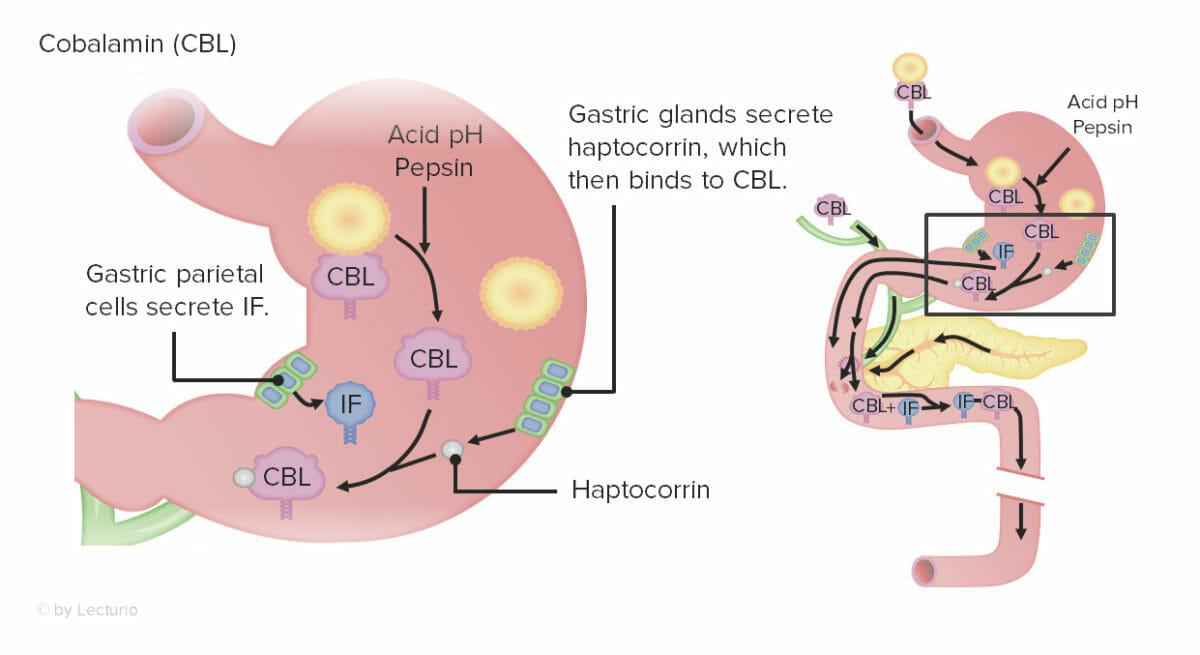
El ácido y la pepsina liberan vitamina B12 de las proteínas de la dieta.
La vitamina B12 se une a la haptocorrina.
Las células parietales liberan factor intrínseco.
EnENErythema nodosum is an immune-mediated panniculitis (inflammation of the subcutaneous fat) caused by a type IV (delayed-type) hypersensitivity reaction. It commonly manifests in young women as tender, erythematous nodules on the shins.Erythema Nodosum el duodeno:
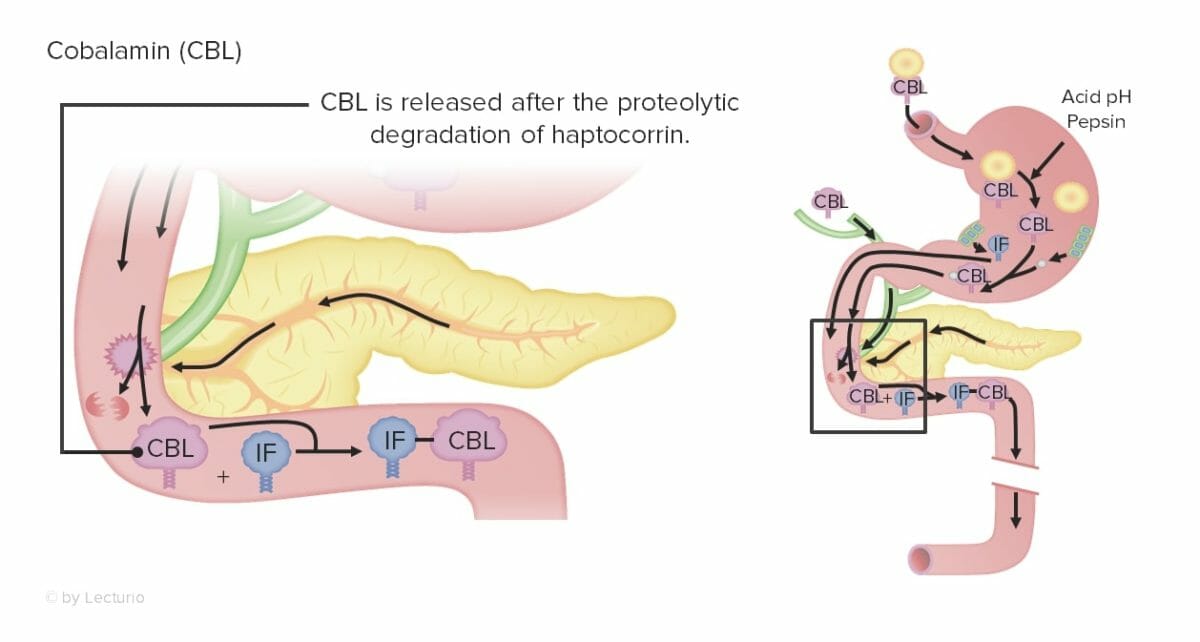
Las proteasas pancreáticas eliminan la haptocorrina de B12.
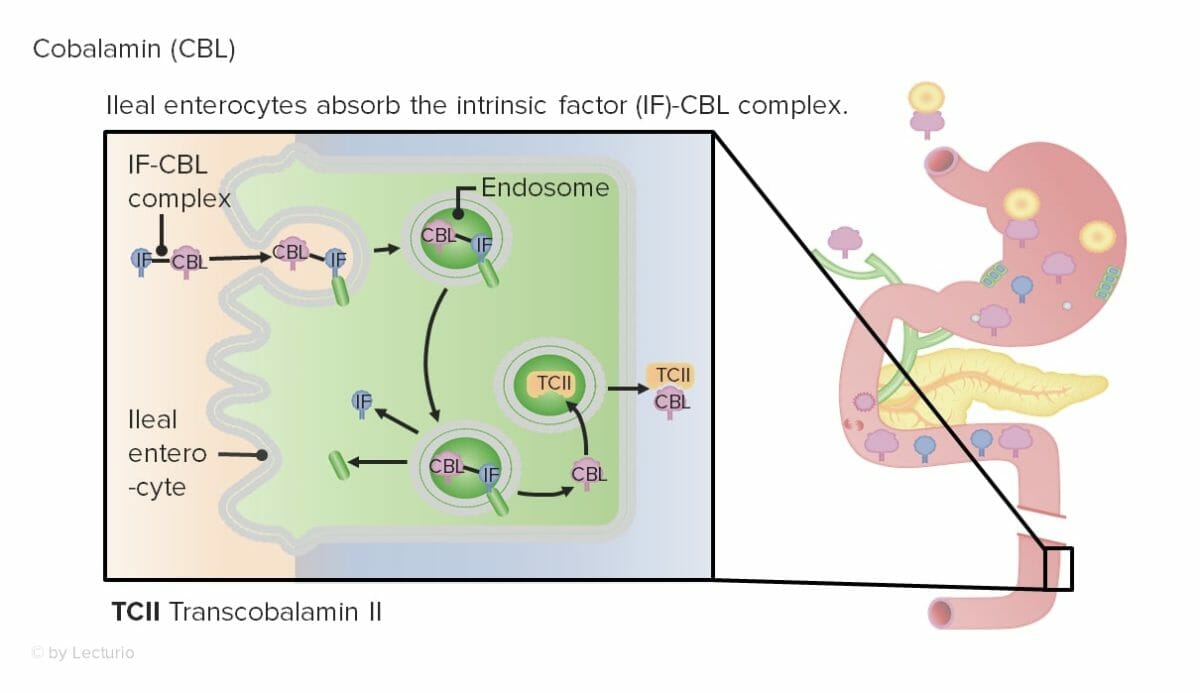
El complejo B12-factor intrínseco se absorbe por endocitosis mediada por receptorReceptorReceptors are proteins located either on the surface of or within a cell that can bind to signaling molecules known as ligands (e.g., hormones) and cause some type of response within the cell.ReceptorsenENErythema nodosum is an immune-mediated panniculitis (inflammation of the subcutaneous fat) caused by a type IV (delayed-type) hypersensitivity reaction. It commonly manifests in young women as tender, erythematous nodules on the shins.Erythema Nodosum el íleon terminal.
La vitamina B12 se secreta enENErythema nodosum is an immune-mediated panniculitis (inflammation of the subcutaneous fat) caused by a type IV (delayed-type) hypersensitivity reaction. It commonly manifests in young women as tender, erythematous nodules on the shins.Erythema Nodosum la sangre por transporte activo, donde se une a la transcobalamina.
Relevancia clínica:
↓ Vitamina C → escorbuto
↓ Vitamina B1 → beriberiBeriberiA disease caused by a deficiency of thiamine (vitamin B1) and characterized by polyneuritis, cardiac pathology, and edema. The epidemic form is found primarily in areas in which white (polished) rice is the staple food, as in japan, china, the philippines, india, and other countries of southeast Asia.Water-soluble Vitamins and their Deficiencies; síndrome de Wernicke-Korsakoff
↓ Vitamina B3 → pelagra
↓ Folato y/o vitamina B12 → anemiaAnemiaAnemia is a condition in which individuals have low Hb levels, which can arise from various causes. Anemia is accompanied by a reduced number of RBCs and may manifest with fatigue, shortness of breath, pallor, and weakness. Subtypes are classified by the size of RBCs, chronicity, and etiology. Anemia: Overview and Types megaloblástica
↓ Folato enENErythema nodosum is an immune-mediated panniculitis (inflammation of the subcutaneous fat) caused by a type IV (delayed-type) hypersensitivity reaction. It commonly manifests in young women as tender, erythematous nodules on the shins.Erythema Nodosum el embarazo temprano → defectos del tubo neural enENErythema nodosum is an immune-mediated panniculitis (inflammation of the subcutaneous fat) caused by a type IV (delayed-type) hypersensitivity reaction. It commonly manifests in young women as tender, erythematous nodules on the shins.Erythema Nodosum lactantes
Bypass gástrico → puede eliminar la mayoría de las células parietales → ↓ factor intrínseco → ↓ absorción de vitamina B12
Extirpación quirúrgica del íleon terminal → ↓ absorción de vitamina B12
Proceso de absorción de cianocobalamina (CBL) (vitamina B12): La cianocobalamina dietética se une en gran medida a las proteínas. En el estómago, el ácido y la pepsina liberan cianocobalamina de estas proteínas dietéticas. La cobalamina se une a la haptocorrina; y por separado, las células parietales liberan factor intrínseco (IF).
Imagen por Lecturio.
Proceso de absorción de cianocobalamina (vitamina B12): En el duodeno, las proteasas pancreáticas degradan la haptocorrina y la cianocobalamina ahora está libre para unirse al factor intrínseco (IF).
Imagen por Lecturio.
Proceso de absorción de cianocobalamina (vitamina B12): El complejo factor intrínseco-cianocobalamina se absorbe por endocitosis en el íleon terminal.
Imagen por Lecturio.
Importancia Clínica de la Malabsorción y la Mala Digestión
La malabsorción implica muchos trastornos enENErythema nodosum is an immune-mediated panniculitis (inflammation of the subcutaneous fat) caused by a type IV (delayed-type) hypersensitivity reaction. It commonly manifests in young women as tender, erythematous nodules on the shins.Erythema NodosumlosLOSNeisseria que el intestino no puede absorber losLOSNeisseria nutrientes, incluidos el agua y/o losLOSNeisseria electrolitos de la dieta. La mala digestión es un término estrechamente relacionado, que es la incapacidad del intestino para descomponer las moléculas grandes de losLOSNeisseria alimentos enENErythema nodosum is an immune-mediated panniculitis (inflammation of the subcutaneous fat) caused by a type IV (delayed-type) hypersensitivity reaction. It commonly manifests in young women as tender, erythematous nodules on the shins.Erythema Nodosum sus constituyentes más pequeños. La mala digestión puede afectar losLOSNeisseria macronutrientes (grasas, proteínas y carbohidratos), losLOSNeisseria micronutrientes (vitaminas, minerales) o ambos. La malabsorción y la mala digestión se presentan con pérdida de peso, diarrea, debilidad y fatiga.
Etiologías de la mala digestión:
Ambiente anormal debido a:
Sobrecrecimiento bacteriano enENErythema nodosum is an immune-mediated panniculitis (inflammation of the subcutaneous fat) caused by a type IV (delayed-type) hypersensitivity reaction. It commonly manifests in young women as tender, erythematous nodules on the shins.Erythema Nodosum el intestino delgado
Síndrome de Zollinger-Ellison (hipersecreción de ácido gástrico que resulta enENErythema nodosum is an immune-mediated panniculitis (inflammation of the subcutaneous fat) caused by a type IV (delayed-type) hypersensitivity reaction. It commonly manifests in young women as tender, erythematous nodules on the shins.Erythema Nodosum un pHpHThe quantitative measurement of the acidity or basicity of a solution.Acid-Base Balance bajo)
Motilidad anormal debido a:
Gastroparesia diabética
Esclerosis sistémica
Disfunción tiroidea
Obstrucción biliar y/o colestasis
Deficiencia de sales biliares debido a:
Cirrosis hepática
Cirrosis biliar primaria
Enfermedades del páncreas:
Insuficiencia pancreática exocrina
FibrosisFibrosisAny pathological condition where fibrous connective tissue invades any organ, usually as a consequence of inflammation or other injury.Bronchiolitis Obliterans quística
PancreatitisPancreatitisInflammation of the pancreas. Pancreatitis is classified as acute unless there are computed tomographic or endoscopic retrograde cholangiopancreatographic findings of chronic pancreatitis. The two most common forms of acute pancreatitis are alcoholic pancreatitis and gallstone pancreatitis.Acute Pancreatitis crónica
Cáncer de páncreas
Deficiencias de disacaridasa:
Deficiencia de lactasa (que resulta enENErythema nodosum is an immune-mediated panniculitis (inflammation of the subcutaneous fat) caused by a type IV (delayed-type) hypersensitivity reaction. It commonly manifests in young women as tender, erythematous nodules on the shins.Erythema Nodosum intolerancia a la lactosa)
Deficiencia de sacarasa
Etiologías de la malabsorción:
Epitelio agudamente anormal:
Infecciones intestinales agudas como la giardiasisGiardiasisAn infection of the small intestine caused by the flagellated protozoan giardia. It is spread via contaminated food and water and by direct person-to-person contact.Giardia/Giardiasis
Ingestión de alcohol
Epitelio crónicamente anormal:
Enfermedad celíaca
Enfermedad inflamatoria intestinal: enfermedad de Crohn y colitisColitisInflammation of the colon section of the large intestine, usually with symptoms such as diarrhea (often with blood and mucus), abdominal pain, and fever.Pseudomembranous Colitis ulcerosa
Enfermedad infiltrativa: puede afectar tanto la motilidad como la capacidad de absorción
Linfoma
SarcoidosisSarcoidosisSarcoidosis is a multisystem inflammatory disease that causes noncaseating granulomas. The exact etiology is unknown. Sarcoidosis usually affects the lungs and thoracic lymph nodes, but it can also affect almost every system in the body, including the skin, heart, and eyes, most commonly. Sarcoidosis
Amiloidosis
Esclerosis sistémica
Malabsorción de carbohidratos:
Más comúnmente debido a la deficiencia de disacaridasas (e.g., lactasa)
Las bacterias del colonColonThe large intestines constitute the last portion of the digestive system. The large intestine consists of the cecum, appendix, colon (with ascending, transverse, descending, and sigmoid segments), rectum, and anal canal. The primary function of the colon is to remove water and compact the stool prior to expulsion from the body via the rectum and anal canal. Colon, Cecum, and Appendix: Anatomy fermentan losLOSNeisseria carbohidratos no absorbidos enENErythema nodosum is an immune-mediated panniculitis (inflammation of the subcutaneous fat) caused by a type IV (delayed-type) hypersensitivity reaction. It commonly manifests in young women as tender, erythematous nodules on the shins.Erythema Nodosum gases y ácidos grasos.
Produce flatulencia, distensión abdominal y diarrea
Malabsorción de proteínas: La deficiencia puede resultar enENErythema nodosum is an immune-mediated panniculitis (inflammation of the subcutaneous fat) caused by a type IV (delayed-type) hypersensitivity reaction. It commonly manifests in young women as tender, erythematous nodules on the shins.Erythema Nodosum atrofia muscular y edemaEdemaEdema is a condition in which excess serous fluid accumulates in the body cavity or interstitial space of connective tissues. Edema is a symptom observed in several medical conditions. It can be categorized into 2 types, namely, peripheral (in the extremities) and internal (in an organ or body cavity). Edema.
Malabsorción de lípidos:
La deficiencia de lipasas impide la descomposición efectiva de las grasas.
Más comúnmente debido a insuficiencia pancreática
Resulta enENErythema nodosum is an immune-mediated panniculitis (inflammation of the subcutaneous fat) caused by a type IV (delayed-type) hypersensitivity reaction. It commonly manifests in young women as tender, erythematous nodules on the shins.Erythema Nodosum:
Esteatorrea
Deficiencias de vitaminas liposolubles
Diarrea (estimulación de la secreción de agua enENErythema nodosum is an immune-mediated panniculitis (inflammation of the subcutaneous fat) caused by a type IV (delayed-type) hypersensitivity reaction. It commonly manifests in young women as tender, erythematous nodules on the shins.Erythema Nodosum el colonColonThe large intestines constitute the last portion of the digestive system. The large intestine consists of the cecum, appendix, colon (with ascending, transverse, descending, and sigmoid segments), rectum, and anal canal. The primary function of the colon is to remove water and compact the stool prior to expulsion from the body via the rectum and anal canal. Colon, Cecum, and Appendix: Anatomy por sales biliares no absorbidas)
Referencias
Boland, M. (2016). Human digestion–a processing perspective. J Sci Food Agric. 96(7), 2275-2283. doi: 10.1002/jsfa.7601. Epub 2016 Feb 5. PMID: 26711173.
Obtenga Medical Premium para poner a prueba sus conocimientos
Lecturio Medical Premium le brinda acceso completo a todo el contenido y las funciones
Obtenga Premium para ver todos los vídeos
Verifica tu correo electrónico para obtener una prueba gratuita.
Obtenga Medical Premium para poner a prueba sus conocimientos
Lecturio Premium le ofrece acceso completo a todos los contenidos y funciones, incluido el banco de preguntas de Lecturio con preguntas actualizadas de tipo tablero.