Domina Conceptos Médicos

Estudia para la escuela de medicina y tus examenes con Lecturio.

Desnutrición en Niños en Países de Recursos Limitados

La desnutrición es un estado clínico causado por un desequilibrio o deficiencia de calorías y/o micronutrientes y macronutrientes. Las 2 manifestaciones principales de la desnutrición aguda grave son el marasmo (insuficiencia calórica total) y el kwashiorkor Kwashiorkor A syndrome produced by severe protein deficiency, characterized by retarded growth, changes in skin and hair pigment, edema, and pathologic changes in the liver, including fatty infiltration, necrosis, and fibrosis. The word is a local name in gold coast, africa, meaning 'displaced child'. Although first reported from africa, kwashiorkor is now known throughout the world, but mainly in the tropics and subtropics. It is considered to be related to marasmus. Malnutrition in children in resource-limited countries (desnutrición proteica con edema Edema Edema is a condition in which excess serous fluid accumulates in the body cavity or interstitial space of connective tissues. Edema is a symptom observed in several medical conditions. It can be categorized into 2 types, namely, peripheral (in the extremities) and internal (in an organ or body cavity). Edema característico). La desnutrición casi siempre se asocia con un proceso de enfermedad subyacente, que se puede clasificar en EN Erythema nodosum is an immune-mediated panniculitis (inflammation of the subcutaneous fat) caused by a type IV (delayed-type) hypersensitivity reaction. It commonly manifests in young women as tender, erythematous nodules on the shins. Erythema Nodosum 4 categorías: disminución de la ingesta de nutrientes, disminución de la absorción de micronutrientes y macronutrientes, aumento de la pérdida de nutrientes y aumento del gasto energético. La presentación clínica del marasmo varía según la gravedad, duración de la restricción calórica y deficiencias de vitaminas y minerales. La presentación clínica del kwashiorkor Kwashiorkor A syndrome produced by severe protein deficiency, characterized by retarded growth, changes in skin and hair pigment, edema, and pathologic changes in the liver, including fatty infiltration, necrosis, and fibrosis. The word is a local name in gold coast, africa, meaning 'displaced child'. Although first reported from africa, kwashiorkor is now known throughout the world, but mainly in the tropics and subtropics. It is considered to be related to marasmus. Malnutrition in children in resource-limited countries incluye edema Edema Edema is a condition in which excess serous fluid accumulates in the body cavity or interstitial space of connective tissues. Edema is a symptom observed in several medical conditions. It can be categorized into 2 types, namely, peripheral (in the extremities) and internal (in an organ or body cavity). Edema periférico con fóvea, atrofia muscular y distensión abdominal. La antropometría es fundamental en EN Erythema nodosum is an immune-mediated panniculitis (inflammation of the subcutaneous fat) caused by a type IV (delayed-type) hypersensitivity reaction. It commonly manifests in young women as tender, erythematous nodules on the shins. Erythema Nodosum el diagnóstico de la desnutrición. El enfoque de 3 pasos para tratar la desnutrición incluye reanimación, rehabilitación y prevención de recaídas.

Last updated: Dec 15, 2025

Editorial responsibility: Stanley Oiseth, Lindsay Jones, Evelin Maza

Descripción General

Definición

La desnutrición es un estado clínico con un desequilibrio, deficiencia o exceso de una amplia gama de nutrientes y energía.
  • Marasmo:
    • Ingesta inadecuada de calorías/nutrientes
    • Relación peso-talla baja (< 3 desviaciones estándar de la media para la edad)
    • Atrofia muscular y tejido adiposo reducido
  • Kwashiorkor Kwashiorkor A syndrome produced by severe protein deficiency, characterized by retarded growth, changes in skin and hair pigment, edema, and pathologic changes in the liver, including fatty infiltration, necrosis, and fibrosis. The word is a local name in gold coast, africa, meaning ‘displaced child’. Although first reported from africa, kwashiorkor is now known throughout the world, but mainly in the tropics and subtropics. It is considered to be related to marasmus. Malnutrition in children in resource-limited countries:
    • Deficiencia de proteína
    • Normalmente suficientes calorías (dieta compensada)
    • Hallazgo clásico: edema Edema Edema is a condition in which excess serous fluid accumulates in the body cavity or interstitial space of connective tissues. Edema is a symptom observed in several medical conditions. It can be categorized into 2 types, namely, peripheral (in the extremities) and internal (in an organ or body cavity). Edema por falta de presión coloidal intravascular
Tipos de desnutrición

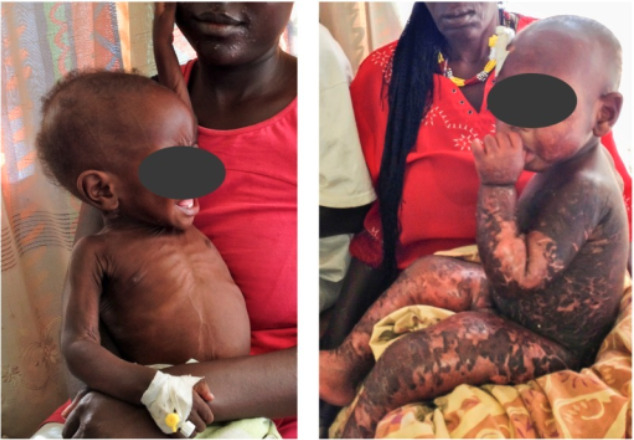
Dos formas de desnutrición aguda grave: la desnutrición no edematosa (marasmo) y la edematosa (kwashiorkor)

Imagen: “Clinical picture” por Department of Nutrition, Exercise and Sports, Faculty of Science, University of Copenhagen, Frederiksberg, Denmark. Licencia: CC BY 4.0

Epidemiología

  • Prevalencia mundial de la desnutrición aguda:
    • Desnutrición moderada: 32,7 millones de niños
    • Emaciación grave: 14,3 millones de niños < 5 años
  • Principalmente en EN Erythema nodosum is an immune-mediated panniculitis (inflammation of the subcutaneous fat) caused by a type IV (delayed-type) hypersensitivity reaction. It commonly manifests in young women as tender, erythematous nodules on the shins. Erythema Nodosum regiones con recursos limitados (e.g., sur de Asia ASIA Spinal Cord Injuries y África subsahariana)

Etiología

La desnutrición a menudo se asocia con una enfermedad subyacente y se puede categorizar conceptualmente en EN Erythema nodosum is an immune-mediated panniculitis (inflammation of the subcutaneous fat) caused by a type IV (delayed-type) hypersensitivity reaction. It commonly manifests in young women as tender, erythematous nodules on the shins. Erythema Nodosum 4 categorías etiológicas amplias :

  • Disminución de la ingesta:
    • Falta de disponibilidad
    • Falta de acceso (e.g., dificultad para alcanzar físicamente los LOS Neisseria alimentos y masticarlos)
  • Disminución de la absorción de micronutrientes/macronutrientes (malabsorción):
    • Diarrea crónica
    • Falta de superficie del intestino delgado
  • Mayor pérdida y/o cambio en EN Erythema nodosum is an immune-mediated panniculitis (inflammation of the subcutaneous fat) caused by a type IV (delayed-type) hypersensitivity reaction. It commonly manifests in young women as tender, erythematous nodules on the shins. Erythema Nodosum los LOS Neisseria requerimientos de energía:
    • Embarazo
    • Fístula enterocutánea
  • Aumento del gasto de energía:
    • Estados hipermetabólicos (hipertiroidismo)
    • Estados patológicos específicos (e.g., quemaduras extensas, disfunción cardíaca y lesión en EN Erythema nodosum is an immune-mediated panniculitis (inflammation of the subcutaneous fat) caused by a type IV (delayed-type) hypersensitivity reaction. It commonly manifests in young women as tender, erythematous nodules on the shins. Erythema Nodosum la cabeza)

Related videos

Presentación Clínica

Cambios patológicos causados por la desnutrición

  • Tasa metabólica basal ↓ en EN Erythema nodosum is an immune-mediated panniculitis (inflammation of the subcutaneous fat) caused by a type IV (delayed-type) hypersensitivity reaction. It commonly manifests in young women as tender, erythematous nodules on the shins. Erythema Nodosum un 30%
  • ↓ Síntesis de proteínas
  • Disfunción de la bomba de sodio–potasio → aumento de sodio intracelular
  • Endocrinos:
    • ↓ Producción de insulina
    • ↓ Producción del factor de crecimiento similar a la insulina
    • ↑ Producción de cortisol Cortisol Glucocorticoids

Presentación clínica del marasmo

La presentación clínica varía según la gravedad, duración de la restricción calórica y presencia de deficiencias de vitaminas/minerales.

Los LOS Neisseria individuos presentan:
  • Falta de crecimiento:
    • Bajo peso para la estatura
    • Disminución de la circunferencia del brazo medio superior
  • Pérdida de tejido adiposo:
    • Comienza en EN Erythema nodosum is an immune-mediated panniculitis (inflammation of the subcutaneous fat) caused by a type IV (delayed-type) hypersensitivity reaction. It commonly manifests in young women as tender, erythematous nodules on the shins. Erythema Nodosum la ingle o la axila → glúteos, cara y muslo
    • Aspecto general: encogido y gastado
  • Signos exclusivos de los LOS Neisseria lactantes:
    • Fontanela hundida (deshidratación)
    • Irritabilidad
    • Apatía/letargo
  • Síntomas de marasmo asociados con deficiencias de vitaminas/minerales:
    • Deficiencia de vitamina A: ojos secos y manchas de Bitot
    • Deficiencia de hierro y anemia Anemia Anemia is a condition in which individuals have low Hb levels, which can arise from various causes. Anemia is accompanied by a reduced number of RBCs and may manifest with fatigue, shortness of breath, pallor, and weakness. Subtypes are classified by the size of RBCs, chronicity, and etiology. Anemia: Overview and Types: uña de cuchara (coiloniquia)
    • Hipocalcemia: hiperreflexia
      • Signo de Chvostek: espasmos de los LOS Neisseria músculos faciales en EN Erythema nodosum is an immune-mediated panniculitis (inflammation of the subcutaneous fat) caused by a type IV (delayed-type) hypersensitivity reaction. It commonly manifests in young women as tender, erythematous nodules on the shins. Erythema Nodosum respuesta al AL Amyloidosis golpeteo sobre el área del nervio facial.
      • Signo de Trousseau: espasmo carpopedal causado por inflar el manguito de presión arterial a un nivel superior a la presión sistólica durante 3 minutos
  • Deficiencia de calcio y vitamina D: deformidades óseas que incluyen raquitismo y/u osteomalacia Osteomalacia Disorder caused by an interruption of the mineralization of organic bone matrix leading to bone softening, bone pain, and weakness. It is the adult form of rickets resulting from disruption of vitamin d; phosphorus; or calcium homeostasis. Osteomalacia and Rickets
  • Marasmo de larga data:
    • Retraso en EN Erythema nodosum is an immune-mediated panniculitis (inflammation of the subcutaneous fat) caused by a type IV (delayed-type) hypersensitivity reaction. It commonly manifests in young women as tender, erythematous nodules on the shins. Erythema Nodosum el crecimiento
    • Síntomas de anemia Anemia Anemia is a condition in which individuals have low Hb levels, which can arise from various causes. Anemia is accompanied by a reduced number of RBCs and may manifest with fatigue, shortness of breath, pallor, and weakness. Subtypes are classified by the size of RBCs, chronicity, and etiology. Anemia: Overview and Types y raquitismo
    • Deterioro de la función cardiovascular → hipotensión, hipotermia y bradicardia
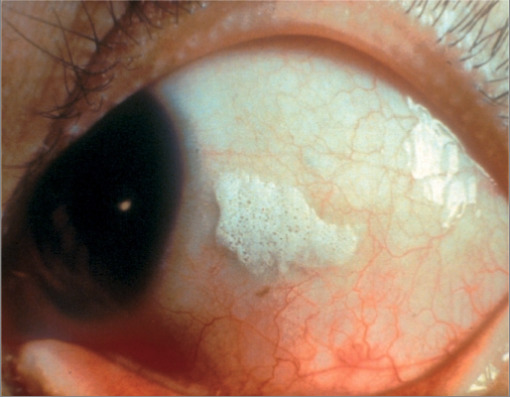
Manchas de bitot

Manchas de bitot resultantes de la deficiencia de vitamina A

Imagen: “Bitot spots” por Professor of Ophthalmology, College of Medicine, University of Ibadan, Nigeria Licencia: CC BY 2.0

Presentación clínica de kwashiorkor Kwashiorkor A syndrome produced by severe protein deficiency, characterized by retarded growth, changes in skin and hair pigment, edema, and pathologic changes in the liver, including fatty infiltration, necrosis, and fibrosis. The word is a local name in gold coast, africa, meaning ‘displaced child’. Although first reported from africa, kwashiorkor is now known throughout the world, but mainly in the tropics and subtropics. It is considered to be related to marasmus. Malnutrition in children in resource-limited countries

Los LOS Neisseria individuos presentan:

  • Edema Edema Edema is a condition in which excess serous fluid accumulates in the body cavity or interstitial space of connective tissues. Edema is a symptom observed in several medical conditions. It can be categorized into 2 types, namely, peripheral (in the extremities) and internal (in an organ or body cavity). Edema periférico con fóvea:
    • Edema Edema Edema is a condition in which excess serous fluid accumulates in the body cavity or interstitial space of connective tissues. Edema is a symptom observed in several medical conditions. It can be categorized into 2 types, namely, peripheral (in the extremities) and internal (in an organ or body cavity). Edema dependiente de la gravedad: comienza en EN Erythema nodosum is an immune-mediated panniculitis (inflammation of the subcutaneous fat) caused by a type IV (delayed-type) hypersensitivity reaction. It commonly manifests in young women as tender, erythematous nodules on the shins. Erythema Nodosum las extremidades inferiores y se desplaza cranealmente
    • Simétrico
  • Atrofia muscular significativa
  • Distensión abdominal (con o sin dilatación del asa ASA Anterior Cord Syndrome intestinal y hepatomegalia)
  • Rostro redondo con mejillas prominentes
  • Cambios en EN Erythema nodosum is an immune-mediated panniculitis (inflammation of the subcutaneous fat) caused by a type IV (delayed-type) hypersensitivity reaction. It commonly manifests in young women as tender, erythematous nodules on the shins. Erythema Nodosum la piel:
    • Sequedad
    • Adelgazamiento
    • Se pela fácilmente
    • Áreas confluentes de descamación e hiperpigmentación
    • Lesiones y dermatitis Dermatitis Any inflammation of the skin. Atopic Dermatitis (Eczema) en EN Erythema nodosum is an immune-mediated panniculitis (inflammation of the subcutaneous fat) caused by a type IV (delayed-type) hypersensitivity reaction. It commonly manifests in young women as tender, erythematous nodules on the shins. Erythema Nodosum perineo, ingle, extremidades, orejas y axilas
  • Cambios en EN Erythema nodosum is an immune-mediated panniculitis (inflammation of the subcutaneous fat) caused by a type IV (delayed-type) hypersensitivity reaction. It commonly manifests in young women as tender, erythematous nodules on the shins. Erythema Nodosum el pelo:
    • Sequedad
    • Hipopigmentación
    • Se cae/se arranca fácilmente
  • Retraso del crecimiento
  • La retención de grasa en EN Erythema nodosum is an immune-mediated panniculitis (inflammation of the subcutaneous fat) caused by a type IV (delayed-type) hypersensitivity reaction. It commonly manifests in young women as tender, erythematous nodules on the shins. Erythema Nodosum la piel subcutánea se acompaña de pliegues cutáneos sueltos en EN Erythema nodosum is an immune-mediated panniculitis (inflammation of the subcutaneous fat) caused by a type IV (delayed-type) hypersensitivity reaction. It commonly manifests in young women as tender, erythematous nodules on the shins. Erythema Nodosum la piel inguinal interna.
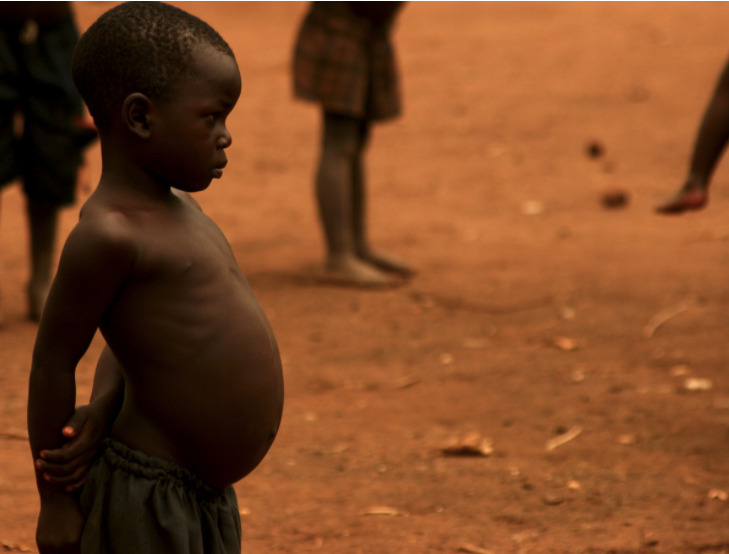
presentación kwashiorkor

Un niño con kwashiorkor: la ascitis conduce a un abdomen protuberante.

Imagen: “Kwashiorkor” por Av TKnoxB/Flickr. Licencia: CC BY 2.0

Diagnóstico

Desnutrición

La antropometría precisa es esencial en EN Erythema nodosum is an immune-mediated panniculitis (inflammation of the subcutaneous fat) caused by a type IV (delayed-type) hypersensitivity reaction. It commonly manifests in young women as tender, erythematous nodules on the shins. Erythema Nodosum el diagnóstico de la desnutrición:

  • Precisión de longitud vertical: 0,5 cm
  • Precisión de peso: 100 g
  • Precisión de circunferencia del brazo medio superior: 2 mm MM Multiple myeloma (MM) is a malignant condition of plasma cells (activated B lymphocytes) primarily seen in the elderly. Monoclonal proliferation of plasma cells results in cytokine-driven osteoclastic activity and excessive secretion of IgG antibodies. Multiple Myeloma o menos

Pruebas de laboratorio a tener en EN Erythema nodosum is an immune-mediated panniculitis (inflammation of the subcutaneous fat) caused by a type IV (delayed-type) hypersensitivity reaction. It commonly manifests in young women as tender, erythematous nodules on the shins. Erythema Nodosum cuenta:

  • Hemoglobina y hemograma
  • Frotis de sangre
  • Glucosa en EN Erythema nodosum is an immune-mediated panniculitis (inflammation of the subcutaneous fat) caused by a type IV (delayed-type) hypersensitivity reaction. It commonly manifests in young women as tender, erythematous nodules on the shins. Erythema Nodosum sangre
  • Albúmina sérica
  • Microscopía y cultivo de heces (huevos incluidos)
  • Microscopía y cultivo de orina
  • Test de virus Virus Viruses are infectious, obligate intracellular parasites composed of a nucleic acid core surrounded by a protein capsid. Viruses can be either naked (non-enveloped) or enveloped. The classification of viruses is complex and based on many factors, including type and structure of the nucleoid and capsid, the presence of an envelope, the replication cycle, and the host range. Virology de inmunodeficiencia humana (VIH)
  • Estudios de hierro
  • Nivel de ácido fólico
  • Nivel de vitamina B12

Marasmo

Diagnóstico realizado si:

  • Circunferencia del brazo medio superior < 115 mm MM Multiple myeloma (MM) is a malignant condition of plasma cells (activated B lymphocytes) primarily seen in the elderly. Monoclonal proliferation of plasma cells results in cytokine-driven osteoclastic activity and excessive secretion of IgG antibodies. Multiple Myeloma O
  • Puntuación Z de peso para la estatura > 3 desviaciones estándar por debajo de la media
  • Investigue el edema Edema Edema is a condition in which excess serous fluid accumulates in the body cavity or interstitial space of connective tissues. Edema is a symptom observed in several medical conditions. It can be categorized into 2 types, namely, peripheral (in the extremities) and internal (in an organ or body cavity). Edema con fóvea para descartar kwashiorkor Kwashiorkor A syndrome produced by severe protein deficiency, characterized by retarded growth, changes in skin and hair pigment, edema, and pathologic changes in the liver, including fatty infiltration, necrosis, and fibrosis. The word is a local name in gold coast, africa, meaning ‘displaced child’. Although first reported from africa, kwashiorkor is now known throughout the world, but mainly in the tropics and subtropics. It is considered to be related to marasmus. Malnutrition in children in resource-limited countries.

Kwashiorkor Kwashiorkor A syndrome produced by severe protein deficiency, characterized by retarded growth, changes in skin and hair pigment, edema, and pathologic changes in the liver, including fatty infiltration, necrosis, and fibrosis. The word is a local name in gold coast, africa, meaning ‘displaced child’. Although first reported from africa, kwashiorkor is now known throughout the world, but mainly in the tropics and subtropics. It is considered to be related to marasmus. Malnutrition in children in resource-limited countries

  • Circunferencia del brazo medio superior baja
  • Edema Edema Edema is a condition in which excess serous fluid accumulates in the body cavity or interstitial space of connective tissues. Edema is a symptom observed in several medical conditions. It can be categorized into 2 types, namely, peripheral (in the extremities) and internal (in an organ or body cavity). Edema simétrico con fóvea
  • Otros criterios de diagnóstico para kwashiorkor Kwashiorkor A syndrome produced by severe protein deficiency, characterized by retarded growth, changes in skin and hair pigment, edema, and pathologic changes in the liver, including fatty infiltration, necrosis, and fibrosis. The word is a local name in gold coast, africa, meaning ‘displaced child’. Although first reported from africa, kwashiorkor is now known throughout the world, but mainly in the tropics and subtropics. It is considered to be related to marasmus. Malnutrition in children in resource-limited countries:

Tratamiento

Enfoque paso a paso

Dividido en EN Erythema nodosum is an immune-mediated panniculitis (inflammation of the subcutaneous fat) caused by a type IV (delayed-type) hypersensitivity reaction. It commonly manifests in young women as tender, erythematous nodules on the shins. Erythema Nodosum 3 fases principales:

  1. Reanimación y estabilización del individuo (aproximadamente 1 semana):
    • Objetivos:
      • Tratamiento y prevención de la deshidratación y corrección de los LOS Neisseria desequilibrios electrolíticos:
        • El sodio en EN Erythema nodosum is an immune-mediated panniculitis (inflammation of the subcutaneous fat) caused by a type IV (delayed-type) hypersensitivity reaction. It commonly manifests in young women as tender, erythematous nodules on the shins. Erythema Nodosum la solución salina normal es demasiado alto y el potasio es demasiado bajo.
        • ReSoMal ( REhydration Rehydration Dengue Virus SOlution for MALnutrition Malnutrition Malnutrition is a clinical state caused by an imbalance or deficiency of calories and/or micronutrients and macronutrients. The 2 main manifestations of acute severe malnutrition are marasmus (total caloric insufficiency) and kwashiorkor (protein malnutrition with characteristic edema). Malnutrition in children in resource-limited countries) (SOlución de REhidratación para la MALnutrición) es una solución personalizada administrada por vía oral o a través de una sonda nasogástrica, que contiene la cantidad exacta de electrolitos, minerales, agua y azúcar necesarios.
      • Tratamiento y prevención de infecciones:
        • Es posible que los LOS Neisseria individuos no presenten una respuesta manifiesta a la sepsis Sepsis Systemic inflammatory response syndrome with a proven or suspected infectious etiology. When sepsis is associated with organ dysfunction distant from the site of infection, it is called severe sepsis. When sepsis is accompanied by hypotension despite adequate fluid infusion, it is called septic shock. Sepsis and Septic Shock.
        • Administrar antibióticos a las personas con sospecha de infección.
      • Tratamiento y prevención de la hipotermia
    • Prevención del síndrome de realimentación:
      • La nutrición debe administrarse a un ritmo lento con una ingesta calórica entre el 60% y el 80% de las necesidades específicas de la edad.
      • La hipoglucemia es un riesgo del síndrome de realimentación: recomendar alimentaciones nasogástricas continuas o comidas pequeñas por la noche para evitar la hipoglucemia.
      • Administrar tiamina y fosfato oral para prevenir la hipofosfatemia.
  2. Rehabilitación nutricional (2–6 semanas):
    • La ingesta calórica se puede aumentar a 120%–140% de los LOS Neisseria requisitos específicos de la edad.
    • Administrar las vacunas necesarias.
    • Fomentar el aumento de la actividad motora.
    • El vínculo madre/hijo es beneficioso para revertir el retraso en EN Erythema nodosum is an immune-mediated panniculitis (inflammation of the subcutaneous fat) caused by a type IV (delayed-type) hypersensitivity reaction. It commonly manifests in young women as tender, erythematous nodules on the shins. Erythema Nodosum el desarrollo y proporcionar estimulación sensorial y apoyo emocional.
  3. Seguimiento y prevención de la recurrencia:
    • Educar al AL Amyloidosis cuidador (especialmente sobre consideraciones de lactancia y alimentación suplementaria).
    • El control de enfermedades infecciosas y un suministro continuo de nutrición adecuada y agua potable limpia son cruciales.

Consideraciones clave:

  • El desequilibrio de líquidos es un problema importante en EN Erythema nodosum is an immune-mediated panniculitis (inflammation of the subcutaneous fat) caused by a type IV (delayed-type) hypersensitivity reaction. It commonly manifests in young women as tender, erythematous nodules on the shins. Erythema Nodosum kwashiorkor Kwashiorkor A syndrome produced by severe protein deficiency, characterized by retarded growth, changes in skin and hair pigment, edema, and pathologic changes in the liver, including fatty infiltration, necrosis, and fibrosis. The word is a local name in gold coast, africa, meaning ‘displaced child’. Although first reported from africa, kwashiorkor is now known throughout the world, but mainly in the tropics and subtropics. It is considered to be related to marasmus. Malnutrition in children in resource-limited countries:
    • Rehidratarse atentamente.
    • La rehidratación agresiva puede causar insuficiencia cardíaca aguda e hipovolemia grave, lo que puede provocar shock Shock Shock is a life-threatening condition associated with impaired circulation that results in tissue hypoxia. The different types of shock are based on the underlying cause: distributive (↑ cardiac output (CO), ↓ systemic vascular resistance (SVR)), cardiogenic (↓ CO, ↑ SVR), hypovolemic (↓ CO, ↑ SVR), obstructive (↓ CO), and mixed. Types of Shock y la muerte.
  • Si un lactante tiene < 6 meses de edad, una circunferencia del brazo medio superior < 110 mm MM Multiple myeloma (MM) is a malignant condition of plasma cells (activated B lymphocytes) primarily seen in the elderly. Monoclonal proliferation of plasma cells results in cytokine-driven osteoclastic activity and excessive secretion of IgG antibodies. Multiple Myeloma está altamente asociada con mortalidad.

Complicaciones

Síndrome de realimentación

  • Los LOS Neisseria electrolitos intracelulares/extracelulares y los LOS Neisseria niveles de líquidos son anormales en EN Erythema nodosum is an immune-mediated panniculitis (inflammation of the subcutaneous fat) caused by a type IV (delayed-type) hypersensitivity reaction. It commonly manifests in young women as tender, erythematous nodules on the shins. Erythema Nodosum personas desnutridas.
  • La alimentación y la hidratación realizadas con demasiada rapidez provocan cambios inesperados en EN Erythema nodosum is an immune-mediated panniculitis (inflammation of the subcutaneous fat) caused by a type IV (delayed-type) hypersensitivity reaction. It commonly manifests in young women as tender, erythematous nodules on the shins. Erythema Nodosum los LOS Neisseria líquidos y electrolitos.
  • Características del síndrome de realimentación:
    • Edema Edema Edema is a condition in which excess serous fluid accumulates in the body cavity or interstitial space of connective tissues. Edema is a symptom observed in several medical conditions. It can be categorized into 2 types, namely, peripheral (in the extremities) and internal (in an organ or body cavity). Edema
    • Convulsiones
    • Rabdomiólisis
    • Hipofosfatemia
    • Hipopotasemia

Implicaciones cardiacas y pulmonares

  • Reducción de la masa muscular cardíaca → disminución del gasto cardíaco → disminución de la perfusión renal y la tasa de filtración glomerular
  • Debilitamiento de la función diafragmática y de los LOS Neisseria músculos respiratorios → reducción de la presión de la tos TOS Thoracic outlet syndrome (TOS) is a broad term used for a spectrum of syndromes related to the general region of the thoracic outlet, which involves the compression or irritation of elements of the brachial plexus, subclavian artery, or subclavian vein. Thoracic Outlet Syndrome y disminución de la expectoración de secreciones → retraso en EN Erythema nodosum is an immune-mediated panniculitis (inflammation of the subcutaneous fat) caused by a type IV (delayed-type) hypersensitivity reaction. It commonly manifests in young women as tender, erythematous nodules on the shins. Erythema Nodosum la recuperación de la infección del tracto respiratorio

Consecuencias gastrointestinales

  • Insuficiencia pancreática
  • Alteración de la permeabilidad intestinal, la arquitectura de las vellosidades y el flujo sanguíneo intestinal:
    • Las secreciones de iones y fluidos ocurren en EN Erythema nodosum is an immune-mediated panniculitis (inflammation of the subcutaneous fat) caused by a type IV (delayed-type) hypersensitivity reaction. It commonly manifests in young women as tender, erythematous nodules on the shins. Erythema Nodosum el intestino delgado y grueso.
    • El colon Colon The large intestines constitute the last portion of the digestive system. The large intestine consists of the cecum, appendix, colon (with ascending, transverse, descending, and sigmoid segments), rectum, and anal canal. The primary function of the colon is to remove water and compact the stool prior to expulsion from the body via the rectum and anal canal. Colon, Cecum, and Appendix: Anatomy pierde la capacidad de reabsorber agua y electrolitos.
  • Conduce a diarrea → alta tasa de mortalidad en EN Erythema nodosum is an immune-mediated panniculitis (inflammation of the subcutaneous fat) caused by a type IV (delayed-type) hypersensitivity reaction. It commonly manifests in young women as tender, erythematous nodules on the shins. Erythema Nodosum desnutridos severos
  • Los LOS Neisseria individuos pueden desarrollar íleo, deficiencia de lactasa o sobrecrecimiento bacteriano, que puede progresar a septicemia y muerte.

Inmunidad y cicatrización de heridas

  • Deterioro de la inmunidad mediada por células y función alterada de citoquinas, complemento y fagocitos → mayor riesgo de infección
  • Se observa un retraso en EN Erythema nodosum is an immune-mediated panniculitis (inflammation of the subcutaneous fat) caused by a type IV (delayed-type) hypersensitivity reaction. It commonly manifests in young women as tender, erythematous nodules on the shins. Erythema Nodosum la cicatrización de heridas en EN Erythema nodosum is an immune-mediated panniculitis (inflammation of the subcutaneous fat) caused by a type IV (delayed-type) hypersensitivity reaction. It commonly manifests in young women as tender, erythematous nodules on the shins. Erythema Nodosum pacientes quirúrgicos desnutridos.

Impacto psicosocial

  • Apatía
  • Depresión
  • Abandono de uno mismo
  • Ansiedad

Diagnóstico Diferencial

  • Virus Virus Viruses are infectious, obligate intracellular parasites composed of a nucleic acid core surrounded by a protein capsid. Viruses can be either naked (non-enveloped) or enveloped. The classification of viruses is complex and based on many factors, including type and structure of the nucleoid and capsid, the presence of an envelope, the replication cycle, and the host range. Virology de inmunodeficiencia humana (VIH): un virus Virus Viruses are infectious, obligate intracellular parasites composed of a nucleic acid core surrounded by a protein capsid. Viruses can be either naked (non-enveloped) or enveloped. The classification of viruses is complex and based on many factors, including type and structure of the nucleoid and capsid, the presence of an envelope, the replication cycle, and the host range. Virology de ARN monocatenario que se transmite sexualmente o por contacto de sangre a sangre. El virus Virus Viruses are infectious, obligate intracellular parasites composed of a nucleic acid core surrounded by a protein capsid. Viruses can be either naked (non-enveloped) or enveloped. The classification of viruses is complex and based on many factors, including type and structure of the nucleoid and capsid, the presence of an envelope, the replication cycle, and the host range. Virology ataca los LOS Neisseria linfocitos T CD4, los LOS Neisseria macrófagos y las células dendríticas, lo que provoca inmunodeficiencia. La presentación está marcada por síntomas constitucionales, como linfadenopatía y fiebre. Se recomienda el tratamiento inmediato con terapia antirretroviral combinada.
  • Enfermedad inflamatoria intestinal: una afección patológica crónica de los LOS Neisseria intestinos dividida en EN Erythema nodosum is an immune-mediated panniculitis (inflammation of the subcutaneous fat) caused by a type IV (delayed-type) hypersensitivity reaction. It commonly manifests in young women as tender, erythematous nodules on the shins. Erythema Nodosum enfermedad de Crohn y colitis Colitis Inflammation of the colon section of the large intestine, usually with symptoms such as diarrhea (often with blood and mucus), abdominal pain, and fever. Pseudomembranous Colitis ulcerosa. La enfermedad de Crohn es una afección crónica y recurrente que causa una inflamación transmural irregular que afecta a cualquier parte del tracto gastrointestinal. La colitis Colitis Inflammation of the colon section of the large intestine, usually with symptoms such as diarrhea (often with blood and mucus), abdominal pain, and fever. Pseudomembranous Colitis ulcerosa es una afección inflamatoria idiopática que afecta la superficie mucosa del colon Colon The large intestines constitute the last portion of the digestive system. The large intestine consists of the cecum, appendix, colon (with ascending, transverse, descending, and sigmoid segments), rectum, and anal canal. The primary function of the colon is to remove water and compact the stool prior to expulsion from the body via the rectum and anal canal. Colon, Cecum, and Appendix: Anatomy. Las manifestaciones extraintestinales de la enfermedad de Crohn incluyen cálculos renales de oxalato de calcio, cálculos biliares, eritema nodoso y artritis. Las manifestaciones extraintestinales de la colitis Colitis Inflammation of the colon section of the large intestine, usually with symptoms such as diarrhea (often with blood and mucus), abdominal pain, and fever. Pseudomembranous Colitis ulcerosa incluyen colangitis esclerosante primaria, inflamación ocular, ulceraciones orales y eritema nodoso.
  • Síndrome nefrótico: una amplia categoría de enfermedades glomerulares caracterizadas por proteinuria Proteinuria The presence of proteins in the urine, an indicator of kidney diseases. Nephrotic Syndrome in Children grave, hipoalbuminemia, edema Edema Edema is a condition in which excess serous fluid accumulates in the body cavity or interstitial space of connective tissues. Edema is a symptom observed in several medical conditions. It can be categorized into 2 types, namely, peripheral (in the extremities) and internal (in an organ or body cavity). Edema e hiperlipidemia. La presentación clínica del síndrome nefrótico incluye edema Edema Edema is a condition in which excess serous fluid accumulates in the body cavity or interstitial space of connective tissues. Edema is a symptom observed in several medical conditions. It can be categorized into 2 types, namely, peripheral (in the extremities) and internal (in an organ or body cavity). Edema (periférico y periorbitario), orina espumosa (lipiduria por hiperlipidemia), hipoalbuminemia y grados variables de disfunción renal. El tratamiento varía según la etiología y por lo general incluye glucocorticoides.
  • Pancreatitis Pancreatitis Inflammation of the pancreas. Pancreatitis is classified as acute unless there are computed tomographic or endoscopic retrograde cholangiopancreatographic findings of chronic pancreatitis. The two most common forms of acute pancreatitis are alcoholic pancreatitis and gallstone pancreatitis. Acute Pancreatitis: inflamación persistente, fibrosis Fibrosis Any pathological condition where fibrous connective tissue invades any organ, usually as a consequence of inflammation or other injury. Bronchiolitis Obliterans y daño celular irreversible del páncreas secundario a múltiples etiologías (e.g., neoplasia, infección y alcoholismo), lo que resulta en EN Erythema nodosum is an immune-mediated panniculitis (inflammation of the subcutaneous fat) caused by a type IV (delayed-type) hypersensitivity reaction. It commonly manifests in young women as tender, erythematous nodules on the shins. Erythema Nodosum una pérdida de la función de las glándulas endocrinas y exocrinas. Los LOS Neisseria individuos a menudo se presentan con dolor Dolor Inflammation abdominal epigástrico recurrente, náuseas y características del síndrome de malabsorción (e.g., diarrea, esteatorrea y pérdida de peso). La terapia se enfoca en EN Erythema nodosum is an immune-mediated panniculitis (inflammation of the subcutaneous fat) caused by a type IV (delayed-type) hypersensitivity reaction. It commonly manifests in young women as tender, erythematous nodules on the shins. Erythema Nodosum dejar el alcohol, cambios en EN Erythema nodosum is an immune-mediated panniculitis (inflammation of the subcutaneous fat) caused by a type IV (delayed-type) hypersensitivity reaction. It commonly manifests in young women as tender, erythematous nodules on the shins. Erythema Nodosum la dieta, tratamiento del dolor Dolor Inflammation y tratamiento de la insuficiencia pancreática.

Referencias

  1. Abuya B.A., Onsomu E.O., Kimani J.K., Moore D. (2011). Influence of maternal education on child immunization and stunting in Kenya. Matern Child Health J. 1389–99. 
  2. de Waal A., Whiteside A. (2003). New variant famine: AIDS and food crisis in southern Africa. Lancet. https://www.ncbi.nlm.nih.gov/pubmed/14568749
  3. Elia M., editor. Guidelines for detection and management of malnutrition. Malnutrition Advisory Group, Standing Committee of BAPEN. Maidenhead: BAPEN, 2000. 
  4. Grellety E., Golden M.H. Severely malnourished children with a low weight-for-height have a higher mortality than those with a low mid-upper-arm-circumference: I. Empirical data demonstrates Simpson’s paradox. Nutr J. 2018 Sep 15;17(1):79.
  5. Grellety E., Golden M.H. Severely malnourished children with a low weight-for-height have similar mortality to those with a low mid-upper-arm-circumference: II. Systematic literature review and meta-analysis. Nutr J. 2018 Sep 15;17(1):80. 
  6. Grover Z., Ee L.C. Protein energy malnutrition. Pediatr Clin North Am. 2009 Oct;56(5):1055–68.
  7. Ibrahim M.K., Zambruni M., Melby C.L., Melby P.C. Impact of Childhood Malnutrition on Host Defense and Infection. Clin Microbiol Rev. 2017 Oct;30(4):919–971.
  8. Müller O., Krawinkel M. (2005). Malnutrition and health in developing countries. CMAJ. https://www.ncbi.nlm.nih.gov/pmc/articles/PMC1180662/
  9. Sachs J.D., McArthur J.W. (2005). The Millennium Project: a plan for meeting the Millennium Development Goals. Lancet. 347–53. https://pubmed.ncbi.nlm.nih.gov/15664232/
  10. Stratton R., Green C.J., Elia M. (2003). Disease-related malnutrition: an evidence-based approach to treatment. Oxon: Cabi Publishing.
  11. Titi-Lartey OA, Gupta V. Marasmus. [Updated 2021 Jun 20]. In: StatPearls [Internet]. Treasure Island (FL): StatPearls Publishing; 2021. https://www.ncbi.nlm.nih.gov/books/NBK559224/
  12. World Health Organization. (n.d.). Fact sheets – Malnutrition. World Health Organization. https://www.who.int/news-room/fact-sheets/detail/malnutrition

¡Crea tu cuenta gratis o inicia una sesión para seguir leyendo!

Regístrate ahora y obtén acceso gratuito a Lecturio con páginas de concepto, videos médicos y cuestionarios para tu educación médica.

User Reviews

Que tengas una sesión de estudio alegre y navideña 🎁 Ahorra 50% en todos los planes >>

Details