
Domina Conceptos Médicos

Estudia para la escuela de medicina y tus examenes con Lecturio.

Defectos Teratogénicos al Nacimiento

Las malformaciones congénitas o defectos teratogénicos al AL Amyloidosis nacimiento son trastornos del desarrollo que surgen antes del nacimiento, durante el período embrionario o fetal. La tasa de incidencia para los LOS Neisseria niños nacidos vivos es aproximadamente del 3%. La causa puede ser genética o depender de influencias externas o teratógenos. Los LOS Neisseria teratógenos son factores ambientales que dan como resultado malformaciones estructurales o funcionales permanentes, o la muerte del embrión o feto. Los LOS Neisseria teratógenos incluyen infecciones, ciertos medicamentos, drogas y radiación.

Last updated: Dec 15, 2025

Editorial responsibility: Stanley Oiseth, Lindsay Jones, Evelin Maza

Epidemiología

  • Tasa de incidencia de malformaciones: 4%–6%
  • Las malformaciones son la causa más común de mortalidad infantil (aproximadamente el 21%) y la principal causa de discapacidad.
  • Una causa directa solo se conoce en EN Erythema nodosum is an immune-mediated panniculitis (inflammation of the subcutaneous fat) caused by a type IV (delayed-type) hypersensitivity reaction. It commonly manifests in young women as tender, erythematous nodules on the shins. Erythema Nodosum el 40%–60% de los LOS Neisseria casos:
    • 15%: factores genéticos (e.g., anomalías y mutaciones cromosómicas)
    • 10%: teratógenos
    • 20%–25%: una combinación de factores genéticos y externos
    • 0,5%–1%: desarrollo de gemelos

Clasificación

Malformaciones primarias:

  • Ocurren durante la organogénesis (3ra a 8va semana de gestación)
  • Falla orgánica total o parcial
  • Defectos estructurales (e.g., agenesia)

Malformaciones secundarias:

  • Ocurren por destrucción o alteración de órganos en EN Erythema nodosum is an immune-mediated panniculitis (inflammation of the subcutaneous fat) caused by a type IV (delayed-type) hypersensitivity reaction. It commonly manifests in young women as tender, erythematous nodules on the shins. Erythema Nodosum desarrollo
  • E.g., atresia Atresia Hypoplastic Left Heart Syndrome (HLHS) intestinal, defectos de bandas amnióticas

Malformaciones dobles o gemelos siameses:

Dos fetos que han crecido juntos debido a un entrelazamiento incompleto del embrioblasto en EN Erythema nodosum is an immune-mediated panniculitis (inflammation of the subcutaneous fat) caused by a type IV (delayed-type) hypersensitivity reaction. It commonly manifests in young women as tender, erythematous nodules on the shins. Erythema Nodosum la etapa de blastocisto (día 13):

  • Doble malformación simétrica: ambos fetos tienen un conjunto completo de órganos.
  • Malformación asimétrica: la asignación desigual conduce al AL Amyloidosis desarrollo desigual de ambos fetos.

Terminología

  • Agenesia: un órgano que no se ha HA Hemolytic anemia (HA) is the term given to a large group of anemias that are caused by the premature destruction/hemolysis of circulating red blood cells (RBCs). Hemolysis can occur within (intravascular hemolysis) or outside the blood vessels (extravascular hemolysis). Hemolytic Anemia desarrollado
  • Aplasia Aplasia Cranial Nerve Palsies: el órgano se desarrolla con diferenciación defectuosa → regresión o pérdida de función
  • Hipoplasia: el órgano crece insuficientemente → discapacidades funcionales
  • Hiperplasia: órgano demasiado grande → discapacidades funcionales
  • Displasia: diferenciación celular anormal
  • Distopía: un órgano no se encuentra en EN Erythema nodosum is an immune-mediated panniculitis (inflammation of the subcutaneous fat) caused by a type IV (delayed-type) hypersensitivity reaction. It commonly manifests in young women as tender, erythematous nodules on the shins. Erythema Nodosum su ubicación fisiológica normal.
  • Heterotopía: el tejido típicamente diferenciado se encuentra disperso en EN Erythema nodosum is an immune-mediated panniculitis (inflammation of the subcutaneous fat) caused by a type IV (delayed-type) hypersensitivity reaction. It commonly manifests in young women as tender, erythematous nodules on the shins. Erythema Nodosum ≥ 1 ubicación atípica en EN Erythema nodosum is an immune-mediated panniculitis (inflammation of the subcutaneous fat) caused by a type IV (delayed-type) hypersensitivity reaction. It commonly manifests in young women as tender, erythematous nodules on the shins. Erythema Nodosum el cuerpo.
  • Coristia: término genérico para designar un conjunto de tejidos normales pero ectópicos
  • Deformaciones: fuerzas mecánicas que afectan el aparato locomotor (e.g., pie zambo)
  • Disrafismo: cierre defectuoso del tubo neural (e.g., espina bífida)
  • Estenosis: constricción dentro de un órgano hueco
  • Atresia Atresia Hypoplastic Left Heart Syndrome (HLHS): ausencia u oclusión de la luz de un órgano hueco
  • Síndrome: múltiples malformaciones con la misma causa y en EN Erythema nodosum is an immune-mediated panniculitis (inflammation of the subcutaneous fat) caused by a type IV (delayed-type) hypersensitivity reaction. It commonly manifests in young women as tender, erythematous nodules on the shins. Erythema Nodosum una combinación característica (e.g., síndrome de Down).
  • Persistencia: existencia de un órgano o parte de un órgano que, fisiológicamente, solo existe durante un período limitado durante el desarrollo embrionario
  • Asociación: aparición frecuente de ≥ 2 malformaciones de causa compartida desconocida

Fisiopatología

El desarrollo de malformaciones varía a lo largo de las diferentes etapas del desarrollo embrionario/fetal y se denomina vulnerabilidad dependiente de la fase.
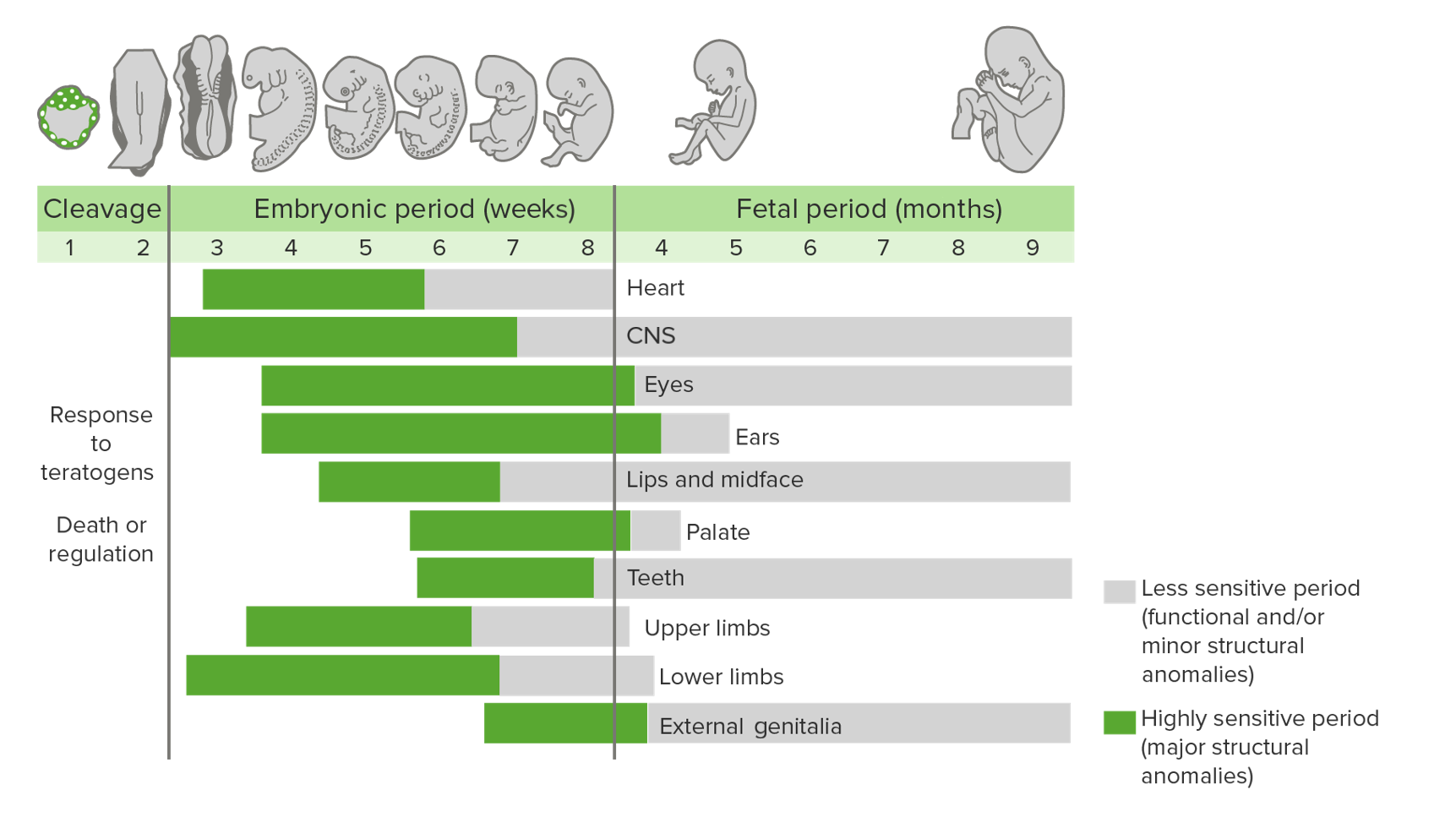
  • Gametopatía: deterioro previo a la concepción del gameto materno o paterno → defectos cromosómicos estructurales o numéricos → aborto
  • Blastopatía: alteraciones del blastocisto fecundado (días 1–14 de gestación) → falta de implantación, malformaciones dobles o gemelos idénticos
  • Embriopatía: todas las alteraciones de los LOS Neisseria órganos durante la organogénesis (semanas 2–8):
    • Alta vulnerabilidad a los LOS Neisseria teratógenos
    • Sistema nervioso central (SNC), tubo neural (semanas 3 a 32–40) → defectos del tubo neural como espina bífida y discapacidad mental
    • Corazón (semanas 3 a 7–9) → tronco arterioso común, comunicación interauricular y comunicación interventricular
    • Extremidades (semanas 4 a 6–9) → ausencia parcial ( meromelia Meromelia The condition when a part of the limb is missing. This occurs due to a disturbance in development during the 5th week of development. Development of the Limbs) o ausencia completa ( amelia Amelia The absence of one or both limbs, which occurs due to suspension in development during the 4th week. Development of the Limbs) de ≥ 1 extremidad
    • Oídos (semanas 4 a 10–32) → sordera, displasia auricular o implantación baja del oído
    • Tracto respiratorio (semanas 4 a 16–40) → fístulas, estenosis y atresia Atresia Hypoplastic Left Heart Syndrome (HLHS)
    • Sistema urogenital (semanas 4 a 16–40) → fístula uracal, riñón en EN Erythema nodosum is an immune-mediated panniculitis (inflammation of the subcutaneous fat) caused by a type IV (delayed-type) hypersensitivity reaction. It commonly manifests in young women as tender, erythematous nodules on the shins. Erythema Nodosum herradura
    • Tracto gastrointestinal (semanas 5 a 32–40) → estenosis, atresia Atresia Hypoplastic Left Heart Syndrome (HLHS), discapacidades rotacionales, hernias u onfalocele
    • Cara, labios, paladar (semanas 5–8 a 16) → labio leporino y paladar hendido
  • Fetopatía: alteraciones en EN Erythema nodosum is an immune-mediated panniculitis (inflammation of the subcutaneous fat) caused by a type IV (delayed-type) hypersensitivity reaction. It commonly manifests in young women as tender, erythematous nodules on the shins. Erythema Nodosum la maduración/diferenciación de órganos (semanas 9–38) → discapacidades funcionales
Períodos de tiempo dentro de la gestación en los que los sistemas de órganos son más susceptibles a los teratógenos.

Períodos de tiempo dentro de la gestación en los que los sistemas de órganos son más susceptibles a los teratógenos:
Gris: período menos sensible (anomalías funcionales y/o estructurales menores)
Verde: período de alta sensibilidad (anomalías estructurales importantes)

Imagen por Lecturio.

Enfermedades Sistémicas Maternas

  • Diabetes Diabetes Diabetes mellitus (DM) is a metabolic disease characterized by hyperglycemia and dysfunction of the regulation of glucose metabolism by insulin. Type 1 DM is diagnosed mostly in children and young adults as the result of autoimmune destruction of β cells in the pancreas and the resulting lack of insulin. Type 2 DM has a significant association with obesity and is characterized by insulin resistance. Diabetes Mellitus mellitus:
    • Hiperglucemia materna → hiperglucemia fetal → hiperinsulinemia fetal + hiperplasia de células de los LOS Neisseria islotes → macrosomía → mayor riesgo de lesiones durante el parto e hipoglucemia neonatal
    • Mayor riesgo de:
      • Malformaciones congénitas (especialmente defectos cardíacos y neurales)
      • Pérdida del embarazo
      • Restricción de crecimiento
      • Cetoacidosis diabética
      • Mortalidad materna y perinatal
  • Hipertensión → ↓ flujo de nutrientes al AL Amyloidosis feto + ↓ flujo sanguíneo placentario → restricción del crecimiento fetal, preeclampsia Preeclampsia A complication of pregnancy, characterized by a complex of symptoms including maternal hypertension and proteinuria with or without pathological edema. Symptoms may range between mild and severe. Pre-eclampsia usually occurs after the 20th week of gestation, but may develop before this time in the presence of trophoblastic disease. Hypertensive Pregnancy Disorders, parto prematuro, desprendimiento de placenta Placenta A highly vascularized mammalian fetal-maternal organ and major site of transport of oxygen, nutrients, and fetal waste products. It includes a fetal portion (chorionic villi) derived from trophoblasts and a maternal portion (decidua) derived from the uterine endometrium. The placenta produces an array of steroid, protein and peptide hormones (placental hormones). Placenta, Umbilical Cord, and Amniotic Cavity y necesidad de cesárea
  • Obesidad: Índice de masa corporal (IMC) ≥ 30 kg/m²
    • ↑ Riesgo materno de diabetes Diabetes Diabetes mellitus (DM) is a metabolic disease characterized by hyperglycemia and dysfunction of the regulation of glucose metabolism by insulin. Type 1 DM is diagnosed mostly in children and young adults as the result of autoimmune destruction of β cells in the pancreas and the resulting lack of insulin. Type 2 DM has a significant association with obesity and is characterized by insulin resistance. Diabetes Mellitus gestacional, preeclampsia Preeclampsia A complication of pregnancy, characterized by a complex of symptoms including maternal hypertension and proteinuria with or without pathological edema. Symptoms may range between mild and severe. Pre-eclampsia usually occurs after the 20th week of gestation, but may develop before this time in the presence of trophoblastic disease. Hypertensive Pregnancy Disorders y apnea del sueño
    • ↑ Riesgo fetal de macrosomía, parto prematuro y muerte fetal
    • Defectos del tubo neural, defectos cardíacos, onfalocele
  • Enfermedad de Graves → tirotoxicosis neonatal
  • Hipotiroidismo → hipotiroidismo congénito → falla del crecimiento y discapacidad intelectual permanente

Related videos

Abuso de Sustancias

Tabaquismo

  • La nicotina es un vasoconstrictor fuerte → ↓ flujo sanguíneo uterino y placentario → ↓ irrigación fetal
  • Aumenta significativamente el riesgo de:
    • Aborto espontáneo
    • Nacimiento prematuro
    • Desprendimiento de la placenta Placenta A highly vascularized mammalian fetal-maternal organ and major site of transport of oxygen, nutrients, and fetal waste products. It includes a fetal portion (chorionic villi) derived from trophoblasts and a maternal portion (decidua) derived from the uterine endometrium. The placenta produces an array of steroid, protein and peptide hormones (placental hormones). Placenta, Umbilical Cord, and Amniotic Cavity
    • Síndrome de muerte súbita del lactante
    • Asma ASMA Autoimmune Hepatitis
    • Infecciones de las vías respiratorias superiores
    • Hendiduras orofaciales
    • Bajo peso al AL Amyloidosis nacer
  • Aumenta moderadamente el riesgo de:
    • Transposición de las grandes arterias
    • Comunicación interauricular
    • Estenosis pulmonar
    • Tronco arterioso común

Abuso de alcohol

Abuso de alcohol → defectos fetales por consumo de alcohol/síndrome alcohólico fetal (extremo severo del espectro de defectos relacionados con el alcohol)
  • Aproximadamente 1 de cada 100 niños tiene defecto fetal por consumo de alcohol.
  • Principal causa prevenible de discapacidad intelectual
  • La actividad de la alcohol deshidrogenasa es menor en EN Erythema nodosum is an immune-mediated panniculitis (inflammation of the subcutaneous fat) caused by a type IV (delayed-type) hypersensitivity reaction. It commonly manifests in young women as tender, erythematous nodules on the shins. Erythema Nodosum el hígado fetal → el líquido amniótico actúa como reservorio de alcohol → el etanol y el acetaldehído alteran el desarrollo fetal
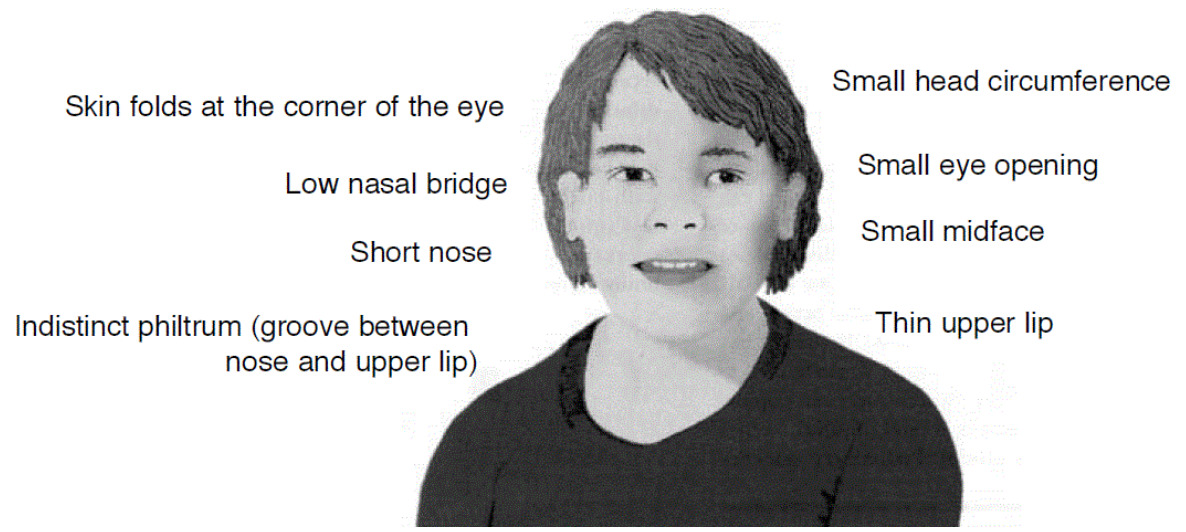
  • El más grave es el síndrome alcohólico fetal caracterizado por anomalías congénitas, retraso del crecimiento, discapacidad intelectual y rasgos craneofaciales característicos:
    • Fisuras palpebrales cortas
    • Área centrofacial plana y pequeña
    • Surco subnasal largo y plano
    • Borde bermellón fino del labio superior
    • Perímetro cefálico pequeño
    • Aperturas oculares pequeñas
Rasgos faciales característicos de un individuo con trastorno del espectro alcohólico fetal

Rasgos faciales característicos de un individuo con trastorno del espectro alcohólico fetal

Image: “FASkid” por NIH/National Institute on Alcohol Abuse and Alcoholism. Licencia: Dominio Público

Opioides

  • El uso de opioides aumenta el riesgo de:
    • Restricción del crecimiento intrauterino
    • Desprendimiento de la placenta Placenta A highly vascularized mammalian fetal-maternal organ and major site of transport of oxygen, nutrients, and fetal waste products. It includes a fetal portion (chorionic villi) derived from trophoblasts and a maternal portion (decidua) derived from the uterine endometrium. The placenta produces an array of steroid, protein and peptide hormones (placental hormones). Placenta, Umbilical Cord, and Amniotic Cavity
    • Trabajo de parto pretérmino
    • Muerte fetal
    • Defectos del tubo neural
    • Defectos cardiacos
    • Gastrosquisis
  • Una vez que nacen, los LOS Neisseria bebés presentan síndrome de abstinencia neonatal y abstinencia.

Marihuana

  • Vinculada a una serie de resultados adversos del embarazo, independientemente de si se fuma o se ingiere
  • Asociada con un mayor riesgo de anencefalia (consumo de drogas durante las 1ras 4 semanas)
  • Aumenta el riesgo de deficiencias en EN Erythema nodosum is an immune-mediated panniculitis (inflammation of the subcutaneous fat) caused by a type IV (delayed-type) hypersensitivity reaction. It commonly manifests in young women as tender, erythematous nodules on the shins. Erythema Nodosum el desarrollo neurológico:
    • Trastorno de déficit de atención
    • Dificultades de aprendizaje
    • Deterioro de la memoria

Medicamentos

Los LOS Neisseria medicamentos que están contraindicados durante el embarazo y las posibles complicaciones con las que están asociados son los LOS Neisseria siguientes:

  • Antibióticos:
    • Aminoglucósidos (ototoxicidad)
    • Tetraciclinas (enfermedades dentales o sordera)
  • Antihipertensivos:
    • Inhibidores de la enzima convertidora de angiotensina (IECA) (oligohidramnios, insuficiencia renal)
    • Antagonistas de los LOS Neisseria receptores de angiotensina (ARA) (displasia renal)
  • Anticonvulsivos: fenitoína o ácido valproico (dismorfia facial, defectos del tubo neural, cardiopatía congénita)
  • Medicamentos psiquiátricos: litio (anomalías cardíacas, incluida la anomalía de Ebstein)
  • Isotretinoína (anomalías faciales, cardiopatía congénita, defectos del tubo neural)
  • Warfarina (anomalías esqueléticas)
  • Talidomida ( amelia Amelia The absence of one or both limbs, which occurs due to suspension in development during the 4th week. Development of the Limbs/ meromelia Meromelia The condition when a part of the limb is missing. This occurs due to a disturbance in development during the 5th week of development. Development of the Limbs y trastornos cardíacos)
  • Dietilestilbestrol (adenocarcinoma vaginal de células claras)

Infecciones

  • Las infecciones del tracto urinario durante el embarazo aumentan el riesgo de bajo peso al AL Amyloidosis nacer, parto prematuro, sepsis Sepsis Systemic inflammatory response syndrome with a proven or suspected infectious etiology. When sepsis is associated with organ dysfunction distant from the site of infection, it is called severe sepsis. When sepsis is accompanied by hypotension despite adequate fluid infusion, it is called septic shock. Sepsis and Septic Shock, neumonía y aborto espontáneo.
  • Infección por rubéola durante el embarazo:
    • Puede conducir a una tríada clásica de cataratas, sordera y conducto arterioso persistente
    • También puede presentarse con glaucoma Glaucoma Glaucoma is an optic neuropathy characterized by typical visual field defects and optic nerve atrophy seen as optic disc cupping on examination. The acute form of glaucoma is a medical emergency. Glaucoma is often, but not always, caused by increased intraocular pressure (IOP). Glaucoma, microftalmia, estenosis de la arteria pulmonar, discapacidad intelectual, microcefalia o hepatomegalia
  • Las infecciones de transmisión sexual pueden causar varios problemas durante el embarazo:
    • Gonorrea y/o clamidia:
      • Mayor riesgo de aborto espontáneo y parto prematuro
      • La infección congénita puede causar conjuntivitis, neumonía y sepsis Sepsis Systemic inflammatory response syndrome with a proven or suspected infectious etiology. When sepsis is associated with organ dysfunction distant from the site of infection, it is called severe sepsis. When sepsis is accompanied by hypotension despite adequate fluid infusion, it is called septic shock. Sepsis and Septic Shock.
    • Sífilis:
      • Aumenta el riesgo de aborto espontáneo y a menudo resulta en EN Erythema nodosum is an immune-mediated panniculitis (inflammation of the subcutaneous fat) caused by a type IV (delayed-type) hypersensitivity reaction. It commonly manifests in young women as tender, erythematous nodules on the shins. Erythema Nodosum muerte fetal
      • La sífilis congénita puede causar sordera, deformidades esqueléticas, ictericia y anomalías faciales.

Referencias

  1. Hegde, S., Aedulla, N.R. (2021). Secondary Hypertension. StatPearls (Internet). Retrieved November 14, 2021. Secondary Hypertension – StatPearls – NCBI Bookshelf (nih.gov)
  2. Tsamantioti, E.S., Hashmi, M.F. (2021). Teratogenic Medications. StatPearls (Internet). Retrieved November 14, 2021. Teratogenic Medications – StatPearls – NCBI Bookshelf (nih.gov)
  3. Vorgias, D., Bernstein, B. (2021). Fetal Alcohol syndrome. StatPearls (Internet). Retrieved November 14, 2021. Fetal Alcohol Syndrome – StatPearls – NCBI Bookshelf (nih.gov)

¡Crea tu cuenta gratis o inicia una sesión para seguir leyendo!

Regístrate ahora y obtén acceso gratuito a Lecturio con páginas de concepto, videos médicos y cuestionarios para tu educación médica.

User Reviews

Que tengas una sesión de estudio alegre y navideña 🎁 Ahorra 50% en todos los planes >>

Details