
Domina Conceptos Médicos

Estudia para la escuela de medicina y tus examenes con Lecturio.

Corioamnionitis

La corioamnionitis, comúnmente conocida como infección intraamniótica, es una complicación obstétrica común que involucra infección e inflamación de las membranas fetales, el líquido amniótico, la placenta Placenta A highly vascularized mammalian fetal-maternal organ and major site of transport of oxygen, nutrients, and fetal waste products. It includes a fetal portion (chorionic villi) derived from trophoblasts and a maternal portion (decidua) derived from the uterine endometrium. The placenta produces an array of steroid, protein and peptide hormones (placental hormones). Placenta, Umbilical Cord, and Amniotic Cavity o el feto. La corioamnionitis generalmente es causada por una infección polimicrobiana que asciende desde el tracto genitourinario inferior. Los LOS Neisseria factores de riesgo primarios incluyen ruptura prolongada de membranas y trabajo de parto prolongado. La corioamnionitis se diagnostica por los LOS Neisseria hallazgos clínicos, incluida la fiebre materna. La corioamnionitis se trata con antibióticos y asegurando el progreso continuo del trabajo de parto (o iniciando el progreso) hacia el parto. La corioamnionitis generalmente se resuelve poco después del parto. Es posible que se produzcan importantes complicaciones maternas y fetales que justifiquen un diagnóstico y tratamiento oportunos.

Last updated: Dec 15, 2025

Editorial responsibility: Stanley Oiseth, Lindsay Jones, Evelin Maza

Definición y Epidemiología

Definición

También conocida como infección intraamniótica, la corioamnionitis es una infección, y la inflamación resultante, de cualquier combinación de las membranas fetales (corion y amnios), líquido amniótico, placenta Placenta A highly vascularized mammalian fetal-maternal organ and major site of transport of oxygen, nutrients, and fetal waste products. It includes a fetal portion (chorionic villi) derived from trophoblasts and a maternal portion (decidua) derived from the uterine endometrium. The placenta produces an array of steroid, protein and peptide hormones (placental hormones). Placenta, Umbilical Cord, and Amniotic Cavity, cordón umbilical (funisitis) y/o del feto.

Epidemiología

La corioamnionitis es la causa más común de infección periparto, con las siguientes tasas de incidencia:

  • Incidencia general: 3,9%
  • Todos los LOS Neisseria partos a término: 1%–5%
    • Ruptura prematura de membranas a término, cualquier duración: 7%
    • Ruptura prematura de membranas a término > 24 horas: 40%
  • Partos pretérmino: 40%–70%
  • Partos pretérmino extremos (< 24 semanas de gestación): hasta 94%

Etiología

La infección e inflamación intraamnióticas pueden deberse a los LOS Neisseria siguientes mecanismos:
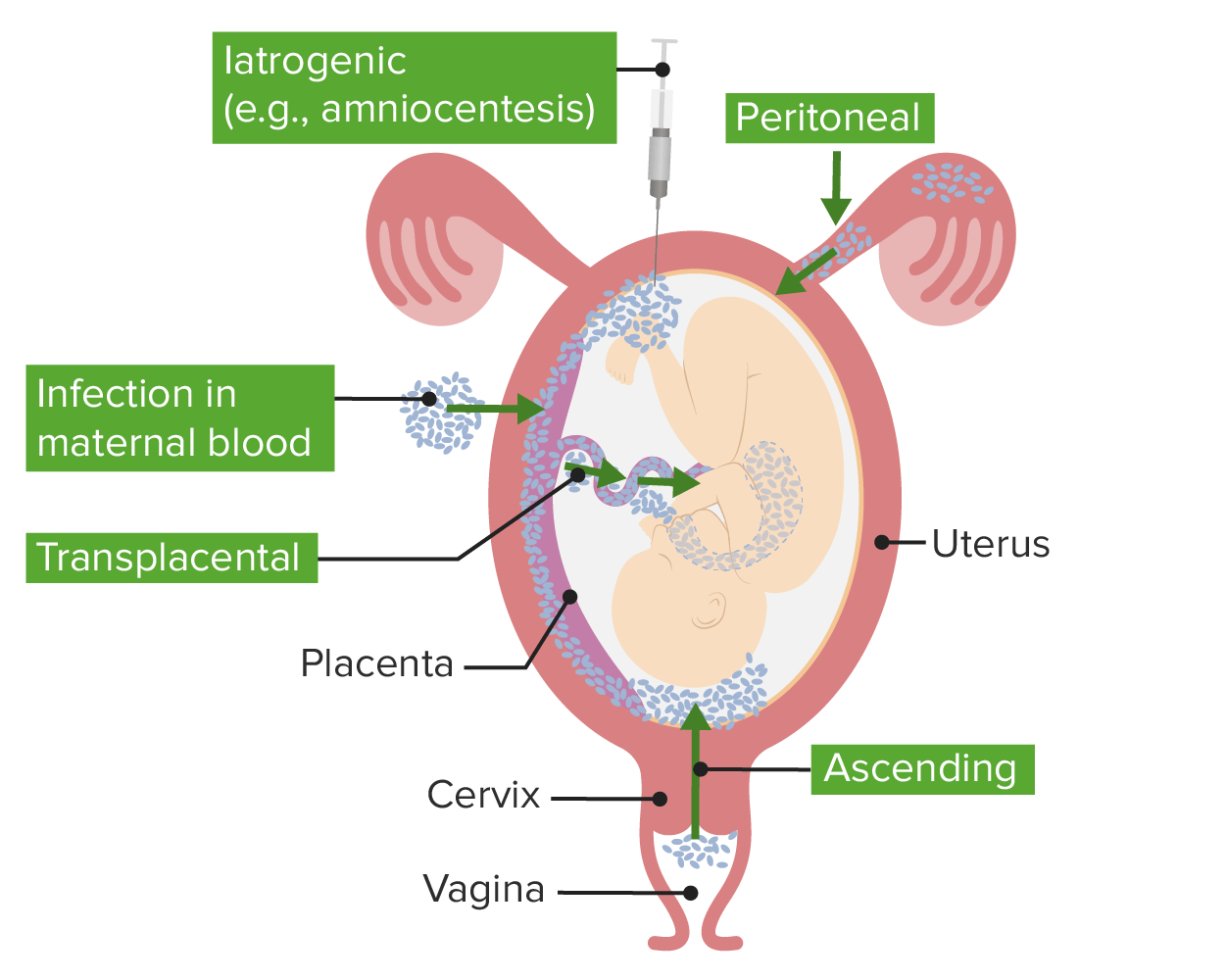
  • Migración ascendente de la flora cervicovaginal (mecanismo primario)
  • Diseminación hematógena al AL Amyloidosis espacio intervelloso, asociada con bacteriemia materna
  • Infección directa después de procedimientos invasivos (e.g., amniocentesis Amniocentesis Percutaneous transabdominal puncture of the uterus during pregnancy to obtain amniotic fluid. It is commonly used for fetal karyotype determination in order to diagnose abnormal fetal conditions. Polyhydramnios)
  • Infección descendente del peritoneo a través de las trompas de Falopio (muy raro)
Chorioamnionitis

Vías de corioamnionitis/funisitis:
Existen múltiples vías de infección que dan lugar a la corioamnionitis. La infección ascendente con flora cervicovaginal es la etiología más común.

Imagen de Lecturio.

Factores de riesgo:

  • Ruptura de membranas prolongada > 18 horas
    • Factor de riesgo más significativo
    • Tanto en EN Erythema nodosum is an immune-mediated panniculitis (inflammation of the subcutaneous fat) caused by a type IV (delayed-type) hypersensitivity reaction. It commonly manifests in young women as tender, erythematous nodules on the shins. Erythema Nodosum embarazos a término como pretérmino
  • Trabajo de parto prolongado
  • Trabajo de parto pretérmino
  • Ruptura prematura de membranas pretérmino
  • Múltiples tactos vaginales (especialmente después de una ruptura de membranas prolongada)
  • Uso de monitores fetales uterinos internos
  • Patógenos del tracto genital presentes durante el trabajo de parto:
    • Colonización por estreptococos del grupo B
    • ETS
  • Embarazo primíparo
  • Líquido amniótico meconial
  • Consumo de tabaco
  • Consumo de alcohol

Fisiopatología

Por mucho, la causa más común de corioamnionitis es la migración ascendente de la flora cervicovaginal.

  • Flora cervicovaginal introducida en EN Erythema nodosum is an immune-mediated panniculitis (inflammation of the subcutaneous fat) caused by a type IV (delayed-type) hypersensitivity reaction. It commonly manifests in young women as tender, erythematous nodules on the shins. Erythema Nodosum la cavidad amniótica → infección → inflamación materna y fetal
  • Puede llevar a:
    • Trabajo de parto
    • Ruptura de membranas prolongada
  • Respuesta inmune materna: inflamación neutrofílica de membranas (corion/amnios)
  • Respuesta inmune fetal: inflamación neutrofílica del cordón umbilical
  • Microbiología:
    • Polimicrobiana
    • Incluye tanto aerobios como anaerobios (especialmente en EN Erythema nodosum is an immune-mediated panniculitis (inflammation of the subcutaneous fat) caused by a type IV (delayed-type) hypersensitivity reaction. It commonly manifests in young women as tender, erythematous nodules on the shins. Erythema Nodosum gestaciones pretérmino)
    • Organismos más comunes:
      • Micoplasmas genitales: Ureaplasma y Mycoplasma Mycoplasma Mycoplasma is a species of pleomorphic bacteria that lack a cell wall, which makes them difficult to target with conventional antibiotics and causes them to not gram stain well. Mycoplasma bacteria commonly target the respiratory and urogenital epithelium. Mycoplasma pneumoniae (M. pneumoniae), the causative agent of atypical or “walking” pneumonia. Mycoplasma
      • Gardnerella vaginalis Gardnerella vaginalis Polymicrobial, nonspecific vaginitis associated with positive cultures of gardnerella vaginalis and other anaerobic organisms and a decrease in lactobacilli. It remains unclear whether the initial pathogenic event is caused by the growth of anaerobes or a primary decrease in lactobacilli. Vulvovaginitis
      • Especies de Bacteroides Bacteroides Bacteroides is a genus of opportunistic, anaerobic, gram-negative bacilli. Bacteroides fragilis is the most common species involved in human disease and is part of the normal flora of the large intestine. Bacteroides
      • Bacilos gram-negativos entéricos (e.g., Escherichia coli Escherichia coli The gram-negative bacterium Escherichia coli is a key component of the human gut microbiota. Most strains of E. coli are avirulent, but occasionally they escape the GI tract, infecting the urinary tract and other sites. Less common strains of E. coli are able to cause disease within the GI tract, most commonly presenting as abdominal pain and diarrhea. Escherichia coli)
      • Streptococcus Streptococcus Streptococcus is one of the two medically important genera of gram-positive cocci, the other being Staphylococcus. Streptococci are identified as different species on blood agar on the basis of their hemolytic pattern and sensitivity to optochin and bacitracin. There are many pathogenic species of streptococci, including S. pyogenes, S. agalactiae, S. pneumoniae, and the viridans streptococci. Streptococcus del grupo B
      • Listeria Listeria Listeria spp. are motile, flagellated, gram-positive, facultative intracellular bacilli. The major pathogenic species is Listeria monocytogenes. Listeria are part of the normal gastrointestinal flora of domestic mammals and poultry and are transmitted to humans through the ingestion of contaminated food, especially unpasteurized dairy products. Listeria Monocytogenes/Listeriosis monocytogenes (diseminación hematógena)
  • Mecanismos de defensa del huésped:
    • Tapón de moco cervical
    • Membranas fetales intactas:
      • Función de barrera
      • Actividad antimicrobiana
      • Modular la respuesta inmune
    • Lactobacilos vaginales productores de peróxido → alteran la virulencia de patógenos

Presentación Clínica

La gran mayoría de las mujeres estarán en EN Erythema nodosum is an immune-mediated panniculitis (inflammation of the subcutaneous fat) caused by a type IV (delayed-type) hypersensitivity reaction. It commonly manifests in young women as tender, erythematous nodules on the shins. Erythema Nodosum trabajo de parto, tendrán ruptura de membranas o ambas.

Manifestaciones primarias:

  • Fiebre
  • Sensibilidad del fondo uterino
  • Líquido purulento o fétido del orificio cervical
  • Taquicardia materna (> 100/minuto)
  • Taquicardia fetal (> 160/minuto)
  • Variabilidad de la frecuencia cardíaca fetal reducida

Diagnóstico

Hay 3 categorías de infecciones intraamnióticas:

  • Fiebre materna aislada
  • Sospecha de infección intraamniótica
  • Infección intraamniótica confirmada

Fiebre materna aislada

  • Fiebre (temperatura oral):
    • > 39°C (102,2°F) una vez
    • 38,0–38,9°C (100,4–102,02°F) en EN Erythema nodosum is an immune-mediated panniculitis (inflammation of the subcutaneous fat) caused by a type IV (delayed-type) hypersensitivity reaction. It commonly manifests in young women as tender, erythematous nodules on the shins. Erythema Nodosum 2 ocasiones, con 30 minutos de diferencia
  • Descartar otras posibles causas de fiebre:
    • Análisis de orina
    • Otras pruebas basadas en EN Erythema nodosum is an immune-mediated panniculitis (inflammation of the subcutaneous fat) caused by a type IV (delayed-type) hypersensitivity reaction. It commonly manifests in young women as tender, erythematous nodules on the shins. Erythema Nodosum signos y síntomas asociados:
      • Hemocultivos
      • Prueba de esputo
      • Prueba de influenza Influenza Influenza viruses are members of the Orthomyxoviridae family and the causative organisms of influenza, a highly contagious febrile respiratory disease. There are 3 primary influenza viruses (A, B, and C) and various subtypes, which are classified based on their virulent surface antigens, hemagglutinin (HA) and neuraminidase (NA). Influenza typically presents with a fever, myalgia, headache, and symptoms of an upper respiratory infection. Influenza Viruses/Influenza/ COVID-19 COVID-19 Coronavirus disease 2019 (COVID-19) is an infectious disease caused by the severe acute respiratory syndrome coronavirus 2 (SARS-CoV-2) that mainly affects the respiratory system but can also cause damage to other body systems (cardiovascular, gastrointestinal, renal, and central nervous systems).
  • Si no se encuentra otra fuente, la opinión de un experto recomienda considerar a los LOS Neisseria pacientes con fiebre > 39°C (102,2°F) como sospecha de infección intraamniótica.

Sospecha de infección intraamniótica

Fiebre y 1 de los LOS Neisseria siguientes:

  • Taquicardia fetal: > 160/minuto durante ≥ 10 minutos
  • Leucocitosis materna: leucocitos > 15 000/mm 3
  • Secreción cervical purulenta o maloliente al AL Amyloidosis examen
  • Dolor Dolor Inflammation a la palpación del fondo uterino

Infección intraamniótica confirmada

Debe cumplir con los criterios de “sospecha de infección intraamniótica” y al AL Amyloidosis menos 1 de los LOS Neisseria siguientes:

  • Prueba de líquido amniótico positiva (obtenida por amniocentesis Amniocentesis Percutaneous transabdominal puncture of the uterus during pregnancy to obtain amniotic fluid. It is commonly used for fetal karyotype determination in order to diagnose abnormal fetal conditions. Polyhydramnios):
    • Cultivo positivo:
      • Estándar de oro
      • Se necesitan días para obtener resultados → ↓ utilidad clínica
    • Tinción de Gram positiva
    • ↓ Glucosa
    • ↑ Leucocitos
  • Histopatología (después del parto) que muestra infiltrados inflamatorios en EN Erythema nodosum is an immune-mediated panniculitis (inflammation of the subcutaneous fat) caused by a type IV (delayed-type) hypersensitivity reaction. It commonly manifests in young women as tender, erythematous nodules on the shins. Erythema Nodosum las membranas

Tratamiento

El objetivo del tratamiento es minimizar los LOS Neisseria riesgos de complicaciones maternas y fetales.

  • Antibióticos:
    • Régimen estándar: ampicilina + gentamicina
    • Si la paciente se somete a una cesárea, agregar cobertura anaeróbica:
      • Clindamicina
      • Azitromicina (dosis preoperatoria única)
  • Antipiréticos:
    • Para prevenir el riesgo para el feto asociado con ↑ temperatura materna
    • Acetaminofén
  • Progresión hacia el parto:
    • Piense en el “parto” como drenar un absceso:
      • Elimina la infección de la madre
      • Elimina al AL Amyloidosis bebé de la infección
    • Aumentar el trabajo de parto si es disfuncional (común):
      • Oxitocina
      • La infección intraamniótica no requiere un parto inmediato, pero se debe lograr un progreso continuo.
    • En EN Erythema nodosum is an immune-mediated panniculitis (inflammation of the subcutaneous fat) caused by a type IV (delayed-type) hypersensitivity reaction. It commonly manifests in young women as tender, erythematous nodules on the shins. Erythema Nodosum pacientes prematuros:
      • Una infección intraamniótica es una indicación para iniciar la inducción del trabajo de parto.
      • El tratamiento es complejo: se basa en EN Erythema nodosum is an immune-mediated panniculitis (inflammation of the subcutaneous fat) caused by a type IV (delayed-type) hypersensitivity reaction. It commonly manifests in young women as tender, erythematous nodules on the shins. Erythema Nodosum la edad gestacional y el escenario clínico
  • Monitorización fetal continua
  • Ruta del parto:
    • Basada en EN Erythema nodosum is an immune-mediated panniculitis (inflammation of the subcutaneous fat) caused by a type IV (delayed-type) hypersensitivity reaction. It commonly manifests in young women as tender, erythematous nodules on the shins. Erythema Nodosum las indicaciones obstétricas de rutina
    • Se prefiere el parto vaginal (↓ morbilidad/mortalidad en EN Erythema nodosum is an immune-mediated panniculitis (inflammation of the subcutaneous fat) caused by a type IV (delayed-type) hypersensitivity reaction. It commonly manifests in young women as tender, erythematous nodules on the shins. Erythema Nodosum comparación con la cesárea)
  • Cuidados postparto:
    • Generalmente, cuidados de rutina
    • Monitorizar en EN Erythema nodosum is an immune-mediated panniculitis (inflammation of the subcutaneous fat) caused by a type IV (delayed-type) hypersensitivity reaction. It commonly manifests in young women as tender, erythematous nodules on the shins. Erythema Nodosum busca de infecciones de heridas
    • Por lo general, una infección intraamniótica se resuelve rápidamente después del parto.

Complicaciones

Complicaciones maternas

  • Trabajo de parto disfuncional (el útero infectado no se contrae bien)
  • Parto quirúrgico
  • Hemorragia postparto (el útero infectado no se contrae bien)
  • Sepsis Sepsis Systemic inflammatory response syndrome with a proven or suspected infectious etiology. When sepsis is associated with organ dysfunction distant from the site of infection, it is called severe sepsis. When sepsis is accompanied by hypotension despite adequate fluid infusion, it is called septic shock. Sepsis and Septic Shock materna
  • Endometritis Endometritis Endometritis is an inflammation of the endometrium, the inner layer of the uterus. The most common subtype is postpartum endometritis, resulting from the ascension of normal vaginal flora to the previously aseptic uterus. Postpartum Endometritis postparto
  • Síndrome de dificultad respiratoria del adulto

Complicaciones neonatales

Cuanto más precoz sea la edad gestacional al AL Amyloidosis momento del parto, mayor será el riesgo de complicaciones neonatales.

  • Meningitis Meningitis Meningitis is inflammation of the meninges, the protective membranes of the brain, and spinal cord. The causes of meningitis are varied, with the most common being bacterial or viral infection. The classic presentation of meningitis is a triad of fever, altered mental status, and nuchal rigidity. Meningitis
  • Hemorragia intraventricular
  • Neumonía
  • Displasia broncopulmonar
  • Parálisis cerebral
  • Septicemia
  • Nacimiento prematuro (con muchas de sus propias complicaciones asociadas):
    • Síndrome de dificultad respiratoria
    • Anomalías neurológicas
    • Retinopatía del prematuro
    • Enterocolitis Enterocolitis Inflammation of the mucosa of both the small intestine and the large intestine. Etiology includes ischemia, infections, allergic, and immune responses. Yersinia spp./Yersiniosis necrosante
  • Muerte

Diagnóstico Diferencial

  • Infección del tracto urinario (ITU)/pielonefritis: una afección común durante el embarazo con un mayor riesgo de pielonefritis. Los LOS Neisseria síntomas de la pielonefritis incluyen fiebre, disuria, dolor Dolor Inflammation suprapúbico o de costado, dolor Dolor Inflammation a la palpación del ángulo costovertebral, náuseas y vómitos. El diagnóstico se basa en EN Erythema nodosum is an immune-mediated panniculitis (inflammation of the subcutaneous fat) caused by a type IV (delayed-type) hypersensitivity reaction. It commonly manifests in young women as tender, erythematous nodules on the shins. Erythema Nodosum la bacteriuria Bacteriuria The presence of bacteria in the urine which is normally bacteria-free. These bacteria are from the urinary tract and are not contaminants of the surrounding tissues. Bacteriuria can be symptomatic or asymptomatic. Significant bacteriuria is an indicator of urinary tract infection. Urinary Tract Infections (UTIs) in Children en EN Erythema nodosum is an immune-mediated panniculitis (inflammation of the subcutaneous fat) caused by a type IV (delayed-type) hypersensitivity reaction. It commonly manifests in young women as tender, erythematous nodules on the shins. Erythema Nodosum el contexto de los LOS Neisseria síntomas antes mencionados. El tratamiento consiste en EN Erythema nodosum is an immune-mediated panniculitis (inflammation of the subcutaneous fat) caused by a type IV (delayed-type) hypersensitivity reaction. It commonly manifests in young women as tender, erythematous nodules on the shins. Erythema Nodosum antibióticos.
  • Infección del tracto respiratorio superior: una afección común, especialmente en EN Erythema nodosum is an immune-mediated panniculitis (inflammation of the subcutaneous fat) caused by a type IV (delayed-type) hypersensitivity reaction. It commonly manifests in young women as tender, erythematous nodules on the shins. Erythema Nodosum invierno. Los LOS Neisseria síntomas incluyen congestión nasal, rinorrea, dolor Dolor Inflammation de garganta, tos TOS Thoracic outlet syndrome (TOS) is a broad term used for a spectrum of syndromes related to the general region of the thoracic outlet, which involves the compression or irritation of elements of the brachial plexus, subclavian artery, or subclavian vein. Thoracic Outlet Syndrome y fiebre. Los LOS Neisseria pacientes deben someterse a pruebas de detección de influenza Influenza Influenza viruses are members of the Orthomyxoviridae family and the causative organisms of influenza, a highly contagious febrile respiratory disease. There are 3 primary influenza viruses (A, B, and C) and various subtypes, which are classified based on their virulent surface antigens, hemagglutinin (HA) and neuraminidase (NA). Influenza typically presents with a fever, myalgia, headache, and symptoms of an upper respiratory infection. Influenza Viruses/Influenza y COVID-19 COVID-19 Coronavirus disease 2019 (COVID-19) is an infectious disease caused by the severe acute respiratory syndrome coronavirus 2 (SARS-CoV-2) that mainly affects the respiratory system but can also cause damage to other body systems (cardiovascular, gastrointestinal, renal, and central nervous systems). . Generalmente, se requiere una radiografía de tórax para confirmar el diagnóstico de neumonía, aunque la radiografía a menudo se puede retrasar hasta después del parto, excepto en EN Erythema nodosum is an immune-mediated panniculitis (inflammation of the subcutaneous fat) caused by a type IV (delayed-type) hypersensitivity reaction. It commonly manifests in young women as tender, erythematous nodules on the shins. Erythema Nodosum casos más graves.
  • Apendicitis aguda: se presenta con dolor Dolor Inflammation abdominal intenso, fiebre, náuseas y vómitos. El diagnóstico se puede confirmar con un ultrasonido o una TC (la TC expone al AL Amyloidosis feto a una radiación significativa y debe usarse con extrema cautela). La apendicitis rara vez se presenta durante el parto, mientras que la infección intraamniótica es rara fuera del trabajo de parto o cuando las membranas aún están intactas. El tratamiento es quirúrgico.
  • Fiebre asociada a la anestesia epidural: la evidencia apunta a una asociación frecuente y significativa entre un aumento de la temperatura materna y la anestesia neuroaxial que suele ocurrir rápidamente. No existen pruebas fiables para identificar la anestesia neuroaxial como la causa de la fiebre; por lo tanto, la observación cercana y/o el tratamiento presuntivo para infección intraamniótica pueden ser apropiados.
  • Desprendimiento de placenta Placenta A highly vascularized mammalian fetal-maternal organ and major site of transport of oxygen, nutrients, and fetal waste products. It includes a fetal portion (chorionic villi) derived from trophoblasts and a maternal portion (decidua) derived from the uterine endometrium. The placenta produces an array of steroid, protein and peptide hormones (placental hormones). Placenta, Umbilical Cord, and Amniotic Cavity: ocurre cuando la placenta Placenta A highly vascularized mammalian fetal-maternal organ and major site of transport of oxygen, nutrients, and fetal waste products. It includes a fetal portion (chorionic villi) derived from trophoblasts and a maternal portion (decidua) derived from the uterine endometrium. The placenta produces an array of steroid, protein and peptide hormones (placental hormones). Placenta, Umbilical Cord, and Amniotic Cavity comienza a separarse prematuramente, comprometiendo el flujo sanguíneo fetal y la oxigenación. El desprendimiento de placenta Placenta A highly vascularized mammalian fetal-maternal organ and major site of transport of oxygen, nutrients, and fetal waste products. It includes a fetal portion (chorionic villi) derived from trophoblasts and a maternal portion (decidua) derived from the uterine endometrium. The placenta produces an array of steroid, protein and peptide hormones (placental hormones). Placenta, Umbilical Cord, and Amniotic Cavity generalmente se presenta con cólicos o dolor Dolor Inflammation uterino y hemorragia vaginal. Generalmente, no hay fiebre. La falta de fiebre, la presencia de hemorragia y los LOS Neisseria hallazgos característicos en EN Erythema nodosum is an immune-mediated panniculitis (inflammation of the subcutaneous fat) caused by a type IV (delayed-type) hypersensitivity reaction. It commonly manifests in young women as tender, erythematous nodules on the shins. Erythema Nodosum la monitorización fetal permiten el diagnóstico y ayudan a distinguir el desprendimiento de la infección intraamniótica. El desprendimiento de placenta Placenta A highly vascularized mammalian fetal-maternal organ and major site of transport of oxygen, nutrients, and fetal waste products. It includes a fetal portion (chorionic villi) derived from trophoblasts and a maternal portion (decidua) derived from the uterine endometrium. The placenta produces an array of steroid, protein and peptide hormones (placental hormones). Placenta, Umbilical Cord, and Amniotic Cavity es una emergencia obstétrica que requiere un tratamiento oportuno, incluido el parto urgente en EN Erythema nodosum is an immune-mediated panniculitis (inflammation of the subcutaneous fat) caused by a type IV (delayed-type) hypersensitivity reaction. It commonly manifests in young women as tender, erythematous nodules on the shins. Erythema Nodosum la mayoría de los LOS Neisseria casos.

Referencias

  1. Moldenhauer, J. S. (2024). Intraamniotic infection (chorioamnionitis). In MSD Manual Professional Version. Merck & Co., Inc. https://www.msdmanuals.com/professional/gynecology-and-obstetrics/intrapartum-complications/intraamniotic-infection
  2. Tita, A. T. N. (2025). Clinical chorioamnionitis. In S. L. Gaw (Ed.), & A. Chakrabarti (Deputy Ed.), UpToDate. Retrieved November 15, 2025, from https://www.uptodate.com/contents/clinical-chorioamnionitis
  3. Chen, K.T. (2024). Intrapartum fever. In Barss, V. A. (Ed.), UpToDate. Retrieved November 15, 2025, from https://www.uptodate.com/contents/intrapartum-fever
  4. Committee on Obstetric Practice (2017). Intrapartum management of intraamniotic infection. American College of Obstetrics and Gynecology Committee Opinion No. 712. Retrieved November 15, 2025, from https://www.acog.org/clinical/clinical-guidance/committee-opinion/articles/2017/08/intrapartum-management-of-intraamniotic-infection 
  5. Bany-Mohammed, F. M. (2024). Chorioamnionitis. In Rosenkrantz, T. (Ed.). Medscape. Retrieved November 15, 2025, from https://emedicine.medscape.com/article/973237-overview
  6. Tita, A. T., Andrews, W. W. (2010). Diagnosis and management of clinical chorioamnionitis. Clinics in Perinatology, 37(2), 339–354. Retrieved November 15, 2025, from https://www.ncbi.nlm.nih.gov/pmc/articles/PMC3008318/; https://doi.org/10.1016/j.clp.2010.02.003 
  7. Fowler J.R., Simon L.V. (2023). Chorioamnionitis. StatPearls. Retrieved November 15, 2025, from https://www.ncbi.nlm.nih.gov/books/NBK532251/

¡Crea tu cuenta gratis o inicia una sesión para seguir leyendo!

Regístrate ahora y obtén acceso gratuito a Lecturio con páginas de concepto, videos médicos y cuestionarios para tu educación médica.

User Reviews

Que tengas una sesión de estudio alegre y navideña 🎁 Ahorra 50% en todos los planes >>

Details