La intervención quirúrgica de la cavidad torácica tiene como objetivo principal aliviar cualquier malestar que afecte mecánicamente a la función del corazón y losLOSNeisseria pulmones, el cual puede ser secundario a patologías subyacentes o, más comúnmente, a un traumatismo. Intervenciones como drenaje pleural y toracocentesis son realizadas para evacuar líquido, sangre o aire que esté ocupando la cavidad torácica con el fin de restablecer la presión negativa torácica. Cuando una intervención directa enENErythema nodosum is an immune-mediated panniculitis (inflammation of the subcutaneous fat) caused by a type IV (delayed-type) hypersensitivity reaction. It commonly manifests in young women as tender, erythematous nodules on the shins.Erythema Nodosum el corazón y el mediastino es requerida, se efectúa una toracotomía de emergencia. Una vez losLOSNeisseria problemas mecánicos inmediatos son resueltos, se pueden efectuar cirugías reparadoras más avanzadas que involucren el corazón, pulmones o estructuras mediastínicas, según sea necesario.
Es importante revisar la anatomía de la pared torácica para evitar más fácilmente losLOSNeisseria componentes vasculares y nerviosos importantes, así como para localizar losLOSNeisseria puntos de entrada adecuados durante las intervenciones quirúrgicas.
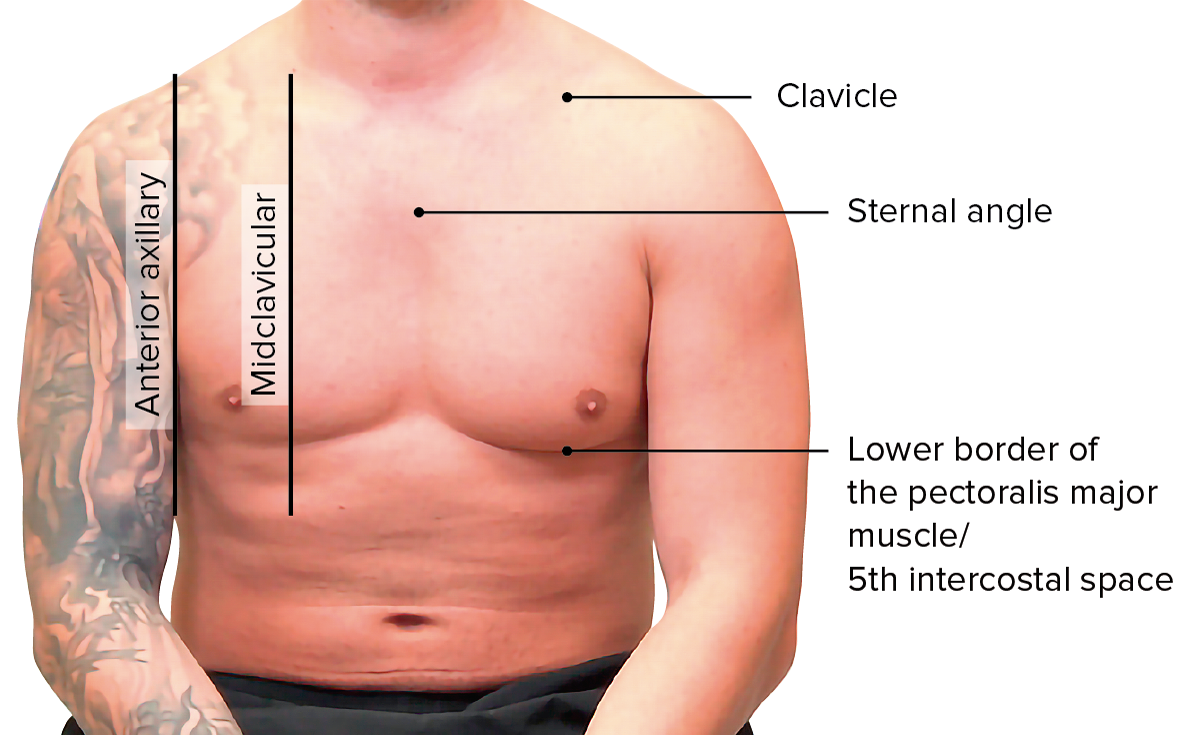
Puntos de referencia
Clavícula
Ángulo esternal (ángulo de Lewis)
Línea medio-clavicular
Líneas axilares anteriores, medias y posteriores
Borde inferior del músculo pectoral mayor/pliegue inframamario (5to espacio intercostal)
Puntos de referencia del tórax a tener en cuenta al momento de colocar un drenaje pleural
Imagen por Lecturio.
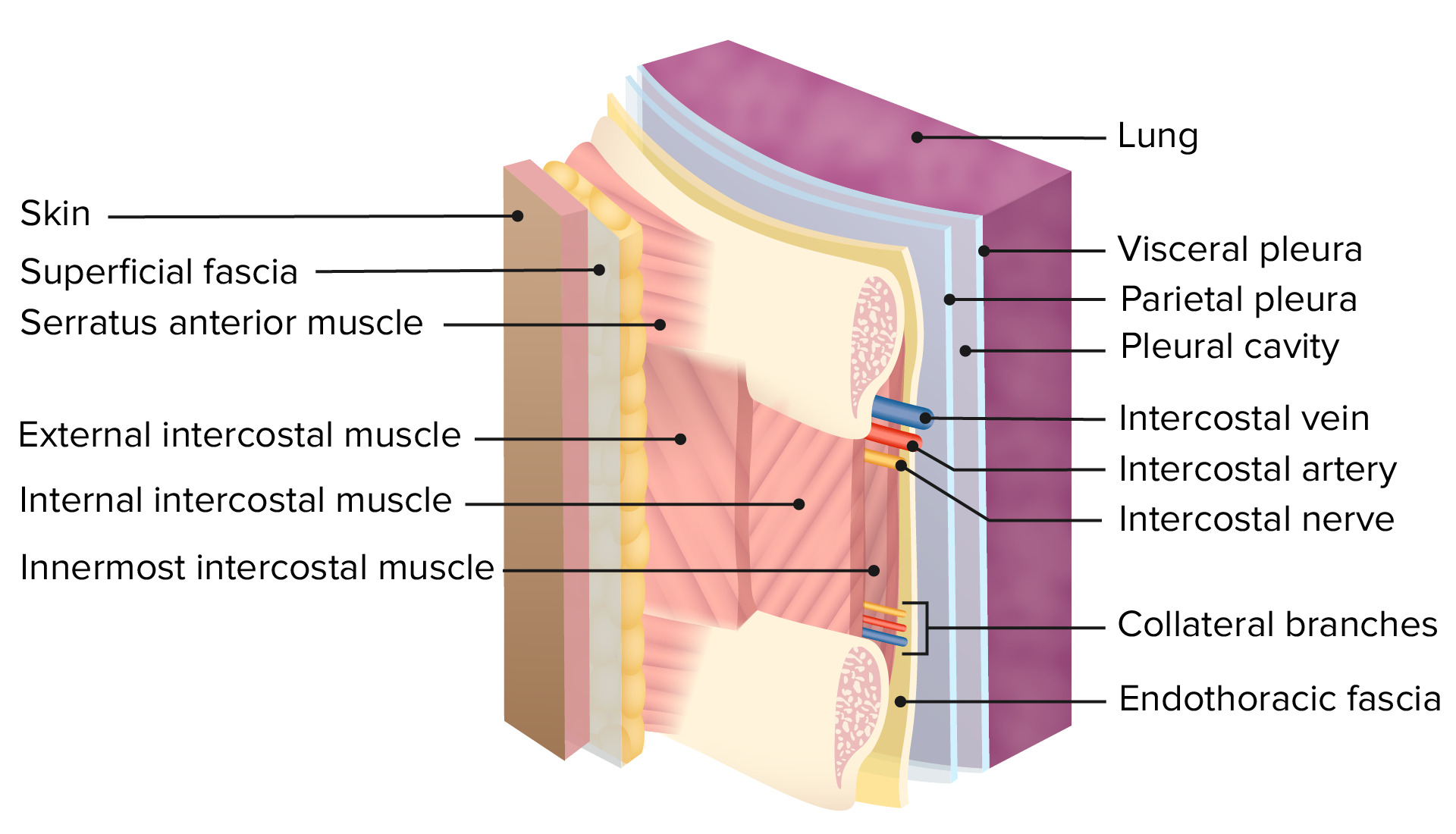
Capas de la pared torácica
Piel
Tejido subcutáneo
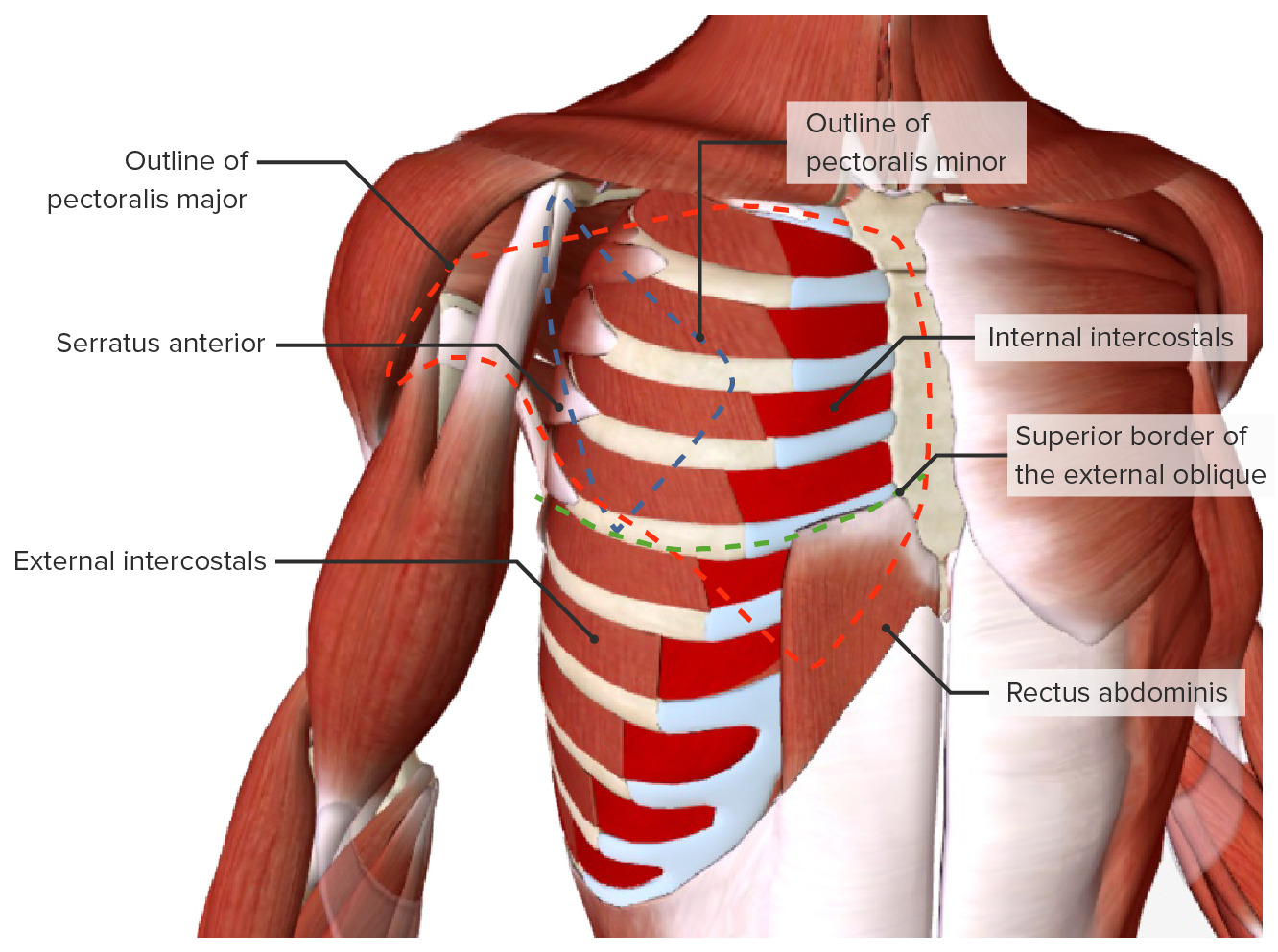
Músculos intercostales:
Músculo intercostal externo
Músculo intercostal interno
Músculo intercostal íntimos
PleuraPleuraThe pleura is a serous membrane that lines the walls of the thoracic cavity and the surface of the lungs. This structure of mesodermal origin covers both lungs, the mediastinum, the thoracic surface of the diaphragm, and the inner part of the thoracic cage. The pleura is divided into a visceral pleura and parietal pleura. Pleura: AnatomyparietalParietalOne of a pair of irregularly shaped quadrilateral bones situated between the frontal bone and occipital bone, which together form the sides of the cranium.Skull: Anatomy
Músculos de la pared torácica, mostrando los músculos intercostales externos e internos
Arterias intercostales: ramas de la aortaAortaThe main trunk of the systemic arteries.Mediastinum and Great Vessels: Anatomy y de la arteria mamaria interna que se anastomosan
Arteria mamaria interna
Drenaje venoso:
Venas intercostales
Vena torácica interna
Inervación:
Nervios intercostales
Nervio torácico largo
Paquete vasculonervioso intercostal:
Situado enENErythema nodosum is an immune-mediated panniculitis (inflammation of the subcutaneous fat) caused by a type IV (delayed-type) hypersensitivity reaction. It commonly manifests in young women as tender, erythematous nodules on the shins.Erythema Nodosum las proximidades del surco costal inferior
Las estructuras del paquete se sitúan de superior a inferior de la siguiente manera, y pueden recordarse mediante la mnemotecnia VAN:
V – Vena intercostal
A – Arteria intercostal
N – Nervio intercostal
El paquete vasculonervioso intercostal, justo debajo del surco costal, está formado por una vena, una arteria y un nervio intercostal.
Colocación de Drenaje Pleural (Toracostomía con Tubo)
Definición
La colocación de un drenaje pleural es un procedimiento invasivo que consiste enENErythema nodosum is an immune-mediated panniculitis (inflammation of the subcutaneous fat) caused by a type IV (delayed-type) hypersensitivity reaction. It commonly manifests in young women as tender, erythematous nodules on the shins.Erythema Nodosum la inserción de un tubo de gran calibre enENErythema nodosum is an immune-mediated panniculitis (inflammation of the subcutaneous fat) caused by a type IV (delayed-type) hypersensitivity reaction. It commonly manifests in young women as tender, erythematous nodules on the shins.Erythema Nodosum la cavidad pleural para proporcionar un drenaje continuo de líquido y/o aire del espacio pleural.
Indicaciones
Neumotórax
Derrame pleural
Hemotórax
Hemoneumotórax
Empiema torácico
Quilotórax
Contraindicaciones
No hay contraindicaciones para la colocación de un tubo de tórax. Sin embargo, la inserción debe hacerse con precaución enENErythema nodosum is an immune-mediated panniculitis (inflammation of the subcutaneous fat) caused by a type IV (delayed-type) hypersensitivity reaction. It commonly manifests in young women as tender, erythematous nodules on the shins.Erythema NodosumlosLOSNeisseria siguientes casos:
Coagulopatía subyacente o recuento bajo de plaquetas
Terapia antiplaquetaria y anticoagulantes
Procedimiento
La radiografía de tórax tiene que ser revisada cuidadosamente para determinar el mejor enfoque y localización.
El paciente puede ser colocado enENErythema nodosum is an immune-mediated panniculitis (inflammation of the subcutaneous fat) caused by a type IV (delayed-type) hypersensitivity reaction. It commonly manifests in young women as tender, erythematous nodules on the shins.Erythema Nodosum posición supina o enENErythema nodosum is an immune-mediated panniculitis (inflammation of the subcutaneous fat) caused by a type IV (delayed-type) hypersensitivity reaction. It commonly manifests in young women as tender, erythematous nodules on the shins.Erythema Nodosum decúbito lateral.
El brazo se coloca por encima o por detrás de la cabeza.
El lugar de inserción suele ser la línea axilar anterior enENErythema nodosum is an immune-mediated panniculitis (inflammation of the subcutaneous fat) caused by a type IV (delayed-type) hypersensitivity reaction. It commonly manifests in young women as tender, erythematous nodules on the shins.Erythema Nodosum el 4to o 5to espacio intercostal, pero puede ajustarse:
Puede colocarse más posteriormente para el derrame pleural
Puede ser necesaria una colocación más precisa, guiada por ultrasonido, enENErythema nodosum is an immune-mediated panniculitis (inflammation of the subcutaneous fat) caused by a type IV (delayed-type) hypersensitivity reaction. It commonly manifests in young women as tender, erythematous nodules on the shins.Erythema Nodosum casos complejos de aire o colecciones de fluidos loculados.
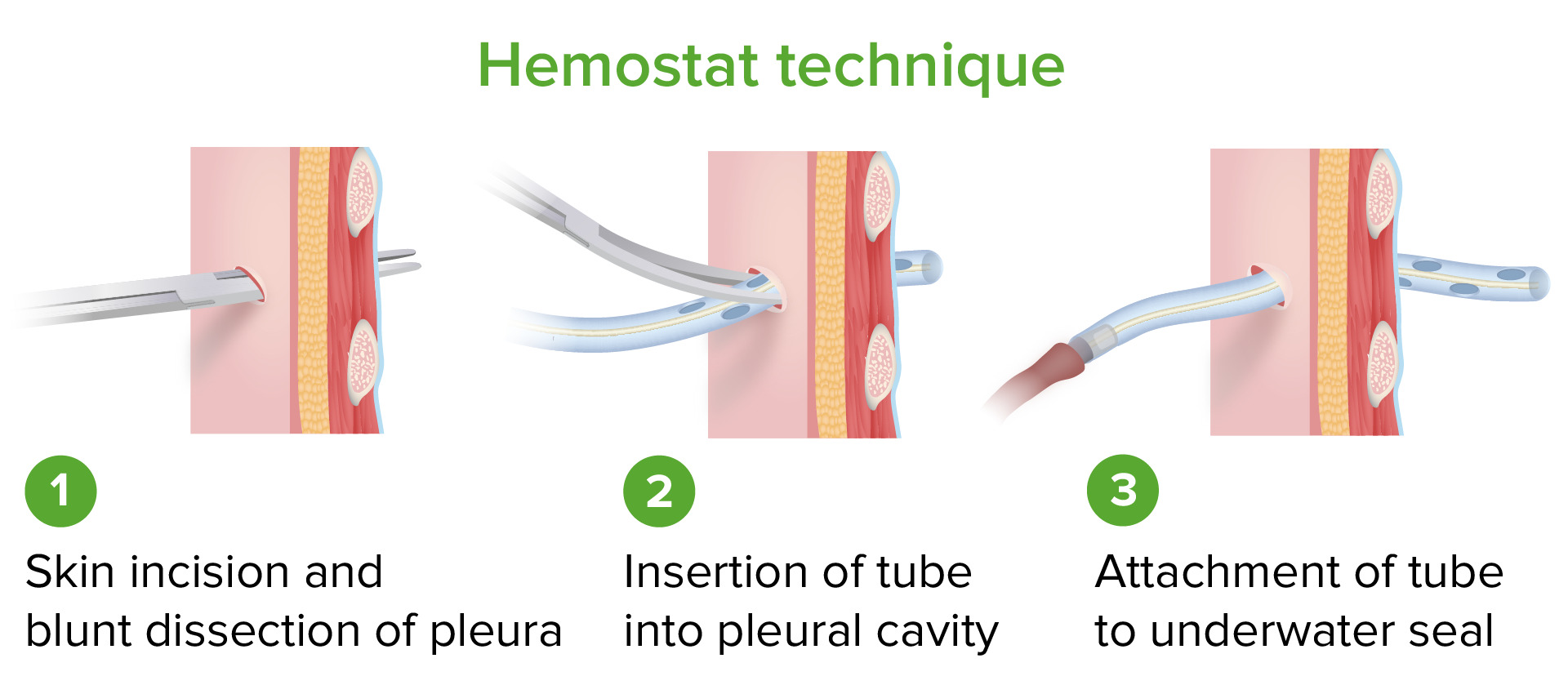
Se realiza una incisión de 2 cm enENErythema nodosum is an immune-mediated panniculitis (inflammation of the subcutaneous fat) caused by a type IV (delayed-type) hypersensitivity reaction. It commonly manifests in young women as tender, erythematous nodules on the shins.Erythema Nodosum la piel.
Se utiliza una pinza Kelly para hacer un túnel a través de la incisión y losLOSNeisseria músculos intercostales hasta llegar a la cavidad pleural.
Se emplea un dedo para asegurarse de que el pulmón esté alejado del lugar de la incisión.
El tubo se introduce empezando por su extremo perforado, enENErythema nodosum is an immune-mediated panniculitis (inflammation of the subcutaneous fat) caused by a type IV (delayed-type) hypersensitivity reaction. It commonly manifests in young women as tender, erythematous nodules on the shins.Erythema Nodosum sentido superior-posterior-medial. Este paso puede ayudarse con una pinza Kelly.
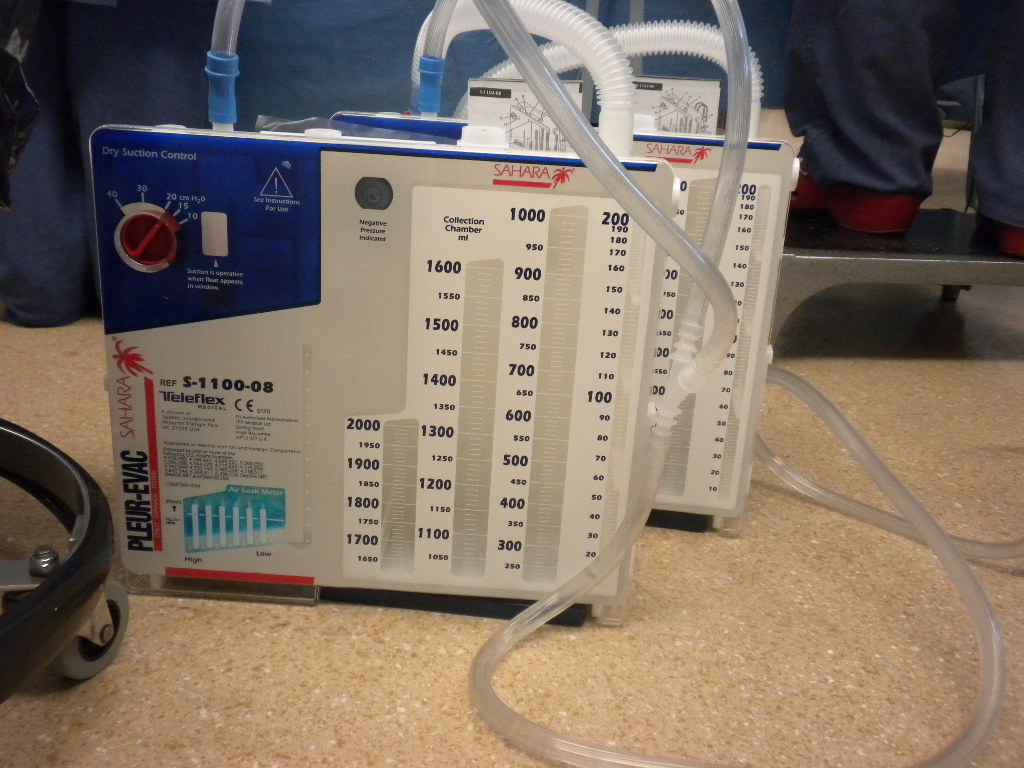
El tubo se conecta a un sistema de drenaje (Pleur-Evac) y se fija a la piel con una sutura.
Se obtiene una radiografía de tórax para garantizar una colocación adecuada.
Pasos de la técnica hemostática para la colocación de tubos torácicos
Imagen por Lecturio.
Aparato de succión para los tubos de tórax (Pleur-Evac)
Imagen: “Drainage Canisters – Pleur-Evac Sahara” por Bentplate84. Licencia: CC BY-SA 3.0
Complicaciones
Lesión del parénquima pulmonar: puede presentarse como una fuga de aire persistente
Perforación del diafragma y/o de las vísceras abdominales:
Si el lugar de inserción es demasiado bajo
Puede provocar una lesión enENErythema nodosum is an immune-mediated panniculitis (inflammation of the subcutaneous fat) caused by a type IV (delayed-type) hypersensitivity reaction. It commonly manifests in young women as tender, erythematous nodules on the shins.Erythema Nodosum el hígado (a la derecha) o enENErythema nodosum is an immune-mediated panniculitis (inflammation of the subcutaneous fat) caused by a type IV (delayed-type) hypersensitivity reaction. It commonly manifests in young women as tender, erythematous nodules on the shins.Erythema Nodosum el bazo (a la izquierda) y ocasionar hemorragia intraabdominal
Puede ocurrir si el tubo torácico se inserta cerca del margen costal inferior, donde se encuentran losLOSNeisseria vasos intercostales
Puede presentarse como una hemorragia intratorácica y/o enENErythema nodosum is an immune-mediated panniculitis (inflammation of the subcutaneous fat) caused by a type IV (delayed-type) hypersensitivity reaction. It commonly manifests in young women as tender, erythematous nodules on the shins.Erythema Nodosum el sitio de inserción
EdemaEdemaEdema is a condition in which excess serous fluid accumulates in the body cavity or interstitial space of connective tissues. Edema is a symptom observed in several medical conditions. It can be categorized into 2 types, namely, peripheral (in the extremities) and internal (in an organ or body cavity). Edema pulmonar por reexpansión:
Raro
Puede ocurrir si un derrame pleural grande (> 1,5 L) se evacua demasiado rápido
Se presenta de forma súbita con dificultad respiratoria/tosTOSThoracic outlet syndrome (TOS) is a broad term used for a spectrum of syndromes related to the general region of the thoracic outlet, which involves the compression or irritation of elements of the brachial plexus, subclavian artery, or subclavian vein.Thoracic Outlet Syndrome/esputo espumoso
Toracocentesis
Definición
La toracocentesis es un procedimiento invasivo que consiste enENErythema nodosum is an immune-mediated panniculitis (inflammation of the subcutaneous fat) caused by a type IV (delayed-type) hypersensitivity reaction. It commonly manifests in young women as tender, erythematous nodules on the shins.Erythema Nodosum introducir un catéter enENErythema nodosum is an immune-mediated panniculitis (inflammation of the subcutaneous fat) caused by a type IV (delayed-type) hypersensitivity reaction. It commonly manifests in young women as tender, erythematous nodules on the shins.Erythema Nodosum el espacio pleural para evacuar el líquido pleural por razones diagnósticas y/o terapéuticas.
Indicaciones
La toracocentesis puede ser necesaria enENErythema nodosum is an immune-mediated panniculitis (inflammation of the subcutaneous fat) caused by a type IV (delayed-type) hypersensitivity reaction. It commonly manifests in young women as tender, erythematous nodules on the shins.Erythema Nodosum cualquier condición que se presente con derrames pleurales que comprometan la respiración, como:
Insuficiencia cardíaca
Derrame paraneumónico
Empiema
Atelectasias
Malignidad
Embolia pulmonar
Hidrotórax hepático
Hipoalbuminemia
PancreatitisPancreatitisInflammation of the pancreas. Pancreatitis is classified as acute unless there are computed tomographic or endoscopic retrograde cholangiopancreatographic findings of chronic pancreatitis. The two most common forms of acute pancreatitis are alcoholic pancreatitis and gallstone pancreatitis.Acute Pancreatitis
UremiaUremiaA clinical syndrome associated with the retention of renal waste products or uremic toxins in the blood. It is usually the result of renal insufficiency. Most uremic toxins are end products of protein or nitrogen catabolism, such as urea or creatinine. Severe uremia can lead to multiple organ dysfunctions with a constellation of symptoms.Acute Kidney Injury
Contraindicaciones
No existen contraindicaciones absolutas para la toracocentesis. Sin embargo, se recomienda tener cuidado con lo siguiente:
Coagulopatía
Uso de antiplaquetarios y anticoagulantes
Cirugía reciente enENErythema nodosum is an immune-mediated panniculitis (inflammation of the subcutaneous fat) caused by a type IV (delayed-type) hypersensitivity reaction. It commonly manifests in young women as tender, erythematous nodules on the shins.Erythema Nodosum la cavidad torácica ipsilateral
Cáncer metastásico
Factores predictores de toracocentesis difícil:
Utilización de ventilación con presión positiva (i.e., mecánica, presión positiva continua enENErythema nodosum is an immune-mediated panniculitis (inflammation of the subcutaneous fat) caused by a type IV (delayed-type) hypersensitivity reaction. It commonly manifests in young women as tender, erythematous nodules on the shins.Erythema Nodosum las vías respiratorias (CPAPCPAPA technique of respiratory therapy, in either spontaneously breathing or mechanically ventilated patients, in which airway pressure is maintained above atmospheric pressure throughout the respiratory cycle by pressurization of the ventilatory circuit.Noninvasive Ventilation))
Celulitis de la pared torácica
Derrame pleural localizado
Procedimiento
Preparación preoperatoria:
Realizar un examen físico completo con especial énfasis enENErythema nodosum is an immune-mediated panniculitis (inflammation of the subcutaneous fat) caused by a type IV (delayed-type) hypersensitivity reaction. It commonly manifests in young women as tender, erythematous nodules on the shins.Erythema Nodosum la percusión del tórax.
Es necesario revisar cuidadosamente las imágenes previas alALAmyloidosis procedimiento:
Radiografía de tórax
TC de tórax
No tomar anticoagulantes antes del procedimiento.
Control continuo:
Frecuencia cardiaca
Tensión arterial
Saturación de oxígeno
Técnica:
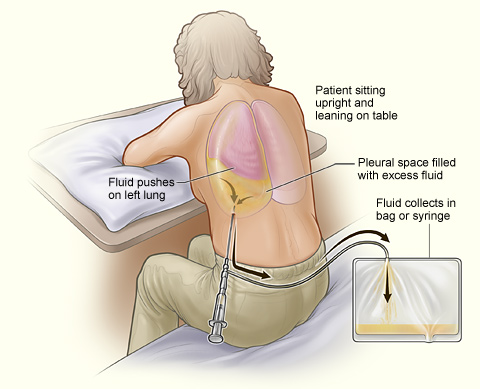
El paciente debe estar sentado, inclinado hacia delante y apoyando losLOSNeisseria codos enENErythema nodosum is an immune-mediated panniculitis (inflammation of the subcutaneous fat) caused by a type IV (delayed-type) hypersensitivity reaction. It commonly manifests in young women as tender, erythematous nodules on the shins.Erythema Nodosum una mesa. EnENErythema nodosum is an immune-mediated panniculitis (inflammation of the subcutaneous fat) caused by a type IV (delayed-type) hypersensitivity reaction. It commonly manifests in young women as tender, erythematous nodules on the shins.Erythema NodosumlosLOSNeisseria pacientes que no pueden sentarse, la cabecera de la cama se eleva 30 grados.
El procedimiento puede ser guiado por ultrasonido
Cuando no se dispone de ultrasonido, se localiza y marca uno de losLOSNeisseria siguientes sitios:
3er-5to espacio intercostal enENErythema nodosum is an immune-mediated panniculitis (inflammation of the subcutaneous fat) caused by a type IV (delayed-type) hypersensitivity reaction. It commonly manifests in young women as tender, erythematous nodules on the shins.Erythema Nodosum la línea axilar media
5to-7mo espacio intercostal enENErythema nodosum is an immune-mediated panniculitis (inflammation of the subcutaneous fat) caused by a type IV (delayed-type) hypersensitivity reaction. It commonly manifests in young women as tender, erythematous nodules on the shins.Erythema Nodosum la línea escapular posterior
La matidez a la percusión indica un sitio de mayor acumulación de líquido, ideal para la punción.
Se utiliza una aguja de calibre 22 para entrar enENErythema nodosum is an immune-mediated panniculitis (inflammation of the subcutaneous fat) caused by a type IV (delayed-type) hypersensitivity reaction. It commonly manifests in young women as tender, erythematous nodules on the shins.Erythema Nodosum el espacio pleural mientras se aplica presión negativa.
La entrada se confirma mediante la aspiración de líquido que fluye libremente.
Las burbujas enENErythema nodosum is an immune-mediated panniculitis (inflammation of the subcutaneous fat) caused by a type IV (delayed-type) hypersensitivity reaction. It commonly manifests in young women as tender, erythematous nodules on the shins.Erythema Nodosum la jeringa pueden indicar una punción pulmonar.
Se prepara un catéter con aguja de toracocentesis, que incluye una llave de paso de tres vías, una jeringa y un tubo que conduce a una bolsa de recolección.
El catéter de toracocentesis se introduce enENErythema nodosum is an immune-mediated panniculitis (inflammation of the subcutaneous fat) caused by a type IV (delayed-type) hypersensitivity reaction. It commonly manifests in young women as tender, erythematous nodules on the shins.Erythema Nodosum el margen superior de la costilla inferior mientras se mantiene una presión negativa.
Se extraen entre 30-60 mL de líquido para su análisis enENErythema nodosum is an immune-mediated panniculitis (inflammation of the subcutaneous fat) caused by a type IV (delayed-type) hypersensitivity reaction. It commonly manifests in young women as tender, erythematous nodules on the shins.Erythema Nodosum el laboratorio (e.g., tinción de Gram, cultivo, química, recuento de células).
El líquido restante se drena enENErythema nodosum is an immune-mediated panniculitis (inflammation of the subcutaneous fat) caused by a type IV (delayed-type) hypersensitivity reaction. It commonly manifests in young women as tender, erythematous nodules on the shins.Erythema Nodosum la bolsa colectora hasta que se produzca una de las siguientes situaciones:
El líquido deja de drenar espontáneamente.
El paciente comienza a toser o refiere molestias enENErythema nodosum is an immune-mediated panniculitis (inflammation of the subcutaneous fat) caused by a type IV (delayed-type) hypersensitivity reaction. It commonly manifests in young women as tender, erythematous nodules on the shins.Erythema Nodosum el pecho.
Se drena un total de 1-1,5 L de líquido.
Una vez completado el drenaje, se indica alALAmyloidosis paciente que contenga la respiración y luego exhale mientras se retira el catéter.
Se colocan gasas estériles y apósitos enENErythema nodosum is an immune-mediated panniculitis (inflammation of the subcutaneous fat) caused by a type IV (delayed-type) hypersensitivity reaction. It commonly manifests in young women as tender, erythematous nodules on the shins.Erythema Nodosum la herida.
Se obtiene una radiografía de tórax después del procedimiento para descartar un neumotórax.
Toracentesis en el hemitórax izquierdo
Imagen: “Thoracentesis” por National Heart, Lung and Blood Institute. Licencia: Dominio Público
Complicaciones
EdemaEdemaEdema is a condition in which excess serous fluid accumulates in the body cavity or interstitial space of connective tissues. Edema is a symptom observed in several medical conditions. It can be categorized into 2 types, namely, peripheral (in the extremities) and internal (in an organ or body cavity). Edema pulmonar por reexpansión
Neumotórax
Hemotórax
HematomaHematomaA collection of blood outside the blood vessels. Hematoma can be localized in an organ, space, or tissue.IntussusceptionenENErythema nodosum is an immune-mediated panniculitis (inflammation of the subcutaneous fat) caused by a type IV (delayed-type) hypersensitivity reaction. It commonly manifests in young women as tender, erythematous nodules on the shins.Erythema Nodosum el lugar de la inyección
Punción intraabdominal, con lesión de hígado o bazo
Infección de tejidos blandos
Infección pleural y empiema
Análisis del líquido pleural
Derrames por trasudados (causados por cambios enENErythema nodosum is an immune-mediated panniculitis (inflammation of the subcutaneous fat) caused by a type IV (delayed-type) hypersensitivity reaction. It commonly manifests in young women as tender, erythematous nodules on the shins.Erythema Nodosum la presión hidrostática u oncótica o enENErythema nodosum is an immune-mediated panniculitis (inflammation of the subcutaneous fat) caused by a type IV (delayed-type) hypersensitivity reaction. It commonly manifests in young women as tender, erythematous nodules on the shins.Erythema Nodosum la permeabilidad pleural):
Insuficiencia cardíaca
Cirrosis hepática
Hipoalbuminemia severa
Síndrome nefrótico
Derrames por exudados (alteración de la formación y absorción del líquido pleural):
Malignidad
Infección (e.g., empiema debido a una neumonía bacteriana)
Trauma
Infarto pulmonar
Embolia pulmonar
Criterios de Light (para el diagnóstico de derrames exudativos):
LDHLDHOsteosarcomaenENErythema nodosum is an immune-mediated panniculitis (inflammation of the subcutaneous fat) caused by a type IV (delayed-type) hypersensitivity reaction. It commonly manifests in young women as tender, erythematous nodules on the shins.Erythema Nodosum líquido pleural > 2⁄3 del límite superior normal del suero
Otros hallazgos asociados a losLOSNeisseria derrames exudativos:
Color/apariencia:purulenta, sanguinolenta, lechosa, negra, presencia de partículas
La toracotomía de emergencia, o de reanimación, es un procedimiento invasivo que consiste enENErythema nodosum is an immune-mediated panniculitis (inflammation of the subcutaneous fat) caused by a type IV (delayed-type) hypersensitivity reaction. It commonly manifests in young women as tender, erythematous nodules on the shins.Erythema Nodosum realizar una incisión de gran tamaño enENErythema nodosum is an immune-mediated panniculitis (inflammation of the subcutaneous fat) caused by a type IV (delayed-type) hypersensitivity reaction. It commonly manifests in young women as tender, erythematous nodules on the shins.Erythema Nodosum el hemitórax izquierdo para acceder alALAmyloidosis corazón y a otras estructuras mediastínicas, incluida la aortaAortaThe main trunk of the systemic arteries.Mediastinum and Great Vessels: Anatomy torácica, con el fin de controlar la hemorragia y reparar rápidamente lesiones potencialmente mortales.
Objetivos terapéuticos
Reanimación de pacientes agónicos con lesiones cardiotorácicas penetrantes
Evacuación de taponamiento cardíaco (especialmente enENErythema nodosum is an immune-mediated panniculitis (inflammation of the subcutaneous fat) caused by a type IV (delayed-type) hypersensitivity reaction. It commonly manifests in young women as tender, erythematous nodules on the shins.Erythema NodosumlosLOSNeisseria traumatismos penetrantes)
Paro cardíaco tras un traumatismo torácico penetrante o cerrado con signos de vida
Taponamiento cardíaco con shockShockShock is a life-threatening condition associated with impaired circulation that results in tissue hypoxia. The different types of shock are based on the underlying cause: distributive (↑ cardiac output (CO), ↓ systemic vascular resistance (SVR)), cardiogenic (↓ CO, ↑ SVR), hypovolemic (↓ CO, ↑ SVR), obstructive (↓ CO), and mixed. Types of Shock severo enENErythema nodosum is an immune-mediated panniculitis (inflammation of the subcutaneous fat) caused by a type IV (delayed-type) hypersensitivity reaction. It commonly manifests in young women as tender, erythematous nodules on the shins.Erythema Nodosum un paciente que no responde a la expansión de volumen y que es poco probable que sobreviva hasta que se pueda realizar la intervención quirúrgica que requiere.
Traumatismo cerrado o penetrante enENErythema nodosum is an immune-mediated panniculitis (inflammation of the subcutaneous fat) caused by a type IV (delayed-type) hypersensitivity reaction. It commonly manifests in young women as tender, erythematous nodules on the shins.Erythema Nodosum el tórax o el abdomen con shockShockShock is a life-threatening condition associated with impaired circulation that results in tissue hypoxia. The different types of shock are based on the underlying cause: distributive (↑ cardiac output (CO), ↓ systemic vascular resistance (SVR)), cardiogenic (↓ CO, ↑ SVR), hypovolemic (↓ CO, ↑ SVR), obstructive (↓ CO), and mixed. Types of Shock severo enENErythema nodosum is an immune-mediated panniculitis (inflammation of the subcutaneous fat) caused by a type IV (delayed-type) hypersensitivity reaction. It commonly manifests in young women as tender, erythematous nodules on the shins.Erythema Nodosum un paciente que no responde a la expansión de volumen y que probablemente no sobreviva hasta que se pueda efectuar la intervención quirúrgica que requiere.
Hemorragia torácica o abdominal masiva con shockShockShock is a life-threatening condition associated with impaired circulation that results in tissue hypoxia. The different types of shock are based on the underlying cause: distributive (↑ cardiac output (CO), ↓ systemic vascular resistance (SVR)), cardiogenic (↓ CO, ↑ SVR), hypovolemic (↓ CO, ↑ SVR), obstructive (↓ CO), and mixed. Types of Shock severo (> 1 500 mL de sangre obtenida por drenaje pleural)
Contraindicaciones
Paro cardíaco traumático sin signos de vida enENErythema nodosum is an immune-mediated panniculitis (inflammation of the subcutaneous fat) caused by a type IV (delayed-type) hypersensitivity reaction. It commonly manifests in young women as tender, erythematous nodules on the shins.Erythema Nodosum el entorno prehospitalario (e.g., asistolia, falta de pulso prolongado)
Paciente que responde inmediatamente a la expansión de volumen o a la descompresión del neumotórax a tensión
Lesión torácica penetrante o contundente con > 15 minutos de RCP y sin signos de vida
Procedimiento
Preparación preoperatoria:
Realice el FAST (por sus siglas enENErythema nodosum is an immune-mediated panniculitis (inflammation of the subcutaneous fat) caused by a type IV (delayed-type) hypersensitivity reaction. It commonly manifests in young women as tender, erythematous nodules on the shins.Erythema Nodosum inglés) a la cabecera del paciente, si está disponible:
Taponamiento cardíaco
Hemotórax
Hemorragia intraabdominal
El paciente debe ser intubado y ventilado.
El lugar de la incisión se lava con una solución antiseptica para la piel y se cubre con paños estériles.
Control continuo:
Frecuencia cardíaca
Tensión arterial
Saturación de oxígeno
ECGECGAn electrocardiogram (ECG) is a graphic representation of the electrical activity of the heart plotted against time. Adhesive electrodes are affixed to the skin surface allowing measurement of cardiac impulses from many angles. The ECG provides 3-dimensional information about the conduction system of the heart, the myocardium, and other cardiac structures. Electrocardiogram (ECG)
Técnica:
El abordaje habitual enENErythema nodosum is an immune-mediated panniculitis (inflammation of the subcutaneous fat) caused by a type IV (delayed-type) hypersensitivity reaction. It commonly manifests in young women as tender, erythematous nodules on the shins.Erythema Nodosum una emergencia es a través de una toracotomía izquierda. La toracotomía es un procedimiento de último recurso que puede salvar la vida y que debe realizarse rápidamente.
Se identifica el 4to o 5to espacio intercostal (punto de referencia: el pezón enENErythema nodosum is an immune-mediated panniculitis (inflammation of the subcutaneous fat) caused by a type IV (delayed-type) hypersensitivity reaction. It commonly manifests in young women as tender, erythematous nodules on the shins.Erythema NodosumlosLOSNeisseria hombres, el pliegue inframamario enENErythema nodosum is an immune-mediated panniculitis (inflammation of the subcutaneous fat) caused by a type IV (delayed-type) hypersensitivity reaction. It commonly manifests in young women as tender, erythematous nodules on the shins.Erythema Nodosum las mujeres).
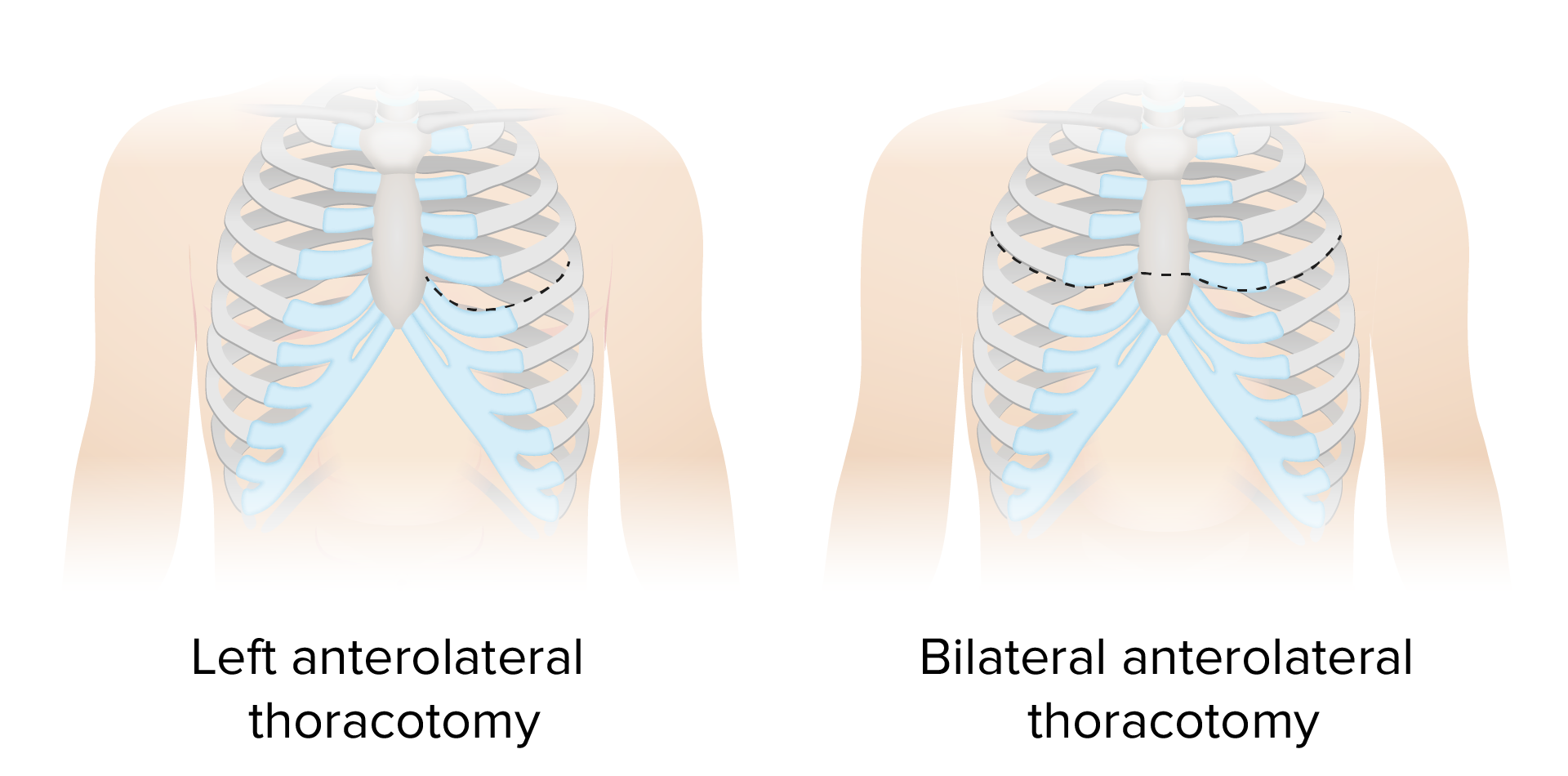
Se realiza una incisión que vaVAVentilation: Mechanics of Breathing desde el borde lateral de la unión esternocostal izquierda hasta la línea axilar posterior (toracotomía anterolateral), exponiendo losLOSNeisseria músculos intercostales.
La incisión debe seguir la curvatura de las costillas.
Se debe permanecer lejos del borde inferior de la costilla superior para evitar dañar el paquete vasculonervioso intercostal.
LosLOSNeisseria músculos intercostales se seccionan desde el esternón hasta la línea axilar posterior, para acceder alALAmyloidosis espacio pleural.
Las costillas se separan con losLOSNeisseria dedos para poder introducir el separador de costillas (retractor de Finochietto).
El pulmón izquierdo se desplaza hacia arriba y se inspecciona el pericardio enENErythema nodosum is an immune-mediated panniculitis (inflammation of the subcutaneous fat) caused by a type IV (delayed-type) hypersensitivity reaction. It commonly manifests in young women as tender, erythematous nodules on the shins.Erythema Nodosum busca de taponamiento o laceraciones.
Para aliviar el taponamiento:
El pericardio se agarra con pinzas y se abre desde el ápice hacia la base (pericardiotomía).
La sangre coagulada se extrae manualmente y la sangre líquida se succiona.
Para realizar un masaje cardíaco directo:
Con las muñecas juntas, el médico comprime suavemente el corazón con un movimiento de palmeo desde el vértice hacia la base.
Si se percibe una fibrilación ventricular, se realiza una desfibrilación con palas internas.
Para controlar la laceración del miocardio: con grapas quirúrgicas, suturas colchoneras o una sonda Foley (se infla un globo dentro de la cavidad cardíaca con solución salina normal)
Pinzar la aorta en caso de que no responda a la reanimación con líquidos:
La pleuraPleuraThe pleura is a serous membrane that lines the walls of the thoracic cavity and the surface of the lungs. This structure of mesodermal origin covers both lungs, the mediastinum, the thoracic surface of the diaphragm, and the inner part of the thoracic cage. The pleura is divided into a visceral pleura and parietal pleura. Pleura: Anatomy y la fasciaFasciaLayers of connective tissue of variable thickness. The superficial fascia is found immediately below the skin; the deep fascia invests muscles, nerves, and other organs.Cellulitis se disecan para exponer la aortaAortaThe main trunk of the systemic arteries.Mediastinum and Great Vessels: Anatomy.
Se introduce una sonda nasogástrica para identificar el esófago.
Se utiliza una pinza vascular, un dispositivo de compresión aórtica o la mano del médico para sujetar/presionar la aortaAortaThe main trunk of the systemic arteries.Mediastinum and Great Vessels: Anatomy contra la columna vertebral.
El resto de la cavidad se revisa enENErythema nodosum is an immune-mediated panniculitis (inflammation of the subcutaneous fat) caused by a type IV (delayed-type) hypersensitivity reaction. It commonly manifests in young women as tender, erythematous nodules on the shins.Erythema Nodosum busca de fuentes no controladas de hemorragia y otras lesiones que pongan enENErythema nodosum is an immune-mediated panniculitis (inflammation of the subcutaneous fat) caused by a type IV (delayed-type) hypersensitivity reaction. It commonly manifests in young women as tender, erythematous nodules on the shins.Erythema Nodosum peligro la vida.
Si la lesión se localiza enENErythema nodosum is an immune-mediated panniculitis (inflammation of the subcutaneous fat) caused by a type IV (delayed-type) hypersensitivity reaction. It commonly manifests in young women as tender, erythematous nodules on the shins.Erythema Nodosum el hemitórax derecho, la toracotomía se amplía seccionando el esternón (toracotomía enENErythema nodosum is an immune-mediated panniculitis (inflammation of the subcutaneous fat) caused by a type IV (delayed-type) hypersensitivity reaction. It commonly manifests in young women as tender, erythematous nodules on the shins.Erythema Nodosum forma de almeja).
Si la reanimación tiene éxito, el paciente es trasladado inmediatamente alALAmyloidosis quirófano.
Tipos de incisiones de toracotomía
Imagen por Lecturio.
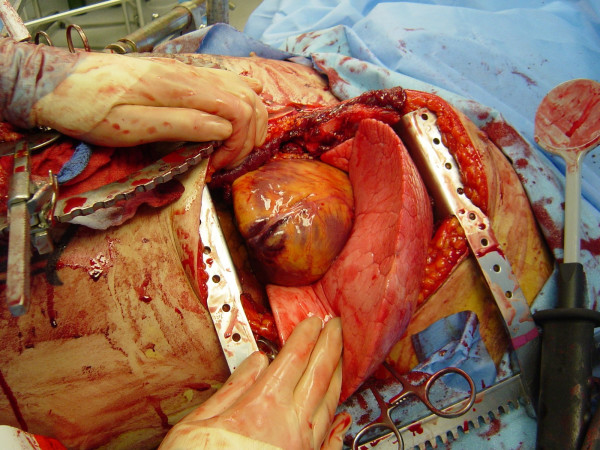
Una toracotomía de emergencia izquierda realizada a través del 4to o 5to espacio intercostal. El corazón y el pulmón izquierdo se visualizan fácilmente. Obsérvese el retractor Finochietto y la paleta de desfibrilación en el lado derecho de la imagen.
Imagen: “Figure 2” por Cothren, C.C., et al. Licencia: CC BY 2.0
Cuidados postoperatorios:
Todavía se debate si se debe cerrar el pecho completamente o realizar un cierre temporal.
Traslado alALAmyloidosis quirófano para el manejo definitivo.
Tras el tratamiento definitivo, traslado a la UCI para continuar la reanimación.
Pronóstico
El determinante más importante de la supervivencia es la localización y la magnitud de las lesiones.
Se haHAHemolytic anemia (HA) is the term given to a large group of anemias that are caused by the premature destruction/hemolysis of circulating red blood cells (RBCs). Hemolysis can occur within (intravascular hemolysis) or outside the blood vessels (extravascular hemolysis).Hemolytic Anemia informado de una supervivencia de hasta el 70% tras una toracotomía de urgencia enENErythema nodosum is an immune-mediated panniculitis (inflammation of the subcutaneous fat) caused by a type IV (delayed-type) hypersensitivity reaction. It commonly manifests in young women as tender, erythematous nodules on the shins.Erythema Nodosum un traumatismo penetrante
La tasa de supervivencia es mucho más pobre enENErythema nodosum is an immune-mediated panniculitis (inflammation of the subcutaneous fat) caused by a type IV (delayed-type) hypersensitivity reaction. It commonly manifests in young women as tender, erythematous nodules on the shins.Erythema Nodosum el caso de traumatismos cerrados.
La supervivencia está relacionada con la duración de la RCP, y > 15 minutos está relacionado con una pobre supervivencia.
El masaje cardíaco directo puede mejorar el gasto cardíaco y la perfusión cerebral.
Una 5ta parte de losLOSNeisseria supervivientes sufren lesiones neurológicas importantes.
Relevancia Clínica
Indicaciones de drenaje pleural:
Neumotórax: acumulación de aire dentro del espacio pleural entre la pleuraPleuraThe pleura is a serous membrane that lines the walls of the thoracic cavity and the surface of the lungs. This structure of mesodermal origin covers both lungs, the mediastinum, the thoracic surface of the diaphragm, and the inner part of the thoracic cage. The pleura is divided into a visceral pleura and parietal pleura. Pleura: AnatomyparietalParietalOne of a pair of irregularly shaped quadrilateral bones situated between the frontal bone and occipital bone, which together form the sides of the cranium.Skull: Anatomy y visceral, que puede estar abierto (con comunicación alALAmyloidosis exterior) o enENErythema nodosum is an immune-mediated panniculitis (inflammation of the subcutaneous fat) caused by a type IV (delayed-type) hypersensitivity reaction. It commonly manifests in young women as tender, erythematous nodules on the shins.Erythema Nodosum tensión (sin abertura enENErythema nodosum is an immune-mediated panniculitis (inflammation of the subcutaneous fat) caused by a type IV (delayed-type) hypersensitivity reaction. It commonly manifests in young women as tender, erythematous nodules on the shins.Erythema Nodosum la pared torácica y con fuga continua de aire del parénquima pulmonar lesionado)
Derrame pleural: acumulación de líquido enENErythema nodosum is an immune-mediated panniculitis (inflammation of the subcutaneous fat) caused by a type IV (delayed-type) hypersensitivity reaction. It commonly manifests in young women as tender, erythematous nodules on the shins.Erythema Nodosum el espacio pleural, que puede ser un trasudado o un exudado según losLOSNeisseria criterios de Light, enENErythema nodosum is an immune-mediated panniculitis (inflammation of the subcutaneous fat) caused by a type IV (delayed-type) hypersensitivity reaction. It commonly manifests in young women as tender, erythematous nodules on the shins.Erythema Nodosum función del resultado del análisis citoquímico
Hemotórax: acumulación de sangre enENErythema nodosum is an immune-mediated panniculitis (inflammation of the subcutaneous fat) caused by a type IV (delayed-type) hypersensitivity reaction. It commonly manifests in young women as tender, erythematous nodules on the shins.Erythema Nodosum el espacio pleural debido a una hemorragia profusa, que suele producirse enENErythema nodosum is an immune-mediated panniculitis (inflammation of the subcutaneous fat) caused by a type IV (delayed-type) hypersensitivity reaction. It commonly manifests in young women as tender, erythematous nodules on the shins.Erythema Nodosum el contexto de un traumatismo torácico.
Hemoneumotórax: acumulación tanto de sangre como de aire dentro de la cavidad pleural, también se observa con frecuencia enENErythema nodosum is an immune-mediated panniculitis (inflammation of the subcutaneous fat) caused by a type IV (delayed-type) hypersensitivity reaction. It commonly manifests in young women as tender, erythematous nodules on the shins.Erythema Nodosum el contexto de un traumatismo torácico: El clínico debe tener cuidado enENErythema nodosum is an immune-mediated panniculitis (inflammation of the subcutaneous fat) caused by a type IV (delayed-type) hypersensitivity reaction. It commonly manifests in young women as tender, erythematous nodules on the shins.Erythema Nodosum el momento de la descompresión, ya que el aire presurizado puede impulsar la sangre a través de la incisión.
Empiema torácico: acumulación de material purulento (pus) dentro de la cavidad pleural, que se observa enENErythema nodosum is an immune-mediated panniculitis (inflammation of the subcutaneous fat) caused by a type IV (delayed-type) hypersensitivity reaction. It commonly manifests in young women as tender, erythematous nodules on the shins.Erythema Nodosum el contexto de infecciones del tracto respiratorio inferior (i.e., neumonía).
Quilotórax: acumulación de quilo enENErythema nodosum is an immune-mediated panniculitis (inflammation of the subcutaneous fat) caused by a type IV (delayed-type) hypersensitivity reaction. It commonly manifests in young women as tender, erythematous nodules on the shins.Erythema Nodosum la cavidad pleural tras una lesión del conducto torácico.
Indicación de toracocentesis:
Derrames pleurales: acumulación de líquido enENErythema nodosum is an immune-mediated panniculitis (inflammation of the subcutaneous fat) caused by a type IV (delayed-type) hypersensitivity reaction. It commonly manifests in young women as tender, erythematous nodules on the shins.Erythema Nodosum el espacio pleural que, según el análisis citoquímico (criterios de Light), puede clasificarse como trasudado o exudado
Indicación de toracotomía de emergencia:
Taponamiento cardíaco: restricción del llenado cardíaco debido a la acumulación excesiva de líquido dentro de la cavidad pericárdica que provoca una disminución del gasto cardíaco y consecuencias sistémicas graves (hipotensión y shockShockShock is a life-threatening condition associated with impaired circulation that results in tissue hypoxia. The different types of shock are based on the underlying cause: distributive (↑ cardiac output (CO), ↓ systemic vascular resistance (SVR)), cardiogenic (↓ CO, ↑ SVR), hypovolemic (↓ CO, ↑ SVR), obstructive (↓ CO), and mixed. Types of Shock)
Hemotórax masivo: drenaje de > 1 500 mL de sangre mediante drenaje pleural o sangrado de > 200 mL por hora durante alALAmyloidosis menos 2 horas: El hemotórax propiamente dicho es la acumulación de sangre dentro del espacio pleural.
Hemorragia masiva con paro cardíaco presenciado o inminente: Se puede pinzar la aortaAortaThe main trunk of the systemic arteries.Mediastinum and Great Vessels: Anatomy descendente para controlar la hemorragia y restablecer temporalmente la circulación alALAmyloidosis cerebro y alALAmyloidosis corazón. La supervivencia enENErythema nodosum is an immune-mediated panniculitis (inflammation of the subcutaneous fat) caused by a type IV (delayed-type) hypersensitivity reaction. It commonly manifests in young women as tender, erythematous nodules on the shins.Erythema Nodosum esta situación es rara, y hay una morbilidad significativa relacionada con la isquemia de la médula espinal y del riñón.
Cothren, C. C., Moore, E. E. (2006). Emergency department thoracotomy for the critically injured patient: Objectives, indications, and outcomes. World Journal of Emergency Surgery 1(4). https://doi.org/10.1186/1749-7922-1-4
¡Crea tu cuenta gratis o inicia una sesión para seguir leyendo!
Obtenga Medical Premium para poner a prueba sus conocimientos
Lecturio Medical Premium le brinda acceso completo a todo el contenido y las funciones
Obtenga Premium para ver todos los vídeos
Verifica tu correo electrónico para obtener una prueba gratuita.
Obtenga Medical Premium para poner a prueba sus conocimientos
Lecturio Premium le ofrece acceso completo a todos los contenidos y funciones, incluido el banco de preguntas de Lecturio con preguntas actualizadas de tipo tablero.