Domina Conceptos Médicos

Estudia para la escuela de medicina y tus examenes con Lecturio.

Carcinogénesis

La carcinogénesis es el desarrollo del cáncer mediante la transformación de células sanas en EN Erythema nodosum is an immune-mediated panniculitis (inflammation of the subcutaneous fat) caused by a type IV (delayed-type) hypersensitivity reaction. It commonly manifests in young women as tender, erythematous nodules on the shins. Erythema Nodosum células cancerosas. Este complejo proceso ocurre debido a mutaciones en EN Erythema nodosum is an immune-mediated panniculitis (inflammation of the subcutaneous fat) caused by a type IV (delayed-type) hypersensitivity reaction. It commonly manifests in young women as tender, erythematous nodules on the shins. Erythema Nodosum el ácido desoxirribonucleico (ADN) que impiden el proceso normal de división celular. Las células normales tienen muerte celular programada, pero las células cancerosas proliferan sin regulación. Los LOS Neisseria cambios genéticos que causan el cáncer pueden ocurrir en EN Erythema nodosum is an immune-mediated panniculitis (inflammation of the subcutaneous fat) caused by a type IV (delayed-type) hypersensitivity reaction. It commonly manifests in young women as tender, erythematous nodules on the shins. Erythema Nodosum las células reproductoras de los LOS Neisseria óvulos y los LOS Neisseria espermatozoides y propagarse a la descendencia. Los LOS Neisseria cambios somáticos se adquieren durante la vida de un individuo debido a la exposición a sustancias químicas cancerígenas, tabaco, radiación y otros factores. Las mutaciones en EN Erythema nodosum is an immune-mediated panniculitis (inflammation of the subcutaneous fat) caused by a type IV (delayed-type) hypersensitivity reaction. It commonly manifests in young women as tender, erythematous nodules on the shins. Erythema Nodosum los LOS Neisseria oncogenes Oncogenes Genes whose gain-of-function alterations lead to neoplastic cell transformation. They include, for example, genes for activators or stimulators of cell proliferation such as growth factors, growth factor receptors, protein kinases, signal transducers, nuclear phosphoproteins, and transcription factors. A prefix of 'v-' before oncogene symbols indicates oncogenes captured and transmitted by retroviruses; the prefix 'c-' before the gene symbol of an oncogene indicates it is the cellular homolog (proto-oncogenes) of a v-oncogene. Carcinogenesis que promueven el crecimiento celular y los LOS Neisseria genes Genes A category of nucleic acid sequences that function as units of heredity and which code for the basic instructions for the development, reproduction, and maintenance of organisms. DNA Types and Structure supresores de tumores que reducen el crecimiento celular son mecanismos importantes en EN Erythema nodosum is an immune-mediated panniculitis (inflammation of the subcutaneous fat) caused by a type IV (delayed-type) hypersensitivity reaction. It commonly manifests in young women as tender, erythematous nodules on the shins. Erythema Nodosum la desregulación de la división celular y conducen al AL Amyloidosis cáncer. Los LOS Neisseria cánceres se clasifican por su tipo de célula y su ubicación.

Last updated: Dec 15, 2025
Editorial responsibility: Stanley Oiseth, Lindsay Jones, Evelin Maza

Agentes que Afectan al ADN

Descripción general

  • Las mutaciones genéticas se consideran la principal causa de cáncer.
  • Se requieren numerosas mutaciones.
  • Desregulación del crecimiento celular → crecimiento celular incontrolable
  • > 1 de cada 3 casos de cáncer se atribuyen a un factor de riesgo modificable (e.g., fumar)
  • Predisposición al AL Amyloidosis cáncer:
    • Exposición química (incluyendo tabaco y alcohol)
    • Exposición a la radiación (luz solar, rayos X)
    • Infecciones (e.g., virus Virus Viruses are infectious, obligate intracellular parasites composed of a nucleic acid core surrounded by a protein capsid. Viruses can be either naked (non-enveloped) or enveloped. The classification of viruses is complex and based on many factors, including type and structure of the nucleoid and capsid, the presence of an envelope, the replication cycle, and the host range. Virology del papiloma humano)

Carcinógenos químicos

  • Benceno y tolueno: se encuentran en EN Erythema nodosum is an immune-mediated panniculitis (inflammation of the subcutaneous fat) caused by a type IV (delayed-type) hypersensitivity reaction. It commonly manifests in young women as tender, erythematous nodules on the shins. Erythema Nodosum la gasolina y los LOS Neisseria cigarrillos
  • Etanol
  • Cigarrillos (muchos químicos cancerígenos)
  • Cloruro de vinilo
  • Nitrosaminas (encontradas en EN Erythema nodosum is an immune-mediated panniculitis (inflammation of the subcutaneous fat) caused by a type IV (delayed-type) hypersensitivity reaction. It commonly manifests in young women as tender, erythematous nodules on the shins. Erythema Nodosum carnes curadas y alimentos ahumados) → cáncer gástrico
  • Asbesto (se encuentra en EN Erythema nodosum is an immune-mediated panniculitis (inflammation of the subcutaneous fat) caused by a type IV (delayed-type) hypersensitivity reaction. It commonly manifests in young women as tender, erythematous nodules on the shins. Erythema Nodosum materiales aislantes) → ↑ riesgo de:
    • Cáncer de pulmón
    • Mesotelioma
    • Carcinoma de células renales
  • Arsénico→ ↑riesgo de:
    • Cáncer de células escamosas de piel y pulmón
    • Angiosarcoma de hígado
  • Sílice (asociada al AL Amyloidosis arenado) → ↑riesgo de cáncer de pulmón
  • Cromo y níquel → ↑riesgo de cáncer de pulmón

Radiación

  • Radiación no ionizante:
    • Luz ultravioleta (UV) B → ↑ riesgo de cáncer de piel
    • Produce dímeros de pirimidina en EN Erythema nodosum is an immune-mediated panniculitis (inflammation of the subcutaneous fat) caused by a type IV (delayed-type) hypersensitivity reaction. It commonly manifests in young women as tender, erythematous nodules on the shins. Erythema Nodosum el ADN, que conducen a errores transcripcionales y mutaciones de oncogenes Oncogenes Genes whose gain-of-function alterations lead to neoplastic cell transformation. They include, for example, genes for activators or stimulators of cell proliferation such as growth factors, growth factor receptors, protein kinases, signal transducers, nuclear phosphoproteins, and transcription factors. A prefix of ‘v-‘ before oncogene symbols indicates oncogenes captured and transmitted by retroviruses; the prefix ‘c-‘ before the gene symbol of an oncogene indicates it is the cellular homolog (proto-oncogenes) of a v-oncogene. Carcinogenesis y genes Genes A category of nucleic acid sequences that function as units of heredity and which code for the basic instructions for the development, reproduction, and maintenance of organisms. DNA Types and Structure supresores de tumores
  • Radiación ionizante:
    • Rayos x→ ↑riesgo de neoplasias hematológicas
    • Bomba atómica → ↑riesgo de leucemias, cáncer de tiroides
    • Uranio → ↑riesgo de cáncer de pulmón
    • Radio → ↑riesgo de osteosarcoma Osteosarcoma Osteosarcoma is a primary malignant tumor of the bone characterized by the production of osteoid or immature bone by the tumor cells. The disease is most common in children and young adults and most frequently affects growth plates of the long bones, although it can involve any bone. Osteosarcoma
    • Rayos gamma:
      • Considerada la forma más peligrosa de radiación ionizante
      • Puede afectar tejidos desde la piel hasta estructuras profundas como la médula ósea
    • Partículas alfa en EN Erythema nodosum is an immune-mediated panniculitis (inflammation of the subcutaneous fat) caused by a type IV (delayed-type) hypersensitivity reaction. It commonly manifests in young women as tender, erythematous nodules on the shins. Erythema Nodosum gas radón → ↑riesgo de cáncer de pulmón

Infecciones

  • Virus Virus Viruses are infectious, obligate intracellular parasites composed of a nucleic acid core surrounded by a protein capsid. Viruses can be either naked (non-enveloped) or enveloped. The classification of viruses is complex and based on many factors, including type and structure of the nucleoid and capsid, the presence of an envelope, the replication cycle, and the host range. Virology de ADN:
    • Virus Virus Viruses are infectious, obligate intracellular parasites composed of a nucleic acid core surrounded by a protein capsid. Viruses can be either naked (non-enveloped) or enveloped. The classification of viruses is complex and based on many factors, including type and structure of the nucleoid and capsid, the presence of an envelope, the replication cycle, and the host range. Virology del papiloma humano→ ↑riesgo de carcinoma de cuello uterino
    • Virus Virus Viruses are infectious, obligate intracellular parasites composed of a nucleic acid core surrounded by a protein capsid. Viruses can be either naked (non-enveloped) or enveloped. The classification of viruses is complex and based on many factors, including type and structure of the nucleoid and capsid, the presence of an envelope, the replication cycle, and the host range. Virology de Epstein-Barr (infecta las células B y las células epiteliales de la nasofaringe a través de CD21 CD21 Molecular sites on or in B-lymphocytes, follicular dendritic cells, lymphoid cells, and epithelial cells that recognize and combine with complement C3D. Human complement receptor 2 (CR2) serves as a receptor for both C3dg and the gp350/220 glycoprotein of Human Herpesvirus 4 and binds the monoclonal antibody OKB7, which blocks binding of both ligands to the receptor. Epstein-Barr Virus)→ ↑riesgo para:
      • Linfoma de Burkitt
      • Linfoma de células B
      • Enfermedad de Hodgkin
      • Carcinomas nasofaríngeos
    • Hepatitis B Hepatitis B Hepatitis B virus (HBV) is a partially double-stranded DNA virus, which belongs to the Orthohepadnavirus genus and the Hepadnaviridae family. Most individuals with acute HBV infection are asymptomatic or have mild, self-limiting symptoms. Chronic infection can be asymptomatic or create hepatic inflammation, leading to liver cirrhosis and hepatocellular carcinoma (HCC). Hepatitis B Virus → ↑riesgo de carcinoma hepatocelular (hígado)
  • Virus Virus Viruses are infectious, obligate intracellular parasites composed of a nucleic acid core surrounded by a protein capsid. Viruses can be either naked (non-enveloped) or enveloped. The classification of viruses is complex and based on many factors, including type and structure of the nucleoid and capsid, the presence of an envelope, the replication cycle, and the host range. Virology de ácido ribonucleico (ARN):
    • Hepatitis C Hepatitis C Hepatitis C is an infection of the liver caused by the hepatitis C virus (HCV). The infection can be transmitted through infectious blood or body fluids and may be transmitted during childbirth or through IV drug use or sexual intercourse. Hepatitis C virus can cause both acute and chronic hepatitis, ranging from a mild to a serious, lifelong illness including liver cirrhosis and hepatocellular carcinoma (HCC). Hepatitis C Virus → ↑riesgo de cáncer hepatocelular (hígado)
    • Virus Virus Viruses are infectious, obligate intracellular parasites composed of a nucleic acid core surrounded by a protein capsid. Viruses can be either naked (non-enveloped) or enveloped. The classification of viruses is complex and based on many factors, including type and structure of the nucleoid and capsid, the presence of an envelope, the replication cycle, and the host range. Virology de la leucemia de células T humanas tipo 1 (infecta las células T CD4+) → ↑riesgo de leucemia/linfoma de células T
  • Bacterias: Helicobacter pylori Helicobacter pylori A spiral bacterium active as a human gastric pathogen. It is a gram-negative, urease-positive, curved or slightly spiral organism initially isolated in 1982 from patients with lesions of gastritis or peptic ulcers in Western Australia. Helicobacter pylori was originally classified in the genus campylobacter, but RNA sequencing, cellular fatty acid profiles, growth patterns, and other taxonomic characteristics indicate that the micro-organism should be included in the genus Helicobacter. It has been officially transferred to Helicobacter gen. Helicobacter
    • Vinculado a carcinomas gástricos y linfomas de células B
    • Puede revertirse con un tratamiento de terapia triple antes de convertirse en EN Erythema nodosum is an immune-mediated panniculitis (inflammation of the subcutaneous fat) caused by a type IV (delayed-type) hypersensitivity reaction. It commonly manifests in young women as tender, erythematous nodules on the shins. Erythema Nodosum linfoma
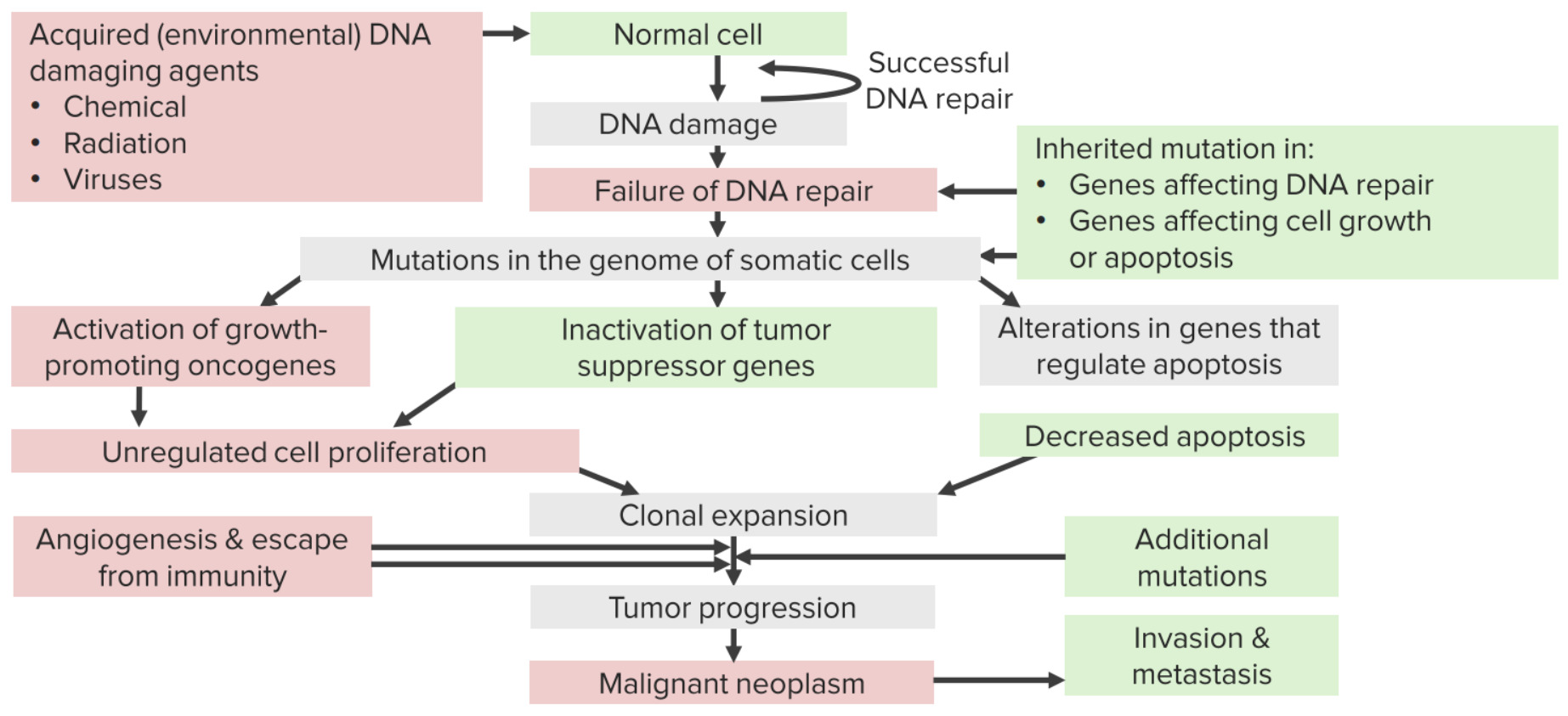
Mecanismos de carcinogénesis debido a carcinógenos que causan daño en el ADN

Mecanismos de carcinogénesis debido a carcinógenos que causan daño en el ADN

Imagen por Lecturio. Licencia: CC BY-NC-SA 4.0
Patogénesis

Descripción general

  • El cáncer es un problema de disfunción celular; no tiene por qué ser un daño genético letal.
  • Ocurre en EN Erythema nodosum is an immune-mediated panniculitis (inflammation of the subcutaneous fat) caused by a type IV (delayed-type) hypersensitivity reaction. It commonly manifests in young women as tender, erythematous nodules on the shins. Erythema Nodosum un proceso de varios pasos: exposición al AL Amyloidosis carcinógeno → genes Genes A category of nucleic acid sequences that function as units of heredity and which code for the basic instructions for the development, reproduction, and maintenance of organisms. DNA Types and Structure involucrados en EN Erythema nodosum is an immune-mediated panniculitis (inflammation of the subcutaneous fat) caused by a type IV (delayed-type) hypersensitivity reaction. It commonly manifests in young women as tender, erythematous nodules on the shins. Erythema Nodosum el crecimiento, la diferenciación y la supervivencia celular activados
  • Los LOS Neisseria carcinógenos conducen al AL Amyloidosis desarrollo de mutaciones que se transmiten a las futuras generaciones de células.
  • Estas mutaciones conducen a una proliferación celular más rápida, más mutaciones y, finalmente, metástasis (propagación del cáncer a otras ubicaciones del cuerpo a través del sistema hematológico o linfático).

Cambios celulares

  • Los LOS Neisseria cambios graduales en EN Erythema nodosum is an immune-mediated panniculitis (inflammation of the subcutaneous fat) caused by a type IV (delayed-type) hypersensitivity reaction. It commonly manifests in young women as tender, erythematous nodules on the shins. Erythema Nodosum las propiedades de las células se acumulan con cambios genéticos que ocurren durante un largo período de tiempo.
  • Expansión clonal de una sola célula precursora dañada genéticamente → tumor Tumor Inflammation
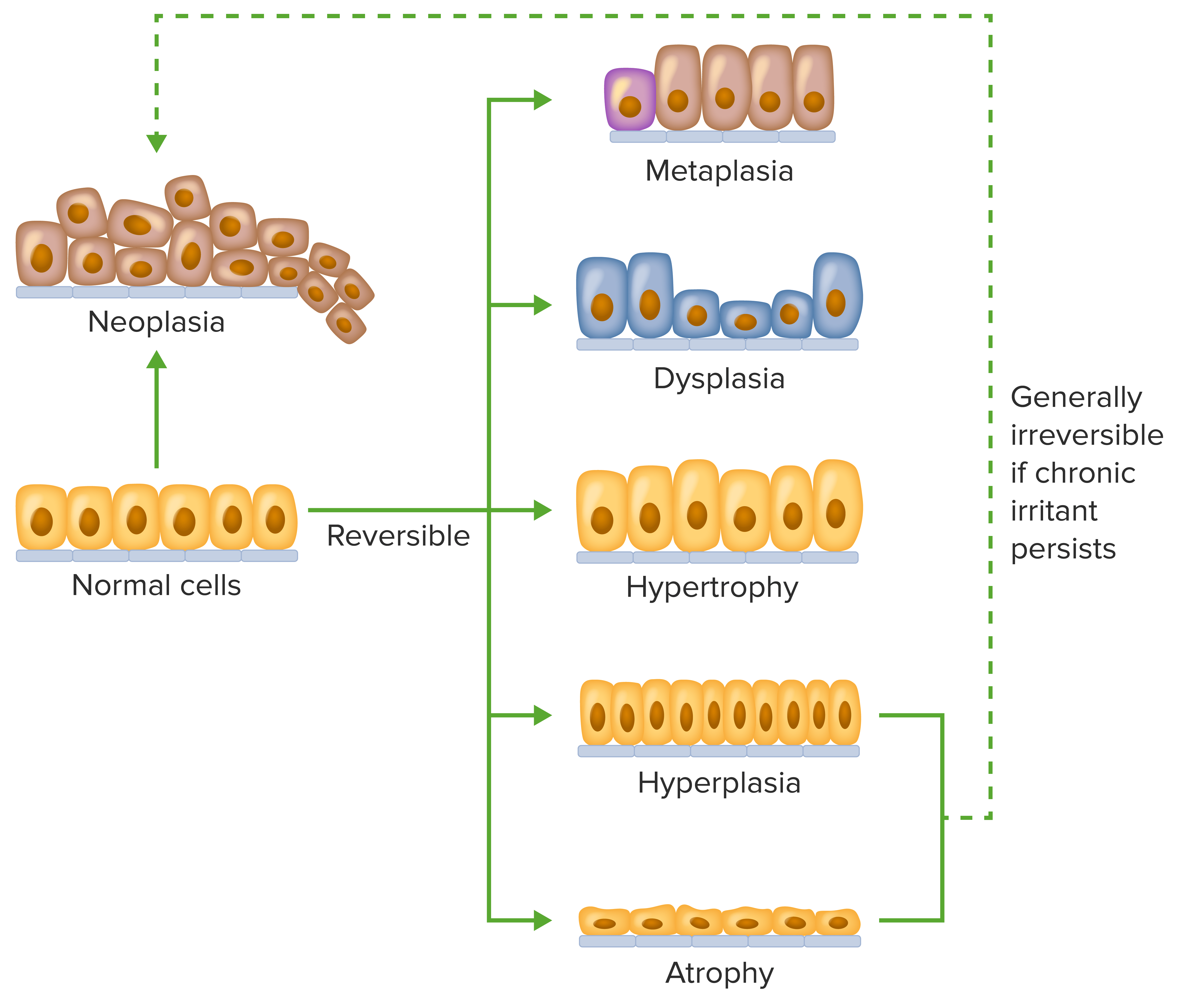
  • Cambios celulares típicos que acompañan al AL Amyloidosis desarrollo del cáncer:
    • Hiperplasia (aumento en EN Erythema nodosum is an immune-mediated panniculitis (inflammation of the subcutaneous fat) caused by a type IV (delayed-type) hypersensitivity reaction. It commonly manifests in young women as tender, erythematous nodules on the shins. Erythema Nodosum el número de células)
    • Aumento de la variación en EN Erythema nodosum is an immune-mediated panniculitis (inflammation of the subcutaneous fat) caused by a type IV (delayed-type) hypersensitivity reaction. It commonly manifests in young women as tender, erythematous nodules on the shins. Erythema Nodosum el tamaño y la forma de las células y los LOS Neisseria núcleos
    • Pérdida de la estructura del tejido
  • Displasia (proliferación anormal con pérdida de la estructura normal de las células):
    • Displasia severa: carcinoma in situ
    • El carcinoma in situ describe un estado en EN Erythema nodosum is an immune-mediated panniculitis (inflammation of the subcutaneous fat) caused by a type IV (delayed-type) hypersensitivity reaction. It commonly manifests in young women as tender, erythematous nodules on the shins. Erythema Nodosum el que hay células displásicas que no han migrado ni invadido otros tejidos.
  • La transformación de una célula normal a una célula cancerosa requiere muchos pasos que resultan ventajosos para el crecimiento:
    • Autosuficiencia en EN Erythema nodosum is an immune-mediated panniculitis (inflammation of the subcutaneous fat) caused by a type IV (delayed-type) hypersensitivity reaction. It commonly manifests in young women as tender, erythematous nodules on the shins. Erythema Nodosum la señalización del crecimiento
    • Insensibilidad a la señalización contra el crecimiento
    • Evasión de la apoptosis Apoptosis A regulated cell death mechanism characterized by distinctive morphologic changes in the nucleus and cytoplasm, including the endonucleolytic cleavage of genomic DNA, at regularly spaced, internucleosomal sites, I.e., DNA fragmentation. It is genetically-programmed and serves as a balance to mitosis in regulating the size of animal tissues and in mediating pathologic processes associated with tumor growth. Ischemic Cell Damage
    • Potencial replicativo ilimitado
    • Angiogénesis sostenida
    • Invasión de tejidos y potencial de metástasis

Genes Reguladores

Hay 4 clases de genes Genes A category of nucleic acid sequences that function as units of heredity and which code for the basic instructions for the development, reproduction, and maintenance of organisms. DNA Types and Structure reguladores normales que a menudo son afectados.

  • Oncogenes Oncogenes Genes whose gain-of-function alterations lead to neoplastic cell transformation. They include, for example, genes for activators or stimulators of cell proliferation such as growth factors, growth factor receptors, protein kinases, signal transducers, nuclear phosphoproteins, and transcription factors. A prefix of ‘v-‘ before oncogene symbols indicates oncogenes captured and transmitted by retroviruses; the prefix ‘c-‘ before the gene symbol of an oncogene indicates it is the cellular homolog (proto-oncogenes) of a v-oncogene. Carcinogenesis (e.g., c-myc c-MYC Basic helix-loop-helix transcription factors encoded by the c-myc genes. They are normally involved in nucleic acid metabolism and in mediating the cellular response to growth factors. Elevated and deregulated (constitutive) expression of c-myc proteins can cause tumorigenesis. Non-Hodgkin Lymphomas en EN Erythema nodosum is an immune-mediated panniculitis (inflammation of the subcutaneous fat) caused by a type IV (delayed-type) hypersensitivity reaction. It commonly manifests in young women as tender, erythematous nodules on the shins. Erythema Nodosum el linfoma de Burkitt):
    • Promueven el crecimiento y la división celular
    • Aumento de la expresión → carcinogénesis (crecimiento celular descontrolado)
    • Permiten que las células eviten la muerte celular programada ( apoptosis Apoptosis A regulated cell death mechanism characterized by distinctive morphologic changes in the nucleus and cytoplasm, including the endonucleolytic cleavage of genomic DNA, at regularly spaced, internucleosomal sites, I.e., DNA fragmentation. It is genetically-programmed and serves as a balance to mitosis in regulating the size of animal tissues and in mediating pathologic processes associated with tumor growth. Ischemic Cell Damage)
    • Categorizados según su función celular:
      • Factor de crecimiento: conduce a la proliferación celular
      • Tirosina quinasa: transmite señales celulares
      • Guanosina trifosfatasa (GTPasa): transmite señales celulares
      • Factor de transcripción: induce el crecimiento y la división celular
    • Protooncogén:
      • Genes Genes A category of nucleic acid sequences that function as units of heredity and which code for the basic instructions for the development, reproduction, and maintenance of organisms. DNA Types and Structure normales que producen proteínas implicadas en EN Erythema nodosum is an immune-mediated panniculitis (inflammation of the subcutaneous fat) caused by a type IV (delayed-type) hypersensitivity reaction. It commonly manifests in young women as tender, erythematous nodules on the shins. Erythema Nodosum la regulación del crecimiento y la proliferación celular.
      • Protooncogén mutado → se convierte en EN Erythema nodosum is an immune-mediated panniculitis (inflammation of the subcutaneous fat) caused by a type IV (delayed-type) hypersensitivity reaction. It commonly manifests in young women as tender, erythematous nodules on the shins. Erythema Nodosum un oncogén.
      • Cambios en EN Erythema nodosum is an immune-mediated panniculitis (inflammation of the subcutaneous fat) caused by a type IV (delayed-type) hypersensitivity reaction. It commonly manifests in young women as tender, erythematous nodules on the shins. Erythema Nodosum la expresión de los LOS Neisseria productos proteicos del gen (e.g., producción de ↑, cambio en EN Erythema nodosum is an immune-mediated panniculitis (inflammation of the subcutaneous fat) caused by a type IV (delayed-type) hypersensitivity reaction. It commonly manifests in young women as tender, erythematous nodules on the shins. Erythema Nodosum la estructura de la proteína que afecta a su función) → crecimiento y división celular no regulados.
  • Genes Genes A category of nucleic acid sequences that function as units of heredity and which code for the basic instructions for the development, reproduction, and maintenance of organisms. DNA Types and Structure supresores de tumores:
    • Inhiben la división celular
    • Expresión disminuida → carcinogénesis
    • Funcionan normalmente para prevenir el crecimiento celular incontrolado
    • Mutación → crecimiento celular incontrolado
    • Los LOS Neisseria genes Genes A category of nucleic acid sequences that function as units of heredity and which code for the basic instructions for the development, reproduction, and maintenance of organisms. DNA Types and Structure supresores de tumores están categorizados:
      • Gen cuidador: involucrado en EN Erythema nodosum is an immune-mediated panniculitis (inflammation of the subcutaneous fat) caused by a type IV (delayed-type) hypersensitivity reaction. It commonly manifests in young women as tender, erythematous nodules on the shins. Erythema Nodosum la reparación del ADN
      • Gen guardián: regula el crecimiento celular
  • Genes Genes A category of nucleic acid sequences that function as units of heredity and which code for the basic instructions for the development, reproduction, and maintenance of organisms. DNA Types and Structure que regulan la apoptosis Apoptosis A regulated cell death mechanism characterized by distinctive morphologic changes in the nucleus and cytoplasm, including the endonucleolytic cleavage of genomic DNA, at regularly spaced, internucleosomal sites, I.e., DNA fragmentation. It is genetically-programmed and serves as a balance to mitosis in regulating the size of animal tissues and in mediating pathologic processes associated with tumor growth. Ischemic Cell Damage:
    • Mutación significativa → sin muerte celular programada
    • Las mutaciones se transmiten a futuras líneas celulares
    • p53 es un gen supresor de tumores que promueve la apoptosis Apoptosis A regulated cell death mechanism characterized by distinctive morphologic changes in the nucleus and cytoplasm, including the endonucleolytic cleavage of genomic DNA, at regularly spaced, internucleosomal sites, I.e., DNA fragmentation. It is genetically-programmed and serves as a balance to mitosis in regulating the size of animal tissues and in mediating pathologic processes associated with tumor growth. Ischemic Cell Damage cuando funciona normalmente
      • Después de la mutación de pérdida de función, p53 no detiene el ciclo celular
      • p53 está implicado en EN Erythema nodosum is an immune-mediated panniculitis (inflammation of the subcutaneous fat) caused by a type IV (delayed-type) hypersensitivity reaction. It commonly manifests in young women as tender, erythematous nodules on the shins. Erythema Nodosum casi la mitad de todos los LOS Neisseria cánceres conocidos.
  • Genes Genes A category of nucleic acid sequences that function as units of heredity and which code for the basic instructions for the development, reproduction, and maintenance of organisms. DNA Types and Structure implicados en EN Erythema nodosum is an immune-mediated panniculitis (inflammation of the subcutaneous fat) caused by a type IV (delayed-type) hypersensitivity reaction. It commonly manifests in young women as tender, erythematous nodules on the shins. Erythema Nodosum la reparación del ADN

Subtipos de Cáncer

Tipo de célula

  • Carcinoma: derivado de células epiteliales
  • Sarcoma: derivado del tejido conectivo
  • Linfoma y leucemia: derivados de la médula ósea
  • Tumor Tumor Inflammation de células germinales: derivado de células pluripotentes

Cánceres comunes

  • Osteosarcoma Osteosarcoma Osteosarcoma is a primary malignant tumor of the bone characterized by the production of osteoid or immature bone by the tumor cells. The disease is most common in children and young adults and most frequently affects growth plates of the long bones, although it can involve any bone. Osteosarcoma: cáncer óseo de origen mesenquimatoso
  • Glioblastoma: cáncer cerebral agresivo
  • Cáncer de seno
  • Retinoblastoma Retinoblastoma Retinoblastoma is a rare tumor but the most common primary intraocular malignancy of childhood. It is believed that the condition arises from a neuronal progenitor cell. Retinoblastoma can be heritable or non-heritable. Retinoblastoma: cáncer intraocular que surge de la retina Retina The ten-layered nervous tissue membrane of the eye. It is continuous with the optic nerve and receives images of external objects and transmits visual impulses to the brain. Its outer surface is in contact with the choroid and the inner surface with the vitreous body. The outermost layer is pigmented, whereas the inner nine layers are transparent. Eye: Anatomy
  • Cáncer colorrectal
  • Cáncer de páncreas
  • Cáncer de próstata
  • Cáncer hematopoyético:
    • Leucemia mieloide aguda (LMA)
    • Leucemia linfocítica crónica (LLC)
    • Leucemia mieloide crónica (LMC)
    • Linfoma de Hodgkin
  • Melanoma Melanoma Melanoma is a malignant tumor arising from melanocytes, the melanin-producing cells of the epidermis. These tumors are most common in fair-skinned individuals with a history of excessive sun exposure and sunburns. Melanoma: cáncer de piel que surge de los LOS Neisseria melanocitos
  • Cáncer de pulmón:
    • Cáncer de pulmón de células pequeñas
    • Cáncer de pulmón de células no pequeñas:
      • Adenocarcinoma
      • Carcinoma de células escamosas

Relevancia Clínica

  • Cáncer de pulmón: El carcinoma broncogénico, o cáncer de pulmón, es una neoplasia maligna que surge del revestimiento epitelial de los LOS Neisseria bronquios o bronquiolos. El cáncer de pulmón es la muerte por cáncer más común en EN Erythema nodosum is an immune-mediated panniculitis (inflammation of the subcutaneous fat) caused by a type IV (delayed-type) hypersensitivity reaction. It commonly manifests in young women as tender, erythematous nodules on the shins. Erythema Nodosum los LOS Neisseria Estados Unidos. El tabaquismo es el factor de riesgo más importante para la enfermedad, y dejar de fumar disminuye el riesgo de cáncer de pulmón. Un paciente puede presentar tos TOS Thoracic outlet syndrome (TOS) is a broad term used for a spectrum of syndromes related to the general region of the thoracic outlet, which involves the compression or irritation of elements of the brachial plexus, subclavian artery, or subclavian vein. Thoracic Outlet Syndrome, pérdida de peso, hemoptisis o malestar torácico. La tomografía computarizada (TC) de tórax se usa para el tamizaje en EN Erythema nodosum is an immune-mediated panniculitis (inflammation of the subcutaneous fat) caused by a type IV (delayed-type) hypersensitivity reaction. It commonly manifests in young women as tender, erythematous nodules on the shins. Erythema Nodosum pacientes con antecedentes extensos de tabaquismo. El diagnóstico es con biopsia. El tratamiento puede incluir cirugía, radiación y quimioterapia.
  • Cáncer de mama: 2da causa más común de muerte por cáncer en EN Erythema nodosum is an immune-mediated panniculitis (inflammation of the subcutaneous fat) caused by a type IV (delayed-type) hypersensitivity reaction. It commonly manifests in young women as tender, erythematous nodules on the shins. Erythema Nodosum mujeres después del cáncer de pulmón. El tipo histológico más común de cáncer de mama es el carcinoma ductal infiltrante. Se recomienda el tamizaje con mamografía y el diagnóstico se realiza mediante biopsia. El tratamiento se basa en EN Erythema nodosum is an immune-mediated panniculitis (inflammation of the subcutaneous fat) caused by a type IV (delayed-type) hypersensitivity reaction. It commonly manifests in young women as tender, erythematous nodules on the shins. Erythema Nodosum cirugía, radiación y terapias sistémicas (e.g., quimioterapia, terapia endocrina).
  • Cáncer de próstata: cáncer más común en EN Erythema nodosum is an immune-mediated panniculitis (inflammation of the subcutaneous fat) caused by a type IV (delayed-type) hypersensitivity reaction. It commonly manifests in young women as tender, erythematous nodules on the shins. Erythema Nodosum los LOS Neisseria hombres. En EN Erythema nodosum is an immune-mediated panniculitis (inflammation of the subcutaneous fat) caused by a type IV (delayed-type) hypersensitivity reaction. It commonly manifests in young women as tender, erythematous nodules on the shins. Erythema Nodosum la mayoría de los LOS Neisseria casos, el cáncer de próstata crece lentamente y, por este motivo, no hay acuerdo sobre la necesidad de exámenes de tamizaje de rutina. Los LOS Neisseria factores de riesgo son la edad avanzada, la herencia afroamericana o caribeña y antecedentes familiares de cáncer de próstata. El método preferido para la detección es la prueba de antígeno prostático específico ( PSA PSA A glycoprotein that is a kallikrein-like serine proteinase and an esterase, produced by epithelial cells of both normal and malignant prostate tissue. It is an important marker for the diagnosis of prostate cancer. Prostate Cancer, por sus siglas en EN Erythema nodosum is an immune-mediated panniculitis (inflammation of the subcutaneous fat) caused by a type IV (delayed-type) hypersensitivity reaction. It commonly manifests in young women as tender, erythematous nodules on the shins. Erythema Nodosum inglés). El diagnóstico se confirma con biopsia.

Referencias

  1. Botelho, M.C., et al. (2014). Carcinogenesis. In Wexler, P. Ed., Encyclopedia of Toxicology, 3rd ed.
  2. Elsevier, pp. 713–729. https://www.sciencedirect.com/science/article/pii/B9780123864543003717
  3. National Cancer Institute: National Institutes of Health. (2021). What is cancer? Retrieved May 6, 2021, from https://www.cancer.gov/about-cancer/understanding/what-is-cancer 
  4. Dunn, L., Rudin, C.M. (2021). Head and neck squamous cell carcinogenesis: molecular and genetic alterations. UpToDate. Retrieved July 20, 2021, from https://www.uptodate.com/contents/head-and-neck-squamous-cell-carcinogenesis-molecular-and-genetic-alterations
  5. Frucht, H., Lucas, A.L. (2021). Molecular genetics of colorectal cancer. UpToDate. Retrieved July 20, 2021, from https://www.uptodate.com/contents/molecular-genetics-of-colorectal-cancer

¡Crea tu cuenta gratis o inicia una sesión para seguir leyendo!

Regístrate ahora y obtén acceso gratuito a Lecturio con páginas de concepto, videos médicos y cuestionarios para tu educación médica.

User Reviews

Que tengas una sesión de estudio alegre y navideña 🎁 Ahorra 50% en todos los planes >>

Details