
Borrelia Borrelia Borrelia are gram-negative microaerophilic spirochetes. Owing to their small size, they are not easily seen on Gram stain but can be visualized using dark-field microscopy, Giemsa, or Wright stain. Spirochetes are motile and move in a characteristic spinning fashion due to axial filaments in the periplasmic space. Borrelia son espiroquetas microaerofílicas gram-negativas. Debido a su pequeño tamaño, no se ven fácilmente en EN Erythema nodosum is an immune-mediated panniculitis (inflammation of the subcutaneous fat) caused by a type IV (delayed-type) hypersensitivity reaction. It commonly manifests in young women as tender, erythematous nodules on the shins. Erythema Nodosum la tinción de Gram, pero se pueden visualizar mediante microscopía de campo oscuro, tinción de Giemsa o de Wright. Las espiroquetas son móviles y se mueven de forma giratoria característica debido a los LOS Neisseria filamentos axiales en EN Erythema nodosum is an immune-mediated panniculitis (inflammation of the subcutaneous fat) caused by a type IV (delayed-type) hypersensitivity reaction. It commonly manifests in young women as tender, erythematous nodules on the shins. Erythema Nodosum el espacio periplásmico. La capacidad de Borrelia Borrelia Borrelia are gram-negative microaerophilic spirochetes. Owing to their small size, they are not easily seen on Gram stain but can be visualized using dark-field microscopy, Giemsa, or Wright stain. Spirochetes are motile and move in a characteristic spinning fashion due to axial filaments in the periplasmic space. Borrelia para expresar diferentes repertorios de proteínas de superficie permite la transmisión bacteriana y la evasión del sistema inmunológico del huésped. Borrelia Borrelia Borrelia are gram-negative microaerophilic spirochetes. Owing to their small size, they are not easily seen on Gram stain but can be visualized using dark-field microscopy, Giemsa, or Wright stain. Spirochetes are motile and move in a characteristic spinning fashion due to axial filaments in the periplasmic space. Borrelia utiliza garrapatas Ixodes, garrapatas Ornithodoros Ornithodoros A genus of softbacked ticks, in the family argasidae, serving as the vector of borrelia, causing relapsing fever, and of the african swine fever virus. Borrelia y el piojo del cuerpo humano como vectores, y las enfermedades resultantes incluyen la enfermedad de Lyme y la fiebre recurrente.
Last updated: Dec 15, 2025
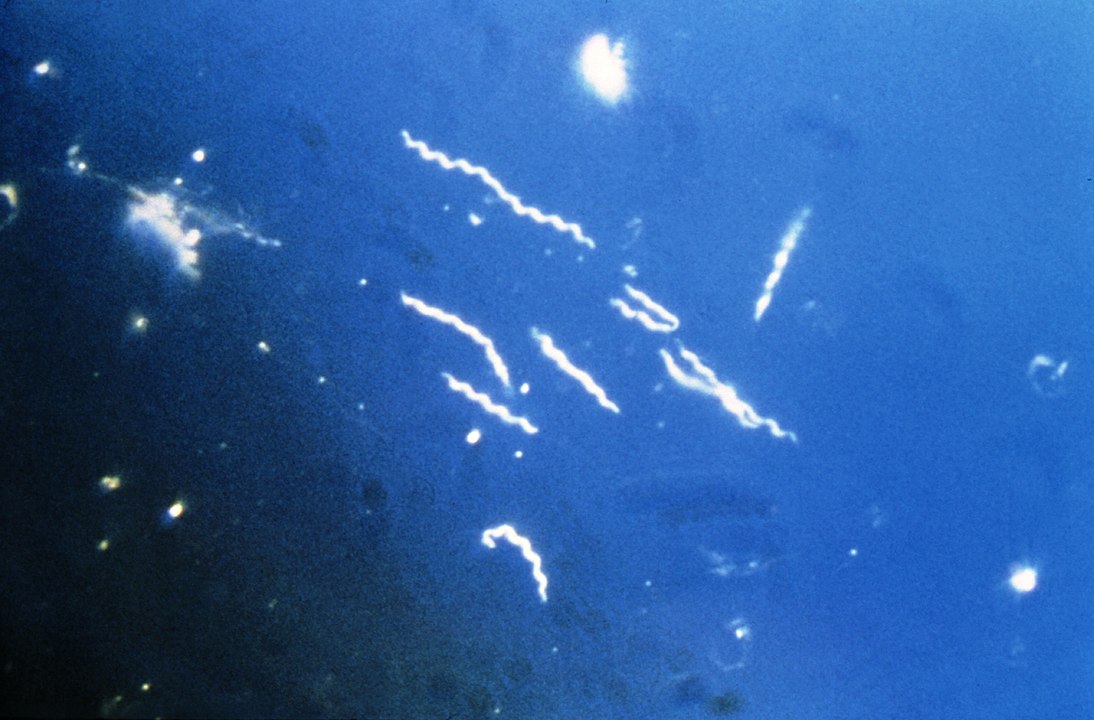
Microscopía de campo oscuro de Borrelia burgdorferi
Imagen: “Borrelia burgdorferi (CDC-PHIL-6631) lores” por CDC. Licencia: Dominio Público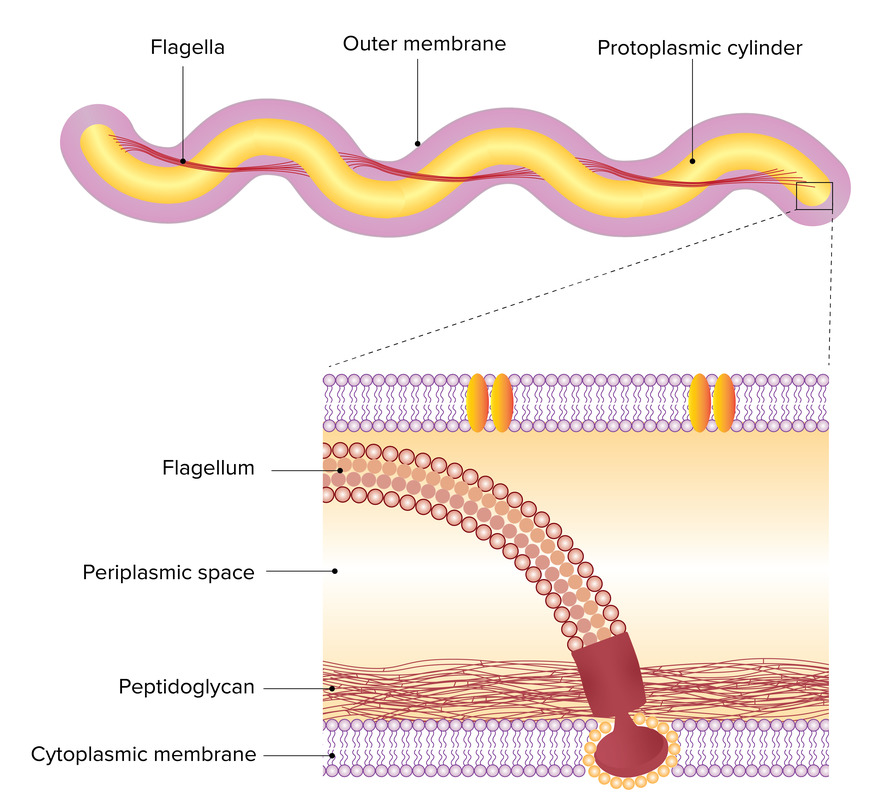
Filamentos axiales de Borrelia:
Los filamentos axiales están formados por múltiples flagelos periplásmicos (imagen inferior). Esto permite que la espiroqueta (imagen superior) se mueva de manera giratoria.
Las siguientes enfermedades son causadas por Borrelia Borrelia Borrelia are gram-negative microaerophilic spirochetes. Owing to their small size, they are not easily seen on Gram stain but can be visualized using dark-field microscopy, Giemsa, or Wright stain. Spirochetes are motile and move in a characteristic spinning fashion due to axial filaments in the periplasmic space. Borrelia:
| Enfermedad | Enfermedad de Lyme | Fiebre recurrente |
|---|---|---|
| Especies asociadas |
|
|
| Manifestaciones clínicas |
|
|
| Complicaciones |
|
|
| Diagnóstico | Clínico, apoyado usando ELISA ELISA An immunoassay utilizing an antibody labeled with an enzyme marker such as horseradish peroxidase. While either the enzyme or the antibody is bound to an immunosorbent substrate, they both retain their biologic activity; the change in enzyme activity as a result of the enzyme-antibody-antigen reaction is proportional to the concentration of the antigen and can be measured spectrophotometrically or with the naked eye. Many variations of the method have been developed. St. Louis Encephalitis Virus y Western blot | Microscopía clínica de campo oscuro, tinción de Giemsa, o tinción de Wright de frotis de sangre |
| Tratamiento |
|
|
| Prevención |
|
|
TBRF: fiebre recurrente transmitida por garrapatas (en inglés)
LBRF: fiebre recurrente transmitida por piojos (en inglés)
AV: auriculoventricular
SDRA: síndrome de dificultad respiratoria aguda
ELISA: ensayo inmunoabsorbente ligado a enzimas (en inglés)
PEP: profilaxis post-exposición (en inglés)
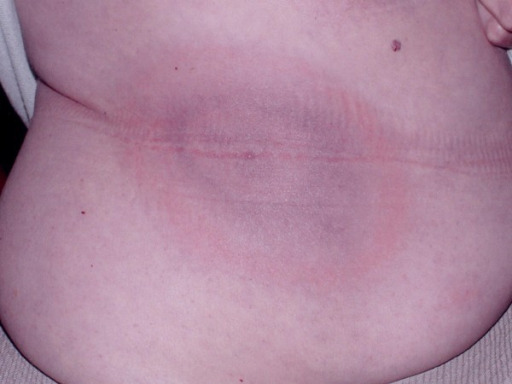
Erupción clásica de eritema migratorio de Borrelia burgdorferi
Imagen: “Diagnostic challenges of early Lyme disease: lessons from a community case series” por Aucott J, Morrison C, Muñoz B, Rowe PC, Schwarzwalder A, West SK. Licencia: CC BY 2.0Las espiroquetas son gram-negativas, en EN Erythema nodosum is an immune-mediated panniculitis (inflammation of the subcutaneous fat) caused by a type IV (delayed-type) hypersensitivity reaction. It commonly manifests in young women as tender, erythematous nodules on the shins. Erythema Nodosum forma de espiral y móviles. La siguiente tabla compara brevemente algunas espiroquetas clínicamente relevantes:
| Organismo | Treponema pallidum Treponema pallidum The causative agent of venereal and non-venereal syphilis as well as yaws. Treponema pallidum | Otras subespecies deT. pallidum | Treponema carateum Treponema carateum Treponema | Borrelia Borrelia Borrelia are gram-negative microaerophilic spirochetes. Owing to their small size, they are not easily seen on Gram stain but can be visualized using dark-field microscopy, Giemsa, or Wright stain. Spirochetes are motile and move in a characteristic spinning fashion due to axial filaments in the periplasmic space. Borrelia burgdorfi | Borrelia recurrentis Borrelia recurrentis Borrelia | Leptospira interrogans Leptospira interrogans A genus of question mark-shaped bacteria spirochetes which is found in freshwater that is contaminated by animal urine. It causes leptospirosis. Leptospira/Leptospirosis |
|---|---|---|---|---|---|---|
| Micro |
|
|
|
|
|
|
| Virulencia |
|
|
|
|
Variación antigénica |
|
| Reservorio | Humanos | Humanos | Humanos |
|
Humanos |
|
| Transmisión | Contacto sexual | Contacto P2P | Contacto P2P | Garrapata Ixodes | Piojo | Contacto directo con tejidos o fluidos animales |
| Hallazgos clínicos | Sífilis |
|
Pinta Pinta An infectious disease of the skin caused by treponema carateum that occurs only in the Western hemisphere. Age of onset is between 10 and 20 years of age. This condition is characterized by marked changes in the skin color and is believed to be transmitted by direct person-to-person contact. Yaws, Bejel, and Pinta | Enfermedad de Lyme | Fiebre recurrente |
|
| Diagnóstico |
|
Análisis de frotis de sangre |
|
|||
| Tratamiento |
|
|
|
|
|
|
Osp: proteína de superficie externa (en inglés)
LPS: lipopolisacárido
P2P: persona a persona (en inglés)
Microaero: microaerofílico
VDRL: prueba del Venereal Disease Research Laboratory
FTA-ABS: absorción de anticuerpos treponémicos fluorescentes (en inglés)
ELISA: ensayo inmunoabsorbente ligado a enzimas (en inglés)
PCR: reacción en cadena de la polimerasa (en inglés)
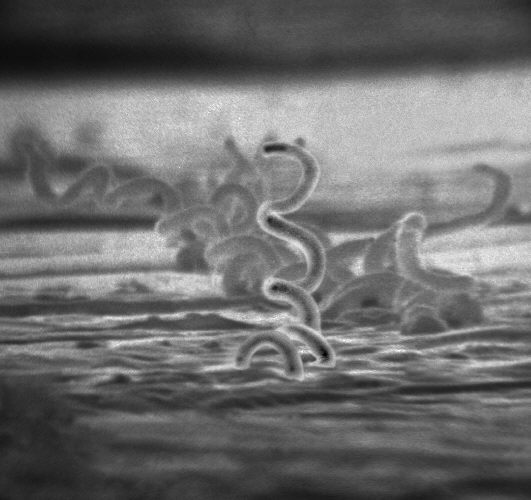
Comparación visual de espiroquetas en micrografía electrónica: espirales gruesas de Treponema
Imagen: “Treponema pallidum” por Dr. David Cox. Licencia: Dominio Público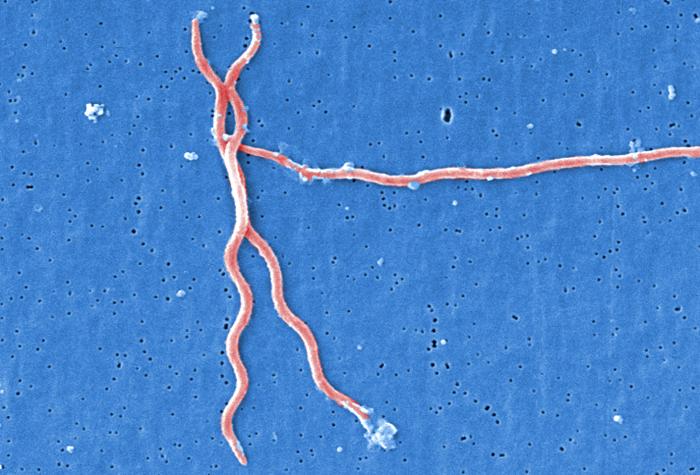
Comparación visual de espiroquetas en micrografía electrónica: Borrelia, que son más grandes que Treponema
Imagen: “Lyme disease parasite, Borrelia burgdorferi” por Claudia Molins. Licencia: Dominio Público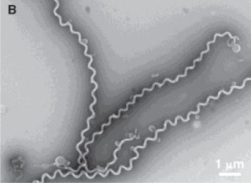
Comparación visual de espiroquetas en micrografía electrónica: extremos en forma de gancho de Leptospira
Imagen: “A filtration-based technique for simultaneous SEM and TEM sample preparation for the rapid detection of pathogens” por Beniac DR, Siemens CG, Wright CJ, Booth TF. Licencia: CC BY 3.0, editada por Lecturio.