Domina Conceptos Médicos

Estudia para la escuela de medicina y tus examenes con Lecturio.

Asplenia

El bazo desempeña un papel crucial en EN Erythema nodosum is an immune-mediated panniculitis (inflammation of the subcutaneous fat) caused by a type IV (delayed-type) hypersensitivity reaction. It commonly manifests in young women as tender, erythematous nodules on the shins. Erythema Nodosum la función inmunitaria, filtración de la sangre y almacenamiento de las plaquetas. La asplenia Asplenia Asplenia is the absence of splenic tissue or function and can stem from several factors ranging from congenital to iatrogenic. There is a distinction between anatomic asplenia, which is due to the surgical removal of the spleen, and functional asplenia, which is due to a condition that leads to splenic atrophy, infarct, congestion, or infiltrative disease. Asplenia es la ausencia de tejido o función esplénica y puede deberse a varios factores, desde congénitos hasta iatrogénicos. Existe una distinción entre la asplenia Asplenia Asplenia is the absence of splenic tissue or function and can stem from several factors ranging from congenital to iatrogenic. There is a distinction between anatomic asplenia, which is due to the surgical removal of the spleen, and functional asplenia, which is due to a condition that leads to splenic atrophy, infarct, congestion, or infiltrative disease. Asplenia anatómica, que se debe a la extirpación quirúrgica del bazo, y la asplenia Asplenia Asplenia is the absence of splenic tissue or function and can stem from several factors ranging from congenital to iatrogenic. There is a distinction between anatomic asplenia, which is due to the surgical removal of the spleen, and functional asplenia, which is due to a condition that leads to splenic atrophy, infarct, congestion, or infiltrative disease. Asplenia funcional, que se debe a una afección que provoca atrofia esplénica, infarto, congestión o enfermedad infiltrativa. Los LOS Neisseria cuerpos de Howell-Jolly se observan habitualmente en EN Erythema nodosum is an immune-mediated panniculitis (inflammation of the subcutaneous fat) caused by a type IV (delayed-type) hypersensitivity reaction. It commonly manifests in young women as tender, erythematous nodules on the shins. Erythema Nodosum el frotis de sangre periférica. Para el diagnóstico se utilizan imágenes abdominales y gammagrafías. El alto riesgo de sepsis Sepsis Systemic inflammatory response syndrome with a proven or suspected infectious etiology. When sepsis is associated with organ dysfunction distant from the site of infection, it is called severe sepsis. When sepsis is accompanied by hypotension despite adequate fluid infusion, it is called septic shock. Sepsis and Septic Shock por bacterias encapsuladas requiere el cumplimiento de un estricto calendario de vacunación y un tratamiento antibiótico temprano cuando se sospecha una infección. Los LOS Neisseria eventos tromboembólicos son comunes.

Last updated: Dec 15, 2025

Editorial responsibility: Stanley Oiseth, Lindsay Jones, Evelin Maza

Descripción General

Definición

El bazo es uno de los LOS Neisseria órganos linfáticos secundarios fundamentales para la función inmunitaria, que desempeña un papel en EN Erythema nodosum is an immune-mediated panniculitis (inflammation of the subcutaneous fat) caused by a type IV (delayed-type) hypersensitivity reaction. It commonly manifests in young women as tender, erythematous nodules on the shins. Erythema Nodosum el filtrado de la sangre y la eliminación de eritrocitos viejos o dañados. La asplenia Asplenia Asplenia is the absence of splenic tissue or function and can stem from several factors ranging from congenital to iatrogenic. There is a distinction between anatomic asplenia, which is due to the surgical removal of the spleen, and functional asplenia, which is due to a condition that leads to splenic atrophy, infarct, congestion, or infiltrative disease. Asplenia se define como la ausencia de bazo o de función esplénica.

Etiología

  • Congénita:
    • Componente del síndrome de heterotaxia que afecta a los LOS Neisseria órganos del tórax y del abdomen
    • Herencia autosómica dominante
  • Funcional:
    • Atrofia
    • Infarto
    • Congestión
    • Infiltración
  • Adquirido:
    • Extirpación quirúrgica: la causa más común
    • Rotura esplénica

Epidemiología

La epidemiología difiere según la etiología.

  • Congénita:
    • Rara
    • La asplenia Asplenia Asplenia is the absence of splenic tissue or function and can stem from several factors ranging from congenital to iatrogenic. There is a distinction between anatomic asplenia, which is due to the surgical removal of the spleen, and functional asplenia, which is due to a condition that leads to splenic atrophy, infarct, congestion, or infiltrative disease. Asplenia sindrómica predomina en EN Erythema nodosum is an immune-mediated panniculitis (inflammation of the subcutaneous fat) caused by a type IV (delayed-type) hypersensitivity reaction. It commonly manifests in young women as tender, erythematous nodules on the shins. Erythema Nodosum los LOS Neisseria hombres.
    • La enfermedad celíaca, el procedimiento de Whipple y la hepatopatía alcohólica están fuertemente asociados a la disfunción esplénica parcial.
  • Asplenia Asplenia Asplenia is the absence of splenic tissue or function and can stem from several factors ranging from congenital to iatrogenic. There is a distinction between anatomic asplenia, which is due to the surgical removal of the spleen, and functional asplenia, which is due to a condition that leads to splenic atrophy, infarct, congestion, or infiltrative disease. Asplenia funcional: Casi todos los LOS Neisseria pacientes con anemia Anemia Anemia is a condition in which individuals have low Hb levels, which can arise from various causes. Anemia is accompanied by a reduced number of RBCs and may manifest with fatigue, shortness of breath, pallor, and weakness. Subtypes are classified by the size of RBCs, chronicity, and etiology. Anemia: Overview and Types falciforme (y otras hemoglobinopatías) padecerán asplenia Asplenia Asplenia is the absence of splenic tissue or function and can stem from several factors ranging from congenital to iatrogenic. There is a distinction between anatomic asplenia, which is due to the surgical removal of the spleen, and functional asplenia, which is due to a condition that leads to splenic atrophy, infarct, congestion, or infiltrative disease. Asplenia funcional.
  • Adquirida: La incidencia de la esplenectomía quirúrgica está disminuyendo debido a las nuevas técnicas quirúrgicas.

Fisiopatología

  • La asplenia Asplenia Asplenia is the absence of splenic tissue or function and can stem from several factors ranging from congenital to iatrogenic. There is a distinction between anatomic asplenia, which is due to the surgical removal of the spleen, and functional asplenia, which is due to a condition that leads to splenic atrophy, infarct, congestion, or infiltrative disease. Asplenia funcional suele comenzar con un hipoesplenismo:
    • Atrapamiento de eritrocitos
    • Infarto
    • Hipoesplenismo
    • Autoesplenectomía
  • Alteración en EN Erythema nodosum is an immune-mediated panniculitis (inflammation of the subcutaneous fat) caused by a type IV (delayed-type) hypersensitivity reaction. It commonly manifests in young women as tender, erythematous nodules on the shins. Erythema Nodosum la función de filtrado de bacterias: mayor riesgo de sepsis Sepsis Systemic inflammatory response syndrome with a proven or suspected infectious etiology. When sepsis is associated with organ dysfunction distant from the site of infection, it is called severe sepsis. When sepsis is accompanied by hypotension despite adequate fluid infusion, it is called septic shock. Sepsis and Septic Shock debido a bacterias encapsuladas
    • Haemophilus influenzae Haemophilus Influenzae A species of Haemophilus found on the mucous membranes of humans and a variety of animals. The species is further divided into biotypes I through viii. Haemophilus
    • Streptococcus Streptococcus Streptococcus is one of the two medically important genera of gram-positive cocci, the other being Staphylococcus. Streptococci are identified as different species on blood agar on the basis of their hemolytic pattern and sensitivity to optochin and bacitracin. There are many pathogenic species of streptococci, including S. pyogenes, S. agalactiae, S. pneumoniae, and the viridans streptococci. Streptococcus pneumoniae
    • Neisseria meningitidis Neisseria meningitidis A species of gram-negative, aerobic bacteria. It is a commensal and pathogen only of humans, and can be carried asymptomatically in the nasopharynx. When found in cerebrospinal fluid it is the causative agent of cerebrospinal meningitis. It is also found in venereal discharges and blood. There are at least 13 serogroups based on antigenic differences in the capsular polysaccharides; the ones causing most meningitis infections being a, b, c, y, and w-135. Each serogroup can be further classified by serotype, serosubtype, and immunotype. Neisseria
    • Escherichia coli Escherichia coli The gram-negative bacterium Escherichia coli is a key component of the human gut microbiota. Most strains of E. coli are avirulent, but occasionally they escape the GI tract, infecting the urinary tract and other sites. Less common strains of E. coli are able to cause disease within the GI tract, most commonly presenting as abdominal pain and diarrhea. Escherichia coli
    • Klebsiella Klebsiella Klebsiella are encapsulated gram-negative, lactose-fermenting bacilli. They form pink colonies on MacConkey agar due to lactose fermentation. The main virulence factor is a polysaccharide capsule. Klebsiella pneumoniae is the most important pathogenic species. Klebsiella
  • Mayor riesgo de eventos vasculares:
    • Secundario a trombocitosis
    • Aumento de la circulación de eritrocitos dañados
Tabla: Causas de asplenia Asplenia Asplenia is the absence of splenic tissue or function and can stem from several factors ranging from congenital to iatrogenic. There is a distinction between anatomic asplenia, which is due to the surgical removal of the spleen, and functional asplenia, which is due to a condition that leads to splenic atrophy, infarct, congestion, or infiltrative disease. Asplenia por categoría
Categoría Enfermedad/condición
Congénito
  • Síndrome de heterotaxia
  • Síndrome de Ivemark
Iatrogénica
  • Esplenectomía (post trauma)
  • Irradiación
Circulatorias
  • Trombosis de la arteria/vena esplénica
  • Trombosis de la arteria celíaca
Hematológicas/oncológicas
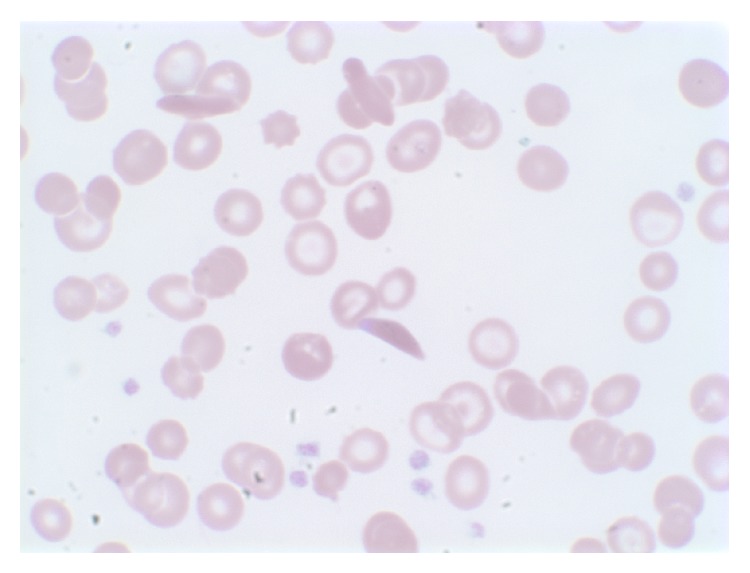
  • Enfermedad de células falciformes
  • Esferocitosis hereditaria
  • Trastornos mieloproliferativos
  • Enfermedad de injerto contra huésped
  • Malignidad (leucemia, linfoma, metástasis)
Hepáticas
  • Hepatopatía alcohólica/cirrosis
  • Hepatitis crónica
  • Hipertensión portal
Autoinmune
  • Lupus eritematoso sistémico
  • Tiroiditis
  • Sarcoidosis Sarcoidosis Sarcoidosis is a multisystem inflammatory disease that causes noncaseating granulomas. The exact etiology is unknown. Sarcoidosis usually affects the lungs and thoracic lymph nodes, but it can also affect almost every system in the body, including the skin, heart, and eyes, most commonly. Sarcoidosis
  • Artritis reumatoide
Gastrointestinales
  • Enfermedad celíaca
  • Enfermedad inflamatoria intestinal
  • Enfermedad de Whipple
Infecciosa
  • SIDA
  • Malaria Malaria Malaria is an infectious parasitic disease affecting humans and other animals. Most commonly transmitted via the bite of a female Anopheles mosquito infected with microorganisms of the Plasmodium genus. Patients present with fever, chills, myalgia, headache, and diaphoresis. Plasmodium/Malaria
  • Infecciones bacterianas por Neumococcus, Haemophilus influenzae Haemophilus Influenzae A species of Haemophilus found on the mucous membranes of humans and a variety of animals. The species is further divided into biotypes I through viii. Haemophilus, Neisseria Neisseria Neisseria is a genus of bacteria commonly present on mucosal surfaces. Several species exist, but only 2 are pathogenic to humans: N. gonorrhoeae and N. meningitidis. Neisseria species are non-motile, gram-negative diplococci most commonly isolated on modified Thayer-Martin (MTM) agar. Neisseria
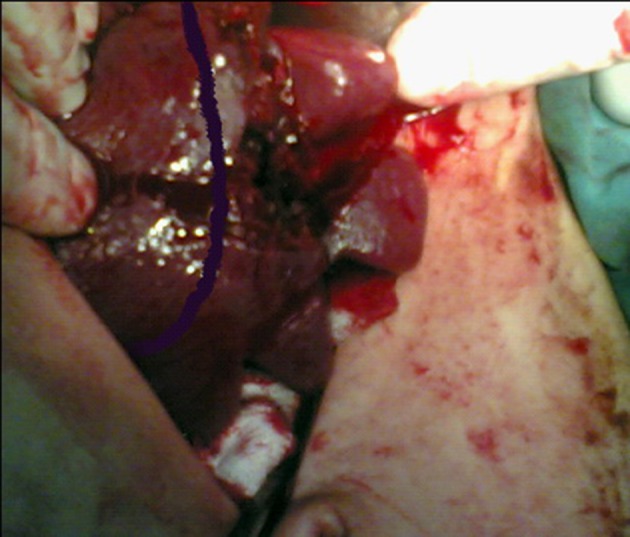
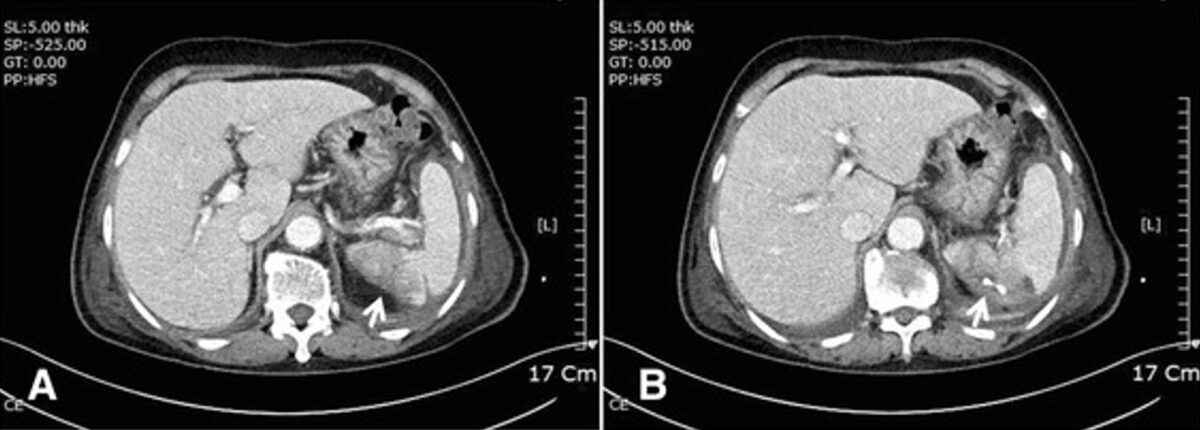
Lesión esplénica en estadio IV

Lesión esplénica en estadio IV en un paciente de 34 años

Imagen: “Stage IV Splenic injury in a 34 Year Old Patient” por Eskandarlou, M., Derakhshanfar, A. Licencia: CC BY 3.0
Diagnóstico

  • Antecedentes y examen físico:
    • Antecedentes de síndrome, condición o traumatismo predisponentes
    • Antecedentes quirúrgicos
  • Pruebas de laboratorio:
    • Frotis de sangre periférica:
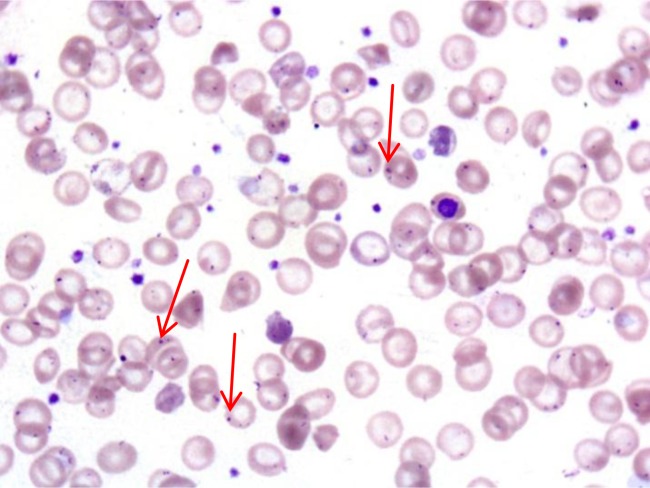
      • Cuerpos de Howell-Jolly. Patognomónico
      • Cuerpos de Heinz, células diana, eritrocitos con pits. Común
    • Hemograma
      • Neutrofilia
      • Trombocitosis
  • Imagenología:
    • Radiografía simple:
      • Revela la orientación anormal de los LOS Neisseria órganos en EN Erythema nodosum is an immune-mediated panniculitis (inflammation of the subcutaneous fat) caused by a type IV (delayed-type) hypersensitivity reaction. It commonly manifests in young women as tender, erythematous nodules on the shins. Erythema Nodosum los LOS Neisseria síndromes de heterotaxia
      • Puede ser útil en EN Erythema nodosum is an immune-mediated panniculitis (inflammation of the subcutaneous fat) caused by a type IV (delayed-type) hypersensitivity reaction. It commonly manifests in young women as tender, erythematous nodules on the shins. Erythema Nodosum caso de traumatismo
    • RM
    • Ultrasonido
    • Gammagrafía

Tratamiento

El tratamiento depende de la causa subyacente, el grado de asplenia Asplenia Asplenia is the absence of splenic tissue or function and can stem from several factors ranging from congenital to iatrogenic. There is a distinction between anatomic asplenia, which is due to the surgical removal of the spleen, and functional asplenia, which is due to a condition that leads to splenic atrophy, infarct, congestion, or infiltrative disease. Asplenia y la edad. Los LOS Neisseria pacientes > 5 años tienen un mejor pronóstico. La prevención de infecciones es la piedra angular de los LOS Neisseria cuidados a largo plazo, debido al AL Amyloidosis mayor riesgo de septicemia de rápida evolución, que es mortal en EN Erythema nodosum is an immune-mediated panniculitis (inflammation of the subcutaneous fat) caused by a type IV (delayed-type) hypersensitivity reaction. It commonly manifests in young women as tender, erythematous nodules on the shins. Erythema Nodosum el 50% de los LOS Neisseria pacientes.

Control de la infección

  • Vacunación de rutina:
    • Neumococo
    • Meningococo
    • H. influenzae H. influenzae A species of Haemophilus found on the mucous membranes of humans and a variety of animals. The species is further divided into biotypes I through VIII. Haemophilus (tipo B)
    • Influenza Influenza Influenza viruses are members of the Orthomyxoviridae family and the causative organisms of influenza, a highly contagious febrile respiratory disease. There are 3 primary influenza viruses (A, B, and C) and various subtypes, which are classified based on their virulent surface antigens, hemagglutinin (HA) and neuraminidase (NA). Influenza typically presents with a fever, myalgia, headache, and symptoms of an upper respiratory infection. Influenza Viruses/Influenza
  • Profilaxis antibiótica:
    • Durante 1–3 años después de la esplenectomía
    • Hasta 5 años de edad
    • Procedimientos quirúrgicos que pueden predisponer a la infección por bacterias encapsuladas
    • De por vida, si hay antecedentes de sepsis Sepsis Systemic inflammatory response syndrome with a proven or suspected infectious etiology. When sepsis is associated with organ dysfunction distant from the site of infection, it is called severe sepsis. When sepsis is accompanied by hypotension despite adequate fluid infusion, it is called septic shock. Sepsis and Septic Shock post-esplenectomía
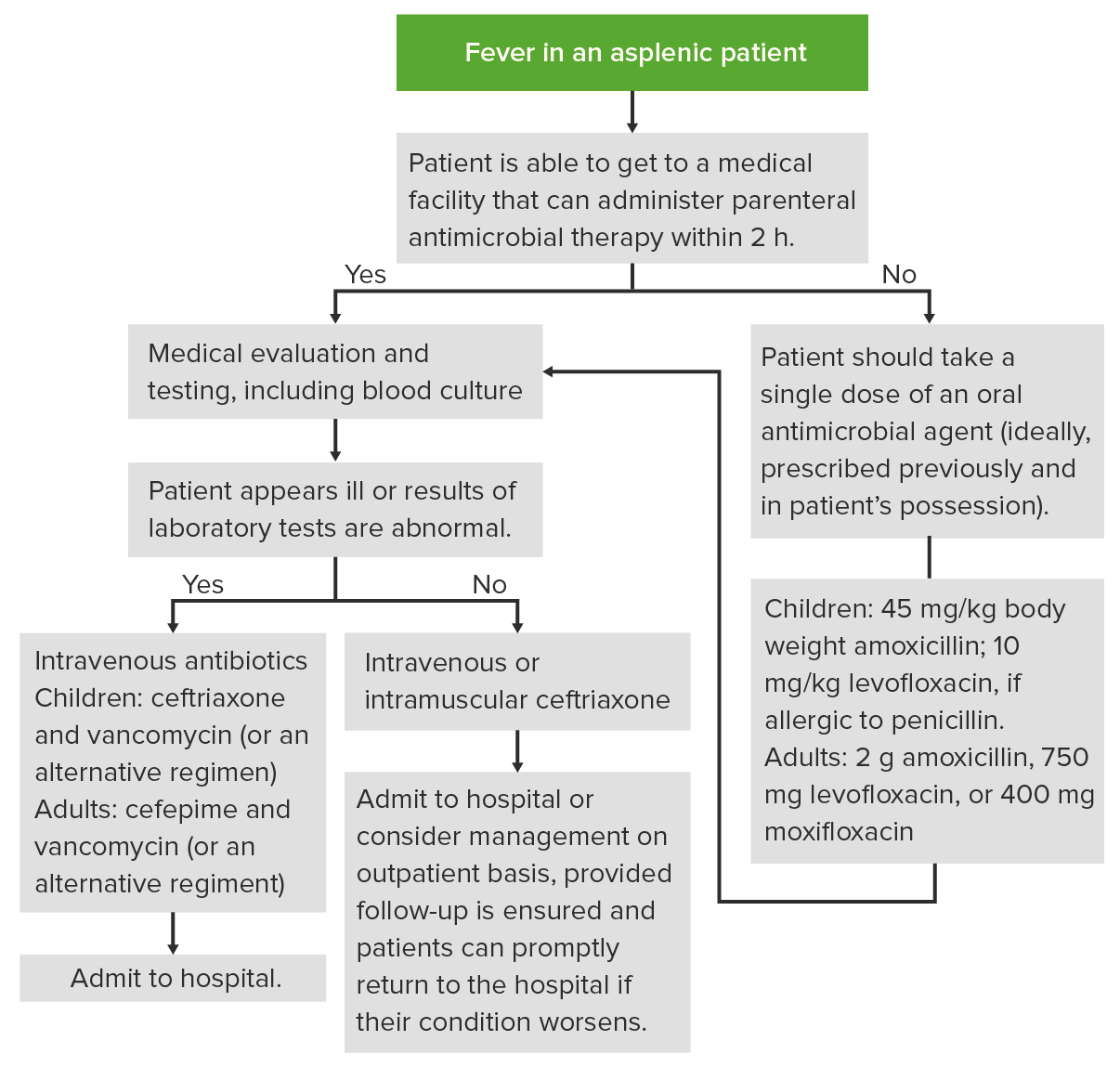
  • Tratamiento antibiótico empírico: indicado de forma precoz cuando el paciente presenta fiebre u otros signos de infección

Síndrome de sepsis Sepsis Systemic inflammatory response syndrome with a proven or suspected infectious etiology. When sepsis is associated with organ dysfunction distant from the site of infection, it is called severe sepsis. When sepsis is accompanied by hypotension despite adequate fluid infusion, it is called septic shock. Sepsis and Septic Shock grave post-esplenectomía ( OPSI OPSI Asplenia)

Septicemia de inicio rápido:

  • Infección sin origen definitivo acompañada de CID
  • Tasa de mortalidad: 50%–70%
Manejo de la fiebre en un paciente asplénico
Tratamiento de un episodio de fiebre en un paciente asplenico
Imagen por Lecturio. Licencia: CC BY-NC-SA 4.0

Relevancia Clínica

  • Traumatismo abdominal cerrado y lesión abdominal penetrante: las lesiones abdominales se clasifican en EN Erythema nodosum is an immune-mediated panniculitis (inflammation of the subcutaneous fat) caused by a type IV (delayed-type) hypersensitivity reaction. It commonly manifests in young women as tender, erythematous nodules on the shins. Erythema Nodosum cerradas o penetrantes, según el mecanismo de la lesión. Pueden lesionarse diferentes estructuras, como el duodeno, el bazo, el hígado, los LOS Neisseria riñones y los LOS Neisseria órganos pélvicos. En EN Erythema nodosum is an immune-mediated panniculitis (inflammation of the subcutaneous fat) caused by a type IV (delayed-type) hypersensitivity reaction. It commonly manifests in young women as tender, erythematous nodules on the shins. Erythema Nodosum caso de lesión esplénica grave, puede ser necesario realizar una esplenectomía para extirpar el bazo.
  • Mononucleosis: también conocida como “enfermedad del beso” o mononucleosis Mononucleosis Infectious mononucleosis (IM), also known as “the kissing disease,” is a highly contagious viral infection caused by the Epstein-Barr virus. Its common name is derived from its main method of transmission: the spread of infected saliva via kissing. Clinical manifestations of IM include fever, tonsillar pharyngitis, and lymphadenopathy. Mononucleosis infecciosa. La mononucleosis Mononucleosis Infectious mononucleosis (IM), also known as “the kissing disease,” is a highly contagious viral infection caused by the Epstein-Barr virus. Its common name is derived from its main method of transmission: the spread of infected saliva via kissing. Clinical manifestations of IM include fever, tonsillar pharyngitis, and lymphadenopathy. Mononucleosis es una infección viral altamente contagiosa causada por el EBV EBV Epstein-barr virus (EBV) is a linear, double-stranded DNA virus belonging to the herpesviridae family. This highly prevalent virus is mostly transmitted through contact with oropharyngeal secretions from an infected individual. The virus can infect epithelial cells and B lymphocytes, where it can undergo lytic replication or latency. Epstein-Barr Virus. El nombre común de la mononucleosis Mononucleosis Infectious mononucleosis (IM), also known as “the kissing disease,” is a highly contagious viral infection caused by the Epstein-Barr virus. Its common name is derived from its main method of transmission: the spread of infected saliva via kissing. Clinical manifestations of IM include fever, tonsillar pharyngitis, and lymphadenopathy. Mononucleosis proviene de su principal método de transmisión: el traspaso de saliva Saliva The clear, viscous fluid secreted by the salivary glands and mucous glands of the mouth. It contains mucins, water, organic salts, and ptyalin. Salivary Glands: Anatomy infectada a través de los LOS Neisseria besos. Durante las infecciones agudas por el EBV EBV Epstein-barr virus (EBV) is a linear, double-stranded DNA virus belonging to the herpesviridae family. This highly prevalent virus is mostly transmitted through contact with oropharyngeal secretions from an infected individual. The virus can infect epithelial cells and B lymphocytes, where it can undergo lytic replication or latency. Epstein-Barr Virus, el bazo puede agrandarse y romperse, ya sea de forma espontánea (poco frecuente) o debido a su mayor vulnerabilidad a los LOS Neisseria traumatismos.
  • Bazo: órgano con forma de grano de café situado en EN Erythema nodosum is an immune-mediated panniculitis (inflammation of the subcutaneous fat) caused by a type IV (delayed-type) hypersensitivity reaction. It commonly manifests in young women as tender, erythematous nodules on the shins. Erythema Nodosum la parte posterior izquierda del abdomen superior (región del hipocondrio izquierdo) y que pesa unos 150 gramos. El bazo se compone de un tejido muy blando, el cual se llena de sangre que fluye a través del parénquima y filtra los LOS Neisseria glóbulos rojos y blancos viejos o anormales. El bazo también desempeña un papel en EN Erythema nodosum is an immune-mediated panniculitis (inflammation of the subcutaneous fat) caused by a type IV (delayed-type) hypersensitivity reaction. It commonly manifests in young women as tender, erythematous nodules on the shins. Erythema Nodosum la función inmunitaria al AL Amyloidosis eliminar agentes patógenos y producir anticuerpos. Debido a su naturaleza frágil y a su gran vascularización, el bazo puede romperse fácilmente durante un traumatismo abdominal, especialmente cuando su tamaño está aumentado.
  • Esplenomegalia: agrandamiento masivo del bazo que lo hace HACE Altitude Sickness palpable por debajo del reborde costal izquierdo. Las ecografías muestran una forma abultada y un redondeo de los LOS Neisseria extremos normalmente puntiagudos. Cualquier tejido ectópico, como los LOS Neisseria bazos accesorios, también estarán hipertrofiados. El agrandamiento del bazo puede producirse por diferentes motivos, como una infección, una hemorragia interna o el secuestro de células sanguíneas anormales. El agrandamiento del bazo le aumenta el riesgo de ruptura durante un traumatismo.

Referencias

  1. Lee, G. M. (2020). Preventing infections in children and adults with asplenia. Hematology: American Society of Hematology Education Program, 2020(1), 328–335. https://doi.org/10.1182/hematology.2020000117
  2. Stiehm, E. R. (Ed.). (2020). Asplenia. In Stiehm’s Immune Deficiencies (2nd ed.). Elsevier. Retrieved April 11, 2025, from https://www.sciencedirect.com/topics/immunology-and-microbiology/asplenia
  3. Quinti, I., Paganelli, R. (2014). Chapter 45. In Sullivan, K., and Stiehm, R. (Ed.), Stiehm’s Immune Deficiencies Inborn Errors of Metabolism. 1st ed. pp. 835–844. Retrieved April 12, 2021, from https://doi.org/10.1016/B978-0-12-405546-9.00045-5
  4. Chen, M.J., Huang, M.J., et al. (2005). Ultrasonography of splenic abnormalities. World Journal of Gastroenterology. 11(26), 4061–4066. Retrieved April 11, 2025, from http://dx.doi.org/10.3748/wjg.v11.i26.4061
  5. Rubin, L., Schaffner, W. (2014). Care of the asplenic patient. New England Journal of Medicine. 371, 349–356. Retrieved April 11, 2025, from https://doi.org/10.1056/NEJMcp1314291
  6. Pasternack, M. S. (2025, March 25). Prevention of infection in patients with impaired splenic function. In D. Spelman, M. S. Edwards, & N. White (Eds.), UpToDate. Retrieved April 11, 2025, from https://www.uptodate.com/contents/prevention-of-infection-in-patients-with-impaired-splenic-function

¡Crea tu cuenta gratis o inicia una sesión para seguir leyendo!

Regístrate ahora y obtén acceso gratuito a Lecturio con páginas de concepto, videos médicos y cuestionarios para tu educación médica.

User Reviews

Que tengas una sesión de estudio alegre y navideña 🎁 Ahorra 50% en todos los planes >>

Details