Domina Conceptos Médicos

Estudia para la escuela de medicina y tus examenes con Lecturio.

Actinomyces/Actinomicosis

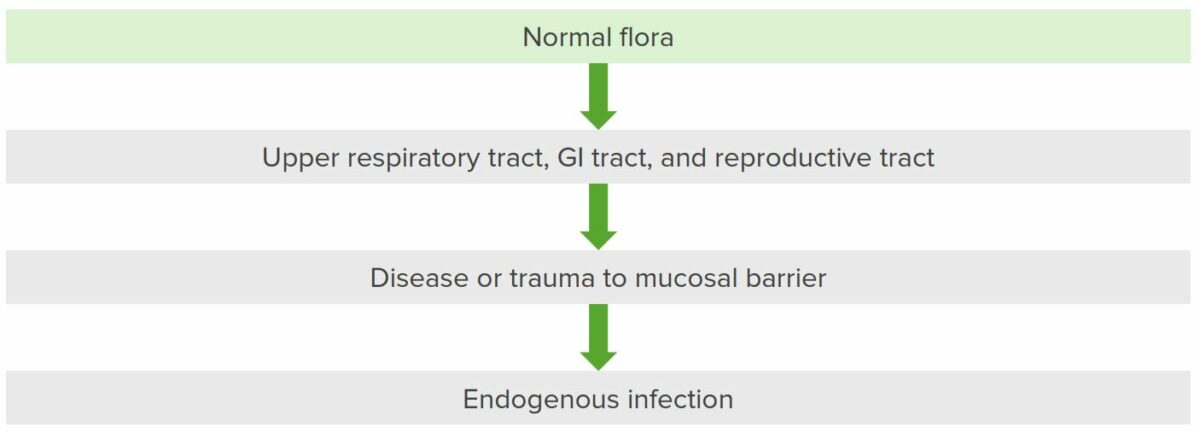
Actinomyces es un bacilo anaerobio, gram-positivo, ramificado y filamentoso. Actinomyces israelii es la especie más comúnmente implicada en enfermedades humanas. El organismo suele encontrarse como parte de la flora normal en la cavidad oral, el tracto gastrointestinal y el tracto reproductivo. La enfermedad se produce cuando el organismo se desplaza incluso por un traumatismo o procedimiento menor, lo que permite que el organismo se mueva más allá de la barrera mucosa. El alcanzar áreas de bajo oxígeno conduce a la multiplicación del organismo. Actinomyces se asocia con infección cervicofacial, que forma tractos sinusales que drenan. Actinomyces también puede afectar las áreas torácica, abdominal y pélvica. El drenaje o el tejido infectado pueden tener los característicos gránulos amarillos de azufre asociados con Actinomyces. El tratamiento es con penicilina a largo plazo y cirugía, si es necesario.

Last updated: Dec 15, 2025
Editorial responsibility: Stanley Oiseth, Lindsay Jones, Evelin Maza

Clasificación

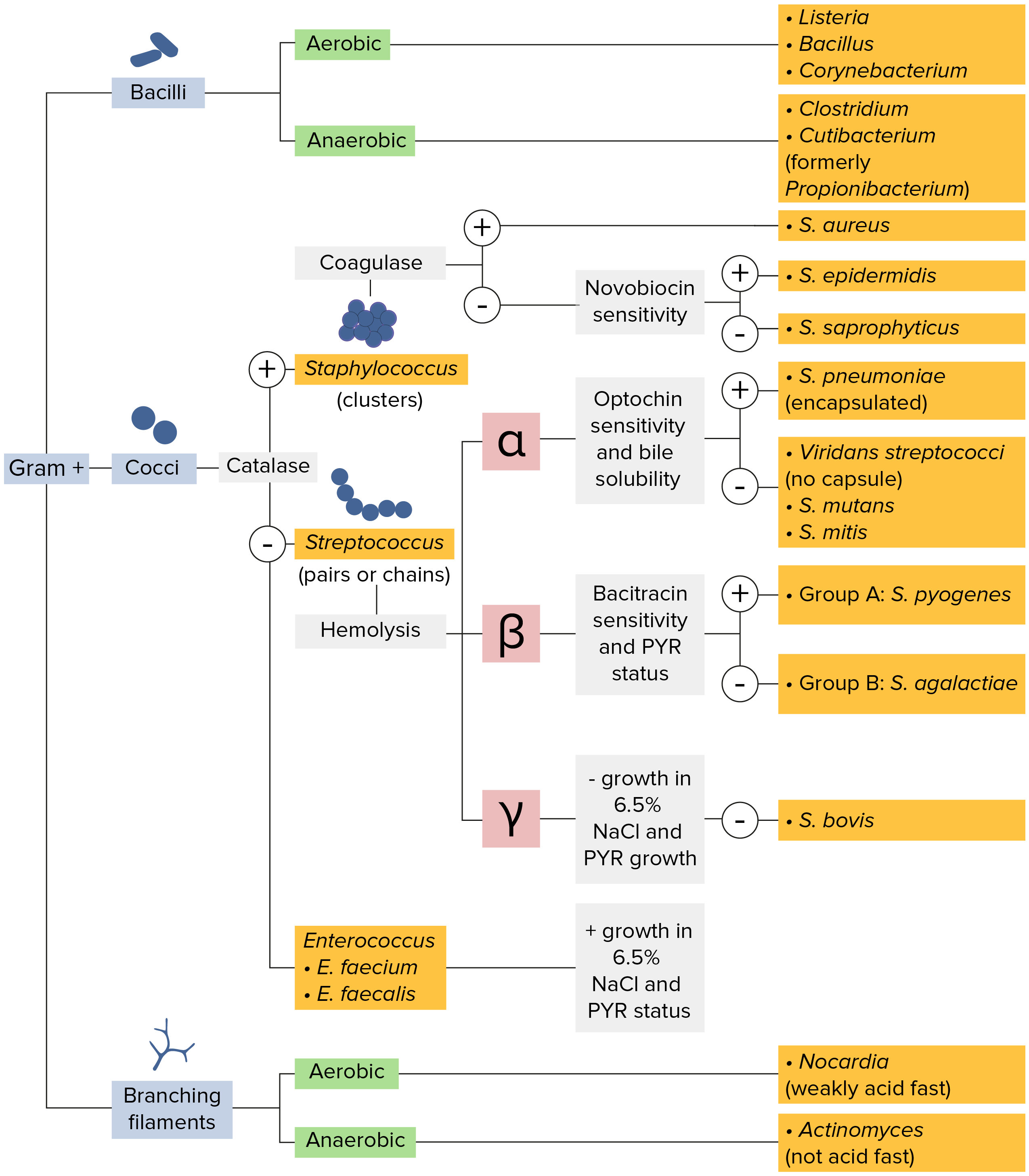
Diagrama de flujo de microbiología clasificación de bacterias grampositivas

Bacterias gram-positivas:
La mayoría de las bacterias se pueden clasificar de acuerdo con un procedimiento de laboratorio llamado tinción de Gram.
Las bacterias con paredes celulares que tienen una capa gruesa de peptidoglicano retienen la tinción cristal violeta utilizada en la tinción de Gram, pero no se ven afectadas por la contratinción de safranina. Estas bacterias aparecen como azul púrpura en la tinción, lo que indica que son gram-positivas. Las bacterias pueden clasificarse además según su morfología (filamentos ramificados, bacilos y cocos en grupos o cadenas) y su capacidad para crecer en presencia de oxígeno (aeróbicos versus anaeróbicos). Los cocos también pueden identificarse con mayor profundidad. Los estafilococos pueden reducirse en función de la presencia de la enzima coagulasa y de su sensibilidad al antibiótico novobiocina. Los estreptococos se cultivan en agar sangre y se clasifican según la forma de hemólisis que emplean (α, β o γ). Los estreptococos se reducen aún más en función de su respuesta a la prueba de pirrolidonil-β-naftilamida, su sensibilidad a antimicrobianos específicos (optoquina y bacitracina) y su capacidad para crecer en medios de cloruro de sodio (NaCl).
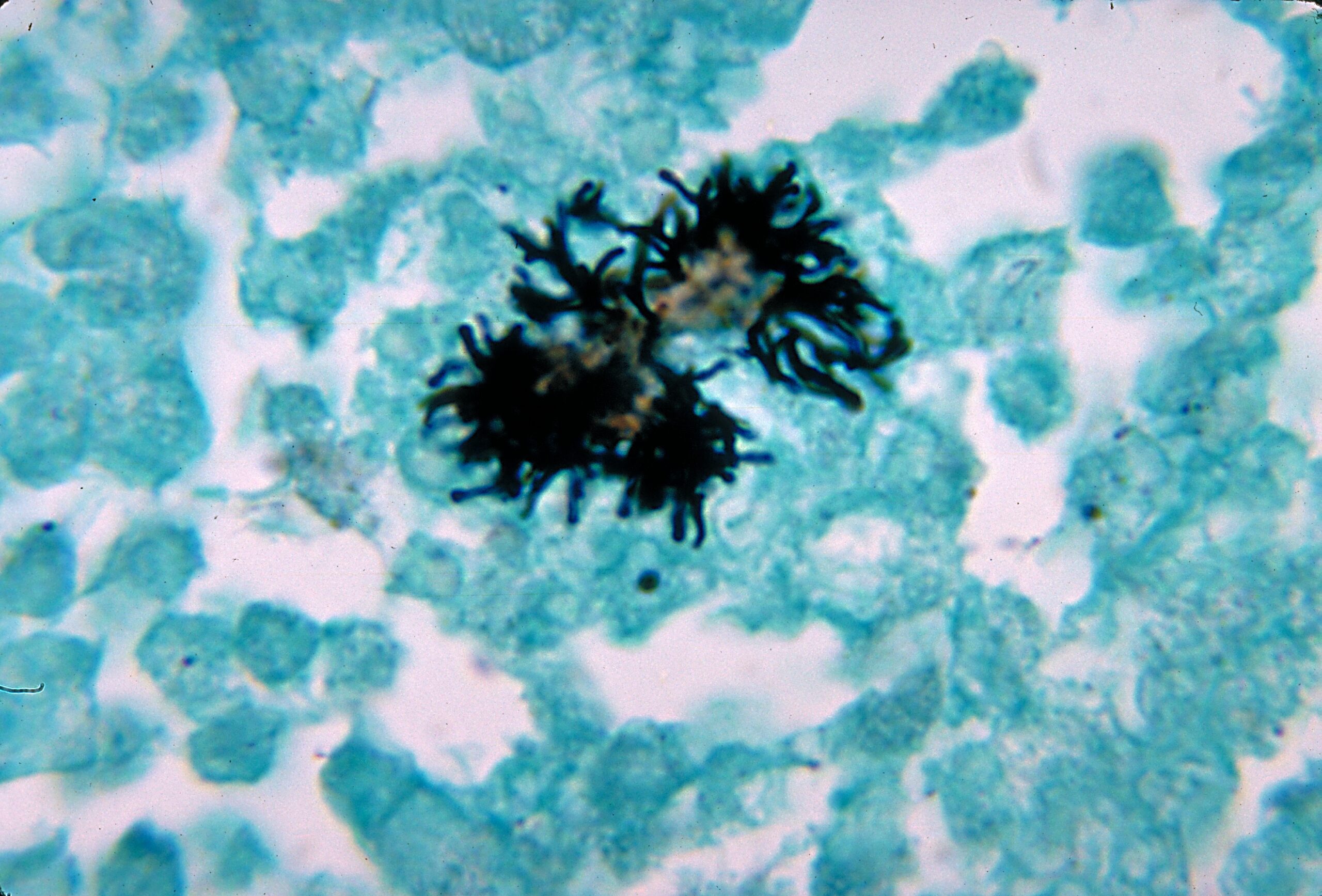
Imagen por Lecturio. Licencia: CC BY-NC-SA 4.0

Características Generales

Actinomyces Actinomyces Actinomyces is an anaerobic, gram-positive, branching, filamentous rod. Actinomyces israelii is the most common species involved in human disease. The organism is commonly found as part of the normal flora in the oral cavity, gastrointestinal tract, and reproductive tract. Actinomyces/Actinomycosis

  • Características generales:
    • Estructura: bacilos filamentosos y ramificados
    • Tinción de Gram: gram-positivo
    • Otras tinciones: no ácido-alcohol resistente
    • Formación de esporas: no formadores de esporas (diferencia a Actinomyces Actinomyces Actinomyces is an anaerobic, gram-positive, branching, filamentous rod. Actinomyces israelii is the most common species involved in human disease. The organism is commonly found as part of the normal flora in the oral cavity, gastrointestinal tract, and reproductive tract. Actinomyces/Actinomycosis de hongos)
    • Requerimiento de oxígeno: anaerobio
  • Medio de cultivo: igual que para otros anaerobios
  • Actinomicosis (causada por una enfermedad):
    • Infección crónica supurativa y granulomatosa
    • Asociada con la formación de abscesos con trayectos sinusales interconectados
    • Gránulos de azufre:
      • Hallazgo característico
      • Microcolonias de bacterias de color amarillo (sin azufre) y mazas periféricas
      • Encontrado incrustado en EN Erythema nodosum is an immune-mediated panniculitis (inflammation of the subcutaneous fat) caused by a type IV (delayed-type) hypersensitivity reaction. It commonly manifests in young women as tender, erythematous nodules on the shins. Erythema Nodosum elementos tisulares

Especies clínicamente relevantes

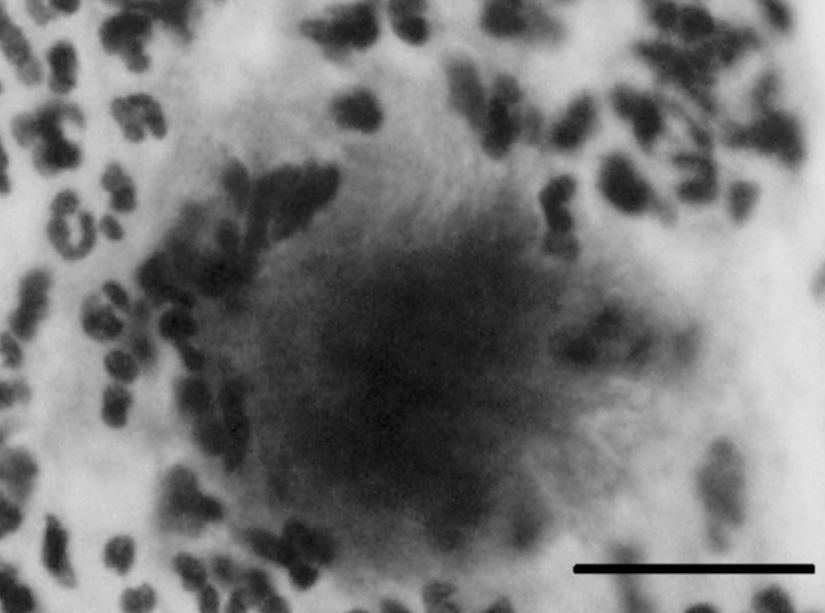
Actinomyces naeslundii

Cambios histopatológicos de un absceso cerebral debido a la bacteria A. naeslundii (en tinción de plata). Se observan bacilos ramificados.

Imagen: “Actinomyces naeslundii 01” por CDC/Dr. Lucille Georg. Licencia: Dominio Público

Epidemiología

  • Hombres > mujeres
  • Mayor prevalencia en EN Erythema nodosum is an immune-mediated panniculitis (inflammation of the subcutaneous fat) caused by a type IV (delayed-type) hypersensitivity reaction. It commonly manifests in young women as tender, erythematous nodules on the shins. Erythema Nodosum áreas socioeconómicas bajas y en EN Erythema nodosum is an immune-mediated panniculitis (inflammation of the subcutaneous fat) caused by a type IV (delayed-type) hypersensitivity reaction. It commonly manifests in young women as tender, erythematous nodules on the shins. Erythema Nodosum aquellas con mala higiene dental
  • El uso de dispositivos intrauterinos (DIU) ha HA Hemolytic anemia (HA) is the term given to a large group of anemias that are caused by the premature destruction/hemolysis of circulating red blood cells (RBCs). Hemolysis can occur within (intravascular hemolysis) or outside the blood vessels (extravascular hemolysis). Hemolytic Anemia aumentado la incidencia en EN Erythema nodosum is an immune-mediated panniculitis (inflammation of the subcutaneous fat) caused by a type IV (delayed-type) hypersensitivity reaction. It commonly manifests in young women as tender, erythematous nodules on the shins. Erythema Nodosum las mujeres.

Related videos

Patogénesis

Reservorio y transmisión

Reservorio:

  • Flora normal de:
    • Cavidad oral
    • Tracto reproductivo
    • Tracto gastrointestinal

Transmisión:

  • El traumatismo desplaza el organismo.
  • La ruptura de la barrera mucosa y el desplazamiento a zonas con poco oxígeno (ambiente anaeróbico) facilitan su multiplicación.

Factores de riesgo

  • Mala higiene bucal
  • Gingivitis Gingivitis Inflammation of gum tissue (gingiva) without loss of connective tissue. Chédiak-Higashi Syndrome
  • Cirugía dental
  • Traumatismo dental
  • Uso de DIU
  • Alcoholismo
  • Malnutrición
  • Neoplasia maligna y daño tisular local relacionado (debido a la enfermedad o a la radioterapia)
  • Diabetes Diabetes Diabetes mellitus (DM) is a metabolic disease characterized by hyperglycemia and dysfunction of the regulation of glucose metabolism by insulin. Type 1 DM is diagnosed mostly in children and young adults as the result of autoimmune destruction of β cells in the pancreas and the resulting lack of insulin. Type 2 DM has a significant association with obesity and is characterized by insulin resistance. Diabetes Mellitus
  • Osteonecrosis de la mandíbula por bifosfonatos

Fisiopatología

  • Las bacterias aprovechan la ruptura de la mucosa, invadiendo los LOS Neisseria tejidos vecinos.
  • Una vez que se establece la infección por Actinomyces Actinomyces Actinomyces is an anaerobic, gram-positive, branching, filamentous rod. Actinomyces israelii is the most common species involved in human disease. The organism is commonly found as part of the normal flora in the oral cavity, gastrointestinal tract, and reproductive tract. Actinomyces/Actinomycosis, sigue una respuesta inflamatoria (supurativa y granulomatosa).
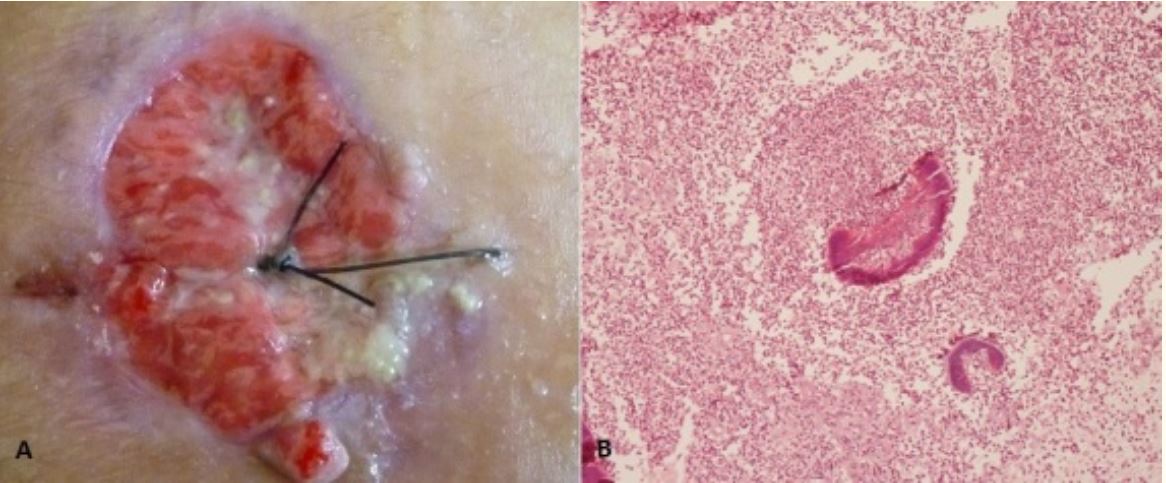
  • La infección se propaga creando senos que contienen gránulos de azufre; estos pueden drenar hacia la superficie.
  • Las infecciones ocurren cerca del reservorio habitual.
  • Las infecciones pulmonares ocurren por extensión directa de la fuente orofaríngea o por aspiración de secreciones orales y gastrointestinales.
Patogenia de Actinomyces

Patogenia de Actinomyces
Cuando hay una ruptura de la barrera mucosa, los Actinomyces de la orofaringe (que se dirige hacia áreas respiratorias), el tracto gastrointestinal y el tracto reproductivo causan una infección y se diseminan a los tejidos contiguos mientras crean tractos sinusales.
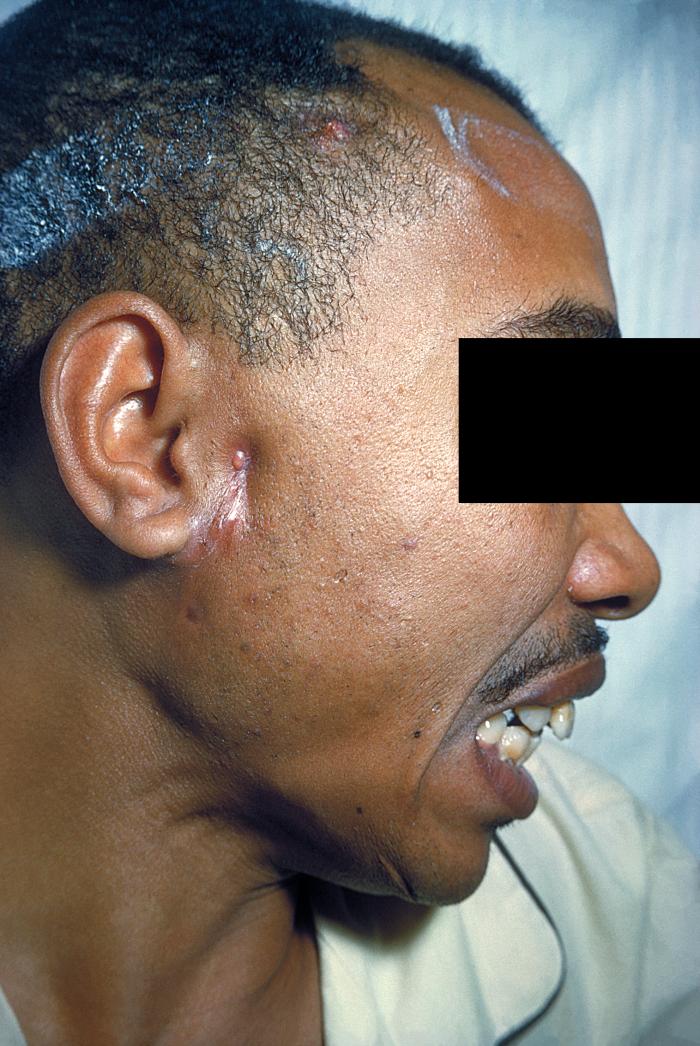
Imagen por Lecturio.

Presentación Clínica

Enfermedad cervicofacial

  • Presentación más común
  • Abscesos orales/faciales en la mandíbula (“mandíbula grumosa”), que drenan a través de tractos sinusales
  • Comúnmente afecta el maxilar, la mejilla y la mandíbula inferior
  • Forma gránulos de azufre amarillos característicos en EN Erythema nodosum is an immune-mediated panniculitis (inflammation of the subcutaneous fat) caused by a type IV (delayed-type) hypersensitivity reaction. It commonly manifests in young women as tender, erythematous nodules on the shins. Erythema Nodosum pus o tejidos:
    • Parecidos a granos de arena
    • Microcolonias bacterianas
  • Puede extenderse a otros tejidos, huesos y ganglios linfáticos
  • Manifestaciones:
    • Trismo y dificultad para masticar
    • El dolor Dolor Inflammation ocurre con la compresión de las estructuras vecinas.
  • A menudo asociado con caries dentales, extracciones o traumatismos mandibulares

Actinomicosis torácica

  • Transmisión:
    • Aspiración de secreciones orofaríngeas
    • Introducción de bacterias a través de una lesión esofágica
    • Extensión directa desde el cuello o el abdomen
    • Propagación hematógena
  • Se presenta como infección pulmonar subaguda: fiebre, tos TOS Thoracic outlet syndrome (TOS) is a broad term used for a spectrum of syndromes related to the general region of the thoracic outlet, which involves the compression or irritation of elements of the brachial plexus, subclavian artery, or subclavian vein. Thoracic Outlet Syndrome con esputo
  • Parénquima pulmonar: puede tener cavitaciones, que pueden formar tractos sinusales
  • Estos tractos pueden atravesar la pared torácica o invadir las costillas.

Actinomicosis abdominal

  • De una ruptura de apéndice/intestino o una úlcera
  • El paciente puede haber tenido una cirugía abdominal previa.
  • Se presenta con fiebre, cambios en EN Erythema nodosum is an immune-mediated panniculitis (inflammation of the subcutaneous fat) caused by a type IV (delayed-type) hypersensitivity reaction. It commonly manifests in young women as tender, erythematous nodules on the shins. Erythema Nodosum los LOS Neisseria hábitos intestinales, dolor Dolor Inflammation abdominal, pérdida de peso
  • La extensión puede afectar a cualquier órgano intraabdominal.

Actinomicosis pélvica

  • En EN Erythema nodosum is an immune-mediated panniculitis (inflammation of the subcutaneous fat) caused by a type IV (delayed-type) hypersensitivity reaction. It commonly manifests in young women as tender, erythematous nodules on the shins. Erythema Nodosum pacientes con DIU
  • Puede presentarse como dolor Dolor Inflammation abdominal inferior y secreción vaginal
  • Puede causar abscesos pélvicos

Diagnóstico y Tratamiento

Diagnóstico

  • Cultivo:
    • Medios y técnicas de cultivo: igual que para otros anaerobios
    • Incubación prolongada (a veces tarda 7–21 días en EN Erythema nodosum is an immune-mediated panniculitis (inflammation of the subcutaneous fat) caused by a type IV (delayed-type) hypersensitivity reaction. It commonly manifests in young women as tender, erythematous nodules on the shins. Erythema Nodosum aparecer)
    • Muestra(s):
      • Pus (del drenaje de los LOS Neisseria senos)
      • Esputo
      • Muestras de tejido (con gránulos de azufre microscópicos de color amarillo anaranjado)
    • En EN Erythema nodosum is an immune-mediated panniculitis (inflammation of the subcutaneous fat) caused by a type IV (delayed-type) hypersensitivity reaction. It commonly manifests in young women as tender, erythematous nodules on the shins. Erythema Nodosum algunos casos, se observa Actinomyces Actinomyces Actinomyces is an anaerobic, gram-positive, branching, filamentous rod. Actinomyces israelii is the most common species involved in human disease. The organism is commonly found as part of the normal flora in the oral cavity, gastrointestinal tract, and reproductive tract. Actinomyces/Actinomycosis en EN Erythema nodosum is an immune-mediated panniculitis (inflammation of the subcutaneous fat) caused by a type IV (delayed-type) hypersensitivity reaction. It commonly manifests in young women as tender, erythematous nodules on the shins. Erythema Nodosum el frotis de Papanicolaou.
      • Si hay síntomas de infección: se extrae el DIU y se envía para cultivo.
      • Si no presenta síntomas: se educa a la paciente sobre los LOS Neisseria síntomas a los LOS Neisseria que debe prestar atención y se deja el DIU colocado.
  • Examen microscópico de gránulos de azufre: compuestos de elementos tisulares y filamentos actinomicóticos ramificados ( en EN Erythema nodosum is an immune-mediated panniculitis (inflammation of the subcutaneous fat) caused by a type IV (delayed-type) hypersensitivity reaction. It commonly manifests in young women as tender, erythematous nodules on the shins. Erythema Nodosum forma de porra en EN Erythema nodosum is an immune-mediated panniculitis (inflammation of the subcutaneous fat) caused by a type IV (delayed-type) hypersensitivity reaction. It commonly manifests in young women as tender, erythematous nodules on the shins. Erythema Nodosum la periferia)
  • Imagenología:
    • Tomografía computarizada (TC) del abdomen: muestra el sitio y la extensión de la enfermedad en EN Erythema nodosum is an immune-mediated panniculitis (inflammation of the subcutaneous fat) caused by a type IV (delayed-type) hypersensitivity reaction. It commonly manifests in young women as tender, erythematous nodules on the shins. Erythema Nodosum la infección abdominal
    • TC de tórax:
      • Evalúa la infección torácica
      • Muestra una masa con áreas centrales de baja atenuación y realce de borde en EN Erythema nodosum is an immune-mediated panniculitis (inflammation of the subcutaneous fat) caused by a type IV (delayed-type) hypersensitivity reaction. It commonly manifests in young women as tender, erythematous nodules on the shins. Erythema Nodosum forma de anillo
      • También se pueden ver cavidades.
    • Ultrasonido pelvico:
      • Se obtiene cuando los LOS Neisseria pacientes presentan síntomas de enfermedad pélvica inflamatoria
      • Se investiga la presencia de un absceso
Osteonecrosis de la mandíbula asociada a Actinomyces

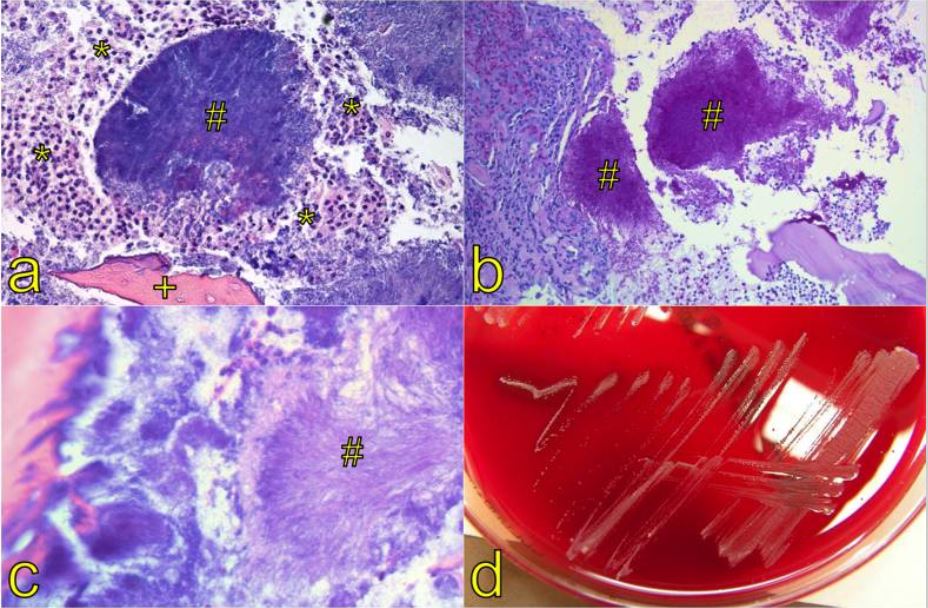
Osteonecrosis de la mandíbula asociada a Actinomyces
(a) Tinción con hematoxilina y eosina de un agregado compuesto de filamentos, los llamados gránulos de azufre (#). Estos gránulos aparecen macroscópicamente como gránulos amarillos rodeados de granulocitos neutrofílicos (*) y una trabécula ósea necrótica (+, aumento x 100).
(b) Los gránulos (#) se tiñen ácido periódico de Schiff positivo (aumento x 200).
(c) Un gran aumento muestra la estructura filamentosa (#, morfología de rayos solares) de los organismos (aumento x 400).
(d) Patrón de crecimiento típico de Actinomyces spp. en cultivo microbiológico.

Imagen: The association of medication-related osteonecrosis of the jaw with Actinomyces spp. infection” por Scientific Reports. Licencia: CC BY 4.0

Tratamiento

  • Tratamiento prolongado con penicilina
    • Enfermedad leve: 2–6 meses
    • Enfermedad severa: 6–12 meses
  • Alternativas para pacientes alérgicos a la penicilina: clindamicina o eritromicina
  • Es posible que se requiera incisión quirúrgica y drenaje.
  • Retiro del DIU

Comparación

Dos bacilos filamentosos, gram-positivos y ramificados clínicamente relevantes que deben distinguirse:

Factores diferenciadores Actinomyces Actinomyces Actinomyces is an anaerobic, gram-positive, branching, filamentous rod. Actinomyces israelii is the most common species involved in human disease. The organism is commonly found as part of the normal flora in the oral cavity, gastrointestinal tract, and reproductive tract. Actinomyces/Actinomycosis Nocardia Nocardia Nocardia is a branching, filamentous, gram-positive bacilli. It is partially acid fast due to the presence of mycolic acids in the cell wall. Nocardia is a ubiquitous soil organism that most commonly affects immunocompromised patients. Nocardia is transmitted via inhalation of aerosolized bacteria or less commonly, via direct contact with wounds. Nocardia/Nocardiosis
Requerimiento de oxígeno Anaeróbico Aeróbico
Tinción de ácido-alcohol resistencia No ácido-alcohol resistente Ácido-alcohol resistente (parcialmente)
Reservorio/hábitat Flora oral, gastrointestinal y del tracto reproductor normal Se encuentra en EN Erythema nodosum is an immune-mediated panniculitis (inflammation of the subcutaneous fat) caused by a type IV (delayed-type) hypersensitivity reaction. It commonly manifests in young women as tender, erythematous nodules on the shins. Erythema Nodosum tierra, agua, materia orgánica en EN Erythema nodosum is an immune-mediated panniculitis (inflammation of the subcutaneous fat) caused by a type IV (delayed-type) hypersensitivity reaction. It commonly manifests in young women as tender, erythematous nodules on the shins. Erythema Nodosum descomposición
Infecciones causadas
  • Abscesos orofaciales, asociados a caries dental o traumatismo facial
  • Tractos sinusales
  • Enfermedad pélvica inflamatoria
  • Infección pulmonar en EN Erythema nodosum is an immune-mediated panniculitis (inflammation of the subcutaneous fat) caused by a type IV (delayed-type) hypersensitivity reaction. It commonly manifests in young women as tender, erythematous nodules on the shins. Erythema Nodosum pacientes inmunocomprometidos (puede diseminarse por vía hematógena y causar abscesos cerebrales)
  • Lesiones cutáneas en EN Erythema nodosum is an immune-mediated panniculitis (inflammation of the subcutaneous fat) caused by a type IV (delayed-type) hypersensitivity reaction. It commonly manifests in young women as tender, erythematous nodules on the shins. Erythema Nodosum pacientes inmunocompetentes
Tratamiento Penicilina Trimetoprim-sulfametoxazol

Mnemotecnia:

SNAP” (Sulfonamidas-Nocardia, ActinomycesPenicilina)

Diagnóstico Diferencial

  • Apendicitis: se presenta con dolor Dolor Inflammation abdominal agudo y sensibilidad, clásicamente en EN Erythema nodosum is an immune-mediated panniculitis (inflammation of the subcutaneous fat) caused by a type IV (delayed-type) hypersensitivity reaction. It commonly manifests in young women as tender, erythematous nodules on the shins. Erythema Nodosum el cuadrante inferior derecho. La TC o la ecografía confirman un apéndice inflamado o perforado. La rotura puede diseminar Actinomyces Actinomyces Actinomyces is an anaerobic, gram-positive, branching, filamentous rod. Actinomyces israelii is the most common species involved in human disease. The organism is commonly found as part of the normal flora in the oral cavity, gastrointestinal tract, and reproductive tract. Actinomyces/Actinomycosis al AL Amyloidosis peritoneo, lo que provoca actinomicosis abdominal.
  • Absceso/infección odontogénica: surge después de una extracción dental o de un diente infectado sin tratamiento. Las infecciones suelen ser polimicrobianas, con predominio de Streptococcus viridans Streptococcus viridans A large heterogeneous group of mostly alpha-hemolytic streptococci. They colonize the respiratory tract at birth and generally have a low degree of pathogenicity. This group of species includes Streptococcus mitis; Streptococcus mutans; Streptococcus oralis; Streptococcus sanguis; Streptococcus sobrinus; and the Streptococcus milleri group. The latter are often beta-hemolytic and commonly produce invasive pyogenic infections including brain and abdominal abscesses. Brain Abscess, Peptostreptococcus Peptostreptococcus A genus of gram-positive, anaerobic, coccoid bacteria that is part of the normal flora of humans. Its organisms are opportunistic pathogens causing bacteremias and soft tissue infections. Perianal and Perirectal Abscess y Staphylococcus Staphylococcus Staphylococcus is a medically important genera of Gram-positive, aerobic cocci. These bacteria form clusters resembling grapes on culture plates. Staphylococci are ubiquitous for humans, and many strains compose the normal skin flora. Staphylococcus spp. La inflamación local, el trismo y el drenaje purulento son típicos, y el cultivo identifica la bacteria Bacteria Bacteria are prokaryotic single-celled microorganisms that are metabolically active and divide by binary fission. Some of these organisms play a significant role in the pathogenesis of diseases. Bacteriology causante.
  • Enfermedad inflamatoria pélvica: infección de transmisión sexual del tracto genital superior, más comúnmente debida a Chlamydia trachomatis Chlamydia trachomatis Type species of Chlamydia causing a variety of ocular and urogenital diseases. Chlamydia o Neisseria gonorrhoeae Neisseria gonorrhoeae A species of gram-negative, aerobic bacteria primarily found in purulent venereal discharges. It is the causative agent of gonorrhea. Neisseria. Se presenta con dolor Dolor Inflammation abdominal bajo, fiebre y sensibilidad a la movilización cervical; la prueba NAAT confirma los LOS Neisseria patógenos. Absceso pélvico actinomicótico. Las masas se asocian clásicamente al AL Amyloidosis uso prolongado de DIU más que a la exposición a ITS.
  • Osteomielitis piógena crónica: infección ósea de larga duración, generalmente causada por Staphylococcus aureus Staphylococcus aureus Potentially pathogenic bacteria found in nasal membranes, skin, hair follicles, and perineum of warm-blooded animals. They may cause a wide range of infections and intoxications. Brain Abscess, que se caracteriza por dolor Dolor Inflammation persistente, lesiones líticas en EN Erythema nodosum is an immune-mediated panniculitis (inflammation of the subcutaneous fat) caused by a type IV (delayed-type) hypersensitivity reaction. It commonly manifests in young women as tender, erythematous nodules on the shins. Erythema Nodosum la radiografía y fístulas supurantes. Los LOS Neisseria cultivos óseos desarrollan bacterias piógenas típicas, mientras que la infección actinomicótica muestra organismos filamentosos que requieren tratamiento prolongado con penicilina.
  • Enfermedad tuberculosa: la infección por Mycobacterium tuberculosis Mycobacterium tuberculosis Tuberculosis (TB) is an infectious disease caused by Mycobacterium tuberculosis complex bacteria. The bacteria usually attack the lungs but can also damage other parts of the body. Approximately 30% of people around the world are infected with this pathogen, with the majority harboring a latent infection. Tuberculosis spreads through the air when a person with active pulmonary infection coughs or sneezes. Tuberculosis puede afectar los LOS Neisseria pulmones, el abdomen o la columna vertebral, presentándose con tos TOS Thoracic outlet syndrome (TOS) is a broad term used for a spectrum of syndromes related to the general region of the thoracic outlet, which involves the compression or irritation of elements of the brachial plexus, subclavian artery, or subclavian vein. Thoracic Outlet Syndrome crónica o dolor Dolor Inflammation de espalda, pérdida de peso y sudores nocturnos. Los LOS Neisseria granulomas Granulomas A relatively small nodular inflammatory lesion containing grouped mononuclear phagocytes, caused by infectious and noninfectious agents. Sarcoidosis caseosos y los LOS Neisseria bacilos acidorresistentes en EN Erythema nodosum is an immune-mediated panniculitis (inflammation of the subcutaneous fat) caused by a type IV (delayed-type) hypersensitivity reaction. It commonly manifests in young women as tender, erythematous nodules on the shins. Erythema Nodosum la tinción de Ziehl-Neelsen o PCR PCR Polymerase chain reaction (PCR) is a technique that amplifies DNA fragments exponentially for analysis. The process is highly specific, allowing for the targeting of specific genomic sequences, even with minuscule sample amounts. The PCR cycles multiple times through 3 phases: denaturation of the template DNA, annealing of a specific primer to the individual DNA strands, and synthesis/elongation of new DNA molecules. Polymerase Chain Reaction (PCR) distinguen la tuberculosis Tuberculosis Tuberculosis (TB) is an infectious disease caused by Mycobacterium tuberculosis complex bacteria. The bacteria usually attack the lungs but can also damage other parts of the body. Approximately 30% of people around the world are infected with this pathogen, with the majority harboring a latent infection. Tuberculosis spreads through the air when a person with active pulmonary infection coughs or sneezes. Tuberculosis de los LOS Neisseria filamentos no acidorresistentes de la actinomicosis.
  • Carcinoma ( en EN Erythema nodosum is an immune-mediated panniculitis (inflammation of the subcutaneous fat) caused by a type IV (delayed-type) hypersensitivity reaction. It commonly manifests in young women as tender, erythematous nodules on the shins. Erythema Nodosum la zona afectada): las neoplasias malignas de colon Colon The large intestines constitute the last portion of the digestive system. The large intestine consists of the cecum, appendix, colon (with ascending, transverse, descending, and sigmoid segments), rectum, and anal canal. The primary function of the colon is to remove water and compact the stool prior to expulsion from the body via the rectum and anal canal. Colon, Cecum, and Appendix: Anatomy, orofaringe, cuello uterino o pulmón pueden producir una masa firme e infiltrante o una úlcera que no cicatriza con síntomas generales. La biopsia revela células malignas en EN Erythema nodosum is an immune-mediated panniculitis (inflammation of the subcutaneous fat) caused by a type IV (delayed-type) hypersensitivity reaction. It commonly manifests in young women as tender, erythematous nodules on the shins. Erythema Nodosum lugar de ramificaciones. Filamentos grampositivos y gránulos de azufre observados en EN Erythema nodosum is an immune-mediated panniculitis (inflammation of the subcutaneous fat) caused by a type IV (delayed-type) hypersensitivity reaction. It commonly manifests in young women as tender, erythematous nodules on the shins. Erythema Nodosum la actinomicosis.

Referencias

  1. Riedel S, Hobden JA, et al (Eds.) (2019). Infections caused by anaerobic bacteria. In Jawetz, Melnick, & Adelberg’s Medical Microbiology (28th ed.) McGraw-Hill. 
  2. Russo TA. (2018). Actinomycosis. In Jameson J, Fauci AS, et al (Eds.), Harrison’s Principles of Internal Medicine (20th ed.) McGraw-Hill.
  3. Ryan KJ (Ed.) (2017). Actinomyces and nocardia. In Sherris Medical Microbiology (7th ed.) McGraw-Hill.
  4. Sharma S, Hashmi M, Valentino D. (2020). Actinomycosis. StatPearls. Retrieved Nov 25, 2020, from https://www.ncbi.nlm.nih.gov/books/NBK482151/
  5. Valour F, Sénéchal A, et al (2014). Actinomycosis: etiology, clinical features, diagnosis, treatment, and management. Infect Drug Resist, 7, 183–197. https://dx.doi.org/10.2147%2FIDR.S39601

¡Crea tu cuenta gratis o inicia una sesión para seguir leyendo!

Regístrate ahora y obtén acceso gratuito a Lecturio con páginas de concepto, videos médicos y cuestionarios para tu educación médica.

User Reviews

Que tengas una sesión de estudio alegre y navideña 🎁 Ahorra 50% en todos los planes >>

Details