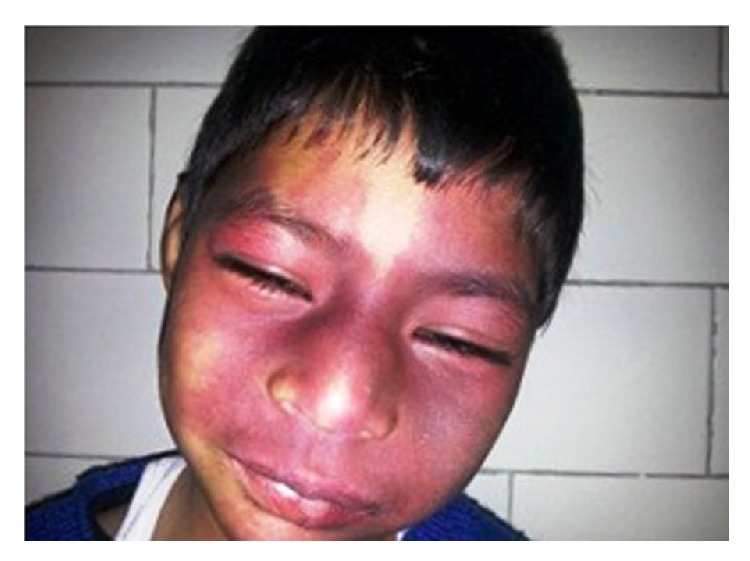



Síndrome de Sturge-Weber (SSW)

A síndrome de Sturge-Weber (SSW) é um distúrbio neurocutâneo congénito que se apresenta com uma marca de nascença facial chamada mancha vinho do porto ( MVP MVP Mitral valve prolapse (MVP) is the most common cardiac valvular defect, and is characterized by bulging of the mitral valve (MV) cusps into the left atrium (LA) during systole. Mitral valve prolapse is most commonly due to idiopathic myxomatous degeneration. Patients are typically asymptomatic. Mitral Valve Prolapse), alterações neurológicas, como convulsões, e alterações oculares, como glaucoma Glaucoma Glaucoma is an optic neuropathy characterized by typical visual field defects and optic nerve atrophy seen as optic disc cupping on examination. The acute form of glaucoma is a medical emergency. Glaucoma is often, but not always, caused by increased intraocular pressure (IOP). Glaucoma. Nem todos estes sintomas precisam de estar presentes num indivíduo afetado, e alguns podem desenvolver-se mais MAIS Androgen Insensitivity Syndrome tarde. Embora a condição seja congénita, não é herdada, pois a mutação causadora no gene Gene A category of nucleic acid sequences that function as units of heredity and which code for the basic instructions for the development, reproduction, and maintenance of organisms. Basic Terms of Genetics GNAQ é somática e esporádica. A suspeita do diagnóstico ocorre com base nos sintomas e na neuroimagem e é confirmada com testes Testes Gonadal Hormones genéticos. O tratamento é direcionado ao controlo dos sintomas e prevenção de convulsões e hemiparésia.

Last updated: Dec 15, 2025

Editorial responsibility: Stanley Oiseth, Lindsay Jones, Evelin Maza

Descrição Geral

Epidemiologia

A incidência é de aproximadamente 1 em 20.000 a 50.000 recém-nascidos vivos.

Etiologia

  • Congénito, mas não é herdado
  • Mutação esporádica sem causa conhecida
  • Em 80-90% dos casos, é causada por uma variante somática em mosaico no gene Gene A category of nucleic acid sequences that function as units of heredity and which code for the basic instructions for the development, reproduction, and maintenance of organisms. Basic Terms of Genetics GNAQ → não é transmitida aos descendentes

Fisiopatologia

  • Gene Gene A category of nucleic acid sequences that function as units of heredity and which code for the basic instructions for the development, reproduction, and maintenance of organisms. Basic Terms of Genetics GNAQ : codifica G-alfa-q, uma proteína de ligação ao nucleotídeo guanina → regula as vias de sinalização intracelular
  • A mutação resulta no crescimento irregular das células endoteliais vasculares.
  • Apresenta-se como uma malformação capilar-venosa, principalmente nas regiões dérmica e leptomeníngeas

Apresentação Clínica

Os sintomas são geralmente causados pelo efeito da malformação capilar-venosa no cérebro, na pele e no olho. Nem todos os sintomas precisam de estar presentes num indivíduo para que seja diagnosticado com SSW, e alguns sintomas podem desenvolver-se mais MAIS Androgen Insensitivity Syndrome tarde.

Dermatológico

Mancha de vinho do Porto ( MVP MVP Mitral valve prolapse (MVP) is the most common cardiac valvular defect, and is characterized by bulging of the mitral valve (MV) cusps into the left atrium (LA) during systole. Mitral valve prolapse is most commonly due to idiopathic myxomatous degeneration. Patients are typically asymptomatic. Mitral Valve Prolapse):
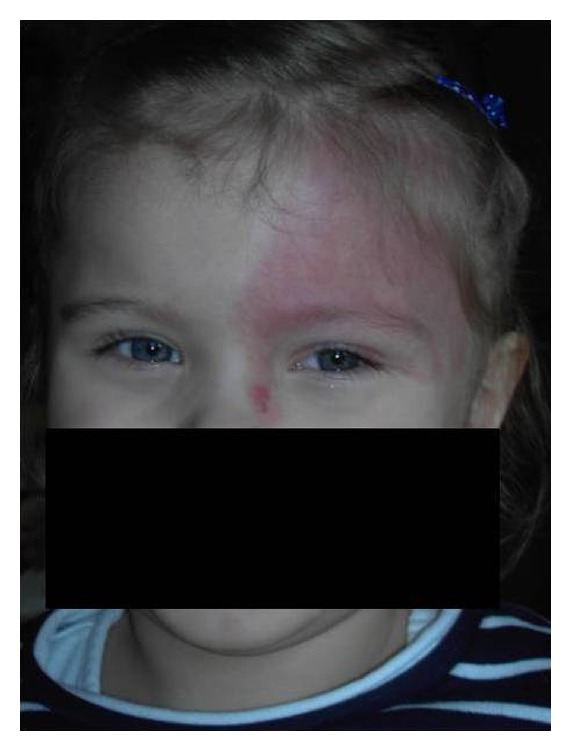
  • Também conhecida como nevo flammeus
  • Presente desde o nascimento
  • Distribuição:
    • Facial: ramos oftálmicos e maxilares do nervo trigémeo
    • Pode extender-se para:
      • Tronco
      • Braço
  • Rosa claro a vermelho escuro

Neurológico

  • Malformação vascular leptomeníngea, também chamada de angioma leptomeníngeo
  • Tumor Tumor Inflammation benigno da aracnoide e pia-máter ( leptomeninges Leptomeninges Meninges: Anatomy)
  • Ipsilateral à MVP MVP Mitral valve prolapse (MVP) is the most common cardiac valvular defect, and is characterized by bulging of the mitral valve (MV) cusps into the left atrium (LA) during systole. Mitral valve prolapse is most commonly due to idiopathic myxomatous degeneration. Patients are typically asymptomatic. Mitral Valve Prolapse
  • Principalmente nos lobos parietal Parietal One of a pair of irregularly shaped quadrilateral bones situated between the frontal bone and occipital bone, which together form the sides of the cranium. Skull: Anatomy e occipital Occipital Part of the back and base of the cranium that encloses the foramen magnum. Skull: Anatomy
  • Leva a atrofia e calcificações no córtex cerebral abaixo do tumor Tumor Inflammation, causando:
    • Convulsões:
      • Início precoce (pelos 6 meses)
      • Geralmente é a queixa à apresentação
      • Crises focais
    • Hemiparésia/hemianópsia:
      • Sintomas semelhantes ao AVC
      • Transitório
    • Défice intelectual, dificuldades de aprendizagem
    • Perturbações de humor Humor Defense Mechanisms

Oftalmológico

  • Glaucoma Glaucoma Glaucoma is an optic neuropathy characterized by typical visual field defects and optic nerve atrophy seen as optic disc cupping on examination. The acute form of glaucoma is a medical emergency. Glaucoma is often, but not always, caused by increased intraocular pressure (IOP). Glaucoma (início precoce), potencialmente causado por:
    • ângulo anormal da câmara anterior
    • ↑ Pressão venosa episcleral → obstrução da drenagem do humor Humor Defense Mechanisms aquoso
  • Hemianopsia homónima (por malformações vasculares que afetam os tratos óticos ou os lobos occipotais)
  • Estrabismo
  • Lacrimejo excessivo
  • Alterações vasculares, que podem afetar:
    • Coroide
    • Episclera
    • Conjuntiva
    • Retina Retina The ten-layered nervous tissue membrane of the eye. It is continuous with the optic nerve and receives images of external objects and transmits visual impulses to the brain. Its outer surface is in contact with the choroid and the inner surface with the vitreous body. The outermost layer is pigmented, whereas the inner nine layers are transparent. Eye: Anatomy
    • Corpo ciliar

Endócrino

  • Hormona de crescimento (GH) reduzida → baixa estatura
  • Hipotiroidismo central

Mnemónica

Uma forma fácil de lembrar é usando a mnemónica STURGE:
  • Stain (port wein) (mancha vinho do Porto)
  • Tram-track-like calcification (calcificação em linha de comboio)
  • Unilateral weakness (fraqueza unilateral)
  • Recurrent seizure (convulsões recorrentes)
  • Glaucoma ( glaucoma Glaucoma Glaucoma is an optic neuropathy characterized by typical visual field defects and optic nerve atrophy seen as optic disc cupping on examination. The acute form of glaucoma is a medical emergency. Glaucoma is often, but not always, caused by increased intraocular pressure (IOP). Glaucoma)
  • Eye signs (sinais oculares)

Diagnóstico e Tratamento

Diagnóstico

  • Neuroimagem:
    • RMN com contraste: realça angiomas leptomeníngeos
    • TAC: calcificações corticais tipo carris de comboio devido às malformações vasculares leptomeníngeas
    • Feito imediatamente se o doente apresentar sintomas neurológicos
    • Feito após o 1º ano de idade em doentes com MVP MVP Mitral valve prolapse (MVP) is the most common cardiac valvular defect, and is characterized by bulging of the mitral valve (MV) cusps into the left atrium (LA) during systole. Mitral valve prolapse is most commonly due to idiopathic myxomatous degeneration. Patients are typically asymptomatic. Mitral Valve Prolapse
  • Exame oftalmológico: medição da pressão intraocular (PIO) para avaliar a presença de glaucoma Glaucoma Glaucoma is an optic neuropathy characterized by typical visual field defects and optic nerve atrophy seen as optic disc cupping on examination. The acute form of glaucoma is a medical emergency. Glaucoma is often, but not always, caused by increased intraocular pressure (IOP). Glaucoma
  • EEG EEG Seizures: para avaliar a atividade convulsiva
  • Confirmação: teste genético para mutações no GNAQ
Epilepsia associada a SWS

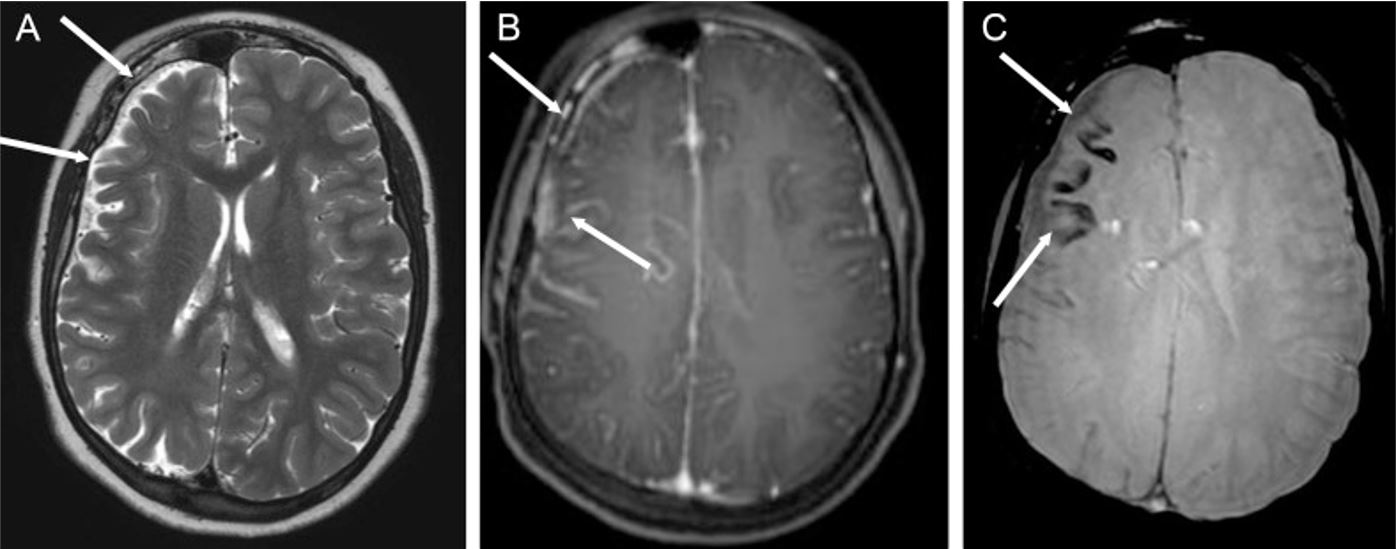
Epilepsia associada à síndrome de Sturge-Weber (SSW): síndrome de Sturge-Weber num menino de 14 anos com múltiplos focos epiléticos no hemisfério cerebral direito e epilepsia parcial crónica
A: imagem axial ponderada em T2 a demonstrar hemiatrofia cerebral direita (setas brancas)
B: sequência axial ponderada em T1 após injeção de gadolínio, a demonstrar realce leptomeníngeo da região frontoparietal (setas brancas)
C: As setas brancas apontam para calcificação cortical no lobo frontal, aparecendo como ausência de sinal nas imagens ponderadas obtidas.

Imagem: “Sturge-Weber syndrome in a 14-year-old boy with multiple epileptic foci in the right cerebral hemisphere” por Abud LG, Thivard L, Abud TG, Nakiri GS, Dos Santos AC, Dormont D. Licença: CC BY 4.0

Tratamento

  • Centra-se no tratamento de sintomas, tais como lesões cutâneas, convulsões e glaucoma Glaucoma Glaucoma is an optic neuropathy characterized by typical visual field defects and optic nerve atrophy seen as optic disc cupping on examination. The acute form of glaucoma is a medical emergency. Glaucoma is often, but not always, caused by increased intraocular pressure (IOP). Glaucoma:
    • MVP MVP Mitral valve prolapse (MVP) is the most common cardiac valvular defect, and is characterized by bulging of the mitral valve (MV) cusps into the left atrium (LA) during systole. Mitral valve prolapse is most commonly due to idiopathic myxomatous degeneration. Patients are typically asymptomatic. Mitral Valve Prolapse: terapêutica com laser pulsado
    • Convulsões:
      • Anticonvulsivantes (carbamazepina)
      • Hemisferectomia em casos refratários
    • Glaucoma Glaucoma Glaucoma is an optic neuropathy characterized by typical visual field defects and optic nerve atrophy seen as optic disc cupping on examination. The acute form of glaucoma is a medical emergency. Glaucoma is often, but not always, caused by increased intraocular pressure (IOP). Glaucoma: tratamento tópico ou cirúrgico
  • Prevenção:
    • Aspirina em baixa dose (provavelmente reduz o risco de eventos isquémicos cerebrais e convulsões)
    • Exame oftalmológico regular Regular Insulin para monitorizar a PIO

Prognóstico

  • Determinado pela extensão da lesão e idade de início das convulsões
  • É provável que a função neurológica se deteriore com a idade, prejudicando a função diária.

Diagnóstico Diferencial

  • Síndrome de Klippel-Trenaunay (SKT): doença congénita rara e esporádica que resulta de uma malformação vascular semelhante à SSW. Ao contrário da SSW, os sintomas neurológicos e oftalmológicos são raros e as MVP MVP Mitral valve prolapse (MVP) is the most common cardiac valvular defect, and is characterized by bulging of the mitral valve (MV) cusps into the left atrium (LA) during systole. Mitral valve prolapse is most commonly due to idiopathic myxomatous degeneration. Patients are typically asymptomatic. Mitral Valve Prolapse são mais MAIS Androgen Insensitivity Syndrome frequentemente observadas nos membros. O envolvimento ósseo e muscular resulta em hipertrofia dos membros. O tratamento consiste em citorredução cirúrgica ou escleroterapia dos vasos com malformação.
  • Doença de Von Hippel-Lindau (VHL): uma doença neurocutânea genética autossómica dominante que resulta de uma eliminação ou mutação no gene Gene A category of nucleic acid sequences that function as units of heredity and which code for the basic instructions for the development, reproduction, and maintenance of organisms. Basic Terms of Genetics VHL. Os indivíduos diagnosticados com doença de VHL têm tumores e quistos em várias partes do corpo e podem apresentar hemangioblastomas Hemangioblastomas A benign tumor of the nervous system that may occur sporadically or in association with von Hippel-Lindau disease. It accounts for approximately 2% of intracranial tumors, arising most frequently in the cerebellar hemispheres and vermis. Histologically, the tumors are composed of multiple capillary and sinusoidal channels lined with endothelial cells and clusters of lipid-laden pseudoxanthoma cells. Usually solitary, these tumors can be multiple and may also occur in the brain stem, spinal cord, retina, and supratentorial compartment. Cerebellar hemangioblastomas usually present in the third decade with intracranial hypertension, and ataxia. Von Hippel-Lindau Disease, carcinoma de células renais (CCR), feocromocitoma, tumores do saco endolinfático do ouvido médio, tumores pancreáticos e/ou cistadenomas papilares do epidídimo ou do ligamento largo. O diagnóstico é feito através de testes Testes Gonadal Hormones genéticos, avaliação laboratorial, exame fundoscópico e TAC/MRI para detetar tumores. O tratamento da doença inclui a remoção cirúrgica dos tumores.
  • Neurofibromatose tipo 1 ( NF1 NF1 Neurofibromatosis type 1 (NF1), also known as phakomatosis, is a neurocutaneous disorder that is most commonly of autosomal dominant inheritance due to mutations in the NF1 gene. Neurofibromatosis type 1 presents a range of clinical manifestations with the most prominent features being various pigmented skin lesions called café au lait macules (CALMs), neurofibromas, freckling of the inguinal and axillary regions, and iris hamartomas. Neurofibromatosis Type 1): uma doença neurocutânea hereditária autossómica dominante caracterizada por uma anomalia no gene Gene A category of nucleic acid sequences that function as units of heredity and which code for the basic instructions for the development, reproduction, and maintenance of organisms. Basic Terms of Genetics supressor tumoral, dando origem a tumores nervosos. Os indivíduos afetados apresentam-se com manchas de café com leite, neurofibromas, sardas cutâneas, gliomas da via óptica e nódulos de Lisch. O diagnóstico é baseado nos critérios clínicos e estudos de imagem do NIH. As modalidades terapêuticas são o selumetinibe e a cirurgia.
  • Esclerose tuberosa: uma doença autossómica dominante que se apresenta principalmente com sintomas neurocutâneos. A mutação no gene Gene A category of nucleic acid sequences that function as units of heredity and which code for the basic instructions for the development, reproduction, and maintenance of organisms. Basic Terms of Genetics TSC TSC Tuberous sclerosis or tuberous sclerosis complex (TSC) is an autosomal dominant disorder with mainly neurocutaneous symptoms. Mutation in the tsc genes causes excessive tumor-like growths in the brain, eyes, heart, kidney, and lungs. Cutaneous manifestations include hypopigmentation (i.e., ash leaf spots, confetti lesions) or excessive growth (i.e., angiofibroma, shagreen patch). Tuberous Sclerosis causa um crescimento tumoral excessivo no cérebro, nos olhos, no coração, no rim e nos pulmões. As manifestações cutâneas incluem hipopigmentação (ou seja, manchas em folhas de cinzas) ou crescimento excessivo (ou seja, angiofibroma Angiofibroma A benign neoplasm of fibrous tissue in which there are numerous small and large, frequently dilated, vascular channels. Tuberous Sclerosis). O diagnóstico é feito clinicamente e confirmado através de testes Testes Gonadal Hormones genéticos. O tratamento implica uma abordagem multidisciplinar que visa a monitorização e o tratamento de várias manifestações da doença.

Referências

  1. NORD (National Organization for Rare Disorders). (2021). Sturge Weber syndrome. Retrieved November 23, 2024, from https://rarediseases.org/rare-diseases/sturge-weber-syndrome/ 
  2. Shirley, MD, Tang, H, Gallione, CJ, et al. (2013). Sturge-Weber syndrome and port-wine stains caused by somatic mutation in GNAQ. N Engl J Med. 368(21), 1971–9. Retrieved November 23, 2024, from https://doi.org/10.1056/NEJMoa1213507
  3. Comi, AM. (2011). Presentation, diagnosis, pathophysiology, and treatment of the neurological features of Sturge-Weber syndrome. Neurologist. 17(4), 179–184. Retrieved November 23, 2024, from https://doi.org/10.1097/NRL.0b013e318220c5b6
  4. Sujansky, E, & Conradi, S. (1995). Sturge-Weber syndrome: Age of onset of seizures and glaucoma and the prognosis for affected children. J Child Neurol. 10(1), 49–58. Retrieved November 23, 2024, from https://doi.org/10.1177/088307389501000113
  5. Patterson, MC. (2024). Sturge-Weber syndrome. UpToDate. Retrieved November 23, 2024, from https://www.uptodate.com/contents/sturge-weber-syndrome
  6. Wei-Wen, S. (2018). Acute primary angle-closure in Sturge-Weber syndrome. American Journal of Ophthalmology Case Reports. 10:101-104. Retrieved November 23, 2024, from https://www.sciencedirect.com/science/article/pii/S2451993617303882
  7. Ramirez, E. L., & Jülich, K. (2024). Sturge-Weber syndrome: An overview of history, genetics, clinical manifestations, and management. Seminars in Pediatric Neurology, 101151. Retrieved November 23, 2024, from https://doi.org/10.1016/j.spen.2024.101151

Crie sua conta gratuita ou faça login para continuar lendo!

Cadastre-se agora e tenha acesso grátis ao Lecturio, com páginas de conceitos, vídeos de medicina e questões para sua educação médica.

Aprende mais com a Lecturio:

Multiple devices displaying human anatomy and health education content.

Complementa o teu estudo da faculdade com o companheiro de estudo tudo-em-um da Lecturio, através de métodos de ensino baseados em evidência.

Estuda onde quiseres

Two iPhones display medical education apps, one showing anatomy, the other Bookmatcher.

A Lecturio Medical complementa o teu estudo através de métodos de ensino baseados em evidência, vídeos de palestras, perguntas e muito mais – tudo combinado num só lugar e fácil de usar.

User Reviews

Have a holly, jolly study session 🎁 Save 50% on all plans now >>

Que tengas una sesión de estudio alegre y navideña 🎁 Ahorra 50% en todos los planes >>

Details