


Reação de Hipersensibilidade Tipo III

A reação de hipersensibilidade tipo III, também conhecida como hipersensibilidade mediada por complexos imunes, ocorre quando anticorpos e antigénios formam complexos imunes ( CI CI The percentage of the chest diameter occupied by the heart. Imaging of the Heart and Great Vessels) em circulação, que se depositam em tecidos suscetíveis. O sistema do complemento desencadeia a resposta imunológica, levando ao recrutamento de leucócitos e a lesões teciduais. Não há uma síndrome clínica única para esta hipersensibilidade. Os sintomas refletem o comprometimento de múltiplos sistemas de órgãos com base nos locais de deposição de CI CI The percentage of the chest diameter occupied by the heart. Imaging of the Heart and Great Vessels. A abordagem diagnóstica depende em grande parte da anamnese, incluindo testes Testes Gonadal Hormones laboratoriais, imagiologia e biópsia do órgão afetado. O tratamento consiste na remoção ou evicção de agentes agressores e, em condições graves, glucocorticoides ou terapêutica imunossupressora.

Last updated: Dec 15, 2025

Editorial responsibility: Stanley Oiseth, Lindsay Jones, Evelin Maza

Descrição Geral

  • Reação de hipersensibilidade
    • Uma resposta imunológica exagerada dirigida a agentes patogénicos ambientais que deviam ser tratados como inofensivos
    • Os tipos I, II e III representam reações imediatas que ocorrem em 24 horas.
    • A reação de tipo IV desenvolve-se ao longo de vários dias.
  • Reação de hipersensibilidade tipo III
    • Hipersensibilidade mediada pelo complexo imune ( CI CI The percentage of the chest diameter occupied by the heart. Imaging of the Heart and Great Vessels): desencadeada por complexos antigénio-anticorpo (Ag-Ab, pela sigla em inglês) depositados nos tecidos
    • Ag AG Metabolic Acidosis: intrínseco (parte do hospedeiro) ou extrínseco (fonte exógena, como bactérias, vírus)
    • Tal TAL Renal Sodium and Water Regulation como na hipersensibilidade tipo II, a lesão celular é semelhante: o sistema do complemento conduz a uma reação que produz danos celulares.
    • Ao contrário da hipersensibilidade tipo II, nas reações de tipo III:
      • Os antigénios não estão ligados a superfícies celulares.
      • Os complexos Ag-Ab formam-se em circulação.
      • O alvo da resposta imunológica não é o tecido ou a célula.
      • O alvo é o CI CI The percentage of the chest diameter occupied by the heart. Imaging of the Heart and Great Vessels depositado no tecido.

Fisiopatologia

Fisiologia

  • Normalmente, a formação de complexos imunes leva à neutralização de antigénios.
  • O sistema do complemento reduz a acumulação patológica de CI CI The percentage of the chest diameter occupied by the heart. Imaging of the Heart and Great Vessels.
    • Os anticorpos (Ab, da sigla em inglês) têm 2 regiões:
      • Região Fab Fab Univalent antigen-binding fragments composed of one entire immunoglobulin light chain and the amino terminal end of one of the immunoglobulin heavy chains from the hinge region, linked to each other by disulfide bonds. Fab contains the immunoglobulin variable regions, which are part of the antigen-binding site, and the first immunoglobulin constant regions. This fragment can be obtained by digestion of immunoglobulins with the proteolytic enzyme papain. Immunoglobulins: Types and Functions: liga-se aos antigénios
      • Região Fc Fc Crystallizable fragments composed of the carboxy-terminal halves of both immunoglobulin heavy chains linked to each other by disulfide bonds. Fc fragments contain the carboxy-terminal parts of the heavy chain constant regions that are responsible for the effector functions of an immunoglobulin (complement fixation, binding to the cell membrane via fc receptors, and placental transport). This fragment can be obtained by digestion of immunoglobulins with the proteolytic enzyme papain. Immunoglobulins: Types and Functions: interage com o sistema do complemento e com células com recetor Fc Fc Crystallizable fragments composed of the carboxy-terminal halves of both immunoglobulin heavy chains linked to each other by disulfide bonds. Fc fragments contain the carboxy-terminal parts of the heavy chain constant regions that are responsible for the effector functions of an immunoglobulin (complement fixation, binding to the cell membrane via fc receptors, and placental transport). This fragment can be obtained by digestion of immunoglobulins with the proteolytic enzyme papain. Immunoglobulins: Types and Functions (células portadoras de FcR, da sigla em inglês)
    • C1q: ativa o sistema do complemento e liga-se à região Fc Fc Crystallizable fragments composed of the carboxy-terminal halves of both immunoglobulin heavy chains linked to each other by disulfide bonds. Fc fragments contain the carboxy-terminal parts of the heavy chain constant regions that are responsible for the effector functions of an immunoglobulin (complement fixation, binding to the cell membrane via fc receptors, and placental transport). This fragment can be obtained by digestion of immunoglobulins with the proteolytic enzyme papain. Immunoglobulins: Types and Functions do Ab, mediando a eliminação do CI CI The percentage of the chest diameter occupied by the heart. Imaging of the Heart and Great Vessels pelas células portadoras de FcR.
    • C3b: solubiliza os CIs CIS Multiple Sclerosis e marca-os para fagocitose (opsonização).

Patogénese

Formação de complexos imunes: CI CI The percentage of the chest diameter occupied by the heart. Imaging of the Heart and Great Vessels é formado pela ligação entre Ag AG Metabolic Acidosis e Ab

Deposição do complexo imune

A deposição do complexo imune depende de:

  • Propriedades físicas do CI CI The percentage of the chest diameter occupied by the heart. Imaging of the Heart and Great Vessels:
  • Rácio antigénio/anticorpo:
    • Níveis baixos ou excessivos de anticorpos → diminuição da ativação de efetores
  • Hemodinâmica tecidual específica
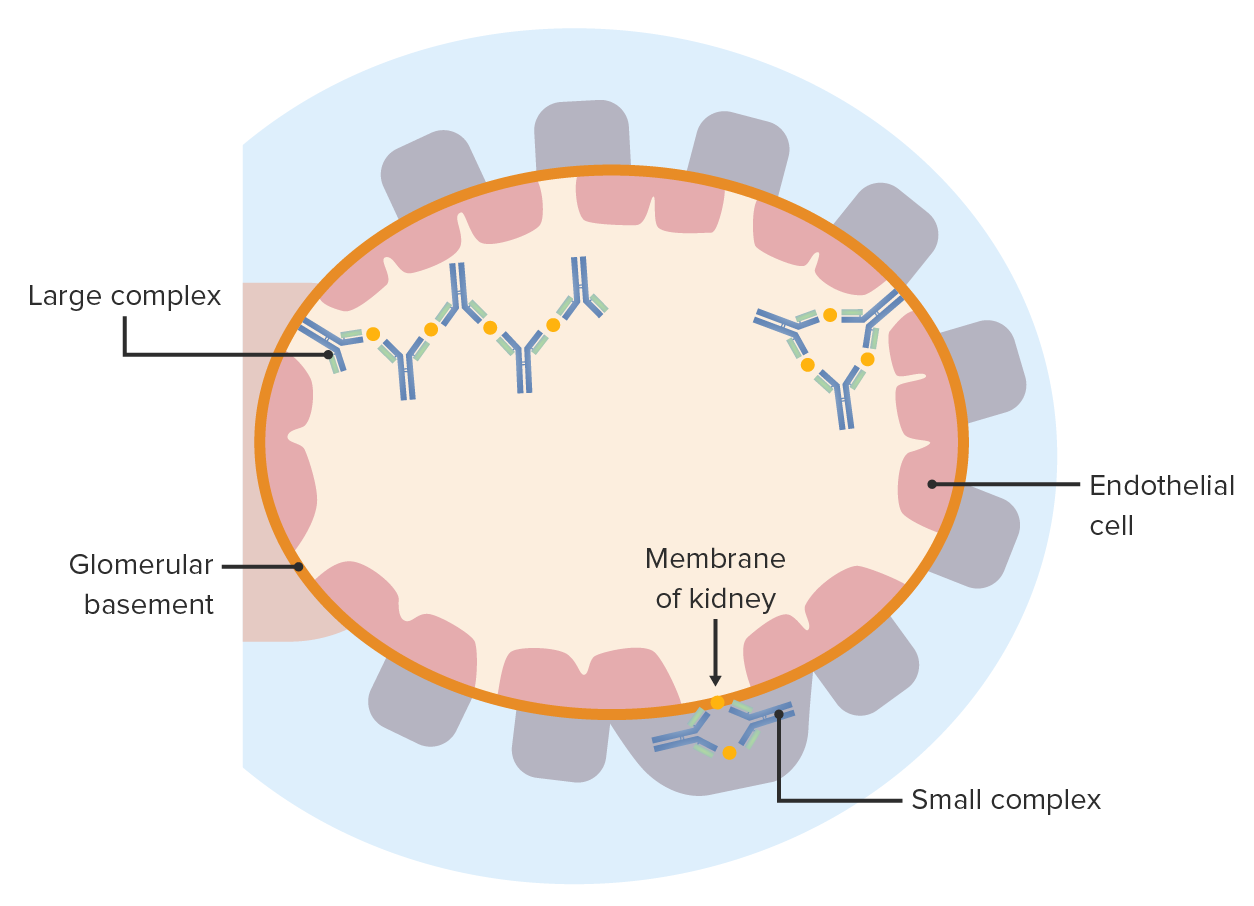
    • Os CIs CIS Multiple Sclerosis depositam-se primeiro nos vasos sanguíneos → vasculite
    • As áreas usualmente afetadas são os tecidos sensíveis à “permeabilidade”:
      • Glomérulos (nefrite)
      • Articulações/sinóvia (artrite)

Reação inflamatória do complexo imune

  • Os depósitos de CI CI The percentage of the chest diameter occupied by the heart. Imaging of the Heart and Great Vessels ativam a cascata do complemento.
  • O C3a inicia a desgranulação dos mastócitos:
    • A histamina aumenta a permeabilidade vascular no tecido envolvido.
    • Os CIs CIS Multiple Sclerosis entram no tecido → um tecido normal com CIs CIS Multiple Sclerosis torna-se num alvo para uma resposta inflamatória
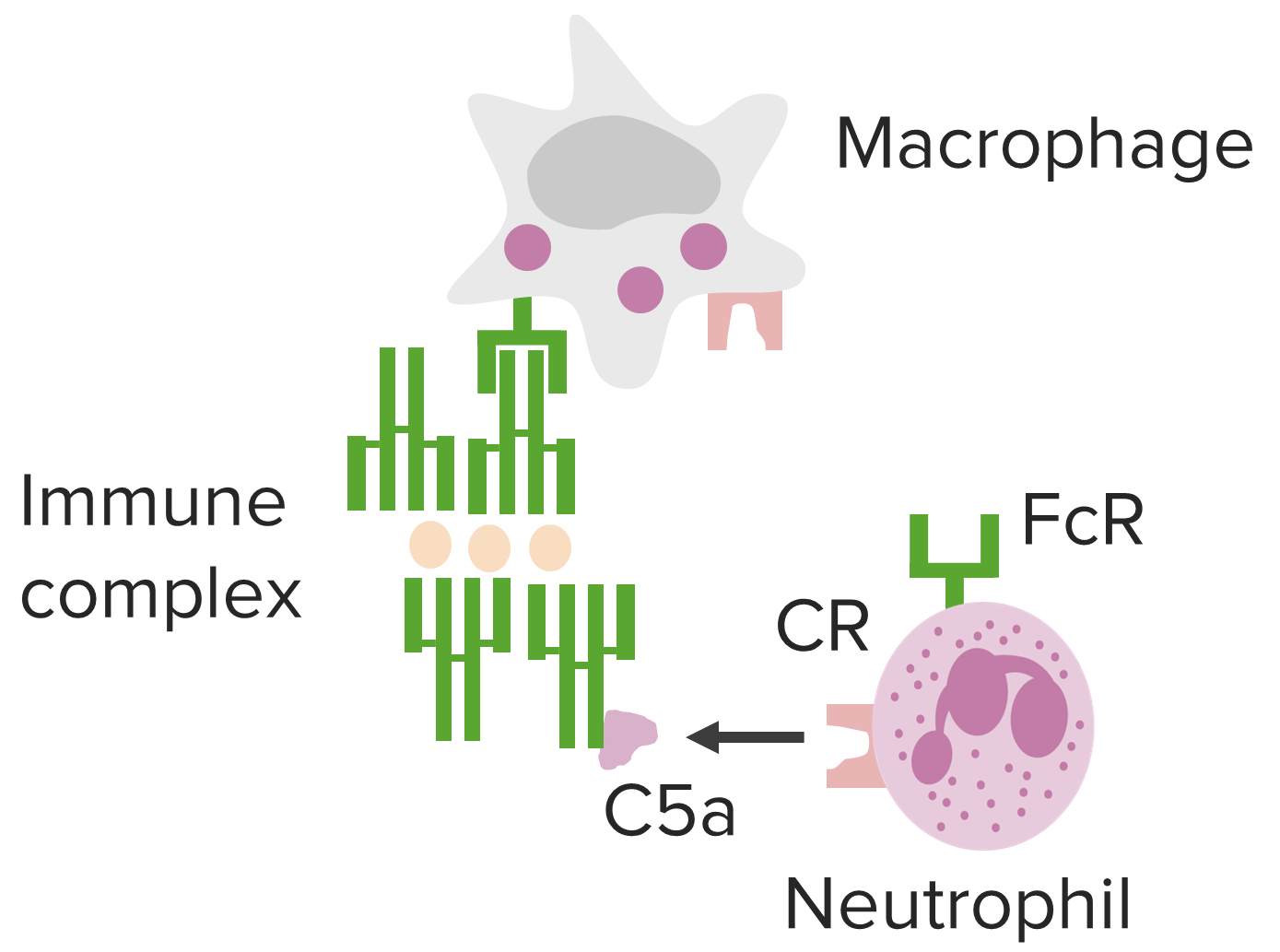
  • O C5a (quimioatrativo) recruta neutrófilos → libertação de lisozimas e mediadores inflamatórios → morte celular e lesão tecidual
  • O C3b opsoniza o tecido → fagocitose e lise celular mediada pelo complexo de ataque à membrana (MAC, pela sigla em inglês)
  • Macrófagos, células NK → libertam mediadores líticos e lesam as células do tecido
  • Pode ocorrer agregação plaquetária → formação de microtrombos
Immune complex mediated pathways underlying type III hypersensitivity.

Vias mediadas por complexos imunes, subjacentes à hipersensibilidade tipo III.

Imagem de Lecturio.

Apresentação Clínica

As manifestações clínicas dependem da porta de entrada, do(s) local(is) de deposição dos CIs CIS Multiple Sclerosis e da persistência do(s) antigénio(s).

Fenómeno de Arthus / Reação de Arthus

  • Um antigénio é injetado localmente (por exemplo, uma vacina como a vacina combinada contra a tosse convulsa, o tétano e a difteria) e causa uma reação localizada.
  • Devido ao excesso de antigénio e à deposição de CIs CIS Multiple Sclerosis nas paredes vasculares
  • Necrose dos tecidos afetados: dor, rubor Rubor Inflammation, endurecimento e edema Edema Edema is a condition in which excess serous fluid accumulates in the body cavity or interstitial space of connective tissues. Edema is a symptom observed in several medical conditions. It can be categorized into 2 types, namely, peripheral (in the extremities) and internal (in an organ or body cavity). Edema no local da injeção
  • Auto-limitado

Lúpus eritematoso sistémico (LES)

  • Anticorpos dirigidos contra partes do núcleo celular: anticorpos antinucleares (ANA), um achado universal no LES
  • Anticorpos dirigidos contra outras partes do núcleo:
    • Histona (Ab anti-histona)
    • ADN (Ab anti-dsDNA, pela sigla em inglês)
    • Ribonucleoproteína (Ab anti-RNP)
    • Antigénio de Smith (Ab anti-Sm)
  • Outro: Anticorpos contra os fosfolípidos celulares (Ab anti-fosfolípidos)
    • Presentes em 30%–40% dos pacientes com LES
    • Aumento do risco de trombose
  • Os complexos Ag-Ab depositam-se em múltiplas áreas:
    • Pele/região mucocutânea (erupção malar, fotossensibilidade, úlceras orais)
    • Rins (glomerulonefrite)
    • Articulações (artrite)
    • Vasos sanguíneos (vasculite, fenómeno de Raynaud, coágulos sanguíneos)
    • Pleura Pleura The pleura is a serous membrane that lines the walls of the thoracic cavity and the surface of the lungs. This structure of mesodermal origin covers both lungs, the mediastinum, the thoracic surface of the diaphragm, and the inner part of the thoracic cage. The pleura is divided into a visceral pleura and parietal pleura. Pleura: Anatomy (derrame pleural)
    • Pericárdio (pericardite)
    • Células sanguíneas ( anemia Anemia Anemia is a condition in which individuals have low Hb levels, which can arise from various causes. Anemia is accompanied by a reduced number of RBCs and may manifest with fatigue, shortness of breath, pallor, and weakness. Subtypes are classified by the size of RBCs, chronicity, and etiology. Anemia: Overview and Types, leucopénia, trombocitopénia)
    • Sistema nervoso central (AVC, convulsões)

Glomerulonefrite pós-estreptocócica ( PSGN PSGN Post-streptococcal glomerulonephritis (PSGN) is a type of nephritis that is caused by a prior infection with group A beta-hemolytic Streptococcus (GAS). The clinical presentation of PSGN can range from asymptomatic, microscopic hematuria to full-blown acute nephritic syndrome, which is characterized by red-to-brown urine, proteinuria, edema, and acute kidney injury. Postinfectious Glomerulonephritis, pela sigla em inglês)

  • Reação a antigénios nefritogénicos do estreptococo beta-hemolítico do grupo A (GAS, pela sigla em inglês)
  • Pode ter origem de uma infeção estreptocócica da garganta ou de uma infeção da pele
  • Apresentação clínica: hematúria, proteinúria, hipertensão arterial, edema Edema Edema is a condition in which excess serous fluid accumulates in the body cavity or interstitial space of connective tissues. Edema is a symptom observed in several medical conditions. It can be categorized into 2 types, namely, peripheral (in the extremities) and internal (in an organ or body cavity). Edema e creatinina elevada.

Doença do soro

  • Reação a antissoros estranhos ao hospedeiro (por exemplo, antiveneno)
  • As administrações de doses mais MAIS Androgen Insensitivity Syndrome elevadas do agente têm uma maior probabilidade de originar uma reação
  • 1–2 semanas após a exposição: febre, exantema, artrite; a proteinúria ocorre se houver envolvimento renal

Pneumonite de hipersensibilidade

  • Alveolite alérgica extrínseca
  • Antigénio: um microorganismo, proteína ou substância química
  • Deposição de CIs CIS Multiple Sclerosis em alvéolos, interstício, bronquíolos e parênquima pulmonar
  • Pulmão do agricultor: Ag AG Metabolic Acidosis com origem em moldes termofílicos nas culturas
  • Doença do avicultor: Ag AG Metabolic Acidosis com origem na mucina intestinal dos excrementos ou nas penas
  • Nota: também pode ser mediada por linfócitos T (reação de tipo IV)

Poliarterite nodosa (PAN)

  • Etiologia maioritariamente idiopática, mas pode ser uma reação ao Ag AG Metabolic Acidosis de superfície do vírus da hepatite B
  • Inflamação das artérias de médio porte → ↓ fluxo sanguíneo, ↑ trombose; poupa as veias
  • Rins: órgão mais MAIS Androgen Insensitivity Syndrome usualmente envolvido
  • Apresentação clínica:
    • Nódulos eritematosos dolorosos, hipertensão arterial, insuficiência renal e neuropatia
    • Alguns doentes têm sintomas abdominais (arterite mesentérica)

Diagnóstico e Tratamento

Diagnóstico

  • História clínica e achados (reação de Arthus, doença do soro com diagnóstico frequentemente clínico)
  • Avaliação analítica:
    • Hemograma completo
      • Anemia Anemia Anemia is a condition in which individuals have low Hb levels, which can arise from various causes. Anemia is accompanied by a reduced number of RBCs and may manifest with fatigue, shortness of breath, pallor, and weakness. Subtypes are classified by the size of RBCs, chronicity, and etiology. Anemia: Overview and Types, trombocitopénia, leucopénia: LES
      • Eosinofilia: doença do soro, pneumonite de hipersensibilidade
    • Painel metabólico
      • A creatinina é anormal nas reações que envolvem os rins
    • Serologias e culturas
      • Painel de hepatite para a poliarterite nodosa
      • Cultura: infeção estreptocócica (apenas 25% dos pacientes terão resultados positivos porque a PSGN PSGN Post-streptococcal glomerulonephritis (PSGN) is a type of nephritis that is caused by a prior infection with group A beta-hemolytic Streptococcus (GAS). The clinical presentation of PSGN can range from asymptomatic, microscopic hematuria to full-blown acute nephritic syndrome, which is characterized by red-to-brown urine, proteinuria, edema, and acute kidney injury. Postinfectious Glomerulonephritis ocorre semanas após a infeção)
    • Níveis de complemento
      • Geralmente com níveis baixos em patologias associadas
    • Anticorpos
      • ANA, Ab anti-dsDNA, Ab anti-Sm, Ab anti-RNP, Ab anti-fosfolípidos: LES
      • PSGN PSGN Post-streptococcal glomerulonephritis (PSGN) is a type of nephritis that is caused by a prior infection with group A beta-hemolytic Streptococcus (GAS). The clinical presentation of PSGN can range from asymptomatic, microscopic hematuria to full-blown acute nephritic syndrome, which is characterized by red-to-brown urine, proteinuria, edema, and acute kidney injury. Postinfectious Glomerulonephritis: antiestreptolisina O (ASLO), teste da estreptozima
    • Urina II
      • Proteinúria: LES, PAN, doença do soro
      • PSGN PSGN Post-streptococcal glomerulonephritis (PSGN) is a type of nephritis that is caused by a prior infection with group A beta-hemolytic Streptococcus (GAS). The clinical presentation of PSGN can range from asymptomatic, microscopic hematuria to full-blown acute nephritic syndrome, which is characterized by red-to-brown urine, proteinuria, edema, and acute kidney injury. Postinfectious Glomerulonephritis: hematúria, proteinúria
    • Marcadores de inflamação
      • Proteína C reativa ( PCR PCR Polymerase chain reaction (PCR) is a technique that amplifies DNA fragments exponentially for analysis. The process is highly specific, allowing for the targeting of specific genomic sequences, even with minuscule sample amounts. The PCR cycles multiple times through 3 phases: denaturation of the template DNA, annealing of a specific primer to the individual DNA strands, and synthesis/elongation of new DNA molecules. Polymerase Chain Reaction (PCR)) geralmente elevada, velocidade de sedimentação (VS) durante a inflamação ativa
    • Imagiologia
      • Tomografia computorizada (TC) de alta resolução (pulmão): pneumonite de hipersensibilidade
      • Arteriografia ou angiografia por ressonância magnética/TC: para a poliarterite nodosa
      • Raio-x: envolvimento das articulações
    • Procedimentos cirúrgicos
      • Biópsia renal: para envolvimento renal
      • Biópsia da pele: para envolvimento cutâneo
      • Broncoscopia: para envolvimento pulmonar
Hypersensitivity Pneumonitis

Uma paciente do sexo feminino com 27 anos com antecedentes de exposição ao bolor. A tomografia computorizada de alta resolução do tórax (janela pulmonar) ao nível dos lobos inferiores mostra opacidades extensas em vidro despolido (asteriscos), com focos sobrepostos de retenção de ar lobular (setas).

Imagem: “Hypersensitivity Pneumonitis” de Torres PP, Moreira MA, Silva DG, da Gama RR, Sugita DM, Moreira MA. Licença: CC BY 4.0

Tratamento

  • Remover ou evitar o agente agressor
  • Anti-histamínicos, anti-inflamatórios não esteroides (AINEs) para o alívio dos sintomas (exantema, prurido, dor articular)
  • Nas reações devidas à infeção ( PSGN PSGN Post-streptococcal glomerulonephritis (PSGN) is a type of nephritis that is caused by a prior infection with group A beta-hemolytic Streptococcus (GAS). The clinical presentation of PSGN can range from asymptomatic, microscopic hematuria to full-blown acute nephritic syndrome, which is characterized by red-to-brown urine, proteinuria, edema, and acute kidney injury. Postinfectious Glomerulonephritis), antibioterapia se a infeção ainda estiver presente
  • Controlo de complicações como a hipertensão ( PSGN PSGN Post-streptococcal glomerulonephritis (PSGN) is a type of nephritis that is caused by a prior infection with group A beta-hemolytic Streptococcus (GAS). The clinical presentation of PSGN can range from asymptomatic, microscopic hematuria to full-blown acute nephritic syndrome, which is characterized by red-to-brown urine, proteinuria, edema, and acute kidney injury. Postinfectious Glomerulonephritis, PAN), o edema Edema Edema is a condition in which excess serous fluid accumulates in the body cavity or interstitial space of connective tissues. Edema is a symptom observed in several medical conditions. It can be categorized into 2 types, namely, peripheral (in the extremities) and internal (in an organ or body cavity). Edema ( PSGN PSGN Post-streptococcal glomerulonephritis (PSGN) is a type of nephritis that is caused by a prior infection with group A beta-hemolytic Streptococcus (GAS). The clinical presentation of PSGN can range from asymptomatic, microscopic hematuria to full-blown acute nephritic syndrome, which is characterized by red-to-brown urine, proteinuria, edema, and acute kidney injury. Postinfectious Glomerulonephritis, LES), os sintomas respiratórios (pneumonite de hipersensibilidade)
  • Os glucocorticoides são utilizados em casos graves para suprimir a inflamação
  • Opções terapêuticas para doenças específicas:
    • Pneumonite de hipersensibilidade: terapêutica imunossupressora (micofenolato, azatioprina)
    • LES:
      • Antimaláricos (hidroxicloroquina, cloroquina)
      • Terapêutica imunossupressora: micofenolato, azatioprina, ciclofosfamida, rituximab Rituximab A murine-derived monoclonal antibody and antineoplastic agent that binds specifically to the cd20 antigen and is used in the treatment of leukemia; lymphoma and rheumatoid arthritis. Immunosuppressants, belimumab Belimumab Immunosuppressants, anifrolumab
      • Anticoagulação a longo prazo se existir trombose: varfarina, heparina de baixo peso molecular
    • PAN:
      • Metotrexato, um medicamento antirreumático modificador de doença ( DMARD DMARD Disease-modifying antirheumatic drugs are antiinflammatory medications used to manage rheumatoid arthritis. The medications slow, but do not cure, the progression of the disease. The medications are classified as either synthetic or biologic agents and each has unique mechanisms of action and side effects. Disease-Modifying Antirheumatic Drugs (DMARDs), pela sigla em inglês)
      • Terapêutica imunossupressora (ciclofosfamida, azatioprina)
  • Diálise para a doença renal em fase terminal decorrente do LES
  • Transplante de órgãos:
    • Transplante pulmonar para a doença pulmonar avançada em pneumonite de hipersensibilidade
    • Transplante renal para a doença renal em fase terminal no LES

Referências

  1. King, T., Flaherty, K. & Hollingsworth, H. (Eds.). (2024). Hypersensitivity pneumonitis (extrinsic allergic alveolitis): Clinical manifestations and diagnosis. UpToDate. Retrieved November 23, 2024, from https://www.uptodate.com/contents/hypersensitivity-pneumonitis-extrinsic-allergic-alveolitis-clinical-manifestations-and-diagnosis
  2. King, T., Flaherty, K. & Hollingsworth, H. (Eds.). (2024). Hypersensitivity pneumonitis (extrinsic allergic alveolitis): Treatment, prognosis, and prevention. UpToDate.  Retrieved November 23, 2024, from https://www.uptodate.com/contents/hypersensitivity-pneumonitis-extrinsic-allergic-alveolitis-treatment-prognosis-and-prevention
  3. Lu, L., Suscovich, T., Fortune, S., Galit, A. (2018). Beyond Binding: antibody effector functions in infectious diseases. Nature Reviews Immunology, 18, 46–61. Retrieved November 23, 2024, from https://doi.org/10.1038/nri.2017.106
  4. Mak, T., Saunders, M., Jett, B. (2014). Primer to the Immune response. Elsevier, 2nd ed.
  5. Mayadas, T., Tsokos, G., Tsuboi, N. (2009). Mechanisms of Immune Complex-mediated Neutrophil Recruitment and Tissue Injury: official publication of the Circulation, 120(20), 2012–2014. Retrieved November 23, 2024, from https://www.ahajournals.org/doi/10.1161/CIRCULATIONAHA.108.771170
  6. Merkel, P., Hunder, G. & Ramirez Curtis, M. (Eds.) (2024). Clinical manifestations and diagnosis of polyarteritis arteritis nodosa in adults. UpToDate.  Retrieved November 23, 2024, from https://www.uptodate.com/contents/clinical-manifestations-and-diagnosis-of-polyarteritis-nodosa-in-adults
  7. Wallace, D., Gladman, D., Pisetsky, D.,Shur, P & Ramirez Curtis, M. (Eds.) (2024). Clinical manifestations and diagnosis of systemic lupus erythematosus in adults. UpToDate. Retrieved November 23, 2024, from https://www.uptodate.com/contents/clinical-manifestations-and-diagnosis-of-systemic-lupus-erythematosus-in-adults
  8. Wallace, D., Pisetsky, D., Shur, P & Ramirez Curtis, M. (Eds.) (2024). Overview of the management and prognosis of systemic lupus erythematosus in adults. UpToDate. Retrieved November 23, 2024, from https://www.uptodate.com/contents/overview-of-the-management-and-prognosis-of-systemic-lupus-erythematosus-in-adults
  9. Agrawal, A., & Singh, P. (2024). Immune complex-mediated diseases: Pathophysiology and management. Journal of Clinical Immunology, 44(2), 155-168.
  10. Bousquet, J., et al. (2023). The global allergy and asthma European network (GA2LEN) and the European Academy of Allergy and Clinical Immunology (EAACI) position paper on allergic rhinitis. Allergy, 78(2), 301-314.
  11. Gell, P. G. H., & Coombs, R. R. A. (2024). Classification of allergic reactions underlying disease. In Clinical aspects of immunology (pp. 761-781). Wiley.
  12. Kumar, V., Abbas, A. K., & Aster, J. C. (2021). Robbins and Cotran Pathologic Basis of Disease (10th ed.). Elsevier.
  13. McGowan, M. R., & Leslie, G. (2023). Immune complexes in systemic disease: Clinical implications and treatment strategies. Nature Reviews Immunology, 23(3), 182-197.
  14. van Neerven, R. J., et al. (2024). Advances in understanding the mechanisms of Type III hypersensitivity reactions: Implications for therapy. Frontiers in Immunology, 15, 123456.
  15. Vohr, H. W. (2024). Hypersensitivity reactions. In Encyclopedic Reference of Immunotoxicology (pp. 302-305). Springer.

Crie sua conta gratuita ou faça login para continuar lendo!

Cadastre-se agora e tenha acesso grátis ao Lecturio, com páginas de conceitos, vídeos de medicina e questões para sua educação médica.

Aprende mais com a Lecturio:

Multiple devices displaying human anatomy and health education content.

Complementa o teu estudo da faculdade com o companheiro de estudo tudo-em-um da Lecturio, através de métodos de ensino baseados em evidência.

Estuda onde quiseres

Two iPhones display medical education apps, one showing anatomy, the other Bookmatcher.

A Lecturio Medical complementa o teu estudo através de métodos de ensino baseados em evidência, vídeos de palestras, perguntas e muito mais – tudo combinado num só lugar e fácil de usar.

User Reviews

Have a holly, jolly study session 🎁 Save 50% on all plans now >>

Que tengas una sesión de estudio alegre y navideña 🎁 Ahorra 50% en todos los planes >>

Details