A hipersensibilidade tipo II, também conhecida como hipersensibilidade citotóxica mediada por anticorpos, é causada por anticorpos imunoglobulina G (IgGIgGThe major immunoglobulin isotype class in normal human serum. There are several isotype subclasses of igg, for example, igg1, igg2a, and igg2b.Hypersensitivity Pneumonitis) e IgMIgMA class of immunoglobulin bearing mu chains (immunoglobulin mu-chains). Igm can fix complement. The name comes from its high molecular weight and originally being called a macroglobulin.Immunoglobulins: Types and Functions dirigidos contra antigénios nas células ou em materiais extracelulares. Esta reação leva a processos citotóxicos envolvendo anticorpos e o sistema do complemento. Outro mecanismo que ocorre é a interferência na função celular normal, resultando numa disfunção estimulatória ou inibitória. O antigénio desencadeante pode ser intrínseco ou parte da célula hospedeira. Os antigénios extrínsecos como os hemoderivados ou determinados fármacos, podem provocar uma reação semelhante. Para o diagnóstico, são utilizadas análises laboratoriais e procedimentos invasivos, consoante o sistema afetado. O tratamento da doença resultante varia desde cuidados de suporte a antibioterapia, fármacos imunossupressores e cirurgia.
São uma resposta “hiper” ou exagerada a antigénios ambientais que devem ser considerados inofensivos.
Os tipos I, II e III são reações imediatas que ocorrem em 24 horas.
A reação do tipo IV desenvolve-se ao longo de vários dias.
Reação de hipersensibilidade tipo II
Reação de hipersensibilidade mediada pela imunoglobulina M (IgMIgMA class of immunoglobulin bearing mu chains (immunoglobulin mu-chains). Igm can fix complement. The name comes from its high molecular weight and originally being called a macroglobulin.Immunoglobulins: Types and Functions) e por anticorpos (Ac) IgGIgGThe major immunoglobulin isotype class in normal human serum. There are several isotype subclasses of igg, for example, igg1, igg2a, and igg2b.Hypersensitivity Pneumonitis que se ligam a:
Antigénios intrínsecos nas superfícies celulares (por exemplo, nas hemácias) ou em materiais extracelulares (por exemplo, na membrana basal)
Antigénios extrínsecos (por exemplo, produtos sanguíneos, fármacos)
O complexo anticorpo (Ac)-antigénio desencadeia processos que resultam na lise celular e na lesão e/ou disfunção tecidual.
A ligação dos complexos Ac-antigénio desencadeia os seguintes mecanismos:
Complemento: proteínas grandes envolvidas numa cascata enzimática sequencial para a defesa do hospedeiro
Os números do complemento (C1-4) não indicam a ordem de ativação; refletem apenas a ordem da sua descoberta.
As vias do C1 são iniciadas por complexos de antigénio-Ac → C3 → clivado em C3a e C3b → o C3b cliva o C5 em C5a e C5b
C3a, C4a,e C5a:
Mediadores inflamatórios = anafilatoxinas
Desgranulação de mastócitos e basófilos
O C5a também causa quimiotaxia de neutrófilos.
C5b e C6, C7, C8, C9:
Complexo de ataque à membrana (MAC, pela sigla em inglês)
Liga-se à membrana celular e cria canais permeáveis a iões, causando alterações osmóticas e lise celular.
C3b:
É uma opsonina (marca os antigénios para serem eliminados pelos fagócitos = opsonização) mediando a fagocitose das células-alvo
Exemplos: reação transfusional, anemiaAnemiaAnemia is a condition in which individuals have low Hb levels, which can arise from various causes. Anemia is accompanied by a reduced number of RBCs and may manifest with fatigue, shortness of breath, pallor, and weakness. Subtypes are classified by the size of RBCs, chronicity, and etiology. Anemia: Overview and Types hemolítica autoimune
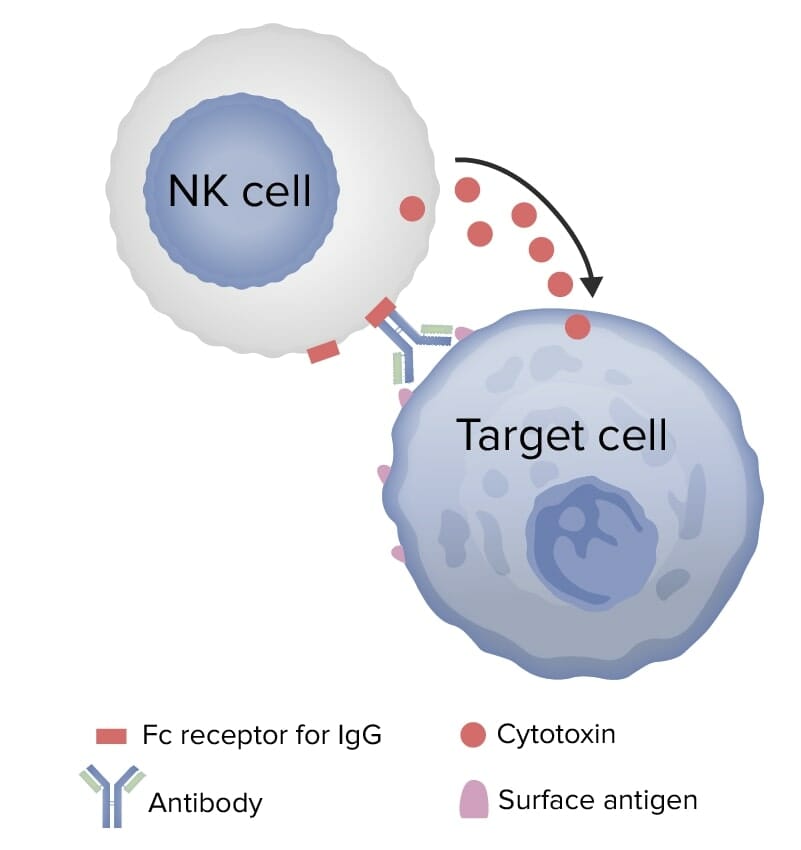
Citotoxicidade mediada por células e dependente de anticorpos (ADCCADCCThe phenomenon of antibody-mediated target cell destruction by non-sensitized effector cells. The identity of the target cell varies, but it must possess surface immunoglobulin G whose Fc portion is intact. The effector cell is a ‘killer’ cell possessing Fc receptors. It may be a lymphocyte lacking conventional B- or T-cell markers, or a monocyte, macrophage, or polynuclear leukocyte, depending on the identity of the target cell. The reaction is complement-independent.Humoral Adaptive Immunity)
Os anticorpos, ou opsoninas, ligam os seus locais de fragmentos de ligação a antigénios (FabFabUnivalent antigen-binding fragments composed of one entire immunoglobulin light chain and the amino terminal end of one of the immunoglobulin heavy chains from the hinge region, linked to each other by disulfide bonds. Fab contains the immunoglobulin variable regions, which are part of the antigen-binding site, and the first immunoglobulin constant regions. This fragment can be obtained by digestion of immunoglobulins with the proteolytic enzyme papain.Immunoglobulins: Types and Functions) aos antigénios, marcando-os para fagocitose.
Se os complexos antigénio-Ac forem demasiado grandes para serem fagocitados, as células efetoras que contêm o recetor FcFcCrystallizable fragments composed of the carboxy-terminal halves of both immunoglobulin heavy chains linked to each other by disulfide bonds. Fc fragments contain the carboxy-terminal parts of the heavy chain constant regions that are responsible for the effector functions of an immunoglobulin (complement fixation, binding to the cell membrane via fc receptors, and placental transport). This fragment can be obtained by digestion of immunoglobulins with the proteolytic enzyme papain.Immunoglobulins: Types and Functions, principalmente as células natural killer (NK),são recrutadas.
As células NK ligam-se ao recetor FcFcCrystallizable fragments composed of the carboxy-terminal halves of both immunoglobulin heavy chains linked to each other by disulfide bonds. Fc fragments contain the carboxy-terminal parts of the heavy chain constant regions that are responsible for the effector functions of an immunoglobulin (complement fixation, binding to the cell membrane via fc receptors, and placental transport). This fragment can be obtained by digestion of immunoglobulins with the proteolytic enzyme papain.Immunoglobulins: Types and Functions dos Ac→ libertam grânulos tóxicos nas células → perfurações na membrana causadas pelas perforinas e granzimas → lise celular
Exemplos: rejeição de transplante, reação imune contra uma neoplasia
Disfunção celular mediada por anticorpos
Não citotóxica; a função celular é afetada sem ocorrer lesão celular ou inflamação
Os autoanticorpos ligam-se aos recetores da superfície celular para levar a uma ativação/bloqueio anormal do processo de sinalização.
Exemplos:
Miastenia gravis (o Ac causa um bloqueio do recetor de acetilcolina)
Doença de Graves (o Ac causa uma estimulação do recetor da hormona estimulante da tiroide (TSH))
AnemiaAnemiaAnemia is a condition in which individuals have low Hb levels, which can arise from various causes. Anemia is accompanied by a reduced number of RBCs and may manifest with fatigue, shortness of breath, pallor, and weakness. Subtypes are classified by the size of RBCs, chronicity, and etiology. Anemia: Overview and Types perniciosa (Ac contra o fator intrínseco)
Citotoxicidade celular ou mediada por células dependente de anticorpos: O anticorpo liga-se aos antigénios de superfície da célula alvo. A célula efetora portadora de Fc (natural killer ou célula NK) liga-se à região Fc do anticorpo e liberta grânulos citotóxicos levando à lise da célula alvo.
Imagem de Lecturio.
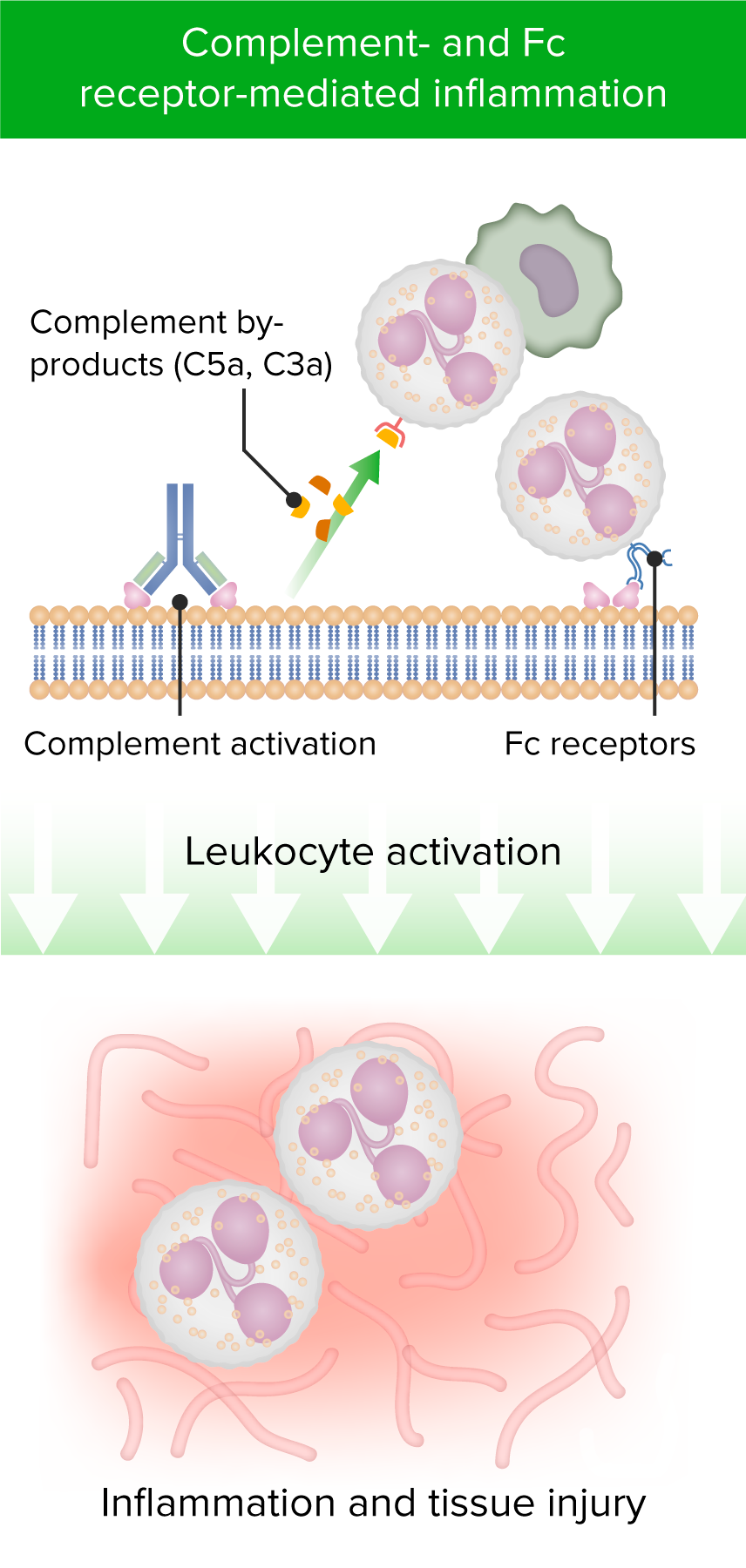
Efeitos mediados por anticorpos (quando um anticorpo se liga à superfície celular): Ativação do sistema de complemento, de leucócitos e de células efetoras portadoras do recetor Fc, sobretudo as células NK, levando a inflamação e a lesão celular.
A hipersensibilidade tipo II pode resultar das seguintes condições:
Reações transfusionais (incompatibilidadeABO ou de grupo sanguíneo)
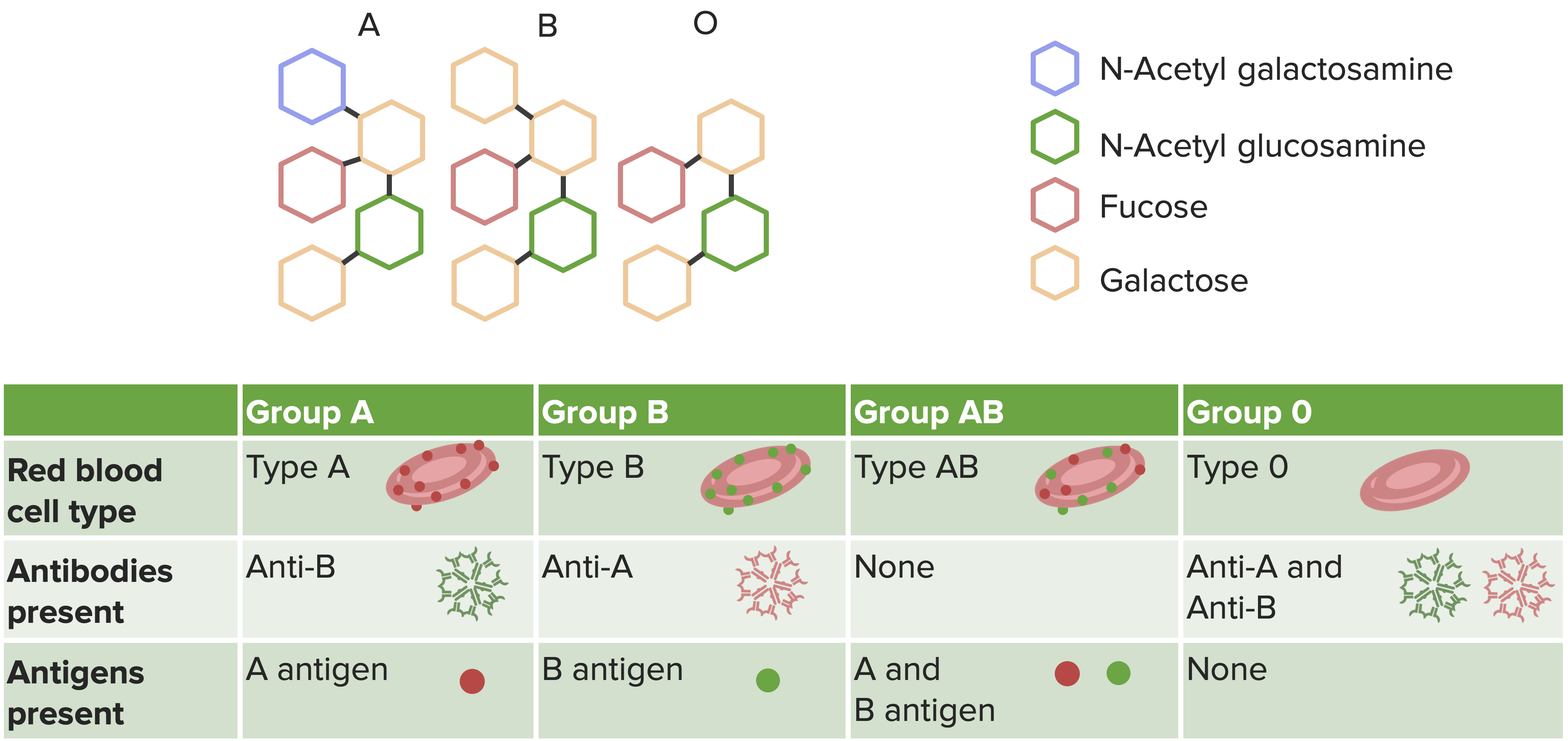
Um indivíduo do grupo sanguíneo A ou O reagiria com o sangue de um dador do tipo AB ou B (devido à presença de anticorpos anti-B)
Um recetor do grupo sanguíneo B ou O reagiria com um dador do tipo A ou AB (devido à presença de anticorpos anti-A)
Sintomas: febre, prurido, urticária; uma reação grave resulta em dificuldade respiratória e em hipotensão
Reações transfusionais induzidas por reações de hipersensibilidade tipo II. Este diagrama mostra os grupos sanguíneos e os seus anticorpos e antigénios correspondentes.
Imagem de Lecturio.
AnemiaAnemiaAnemia is a condition in which individuals have low Hb levels, which can arise from various causes. Anemia is accompanied by a reduced number of RBCs and may manifest with fatigue, shortness of breath, pallor, and weakness. Subtypes are classified by the size of RBCs, chronicity, and etiology. Anemia: Overview and Types hemolítica autoimune (contra os eritrócitos)
Pode ser mediada por IgGIgGThe major immunoglobulin isotype class in normal human serum. There are several isotype subclasses of igg, for example, igg1, igg2a, and igg2b.Hypersensitivity Pneumonitis (anemiaAnemiaAnemia is a condition in which individuals have low Hb levels, which can arise from various causes. Anemia is accompanied by a reduced number of RBCs and may manifest with fatigue, shortness of breath, pallor, and weakness. Subtypes are classified by the size of RBCs, chronicity, and etiology. Anemia: Overview and Types hemolítica autoimune quente) ou por IgMIgMA class of immunoglobulin bearing mu chains (immunoglobulin mu-chains). Igm can fix complement. The name comes from its high molecular weight and originally being called a macroglobulin.Immunoglobulins: Types and Functions (anemiaAnemiaAnemia is a condition in which individuals have low Hb levels, which can arise from various causes. Anemia is accompanied by a reduced number of RBCs and may manifest with fatigue, shortness of breath, pallor, and weakness. Subtypes are classified by the size of RBCs, chronicity, and etiology. Anemia: Overview and Types hemolítica autoimune fria)
Manifesta-se por fraqueza, dispneia, palidez pela anemiaAnemiaAnemia is a condition in which individuals have low Hb levels, which can arise from various causes. Anemia is accompanied by a reduced number of RBCs and may manifest with fatigue, shortness of breath, pallor, and weakness. Subtypes are classified by the size of RBCs, chronicity, and etiology. Anemia: Overview and Types, icterícia, colúria pela hemólise.
AnemiaAnemiaAnemia is a condition in which individuals have low Hb levels, which can arise from various causes. Anemia is accompanied by a reduced number of RBCs and may manifest with fatigue, shortness of breath, pallor, and weakness. Subtypes are classified by the size of RBCs, chronicity, and etiology. Anemia: Overview and Types perniciosa (contra o fator intrínseco)
O Ac impede a absorção de vitamina B12, causando anemiaAnemiaAnemia is a condition in which individuals have low Hb levels, which can arise from various causes. Anemia is accompanied by a reduced number of RBCs and may manifest with fatigue, shortness of breath, pallor, and weakness. Subtypes are classified by the size of RBCs, chronicity, and etiology. Anemia: Overview and Types por deficiência de B12.
A deficiência de B12 pode levar a sintomas gerais de anemiaAnemiaAnemia is a condition in which individuals have low Hb levels, which can arise from various causes. Anemia is accompanied by a reduced number of RBCs and may manifest with fatigue, shortness of breath, pallor, and weakness. Subtypes are classified by the size of RBCs, chronicity, and etiology. Anemia: Overview and Types, glossite, parestesias e alterações da marcha.
Doença hemolítica do feto e do recém-nascido (contra eritrócitos; incompatibilidade RhD)
Primeira gravidez: mulher Rh-negativa concebe um feto Rh-positivo.
Trabalho de parto: durante o trabalho de parto, os eritrócitos fetais passam para a mãe.
Pós-parto: os eritrócitos fetais sobrevivem tempo suficiente para despoletar uma resposta de IgGIgGThe major immunoglobulin isotype class in normal human serum. There are several isotype subclasses of igg, for example, igg1, igg2a, and igg2b.Hypersensitivity Pneumonitis.
Segunda gravidez: Os anticorpos anti-D maternos atravessam a placentaPlacentaA highly vascularized mammalian fetal-maternal organ and major site of transport of oxygen, nutrients, and fetal waste products. It includes a fetal portion (chorionic villi) derived from trophoblasts and a maternal portion (decidua) derived from the uterine endometrium. The placenta produces an array of steroid, protein and peptide hormones (placental hormones).Placenta, Umbilical Cord, and Amniotic Cavity e atacam os eritrócitos fetais do segundo feto Rh-positivo.
Os recém-nascidos podem apresentar uma anemiaAnemiaAnemia is a condition in which individuals have low Hb levels, which can arise from various causes. Anemia is accompanied by a reduced number of RBCs and may manifest with fatigue, shortness of breath, pallor, and weakness. Subtypes are classified by the size of RBCs, chronicity, and etiology. Anemia: Overview and Types hemolítica autolimitada até uma hidrópsia fetal (anemiaAnemiaAnemia is a condition in which individuals have low Hb levels, which can arise from various causes. Anemia is accompanied by a reduced number of RBCs and may manifest with fatigue, shortness of breath, pallor, and weakness. Subtypes are classified by the size of RBCs, chronicity, and etiology. Anemia: Overview and Types grave, edemaEdemaEdema is a condition in which excess serous fluid accumulates in the body cavity or interstitial space of connective tissues. Edema is a symptom observed in several medical conditions. It can be categorized into 2 types, namely, peripheral (in the extremities) and internal (in an organ or body cavity). Edema de pele, ascite, derrame pulmonar/pericárdico).
Púrpura trombocitopénica autoimune
Os fagócitos destroem as plaquetas sensibilizadas no sangue.
Risco de hemorragia aumentado: < 20.000/μL
Pode apresentar desde petéquias, púrpura e epistáxis até uma hemorragia grave.
Febre reumática aguda
Os anticorpos contra a parede celular do StreptococcusStreptococcusStreptococcus is one of the two medically important genera of gram-positive cocci, the other being Staphylococcus. Streptococci are identified as different species on blood agar on the basis of their hemolytic pattern and sensitivity to optochin and bacitracin. There are many pathogenic species of streptococci, including S. pyogenes, S. agalactiae, S. pneumoniae, and the viridans streptococci.Streptococcus também reagem contra o miocárdio.
Principais manifestações: artrite, cardite, coreia de Sydenham, nódulos subcutâneos, eritema marginatum.
Síndrome de Goodpasture
Os anticorpos atacam os antigénios na membrana basal dos alvéolos (hemorragia pulmonar) e dos rins (nefrite).
Inicialmente apresenta-se com queixas sistémicas, seguidas de sintomas renais (hematúria) e pulmonares (dispneia, hemoptises, tosse)
Doença de Graves
Os anticorpos contra o recetor de TSH estimulam a tiroide a produzir T4T4The major hormone derived from the thyroid gland. Thyroxine is synthesized via the iodination of tyrosines (monoiodotyrosine) and the coupling of iodotyrosines (diiodotyrosine) in the thyroglobulin. Thyroxine is released from thyroglobulin by proteolysis and secreted into the blood. Thyroxine is peripherally deiodinated to form triiodothyronine which exerts a broad spectrum of stimulatory effects on cell metabolism.Thyroid Hormones e T3T3A T3 thyroid hormone normally synthesized and secreted by the thyroid gland in much smaller quantities than thyroxine (T4). Most T3 is derived from peripheral monodeiodination of T4 at the 5′ position of the outer ring of the iodothyronine nucleus. The hormone finally delivered and used by the tissues is mainly t3.Thyroid Hormones livres na ausência de TSH.
Apresenta-se por bócio e exoftalmia ao exame objetivo, com sintomas como intolerância ao calorCalorInflammation, ansiedade, tremores, palpitações e perda de peso.
Miastenia gravis
Os anticorpos inibem a ligação da acetilcolina ao recetor nicotínico de acetilcolina.
Os anticorpos também ativam a destruição do recetor mediada pelo complemento.
Manifestações: fraqueza muscular flutuante, pior ao final do dia ou após o exercício (ptose, diplopiaDiplopiaA visual symptom in which a single object is perceived by the visual cortex as two objects rather than one. Disorders associated with this condition include refractive errors; strabismus; oculomotor nerve diseases; trochlear nerve diseases; abducens nerve diseases; and diseases of the brain stem and occipital lobe.Myasthenia Gravis, mastigação fatigável, fraqueza dos membros)
A fraqueza muscular respiratória leva à insuficiência respiratória (crise de miastenia).
Mecanismo da Doença de Graves (esquerda) e da Miastenia gravis (direita), ambas causadas pelo mecanismo de hipersensibilidade tipo II.
O diagnóstico e o tratamento variam consoante as manifestações clínicas, o sistema orgânico envolvido e a gravidade do comprometimento causada pela reação.
Reações transfusionais
Diagnóstico: clínico; teste de Coombs
Tratamento: interrupção da transfusão, repetição da tipagem sanguínea e da prova cruzada e cuidados de suporte (investigação de coagulação intravascular disseminada (CID) dependendo da gravidade da reação)
AnemiaAnemiaAnemia is a condition in which individuals have low Hb levels, which can arise from various causes. Anemia is accompanied by a reduced number of RBCs and may manifest with fatigue, shortness of breath, pallor, and weakness. Subtypes are classified by the size of RBCs, chronicity, and etiology. Anemia: Overview and Types hemolítica autoimune
Diagnóstico: investigação da hemólise; teste de Coombs
Tratamento (primeira linha): glucocorticoides; tratar a doença subjacente
Os casos refratários podem necessitar de fármacos imunossupressores e/ou esplenectomia.
AnemiaAnemiaAnemia is a condition in which individuals have low Hb levels, which can arise from various causes. Anemia is accompanied by a reduced number of RBCs and may manifest with fatigue, shortness of breath, pallor, and weakness. Subtypes are classified by the size of RBCs, chronicity, and etiology. Anemia: Overview and Types perniciosa
Diagnóstico: hemograma, B12 , dosagem de folato com análise confirmatória se níveis borderline
Tratamento: Suplementação com B12
Doença hemolítica do feto e do recém-nascido
Diagnóstico: história da gravidez, anticorpos maternos, ecografias, análises laboratoriais fetais
Prevenção:anti-RhD às 28 semanas de gestação e dentro de 72 horas após o nascimento.
Púrpura trombocitopénica autoimune
Diagnóstico: clínico com hemograma completo, esfregaço de sangue periférico, HIVHIVAnti-HIV Drugs, hepatite C e outros exames baseados na história
Objetivo do tratamento: prevenir uma hemorragia clinicamente importante
Se houver hemorragia, o tratamento pode incluir: transfusão de plaquetas, imunoglobulina intravenosa (IGIV), glucocorticoides
Febre reumática aguda
Diagnóstico: análises laboratoriais (proteína C reativa (PCRPCRPolymerase chain reaction (PCR) is a technique that amplifies DNA fragments exponentially for analysis. The process is highly specific, allowing for the targeting of specific genomic sequences, even with minuscule sample amounts. The PCR cycles multiple times through 3 phases: denaturation of the template DNA, annealing of a specific primer to the individual DNA strands, and synthesis/elongation of new DNA molecules.Polymerase Chain Reaction (PCR)), velocidade de sedimentação (VS), título de antiestreptolisina O (TASO)) com critérios de Jones; ecocardiograma.
Tratamento: antibióticos para StreptococcusStreptococcusStreptococcus is one of the two medically important genera of gram-positive cocci, the other being Staphylococcus. Streptococci are identified as different species on blood agar on the basis of their hemolytic pattern and sensitivity to optochin and bacitracin. There are many pathogenic species of streptococci, including S. pyogenes, S. agalactiae, S. pneumoniae, and the viridans streptococci.Streptococcus e cuidados de suporte
Síndrome de Goodpasture
Diagnóstico: clínico juntamente com as análises laboratoriais (anticorpos anticitoplasma de neutrófilos (ANCAANCAGroup of systemic vasculitis with a strong association with anca. The disorders are characterized by necrotizing inflammation of small and medium size vessels, with little or no immune-complex deposits in vessel walls.Rapidly Progressive Glomerulonephritis) e antimembrana basal glomerular (anti-GBM)); biópsia renal
Tratamento: plasmaferese e terapêutica imunossupressora
Doença de Graves
Diagnóstico: O Ac anti-recetor de TSH confirma o diagnóstico; análises da função tiroideia
Tratamento: controlo dos sintomas (betabloqueadores) e redução da síntese das hormonas tiroideias (fármacos antitiroideus, iodo radioativo, ou tiroidectomia)
Tratamento: piridostigmina, imunoterapias e timectomia
Referências
Akdis, C. A., & Akdis, M. (2023). Mechanisms of allergic diseases: From basic research to clinical applications. Journal of Allergy and Clinical Immunology, 152(4), 998-1010.
Bousquet, J., et al. (2023). The global allergy and asthma European network (GA2LEN) and the European Academy of Allergy and Clinical Immunology (EAACI) position paper on allergic rhinitis. Allergy, 78(2), 301-314.
Gell, P. G. H., & Coombs, R. R. A. (2024). Classification of allergic reactions underlying disease. In Clinical aspects of immunology (pp. 761-781). Wiley.
Haahtela, T., et al. (2023). The role of environmental and genetic factors in allergic diseases. Nature Reviews Immunology, 23(1), 15-30.
Kumar, V., Abbas, A. K., Aster, J. C. (2021). Robbins and Cotran Pathologic Basis of Disease (10th ed.). Elsevier.
van Neerven, R. J., et al. (2024). Advances in understanding the mechanisms of Type I hypersensitivity reactions: Implications for therapy. Frontiers in Immunology, 15, 123456.
Vohr, H. W. (2024). Hypersensitivity reactions. In Encyclopedic Reference of Immunotoxicology (pp. 302-305). Springer.
Zeldin, R. K., & Schwartz, M. (2022). Immunology Made Ridiculously Simple. MedMaster Inc.
A Lecturio Medical complementa o teu estudo através de métodos de ensino baseados em evidência, vídeos de palestras, perguntas e muito mais – tudo combinado num só lugar e fácil de usar.
User Reviews
One Platform. Everything You Need to Succeed. 📚 Get 30% off all plans and certificates!
Lecturio Premium dá-lhe acesso total a todos os conteúdos e características
Obtenha Premium para ver todos os vídeos
Verifique agora o seu e-mail para obter um teste gratuito.
Crie uma conta gratuita para testar os seus conhecimentos
Lecturio Premium dá-lhe acesso total a todos os conteúdos e características - incluindo o Qbank de Lecturio com perguntas actualizadas ao estilo do board-.