
Domina Conceptos Médicos

Estudia para la escuela de medicina y tus examenes con Lecturio.

Virus de la Hepatitis E

El virus Virus Viruses are infectious, obligate intracellular parasites composed of a nucleic acid core surrounded by a protein capsid. Viruses can be either naked (non-enveloped) or enveloped. The classification of viruses is complex and based on many factors, including type and structure of the nucleoid and capsid, the presence of an envelope, the replication cycle, and the host range. Virology de la hepatitis E Hepatitis E Acute inflammation of the liver in humans; caused by hepatitis E virus, a non-enveloped single-stranded RNA virus. Similar to hepatitis a, its incubation period is 15-60 days and is enterically transmitted, usually by fecal-oral transmission. Hepatitis E Virus ( HEV HEV The hepatitis E virus (HEV) is a small nonenveloped virus that contains linear, single-stranded, positive-sense RNA, making it similar to norovirus. Transmission of HEV is via the fecal-oral route and is clinically similar to that of hepatitis A. However, unlike hepatitis A, hepatitis E is quite severe, especially in pregnant women, and may cause fulminant hepatitis. Hepatitis E Virus, por sus siglas en EN Erythema nodosum is an immune-mediated panniculitis (inflammation of the subcutaneous fat) caused by a type IV (delayed-type) hypersensitivity reaction. It commonly manifests in young women as tender, erythematous nodules on the shins. Erythema Nodosum inglés) es un pequeño virus Virus Viruses are infectious, obligate intracellular parasites composed of a nucleic acid core surrounded by a protein capsid. Viruses can be either naked (non-enveloped) or enveloped. The classification of viruses is complex and based on many factors, including type and structure of the nucleoid and capsid, the presence of an envelope, the replication cycle, and the host range. Virology no envuelto de ARN lineal, monocatenario positivo, por lo que es similar al AL Amyloidosis norovirus Norovirus Norovirus is a nonenveloped, single-stranded, positive-sense RNA virus belonging to the Caliciviridae family. Norovirus infections are transmitted via the fecal-oral route or by aerosols from vomiting. The virus is one of the most common causes of nonbacterial gastroenteritis epidemic worldwide. Symptoms include watery and nonbloody diarrhea, nausea, vomiting, and low-grade fever. Norovirus. La transmisión del HEV HEV The hepatitis E virus (HEV) is a small nonenveloped virus that contains linear, single-stranded, positive-sense RNA, making it similar to norovirus. Transmission of HEV is via the fecal-oral route and is clinically similar to that of hepatitis A. However, unlike hepatitis A, hepatitis E is quite severe, especially in pregnant women, and may cause fulminant hepatitis. Hepatitis E Virus es por vía fecal-oral y es clínicamente similar a la de la hepatitis A Hepatitis A Hepatitis A is caused by the hepatitis A virus (HAV), a nonenveloped virus of the Picornaviridae family with single-stranded RNA. HAV causes an acute, highly contagious hepatitis with unspecific prodromal symptoms such as fever and malaise followed by jaundice and elevated liver transaminases. Hepatitis A Virus. Sin embargo, a diferencia de la hepatitis A Hepatitis A Hepatitis A is caused by the hepatitis A virus (HAV), a nonenveloped virus of the Picornaviridae family with single-stranded RNA. HAV causes an acute, highly contagious hepatitis with unspecific prodromal symptoms such as fever and malaise followed by jaundice and elevated liver transaminases. Hepatitis A Virus, la hepatitis E Hepatitis E Acute inflammation of the liver in humans; caused by hepatitis E virus, a non-enveloped single-stranded RNA virus. Similar to hepatitis a, its incubation period is 15-60 days and is enterically transmitted, usually by fecal-oral transmission. Hepatitis E Virus es bastante grave, especialmente en EN Erythema nodosum is an immune-mediated panniculitis (inflammation of the subcutaneous fat) caused by a type IV (delayed-type) hypersensitivity reaction. It commonly manifests in young women as tender, erythematous nodules on the shins. Erythema Nodosum mujeres embarazadas, y puede causar una hepatitis fulminante junto con una encefalopatía hepática en EN Erythema nodosum is an immune-mediated panniculitis (inflammation of the subcutaneous fat) caused by a type IV (delayed-type) hypersensitivity reaction. It commonly manifests in young women as tender, erythematous nodules on the shins. Erythema Nodosum un periodo de aproximadamente 8 semanas. El tratamiento es principalmente preventivo e incluye evitar el consumo de agua contaminada, un buen saneamiento y una higiene personal adecuada.

Last updated: Dec 15, 2025
Editorial responsibility: Stanley Oiseth, Lindsay Jones, Evelin Maza

Clasificación

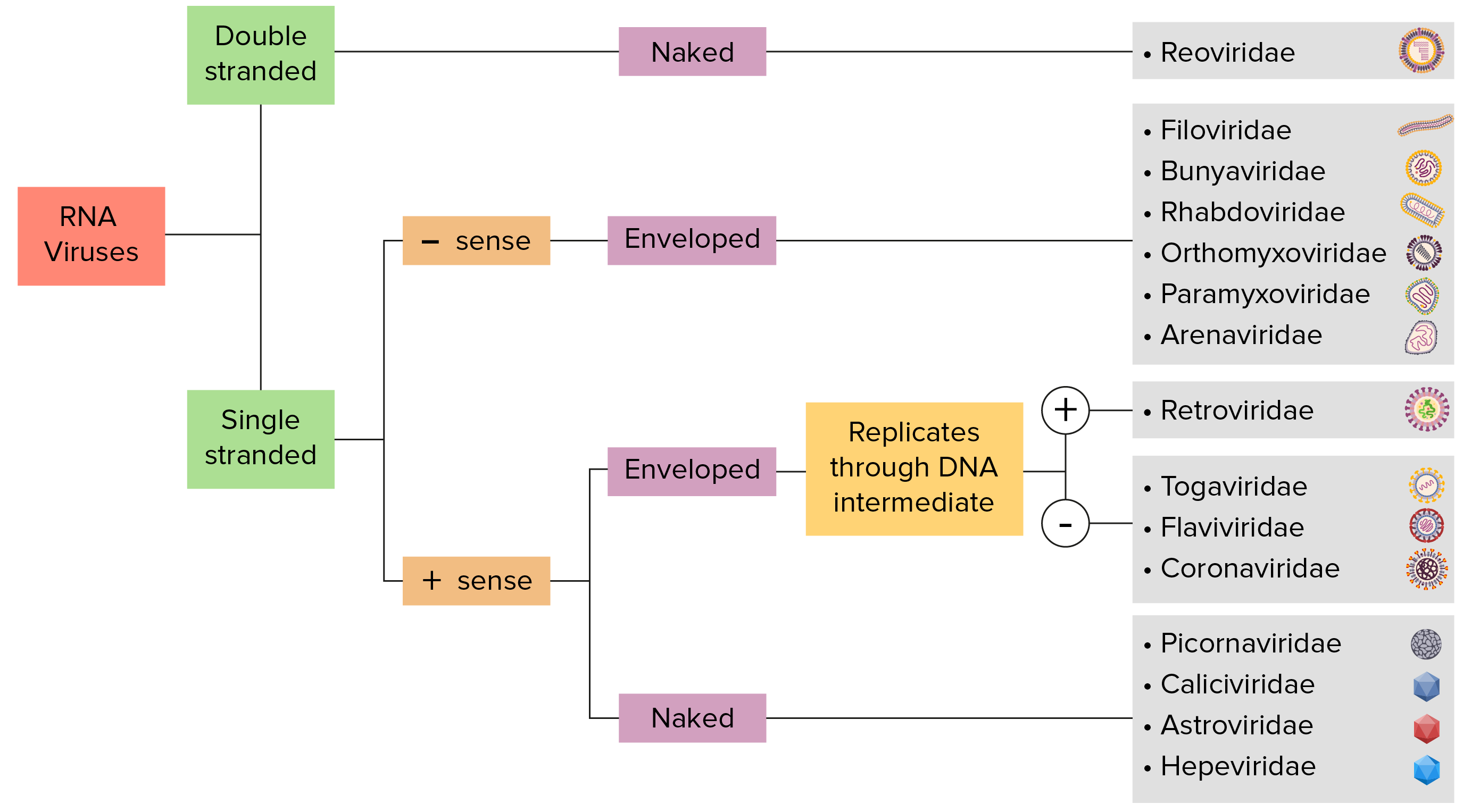
Diagrama de flujo de la clasificación de los virus de ARN

Identificación de los virus ARN:
Los virus pueden clasificarse de muchas maneras. Sin embargo, la mayoría de los virus tienen un genoma formado por ADN o ARN. Los virus con genoma ARN pueden caracterizarse además por tener ARN monocatenario o bicatenario. Los virus “envueltos” están cubiertos por una fina capa de membrana celular (normalmente tomada de la célula huésped). Si la capa está ausente, los virus se denominan “desnudos”. Los virus con genomas monocatenarios son “positivos” si el genoma se emplea directamente como ARN mensajero (ARNm), que se traduce en proteínas. Los virus monocatenarios negativos emplean la ARN polimerasa dependiente de ARN, una enzima viral, para transcribir su genoma en ARN mensajero.

Imagen de Lecturio. Licencia: CC BY-NC-SA 4.0

Características Generales

Estructura

  • Virus Virus Viruses are infectious, obligate intracellular parasites composed of a nucleic acid core surrounded by a protein capsid. Viruses can be either naked (non-enveloped) or enveloped. The classification of viruses is complex and based on many factors, including type and structure of the nucleoid and capsid, the presence of an envelope, the replication cycle, and the host range. Virology de ARN: género Hepevirus Hepevirus An unassigned genus of RNA viruses with a single officially described species, hepatitis E virus. A distantly related virus, avian hepatitis E virus, has been listed as a tentative species. Strains have also been identified in swine. The family name hepeviridae has been proposed. Hepatitis E Virus
  • 27–34 nm de diámetro
  • ARN lineal, monocatenario, de sentido positivo (parecido al AL Amyloidosis norovirus Norovirus Norovirus is a nonenveloped, single-stranded, positive-sense RNA virus belonging to the Caliciviridae family. Norovirus infections are transmitted via the fecal-oral route or by aerosols from vomiting. The virus is one of the most common causes of nonbacterial gastroenteritis epidemic worldwide. Symptoms include watery and nonbloody diarrhea, nausea, vomiting, and low-grade fever. Norovirus)
  • No envuelto
  • Cápside icosaédrica
  • 5 genotipos identificados (solo los LOS Neisseria genotipos 1 y 2 afectan a los LOS Neisseria humanos)

Características básicas

  • Viable durante años
  • Eliminación: hervir agua, cloro y el yodo pueden destruir eficazmente el virus Virus Viruses are infectious, obligate intracellular parasites composed of a nucleic acid core surrounded by a protein capsid. Viruses can be either naked (non-enveloped) or enveloped. The classification of viruses is complex and based on many factors, including type and structure of the nucleoid and capsid, the presence of an envelope, the replication cycle, and the host range. Virology.
  • Reservorio principal: animales ( virus Virus Viruses are infectious, obligate intracellular parasites composed of a nucleic acid core surrounded by a protein capsid. Viruses can be either naked (non-enveloped) or enveloped. The classification of viruses is complex and based on many factors, including type and structure of the nucleoid and capsid, the presence of an envelope, the replication cycle, and the host range. Virology zoonótico)
  • Aguda versus crónica:
    • Causa hepatitis aguda
    • Se han reportado casos crónicos del virus Virus Viruses are infectious, obligate intracellular parasites composed of a nucleic acid core surrounded by a protein capsid. Viruses can be either naked (non-enveloped) or enveloped. The classification of viruses is complex and based on many factors, including type and structure of the nucleoid and capsid, the presence of an envelope, the replication cycle, and the host range. Virology de la hepatitis E Hepatitis E Acute inflammation of the liver in humans; caused by hepatitis E virus, a non-enveloped single-stranded RNA virus. Similar to hepatitis a, its incubation period is 15-60 days and is enterically transmitted, usually by fecal-oral transmission. Hepatitis E Virus ( HEV HEV The hepatitis E virus (HEV) is a small nonenveloped virus that contains linear, single-stranded, positive-sense RNA, making it similar to norovirus. Transmission of HEV is via the fecal-oral route and is clinically similar to that of hepatitis A. However, unlike hepatitis A, hepatitis E is quite severe, especially in pregnant women, and may cause fulminant hepatitis. Hepatitis E Virus, por sus siglas en EN Erythema nodosum is an immune-mediated panniculitis (inflammation of the subcutaneous fat) caused by a type IV (delayed-type) hypersensitivity reaction. It commonly manifests in young women as tender, erythematous nodules on the shins. Erythema Nodosum inglés) en EN Erythema nodosum is an immune-mediated panniculitis (inflammation of the subcutaneous fat) caused by a type IV (delayed-type) hypersensitivity reaction. It commonly manifests in young women as tender, erythematous nodules on the shins. Erythema Nodosum pacientes inmunodeprimidos, pero son muy raros.

Epidemiología

  • Prevalencia:
    • Los LOS Neisseria anticuerpos se encuentran en EN Erythema nodosum is an immune-mediated panniculitis (inflammation of the subcutaneous fat) caused by a type IV (delayed-type) hypersensitivity reaction. It commonly manifests in young women as tender, erythematous nodules on the shins. Erythema Nodosum el 21% de los LOS Neisseria adultos de EE. UU.
    • Las tasas de anticuerpos ↑ con la edad, siendo las personas de > 60 años las que presentan una mayor prevalencia.
  • Incidencia:
  • Tasa de mortalidad: 4% en EN Erythema nodosum is an immune-mediated panniculitis (inflammation of the subcutaneous fat) caused by a type IV (delayed-type) hypersensitivity reaction. It commonly manifests in young women as tender, erythematous nodules on the shins. Erythema Nodosum general, pero 20% en EN Erythema nodosum is an immune-mediated panniculitis (inflammation of the subcutaneous fat) caused by a type IV (delayed-type) hypersensitivity reaction. It commonly manifests in young women as tender, erythematous nodules on the shins. Erythema Nodosum las pacientes embarazadas

Patogénesis

Transmisión

  • Más frecuente: vía fecal-oral.
    • Son frecuentes los LOS Neisseria brotes de transmisión alimentaria (e.g., mariscos cultivados en EN Erythema nodosum is an immune-mediated panniculitis (inflammation of the subcutaneous fat) caused by a type IV (delayed-type) hypersensitivity reaction. It commonly manifests in young women as tender, erythematous nodules on the shins. Erythema Nodosum aguas contaminadas).
    • Mayor transmisión: mayor excreción viral durante el pródromo anictérico (14-21 días).
  • Menos frecuente: productos sanguíneos u órganos contaminados

Factores de riesgo del huésped

  • Institucionalización (e.g., residencias de ancianos)
  • Ocupación (e.g., guardería)
  • Viajes al AL Amyloidosis extranjero
  • Productos sanguíneos contaminados
  • Usuarios de drogas IV u otras drogas ilícitas
  • Población indigente
  • Receptores de trasplante de órgano sólido (e.g., hígado, riñón)

Fisiopatología

Replicación primaria:

  • Ingestión de alimentos contaminados/transmisión fecal-oral → se replica en EN Erythema nodosum is an immune-mediated panniculitis (inflammation of the subcutaneous fat) caused by a type IV (delayed-type) hypersensitivity reaction. It commonly manifests in young women as tender, erythematous nodules on the shins. Erythema Nodosum la orofaringe/intestinos → torrente sanguíneo = 1ra viremia Viremia The presence of viruses in the blood. Erythema Infectiosum
  • Llega al AL Amyloidosis hígado por su tropismo tisular (hepatotrópico)
  • Los LOS Neisseria hepatocitos captan el virus Virus Viruses are infectious, obligate intracellular parasites composed of a nucleic acid core surrounded by a protein capsid. Viruses can be either naked (non-enveloped) or enveloped. The classification of viruses is complex and based on many factors, including type and structure of the nucleoid and capsid, the presence of an envelope, the replication cycle, and the host range. Virology mediante un receptor Receptor Receptors are proteins located either on the surface of or within a cell that can bind to signaling molecules known as ligands (e.g., hormones) and cause some type of response within the cell. Receptors en EN Erythema nodosum is an immune-mediated panniculitis (inflammation of the subcutaneous fat) caused by a type IV (delayed-type) hypersensitivity reaction. It commonly manifests in young women as tender, erythematous nodules on the shins. Erythema Nodosum la membrana plasmática.
  • La replicación se da en EN Erythema nodosum is an immune-mediated panniculitis (inflammation of the subcutaneous fat) caused by a type IV (delayed-type) hypersensitivity reaction. It commonly manifests in young women as tender, erythematous nodules on the shins. Erythema Nodosum los LOS Neisseria hepatocitos y en EN Erythema nodosum is an immune-mediated panniculitis (inflammation of the subcutaneous fat) caused by a type IV (delayed-type) hypersensitivity reaction. It commonly manifests in young women as tender, erythematous nodules on the shins. Erythema Nodosum las células de Kupffer (macrófagos hepáticos):
    • Tras la entrada en EN Erythema nodosum is an immune-mediated panniculitis (inflammation of the subcutaneous fat) caused by a type IV (delayed-type) hypersensitivity reaction. It commonly manifests in young women as tender, erythematous nodules on the shins. Erythema Nodosum la célula, el ARN viral no está recubierto y los LOS Neisseria ribosomas del huésped se unen para formar polisomas.
    • Se sintetizan proteínas virales y el genoma viral es copiado por una ARN polimerasa viral.
  • Partículas virales se desprenden hacia el árbol biliar → excretadas en EN Erythema nodosum is an immune-mediated panniculitis (inflammation of the subcutaneous fat) caused by a type IV (delayed-type) hypersensitivity reaction. It commonly manifests in young women as tender, erythematous nodules on the shins. Erythema Nodosum las heces

Presentación Clínica

  • Causa hepatitis viral aguda
  • Periodo de incubación: 2–6 semanas
  • Período infeccioso: de 2 semanas antes a 1 semana después del inicio de los LOS Neisseria síntomas
  • El HEV HEV The hepatitis E virus (HEV) is a small nonenveloped virus that contains linear, single-stranded, positive-sense RNA, making it similar to norovirus. Transmission of HEV is via the fecal-oral route and is clinically similar to that of hepatitis A. However, unlike hepatitis A, hepatitis E is quite severe, especially in pregnant women, and may cause fulminant hepatitis. Hepatitis E Virus puede ser asintomático o muy leve en EN Erythema nodosum is an immune-mediated panniculitis (inflammation of the subcutaneous fat) caused by a type IV (delayed-type) hypersensitivity reaction. It commonly manifests in young women as tender, erythematous nodules on the shins. Erythema Nodosum los LOS Neisseria niños.
  • Síntomas prodrómicos:
    • Fiebre
    • Malestar
    • Dolor Dolor Inflammation abdominal (cuadrante superior derecho (CSD))
    • Mialgia y artralgia
  • Síntomas de la fase ictérica:
    • Puede durar de días a varias semanas
    • Ictericia
    • Orina oscura
    • Heces grisáceas
    • Prurito
  • La hepatitis recidivante se produce en EN Erythema nodosum is an immune-mediated panniculitis (inflammation of the subcutaneous fat) caused by a type IV (delayed-type) hypersensitivity reaction. It commonly manifests in young women as tender, erythematous nodules on the shins. Erythema Nodosum el 15% de los LOS Neisseria casos (pero solo durante un año como máximo).

Diagnóstico y Tratamiento

Diagnóstico

  • Ultrasonido abdominal: Descartar causas extrahepáticas de obstrucción biliar.
  • Pruebas serológicas:
    • Anticuerpos IgM IgM A class of immunoglobulin bearing mu chains (immunoglobulin mu-chains). Igm can fix complement. The name comes from its high molecular weight and originally being called a macroglobulin. Immunoglobulins: Types and Functions anti-HEV:
      • Positivo en EN Erythema nodosum is an immune-mediated panniculitis (inflammation of the subcutaneous fat) caused by a type IV (delayed-type) hypersensitivity reaction. It commonly manifests in young women as tender, erythematous nodules on the shins. Erythema Nodosum infección actual o reciente
      • Comienzan a aumentar 4 semanas después de la infección y sigue siendo detectable durante 2 meses después
    • Anticuerpos IgG IgG The major immunoglobulin isotype class in normal human serum. There are several isotype subclasses of igg, for example, igg1, igg2a, and igg2b. Hypersensitivity Pneumonitis anti-HEV: infección previa
    • ARN del HEV HEV The hepatitis E virus (HEV) is a small nonenveloped virus that contains linear, single-stranded, positive-sense RNA, making it similar to norovirus. Transmission of HEV is via the fecal-oral route and is clinically similar to that of hepatitis A. However, unlike hepatitis A, hepatitis E is quite severe, especially in pregnant women, and may cause fulminant hepatitis. Hepatitis E Virus: analizado en EN Erythema nodosum is an immune-mediated panniculitis (inflammation of the subcutaneous fat) caused by a type IV (delayed-type) hypersensitivity reaction. It commonly manifests in young women as tender, erythematous nodules on the shins. Erythema Nodosum heces o suero
  • Durante la infección aguda, la enzima hepática ALT ALT An enzyme that catalyzes the conversion of l-alanine and 2-oxoglutarate to pyruvate and l-glutamate. Liver Function Tests está elevada.

Tratamiento

  • Casos agudos y no complicados: cuidados de soporte suficientes
  • Casos graves: Reducir la terapia inmunosupresora, si es posible.
  • Opciones antivirales:
    • Ribavirina (contraindicada en EN Erythema nodosum is an immune-mediated panniculitis (inflammation of the subcutaneous fat) caused by a type IV (delayed-type) hypersensitivity reaction. It commonly manifests in young women as tender, erythematous nodules on the shins. Erythema Nodosum el embarazo)
    • Sofosbuvir: en EN Erythema nodosum is an immune-mediated panniculitis (inflammation of the subcutaneous fat) caused by a type IV (delayed-type) hypersensitivity reaction. It commonly manifests in young women as tender, erythematous nodules on the shins. Erythema Nodosum combinación con ribavirina
    • Interferón alfa pegilado (PEG-IFN-α, por sus siglas en EN Erythema nodosum is an immune-mediated panniculitis (inflammation of the subcutaneous fat) caused by a type IV (delayed-type) hypersensitivity reaction. It commonly manifests in young women as tender, erythematous nodules on the shins. Erythema Nodosum inglés)

Prevención

  • Saneamiento:
    • Tratamiento del agua y las aguas residuales con cloro y lavado de manos regular Regular Insulin
    • Evitar los LOS Neisseria alimentos posiblemente contaminados, como el marisco sin cocinar
  • Hasta la fecha, no existe ninguna vacuna aprobada por la FDA.

Comparación de los Virus de la Hepatitis

Tabla: Comparación de los LOS Neisseria virus Virus Viruses are infectious, obligate intracellular parasites composed of a nucleic acid core surrounded by a protein capsid. Viruses can be either naked (non-enveloped) or enveloped. The classification of viruses is complex and based on many factors, including type and structure of the nucleoid and capsid, the presence of an envelope, the replication cycle, and the host range. Virology de la hepatitis A Hepatitis A Hepatitis A is caused by the hepatitis A virus (HAV), a nonenveloped virus of the Picornaviridae family with single-stranded RNA. HAV causes an acute, highly contagious hepatitis with unspecific prodromal symptoms such as fever and malaise followed by jaundice and elevated liver transaminases. Hepatitis A Virus–E
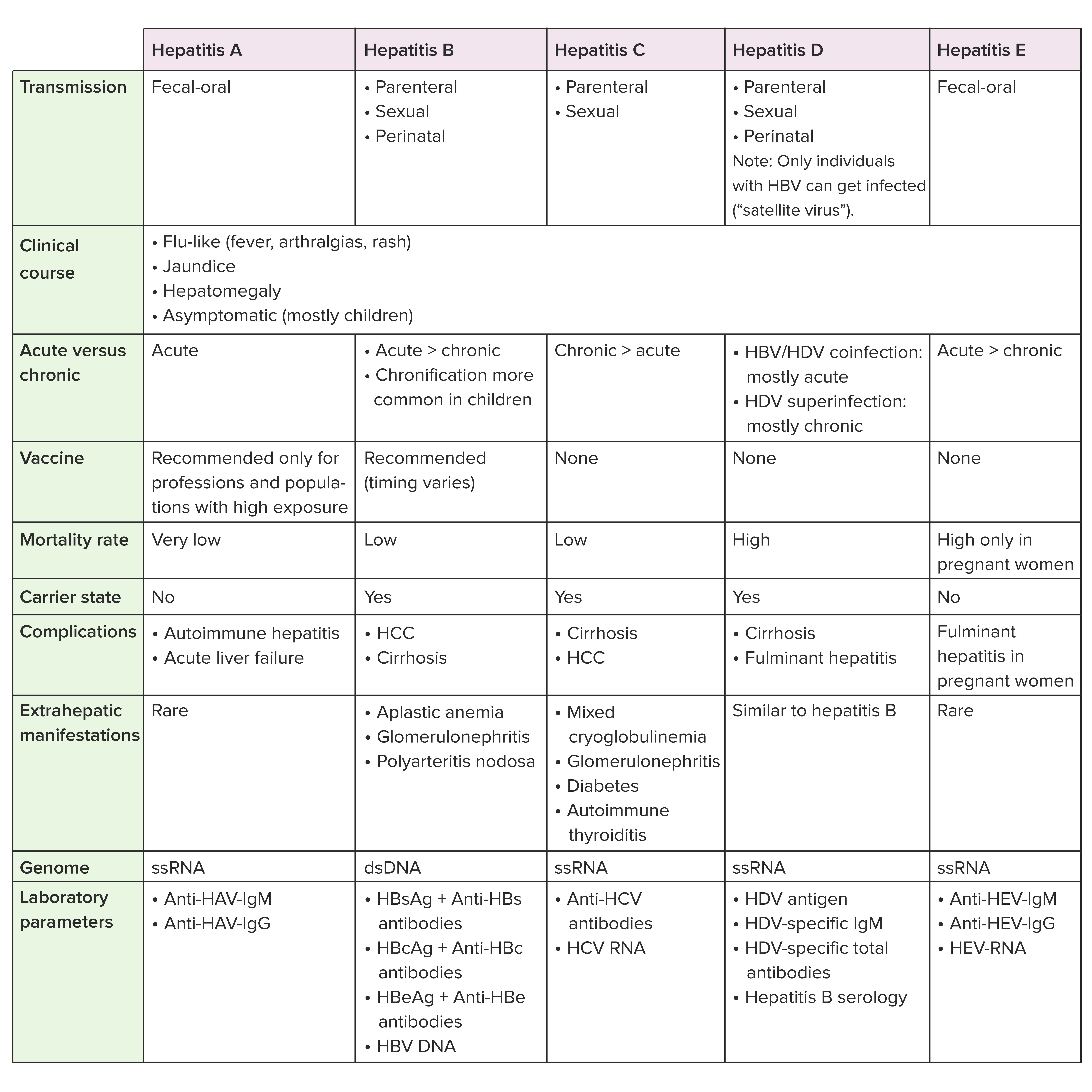
Hepatitis A–E in comparison

Anti-HBc antibodies: anticuerpos del núcleo de la hepatitis B
Anti-HBs antibodies: anticuerpos de superficie contra la hepatitis B
HBcAg: antígeno del núcleo de la hepatitis B
HBsAg: antígeno de superficie de la hepatitis B
HBV: virus de la hepatitis B
HCC: carcinoma hepatocelular
HCV: virus de la hepatitis C
HDV: virus de la hepatitis D

Imagen por Lecturio. Licencia: CC BY-NC-SA 4.0

Diagnóstico Diferencial

  • Enfermedad hepática alcohólica: patología hepática que se produce por el consumo excesivo y prolongado de alcohol. El 1er estadio es un hígado graso asintomático, que es reversible. El 2do estadio es la hepatitis alcohólica, que suele presentarse con ictericia, fiebre y dolor Dolor Inflammation en EN Erythema nodosum is an immune-mediated panniculitis (inflammation of the subcutaneous fat) caused by a type IV (delayed-type) hypersensitivity reaction. It commonly manifests in young women as tender, erythematous nodules on the shins. Erythema Nodosum el CSD. El 3er estadio es la cirrosis hepática. El diagnóstico se establece mediante los LOS Neisseria antecedentes, las pruebas de función hepática y los LOS Neisseria estudios de imagen.
  • Lesión hepática inducida por medicamentos: se produce cuando los LOS Neisseria medicamentos ingeridos causan lesiones en EN Erythema nodosum is an immune-mediated panniculitis (inflammation of the subcutaneous fat) caused by a type IV (delayed-type) hypersensitivity reaction. It commonly manifests in young women as tender, erythematous nodules on the shins. Erythema Nodosum los LOS Neisseria hepatocitos directamente de forma predecible y dependiente de la dosis o a través de reacciones idiosincrásicas. La presentación de la lesión hepática inducida por medicamentos puede ser aguda o crónica, con una toxicidad grave que se manifiesta como una insuficiencia hepática fulminante. El diagnóstico de la lesión hepática inducida por medicamentos requiere una toma adecuada de los LOS Neisseria antecedentes y pruebas de laboratorio. El tratamiento consiste en EN Erythema nodosum is an immune-mediated panniculitis (inflammation of the subcutaneous fat) caused by a type IV (delayed-type) hypersensitivity reaction. It commonly manifests in young women as tender, erythematous nodules on the shins. Erythema Nodosum el diagnóstico precoz y la interrupción del medicamento, así como la terapia de soporte.
  • Hepatitis autoinmune: inflamación del hígado que se produce cuando el sistema inmunitario del organismo ataca a sus propias células hepáticas. La presentación clínica va VA Ventilation: Mechanics of Breathing desde lo asintomático hasta los LOS Neisseria síntomas de insuficiencia hepática aguda. El diagnóstico se establece mediante un análisis de sangre para detectar los LOS Neisseria autoanticuerpos característicos (especialmente, los LOS Neisseria anticuerpos contra el músculo liso) y una biopsia de hígado. El tratamiento incluye corticosteroides y azatioprina.
  • Enfermedad de Wilson: trastorno autosómico recesivo por una mutación en EN Erythema nodosum is an immune-mediated panniculitis (inflammation of the subcutaneous fat) caused by a type IV (delayed-type) hypersensitivity reaction. It commonly manifests in young women as tender, erythematous nodules on the shins. Erythema Nodosum el gen ATP7B, que regula el transporte de cobre en EN Erythema nodosum is an immune-mediated panniculitis (inflammation of the subcutaneous fat) caused by a type IV (delayed-type) hypersensitivity reaction. It commonly manifests in young women as tender, erythematous nodules on the shins. Erythema Nodosum los LOS Neisseria hepatocitos. Las manifestaciones neuropsiquiátricas de la enfermedad de Wilson ayudan a diferenciarla de otras causas de hepatitis. En EN Erythema nodosum is an immune-mediated panniculitis (inflammation of the subcutaneous fat) caused by a type IV (delayed-type) hypersensitivity reaction. It commonly manifests in young women as tender, erythematous nodules on the shins. Erythema Nodosum los LOS Neisseria primeros estadios, la enfermedad de Wilson puede confundirse con la encefalopatía hepática. Los LOS Neisseria anillos de Kayser-Fleischer y los LOS Neisseria niveles bajos de ceruloplasmina ayudan a diferenciar la enfermedad de Wilson de otras causas de hepatitis.
  • Enfermedad del hígado graso no alcohólico: espectro de patología hepática que surge debido a la acumulación de triglicéridos en EN Erythema nodosum is an immune-mediated panniculitis (inflammation of the subcutaneous fat) caused by a type IV (delayed-type) hypersensitivity reaction. It commonly manifests in young women as tender, erythematous nodules on the shins. Erythema Nodosum los LOS Neisseria hepatocitos. La enfermedad del hígado graso no alcohólico va VA Ventilation: Mechanics of Breathing desde el hígado graso o la esteatosis hepática hasta la esteatohepatitis no alcohólica, que presenta depósitos grasos e inflamación. La lesión hepática progresiva y la fibrosis Fibrosis Any pathological condition where fibrous connective tissue invades any organ, usually as a consequence of inflammation or other injury. Bronchiolitis Obliterans se convierten irreversiblemente en EN Erythema nodosum is an immune-mediated panniculitis (inflammation of the subcutaneous fat) caused by a type IV (delayed-type) hypersensitivity reaction. It commonly manifests in young women as tender, erythematous nodules on the shins. Erythema Nodosum cirrosis y, posiblemente, en EN Erythema nodosum is an immune-mediated panniculitis (inflammation of the subcutaneous fat) caused by a type IV (delayed-type) hypersensitivity reaction. It commonly manifests in young women as tender, erythematous nodules on the shins. Erythema Nodosum cáncer primario de hígado. El tratamiento se realiza con modificaciones del estilo de vida (dieta y ejercicio).

Referencias

  1. Remy, M. (2019). Hepatitis E. Emedicine. Retrieved January 28, 2021, from https://emedicine.medscape.com/article/178140-overview
  2. Sherman, K. (2020). Hepatitis E virus infection. UpToDate. Retrieved January 27, 2021, from https://www.uptodate.com/contents/hepatitis-e-virus-infection
  3. Mast EE, Krawczynski K. (1996). Hepatitis E: an overview. Annu Rev Med 47:257–266.
  4. Kamar N, Bendall R, Legrand-Abravanel F, et al. (2012). Hepatitis E. Lancet 379:2477–2488.

¡Crea tu cuenta gratis o inicia una sesión para seguir leyendo!

Regístrate ahora y obtén acceso gratuito a Lecturio con páginas de concepto, videos médicos y cuestionarios para tu educación médica.

User Reviews

Que tengas una sesión de estudio alegre y navideña 🎁 Ahorra 50% en todos los planes >>

Details