Domina Conceptos Médicos

Estudia para la escuela de medicina y tus examenes con Lecturio.

Tamizaje de Cáncer Cervicouterino

El cáncer cervicouterino es el 3er cáncer ginecológico más común. Más del 90% de los LOS Neisseria casos de cáncer cervicouterino están asociados con los LOS Neisseria virus Virus Viruses are infectious, obligate intracellular parasites composed of a nucleic acid core surrounded by a protein capsid. Viruses can be either naked (non-enveloped) or enveloped. The classification of viruses is complex and based on many factors, including type and structure of the nucleoid and capsid, the presence of an envelope, the replication cycle, and the host range. Virology del papiloma humano (VPH) de alto riesgo, que se transmiten por contacto sexual. El cáncer cervicouterino se puede prevenir mediante la detección temprana y el tratamiento de las lesiones precancerosas causadas por el VPH de alto riesgo. Los LOS Neisseria métodos de detección son la citología cervical y la tipificación de VPH. Las guías varían en EN Erythema nodosum is an immune-mediated panniculitis (inflammation of the subcutaneous fat) caused by a type IV (delayed-type) hypersensitivity reaction. It commonly manifests in young women as tender, erythematous nodules on the shins. Erythema Nodosum cuanto al AL Amyloidosis momento de iniciar el tamizaje; varias sociedades estadounidenses recomiendan que el tamizaje comience entre los LOS Neisseria 21 y los LOS Neisseria 25 años de edad, mientras que la Organización Mundial de la Salud (OMS) sugiere esperar hasta los LOS Neisseria 30 años, especialmente en EN Erythema nodosum is an immune-mediated panniculitis (inflammation of the subcutaneous fat) caused by a type IV (delayed-type) hypersensitivity reaction. It commonly manifests in young women as tender, erythematous nodules on the shins. Erythema Nodosum entornos con recursos limitados. Las guías también varían en EN Erythema nodosum is an immune-mediated panniculitis (inflammation of the subcutaneous fat) caused by a type IV (delayed-type) hypersensitivity reaction. It commonly manifests in young women as tender, erythematous nodules on the shins. Erythema Nodosum cuanto al AL Amyloidosis método preferido para realizar las pruebas, aunque universalmente se prefiere la prueba del VPH (con o sin citología) a partir de los LOS Neisseria 30 años. Desde que se inició el programa de tamizaje, la incidencia y la mortalidad por cáncer cervicouterino han disminuido en EN Erythema nodosum is an immune-mediated panniculitis (inflammation of the subcutaneous fat) caused by a type IV (delayed-type) hypersensitivity reaction. It commonly manifests in young women as tender, erythematous nodules on the shins. Erythema Nodosum un 75%.

Last updated: Feb 13, 2023

Editorial responsibility: Stanley Oiseth, Lindsay Jones, Evelin Maza

Descripción General

Cáncer cervicouterino

  • Cáncer del cuello uterino
  • Principales tipos histológicos:
    • Carcinoma de células escamosas: aproximadamente el 80% de los LOS Neisseria cánceres cervicouterinos
    • Adenocarcinoma: 15%
    • Carcinoma adenoescamoso: 3%–5%
  • Asociado con el virus Virus Viruses are infectious, obligate intracellular parasites composed of a nucleic acid core surrounded by a protein capsid. Viruses can be either naked (non-enveloped) or enveloped. The classification of viruses is complex and based on many factors, including type and structure of the nucleoid and capsid, the presence of an envelope, the replication cycle, and the host range. Virology del papiloma humano (VPH):
    • Detectado en EN Erythema nodosum is an immune-mediated panniculitis (inflammation of the subcutaneous fat) caused by a type IV (delayed-type) hypersensitivity reaction. It commonly manifests in young women as tender, erythematous nodules on the shins. Erythema Nodosum el 99,7% de los LOS Neisseria cánceres cervicouterinos
    • Los LOS Neisseria subtipos de VPH 16 y 18 se encuentran en EN Erythema nodosum is an immune-mediated panniculitis (inflammation of the subcutaneous fat) caused by a type IV (delayed-type) hypersensitivity reaction. It commonly manifests in young women as tender, erythematous nodules on the shins. Erythema Nodosum > 70% de los LOS Neisseria cánceres cervicouterino

Epidemiología

  • Más del 80% de los LOS Neisseria casos nuevos a nivel mundial provienen de países menos desarrollados.
  • A nivel mundial:
    • Estimación para el 2020:
      • > 600 000 diagnósticos de cáncer cervicouterino
      • > 340 000 muertes por cáncer cervicouterino
    • Causa más frecuente de cáncer en EN Erythema nodosum is an immune-mediated panniculitis (inflammation of the subcutaneous fat) caused by a type IV (delayed-type) hypersensitivity reaction. It commonly manifests in young women as tender, erythematous nodules on the shins. Erythema Nodosum 23 países en EN Erythema nodosum is an immune-mediated panniculitis (inflammation of the subcutaneous fat) caused by a type IV (delayed-type) hypersensitivity reaction. It commonly manifests in young women as tender, erythematous nodules on the shins. Erythema Nodosum desarrollo, principalmente en EN Erythema nodosum is an immune-mediated panniculitis (inflammation of the subcutaneous fat) caused by a type IV (delayed-type) hypersensitivity reaction. It commonly manifests in young women as tender, erythematous nodules on the shins. Erythema Nodosum áfrica subsahariana, sur américa y sudeste asiático.
  • En EN Erythema nodosum is an immune-mediated panniculitis (inflammation of the subcutaneous fat) caused by a type IV (delayed-type) hypersensitivity reaction. It commonly manifests in young women as tender, erythematous nodules on the shins. Erythema Nodosum Estados Unidos:
    • Anualmente se diagnostican 14 000 casos nuevos de cáncer cervicouterino invasivo.
    • Edad media al AL Amyloidosis diagnóstico: 50 años
    • 3er cáncer gineclógico más comúnmente diagnosticado
    • 18va causa de muerte por cáncer en EN Erythema nodosum is an immune-mediated panniculitis (inflammation of the subcutaneous fat) caused by a type IV (delayed-type) hypersensitivity reaction. It commonly manifests in young women as tender, erythematous nodules on the shins. Erythema Nodosum general

Factores de riesgo

  • Relacionados con el VPH:
    • Actividad sexual de inicio temprano
    • Múltiples parejas sexuales
    • Multiparidad y edad temprana al AL Amyloidosis 1er parto
    • Antecedentes de cáncer o neoplasia intraepitelial escamosa vaginal o vulvar
    • Inmunosupresión
    • Infección por el virus Virus Viruses are infectious, obligate intracellular parasites composed of a nucleic acid core surrounded by a protein capsid. Viruses can be either naked (non-enveloped) or enveloped. The classification of viruses is complex and based on many factors, including type and structure of the nucleoid and capsid, the presence of an envelope, the replication cycle, and the host range. Virology de la inmunodeficiencia humana (VIH)
    • Coinfección con Chlamydia trachomatis Chlamydia trachomatis Type species of Chlamydia causing a variety of ocular and urogenital diseases. Chlamydia o virus Virus Viruses are infectious, obligate intracellular parasites composed of a nucleic acid core surrounded by a protein capsid. Viruses can be either naked (non-enveloped) or enveloped. The classification of viruses is complex and based on many factors, including type and structure of the nucleoid and capsid, the presence of an envelope, the replication cycle, and the host range. Virology del herpes simple
  • No relacionados con el VPH:
    • Nivel socioeconómico bajo
    • Raza afroamericana
    • Uso de anticonceptivos orales
    • Fumar cigarrillos (asociado con el carcinoma de células escamosas)
    • Antecedentes familiares
    • Factor de riesgo negativo: compañeros masculinos circuncidados

Justificación del Tamizaje

  • Se recomienda el tamizaje porque:
    • Las mujeres de 21–65 años de edad tienen riesgo de cáncer cervicouterino debido a la posible exposición al AL Amyloidosis virus Virus Viruses are infectious, obligate intracellular parasites composed of a nucleic acid core surrounded by a protein capsid. Viruses can be either naked (non-enveloped) or enveloped. The classification of viruses is complex and based on many factors, including type and structure of the nucleoid and capsid, the presence of an envelope, the replication cycle, and the host range. Virology del papiloma humano de alto riesgo a través de las relaciones sexuales.
    • En EN Erythema nodosum is an immune-mediated panniculitis (inflammation of the subcutaneous fat) caused by a type IV (delayed-type) hypersensitivity reaction. It commonly manifests in young women as tender, erythematous nodules on the shins. Erythema Nodosum los LOS Neisseria últimos 50 años se produjo una disminución del 75% en EN Erythema nodosum is an immune-mediated panniculitis (inflammation of the subcutaneous fat) caused by a type IV (delayed-type) hypersensitivity reaction. It commonly manifests in young women as tender, erythematous nodules on the shins. Erythema Nodosum la incidencia y la mortalidad del cáncer cervicouterino debido al AL Amyloidosis tamizaje.
    • La mayoría de los LOS Neisseria casos de cáncer cervicouterino se encuentran en EN Erythema nodosum is an immune-mediated panniculitis (inflammation of the subcutaneous fat) caused by a type IV (delayed-type) hypersensitivity reaction. It commonly manifests in young women as tender, erythematous nodules on the shins. Erythema Nodosum mujeres que no se han examinado adecuadamente.
    • El cáncer cervicouterino generalmente no causa síntomas.
  • No se recomienda el tamizaje antes de los LOS Neisseria 21 años porque:
    • Las lesiones cancerosas y precancerosas son raras antes de los LOS Neisseria 21 años.
    • La progresión desde la infección por el VPH de alto riesgo → lesiones precancerosas (neoplasia intraepitelial cervical [NIC]) → cáncer invasivo lleva muchos años
    • Muchas lesiones precancerosas e infecciones por VPH retrocederán.
    • Puede provocar más daño por angustia psicológica y procedimientos innecesarios

Estrategias de Tamizaje

Las estrategias de tamizaje se pueden realizar de forma independiente o simultánea (prueba conjunta).
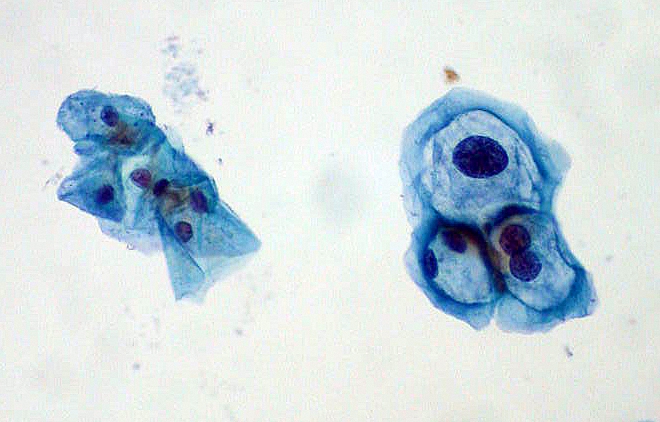
  • Citología cervical:
    • Se recolectan células ectocervicales y endocervicales para evaluar la zona de transformación (área de riesgo de cáncer cervicouterino).
    • El procedimiento se realiza con:
      • Cepillo endocervical y espátula ectocervical
      • Una escoba cervical (recoge simultáneamente células endocervicales y ectocervicales)
    • Métodos de preparación:
      • Frotis convencional de Papanicolaou: se extiende la muestra obtenida por medio de una espátula ectocervical y/o un cepillo sobre un portaobjetos, y se aplica un fijador inmediatamente
      • Citología en EN Erythema nodosum is an immune-mediated panniculitis (inflammation of the subcutaneous fat) caused by a type IV (delayed-type) hypersensitivity reaction. It commonly manifests in young women as tender, erythematous nodules on the shins. Erythema Nodosum base líquida: el dispositivo de recolección se coloca y se agita en EN Erythema nodosum is an immune-mediated panniculitis (inflammation of the subcutaneous fat) caused by a type IV (delayed-type) hypersensitivity reaction. It commonly manifests in young women as tender, erythematous nodules on the shins. Erythema Nodosum la solución fijadora líquida, que luego es procesada por el laboratorio.
  • Tipificación de VPH:
    • Identifica subtipos de VPH de alto riesgo
    • Las muestras se obtienen del endocérvix.
    • Si se realiza una citología de base líquida, se puede utilizar la misma muestra de citología.

Tamizaje de Cáncer Cervicouterino Para Individuos de Riesgo Promedio

Las siguientes recomendaciones son para individuos de riesgo promedio. Este grupo incluye personas que completaron su esquema de vacunación contra el VPH.

  • Recomendaciones del United States Preventive Services Task Force (USPSTF):
    • No tamizaje antes de los LOS Neisseria 21 años, independientemente de los LOS Neisseria antecedentes sexuales
    • Para edades entre 21–29 años: solo citología cada 3 años
    • Para las edades entre 30–65 años, las opciones son:
      • Solo citología cervical cada 3 años
      • Tipificación de VPH de alto riesgo cada 5 años
      • Citología en EN Erythema nodosum is an immune-mediated panniculitis (inflammation of the subcutaneous fat) caused by a type IV (delayed-type) hypersensitivity reaction. It commonly manifests in young women as tender, erythematous nodules on the shins. Erythema Nodosum conjunto con tipificación de VPH de alto riesgo cada 5 años
    • El tamizaje finaliza a la edad de 65 años si la paciente tiene un tamizaje adecuado negativo.
  • Recomendaciones actualizadas de la American Cancer Society (2020):
    • Tamizaje de individuos entre 25-65 años.
    • Prueba de preferencia: prueba primaria de VPH (prueba aprobada que es adecuada para el tamizaje por sí misma) cada 5 años.
    • Si no se puede realizar la prueba primaria de VPH:
      • Prueba conjunta de tipificación del VPH y citología cervical cada 5 años
      • Citología cervical sola cada 3 años
    • El tamizaje finaliza a los LOS Neisseria 65 años para individuos de alto riesgo con un tamizaje adecuado negativo.
    • Justificación de lo anterior:
      • Baja incidencia de cáncer cervicouterino en EN Erythema nodosum is an immune-mediated panniculitis (inflammation of the subcutaneous fat) caused by a type IV (delayed-type) hypersensitivity reaction. It commonly manifests in young women as tender, erythematous nodules on the shins. Erythema Nodosum < 24 años
      • La tipificación del VPH es más específica.
      • Aproximadamente el 70% de los LOS Neisseria adolescentes han recibido al AL Amyloidosis menos 1 dosis de la vacuna contra el VPH.
  • Recomendaciones de la Organización Mundial de la Salud:
    • Edades de tamizaje:
      • Individuos de 30-50 años deben ser tamizados/ priorizados
      • Tamizaje debe continuar en EN Erythema nodosum is an immune-mediated panniculitis (inflammation of the subcutaneous fat) caused by a type IV (delayed-type) hypersensitivity reaction. It commonly manifests in young women as tender, erythematous nodules on the shins. Erythema Nodosum individuos de 50-65 años si hay recursos disponibles, priorizando aquellos que nunca se han tamizado.
    • Se recomienda tamizaje con tipificación de VPH de alto riesgo cada 5-10 años.
  • El tamizaje negativo previo adecuado se define como uno de los LOS Neisseria siguientes:
    • 3 resultados de citología negativas consecutivas, con el último resultado en EN Erythema nodosum is an immune-mediated panniculitis (inflammation of the subcutaneous fat) caused by a type IV (delayed-type) hypersensitivity reaction. It commonly manifests in young women as tender, erythematous nodules on the shins. Erythema Nodosum los LOS Neisseria últimos 3 años
    • 2 resultados consecutivos negativos de la prueba conjunta en EN Erythema nodosum is an immune-mediated panniculitis (inflammation of the subcutaneous fat) caused by a type IV (delayed-type) hypersensitivity reaction. It commonly manifests in young women as tender, erythematous nodules on the shins. Erythema Nodosum los LOS Neisseria últimos 10 años, con la prueba más reciente en EN Erythema nodosum is an immune-mediated panniculitis (inflammation of the subcutaneous fat) caused by a type IV (delayed-type) hypersensitivity reaction. It commonly manifests in young women as tender, erythematous nodules on the shins. Erythema Nodosum los LOS Neisseria últimos 5 años
    • 2 resultados consecutivos negativos de la prueba primaria del VPH en EN Erythema nodosum is an immune-mediated panniculitis (inflammation of the subcutaneous fat) caused by a type IV (delayed-type) hypersensitivity reaction. It commonly manifests in young women as tender, erythematous nodules on the shins. Erythema Nodosum los LOS Neisseria últimos 10 años, con la prueba más reciente en EN Erythema nodosum is an immune-mediated panniculitis (inflammation of the subcutaneous fat) caused by a type IV (delayed-type) hypersensitivity reaction. It commonly manifests in young women as tender, erythematous nodules on the shins. Erythema Nodosum los LOS Neisseria últimos 5 años

Tamizaje de Cáncer Cervicouterino para Poblaciones Especiales

Individuos de alto riesgo

Ciertas condiciones tienen un alto riesgo de cáncer cervicouterino, por lo que las pruebas de tamizaje deben ser individualizadas y más frecuentes:

  • Infección por VIH: el tamizaje puede comenzar en EN Erythema nodosum is an immune-mediated panniculitis (inflammation of the subcutaneous fat) caused by a type IV (delayed-type) hypersensitivity reaction. It commonly manifests in young women as tender, erythematous nodules on the shins. Erythema Nodosum el momento del diagnóstico del VIH, pero no antes de los LOS Neisseria 21 años de edad, independientemente de los LOS Neisseria antecedentes sexuales.
  • Inmunodeprimidos: el tamizaje puede comenzar a los LOS Neisseria 21 años de edad, independientemente de los LOS Neisseria antecedentes sexuales.
  • Exposición in útero a dietilestilbestrol (utilizado por última vez en EN Erythema nodosum is an immune-mediated panniculitis (inflammation of the subcutaneous fat) caused by a type IV (delayed-type) hypersensitivity reaction. It commonly manifests in young women as tender, erythematous nodules on the shins. Erythema Nodosum la década de 1970, por lo que es más relevante en EN Erythema nodosum is an immune-mediated panniculitis (inflammation of the subcutaneous fat) caused by a type IV (delayed-type) hypersensitivity reaction. It commonly manifests in young women as tender, erythematous nodules on the shins. Erythema Nodosum mujeres nacidas antes de 1980)
  • Tratamiento previo de una lesión precancerosa de alto grado o cáncer cervicouterino

Histerectomía previa

  • Todavía se recomienda el tamizaje en EN Erythema nodosum is an immune-mediated panniculitis (inflammation of the subcutaneous fat) caused by a type IV (delayed-type) hypersensitivity reaction. It commonly manifests in young women as tender, erythematous nodules on the shins. Erythema Nodosum mujeres:
    • Con antecedentes de histerectomía subtotal (cuello uterino intacto; típicamente denominada histerectomía supracervical)
    • Con antecedentes de neoplasia intraepitelial cervical (NIC), incluso después de una histerectomía
  • No se recomienda tamizaje en EN Erythema nodosum is an immune-mediated panniculitis (inflammation of the subcutaneous fat) caused by a type IV (delayed-type) hypersensitivity reaction. It commonly manifests in young women as tender, erythematous nodules on the shins. Erythema Nodosum mujeres que cumplan los LOS Neisseria dos siguientes criterios:
    • Antecedentes de histerectomía total (que incluye remoción del cérvix) por una enfermedad benigna
    • Sin antecedentes de una lesión precancerosa de alto grado (NIC grado 2 o 3) o cáncer cervicouterino

Individuos > 65 años

  • El tamizaje puede estar indicado en EN Erythema nodosum is an immune-mediated panniculitis (inflammation of the subcutaneous fat) caused by a type IV (delayed-type) hypersensitivity reaction. It commonly manifests in young women as tender, erythematous nodules on the shins. Erythema Nodosum mujeres mayores con un tamizaje inadecuado.
    • Aquellas en EN Erythema nodosum is an immune-mediated panniculitis (inflammation of the subcutaneous fat) caused by a type IV (delayed-type) hypersensitivity reaction. It commonly manifests in young women as tender, erythematous nodules on the shins. Erythema Nodosum riesgo de un tamizaje inadecuado:
      • Pacientes con acceso limitado a la atención
      • Mujeres de grupos raciales o étnicos minoritarios
      • Mujeres inmigrantes de países donde el tamizaje no está disponible
    • La duración del tamizaje se basa en EN Erythema nodosum is an immune-mediated panniculitis (inflammation of the subcutaneous fat) caused by a type IV (delayed-type) hypersensitivity reaction. It commonly manifests in young women as tender, erythematous nodules on the shins. Erythema Nodosum:
      • Una esperanza de vida de ≥ 10 años.
      • Una discusión informada sobre la toma de decisiones con la paciente.
    • El tamizaje debe continuar hasta que “los criterios de tamizaje negativos adecuados” previamente descritos se cumplan.
  • Se recomienda el tamizaje continuo durante al AL Amyloidosis menos 25 años después de que una lesión precancerosa retrocede o se trata, incluso si el tamizaje supera los LOS Neisseria 65 años, incluyendo situaciones en EN Erythema nodosum is an immune-mediated panniculitis (inflammation of the subcutaneous fat) caused by a type IV (delayed-type) hypersensitivity reaction. It commonly manifests in young women as tender, erythematous nodules on the shins. Erythema Nodosum las cuales:
    • La lesión revierta o sea tratada
    • La paciente ha HA Hemolytic anemia (HA) is the term given to a large group of anemias that are caused by the premature destruction/hemolysis of circulating red blood cells (RBCs). Hemolysis can occur within (intravascular hemolysis) or outside the blood vessels (extravascular hemolysis). Hemolytic Anemia sido sometida a histerectomía total

Citología cervical (i.e., Prueba de Papanicolaou)

Resultados (sistema Bethesda)

El sistema Bethesda es un informe estandarizado de resultados, que incluye una muestra adecuada, la categorización general de los LOS Neisseria hallazgos y los LOS Neisseria resultados:

Tipos de anormalides de células epiteliales escamosas:

  • Negativo para lesión intraepitelial o malignidad: sin evidencia celular de neoplasia
  • Células escamosas atípicas (ASC, por sus siglas en EN Erythema nodosum is an immune-mediated panniculitis (inflammation of the subcutaneous fat) caused by a type IV (delayed-type) hypersensitivity reaction. It commonly manifests in young women as tender, erythematous nodules on the shins. Erythema Nodosum inglés):
    • Algunas células observadas no son normales pero no cumplen los LOS Neisseria requisitos para ser precancerosas.
    • Pueden ser precancerosas o estar asociadas a infecciones, irritaciones o relaciones sexuales.
    • Categorías:
      • ASC de significado indeterminado (ASC-US): células anormales, pero sin lesiones intraepiteliales escamosas (SIL).
      • ASC no puede excluir SIL de alto grado (HSIL): hallazgos equívocos, pero puede ser un signo de HSIL
  • Lesión escamosa intraepitelial (SIL):
    • Hallazgos premalignos de carcinoma escamoso invasivo
    • Lesión escamosa intraepitelial de bajo grado (LSIL, por sus siglas en EN Erythema nodosum is an immune-mediated panniculitis (inflammation of the subcutaneous fat) caused by a type IV (delayed-type) hypersensitivity reaction. It commonly manifests in young women as tender, erythematous nodules on the shins. Erythema Nodosum inglés):
      • Displasia de bajo grado correspondiente a CIN CIN An increased tendency to acquire chromosome aberrations when various processes involved in chromosome replication, repair, or segregation are dysfunctional. Colorectal Cancer 1 (neoplasia intraepitelial cervical tipo 1)
      • Cambios tempranos y leves en EN Erythema nodosum is an immune-mediated panniculitis (inflammation of the subcutaneous fat) caused by a type IV (delayed-type) hypersensitivity reaction. It commonly manifests in young women as tender, erythematous nodules on the shins. Erythema Nodosum el tamaño o la forma de las células
      • Puede remitir por sí sola
    • Lesión intraepitelial escamosa de alto grado (HSIL, por sus siglas en EN Erythema nodosum is an immune-mediated panniculitis (inflammation of the subcutaneous fat) caused by a type IV (delayed-type) hypersensitivity reaction. It commonly manifests in young women as tender, erythematous nodules on the shins. Erythema Nodosum inglés):
      • Displasia de grado moderado o alto (correspondiente a CIN CIN An increased tendency to acquire chromosome aberrations when various processes involved in chromosome replication, repair, or segregation are dysfunctional. Colorectal Cancer 2, CIN CIN An increased tendency to acquire chromosome aberrations when various processes involved in chromosome replication, repair, or segregation are dysfunctional. Colorectal Cancer 3 o carcinoma in situ Carcinoma in situ A lesion with cytological characteristics associated with invasive carcinoma but the tumor cells are confined to the epithelium of origin, without invasion of the basement membrane. Leukoplakia)
      • Mayor riesgo de progresión a carcinoma invasivo ( en EN Erythema nodosum is an immune-mediated panniculitis (inflammation of the subcutaneous fat) caused by a type IV (delayed-type) hypersensitivity reaction. It commonly manifests in young women as tender, erythematous nodules on the shins. Erythema Nodosum comparación con los LOS Neisseria cambios LSIL)
  • Carcinoma de células escamosas: cáncer

Anomalías de las células glandulares (clasificadas como endocervicales, endometriales o no especificadas):

  • Células endocervicales, endometriales o glandulares atípicas (AGC, por sus siglas en EN Erythema nodosum is an immune-mediated panniculitis (inflammation of the subcutaneous fat) caused by a type IV (delayed-type) hypersensitivity reaction. It commonly manifests in young women as tender, erythematous nodules on the shins. Erythema Nodosum inglés): cambios celulares endometriales o cervicales anormales, que requieren una evaluación más detallada
  • AGC, favorablemente neoplásicas: presentan características que sugieren, pero no son suficientes para, un diagnóstico de adenocarcinoma
  • Adenocarcinoma endocervical in situ ( AIS AIS Scoliosis, por sus siglas en EN Erythema nodosum is an immune-mediated panniculitis (inflammation of the subcutaneous fat) caused by a type IV (delayed-type) hypersensitivity reaction. It commonly manifests in young women as tender, erythematous nodules on the shins. Erythema Nodosum inglés): lesión premaligna de adenocarcinoma invasivo
  • Adenocarcinoma: cáncer

Otros posibles hallazgos reportados en EN Erythema nodosum is an immune-mediated panniculitis (inflammation of the subcutaneous fat) caused by a type IV (delayed-type) hypersensitivity reaction. It commonly manifests in young women as tender, erythematous nodules on the shins. Erythema Nodosum la citología cervical:
  • Organismos:
    • Trichomonas Trichomonas A genus of parasitic flagellate eukaryotes distinguished by the presence of four anterior flagella, an undulating membrane, and a trailing flagellum. Nitroimidazoles vaginalis
    • Elementos fúngicos (compatibles con Candida Candida Candida is a genus of dimorphic, opportunistic fungi. Candida albicans is part of the normal human flora and is the most common cause of candidiasis. The clinical presentation varies and can include localized mucocutaneous infections (e.g., oropharyngeal, esophageal, intertriginous, and vulvovaginal candidiasis) and invasive disease (e.g., candidemia, intraabdominal abscess, pericarditis, and meningitis). Candida/Candidiasis)
    • Cambios celulares compatibles con el virus Virus Viruses are infectious, obligate intracellular parasites composed of a nucleic acid core surrounded by a protein capsid. Viruses can be either naked (non-enveloped) or enveloped. The classification of viruses is complex and based on many factors, including type and structure of the nucleoid and capsid, the presence of an envelope, the replication cycle, and the host range. Virology del herpes simple o citomegalovirus
    • Vaginosis bacteriana
    • Bacterias compatibles con Actinomyces Actinomyces Actinomyces is an anaerobic, gram-positive, branching, filamentous rod. Actinomyces israelii is the most common species involved in human disease. The organism is commonly found as part of the normal flora in the oral cavity, gastrointestinal tract, and reproductive tract. Actinomyces/Actinomycosis
  • Se pueden incluir otros hallazgos no neoplásicos:
    • Cambios celulares reactivos
    • Estado de las células glandulares post histerectomía
    • Atrofia
    • Inflamación
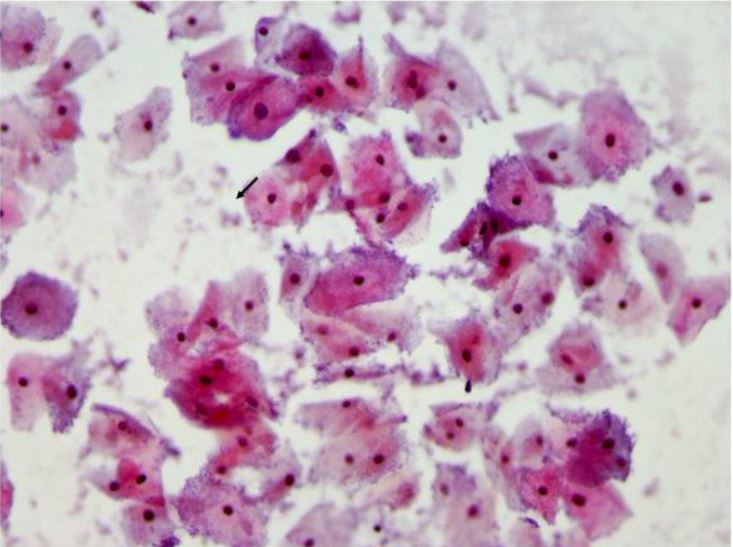
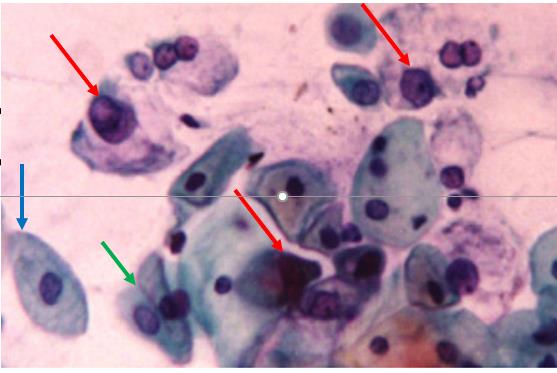
Frotis de Papanicolaou que muestra vaginosis bacteriana con muchas células guía

Frotis de Papanicolaou que muestra vaginosis bacteriana con muchas células guía
Las células guía son células epiteliales vaginales salpicadas de cocobacilos adherentes que se aprecian mejor en el borde de las células. Las bacterias se tiñen de azul- violeta con la tinción de Papanicolaou (flechas).
Imagen: “Cervical cytological changes in HIV-infected patients” por Mwakigonja AR, Torres LM, Mwakyoma HA, Kaaya EE. Licencia: CC BY 2.0, editado por Lecturio

Tratamiento de Resultados Anormales

Determinación del riesgo de CIN CIN An increased tendency to acquire chromosome aberrations when various processes involved in chromosome replication, repair, or segregation are dysfunctional. Colorectal Cancer 3+

El tratamiento de los LOS Neisseria resultados anormales del tamizaje se basa en EN Erythema nodosum is an immune-mediated panniculitis (inflammation of the subcutaneous fat) caused by a type IV (delayed-type) hypersensitivity reaction. It commonly manifests in young women as tender, erythematous nodules on the shins. Erythema Nodosum el riesgo de la paciente de CIN CIN An increased tendency to acquire chromosome aberrations when various processes involved in chromosome replication, repair, or segregation are dysfunctional. Colorectal Cancer 3+ (expresado en EN Erythema nodosum is an immune-mediated panniculitis (inflammation of the subcutaneous fat) caused by a type IV (delayed-type) hypersensitivity reaction. It commonly manifests in young women as tender, erythematous nodules on the shins. Erythema Nodosum porcentaje), tanto ahora como dentro de 5 años.in

  • El riesgo de CIN CIN An increased tendency to acquire chromosome aberrations when various processes involved in chromosome replication, repair, or segregation are dysfunctional. Colorectal Cancer 3+ incluye
    • CIN CIN An increased tendency to acquire chromosome aberrations when various processes involved in chromosome replication, repair, or segregation are dysfunctional. Colorectal Cancer 3
    • AIS AIS Scoliosis
    • Carcinoma de células escamosas cervicouterino
  • El manejo en EN Erythema nodosum is an immune-mediated panniculitis (inflammation of the subcutaneous fat) caused by a type IV (delayed-type) hypersensitivity reaction. It commonly manifests in young women as tender, erythematous nodules on the shins. Erythema Nodosum el riesgo CIN CIN An increased tendency to acquire chromosome aberrations when various processes involved in chromosome replication, repair, or segregation are dysfunctional. Colorectal Cancer 3+ se eligió porque:
    • La infección persistente por VPH es necesaria para el desarrollo de precáncer de alto grado (HSIL) y cáncer.
    • El objetivo de los LOS Neisseria programas de tamizaje es prevenir el cáncer identificando y tratando las lesiones precancerosas con probabilidad de progresar.
  • Utiliza una combinación de los LOS Neisseria resultados del tamizaje actual y los LOS Neisseria antecedentes (incluidos los LOS Neisseria desconocidos).
  • Las personas con los LOS Neisseria mismos niveles generales de riesgo reciben el mismo tratamiento, independientemente de la combinación de resultados que haya dado lugar al AL Amyloidosis nivel de riesgo.
  • El mismo resultado de la prueba actual puede dar lugar a diferentes opciones de tratamiento en EN Erythema nodosum is an immune-mediated panniculitis (inflammation of the subcutaneous fat) caused by a type IV (delayed-type) hypersensitivity reaction. It commonly manifests in young women as tender, erythematous nodules on the shins. Erythema Nodosum función de cómo afecten al AL Amyloidosis riesgo los LOS Neisseria antecedentes/resultados anteriores.
  • Opciones para determinar el riesgo de CIN CIN An increased tendency to acquire chromosome aberrations when various processes involved in chromosome replication, repair, or segregation are dysfunctional. Colorectal Cancer 3+ de una paciente:
    • Utilizar la aplicación (paga) basada en EN Erythema nodosum is an immune-mediated panniculitis (inflammation of the subcutaneous fat) caused by a type IV (delayed-type) hypersensitivity reaction. It commonly manifests in young women as tender, erythematous nodules on the shins. Erythema Nodosum las guías de la ASCCP o la aplicación web (gratuita, pero requiere registro).
    • Buscar el nivel de riesgo en EN Erythema nodosum is an immune-mediated panniculitis (inflammation of the subcutaneous fat) caused by a type IV (delayed-type) hypersensitivity reaction. It commonly manifests in young women as tender, erythematous nodules on the shins. Erythema Nodosum una de las tablas de riesgo de los LOS Neisseria Institutos Nacionales de Salud de EE.UU., disponibles públicamente en EN Erythema nodosum is an immune-mediated panniculitis (inflammation of the subcutaneous fat) caused by a type IV (delayed-type) hypersensitivity reaction. It commonly manifests in young women as tender, erythematous nodules on the shins. Erythema Nodosum https://CervixCa.nlm.nih.gov/RiskTables.

Tablas de estimación y manejo del riesgo

  • Las tablas dan:
    • El riesgo inmediato/actual de tener CIN CIN An increased tendency to acquire chromosome aberrations when various processes involved in chromosome replication, repair, or segregation are dysfunctional. Colorectal Cancer 3+
    • El riesgo de desarrollar CIN CIN An increased tendency to acquire chromosome aberrations when various processes involved in chromosome replication, repair, or segregation are dysfunctional. Colorectal Cancer 3+ en EN Erythema nodosum is an immune-mediated panniculitis (inflammation of the subcutaneous fat) caused by a type IV (delayed-type) hypersensitivity reaction. It commonly manifests in young women as tender, erythematous nodules on the shins. Erythema Nodosum los LOS Neisseria próximos 5 años
    • Tratamiento recomendado
  • Existen tablas para las siguientes situaciones:
    • Resultados iniciales de tamizaje anormales
    • Vigilancia tras resultados anormales que no requirieron colposcopia inmediata
    • Resultados actuales de colposcopia/biopsia
    • Vigilancia tras resultados de colposcopia/biopsia < CIN CIN An increased tendency to acquire chromosome aberrations when various processes involved in chromosome replication, repair, or segregation are dysfunctional. Colorectal Cancer 2 (sin tratamiento):
    • Seguimiento tras tratamiento de CIN CIN An increased tendency to acquire chromosome aberrations when various processes involved in chromosome replication, repair, or segregation are dysfunctional. Colorectal Cancer 2 o CIN CIN An increased tendency to acquire chromosome aberrations when various processes involved in chromosome replication, repair, or segregation are dysfunctional. Colorectal Cancer 3:
  • Tratamiento:
    • Basado en EN Erythema nodosum is an immune-mediated panniculitis (inflammation of the subcutaneous fat) caused by a type IV (delayed-type) hypersensitivity reaction. It commonly manifests in young women as tender, erythematous nodules on the shins. Erythema Nodosum el riesgo de CIN CIN An increased tendency to acquire chromosome aberrations when various processes involved in chromosome replication, repair, or segregation are dysfunctional. Colorectal Cancer 3+ de la paciente, ya sea:
      • Inmediatamente/actualmente o
      • Desarrollarse en EN Erythema nodosum is an immune-mediated panniculitis (inflammation of the subcutaneous fat) caused by a type IV (delayed-type) hypersensitivity reaction. It commonly manifests in young women as tender, erythematous nodules on the shins. Erythema Nodosum los LOS Neisseria próximos 5 años
    • Se definen recomendaciones específicas de manejo para diferentes niveles de riesgo.
    • El límite inferior de cada “nivel de riesgo” se conoce como umbral de actuación clínica.
    • Elección del nivel de riesgo inmediato frente al AL Amyloidosis de los LOS Neisseria próximos 5 años:
      • Si el riesgo inmediato es ≥ 4 % → gestión basada en EN Erythema nodosum is an immune-mediated panniculitis (inflammation of the subcutaneous fat) caused by a type IV (delayed-type) hypersensitivity reaction. It commonly manifests in young women as tender, erythematous nodules on the shins. Erythema Nodosum el nivel de riesgo inmediato de CIN CIN An increased tendency to acquire chromosome aberrations when various processes involved in chromosome replication, repair, or segregation are dysfunctional. Colorectal Cancer 3+.
      • Si el riesgo inmediato es < 4 % → gestión basada en EN Erythema nodosum is an immune-mediated panniculitis (inflammation of the subcutaneous fat) caused by a type IV (delayed-type) hypersensitivity reaction. It commonly manifests in young women as tender, erythematous nodules on the shins. Erythema Nodosum el CIN CIN An increased tendency to acquire chromosome aberrations when various processes involved in chromosome replication, repair, or segregation are dysfunctional. Colorectal Cancer 3+ a 5 años
  • Nota: La colposcopia es un procedimiento en EN Erythema nodosum is an immune-mediated panniculitis (inflammation of the subcutaneous fat) caused by a type IV (delayed-type) hypersensitivity reaction. It commonly manifests in young women as tender, erythematous nodules on the shins. Erythema Nodosum el que se utiliza un colposcopio (dispositivo de aumento) para mejorar la visualización del cuello uterino, identificar áreas anormales macroscópicas y guiar la biopsia.
Tabla: Umbrales de actuación clínica y tratamiento de preferencia
Riesgo Tratamiento de preferencia
Riesgo de CIN CIN An increased tendency to acquire chromosome aberrations when various processes involved in chromosome replication, repair, or segregation are dysfunctional. Colorectal Cancer 3+ en EN Erythema nodosum is an immune-mediated panniculitis (inflammation of the subcutaneous fat) caused by a type IV (delayed-type) hypersensitivity reaction. It commonly manifests in young women as tender, erythematous nodules on the shins. Erythema Nodosum los LOS Neisseria próximos 5 años (umbrales de actuación clínica)
< 0.15 % Retorno al AL Amyloidosis tamizaje de rutina a intervalos de 5 años.
0.15 % a < 0.55 % Reptir prueba (pruebas primarias de VPH, pruebas conjuntas) en EN Erythema nodosum is an immune-mediated panniculitis (inflammation of the subcutaneous fat) caused by a type IV (delayed-type) hypersensitivity reaction. It commonly manifests in young women as tender, erythematous nodules on the shins. Erythema Nodosum 3 años.
0.55 % a < 4 % Repetir prueba en EN Erythema nodosum is an immune-mediated panniculitis (inflammation of the subcutaneous fat) caused by a type IV (delayed-type) hypersensitivity reaction. It commonly manifests in young women as tender, erythematous nodules on the shins. Erythema Nodosum 1 año.
Riesgo inmediato de CIN CIN An increased tendency to acquire chromosome aberrations when various processes involved in chromosome replication, repair, or segregation are dysfunctional. Colorectal Cancer 3+ (umbral de intervención clínica)
4 % a < 25 % Se recomienda colposcopia
25 % a < 60 % Tratamiento expedito o colposcopia es aceptable (para pacientes no embarazadas ≥ 25 años de edad).
≥ 60 % Tratamiento expedito de preferencia (para pacientes no embarazadas ≥ 25 años de edad)
Tabla: Estimación y manejo del riesgo – riesgos inmediatos y a 5 años de CIN CIN An increased tendency to acquire chromosome aberrations when various processes involved in chromosome replication, repair, or segregation are dysfunctional. Colorectal Cancer 3+ para resultados de tamizaje anormales.
Antecedentes Resultado actual de VPH Resultado actual de citología Riesgo inmediato de CIN CIN An increased tendency to acquire chromosome aberrations when various processes involved in chromosome replication, repair, or segregation are dysfunctional. Colorectal Cancer 3+(%) Riesgo a 5 años de CIN CIN An increased tendency to acquire chromosome aberrations when various processes involved in chromosome replication, repair, or segregation are dysfunctional. Colorectal Cancer 3+(%) Tratamiento recomendado
Desconocido VPH-negativo NILM 0.00 0.12 Seguimiento en EN Erythema nodosum is an immune-mediated panniculitis (inflammation of the subcutaneous fat) caused by a type IV (delayed-type) hypersensitivity reaction. It commonly manifests in young women as tender, erythematous nodules on the shins. Erythema Nodosum 5 años
ASC-US 0.04 0.40 Seguimiento en EN Erythema nodosum is an immune-mediated panniculitis (inflammation of the subcutaneous fat) caused by a type IV (delayed-type) hypersensitivity reaction. It commonly manifests in young women as tender, erythematous nodules on the shins. Erythema Nodosum 3 años
LSIL 1.1 2.0 Seguimiento en EN Erythema nodosum is an immune-mediated panniculitis (inflammation of the subcutaneous fat) caused by a type IV (delayed-type) hypersensitivity reaction. It commonly manifests in young women as tender, erythematous nodules on the shins. Erythema Nodosum 1 año
ASC-H 3.4 3.8 Colposcopía
HSIL+ 25 27 Colposcopia o tratamiento expedito
VPH-positivo NILM 2.1 4.8 Seguimiento en EN Erythema nodosum is an immune-mediated panniculitis (inflammation of the subcutaneous fat) caused by a type IV (delayed-type) hypersensitivity reaction. It commonly manifests in young women as tender, erythematous nodules on the shins. Erythema Nodosum 1 año
ASC-US 4.4 7.3 Colposcopía
LSIL 4.3 6.9 Colposcopia
ASC-H 26 33 Colposcopia o tratamiento expedito
HSIL+ 49 53 Colposcopia o tratamiento expedito
VPH-negativo VPH-negativo NILM 0.00 0.09 Seguimiento en EN Erythema nodosum is an immune-mediated panniculitis (inflammation of the subcutaneous fat) caused by a type IV (delayed-type) hypersensitivity reaction. It commonly manifests in young women as tender, erythematous nodules on the shins. Erythema Nodosum 5 años
ASC-US 0.01 0.36 Seguimiento en EN Erythema nodosum is an immune-mediated panniculitis (inflammation of the subcutaneous fat) caused by a type IV (delayed-type) hypersensitivity reaction. It commonly manifests in young women as tender, erythematous nodules on the shins. Erythema Nodosum 3 años
LSIL 0.44 0.79 Seguimiento en EN Erythema nodosum is an immune-mediated panniculitis (inflammation of the subcutaneous fat) caused by a type IV (delayed-type) hypersensitivity reaction. It commonly manifests in young women as tender, erythematous nodules on the shins. Erythema Nodosum 1 año
ASC-H 2.8 3.3 Colposcopia
HSIL+ 14 14 Colposcopia
VPH-positivo NILM 0.74 2.3 Seguimiento en EN Erythema nodosum is an immune-mediated panniculitis (inflammation of the subcutaneous fat) caused by a type IV (delayed-type) hypersensitivity reaction. It commonly manifests in young women as tender, erythematous nodules on the shins. Erythema Nodosum 1 año
ASC-US 2.0 3.8 Seguimiento en EN Erythema nodosum is an immune-mediated panniculitis (inflammation of the subcutaneous fat) caused by a type IV (delayed-type) hypersensitivity reaction. It commonly manifests in young women as tender, erythematous nodules on the shins. Erythema Nodosum 1 año
LSIL 2.1 3.8 Seguimiento en EN Erythema nodosum is an immune-mediated panniculitis (inflammation of the subcutaneous fat) caused by a type IV (delayed-type) hypersensitivity reaction. It commonly manifests in young women as tender, erythematous nodules on the shins. Erythema Nodosum 1 año
ASC-H 14 18 Colposcopia
HSIL+ 32 34 Colposcopia o tratamiento expedito
ASC-H células escamosas atípicas, no se puede excluir HSIL
ASC-US: células escamosas atípicas de significado incierto
HSIL: lesión intraepitelial escamosa de alto grado
LSIL: lesión intraepitelial escamosa de bajo grado
NILM: sin lesiones intraepiteliales o malignidad

Situaciones especiales

  • Citología insatisfactoria:
    • Sin VPH o resultado desconocido (cualquier edad) o VPH negativo (edad ≥ 25 años) → repetir tamizaje por edad en EN Erythema nodosum is an immune-mediated panniculitis (inflammation of the subcutaneous fat) caused by a type IV (delayed-type) hypersensitivity reaction. It commonly manifests in young women as tender, erythematous nodules on the shins. Erythema Nodosum 2-4 meses.
    • Opciones para VPH positivo con genotipo desconocido (edad ≥ 25 años):
      • Repetir el tamizaje basado en EN Erythema nodosum is an immune-mediated panniculitis (inflammation of the subcutaneous fat) caused by a type IV (delayed-type) hypersensitivity reaction. It commonly manifests in young women as tender, erythematous nodules on the shins. Erythema Nodosum la edad en EN Erythema nodosum is an immune-mediated panniculitis (inflammation of the subcutaneous fat) caused by a type IV (delayed-type) hypersensitivity reaction. It commonly manifests in young women as tender, erythematous nodules on the shins. Erythema Nodosum 2-4 meses
      • Colposcopia
    • VPH 16 o 18 positivo (edad ≥ 25 años) → colposcopia
  • Para pacientes < 25 años con resultados de tamizaje anormales:
    • ASC-US o LSIL → repetir citología en EN Erythema nodosum is an immune-mediated panniculitis (inflammation of the subcutaneous fat) caused by a type IV (delayed-type) hypersensitivity reaction. It commonly manifests in young women as tender, erythematous nodules on the shins. Erythema Nodosum 1 año (preferible)
    • ASC-H o HSIL → colposcopia
  • Para pacientes con AGC:
    • Células endometriales atípicas →
      • Muestreo endometrial MÁS
      • Muestreo endocervical
      • +/- Colposcopia
    • Todos los LOS Neisseria demás CGA CgA A type of chromogranin which was first isolated from chromaffin cells of the adrenal medulla but is also found in other tissues and in many species including human, bovine, rat, mouse, and others. It is an acidic protein with 431 to 445 amino acid residues. It contains fragments that inhibit vasoconstriction or release of hormones and neurotransmitter, while other fragments exert antimicrobial actions. Serum Tumor Markers
      • Colposcopia + muestreo endocervical (todas las pacientes)
      • Muestreo endometrial sólo si edad ≥ 35 años o < 35 años con hemorragia uterina anormal, obesidad u otras condiciones que sugieran anovulación crónica
  • Para pacientes embarazadas:
    • Utilizar los LOS Neisseria mismos umbrales de actuación clínica que para las pacientes no embarazadas.
    • La colposcopia y las biopsias ectocervicales pueden realizarse durante el embarazo.
    • Contraindicado en EN Erythema nodosum is an immune-mediated panniculitis (inflammation of the subcutaneous fat) caused by a type IV (delayed-type) hypersensitivity reaction. It commonly manifests in young women as tender, erythematous nodules on the shins. Erythema Nodosum el embarazo:
      • Tratamiento expedito (i.e., tratamiento sin biopsia)
      • Legrado endocervical (normalmente realizado con colposcopia)
      • Muestreo endometrial
  • Las pacientes con antecedentes de HSIL y/o CIN CIN An increased tendency to acquire chromosome aberrations when various processes involved in chromosome replication, repair, or segregation are dysfunctional. Colorectal Cancer 2+ nunca vuelven al AL Amyloidosis riesgo basal y deben continuar el tamizaje de vigilancia a intervalos de 3 años ( en EN Erythema nodosum is an immune-mediated panniculitis (inflammation of the subcutaneous fat) caused by a type IV (delayed-type) hypersensitivity reaction. It commonly manifests in young women as tender, erythematous nodules on the shins. Erythema Nodosum lugar de 5 años) durante 25 años.

Referencias

  1. U.S. Preventive Services Task Force, (2018). Cervical cancer: screening. https://www.uspreventiveservicestaskforce.org/uspstf/recommendation/cervical-cancer-screening#fullrecommendationstart
  2. The American Cancer Society. (2020). Guidelines for the prevention and early detection of cervical cancer. https://www.cancer.org/cancer/cervical-cancer/detection-diagnosis-staging/cervical-cancer-screening-guidelines.html
  3. Feldman, S., Goodman, A., Peipert, J.F. (2022). Screening for cervical cancer in resource-rich settings. Philippine Academy of Family Physicians (PAFP). Retrieved July 15, 2025, from https://thepafp.org/wp-content/uploads/2022/10/5.3-Screening-for-cervical-cancer-in-resource.pdf
  4. Frumovitz, M. (2020). Invasive cervical cancer: epidemiology, risk factors, clinical manifestations, and diagnosis. UpToDate. Retrieved December 17, 2020, from https://www.uptodate.com/contents/invasive-cervical-cancer-epidemiology-risk-factors-clinical-manifestations-and-diagnosis
  5. Feldman, S., Crum, C. P. (2020). Cervical cancer screening tests: techniques for cervical cytology and human papillomavirus testing. UpToDate. Retrieved December 17, 2020, from https://www.uptodate.com/contents/cervical-cancer-screening-tests-techniques-for-cervical-cytology-and-human-papillomavirus-testing
  6. Crum, C.P, and Huh, W.K. (2020). Cervical and vaginal cytology: Interpretation or results (Pap test report). UpToDate. Retrieved December 20, 2020, from https://www.uptodate.com/contents/cervical-and-vaginal-cytology-interpretation-of-results-pap-test-report
  7. Iniesta M.D., Schmeler K.M., & Ramirez P.T. (2016). Tumors of the uterine cervix. In Kantarjian H.M., & Wolff R.A. (Eds.), The MD Anderson Manual of Medical Oncology, 3rd ed. McGraw-Hill.
  8. Karjane, N., & Ivey, S. (2018). Pap smear. Medscape. https://emedicine.medscape.com/article/1947979-overview#a9
  9. Papadakis M.A., McPhee S.J., & Bernstein J. (Eds.). (2020). Cervical cancer. Quick Medical Diagnosis & Treatment 2020. McGraw-Hill

¡Crea tu cuenta gratis o inicia una sesión para seguir leyendo!

Regístrate ahora y obtén acceso gratuito a Lecturio con páginas de concepto, videos médicos y cuestionarios para tu educación médica.

User Reviews

Que tengas una sesión de estudio alegre y navideña 🎁 Ahorra 50% en todos los planes >>

Details