Domina Conceptos Médicos

Estudia para la escuela de medicina y tus examenes con Lecturio.

Taenia/Teniasis

Taenia Taenia Taenia belong to the Cestoda class of helminths. Humans are infected with these tapeworms by eating undercooked beef (T. saginata) or pork (T. solium and T. asiatica). Taeniasis is often asymptomatic, but the ingestion of larvae can cause abdominal discomfort, nausea, and constipation or diarrhea. Taenia/Taeniasis pertenece a la clase Cestoda de los LOS Neisseria helmintos. Los LOS Neisseria seres humanos se infectan con tenias al AL Amyloidosis comer carne de vaca ( T. saginata T. saginata Species of tapeworm in the genus taenia, that infects cattle. It is acquired by humans through the ingestion of raw or insufficiently cooked beef. Taenia/Taeniasis) o de cerdo ( T. solium T. solium Species of tapeworm in the genus taenia, that infects swine. It is acquired by humans through the ingestion of cured or undercooked pork. Taenia/Taeniasis y T. asiatica T. asiatica Taenia/Taeniasis) poco cocinada. La teniasis suele ser asintomática, pero la ingestión de larvas puede provocar malestar abdominal, náuseas y estreñimiento o diarrea. La expulsión de proglótides en EN Erythema nodosum is an immune-mediated panniculitis (inflammation of the subcutaneous fat) caused by a type IV (delayed-type) hypersensitivity reaction. It commonly manifests in young women as tender, erythematous nodules on the shins. Erythema Nodosum las heces es el signo más común de la teniasis. Un paciente que ingiere huevos de T. solium T. solium Species of tapeworm in the genus taenia, that infects swine. It is acquired by humans through the ingestion of cured or undercooked pork. Taenia/Taeniasis puede desarrollar cisticercosis, que puede presentarse con quistes musculares y dermatológicos, afectación ocular o manifestaciones neurológicas (neurocisticercosis). El diagnóstico se realiza mediante la identificación de proglótides o huevos en EN Erythema nodosum is an immune-mediated panniculitis (inflammation of the subcutaneous fat) caused by a type IV (delayed-type) hypersensitivity reaction. It commonly manifests in young women as tender, erythematous nodules on the shins. Erythema Nodosum las heces. Los LOS Neisseria hallazgos característicos en EN Erythema nodosum is an immune-mediated panniculitis (inflammation of the subcutaneous fat) caused by a type IV (delayed-type) hypersensitivity reaction. It commonly manifests in young women as tender, erythematous nodules on the shins. Erythema Nodosum la TC o en EN Erythema nodosum is an immune-mediated panniculitis (inflammation of the subcutaneous fat) caused by a type IV (delayed-type) hypersensitivity reaction. It commonly manifests in young women as tender, erythematous nodules on the shins. Erythema Nodosum la RM ayudarán a diagnosticar la neurocisticercosis. El tratamiento suele incluir terapia antihelmíntica.

Last updated: Feb 11, 2025

Editorial responsibility: Stanley Oiseth, Lindsay Jones, Evelin Maza

Características Generales y Epidemiología

Características generales de Taenia Taenia Taenia belong to the Cestoda class of helminths. Humans are infected with these tapeworms by eating undercooked beef (T. saginata) or pork (T. solium and T. asiatica). Taeniasis is often asymptomatic, but the ingestion of larvae can cause abdominal discomfort, nausea, and constipation or diarrhea. Taenia/Taeniasis

Taenia Taenia Taenia belong to the Cestoda class of helminths. Humans are infected with these tapeworms by eating undercooked beef (T. saginata) or pork (T. solium and T. asiatica). Taeniasis is often asymptomatic, but the ingestion of larvae can cause abdominal discomfort, nausea, and constipation or diarrhea. Taenia/Taeniasis es un género de cestodos parasitarios (tenias).

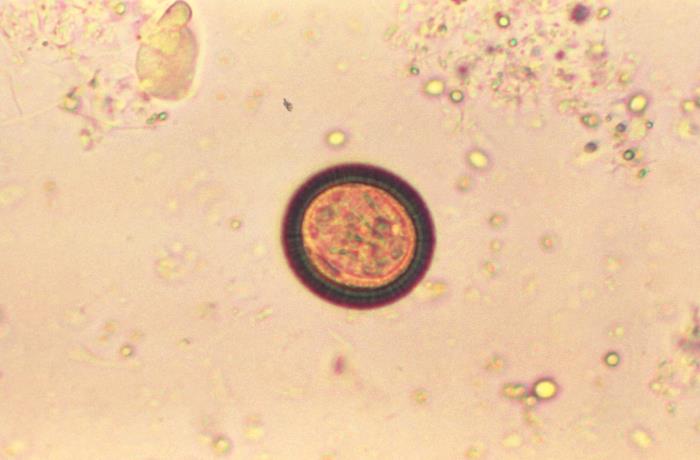
Huevos:

  • Esféricos
  • Paredes gruesas y estriadas
  • Contiene un embrión de 6 ganchos (hexacanto)

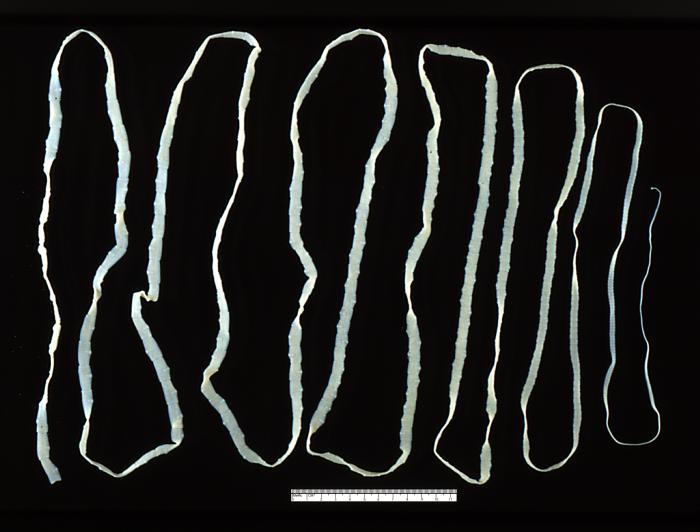
Adultos:

  • Tamaño:
    • T. saginata T. saginata Species of tapeworm in the genus taenia, that infects cattle. It is acquired by humans through the ingestion of raw or insufficiently cooked beef. Taenia/Taeniasis: < 5 m de longitud
    • T. solium T. solium Species of tapeworm in the genus taenia, that infects swine. It is acquired by humans through the ingestion of cured or undercooked pork. Taenia/Taeniasis: aproximadamente 2–7 m de longitud
  • Cuerpo segmentado en EN Erythema nodosum is an immune-mediated panniculitis (inflammation of the subcutaneous fat) caused by a type IV (delayed-type) hypersensitivity reaction. It commonly manifests in young women as tender, erythematous nodules on the shins. Erythema Nodosum forma de cinta:
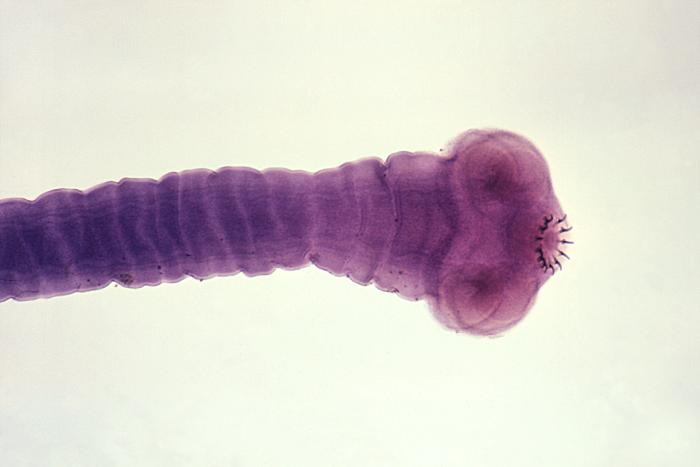
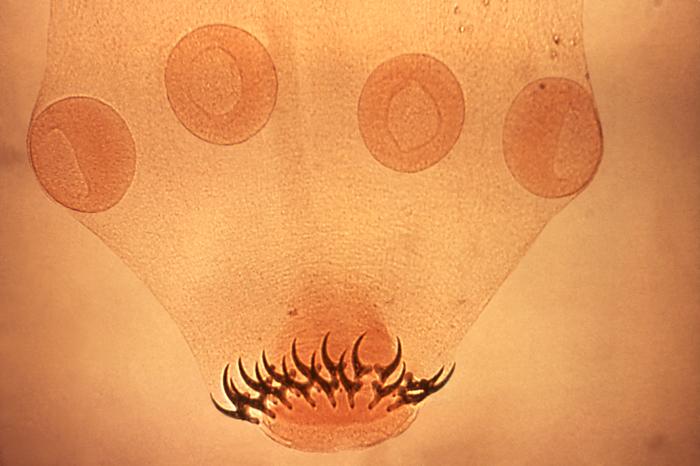
    • Escólex:
      • Rostelo con 2 anillos de ganchos en EN Erythema nodosum is an immune-mediated panniculitis (inflammation of the subcutaneous fat) caused by a type IV (delayed-type) hypersensitivity reaction. It commonly manifests in young women as tender, erythematous nodules on the shins. Erythema Nodosum T. solium T. solium Species of tapeworm in the genus taenia, that infects swine. It is acquired by humans through the ingestion of cured or undercooked pork. Taenia/Taeniasis
      • 4 ventosas musculares
    • Estróbilo con aproximadamente 1 000 proglótides:
      • Segmentado
      • Contiene un conjunto de órganos reproductores

Especies clínicamente relevantes

Las especies de Taenia Taenia Taenia belong to the Cestoda class of helminths. Humans are infected with these tapeworms by eating undercooked beef (T. saginata) or pork (T. solium and T. asiatica). Taeniasis is often asymptomatic, but the ingestion of larvae can cause abdominal discomfort, nausea, and constipation or diarrhea. Taenia/Taeniasis causan las siguientes enfermedades:

  • Teniasis:
    • T. saginata T. saginata Species of tapeworm in the genus taenia, that infects cattle. It is acquired by humans through the ingestion of raw or insufficiently cooked beef. Taenia/Taeniasis (tenia de la carne)
    • T. solium T. solium Species of tapeworm in the genus taenia, that infects swine. It is acquired by humans through the ingestion of cured or undercooked pork. Taenia/Taeniasis (tenia del cerdo)
    • T. asiatica T. asiatica Taenia/Taeniasis (tenia asiática)
  • Cisticercosis: T. solium T. solium Species of tapeworm in the genus taenia, that infects swine. It is acquired by humans through the ingestion of cured or undercooked pork. Taenia/Taeniasis

Epidemiología

Distribución geográfica de las especies:

Teniasis:

  • Afecta aproximadamente a 50 millones de personas a nivel mundial
  • Poco frecuente en EN Erythema nodosum is an immune-mediated panniculitis (inflammation of the subcutaneous fat) caused by a type IV (delayed-type) hypersensitivity reaction. It commonly manifests in young women as tender, erythematous nodules on the shins. Erythema Nodosum Estados Unidos
  • La mayor incidencia se da en EN Erythema nodosum is an immune-mediated panniculitis (inflammation of the subcutaneous fat) caused by a type IV (delayed-type) hypersensitivity reaction. It commonly manifests in young women as tender, erythematous nodules on the shins. Erythema Nodosum zonas donde:
    • Hay poco acceso al AL Amyloidosis agua potable
    • La ingestión de carne cruda o poco cocinada es frecuente

Cisticercosis:

  • Aproximadamente 1 000 casos diagnosticados cada año en EN Erythema nodosum is an immune-mediated panniculitis (inflammation of the subcutaneous fat) caused by a type IV (delayed-type) hypersensitivity reaction. It commonly manifests in young women as tender, erythematous nodules on the shins. Erythema Nodosum Estados Unidos
  • Más común en EN Erythema nodosum is an immune-mediated panniculitis (inflammation of the subcutaneous fat) caused by a type IV (delayed-type) hypersensitivity reaction. It commonly manifests in young women as tender, erythematous nodules on the shins. Erythema Nodosum los LOS Neisseria inmigrantes

Patogénesis

Huéspedes

  • Huésped definitivo: el ser humano
  • Huéspedes intermedios:
    • T. saginata T. saginata Species of tapeworm in the genus taenia, that infects cattle. It is acquired by humans through the ingestion of raw or insufficiently cooked beef. Taenia/Taeniasis: ganado
    • T. solium T. solium Species of tapeworm in the genus taenia, that infects swine. It is acquired by humans through the ingestion of cured or undercooked pork. Taenia/Taeniasis y T. asiatica T. asiatica Taenia/Taeniasis: cerdos

Factores de riesgo del huésped

  • Consumo de carne cruda o poco cocinada de vaca o de cerdo
  • Aquellos que viven en EN Erythema nodosum is an immune-mediated panniculitis (inflammation of the subcutaneous fat) caused by a type IV (delayed-type) hypersensitivity reaction. It commonly manifests in young women as tender, erythematous nodules on the shins. Erythema Nodosum:
    • Zonas rurales
    • Países en EN Erythema nodosum is an immune-mediated panniculitis (inflammation of the subcutaneous fat) caused by a type IV (delayed-type) hypersensitivity reaction. It commonly manifests in young women as tender, erythematous nodules on the shins. Erythema Nodosum desarrollo
  • Malas condiciones sanitarias
  • Contacto estrecho con animales infectados

Transmisión

  • Teniasis: ingestión de estadios larvarios en EN Erythema nodosum is an immune-mediated panniculitis (inflammation of the subcutaneous fat) caused by a type IV (delayed-type) hypersensitivity reaction. It commonly manifests in young women as tender, erythematous nodules on the shins. Erythema Nodosum la carne
  • Cisticercosis: ingestión de huevos de T. solium T. solium Species of tapeworm in the genus taenia, that infects swine. It is acquired by humans through the ingestion of cured or undercooked pork. Taenia/Taeniasis a través de:
    • Agua o alimentos contaminados
    • Transmisión fecal-oral

Ciclo de vida y fisiopatología

Teniasis:

  1. Los LOS Neisseria cerdos o el ganado ingieren vegetación contaminada con huevos o proglótides grávidas.
  2. Los LOS Neisseria huevos eclosionan en EN Erythema nodosum is an immune-mediated panniculitis (inflammation of the subcutaneous fat) caused by a type IV (delayed-type) hypersensitivity reaction. It commonly manifests in young women as tender, erythematous nodules on the shins. Erythema Nodosum el intestino → oncosferas
  3. Invasión en EN Erythema nodosum is an immune-mediated panniculitis (inflammation of the subcutaneous fat) caused by a type IV (delayed-type) hypersensitivity reaction. It commonly manifests in young women as tender, erythematous nodules on the shins. Erythema Nodosum la pared intestinal → torrente sanguíneo → migración al AL Amyloidosis músculo estriado → se convierten en EN Erythema nodosum is an immune-mediated panniculitis (inflammation of the subcutaneous fat) caused by a type IV (delayed-type) hypersensitivity reaction. It commonly manifests in young women as tender, erythematous nodules on the shins. Erythema Nodosum cisticercos (larvas dentro de un saco lleno de líquido)
  4. Los LOS Neisseria humanos ingieren carne de vaca o de cerdo cruda o poco cocinada → se convierten en EN Erythema nodosum is an immune-mediated panniculitis (inflammation of the subcutaneous fat) caused by a type IV (delayed-type) hypersensitivity reaction. It commonly manifests in young women as tender, erythematous nodules on the shins. Erythema Nodosum una tenia adulta en EN Erythema nodosum is an immune-mediated panniculitis (inflammation of the subcutaneous fat) caused by a type IV (delayed-type) hypersensitivity reaction. It commonly manifests in young women as tender, erythematous nodules on the shins. Erythema Nodosum el intestino y se adhieren a la pared intestinal mediante el escólex
  5. Los LOS Neisseria adultos producen proglótides → maduran y se vuelven grávidas → se desprenden de la tenia
  6. Las proglótides grávidas y los LOS Neisseria huevos se excretan en EN Erythema nodosum is an immune-mediated panniculitis (inflammation of the subcutaneous fat) caused by a type IV (delayed-type) hypersensitivity reaction. It commonly manifests in young women as tender, erythematous nodules on the shins. Erythema Nodosum las heces → el ciclo continúa

Cisticercosis:

  1. Los LOS Neisseria seres humanos consumen agua o alimentos contaminados con huevos de T. solium T. solium Species of tapeworm in the genus taenia, that infects swine. It is acquired by humans through the ingestion of cured or undercooked pork. Taenia/Taeniasis o proglótides grávidas.
  2. Los LOS Neisseria huevos eclosionan en EN Erythema nodosum is an immune-mediated panniculitis (inflammation of the subcutaneous fat) caused by a type IV (delayed-type) hypersensitivity reaction. It commonly manifests in young women as tender, erythematous nodules on the shins. Erythema Nodosum el intestino → oncosferas
  3. Invasión en EN Erythema nodosum is an immune-mediated panniculitis (inflammation of the subcutaneous fat) caused by a type IV (delayed-type) hypersensitivity reaction. It commonly manifests in young women as tender, erythematous nodules on the shins. Erythema Nodosum la pared intestinal → torrente sanguíneo → migración a tejidos y órganos → desarrollo de cisticercos → cisticercosis
  4. Los LOS Neisseria cisticercos pueden migrar al AL Amyloidosis SNC → neurocisticercosis
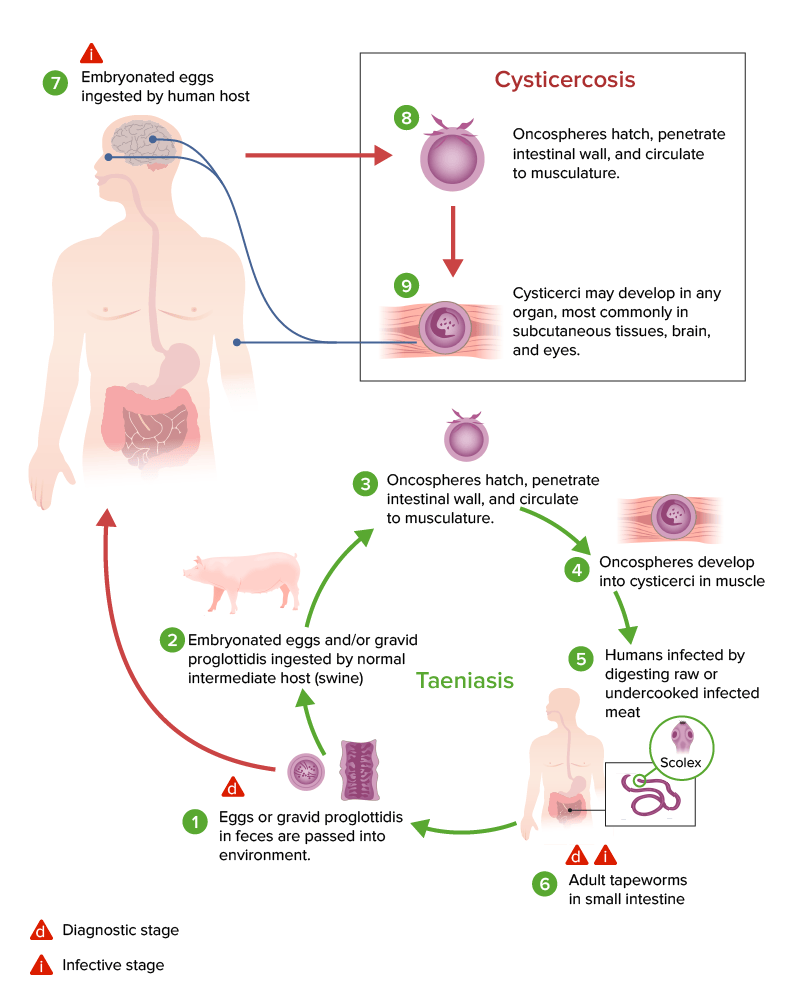
Life cycle of Taenia Solium cysticercosis taeniasis
Ciclo de vida de la Taenia solium y desarrollo de la cisticercosis versus la teniasis.
Imagen: “Cysticercosis” por CDC. Licencia: Dominio Público

Presentación Clínica

Teniasis

La mayoría de los LOS Neisseria pacientes (especialmente los LOS Neisseria adultos) son asintomáticos.

  • Los LOS Neisseria síntomas más comunes son:
    • Expulsar proglótides en EN Erythema nodosum is an immune-mediated panniculitis (inflammation of the subcutaneous fat) caused by a type IV (delayed-type) hypersensitivity reaction. It commonly manifests in young women as tender, erythematous nodules on the shins. Erythema Nodosum las heces (muy común)
    • Náuseas
    • Anorexia Anorexia The lack or loss of appetite accompanied by an aversion to food and the inability to eat. It is the defining characteristic of the disorder anorexia nervosa. Anorexia Nervosa
    • Dolor Dolor Inflammation abdominal
    • Prurito anal
  • Menos comunes:
    • Estreñimiento o diarrea
    • Cefalea
    • Mareo
    • Ansiedad
  • Complicaciones debidas a la obstrucción por segmentos de tenia:
    • Obstrucción biliar:
      • Colecistitis
      • Pancreatitis Pancreatitis Inflammation of the pancreas. Pancreatitis is classified as acute unless there are computed tomographic or endoscopic retrograde cholangiopancreatographic findings of chronic pancreatitis. The two most common forms of acute pancreatitis are alcoholic pancreatitis and gallstone pancreatitis. Acute Pancreatitis
    • Obstrucción intestinal
    • Apendicitis

Cisticercosis

Los LOS Neisseria signos y síntomas dependen de los LOS Neisseria tejidos afectados.

Cisticercosis muscular y dermatológica:

  • La mayoría son asintomáticos
  • Los LOS Neisseria quistes pueden palparse bajo la piel
  • Mialgia
  • Miositis

Cisticercosis ocular:

  • Sensación de cuerpo extraño
  • Dolor Dolor Inflammation ocular
  • Miodesopsias
  • Deterioro de la visión
  • Sensación de movimiento en EN Erythema nodosum is an immune-mediated panniculitis (inflammation of the subcutaneous fat) caused by a type IV (delayed-type) hypersensitivity reaction. It commonly manifests in young women as tender, erythematous nodules on the shins. Erythema Nodosum el ojo
  • Enrojecimiento
  • Fotofobia

Neurocisticercosis:

  • Convulsiones
  • Déficits neurológicos focales
  • Hipertensión intracraneal:
    • Cefalea
    • Náuseas
    • Vértigo
    • Papiledema
  • Alteraciones psiquiátricas:
    • Alteración del estado mental
    • Cambios de personalidad
    • Dificultades de aprendizaje
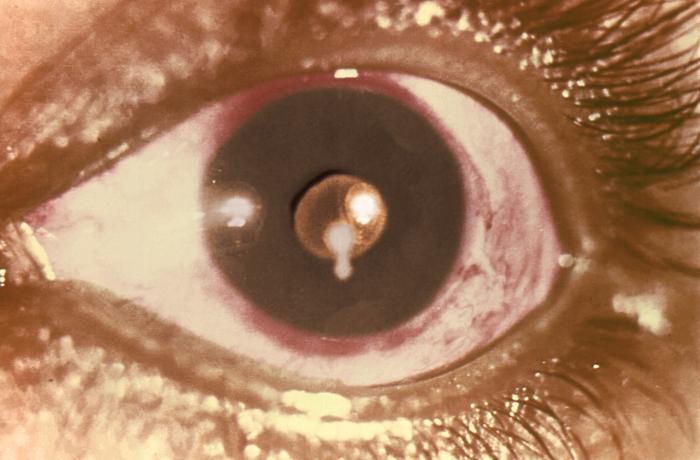
Cisticercosis ocular

Un cisticerco de la tenia del cerdo, Taenia solium, en la pupila del ojo de un paciente:
Aunque es poco frecuente, los cisticercos pueden flotar en el ojo, provocando cambios en la visión.
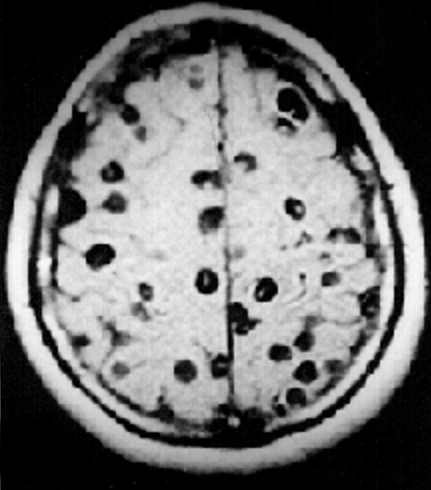
Imagen: “14629” por CDC/Dr. H. Zaiman, Dr. Myron G. Schultz. Licencia: Dominio Público

Diagnóstico y Tratamiento

Diagnóstico

  • Hallazgos de laboratorio inespecíficos:
    • Anemia Anemia Anemia is a condition in which individuals have low Hb levels, which can arise from various causes. Anemia is accompanied by a reduced number of RBCs and may manifest with fatigue, shortness of breath, pallor, and weakness. Subtypes are classified by the size of RBCs, chronicity, and etiology. Anemia: Overview and Types
    • Eosinofilia
  • Análisis de las heces:
    • La identificación de los LOS Neisseria huevos o proglótides permitirá establecer el diagnóstico de la teniasis.
    • ELISA ELISA An immunoassay utilizing an antibody labeled with an enzyme marker such as horseradish peroxidase. While either the enzyme or the antibody is bound to an immunosorbent substrate, they both retain their biologic activity; the change in enzyme activity as a result of the enzyme-antibody-antigen reaction is proportional to the concentration of the antigen and can be measured spectrophotometrically or with the naked eye. Many variations of the method have been developed. St. Louis Encephalitis Virus para antígenos de Taenia Taenia Taenia belong to the Cestoda class of helminths. Humans are infected with these tapeworms by eating undercooked beef (T. saginata) or pork (T. solium and T. asiatica). Taeniasis is often asymptomatic, but the ingestion of larvae can cause abdominal discomfort, nausea, and constipation or diarrhea. Taenia/Taeniasis
    • PCR PCR Polymerase chain reaction (PCR) is a technique that amplifies DNA fragments exponentially for analysis. The process is highly specific, allowing for the targeting of specific genomic sequences, even with minuscule sample amounts. The PCR cycles multiple times through 3 phases: denaturation of the template DNA, annealing of a specific primer to the individual DNA strands, and synthesis/elongation of new DNA molecules. Polymerase Chain Reaction (PCR) para identificar el ADN
  • Serología para la cisticercosis: inmunoelectrotransferencia ligada a enzimas
  • En EN Erythema nodosum is an immune-mediated panniculitis (inflammation of the subcutaneous fat) caused by a type IV (delayed-type) hypersensitivity reaction. It commonly manifests in young women as tender, erythematous nodules on the shins. Erythema Nodosum los LOS Neisseria pacientes con sospecha de neurocisticercosis se puede utilizar la TC o la RM.
    • Aspecto de “queso suizo”
    • Las lesiones pueden ser:
      • Quísticas
      • Calcificadas
      • Con realce en EN Erythema nodosum is an immune-mediated panniculitis (inflammation of the subcutaneous fat) caused by a type IV (delayed-type) hypersensitivity reaction. It commonly manifests in young women as tender, erythematous nodules on the shins. Erythema Nodosum anillo
    • Otros posibles hallazgos:
Neurocisticercosis

RM de un paciente con neurocisticercosis:
Obsérvense las lesiones quísticas en forma de “queso suizo” presentes en todo el cerebro.

Imagen: “Neurocysticercosis” por Shushruth. Licencia: Dominio Público

Tratamiento de la teniasis

La teniasis puede tratarse con una terapia antihelmíntica:

  • Praziquantel Praziquantel An anthelmintic used in most schistosome and many cestode infestations. Anthelmintic Drugs (medicamento preferido)
  • Niclosamida

Tratamiento de la cisticercosis

  • General: La enfermedad asintomática no requiere tratamiento.
  • Cisticercosis ocular: evaluación oftalmológica
  • Neurocisticercosis:
    • Terapia antihelmíntica
    • Corticosteroides
      • Prednisona o dexametasona
      • Administrado antes y durante la terapia antihelmíntica
      • Reducen la inflamación causada por los LOS Neisseria quistes que están muriendo
    • Medicamentos antiepilépticos
    • Consulta neuroquirúrgica por:
      • ↑ Presión intracraneal
      • Quistes intraventriculares

Prevención

  • Cocinar correctamente la carne.
  • Identificar y tratar a los LOS Neisseria pacientes infectados.
  • Realizar una higiene adecuada.
  • Evitar los LOS Neisseria alimentos y el agua potencialmente contaminados.

Comparación de Tenias

Tabla: Características y enfermedades de las diferentes especies de tenias
Organismo Dibothriocephalus latus Taenia Taenia Taenia belong to the Cestoda class of helminths. Humans are infected with these tapeworms by eating undercooked beef (T. saginata) or pork (T. solium and T. asiatica). Taeniasis is often asymptomatic, but the ingestion of larvae can cause abdominal discomfort, nausea, and constipation or diarrhea. Taenia/Taeniasis saginata Echinococcus Echinococcus Echinococcosis is a parasitic disease caused by Echinococcus tapeworms. Infection most often occurs from the ingestion of Echinococcus eggs in food or water contaminated with dog feces. Signs and symptoms are caused by hydatid cyst development in visceral organs and depend on the species. Echinococcus/Echinococcosis granulosus
Características
  • Aproximadamente 10 m de longitud
  • Sin ganchos
  • Botria presente
  • > 3 000 proglótides
  • < 5 m de longitud
  • Sin ganchos
  • Sin cuello
  • Aproximadamente 1 000 proglótides
  • 2–7 mm de longitud
  • Ganchos presentes
  • 3–6 proglótides
Transmisión Consumo de pescado crudo infectado Consumo de carne cruda infectada Fecal-oral (ingestión de agua o alimentos contaminados)
Enfermedad Difilobotriasis Teniasis Equinococosis quística
Cuadro clínico
  • Malestar abdominal
  • Pérdida de peso
  • Deficiencia de vitamina B12
  • Obstrucción intestinal
  • Generalmente asintomático
  • Síntomas gastrointestinales leves
Depende de la ubicación y el tamaño de los LOS Neisseria quistes hidatídicos
Diagnóstico Huevos o proglótides en EN Erythema nodosum is an immune-mediated panniculitis (inflammation of the subcutaneous fat) caused by a type IV (delayed-type) hypersensitivity reaction. It commonly manifests in young women as tender, erythematous nodules on the shins. Erythema Nodosum las heces Huevos o proglótides en EN Erythema nodosum is an immune-mediated panniculitis (inflammation of the subcutaneous fat) caused by a type IV (delayed-type) hypersensitivity reaction. It commonly manifests in young women as tender, erythematous nodules on the shins. Erythema Nodosum las heces
  • Imagenología
  • Serología
Tratamiento
  • Albendazol
  • Drenaje percutáneo
  • Excisión quirúrgica
Prevención
  • Congelar el pescado.
  • Cocinar bien el pescado.
  • Medidas de saneamiento del agua
Cocinar bien la carne.
  • Higiene personal
  • Evitar el contacto con perros de la calle.
  • Evitar los LOS Neisseria alimentos potencialmente contaminados.
  • Mejorar el saneamiento del agua.

Diagnóstico Diferencial

  • Ascariasis Ascariasis Ascariasis is most often caused by A. lumbricoides. If symptomatic, characteristics typically follow 2 phases, which correlate with the migration of the parasite through the body. The early phase may include cough, dyspnea, and wheezing. The late phase typically includes abdominal discomfort, bloating, nausea, and intermittent diarrhea. Ascaris/Ascariasis: infección parasitaria causada por el nematodo Ascaris Ascaris Ascaris is a genus of parasitic nematodes. The infection, ascariasis, is most often caused by A. lumbricoides. Transmission occurs primarily via ingestion of water or food contaminated with Ascaris eggs. Most patients with ascariasis are asymptomatic. Ascaris/Ascariasis lumbricoides: La transmisión del helminto se produce por la ingestión de agua o alimentos contaminados con huevos de Ascaris Ascaris Ascaris is a genus of parasitic nematodes. The infection, ascariasis, is most often caused by A. lumbricoides. Transmission occurs primarily via ingestion of water or food contaminated with Ascaris eggs. Most patients with ascariasis are asymptomatic. Ascaris/Ascariasis. Los LOS Neisseria pacientes pueden ser asintomáticos o experimentar tos TOS Thoracic outlet syndrome (TOS) is a broad term used for a spectrum of syndromes related to the general region of the thoracic outlet, which involves the compression or irritation of elements of the brachial plexus, subclavian artery, or subclavian vein. Thoracic Outlet Syndrome y hemoptisis. Una gran carga de helmintos puede causar obstrucción intestinal y afectar el crecimiento de los LOS Neisseria niños. El análisis de las heces puede mostrar la presencia de helmintos o huevos. El tratamiento es con terapia antihelmíntica.
  • Gastroenteritis Gastroenteritis Gastroenteritis is inflammation of the stomach and intestines, commonly caused by infections from bacteria, viruses, or parasites. Transmission may be foodborne, fecal-oral, or through animal contact. Common clinical features include abdominal pain, diarrhea, vomiting, fever, and dehydration. Gastroenteritis: inflamación del estómago y los LOS Neisseria intestinos, comúnmente causada por infecciones de bacterias, virus Virus Viruses are infectious, obligate intracellular parasites composed of a nucleic acid core surrounded by a protein capsid. Viruses can be either naked (non-enveloped) or enveloped. The classification of viruses is complex and based on many factors, including type and structure of the nucleoid and capsid, the presence of an envelope, the replication cycle, and the host range. Virology o parásitos: Las características clínicas comunes incluyen dolor Dolor Inflammation abdominal, diarrea, vómitos, fiebre y deshidratación. Las pruebas de diagnóstico mediante análisis de las heces o coprocultivos no siempre son necesarias, pero pueden ayudar a determinar la etiología en EN Erythema nodosum is an immune-mediated panniculitis (inflammation of the subcutaneous fat) caused by a type IV (delayed-type) hypersensitivity reaction. It commonly manifests in young women as tender, erythematous nodules on the shins. Erythema Nodosum determinadas circunstancias. La mayoría de los LOS Neisseria casos son autolimitados, por lo que el único tratamiento necesario es la terapia de soporte (líquidos).
  • Enfermedad inflamatoria intestinal: incluye la enfermedad de Crohn y la colitis Colitis Inflammation of the colon section of the large intestine, usually with symptoms such as diarrhea (often with blood and mucus), abdominal pain, and fever. Pseudomembranous Colitis ulcerosa y se caracterizan por la inflamación crónica del tracto gastrointestinal debido a una respuesta inmunitaria celular en EN Erythema nodosum is an immune-mediated panniculitis (inflammation of the subcutaneous fat) caused by a type IV (delayed-type) hypersensitivity reaction. It commonly manifests in young women as tender, erythematous nodules on the shins. Erythema Nodosum la mucosa gastrointestinal. Los LOS Neisseria síntomas incluyen diarrea, dolor Dolor Inflammation abdominal, pérdida de peso y manifestaciones extraintestinales. El diagnóstico incluye imagenología, endoscopia y biopsia. El tratamiento incluye esteroides, aminosalicilatos, inmunomoduladores y agentes biológicos.
  • Anemia Anemia Anemia is a condition in which individuals have low Hb levels, which can arise from various causes. Anemia is accompanied by a reduced number of RBCs and may manifest with fatigue, shortness of breath, pallor, and weakness. Subtypes are classified by the size of RBCs, chronicity, and etiology. Anemia: Overview and Types perniciosa: causa deficiencia de vitamina B12 y anemia Anemia Anemia is a condition in which individuals have low Hb levels, which can arise from various causes. Anemia is accompanied by a reduced number of RBCs and may manifest with fatigue, shortness of breath, pallor, and weakness. Subtypes are classified by the size of RBCs, chronicity, and etiology. Anemia: Overview and Types megaloblástica debido a una deficiencia del factor intrínseco, que es necesario para la absorción de la vitamina B12: Los LOS Neisseria pacientes pueden presentar fatiga, deterioro cognitivo, neuropatía, ataxia Ataxia Impairment of the ability to perform smoothly coordinated voluntary movements. This condition may affect the limbs, trunk, eyes, pharynx, larynx, and other structures. Ataxia may result from impaired sensory or motor function. Sensory ataxia may result from posterior column injury or peripheral nerve diseases. Motor ataxia may be associated with cerebellar diseases; cerebral cortex diseases; thalamic diseases; basal ganglia diseases; injury to the red nucleus; and other conditions. Ataxia-telangiectasia y glositis. Niveles bajos de vitamina B12, los LOS Neisseria anticuerpos contra el factor intrínseco y la prueba de Schilling pueden utilizarse para el diagnóstico. El tratamiento incluye el reemplazo de vitamina B12.
  • Meningitis Meningitis Meningitis is inflammation of the meninges, the protective membranes of the brain, and spinal cord. The causes of meningitis are varied, with the most common being bacterial or viral infection. The classic presentation of meningitis is a triad of fever, altered mental status, and nuchal rigidity. Meningitis bacteriana: infección bacteriana de las meninges Meninges The brain and the spinal cord are enveloped by 3 overlapping layers of connective tissue called the meninges. The layers are, from the most external layer to the most internal layer, the dura mater, arachnoid mater, and pia mater. Between these layers are 3 potential spaces called the epidural, subdural, and subarachnoid spaces. Meninges: Anatomy potencialmente mortal: La meningitis Meningitis Meningitis is inflammation of the meninges, the protective membranes of the brain, and spinal cord. The causes of meningitis are varied, with the most common being bacterial or viral infection. The classic presentation of meningitis is a triad of fever, altered mental status, and nuchal rigidity. Meningitis bacteriana puede presentarse con fiebre, cefalea, signos meníngeos y convulsiones. El diagnóstico se realiza mediante un examen clínico y se confirma con el hallazgo de bacterias en EN Erythema nodosum is an immune-mediated panniculitis (inflammation of the subcutaneous fat) caused by a type IV (delayed-type) hypersensitivity reaction. It commonly manifests in young women as tender, erythematous nodules on the shins. Erythema Nodosum el LCR, que se obtiene por punción lumbar. El tratamiento incluye corticosteroides y antibióticos IV dirigidos contra las bacterias identificadas.
  • Tumores intracraneales: crecimiento benigno o maligno de células en EN Erythema nodosum is an immune-mediated panniculitis (inflammation of the subcutaneous fat) caused by a type IV (delayed-type) hypersensitivity reaction. It commonly manifests in young women as tender, erythematous nodules on the shins. Erythema Nodosum el cerebro: Los LOS Neisseria tumores intracraneales se presentan como cefalea, náuseas o vómitos inexplicables, visión borrosa y dificultad para hablar o escuchar. El diagnóstico se realiza mediante un examen neurológico, imagenología (RM o TC) y a veces, una biopsia. El tratamiento incluye radiación, quimioterapia y/o cirugía.
  • Absceso cerebral: acumulación de pus en EN Erythema nodosum is an immune-mediated panniculitis (inflammation of the subcutaneous fat) caused by a type IV (delayed-type) hypersensitivity reaction. It commonly manifests in young women as tender, erythematous nodules on the shins. Erythema Nodosum el parénquima cerebral debido a una infección: El absceso cerebral se presenta con fiebre, cefalea, convulsiones, náuseas y vómitos. El diagnóstico se basa principalmente en EN Erythema nodosum is an immune-mediated panniculitis (inflammation of the subcutaneous fat) caused by a type IV (delayed-type) hypersensitivity reaction. It commonly manifests in young women as tender, erythematous nodules on the shins. Erythema Nodosum la imagenología, ya que es difícil llegar a un diagnóstico definitivo basándose únicamente en EN Erythema nodosum is an immune-mediated panniculitis (inflammation of the subcutaneous fat) caused by a type IV (delayed-type) hypersensitivity reaction. It commonly manifests in young women as tender, erythematous nodules on the shins. Erythema Nodosum la presentación clínica. El tratamiento incluye terapia con antibióticos y cirugía para drenar el absceso.

Referencias

  1. Craig P, Ito A. (2007). Intestinal cestodes. Curr Opin Infect Dis 20:524–532. http://reference.medscape.com/medline/abstract/17762788
  2. O’Neal S, Noh J, Wilkins P, Keene W, Lambert W, Anderson J. (2011). Taenia solium tapeworm infection, Oregon, 2006-2009. Emerg Infect Dis 17:1030–1036. http://reference.medscape.com/medline/abstract/21749764
  3. O’Keefe KA, Eberhard ML, Shafir SC, Wilkins P, Ash LR, Sorvillo FJ. (2015). Cysticercosis-related hospitalizations in the United States, 1998-2011. Am J Trop Med Hyg 92:354–359. http://reference.medscape.com/medline/abstract/25385857
  4. Garcia HH, Del Brutto OH. (2005). Neurocysticercosis: updated concepts about an old disease. Lancet Neurol 4:653–661. http://reference.medscape.com/medline/abstract/16168934
  5. Centers for Disease Control and Prevention. (2024). About human tapeworm (taeniasis). Centers for Disease Control and Prevention. https://www.cdc.gov/taeniasis/about/index.html
  6. Leder K, Weller PF. (2025). Tapeworm infections. In Baron EL (Ed.), UpToDate. Retrieved February 10, 2025, from https://www.uptodate.com/contents/tapeworm-infections
  7. Pearson RD. (2023). Taenia solium (pork tapeworm) infection and cysticercosis. MSD Manual Professional Version. Retrieved February 10, 2025, from https://www.msdmanuals.com/professional/infectious-diseases/cestodes-tapeworms/taenia-solium-pork-tapeworm-infection-and-cysticercosis
  8. Pearson RD. (2023). Taenia saginata (beef tapeworm) infection. MSD Manual Professional Version. Retrieved February 10, 2025, from https://www.msdmanuals.com/professional/infectious-diseases/cestodes-tapeworms/taenia-saginata-beef-tapeworm-infection
  9. Pearson RD. (2023). Taenia asiatica (Asian tapeworm) infection. MSD Manual Profession Version. Retrieved February 10, 2025, from https://www.msdmanuals.com/professional/infectious-diseases/cestodes-tapeworms/taenia-asiatica-asian-tapeworm-infection
  10. Lesh EJ, Brady MF. (2023). Tapeworm. StatPearls. Retrieved February 10, 2025, from https://www.ncbi.nlm.nih.gov/books/NBK537154/
  11. The Australian Society for Parasitology Inc. (n.d.). Taenia. Retrieved February 10, 2025, from https://parasite.org.au/para-site/text/taenia-text.html
  12. Tengsupakul S. (2023). Taenia infection. In Steele RW (Ed.), Medscape. Retrieved February 10, 2025, from https://emedicine.medscape.com/article/999727-overview

¡Crea tu cuenta gratis o inicia una sesión para seguir leyendo!

Regístrate ahora y obtén acceso gratuito a Lecturio con páginas de concepto, videos médicos y cuestionarios para tu educación médica.

User Reviews

Que tengas una sesión de estudio alegre y navideña 🎁 Ahorra 50% en todos los planes >>

Details