Domina Conceptos Médicos

Estudia para la escuela de medicina y tus examenes con Lecturio.

Síndrome de Dificultad Respiratoria Aguda (SDRA)

El síndrome de dificultad respiratoria aguda se caracteriza por la aparición repentina de hipoxemia y edema Edema Edema is a condition in which excess serous fluid accumulates in the body cavity or interstitial space of connective tissues. Edema is a symptom observed in several medical conditions. It can be categorized into 2 types, namely, peripheral (in the extremities) and internal (in an organ or body cavity). Edema pulmonar bilateral sin insuficiencia cardíaca. La sepsis Sepsis Systemic inflammatory response syndrome with a proven or suspected infectious etiology. When sepsis is associated with organ dysfunction distant from the site of infection, it is called severe sepsis. When sepsis is accompanied by hypotension despite adequate fluid infusion, it is called septic shock. Sepsis and Septic Shock es la causa más común del SDRA. El mecanismo subyacente y la correlación histológica es el daño alveolar difuso. El daño alveolar difuso implica daños en EN Erythema nodosum is an immune-mediated panniculitis (inflammation of the subcutaneous fat) caused by a type IV (delayed-type) hypersensitivity reaction. It commonly manifests in young women as tender, erythematous nodules on the shins. Erythema Nodosum las células endoteliales y epiteliales alveolares, y se asocia con inflamación y desarrollo de membranas hialinas que recubren las paredes alveolares internas. El estadio de reparación sigue después de semanas, con la posibilidad de que se desarrolle fibrosis Fibrosis Any pathological condition where fibrous connective tissue invades any organ, usually as a consequence of inflammation or other injury. Bronchiolitis Obliterans más adelante. Clínicamente, la siguiente tríada de hallazgos favorece el diagnóstico de SDRA: disnea aguda o rápidamente progresiva, insuficiencia respiratoria hipóxica (relación de presión parcial de O2/fracción de O2 inspirado < 300 mm Hg) y opacidades alveolares bilaterales en EN Erythema nodosum is an immune-mediated panniculitis (inflammation of the subcutaneous fat) caused by a type IV (delayed-type) hypersensitivity reaction. It commonly manifests in young women as tender, erythematous nodules on the shins. Erythema Nodosum la imagenología torácica. El tratamiento implica la determinación y el tratamiento de la causa mientras se proporciona el oxígeno adecuado, se reduce el daño pulmonar adicional y se evita la sobrecarga de líquidos. La mayoría de los LOS Neisseria pacientes requieren ventilación mecánica. El síndrome de dificultad respiratoria aguda se asocia a una elevada mortalidad o a complicaciones a largo plazo que pueden desarrollarse incluso después del tratamiento.

Last updated: Dec 15, 2025

Editorial responsibility: Stanley Oiseth, Lindsay Jones, Evelin Maza

Descripción General

Definición

El síndrome de dificultad respiratoria aguda es un síndrome clínico (no un diagnóstico patológico) caracterizado por una aparición repentina de hipoxemia y edema Edema Edema is a condition in which excess serous fluid accumulates in the body cavity or interstitial space of connective tissues. Edema is a symptom observed in several medical conditions. It can be categorized into 2 types, namely, peripheral (in the extremities) and internal (in an organ or body cavity). Edema pulmonar bilateral sin insuficiencia cardíaca.

El mecanismo subyacente del SDRA es el daño alveolar difuso:

  • También la correlación histológica
  • Indica daños en EN Erythema nodosum is an immune-mediated panniculitis (inflammation of the subcutaneous fat) caused by a type IV (delayed-type) hypersensitivity reaction. It commonly manifests in young women as tender, erythematous nodules on the shins. Erythema Nodosum las células endoteliales y epiteliales alveolares
  • Se asocia con inflamación y el desarrollo de membranas hialinas que recubren las paredes alveolares internas

El síndrome de dificultad respiratoria aguda se diagnostica clínicamente utilizando los LOS Neisseria criterios diagnósticos de Berlín.

Epidemiología

  • El SDRA es la causa más común de edema Edema Edema is a condition in which excess serous fluid accumulates in the body cavity or interstitial space of connective tissues. Edema is a symptom observed in several medical conditions. It can be categorized into 2 types, namely, peripheral (in the extremities) and internal (in an organ or body cavity). Edema pulmonar no cardiogénico.
  • Cada año se registran aproximadamente 190 000 casos de SDRA en EN Erythema nodosum is an immune-mediated panniculitis (inflammation of the subcutaneous fat) caused by a type IV (delayed-type) hypersensitivity reaction. It commonly manifests in young women as tender, erythematous nodules on the shins. Erythema Nodosum Estados Unidos.
  • ≥ 20% de los LOS Neisseria pacientes que son ventilados mecánicamente cumplen los LOS Neisseria criterios del SDRA
  • Tasa de mortalidad: 27%–43%

Etiología

El síndrome de dificultad respiratoria aguda es el resultado de trastornos clínicos que afectan a los LOS Neisseria pulmones directa o indirectamente.

Lesión pulmonar directa:

  • Neumonía bacteriana (e.g., Streptococcus Streptococcus Streptococcus is one of the two medically important genera of gram-positive cocci, the other being Staphylococcus. Streptococci are identified as different species on blood agar on the basis of their hemolytic pattern and sensitivity to optochin and bacitracin. There are many pathogenic species of streptococci, including S. pyogenes, S. agalactiae, S. pneumoniae, and the viridans streptococci. Streptococcus pneumoniae)
  • Neumonía viral (e.g., influenza Influenza Influenza viruses are members of the Orthomyxoviridae family and the causative organisms of influenza, a highly contagious febrile respiratory disease. There are 3 primary influenza viruses (A, B, and C) and various subtypes, which are classified based on their virulent surface antigens, hemagglutinin (HA) and neuraminidase (NA). Influenza typically presents with a fever, myalgia, headache, and symptoms of an upper respiratory infection. Influenza Viruses/Influenza, COVID-19 COVID-19 Coronavirus disease 2019 (COVID-19) is an infectious disease caused by the severe acute respiratory syndrome coronavirus 2 (SARS-CoV-2) that mainly affects the respiratory system but can also cause damage to other body systems (cardiovascular, gastrointestinal, renal, and central nervous systems). )
  • Aspiración del contenido gástrico
  • Contusión pulmonar
  • Incidentes de casi ahogamiento
  • Lesión por inhalación tóxica
  • Trasplante de pulmón

Lesión pulmonar indirecta:

  • Sepsis Sepsis Systemic inflammatory response syndrome with a proven or suspected infectious etiology. When sepsis is associated with organ dysfunction distant from the site of infection, it is called severe sepsis. When sepsis is accompanied by hypotension despite adequate fluid infusion, it is called septic shock. Sepsis and Septic Shock (causa más común)
  • Traumatismos graves:
    • Fracturas óseas múltiples
    • Tórax inestable
    • Traumatismo craneal
    • Quemaduras
  • Pancreatitis Pancreatitis Inflammation of the pancreas. Pancreatitis is classified as acute unless there are computed tomographic or endoscopic retrograde cholangiopancreatographic findings of chronic pancreatitis. The two most common forms of acute pancreatitis are alcoholic pancreatitis and gallstone pancreatitis. Acute Pancreatitis
  • Múltiples transfusiones (lesión pulmonar aguda relacionada con la transfusión)
  • Sobredosis de medicamentos
  • Bypass postcardiopulmonar
  • Trasplante de células madre hematopoyéticas
  • Embolia grasa y embolia de líquido amniótico

Riesgo de SDRA:

  • Aumenta en EN Erythema nodosum is an immune-mediated panniculitis (inflammation of the subcutaneous fat) caused by a type IV (delayed-type) hypersensitivity reaction. It commonly manifests in young women as tender, erythematous nodules on the shins. Erythema Nodosum un paciente con múltiples condiciones clínicas predisponentes
  • El 25% en EN Erythema nodosum is an immune-mediated panniculitis (inflammation of the subcutaneous fat) caused by a type IV (delayed-type) hypersensitivity reaction. It commonly manifests in young women as tender, erythematous nodules on the shins. Erythema Nodosum pacientes con traumatismos graves, que aumenta al AL Amyloidosis 56% si hay sepsis Sepsis Systemic inflammatory response syndrome with a proven or suspected infectious etiology. When sepsis is associated with organ dysfunction distant from the site of infection, it is called severe sepsis. When sepsis is accompanied by hypotension despite adequate fluid infusion, it is called septic shock. Sepsis and Septic Shock asociada
  • Otros factores de riesgo:
    • Abuso de alcohol
    • Tabaquismo
    • Obesidad

Fisiopatología

El síndrome de dificultad respiratoria aguda comienza con una lesión inicial en EN Erythema nodosum is an immune-mediated panniculitis (inflammation of the subcutaneous fat) caused by a type IV (delayed-type) hypersensitivity reaction. It commonly manifests in young women as tender, erythematous nodules on the shins. Erythema Nodosum los LOS Neisseria neumocitos y el endotelio pulmonar, que inicia una reacción en EN Erythema nodosum is an immune-mediated panniculitis (inflammation of the subcutaneous fat) caused by a type IV (delayed-type) hypersensitivity reaction. It commonly manifests in young women as tender, erythematous nodules on the shins. Erythema Nodosum cadena con aumento de la inflamación y el daño pulmonar que puede tener una distribución desigual o en EN Erythema nodosum is an immune-mediated panniculitis (inflammation of the subcutaneous fat) caused by a type IV (delayed-type) hypersensitivity reaction. It commonly manifests in young women as tender, erythematous nodules on the shins. Erythema Nodosum parches.
Fase exudativa

  • Comienza dentro de las 6–72 horas siguientes a un factor de riesgo que la provoque
  • Progresa rápidamente
  • Dura aproximadamente 7 días
  • Destrucción de las células epiteliales alveolares/neumocitos tipo 1( los LOS Neisseria neumocitos de tipo 2 son más resistentes al AL Amyloidosis daño, pero ambos son lesionados) y de las células endoteliales capilares, produciendo numerosos efectos:
    • Daño en EN Erythema nodosum is an immune-mediated panniculitis (inflammation of the subcutaneous fat) caused by a type IV (delayed-type) hypersensitivity reaction. It commonly manifests in young women as tender, erythematous nodules on the shins. Erythema Nodosum la membrana de los LOS Neisseria capilares alveolares → las membranas de las células endoteliales se vuelven permeables → líquido rico en EN Erythema nodosum is an immune-mediated panniculitis (inflammation of the subcutaneous fat) caused by a type IV (delayed-type) hypersensitivity reaction. It commonly manifests in young women as tender, erythematous nodules on the shins. Erythema Nodosum proteínas sale a los LOS Neisseria espacios intersticial y alveolar
    • Liberación de citoquinas proinflamatorias → los LOS Neisseria leucocitos son reclutados en EN Erythema nodosum is an immune-mediated panniculitis (inflammation of the subcutaneous fat) caused by a type IV (delayed-type) hypersensitivity reaction. It commonly manifests in young women as tender, erythematous nodules on the shins. Erythema Nodosum el intersticio y los LOS Neisseria alvéolos
    • Inactivación del surfactante (que ayuda a mantener los LOS Neisseria alvéolos abiertos)
    • Los precipitados de fibrina, las proteínas plasmáticas, los restos necróticos y el surfactante disfuncional forman las “membranas hialinas” que recubren las paredes alveolares internas (aspecto vítreo/ceroso).
    • La pérdida de surfactante también provoca un gran aumento de la tensión superficial de los LOS Neisseria alvéolos, lo que conlleva a:
      • Inestabilidad alveolar
      • Atelectasias
  • Efectos en EN Erythema nodosum is an immune-mediated panniculitis (inflammation of the subcutaneous fat) caused by a type IV (delayed-type) hypersensitivity reaction. It commonly manifests in young women as tender, erythematous nodules on the shins. Erythema Nodosum la función pulmonar:
    • “Pulmones rígidos” → reducción de la distensibilidad pulmonar
    • Reducción de la capacidad de difusión, disnea e hipoxemia
    • La derivación intrapulmonar es el resultado de la oclusión microvascular alveolar.
    • Reducción del flujo sanguíneo arterial pulmonar a las porciones ventiladas del pulmón
    • El espacio muerto pulmonar aumenta, lo que en EN Erythema nodosum is an immune-mediated panniculitis (inflammation of the subcutaneous fat) caused by a type IV (delayed-type) hypersensitivity reaction. It commonly manifests in young women as tender, erythematous nodules on the shins. Erythema Nodosum última instancia provoca hipercapnia además de hipoxemia.

Fase proliferativa

  • Suele durar 7–21 días
  • Muchos pacientes se recuperan en EN Erythema nodosum is an immune-mediated panniculitis (inflammation of the subcutaneous fat) caused by a type IV (delayed-type) hypersensitivity reaction. It commonly manifests in young women as tender, erythematous nodules on the shins. Erythema Nodosum 3–4 semanas después de la lesión pulmonar inicial.
  • Estadio inicial de reparación pulmonar y resolución de los LOS Neisseria cambios fisiopatológicos (proceso de reparación)
  • Las células epiteliales alveolares comienzan a proliferar a lo largo de las membranas basales alveolares.
  • Se produce nuevo surfactante pulmonar.

Fase fibrótica

  • Los LOS Neisseria exudados inflamatorios se convierten en EN Erythema nodosum is an immune-mediated panniculitis (inflammation of the subcutaneous fat) caused by a type IV (delayed-type) hypersensitivity reaction. It commonly manifests in young women as tender, erythematous nodules on the shins. Erythema Nodosum cantidades variables de fibrosis Fibrosis Any pathological condition where fibrous connective tissue invades any organ, usually as a consequence of inflammation or other injury. Bronchiolitis Obliterans en EN Erythema nodosum is an immune-mediated panniculitis (inflammation of the subcutaneous fat) caused by a type IV (delayed-type) hypersensitivity reaction. It commonly manifests in young women as tender, erythematous nodules on the shins. Erythema Nodosum los LOS Neisseria conductos alveolares y el intersticio.
  • La fibrosis Fibrosis Any pathological condition where fibrous connective tissue invades any organ, usually as a consequence of inflammation or other injury. Bronchiolitis Obliterans intimal de los LOS Neisseria vasos pulmonares conduce a la oclusión vascular progresiva y a la hipertensión pulmonar.
  • En EN Erythema nodosum is an immune-mediated panniculitis (inflammation of the subcutaneous fat) caused by a type IV (delayed-type) hypersensitivity reaction. It commonly manifests in young women as tender, erythematous nodules on the shins. Erythema Nodosum algunos pacientes se desarrollan cambios enfisematosos, por lo que requieren oxígeno suplementario.
Síndrome de dificultad respiratoria aguda - daño alveolar

Síndrome de dificultad respiratoria aguda:
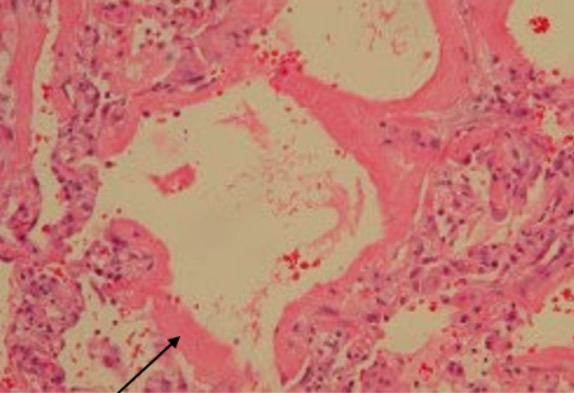
Un hombre de 68 años tenía un linfoma de células del manto y recibió quimioterapia. Fue ingresado en el hospital por fiebre e insuficiencia respiratoria. Se excluyó la afectación pulmonar por linfoma de células del manto. La biopsia pulmonar toracoscópica asistida por vídeo reveló un daño alveolar difuso con membranas hialinas que recubrían las superficies alveolares (flecha), consistente con el SDRA.
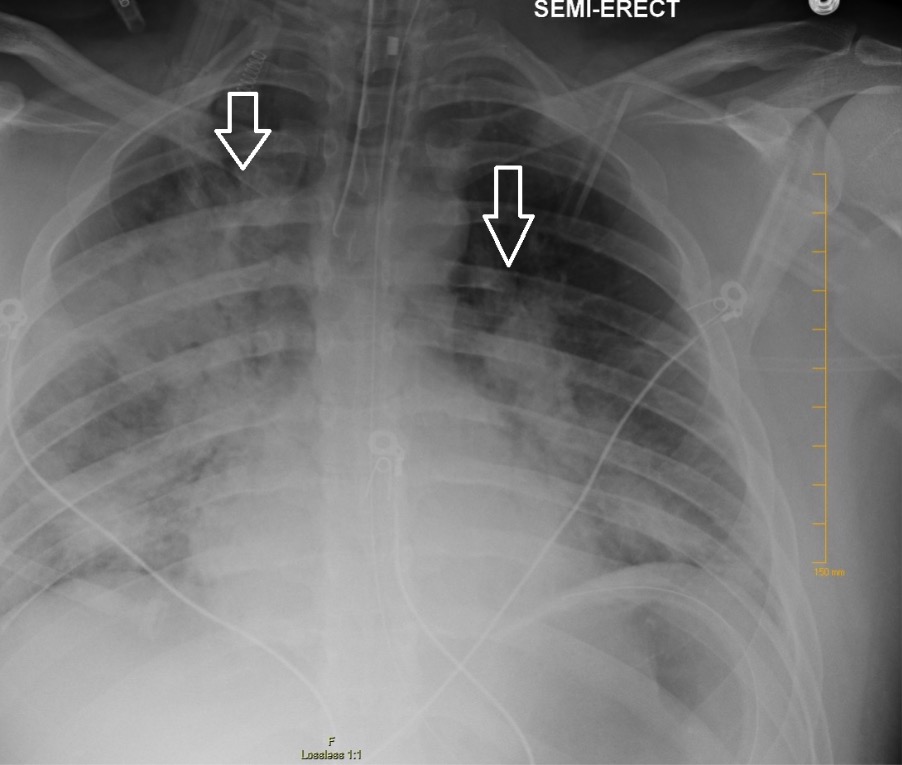
Imagen: “Diffuse alveolar damage” por Chih-Hao Chang et al. Licencia: CC BY 2.0, editada por Lecturio.

Presentación Clínica

Signos vitales

  • Taquipnea
  • Taquicardia
  • Puede haber o no fiebre
  • Hipoxemia a pesar del oxígeno suplementario

Examen físico

  • Estertores/crepitantes difusos
  • Respiración dificultosa
  • Disnea
  • Cianosis

Hallazgos del examen físico que no son compatibles con SDRA

  • Examen cardíaco:
  • Ingurgitación yugular
  • Edema Edema Edema is a condition in which excess serous fluid accumulates in the body cavity or interstitial space of connective tissues. Edema is a symptom observed in several medical conditions. It can be categorized into 2 types, namely, peripheral (in the extremities) and internal (in an organ or body cavity). Edema con fóvea en EN Erythema nodosum is an immune-mediated panniculitis (inflammation of the subcutaneous fat) caused by a type IV (delayed-type) hypersensitivity reaction. It commonly manifests in young women as tender, erythematous nodules on the shins. Erythema Nodosum las extremidades inferiores

Diagnóstico

Criterios de Berlín para el diagnóstico del SDRA

  • Inicio agudo ( en EN Erythema nodosum is an immune-mediated panniculitis (inflammation of the subcutaneous fat) caused by a type IV (delayed-type) hypersensitivity reaction. It commonly manifests in young women as tender, erythematous nodules on the shins. Erythema Nodosum el plazo de 1 semana)
  • Infiltrados bilaterales difusos en EN Erythema nodosum is an immune-mediated panniculitis (inflammation of the subcutaneous fat) caused by a type IV (delayed-type) hypersensitivity reaction. It commonly manifests in young women as tender, erythematous nodules on the shins. Erythema Nodosum la radiografía de tórax
  • No hay evidencia de insuficiencia cardíaca izquierda o sobrecarga de líquidos
  • Presión parcial de O2/fracción de O2 inspirado (PaO2/FiO2) < 300 mm Hg:
    • SDRA leve: 201–300 mm Hg
    • SDRA moderado: 101–200 mm Hg
    • SDRA severo: ≤ 100 mm Hg

Pruebas de laboratorio

  • Los LOS Neisseria niveles de BNP BNP A peptide that is secreted by the brain and the heart atria, stored mainly in cardiac ventricular myocardium. It can cause natriuresis; diuresis; vasodilation; and inhibits secretion of renin and aldosterone. It improves heart function. It contains 32 amino acids. Renal Sodium and Water Regulation < 100 pg/mL favorecen el SDRA (niveles más altos no confirman insuficiencia cardíaca ni excluyen SDRA).
  • Gasometría arterial:
    • Hipoxemia
    • Inicialmente puede haber alcalosis respiratoria aguda.
    • Puede producirse acidosis Acidosis A pathologic condition of acid accumulation or depletion of base in the body. The two main types are respiratory acidosis and metabolic acidosis, due to metabolic acid build up. Respiratory Acidosis respiratoria con el SDRA grave.
  • Ampliación del gradiente alveolo-arterial (A-a):
    • El gradiente A-a mide la diferencia entre la concentración de oxígeno alveolar y el oxígeno arterial.
    • Calculado utilizando los LOS Neisseria siguientes factores: edad, presión atmosférica, FiO2, O2 arterial y CO2 en EN Erythema nodosum is an immune-mediated panniculitis (inflammation of the subcutaneous fat) caused by a type IV (delayed-type) hypersensitivity reaction. It commonly manifests in young women as tender, erythematous nodules on the shins. Erythema Nodosum gases arteriales.

Imagenología

  • Radiografía de tórax:
    • SDRA: infiltrados pulmonares bilaterales
    • Hallazgos más compatibles con edema Edema Edema is a condition in which excess serous fluid accumulates in the body cavity or interstitial space of connective tissues. Edema is a symptom observed in several medical conditions. It can be categorized into 2 types, namely, peripheral (in the extremities) and internal (in an organ or body cavity). Edema pulmonar cardiogénico:
      • Congestión venosa pulmonar
      • Cardiomegalia
      • Derrame pleural
    • Hallazgo más consistente con neumonía: consolidación
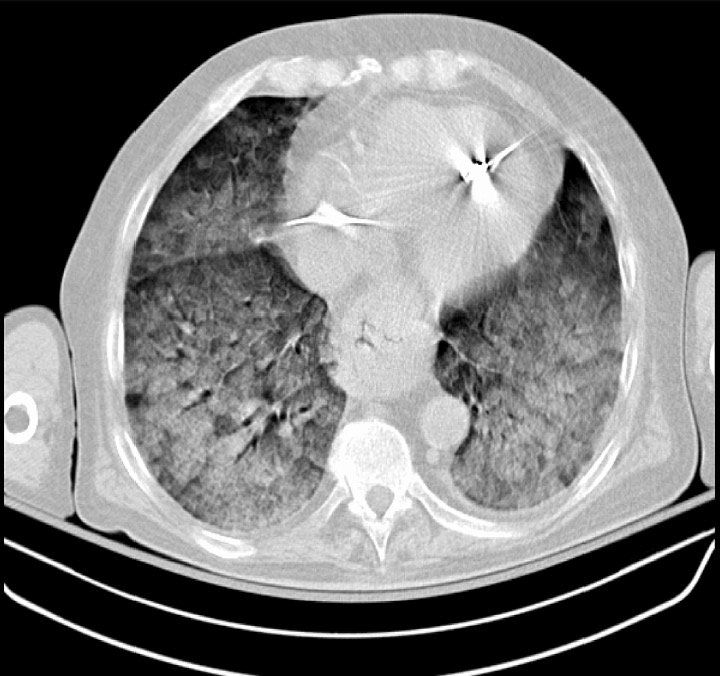
  • TC:
    • No es necesaria, pero ofrece más detalles sobre los LOS Neisseria pulmones
    • SDRA: opacidades generalizadas en EN Erythema nodosum is an immune-mediated panniculitis (inflammation of the subcutaneous fat) caused by a type IV (delayed-type) hypersensitivity reaction. It commonly manifests in young women as tender, erythematous nodules on the shins. Erythema Nodosum el espacio aéreo que son más evidentes en EN Erythema nodosum is an immune-mediated panniculitis (inflammation of the subcutaneous fat) caused by a type IV (delayed-type) hypersensitivity reaction. It commonly manifests in young women as tender, erythematous nodules on the shins. Erythema Nodosum las zonas pulmonares afectadas
    • El SDRA se excluye por los LOS Neisseria siguientes hallazgos:
      • Derrame pericárdico
      • Cardiomegalia
      • Derrame pleural
      • Cavitación
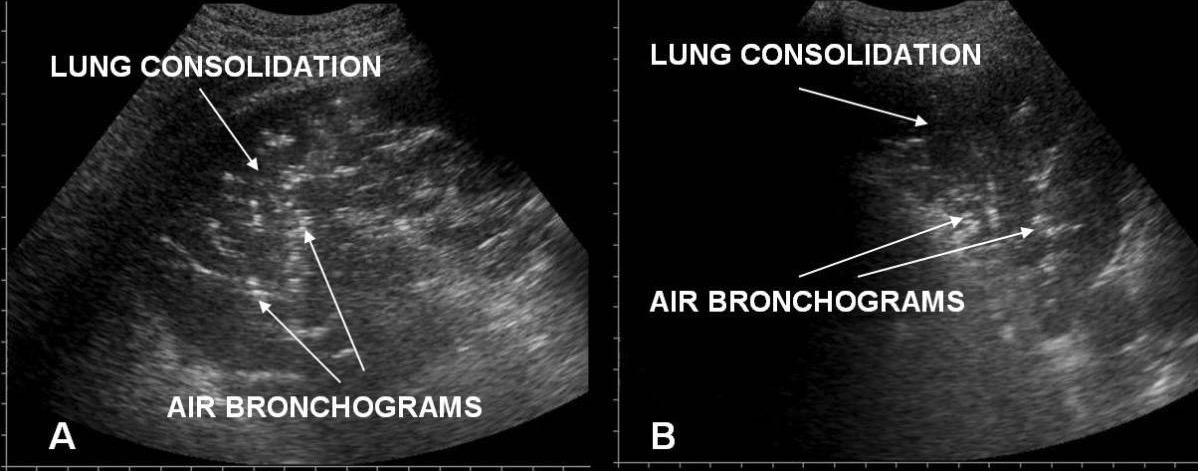
  • Ultrasonido pulmonar:
    • Las líneas B con morfología pleural lisa son sugestivas de edema Edema Edema is a condition in which excess serous fluid accumulates in the body cavity or interstitial space of connective tissues. Edema is a symptom observed in several medical conditions. It can be categorized into 2 types, namely, peripheral (in the extremities) and internal (in an organ or body cavity). Edema pulmonar cardiogénico.
    • Las líneas B con una línea pleural irregular pueden indicar un SDRA.
  • Ultrasonido cardíaco:
    • Ayuda a distinguir la disfunción cardíaca si la presentación clínica no es clara
    • Hallazgos más compatibles con una causa cardiogénica:
      • Reducción de la fracción de eyección del ventrículo izquierdo
      • Presión de llenado elevada en EN Erythema nodosum is an immune-mediated panniculitis (inflammation of the subcutaneous fat) caused by a type IV (delayed-type) hypersensitivity reaction. It commonly manifests in young women as tender, erythematous nodules on the shins. Erythema Nodosum el lado derecho
      • Disfunción grave de la válvula aórtica o mitral

Estudios complementarios

  • Se realizan determinadas pruebas para evaluar la presunta etiología y/o descartar otras condiciones:
    • ECG ECG An electrocardiogram (ECG) is a graphic representation of the electrical activity of the heart plotted against time. Adhesive electrodes are affixed to the skin surface allowing measurement of cardiac impulses from many angles. The ECG provides 3-dimensional information about the conduction system of the heart, the myocardium, and other cardiac structures. Electrocardiogram (ECG) y enzimas cardíacas en EN Erythema nodosum is an immune-mediated panniculitis (inflammation of the subcutaneous fat) caused by a type IV (delayed-type) hypersensitivity reaction. It commonly manifests in young women as tender, erythematous nodules on the shins. Erythema Nodosum el síndrome coronario agudo
    • Lipasa en EN Erythema nodosum is an immune-mediated panniculitis (inflammation of the subcutaneous fat) caused by a type IV (delayed-type) hypersensitivity reaction. It commonly manifests in young women as tender, erythematous nodules on the shins. Erythema Nodosum la pancreatitis Pancreatitis Inflammation of the pancreas. Pancreatitis is classified as acute unless there are computed tomographic or endoscopic retrograde cholangiopancreatographic findings of chronic pancreatitis. The two most common forms of acute pancreatitis are alcoholic pancreatitis and gallstone pancreatitis. Acute Pancreatitis
    • Estudios microbiológicos (e.g., cultivos) en EN Erythema nodosum is an immune-mediated panniculitis (inflammation of the subcutaneous fat) caused by a type IV (delayed-type) hypersensitivity reaction. It commonly manifests in young women as tender, erythematous nodules on the shins. Erythema Nodosum la sepsis Sepsis Systemic inflammatory response syndrome with a proven or suspected infectious etiology. When sepsis is associated with organ dysfunction distant from the site of infection, it is called severe sepsis. When sepsis is accompanied by hypotension despite adequate fluid infusion, it is called septic shock. Sepsis and Septic Shock/etiología infecciosa
  • Imagenología no pulmonar en EN Erythema nodosum is an immune-mediated panniculitis (inflammation of the subcutaneous fat) caused by a type IV (delayed-type) hypersensitivity reaction. It commonly manifests in young women as tender, erythematous nodules on the shins. Erythema Nodosum casos de traumatismos (imagenología de cerebro y de columna vertebral) o de etiología abdominal, como peritonitis Peritonitis Inflammation of the peritoneum lining the abdominal cavity as the result of infectious, autoimmune, or chemical processes. Primary peritonitis is due to infection of the peritoneal cavity via hematogenous or lymphatic spread and without intra-abdominal source. Secondary peritonitis arises from the abdominal cavity itself through rupture or abscess of intra-abdominal organs. Penetrating Abdominal Injury o pancreatitis Pancreatitis Inflammation of the pancreas. Pancreatitis is classified as acute unless there are computed tomographic or endoscopic retrograde cholangiopancreatographic findings of chronic pancreatitis. The two most common forms of acute pancreatitis are alcoholic pancreatitis and gallstone pancreatitis. Acute Pancreatitis (TC abdominal)
  • Broncoscopia:
    • Si la etiología no está clara
    • Se pueden obtener muestras para evaluación citológica y bioquímica.
  • Cateterismo cardíaco derecho:
    • No se realiza de forma rutinaria
    • Ayuda a determinar el estado de los LOS Neisseria fluidos
    • Presión capilar pulmonar:
      • Una función ventricular izquierda normal implica una causa no cardiogénica.
      • Presión capilar pulmonar elevada (≥ 18 mm Hg) implica una causa cardiogénica.
  • Biopsia de pulmón:

Tratamiento

Tratamiento

Casi todos los LOS Neisseria pacientes son tratados en EN Erythema nodosum is an immune-mediated panniculitis (inflammation of the subcutaneous fat) caused by a type IV (delayed-type) hypersensitivity reaction. It commonly manifests in young women as tender, erythematous nodules on the shins. Erythema Nodosum la UCI

  • Corregir las causas subyacentes:
    • Neumonía
    • Pancreatitis Pancreatitis Inflammation of the pancreas. Pancreatitis is classified as acute unless there are computed tomographic or endoscopic retrograde cholangiopancreatographic findings of chronic pancreatitis. The two most common forms of acute pancreatitis are alcoholic pancreatitis and gallstone pancreatitis. Acute Pancreatitis
    • Trauma
    • Sepsis Sepsis Systemic inflammatory response syndrome with a proven or suspected infectious etiology. When sepsis is associated with organ dysfunction distant from the site of infection, it is called severe sepsis. When sepsis is accompanied by hypotension despite adequate fluid infusion, it is called septic shock. Sepsis and Septic Shock
  • El tratamiento con fluidos es difícil:
    • Los LOS Neisseria pacientes con sepsis Sepsis Systemic inflammatory response syndrome with a proven or suspected infectious etiology. When sepsis is associated with organ dysfunction distant from the site of infection, it is called severe sepsis. When sepsis is accompanied by hypotension despite adequate fluid infusion, it is called septic shock. Sepsis and Septic Shock requieren un gran volumen de líquido para mantener su PA.
    • La restricción de líquidos ayuda a reducir la presión de llenado de la aurícula izquierda y mejora la oxigenación.
    • Para el equilibrio, los LOS Neisseria diuréticos pueden facilitar la restricción/eliminación de líquidos
  • Oxígeno suplementario:
    • La mayoría de los LOS Neisseria pacientes requieren una FiO2 alta.
    • Administrado a través de una cánula nasal de alto flujo, una máscara facial o por intubación (ventilación mecánica)
  • Ventilación mecánica:
    • Casi todos los LOS Neisseria pacientes requerirán intubación y ventilación mecánica.
    • Volumen corriente bajo (4–8 mL/kg de peso corporal previsto)
    • Presión de meseta < 30 cm H₂O
    • Presión positiva al AL Amyloidosis final de la espiración ( PEEP PEEP Pressure remaining in the distal airways of the patient at the end of expiration Invasive Mechanical Ventilation, por sus siglas en EN Erythema nodosum is an immune-mediated panniculitis (inflammation of the subcutaneous fat) caused by a type IV (delayed-type) hypersensitivity reaction. It commonly manifests in young women as tender, erythematous nodules on the shins. Erythema Nodosum inglés):
      • 5–20 cm H2O (empezar con la PEEP PEEP Pressure remaining in the distal airways of the patient at the end of expiration Invasive Mechanical Ventilation mínima para una FiO2 dada)
      • Abre los LOS Neisseria alvéolos colapsados
      • Minimiza la FiO2 y maximiza la PaO2
    • La posición prona ha HA Hemolytic anemia (HA) is the term given to a large group of anemias that are caused by the premature destruction/hemolysis of circulating red blood cells (RBCs). Hemolysis can occur within (intravascular hemolysis) or outside the blood vessels (extravascular hemolysis). Hemolytic Anemia demostrado ser beneficiosa.
  • (ECMO, por sus siglas en EN Erythema nodosum is an immune-mediated panniculitis (inflammation of the subcutaneous fat) caused by a type IV (delayed-type) hypersensitivity reaction. It commonly manifests in young women as tender, erythematous nodules on the shins. Erythema Nodosum inglés):
    • Terapia de último recurso o de rescate
    • Una opción si la insuficiencia respiratoria es potencialmente reversible
    • Complicación más frecuente: hemorragia
  • Terapias farmacológicas:
    • Glucocorticoides:
      • Se administra si el paciente tiene indicaciones no relacionadas con el SDRA
      • Precozmente (dentro de los LOS Neisseria 14 días) en EN Erythema nodosum is an immune-mediated panniculitis (inflammation of the subcutaneous fat) caused by a type IV (delayed-type) hypersensitivity reaction. It commonly manifests in young women as tender, erythematous nodules on the shins. Erythema Nodosum el curso del SDRA persistente y de moderado a severo
      • SDRA por COVID-19 COVID-19 Coronavirus disease 2019 (COVID-19) is an infectious disease caused by the severe acute respiratory syndrome coronavirus 2 (SARS-CoV-2) that mainly affects the respiratory system but can also cause damage to other body systems (cardiovascular, gastrointestinal, renal, and central nervous systems).
    • Bloqueo neuromuscular para promover la sincronía del ventilador durante la parálisis: no hay mejoría en EN Erythema nodosum is an immune-mediated panniculitis (inflammation of the subcutaneous fat) caused by a type IV (delayed-type) hypersensitivity reaction. It commonly manifests in young women as tender, erythematous nodules on the shins. Erythema Nodosum la mortalidad ( en EN Erythema nodosum is an immune-mediated panniculitis (inflammation of the subcutaneous fat) caused by a type IV (delayed-type) hypersensitivity reaction. It commonly manifests in young women as tender, erythematous nodules on the shins. Erythema Nodosum el SDRA de moderado a grave)
    • Los LOS Neisseria vasodilatadores pulmonares (e.g., el óxido nitroso inhalado) pueden ser perjudiciales y empeorar la función renal aunque la oxigenación mejore temporalmente.

Pronóstico

El síndrome de dificultad respiratoria aguda es una enfermedad grave que suele estar asociada a una elevada mortalidad y morbilidad.

Se han identificado varios factores de riesgo que pueden estimar el pronóstico en EN Erythema nodosum is an immune-mediated panniculitis (inflammation of the subcutaneous fat) caused by a type IV (delayed-type) hypersensitivity reaction. It commonly manifests in young women as tender, erythematous nodules on the shins. Erythema Nodosum un paciente con SDRA:

  • Edad avanzada (mayor tasa de mortalidad)
  • Disfunción orgánica preexistente por enfermedades crónicas:
    • Enfermedad hepática crónica
    • ERC
    • Inmunosupresión
  • Las lesiones pulmonares directas provocan el doble de muertes que las causas indirectas.

La mayoría de los LOS Neisseria pacientes recuperan la mayor parte de su función pulmonar, pero tardarán meses.

Complicaciones a largo plazo:

  • Muchos pacientes desarrollarán fibrosis Fibrosis Any pathological condition where fibrous connective tissue invades any organ, usually as a consequence of inflammation or other injury. Bronchiolitis Obliterans pulmonar, mientras que algunos pueden requerir ventilación mecánica y suministro de oxígeno a largo plazo.
  • Otros: disfunción cognitiva ( en EN Erythema nodosum is an immune-mediated panniculitis (inflammation of the subcutaneous fat) caused by a type IV (delayed-type) hypersensitivity reaction. It commonly manifests in young women as tender, erythematous nodules on the shins. Erythema Nodosum 30%–55%), enfermedad psiquiátrica (e.g., depresión), menor resistencia durante el ejercicio con debilidad muscular

Diagnóstico Diferencial

  • Edema Edema Edema is a condition in which excess serous fluid accumulates in the body cavity or interstitial space of connective tissues. Edema is a symptom observed in several medical conditions. It can be categorized into 2 types, namely, peripheral (in the extremities) and internal (in an organ or body cavity). Edema pulmonar cardiogénico: condición causada por el exceso de líquido en EN Erythema nodosum is an immune-mediated panniculitis (inflammation of the subcutaneous fat) caused by a type IV (delayed-type) hypersensitivity reaction. It commonly manifests in young women as tender, erythematous nodules on the shins. Erythema Nodosum los LOS Neisseria pulmones, resultante de la insuficiencia cardíaca. La etiología cardiogénica es sugerida por un S3 S3 Heart Sounds o S4 S4 Heart Sounds galopante, presión venosa yugular elevada y edema Edema Edema is a condition in which excess serous fluid accumulates in the body cavity or interstitial space of connective tissues. Edema is a symptom observed in several medical conditions. It can be categorized into 2 types, namely, peripheral (in the extremities) and internal (in an organ or body cavity). Edema de las extremidades inferiores con hallazgos típicos en EN Erythema nodosum is an immune-mediated panniculitis (inflammation of the subcutaneous fat) caused by a type IV (delayed-type) hypersensitivity reaction. It commonly manifests in young women as tender, erythematous nodules on the shins. Erythema Nodosum la radiografía de tórax (congestión venosa pulmonar, cardiomegalia, derrame pleural, respuesta a la diuresis). El tratamiento del edema Edema Edema is a condition in which excess serous fluid accumulates in the body cavity or interstitial space of connective tissues. Edema is a symptom observed in several medical conditions. It can be categorized into 2 types, namely, peripheral (in the extremities) and internal (in an organ or body cavity). Edema pulmonar cardiogénico implica la diuresis.
  • Hemorragia alveolar difusa: condición resultante de una lesión en EN Erythema nodosum is an immune-mediated panniculitis (inflammation of the subcutaneous fat) caused by a type IV (delayed-type) hypersensitivity reaction. It commonly manifests in young women as tender, erythematous nodules on the shins. Erythema Nodosum las arteriolas, vénulas o capilares. La hemorragia alveolar difusa está asociada a múltiples enfermedades (e.g., el síndrome de Goodpasture). Suele haber hemoptisis. La hemorragia alveolar difusa puede presentarse con dificultad respiratoria de inicio repentino, como el SDRA. El diagnóstico se realiza mediante la TC de tórax y la broncoscopia con lavado broncoalveolar, que muestra eritrocitos frescos y macrófagos cargados de hemosiderina.
  • Neumonitis intersticial aguda (síndrome de Hamman-Rich): una forma fulminante de lesión pulmonar difusa que imita el SDRA. El inicio de esta condición es agudo y los LOS Neisseria síntomas incluyen fiebre, tos TOS Thoracic outlet syndrome (TOS) is a broad term used for a spectrum of syndromes related to the general region of the thoracic outlet, which involves the compression or irritation of elements of the brachial plexus, subclavian artery, or subclavian vein. Thoracic Outlet Syndrome y disnea. La neumonitis intersticial aguda puede ser un subgrupo del SDRA idiopático pero sin un factor de riesgo conocido. El diagnóstico se realiza mediante una biopsia de pulmón, que muestra un daño difuso en EN Erythema nodosum is an immune-mediated panniculitis (inflammation of the subcutaneous fat) caused by a type IV (delayed-type) hypersensitivity reaction. It commonly manifests in young women as tender, erythematous nodules on the shins. Erythema Nodosum los LOS Neisseria alvéolos.
  • Exacerbación aguda de la fibrosis Fibrosis Any pathological condition where fibrous connective tissue invades any organ, usually as a consequence of inflammation or other injury. Bronchiolitis Obliterans pulmonar idiopática: una condición similar al AL Amyloidosis SDRA que se presenta con daño alveolar difuso y neumonitis intersticial aguda, pero con un peor pronóstico. La exacerbación aguda de la fibrosis Fibrosis Any pathological condition where fibrous connective tissue invades any organ, usually as a consequence of inflammation or other injury. Bronchiolitis Obliterans pulmonar idiopática puede ocurrir en EN Erythema nodosum is an immune-mediated panniculitis (inflammation of the subcutaneous fat) caused by a type IV (delayed-type) hypersensitivity reaction. It commonly manifests in young women as tender, erythematous nodules on the shins. Erythema Nodosum pacientes con enfermedad pulmonar intersticial no diagnosticada previamente. El diagnóstico se realiza mediante la comparación de imágenes de radiografía y TC previas, y mediante una biopsia de pulmón.

Referencias

  1. Baron, R.M., Levy, B.D. (2018). Acute respiratory distress syndrome. Jameson, J., Fauci A.S., Kasper, D.L., Hauser, S.L., Longo, D.L., Loscalzo, J. (Eds.) Harrison’s Principles of Internal Medicine, 20th Ed. McGraw-Hill.
  2. Diamond, M., Peniston Feliciano, H.L., Sanghavi, D., et al. (2020). Acute respiratory distress syndrome. StatPearls [Internet]. Treasure Island (FL): StatPearls Publishing. https://www.ncbi.nlm.nih.gov/books/NBK436002/
  3. Ologun, G.O., Ridley, D., Chea, N. D., et al. (2017). Severe acute respiratory distress syndrome after laparoscopic appendectomy in a young adult. Cureus 9(9). https://www.cureus.com/articles/8336-severe-acute-respiratory-distress-syndrome-after-laparoscopic-appendectomy-in-a-young-adult
  4. Raheja, R., Brahmavar, M., Joshi, D., et al. (2019). Application of lung ultrasound in critical care setting: A review. Cureus 11(7). https://www.cureus.com/articles/16482-application-of-lung-ultrasound-in-critical-care-setting-a-review
  5. Seigel, M.D. (2020). Acute respiratory distress syndrome: Epidemiology, pathophysiology, pathology, and etiology in adults. In G. Finlay (Ed.). UpToDate. Retrieved February 9, 2021, from https://www.uptodate.com/contents/acute-respiratory-distress-syndrome-epidemiology-pathophysiology-pathology-and-etiology-in-adults
  6. Seigel, M.D. (2020). Acute respiratory distress syndrome: Clinical features, diagnosis, and complications in adults. In G. Finlay (Ed.). UpToDate. Retrieved February 9, 2021, from https://www.uptodate.com/contents/acute-respiratory-distress-syndrome-clinical-features-diagnosis-and-complications-in-adults
  7. Siegel, M., Hyzy, R. (2019). Ventilator management strategies for adults with acute respiratory distress syndrome. In G. Finlay (Ed.). UpToDate. Retrieved March 17, 2021, from https://www.uptodate.com/contents/ventilator-management-strategies-for-adults-with-acute-respiratory-distress-syndrome
  8. Zagkotsis, G., Markou, M., Papanikolaou, P., et al. (2021). Acute respiratory distress syndrome induced by parathyroid storm. Cureus 13(1). https://www.cureus.com/articles/48730-acute-respiratory-distress-syndrome-induced-by-parathyroid-storm
  9. Husain, A.N. (2020). Acute lung injury and acute respiratory distress syndrome (diffuse alveolar damage) In Kumar, V., Abbas, A.K., Aster, J.C., (Eds.). Robbins & Cotran Pathologic Basis of Disease. (10th Ed. pp. 676–678).
  10. Duggal, A., Panitchote, A., Siuba, M., Krishnan, S., Torbic, H., Hastings, A., Mehkri, O., Hanane, T., Hatipoglu, U., Hite, R.D., Mireles-Cabodevila, E. (2021). Implementation of protocolized care in ARDS improves outcomes. Respiratory Care, 66(4), 600–609. https://doi.org/10.4187/respcare.07999
  11. Barrot, L., Asfar, P., Mauny, F., Winiszewski, H., Montini, F., Badie, J., Quenot, J.-P., Pili-Floury, S., Bouhemad, B., Louis, G., Souweine, B., Collange, O., Pottecher, J., Levy, B., Puyraveau, M., Vettoretti, L., Constantin, J.-M., Capellier, G. (2020). Liberal or conservative oxygen therapy for acute respiratory distress syndrome. New England Journal of Medicine, 382(11), 999–1008. https://doi.org/10.1056/NEJMoa1916431
  12. Welker, C., Huang, J., Gil, I.J.N., Ramakrishna, H. (2021). 2021 Acute respiratory distress syndrome update, with coronavirus disease 2019 focus. Journal of Cardiothoracic and Vascular Anesthesia. https://doi.org/10.1053/j.jvca.2021.02.053

¡Crea tu cuenta gratis o inicia una sesión para seguir leyendo!

Regístrate ahora y obtén acceso gratuito a Lecturio con páginas de concepto, videos médicos y cuestionarios para tu educación médica.

User Reviews

Details