Domina Conceptos Médicos

Estudia para la escuela de medicina y tus examenes con Lecturio.

Shigela

Shigella Shigella Shigella is a genus of gram-negative, non-lactose-fermenting facultative intracellular bacilli. Infection spreads most commonly via person-to-person contact or through contaminated food and water. Humans are the only known reservoir. Shigella es un género de bacilos intracelulares facultativos gramnegativos que no fermentan la lactosa. La infección se propaga más comúnmente a través del contacto de persona a persona o a través de alimentos y agua contaminados. Los LOS Neisseria humanos son el único reservorio conocido. Debido a que es resistente al AL Amyloidosis ácido, Shigella Shigella Shigella is a genus of gram-negative, non-lactose-fermenting facultative intracellular bacilli. Infection spreads most commonly via person-to-person contact or through contaminated food and water. Humans are the only known reservoir. Shigella spp. sobrevive al AL Amyloidosis tránsito por el estómago; por lo tanto, solo se necesita una pequeña cantidad del inóculo para causar la enfermedad. La shigelosis (disentería por Shigella Shigella Shigella is a genus of gram-negative, non-lactose-fermenting facultative intracellular bacilli. Infection spreads most commonly via person-to-person contact or through contaminated food and water. Humans are the only known reservoir. Shigella) produce fiebre, dolor Dolor Inflammation abdominal y diarrea sanguinolenta, que son efectos de las toxinas y la invasión de células epiteliales del organismo. En EN Erythema nodosum is an immune-mediated panniculitis (inflammation of the subcutaneous fat) caused by a type IV (delayed-type) hypersensitivity reaction. It commonly manifests in young women as tender, erythematous nodules on the shins. Erythema Nodosum la mayoría de los LOS Neisseria casos, los LOS Neisseria síntomas se resuelven en EN Erythema nodosum is an immune-mediated panniculitis (inflammation of the subcutaneous fat) caused by a type IV (delayed-type) hypersensitivity reaction. It commonly manifests in young women as tender, erythematous nodules on the shins. Erythema Nodosum unos pocos días. Sin embargo, pueden surgir complicaciones de deshidratación, síndrome urémico hemolítico, megacólon tóxico o artritis reactiva. El tratamiento consiste principalmente en EN Erythema nodosum is an immune-mediated panniculitis (inflammation of the subcutaneous fat) caused by a type IV (delayed-type) hypersensitivity reaction. It commonly manifests in young women as tender, erythematous nodules on the shins. Erythema Nodosum reposición de líquidos y electrolitos y antibióticos.

Last updated: Apr 6, 2022

Editorial responsibility: Stanley Oiseth, Lindsay Jones, Evelin Maza

Clasificación

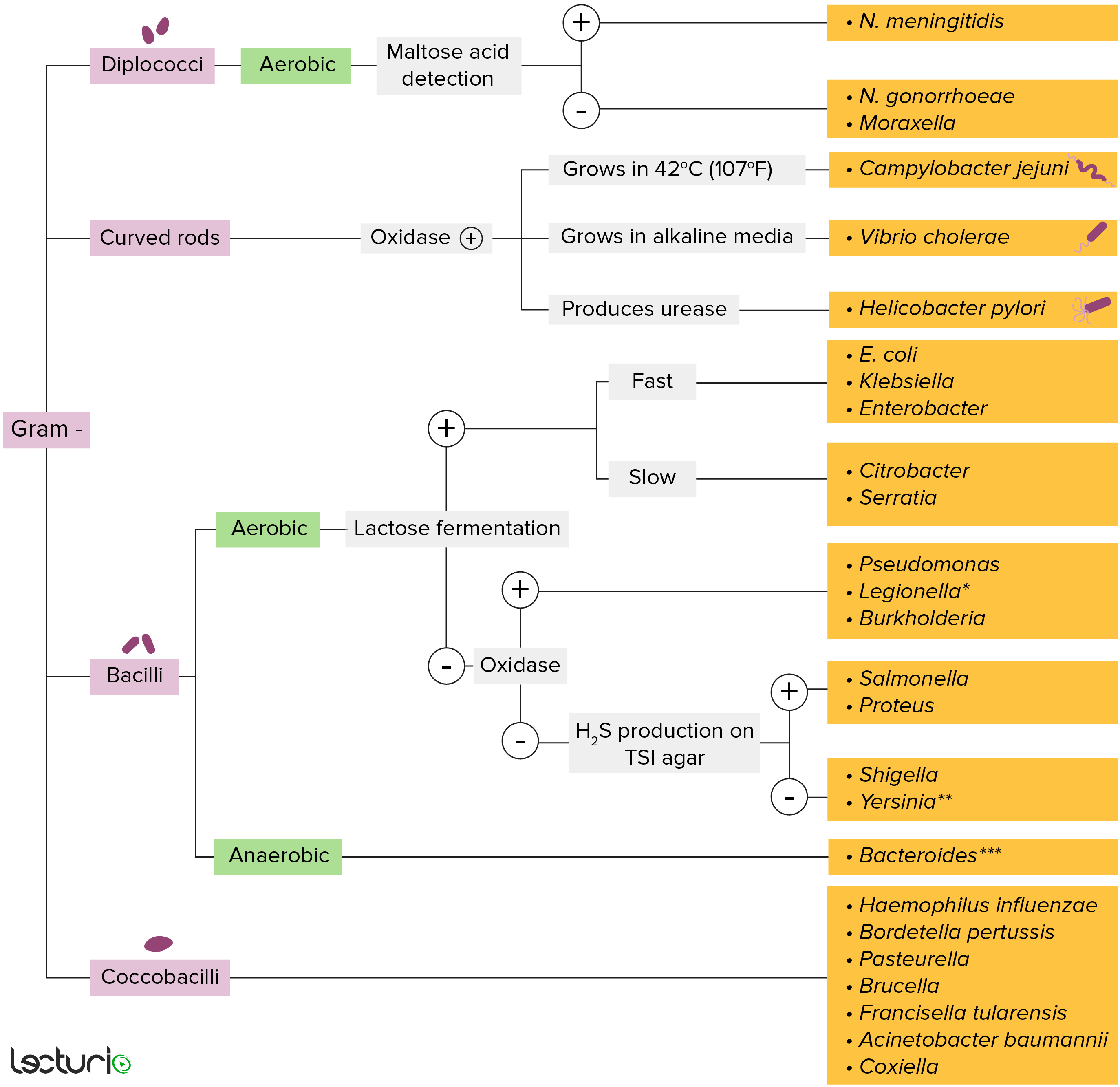
Diagrama de flujo de clasificación de bacterias gram negativas

Bacterias gram-negativas:
La mayoría de las bacterias se pueden clasificar de acuerdo con un procedimiento de laboratorio llamado tinción de Gram.
Las bacterias con paredes celulares que tienen una capa delgada de peptidoglicano no retienen la tinción de cristal violeta utilizada en la tinción de Gram. Sin embargo, estas bacterias retienen la contratinción de safranina y, por lo tanto, se tiñen de color rojo rosado, lo que las convierte en gram negativas. Estas bacterias pueden clasificarse además según su morfología (diplococos, bastoncillos curvos, bacilos y cocobacilos) y su capacidad para crecer en presencia de oxígeno (aeróbicos frente a anaeróbicos). Las bacterias se pueden identificar de manera más estrecha cultivándolas en medios específicos (agar triple azúcar hierro) donde se pueden identificar sus enzimas (ureasa, oxidasa) y se puede probar su capacidad para fermentar lactosa.
* Se tiñe mal en la tinción de Gram
** Baston pleomórfico/cocobacilo
*** Requiere medios de transporte especiales

Imagen por Lecturio.

Características Generales

Shigella Shigella Shigella is a genus of gram-negative, non-lactose-fermenting facultative intracellular bacilli. Infection spreads most commonly via person-to-person contact or through contaminated food and water. Humans are the only known reservoir. Shigella spp.

  • Características generales:
    • Estructura: bacilos
    • Tinción de Gram: gram negativo
    • Intracelular facultativo
    • Motilidad: inmóvil, no flagelado
    • Fermentación de lactosa: fermentación sin lactosa
    • Oxidasa negativa
    • Estable al AL Amyloidosis ácido
    • Cultivos:
      • Sin producción de sulfuro de hidrógeno (H₂S)
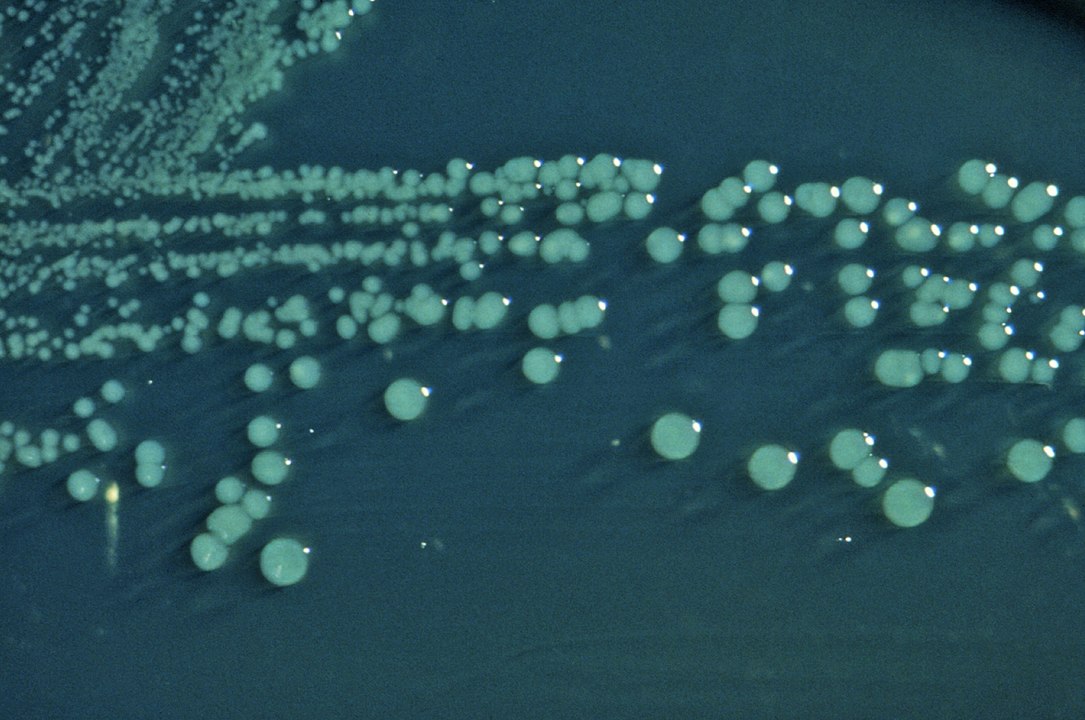
      • En EN Erythema nodosum is an immune-mediated panniculitis (inflammation of the subcutaneous fat) caused by a type IV (delayed-type) hypersensitivity reaction. It commonly manifests in young women as tender, erythematous nodules on the shins. Erythema Nodosum agar Hektoen entérico (HE): colonias verdes transparentes
  • Enfermedad asociada: shigellosis Shigellosis Shigella (disentería o diarrea por Shigella Shigella Shigella is a genus of gram-negative, non-lactose-fermenting facultative intracellular bacilli. Infection spreads most commonly via person-to-person contact or through contaminated food and water. Humans are the only known reservoir. Shigella)

Especies clínicamente relevantes

Serogrupos definidos por antígenos O específicos:

  • S. dysenteriae S. dysenteriae A species of gram-negative, facultatively anaerobic, rod-shaped bacteria that is extremely pathogenic and causes severe dysentery. Infection with this organism often leads to ulceration of the intestinal epithelium. Shigella (serogrupo A)
  • S. flexneri S. flexneri A bacterium which is one of the etiologic agents of bacillary dysentery and sometimes of infantile gastroenteritis. Shigella (serogrupo B)
  • S. boydii S. boydii One of the shigella species that produces bacillary dysentery. Shigella (serogrupo C)
  • S. sonnei S. sonnei A lactose-fermenting bacterium causing dysentery. Shigella (serogrupo D)

Epidemiología

  • Shigellosis Shigellosis Shigella en EN Erythema nodosum is an immune-mediated panniculitis (inflammation of the subcutaneous fat) caused by a type IV (delayed-type) hypersensitivity reaction. It commonly manifests in young women as tender, erythematous nodules on the shins. Erythema Nodosum el mundo: 164 000 muertes al AL Amyloidosis año
  • En EN Erythema nodosum is an immune-mediated panniculitis (inflammation of the subcutaneous fat) caused by a type IV (delayed-type) hypersensitivity reaction. It commonly manifests in young women as tender, erythematous nodules on the shins. Erythema Nodosum países de ingresos bajos a medianos:
    • Shigella Shigella Shigella is a genus of gram-negative, non-lactose-fermenting facultative intracellular bacilli. Infection spreads most commonly via person-to-person contact or through contaminated food and water. Humans are the only known reservoir. Shigella: la etiología más común de disentería en EN Erythema nodosum is an immune-mediated panniculitis (inflammation of the subcutaneous fat) caused by a type IV (delayed-type) hypersensitivity reaction. It commonly manifests in young women as tender, erythematous nodules on the shins. Erythema Nodosum niños
    • Más común: S. flexneri S. flexneri A bacterium which is one of the etiologic agents of bacillary dysentery and sometimes of infantile gastroenteritis. Shigella, seguido de S. sonnei S. sonnei A lactose-fermenting bacterium causing dysentery. Shigella
    • S. dysenteriae S. dysenteriae A species of gram-negative, facultatively anaerobic, rod-shaped bacteria that is extremely pathogenic and causes severe dysentery. Infection with this organism often leads to ulceration of the intestinal epithelium. Shigella: causa disentería epidémica
    • La eliminación insuficiente de aguas residuales es uno de los LOS Neisseria principales culpables.
  • En EN Erythema nodosum is an immune-mediated panniculitis (inflammation of the subcutaneous fat) caused by a type IV (delayed-type) hypersensitivity reaction. It commonly manifests in young women as tender, erythematous nodules on the shins. Erythema Nodosum los LOS Neisseria Estados Unidos:
    • Incidencia: 4,8 casos por 100 000 habitantes
    • Los LOS Neisseria niños son más afectados
    • Más común: S. sonnei S. sonnei A lactose-fermenting bacterium causing dysentery. Shigella (> 75%), S. flexneri S. flexneri A bacterium which is one of the etiologic agents of bacillary dysentery and sometimes of infantile gastroenteritis. Shigella
    • Locaciones:
      • Instituciones como guarderías
      • Agua recreativa no tratada

Patogénesis

Reservorio y transmisión

  • Reservorio: tracto intestinal humano
  • Transmisión:
    • Alimentos o agua contaminados, generalmente transmisión fecal-oral
    • Contacto de persona a persona (e.g., falta de lavado de manos, transmisión sexual en EN Erythema nodosum is an immune-mediated panniculitis (inflammation of the subcutaneous fat) caused by a type IV (delayed-type) hypersensitivity reaction. It commonly manifests in young women as tender, erythematous nodules on the shins. Erythema Nodosum hombres que tienen sexo con hombres)

Mnemotécnia

Para ayudar a recordar los LOS Neisseria modos de transmisión de Shigella Shigella Shigella is a genus of gram-negative, non-lactose-fermenting facultative intracellular bacilli. Infection spreads most commonly via person-to-person contact or through contaminated food and water. Humans are the only known reservoir. Shigella, recuerde las “4 Fs” ( en EN Erythema nodosum is an immune-mediated panniculitis (inflammation of the subcutaneous fat) caused by a type IV (delayed-type) hypersensitivity reaction. It commonly manifests in young women as tender, erythematous nodules on the shins. Erythema Nodosum ingles):

  • F – Fingers (dedos)
  • F – Flies (moscas)
  • F – Food (comida)
  • F – Feces (heces)

Factores virulentos

  • Endotoxina:
    • Lipopolisacárido tóxico
    • Provoca irritación de la pared intestinal.
  • Toxina Shiga:
    • Producida por S. dysenteriae S. dysenteriae A species of gram-negative, facultatively anaerobic, rod-shaped bacteria that is extremely pathogenic and causes severe dysentery. Infection with this organism often leads to ulceration of the intestinal epithelium. Shigella tipo 1
    • Inhibe la unión de aminoacil-tRNA al AL Amyloidosis ribosoma 60S, lo que lleva al AL Amyloidosis cese de la síntesis de proteínas
    • Provoca daño en EN Erythema nodosum is an immune-mediated panniculitis (inflammation of the subcutaneous fat) caused by a type IV (delayed-type) hypersensitivity reaction. It commonly manifests in young women as tender, erythematous nodules on the shins. Erythema Nodosum la mucosa colónica, lo que lleva a descamación y disentería.
    • Otros cambios (observados en EN Erythema nodosum is an immune-mediated panniculitis (inflammation of the subcutaneous fat) caused by a type IV (delayed-type) hypersensitivity reaction. It commonly manifests in young women as tender, erythematous nodules on the shins. Erythema Nodosum el síndrome urémico hemolítico):
      • La toxina se transloca a la circulación e induce daño endotelial, particularmente en EN Erythema nodosum is an immune-mediated panniculitis (inflammation of the subcutaneous fat) caused by a type IV (delayed-type) hypersensitivity reaction. It commonly manifests in young women as tender, erythematous nodules on the shins. Erythema Nodosum los LOS Neisseria glomérulos.
      • El endotelio dañado provoca la agregación plaquetaria.
      • Los LOS Neisseria eritrocitos se lisan → esquistocitos/esquizocitos (eritrocitos fragmentados)
  • Enterotoxina 1 de Shigella Shigella Shigella is a genus of gram-negative, non-lactose-fermenting facultative intracellular bacilli. Infection spreads most commonly via person-to-person contact or through contaminated food and water. Humans are the only known reservoir. Shigella (ShET1; S. flexneri S. flexneri A bacterium which is one of the etiologic agents of bacillary dysentery and sometimes of infantile gastroenteritis. Shigella) y enterotoxina 2 de Shigella Shigella Shigella is a genus of gram-negative, non-lactose-fermenting facultative intracellular bacilli. Infection spreads most commonly via person-to-person contact or through contaminated food and water. Humans are the only known reservoir. Shigella (ShET2; 4 especies) causan secreción de líquido y diarrea acuosa subsiguiente.
  • Sistema de secreción tipo III:
    • Entrega directamente efectores de virulencia a la célula huésped.
    • Facilita la invasión bacteriana de las células epiteliales
  • Resistencia a los LOS Neisseria ácidos gástricos:
    • La Shigella Shigella Shigella is a genus of gram-negative, non-lactose-fermenting facultative intracellular bacilli. Infection spreads most commonly via person-to-person contact or through contaminated food and water. Humans are the only known reservoir. Shigella puede sobrevivir al AL Amyloidosis ambiente ácido del estómago durante el tránsito.
    • Por lo tanto, solo se requiere un pequeño inóculo para producir la enfermedad.

Proceso de enfermedad

  • Shigela:
    • Técnicamente inmóvil
    • Invade las células huésped (íleon y colon Colon The large intestines constitute the last portion of the digestive system. The large intestine consists of the cecum, appendix, colon (with ascending, transverse, descending, and sigmoid segments), rectum, and anal canal. The primary function of the colon is to remove water and compact the stool prior to expulsion from the body via the rectum and anal canal. Colon, Cecum, and Appendix: Anatomy) por fagocitosis inducida
  • Invasión:
    • Entra a través de las células microfold(M) de las placas de Peyer intestinales (transcitosis):
      • Las células M engullen al AL Amyloidosis patógeno desde la luz y luego lo transportan al AL Amyloidosis subepitelio.
      • De las células M, el patógeno es absorbido por macrófagos subepiteliales (también por neutrófilos, células dendríticas).
      • Los LOS Neisseria macrófagos sufren apoptosis Apoptosis A regulated cell death mechanism characterized by distinctive morphologic changes in the nucleus and cytoplasm, including the endonucleolytic cleavage of genomic DNA, at regularly spaced, internucleosomal sites, I.e., DNA fragmentation. It is genetically-programmed and serves as a balance to mitosis in regulating the size of animal tissues and in mediating pathologic processes associated with tumor growth. Ischemic Cell Damage y el patógeno liberado invade las células epiteliales intestinales.
    • Durante la apoptosis Apoptosis A regulated cell death mechanism characterized by distinctive morphologic changes in the nucleus and cytoplasm, including the endonucleolytic cleavage of genomic DNA, at regularly spaced, internucleosomal sites, I.e., DNA fragmentation. It is genetically-programmed and serves as a balance to mitosis in regulating the size of animal tissues and in mediating pathologic processes associated with tumor growth. Ischemic Cell Damage, las citocinas liberadas reclutan leucocitos polimorfonucleares:
      • Los LOS Neisseria polimorfonucleares desestabilizan las uniones entre las células epiteliales, lo que permite que el patógeno atraviese la unión interrumpida.
      • La transmigración de polimorfonucleares es otra vía de entrada para Shigella Shigella Shigella is a genus of gram-negative, non-lactose-fermenting facultative intracellular bacilli. Infection spreads most commonly via person-to-person contact or through contaminated food and water. Humans are the only known reservoir. Shigella sp., que conduce a una mayor invasión.
    • Captación en EN Erythema nodosum is an immune-mediated panniculitis (inflammation of the subcutaneous fat) caused by a type IV (delayed-type) hypersensitivity reaction. It commonly manifests in young women as tender, erythematous nodules on the shins. Erythema Nodosum células epiteliales:
      • Una vez en EN Erythema nodosum is an immune-mediated panniculitis (inflammation of the subcutaneous fat) caused by a type IV (delayed-type) hypersensitivity reaction. It commonly manifests in young women as tender, erythematous nodules on the shins. Erythema Nodosum el citosol epitelial, el patógeno secuestra los LOS Neisseria nucleadores de actina de la célula huésped.
      • Luego, se utilizan los LOS Neisseria filamentos de actina del huésped (cola de actina) para moverse dentro de la célula (motilidad basada en EN Erythema nodosum is an immune-mediated panniculitis (inflammation of the subcutaneous fat) caused by a type IV (delayed-type) hypersensitivity reaction. It commonly manifests in young women as tender, erythematous nodules on the shins. Erythema Nodosum actina).
    • Formación y resolución de protuberancias:
      • La motilidad basada en EN Erythema nodosum is an immune-mediated panniculitis (inflammation of the subcutaneous fat) caused by a type IV (delayed-type) hypersensitivity reaction. It commonly manifests in young women as tender, erythematous nodules on the shins. Erythema Nodosum actina impulsa el patógeno a la membrana y se crea una protuberancia en EN Erythema nodosum is an immune-mediated panniculitis (inflammation of the subcutaneous fat) caused by a type IV (delayed-type) hypersensitivity reaction. It commonly manifests in young women as tender, erythematous nodules on the shins. Erythema Nodosum la membrana hacia la célula vecina.
      • La protuberancia se alarga y se resuelve como una vacuola de doble membrana.
      • El patógeno lisa la vacuola, escapa e infecta la célula adyacente (propagación de célula a célula).
    • La invasión no implica una penetración profunda; por lo tanto, no hay diseminación hematógena
    • Efectos: respuesta inflamatoria ( colitis Colitis Inflammation of the colon section of the large intestine, usually with symptoms such as diarrhea (often with blood and mucus), abdominal pain, and fever. Pseudomembranous Colitis) → ulceraciones mucosas, abscesos, hemorragias y formación de una “pseudomembrana” en EN Erythema nodosum is an immune-mediated panniculitis (inflammation of the subcutaneous fat) caused by a type IV (delayed-type) hypersensitivity reaction. It commonly manifests in young women as tender, erythematous nodules on the shins. Erythema Nodosum el área ulcerada
Invasión y propagación de célula a célula por Shigella

Invasión y propagación de célula a célula por Shigella:

1. El patógeno invade y es engullido por la célula M (transcitosis).
2. El patógeno alcanza los macrófagos subepiteliales y las células dendríticas y luego induce la apoptosis de los macrófagos. Shigella sp. se libera junto con la interleucina-1 (IL-1) y otras citocinas. Luego, el patógeno es absorbido por la célula epitelial adyacente en un compartimento unido a la membrana (entrada de la célula epitelial).
3. Las interleucinas liberadas también reclutan leucocitos polimorfonucleares (PMN), que desestabilizan las uniones celulares. Esta es otra vía de entrada para el patógeno (transmigración de PMN).
4. La Shigella sp. pasa a través de las uniones estrechas interrumpidas y luego el patógeno ingresa a la célula epitelial. Una vez dentro, los nucleadores de actina de la célula huésped son secuestrados. La motilidad basada en actina (ABM, por sus siglas en inglés) impulsa al patógeno a alcanzar la membrana plasmática, donde la célula infectada entra en contacto con otra célula.
5. La protrusión celular (con Shigella) y la elongación hacia la célula adyacente facilitan la multiplicación y la diseminación intercelular. La protuberancia se resuelve como una vacuola de doble membrana. El patógeno lisa la membrana, escapa y entra en la célula adyacente. La célula adyacente se infecta y este proceso se repite en otras células.
6. A medida que muere cada célula epitelial invadida, se pierden líquidos.
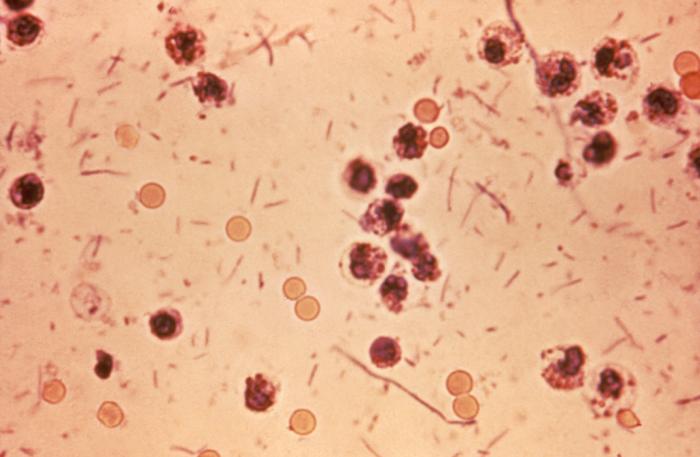
Imagen por Lecturio.

Presentación Clínica

  • Shigellosis Shigellosis Shigella:
    • Período de incubación: 1–4 días.
    • Diarrea acuosa inicialmente, luego disentería (diarrea sanguinolenta con mucosidad)
    • Se acompaña de dolor Dolor Inflammation abdominal, tenesmo y fiebre.
    • En EN Erythema nodosum is an immune-mediated panniculitis (inflammation of the subcutaneous fat) caused by a type IV (delayed-type) hypersensitivity reaction. It commonly manifests in young women as tender, erythematous nodules on the shins. Erythema Nodosum la mayoría de los LOS Neisseria casos, la resolución se nota dentro de los LOS Neisseria 5 días.
    • En EN Erythema nodosum is an immune-mediated panniculitis (inflammation of the subcutaneous fat) caused by a type IV (delayed-type) hypersensitivity reaction. It commonly manifests in young women as tender, erythematous nodules on the shins. Erythema Nodosum poblaciones de alto riesgo (inmunocomprometidos, ancianos y niños < 5 años), las pérdidas de líquidos y electrolitos pueden provocar deshidratación y posible muerte.
  • Otras complicaciones:
    • Síndrome hemolítico urémico:
      • Shigella Shigella Shigella is a genus of gram-negative, non-lactose-fermenting facultative intracellular bacilli. Infection spreads most commonly via person-to-person contact or through contaminated food and water. Humans are the only known reservoir. Shigella es la segunda causa más común de síndrome hemolítico urémico.
      • Mediado por la toxina Shiga
      • Generalmente ocurre en EN Erythema nodosum is an immune-mediated panniculitis (inflammation of the subcutaneous fat) caused by a type IV (delayed-type) hypersensitivity reaction. It commonly manifests in young women as tender, erythematous nodules on the shins. Erythema Nodosum niños menores de 10 años
      • Típicamente asociado con S. dysenteriae S. dysenteriae A species of gram-negative, facultatively anaerobic, rod-shaped bacteria that is extremely pathogenic and causes severe dysentery. Infection with this organism often leads to ulceration of the intestinal epithelium. Shigella tipo 1
    • Megacolon Megacolon Megacolon is a severe, abnormal dilatation of the colon, and is classified as acute or chronic. There are many etiologies of megacolon, including neuropathic and dysmotility conditions, severe infections, ischemia, and inflammatory bowel disease. Megacolon tóxico:
      • La inflamación involucra la capa muscular lisa que resulta en EN Erythema nodosum is an immune-mediated panniculitis (inflammation of the subcutaneous fat) caused by a type IV (delayed-type) hypersensitivity reaction. It commonly manifests in young women as tender, erythematous nodules on the shins. Erythema Nodosum parálisis y dilatación del colon Colon The large intestines constitute the last portion of the digestive system. The large intestine consists of the cecum, appendix, colon (with ascending, transverse, descending, and sigmoid segments), rectum, and anal canal. The primary function of the colon is to remove water and compact the stool prior to expulsion from the body via the rectum and anal canal. Colon, Cecum, and Appendix: Anatomy.
      • Distensión y sensibilidad abdominal
    • Otras secuelas intestinales: obstrucción intestinal, perforación
    • Prolapso rectal:
      • Debido a la inflamación en EN Erythema nodosum is an immune-mediated panniculitis (inflammation of the subcutaneous fat) caused by a type IV (delayed-type) hypersensitivity reaction. It commonly manifests in young women as tender, erythematous nodules on the shins. Erythema Nodosum el colon Colon The large intestines constitute the last portion of the digestive system. The large intestine consists of the cecum, appendix, colon (with ascending, transverse, descending, and sigmoid segments), rectum, and anal canal. The primary function of the colon is to remove water and compact the stool prior to expulsion from the body via the rectum and anal canal. Colon, Cecum, and Appendix: Anatomy.
      • Afecta a niños pequeños
    • Artritis reactiva:
      • Asociado con S. flexneri S. flexneri A bacterium which is one of the etiologic agents of bacillary dysentery and sometimes of infantile gastroenteritis. Shigella
      • Dolor Dolor Inflammation articular de 1–4 semanas después de la infección (oligoartritis, entesitis, dactilitis, dolor Dolor Inflammation inflamatorio de espalda)
      • Hallazgos extraarticulares: conjuntivitis, uretritis, úlceras orales
    • Efectos neurológicos:
      • Convulsiones generalizadas: asociadas a fiebre y más frecuentes en EN Erythema nodosum is an immune-mediated panniculitis (inflammation of the subcutaneous fat) caused by a type IV (delayed-type) hypersensitivity reaction. It commonly manifests in young women as tender, erythematous nodules on the shins. Erythema Nodosum niños
      • Encefalopatía
    • Reacción leucemoide:
      • Recuento de leucocitos > 50 000/mm³
      • Asociado con aumento de la mortalidad

Diagnóstico y Tratamiento

Diagnóstico

  • Tinción de Gram y cultivo: heces frescas o hisopado rectal
    • Gram negativo
    • Medios diferenciales: eosina azul de metileno o agar de MacConkey, mostrando colonias que no fermentan la lactosa
    • Medios selectivos: agar HE (colonias verdes transparentes) o agar xilosa-lisina-desoxicolato
    • Hierro de triple azúcar: inclinación alcalina, ácido en EN Erythema nodosum is an immune-mediated panniculitis (inflammation of the subcutaneous fat) caused by a type IV (delayed-type) hypersensitivity reaction. It commonly manifests in young women as tender, erythematous nodules on the shins. Erythema Nodosum el fondo y sin H₂S
  • Reacción en EN Erythema nodosum is an immune-mediated panniculitis (inflammation of the subcutaneous fat) caused by a type IV (delayed-type) hypersensitivity reaction. It commonly manifests in young women as tender, erythematous nodules on the shins. Erythema Nodosum cadena de la polimerasa ( PCR PCR Polymerase chain reaction (PCR) is a technique that amplifies DNA fragments exponentially for analysis. The process is highly specific, allowing for the targeting of specific genomic sequences, even with minuscule sample amounts. The PCR cycles multiple times through 3 phases: denaturation of the template DNA, annealing of a specific primer to the individual DNA strands, and synthesis/elongation of new DNA molecules. Polymerase Chain Reaction (PCR)): detección de ácido desoxirribonucleico (ADN) específico de Shigella Shigella Shigella is a genus of gram-negative, non-lactose-fermenting facultative intracellular bacilli. Infection spreads most commonly via person-to-person contact or through contaminated food and water. Humans are the only known reservoir. Shigella en EN Erythema nodosum is an immune-mediated panniculitis (inflammation of the subcutaneous fat) caused by a type IV (delayed-type) hypersensitivity reaction. It commonly manifests in young women as tender, erythematous nodules on the shins. Erythema Nodosum heces
  • Estudios adicionales, especialmente en EN Erythema nodosum is an immune-mediated panniculitis (inflammation of the subcutaneous fat) caused by a type IV (delayed-type) hypersensitivity reaction. It commonly manifests in young women as tender, erythematous nodules on the shins. Erythema Nodosum infecciones graves:
    • Hemograma completo ( anemia Anemia Anemia is a condition in which individuals have low Hb levels, which can arise from various causes. Anemia is accompanied by a reduced number of RBCs and may manifest with fatigue, shortness of breath, pallor, and weakness. Subtypes are classified by the size of RBCs, chronicity, and etiology. Anemia: Overview and Types y trombocitopenia en EN Erythema nodosum is an immune-mediated panniculitis (inflammation of the subcutaneous fat) caused by a type IV (delayed-type) hypersensitivity reaction. It commonly manifests in young women as tender, erythematous nodules on the shins. Erythema Nodosum síndrome hemolítico urémico)
    • Panel metabólico (insuficiencia renal y anomalías electrolíticas en EN Erythema nodosum is an immune-mediated panniculitis (inflammation of the subcutaneous fat) caused by a type IV (delayed-type) hypersensitivity reaction. It commonly manifests in young women as tender, erythematous nodules on the shins. Erythema Nodosum deshidratación o síndrome hemolítico urémico)

Tratamiento

  • Tratamiento a través de hidratación oral y reposición de electrolitos
  • En EN Erythema nodosum is an immune-mediated panniculitis (inflammation of the subcutaneous fat) caused by a type IV (delayed-type) hypersensitivity reaction. It commonly manifests in young women as tender, erythematous nodules on the shins. Erythema Nodosum poblaciones de alto riesgo (inmunocomprometidos, desnutridos, ancianos, niños): reposición de líquidos por vía intravenosa
  • Evite los LOS Neisseria medicamentos antidiarreicos (e.g., loperamida); puede empeorar la infección
  • Antibióticos:
    • Acorta la duración de la infección.
    • Previene la propagación de la infección.
    • Opciones: ciprofloxacina, ceftriaxona, cefixima
    • Para infección resistente a antibióticos: azitromicina
    • Trimetoprim-sulfametoxazol (TMP-SMX) y ampicilina:
      • Asociado con alta resistencia en EN Erythema nodosum is an immune-mediated panniculitis (inflammation of the subcutaneous fat) caused by a type IV (delayed-type) hypersensitivity reaction. It commonly manifests in young women as tender, erythematous nodules on the shins. Erythema Nodosum los LOS Neisseria Estados Unidos
      • Recetar si el cultivo con antibiograma muestra sensibilidad

Prevención

  • Control de moscas y eliminación adecuada de aguas residuales.
  • Medidas sanitarias (agua, alimentos y leche) y correcta higiene
  • Aislamiento de pacientes infectados
  • Detección de casos y portadores, especialmente manipuladores de alimentos y tratamiento de personas infectadas

Comparación con Salmonella

Shigella Shigella Shigella is a genus of gram-negative, non-lactose-fermenting facultative intracellular bacilli. Infection spreads most commonly via person-to-person contact or through contaminated food and water. Humans are the only known reservoir. Shigella y Salmonella Salmonella Salmonellae are gram-negative bacilli of the family Enterobacteriaceae. Salmonellae are flagellated, non-lactose-fermenting, and hydrogen sulfide-producing microbes. Salmonella enterica, the most common disease-causing species in humans, is further classified based on serotype as typhoidal (S. typhi and paratyphi) and nontyphoidal (S. enteritidis and typhimurium). Salmonella invaden el tracto gastrointestinal y causan diarrea.

Tabla: Shigella Shigella Shigella is a genus of gram-negative, non-lactose-fermenting facultative intracellular bacilli. Infection spreads most commonly via person-to-person contact or through contaminated food and water. Humans are the only known reservoir. Shigella y Salmonella Salmonella Salmonellae are gram-negative bacilli of the family Enterobacteriaceae. Salmonellae are flagellated, non-lactose-fermenting, and hydrogen sulfide-producing microbes. Salmonella enterica, the most common disease-causing species in humans, is further classified based on serotype as typhoidal (S. typhi and paratyphi) and nontyphoidal (S. enteritidis and typhimurium). Salmonella
Shigela Salmonela
Tinción de Gram/estructura Bacilos gramnegativos Bacilos gramnegativos
Fermentación de lactosa No fermentadores de lactosa No fermentadores de lactosa
Oxidasa Negativa Negativa
Producción de H2S No Si
Motilidad No Sí (con flagelos)
Factores virulentos Endotoxina, toxina Shiga Endotoxina, antígeno capsular Vi
Reservorio Humanos Humanos (S. typhi), animales
Dosis para producir la enfermedad Inóculo pequeño (estable en EN Erythema nodosum is an immune-mediated panniculitis (inflammation of the subcutaneous fat) caused by a type IV (delayed-type) hypersensitivity reaction. It commonly manifests in young women as tender, erythematous nodules on the shins. Erythema Nodosum ácido) Gran dosis (inactivado por ácidos)
Propagación de infecciones De célula a célula (sin diseminación hematógena) Puede diseminarse hematógenamente

Diagnóstico Diferencial

  • Otras colitis Colitis Inflammation of the colon section of the large intestine, usually with symptoms such as diarrhea (often with blood and mucus), abdominal pain, and fever. Pseudomembranous Colitis infecciosas: se presentan con fiebre y diarrea de inicio agudo. Otros patógenos entéricos causantes incluyen Salmonella Salmonella Salmonellae are gram-negative bacilli of the family Enterobacteriaceae. Salmonellae are flagellated, non-lactose-fermenting, and hydrogen sulfide-producing microbes. Salmonella enterica, the most common disease-causing species in humans, is further classified based on serotype as typhoidal (S. typhi and paratyphi) and nontyphoidal (S. enteritidis and typhimurium). Salmonella, Campylobacter Campylobacter Campylobacter (“curved bacteria”) is a genus of thermophilic, S-shaped, gram-negative bacilli. There are many species of Campylobacter, with C. jejuni and C. coli most commonly implicated in human disease. Campylobacter, Escherichia coli Escherichia coli The gram-negative bacterium Escherichia coli is a key component of the human gut microbiota. Most strains of E. coli are avirulent, but occasionally they escape the GI tract, infecting the urinary tract and other sites. Less common strains of E. coli are able to cause disease within the GI tract, most commonly presenting as abdominal pain and diarrhea. Escherichia coli (O157:H7), Yersinia Yersinia Yersinia is a genus of bacteria characterized as gram-negative bacilli that are facultative anaerobic with bipolar staining. There are 2 enteropathogenic species that cause yersiniosis, Y. enterocolitica and Y. pseudotuberculosis. Infections are manifested as pseudoappendicitis or mesenteric lymphadenitis, and enterocolitis. Yersinia spp./Yersiniosis y Clostridioides difficile. Estas infecciones se pueden confirmar en EN Erythema nodosum is an immune-mediated panniculitis (inflammation of the subcutaneous fat) caused by a type IV (delayed-type) hypersensitivity reaction. It commonly manifests in young women as tender, erythematous nodules on the shins. Erythema Nodosum base a cultivos de heces y PCR PCR Polymerase chain reaction (PCR) is a technique that amplifies DNA fragments exponentially for analysis. The process is highly specific, allowing for the targeting of specific genomic sequences, even with minuscule sample amounts. The PCR cycles multiple times through 3 phases: denaturation of the template DNA, annealing of a specific primer to the individual DNA strands, and synthesis/elongation of new DNA molecules. Polymerase Chain Reaction (PCR). El curso puede ser autolimitado o puede requerir tratamiento con antibióticos.
  • Colitis Colitis Inflammation of the colon section of the large intestine, usually with symptoms such as diarrhea (often with blood and mucus), abdominal pain, and fever. Pseudomembranous Colitis ulcerosa (CU): un tipo de enfermedad inflamatoria intestinal caracterizada por la inflamación del colon Colon The large intestines constitute the last portion of the digestive system. The large intestine consists of the cecum, appendix, colon (with ascending, transverse, descending, and sigmoid segments), rectum, and anal canal. The primary function of the colon is to remove water and compact the stool prior to expulsion from the body via the rectum and anal canal. Colon, Cecum, and Appendix: Anatomy. La enfermedad comúnmente involucra el recto y la inflamación puede extenderse continuamente a través del colon Colon The large intestines constitute the last portion of the digestive system. The large intestine consists of the cecum, appendix, colon (with ascending, transverse, descending, and sigmoid segments), rectum, and anal canal. The primary function of the colon is to remove water and compact the stool prior to expulsion from the body via the rectum and anal canal. Colon, Cecum, and Appendix: Anatomy. La presentación incluye diarrea sanguinolenta, dolor Dolor Inflammation abdominal y tenesmo. El diagnóstico se establece mediante endoscopia con biopsia. Los LOS Neisseria hallazgos incluyen friabilidad difusa y erosiones con hemorragia.
  • Enfermedad de Crohn: una afección crónica y recurrente que causa inflamación transmural parcheada que puede afectar cualquier parte del tracto gastrointestinal. El íleon terminal y el colon Colon The large intestines constitute the last portion of the digestive system. The large intestine consists of the cecum, appendix, colon (with ascending, transverse, descending, and sigmoid segments), rectum, and anal canal. The primary function of the colon is to remove water and compact the stool prior to expulsion from the body via the rectum and anal canal. Colon, Cecum, and Appendix: Anatomy suelen verse afectados. La enfermedad generalmente se presenta con diarrea intermitente crónica (con o sin sangre) y dolor Dolor Inflammation abdominal tipo cólico. Pueden ocurrir manifestaciones extraintestinales. El diagnóstico se establece con base en EN Erythema nodosum is an immune-mediated panniculitis (inflammation of the subcutaneous fat) caused by a type IV (delayed-type) hypersensitivity reaction. It commonly manifests in young women as tender, erythematous nodules on the shins. Erythema Nodosum la endoscopia y la biopsia.
  • Enfermedad celíaca: una enfermedad asociada con anticuerpos IgA IgA Represents 15-20% of the human serum immunoglobulins, mostly as the 4-chain polymer in humans or dimer in other mammals. Secretory iga is the main immunoglobulin in secretions. Immunoglobulins: Types and Functions anti-transglutaminasa tisular. Los LOS Neisseria síntomas incluyen dolor Dolor Inflammation abdominal y diarrea después del consumo de gluten Gluten Prolamins in the endosperm of seeds from the triticeae tribe which includes species of wheat; barley; and rye. Celiac Disease. El diagnóstico se confirma con base en EN Erythema nodosum is an immune-mediated panniculitis (inflammation of the subcutaneous fat) caused by a type IV (delayed-type) hypersensitivity reaction. It commonly manifests in young women as tender, erythematous nodules on the shins. Erythema Nodosum una biopsia intestinal que demuestra atrofia de las vellosidades, hiperplasia de las criptas e inflamación de la mucosa.

Referencias

  1. Corry, J., Curtis, G., Baird, R. (2003) Progress in industrial microbiology. Elsevier Vol. 37 pp 481-483, https://www.sciencedirect.com/science/article/pii/S0079635203800565?via%3Dihub
  2. Agha, R., & Goldberg, M. B. (2025). Shigella infection: Epidemiology, clinical manifestations, and diagnosis. In M. Yushak (Ed.), UpToDate. Wolters Kluwer. Retrieved June 3, 2025, from https://www.uptodate.com/contents/shigella-infection-epidemiology-clinical-manifestations-and-diagnosis
  3. Kroser, J., Singh, A. (2019) Shigellosis. Medscape. Retrieved 5 Jan 2020, from https://emedicine.medscape.com/article/182767-overview#a3
  4. Lucchini, S., Liu, H., Jin, Q., Hinton, J., Yu, J. (2005) Transcriptional adaptation of Shigella flexneri during infection of macrophages and epithelial cells: Insights into the strategies of a cytosolic bacterial pathogen. Infect Immun. 73(1): 88–102.
  5. Mattock, E., Blocker, J. (2017) How do the virulence factors of Shigella work together to cause disease? Front. Cell. Infect. Microbiol. 7:64. doi: 10.3389/fcimb.2017.00064
  6. Riedel S. et al. (Eds.). (2019). Jawetz, Melnick, & Adelberg’s Medical Microbiology, 28e. McGraw-Hill. 
  7. Sansonetti P.J. et al. (Eds.). Harrison’s Principles of Internal Medicine, 20e. McGraw-Hill.
  8. Weddle, E., Agaisse, H. (2018) Principles of intracellular bacterial pathogen spread from cell to cell. Retrieved 3 Jan 2021 from https://doi.org/10.1371/journal.ppat.1007380

¡Crea tu cuenta gratis o inicia una sesión para seguir leyendo!

Regístrate ahora y obtén acceso gratuito a Lecturio con páginas de concepto, videos médicos y cuestionarios para tu educación médica.

User Reviews

Que tengas una sesión de estudio alegre y navideña 🎁 Ahorra 50% en todos los planes >>

Details