Domina Conceptos Médicos

Estudia para la escuela de medicina y tus examenes con Lecturio.

Medicamentos Antimicobacterianos

Los LOS Neisseria medicamentos antimicobacterianos representan un grupo diverso de compuestos que tienen actividad contra las infecciones micobacterianas, incluidas la tuberculosis Tuberculosis Tuberculosis (TB) is an infectious disease caused by Mycobacterium tuberculosis complex bacteria. The bacteria usually attack the lungs but can also damage other parts of the body. Approximately 30% of people around the world are infected with this pathogen, with the majority harboring a latent infection. Tuberculosis spreads through the air when a person with active pulmonary infection coughs or sneezes. Tuberculosis, lepra y enfermedades ocasionadas por el complejo Mycobacterium avium Mycobacterium avium A bacterium causing tuberculosis in domestic fowl and other birds. In pigs, it may cause localized and sometimes disseminated disease. The organism occurs occasionally in sheep and cattle. It should be distinguished from the m. avium complex, which infects primarily humans. Mycobacterium. Los LOS Neisseria agentes de 1ra línea para la tuberculosis Tuberculosis Tuberculosis (TB) is an infectious disease caused by Mycobacterium tuberculosis complex bacteria. The bacteria usually attack the lungs but can also damage other parts of the body. Approximately 30% of people around the world are infected with this pathogen, with the majority harboring a latent infection. Tuberculosis spreads through the air when a person with active pulmonary infection coughs or sneezes. Tuberculosis son rifampicina, isoniazida, pirazinamida y etambutol. Los LOS Neisseria medicamentos varían en EN Erythema nodosum is an immune-mediated panniculitis (inflammation of the subcutaneous fat) caused by a type IV (delayed-type) hypersensitivity reaction. It commonly manifests in young women as tender, erythematous nodules on the shins. Erythema Nodosum sus mecanismos de acción: la rifampicina inhibe la síntesis de ácido ribonucleico (ARN), la isoniazida inhibe la síntesis de ácido micólico, la pirazinamida altera la energía de la membrana tras su conversión a ácido pirazinoico y el etambutol previene la síntesis de la pared celular. No se recomienda la monoterapia debido al AL Amyloidosis mayor riesgo de resistencia a los LOS Neisseria medicamentos. El tratamiento con múltiples medicamentos lleva varios meses y requiere control de esputo. En EN Erythema nodosum is an immune-mediated panniculitis (inflammation of the subcutaneous fat) caused by a type IV (delayed-type) hypersensitivity reaction. It commonly manifests in young women as tender, erythematous nodules on the shins. Erythema Nodosum cuanto a la lepra, una infección por Mycobacterium leprae Mycobacterium leprae A species of gram-positive, aerobic bacteria that causes leprosy in man. Its organisms are generally arranged in clumps, rounded masses, or in groups of bacilli side by side. Mycobacterium, también se usa rifampicina con dapsona. La forma lepromatosa requiere un 3er agente (clofazimina). Las infecciones pulmonares por el complejo Mycobacterium avium Mycobacterium avium A bacterium causing tuberculosis in domestic fowl and other birds. In pigs, it may cause localized and sometimes disseminated disease. The organism occurs occasionally in sheep and cattle. It should be distinguished from the m. avium complex, which infects primarily humans. Mycobacterium se tratan con macrólidos (azitromicina), rifampicina y etambutol.

Last updated: Dec 15, 2025

Editorial responsibility: Stanley Oiseth, Lindsay Jones, Evelin Maza

Descripción General

Definición

Los LOS Neisseria medicamentos antimicobacterianos representan un grupo diverso de compuestos utilizados contra infecciones micobacterianas (e.g., tuberculosis Tuberculosis Tuberculosis (TB) is an infectious disease caused by Mycobacterium tuberculosis complex bacteria. The bacteria usually attack the lungs but can also damage other parts of the body. Approximately 30% of people around the world are infected with this pathogen, with the majority harboring a latent infection. Tuberculosis spreads through the air when a person with active pulmonary infection coughs or sneezes. Tuberculosis, lepra, complejo Mycobacterium avium Mycobacterium avium A bacterium causing tuberculosis in domestic fowl and other birds. In pigs, it may cause localized and sometimes disseminated disease. The organism occurs occasionally in sheep and cattle. It should be distinguished from the m. avium complex, which infects primarily humans. Mycobacterium).

Medicamentos frente a micobacterias

Tabla: Regímenes de tratamiento para infecciones micobacterianas
Bacteria Bacteria Bacteria are prokaryotic single-celled microorganisms that are metabolically active and divide by binary fission. Some of these organisms play a significant role in the pathogenesis of diseases. Bacteriology Régimen de tratamiento* Profilaxis
Mycobacterium tuberculosis Mycobacterium tuberculosis Tuberculosis (TB) is an infectious disease caused by Mycobacterium tuberculosis complex bacteria. The bacteria usually attack the lungs but can also damage other parts of the body. Approximately 30% of people around the world are infected with this pathogen, with the majority harboring a latent infection. Tuberculosis spreads through the air when a person with active pulmonary infection coughs or sneezes. Tuberculosis
  • RIPE: Rifampicina, Isoniazida (isoniazida (hidrazida de ácido isonicotínico)), Pirazinamida, Etambutol
  • Régimen de 3 a 4 medicamentos (para reducir la resistencia)
Isoniazida
M. leprae
  • Dapsona + rifampicina (para la forma tuberculoide)
  • Agregar clofazimina en EN Erythema nodosum is an immune-mediated panniculitis (inflammation of the subcutaneous fat) caused by a type IV (delayed-type) hypersensitivity reaction. It commonly manifests in young women as tender, erythematous nodules on the shins. Erythema Nodosum la forma lepromatosa
Ninguna
Las especies predominantes del complejo M. avium incluyen:
  • M. avium
  • M. intracelular
  • M. quimera
  • Enfermedad pulmonar por complejo M. avium: macrólidos (azitromicina o claritromicina) + rifamicina (e.g., rifampicina) + etambutol
  • Si no se tolera: régimen de 2 medicamentos
  • Si hay enfermedad cavitaria: agregar aminoglucósido parenteral
Azitromicina o rifabutina
*Agentes de 1ra línea

Rifampicina

Descripción y farmacodinamia

  • Rifamicina más utilizada (las rifamicinas también incluyen rifabutina y rifapentina)
  • Antibiótico macrocíclico
  • La resistencia ↑ si se usa solo
  • Incrementa el citocromo P450 (conduce a ↓ biodisponibilidad de los LOS Neisseria medicamentos coadministrados)
  • Líquidos corporales se tornan de color rojo anaranjado a naranja (e.g., orina, sudor, lágrimas, saliva Saliva The clear, viscous fluid secreted by the salivary glands and mucous glands of the mouth. It contains mucins, water, organic salts, and ptyalin. Salivary Glands: Anatomy)
  • Mecanismo de acción: inhibe la enzima ARN polimerasa dependiente de ácido desoxirribonucleico (ADN), bloqueando la síntesis de ARN mensajero (ARNm)
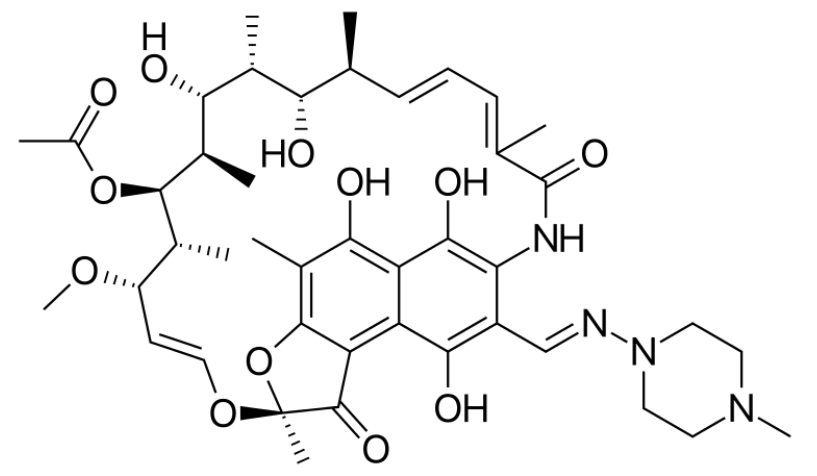
Estructura química Rifampicina

Fórmula esquelética de rifampicina

Imagen:Skeletal formula of rifampin” por Vaccinationist. Licencia: Dominio Público
Farmacocinética

  • Absorción: reducida por la comida (tomar con el estómago vacío)
  • Distribución: lipofílica, ampliamente distribuida en EN Erythema nodosum is an immune-mediated panniculitis (inflammation of the subcutaneous fat) caused by a type IV (delayed-type) hypersensitivity reaction. It commonly manifests in young women as tender, erythematous nodules on the shins. Erythema Nodosum todos los LOS Neisseria tejidos y fluidos (incluido el líquido cefalorraquídeo (LCR))
  • Metabolismo: hepático (precaución necesaria en EN Erythema nodosum is an immune-mediated panniculitis (inflammation of the subcutaneous fat) caused by a type IV (delayed-type) hypersensitivity reaction. It commonly manifests in young women as tender, erythematous nodules on the shins. Erythema Nodosum enfermedad hepática)
  • Eliminación: excretada principalmente en EN Erythema nodosum is an immune-mediated panniculitis (inflammation of the subcutaneous fat) caused by a type IV (delayed-type) hypersensitivity reaction. It commonly manifests in young women as tender, erythematous nodules on the shins. Erythema Nodosum bilis/heces, algo en EN Erythema nodosum is an immune-mediated panniculitis (inflammation of the subcutaneous fat) caused by a type IV (delayed-type) hypersensitivity reaction. It commonly manifests in young women as tender, erythematous nodules on the shins. Erythema Nodosum orina (≤ 30%)

Interacciones medicamentosas

  • Incrementa el citocromo P450 (↓ niveles de otros medicamentos)
  • Las interacciones incluyen:
    • Warfarina
    • Anticonceptivos orales u otros anticonceptivos hormonales
    • Glucocorticoides
    • Ciclosporina
    • Inhibidores de la HMG-CoA reductasa (estatinas)
    • Macrólidos, antifúngicos azólicos
    • Fenitoína
    • Levotiroxina
    • Sulfonilurea
    • Antirretrovirales

Efectos secundarios y contraindicaciones

  • Efectos secundarios:
    • Hepáticos: ↑ pruebas de función hepática (hepatotoxicidad), especialmente en EN Erythema nodosum is an immune-mediated panniculitis (inflammation of the subcutaneous fat) caused by a type IV (delayed-type) hypersensitivity reaction. It commonly manifests in young women as tender, erythematous nodules on the shins. Erythema Nodosum aquellos en EN Erythema nodosum is an immune-mediated panniculitis (inflammation of the subcutaneous fat) caused by a type IV (delayed-type) hypersensitivity reaction. It commonly manifests in young women as tender, erythematous nodules on the shins. Erythema Nodosum riesgo (e.g., individuos alcohólicos, individuos que toman otros medicamentos hepatotóxicos)
    • Erupción cutánea
    • Coloración anaranjada/roja de las secreciones corporales
    • Anemia Anemia Anemia is a condition in which individuals have low Hb levels, which can arise from various causes. Anemia is accompanied by a reduced number of RBCs and may manifest with fatigue, shortness of breath, pallor, and weakness. Subtypes are classified by the size of RBCs, chronicity, and etiology. Anemia: Overview and Types hemolítica, neutropenia Neutropenia Neutrophils are an important component of the immune system and play a significant role in the eradication of infections. Low numbers of circulating neutrophils, referred to as neutropenia, predispose the body to recurrent infections or sepsis, though patients can also be asymptomatic. Neutropenia, trombocitopenia
    • Nefritis
    • Síndrome pseudo-gripal
  • Contraindicaciones:
    • Hipersensibilidad o reacción severa previa a la rifampicina
    • Precaución en EN Erythema nodosum is an immune-mediated panniculitis (inflammation of the subcutaneous fat) caused by a type IV (delayed-type) hypersensitivity reaction. It commonly manifests in young women as tender, erythematous nodules on the shins. Erythema Nodosum enfermedades hepáticas
    • Uso concomitante con inhibidores de la proteasa (↑ hepatotoxicidad)

Mecanismo de resistencia

  • Mutaciones en EN Erythema nodosum is an immune-mediated panniculitis (inflammation of the subcutaneous fat) caused by a type IV (delayed-type) hypersensitivity reaction. It commonly manifests in young women as tender, erythematous nodules on the shins. Erythema Nodosum el gen rpoB (codifica la cadena beta de la ARN polimerasa micobacteriana)
  • Efecto de la mutación: reducción de la unión al AL Amyloidosis medicamento

Isoniazida

Descripción y farmacodinamia

  • También conocida como hidrazida de ácido isonicotínico
  • Bactericida
  • Un promedicamento activado por la catalasa-peroxidasa de M. tuberculosis Tuberculosis Tuberculosis (TB) is an infectious disease caused by Mycobacterium tuberculosis complex bacteria. The bacteria usually attack the lungs but can also damage other parts of the body. Approximately 30% of people around the world are infected with this pathogen, with the majority harboring a latent infection. Tuberculosis spreads through the air when a person with active pulmonary infection coughs or sneezes. Tuberculosis (codificada por KatG) → N -acetil isoniazida (metabolito principal)
  • Profilaxis contra la tuberculosis Tuberculosis Tuberculosis (TB) is an infectious disease caused by Mycobacterium tuberculosis complex bacteria. The bacteria usually attack the lungs but can also damage other parts of the body. Approximately 30% of people around the world are infected with this pathogen, with the majority harboring a latent infection. Tuberculosis spreads through the air when a person with active pulmonary infection coughs or sneezes. Tuberculosis
  • Monoterapia para tuberculosis Tuberculosis Tuberculosis (TB) is an infectious disease caused by Mycobacterium tuberculosis complex bacteria. The bacteria usually attack the lungs but can also damage other parts of the body. Approximately 30% of people around the world are infected with this pathogen, with the majority harboring a latent infection. Tuberculosis spreads through the air when a person with active pulmonary infection coughs or sneezes. Tuberculosis latente
  • Mecanismo de acción: inhibe la síntesis de ácido micólico (afecta la pared celular de las micobacterias)
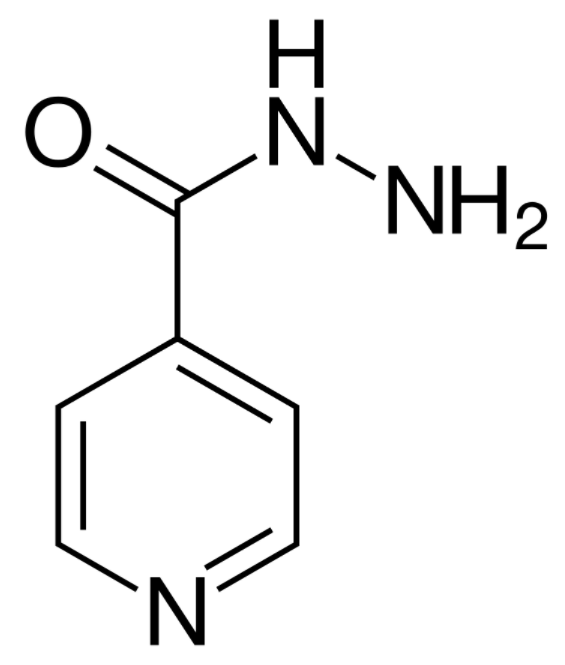
Estructura química de la isoniazida

Fórmula esquelética de isoniazida (hidrazida de ácido isonicotínico)

Imagen:Skeletal formula of isoniazid” por Fvasconcellos. Licencia: Dominio Público
Farmacocinética

  • Absorción: se absorbe bien por vía oral, pero puede reducirse o retrasarse con los LOS Neisseria alimentos
  • Distribución: ampliamente distribuida por todo el cuerpo
  • Metabolismo (metabolismo hepático determinado genéticamente mediante acetilación):
    • 50% de caucásicos y negros → acetiladores rápidos (exhiben concentraciones séricas máximas más bajas)
    • 80%–90% de los LOS Neisseria asiáticos y los LOS Neisseria de las regiones de Alaska y el Ártico → acetiladores rápidos
  • Eliminación: renal (hasta el 96% se excreta sin cambios)

Interacciones medicamentosas

  • La inhibición del sistema enzimático hepático del citocromo P por isoniazida conduce a interacciones medicamentosas (↑ concentración de otros medicamentos).
  • Incluye (pero no se limita a):
    • Carbamazepina
    • Fenitoína
    • Teofilina

Efectos secundarios y contraindicaciones

  • Efectos secundarios (“INH: Isoniazida daña los LOS Neisseria nervios y los LOS Neisseria hepatocitos):
    • Hepáticos: ↑ pruebas de función hepática (hepatotoxicidad)
    • Neurológicos:
      • Neuropatía periférica, ataxia Ataxia Impairment of the ability to perform smoothly coordinated voluntary movements. This condition may affect the limbs, trunk, eyes, pharynx, larynx, and other structures. Ataxia may result from impaired sensory or motor function. Sensory ataxia may result from posterior column injury or peripheral nerve diseases. Motor ataxia may be associated with cerebellar diseases; cerebral cortex diseases; thalamic diseases; basal ganglia diseases; injury to the red nucleus; and other conditions. Ataxia-telangiectasia, parestesia (agota la vitamina B6, por lo que se necesita suplementación)
      • Cefalea
      • Depresión y disforia
      • Convulsiones y psicosis
    • Hematológicos: anemia Anemia Anemia is a condition in which individuals have low Hb levels, which can arise from various causes. Anemia is accompanied by a reduced number of RBCs and may manifest with fatigue, shortness of breath, pallor, and weakness. Subtypes are classified by the size of RBCs, chronicity, and etiology. Anemia: Overview and Types hemolítica (desencadenada por isoniazida en EN Erythema nodosum is an immune-mediated panniculitis (inflammation of the subcutaneous fat) caused by a type IV (delayed-type) hypersensitivity reaction. It commonly manifests in young women as tender, erythematous nodules on the shins. Erythema Nodosum la deficiencia de glucosa-6-fosfato deshidrogenasa)
    • Inmunológicos: síndrome pseudo-gripal, lupus eritematoso sistémico inducido por medicamentos
    • Erupción cutánea
  • Contraindicaciones:
    • Hipersensibilidad o reacción severa previa a la isoniazida
    • Precaución en EN Erythema nodosum is an immune-mediated panniculitis (inflammation of the subcutaneous fat) caused by a type IV (delayed-type) hypersensitivity reaction. It commonly manifests in young women as tender, erythematous nodules on the shins. Erythema Nodosum enfermedades hepáticas

Mecanismo de resistencia

  • Mutación de inhA (proteína involucrada en EN Erythema nodosum is an immune-mediated panniculitis (inflammation of the subcutaneous fat) caused by a type IV (delayed-type) hypersensitivity reaction. It commonly manifests in young women as tender, erythematous nodules on the shins. Erythema Nodosum la síntesis de la pared celular de las micobacterias)
  • Mutación de KatG (actividad enzimática regulada a la baja)

Pirazinamida

Descripción y farmacodinamia

  • Análogo de pirazina sintética de nicotinamida
  • Metabolizado a ácido pirazinoico, la forma activa de la pirazinamida a través de la acción de la pirazinamidasa de M. tuberculosis Tuberculosis Tuberculosis (TB) is an infectious disease caused by Mycobacterium tuberculosis complex bacteria. The bacteria usually attack the lungs but can also damage other parts of the body. Approximately 30% of people around the world are infected with this pathogen, with the majority harboring a latent infection. Tuberculosis spreads through the air when a person with active pulmonary infection coughs or sneezes. Tuberculosis
  • ↑ Actividad en EN Erythema nodosum is an immune-mediated panniculitis (inflammation of the subcutaneous fat) caused by a type IV (delayed-type) hypersensitivity reaction. It commonly manifests in young women as tender, erythematous nodules on the shins. Erythema Nodosum pH pH The quantitative measurement of the acidity or basicity of a solution. Acid-Base Balance ácido
  • Mecanismo de acción:
    • El mecanismo exacto es incierto
    • Es probable que involucre ácido pirazinoico (inicialmente excretado de la célula), que luego se protona
    • El ácido pirazinoico protonado se difunde de regreso a la célula, acidificando el entorno intracelular e inhibiendo el transporte de membrana y la síntesis de proteínas.
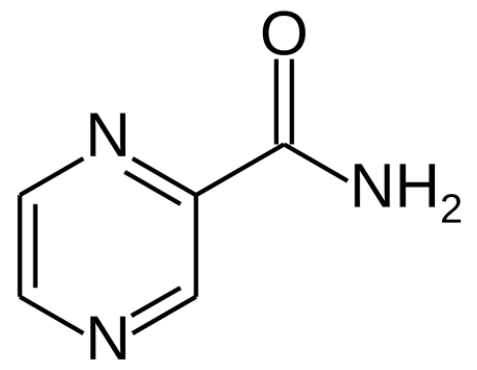
Estructura química de los agentes antimicobacterianos de pirazinamida

Estructura de pirazinamida

Imagen:Structure of pyrazinamide” por Fvasconcellos. Licencia: Dominio Público
Farmacocinética

  • Absorción: absorción rápida, con biodisponibilidad oral de aproximadamente el 90%
  • Distribución: ampliamente distribuida en EN Erythema nodosum is an immune-mediated panniculitis (inflammation of the subcutaneous fat) caused by a type IV (delayed-type) hypersensitivity reaction. It commonly manifests in young women as tender, erythematous nodules on the shins. Erythema Nodosum tejidos y fluidos, incluido LCR
  • Metabolismo: metabolismo hepático a metabolitos activos e inactivos
  • Eliminación: excretada por vía renal; los LOS Neisseria metabolitos se acumulan en EN Erythema nodosum is an immune-mediated panniculitis (inflammation of the subcutaneous fat) caused by a type IV (delayed-type) hypersensitivity reaction. It commonly manifests in young women as tender, erythematous nodules on the shins. Erythema Nodosum la disfunción renal (requiere ajuste de dosis)

Interacciones medicamentosas

  • Rifampicina: ↑ riesgo de hepatotoxicidad (puede ser fatal)
  • Ciclosporina: ↓ concentraciones séricas de ciclosporina

Efectos secundarios y contraindicaciones

  • Efectos secundarios:
    • Hepáticos: ↑ pruebas de función hepática (hepatotoxicidad)
    • Hiperuricemia (metabolito de pirazinamida inhibe la eliminación de ácido úrico)
    • Poliartralgia sin gota
    • Malestar gastrointestinal
    • Trombocitopenia, anemia Anemia Anemia is a condition in which individuals have low Hb levels, which can arise from various causes. Anemia is accompanied by a reduced number of RBCs and may manifest with fatigue, shortness of breath, pallor, and weakness. Subtypes are classified by the size of RBCs, chronicity, and etiology. Anemia: Overview and Types sideroblástica
    • Erupción cutánea, fotosensibilidad
  • Contraindicaciones:
    • Hipersensibilidad a la pirazinamida
    • Gota aguda
    • Daño hepático severo
    • Su uso durante el embarazo depende de las directrices; evaluar los LOS Neisseria riesgos y los LOS Neisseria beneficios

Mecanismo de resistencia

  • Mutación de pncA (codifica pirazinamidasa) → M. tuberculosis Tuberculosis Tuberculosis (TB) is an infectious disease caused by Mycobacterium tuberculosis complex bacteria. The bacteria usually attack the lungs but can also damage other parts of the body. Approximately 30% of people around the world are infected with this pathogen, with the majority harboring a latent infection. Tuberculosis spreads through the air when a person with active pulmonary infection coughs or sneezes. Tuberculosis produce pirazinamidasa con afinidad reducida por pirazinamida.
  • Efecto: ↓ conversión a ácido pirazinoico → sin efecto sobre la síntesis de la pared celular

Etambutol

Descripción y farmacodinamia

  • Bacteriostático
  • Actividad contra diferentes especies de micobacterias, pero sin efecto sobre otros géneros
  • Mecanismo de acción:
    • Inhibe la arabinosiltransferasa, una enzima codificada por genes Genes A category of nucleic acid sequences that function as units of heredity and which code for the basic instructions for the development, reproduction, and maintenance of organisms. DNA Types and Structure embB
    • La arabinosiltransferasa polimeriza la arabinosa (requerida en EN Erythema nodosum is an immune-mediated panniculitis (inflammation of the subcutaneous fat) caused by a type IV (delayed-type) hypersensitivity reaction. It commonly manifests in young women as tender, erythematous nodules on the shins. Erythema Nodosum la síntesis de arabinogalactano en EN Erythema nodosum is an immune-mediated panniculitis (inflammation of the subcutaneous fat) caused by a type IV (delayed-type) hypersensitivity reaction. It commonly manifests in young women as tender, erythematous nodules on the shins. Erythema Nodosum la pared celular)
    • Efecto: alteración de la síntesis de la pared celular de las micobacterias
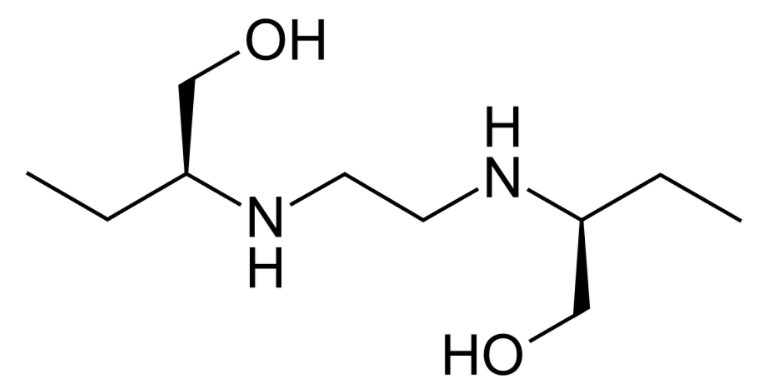
Estructura química del etambutanol.

Estructura del etambutol

Imagen:Structure of ethambutol” por Fvasconcellos. Licencia: Dominio Público

Farmacocinética

  • Absorción: aproximadamente 80% absorbido por administración oral
  • Distribución: ampliamente en EN Erythema nodosum is an immune-mediated panniculitis (inflammation of the subcutaneous fat) caused by a type IV (delayed-type) hypersensitivity reaction. It commonly manifests in young women as tender, erythematous nodules on the shins. Erythema Nodosum la mayoría de los LOS Neisseria tejidos y fluidos, pero no en EN Erythema nodosum is an immune-mediated panniculitis (inflammation of the subcutaneous fat) caused by a type IV (delayed-type) hypersensitivity reaction. It commonly manifests in young women as tender, erythematous nodules on the shins. Erythema Nodosum el LCR
  • Metabolismo: metabolismo hepático parcial
  • Eliminación: la mayoría (hasta el 80%) se excreta por vía renal

Interacciones medicamentosas

Hidróxido de aluminio ↓ absorción del medicamento

Efectos secundarios y contraindicaciones

  • Efectos secundarios:
    • La neuropatía óptica a menudo se observa como:
      • Un cambio en EN Erythema nodosum is an immune-mediated panniculitis (inflammation of the subcutaneous fat) caused by a type IV (delayed-type) hypersensitivity reaction. It commonly manifests in young women as tender, erythematous nodules on the shins. Erythema Nodosum la agudeza visual
      • Daltonismo de colores rojo-verde
    • Hepatotoxicidad
    • Gastrointestinal (náuseas, vómitos, dolor Dolor Inflammation abdominal)
    • Hematológicos ( neutropenia Neutropenia Neutrophils are an important component of the immune system and play a significant role in the eradication of infections. Low numbers of circulating neutrophils, referred to as neutropenia, predispose the body to recurrent infections or sepsis, though patients can also be asymptomatic. Neutropenia, trombocitopenia)
    • Cefalea, mareo, confusión
    • Neuritis periférica
  • Contraindicaciones:

Mecanismo de resistencia

  • Mutaciones que involucran los LOS Neisseria genes Genes A category of nucleic acid sequences that function as units of heredity and which code for the basic instructions for the development, reproduction, and maintenance of organisms. DNA Types and Structure embB
  • Efecto: ↑ la producción de arabinosiltransferasa provoca diversos grados de resistencia.

Otros Agentes Antituberculosos

Se utilizan otros agentes según las condiciones subyacentes y la presencia de Mycobacterium Mycobacterium Mycobacterium is a genus of the family Mycobacteriaceae in the phylum Actinobacteria. Mycobacteria comprise more than 150 species of facultative intracellular bacilli that are mostly obligate aerobes. Mycobacteria are responsible for multiple human infections including serious diseases, such as tuberculosis (M. tuberculosis), leprosy (M. leprae), and M. avium complex infections. Mycobacterium resistente a múltiples medicamentos.
  • Aminoglucósidos:
    • Estreptomicina y amikacina
    • Bactericidas
    • Mecanismo: inhiben la traducción al AL Amyloidosis unirse a la subunidad ribosomal 30S
    • Efectos secundarios:
      • Nefrotoxicidad → acumulación de aminoglucósidos en EN Erythema nodosum is an immune-mediated panniculitis (inflammation of the subcutaneous fat) caused by a type IV (delayed-type) hypersensitivity reaction. It commonly manifests in young women as tender, erythematous nodules on the shins. Erythema Nodosum la corteza renal
      • Ototoxicidad (puede ser irreversible; en EN Erythema nodosum is an immune-mediated panniculitis (inflammation of the subcutaneous fat) caused by a type IV (delayed-type) hypersensitivity reaction. It commonly manifests in young women as tender, erythematous nodules on the shins. Erythema Nodosum mujeres embarazadas, puede causar sordera permanente en EN Erythema nodosum is an immune-mediated panniculitis (inflammation of the subcutaneous fat) caused by a type IV (delayed-type) hypersensitivity reaction. It commonly manifests in young women as tender, erythematous nodules on the shins. Erythema Nodosum el niño)
      • Bloqueo neuromuscular (raro)
  • Bedaquilina:
    • Parte del régimen BPaL (bedaquilina + pretomanid Pretomanid Antimycobacterial Drugs + linezolid Linezolid An oxazolidinone and acetamide derived anti-bacterial agent and protein synthesis inhibitor that is used in the treatment of gram-positive bacterial infections of the skin and respiratory tract. Oxazolidinones) ( tuberculosis Tuberculosis Tuberculosis (TB) is an infectious disease caused by Mycobacterium tuberculosis complex bacteria. The bacteria usually attack the lungs but can also damage other parts of the body. Approximately 30% of people around the world are infected with this pathogen, with the majority harboring a latent infection. Tuberculosis spreads through the air when a person with active pulmonary infection coughs or sneezes. Tuberculosis pulmonar extremadamente resistente a los LOS Neisseria medicamentos (XDR-TB) o tuberculosis Tuberculosis Tuberculosis (TB) is an infectious disease caused by Mycobacterium tuberculosis complex bacteria. The bacteria usually attack the lungs but can also damage other parts of the body. Approximately 30% of people around the world are infected with this pathogen, with the majority harboring a latent infection. Tuberculosis spreads through the air when a person with active pulmonary infection coughs or sneezes. Tuberculosis multirresistente (MDR-TB)): bedaquilina + pretomanid Pretomanid Antimycobacterial Drugs + linezolid Linezolid An oxazolidinone and acetamide derived anti-bacterial agent and protein synthesis inhibitor that is used in the treatment of gram-positive bacterial infections of the skin and respiratory tract. Oxazolidinones
    • Clasificada como una diarilquinolina
    • Bactericida
    • Mecanismo: inhibe la adenosina trifosfato (ATP, por sus siglas en EN Erythema nodosum is an immune-mediated panniculitis (inflammation of the subcutaneous fat) caused by a type IV (delayed-type) hypersensitivity reaction. It commonly manifests in young women as tender, erythematous nodules on the shins. Erythema Nodosum inglés) sintasa micobacteriana
    • Efecto secundario: prolongación del intervalo QT
  • Nitroimidazoles Nitroimidazoles Nitroimidazoles are prodrugs composed of an imidazole ring with an attached nitro group. Nitroimidazoles are reduced within susceptible microorganisms, leading to free radical formation and disruption of DNA integrity. Nitroimidazoles bicíclicos:
    • Pretomanida:
      • Parte del régimen BPaL (XDR-TB o MDR-TB pulmonar)
      • Mecanismo: inhibición de la síntesis de la pared celular (bloquea la oxidación de hidroximicolato a cetomicolato)
    • Delamanid Delamanid Antimycobacterial Drugs: inhibe la síntesis de ácido micólico (para MDR-TB aprobado en EN Erythema nodosum is an immune-mediated panniculitis (inflammation of the subcutaneous fat) caused by a type IV (delayed-type) hypersensitivity reaction. It commonly manifests in young women as tender, erythematous nodules on the shins. Erythema Nodosum Europa, aún no en EN Erythema nodosum is an immune-mediated panniculitis (inflammation of the subcutaneous fat) caused by a type IV (delayed-type) hypersensitivity reaction. It commonly manifests in young women as tender, erythematous nodules on the shins. Erythema Nodosum los LOS Neisseria Estados Unidos)
  • Clofazimina:
    • Para la tuberculosis Tuberculosis Tuberculosis (TB) is an infectious disease caused by Mycobacterium tuberculosis complex bacteria. The bacteria usually attack the lungs but can also damage other parts of the body. Approximately 30% of people around the world are infected with this pathogen, with the majority harboring a latent infection. Tuberculosis spreads through the air when a person with active pulmonary infection coughs or sneezes. Tuberculosis resistente a los LOS Neisseria medicamentos
    • Requiere aprobación de la Food and Drug Administration (FDA) para el uso antituberculoso
    • Disponible en EN Erythema nodosum is an immune-mediated panniculitis (inflammation of the subcutaneous fat) caused by a type IV (delayed-type) hypersensitivity reaction. It commonly manifests in young women as tender, erythematous nodules on the shins. Erythema Nodosum áreas donde se usa clofazimina para la lepra
    • Efectos secundarios: problemas gastrointestinales
  • Cicloserina:
    • Para la tuberculosis Tuberculosis Tuberculosis (TB) is an infectious disease caused by Mycobacterium tuberculosis complex bacteria. The bacteria usually attack the lungs but can also damage other parts of the body. Approximately 30% of people around the world are infected with this pathogen, with the majority harboring a latent infection. Tuberculosis spreads through the air when a person with active pulmonary infection coughs or sneezes. Tuberculosis resistente a los LOS Neisseria medicamentos
    • Mecanismo: bloquea la producción de peptidoglicano, lo que interrumpe la síntesis de la pared celular de las micobacterias
    • Efectos secundarios: síntomas neuropsiquiátricos
  • Etionamida:
    • Para la tuberculosis Tuberculosis Tuberculosis (TB) is an infectious disease caused by Mycobacterium tuberculosis complex bacteria. The bacteria usually attack the lungs but can also damage other parts of the body. Approximately 30% of people around the world are infected with this pathogen, with the majority harboring a latent infection. Tuberculosis spreads through the air when a person with active pulmonary infection coughs or sneezes. Tuberculosis resistente a los LOS Neisseria medicamentos
    • Análogo estructural de isoniazida
    • Un promedicamento
    • Mecanismo: inhibe la síntesis de ácido micólico (similar a isoniazida)
    • Efectos secundarios: irritación gastrointestinal, úlcera péptica
  • Fluoroquinolonas:
    • Levofloxacino y moxifloxacino (mayor actividad in vitro que ciprofloxacino)
    • Bactericida
    • Mecanismo: inhiben la ADN girasa bacteriana e interrumpen la replicación del ADN
  • Oxazolidinonas:
    • Parte del régimen BPaL (XDR-TB o MDR-TB pulmonar)
    • Mecanismo:
      • Se unen al AL Amyloidosis ARNr bacteriano 23S de la subunidad 50S
      • Bloquean la formación del complejo de iniciación 70S → previenen la traducción
    • Efectos secundarios: supresión de la médula ósea, neuropatía, síntomas gastrointestinales y/o retinitis
  • Ácido para-aminosalicílico:
    • Bacteriostático
    • Eficacia limitada contra la tuberculosis Tuberculosis Tuberculosis (TB) is an infectious disease caused by Mycobacterium tuberculosis complex bacteria. The bacteria usually attack the lungs but can also damage other parts of the body. Approximately 30% of people around the world are infected with this pathogen, with the majority harboring a latent infection. Tuberculosis spreads through the air when a person with active pulmonary infection coughs or sneezes. Tuberculosis
    • Mecanismo: interrumpe la síntesis de folato
    • Efectos secundarios:
      • Efectos secundarios gastrointestinales
      • Con etionamida → hipotiroidismo
  • Rifabutina:
    • Una rifamicina, como la rifampicina
    • Menos interacciones medicamentosas que la rifampicina, ya que es un inductor menos potente del sistema enzimático del citocromo P450
    • Preferida en EN Erythema nodosum is an immune-mediated panniculitis (inflammation of the subcutaneous fat) caused by a type IV (delayed-type) hypersensitivity reaction. It commonly manifests in young women as tender, erythematous nodules on the shins. Erythema Nodosum caso con virus Virus Viruses are infectious, obligate intracellular parasites composed of a nucleic acid core surrounded by a protein capsid. Viruses can be either naked (non-enveloped) or enveloped. The classification of viruses is complex and based on many factors, including type and structure of the nucleoid and capsid, the presence of an envelope, the replication cycle, and the host range. Virology de inmunodeficiencia humana (VIH)
  • Información adicional: kanamicina (un aminoglucósido) y capreomicina (un péptido cíclico):
    • Ya no se recomiendan para el tratamiento antituberculoso
    • Ambos medicamentos se asociaron con peores resultados.
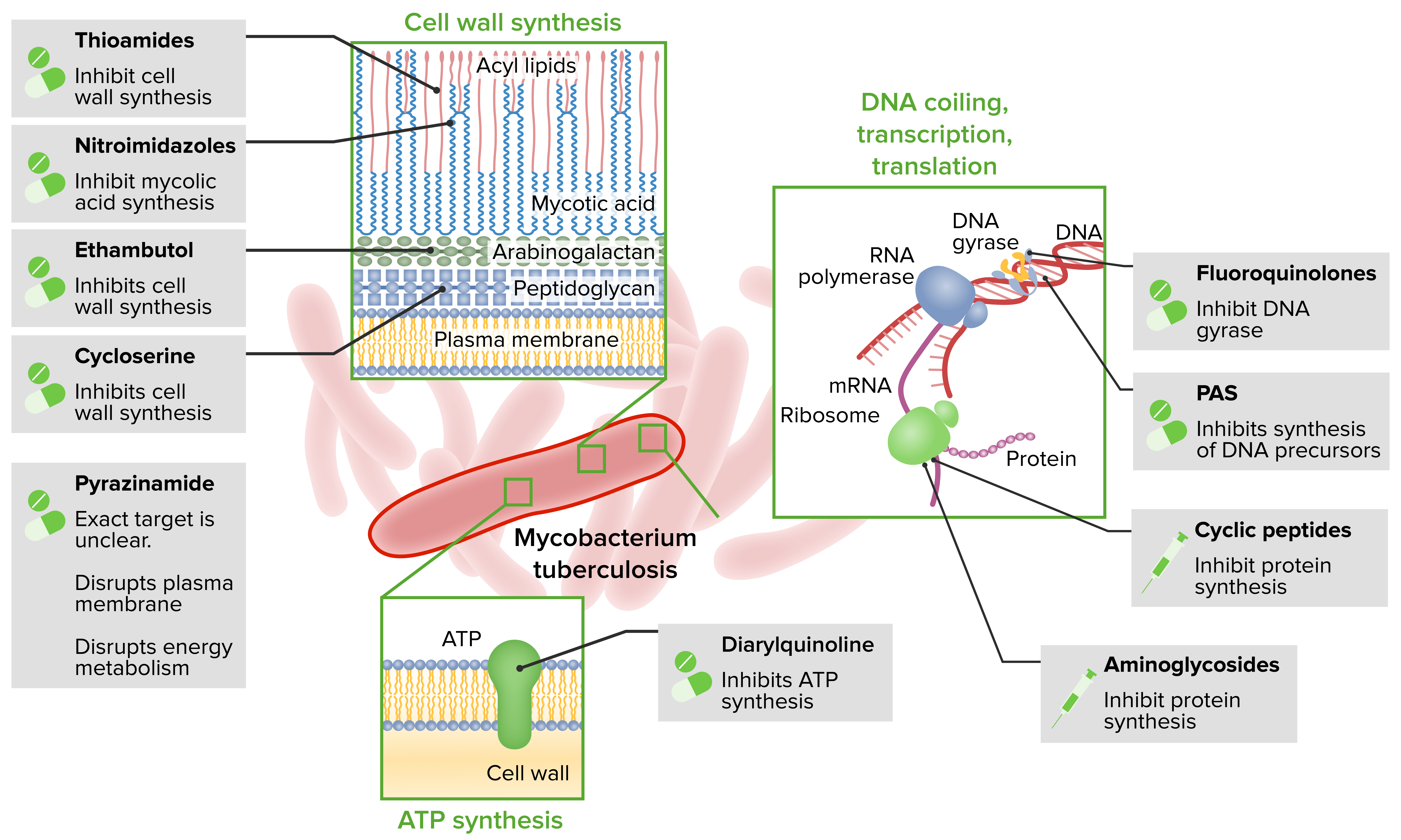
Antimycobacterial drugs

Agentes y mecanismos antituberculosos
PAS: ácido paraaminosalicílico

Imagen por Lecturio.

Agentes contra Mycobacterium leprae y Complejo Mycobacterium avium

Agentes contra Mycobacterium leprae Mycobacterium leprae A species of gram-positive, aerobic bacteria that causes leprosy in man. Its organisms are generally arranged in clumps, rounded masses, or in groups of bacilli side by side. Mycobacterium

  • Régimen de 1ra línea:
    • Dapsona + rifampicina durante 12 meses para la lepra tuberculoide
    • Dapsona + rifampicina + clofazimina durante 24 meses para la lepra lepromatosa
  • Medicamentos:
    • Dapsona:
      • Agente con actividad antibacteriana, antifúngica y antiprotozoaria
      • Mecanismo de acción: inhibe la dihidropteroato sintasa bacteriana en EN Erythema nodosum is an immune-mediated panniculitis (inflammation of the subcutaneous fat) caused by a type IV (delayed-type) hypersensitivity reaction. It commonly manifests in young women as tender, erythematous nodules on the shins. Erythema Nodosum la vía del folato → ↓ síntesis de ácido nucleico
      • Efectos secundarios: hemólisis (especialmente a dosis > 200 mg/día), metahemoglobinemia
    • Rifampicina (ver medicamentos antituberculosos)
    • Clofazimina (ver medicamentos antituberculosos)

Agentes contra el complejo Mycobacterium avium Mycobacterium avium A bacterium causing tuberculosis in domestic fowl and other birds. In pigs, it may cause localized and sometimes disseminated disease. The organism occurs occasionally in sheep and cattle. It should be distinguished from the m. avium complex, which infects primarily humans. Mycobacterium

  • Para la enfermedad pulmonar por complejo Mycobacterium avium Mycobacterium avium A bacterium causing tuberculosis in domestic fowl and other birds. In pigs, it may cause localized and sometimes disseminated disease. The organism occurs occasionally in sheep and cattle. It should be distinguished from the m. avium complex, which infects primarily humans. Mycobacterium, usar un régimen de combinación de 3 medicamentos:
    • Azitromicina:
      • Macrólido (inhibe la síntesis de proteínas bacterianas al AL Amyloidosis unirse de manera reversible a la subunidad ribosomal 50S)
      • Efectos secundarios: hepatotoxicidad, prolongación del intervalo QT
    • Rifampicina
    • Etambutol
  • Para enfermedad cavitaria, agregar estreptomicina o amikacina (aminoglucósidos) parenteral como 4to agente (durante las primeras 8–12 semanas).

Referencias

  1. Drew, R., Sterling, T. (2025). Antituberculous drugs: an overview. UpToDate. Retrieved October 17, 2025, from https://www.uptodate.com/contents/antituberculous-drugs-an-overview
  2. Drew, R. (2025). Rifamycins (rifampin, rifabutin, rifapentine). UpToDate. Retrieved October 17, 2025, from https://www.uptodate.com/contents/rifamycins-rifampin-rifabutin-rifapentine
  3. Drew, R. (2025). Isoniazid: an overview. UpToDate. Retrieved October 17, 2025, from https://www.uptodate.com/contents/isoniazid-an-overview
  4. Drew, R. (2025). Ethambutol: an overview. UpToDate. Retrieved October 17, 2025, from https://www.uptodate.com/contents/ethambutol-an-overview
  5. Drew, R. (2025). Pyrazinamide: an overview. UpToDate. Retrieved October 17, 2025, from https://www.uptodate.com/contents/pyrazinamide-an-overview
  6. Gumbo, T. (2017). Chemotherapy of tuberculosis, mycobacterium avium complex disease, and leprosy. Chapter 60 of Brunton, L.L., Hilal-Dandan, R., Knollmann, B.C. (Eds.), Goodman & Gilman’s: The Pharmacological Basis of Therapeutics, 13th ed. McGraw-Hill. https://accessmedicine.mhmedical.com/content.aspx?bookid=2189&sectionid=172485532
  7. National Institute of Diabetes and Digestive and Kidney Diseases. (2018). Rifampin LiverTox: clinical and Research Information on drug-induced liver injury. https://www.ncbi.nlm.nih.gov/books/NBK548314/
  8. Schluger, N. (2025). Epidemiology and molecular mechanisms of drug-resistant tuberculosis. UpToDate. Retrieved October 17, 2025, from https://www.uptodate.com/contents/epidemiology-and-molecular-mechanisms-of-drug-resistant-tuberculosis
  9. Soeroto, A.,  Darmawan, G., Supriyadi, R., Bhaskara, P., Santoso, P., Alisjahbana, B., Parwati, I. (2019). Comparison of serum potassium, magnesium, and calcium levels between kanamycin and capreomycin-based regimen-treated multidrug-resistant tuberculosis patients in Bandung (CEASE MDR-TB): a retrospective cohort study. International Journal of Microbiology 2019, Article ID 5065847. https://doi.org/10.1155/2019/5065847

¡Crea tu cuenta gratis o inicia una sesión para seguir leyendo!

Regístrate ahora y obtén acceso gratuito a Lecturio con páginas de concepto, videos médicos y cuestionarios para tu educación médica.

User Reviews

Que tengas una sesión de estudio alegre y navideña 🎁 Ahorra 50% en todos los planes >>

Details