
Domina Conceptos Médicos

Estudia para la escuela de medicina y tus examenes con Lecturio.

Medicamentos Antiarrítmicos Clase 3 (Bloqueadores de los Canales de Potasio)

Los LOS Neisseria antiarrítmicos de clase 3 son medicamentos que bloquean los LOS Neisseria canales de K del tejido cardíaco. Estos incluyen amiodarona, dronedarona, sotalol Sotalol An adrenergic beta-antagonist that is used in the treatment of life-threatening arrhythmias. Class 3 Antiarrhythmic Drugs (Potassium Channel Blockers), ibutilida, dofetilida y bretilio. El principal mecanismo de acción incluye el bloqueo de los LOS Neisseria canales de K cardíacos para prolongar la repolarización. Sin embargo, algunos medicamentos de esta clase también ejercen efectos sobre los LOS Neisseria canales de Na, los LOS Neisseria canales de calcio y los LOS Neisseria receptores adrenérgicos. Las indicaciones varían entre los LOS Neisseria medicamentos, pero incluyen tanto las arritmias auriculares como las ventriculares. Dado que estos medicamentos prolongan el intervalo QT, las torsades de pointes Torsades de pointes A malignant form of polymorphic ventricular tachycardia that is characterized by heart rate between 200 and 250 beats per minute, and QRS complexes with changing amplitude and twisting of the points. The term also describes the syndrome of tachycardia with prolonged ventricular repolarization, long qt intervals exceeding 500 milliseconds or bradycardia. Torsades de pointes may be self-limited or may progress to ventricular fibrillation. Ventricular Tachycardia son una complicación potencial del tratamiento.

Last updated: Dec 15, 2025
Editorial responsibility: Stanley Oiseth, Lindsay Jones, Evelin Maza

Descripción General

Potencial de acción cardíaco

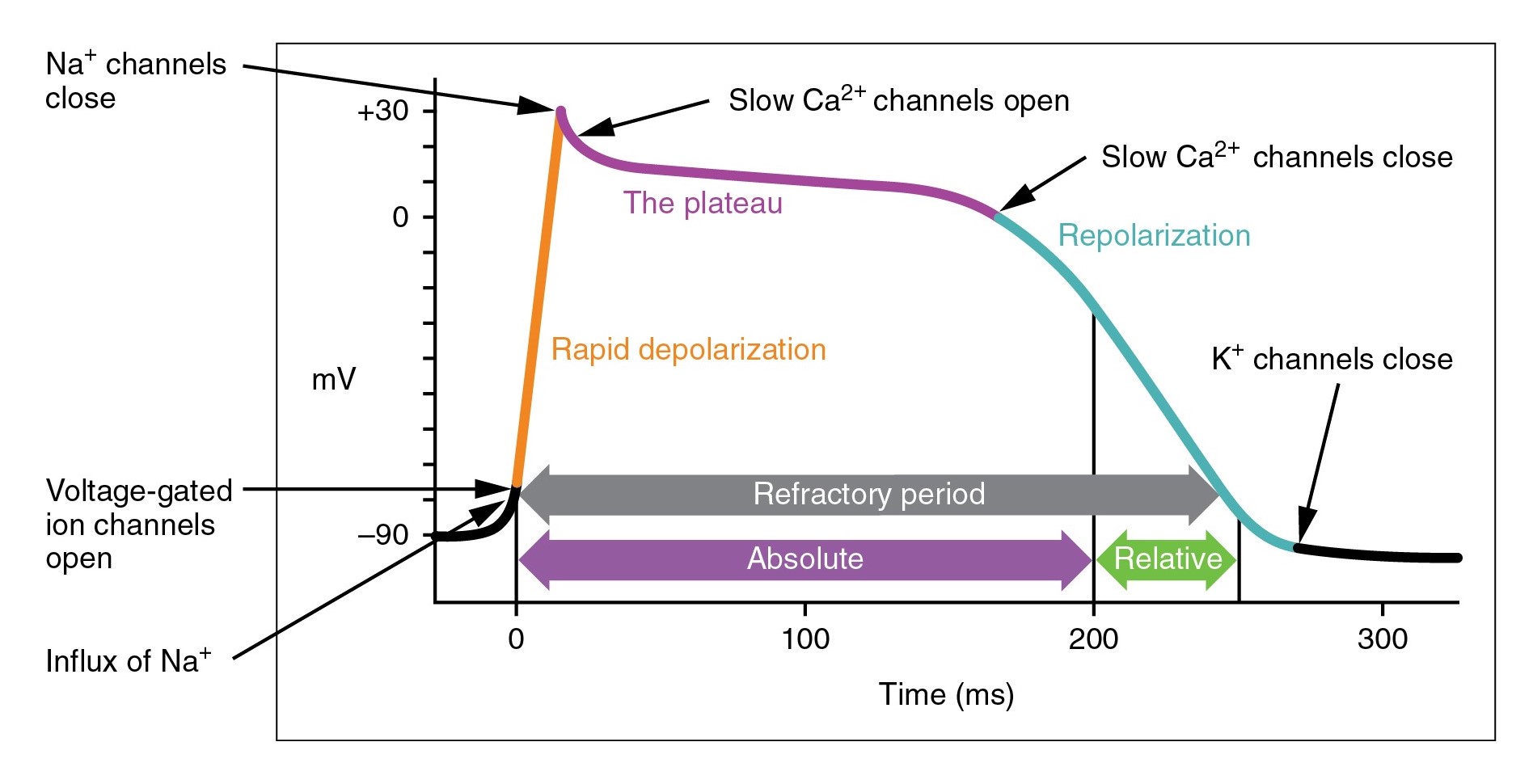
  • La trayectoria seguida por el potencial de acción dependerá del potencial de membrana de las células cardíacas, que varía entre las distintas partes del corazón.
  • Fase 4: potencial de reposo
  • Fase 0: fase de despolarización rápida que se produce por la entrada de Na a través de los LOS Neisseria canales de Na dependientes de voltaje
  • Fases 1-3:
    • Representan la repolarización
    • Salida prominente de K
    • Fase 2: la salida de K se equilibra con la entrada transitoria de calcio ( Ca CA Condylomata acuminata are a clinical manifestation of genital HPV infection. Condylomata acuminata are described as raised, pearly, flesh-colored, papular, cauliflower-like lesions seen in the anogenital region that may cause itching, pain, or bleeding. Condylomata Acuminata (Genital Warts)) → hace HACE Altitude Sickness que el potencial de acción se estabilice
El potencial de acción cardíaco

El potencial de acción cardíaco

Imagen: “Action Potential Heart Contraction, Illustration from Anatomy & Physiology” por OpenStax College. License: CC BY 3.0, editada por Lecturio.
Clasificación Vaughan-Williams

  • Clasificación más utilizada para los LOS Neisseria medicamentos antiarrítmicos
  • 5 clases basadas en EN Erythema nodosum is an immune-mediated panniculitis (inflammation of the subcutaneous fat) caused by a type IV (delayed-type) hypersensitivity reaction. It commonly manifests in young women as tender, erythematous nodules on the shins. Erythema Nodosum el efecto general (mecanismo de acción) de la clase de medicamentos:
    • Clase 1: bloqueadores de los LOS Neisseria canales de Na (divididos en EN Erythema nodosum is an immune-mediated panniculitis (inflammation of the subcutaneous fat) caused by a type IV (delayed-type) hypersensitivity reaction. It commonly manifests in young women as tender, erythematous nodules on the shins. Erythema Nodosum 3 subgrupos):
      • 1A: prolongan el potencial de acción
      • 1B: acortan el potencial de acción
      • 1C: efecto mínimo sobre la duración del potencial de acción
    • Clase 2: betabloqueadores
    • Clase 3: bloqueadores de los LOS Neisseria canales de K
    • Clase 4: bloqueadores de los LOS Neisseria canales de Ca CA Condylomata acuminata are a clinical manifestation of genital HPV infection. Condylomata acuminata are described as raised, pearly, flesh-colored, papular, cauliflower-like lesions seen in the anogenital region that may cause itching, pain, or bleeding. Condylomata Acuminata (Genital Warts)
    • Clase 5: agentes que no pueden clasificarse en EN Erythema nodosum is an immune-mediated panniculitis (inflammation of the subcutaneous fat) caused by a type IV (delayed-type) hypersensitivity reaction. It commonly manifests in young women as tender, erythematous nodules on the shins. Erythema Nodosum los LOS Neisseria grupos anteriores
potencial de acción cardíaco clase 1 Fármacos antiarrítmicos

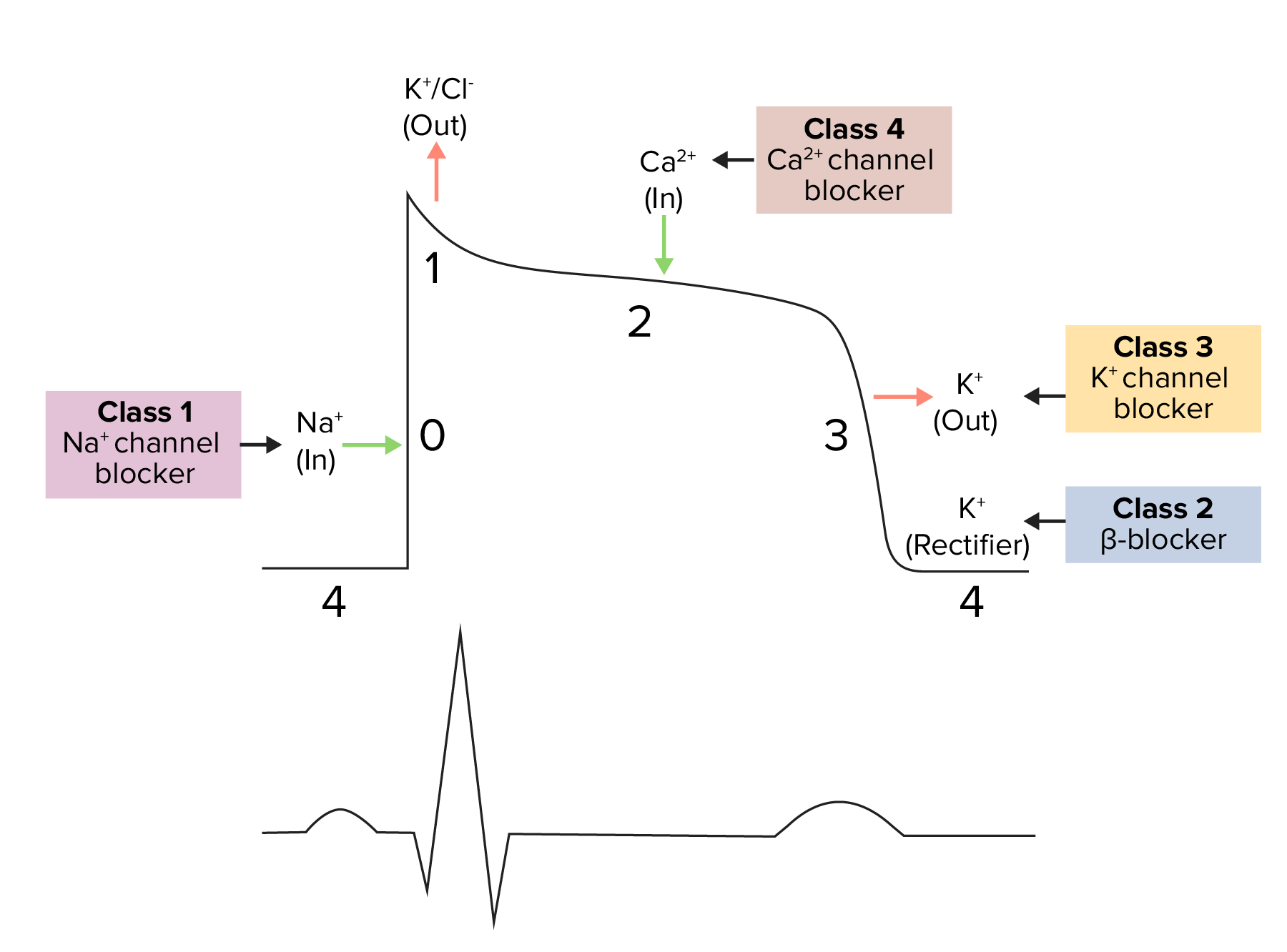
Diagrama que muestra un potencial de acción cardíaco y las fases de acción de diferentes clases de medicamentos antiarrítmicos:
El ciclo comienza con la fase 4, el potencial de reposo. La fase 0 es cuando se produce una despolarización rápida debido a la entrada de iones de sodio en la célula. A continuación se produce la repolarización, con salida de potasio a través de los canales de potasio rápidos en la fase 1, entrada de calcio en la fase 2 y salida de potasio a través de los canales de potasio retardados en la fase 3. Los bloqueadores de los canales de potasio suelen afectar a la fase 3.
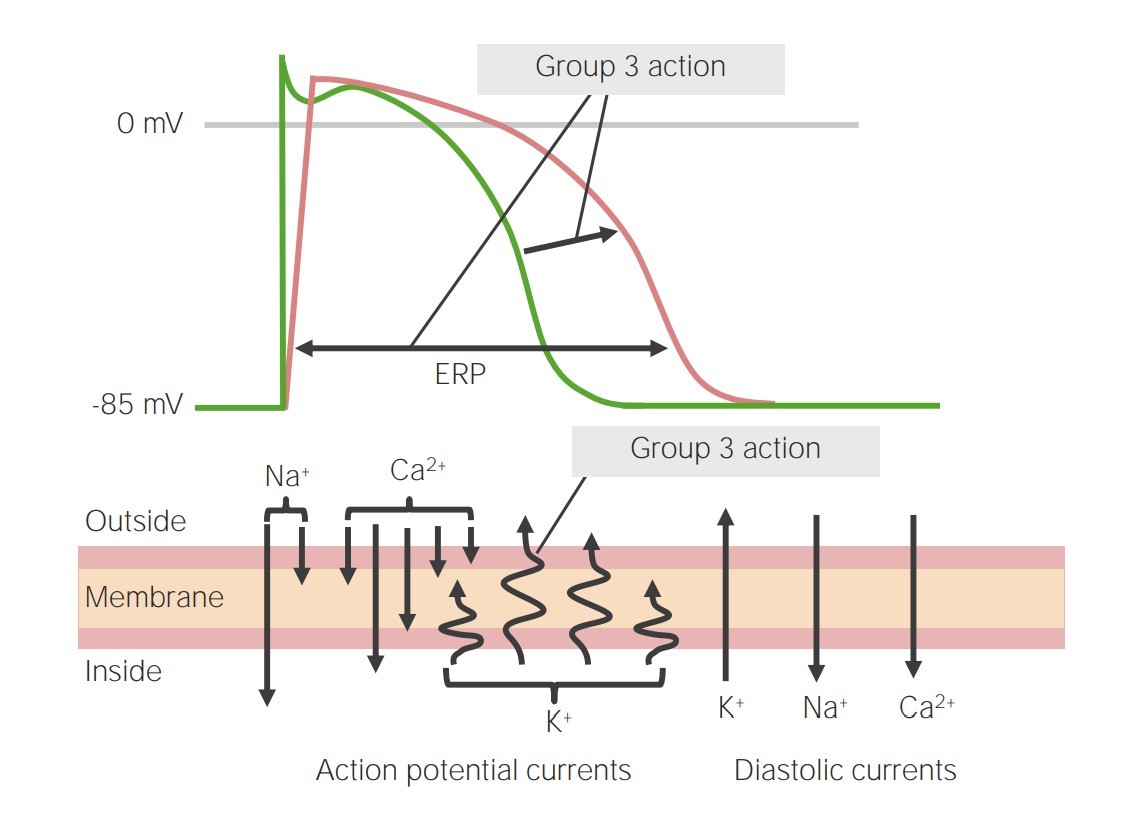
Imagen por Lecturio. Licencia: CC BY-NC-SA 4.0

Mecanismo de acción general

  • Fisiología normal:
    • El papel principal del K es la repolarización
    • Los LOS Neisseria canales de K cardíacos se abren → salida de K → repolarización de la célula
  • Bloqueadores de los LOS Neisseria canales de K:
    • Se unen a los LOS Neisseria canales de K → bloquean el movimiento de K
    • Esto impide la salida de K → prolongan la repolarización (fase 3)
    • Resulta en EN Erythema nodosum is an immune-mediated panniculitis (inflammation of the subcutaneous fat) caused by a type IV (delayed-type) hypersensitivity reaction. It commonly manifests in young women as tender, erythematous nodules on the shins. Erythema Nodosum ↑ duración del potencial de acción y ↑ período refractario efectivo
    • Efecto de la terapia electroconvulsiva: ↑ intervalo QT
Imagen que representa la acción de los antiarrítmicos de clase 3 en la fase 3 del potencial de acción

Imagen que representa la acción de los antiarrítmicos de clase 3 sobre la fase 3 del potencial de acción:
Al bloquear los canales de potasio, la fase 3 se prolonga, lo que conduce a un aumento del período refractario efectivo (ERP, por sus siglas en inglés).

Imagen por Lecturio.

Medicamentos de esta clase

Los LOS Neisseria antiarrítmicos de clase 3 incluyen una variedad de medicamentos que varían en EN Erythema nodosum is an immune-mediated panniculitis (inflammation of the subcutaneous fat) caused by a type IV (delayed-type) hypersensitivity reaction. It commonly manifests in young women as tender, erythematous nodules on the shins. Erythema Nodosum cuanto a la selectividad del canal de K y otros efectos antiarrítmicos:

Amiodarona

Mecanismo de acción

  • Mecanismo multifactorial que afecta:
    • Canales de K (efecto de clase 3)
    • Canales de Na (efecto de clase 1)
    • Receptores alfa y beta-adrenérgicos (efecto de clase 2)
    • Canales de Ca CA Condylomata acuminata are a clinical manifestation of genital HPV infection. Condylomata acuminata are described as raised, pearly, flesh-colored, papular, cauliflower-like lesions seen in the anogenital region that may cause itching, pain, or bleeding. Condylomata Acuminata (Genital Warts) (efecto de clase 4)
  • Bloquea los LOS Neisseria canales del rectificador rápido retardado (IKr) activado:
    • Tejido auricular
    • Tejido ventricular
  • Además de los LOS Neisseria efectos típicos de los LOS Neisseria bloqueadores de K:
    • ↓ Conducción auriculoventricular (AV)
    • ↓ Tasa del nodo sinusal
  • ECG ECG An electrocardiogram (ECG) is a graphic representation of the electrical activity of the heart plotted against time. Adhesive electrodes are affixed to the skin surface allowing measurement of cardiac impulses from many angles. The ECG provides 3-dimensional information about the conduction system of the heart, the myocardium, and other cardiac structures. Electrocardiogram (ECG):
    • ↑ Intervalo PR
    • Ligero ensanchamiento del complejo QRS
    • ↑ Intervalo QT

Farmacocinética

  • Absorción:
    • Oral: lenta
    • Intravenosa: el inicio de acción es más rápido
  • Distribución:
    • Lipofílica:
      • ↑ Volumen de distribución
      • Lenta para alcanzar la concentración sérica prevista → largo periodo de carga
    • Se distribuye a una amplia gama de tejidos
    • Fijación a proteínas: > 96%.
  • Metabolismo:
    • Metabolismo hepático vía CYP2C8 CYP2C8 A liver microsomal cytochrome p450 hydroxylase that oxidizes a broad spectrum of substrates including steroids, fatty acids, and xenobiotics. Examples of pharmaceutical substrates for cyp2c8 include; paclitaxol; torsemide; and; amodiaquine. Class 3 Antiarrhythmic Drugs (Potassium Channel Blockers) y 3A4
    • Metabolito activo
    • Nota: la amiodarona inhibe CYP2C9 CYP2C9 A cytochrome p-450 subtype that has specificity for acidic xenobiotics. It oxidizes a broad range of important clinical drugs that fall under the categories of nonsteroidal anti-inflammatory agents; hypoglycemic agents; anticoagulants; and diuretics. Anticoagulants, CYP3A4 CYP3A4 Class 3 Antiarrhythmic Drugs (Potassium Channel Blockers) y la glicoproteína P (P-gp) → ↑ concentraciones de co-medicamentos susceptibles
  • Excreción:
    • Orina
    • Bilis → heces
    • Recirculación enterohepática (medicamento excretado en EN Erythema nodosum is an immune-mediated panniculitis (inflammation of the subcutaneous fat) caused by a type IV (delayed-type) hypersensitivity reaction. It commonly manifests in young women as tender, erythematous nodules on the shins. Erythema Nodosum la bilis reabsorbido en EN Erythema nodosum is an immune-mediated panniculitis (inflammation of the subcutaneous fat) caused by a type IV (delayed-type) hypersensitivity reaction. It commonly manifests in young women as tender, erythematous nodules on the shins. Erythema Nodosum los LOS Neisseria intestinos)

Indicaciones

  • Cardioversión farmacológica y mantenimiento del ritmo sinusal en EN Erythema nodosum is an immune-mediated panniculitis (inflammation of the subcutaneous fat) caused by a type IV (delayed-type) hypersensitivity reaction. It commonly manifests in young women as tender, erythematous nodules on the shins. Erythema Nodosum la fibrilación auricular
  • Control de la frecuencia en EN Erythema nodosum is an immune-mediated panniculitis (inflammation of the subcutaneous fat) caused by a type IV (delayed-type) hypersensitivity reaction. It commonly manifests in young women as tender, erythematous nodules on the shins. Erythema Nodosum enfermos críticos con compromiso hemodinámico y fibrilación o flutter auricular
  • Otras taquicardias supraventriculares:
    • Taquicardia por reentrada del nodo AV
    • Taquicardia por reentrada AV
    • Taquicardia auricular focal
  • Arritmias ventriculares:
    • Fibrilación ventricular
    • Taquicardia ventricular

Efectos secundarios

Los LOS Neisseria efectos secundarios de la amiodarona se observan principalmente en EN Erythema nodosum is an immune-mediated panniculitis (inflammation of the subcutaneous fat) caused by a type IV (delayed-type) hypersensitivity reaction. It commonly manifests in young women as tender, erythematous nodules on the shins. Erythema Nodosum la terapia oral a largo plazo (más que en EN Erythema nodosum is an immune-mediated panniculitis (inflammation of the subcutaneous fat) caused by a type IV (delayed-type) hypersensitivity reaction. It commonly manifests in young women as tender, erythematous nodules on the shins. Erythema Nodosum la terapia intravenosa a corto plazo).

Efectos cardiovasculares:

  • Bradicardia
  • Bloqueo auriculoventricular
  • Paro sinoauricular
  • Prolongación del QT y torsades de pointes Torsades de pointes A malignant form of polymorphic ventricular tachycardia that is characterized by heart rate between 200 and 250 beats per minute, and QRS complexes with changing amplitude and twisting of the points. The term also describes the syndrome of tachycardia with prolonged ventricular repolarization, long qt intervals exceeding 500 milliseconds or bradycardia. Torsades de pointes may be self-limited or may progress to ventricular fibrillation. Ventricular Tachycardia (menos común que otros medicamentos de clase 3)
  • Hipotensión:
    • Se observa con mayor frecuencia con administración intravenosa
    • Relacionada con la tasa de administración de medicamentos

Toxicidad pulmonar:

  • Fibrosis Fibrosis Any pathological condition where fibrous connective tissue invades any organ, usually as a consequence of inflammation or other injury. Bronchiolitis Obliterans pulmonar
  • Neumonía eosinofílica
  • Bronquiolitis obliterante con neumonía organizativa
  • Hemorragia alveolar
  • Síndrome de distrés respiratorio agudo

Disfunción tiroidea:

  • Hipertiroidismo
  • Hipotiroidismo

Hepatotoxicidad:

  • ↑ Transaminasas
  • Hepatitis
  • Cirrosis
  • Colestasis intrahepática

Toxicidad neurológica:

  • Neuropatía periférica y parestesias
  • Temblor
  • Ataxia Ataxia Impairment of the ability to perform smoothly coordinated voluntary movements. This condition may affect the limbs, trunk, eyes, pharynx, larynx, and other structures. Ataxia may result from impaired sensory or motor function. Sensory ataxia may result from posterior column injury or peripheral nerve diseases. Motor ataxia may be associated with cerebellar diseases; cerebral cortex diseases; thalamic diseases; basal ganglia diseases; injury to the red nucleus; and other conditions. Ataxia-telangiectasia

Efectos oculares:

  • Microdepósitos corneales
  • Neuropatía óptica

Reacciones cutáneas:

  • Fotosensibilidad
  • “Síndrome del hombre azul” (decoloración azul-gris de la piel)

Contraindicaciones

  • Hipersensibilidad al AL Amyloidosis yodo
  • Síndrome del seno enfermo
  • Bloqueo AV de 2do o 3er grado
  • Shock Shock Shock is a life-threatening condition associated with impaired circulation that results in tissue hypoxia. The different types of shock are based on the underlying cause: distributive (↑ cardiac output (CO), ↓ systemic vascular resistance (SVR)), cardiogenic (↓ CO, ↑ SVR), hypovolemic (↓ CO, ↑ SVR), obstructive (↓ CO), and mixed. Types of Shock cardiogénico
  • Síndrome de Wolff-Parkinson-White

Interacciones medicamentosas

  • Prolongación del QT:
    • Antiarrítmicos que prolongan el QT
    • Azitromicina y eritromicina
    • Domperidona
    • Antipsicóticos (e.g., haloperidol Haloperidol A phenyl-piperidinyl-butyrophenone that is used primarily to treat schizophrenia and other psychoses. It is also used in schizoaffective disorder, delusional disorders, ballism, and tourette syndrome (a drug of choice) and occasionally as adjunctive therapy in intellectual disability and the chorea of huntington disease. It is a potent antiemetic and is used in the treatment of intractable hiccups. First-Generation Antipsychotics, clozapina)
    • Citalopram Citalopram A furancarbonitrile that is one of the serotonin uptake inhibitors used as an antidepressant. The drug is also effective in reducing ethanol uptake in alcoholics and is used in depressed patients who also suffer from tardive dyskinesia in preference to tricyclic antidepressants, which aggravate dyskinesia. Serotonin Reuptake Inhibitors and Similar Antidepressants
    • Ondansetrón
  • ↑ Concentración de (debido a la interferencia con el metabolismo hepático):
    • Estatinas → ↑ de rabdomiólisis
    • Digoxina → ↑ riesgo de toxicidad por digoxina
    • Warfarina → ↑ de INR supraterapéutico
  • ↑ Efecto de bradicardia:
    • Betabloqueadores
    • Bloqueadores de los LOS Neisseria canales de calcio

Dronedarona

Mecanismo de acción

  • Similar a la amiodarona en EN Erythema nodosum is an immune-mediated panniculitis (inflammation of the subcutaneous fat) caused by a type IV (delayed-type) hypersensitivity reaction. It commonly manifests in young women as tender, erythematous nodules on the shins. Erythema Nodosum su estructura (excepto que carece de yodo) y en EN Erythema nodosum is an immune-mediated panniculitis (inflammation of the subcutaneous fat) caused by a type IV (delayed-type) hypersensitivity reaction. It commonly manifests in young women as tender, erythematous nodules on the shins. Erythema Nodosum su mecanismo
  • Mecanismo multifactorial que afecta:
    • Canales de K (efecto de clase 3)
    • Canales de Na (efecto de clase 1)
    • Receptores alfa y beta-adrenérgicos (efecto de clase 2)
    • Canales de Ca CA Condylomata acuminata are a clinical manifestation of genital HPV infection. Condylomata acuminata are described as raised, pearly, flesh-colored, papular, cauliflower-like lesions seen in the anogenital region that may cause itching, pain, or bleeding. Condylomata Acuminata (Genital Warts) (efecto de clase 4)

Farmacocinética

Indicaciones

  • Mantenimiento del ritmo sinusal en EN Erythema nodosum is an immune-mediated panniculitis (inflammation of the subcutaneous fat) caused by a type IV (delayed-type) hypersensitivity reaction. It commonly manifests in young women as tender, erythematous nodules on the shins. Erythema Nodosum individuos con:
    • Fibrilación auricular paroxística
    • Fibrilación auricular persistente
  • Inefectiva para la cardioversión farmacológica
  • Nota: A diferencia de la amiodarona, la dronedarona no se utiliza para tratar las taquiarritmias ventriculares.

Efectos secundarios

  • Cardiovascular:
    • Intervalo QT prolongado
    • Bradicardia
  • Renal: ↑ creatinina sérica
  • Gastrointestinales:
  • Neurológicos: debilidad
  • Se cree que la dronedarona tiene menos probabilidades que la amiodarona de provocar:
    • Disfunción tiroidea
    • Hepatotoxicidad
    • Toxicidad pulmonar

Contraindicaciones

  • Fibrilación auricular permanente
  • Insuficiencia cardíaca sintomática o severa (asociada a una mortalidad ↑)
  • Bloqueo cardíaco de 2do o 3er grado
  • Síndrome del seno enfermo
  • Agentes de prolongación del QT concurrentes
  • Deterioro hepático severo
  • Toxicidad previa de la amiodarona
  • Embarazo y lactancia materna

Interacciones medicamentosas

  • ↑ Prolongación del QT:
    • Otros antiarrítmicos que prolongan el QT
    • Antidepresivos tricíclicos
    • Antibióticos macrólidos
  • ↑ Concentración sérica de:
    • Estatinas
    • Digoxina
    • Warfarina (más suave que la amiodarona)

Sotalol

Mecanismo de acción

  • Mezcla racémica de isómeros d- y l-
  • Mecanismo doble:
    • Betabloqueador (solo del isómero l-):
      • No es cardioselectivo
      • Sin actividad estabilizadora de la membrana o simpaticomimética intrínseca
    • Bloqueador IKr:
      • Prolongación de los LOS Neisseria potenciales de acción auricular y ventricular
      • Prolongación refractaria efectiva de las vías accesorias auriculares, ventriculares y auriculoventriculares
  • Afecta a los LOS Neisseria tejidos de:
    • Aurículas
    • Ventrículos
    • Nodo AV
    • Vías de derivación anterógrada y retrógrada (si están presentes)
  • Efectos del ECG ECG An electrocardiogram (ECG) is a graphic representation of the electrical activity of the heart plotted against time. Adhesive electrodes are affixed to the skin surface allowing measurement of cardiac impulses from many angles. The ECG provides 3-dimensional information about the conduction system of the heart, the myocardium, and other cardiac structures. Electrocardiogram (ECG):
    • ↑ Intervalo QT (dependiente de la FC Fc Crystallizable fragments composed of the carboxy-terminal halves of both immunoglobulin heavy chains linked to each other by disulfide bonds. Fc fragments contain the carboxy-terminal parts of the heavy chain constant regions that are responsible for the effector functions of an immunoglobulin (complement fixation, binding to the cell membrane via fc receptors, and placental transport). This fragment can be obtained by digestion of immunoglobulins with the proteolytic enzyme papain. Immunoglobulins: Types and Functions): más largo con FCs más lentas.
    • Leve ↑ intervalo PR

Farmacocinética

  • Absorción:
    • Se absorbe bien por vía oral
    • ↓ Absorción con los LOS Neisseria alimentos
  • Distribución:
    • Hidrófilo
    • No está ligado a las proteínas
  • Metabolismo: ninguno
  • Excreción: orina

Indicaciones

  • Arritmias auriculares (mantenimiento del ritmo sinusal tras la cardioversión):
    • Fibrilación auricular
    • Flutter auricular
  • Arritmias ventriculares

Efectos secundarios

  • Cardiovasculares:
    • Hipotensión
    • Bradicardia
    • Bloqueo AV
    • Prolongación del QT y torsades de pointes Torsades de pointes A malignant form of polymorphic ventricular tachycardia that is characterized by heart rate between 200 and 250 beats per minute, and QRS complexes with changing amplitude and twisting of the points. The term also describes the syndrome of tachycardia with prolonged ventricular repolarization, long qt intervals exceeding 500 milliseconds or bradycardia. Torsades de pointes may be self-limited or may progress to ventricular fibrillation. Ventricular Tachycardia
  • Neurológicos:
    • Mareo
    • Fatiga
    • Astenia (debilidad/falta de energía)
    • Cefalea
  • Pulmonares: disnea
  • Gastrointestinales:

Contraindicaciones

  • Bradicardia sinusal
  • Bloqueo AV de 2do o 3er grado
  • Síndrome del seno enfermo
  • Prolongación del QT
  • Insuficiencia cardíaca descompensada o shock Shock Shock is a life-threatening condition associated with impaired circulation that results in tissue hypoxia. The different types of shock are based on the underlying cause: distributive (↑ cardiac output (CO), ↓ systemic vascular resistance (SVR)), cardiogenic (↓ CO, ↑ SVR), hypovolemic (↓ CO, ↑ SVR), obstructive (↓ CO), and mixed. Types of Shock cardiogénico
  • Hipopotasemia
  • Enfermedad broncoespástica
  • Deterioro renal severo

Interacciones medicamentosas

  • Prolongación del QT:
    • Antiarrítmicos que prolongan el QT
    • Antibióticos macrólidos
    • Citalopram Citalopram A furancarbonitrile that is one of the serotonin uptake inhibitors used as an antidepressant. The drug is also effective in reducing ethanol uptake in alcoholics and is used in depressed patients who also suffer from tardive dyskinesia in preference to tricyclic antidepressants, which aggravate dyskinesia. Serotonin Reuptake Inhibitors and Similar Antidepressants
    • Antipsicóticos
    • Metadona
    • Ondansetrón
  • ↑ Hipotensión:
    • Antipsicóticos
    • Barbitúricos
    • Antihipertensivos
    • Pentoxifilina
  • ↑ Bradicardia:
    • Betabloqueadores
    • Agonistas alfa-2
    • Rivastigmina
  • ↓ Concentración sérica de sotalol Sotalol An adrenergic beta-antagonist that is used in the treatment of life-threatening arrhythmias. Class 3 Antiarrhythmic Drugs (Potassium Channel Blockers): antiácidos

Ibutilida

Mecanismo de acción

  • Bloqueador IKr
  • Activa las corrientes lentas de entrada de Na
  • Afecta:
    • Aurículas
    • Ventrículos
  • ECG ECG An electrocardiogram (ECG) is a graphic representation of the electrical activity of the heart plotted against time. Adhesive electrodes are affixed to the skin surface allowing measurement of cardiac impulses from many angles. The ECG provides 3-dimensional information about the conduction system of the heart, the myocardium, and other cardiac structures. Electrocardiogram (ECG):
    • ↑ Intervalo QT (dependiente de la FC Fc Crystallizable fragments composed of the carboxy-terminal halves of both immunoglobulin heavy chains linked to each other by disulfide bonds. Fc fragments contain the carboxy-terminal parts of the heavy chain constant regions that are responsible for the effector functions of an immunoglobulin (complement fixation, binding to the cell membrane via fc receptors, and placental transport). This fragment can be obtained by digestion of immunoglobulins with the proteolytic enzyme papain. Immunoglobulins: Types and Functions)
    • No hay cambios en EN Erythema nodosum is an immune-mediated panniculitis (inflammation of the subcutaneous fat) caused by a type IV (delayed-type) hypersensitivity reaction. It commonly manifests in young women as tender, erythematous nodules on the shins. Erythema Nodosum el PR o QRS

Farmacocinética

  • Absorción:
    • Vía de administración: intravenosa
    • Poca biodisponibilidad oral
  • Metabolismo:
    • Hepático
    • 1 metabolito activo
  • Excreción:
    • Orina (primaria)
    • Heces

Indicaciones

La ibutilida se utiliza para convertir farmacológicamente la fibrilación auricular o el flutter auricular en EN Erythema nodosum is an immune-mediated panniculitis (inflammation of the subcutaneous fat) caused by a type IV (delayed-type) hypersensitivity reaction. It commonly manifests in young women as tender, erythematous nodules on the shins. Erythema Nodosum ritmo sinusal.

Efectos secundarios

  • Intervalo QT prolongado y torsades de pointes Torsades de pointes A malignant form of polymorphic ventricular tachycardia that is characterized by heart rate between 200 and 250 beats per minute, and QRS complexes with changing amplitude and twisting of the points. The term also describes the syndrome of tachycardia with prolonged ventricular repolarization, long qt intervals exceeding 500 milliseconds or bradycardia. Torsades de pointes may be self-limited or may progress to ventricular fibrillation. Ventricular Tachycardia
  • Taquicardia ventricular monomórfica
  • Taquicardia supraventricular
  • Cefalea

Interacciones medicamentosas

El aumento de la prolongación del QT puede ocurrir con:

  • Antiarrítmicos que prolongan el QT
  • Antibióticos macrólidos
  • Citalopram Citalopram A furancarbonitrile that is one of the serotonin uptake inhibitors used as an antidepressant. The drug is also effective in reducing ethanol uptake in alcoholics and is used in depressed patients who also suffer from tardive dyskinesia in preference to tricyclic antidepressants, which aggravate dyskinesia. Serotonin Reuptake Inhibitors and Similar Antidepressants
  • Antipsicóticos
  • Metadona
  • Ondansetrón

Dofetilida

Mecanismo de acción

  • IKr-selectiva
  • ECG ECG An electrocardiogram (ECG) is a graphic representation of the electrical activity of the heart plotted against time. Adhesive electrodes are affixed to the skin surface allowing measurement of cardiac impulses from many angles. The ECG provides 3-dimensional information about the conduction system of the heart, the myocardium, and other cardiac structures. Electrocardiogram (ECG):
    • ↑ Intervalo QT (dependiente de la FC Fc Crystallizable fragments composed of the carboxy-terminal halves of both immunoglobulin heavy chains linked to each other by disulfide bonds. Fc fragments contain the carboxy-terminal parts of the heavy chain constant regions that are responsible for the effector functions of an immunoglobulin (complement fixation, binding to the cell membrane via fc receptors, and placental transport). This fragment can be obtained by digestion of immunoglobulins with the proteolytic enzyme papain. Immunoglobulins: Types and Functions)
    • No hay cambios en EN Erythema nodosum is an immune-mediated panniculitis (inflammation of the subcutaneous fat) caused by a type IV (delayed-type) hypersensitivity reaction. It commonly manifests in young women as tender, erythematous nodules on the shins. Erythema Nodosum el PR o QRS

Farmacocinética

Indicaciones

La dofetilida se utiliza para la cardioversión y el mantenimiento del ritmo sinusal en EN Erythema nodosum is an immune-mediated panniculitis (inflammation of the subcutaneous fat) caused by a type IV (delayed-type) hypersensitivity reaction. It commonly manifests in young women as tender, erythematous nodules on the shins. Erythema Nodosum la fibrilación y el flutter auricular.

Efectos secundarios

  • Cardiovasculares:
    • Intervalo QT prolongado y torsades de pointes Torsades de pointes A malignant form of polymorphic ventricular tachycardia that is characterized by heart rate between 200 and 250 beats per minute, and QRS complexes with changing amplitude and twisting of the points. The term also describes the syndrome of tachycardia with prolonged ventricular repolarization, long qt intervals exceeding 500 milliseconds or bradycardia. Torsades de pointes may be self-limited or may progress to ventricular fibrillation. Ventricular Tachycardia
    • Fibrilación ventricular y/o taquicardia
    • Bradicardia
  • SNC:
    • Mareo
    • Cefalea
    • Migraña
    • Insomnio
  • Gastrointestinales:

Contraindicaciones

  • Síndromes QT prolongados congénitos o adquiridos
  • Deterioro renal severo

Interacciones medicamentosas

Bretilio

Mecanismo de acción

  • Bloqueador IKr que afecta:
    • Fibras de Purkinje
    • Tejido ventricular
  • Bloquea la liberación de norepinefrina de las terminales nerviosas → ↓ actividad simpática

Farmacocinética

  • Vía de administración:
    • Intravenosa
    • Intramuscular
  • Distribución: no se une a proteínas
  • Metabolismo: no se metaboliza
  • Excreción: orina

Indicaciones

El bretilio se utiliza para las arritmias ventriculares:

  • Profilaxis o tratamiento
  • Considerar si la arritmia es resistente a las terapias convencionales

Efectos secundarios

  • Cardiovasculares:
    • Hipotensión
    • Bradicardia
    • Mareos
  • Gastrointestinales:
    • Náuseas
    • Vómitos

Contraindicaciones

  • Toxicidad por digoxina (arritmia inducida por digitálicos)
  • Deterioro renal

Comparación de las Clases de Medicamentos Antiarrítmicos

La siguiente tabla compara las clases de antiarrítmicos 1-4. La clase 5 no se incluye debido a los LOS Neisseria variados mecanismos de acción y efectos.

Tabla: Comparación de las clases de medicamentos antiarrítmicos 1-4
Clase Mecanismo de acción Efectos Indicaciones de arritmia
1 1A
  • Bloquean los LOS Neisseria canales rápidos de Na
  • ↓ Entrada de Na en EN Erythema nodosum is an immune-mediated panniculitis (inflammation of the subcutaneous fat) caused by a type IV (delayed-type) hypersensitivity reaction. It commonly manifests in young women as tender, erythematous nodules on the shins. Erythema Nodosum las células del miocardio
  • Afectan a la despolarización
  • ↓ Pendiente de la fase 0
  • ↓ Velocidad de conducción en EN Erythema nodosum is an immune-mediated panniculitis (inflammation of the subcutaneous fat) caused by a type IV (delayed-type) hypersensitivity reaction. It commonly manifests in young women as tender, erythematous nodules on the shins. Erythema Nodosum el tejido no nodal
  • Auricular y ventricular
  • Síndrome de WPW
1B Ventricular
1C Mayormente auricular
2
  • Bloquean los LOS Neisseria receptores beta
  • ↓ Entrada de Ca CA Condylomata acuminata are a clinical manifestation of genital HPV infection. Condylomata acuminata are described as raised, pearly, flesh-colored, papular, cauliflower-like lesions seen in the anogenital region that may cause itching, pain, or bleeding. Condylomata Acuminata (Genital Warts) en EN Erythema nodosum is an immune-mediated panniculitis (inflammation of the subcutaneous fat) caused by a type IV (delayed-type) hypersensitivity reaction. It commonly manifests in young women as tender, erythematous nodules on the shins. Erythema Nodosum las células del miocardio
  • Afectan al AL Amyloidosis periodo refractario
  • ↓ Pendiente de la fase 4
  • ↑ Duración de la fase 4
  • ↓ Velocidad de conducción en EN Erythema nodosum is an immune-mediated panniculitis (inflammation of the subcutaneous fat) caused by a type IV (delayed-type) hypersensitivity reaction. It commonly manifests in young women as tender, erythematous nodules on the shins. Erythema Nodosum tejido nodal y no nodal
Auricular y ventricular
3
  • Bloquean los LOS Neisseria canales K
  • ↓ Salida de K fuera de las células del miocardio
  • Afectan a la repolarización
  • ↑ Duración de la fase 3
  • La mayor parte de la transmisión de impulsos ↓ en EN Erythema nodosum is an immune-mediated panniculitis (inflammation of the subcutaneous fat) caused by a type IV (delayed-type) hypersensitivity reaction. It commonly manifests in young women as tender, erythematous nodules on the shins. Erythema Nodosum el tejido no nodal
  • La amiodarona y el sotalol Sotalol An adrenergic beta-antagonist that is used in the treatment of life-threatening arrhythmias. Class 3 Antiarrhythmic Drugs (Potassium Channel Blockers) también ↓ la conducción nodal
Auricular y ventricular
4
  • Bloquean los LOS Neisseria canales de Ca CA Condylomata acuminata are a clinical manifestation of genital HPV infection. Condylomata acuminata are described as raised, pearly, flesh-colored, papular, cauliflower-like lesions seen in the anogenital region that may cause itching, pain, or bleeding. Condylomata Acuminata (Genital Warts)
  • ↓ Entrada de Ca CA Condylomata acuminata are a clinical manifestation of genital HPV infection. Condylomata acuminata are described as raised, pearly, flesh-colored, papular, cauliflower-like lesions seen in the anogenital region that may cause itching, pain, or bleeding. Condylomata Acuminata (Genital Warts) en EN Erythema nodosum is an immune-mediated panniculitis (inflammation of the subcutaneous fat) caused by a type IV (delayed-type) hypersensitivity reaction. It commonly manifests in young women as tender, erythematous nodules on the shins. Erythema Nodosum las células del miocardio
  • Afecta a la fase 2 en EN Erythema nodosum is an immune-mediated panniculitis (inflammation of the subcutaneous fat) caused by a type IV (delayed-type) hypersensitivity reaction. It commonly manifests in young women as tender, erythematous nodules on the shins. Erythema Nodosum el tejido no nodal
  • ↓ Pendiente de la fase 0 en EN Erythema nodosum is an immune-mediated panniculitis (inflammation of the subcutaneous fat) caused by a type IV (delayed-type) hypersensitivity reaction. It commonly manifests in young women as tender, erythematous nodules on the shins. Erythema Nodosum el tejido nodal
  • ↓ Velocidad de conducción en EN Erythema nodosum is an immune-mediated panniculitis (inflammation of the subcutaneous fat) caused by a type IV (delayed-type) hypersensitivity reaction. It commonly manifests in young women as tender, erythematous nodules on the shins. Erythema Nodosum el tejido nodal
Auricular

Referencias

  1. Roden, D. M. (2016). Pharmacogenetics of potassium channel blockers. Card Electrophysiol Clin 8:385–393. Retrieved October 10, 2025, from https://www.ncbi.nlm.nih.gov/pmc/articles/PMC4893809/
  2. Kumar, K., Zimetbaum, P. J. (2025). Antiarrhythmic drugs to maintain sinus rhythm in patients with atrial fibrillation: clinical trials. UpToDate. Retrieved October 10, 2025, from https://www.uptodate.com/contents/antiarrhythmic-drugs-to-maintain-sinus-rhythm-in-patients-with-atrial-fibrillation-clinical-trials
  3. Makielski, J. C., Eckhardt, L. L. L. (2025). Cardiac excitability, mechanisms of arrhythmia, and action of antiarrhythmic drugs. UpToDate. Retrieved October 10, 2025, from https://www.uptodate.com/contents/cardiac-excitability-mechanisms-of-arrhythmia-and-action-of-antiarrhythmic-drugs
  4. Giardina, E.-G. V., & Passman, R. (2025). Amiodarone: Clinical uses, administration, and adverse effects. UpToDate. Retrieved October 10, 2025, from https://www.uptodate.com/contents/amiodarone-clinical-uses-administration-and-adverse-effects
  5. Giardina, E. G., Passman, R. (2025). Amiodarone: Clinical uses, administration, and adverse effects. UpToDate. Retrieved October 10, 2025, from https://www.uptodate.com/contents/amiodarone-clinical-uses-administration-and-adverse-effects
  6. Passman, R., Giardina, E. G. (2025). Clinical uses of dronedarone. UpToDate. Retrieved October 10, 2025, from https://www.uptodate.com/contents/clinical-uses-of-dronedarone
  7. Giardin, E. G., Passman, R. (2025). Clinical uses of sotalol. UpToDate. Retrieved October 10, 2025, from https://www.uptodate.com/contents/clinical-uses-of-sotalol
  8. Giardina, E.G. (2024). Therapeutic use of ibutilide. UpToDate. Retrieved October 10, 2025, from https://www.uptodate.com/contents/therapeutic-use-of-ibutilide
  9. Woosley, R. L., Passman, R., Giardina, E. G. (2023). Clinical use of dofetilide. UpToDate. Retrieved October 10, 2025, from https://www.uptodate.com/contents/clinical-use-of-dofetilide
  10. Somberg, J., Molnar, J. (2020). What is new in pharmacologic therapy for cardiac resuscitation? Cardiology Research 11:141–144. Retrieved October 10, 2025, from https://cardiologyres.org/index.php/Cardiologyres/article/view/1058/1056
  11. Hume, J. R., Grant, A. O. (2012). Agents used in cardiac arrhythmias. In Katzung, B. G., Masters, S. B., and Trevor, A. J. (Eds.), Basic & Clinical Pharmacology, 12th ed. McGraw-Hill, pp. 227–250. https://pharmacomedicale.org/images/cnpm/CNPM_2016/katzung-pharmacology.pdf

¡Crea tu cuenta gratis o inicia una sesión para seguir leyendo!

Regístrate ahora y obtén acceso gratuito a Lecturio con páginas de concepto, videos médicos y cuestionarios para tu educación médica.

User Reviews

Details