
Domina Conceptos Médicos

Estudia para la escuela de medicina y tus examenes con Lecturio.

Errores de Refracción

Mediante la refracción, la luz que entra en EN Erythema nodosum is an immune-mediated panniculitis (inflammation of the subcutaneous fat) caused by a type IV (delayed-type) hypersensitivity reaction. It commonly manifests in young women as tender, erythematous nodules on the shins. Erythema Nodosum el ojo se enfoca en EN Erythema nodosum is an immune-mediated panniculitis (inflammation of the subcutaneous fat) caused by a type IV (delayed-type) hypersensitivity reaction. It commonly manifests in young women as tender, erythematous nodules on the shins. Erythema Nodosum un punto concreto de la retina Retina The ten-layered nervous tissue membrane of the eye. It is continuous with the optic nerve and receives images of external objects and transmits visual impulses to the brain. Its outer surface is in contact with the choroid and the inner surface with the vitreous body. The outermost layer is pigmented, whereas the inner nine layers are transparent. Eye: Anatomy. Los LOS Neisseria principales componentes refractivos del ojo son la córnea y el cristalino. Cuando la curvatura de la córnea, el poder de refracción del cristalino, no coincide con el tamaño del ojo, se produce una ametropía o un error Error Refers to any act of commission (doing something wrong) or omission (failing to do something right) that exposes patients to potentially hazardous situations. Disclosure of Information de refracción. Los LOS Neisseria tipos de errores de refracción incluyen la miopía, la hipermetropía y el astigmatismo (que puede darse tanto en EN Erythema nodosum is an immune-mediated panniculitis (inflammation of the subcutaneous fat) caused by a type IV (delayed-type) hypersensitivity reaction. It commonly manifests in young women as tender, erythematous nodules on the shins. Erythema Nodosum la miopía como en EN Erythema nodosum is an immune-mediated panniculitis (inflammation of the subcutaneous fat) caused by a type IV (delayed-type) hypersensitivity reaction. It commonly manifests in young women as tender, erythematous nodules on the shins. Erythema Nodosum la hipermetropía). El uso de un dispositivo refractivo adecuado ayuda a corregir la deficiencia visual. La queratomileusis in situ asistida con láser ( LASIK LASIK Refractive Errors, por sus siglas en EN Erythema nodosum is an immune-mediated panniculitis (inflammation of the subcutaneous fat) caused by a type IV (delayed-type) hypersensitivity reaction. It commonly manifests in young women as tender, erythematous nodules on the shins. Erythema Nodosum inglés) es el procedimiento quirúrgico correctivo más común.

Last updated: Dec 15, 2025
Editorial responsibility: Stanley Oiseth, Lindsay Jones, Evelin Maza

Definiciones y Epidemiología

Refracción

  • La luz que entra en EN Erythema nodosum is an immune-mediated panniculitis (inflammation of the subcutaneous fat) caused by a type IV (delayed-type) hypersensitivity reaction. It commonly manifests in young women as tender, erythematous nodules on the shins. Erythema Nodosum el ojo se desvía y es enfocada en EN Erythema nodosum is an immune-mediated panniculitis (inflammation of the subcutaneous fat) caused by a type IV (delayed-type) hypersensitivity reaction. It commonly manifests in young women as tender, erythematous nodules on the shins. Erythema Nodosum la retina Retina The ten-layered nervous tissue membrane of the eye. It is continuous with the optic nerve and receives images of external objects and transmits visual impulses to the brain. Its outer surface is in contact with the choroid and the inner surface with the vitreous body. The outermost layer is pigmented, whereas the inner nine layers are transparent. Eye: Anatomy para crear una imagen.
  • Afecta a la agudeza visual
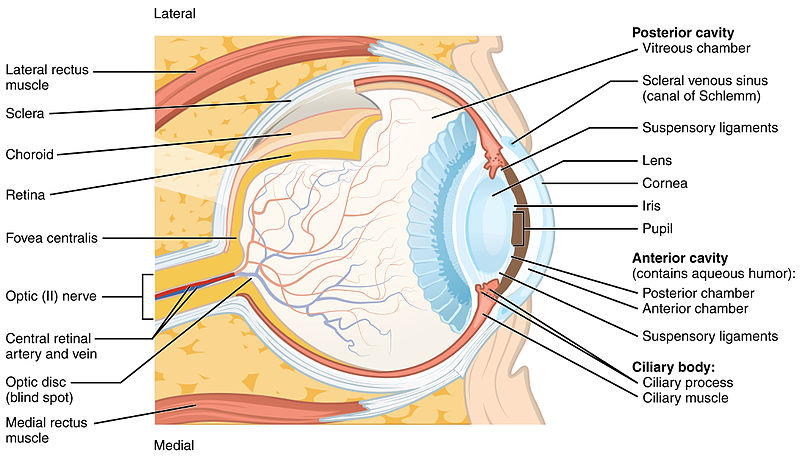
  • La luz se refracta a medida que se desplaza por las estructuras del ojo (enumeradas en EN Erythema nodosum is an immune-mediated panniculitis (inflammation of the subcutaneous fat) caused by a type IV (delayed-type) hypersensitivity reaction. It commonly manifests in young women as tender, erythematous nodules on the shins. Erythema Nodosum orden de encuentro con los LOS Neisseria rayos de luz):
    1. Córnea
      • Estructura avascular Avascular Corneal Abrasions, Erosion, and Ulcers y transparente en EN Erythema nodosum is an immune-mediated panniculitis (inflammation of the subcutaneous fat) caused by a type IV (delayed-type) hypersensitivity reaction. It commonly manifests in young women as tender, erythematous nodules on the shins. Erythema Nodosum la parte frontal Frontal The bone that forms the frontal aspect of the skull. Its flat part forms the forehead, articulating inferiorly with the nasal bone and the cheek bone on each side of the face. Skull: Anatomy del ojo
      • Sitio primario de refracción (dos-tercios del poder de refracción del ojo)
      • La curvatura de la córnea debe coincidir con el tamaño del ojo; si no lo hace HACE Altitude Sickness error Error Refers to any act of commission (doing something wrong) or omission (failing to do something right) that exposes patients to potentially hazardous situations. Disclosure of Information de refracción
    2. Humor Humor Defense Mechanisms acuoso
    3. A través de la pupila (dilatación ajustada por el iris)
    4. Cristalino
      • El segundo sitio de mayor refracción
      • Capaz de ajustar la refracción
      • Acomodación: ajuste de la forma del cristalino para cambiar el enfoque de las imágenes lejanas a las cercanas (la forma del cristalino cambia por la acción del músculo ciliar)
    5. Cuerpo vítreo
    6. Retina Retina The ten-layered nervous tissue membrane of the eye. It is continuous with the optic nerve and receives images of external objects and transmits visual impulses to the brain. Its outer surface is in contact with the choroid and the inner surface with the vitreous body. The outermost layer is pigmented, whereas the inner nine layers are transparent. Eye: Anatomy (superficie interna del ojo que contiene fotorreceptores)

Ametropía o error Error Refers to any act of commission (doing something wrong) or omission (failing to do something right) that exposes patients to potentially hazardous situations. Disclosure of Information de refracción

  • Cuando la luz que entra en EN Erythema nodosum is an immune-mediated panniculitis (inflammation of the subcutaneous fat) caused by a type IV (delayed-type) hypersensitivity reaction. It commonly manifests in young women as tender, erythematous nodules on the shins. Erythema Nodosum el ojo no se enfoca en EN Erythema nodosum is an immune-mediated panniculitis (inflammation of the subcutaneous fat) caused by a type IV (delayed-type) hypersensitivity reaction. It commonly manifests in young women as tender, erythematous nodules on the shins. Erythema Nodosum la retina Retina The ten-layered nervous tissue membrane of the eye. It is continuous with the optic nerve and receives images of external objects and transmits visual impulses to the brain. Its outer surface is in contact with the choroid and the inner surface with the vitreous body. The outermost layer is pigmented, whereas the inner nine layers are transparent. Eye: Anatomy
  • El poder de enfoque de la córnea y el cristalino (curvatura de la córnea, poder de refracción del cristalino) no coincide con el tamaño del ojo (longitud axial Axial Computed Tomography (CT) del globo ocular).
  • La afección requiere un dispositivo de refracción.
  • Unidad de medida del error Error Refers to any act of commission (doing something wrong) or omission (failing to do something right) that exposes patients to potentially hazardous situations. Disclosure of Information de refracción: dioptrías
  • Tipos:
    • Miopía: visión lejana disminuida
    • Hipermetropía: visión cercana disminuida
    • Astigmatismo: enfoque desigual

Epidemiología

  • Los LOS Neisseria errores de la refracción afectan aproximadamente a un-tercio de la población > 40 años en EN Erythema nodosum is an immune-mediated panniculitis (inflammation of the subcutaneous fat) caused by a type IV (delayed-type) hypersensitivity reaction. It commonly manifests in young women as tender, erythematous nodules on the shins. Erythema Nodosum Estados Unidos y Europa Occidental.
  • La miopía, el error Error Refers to any act of commission (doing something wrong) or omission (failing to do something right) that exposes patients to potentially hazardous situations. Disclosure of Information de refracción más común, disminuye con el aumento de la edad; alta prevalencia entre los LOS Neisseria asiáticos
  • La hipermetropía y el astigmatismo aumentan con la edad.

Otras definiciones

  • Emetropía
    • Visión normal
    • La luz es enfocada en EN Erythema nodosum is an immune-mediated panniculitis (inflammation of the subcutaneous fat) caused by a type IV (delayed-type) hypersensitivity reaction. It commonly manifests in young women as tender, erythematous nodules on the shins. Erythema Nodosum la retina Retina The ten-layered nervous tissue membrane of the eye. It is continuous with the optic nerve and receives images of external objects and transmits visual impulses to the brain. Its outer surface is in contact with the choroid and the inner surface with the vitreous body. The outermost layer is pigmented, whereas the inner nine layers are transparent. Eye: Anatomy
  • Presbicia
    • No es un error Error Refers to any act of commission (doing something wrong) or omission (failing to do something right) that exposes patients to potentially hazardous situations. Disclosure of Information de refracción, pero afecta a la agudeza visual
    • Afectado por la pérdida fisiológica de la acomodación
    • Al AL Amyloidosis envejecer, el cristalino pierde elasticidad, por lo que tiene menos capacidad para redondearse → incapacidad para enfocar a distancia de lectura
  • Anisometropía: cada ojo con diferente potencia refractiva

Presentación Clínica

Miopía Hipermetropía Astigmatismo
Punto focal Delante de la retina Retina The ten-layered nervous tissue membrane of the eye. It is continuous with the optic nerve and receives images of external objects and transmits visual impulses to the brain. Its outer surface is in contact with the choroid and the inner surface with the vitreous body. The outermost layer is pigmented, whereas the inner nine layers are transparent. Eye: Anatomy Detrás de la retina Retina The ten-layered nervous tissue membrane of the eye. It is continuous with the optic nerve and receives images of external objects and transmits visual impulses to the brain. Its outer surface is in contact with the choroid and the inner surface with the vitreous body. The outermost layer is pigmented, whereas the inner nine layers are transparent. Eye: Anatomy Varios sitios
Causas Ojo demasiado largo, córnea con mucha curvatura Ojo demasiado corto, córnea con muy poca curvatura Curvatura irregular de la córnea
Resultado No puede enfocar objetos lejanos No puede enfocar objetos cercanos Visión borrosa

Miopía

  • La longitud axial Axial Computed Tomography (CT) del ojo es demasiado larga o la córnea está demasiado curvada.
  • La luz se enfoca delante de la retina Retina The ten-layered nervous tissue membrane of the eye. It is continuous with the optic nerve and receives images of external objects and transmits visual impulses to the brain. Its outer surface is in contact with the choroid and the inner surface with the vitreous body. The outermost layer is pigmented, whereas the inner nine layers are transparent. Eye: Anatomy.
  • Capacidad de enfocar solo los LOS Neisseria objetos cercanos; los LOS Neisseria objetos lejanos estarán desenfocados
  • Factores de riesgo:
    • Genéticos
    • Lectura (↑ longitud axial Axial Computed Tomography (CT) durante el desarrollo)
    • Medicamentos (sulfamidas, diuréticos, colinérgicos): efecto transitorio
    • Diabetes Diabetes Diabetes mellitus (DM) is a metabolic disease characterized by hyperglycemia and dysfunction of the regulation of glucose metabolism by insulin. Type 1 DM is diagnosed mostly in children and young adults as the result of autoimmune destruction of β cells in the pancreas and the resulting lack of insulin. Type 2 DM has a significant association with obesity and is characterized by insulin resistance. Diabetes Mellitus mellitus: transitoria; el cambio en EN Erythema nodosum is an immune-mediated panniculitis (inflammation of the subcutaneous fat) caused by a type IV (delayed-type) hypersensitivity reaction. It commonly manifests in young women as tender, erythematous nodules on the shins. Erythema Nodosum la osmolaridad del suero aumenta el líquido osmótico en EN Erythema nodosum is an immune-mediated panniculitis (inflammation of the subcutaneous fat) caused by a type IV (delayed-type) hypersensitivity reaction. It commonly manifests in young women as tender, erythematous nodules on the shins. Erythema Nodosum el cristalino → el cristalino se hincha → aumento del poder de refracción
    • Trauma
    • Acomodación excesiva
    • Presión intraocular elevada
    • ↑ edad materna y tabaquismo materno durante el embarazo
Miopía

Esta figura ilustra la miopía. La imagen superior muestra la luz cuando es refractada con demasiada intensidad por la córnea, lo que da lugar a un punto focal delante de la retina.
Con las lentes negativas correctoras (imagen inferior), la luz puede dispersarse a través de la lente cóncava y enfocarse adecuadamente en la retina para obtener una visión clara.
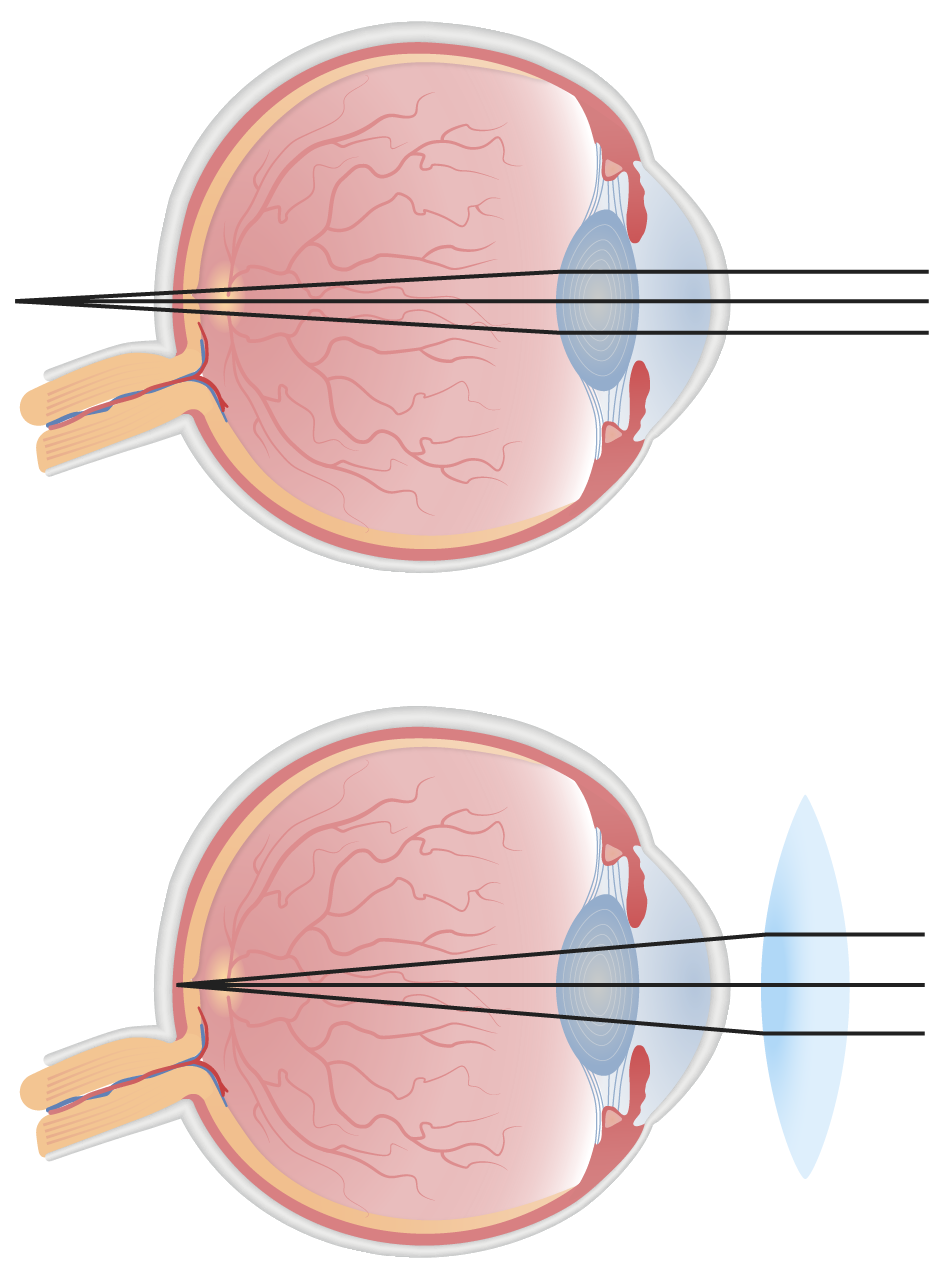
Imagen: “myopia” por OpenStax-CNX. Licencia: CC BY 4.0

Hipermetropía

  • La longitud axial Axial Computed Tomography (CT) del ojo es demasiado corta o la córnea es plana.
  • La luz se enfoca detrás de la retina Retina The ten-layered nervous tissue membrane of the eye. It is continuous with the optic nerve and receives images of external objects and transmits visual impulses to the brain. Its outer surface is in contact with the choroid and the inner surface with the vitreous body. The outermost layer is pigmented, whereas the inner nine layers are transparent. Eye: Anatomy.
  • Capacidad de enfocar solo los LOS Neisseria objetos lejanos; los LOS Neisseria objetos cercanos estarán desenfocados.
  • Factores de riesgo:
    • Trauma
    • Una masa o lesión detrás del ojo
    • Cirugía (extracción del cristalino)
    • Medicamentos: anticolinérgicos
    • Disminución rápida de la glucosa (transitoria)
Hipermetropía

Esta figura ilustra la hipermetropía. La imagen superior ilustra la refracción no corregida, donde la luz no se refracta con suficiente nitidez, lo que da lugar a un punto focal detrás de la retina.
Con las lentes positivas correctoras (imagen inferior), la luz puede dispersarse a través de la lente convexa y enfocarse adecuadamente en la retina para obtener una visión clara.
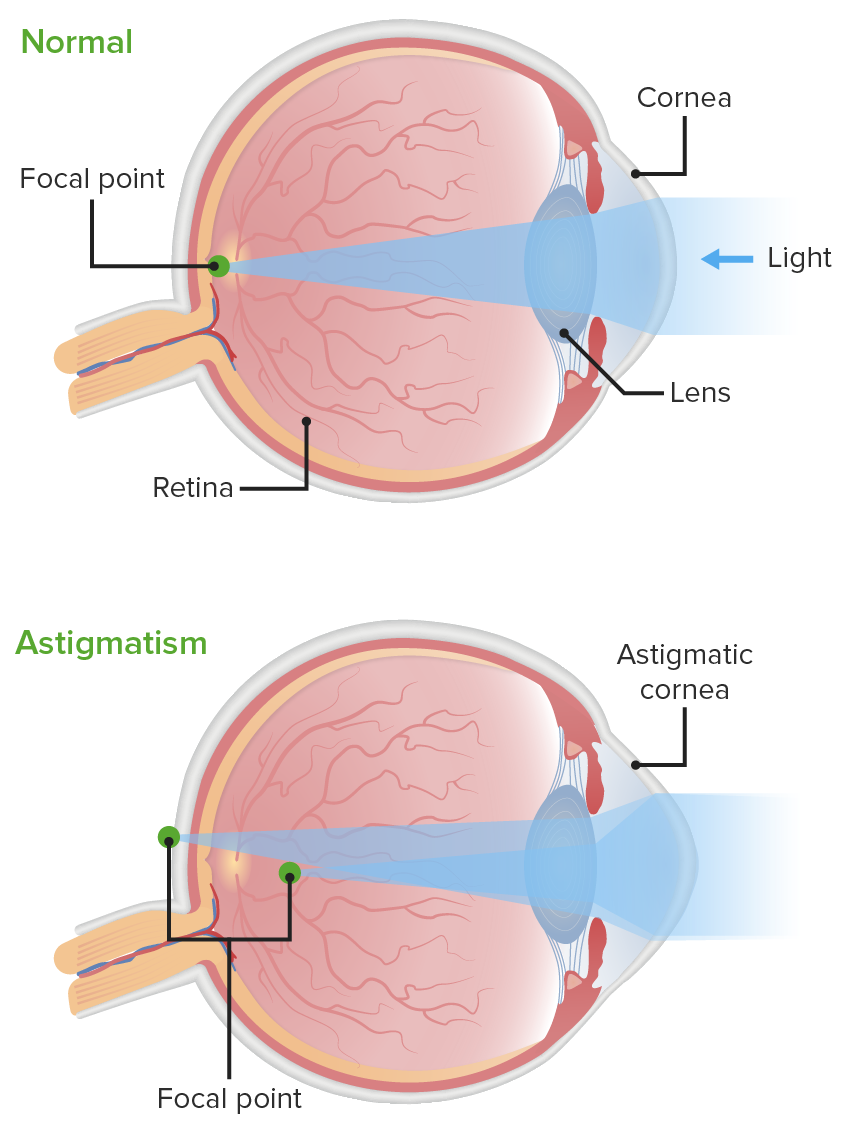
Imagen por Lecturio.

Astigmatismo

  • Curvatura desigual de la córnea (la forma de la córnea es “más parecida a un balón de fútbol que a uno de baloncesto”)
  • Múltiples puntos de enfoque = diferentes poderes de refracción a lo largo de diferentes meridianos
  • Produce una visión borrosa en EN Erythema nodosum is an immune-mediated panniculitis (inflammation of the subcutaneous fat) caused by a type IV (delayed-type) hypersensitivity reaction. It commonly manifests in young women as tender, erythematous nodules on the shins. Erythema Nodosum todas las distancias de visión
Astigmatismo

Esta figura contrasta la curvatura corneal normal con la de una córnea astigmática. La córnea con astigmatismo distorsiona el punto de enfoque de la luz por delante y/o por detrás de la retina.

Imagen por Lecturio.

Diagnóstico

Adultos

  • No hay consenso sobre el tamizaje rutinario de la visión en EN Erythema nodosum is an immune-mediated panniculitis (inflammation of the subcutaneous fat) caused by a type IV (delayed-type) hypersensitivity reaction. It commonly manifests in young women as tender, erythematous nodules on the shins. Erythema Nodosum adultos > 65 años sin problemas de visión
  • La visión es fundamental para mantener la independencia en EN Erythema nodosum is an immune-mediated panniculitis (inflammation of the subcutaneous fat) caused by a type IV (delayed-type) hypersensitivity reaction. It commonly manifests in young women as tender, erythematous nodules on the shins. Erythema Nodosum las actividades de la vida diaria (AVD), por lo que hay que determinar la necesidad de corrección óptica.
  • Se recomienda la referencia a un oftalmólogo en EN Erythema nodosum is an immune-mediated panniculitis (inflammation of the subcutaneous fat) caused by a type IV (delayed-type) hypersensitivity reaction. It commonly manifests in young women as tender, erythematous nodules on the shins. Erythema Nodosum caso de cambio/pérdida de visión inexplicable.
  • Tabla de Snellen
    • Símbolos de alto contraste (letras/números negros sobre fondo blanco) con tamaños variables que se leen a una distancia estándar (6 metros)
    • A menudo se utiliza para evaluar la agudeza visual

Niños

  • La visión es fundamental para las relaciones sociales y el desarrollo mental (aprendizaje y lectura) → se recomienda el tamizaje para detectar problemas visuales
  • Optotipos preferidos para el tamizaje de la visión pediátrica (estandarizados y validados):
    • Tabla LEA (símbolos para niños o personas con discapacidad mental)
    • Cartas de Sloan
    • HOTV (combinación de letras con esas ESAs Hematopoietic Growth Factors 4 letras)
  • Tamizaje en EN Erythema nodosum is an immune-mediated panniculitis (inflammation of the subcutaneous fat) caused by a type IV (delayed-type) hypersensitivity reaction. It commonly manifests in young women as tender, erythematous nodules on the shins. Erythema Nodosum niños < 5 años:
    • Evaluación de la visión en EN Erythema nodosum is an immune-mediated panniculitis (inflammation of the subcutaneous fat) caused by a type IV (delayed-type) hypersensitivity reaction. It commonly manifests in young women as tender, erythematous nodules on the shins. Erythema Nodosum recién nacidos (inspección, motilidad ocular, examen pupilar, reflejo rojo)
    • Evaluación del riesgo visual en EN Erythema nodosum is an immune-mediated panniculitis (inflammation of the subcutaneous fat) caused by a type IV (delayed-type) hypersensitivity reaction. It commonly manifests in young women as tender, erythematous nodules on the shins. Erythema Nodosum todas las visitas de control de la salud y examen de la vista si hay factores de riesgo (prematuridad, antecedentes familiares de cataratas congénitas/ retinoblastoma Retinoblastoma Retinoblastoma is a rare tumor but the most common primary intraocular malignancy of childhood. It is believed that the condition arises from a neuronal progenitor cell. Retinoblastoma can be heritable or non-heritable. Retinoblastoma, retraso en EN Erythema nodosum is an immune-mediated panniculitis (inflammation of the subcutaneous fat) caused by a type IV (delayed-type) hypersensitivity reaction. It commonly manifests in young women as tender, erythematous nodules on the shins. Erythema Nodosum el desarrollo, síntomas oculares de enfermedades sistémicas)
    • Comenzar el tamizaje a los LOS Neisseria 12 meses de edad (fotosensor o autorefractor); referir si el niño no supera el tamizaje fotográfico
    • Examen de visión a los LOS Neisseria 3-4 años de edad (agudeza monocular a distancia); referir si:
      • Visión peor que 20/50 en EN Erythema nodosum is an immune-mediated panniculitis (inflammation of the subcutaneous fat) caused by a type IV (delayed-type) hypersensitivity reaction. It commonly manifests in young women as tender, erythematous nodules on the shins. Erythema Nodosum un niño de 3 años
      • Visión peor que 20/40 en EN Erythema nodosum is an immune-mediated panniculitis (inflammation of the subcutaneous fat) caused by a type IV (delayed-type) hypersensitivity reaction. It commonly manifests in young women as tender, erythematous nodules on the shins. Erythema Nodosum un niño de 4 años
  • Tamizaje en EN Erythema nodosum is an immune-mediated panniculitis (inflammation of the subcutaneous fat) caused by a type IV (delayed-type) hypersensitivity reaction. It commonly manifests in young women as tender, erythematous nodules on the shins. Erythema Nodosum niños ≥ 5 años:
    • Comprobar cada 12 años
    • Referir si es peor que 20/30

Tratamiento

Tratamiento no quirúrgico

Miopía

  1. Se corrige con una lente cóncava (divergente), que esparce la luz
    • Funciones para disminuir la potencia de enfoque (lentes de potencia “negativa”)
    • Las prescripciones de gafas para la miopía están en EN Erythema nodosum is an immune-mediated panniculitis (inflammation of the subcutaneous fat) caused by a type IV (delayed-type) hypersensitivity reaction. It commonly manifests in young women as tender, erythematous nodules on the shins. Erythema Nodosum dioptrías negativas (menor poder de enfoque), i.e., -3,00.
  2. En EN Erythema nodosum is an immune-mediated panniculitis (inflammation of the subcutaneous fat) caused by a type IV (delayed-type) hypersensitivity reaction. It commonly manifests in young women as tender, erythematous nodules on the shins. Erythema Nodosum general, los LOS Neisseria niños en EN Erythema nodosum is an immune-mediated panniculitis (inflammation of the subcutaneous fat) caused by a type IV (delayed-type) hypersensitivity reaction. It commonly manifests in young women as tender, erythematous nodules on the shins. Erythema Nodosum edad escolar reciben tratamiento para la miopía de > 1,52 dioptrías (interfiere con la educación y/o la función social).

Hipermetropía

  • Se corrige con una lente convexa (convergente), que adelanta el enfoque sobre la retina
    • Funciones para aumentar la potencia de enfoque (lentes “positivos”)
    • Las prescripciones de gafas para la hipermetropía son en EN Erythema nodosum is an immune-mediated panniculitis (inflammation of the subcutaneous fat) caused by a type IV (delayed-type) hypersensitivity reaction. It commonly manifests in young women as tender, erythematous nodules on the shins. Erythema Nodosum dioptrías positivas (más poder de enfoque), i.e., +2,00.
  • En EN Erythema nodosum is an immune-mediated panniculitis (inflammation of the subcutaneous fat) caused by a type IV (delayed-type) hypersensitivity reaction. It commonly manifests in young women as tender, erythematous nodules on the shins. Erythema Nodosum los LOS Neisseria niños, la hipermetropía leve es normal. La corrección es recomendada en EN Erythema nodosum is an immune-mediated panniculitis (inflammation of the subcutaneous fat) caused by a type IV (delayed-type) hypersensitivity reaction. It commonly manifests in young women as tender, erythematous nodules on the shins. Erythema Nodosum hipermetropía alta, es decir, > 4 dioptrías (interfiere con la educación y tiene riesgo de ambliopía refractiva).

Astigmatismo

  • Corregido con lentes cilíndricas (para emparejar la potencia de enfoque)
  • La prescripción de gafas para el astigmatismo indica el cilindro y el eje (orientación del astigmatismo)

Presbicia

  • Uso de gafas de lectura (lentes convexas)

Prescripción de gafas

  • OS (oculus sinister): ojo izquierdo
  • OD (oculus dexter): ojo derecho
  • OU (oculus uterque): ambos ojos
  • SPH: esfera/grado de miopía o hipermetropía)
    • Los números representan las dioptrías: cuanto más lejos del cero, más fuerte es la prescripción
    • Signo “menos”: miopía, i.e., -3,00 = 3 dioptrías de miopía
    • Signo “más”: hipermetropía, i.e., +2,25 = 2 y un-cuarto dioptrías de hipermetropía
  • CYL/cilindro: indica el componente astigmático x EJE (grados radiales del cilindro)
    • El CYL puede ser “más” (astigmatismo hipermétrope) o “menos” (astigmatismo miope)
    • El EJE es de 0 – 180 grados; indica dónde está la diferencia de curvatura
  • Añadir: potencia de lente adicional, i.e., bifocales ( en EN Erythema nodosum is an immune-mediated panniculitis (inflammation of the subcutaneous fat) caused by a type IV (delayed-type) hypersensitivity reaction. It commonly manifests in young women as tender, erythematous nodules on the shins. Erythema Nodosum lugar de tener gafas de lectura separadas)

Ejemplo:

Un paciente con hipermetropía, mayor en EN Erythema nodosum is an immune-mediated panniculitis (inflammation of the subcutaneous fat) caused by a type IV (delayed-type) hypersensitivity reaction. It commonly manifests in young women as tender, erythematous nodules on the shins. Erythema Nodosum el lado izquierdo, también con astigmatismo en EN Erythema nodosum is an immune-mediated panniculitis (inflammation of the subcutaneous fat) caused by a type IV (delayed-type) hypersensitivity reaction. It commonly manifests in young women as tender, erythematous nodules on the shins. Erythema Nodosum ambos ojos, recibiría la siguiente prescripción:

Tratamiento quirúrgico

  • Normalmente se realiza en EN Erythema nodosum is an immune-mediated panniculitis (inflammation of the subcutaneous fat) caused by a type IV (delayed-type) hypersensitivity reaction. It commonly manifests in young women as tender, erythematous nodules on the shins. Erythema Nodosum adultos
  • LASIK LASIK Refractive Errors: queratomileusis in situ asistida por láser
    • Es el procedimiento más utilizado
    • Utiliza el láser excimer para remodelar la superficie de la córnea (epitelio y estroma)
    • Dolor Dolor Inflammation mínimo
    • Para la miopía: aplana la córnea
    • Para la hipermetropía: El láser se aplica en EN Erythema nodosum is an immune-mediated panniculitis (inflammation of the subcutaneous fat) caused by a type IV (delayed-type) hypersensitivity reaction. It commonly manifests in young women as tender, erythematous nodules on the shins. Erythema Nodosum la periferia para empinar la córnea central.
    • Para el astigmatismo: combina tratamientos láser periféricos y centrales
  • LASEK LASEK Refractive Errors: queratomileusis epitelial con láser
    • El colgajo de epitelio corneal se forma con el uso de alcohol, luego se aplica el láser
    • Dolor Dolor Inflammation postoperatorio de leve a moderado
    • Recuperación óptica más lenta que el LASIK LASIK Refractive Errors
    • Puede necesitar medicamentos postoperatorios hasta por 3 meses
  • KFR: queratectomía fotorrefractiva
    • Se retira el epitelio corneal y a continuación se aplica el tratamiento con láser.
    • Dolor Dolor Inflammation postoperatorio de leve a moderado, puede requerir un analgésico sistémico
    • La agudeza visual puede tardar hasta 3 meses en EN Erythema nodosum is an immune-mediated panniculitis (inflammation of the subcutaneous fat) caused by a type IV (delayed-type) hypersensitivity reaction. It commonly manifests in young women as tender, erythematous nodules on the shins. Erythema Nodosum estabilizarse

Diagnóstico Diferencial

El diagnóstico diferencial de los LOS Neisseria errores de refracción incluye las siguientes afecciones:

  • Cataratas: es una de las principales causas de ceguera a nivel mundial. Se caracteriza por una disminución de la visión debido a la nubosidad o pérdida de transparencia del cristalino, que desarrolla zonas de opacidad que requieren una extracción quirúrgica.
  • Glaucoma Glaucoma Glaucoma is an optic neuropathy characterized by typical visual field defects and optic nerve atrophy seen as optic disc cupping on examination. The acute form of glaucoma is a medical emergency. Glaucoma is often, but not always, caused by increased intraocular pressure (IOP). Glaucoma: es una neuropatía óptica con cambios distintivos en EN Erythema nodosum is an immune-mediated panniculitis (inflammation of the subcutaneous fat) caused by a type IV (delayed-type) hypersensitivity reaction. It commonly manifests in young women as tender, erythematous nodules on the shins. Erythema Nodosum la copa óptica y defecto del campo visual. Suele asociarse a un aumento de la presión en EN Erythema nodosum is an immune-mediated panniculitis (inflammation of the subcutaneous fat) caused by a type IV (delayed-type) hypersensitivity reaction. It commonly manifests in young women as tender, erythematous nodules on the shins. Erythema Nodosum el interior del globo ocular (normalmente en EN Erythema nodosum is an immune-mediated panniculitis (inflammation of the subcutaneous fat) caused by a type IV (delayed-type) hypersensitivity reaction. It commonly manifests in young women as tender, erythematous nodules on the shins. Erythema Nodosum las cámaras anterior y posterior), lo que provoca una pérdida gradual de la visión. Esto puede ocurrir de forma aguda debido a una obstrucción del drenaje del humor Humor Defense Mechanisms acuoso ( glaucoma Glaucoma Glaucoma is an optic neuropathy characterized by typical visual field defects and optic nerve atrophy seen as optic disc cupping on examination. The acute form of glaucoma is a medical emergency. Glaucoma is often, but not always, caused by increased intraocular pressure (IOP). Glaucoma agudo de ángulo cerrado) que es una emergencia. La mayoría de los LOS Neisseria casos se deben a un glaucoma Glaucoma Glaucoma is an optic neuropathy characterized by typical visual field defects and optic nerve atrophy seen as optic disc cupping on examination. The acute form of glaucoma is a medical emergency. Glaucoma is often, but not always, caused by increased intraocular pressure (IOP). Glaucoma de ángulo abierto.
  • Uveítis: inflamación aguda de la úvea (capa vascular del globo ocular) y del cuerpo ciliar. Los LOS Neisseria pacientes afectados suelen sufrir visión borrosa, enrojecimiento doloroso (uveítis anterior) o indoloro (uveítis posterior) del ojo.

Referencias

  1. Shahzad, M., Gardiner, M. y Givens, J. (2019). Visual impairment in adults: Refractive disorders and presbyopia. UpToDate. Retrieved September 1, 2020, from https://www.uptodate.com/contents/visual-impairment-in-adults-refractive-disorders-and-presbyopia
  2. Bower, K.; Jacobs, D. & Givens, J. (2020). Laser refractive surgery. UpToDate. Retrieved September 1, 2020, from https://www.uptodate.com/contents/laser-refractive-surgery
  3. Bope, Edward T.; Kellerman, Rick D. (2015). Conn’s Current Therapy 2016. Elsevier Health Sciences. p. 354. ISBN 9780323355353

¡Crea tu cuenta gratis o inicia una sesión para seguir leyendo!

Regístrate ahora y obtén acceso gratuito a Lecturio con páginas de concepto, videos médicos y cuestionarios para tu educación médica.

User Reviews

Que tengas una sesión de estudio alegre y navideña 🎁 Ahorra 50% en todos los planes >>

Details