Domina Conceptos Médicos

Estudia para la escuela de medicina y tus examenes con Lecturio.

Encefalopatía Hepática

La encefalopatía hepática es una afección reversible en EN Erythema nodosum is an immune-mediated panniculitis (inflammation of the subcutaneous fat) caused by a type IV (delayed-type) hypersensitivity reaction. It commonly manifests in young women as tender, erythematous nodules on the shins. Erythema Nodosum la que los LOS Neisseria niveles elevados de amoníaco provocan un deterioro de la función cerebral en EN Erythema nodosum is an immune-mediated panniculitis (inflammation of the subcutaneous fat) caused by a type IV (delayed-type) hypersensitivity reaction. It commonly manifests in young women as tender, erythematous nodules on the shins. Erythema Nodosum pacientes con enfermedad hepática avanzada. La encefalopatía hepática puede precipitarse por condiciones que afectan la absorción normal, el metabolismo o la depuración de amoníaco, como deshidratación, insuficiencia renal, infecciones y hemorragia digestiva. Los LOS Neisseria pacientes presentan una progresión de los LOS Neisseria síntomas, desde confusión mínima y asterixis Asterixis Hepatic Encephalopathy hasta estupor y coma Coma Coma is defined as a deep state of unarousable unresponsiveness, characterized by a score of 3 points on the GCS. A comatose state can be caused by a multitude of conditions, making the precise epidemiology and prognosis of coma difficult to determine. Coma. El diagnóstico es clínico y requiere la exclusión de diagnósticos alternativos. El tratamiento  implica abordar el factor causal y disminuir la absorción sistémica de amoníaco con lactulosa o rifaximina.

Last updated: Jan 17, 2024

Editorial responsibility: Stanley Oiseth, Lindsay Jones, Evelin Maza

Epidemiología y Etiología

Epidemiología

  • Afecta:
    • 30%–45% de pacientes con cirrosis
    • 10%–50% de los LOS Neisseria pacientes que se someten a derivaciones portosistémicas intrahepáticas transyugulares
  • 2da causa más común de hospitalización para pacientes cirróticos (después de la ascitis)

Etiología

La encefalopatía hepática se observa en EN Erythema nodosum is an immune-mediated panniculitis (inflammation of the subcutaneous fat) caused by a type IV (delayed-type) hypersensitivity reaction. It commonly manifests in young women as tender, erythematous nodules on the shins. Erythema Nodosum pacientes con enfermedad hepática grave o insuficiencia hepática y puede exacerbarse por:

  • Disminución del metabolismo o eliminación de amoníaco
    • Insuficiencia renal
    • Diuréticos
    • Derivación portosistémica intrahepática transyugular
  • Aumento de la producción o absorción de amoníaco.
    • Ingesta excesiva de proteínas en EN Erythema nodosum is an immune-mediated panniculitis (inflammation of the subcutaneous fat) caused by a type IV (delayed-type) hypersensitivity reaction. It commonly manifests in young women as tender, erythematous nodules on the shins. Erythema Nodosum la dieta
    • Hemorragia digestiva
    • Estreñimiento
    • Infección ( peritonitis Peritonitis Inflammation of the peritoneum lining the abdominal cavity as the result of infectious, autoimmune, or chemical processes. Primary peritonitis is due to infection of the peritoneal cavity via hematogenous or lymphatic spread and without intra-abdominal source. Secondary peritonitis arises from the abdominal cavity itself through rupture or abscess of intra-abdominal organs. Penetrating Abdominal Injury bacteriana espontánea)
  • Alteraciones electrolíticas
    • Hipopotasemia
    • Alcalosis metabólica
  • Problemas respiratorios
    • Hipoxia
    • Hipercapnia
  • Oclusión vascular
    • Trombosis de la vena porta
    • Trombosis de la vena hepática
  • Medicamentos
    • Opiáceos
    • Benzodiacepinas
    • Alcohol
    • Hipnóticos

Los factores precipitantes de la encefalopatía hepática pueden recordarse mediante la nemotécnica “HEPATICS” ( En EN Erythema nodosum is an immune-mediated panniculitis (inflammation of the subcutaneous fat) caused by a type IV (delayed-type) hypersensitivity reaction. It commonly manifests in young women as tender, erythematous nodules on the shins. Erythema Nodosum inglés):

H Hemorrhage in the GI tract (Hemorragia digestiva)
E Excess dietary protein (Exceso de proteínas en EN Erythema nodosum is an immune-mediated panniculitis (inflammation of the subcutaneous fat) caused by a type IV (delayed-type) hypersensitivity reaction. It commonly manifests in young women as tender, erythematous nodules on the shins. Erythema Nodosum la dieta)
P Potassium Potassium An element in the alkali group of metals with an atomic symbol k, atomic number 19, and atomic weight 39. 10. It is the chief cation in the intracellular fluid of muscle and other cells. Potassium ion is a strong electrolyte that plays a significant role in the regulation of fluid volume and maintenance of the water-electrolyte balance. Hyperkalemia ( hypokalemia Hypokalemia Hypokalemia is defined as plasma potassium (K+) concentration < 3.5 mEq/L. Homeostatic mechanisms maintain plasma concentration between 3.5-5.2 mEq/L despite marked variation in dietary intake. Hypokalemia can be due to renal losses, GI losses, transcellular shifts, or poor dietary intake. Hypokalemia) (Potasio (hipopotasemia))
A Alkalosis Alkalosis A pathological condition that removes acid or adds base to the body fluids. Respiratory Alkalosis or azotemia Azotemia A biochemical abnormality referring to an elevation of blood urea nitrogen and creatinine. Azotemia can be produced by kidney diseases or other extrarenal disorders. When azotemia becomes associated with a constellation of clinical signs, it is termed uremia. Acute Kidney Injury (Alcalosis o azotemia Azotemia A biochemical abnormality referring to an elevation of blood urea nitrogen and creatinine. Azotemia can be produced by kidney diseases or other extrarenal disorders. When azotemia becomes associated with a constellation of clinical signs, it is termed uremia. Acute Kidney Injury)
T TIPS procedure (TIPS, por sus siglas en EN Erythema nodosum is an immune-mediated panniculitis (inflammation of the subcutaneous fat) caused by a type IV (delayed-type) hypersensitivity reaction. It commonly manifests in young women as tender, erythematous nodules on the shins. Erythema Nodosum inglés, procedimiento de derivación portosistémica intrahepática transyugular)
I Infection (Infección)
C Constipation Constipation Constipation is common and may be due to a variety of causes. Constipation is generally defined as bowel movement frequency < 3 times per week. Patients who are constipated often strain to pass hard stools. The condition is classified as primary (also known as idiopathic or functional constipation) or secondary, and as acute or chronic. Constipation (Constipación)
S Sedatives (Sedantes)
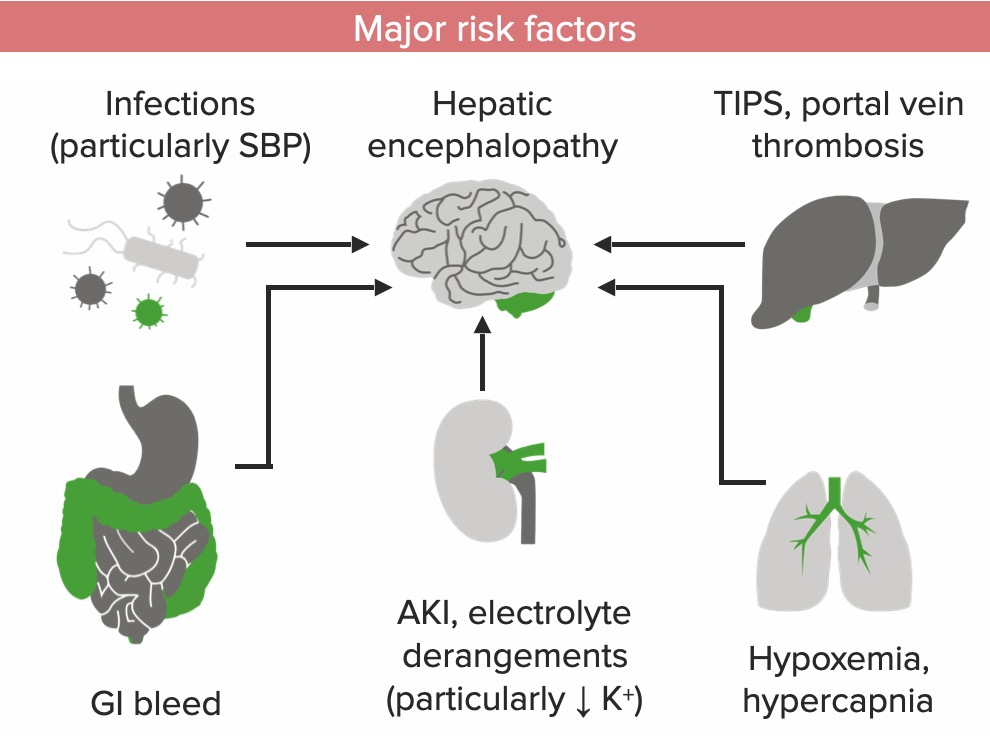
Principales factores de riesgo de la encefalopatía hepática

Principales factores de riesgo de encefalopatía hepática en un paciente con insuficiencia hepática
AKI: lesión renal aguda
SBP: peritonitis bacteriana espontánea

Imagen por Lecturio.

Fisiopatología

Fisiología normal:

  • El tracto gastrointestinal es la principal fuente de amoníaco, donde es producido por:
    • Enterocitos a partir de glutamina
    • Catabolismo del nitrógeno por bacterias colónicas
  • El amoníaco ingresa a la circulación a través de la vena porta.
  • El hígado elimina este amoníaco convirtiéndolo en EN Erythema nodosum is an immune-mediated panniculitis (inflammation of the subcutaneous fat) caused by a type IV (delayed-type) hypersensitivity reaction. It commonly manifests in young women as tender, erythematous nodules on the shins. Erythema Nodosum glutamina → evita la entrada en EN Erythema nodosum is an immune-mediated panniculitis (inflammation of the subcutaneous fat) caused by a type IV (delayed-type) hypersensitivity reaction. It commonly manifests in young women as tender, erythematous nodules on the shins. Erythema Nodosum la circulación sistémica

La enfermedad hepática permite la interrupción de la regulación normal del amoníaco a través de:

  • Disfunción de hepatocitos: ↓ conversión de amoníaco a glutamina → ↑ amoníaco sérico
  • Vasodilatación esplácnica y periférica: derivación portosistémica lejos del hígado → ↑ amoníaco sérico
  • ↑ Permeabilidad de la barrera hematoencefálica: permite ↑ la llegada de amoníaco a los LOS Neisseria astrocitos

El deterioro de la función cerebral resulta de una acumulación de amoníaco, donde:
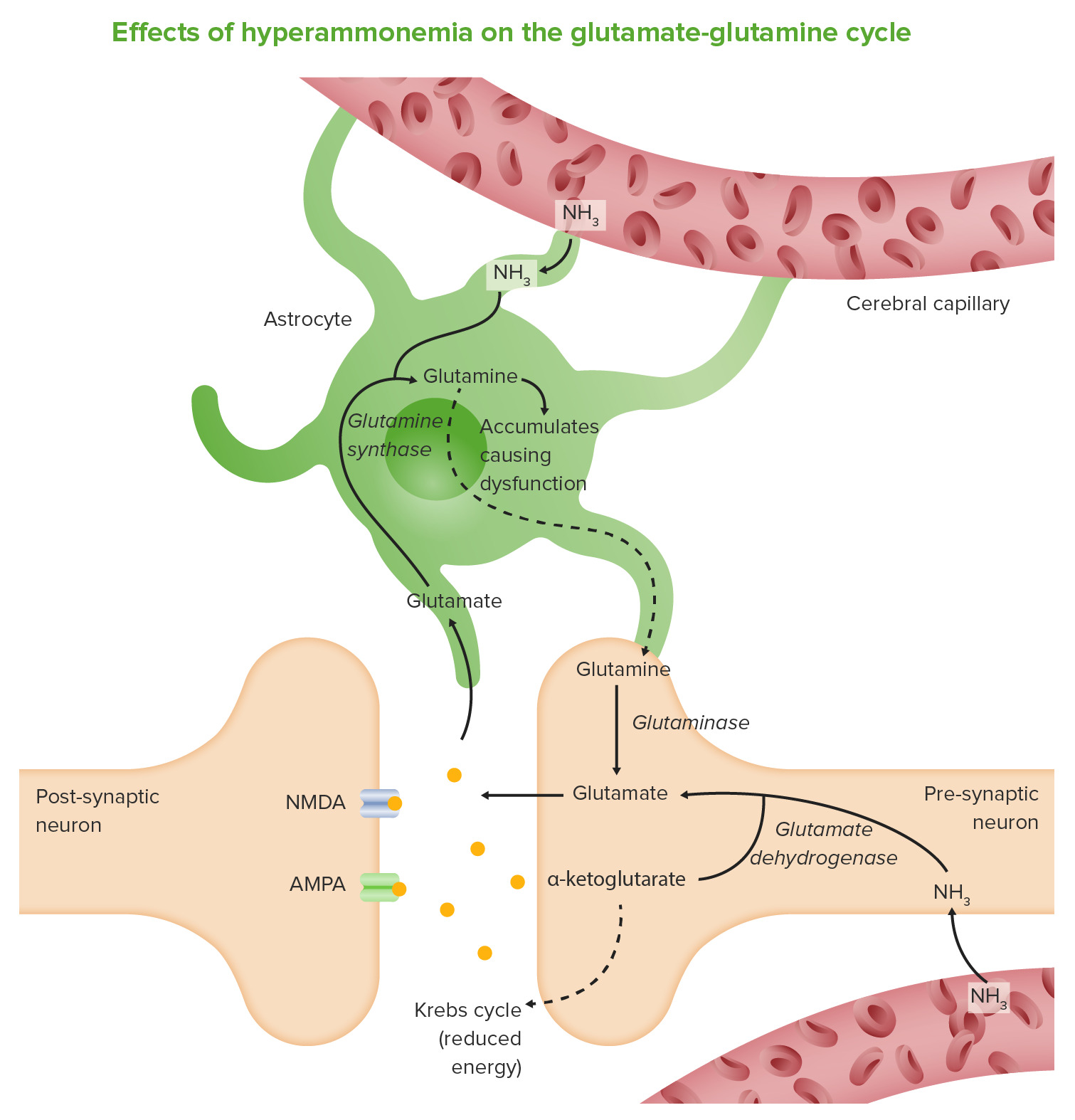
  • Se utiliza para producir glutamina → ↑ presión osmótica e inflamación de astrocitos → edema Edema Edema is a condition in which excess serous fluid accumulates in the body cavity or interstitial space of connective tissues. Edema is a symptom observed in several medical conditions. It can be categorized into 2 types, namely, peripheral (in the extremities) and internal (in an organ or body cavity). Edema cerebral
  • Se une a los LOS Neisseria receptores del ácido γ-aminobutírico ( GABA GABA The most common inhibitory neurotransmitter in the central nervous system. Receptors and Neurotransmitters of the CNS, por sus siglas en EN Erythema nodosum is an immune-mediated panniculitis (inflammation of the subcutaneous fat) caused by a type IV (delayed-type) hypersensitivity reaction. It commonly manifests in young women as tender, erythematous nodules on the shins. Erythema Nodosum inglés) → ↑ función inhibitoria energética de GABA GABA The most common inhibitory neurotransmitter in the central nervous system. Receptors and Neurotransmitters of the CNS
  • Inhibe un paso en EN Erythema nodosum is an immune-mediated panniculitis (inflammation of the subcutaneous fat) caused by a type IV (delayed-type) hypersensitivity reaction. It commonly manifests in young women as tender, erythematous nodules on the shins. Erythema Nodosum el ciclo de Krebs → ↓ suministro de combustible metabólico
Efectos de la hiperamonemia en el ciclo glutamato-glutamina

El amoníaco (NH3) atraviesa la barrera hematoencefálica y es absorbido y metabolizado por los astrocitos. Estas células usan amoníaco cuando sintetizan glutamina a partir de glutamato. El aumento de los niveles de glutamina conduce a un aumento de la presión osmótica en los astrocitos, que se hinchan y provocan edema cerebral. El amoníaco también aumenta la actividad del sistema inhibitorio GABA y reduce la producción de energía.

Imagen por Lecturio.

Presentación Clínica

Síntomas

  • Deterioro cognitivo (incluyendo enlentecimiento mental, confusión, somnolencia y coma Coma Coma is defined as a deep state of unarousable unresponsiveness, characterized by a score of 3 points on the GCS. A comatose state can be caused by a multitude of conditions, making the precise epidemiology and prognosis of coma difficult to determine. Coma)
  • Alteraciones del patrón de sueño
    • Insomnio
    • Hipersomnia
    • Generalmente precede a otros cambios en EN Erythema nodosum is an immune-mediated panniculitis (inflammation of the subcutaneous fat) caused by a type IV (delayed-type) hypersensitivity reaction. It commonly manifests in young women as tender, erythematous nodules on the shins. Erythema Nodosum el estado mental.
  • Cambios de humor Humor Defense Mechanisms
    • Euforia
    • Depresión

Hallazgos al AL Amyloidosis examen físico

  • Asterixis Asterixis Hepatic Encephalopathy (aleteo de manos extendidas y dorsiflexionadas)
  • Ataxia Ataxia Impairment of the ability to perform smoothly coordinated voluntary movements. This condition may affect the limbs, trunk, eyes, pharynx, larynx, and other structures. Ataxia may result from impaired sensory or motor function. Sensory ataxia may result from posterior column injury or peripheral nerve diseases. Motor ataxia may be associated with cerebellar diseases; cerebral cortex diseases; thalamic diseases; basal ganglia diseases; injury to the red nucleus; and other conditions. Ataxia-telangiectasia
  • Hiperreflexia
  • Nistagmo
  • Evidencia de enfermedad hepática crónica (e.g., ictericia, distensión abdominal, ascitis, edema Edema Edema is a condition in which excess serous fluid accumulates in the body cavity or interstitial space of connective tissues. Edema is a symptom observed in several medical conditions. It can be categorized into 2 types, namely, peripheral (in the extremities) and internal (in an organ or body cavity). Edema)

Severidad

Los LOS Neisseria criterios de West Haven se utilizan para establecer la severidad clínica.

Estadio Conciencia Intelecto y comportamiento Hallazgos neurológicos
0 Normal Normal Normal
Mínimo Normal Psicométrico (velocidad psicomotora/función ejecutora) o pruebas neurofisiológicas son anormales. Psicométrico (velocidad psicomotora/función ejecutora) o pruebas neurofisiológicas son anormales.
1 Leve falta de conciencia Intelecto lento, apatía, inquietud, sueño desordenado Asterixis Asterixis Hepatic Encephalopathy leve, cálculo alterado
2 Letárgico Desorientación moderada, somnolencia, comportamiento inapropiado Asterixis Asterixis Hepatic Encephalopathy, dificultad para hablar
3 Somnoliento pero excitable Desorientación, habla incoherente Asterixis Asterixis Hepatic Encephalopathy, hiperreflexia, clonus Clonus Ehrlichiosis and Anaplasmosis, rigidez muscular
4 Coma Coma Coma is defined as a deep state of unarousable unresponsiveness, characterized by a score of 3 points on the GCS. A comatose state can be caused by a multitude of conditions, making the precise epidemiology and prognosis of coma difficult to determine. Coma Coma Coma Coma is defined as a deep state of unarousable unresponsiveness, characterized by a score of 3 points on the GCS. A comatose state can be caused by a multitude of conditions, making the precise epidemiology and prognosis of coma difficult to determine. Coma Posturas de descerebración o decorticación, la asterixis Asterixis Hepatic Encephalopathy suele estar ausente
Mínimo y grado 1: considerado encefalopatía hepática encubierta
Grados 2‒4: considerados encefalopatía hepática manifiesta

Diagnóstico

La encefalopatía hepática es un diagnóstico clínico y deben excluirse otras condiciones.

  • Apoya el diagnóstico: ↑ amoníaco sérico (ayuda en EN Erythema nodosum is an immune-mediated panniculitis (inflammation of the subcutaneous fat) caused by a type IV (delayed-type) hypersensitivity reaction. It commonly manifests in young women as tender, erythematous nodules on the shins. Erythema Nodosum la evaluación, pero no es diagnóstico)
  • Evaluar precipitantes y diagnósticos alternativos:
    • Laboratorios
      • Glucosa → hipoglucemia o hiperglicemia
      • Panel metabólico básico → hipopotasemia, alcalosis, insuficiencia renal
      • Hemograma → infección, hemorragia digestiva
      • Hormona estimulante de la tiroides → coma Coma Coma is defined as a deep state of unarousable unresponsiveness, characterized by a score of 3 points on the GCS. A comatose state can be caused by a multitude of conditions, making the precise epidemiology and prognosis of coma difficult to determine. Coma mixedematoso
      • Gasometría arterial → alcalosis, hipercapnia
      • Control antidopaje
      • Nivel de alcohol
      • Hemocultivos → infección
      • Análisis de orina → infección
    • Imagenología
      • Tomografía computarizada (TC) cerebral → descartar patología intracraneal
      • Ultrasonido
        • Puede ayudar con el diagnóstico de trombosis de la vena porta
        • Evaluar ascitis → paracentesis Paracentesis A procedure in which fluid is withdrawn from a body cavity or organ via a trocar and cannula, needle, or other hollow instrument. Portal Hypertension diagnóstica → descartar peritonitis Peritonitis Inflammation of the peritoneum lining the abdominal cavity as the result of infectious, autoimmune, or chemical processes. Primary peritonitis is due to infection of the peritoneal cavity via hematogenous or lymphatic spread and without intra-abdominal source. Secondary peritonitis arises from the abdominal cavity itself through rupture or abscess of intra-abdominal organs. Penetrating Abdominal Injury bacteriana espontánea

Consejo: La peritonitis Peritonitis Inflammation of the peritoneum lining the abdominal cavity as the result of infectious, autoimmune, or chemical processes. Primary peritonitis is due to infection of the peritoneal cavity via hematogenous or lymphatic spread and without intra-abdominal source. Secondary peritonitis arises from the abdominal cavity itself through rupture or abscess of intra-abdominal organs. Penetrating Abdominal Injury bacteriana espontánea debe descartarse en EN Erythema nodosum is an immune-mediated panniculitis (inflammation of the subcutaneous fat) caused by a type IV (delayed-type) hypersensitivity reaction. It commonly manifests in young women as tender, erythematous nodules on the shins. Erythema Nodosum todos los LOS Neisseria pacientes que presentan encefalopatía hepática y ascitis.

Tratamiento

Se enfoca en EN Erythema nodosum is an immune-mediated panniculitis (inflammation of the subcutaneous fat) caused by a type IV (delayed-type) hypersensitivity reaction. It commonly manifests in young women as tender, erythematous nodules on the shins. Erythema Nodosum identificar y tratar los LOS Neisseria factores precipitantes y reducir la concentración sérica de amoníaco.

  • Cuidados generales de soporte:
    • Establecer un ambiente seguro para el paciente.
      • Hospitalización por síntomas graves o deterioro que impida la adherencia al AL Amyloidosis tratamiento prescrito
      • Los LOS Neisseria síntomas leves se pueden tratar de forma ambulatoria.
    • Hidratación adecuada
    • Evite los LOS Neisseria sedantes.
    • Tratar las causas precipitantes.
    • Proporcionar apoyo nutricional.
  • Tratamiento reductor de amoníaco:
    • Lactulosa
      • Convertido en EN Erythema nodosum is an immune-mediated panniculitis (inflammation of the subcutaneous fat) caused by a type IV (delayed-type) hypersensitivity reaction. It commonly manifests in young women as tender, erythematous nodules on the shins. Erythema Nodosum ácido láctico por la flora intestinal → la acidificación conduce a la conversión de amoníaco (NH₃) en EN Erythema nodosum is an immune-mediated panniculitis (inflammation of the subcutaneous fat) caused by a type IV (delayed-type) hypersensitivity reaction. It commonly manifests in young women as tender, erythematous nodules on the shins. Erythema Nodosum amonio (NH₄+) → el amonio se excreta en EN Erythema nodosum is an immune-mediated panniculitis (inflammation of the subcutaneous fat) caused by a type IV (delayed-type) hypersensitivity reaction. It commonly manifests in young women as tender, erythematous nodules on the shins. Erythema Nodosum las heces → ↓ absorción
      • La dosis se titula para producir al AL Amyloidosis menos 3 deposiciones por día.
    • Rifaximina
      • Antibiótico no absorbible para disminuir la carga bacteriana intestinal
      • Se utiliza en EN Erythema nodosum is an immune-mediated panniculitis (inflammation of the subcutaneous fat) caused by a type IV (delayed-type) hypersensitivity reaction. It commonly manifests in young women as tender, erythematous nodules on the shins. Erythema Nodosum pacientes que inicialmente no responden o no pueden tolerar la lactulosa.
    • El seguimiento de la mejoría se basa en EN Erythema nodosum is an immune-mediated panniculitis (inflammation of the subcutaneous fat) caused by a type IV (delayed-type) hypersensitivity reaction. It commonly manifests in young women as tender, erythematous nodules on the shins. Erythema Nodosum el examen clínico, no en EN Erythema nodosum is an immune-mediated panniculitis (inflammation of the subcutaneous fat) caused by a type IV (delayed-type) hypersensitivity reaction. It commonly manifests in young women as tender, erythematous nodules on the shins. Erythema Nodosum los LOS Neisseria niveles de amoníaco.

Diagnóstico Diferencial

  • Enfermedad de Wilson: causada por un defecto en EN Erythema nodosum is an immune-mediated panniculitis (inflammation of the subcutaneous fat) caused by a type IV (delayed-type) hypersensitivity reaction. It commonly manifests in young women as tender, erythematous nodules on the shins. Erythema Nodosum el transporte de cobre dentro de los LOS Neisseria hepatocitos. Comúnmente se presenta en EN Erythema nodosum is an immune-mediated panniculitis (inflammation of the subcutaneous fat) caused by a type IV (delayed-type) hypersensitivity reaction. It commonly manifests in young women as tender, erythematous nodules on the shins. Erythema Nodosum adultos jóvenes con enfermedad hepática, manifestaciones neurológicas y síntomas psiquiátricos, que pueden confundirse con encefalopatía hepática; sin embargo, la enfermedad de Wilson se asocia con anillos de Kayser-Fleischer, ceruloplasmina plasmática baja y excreción urinaria alta de cobre. Se requieren agentes quelantes para el tratamiento.
  • Encefalopatía tóxico-metabólica: una interrupción de las funciones fisiológicas normales en EN Erythema nodosum is an immune-mediated panniculitis (inflammation of the subcutaneous fat) caused by a type IV (delayed-type) hypersensitivity reaction. It commonly manifests in young women as tender, erythematous nodules on the shins. Erythema Nodosum el cerebro causada por otras afecciones, como infección, disfunción renal, anomalías electrolíticas y medicamentos. Los LOS Neisseria pacientes presentan somnolencia, desorientación, anomalías motoras o convulsiones. La asterixis Asterixis Hepatic Encephalopathy típicamente no está presente. Las pruebas de laboratorio pueden ayudar a distinguir la causa y diferenciar la afección de la encefalopatía hepática. El tratamiento se centra en EN Erythema nodosum is an immune-mediated panniculitis (inflammation of the subcutaneous fat) caused by a type IV (delayed-type) hypersensitivity reaction. It commonly manifests in young women as tender, erythematous nodules on the shins. Erythema Nodosum la causa subyacente.
  • Accidente cerebrovascular isquémico: una enfermedad en EN Erythema nodosum is an immune-mediated panniculitis (inflammation of the subcutaneous fat) caused by a type IV (delayed-type) hypersensitivity reaction. It commonly manifests in young women as tender, erythematous nodules on the shins. Erythema Nodosum la que el flujo sanguíneo deficiente al AL Amyloidosis cerebro provoca la muerte celular. Los LOS Neisseria síntomas incluyen debilidad focal, entumecimiento, pérdida de la visión, disartria y estado mental alterado. No se ve VE Ventilation: Mechanics of Breathing asterixis Asterixis Hepatic Encephalopathy. La tomografía computarizada y la resonancia magnética (RM) del cerebro se utilizan para el diagnóstico y diferenciarán esta afección de la encefalopatía hepática. El tratamiento incluye aspirina, estatinas y tratamiento de factores de riesgo.
  • Encefalitis: una interrupción de la función cerebral normal debido a la inflamación, más comúnmente por un virus Virus Viruses are infectious, obligate intracellular parasites composed of a nucleic acid core surrounded by a protein capsid. Viruses can be either naked (non-enveloped) or enveloped. The classification of viruses is complex and based on many factors, including type and structure of the nucleoid and capsid, the presence of an envelope, the replication cycle, and the host range. Virology. Los LOS Neisseria pacientes pueden tener alteración del estado mental, dolor Dolor Inflammation de cabeza, fiebre, convulsiones y trastornos del movimiento. Las imágenes cerebrales pueden ser útiles, pero se requiere una punción lumbar con análisis del líquido cefalorraquídeo para el diagnóstico y para diferenciar la encefalitis de la encefalopatía hepática. El tratamiento depende del agente causal e incluye antivirales, antibióticos y terapia de soporte.
  • Encefalopatía de Wernicke: una complicación neurológica de la deficiencia de tiamina, que suele observarse en EN Erythema nodosum is an immune-mediated panniculitis (inflammation of the subcutaneous fat) caused by a type IV (delayed-type) hypersensitivity reaction. It commonly manifests in young women as tender, erythematous nodules on the shins. Erythema Nodosum la dependencia crónica del alcohol. Los LOS Neisseria pacientes pueden presentar desorientación, delirio agitado, disfunción oculomotora, ataxia Ataxia Impairment of the ability to perform smoothly coordinated voluntary movements. This condition may affect the limbs, trunk, eyes, pharynx, larynx, and other structures. Ataxia may result from impaired sensory or motor function. Sensory ataxia may result from posterior column injury or peripheral nerve diseases. Motor ataxia may be associated with cerebellar diseases; cerebral cortex diseases; thalamic diseases; basal ganglia diseases; injury to the red nucleus; and other conditions. Ataxia-telangiectasia de la marcha o coma Coma Coma is defined as a deep state of unarousable unresponsiveness, characterized by a score of 3 points on the GCS. A comatose state can be caused by a multitude of conditions, making the precise epidemiology and prognosis of coma difficult to determine. Coma. Este es un diagnóstico clínico, por lo que los LOS Neisseria antecedentes y el examen deben ayudar a diferenciar la encefalopatía de Wernicke de la encefalopatía hepática. Se trata con tiamina intravenosa.

Referencias

  1. Ferenci, P. (2020). Hepatic encephalopathy in adults: Clinical manifestations and diagnosis. In Robson, K.M. (Ed.), UpToDate. Retrieved November 2, 2020, from https://www.uptodate.com/contents/hepatic-encephalopathy-in-adults-clinical-manifestations-and-diagnosis
  2. Ridola, L., & Riggio, O. (2024). Hepatic encephalopathy in adults: Treatment. In E. Tapper & K. M. Robson (Eds.), UpToDate. Wolters Kluwer. Retrieved June 4, 2025, from https://www.uptodate.com/contents/hepatic-encephalopathy-in-adults-treatment
  3. Ferenci, P. (2020). Hepatic encephalopathy in adults: Treatment. In Robson, K.M. (Ed.), UpToDate. Retrieved November 2, 2020, from https://www.uptodate.com/contents/hepatic-encephalopathy-in-adults-treatment
  4. Wolf, D.C. (2020). Hepatic encephalopathy. In Anand, B.S. (Ed.), Medscape. Retrieved November 2, 2020, from https://emedicine.medscape.com/article/186101-overview

¡Crea tu cuenta gratis o inicia una sesión para seguir leyendo!

Regístrate ahora y obtén acceso gratuito a Lecturio con páginas de concepto, videos médicos y cuestionarios para tu educación médica.

User Reviews

Details