Domina Conceptos Médicos

Estudia para la escuela de medicina y tus examenes con Lecturio.

Tromboembolismo Pulmonar

El tromboembolismo pulmonar (TEP) es una afección potencialmente mortal que se produce como resultado de una obstrucción intraluminal de la arteria pulmonar principal o de sus ramas. Los LOS Neisseria factores causantes son los LOS Neisseria trombos, el aire, el líquido amniótico y la grasa. En EN Erythema nodosum is an immune-mediated panniculitis (inflammation of the subcutaneous fat) caused by a type IV (delayed-type) hypersensitivity reaction. It commonly manifests in young women as tender, erythematous nodules on the shins. Erythema Nodosum los LOS Neisseria TEP, el intercambio de gases se ve VE Ventilation: Mechanics of Breathing afectado por la disminución del retorno de sangre desoxigenada a los LOS Neisseria pulmones. Más del 90% de los LOS Neisseria TEP son complicaciones de una trombosis venosa profunda (TVP) de la extremidad inferior. Algunos individuos son asintomáticos, pero el síntoma de presentación más común es la disnea. Los LOS Neisseria síntomas pueden ser agudos o crónicos, y el diagnóstico suele basarse en EN Erythema nodosum is an immune-mediated panniculitis (inflammation of the subcutaneous fat) caused by a type IV (delayed-type) hypersensitivity reaction. It commonly manifests in young women as tender, erythematous nodules on the shins. Erythema Nodosum los LOS Neisseria hallazgos radiográficos, normalmente una angiografía pulmonar por TC. El tratamiento inicial es de soporte y se centra en EN Erythema nodosum is an immune-mediated panniculitis (inflammation of the subcutaneous fat) caused by a type IV (delayed-type) hypersensitivity reaction. It commonly manifests in young women as tender, erythematous nodules on the shins. Erythema Nodosum restablecer la oxigenación y la estabilidad hemodinámica. Para restablecer la permeabilidad de los LOS Neisseria vasos se utilizan tanto terapias médicas (anticoagulantes sistémicos y/o trombolíticos) como intervencionistas (trombólisis por catéter, cirugía). Nota: La siguiente página se centrará en EN Erythema nodosum is an immune-mediated panniculitis (inflammation of the subcutaneous fat) caused by a type IV (delayed-type) hypersensitivity reaction. It commonly manifests in young women as tender, erythematous nodules on the shins. Erythema Nodosum el TEP trombótica. Véase Embolia no trombótica para obtener información sobre embolismos de aire, líquido amniótico y grasa.

Last updated: Dec 15, 2025

Editorial responsibility: Stanley Oiseth, Lindsay Jones, Evelin Maza

Descripción General

Definición

El tromboembolismo pulmonar (TEP) es la obstrucción intraluminal de una arteria pulmonar principal o de cualquiera de sus ramas por un trombo, aire, líquido amniótico o grasa. Cuando el TEP se considera junto con la TVP, la afección se conoce como enfermedad tromboembólica venosa.

Epidemiología

  • Incidencia: aproximadamente 112 por cada 100 000 en EN Erythema nodosum is an immune-mediated panniculitis (inflammation of the subcutaneous fat) caused by a type IV (delayed-type) hypersensitivity reaction. It commonly manifests in young women as tender, erythematous nodules on the shins. Erythema Nodosum Estados Unidos
  • Común en EN Erythema nodosum is an immune-mediated panniculitis (inflammation of the subcutaneous fat) caused by a type IV (delayed-type) hypersensitivity reaction. It commonly manifests in young women as tender, erythematous nodules on the shins. Erythema Nodosum los LOS Neisseria ancianos (> 500 por 100 000 en EN Erythema nodosum is an immune-mediated panniculitis (inflammation of the subcutaneous fat) caused by a type IV (delayed-type) hypersensitivity reaction. It commonly manifests in young women as tender, erythematous nodules on the shins. Erythema Nodosum individuos > 75 años de edad)
  • Ligero predominio en EN Erythema nodosum is an immune-mediated panniculitis (inflammation of the subcutaneous fat) caused by a type IV (delayed-type) hypersensitivity reaction. It commonly manifests in young women as tender, erythematous nodules on the shins. Erythema Nodosum el sexo masculino
  • Relación de TEP con TVP:
    • El 50% de las TVP proximales no tratadas dan lugar a un TEP en EN Erythema nodosum is an immune-mediated panniculitis (inflammation of the subcutaneous fat) caused by a type IV (delayed-type) hypersensitivity reaction. It commonly manifests in young women as tender, erythematous nodules on the shins. Erythema Nodosum un plazo de 3 meses.
    • > 90% de los LOS Neisseria TEP se deben a TVP de la parte inferior de la pierna.

Etiología y Factores de Riesgo

Los LOS Neisseria tres factores principales que contribuyen a la enfermedad tromboembólica venosa (conocidos como la tríada de Virchow) son: estasis venosa, hipercoagulabilidad y daño endotelial vascular. Cualquier condición que empeore 1 (o más) de estos tres factores aumenta el riesgo de formación de TVP y, por tanto, de TEP.
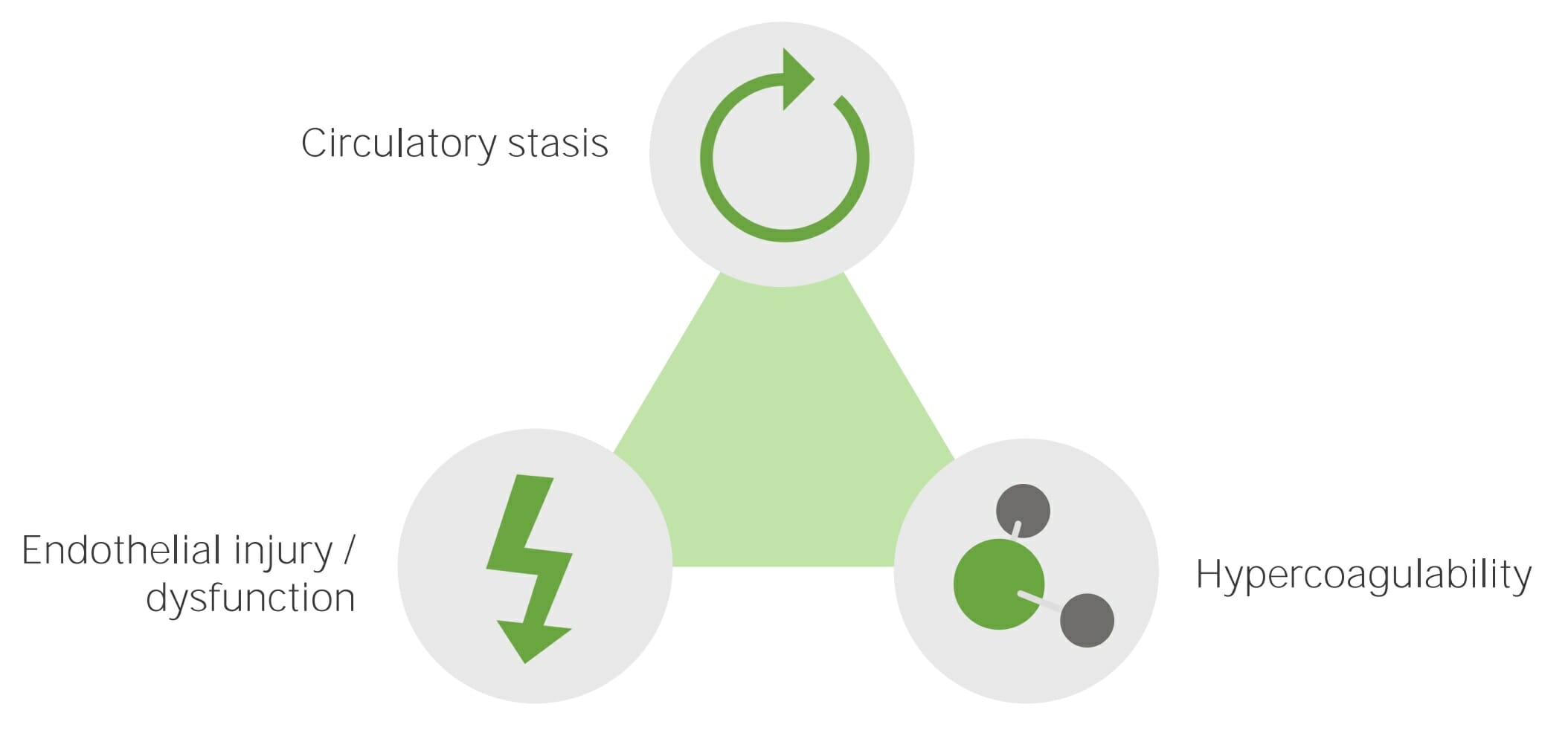
  • La tríada de Virchow (predictiva del desarrollo de la TVP):
    • Estasis
    • Lesión endotelial
    • Estado de hipercoagulabilidad
  • Genéticos:
    • Mutación del factor V Factor V Heat- and storage-labile plasma glycoprotein which accelerates the conversion of prothrombin to thrombin in blood coagulation. Factor V accomplishes this by forming a complex with factor Xa, phospholipid, and calcium (prothrombinase complex). Hemostasis de Leiden
    • Mutación del gen de la protrombina
    • Deficiencias de la proteína C y de la proteína S
  • Adquiridos:
    • Inmovilización
    • Cirugía reciente (especialmente cirugía ortopédica)
    • Malignidad
    • Trauma
    • Obesidad
    • Tabaquismo
    • Exposición a estrógenos:
      • Embarazo
      • Anticoncepción hormonal
      • Terapia de reemplazo hormonal
    • Condiciones médicas:
      • Hipertensión
      • Insuficiencia cardíaca congestiva
      • Enfermedad autoinmune
      • Síndrome nefrótico
Wirchow's triad

La tríada de Virchow. Los principales factores etiológicos que causan la enfermedad tromboembólica venosa son: estasis circulatoria, lesión o disfunción endotelial e hipercoagulabilidad.

Imagen por Lecturio.
Fisiopatología

Localizaciones anatómicas del TEP

  • Émbolo en “silla de montar”:
    • En EN Erythema nodosum is an immune-mediated panniculitis (inflammation of the subcutaneous fat) caused by a type IV (delayed-type) hypersensitivity reaction. It commonly manifests in young women as tender, erythematous nodules on the shins. Erythema Nodosum la bifurcación del tronco pulmonar principal
    • Puede extenderse a la arteria pulmonar principal derecha o izquierda
    • 3%–6% de todos los LOS Neisseria casos
    • 5% de riesgo de mortalidad
  • La mayoría de los LOS Neisseria émbolos se movilizan más allá de la bifurcación hacia ramas más pequeñas de la arteria pulmonar:
    • Ramas lobares
    • Ramas segmentarias
    • Ramas subsegmentarias
  • Los LOS Neisseria casos usualmente tienen múltiples émbolos
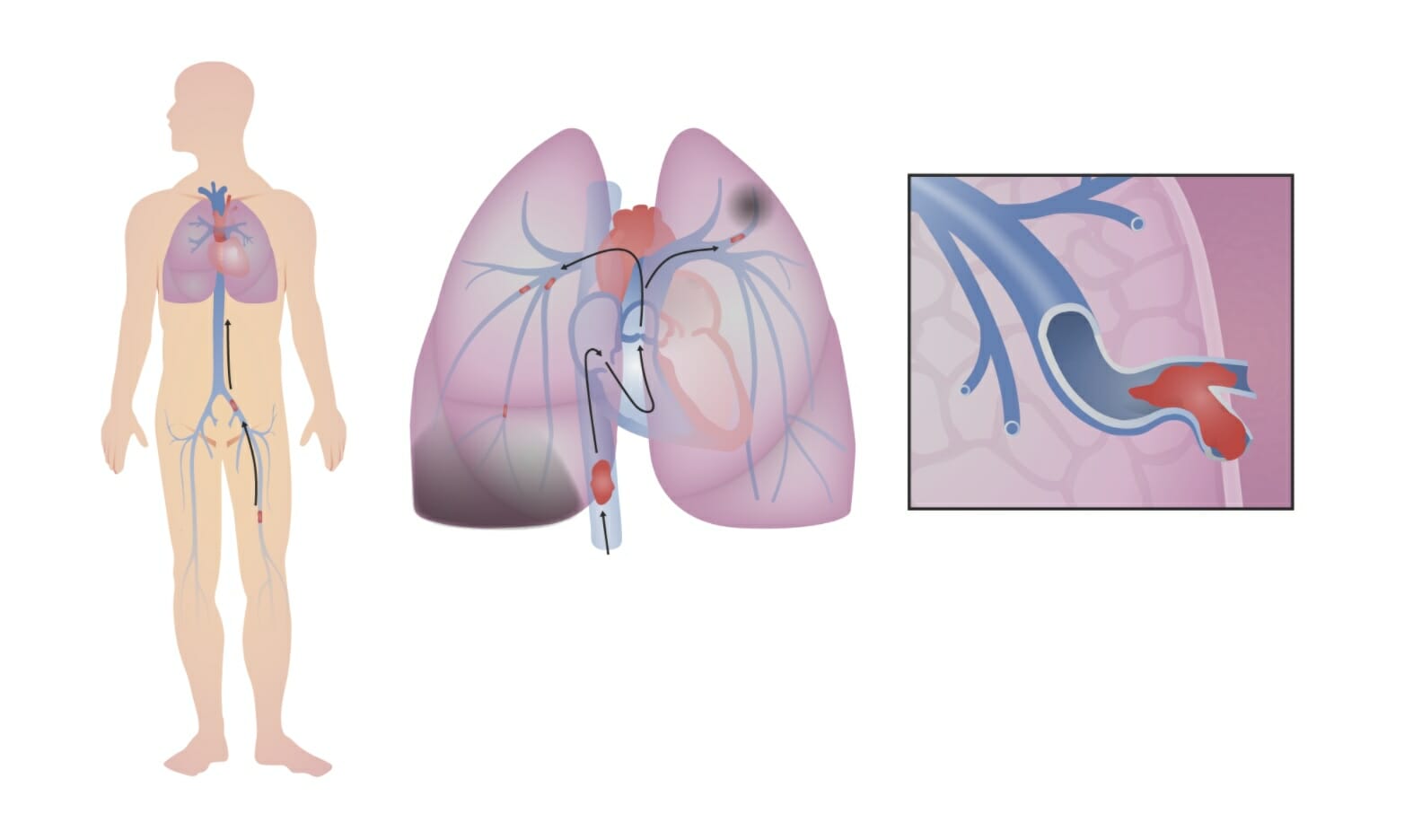
Venous thromboembolism

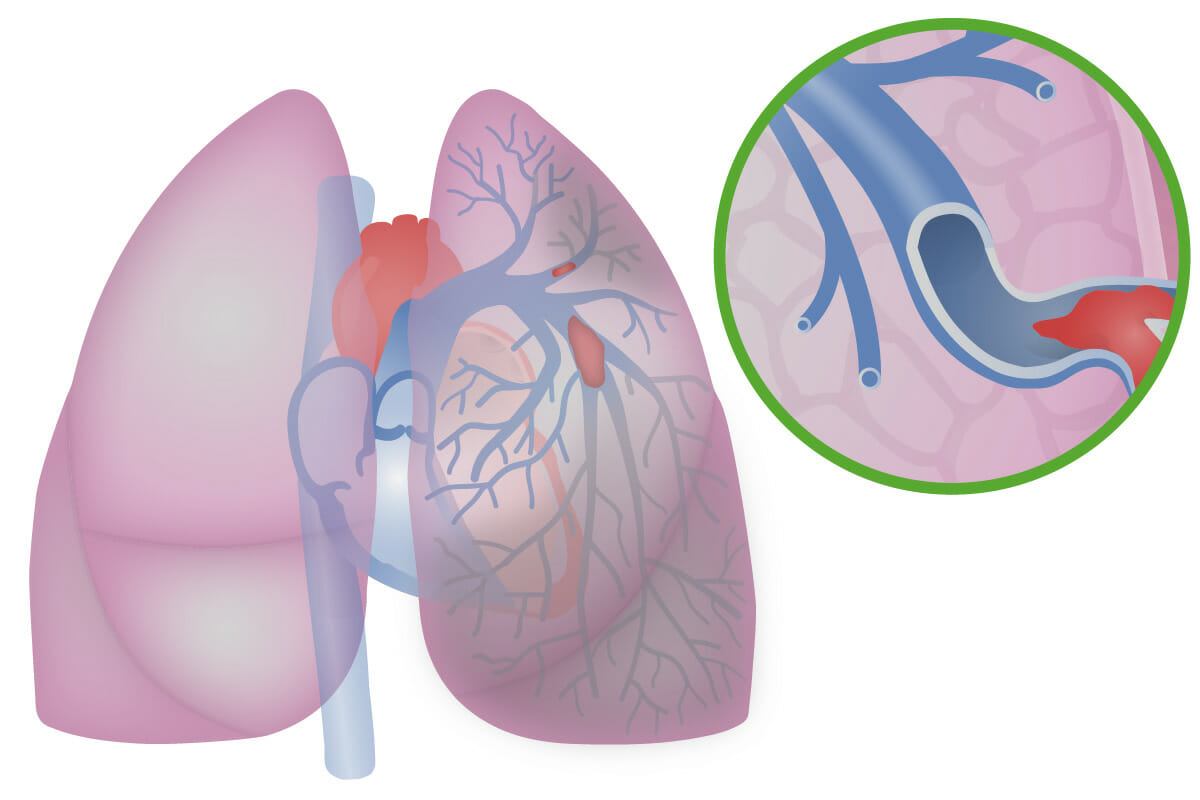
Tromboembolismo venoso. Una trombosis venosa profunda (TVP) se desprende en la pierna (en esta imagen, el trombo se forma en la vena femoral izquierda). Sube por la vena cava inferior, a través del lado derecho del corazón, donde (en este caso) se rompe en fragmentos más pequeños que se alojan en ramas más pequeñas de las arterias pulmonares. Esta obstrucción del flujo sanguíneo a través de los pulmones disminuye la capacidad de los pulmones para oxigenar la sangre y, si es lo suficientemente grande, ejerce presión sobre el lado derecho del corazón.

Imagen por Lecturio.

Fisiopatología

Desajuste de la ventilación/perfusión (V/Q):

  • Obstrucción del flujo vascular → espacio muerto (ventilación sin perfusión)
  • Respuesta inflamatoria, que conduce a:
    • Vasoconstricción y broncoconstricción en EN Erythema nodosum is an immune-mediated panniculitis (inflammation of the subcutaneous fat) caused by a type IV (delayed-type) hypersensitivity reaction. It commonly manifests in young women as tender, erythematous nodules on the shins. Erythema Nodosum zonas cercanas no afectadas → disminuye aún más el flujo sanguíneo (Q) y el flujo aéreo (V).
    • Disminución de la producción de surfactante + atelectasias → cortocircuito (perfusión sin ventilación) → empeora el desajuste V/Q
  • Intercambio gaseoso anormal (debido al AL Amyloidosis espacio muerto y al AL Amyloidosis cortocircuito), que da lugar a:
    • Hipoxemia
    • ↑ impulso respiratorio → hipocapnia y alcalosis respiratoria
    • Nota: el shock Shock Shock is a life-threatening condition associated with impaired circulation that results in tissue hypoxia. The different types of shock are based on the underlying cause: distributive (↑ cardiac output (CO), ↓ systemic vascular resistance (SVR)), cardiogenic (↓ CO, ↑ SVR), hypovolemic (↓ CO, ↑ SVR), obstructive (↓ CO), and mixed. Types of Shock puede provocar hipercapnia y acidosis Acidosis A pathologic condition of acid accumulation or depletion of base in the body. The two main types are respiratory acidosis and metabolic acidosis, due to metabolic acid build up. Respiratory Acidosis

Inestabilidad hemodinámica:

  • Insuficiencia cardíaca derecha:
    • Aumento de la resistencia vascular pulmonar
    • Disminución de la eyección del ventrículo derecho con el consiguiente aumento de la presión venosa central
    • En EN Erythema nodosum is an immune-mediated panniculitis (inflammation of the subcutaneous fat) caused by a type IV (delayed-type) hypersensitivity reaction. It commonly manifests in young women as tender, erythematous nodules on the shins. Erythema Nodosum última instancia, conduce a un strain prolongado del ventrículo derecho, distensión y disminución de la contractilidad
  • Insuficiencia cardíaca izquierda:
    • “La insuficiencia cardíaca derecha causa insuficiencia cardíaca izquierda”.
    • Temporalidad:
      • Ocurre de forma aguda con émbolos más grandes (i.e., centrales)
      • Ocurre más tarde con émbolos alojados en EN Erythema nodosum is an immune-mediated panniculitis (inflammation of the subcutaneous fat) caused by a type IV (delayed-type) hypersensitivity reaction. It commonly manifests in young women as tender, erythematous nodules on the shins. Erythema Nodosum vasos pulmonares más periféricos
    • Mecanismo
      • ↓ Fracción de eyección del ventrículo derecho (debido a grandes émbolos o insuficiencia cardíaca derecha) →
      • ↓ Volumen diastólico final del ventrículo izquierdo →
      • ↓ Gasto cardíaco, que se manifiesta clínicamente como hipotensión y taquicardia

Infarto pulmonar:

  • Ocurre en EN Erythema nodosum is an immune-mediated panniculitis (inflammation of the subcutaneous fat) caused by a type IV (delayed-type) hypersensitivity reaction. It commonly manifests in young women as tender, erythematous nodules on the shins. Erythema Nodosum aproximadamente el 10% de los LOS Neisseria pacientes
  • Asociado a pequeños émbolos en EN Erythema nodosum is an immune-mediated panniculitis (inflammation of the subcutaneous fat) caused by a type IV (delayed-type) hypersensitivity reaction. It commonly manifests in young women as tender, erythematous nodules on the shins. Erythema Nodosum las ramas segmentarias y subsegmentarias, ocasionando isquemia del tejido pulmonar
  • Produce:
    • Respuesta inflamatoria intensa
    • Hemorragia intraalveolar (posible)
Ilustración de una embolia pulmonar

Ilustración de un tromboembolismo pulmonar

Imagen: “Illustration of pulmonary embolism” por Baedr-9439.  Licencia: CC0

Presentación Clínica

Línea de tiempo

  • Aguda: desarrollo inmediato de los LOS Neisseria síntomas
  • Subaguda: desarrollo de los LOS Neisseria síntomas en EN Erythema nodosum is an immune-mediated panniculitis (inflammation of the subcutaneous fat) caused by a type IV (delayed-type) hypersensitivity reaction. It commonly manifests in young women as tender, erythematous nodules on the shins. Erythema Nodosum días o semanas
  • Crónica:
    • No hay síntomas inmediatos
    • Los LOS Neisseria pacientes desarrollan gradualmente la hipertensión pulmonar (durante años).

Síntomas

La presentación varía significativamente. Debe mantenerse una alta sospecha dado el riesgo de complicaciones y mortalidad.

  • Puede ser asintomático (encontrado incidentalmente en EN Erythema nodosum is an immune-mediated panniculitis (inflammation of the subcutaneous fat) caused by a type IV (delayed-type) hypersensitivity reaction. It commonly manifests in young women as tender, erythematous nodules on the shins. Erythema Nodosum las imágenes)
  • El TEP masivo se presenta con inestabilidad hemodinámica/ shock Shock Shock is a life-threatening condition associated with impaired circulation that results in tissue hypoxia. The different types of shock are based on the underlying cause: distributive (↑ cardiac output (CO), ↓ systemic vascular resistance (SVR)), cardiogenic (↓ CO, ↑ SVR), hypovolemic (↓ CO, ↑ SVR), obstructive (↓ CO), and mixed. Types of Shock.
  • Síntoma más frecuente: disnea en EN Erythema nodosum is an immune-mediated panniculitis (inflammation of the subcutaneous fat) caused by a type IV (delayed-type) hypersensitivity reaction. It commonly manifests in young women as tender, erythematous nodules on the shins. Erythema Nodosum reposo y/o de esfuerzo
  • Dolor Dolor Inflammation torácico pleurítico
  • Tos TOS Thoracic outlet syndrome (TOS) is a broad term used for a spectrum of syndromes related to the general region of the thoracic outlet, which involves the compression or irritation of elements of the brachial plexus, subclavian artery, or subclavian vein. Thoracic Outlet Syndrome
  • Hemoptisis (menos común)
  • Infartos pulmonares:
  • Síntomas de la TVP:
    • Dolor Dolor Inflammation y/o sensibilidad en EN Erythema nodosum is an immune-mediated panniculitis (inflammation of the subcutaneous fat) caused by a type IV (delayed-type) hypersensitivity reaction. It commonly manifests in young women as tender, erythematous nodules on the shins. Erythema Nodosum la pantorrilla
    • Edema Edema Edema is a condition in which excess serous fluid accumulates in the body cavity or interstitial space of connective tissues. Edema is a symptom observed in several medical conditions. It can be categorized into 2 types, namely, peripheral (in the extremities) and internal (in an organ or body cavity). Edema de las extremidades
    • Cordón palpable
    • Eritema
    • Calor Calor Inflammation local

Hallazgos al AL Amyloidosis examen físico

  • Taquipnea
  • Taquicardia
  • Estertores y/o disminución de los LOS Neisseria ruidos respiratorios
  • Hipotensión
  • Segundo sonido cardíaco fuerte (P2)
  • Ingurgitación yugular

Related videos

Diagnóstico

El diagnóstico se realiza principalmente por medio de estudios de imagen. La decisión de obtener imágenes se basa en EN Erythema nodosum is an immune-mediated panniculitis (inflammation of the subcutaneous fat) caused by a type IV (delayed-type) hypersensitivity reaction. It commonly manifests in young women as tender, erythematous nodules on the shins. Erythema Nodosum la sospecha clínica, la evaluación de la probabilidad previa a la prueba (normalmente utilizando los LOS Neisseria criterios de Wells modificados) y los LOS Neisseria niveles de dímero D.

Evaluación preliminar

  • Oximetría de pulso: saturación de oxígeno al AL Amyloidosis aire ambiente (Sat O2) < 95%.
  • Dímero D de alta sensibilidad (< 500 ng/mL es normal):
    • Subproducto de la degradación de la fibrina reticulada → indicación de rotura del trombo
    • Sensibilidad > 95% cuando es negativa (i.e., valores normales) → una prueba negativa descarta efectivamente la TEV en EN Erythema nodosum is an immune-mediated panniculitis (inflammation of the subcutaneous fat) caused by a type IV (delayed-type) hypersensitivity reaction. It commonly manifests in young women as tender, erythematous nodules on the shins. Erythema Nodosum casos de riesgo bajo y moderado
    • Baja especificidad → una prueba positiva (valor elevado) no confirma la TEV, ya que cualquier condición que provoque la formación de coágulos puede elevar los LOS Neisseria niveles de dímero D (e.g., cirugía reciente, cáncer, sepsis Sepsis Systemic inflammatory response syndrome with a proven or suspected infectious etiology. When sepsis is associated with organ dysfunction distant from the site of infection, it is called severe sepsis. When sepsis is accompanied by hypotension despite adequate fluid infusion, it is called septic shock. Sepsis and Septic Shock)
  • Otros resultados de laboratorio:
    • La gasometría arterial (GSA) en EN Erythema nodosum is an immune-mediated panniculitis (inflammation of the subcutaneous fat) caused by a type IV (delayed-type) hypersensitivity reaction. It commonly manifests in young women as tender, erythematous nodules on the shins. Erythema Nodosum aire ambiente puede mostrar
      • Hipoxemia
      • Hipocapnia
      • Alcalosis respiratoria
    • Hemograma: Puede haber leucocitosis.
    • Troponinas: pueden estar elevadas en EN Erythema nodosum is an immune-mediated panniculitis (inflammation of the subcutaneous fat) caused by a type IV (delayed-type) hypersensitivity reaction. It commonly manifests in young women as tender, erythematous nodules on the shins. Erythema Nodosum el 50% de los LOS Neisseria pacientes con émbolos de moderados a grandes.
  • Electrocardiografía ( ECG ECG An electrocardiogram (ECG) is a graphic representation of the electrical activity of the heart plotted against time. Adhesive electrodes are affixed to the skin surface allowing measurement of cardiac impulses from many angles. The ECG provides 3-dimensional information about the conduction system of the heart, the myocardium, and other cardiac structures. Electrocardiogram (ECG)) puede mostrar:
    • Arritmia:
      • La taquicardia sinusal es la más común.
      • Fibrilación auricular
    • Patrón de tensión del corazón derecho:
      • Nuevo bloqueo de rama derecha
      • Desviación del eje a la derecha
    • Patrón S1Q3T3 (raro pero patognomónico):
      • Onda S prominente en EN Erythema nodosum is an immune-mediated panniculitis (inflammation of the subcutaneous fat) caused by a type IV (delayed-type) hypersensitivity reaction. It commonly manifests in young women as tender, erythematous nodules on the shins. Erythema Nodosum la derivación I
      • Onda Q en EN Erythema nodosum is an immune-mediated panniculitis (inflammation of the subcutaneous fat) caused by a type IV (delayed-type) hypersensitivity reaction. It commonly manifests in young women as tender, erythematous nodules on the shins. Erythema Nodosum la derivación III
      • Onda T invertida en EN Erythema nodosum is an immune-mediated panniculitis (inflammation of the subcutaneous fat) caused by a type IV (delayed-type) hypersensitivity reaction. It commonly manifests in young women as tender, erythematous nodules on the shins. Erythema Nodosum la derivación III

Determinación de la probabilidad de TEP

  • Comúnmente se utilizan los LOS Neisseria criterios de Wells modificados → califica el TEP como probable o improbable
  • Otros métodos:
    • Puntuación tradicional de los LOS Neisseria criterios de Wells
    • Puntuación de Ginebra
    • Criterio de exclusión del TEP
Tabla: Criterios de Wells modificados
Criterios principales Puntuación
Signos/síntomas de la TVP 3,0
El TEP es clínicamente más probable que otros diagnósticos 3,0
Taquicardia 1,5
Inmovilización prolongada (≥ 3 días) o cirugía reciente ( en EN Erythema nodosum is an immune-mediated panniculitis (inflammation of the subcutaneous fat) caused by a type IV (delayed-type) hypersensitivity reaction. It commonly manifests in young women as tender, erythematous nodules on the shins. Erythema Nodosum los LOS Neisseria últimos 30 días) 1,5
Antecedentes de TEP o TVP 1,5
Hemoptisis 1,0
Malignidad 1,0
Puntuación de los criterios de Wells modificados: ≤ 4: TEP improbable > 4: TEP probable Puntuación de los criterios tradicionales de Wells: 0-1: Bajo riesgo de TEP 2-6: Riesgo intermedio de TEP ≥ 6: Alto riesgo de TEP
TVP: trombosis venosa profunda
TEP: tromboembolismo pulmonar

Uso de la evaluación preliminar y la puntuación de Wells modificada

  • La evaluación de la probabilidad de TEP y los LOS Neisseria niveles de dímero D guían el abordaje diagnóstico.
  • Si el TEP es poco probable (puntuación de Wells modificada ≤ 4):
    • Dímero D normal (< 500): Se excluye TEP.
    • Dímero D elevado: Ordenar angiografía pulmonar por tomografía computarizada con contraste (o gammagrafía V/Q).
  • Si el TEP es probable (puntuación de Wells modificada > 4): Ordenar angiografía pulmonar por tomografía computarizada con contraste.

Imagenología

Radiografía de tórax:

  • Inespecífica
  • Los LOS Neisseria hallazgos pueden incluir:
    • Atelectasia o anomalía en EN Erythema nodosum is an immune-mediated panniculitis (inflammation of the subcutaneous fat) caused by a type IV (delayed-type) hypersensitivity reaction. It commonly manifests in young women as tender, erythematous nodules on the shins. Erythema Nodosum el parénquima
    • Derrame
    • Cardiomegalia

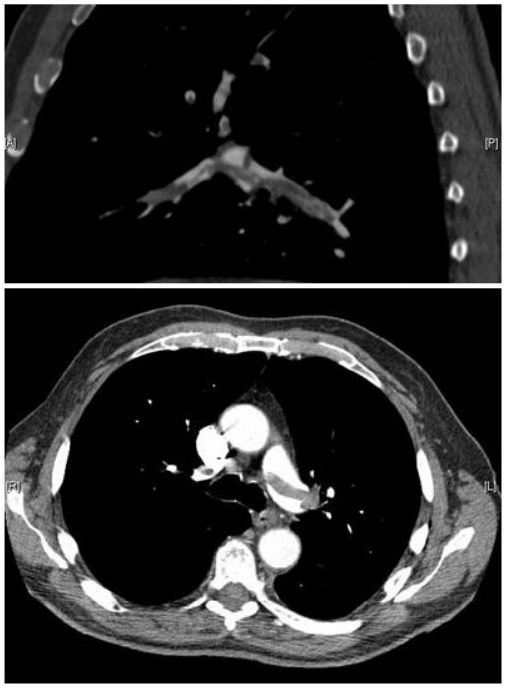
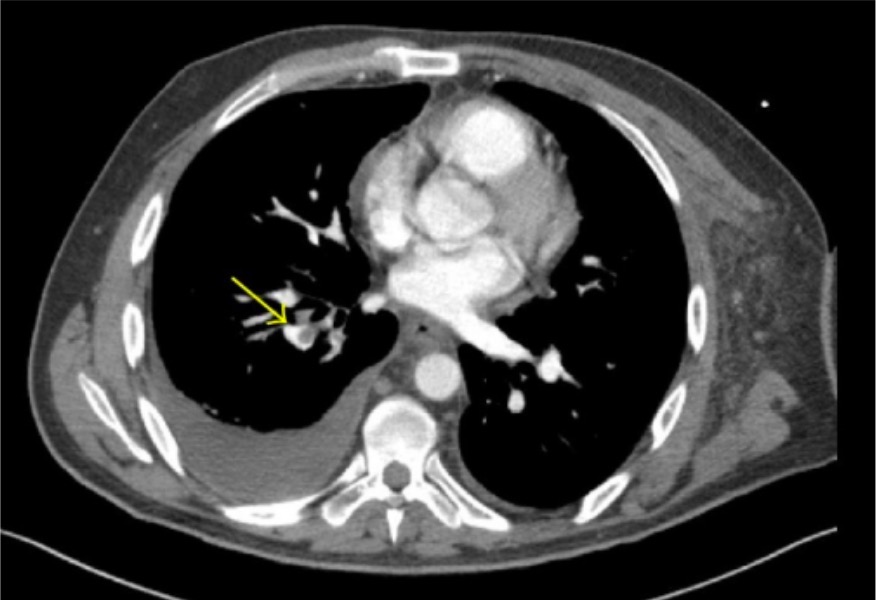
Angiografía pulmonar por TC de tórax con contraste o TC en EN Erythema nodosum is an immune-mediated panniculitis (inflammation of the subcutaneous fat) caused by a type IV (delayed-type) hypersensitivity reaction. It commonly manifests in young women as tender, erythematous nodules on the shins. Erythema Nodosum espiral:

  • Actual “estándar de oro” en EN Erythema nodosum is an immune-mediated panniculitis (inflammation of the subcutaneous fat) caused by a type IV (delayed-type) hypersensitivity reaction. It commonly manifests in young women as tender, erythematous nodules on the shins. Erythema Nodosum el diagnóstico de TEP
  • Mejor prueba inicial si la puntuación de Wells modificada es > 4
  • Muestra defectos de llenado en EN Erythema nodosum is an immune-mediated panniculitis (inflammation of the subcutaneous fat) caused by a type IV (delayed-type) hypersensitivity reaction. It commonly manifests in young women as tender, erythematous nodules on the shins. Erythema Nodosum la vasculatura pulmonar

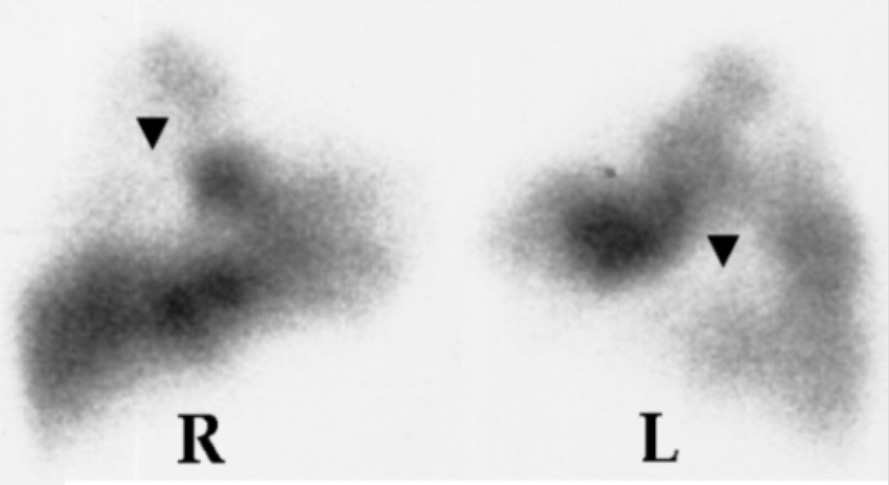
Gammagrafía de ventilación/perfusión (V/Q):

  • Modalidad de diagnóstico de 2da línea
  • Se emplea si la TC está contraindicada, no está disponible o no es concluyente
  • Compara la distribución del aire en EN Erythema nodosum is an immune-mediated panniculitis (inflammation of the subcutaneous fat) caused by a type IV (delayed-type) hypersensitivity reaction. It commonly manifests in young women as tender, erythematous nodules on the shins. Erythema Nodosum los LOS Neisseria pulmones mediante la inhalación de gas xenón radiactivo (la gammagrafía de ventilación) y la perfusión mediante marcadores séricos marcados (la gammagrafía de perfusión)
  • El TEP muestra áreas de defectos de perfusión con ventilación normal
  • Se puntúa como normal, baja, intermedia o alta probabilidad de TEP
  • Limitación importante: la mayoría de los LOS Neisseria individuos tienen gammagrafías indeterminadas

Pruebas en EN Erythema nodosum is an immune-mediated panniculitis (inflammation of the subcutaneous fat) caused by a type IV (delayed-type) hypersensitivity reaction. It commonly manifests in young women as tender, erythematous nodules on the shins. Erythema Nodosum individuos hemodinámicamente inestables: los LOS Neisseria estudios a la cabecera del paciente puede servir para hacer un diagnóstico presuntivo de TEP, que justifica el inicio del tratamiento.

  • Ultrasonido venoso a la cabecera del paciente:
    • Se utiliza para buscar TVP → si está presente, hace HACE Altitude Sickness un diagnóstico presuntivo de TEP
    • Hallazgos:
      • Pérdida de la compresibilidad venosa normal detectada mediante un transductor de ultrasonido
      • Flujo turbulento o retrógrado en EN Erythema nodosum is an immune-mediated panniculitis (inflammation of the subcutaneous fat) caused by a type IV (delayed-type) hypersensitivity reaction. It commonly manifests in young women as tender, erythematous nodules on the shins. Erythema Nodosum las imágenes Doppler Doppler Ultrasonography applying the doppler effect, with frequency-shifted ultrasound reflections produced by moving targets (usually red blood cells) in the bloodstream along the ultrasound axis in direct proportion to the velocity of movement of the targets, to determine both direction and velocity of blood flow. Ultrasound (Sonography)
  • Ecocardiograma a la cabecera del paciente → hallazgos para un diagnóstico presuntivo de TEP incluyen:
    • Strain del ventrículo derecho
    • Puede mostrar un trombo cardíaco (émbolo “en tránsito”)

Angiografía pulmonar:

  • La imagen fluoroscópica se obtiene durante la inyección directa de contraste yodado en EN Erythema nodosum is an immune-mediated panniculitis (inflammation of the subcutaneous fat) caused by a type IV (delayed-type) hypersensitivity reaction. It commonly manifests in young women as tender, erythematous nodules on the shins. Erythema Nodosum la arteria pulmonar principal a través de un catéter central
  • Sustituida en EN Erythema nodosum is an immune-mediated panniculitis (inflammation of the subcutaneous fat) caused by a type IV (delayed-type) hypersensitivity reaction. It commonly manifests in young women as tender, erythematous nodules on the shins. Erythema Nodosum gran medida por la angiografía pulmonar por TC, pero se utiliza si:
    • La TC no es concluyente
    • Planificación de una trombólisis o embolectomía dirigida por catéter

Tratamiento y Pronóstico

Evaluación del ABC

Evaluar y tratar cualquier inestabilidad hemodinámica. La mayoría de los LOS Neisseria individuos se presentarán en EN Erythema nodosum is an immune-mediated panniculitis (inflammation of the subcutaneous fat) caused by a type IV (delayed-type) hypersensitivity reaction. It commonly manifests in young women as tender, erythematous nodules on the shins. Erythema Nodosum condiciones estables o responderán a los LOS Neisseria esfuerzos iniciales de reanimación.

  • Vía aérea
  • Respiración/ Soporte respiratorio:
    • Terapia de oxígeno suplementario para mejorar la saturación de O2 > 95%.
    • Cánula nasal, máscara de no reinhalación, ventilación mecánica
  • Soporte circulatorio/hemodinámico:
    • Pequeña cantidad de líquidos intravenosos (evitar la sobrecarga de fluidos que empeora los LOS Neisseria efectos de la insuficiencia cardíaca derecha)
    • Vasopresores (normalmente norepinefrina)
    • La selección de los LOS Neisseria medicamentos cardíacos debe basarse en EN Erythema nodosum is an immune-mediated panniculitis (inflammation of the subcutaneous fat) caused by a type IV (delayed-type) hypersensitivity reaction. It commonly manifests in young women as tender, erythematous nodules on the shins. Erythema Nodosum la presencia y la gravedad de la insuficiencia cardíaca y la hemodinámica.

Anticoagulación: tratamiento inicial

  • Opciones:
    • Heparina de bajo peso molecular (HBPM)
    • Heparina no fraccionada (HNF)
    • Inhibidor indirecto del factor Xa: fondaparinux Fondaparinux Synthetic pentasaccharide that mediates the interaction of heparin with antithrombins and inhibits factor Xa; it is used for prevention of venous thromboembolism after surgery. Anticoagulants
    • Inhibidores directos del factor Xa: rivaroxabán, apixabán (ambos aprobados en EN Erythema nodosum is an immune-mediated panniculitis (inflammation of the subcutaneous fat) caused by a type IV (delayed-type) hypersensitivity reaction. It commonly manifests in young women as tender, erythematous nodules on the shins. Erythema Nodosum monoterapia para la enfermedad tromboembólica venosa)
    • Inhibidor directo de la trombina: dabigatrán
  • Los LOS Neisseria medicamentos se selecciona en EN Erythema nodosum is an immune-mediated panniculitis (inflammation of the subcutaneous fat) caused by a type IV (delayed-type) hypersensitivity reaction. It commonly manifests in young women as tender, erythematous nodules on the shins. Erythema Nodosum función de la experiencia del médico, las comorbilidades del paciente y sus preferencias.
  • Contraindicaciones:
    • Hemorragia activa
    • Hemorragia intracraneal aguda
    • Traumatismos graves
    • Trastornos hemorrágicos graves
  • Nota:
    • La warfarina no debe utilizarse como tratamiento inicial debido al AL Amyloidosis breve período de hipercoagulabilidad al AL Amyloidosis inicio
      Se prefiere la HNF en EN Erythema nodosum is an immune-mediated panniculitis (inflammation of the subcutaneous fat) caused by a type IV (delayed-type) hypersensitivity reaction. It commonly manifests in young women as tender, erythematous nodules on the shins. Erythema Nodosum personas con insuficiencia renal

Terapia de reperfusión

  • Terapia trombolítica:
    • Infusión de un agente lítico (usualmente un activador tisular del plasminógeno)
    • Rutas:
      • Terapia sistémica
      • Dirigida por catéter: una punta de catéter dirigida al AL Amyloidosis émbolo para intentar lisar el trombo
    • Indicaciones:
      • Pacientes hemodinámicamente inestables con un tromboembolismo masivo
      • Pacientes hemodinámicamente estables con resultados adversos (por ejemplo, disfunción del ventrículo derecho)
      • Individuos que no responden a los LOS Neisseria anticoagulantes sistémicos con un claro deterioro
  • La embolectomía consiste en EN Erythema nodosum is an immune-mediated panniculitis (inflammation of the subcutaneous fat) caused by a type IV (delayed-type) hypersensitivity reaction. It commonly manifests in young women as tender, erythematous nodules on the shins. Erythema Nodosum la extracción del émbolo:
    • Procedimiento quirúrgico o con catéter
    • Indicaciones:
      • Pacientes hemodinámicamente inestables con tromboembolismo masivo, que no son candidatos adecuados para la terapia trombolítica (e.g., hemorragia activa)
      • En EN Erythema nodosum is an immune-mediated panniculitis (inflammation of the subcutaneous fat) caused by a type IV (delayed-type) hypersensitivity reaction. It commonly manifests in young women as tender, erythematous nodules on the shins. Erythema Nodosum casos de terapia trombolítica fallida

Profilaxis contra TEP recurrente

Anticoagulación: prevención secundaria de la enfermedad tromboembólica venosa

  • Se administra durante 3-6 meses para prevenir las recidivas (algunos pacientes pueden necesitar un tratamiento de por vida)
  • La duración de la terapia depende de los LOS Neisseria factores de riesgo de recurrencia y hemorragia
  • Opciones:
    • HBPM
    • Antagonistas de la vitamina K: warfarina
      • Requiere un control regular Regular Insulin del tiempo de protrombina [TP]
      • Numerosas interacciones medicamentosas
      • Contraindicados en EN Erythema nodosum is an immune-mediated panniculitis (inflammation of the subcutaneous fat) caused by a type IV (delayed-type) hypersensitivity reaction. It commonly manifests in young women as tender, erythematous nodules on the shins. Erythema Nodosum el embarazo (teratogénico)
    • Inhibidores directos del factor Xa: rivaroxaban Rivaroxaban A morpholine and thiophene derivative that functions as a factor Xa inhibitor and is used in the treatment and prevention of deep-vein thrombosis and pulmonary embolism. It is also used for the prevention of stroke and systemic embolization in patients with non-valvular atrial fibrillation, and for the prevention of atherothrombotic events in patients after an acute coronary syndrome. Anticoagulants, apixaban Apixaban Anticoagulants, edoxaban Edoxaban Anticoagulants
      • Por lo general, no es necesaria monitorización
      • Más caros
    • Inhibidores de la trombina: dabigatrán
      • Requiere la monitorización del tiempo de tromboplastina parcial activado (TTPa)
      • A menudo se utiliza en EN Erythema nodosum is an immune-mediated panniculitis (inflammation of the subcutaneous fat) caused by a type IV (delayed-type) hypersensitivity reaction. It commonly manifests in young women as tender, erythematous nodules on the shins. Erythema Nodosum pacientes con antecedentes de trombocitopenia inducida por heparina
  • Dependiendo de las terapias iniciales y secundarias, puede ser necesario hacer un “puente” para asegurar la anticoagulación completa durante la transición de la terapia (e.g., continuar con la HBPM hasta que la warfarina sea efectiva según el TP)

Filtro de vena cava inferior (VCI)

  • Se utiliza para prevenir el TEP en EN Erythema nodosum is an immune-mediated panniculitis (inflammation of the subcutaneous fat) caused by a type IV (delayed-type) hypersensitivity reaction. It commonly manifests in young women as tender, erythematous nodules on the shins. Erythema Nodosum pacientes con TVP
  • Barrera colocada dentro de la VCI para impedir el paso del trombo migratorio al AL Amyloidosis sistema arterial pulmonar
  • No es útil para la TVP en EN Erythema nodosum is an immune-mediated panniculitis (inflammation of the subcutaneous fat) caused by a type IV (delayed-type) hypersensitivity reaction. It commonly manifests in young women as tender, erythematous nodules on the shins. Erythema Nodosum las extremidades superiores
  • Indicaciones:
    • Paciente con contraindicación para el uso de anticoagulantes
    • Complicaciones o fracaso de los LOS Neisseria anticoagulantes sistémicos
    • Mala reserva cardiopulmonar

Estilo de vida/otras opciones:

  • Ejercicio
  • Pérdida de peso
  • Dejar de fumar
  • Control de la hipertensión
  • Evitar los LOS Neisseria estrógenos (e.g.,, píldoras anticonceptivas orales combinadas) en EN Erythema nodosum is an immune-mediated panniculitis (inflammation of the subcutaneous fat) caused by a type IV (delayed-type) hypersensitivity reaction. It commonly manifests in young women as tender, erythematous nodules on the shins. Erythema Nodosum pacientes de alto riesgo
  • Medias de compresión

Pronóstico

  • Mortalidad estimada:
    • TEP no tratada: aproximadamente el 30%.
    • TEP tratada: 2%-11%
  • Indicadores de mal pronóstico:
    • Disfunción del ventrículo derecho
    • Shock Shock Shock is a life-threatening condition associated with impaired circulation that results in tissue hypoxia. The different types of shock are based on the underlying cause: distributive (↑ cardiac output (CO), ↓ systemic vascular resistance (SVR)), cardiogenic (↓ CO, ↑ SVR), hypovolemic (↓ CO, ↑ SVR), obstructive (↓ CO), and mixed. Types of Shock durante la presentación
  • Recurrencia:
    • Más probable en EN Erythema nodosum is an immune-mediated panniculitis (inflammation of the subcutaneous fat) caused by a type IV (delayed-type) hypersensitivity reaction. It commonly manifests in young women as tender, erythematous nodules on the shins. Erythema Nodosum pacientes con factores de riesgo no resueltos (i.e., cáncer)
    • Mayor en EN Erythema nodosum is an immune-mediated panniculitis (inflammation of the subcutaneous fat) caused by a type IV (delayed-type) hypersensitivity reaction. It commonly manifests in young women as tender, erythematous nodules on the shins. Erythema Nodosum las 2 primeras semanas tras la presentación
  • La hipertensión pulmonar tromboembólica crónica es una secuela a largo plazo que rara vez se produce:
    • Los LOS Neisseria pacientes se quejan de disnea progresiva y/o intolerancia al AL Amyloidosis ejercicio.
    • Puede ser el resultado de un trombo no disuelto o de daños en EN Erythema nodosum is an immune-mediated panniculitis (inflammation of the subcutaneous fat) caused by a type IV (delayed-type) hypersensitivity reaction. It commonly manifests in young women as tender, erythematous nodules on the shins. Erythema Nodosum el parénquima
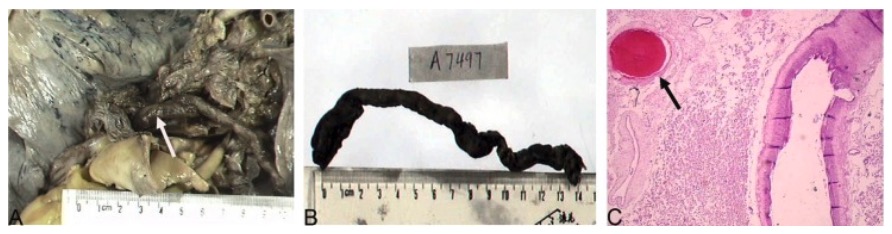
Embolia pulmonar en ambas arterias pulmonares

Émbolos pulmonares en ambas arterias pulmonares revelados tras la autopsia de un paciente que murió de embolia pulmonar:
A: trombo macroscópico (flechas)
B: trombo de 20 cm de longitud
C: trombos microscópicos (flechas), tinción de hematoxilina y eosina, aumento X100

Imagen: “Pulmonary emboli” por Department of Obstetrics and Gynecology, Peking Union Medical College Hospital, Chinese Academy of Medical Sciences & Peking Union Medical College, Beijing, China. Licencia: CC BY 4.0

Diagnóstico Diferencial

  • Insuficiencia cardíaca aguda: una reducción aguda de la función cardíaca. La insuficiencia cardíaca aguda suele presentarse con disnea, niveles bajos de saturación de O2 con aire ambiente y edema Edema Edema is a condition in which excess serous fluid accumulates in the body cavity or interstitial space of connective tissues. Edema is a symptom observed in several medical conditions. It can be categorized into 2 types, namely, peripheral (in the extremities) and internal (in an organ or body cavity). Edema en EN Erythema nodosum is an immune-mediated panniculitis (inflammation of the subcutaneous fat) caused by a type IV (delayed-type) hypersensitivity reaction. It commonly manifests in young women as tender, erythematous nodules on the shins. Erythema Nodosum las extremidades inferiores, que es más probable que sea bilateral que unilateral. El BNP BNP A peptide that is secreted by the brain and the heart atria, stored mainly in cardiac ventricular myocardium. It can cause natriuresis; diuresis; vasodilation; and inhibits secretion of renin and aldosterone. It improves heart function. It contains 32 amino acids. Renal Sodium and Water Regulation y la troponina elevados son habituales y los LOS Neisseria hallazgos de la ecocardiografía ayudan al AL Amyloidosis diagnóstico. La radiografía de tórax puede evidenciar un edema Edema Edema is a condition in which excess serous fluid accumulates in the body cavity or interstitial space of connective tissues. Edema is a symptom observed in several medical conditions. It can be categorized into 2 types, namely, peripheral (in the extremities) and internal (in an organ or body cavity). Edema pulmonar. El tratamiento se basa en EN Erythema nodosum is an immune-mediated panniculitis (inflammation of the subcutaneous fat) caused by a type IV (delayed-type) hypersensitivity reaction. It commonly manifests in young women as tender, erythematous nodules on the shins. Erythema Nodosum la optimización médica.
  • Infarto al AL Amyloidosis miocardio: isquemia aguda del miocardio. El infarto al AL Amyloidosis miocardio puede provocar taquiarritmia, insuficiencia cardíaca derecha y/o izquierda e hipotensión, según la gravedad y la localización. El dolor Dolor Inflammation torácico que se produce durante un infarto suele ser de localización subesternal y no suele ser pleurítico. Las enzimas cardíacas elevadas de forma seriada y los LOS Neisseria cambios del segmento ST en EN Erythema nodosum is an immune-mediated panniculitis (inflammation of the subcutaneous fat) caused by a type IV (delayed-type) hypersensitivity reaction. It commonly manifests in young women as tender, erythematous nodules on the shins. Erythema Nodosum el ECG ECG An electrocardiogram (ECG) is a graphic representation of the electrical activity of the heart plotted against time. Adhesive electrodes are affixed to the skin surface allowing measurement of cardiac impulses from many angles. The ECG provides 3-dimensional information about the conduction system of the heart, the myocardium, and other cardiac structures. Electrocardiogram (ECG) suelen ser diagnósticos. El tratamiento implica estabilización, anticoagulantes y terapias de reperfusión.
  • Neumonía: inflamación del parénquima pulmonar causada generalmente por una infección respiratoria. La neumonía puede causar dolor Dolor Inflammation torácico pleurítico con niveles bajos de saturación de O2 con aire ambiente. La radiografía de tórax suele revelar lesiones parenquimatosas, que suelen estar ausentes en EN Erythema nodosum is an immune-mediated panniculitis (inflammation of the subcutaneous fat) caused by a type IV (delayed-type) hypersensitivity reaction. It commonly manifests in young women as tender, erythematous nodules on the shins. Erythema Nodosum la EP EP Ectopic pregnancy refers to the implantation of a fertilized egg (embryo) outside the uterine cavity. The main cause is disruption of the normal anatomy of the fallopian tube. Ectopic Pregnancy a menos que haya un infarto parenquimatoso. El tratamiento es con antibióticos y soporte respiratorio en EN Erythema nodosum is an immune-mediated panniculitis (inflammation of the subcutaneous fat) caused by a type IV (delayed-type) hypersensitivity reaction. It commonly manifests in young women as tender, erythematous nodules on the shins. Erythema Nodosum los LOS Neisseria casos avanzados.
  • Exacerbación de la enfermedad pulmonar obstructiva crónica (EPOC): exacerbación aguda de una enfermedad crónica de las vías respiratorias inferiores que provoca una alteración respiratoria. La enfermedad pulmonar obstructiva crónica se presenta con una marcada disnea y suele ir acompañada de sibilancias. El dolor Dolor Inflammation torácico es un síntoma poco probable en EN Erythema nodosum is an immune-mediated panniculitis (inflammation of the subcutaneous fat) caused by a type IV (delayed-type) hypersensitivity reaction. It commonly manifests in young women as tender, erythematous nodules on the shins. Erythema Nodosum ausencia de una neumonía concomitante. El diagnóstico se establece sobre la base de una combinación de antecedentes, síntomas clínicos y pruebas de función pulmonar. Los LOS Neisseria síntomas suelen mejorar con terapia de oxígeno suplementario y una combinación de tratamientos esteroides.

Referencias

  1. Bauer, K.A., Lip, G. (2020). Overview of the causes of venous thrombosis. UpToDate. Retrieved December 7, 2020, from https://www.uptodate.com/contents/overview-of-the-causes-of-venous-thrombosis
  2. Tapson, V.F., Weinberg, A.S. (2020). Treatment, prognosis, and follow-up of acute pulmonary embolism in adults. UpToDate. Retrieved December 6, 2020, from https://www.uptodate.com/contents/treatment-prognosis-and-follow-up-of-acute-pulmonary-embolism-in-adults
  3. Thompson, B.T., Kabrhel, C. (2020). Overview of acute pulmonary embolism in adults. UpToDate. Retrieved December 6, 2020, from https://www.uptodate.com/contents/overview-of-acute-pulmonary-embolism-in-adults
  4. Hollander, J.E., Chase, M. (2020). Evaluation of the adult with chest pain in the emergency department. UpToDate. Retrieved December 9, 2020, from https://www.uptodate.com/contents/evaluation-of-the-adult-with-chest-pain-in-the-emergency-department
  5. Thompson, B.T., Kabrhel, C., Pena, C. (2020). Clinical presentation, evaluation, and diagnosis of the nonpregnant adult with suspected acute pulmonary embolism. UpToDate. Retrieved December 9, 2020, from https://www.uptodate.com/contents/clinical-presentation-evaluation-and-diagnosis-of-the-nonpregnant-adult-with-suspected-acute-pulmonary-embolism
  6. Lip, G.Y.H., Hull, R.D. (2020). Overview of the treatment of lower extremity deep vein thrombosis (DVT). UpToDate. Retrieved December 11, 2020, from https://www.uptodate.com/contents/overview-of-the-treatment-of-lower-extremity-deep-vein-thrombosis-dvt
  7. Cordeanu, E.M., Lambach, H., Heitz, M., et al. (2019). Pulmonary Embolism and Coexisting Deep Vein Thrombosis: A Detrimental Association? Journal of Clinical Medicine, 8(6), 899. https://doi.org/10.3390/jcm8060899
  8. Senyei, G., Fernandes, T. (2019). Duration of Anticoagulation Post-PE: Things to Consider. American College of Cardiology, Expert Analysis. https://www.acc.org/latest-in-cardiology/articles/2019/03/22/07/45/duration-of-anticoagulation-post-pe
  9. Sohaip, K.S, Singh, V., Alkassis, S. (2020). A Comprehensive Literature Review on the Management of Distal Deep Vein Thrombosis. Cureus. 12(5): e8048. https://doi.org/10.7759/cureus.8048
  10. Ouellette, D.R. Pulmonary Embolism. Medscape. (2020). https://emedicine.medscape.com/article/300901-overview
  11. Tapson, V. Acute Pulmonary Embolism: Epidemiology, Clinical Manifestations, and Diagnosis. (2017). Pulmonary Advisor. https://www.pulmonologyadvisor.com/home/decision-support-in-medicine/pulmonary-medicine/acute-pulmonary-embolism-epidemiology-clinical-manifestations-and-diagnosis/
  12. Pulivarthi, S., Gurram, M.K. Effectiveness of D-dimer as a screening test for thromboembolism: An Update. (2014). North American Journal of Medical Sciences, 6(10), 491–499. https://doi.org/10.4103/1947-2714.143278
  13. Moore, A.J.E., Wachsmann, J., Chamarthy, M.R., et al. (2018). Imaging of acute PE: an update. Cardiovascular Diagnosis & Therapy, 225–243. https://doi.org/10.21037/cdt.2017.12.01
  14. O’Connell, C. (2015). How I treat incidental pulmonary embolism. Blood, 125 (12), 1877–1882. https://doi.org/10.1182/blood-2014-08-551879
  15. Malik, S., Bhardwaj, A., Eisen, M., et al. (2016). Advanced Management Options For Massive And Submassive Pulmonary Emboli. US Cardiology Review, 10(1), 30–35. https://doi.org/10.15420/usc.2016.10.1.30

¡Crea tu cuenta gratis o inicia una sesión para seguir leyendo!

Regístrate ahora y obtén acceso gratuito a Lecturio con páginas de concepto, videos médicos y cuestionarios para tu educación médica.

User Reviews

Que tengas una sesión de estudio alegre y navideña 🎁 Ahorra 50% en todos los planes >>

Details