
Domina Conceptos Médicos

Estudia para la escuela de medicina y tus examenes con Lecturio.

Eicosanoides

Los LOS Neisseria eicosanoides son moléculas de señalización celular producidas a partir del ácido araquidónico. Con la acción de la fosfolipasa A2, el ácido araquidónico se libera de la membrana plasmática. Las diferentes familias de eicosanoides, que son las prostaglandinas (PGs), los LOS Neisseria tromboxanos (TXA2), la prostaciclina ( PGI PGI An aldose-ketose isomerase that catalyzes the reversible interconversion of glucose 6-phosphate and fructose 6-phosphate. In prokaryotic and eukaryotic organisms it plays an essential role in glycolytic and gluconeogenic pathways. In mammalian systems the enzyme is found in the cytoplasm and as a secreted protein. This secreted form of glucose-6-phosphate isomerase has been referred to as autocrine motility factor or neuroleukin, and acts as a cytokine which binds to the autocrine motility factor receptor. Deficiency of the enzyme in humans is an autosomal recessive trait, which results in congenital nonspherocytic hemolytic anemia. Glycolysis2), las lipoxinas y los LOS Neisseria leucotrienos , surgen de una serie de reacciones catalizadas por diferentes enzimas. Los LOS Neisseria leucotrienos y las lipoxinas son productos de la vía de la lipoxigenasa. Los LOS Neisseria demás eicosanoides se producen a partir de la vía de la ciclooxigenasa (COX), en EN Erythema nodosum is an immune-mediated panniculitis (inflammation of the subcutaneous fat) caused by a type IV (delayed-type) hypersensitivity reaction. It commonly manifests in young women as tender, erythematous nodules on the shins. Erythema Nodosum la que intervienen 2 enzimas, COX-1 y COX-2. Los LOS Neisseria eicosanoides están implicados en EN Erythema nodosum is an immune-mediated panniculitis (inflammation of the subcutaneous fat) caused by a type IV (delayed-type) hypersensitivity reaction. It commonly manifests in young women as tender, erythematous nodules on the shins. Erythema Nodosum diversos procesos fisiológicos y patológicos. Los LOS Neisseria tromboxanos provocan la agregación plaquetaria y son potentes vasoconstrictores. Los LOS Neisseria leucotrienos median las respuestas alérgicas, mientras que las lipoxinas tienen actividades antiinflamatorias. Las principales acciones de las prostaglandinas incluyen la vasodilatación, contracción del músculo liso e inflamación. La prostaciclina, miembro de la familia de las prostaglandinas, tiene un potente efecto vasodilatador. Tanto las acciones biológicas como las inhibiciones de los LOS Neisseria eicosanoides son mecanismos utilizados en EN Erythema nodosum is an immune-mediated panniculitis (inflammation of the subcutaneous fat) caused by a type IV (delayed-type) hypersensitivity reaction. It commonly manifests in young women as tender, erythematous nodules on the shins. Erythema Nodosum los LOS Neisseria medicamentos para diversas condiciones médicas y efectos clínicos deseados.

Last updated: Oct 23, 2022
Editorial responsibility: Stanley Oiseth, Lindsay Jones, Evelin Maza

Descripción General

Eicosanoides

  • Moléculas de señalización celular
  • Se producen a partir del ácido araquidónico (un abundante ácido graso poliinsaturado de 20 carbonos que se libera de la membrana plasmática mediante la actividad de la fosfolipasa A2)
  • Principales familias de eicosanoides:
    • Prostanoides:
      • Tromboxanos (TXA2s)
      • Prostaglandinas (PG)
      • Prostaciclina ( PGI PGI An aldose-ketose isomerase that catalyzes the reversible interconversion of glucose 6-phosphate and fructose 6-phosphate. In prokaryotic and eukaryotic organisms it plays an essential role in glycolytic and gluconeogenic pathways. In mammalian systems the enzyme is found in the cytoplasm and as a secreted protein. This secreted form of glucose-6-phosphate isomerase has been referred to as autocrine motility factor or neuroleukin, and acts as a cytokine which binds to the autocrine motility factor receptor. Deficiency of the enzyme in humans is an autosomal recessive trait, which results in congenital nonspherocytic hemolytic anemia. Glycolysis2)
    • Leucotrienos (LT) y lipoxinas (LX)
  • Nombres de los receptores: El sistema de clasificación de los receptores utiliza la letra distintiva del prostanoide (e.g., “E” en prostaglandina E) y la combina con la letra “p” de prostanoide. (e.g., la PGE tiene receptores EP EP Ectopic pregnancy refers to the implantation of a fertilized egg (embryo) outside the uterine cavity. The main cause is disruption of the normal anatomy of the fallopian tube. Ectopic Pregnancy). Los LOS Neisseria subíndices representan los LOS Neisseria subtipos (e.g., PGE2 = EP EP Ectopic pregnancy refers to the implantation of a fertilized egg (embryo) outside the uterine cavity. The main cause is disruption of the normal anatomy of the fallopian tube. Ectopic Pregnancy2).

Biosíntesis

  • Los LOS Neisseria eicosanoides no suelen almacenarse en EN Erythema nodosum is an immune-mediated panniculitis (inflammation of the subcutaneous fat) caused by a type IV (delayed-type) hypersensitivity reaction. It commonly manifests in young women as tender, erythematous nodules on the shins. Erythema Nodosum las células.
  • La síntesis es a demanda y se ve VE Ventilation: Mechanics of Breathing afectada por estímulos físicos, químicos y hormonales.
  • Con los LOS Neisseria estímulos adecuados, se activan vías específicas para producir diferentes familias de eicosanoides.
  • Estímulos → fosfolipasas activadas → se libera ácido araquidónico
  • El ácido araquidónico se metaboliza por diferentes vías enzimáticas:
    • LOX → Leucotrienos y Lipoxinas
    • COX PGI PGI An aldose-ketose isomerase that catalyzes the reversible interconversion of glucose 6-phosphate and fructose 6-phosphate. In prokaryotic and eukaryotic organisms it plays an essential role in glycolytic and gluconeogenic pathways. In mammalian systems the enzyme is found in the cytoplasm and as a secreted protein. This secreted form of glucose-6-phosphate isomerase has been referred to as autocrine motility factor or neuroleukin, and acts as a cytokine which binds to the autocrine motility factor receptor. Deficiency of the enzyme in humans is an autosomal recessive trait, which results in congenital nonspherocytic hemolytic anemia. Glycolysis2, PG o TXA2
      • COX-1: enzima que se expresa de forma constitutiva en EN Erythema nodosum is an immune-mediated panniculitis (inflammation of the subcutaneous fat) caused by a type IV (delayed-type) hypersensitivity reaction. It commonly manifests in young women as tender, erythematous nodules on the shins. Erythema Nodosum muchos tejidos
      • COX-2: enzima inducida por citoquinas proinflamatorias y que se encuentra en EN Erythema nodosum is an immune-mediated panniculitis (inflammation of the subcutaneous fat) caused by a type IV (delayed-type) hypersensitivity reaction. It commonly manifests in young women as tender, erythematous nodules on the shins. Erythema Nodosum el cerebro, riñón, huesos y el sistema reproductor femenino
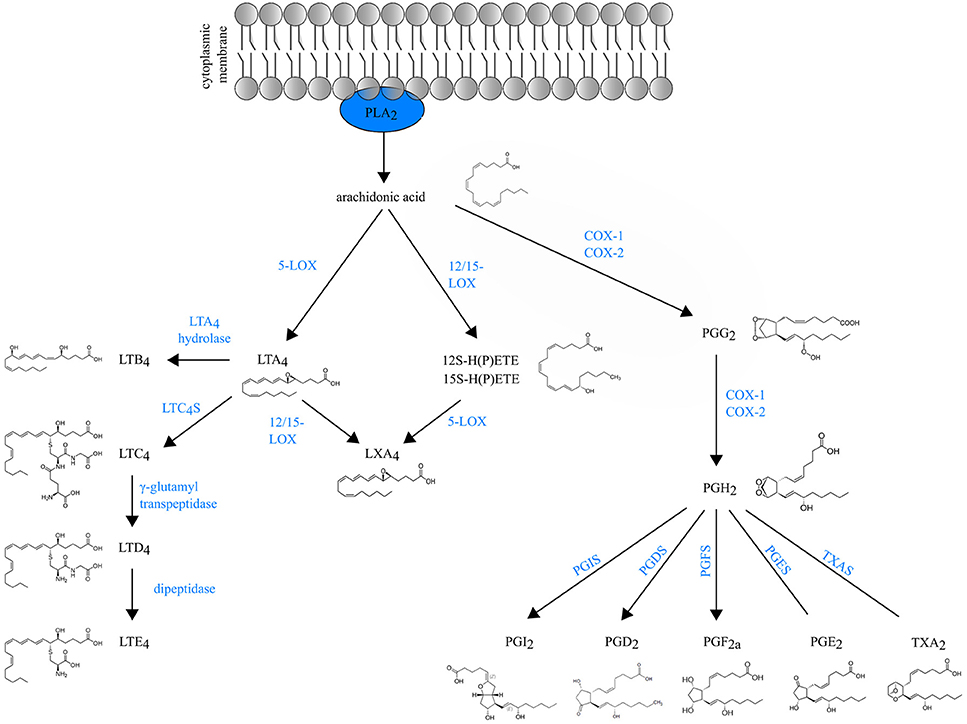
Resumen esquemático de la biosíntesis de los eicosanoides

Resumen esquemático de la biosíntesis de eicosanoides:
El ácido araquidónico liberado de los fosfolípidos de la membrana por la fosfolipasa A2 citosólica puede ser convertido enzimáticamente en prostaglandinas (PGs) y tromboxano (TXA2) por las enzimas COX o en leucotrienos (LTs) y lipoxinas (LXA4) por las lipooxigenasas (LOXs).
5-LOX: 5-lipoxigenasa
12/15-LOX: 12/15-lipoxigenasa
LTC4S: LTC4 sintasa
PGIS: PGI o prostaciclina sintasa
PGDS: PG D2 sintasa
PGFS: PG F sintasa
PGES: PG E sintasa
TXAS: TXA2 sintasa

Imagen: “Schematic overview of eicosanoid biosynthesis” por Debeuf N et al. Licencia: CC BY 4.0

Tromboxanos

Descripción

  • Metabolito del ácido araquidónico sintetizado en EN Erythema nodosum is an immune-mediated panniculitis (inflammation of the subcutaneous fat) caused by a type IV (delayed-type) hypersensitivity reaction. It commonly manifests in young women as tender, erythematous nodules on the shins. Erythema Nodosum las plaquetas
  • Se genera a través del siguiente proceso:
    • Ácido araquidónico → prostaglandina H2 (PGH2) a través de las enzimas COX-1/COX-2
    • El TXA2 deriva predominantemente de COX-1.
    • PGH2→ TXA2 mediante la acción de la TXA2 sintasa (TXAS)
  • Receptores: TPɑ y β (se expresan en EN Erythema nodosum is an immune-mediated panniculitis (inflammation of the subcutaneous fat) caused by a type IV (delayed-type) hypersensitivity reaction. It commonly manifests in young women as tender, erythematous nodules on the shins. Erythema Nodosum diferentes tejidos y células, incluidas las plaquetas, células endoteliales vasculares, los LOS Neisseria pulmones, riñones, corazón, timo y bazo)

Efectos

  • Activan la fosfolipasa A2
  • Activación de las plaquetas:
    • Agregación plaquetaria
    • Cambio de forma de las plaquetas
    • Desgranulación plaquetaria de gránulos densos y gránulos alfa
  • Vasoconstricción

Correlación clínica

Efectos inflamatorios del TXA2 en EN Erythema nodosum is an immune-mediated panniculitis (inflammation of the subcutaneous fat) caused by a type IV (delayed-type) hypersensitivity reaction. It commonly manifests in young women as tender, erythematous nodules on the shins. Erythema Nodosum algunas condiciones:

  • Trombosis:
    • El aumento de los LOS Neisseria niveles de TXA2 se observa en EN Erythema nodosum is an immune-mediated panniculitis (inflammation of the subcutaneous fat) caused by a type IV (delayed-type) hypersensitivity reaction. It commonly manifests in young women as tender, erythematous nodules on the shins. Erythema Nodosum las lesiones y la inflamación.
    • ↑ Activación y agregación plaquetaria y la vasoconstricción → trombosis
    • Condiciones relacionadas con la trombosis:
      • Infarto al AL Amyloidosis miocardio y angina de pecho
      • Aterosclerosis
  • Asma ASMA Autoimmune Hepatitis: El TXA2 está relacionado con la broncoconstricción y la remodelación de las vías respiratorias.

Prostaglandinas

Descripción

  • Producidas a partir del ácido araquidónico a través de la ciclooxigenasa:
    • Las cantidades basales de prostaglandinas se producen a través de la acción de COX-1.
    • Los LOS Neisseria mediadores (e.g., las citoquinas) inducen la isoforma COX-2 → ↑ producción de prostaglandinas
  • Ácido araquidónico → PGH2 (sustrato común para TXA2 y prostaglandinas)
  • A partir de la PGH2, diferentes enzimas producen diferentes prostaglandinas:
    • Los LOS Neisseria nombres de las prostaglandinas se basan en EN Erythema nodosum is an immune-mediated panniculitis (inflammation of the subcutaneous fat) caused by a type IV (delayed-type) hypersensitivity reaction. It commonly manifests in young women as tender, erythematous nodules on the shins. Erythema Nodosum características estructurales, codificadas por una letra (e.g., PGD PGD Determination of the nature of a pathological condition or disease in the ovum; zygote; or blastocyst prior to implantation. Cytogenetic analysis is performed to determine the presence or absence of genetic disease. Reproductive Ethical Issues, PGE, PGI PGI An aldose-ketose isomerase that catalyzes the reversible interconversion of glucose 6-phosphate and fructose 6-phosphate. In prokaryotic and eukaryotic organisms it plays an essential role in glycolytic and gluconeogenic pathways. In mammalian systems the enzyme is found in the cytoplasm and as a secreted protein. This secreted form of glucose-6-phosphate isomerase has been referred to as autocrine motility factor or neuroleukin, and acts as a cytokine which binds to the autocrine motility factor receptor. Deficiency of the enzyme in humans is an autosomal recessive trait, which results in congenital nonspherocytic hemolytic anemia. Glycolysis).
    • El subíndice numérico indica el número de dobles enlaces (e.g., PGE1, PGE2).
  • Receptores:
    • Prostaglandina E (PGE): Receptores de prostanoides de tipo E ( EP EP Ectopic pregnancy refers to the implantation of a fertilized egg (embryo) outside the uterine cavity. The main cause is disruption of the normal anatomy of the fallopian tube. Ectopic Pregnancy) 1-4
    • Prostaglandina D2 ( PGD PGD Determination of the nature of a pathological condition or disease in the ovum; zygote; or blastocyst prior to implantation. Cytogenetic analysis is performed to determine the presence or absence of genetic disease. Reproductive Ethical Issues2): Receptores de prostanoides de tipo D (DP) 1 y 2
    • Prostaglandina F2ɑ (PGF2ɑ): Receptores de prostanoides de tipo F ( FP FP An FP test result indicates that a person has the disease when they do not. Epidemiological Values of Diagnostic Tests)
    • PGI PGI An aldose-ketose isomerase that catalyzes the reversible interconversion of glucose 6-phosphate and fructose 6-phosphate. In prokaryotic and eukaryotic organisms it plays an essential role in glycolytic and gluconeogenic pathways. In mammalian systems the enzyme is found in the cytoplasm and as a secreted protein. This secreted form of glucose-6-phosphate isomerase has been referred to as autocrine motility factor or neuroleukin, and acts as a cytokine which binds to the autocrine motility factor receptor. Deficiency of the enzyme in humans is an autosomal recessive trait, which results in congenital nonspherocytic hemolytic anemia. Glycolysis2: receptores prostanoides de tipo I (IP)

Efectos

Tabla: Efectos de las prostaglandinas
Prostaglandinas Efectos
PGD PGD Determination of the nature of a pathological condition or disease in the ovum; zygote; or blastocyst prior to implantation. Cytogenetic analysis is performed to determine the presence or absence of genetic disease. Reproductive Ethical Issues2 (producida predominantemente por mastocitos)
  • Vasodilatación
  • Quimiotaxis
PGE1
  • Vasodilatación
  • ↓ Producción de ácido gástrico
  • Contracción uterina (↑ tono)
PGE2
  • Vasodilatación
  • Inflamación:
    • Dolor Dolor Inflammation (hiperalgesia)
    • Dilatación arterial (enrojecimiento)
    • Edema Edema Edema is a condition in which excess serous fluid accumulates in the body cavity or interstitial space of connective tissues. Edema is a symptom observed in several medical conditions. It can be categorized into 2 types, namely, peripheral (in the extremities) and internal (in an organ or body cavity). Edema(↑ permeabilidad microvascular)
  • Contracción uterina (↑ tono en EN Erythema nodosum is an immune-mediated panniculitis (inflammation of the subcutaneous fat) caused by a type IV (delayed-type) hypersensitivity reaction. It commonly manifests in young women as tender, erythematous nodules on the shins. Erythema Nodosum bajas concentraciones)
PGF2ɑ
  • Contracción uterina (↑ tono)
  • Relajación del músculo ciliar
PGI PGI An aldose-ketose isomerase that catalyzes the reversible interconversion of glucose 6-phosphate and fructose 6-phosphate. In prokaryotic and eukaryotic organisms it plays an essential role in glycolytic and gluconeogenic pathways. In mammalian systems the enzyme is found in the cytoplasm and as a secreted protein. This secreted form of glucose-6-phosphate isomerase has been referred to as autocrine motility factor or neuroleukin, and acts as a cytokine which binds to the autocrine motility factor receptor. Deficiency of the enzyme in humans is an autosomal recessive trait, which results in congenital nonspherocytic hemolytic anemia. Glycolysis2 (producida por células endoteliales de la pared vascular)
  • Vasodilatación
  • Inhibidor de la agregación plaquetaria
  • Potencia los LOS Neisseria efectos (↑ permeabilidad y quimiotaxis) de otros mediadores

Correlación clínica

Con múltiples efectos biológicos, varias prostaglandinas tienen usos clínicos:

  • La PGE1 ( alprostadil Alprostadil Coarctation of the Aorta) tiene efectos relajantes del músculo liso, utilizadas en EN Erythema nodosum is an immune-mediated panniculitis (inflammation of the subcutaneous fat) caused by a type IV (delayed-type) hypersensitivity reaction. It commonly manifests in young women as tender, erythematous nodules on the shins. Erythema Nodosum:
    • Disfunción eréctil
    • Prevención del cierre del ductus arterioso persistente en EN Erythema nodosum is an immune-mediated panniculitis (inflammation of the subcutaneous fat) caused by a type IV (delayed-type) hypersensitivity reaction. It commonly manifests in young women as tender, erythematous nodules on the shins. Erythema Nodosum neonatos con cardiopatías congénitas a la espera de cirugía cardíaca correctiva
  • PGE1( misoprostol Misoprostol A synthetic analog of natural prostaglandin e1. It produces a dose-related inhibition of gastric acid and pepsin secretion, and enhances mucosal resistance to injury. It is an effective anti-ulcer agent and also has oxytocic properties. Eicosanoids):
    • Efecto citoprotector utilizada en EN Erythema nodosum is an immune-mediated panniculitis (inflammation of the subcutaneous fat) caused by a type IV (delayed-type) hypersensitivity reaction. It commonly manifests in young women as tender, erythematous nodules on the shins. Erythema Nodosum la prevención de la úlcera péptica
    • Inducción del parto
    • Interrupción del embarazo (combinada con mifepristona (RU-486))
    • Efecto secundario: diarrea
  • PGE2(dinoprostona):
    • Inducción del parto (maduración cervical)
    • Interrupción del embarazo
  • PGF2α:
    • Carboprost Carboprost A nonsteroidal abortifacient agent that is effective in both the first and second trimesters of pregnancy. Eicosanoids (análogo de PGF2α):
      • Interrupción del embarazo
      • Efecto oxitócico utilizado en EN Erythema nodosum is an immune-mediated panniculitis (inflammation of the subcutaneous fat) caused by a type IV (delayed-type) hypersensitivity reaction. It commonly manifests in young women as tender, erythematous nodules on the shins. Erythema Nodosum la hemorragia posparto refractaria
    • Latanoprost Latanoprost A prostaglandin f analog used to treat ocular hypertension in patients with glaucoma. Eicosanoids (análogo de PGF2α de acción tópica): ↓ la presión intraocular en EN Erythema nodosum is an immune-mediated panniculitis (inflammation of the subcutaneous fat) caused by a type IV (delayed-type) hypersensitivity reaction. It commonly manifests in young women as tender, erythematous nodules on the shins. Erythema Nodosum el glaucoma Glaucoma Glaucoma is an optic neuropathy characterized by typical visual field defects and optic nerve atrophy seen as optic disc cupping on examination. The acute form of glaucoma is a medical emergency. Glaucoma is often, but not always, caused by increased intraocular pressure (IOP). Glaucoma de ángulo abierto o hipertensión ocular
  • PGI PGI An aldose-ketose isomerase that catalyzes the reversible interconversion of glucose 6-phosphate and fructose 6-phosphate. In prokaryotic and eukaryotic organisms it plays an essential role in glycolytic and gluconeogenic pathways. In mammalian systems the enzyme is found in the cytoplasm and as a secreted protein. This secreted form of glucose-6-phosphate isomerase has been referred to as autocrine motility factor or neuroleukin, and acts as a cytokine which binds to the autocrine motility factor receptor. Deficiency of the enzyme in humans is an autosomal recessive trait, which results in congenital nonspherocytic hemolytic anemia. Glycolysis2 (con potente efecto vasodilatador): Epoprostenol Epoprostenol A prostaglandin that is a powerful vasodilator and inhibits platelet aggregation. It is biosynthesized enzymatically from prostaglandin endoperoxides in human vascular tissue. The sodium salt has been also used to treat primary pulmonary hypertension. Hemostasis, treprostinil Treprostinil Pulmonary Hypertension Drugs, iloprost Iloprost An eicosanoid, derived from the cyclooxygenase pathway of arachidonic acid metabolism. It is a stable and synthetic analog of epoprostenol, but with a longer half-life than the parent compound. Its actions are similar to prostacyclin. Iloprost produces vasodilation and inhibits platelet aggregation. Pulmonary Hypertension Drugs se utilizan para la hipertensión pulmonar.

Leucotrienos y Lipoxinas

Descripción

  • Productos finales de la vía de la lipoxigenasa
  • El ácido araquidónico se convierte en EN Erythema nodosum is an immune-mediated panniculitis (inflammation of the subcutaneous fat) caused by a type IV (delayed-type) hypersensitivity reaction. It commonly manifests in young women as tender, erythematous nodules on the shins. Erythema Nodosum ácido 5-hidroperoxieicosatetraenoico (5-HPETE) mediante la 5-LOX:
    • 5-HPETE → ácido 5-hidroxieicosatetraenoico (5-HETE) → leucotrieno A4 (LTA4)
    • Por la acción de la lipoxigenasa, el LTA4 se convierte en EN Erythema nodosum is an immune-mediated panniculitis (inflammation of the subcutaneous fat) caused by a type IV (delayed-type) hypersensitivity reaction. It commonly manifests in young women as tender, erythematous nodules on the shins. Erythema Nodosum LTB4, cisteinil LTs (LTC4, LTD4, LTE4) o lipoxinas.
    • En EN Erythema nodosum is an immune-mediated panniculitis (inflammation of the subcutaneous fat) caused by a type IV (delayed-type) hypersensitivity reaction. It commonly manifests in young women as tender, erythematous nodules on the shins. Erythema Nodosum algunas células que utilizan diferentes vías de la lipoxigenasa, el ácido araquidónico puede convertirse en EN Erythema nodosum is an immune-mediated panniculitis (inflammation of the subcutaneous fat) caused by a type IV (delayed-type) hypersensitivity reaction. It commonly manifests in young women as tender, erythematous nodules on the shins. Erythema Nodosum lipoxinas sin convertirse en EN Erythema nodosum is an immune-mediated panniculitis (inflammation of the subcutaneous fat) caused by a type IV (delayed-type) hypersensitivity reaction. It commonly manifests in young women as tender, erythematous nodules on the shins. Erythema Nodosum LTA4.
  • Receptores:
    • Cisteinil leucotrienos: Receptores CysLT
    • LTB4: receptores de leucotrienos B (BLT)

Efectos

Los LOS Neisseria leucotrienos median en EN Erythema nodosum is an immune-mediated panniculitis (inflammation of the subcutaneous fat) caused by a type IV (delayed-type) hypersensitivity reaction. It commonly manifests in young women as tender, erythematous nodules on the shins. Erythema Nodosum las respuestas alérgicas e inflamatorias y su liberación es estimulada por antígenos.

Tabla: Efectos de los LOS Neisseria eicosanoides
Eicosanoides Efectos
LTC4, LTD4, LTE4
  • ↑ Permeabilidad vascular
  • Broncoconstricción
  • Vasoconstricción
LTB4 (y HETE (hidroxieicosatetraenoico))
  • Adhesión leucocitaria
  • Quimiotaxis (neutrófilos y eosinófilos)
LXsA4 y B4
  • Antiinflamatorias
  • Inhiben la adhesión de leucocitos y la quimiotaxis

Correlación clínica

Los LOS Neisseria leucotrienos son liberados por las células y sus efectos inflamatorios se observan en EN Erythema nodosum is an immune-mediated panniculitis (inflammation of the subcutaneous fat) caused by a type IV (delayed-type) hypersensitivity reaction. It commonly manifests in young women as tender, erythematous nodules on the shins. Erythema Nodosum el asma ASMA Autoimmune Hepatitis y las alergias.

  • Leucotrienos cisteínicos:
    • Formados por eosinófilos y mastocitos, que suelen estar asociados al AL Amyloidosis asma ASMA Autoimmune Hepatitis
    • ↑ Producción de moco
    • Broncoconstricción (contracción del músculo liso)
  • Aunque está menos definido en EN Erythema nodosum is an immune-mediated panniculitis (inflammation of the subcutaneous fat) caused by a type IV (delayed-type) hypersensitivity reaction. It commonly manifests in young women as tender, erythematous nodules on the shins. Erythema Nodosum el asma ASMA Autoimmune Hepatitis, el LTB4 es un quimio atrayente tanto para los LOS Neisseria neutrófilos como para los LOS Neisseria eosinófilos.

Inhibidores de la Vía Araquidónica

La inhibición de las vías lo cual reduce la producción de eicosanoides, también tiene usos clínicos.

  • Corticosteroides: ejercen efectos antiinflamatorios al AL Amyloidosis inhibir la fosfolipasa A2, bloqueando la liberación de ácido araquidónico
  • Inhibidores no selectivos de la ciclooxigenasa:
    • ↓ Síntesis de eicosanoides → ↓ dolor Dolor Inflammation e inflamación
    • Interfiere en EN Erythema nodosum is an immune-mediated panniculitis (inflammation of the subcutaneous fat) caused by a type IV (delayed-type) hypersensitivity reaction. It commonly manifests in young women as tender, erythematous nodules on the shins. Erythema Nodosum la protección gastroduodenal (que se produce a través de COX-1)
    • + Riesgo de hemorragia (debido a la inhibición de la síntesis de tromboxano → ↓ agregación plaquetaria)
    • Incluye:
      • AINE: se unen reversiblemente a la COX
      • Aspirina: se une irreversiblemente a la COX y se utiliza contra los LOS Neisseria eventos trombóticos vasculares debido a su papel en EN Erythema nodosum is an immune-mediated panniculitis (inflammation of the subcutaneous fat) caused by a type IV (delayed-type) hypersensitivity reaction. It commonly manifests in young women as tender, erythematous nodules on the shins. Erythema Nodosum la reducción del TXA2
    • Inhibidores de COX-2:
      • Efectos mínimos sobre las plaquetas (ya que la vía del TXA2 no se ve VE Ventilation: Mechanics of Breathing afectada)
      • Menos complicaciones gastrointestinales en EN Erythema nodosum is an immune-mediated panniculitis (inflammation of the subcutaneous fat) caused by a type IV (delayed-type) hypersensitivity reaction. It commonly manifests in young women as tender, erythematous nodules on the shins. Erythema Nodosum comparación con los LOS Neisseria inhibidores no selectivos de COX
  • Antagonistas de los LOS Neisseria receptores de leucotrienos:
    • Inhiben los LOS Neisseria receptores de leucotrienos D4 y LTE4
    • Zafirlukast Zafirlukast Asthma Drugs, montelukast Montelukast Asthma Drugs
    • Se utiliza en EN Erythema nodosum is an immune-mediated panniculitis (inflammation of the subcutaneous fat) caused by a type IV (delayed-type) hypersensitivity reaction. It commonly manifests in young women as tender, erythematous nodules on the shins. Erythema Nodosum el broncoespasmo inducido por el ejercicio, en EN Erythema nodosum is an immune-mediated panniculitis (inflammation of the subcutaneous fat) caused by a type IV (delayed-type) hypersensitivity reaction. It commonly manifests in young women as tender, erythematous nodules on the shins. Erythema Nodosum el asma ASMA Autoimmune Hepatitis y alergias
  • Inhibidor de la síntesis de leucotrienoso inhibidor de la 5-LOX(zileutón):
    • Inhibición selectiva de la 5-LOX (impidiendo así la conversión del ácido araquidónico en EN Erythema nodosum is an immune-mediated panniculitis (inflammation of the subcutaneous fat) caused by a type IV (delayed-type) hypersensitivity reaction. It commonly manifests in young women as tender, erythematous nodules on the shins. Erythema Nodosum leucotrienos)
    • Se utiliza en EN Erythema nodosum is an immune-mediated panniculitis (inflammation of the subcutaneous fat) caused by a type IV (delayed-type) hypersensitivity reaction. It commonly manifests in young women as tender, erythematous nodules on the shins. Erythema Nodosum el broncoespasmo inducido por el ejercicio, en EN Erythema nodosum is an immune-mediated panniculitis (inflammation of the subcutaneous fat) caused by a type IV (delayed-type) hypersensitivity reaction. It commonly manifests in young women as tender, erythematous nodules on the shins. Erythema Nodosum el asma ASMA Autoimmune Hepatitis y alergias

Referencias

  1. Botham K. M., & Mayes P. A. (2018). Biosynthesis of fatty acids & eicosanoids. Harper’s Illustrated Biochemistry, 31e. McGraw Hill. https://accessmedicine.mhmedical.com/content.aspx?bookid=2386&sectionid=187837307
  2. Chandrasekharan, J. A., & Sharma-Walia, N. (2015). Lipoxins: nature’s way to resolve inflammation. Journal of inflammation research, 8, 181–192. https://doi.org/10.2147/JIR.S90380
  3. Chung, K., Barnes, P. (2009). Mediator Antagonists. Asthma and COPD (Second Edition, pp.655–662), Academic Press. https://doi.org/10.1016/B978-0-12-374001-4.00052-3
  4. Goodman, S. (2021). General Modes of Intercellular Signaling. Goodman’s Medical Cell Biology (Fourth Edition, Pages 249-270), Academic Press. https://doi.org/10.1016/B978-0-12-817927-7.00008-9
  5. Kumar, V., Abbas, A., Aster, J. (2021). Robbins and Cotran Pathologic Basis of Disease (10th edition, pp. 86–88). Elsevier, Inc.
  6. Malik, K., Dua, A. (2022). Prostaglandins. Treasure Island (FL): StatPearls Publishing. Retrieved on July 21, 2025, from https://www.ncbi.nlm.nih.gov/books/NBK553155/
  7. Ricciotti, E., & FitzGerald, G. A. (2011). Prostaglandins and inflammation. Arteriosclerosis, thrombosis, and vascular biology, 31(5), 986–1000. https://doi.org/10.1161/ATVBAHA.110.207449
  8. Rucker, D., Dhamoon, A. S. (2022). Physiology, Thromboxane A2. Treasure Island (FL): StatPearls Publishing. Retrieved on July 21, 2025, from https://www.ncbi.nlm.nih.gov/books/NBK539817/
  9. Brunton, L. L., & Knollmann, B. C. (Eds.). (2023). Goodman and Gilman’s the pharmacological basis of therapeutics (14th ed.). McGraw Hill.
  10. Undas, A., Brummel-Ziedins, K. E., & Mann, K. G. (2007). Antithrombotic properties of aspirin and resistance to aspirin: beyond strictly antiplatelet actions. Blood, 109(6), 2285–2292. https://doi.org/10.1182/blood-2006-01-010645
  11. Yui, K., Imataka, G., Nakamura, H., Ohara, N., & Naito, Y. (2015). Eicosanoids Derived From Arachidonic Acid and Their Family Prostaglandins and Cyclooxygenase in Psychiatric Disorders. Current neuropharmacology, 13(6), 776–785. https://doi.org/10.2174/1570159×13666151102103305

¡Crea tu cuenta gratis o inicia una sesión para seguir leyendo!

Regístrate ahora y obtén acceso gratuito a Lecturio con páginas de concepto, videos médicos y cuestionarios para tu educación médica.

User Reviews

Que tengas una sesión de estudio alegre y navideña 🎁 Ahorra 50% en todos los planes >>

Details