Domina Conceptos Médicos

Estudia para la escuela de medicina y tus examenes con Lecturio.

Absceso Retrofaríngeo

Los LOS Neisseria abscesos retrofaríngeos ocurren en EN Erythema nodosum is an immune-mediated panniculitis (inflammation of the subcutaneous fat) caused by a type IV (delayed-type) hypersensitivity reaction. It commonly manifests in young women as tender, erythematous nodules on the shins. Erythema Nodosum el espacio retrofaríngeo, el cual se extiende desde la base del cráneo hasta el mediastino posterior. Se producen debido a la extensión de infecciones locales, incluyendo infecciones de las vías respiratorias superiores o infecciones localizadas causadas por traumatismos, como los LOS Neisseria procedimientos dentales. Las infecciones son más frecuentes en EN Erythema nodosum is an immune-mediated panniculitis (inflammation of the subcutaneous fat) caused by a type IV (delayed-type) hypersensitivity reaction. It commonly manifests in young women as tender, erythematous nodules on the shins. Erythema Nodosum los LOS Neisseria niños. Las principales características clínicas son el trismo, la disfagia y la incapacidad de extender el cuello. El diagnóstico se confirma mediante una tomografía computarizada del cuello. El tratamiento es principalmente a través de antibióticos y drenaje quirúrgico. Las complicaciones incluyen compromiso de la vía aérea, mediastinitis Mediastinitis Mediastinitis refers to an infection or inflammation involving the mediastinum (a region in the thoracic cavity containing the heart, thymus gland, portions of the esophagus, and trachea). Acute mediastinitis can be caused by bacterial infection due to direct contamination, hematogenous or lymphatic spread, or extension of infection from nearby structures. Mediastinitis y trombosis de la vena yugular interna.

Last updated: Dec 15, 2025
Editorial responsibility: Stanley Oiseth, Lindsay Jones, Evelin Maza

Epidemiología y Etiología

Epidemiología

  • Más común en EN Erythema nodosum is an immune-mediated panniculitis (inflammation of the subcutaneous fat) caused by a type IV (delayed-type) hypersensitivity reaction. It commonly manifests in young women as tender, erythematous nodules on the shins. Erythema Nodosum niños < 5 años de edad
  • Menos frecuente en EN Erythema nodosum is an immune-mediated panniculitis (inflammation of the subcutaneous fat) caused by a type IV (delayed-type) hypersensitivity reaction. It commonly manifests in young women as tender, erythematous nodules on the shins. Erythema Nodosum adultos (debido a la regresión de los LOS Neisseria ganglios linfáticos retrofaríngeos)
  • Más común en EN Erythema nodosum is an immune-mediated panniculitis (inflammation of the subcutaneous fat) caused by a type IV (delayed-type) hypersensitivity reaction. It commonly manifests in young women as tender, erythematous nodules on the shins. Erythema Nodosum los LOS Neisseria hombres que en EN Erythema nodosum is an immune-mediated panniculitis (inflammation of the subcutaneous fat) caused by a type IV (delayed-type) hypersensitivity reaction. It commonly manifests in young women as tender, erythematous nodules on the shins. Erythema Nodosum las mujeres

Etiología

  • Los LOS Neisseria abscesos se producen por infecciones que drenan a los LOS Neisseria ganglios linfáticos retrofaríngeos laterales.
  • Pueden ser secundarios a:
    • Infecciones del tracto respiratorio superior (más comunes en EN Erythema nodosum is an immune-mediated panniculitis (inflammation of the subcutaneous fat) caused by a type IV (delayed-type) hypersensitivity reaction. It commonly manifests in young women as tender, erythematous nodules on the shins. Erythema Nodosum los LOS Neisseria niños)
    • Otitis media
    • Sinusitis Sinusitis Sinusitis refers to inflammation of the mucosal lining of the paranasal sinuses. The condition usually occurs concurrently with inflammation of the nasal mucosa (rhinitis), a condition known as rhinosinusitis. Acute sinusitis is due to an upper respiratory infection caused by a viral, bacterial, or fungal agent. Sinusitis
    • Traumatismo faríngeo (más común en EN Erythema nodosum is an immune-mediated panniculitis (inflammation of the subcutaneous fat) caused by a type IV (delayed-type) hypersensitivity reaction. It commonly manifests in young women as tender, erythematous nodules on the shins. Erythema Nodosum adultos)
      • Cuerpo extraño (e.g., una espina de pescado)
      • Endoscopia
      • Procedimientos dentales
  • Las infecciones suelen ser polimicrobianas y pueden incluir:
    • Organismos aerobios
      • Staphylococcus aureus Staphylococcus aureus Potentially pathogenic bacteria found in nasal membranes, skin, hair follicles, and perineum of warm-blooded animals. They may cause a wide range of infections and intoxications. Brain Abscess
      • Streptococcus Streptococcus Streptococcus is one of the two medically important genera of gram-positive cocci, the other being Staphylococcus. Streptococci are identified as different species on blood agar on the basis of their hemolytic pattern and sensitivity to optochin and bacitracin. There are many pathogenic species of streptococci, including S. pyogenes, S. agalactiae, S. pneumoniae, and the viridans streptococci. Streptococcus pyogenes
    • Organismos anaerobios
      • Bacteroides Bacteroides Bacteroides is a genus of opportunistic, anaerobic, gram-negative bacilli. Bacteroides fragilis is the most common species involved in human disease and is part of the normal flora of the large intestine. Bacteroides
      • Fusobacterium Fusobacterium A genus of gram-negative, anaerobic, rod-shaped bacteria found in cavities of humans and other animals. No endospores are formed. Some species are pathogenic and occur in various purulent or gangrenous infections. Dog and Cat Bites
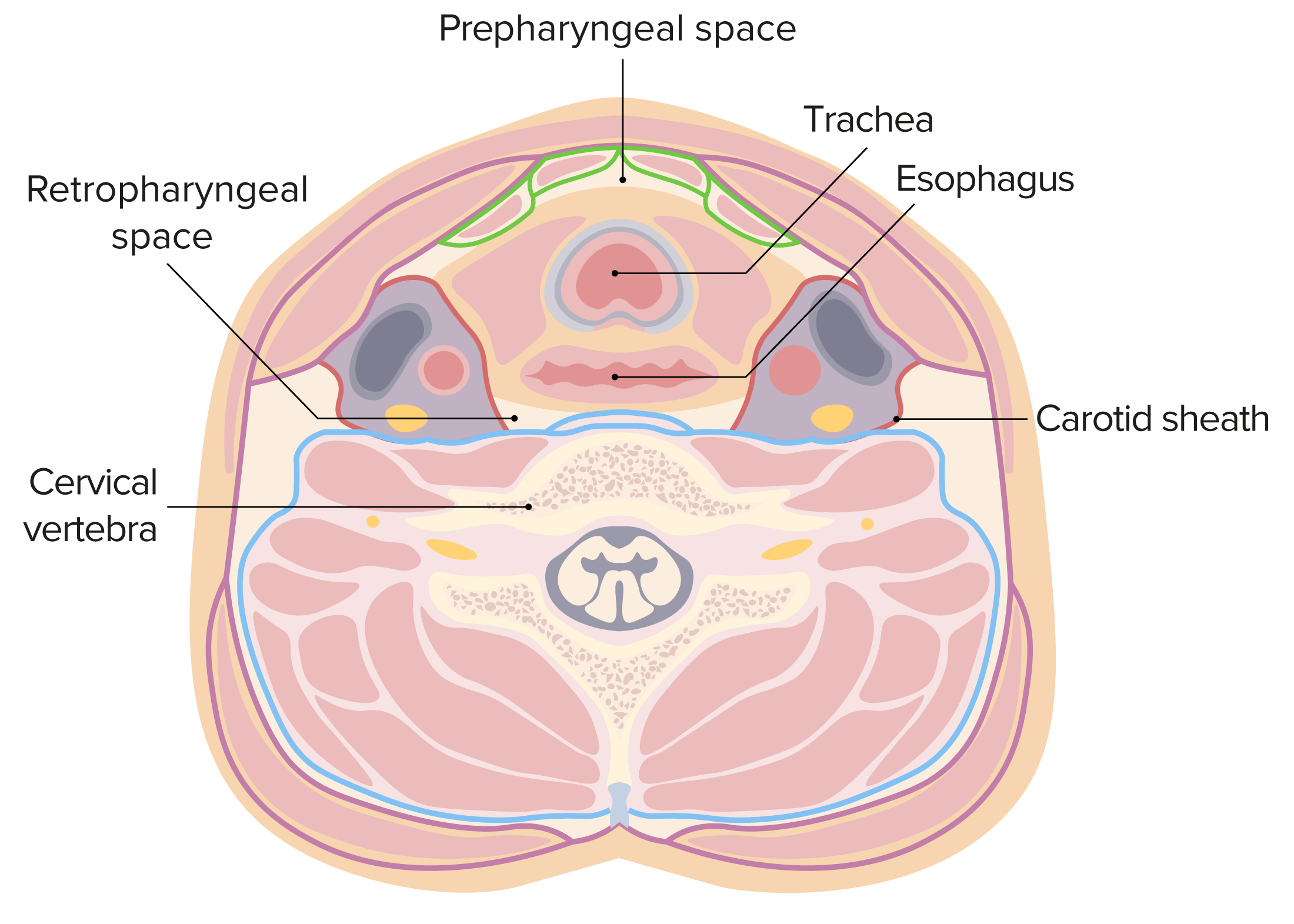
Espacio retrofaríngeo

El espacio retrofaríngeo en esta figura se encuentra entre las líneas amarilla (fascia bucofaríngea) y azul (fascia prevertebral). Los bordes laterales están formados por la vaina carotídea (líneas rojas).

Imagen por Lecturio.
Presentación Clínica

Síntomas iniciales

  • Puede simular una faringitis
  • Disfagia
  • Odinofagia
  • Rigidez/asimetría del cuello
  • Trismo

Síntomas tardíos

  • Mal aspecto, sialorrea
  • Posición de “olfateo“: inclinación hacia adelante con el cuello extendido
  • Dificultad respiratoria:
    • Taquipnea
    • Estridor
    • Aleteo nasal
    • Retracciones subcostales

Diagnóstico y Tratamiento

Diagnóstico

  • Los LOS Neisseria exámenes iniciales incluyen:
    • Hemograma
    • Hemocultivo
  • El diagnóstico se confirma por medio de imagenología:
    • Radiografía lateral del cuello:
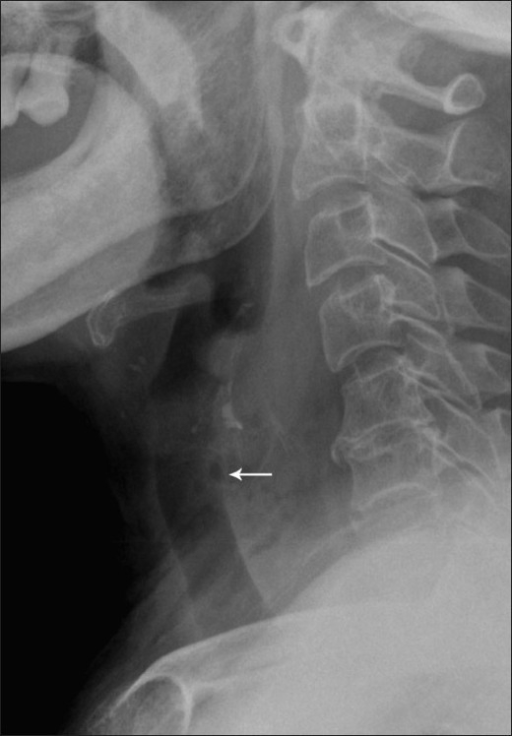
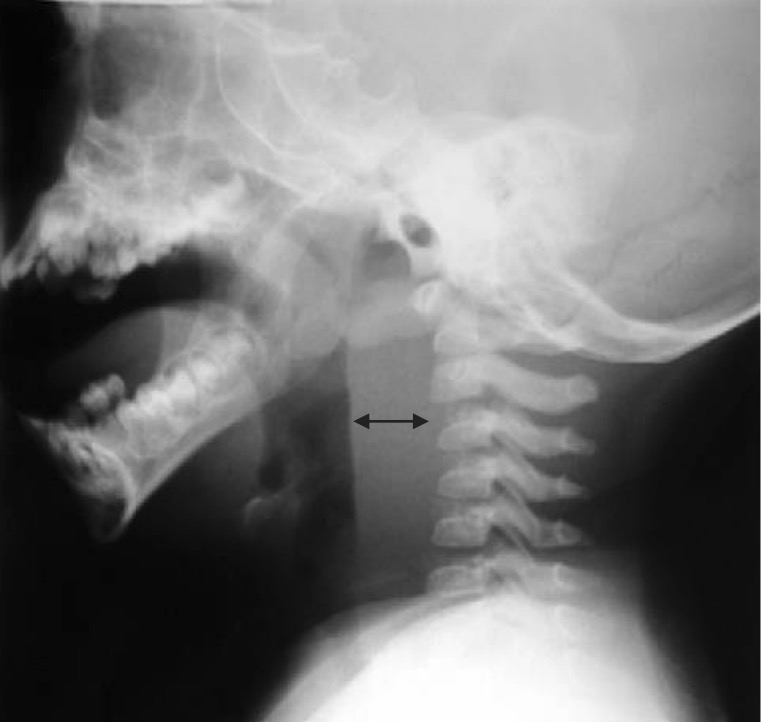
      • Espacio retrofaríngeo ensanchado
      • Aire en EN Erythema nodosum is an immune-mediated panniculitis (inflammation of the subcutaneous fat) caused by a type IV (delayed-type) hypersensitivity reaction. It commonly manifests in young women as tender, erythematous nodules on the shins. Erythema Nodosum el espacio retrofaríngeo
    • Tomografía computarizada (TC) de cuello con contraste (estándar de oro):
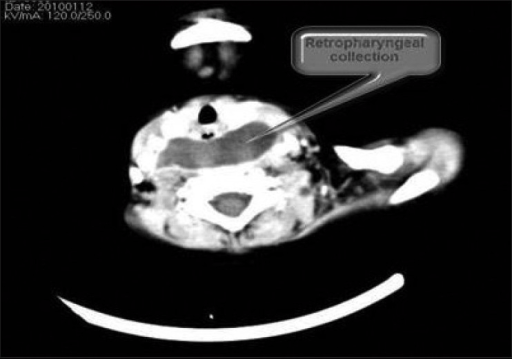
      • Colección hipodensa que realza el contorno del absceso en EN Erythema nodosum is an immune-mediated panniculitis (inflammation of the subcutaneous fat) caused by a type IV (delayed-type) hypersensitivity reaction. It commonly manifests in young women as tender, erythematous nodules on the shins. Erythema Nodosum el espacio retrofaríngeo
      • Engrosamiento del espacio prevertebral
      • Presencia de aire o de niveles hidroaéreos

Tratamiento

  • El 1er paso y el más importante paso es proteger la vía aérea → ¡intubar si es necesario!
  • Drenaje quirúrgico
  • Antibióticos
    • Ampicilina/ sulbactam Sulbactam A beta-lactamase inhibitor with very weak antibacterial action. The compound prevents antibiotic destruction of beta-lactam antibiotics by inhibiting beta-lactamases, thus extending their spectrum activity. Combinations of sulbactam with beta-lactam antibiotics have been used successfully for the therapy of infections caused by organisms resistant to the antibiotic alone. Cephalosporins o clindamicina
    • Si no hay respuesta, vancomicina o linezolid Linezolid An oxazolidinone and acetamide derived anti-bacterial agent and protein synthesis inhibitor that is used in the treatment of gram-positive bacterial infections of the skin and respiratory tract. Oxazolidinones
    • Cuando hay mejoría clínica, se puede cambiar a amoxicilina/clavulanato o clindamicina (con linezolid Linezolid An oxazolidinone and acetamide derived anti-bacterial agent and protein synthesis inhibitor that is used in the treatment of gram-positive bacterial infections of the skin and respiratory tract. Oxazolidinones oral para la cobertura contra Staphylococcus aureus Staphylococcus aureus Potentially pathogenic bacteria found in nasal membranes, skin, hair follicles, and perineum of warm-blooded animals. They may cause a wide range of infections and intoxications. Brain Abscess resistente a la meticilina).

Complicaciones

Los LOS Neisseria abscesos retrofaríngeos se consideran la infección profunda del cuello más mortal.

Las complicaciones más comunes son:

  • Mediastinitis Mediastinitis Mediastinitis refers to an infection or inflammation involving the mediastinum (a region in the thoracic cavity containing the heart, thymus gland, portions of the esophagus, and trachea). Acute mediastinitis can be caused by bacterial infection due to direct contamination, hematogenous or lymphatic spread, or extension of infection from nearby structures. Mediastinitis
    • Se produce por extensión al mediastino posterior a través del “espacio peligroso” → espacio que permite la propagación directa al AL Amyloidosis tórax
    • Puede evolucionar a una mediastinitis Mediastinitis Mediastinitis refers to an infection or inflammation involving the mediastinum (a region in the thoracic cavity containing the heart, thymus gland, portions of the esophagus, and trachea). Acute mediastinitis can be caused by bacterial infection due to direct contamination, hematogenous or lymphatic spread, or extension of infection from nearby structures. Mediastinitis necrosante aguda
    • Tasa de mortalidad de 50%
  • Trombosis de la vena yugular interna
  • Rotura de la arteria carótida → por extensión a través de la vaina carotídea
  • Obstrucción de la vía aérea
  • Septicemia
  • Absceso epidural o disquitis

Diagnóstico Diferencial

  • Epiglotitis: una inflamación de la epiglotis causada, en EN Erythema nodosum is an immune-mediated panniculitis (inflammation of the subcutaneous fat) caused by a type IV (delayed-type) hypersensitivity reaction. It commonly manifests in young women as tender, erythematous nodules on the shins. Erythema Nodosum la mayoría de los LOS Neisseria casos, por una infección por Haemophilus Haemophilus Haemophilus is a genus of Gram-negative coccobacilli, all of whose strains require at least 1 of 2 factors for growth (factor V [NAD] and factor X [heme]); therefore, it is most often isolated on chocolate agar, which can supply both factors. The pathogenic species are H. influenzae and H. ducreyi. Haemophilus influenzae. La epiglotitis se presenta con una epiglotis de color rojo cereza, fiebre, disfagia, sialorrea y dificultad para respirar. Esta afección se observa con frecuencia en EN Erythema nodosum is an immune-mediated panniculitis (inflammation of the subcutaneous fat) caused by a type IV (delayed-type) hypersensitivity reaction. It commonly manifests in young women as tender, erythematous nodules on the shins. Erythema Nodosum niños no vacunados. El tratamiento es con ceftriaxona y esteroides.
  • Absceso periamigdalino: infección bacteriana (comúnmente causada por S. pyogenes) que provoca un absceso junto a las amígdalas palatinas. Esta afección es más común en niños y adultos jóvenes y se presenta con trismo, fiebre y dolor de garganta, con voz de “papa caliente”. El examen físico muestra un absceso cerca de la amígdala faríngea que provoca la desviación de la úvula. El tratamiento es con antibióticos y drenaje quirúrgico.
  • Absceso parafaríngeo o infección del espacio prevertebral: presentación clínica muy similar a la de los LOS Neisseria abscesos retrofaríngeos, pero causados con mayor frecuencia por infecciones dentales que se extienden al AL Amyloidosis espacio faríngeo lateral o posterior. La mejor manera de diferenciar un absceso faríngeo de uno retrofaríngeo es mediante una TC de cuello. El tratamiento es con antibióticos y drenaje quirúrgico.
  • Meningitis Meningitis Meningitis is inflammation of the meninges, the protective membranes of the brain, and spinal cord. The causes of meningitis are varied, with the most common being bacterial or viral infection. The classic presentation of meningitis is a triad of fever, altered mental status, and nuchal rigidity. Meningitis: infección de las meninges Meninges The brain and the spinal cord are enveloped by 3 overlapping layers of connective tissue called the meninges. The layers are, from the most external layer to the most internal layer, the dura mater, arachnoid mater, and pia mater. Between these layers are 3 potential spaces called the epidural, subdural, and subarachnoid spaces. Meninges: Anatomy, las membranas protectoras que rodean el cerebro, causada con mayor frecuencia por Streptococcus Streptococcus Streptococcus is one of the two medically important genera of gram-positive cocci, the other being Staphylococcus. Streptococci are identified as different species on blood agar on the basis of their hemolytic pattern and sensitivity to optochin and bacitracin. There are many pathogenic species of streptococci, including S. pyogenes, S. agalactiae, S. pneumoniae, and the viridans streptococci. Streptococcus pneumoniae o Haemophilus influenzae Haemophilus Influenzae A species of Haemophilus found on the mucous membranes of humans and a variety of animals. The species is further divided into biotypes I through viii. Haemophilus. La meningitis Meningitis Meningitis is inflammation of the meninges, the protective membranes of the brain, and spinal cord. The causes of meningitis are varied, with the most common being bacterial or viral infection. The classic presentation of meningitis is a triad of fever, altered mental status, and nuchal rigidity. Meningitis se presenta con fiebre, rigidez de nuca y cefalea. Se diferencia del absceso retrofaríngeo por la presencia de sensibilidad a la luz, cefalea y rigidez de nuca. El diagnóstico se realiza mediante una punción lumbar para evaluar el líquido cefalorraquídeo (LCR). El tratamiento consiste en EN Erythema nodosum is an immune-mediated panniculitis (inflammation of the subcutaneous fat) caused by a type IV (delayed-type) hypersensitivity reaction. It commonly manifests in young women as tender, erythematous nodules on the shins. Erythema Nodosum administrar rápidamente antibióticos.

Referencias

  1. Jain, H., & Hohman, M. H. (2024). Retropharyngeal Abscess. StatPearls. Retrieved May 20, 2025, from https://www.statpearls.com/ArticleLibrary/viewarticle/28484/
  2. Wald, E. R. (2025). Retropharyngeal infections in children. UpToDate. Retrieved May 20, 2025, from https://www.uptodate.com/contents/retropharyngeal-infections-in-children

¡Crea tu cuenta gratis o inicia una sesión para seguir leyendo!

Regístrate ahora y obtén acceso gratuito a Lecturio con páginas de concepto, videos médicos y cuestionarios para tu educación médica.

User Reviews

Que tengas una sesión de estudio alegre y navideña 🎁 Ahorra 50% en todos los planes >>

Details