Domina Conceptos Médicos

Estudia para la escuela de medicina y tus examenes con Lecturio.

Abdomen Agudo

El abdomen agudo, que en EN Erythema nodosum is an immune-mediated panniculitis (inflammation of the subcutaneous fat) caused by a type IV (delayed-type) hypersensitivity reaction. It commonly manifests in young women as tender, erythematous nodules on the shins. Erythema Nodosum muchos casos es una emergencia quirúrgica, se define como la aparición súbita de dolor Dolor Inflammation abdominal que puede ser causado por inflamación, infección, perforación, isquemia u obstrucción. La localización del dolor Dolor Inflammation, sus características y los LOS Neisseria síntomas asociados (e.g., ictericia) son herramientas importantes que ayudan a dirigir el diagnóstico. Los LOS Neisseria pacientes suelen tener una sensibilidad severa con rigidez asociada y dolor Dolor Inflammation de rebote. Los LOS Neisseria exámenes de laboratorios mostrarán leucocitosis, acidosis Acidosis A pathologic condition of acid accumulation or depletion of base in the body. The two main types are respiratory acidosis and metabolic acidosis, due to metabolic acid build up. Respiratory Acidosis y, en EN Erythema nodosum is an immune-mediated panniculitis (inflammation of the subcutaneous fat) caused by a type IV (delayed-type) hypersensitivity reaction. It commonly manifests in young women as tender, erythematous nodules on the shins. Erythema Nodosum algunos casos, pruebas de función hepática anormales. Los LOS Neisseria estudios de imagen ayudan a reducir el diagnóstico diferencial; la primera línea de estudio de imagen siempre es una radiografía de tórax de pie para evaluar por neumoperitoneo. El tratamiento y el pronóstico del abdomen agudo dependen en EN Erythema nodosum is an immune-mediated panniculitis (inflammation of the subcutaneous fat) caused by a type IV (delayed-type) hypersensitivity reaction. It commonly manifests in young women as tender, erythematous nodules on the shins. Erythema Nodosum gran medida de la causa subyacente, pero la gran mayoría de casos constituyen una emergencia quirúrgica con morbilidad y mortalidad asociadas.

Last updated: Dec 15, 2025

Editorial responsibility: Stanley Oiseth, Lindsay Jones, Evelin Maza

Descripción General

Definición

El abdomen agudo es la constelación de signos y síntomas asociados a un dolor Dolor Inflammation abdominal severo y peritonitis Peritonitis Inflammation of the peritoneum lining the abdominal cavity as the result of infectious, autoimmune, or chemical processes. Primary peritonitis is due to infection of the peritoneal cavity via hematogenous or lymphatic spread and without intra-abdominal source. Secondary peritonitis arises from the abdominal cavity itself through rupture or abscess of intra-abdominal organs. Penetrating Abdominal Injury que con frecuencia requiere una intervención quirúrgica de emergencia.

Epidemiología

  • El dolor Dolor Inflammation abdominal, en EN Erythema nodosum is an immune-mediated panniculitis (inflammation of the subcutaneous fat) caused by a type IV (delayed-type) hypersensitivity reaction. It commonly manifests in young women as tender, erythematous nodules on the shins. Erythema Nodosum general, supone 5–10% de las visitas a la sala de emergencias.
  • Alrededor de un-tercio de los LOS Neisseria pacientes > 65 años con dolor Dolor Inflammation abdominal requerirán una intervención quirúrgica.
  • Abdomen agudo:
    • Individuos jóvenes: La apendicitis es la causa más común.
    • Las personas mayores con abdomen agudo suelen tener:

Etiología

Causas no quirúrgicas de abdomen agudo:

  • Causas endocrinas/metabólicas:
    • Porfiria aguda intermitente
    • Fiebre mediterránea familiar
    • Uremia Uremia A clinical syndrome associated with the retention of renal waste products or uremic toxins in the blood. It is usually the result of renal insufficiency. Most uremic toxins are end products of protein or nitrogen catabolism, such as urea or creatinine. Severe uremia can lead to multiple organ dysfunctions with a constellation of symptoms. Acute Kidney Injury
    • Cetoacidosis diabética
  • Causas hematológicas:
    • Crisis de anemia Anemia Anemia is a condition in which individuals have low Hb levels, which can arise from various causes. Anemia is accompanied by a reduced number of RBCs and may manifest with fatigue, shortness of breath, pallor, and weakness. Subtypes are classified by the size of RBCs, chronicity, and etiology. Anemia: Overview and Types falciforme
    • Leucemia aguda
  • Toxinas y drogas:
    • Intoxicación por plomo
    • Abstinencia de narcóticos
    • Envenenamiento por araña viuda negra

Causas quirúrgicas del abdomen agudo:

  • Hemorragia:
    • Trauma
    • Ruptura de aneurisma
    • Pancreatitis Pancreatitis Inflammation of the pancreas. Pancreatitis is classified as acute unless there are computed tomographic or endoscopic retrograde cholangiopancreatographic findings of chronic pancreatitis. The two most common forms of acute pancreatitis are alcoholic pancreatitis and gallstone pancreatitis. Acute Pancreatitis hemorrágica (normalmente no requiere intervención quirúrgica inicialmente)
    • Síndrome de Mallory-Weiss
    • Ruptura de embarazo ectópico
  • Infección:
  • Perforación:
    • Úlcera gástrica perforada
    • Divertículo perforado
    • Tumor Tumor Inflammation perforado
    • Síndrome de Boerhaave
  • Obstrucción:
    • Obstrucción del intestino delgado o grueso debido a adherencias o a un tumor Tumor Inflammation maligno
    • Vólvulo
    • Hernia Hernia Protrusion of tissue, structure, or part of an organ through the bone, muscular tissue, or the membrane by which it is normally contained. Hernia may involve tissues such as the abdominal wall or the respiratory diaphragm. Hernias may be internal, external, congenital, or acquired. Abdominal Hernias encarcelada
    • Intususcepción
  • Isquemia:
    • Trombosis o embolia mesentérica
    • Torsión ovárica
    • Colitis Colitis Inflammation of the colon section of the large intestine, usually with symptoms such as diarrhea (often with blood and mucus), abdominal pain, and fever. Pseudomembranous Colitis isquémica
    • Torsión testicular
    • Hernia Hernia Protrusion of tissue, structure, or part of an organ through the bone, muscular tissue, or the membrane by which it is normally contained. Hernia may involve tissues such as the abdominal wall or the respiratory diaphragm. Hernias may be internal, external, congenital, or acquired. Abdominal Hernias estrangulada
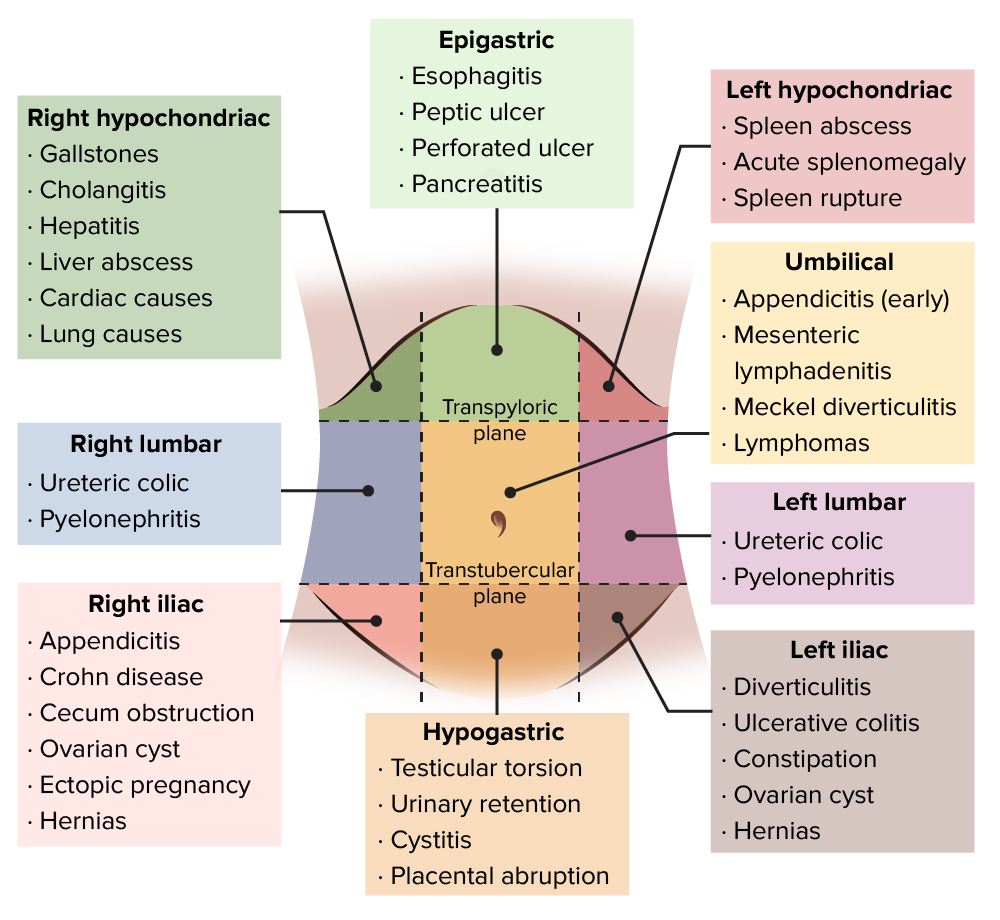
Differential diagnosis of acute abdomen

Diagnósticos diferenciales de un dolor abdominal agudo

Imagen por Lecturio.

Anatomía

Límites de la cavidad abdominal

  • Superiormente: diafragma
  • Inferiormente: entrada de la pelvis Pelvis The pelvis consists of the bony pelvic girdle, the muscular and ligamentous pelvic floor, and the pelvic cavity, which contains viscera, vessels, and multiple nerves and muscles. The pelvic girdle, composed of 2 “hip” bones and the sacrum, is a ring-like bony structure of the axial skeleton that links the vertebral column with the lower extremities. Pelvis: Anatomy
  • Anteriormente: músculos de la pared abdominal y costillas inferiores
  • Posteriormente: costillas, columna vertebral y músculos paraespinales

Anatomía externa

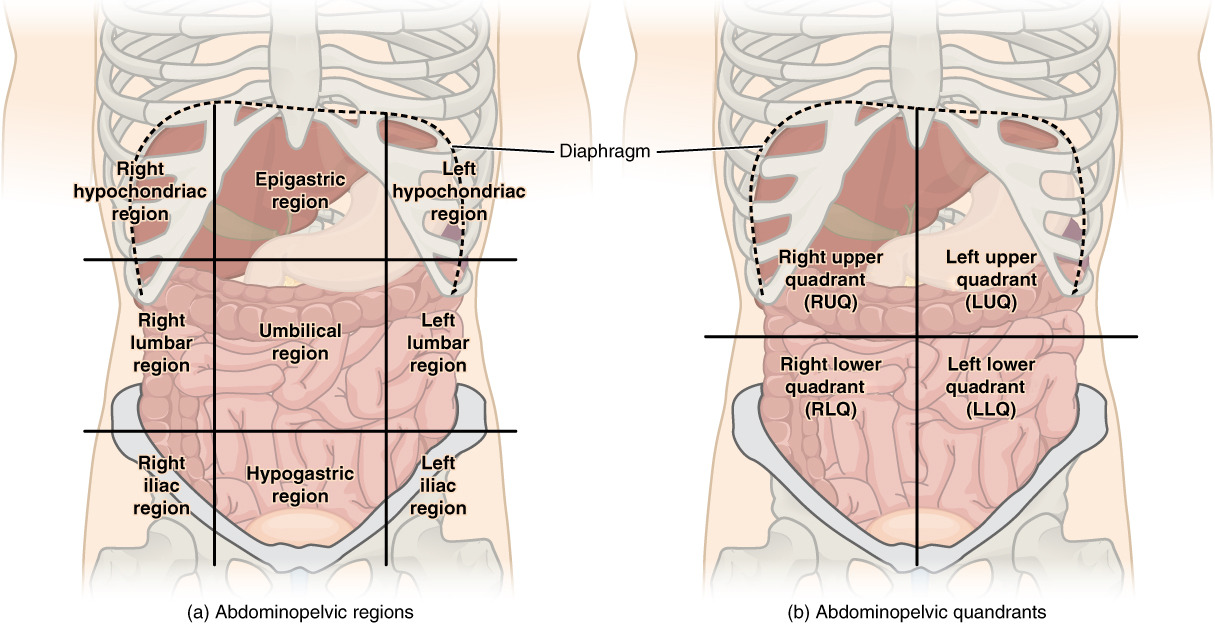
Para efectos descriptivos, el abdomen puede dividirse en EN Erythema nodosum is an immune-mediated panniculitis (inflammation of the subcutaneous fat) caused by a type IV (delayed-type) hypersensitivity reaction. It commonly manifests in young women as tender, erythematous nodules on the shins. Erythema Nodosum 4 cuadrantes o 9 regiones.

Cuadrantes:

Dividido en EN Erythema nodosum is an immune-mediated panniculitis (inflammation of the subcutaneous fat) caused by a type IV (delayed-type) hypersensitivity reaction. It commonly manifests in young women as tender, erythematous nodules on the shins. Erythema Nodosum 4 cuadrantes por 2 líneas perpendiculares que se cruzan en EN Erythema nodosum is an immune-mediated panniculitis (inflammation of the subcutaneous fat) caused by a type IV (delayed-type) hypersensitivity reaction. It commonly manifests in young women as tender, erythematous nodules on the shins. Erythema Nodosum el ombligo:

Cuadrante superior derecho:
  • Lóbulo derecho del hígado
  • Vesícula biliar
  • Píloro
  • Primeras 3 partes del duodeno
  • Cabeza del páncreas
  • Riñón derecho
  • Glándula suprarrenal derecha
  • Colon Colon The large intestines constitute the last portion of the digestive system. The large intestine consists of the cecum, appendix, colon (with ascending, transverse, descending, and sigmoid segments), rectum, and anal canal. The primary function of the colon is to remove water and compact the stool prior to expulsion from the body via the rectum and anal canal. Colon, Cecum, and Appendix: Anatomy ascendente distal
  • Flexura hepática del colon Colon The large intestines constitute the last portion of the digestive system. The large intestine consists of the cecum, appendix, colon (with ascending, transverse, descending, and sigmoid segments), rectum, and anal canal. The primary function of the colon is to remove water and compact the stool prior to expulsion from the body via the rectum and anal canal. Colon, Cecum, and Appendix: Anatomy
  • Mitad derecha del colon Colon The large intestines constitute the last portion of the digestive system. The large intestine consists of the cecum, appendix, colon (with ascending, transverse, descending, and sigmoid segments), rectum, and anal canal. The primary function of the colon is to remove water and compact the stool prior to expulsion from the body via the rectum and anal canal. Colon, Cecum, and Appendix: Anatomy transverso
Cuadrante superior izquierdo:
  • Lóbulo izquierdo del hígado
  • Bazo
  • Estómago
  • Yeyuno
  • Íleon proximal
  • Cuerpo y cola del páncreas
  • Riñón izquierdo
  • Glándula suprarrenal izquierda
  • Mitad izquierda del colon Colon The large intestines constitute the last portion of the digestive system. The large intestine consists of the cecum, appendix, colon (with ascending, transverse, descending, and sigmoid segments), rectum, and anal canal. The primary function of the colon is to remove water and compact the stool prior to expulsion from the body via the rectum and anal canal. Colon, Cecum, and Appendix: Anatomy transverso
  • Flexura esplénica del colon Colon The large intestines constitute the last portion of the digestive system. The large intestine consists of the cecum, appendix, colon (with ascending, transverse, descending, and sigmoid segments), rectum, and anal canal. The primary function of the colon is to remove water and compact the stool prior to expulsion from the body via the rectum and anal canal. Colon, Cecum, and Appendix: Anatomy
  • Parte superior del colon Colon The large intestines constitute the last portion of the digestive system. The large intestine consists of the cecum, appendix, colon (with ascending, transverse, descending, and sigmoid segments), rectum, and anal canal. The primary function of the colon is to remove water and compact the stool prior to expulsion from the body via the rectum and anal canal. Colon, Cecum, and Appendix: Anatomy descendente
Cuadrante inferior derecho:
  • Mayor parte del íleon
  • Ciego y apéndice
  • Colon Colon The large intestines constitute the last portion of the digestive system. The large intestine consists of the cecum, appendix, colon (with ascending, transverse, descending, and sigmoid segments), rectum, and anal canal. The primary function of the colon is to remove water and compact the stool prior to expulsion from the body via the rectum and anal canal. Colon, Cecum, and Appendix: Anatomy ascendente proximal
  • Uréter derecho proximal
  • Ovario derecho
  • Trompa uterina derecha
  • Mitad derecha del útero
  • Mitad derecha de la vejiga urinaria
Cuadrante inferior izquierdo:
  • Colon Colon The large intestines constitute the last portion of the digestive system. The large intestine consists of the cecum, appendix, colon (with ascending, transverse, descending, and sigmoid segments), rectum, and anal canal. The primary function of the colon is to remove water and compact the stool prior to expulsion from the body via the rectum and anal canal. Colon, Cecum, and Appendix: Anatomy descendente distal
  • Colon Colon The large intestines constitute the last portion of the digestive system. The large intestine consists of the cecum, appendix, colon (with ascending, transverse, descending, and sigmoid segments), rectum, and anal canal. The primary function of the colon is to remove water and compact the stool prior to expulsion from the body via the rectum and anal canal. Colon, Cecum, and Appendix: Anatomy sigmoide
  • Uréter izquierdo
  • Ovario izquierdo
  • Trompa uterina izquierda
  • Mitad izquierda del útero
  • Mitad izquierda de la vejiga urinaria

Regiones:

El abdomen puede dividirse en EN Erythema nodosum is an immune-mediated panniculitis (inflammation of the subcutaneous fat) caused by a type IV (delayed-type) hypersensitivity reaction. It commonly manifests in young women as tender, erythematous nodules on the shins. Erythema Nodosum regiones por 4 líneas:

  • 2 líneas transversales:
    • Línea subcostal: a través del 10mo cartílago costal
    • Línea intertubercular: une los LOS Neisseria tubérculos de las crestas ilíacas
  • 2 líneas verticales: líneas medioclaviculares derecha e izquierda
Hipocondrio derecho Región epigástrica Hipocondrio izquierdo
Región lumbar derecha Región umbilical Región lumbar izquierda
Fosa ilíaca derecha Región hipogástrica Fosa ilíaca izquierda
Abdominal Quadrant Regions

Cuadrantes abdominales:
Hay (a) 9 regiones abdominales y (b) 4 cuadrantes abdominales en la cavidad peritoneal.

Imagen: “Abdominal quadrant regions” por OpenStax. Licencia: CC BY 3.0, editada por Lecturio

Anatomía interna

Relación de los LOS Neisseria órganos intraabdominales con la cavidad peritoneal:

  • Intraperitoneal Intraperitoneal Peritoneum: Anatomy:
    • Estómago e intestino delgado
    • Hígado
    • Bazo
    • Colon Colon The large intestines constitute the last portion of the digestive system. The large intestine consists of the cecum, appendix, colon (with ascending, transverse, descending, and sigmoid segments), rectum, and anal canal. The primary function of the colon is to remove water and compact the stool prior to expulsion from the body via the rectum and anal canal. Colon, Cecum, and Appendix: Anatomy transverso
    • Bulbo duodenal y cola pancreática
  • Extraperitoneal: vejiga
  • Los LOS Neisseria órganos retroperitoneales pueden agruparse en EN Erythema nodosum is an immune-mediated panniculitis (inflammation of the subcutaneous fat) caused by a type IV (delayed-type) hypersensitivity reaction. It commonly manifests in young women as tender, erythematous nodules on the shins. Erythema Nodosum la mnemotecnia SAD PUCKER ( en EN Erythema nodosum is an immune-mediated panniculitis (inflammation of the subcutaneous fat) caused by a type IV (delayed-type) hypersensitivity reaction. It commonly manifests in young women as tender, erythematous nodules on the shins. Erythema Nodosum inglés):
    • Suprarenal glands (Glándulas suprarrenales)
    • Aorta and inferior vena cava Inferior vena cava The venous trunk which receives blood from the lower extremities and from the pelvic and abdominal organs. Mediastinum and Great Vessels: Anatomy ( Aorta Aorta The main trunk of the systemic arteries. Mediastinum and Great Vessels: Anatomy y vena cava inferior)
    • Duodenum (Duodeno, excepto la 1ra parte)
    • Pancreas (Páncreas, excepto la cola)
    • Ureters (Uréteres)
    • Colon ( Colon Colon The large intestines constitute the last portion of the digestive system. The large intestine consists of the cecum, appendix, colon (with ascending, transverse, descending, and sigmoid segments), rectum, and anal canal. The primary function of the colon is to remove water and compact the stool prior to expulsion from the body via the rectum and anal canal. Colon, Cecum, and Appendix: Anatomy descendente y ascendente)
    • Kidneys (Riñones)
    • Esophagus (Esófago)
    • Rectum (Recto)

Dolor Dolor Inflammation y patrones de inervación

  • Inervación visceral:
    • Inervación de los LOS Neisseria órganos internos
    • Percibe la distensión de una víscera hueca (e.g., estómago, intestinos)
    • Dolor Dolor Inflammation:
      • Vago y mal localizado
      • Localización epigástrica, periumbilical o hipogástrica
  • Inervación parietal Parietal One of a pair of irregularly shaped quadrilateral bones situated between the frontal bone and occipital bone, which together form the sides of the cranium. Skull: Anatomy:
    • Nervios segmentarios que inervan el peritoneo
    • Transmite el dolor Dolor Inflammation de la irritación peritoneal generalmente secundaria a una inflamación o hemorragia interna
    • Dolor Dolor Inflammation más agudo y localizado
  • Dolor Dolor Inflammation referido:
    • Dolor Dolor Inflammation percibido en EN Erythema nodosum is an immune-mediated panniculitis (inflammation of the subcutaneous fat) caused by a type IV (delayed-type) hypersensitivity reaction. It commonly manifests in young women as tender, erythematous nodules on the shins. Erythema Nodosum un lugar diferente al AL Amyloidosis de la fuente de dolor Dolor Inflammation
    • Secundario a la inervación de diferentes sitios por las mismas raíces nerviosas
    • Ejemplo clásico: irritación diafragmática percibida como dolor Dolor Inflammation de hombro debido a que ambas estructuras están inervadas por las raíces C3-C5

Presentación Clínica

La característica distintiva del abdomen agudo es la aparición aguda de dolor Dolor Inflammation abdominal intenso que puede o no estar asociado a otros síntomas. Se debe realizar una historia clínica detallada y un examen físico para determinar el curso de acción correcto.
Historia clínica

  • Descripción del dolor Dolor Inflammation:
    • Inicio
    • Localización
    • Duración
    • Descripción
    • Irradiación
    • Severidad
    • Factores agravantes o atenuantes: La peritonitis Peritonitis Inflammation of the peritoneum lining the abdominal cavity as the result of infectious, autoimmune, or chemical processes. Primary peritonitis is due to infection of the peritoneal cavity via hematogenous or lymphatic spread and without intra-abdominal source. Secondary peritonitis arises from the abdominal cavity itself through rupture or abscess of intra-abdominal organs. Penetrating Abdominal Injury se agrava clásicamente con el movimiento.
  • Síntomas asociados:
    • Náuseas
    • Vómitos
    • Diarrea
    • Melena Melena The black, tarry, foul-smelling feces that contain degraded blood. Gastrointestinal Bleeding o hematoquecia
    • Fiebre
  • Antecedentes:
    • Episodios anteriores similares
    • Condiciones médicas subyacentes
    • Traumatismo previo (accidente automovilístico, agresión)
    • Cirugías abdominales previas
    • Viajes recientes, exposiciones a tóxicos, intoxicación alimentaria

Examen físico

  • El examen debe comenzar siempre con una inspección visual en EN Erythema nodosum is an immune-mediated panniculitis (inflammation of the subcutaneous fat) caused by a type IV (delayed-type) hypersensitivity reaction. It commonly manifests in young women as tender, erythematous nodules on the shins. Erythema Nodosum búsqueda de:
    • Ictericia
    • Palidez
    • Respiración laboriosa
    • Comportamiento del paciente:
      • Trata de permanecer quieto
      • Facies dolorosa
  • Se debe obtener signos vitales completos y evaluar presencia de signos constitucionales:
    • Fiebre
    • Taquicardia
    • Hipotensión
    • Taquipnea
    • Alteración del estado mental
  • Se debe realizar un examen abdominal completo:
    • Inspección:
      • Distensión
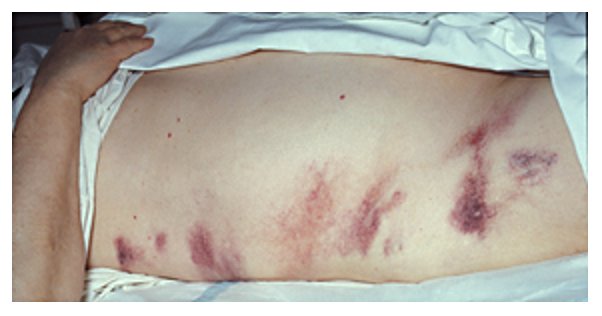
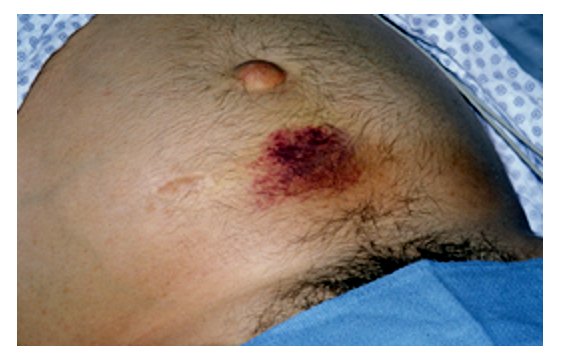
      • Hematomas (signo de Cullen o Grey-Turner: pancreatitis Pancreatitis Inflammation of the pancreas. Pancreatitis is classified as acute unless there are computed tomographic or endoscopic retrograde cholangiopancreatographic findings of chronic pancreatitis. The two most common forms of acute pancreatitis are alcoholic pancreatitis and gallstone pancreatitis. Acute Pancreatitis hemorrágica)
      • Protrusión, cambio de coloración de la piel (sugeriría una hernia Hernia Protrusion of tissue, structure, or part of an organ through the bone, muscular tissue, or the membrane by which it is normally contained. Hernia may involve tissues such as the abdominal wall or the respiratory diaphragm. Hernias may be internal, external, congenital, or acquired. Abdominal Hernias estrangulada)
    • Percusión:
      • Timpánico (distensión intestinal o neumoperitoneo)
      • Mate (ascitis o sangre)
    • Auscultación:
      • Normalmente, el abdomen agudo se asocia con sonidos intestinales hipoactivos o ausentes.
      • Puede haber sonidos intestinales hiperactivos en EN Erythema nodosum is an immune-mediated panniculitis (inflammation of the subcutaneous fat) caused by a type IV (delayed-type) hypersensitivity reaction. It commonly manifests in young women as tender, erythematous nodules on the shins. Erythema Nodosum casos de obstrucción intestinal de alto grado
    • Palpación:
      • Típicamente, dolor Dolor Inflammation difuso en EN Erythema nodosum is an immune-mediated panniculitis (inflammation of the subcutaneous fat) caused by a type IV (delayed-type) hypersensitivity reaction. It commonly manifests in young women as tender, erythematous nodules on the shins. Erythema Nodosum todos los LOS Neisseria cuadrantes
      • Puede tener sensibilidad más pronunciada en EN Erythema nodosum is an immune-mediated panniculitis (inflammation of the subcutaneous fat) caused by a type IV (delayed-type) hypersensitivity reaction. It commonly manifests in young women as tender, erythematous nodules on the shins. Erythema Nodosum un sitio, lo que podría ayudar a dirigir el diagnóstico
    • Signos peritoneales:
      • Dolor Dolor Inflammation de rebote: El dolor Dolor Inflammation empeora repentinamente cuando se retira la presión manual.
      • Defensa abdominal: contracción involuntaria o voluntaria de la pared abdominal
      • Rigidez: contracción constante e involuntaria de los LOS Neisseria músculos abdominales

Diagnóstico

Estudios de laboratorio

  • Hemograma:
    • ↑ Leucocitos
    • ↓ o ↑ hemoglobina (hemorragia vs. hemoconcentración por deshidratación)
  • Panel metabólico básico: ↑ BUN y creatinina
  • Amilasa y lipasa: ↑ en EN Erythema nodosum is an immune-mediated panniculitis (inflammation of the subcutaneous fat) caused by a type IV (delayed-type) hypersensitivity reaction. It commonly manifests in young women as tender, erythematous nodules on the shins. Erythema Nodosum casos de pancreatitis Pancreatitis Inflammation of the pancreas. Pancreatitis is classified as acute unless there are computed tomographic or endoscopic retrograde cholangiopancreatographic findings of chronic pancreatitis. The two most common forms of acute pancreatitis are alcoholic pancreatitis and gallstone pancreatitis. Acute Pancreatitis
  • Panel de función hepática:
    • Bilirrubina total y directa ↑ o normal
    • Enzimas hepáticas ↑ o normales
  • Lactato: niveles elevados indicativos de sepsis Sepsis Systemic inflammatory response syndrome with a proven or suspected infectious etiology. When sepsis is associated with organ dysfunction distant from the site of infection, it is called severe sepsis. When sepsis is accompanied by hypotension despite adequate fluid infusion, it is called septic shock. Sepsis and Septic Shock/hipoperfusión
  • Análisis de orina: para descartar infección del tracto urinario
  • Panel infeccioso de heces
  • Hemocultivos

Estudios de Imagenología

  • Radiografías:
    • Radiografía de tórax de pie:
      • Estudio de imagen de primera línea en EN Erythema nodosum is an immune-mediated panniculitis (inflammation of the subcutaneous fat) caused by a type IV (delayed-type) hypersensitivity reaction. It commonly manifests in young women as tender, erythematous nodules on the shins. Erythema Nodosum la evaluación de un paciente con dolor Dolor Inflammation abdominal para descartar una víscera perforada
      • Puede identificar cantidades tan pequeñas como 1 mL de aire libre intraabdominal
      • También puede revelar dilatación gástrica significativa
    • Proyección en EN Erythema nodosum is an immune-mediated panniculitis (inflammation of the subcutaneous fat) caused by a type IV (delayed-type) hypersensitivity reaction. It commonly manifests in young women as tender, erythematous nodules on the shins. Erythema Nodosum decúbito lateral:
      • Puede detectar 5-10 mL de aire libre intraabdominal
      • Identifica asas intestinales dilatadas, niveles hidroaéreos y vólvulos
  • Ultrasonido abdominal:
    • Cuadrante superior derecho:
      • Patología de la vesícula biliar
      • Patología hepática
      • Evalúa por líquido libre en EN Erythema nodosum is an immune-mediated panniculitis (inflammation of the subcutaneous fat) caused by a type IV (delayed-type) hypersensitivity reaction. It commonly manifests in young women as tender, erythematous nodules on the shins. Erythema Nodosum cavidad
    • Cuadrante inferior derecho:
      • Patología apendicular
      • Patología ovárica y anexial
  • Tomografía computarizada (TC):
    • Estudio de segunda línea después de las radiografías
    • Contraste intravenoso y contraste oral (si tolera la ingesta oral)
    • Muy específica para patología intraabdominal:
      • Perforación: aire libre
      • Obstrucción intestinal con asas intestinales dilatadas y niveles hidroaéreos
      • Isquemia intestinal con neumatosis, aumento de las paredes intestinales y gas venoso portal
      • Hematoma Hematoma A collection of blood outside the blood vessels. Hematoma can be localized in an organ, space, or tissue. Intussusception intraabdominal: con contraste intravenoso se puede identificar un origen vascular
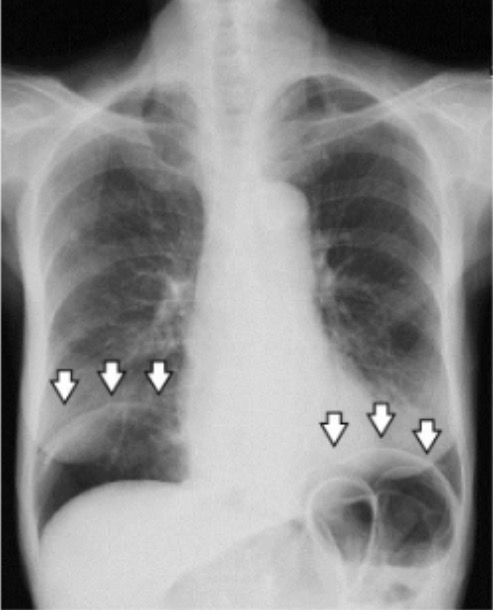
Una radiografía de tórax que demuestra un neumoperitoneo

Radiografía de tórax de pie que muestra un neumoperitoneo (flechas)

Imagen: “A chest radiograph demonstrating pneumoperitoneum” por Manabu Kaneko et al. Licencia: CC BY 4.0

Tratamiento

El abdomen agudo es una emergencia quirúrgica en EN Erythema nodosum is an immune-mediated panniculitis (inflammation of the subcutaneous fat) caused by a type IV (delayed-type) hypersensitivity reaction. It commonly manifests in young women as tender, erythematous nodules on the shins. Erythema Nodosum la gran mayoría de los LOS Neisseria casos. La evaluación inicial debe determinar los LOS Neisseria casos que no requieren tratamiento quirúrgico.

Tratamiento inicial

Reanimación:

  • El primer paso debe ser siempre la reanimación del paciente.
  • Obtener un acceso intravenoso permeable de gran calibre.
  • Bolo de líquido de 30 mL/kg por hipotensión y taquicardia
  • Corrección de electrolitos
  • Protección de la vía aérea/ventilación mecánica en EN Erythema nodosum is an immune-mediated panniculitis (inflammation of the subcutaneous fat) caused by a type IV (delayed-type) hypersensitivity reaction. It commonly manifests in young women as tender, erythematous nodules on the shins. Erythema Nodosum caso de deterioro del estado mental o dificultad respiratoria
  • Pueden administrarse empíricamente antibióticos de amplio espectro por vía intravenosa.
  • Tratamiento analgésico

Evaluación:

  • Historia clínica y examen físico exhaustivos
  • Obtenga laboratorios, incluyendo hemograma, panel metabólico básico, lactato, panel de función hepática.
  • Hemocultivos tempranos
  • Estudios de imagen:
    • En EN Erythema nodosum is an immune-mediated panniculitis (inflammation of the subcutaneous fat) caused by a type IV (delayed-type) hypersensitivity reaction. It commonly manifests in young women as tender, erythematous nodules on the shins. Erythema Nodosum la mayoría de los LOS Neisseria casos, hay al AL Amyloidosis menos tiempo para obtener una radiografía de tórax de pie para evaluar la presencia de aire libre.
    • El aire libre en EN Erythema nodosum is an immune-mediated panniculitis (inflammation of the subcutaneous fat) caused by a type IV (delayed-type) hypersensitivity reaction. It commonly manifests in young women as tender, erythematous nodules on the shins. Erythema Nodosum los LOS Neisseria estudios de imagen es una indicación de intervención quirúrgica inmediata.
    • Si no hay evidencia de aire libre en EN Erythema nodosum is an immune-mediated panniculitis (inflammation of the subcutaneous fat) caused by a type IV (delayed-type) hypersensitivity reaction. It commonly manifests in young women as tender, erythematous nodules on the shins. Erythema Nodosum un paciente estable, hay tiempo para obtener una tomografía computarizada.

Tratamiento quirúrgico

El tratamiento quirúrgico suele ser necesario a menos que se haya establecido una causa no quirúrgica. Si se justifica la intervención quirúrgica, hay dos abordajes:

  • Laparoscopia diagnóstica:
    • Abordaje mínimamente invasivo mediante un laparoscopio para explorar el abdomen
    • Muy útil para clasificar el abdomen y decidir si es necesario el abordaje abierto
    • A veces, la intervención definitiva puede realizarse por laparoscopia.
    • Técnicamente limitado en EN Erythema nodosum is an immune-mediated panniculitis (inflammation of the subcutaneous fat) caused by a type IV (delayed-type) hypersensitivity reaction. It commonly manifests in young women as tender, erythematous nodules on the shins. Erythema Nodosum zonas de difícil acceso y reparaciones quirúrgicas complejas
    • Debe evitarse en EN Erythema nodosum is an immune-mediated panniculitis (inflammation of the subcutaneous fat) caused by a type IV (delayed-type) hypersensitivity reaction. It commonly manifests in young women as tender, erythematous nodules on the shins. Erythema Nodosum casos de intestino muy dilatado debido al AL Amyloidosis riesgo de perforación con la inserción de puertos e instrumentos laparoscópicos
    • No debe realizarse en EN Erythema nodosum is an immune-mediated panniculitis (inflammation of the subcutaneous fat) caused by a type IV (delayed-type) hypersensitivity reaction. It commonly manifests in young women as tender, erythematous nodules on the shins. Erythema Nodosum los LOS Neisseria casos en EN Erythema nodosum is an immune-mediated panniculitis (inflammation of the subcutaneous fat) caused by a type IV (delayed-type) hypersensitivity reaction. It commonly manifests in young women as tender, erythematous nodules on the shins. Erythema Nodosum los LOS Neisseria que el diagnóstico sea claro y se requiera definitivamente una intervención abierta
  • Laparotomía exploratoria:
    • Abordaje quirúrgico abierto, normalmente a través de una incisión en EN Erythema nodosum is an immune-mediated panniculitis (inflammation of the subcutaneous fat) caused by a type IV (delayed-type) hypersensitivity reaction. It commonly manifests in young women as tender, erythematous nodules on the shins. Erythema Nodosum la línea media
    • Permite el examen visual y táctil de todos los LOS Neisseria cuadrantes abdominales y su contenido
    • Abordaje de elección en EN Erythema nodosum is an immune-mediated panniculitis (inflammation of the subcutaneous fat) caused by a type IV (delayed-type) hypersensitivity reaction. It commonly manifests in young women as tender, erythematous nodules on the shins. Erythema Nodosum casos de contaminación abdominal con contenido biliar o entérico
    • Permite la reparación de la fuente de contaminación así como la irrigación de la cavidad abdominal

Referencias

  1. Squires, R. A., Postier, R. G. (2012). In Mattox, K. L., Evers, B. M., Beauchamp, R. D., Townsend, C. M. (Eds.), Sabiston Textbook of Surgery: The Biological Basis of Modern Surgical Practice, 19th ed. pp. 1141–1159.
  2. Penner, R. M., Fishman, M. B. (2020). Evaluation of the adult with abdominal pain. In Kunins L. (Ed.), UpToDate. Retrieved April 4, 2021, from https://www.uptodate.com/contents/evaluation-of-the-adult-with-abdominal-pain
  3. Cahalane, M. J. (2019). Overview of gastrointestinal tract perforation. In Chen, W. (Ed.), UpToDate. Retrieved April 4, 2021, from https://www.uptodate.com/contents/overview-of-gastrointestinal-tract-perforation
  4. Bordejanou, L., Yeh, D. D. (2020). Management of small bowel obstruction in adults. In Chen, W. (Ed.), UpToDate. Retrieved April 4, 2021, from https://www.uptodate.com/contents/management-of-small-bowel-obstruction-in-adults
  5. Daley, B. J. (2019). Peritonitis and abdominal sepsis. In Roy, P. K. (Ed.), Medscape. Retrieved April 6, 2021, from https://emedicine.medscape.com/article/180234-overview#a2

¡Crea tu cuenta gratis o inicia una sesión para seguir leyendo!

Regístrate ahora y obtén acceso gratuito a Lecturio con páginas de concepto, videos médicos y cuestionarios para tu educación médica.

User Reviews

Que tengas una sesión de estudio alegre y navideña 🎁 Ahorra 50% en todos los planes >>

Details