



Síndrome de Wiskott-Aldrich

A síndrome de Wiskott-Aldrich (SWA), também conhecida como síndrome de eczema-trombocitopenia-imunodeficiência, IMD2 IMD2 Wiskott-aldrich syndrome (WAS), also known as eczema-thrombocytopenia-immunodeficiency syndrome, IMD2, or immunodeficiency 2, is a rare genetic mixed disorder of B- and T-cell deficiency that follows an X-linked recessive inheritance pattern. It is caused by a WAS gene mutation that leads to impaired actin cytoskeleton, phagocytosis and chemotaxis, impaired platelet development, and, in general, a loss of humoral and cellular responses. Wiskott-Aldrich Syndrome ou imunodeficiência 2, é um distúrbio genético misto raro de deficiência de células B e T, que segue um padrão de hereditariedade recessivo ligado ao X. É causada por uma mutação no gene Gene A category of nucleic acid sequences that function as units of heredity and which code for the basic instructions for the development, reproduction, and maintenance of organisms. Basic Terms of Genetics WAS que leva ao comprometimento do citoesqueleto de actina, fagocitose e quimiotaxia, comprometimento do desenvolvimento plaquetário e, em geral, perda das respostas humorais e celulares. A síndrome de Wiskott-Aldrich apresenta-se como uma tríade clássica de eczema Eczema Atopic dermatitis, also known as eczema, is a chronic, relapsing, pruritic, inflammatory skin disease that occurs more frequently in children, although adults can also be affected. The condition is often associated with elevated serum levels of IgE and a personal or family history of atopy. Skin dryness, erythema, oozing, crusting, and lichenification are present. Atopic Dermatitis (Eczema), diátese hemorrágica e infeções oportunistas recorrentes, mas também apresenta alto risco de desenvolvimento de autoimunidade e malignidade. O tratamento inclui transplante de células estaminais hematopoiéticas (TCEH), terapêutica de reposição de imunoglobulinas, antibióticos profiláticos e terapêuticos e esteroides sistémicos. Sem o TCEH, o prognóstico é mau e a expectativa de vida é reduzida.

Last updated: Dec 15, 2025
Editorial responsibility: Stanley Oiseth, Lindsay Jones, Evelin Maza

Etiologia e Fisiopatologia

Epidemiologia

  • 1 em 100.000 nados vivos nos Estados Unidos
  • 110 em 1.000.000 homens em todo o mundo
  • Ocorre quase exclusivamente em rapazes devido ao seu padrão de hereditariedade recessivo ligado ao X

Etiologia

  • Mutações no gene Gene A category of nucleic acid sequences that function as units of heredity and which code for the basic instructions for the development, reproduction, and maintenance of organisms. Basic Terms of Genetics WAS no braço curto do cromossoma X (Xp11.22-23)
  • O gene Gene A category of nucleic acid sequences that function as units of heredity and which code for the basic instructions for the development, reproduction, and maintenance of organisms. Basic Terms of Genetics WAS codifica a proteína WASp (proteína da síndrome de Wiskott-Aldrich) que é expressa principalmente em células hematopoiéticas e é responsável pelos defeitos nos sinais de ativação dependentes do citoesqueleto em linfócitos, alterações na apresentação de antigénios e na migração de leucócitos.
  • A trombocitopenia ligada ao X e a neutropenia Neutropenia Neutrophils are an important component of the immune system and play a significant role in the eradication of infections. Low numbers of circulating neutrophils, referred to as neutropenia, predispose the body to recurrent infections or sepsis, though patients can also be asymptomatic. Neutropenia ligada ao X também estão associadas a mutações WAS.
  • Defeitos nas moléculas CD43 CD43 A sialic acid-rich protein and an integral cell membrane mucin. It plays an important role in activation of T-lymphocytes. Wiskott-Aldrich Syndrome também estão associados à WAS.
  • Foram identificadas mais MAIS Androgen Insensitivity Syndrome de 300 mutações no gene Gene A category of nucleic acid sequences that function as units of heredity and which code for the basic instructions for the development, reproduction, and maintenance of organisms. Basic Terms of Genetics da SWA, incluindo mutações missense, mutações nonsense, mutações no local de splice e pequenas deleções.
    • WAS clássica: causada por mutações que levam a uma expressão ausente ou não funcional de WASp
    • Trombocitopenia ligada ao X (XLT): causada por mutações que levam a uma expressão reduzida e parcialmente funcional de WASp
    • Neutropenia Neutropenia Neutrophils are an important component of the immune system and play a significant role in the eradication of infections. Low numbers of circulating neutrophils, referred to as neutropenia, predispose the body to recurrent infections or sepsis, though patients can also be asymptomatic. Neutropenia ligada ao X (XLN): causada por mutações de ganho de função no domínio de ligação da guanosina trifosfatase (GTPase)
    • As mutações Hotspot (T45M, R86C e R211X) estão associadas a fenótipos distintos.
    • Os defeitos nas moléculas CD43 CD43 A sialic acid-rich protein and an integral cell membrane mucin. It plays an important role in activation of T-lymphocytes. Wiskott-Aldrich Syndrome também estão associados à SWA.

Fisiopatologia

  • A mutação no gene Gene A category of nucleic acid sequences that function as units of heredity and which code for the basic instructions for the development, reproduction, and maintenance of organisms. Basic Terms of Genetics WAS leva ao surgimento de microtrombócitos (plaquetas defeituosas pequenas) que são removidas pelo baço e/ou fígado, resultando na redução dos níveis da contagem plaquetária → diátese hemorrágica
  • Defeitos na apresentação de antigénios e na sinalização leucocitária → maior suscetibilidade a infeções por agentes patogénicos oportunistas, mais MAIS Androgen Insensitivity Syndrome frequentemente no trato respiratório, trato gastrointestinal (GI) e na pele

Apresentação Clínica

  • Tríade clássica (presente desde o nascimento em 30% dos casos):
    • Eczema Eczema Atopic dermatitis, also known as eczema, is a chronic, relapsing, pruritic, inflammatory skin disease that occurs more frequently in children, although adults can also be affected. The condition is often associated with elevated serum levels of IgE and a personal or family history of atopy. Skin dryness, erythema, oozing, crusting, and lichenification are present. Atopic Dermatitis (Eczema) (80% dos casos)
    • Diátese hemorrágica (resulta da baixa contagem plaquetária)
      • Petéquias
      • Hematomas
      • Púrpura
      • Hemorragia nasal espontânea
      • Diarreia sanguinolenta
    • Infeções oportunistas recorrentes (geralmente por organismos encapsulados):
      • Streptococcus Streptococcus Streptococcus is one of the two medically important genera of gram-positive cocci, the other being Staphylococcus. Streptococci are identified as different species on blood agar on the basis of their hemolytic pattern and sensitivity to optochin and bacitracin. There are many pathogenic species of streptococci, including S. pyogenes, S. agalactiae, S. pneumoniae, and the viridans streptococci. Streptococcus pneumonia Pneumonia Pneumonia or pulmonary inflammation is an acute or chronic inflammation of lung tissue. Causes include infection with bacteria, viruses, or fungi. In more rare cases, pneumonia can also be caused through toxic triggers through inhalation of toxic substances, immunological processes, or in the course of radiotherapy. Pneumonia ( mais MAIS Androgen Insensitivity Syndrome frequentemente como otite média)
      • Neisseria meningitidis Neisseria meningitidis A species of gram-negative, aerobic bacteria. It is a commensal and pathogen only of humans, and can be carried asymptomatically in the nasopharynx. When found in cerebrospinal fluid it is the causative agent of cerebrospinal meningitis. It is also found in venereal discharges and blood. There are at least 13 serogroups based on antigenic differences in the capsular polysaccharides; the ones causing most meningitis infections being a, b, c, y, and w-135. Each serogroup can be further classified by serotype, serosubtype, and immunotype. Neisseria
      • Haemophilus influenzae Haemophilus Influenzae A species of Haemophilus found on the mucous membranes of humans and a variety of animals. The species is further divided into biotypes I through viii. Haemophilus
      • Ainda, infeções por candida Candida Candida is a genus of dimorphic, opportunistic fungi. Candida albicans is part of the normal human flora and is the most common cause of candidiasis. The clinical presentation varies and can include localized mucocutaneous infections (e.g., oropharyngeal, esophageal, intertriginous, and vulvovaginal candidiasis) and invasive disease (e.g., candidemia, intraabdominal abscess, pericarditis, and meningitis). Candida/Candidiasis do trato respiratório, trato GI ou pele
  • Aumento do risco de manifestações autoimunes (40-70% dos casos, devido à contagem elevada de eosinófilos), incluindo:
    • Anemia Anemia Anemia is a condition in which individuals have low Hb levels, which can arise from various causes. Anemia is accompanied by a reduced number of RBCs and may manifest with fatigue, shortness of breath, pallor, and weakness. Subtypes are classified by the size of RBCs, chronicity, and etiology. Anemia: Overview and Types hemolítica autoimune
    • Neutropenia Neutropenia Neutrophils are an important component of the immune system and play a significant role in the eradication of infections. Low numbers of circulating neutrophils, referred to as neutropenia, predispose the body to recurrent infections or sepsis, though patients can also be asymptomatic. Neutropenia
    • Vasculite
    • Doença inflamatória intestinal
    • Doença renal
    • Artrite reumatoide
  • Maior risco de neoplasias hematológicas (10-20% dos casos), mais MAIS Androgen Insensitivity Syndrome frequentemente o linfoma de células B
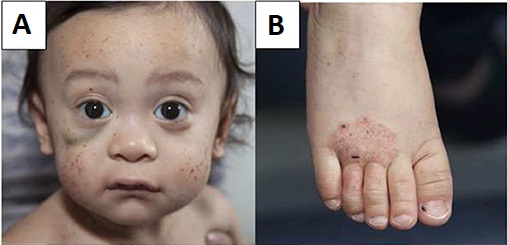
Síndrome de Wiskott-Aldrich: petéquias, hematoma e eczema

Doente jovem do sexo masculino com síndrome de Wiskott-Aldrich que apresenta múltiplas petéquias faciais, hematoma sob o olho direito (A) e eczema do pé (B)

Imagem: “Wiskott–Aldrich syndrome” por Michael H. Albert and Alexandra F. Freeman, on behalf of the Inborn Errors Working Party (IEWP) of the European Society for Blood and Marrow Transplantation (EBMT). Licença: CC BY 4.0

Diagnóstico

  • Verificar os níveis de imunoglobulina:
    • Níveis normais ou baixos de IgG IgG The major immunoglobulin isotype class in normal human serum. There are several isotype subclasses of igg, for example, igg1, igg2a, and igg2b. Hypersensitivity Pneumonitis e IgM IgM A class of immunoglobulin bearing mu chains (immunoglobulin mu-chains). Igm can fix complement. The name comes from its high molecular weight and originally being called a macroglobulin. Immunoglobulins: Types and Functions (baixa especificidade, pois a IgG IgG The major immunoglobulin isotype class in normal human serum. There are several isotype subclasses of igg, for example, igg1, igg2a, and igg2b. Hypersensitivity Pneumonitis também pode estar elevada)
    • Aumento dos níveis de IgE IgE An immunoglobulin associated with mast cells. Overexpression has been associated with allergic hypersensitivity. Immunoglobulins: Types and Functions e IgA IgA Represents 15-20% of the human serum immunoglobulins, mostly as the 4-chain polymer in humans or dimer in other mammals. Secretory iga is the main immunoglobulin in secretions. Immunoglobulins: Types and Functions
  • Avaliar o hemograma:
    • Baixa contagem plaquetária de 20.000/mm3 –50.000/mm3
    • Tamanho plaquetário pequeno (microtrombocitopenia)
  • O teste genético para a mutação WAS confirma o diagnóstico
  • Testes Testes Gonadal Hormones opcionais adicionais:
    • Serologia: diminuição da contagem de células T e B
    • O teste imunológico da pele pode revelar hipossensibilidade ou sensibilidade tardia.
    • São observados níveis diminuídos de WASp

Tratamento

  • O transplante de células estaminais hematopoiéticas (TCEH) é a única cura possível.
  • Medidas gerais:
    • Devem ser usados capacetes de proteção para prevenir hemorragia cerebral em crianças.
    • Os doentes podem beneficiar de transfusões se trombocitopenia grave.
    • A suplementação de ferro é recomendada se anemia Anemia Anemia is a condition in which individuals have low Hb levels, which can arise from various causes. Anemia is accompanied by a reduced number of RBCs and may manifest with fatigue, shortness of breath, pallor, and weakness. Subtypes are classified by the size of RBCs, chronicity, and etiology. Anemia: Overview and Types devido à perda crónica de sangue.
    • São recomendados esteroides tópicos ou sistémicos se eczema Eczema Atopic dermatitis, also known as eczema, is a chronic, relapsing, pruritic, inflammatory skin disease that occurs more frequently in children, although adults can also be affected. The condition is often associated with elevated serum levels of IgE and a personal or family history of atopy. Skin dryness, erythema, oozing, crusting, and lichenification are present. Atopic Dermatitis (Eczema) grave, mas devem ser usados com cautela devido aos efeitos imunossupressores.
    • Antibióticos profiláticos para prevenir infeções
    • Terapêutica de reposição de imunoglobulina, com preferência pela via IV em relação à injeção subcutânea, devido ao maior risco de hemorragia
    • O ácido acetilsalicílico (AAS) e os anti-inflamatórios não esteroides (AINEs) estão contraindicados devido aos seus efeitos sobre a função plaquetária.
  • Prognóstico:
    • O TCEH leva a uma taxa de sobrevivência de 90%.
    • Sem TCEH, a expectativa média de vida é de 15-20 anos.

Diagnóstico Diferencial

As seguintes condições são diagnósticos diferenciais da síndrome de Wiskott-Aldrich:
  • Púrpura trombocitopênica idiopática (PTI): condição que se desenvolve secundariamente à destruição imunomediada de plaquetas, resultando em trombocitopenia (contagem de plaquetas< 150 X 10⁹/L). A condição pode ser primária, com uma diminuição isolada da contagem de plaquetas. As causas secundárias são induzidas por fármacos ou por infeções como o VIH ou a hepatite C. A púrpura trombocitopénica idiopática é geralmente um diagnóstico de exclusão.
  • Aloimunização de plaquetas em recém-nascidos: condição caracterizada por uma baixa contagem de plaquetas que ocorre em lactentes, devido a anticorpos maternos criados contra aloantigénios das plaquetas fetais.
  • Imunodeficiência combinada grave ( SCID SCID Severe combined immunodeficiency (SCID), also called “bubble boy disease,” is a rare genetic disorder in which the development of functional B and T cells is disturbed due to several genetic mutations that result in reduced or absent immune function. Severe Combined Immunodeficiency (SCID), pela sigla em inglês): a forma mais MAIS Androgen Insensitivity Syndrome grave de imunodeficiência primária. A SCID SCID Severe combined immunodeficiency (SCID), also called “bubble boy disease,” is a rare genetic disorder in which the development of functional B and T cells is disturbed due to several genetic mutations that result in reduced or absent immune function. Severe Combined Immunodeficiency (SCID) é um distúrbio genético que envolve uma resposta defeituosa de anticorpos devido ao envolvimento direto de linfócitos B ou à ativação inadequada de linfócitos B devido a células T auxiliares não funcionais. Apresenta-se como infeções oportunistas graves e recorrentes e é diagnosticada por reação em cadeia da polimerase ( PCR PCR Polymerase chain reaction (PCR) is a technique that amplifies DNA fragments exponentially for analysis. The process is highly specific, allowing for the targeting of specific genomic sequences, even with minuscule sample amounts. The PCR cycles multiple times through 3 phases: denaturation of the template DNA, annealing of a specific primer to the individual DNA strands, and synthesis/elongation of new DNA molecules. Polymerase Chain Reaction (PCR)) quantitativa e citometria de fluxo.
  • Púrpura trombocitopénica trombótica (PTT): condição com risco de vida devido a um défice congénito ou adquirido de ADAMTS-13, uma metaloproteinase que cliva multímeros do Fator de von Willebrand (FvW). Estes grandes multímeros agregam de forma excessiva as plaquetas, o que leva a trombose e aumento do uso das mesmas, resultando em trombocitopenia.

Referências

  1. Ochs, H. (2024). Wiskott-Aldrich syndrome. UpToDate. Retrieved November 26, 2024, from: https://www.uptodate.com/contents/wiskott-aldrich-syndrome
  2. Huynh, P. (2024). Wiskott-Aldrich Syndrome. Medscape. Retrieved November 26, 2024, from: https://emedicine.medscape.com/article/137015-overview
  3. Wiskott-Aldrich Syndrome: Medlineplus genetics. (n.d.-b). Retrieved November 26, 2024, from https://medlineplus.gov/genetics/condition/wiskott-aldrich-syndrome/#frequency
  4. Bohm, S., et al. (2023). Outcomes of hematopoietic stem cell gene therapy for Wiskott-Aldrich syndrome. Blood, 142(15), 1281-1292. https://doi.org/10.1182/blood.2022019117
  5. Jiang, Y., et al. (2023). Immunological features and treatment of Wiskott-Aldrich syndrome. Frontiers in Immunology, 14, 123456.
  6. Michels, A., et al. (2023). Excellent outcomes following hematopoietic cell transplantation for Wiskott-Aldrich syndrome. Blood, 135(23), 2094-2104. https://doi.org/10.1182/blood.2019002939
  7. Vallée, T., et al. (2024). Wiskott-Aldrich syndrome: A study of 577 patients defines the genotype as a predictive biomarker for disease severity. Blood, 143(24), 2504-2514. https://doi.org/10.1182/blood.2023021411
  8. Vallée, T., et al. (2024). Recent advances in understanding the pathophysiology of Wiskott-Aldrich syndrome. Blood, American Society of Hematology. https://doi.org/10.1182/blood-2008-12-115253

Crie sua conta gratuita ou faça login para continuar lendo!

Cadastre-se agora e tenha acesso grátis ao Lecturio, com páginas de conceitos, vídeos de medicina e questões para sua educação médica.

Aprende mais com a Lecturio:

Multiple devices displaying human anatomy and health education content.

Complementa o teu estudo da faculdade com o companheiro de estudo tudo-em-um da Lecturio, através de métodos de ensino baseados em evidência.

Estuda onde quiseres

Two iPhones display medical education apps, one showing anatomy, the other Bookmatcher.

A Lecturio Medical complementa o teu estudo através de métodos de ensino baseados em evidência, vídeos de palestras, perguntas e muito mais – tudo combinado num só lugar e fácil de usar.

User Reviews

Details