


Retinopatia de Prematuridade

A retinopatia de prematuridade (ROP) é uma situação clínica observada em recém-nascidos prematuros e com baixo peso que se caracteriza por uma neovascularização progressiva e excessiva. Nesta situação, a anormal proliferação de neovasos e do tecido fibrovascular por detrás do cristalino impede o desenvolvimento normal da retina. Pode levar a défices visuais graves ou mesmo a cegueira. O tratamento com fotocoagulação laser previne a perda de visão em 95% dos casos.

Last updated: Dec 15, 2025

Editorial responsibility: Stanley Oiseth, Lindsay Jones, Evelin Maza

Descrição Geral

Epidemiologia

  • A retinopatia da prematuridade é a principal causa da cegueira pediátrica.
  • A incidência da doença é inversamente proporcional a:
    • Idade gestacional do doente
    • Peso ao nascimento

Fatores de risco

  • Baixo peso à nascença
  • Menor idade gestacional
  • Suplementação de oxigénio
  • Predisposição genética
  • Infeções
  • Defeitos cardíacos congênitos

Fisiopatologia

Os bebés prematuros de baixo peso à nascença correm o risco de desenvolver hiperóxia durante os seus cuidados; isto pode levar a:
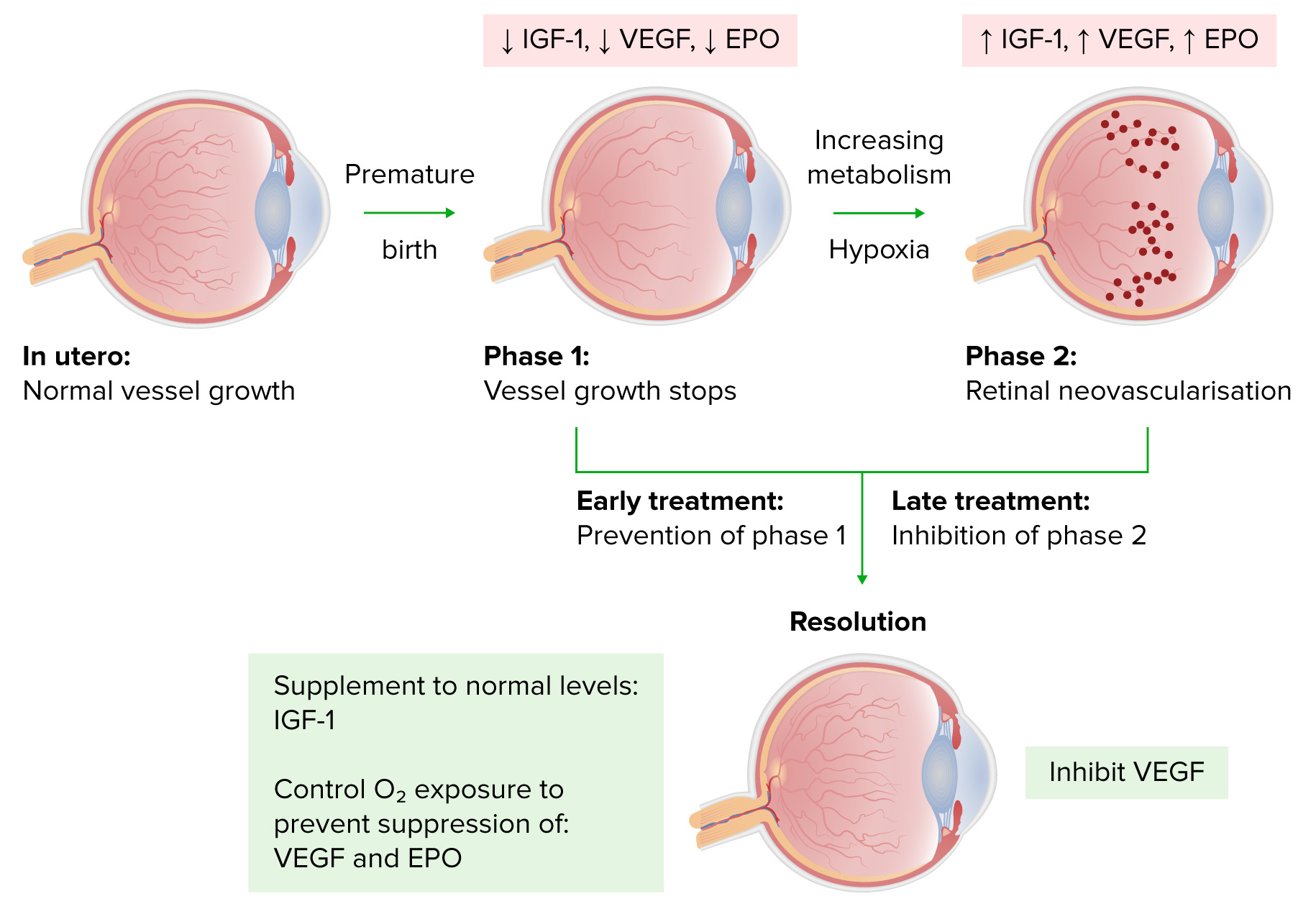
  • Produção de espécies reativas de oxigénio → levando a lesões na retina Retina The ten-layered nervous tissue membrane of the eye. It is continuous with the optic nerve and receives images of external objects and transmits visual impulses to the brain. Its outer surface is in contact with the choroid and the inner surface with the vitreous body. The outermost layer is pigmented, whereas the inner nine layers are transparent. Eye: Anatomy
  • Anormal produção do fator de crescimento endotelial vascular (VEGF) → que leva a uma neovascularização atípica
  • Os vasos recém-formados diferem dos normais:
    • Alterações na permeabilidade
    • Crescimento para fora da retina Retina The ten-layered nervous tissue membrane of the eye. It is continuous with the optic nerve and receives images of external objects and transmits visual impulses to the brain. Its outer surface is in contact with the choroid and the inner surface with the vitreous body. The outermost layer is pigmented, whereas the inner nine layers are transparent. Eye: Anatomy
  • Desenvolvimento de tecido fibrovascular anormal que empurra a retina Retina The ten-layered nervous tissue membrane of the eye. It is continuous with the optic nerve and receives images of external objects and transmits visual impulses to the brain. Its outer surface is in contact with the choroid and the inner surface with the vitreous body. The outermost layer is pigmented, whereas the inner nine layers are transparent. Eye: Anatomy e pode causar o descolamento da mesma.
Progressão da retinopatia da prematuridade

Progressão da retinopatia da prematuridade

Imagem de Lecturio.

Classificação

A classificação internacional da retinopatia da prematuridade utiliza uma série de parâmetros para descrever a situação clínica:
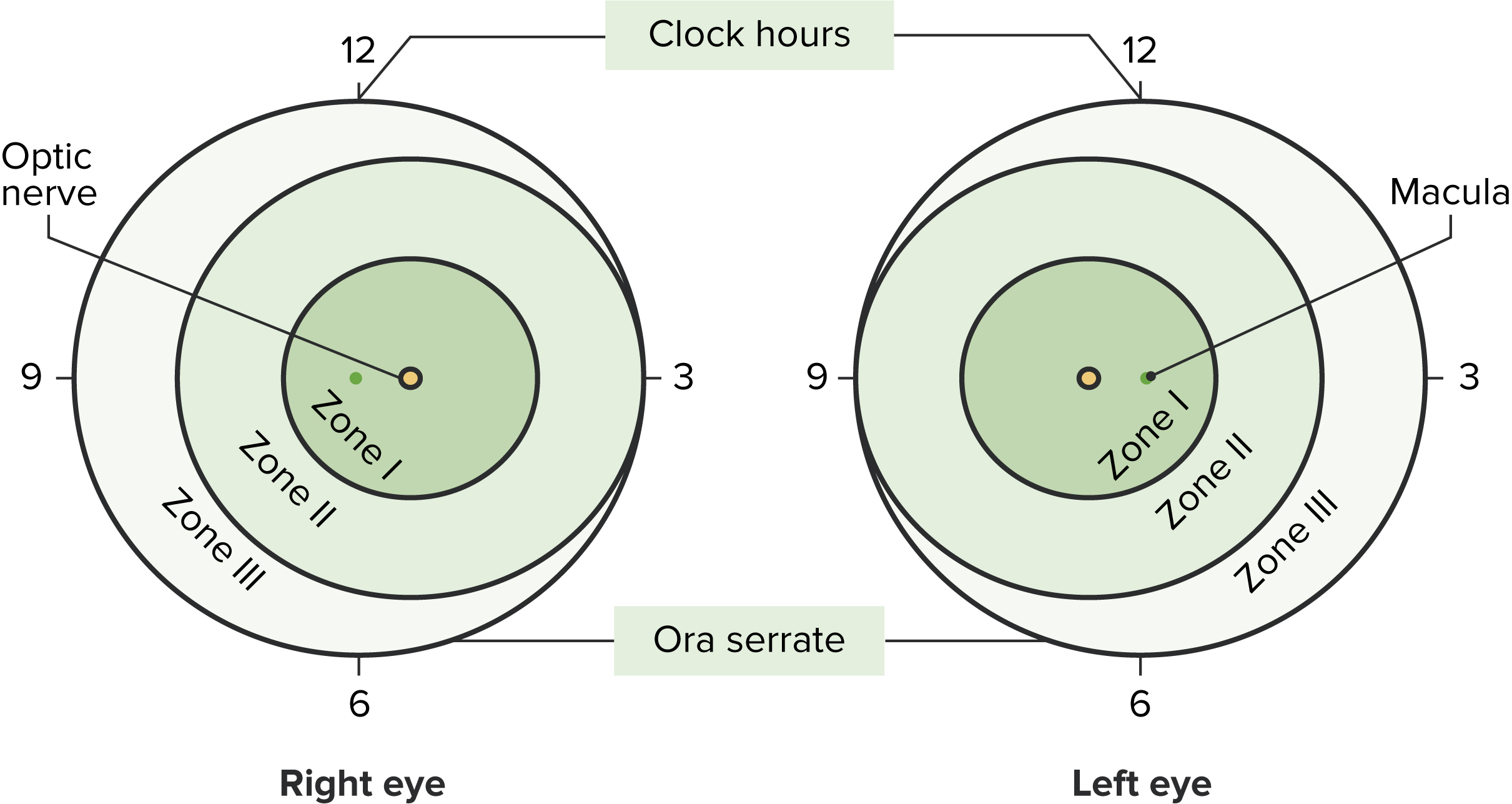
  • Localização envolvida
  • Extensão do envolvimento da retina Retina The ten-layered nervous tissue membrane of the eye. It is continuous with the optic nerve and receives images of external objects and transmits visual impulses to the brain. Its outer surface is in contact with the choroid and the inner surface with the vitreous body. The outermost layer is pigmented, whereas the inner nine layers are transparent. Eye: Anatomy (exprimida no número de horas de envolvidas)
  • Definição da gravidade da doença ou estadio (ver tabela abaixo)
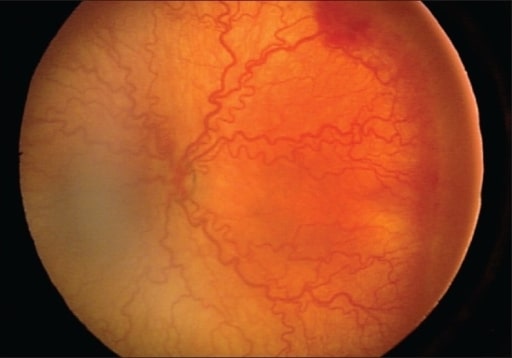
  • A presença ou ausência de “doença plus” (por exemplo, dilatação venosa e tortuosidade arterial dos vasos retinianos posteriores)
Classificação da retinopatia da prematuridade

Representação da classificação da retinopatia da pré-maturidade

Imagem de Lecturio.
Tabela: Fases da retinopatia da prematuridade
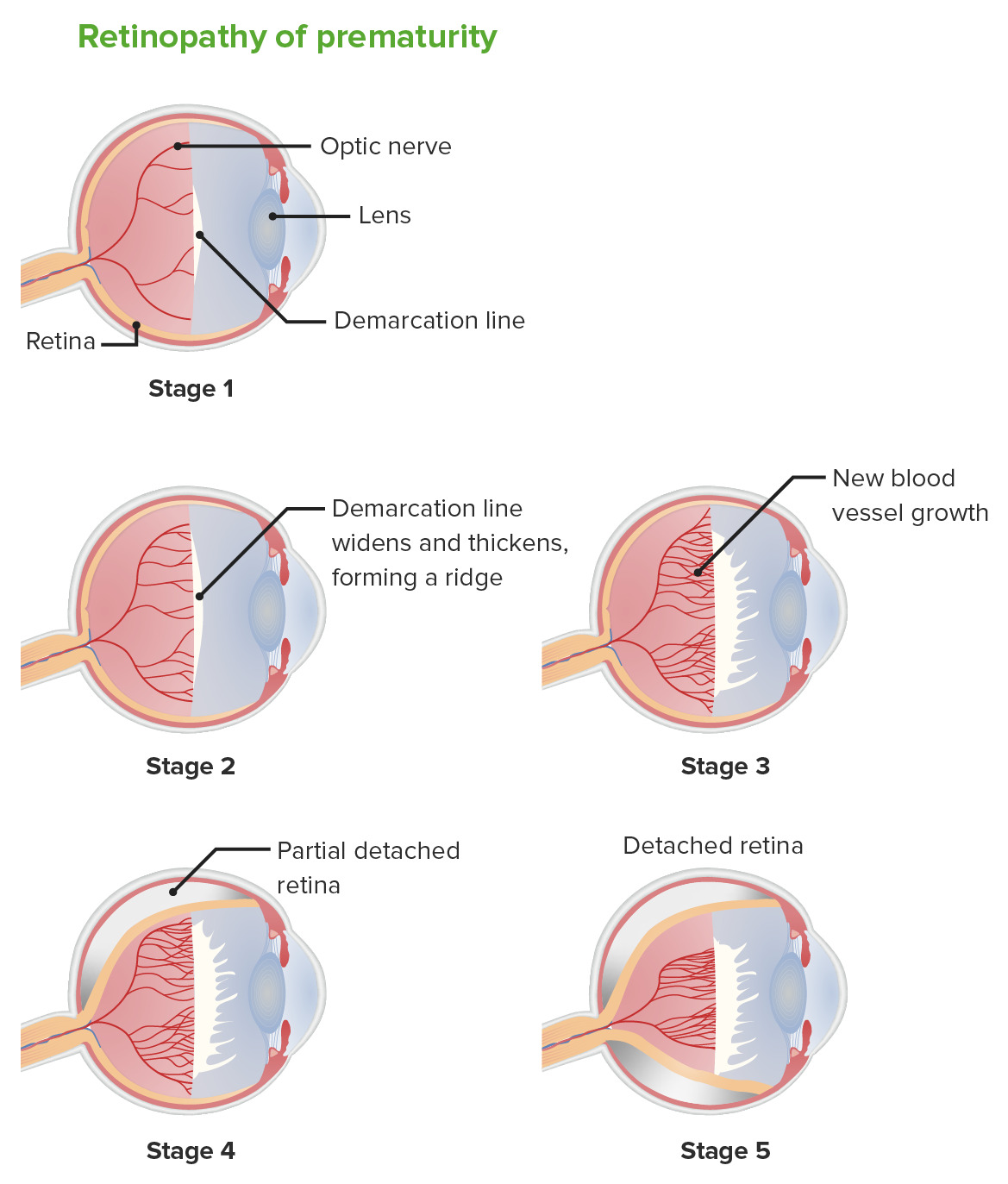
Estadios Características
1 Linha de demarcação entre a retina Retina The ten-layered nervous tissue membrane of the eye. It is continuous with the optic nerve and receives images of external objects and transmits visual impulses to the brain. Its outer surface is in contact with the choroid and the inner surface with the vitreous body. The outermost layer is pigmented, whereas the inner nine layers are transparent. Eye: Anatomy vascular e a retina Retina The ten-layered nervous tissue membrane of the eye. It is continuous with the optic nerve and receives images of external objects and transmits visual impulses to the brain. Its outer surface is in contact with the choroid and the inner surface with the vitreous body. The outermost layer is pigmented, whereas the inner nine layers are transparent. Eye: Anatomy avascular Avascular Corneal Abrasions, Erosion, and Ulcers
2 A linha de demarcação cresce em volume formando uma prega acima do plano da retina Retina The ten-layered nervous tissue membrane of the eye. It is continuous with the optic nerve and receives images of external objects and transmits visual impulses to the brain. Its outer surface is in contact with the choroid and the inner surface with the vitreous body. The outermost layer is pigmented, whereas the inner nine layers are transparent. Eye: Anatomy que se projeta para o vítreo.
3
  • Proliferação fibrovascular na retina Retina The ten-layered nervous tissue membrane of the eye. It is continuous with the optic nerve and receives images of external objects and transmits visual impulses to the brain. Its outer surface is in contact with the choroid and the inner surface with the vitreous body. The outermost layer is pigmented, whereas the inner nine layers are transparent. Eye: Anatomy
  • Formação de tecido fibrovascular; pode estender-se desde a prega anormal da retina Retina The ten-layered nervous tissue membrane of the eye. It is continuous with the optic nerve and receives images of external objects and transmits visual impulses to the brain. Its outer surface is in contact with the choroid and the inner surface with the vitreous body. The outermost layer is pigmented, whereas the inner nine layers are transparent. Eye: Anatomy até ao vítreo.
4 Descolamento da retina Retina The ten-layered nervous tissue membrane of the eye. It is continuous with the optic nerve and receives images of external objects and transmits visual impulses to the brain. Its outer surface is in contact with the choroid and the inner surface with the vitreous body. The outermost layer is pigmented, whereas the inner nine layers are transparent. Eye: Anatomy (parcial ou subtotal)
  • Etapa 4A: sem envolvimento da fóvea
  • Etapa 4B: com envolvimento da fóvea
5
  • Há um descolamento total da retina Retina The ten-layered nervous tissue membrane of the eye. It is continuous with the optic nerve and receives images of external objects and transmits visual impulses to the brain. Its outer surface is in contact with the choroid and the inner surface with the vitreous body. The outermost layer is pigmented, whereas the inner nine layers are transparent. Eye: Anatomy.
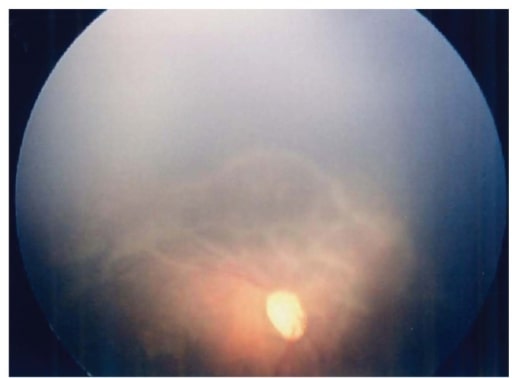
  • O doente apresenta-se com leucocória (reflexo pupilar branco).
Ilustração sobre a retinopatia da prematuridade

Retinopatia da prematuridade: etapas

Imagem de Lecturio.
Rastreio

Indicações para rastreio

  • Todos os recém-nascidos com baixo peso à nascença (< 1.500 g)
  • Todos os recém-nascidos que nasceram antes das 30 semanas de idade gestacional
  • Recém-nascidos com 1.500 g e 2.000 g de peso à nascença e nascidos após 30 semanas de gestação, mas que tenham sido expostos a potenciais fatores de risco (ver acima)

Métodos de rastreio

  • Quando fazer o rastreio:
    • Para os bebés nascidos entre 22 e 26 semanas, deve ser realizado o rastreio quando atingem as 30 semanas de idade gestacional
    • Para bebés ≥ 27 semanas, 4 semanas após o nascimento
    • Exames periódicos
  • Como realizar o rastreio:
    • Com o uso de um oftalmoscópio indireto ou uma câmara digital- RetCam
    • O objetivo consiste em procurar achados de retinopatia.
    • Os doentes são classificados em 2 categorias:
      1. Bebés com baixo risco
      2. Bebés com retinopatia proliferativa a necessitar de tratamento com laser
    • O risco de progressão é determinado por:
      • Aumento de peso
      • Níveis séricos de Insulin-like growth factor 1(IGF-1)
      • Grau da retinopatia

Abordagem

  • Os estadios iniciais (estadios 1 ou 2, na zona I e sem doença plus OU estadio 3, na zona II e sem doença plus) requerem um acompanhamento próximo, mas sem necessidade de intervenção.
  • Indicações para tratamento:
    • Qualquer estadio de retinopatia na zona I com doença plus
    • Etapa 3, na zona I, sem doença plus
    • Estadio 2 ou 3, na zona II, com doença plus
  • Opções de tratamento:
    • Crioterapia: feita sob anestesia geral
    • Fotocoagulação a laser
    • Fármacos anti-VEGF, como as injeções intravítreas de bevacizumabe
    • Vitrectomia no caso de descolamento da retina Retina The ten-layered nervous tissue membrane of the eye. It is continuous with the optic nerve and receives images of external objects and transmits visual impulses to the brain. Its outer surface is in contact with the choroid and the inner surface with the vitreous body. The outermost layer is pigmented, whereas the inner nine layers are transparent. Eye: Anatomy

Diagnóstico Diferencial

As seguintes situações clínicas podem ser diagnósticos diferenciais no caso de cegueira pediátrica:

  • Cataratas: opacificação da lente do olho, o que leva a uma diminuição da visão. Frequentemente as cataratas desenvolvem-se insidiosamente num ou em ambos os olhos. Os sintomas incluem visão desfocada ou dupla, maior sensibilidade ao brilho, observação de halos em torno das luzes, cores desbotadas e diminuição da visão noturna. Ao exame oftalmológico, um escurecimento ou opacidade do reflexo vermelho estão presentes frequentemente. O exame da lâmpada de fenda determina a extensão e a localização da catarata. As cataratas têm múltiplas etiologias, incluindo infeções por TORCH, traumas, efeito adverso dos corticosteroides e radiação.
  • Descolamento da retina Retina The ten-layered nervous tissue membrane of the eye. It is continuous with the optic nerve and receives images of external objects and transmits visual impulses to the brain. Its outer surface is in contact with the choroid and the inner surface with the vitreous body. The outermost layer is pigmented, whereas the inner nine layers are transparent. Eye: Anatomy: a separação da retina Retina The ten-layered nervous tissue membrane of the eye. It is continuous with the optic nerve and receives images of external objects and transmits visual impulses to the brain. Its outer surface is in contact with the choroid and the inner surface with the vitreous body. The outermost layer is pigmented, whereas the inner nine layers are transparent. Eye: Anatomy neurosensorial do epitélio pigmentar da retina Retina The ten-layered nervous tissue membrane of the eye. It is continuous with the optic nerve and receives images of external objects and transmits visual impulses to the brain. Its outer surface is in contact with the choroid and the inner surface with the vitreous body. The outermost layer is pigmented, whereas the inner nine layers are transparent. Eye: Anatomy. A retina Retina The ten-layered nervous tissue membrane of the eye. It is continuous with the optic nerve and receives images of external objects and transmits visual impulses to the brain. Its outer surface is in contact with the choroid and the inner surface with the vitreous body. The outermost layer is pigmented, whereas the inner nine layers are transparent. Eye: Anatomy é a camada mais MAIS Androgen Insensitivity Syndrome interna do olho e contem cones e bastonetes, células sensoriais especializadas na deteção da luz. Qualquer coisa que potencialmente afete a ligação entre a retina Retina The ten-layered nervous tissue membrane of the eye. It is continuous with the optic nerve and receives images of external objects and transmits visual impulses to the brain. Its outer surface is in contact with the choroid and the inner surface with the vitreous body. The outermost layer is pigmented, whereas the inner nine layers are transparent. Eye: Anatomy e a coroide pode levar a isquemia dos fotoreceptores e, como consequência, uma perda de visão indolor.
  • Retinoblastoma Retinoblastoma Retinoblastoma is a rare tumor but the most common primary intraocular malignancy of childhood. It is believed that the condition arises from a neuronal progenitor cell. Retinoblastoma can be heritable or non-heritable. Retinoblastoma: é o tumor Tumor Inflammation maligno primário do globo ocular mais MAIS Androgen Insensitivity Syndrome frequente em crianças, responsável por 2% de todos os tumores malignos na idade pediátrica. A doença manifesta-se tipicamente pela presença de leucocória (reflexo branco anormal no olho) numa criança com menos de 2 anos. A doença pode afetar um ou ambos os olhos e pode ser hereditária ou não hereditária. O retinoblastoma Retinoblastoma Retinoblastoma is a rare tumor but the most common primary intraocular malignancy of childhood. It is believed that the condition arises from a neuronal progenitor cell. Retinoblastoma can be heritable or non-heritable. Retinoblastoma é uma doença potencialmente mortal se não for tratada, mas um diagnóstico precoce está associado a taxas de sobrevivência de 95%>.

Referências

  1. International Committee for the Classification of Retinopathy of Prematurity. (2005). The International Classification of Retinopathy of Prematurity revisited. Archives of Ophthalmology, 123(7), 991–999. https://doi.org/10.1001/archopht.123.7.991 
  2. Smith, L. E. H. (2005). IGF-1 and retinopathy of prematurity in the preterm infant. Biology of the Neonate, 88(3), 237–244. https://doi.org/10.1159/000087587 
  3. Fierson, W. M., Chiang, M. F., Good, W., Phelps, D., Reynolds, J., Robbins, S. L., Karr, D. J., Bradford, G. E., Nischal, K., Roarty, J., Rubin, S. E., Suh, D. W., Lehman, S. S., & Ellis, G. S., Jr. (2018). Screening examination of premature infants for retinopathy of prematurity. Pediatrics, 142(6), e20183061. https://doi.org/10.1542/peds.2018-3061

Crie sua conta gratuita ou faça login para continuar lendo!

Cadastre-se agora e tenha acesso grátis ao Lecturio, com páginas de conceitos, vídeos de medicina e questões para sua educação médica.

Aprende mais com a Lecturio:

Multiple devices displaying human anatomy and health education content.

Complementa o teu estudo da faculdade com o companheiro de estudo tudo-em-um da Lecturio, através de métodos de ensino baseados em evidência.

Estuda onde quiseres

Two iPhones display medical education apps, one showing anatomy, the other Bookmatcher.

A Lecturio Medical complementa o teu estudo através de métodos de ensino baseados em evidência, vídeos de palestras, perguntas e muito mais – tudo combinado num só lugar e fácil de usar.

User Reviews

Have a holly, jolly study session 🎁 Save 50% on all plans now >>

Que tengas una sesión de estudio alegre y navideña 🎁 Ahorra 50% en todos los planes >>

Details