


Olho: Anatomia

O olho humano é um órgão sensorial que tem a visão como a sua função primária. O olho tem uma forma esférica e é estruturado em 3 camadas: uma camada fibrosa externa de suporte, uma camada vascular média e uma camada neuronal interna. O olho também pode ser subdividido em 3 compartimentos: as câmaras anterior, posterior e vítrea. Ao redor do globo ocular estão os músculos extraoculares, o aparelho lacrimal, vários nervos e vasos e a estrutura óssea da órbita. A luz viaja através dos compartimentos do olho para focar na retina Retina The ten-layered nervous tissue membrane of the eye. It is continuous with the optic nerve and receives images of external objects and transmits visual impulses to the brain. Its outer surface is in contact with the choroid and the inner surface with the vitreous body. The outermost layer is pigmented, whereas the inner nine layers are transparent. Eye: Anatomy, que é o local onde os fotorrecetores convertem o estímulo num impulso neuronal, que é transportado pelo nervo ótico até o cérebro.

Last updated: Dec 15, 2025
Editorial responsibility: Stanley Oiseth, Lindsay Jones, Evelin Maza

Desenvolvimento

Geral

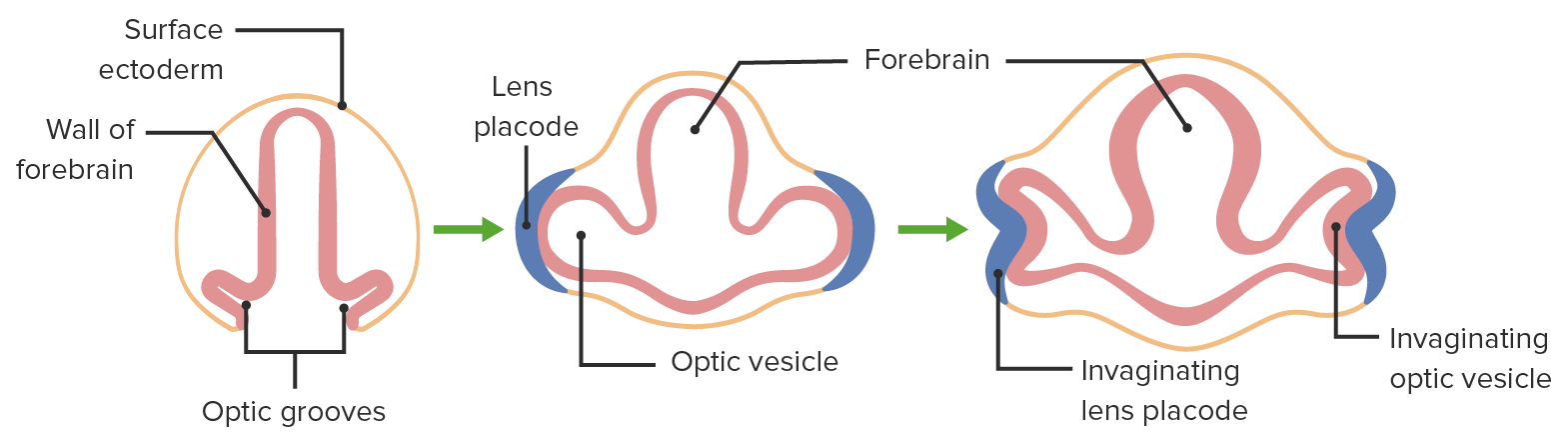
  • Desenvolve-se a partir do prosencéfalo
  • Regulado pelo gene Gene A category of nucleic acid sequences that function as units of heredity and which code for the basic instructions for the development, reproduction, and maintenance of organisms. Basic Terms of Genetics PAX6
  • O placóide da lente dá origem à lente.
  • O copo ótico dá origem à retina Retina The ten-layered nervous tissue membrane of the eye. It is continuous with the optic nerve and receives images of external objects and transmits visual impulses to the brain. Its outer surface is in contact with the choroid and the inner surface with the vitreous body. The outermost layer is pigmented, whereas the inner nine layers are transparent. Eye: Anatomy.

Linha temporal

  • Começa na semana 3, com a formação de sulcos óticos no prosencéfalo
  • Os sulcos óticos fundem-se para se tornarem as vesículas óticas.
  • Na semana 4, as vesículas óticas formam o cálice ótico, que se torna a retina Retina The ten-layered nervous tissue membrane of the eye. It is continuous with the optic nerve and receives images of external objects and transmits visual impulses to the brain. Its outer surface is in contact with the choroid and the inner surface with the vitreous body. The outermost layer is pigmented, whereas the inner nine layers are transparent. Eye: Anatomy.
  • Continua até a semana 10 do desenvolvimento embriológico
Desenvolvimento embrionário dos olhos

Desenvolvimento embrionário do olho

Imagem por Lecturio.

Related videos

Anatomia Geral

Características gerais

O olho adulto é um órgão complexo contido na cavidade orbitária (composta por 7 ossos). Cada olho tem várias camadas e câmaras e é rodeado por 6 músculos extraoculares.
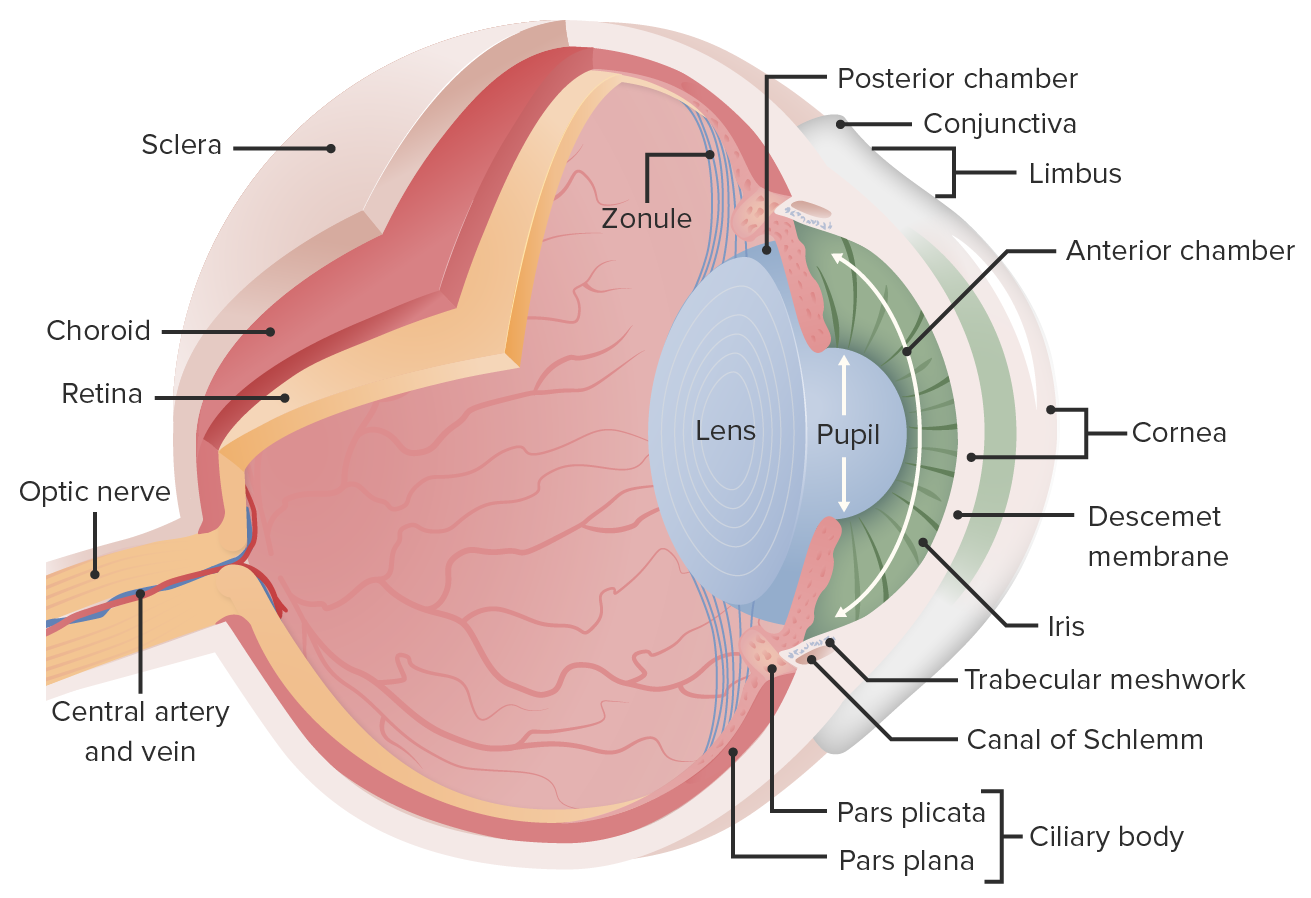
  • Camadas do olho:
    • Camada fibrosa: esclera e córnea
    • Camada vascular (a úvea): coroide, corpo ciliar e íris
    • Camada neuronal: retina Retina The ten-layered nervous tissue membrane of the eye. It is continuous with the optic nerve and receives images of external objects and transmits visual impulses to the brain. Its outer surface is in contact with the choroid and the inner surface with the vitreous body. The outermost layer is pigmented, whereas the inner nine layers are transparent. Eye: Anatomy e nervo ótico
  • Câmaras do olho:
    • Anterior: entre a córnea e a íris
    • Posterior: entre a íris e a lente
    • Vítreo: entre o cristalino e a parede posterior do olho
  • Componentes da órbita:
    • 6 músculos extraoculares:
      • Oblíquo superior
      • Oblíquo inferior
      • Reto lateral
      • Reto medial
      • Reto inferior
      • Reto superior
    • Levantador da pálpebra superior
    • Aparelho lacrimal:
      • Glândulas lacrimais e os seus ductos associados
      • Produz lágrimas para fornecer lubrificação
    • Nervos e vasos sanguíneos
  • Função: sentido da visão
    • O meio refrativo direciona e refrata a luz para a retina Retina The ten-layered nervous tissue membrane of the eye. It is continuous with the optic nerve and receives images of external objects and transmits visual impulses to the brain. Its outer surface is in contact with the choroid and the inner surface with the vitreous body. The outermost layer is pigmented, whereas the inner nine layers are transparent. Eye: Anatomy. A luz viaja através:
    • Lente e corpo ciliar ajustam a faixa de acomodação
    • A retina Retina The ten-layered nervous tissue membrane of the eye. It is continuous with the optic nerve and receives images of external objects and transmits visual impulses to the brain. Its outer surface is in contact with the choroid and the inner surface with the vitreous body. The outermost layer is pigmented, whereas the inner nine layers are transparent. Eye: Anatomy contém fotorrecetores (cones e bastonetes) e o nervo ótico
Representação da anatomia do olho

Anatomia do olho

Imagem por Lecturio.

Camadas do olho

O olho é composto por 3 camadas (fibrosa, vascular, neuronal) e uma cobertura de tecido conjuntivo transparente (conjuntiva).

Conjuntiva :

  • Tecido conjuntivo frouxo e transparente que cobre o olho (conjuntiva bulbar).
  • Adere firmemente ao limbo da córnea
  • Reflete sobre si mesma para formar a camada interna da pálpebra (conjuntiva palpebral)
  • Altamente vascular
  • Mantém a lubrificação normal do olho

Camada fibrosa:

  • A córnea:
  • Esclera:
    • Contínua com a córnea
    • Cobre a face posterior do olho
    • > 80% da camada fibrosa
    • Vista como a parte branca do olho
    • Local de fixação dos músculos extraoculares
  • Limbo:
    • Fronteira entre a córnea e a esclera
    • Via de saída do humor Humor Defense Mechanisms aquoso
    • Local da incisão cirúrgica para a cirurgia da catarata e da glaucoma Glaucoma Glaucoma is an optic neuropathy characterized by typical visual field defects and optic nerve atrophy seen as optic disc cupping on examination. The acute form of glaucoma is a medical emergency. Glaucoma is often, but not always, caused by increased intraocular pressure (IOP). Glaucoma

Camada vascular:

  • Úvea, ou trato úveal:
    • Composta pela íris, corpo ciliar e coroide
    • Situa-se entre a esclera e a retina Retina The ten-layered nervous tissue membrane of the eye. It is continuous with the optic nerve and receives images of external objects and transmits visual impulses to the brain. Its outer surface is in contact with the choroid and the inner surface with the vitreous body. The outermost layer is pigmented, whereas the inner nine layers are transparent. Eye: Anatomy
    • A porção anterior é a íris e o corpo ciliar.
    • A porção posterior é a coroide.
  • Coroide (úvea posterior):
    • Camada castanho-avermelhada entre a esclera e a retina Retina The ten-layered nervous tissue membrane of the eye. It is continuous with the optic nerve and receives images of external objects and transmits visual impulses to the brain. Its outer surface is in contact with the choroid and the inner surface with the vitreous body. The outermost layer is pigmented, whereas the inner nine layers are transparent. Eye: Anatomy
    • Contém grandes vasos externos e um leito capilar mais MAIS Androgen Insensitivity Syndrome interno
    • Fonte de oxigénio/nutrientes para a retina Retina The ten-layered nervous tissue membrane of the eye. It is continuous with the optic nerve and receives images of external objects and transmits visual impulses to the brain. Its outer surface is in contact with the choroid and the inner surface with the vitreous body. The outermost layer is pigmented, whereas the inner nine layers are transparent. Eye: Anatomy
    • Contínua anteriormente com corpo ciliar
  • Corpo ciliar:
    • Estrutura muscular que conecta a coroide com a circunferência da íris.
    • Altera a forma e a espessura da lente (acomodação)
    • Os processos ciliares secretam humor Humor Defense Mechanisms aquoso.
  • Íris:
    • Diafragma pigmentado com abertura central (pupila)
    • Na superfície anterior da lente
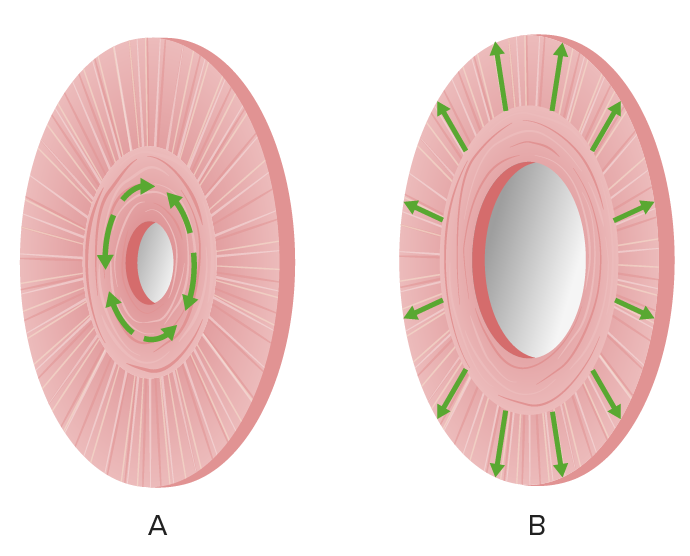
    • Os músculos do esfíncter dentro da íris ajustam o tamanho pupilar em resposta à luz e ao sistema nervoso autónomo.
    • Exposição à luz/estimulação parassimpática:
      • Estreita a pupila (miose)
      • Músculo esfíncter pupilar
    • Escuridão/estimulação simpática:
      • Alarga a pupila (midríase)
      • Músculo dilatador da pupila
Ações musculares da íris

Os músculos do esfíncter da íris são responsáveis pela constrição (A) e dilatação (B) da pupila.

Imagem por Lecturio.

Camada neuronal:

  • Retina Retina The ten-layered nervous tissue membrane of the eye. It is continuous with the optic nerve and receives images of external objects and transmits visual impulses to the brain. Its outer surface is in contact with the choroid and the inner surface with the vitreous body. The outermost layer is pigmented, whereas the inner nine layers are transparent. Eye: Anatomy visual:
    • Camada neuronal:
      • Recetiva à luz
      • Termina anteriormente ao longo da ora serrata
    • Camada de células pigmentadas:
      • Camada única de células
      • Absorve a luz e reduz a dispersão da mesma dentro do olho
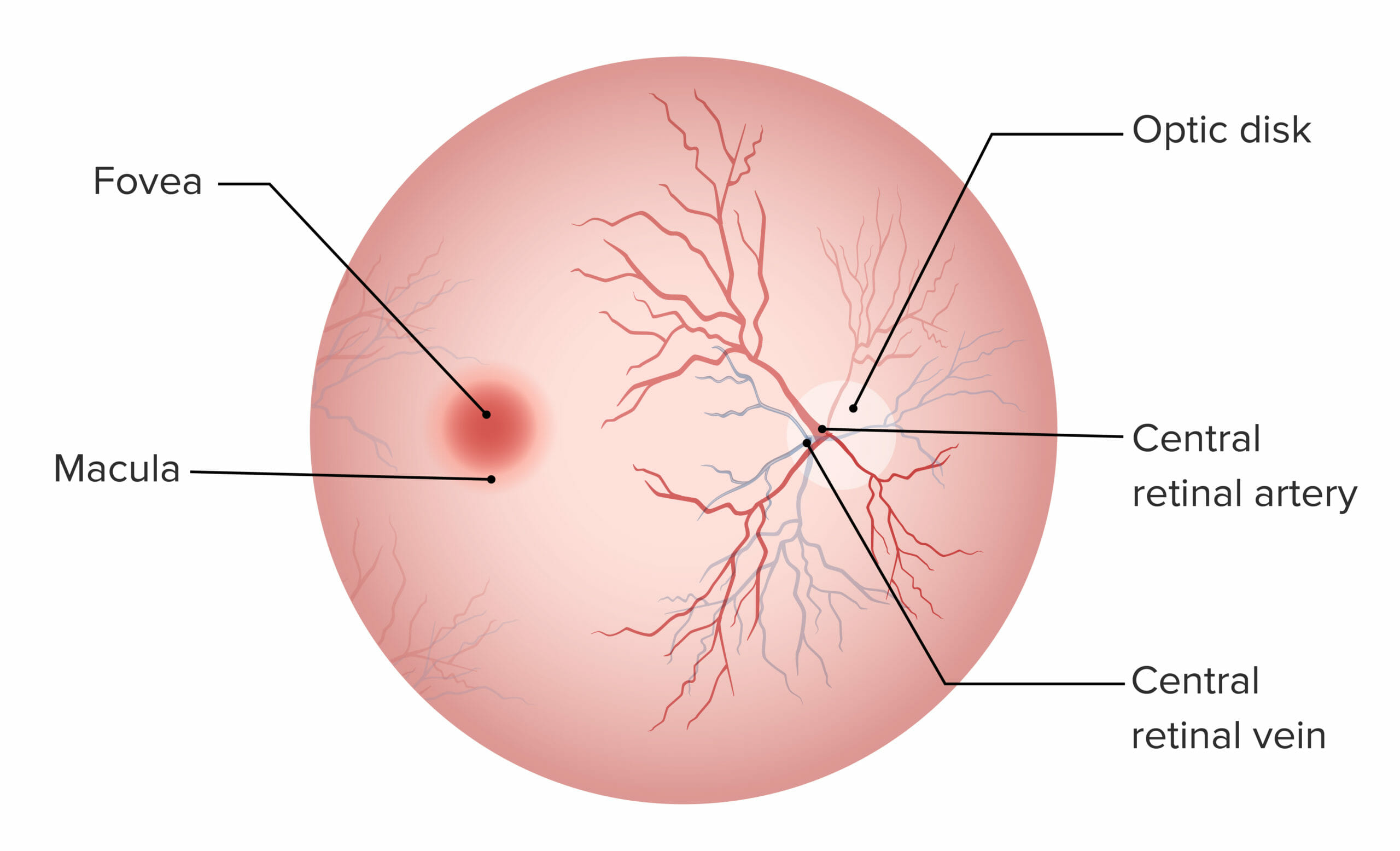
    • Disco ótico ou papila:
      • Conhecido como “ponto cego”: sem fotorrecetores
      • Localizado no fundo da retina Retina The ten-layered nervous tissue membrane of the eye. It is continuous with the optic nerve and receives images of external objects and transmits visual impulses to the brain. Its outer surface is in contact with the choroid and the inner surface with the vitreous body. The outermost layer is pigmented, whereas the inner nine layers are transparent. Eye: Anatomy, que é o local onde as fibras sensitivas do nervo ótico entram no globo ocular.
    • Mácula:
      • Contém cones fotorrecetores especiais que contribuem para a acuidade visual
      • Sem vasos sanguíneos
    • Fóvea:
      • Localizada no centro da mácula
      • Responsável pela visão de alta acuidade
      • Densamente saturada com fotorrecetores do tipo cones
  • Retina Retina The ten-layered nervous tissue membrane of the eye. It is continuous with the optic nerve and receives images of external objects and transmits visual impulses to the brain. Its outer surface is in contact with the choroid and the inner surface with the vitreous body. The outermost layer is pigmented, whereas the inner nine layers are transparent. Eye: Anatomy não visual:
    • Porção da retina Retina The ten-layered nervous tissue membrane of the eye. It is continuous with the optic nerve and receives images of external objects and transmits visual impulses to the brain. Its outer surface is in contact with the choroid and the inner surface with the vitreous body. The outermost layer is pigmented, whereas the inner nine layers are transparent. Eye: Anatomy que não é sensível à luz
    • Continuação anterior da camada de células pigmentares juntamente com células de suporte sobre o corpo ciliar e a superfície posterior da íris
Retina

Retina:
A fóvea e a mácula não possuem vasos sanguíneos, sendo responsáveis pela visão de alta acuidade. O disco ótico é o ponto de entrada da vasculatura do olho e não contém fotorrecetores.

Imagem por Lecturio.

Características da retina Retina The ten-layered nervous tissue membrane of the eye. It is continuous with the optic nerve and receives images of external objects and transmits visual impulses to the brain. Its outer surface is in contact with the choroid and the inner surface with the vitreous body. The outermost layer is pigmented, whereas the inner nine layers are transparent. Eye: Anatomy e as suas camadas:

Tabela: Características da retina Retina The ten-layered nervous tissue membrane of the eye. It is continuous with the optic nerve and receives images of external objects and transmits visual impulses to the brain. Its outer surface is in contact with the choroid and the inner surface with the vitreous body. The outermost layer is pigmented, whereas the inner nine layers are transparent. Eye: Anatomy e suas camadas
Camada da retina Retina The ten-layered nervous tissue membrane of the eye. It is continuous with the optic nerve and receives images of external objects and transmits visual impulses to the brain. Its outer surface is in contact with the choroid and the inner surface with the vitreous body. The outermost layer is pigmented, whereas the inner nine layers are transparent. Eye: Anatomy (externa para interna) Características
Epitélio pigmentado
Camada de bastonetes e cones
  • Células fotorrecetoras
  • Bastonetes: células cilíndricas delgadas contendo rodopsina, localizadas em redor da fóvea central, especializadas na visão noturna (luz fraca) e movimento
  • Cones: células em forma de frasco contendo fotopsina/iodopsina, localizadas na fóvea central, especializadas na visão de cores, luz brilhante, reconhecimento de objetos e acuidade visual
Membrana limitante externa Suporta as células fotorrecetoras
Membrana nuclear externa Núcleos de células fotorrecetoras (neurónio de 1ª ordem)
Camada plexiforme externa 1ª sinapse, entre cones e bastonetes e células bipolares
Membrana limitante média Membrana de suporte
Camada nuclear interna Corpos celulares e núcleos de células bipolares (neurónio de 2ª ordem), transmitem informações para células ganglionares
Camada plexiforme interna Segunda sinapse, entre células bipolares e células ganglionares
Camada de células ganglionares
  • Os corpos celulares e núcleos de células ganglionares (neurónio de 3ª ordem) combinam-se aqui para formar o nervo óptico (nervo craniano (NC) II).
  • Transmite informações para o hipotálamo, núcleo pré-tectal, corpo geniculado lateral, colículo superior e córtex visual
Fibras do nervo ótico Axónios das células ganglionares
Membrana limitante interna Camada mais MAIS Androgen Insensitivity Syndrome interna, mais MAIS Androgen Insensitivity Syndrome próxima do humor Humor Defense Mechanisms vítreo

Câmaras do olho

  • O olho consiste em 3 câmaras fundidas:
    • Anterior: entre a córnea e a íris
    • Posterior: entre a íris e a lente
    • Vítreo: entre o cristalino e a parede posterior do olho
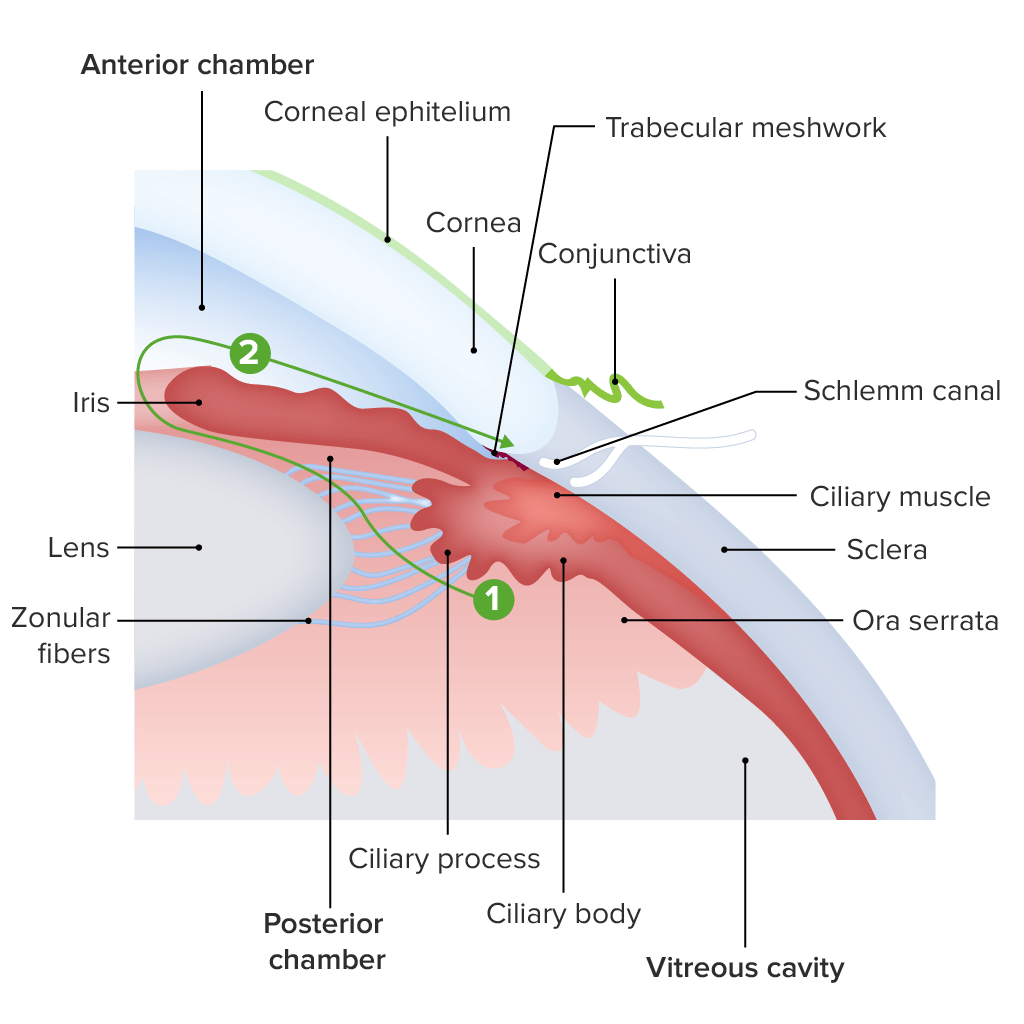
  • Humor Humor Defense Mechanisms aquoso:
    • Produzido pelos processos ciliares do corpo ciliar
    • Viaja para as câmaras anterior e posterior
    • Absorvido pelos linfáticos no canal de Schlemm
  • Corpo vítreo (também conhecido como humor Humor Defense Mechanisms vítreo):
    • Ocupa a câmara vítrea
    • Envolto pela membrana vítrea
    • Fluido no centro e gel nas bordas
    • Fixa-se firmemente à serrata, disco ótico, vasos retinianos, cápsula do cristalino e mácula
Estrutura da região límbica

Diagrama da estrutura da região límbica:
O humor aquoso é produzido pelos processos ciliares (1), circula pela pupila da íris para a câmara anterior (2) e, finalmente, pelo canal de Schlemm para o seio venoso escleral.

Imagem por Lecturio.

Neurovasculatura

Suprimento sanguíneo

Todo o suprimento arterial do olho é fornecido por ramos da artéria oftálmica e drenado por um sistema de veias que se unem para formar a veia central da retina Retina The ten-layered nervous tissue membrane of the eye. It is continuous with the optic nerve and receives images of external objects and transmits visual impulses to the brain. Its outer surface is in contact with the choroid and the inner surface with the vitreous body. The outermost layer is pigmented, whereas the inner nine layers are transparent. Eye: Anatomy.
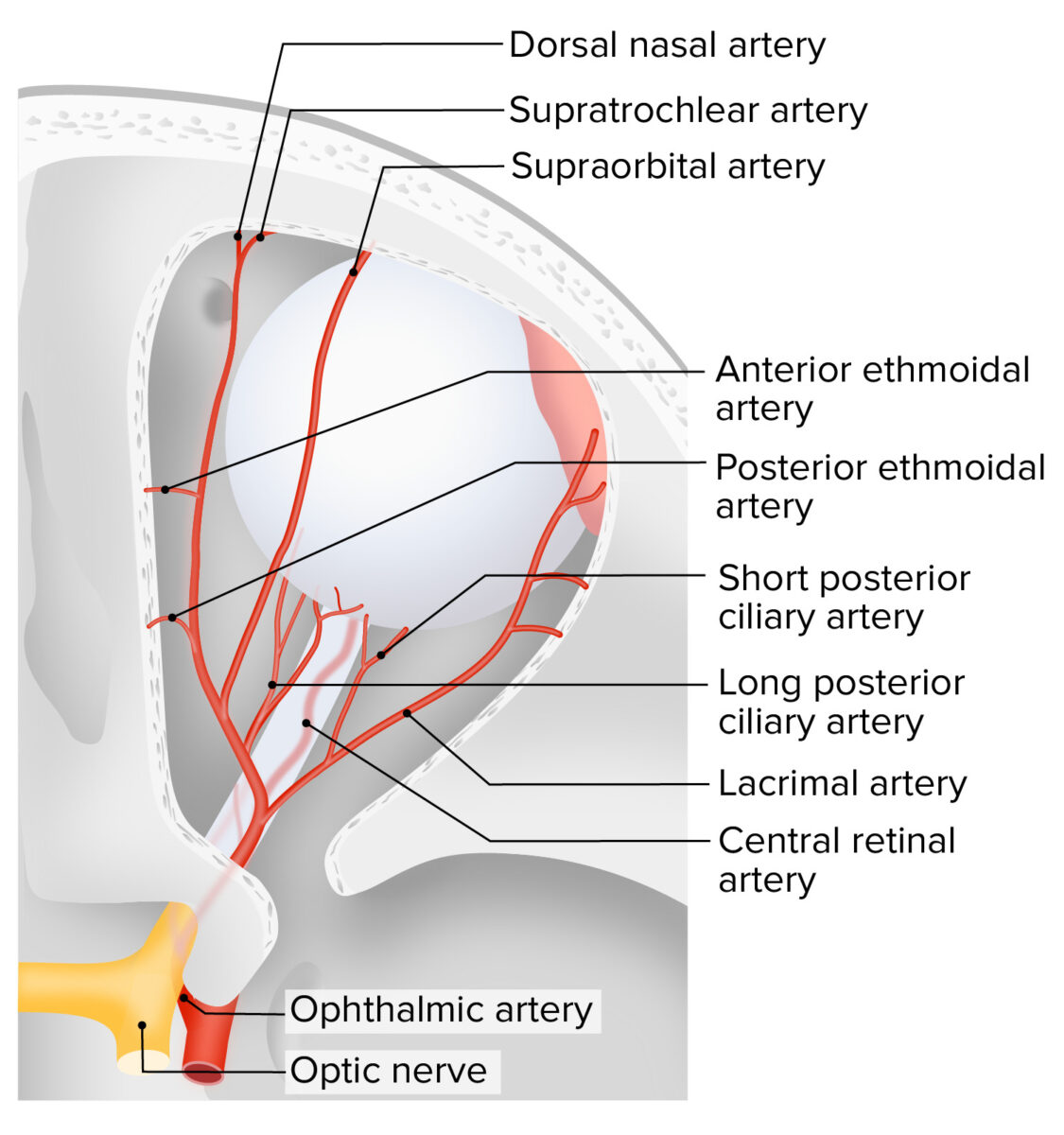
  • A artéria oftálmica, ramo da artéria carótida interna, por sua vez, emite ramos:
    • Artéria central da retina Retina The ten-layered nervous tissue membrane of the eye. It is continuous with the optic nerve and receives images of external objects and transmits visual impulses to the brain. Its outer surface is in contact with the choroid and the inner surface with the vitreous body. The outermost layer is pigmented, whereas the inner nine layers are transparent. Eye: Anatomy:
      • 1º ramo da artéria oftálmica
      • Supre a camada interna da retina Retina The ten-layered nervous tissue membrane of the eye. It is continuous with the optic nerve and receives images of external objects and transmits visual impulses to the brain. Its outer surface is in contact with the choroid and the inner surface with the vitreous body. The outermost layer is pigmented, whereas the inner nine layers are transparent. Eye: Anatomy e todas as fibras nervosas que formam o nervo ótico
    • Artéria lacrimal:
      • 2º ramo da artéria oftálmica
      • Supre as pálpebras, glândula lacrimal e conjuntiva
    • Artérias ciliares:
      • Incluem as artérias ciliares posteriores longas e curtas e a artéria ciliar anterior
      • Suprem a coroide e a íris
    • Artéria supraorbitária:
      • Bifurca-se para formar um ramo superficial e profundo
      • Supre a pálpebra superior, músculo elevador da pálpebra, pele da testa e couro cabeludo
    • Artérias etmoidais:
      • Inclui as artérias etmoidais anterior e posterior
      • Suprem os seios etmoidais
    • Artéria palpebral medial:
      • Também conhecida como artéria palpebral interna – superior e inferior
      • Origina-se da artéria oftálmica perto dos seus ramos terminais
      • Supre as pálpebras
    • Artérias musculares:
      • Ramos medial e lateral da artéria oftálmica
      • Suprem os músculos extraoculares
    • Ramos terminais:
      • Artéria nasal dorsal: irriga o saco lacrimal e a ponta do nariz
      • Artéria supratroclear: irriga a fronte medial
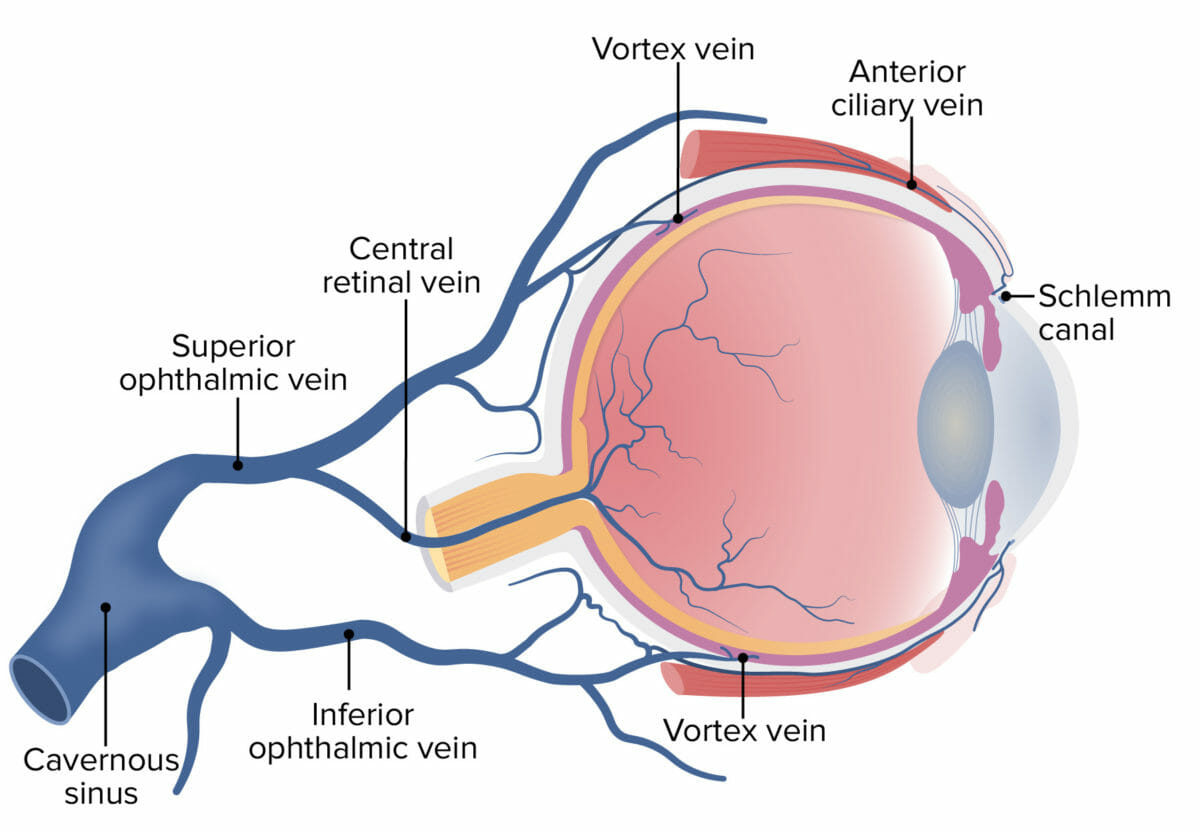
  • Drenagem venosa:
    • A veia central da retina Retina The ten-layered nervous tissue membrane of the eye. It is continuous with the optic nerve and receives images of external objects and transmits visual impulses to the brain. Its outer surface is in contact with the choroid and the inner surface with the vitreous body. The outermost layer is pigmented, whereas the inner nine layers are transparent. Eye: Anatomy e as veias vorticosas fundem-se com as veias oftálmicas superior e inferior
    • Estas veias drenam para o seio cavernoso, o plexo venoso pterigoideu e a veia facial.

Inervação

  • Visão:
    • Nervo ótico (NC II)
    • A camada mais MAIS Androgen Insensitivity Syndrome interna da retina Retina The ten-layered nervous tissue membrane of the eye. It is continuous with the optic nerve and receives images of external objects and transmits visual impulses to the brain. Its outer surface is in contact with the choroid and the inner surface with the vitreous body. The outermost layer is pigmented, whereas the inner nine layers are transparent. Eye: Anatomy contém fotorrecetores, que convertem estímulos luminosos em impulsos neuronais transmitidos pelo nervo ótico:
      • Bastonetes: melhor desempenho com pouca luz; cerca de 120 milhões em cada retina Retina The ten-layered nervous tissue membrane of the eye. It is continuous with the optic nerve and receives images of external objects and transmits visual impulses to the brain. Its outer surface is in contact with the choroid and the inner surface with the vitreous body. The outermost layer is pigmented, whereas the inner nine layers are transparent. Eye: Anatomy
      • Cones: visão de cores; cerca de 6 milhões em cada retina Retina The ten-layered nervous tissue membrane of the eye. It is continuous with the optic nerve and receives images of external objects and transmits visual impulses to the brain. Its outer surface is in contact with the choroid and the inner surface with the vitreous body. The outermost layer is pigmented, whereas the inner nine layers are transparent. Eye: Anatomy
  • Miose:
    • Constrição pupilar
    • Fibras parassimpáticas dos nervos ciliares curtos para o músculo constritor da pupila
  • Midríase:
    • Dilatação pupilar
    • Fibras simpáticas dos nervos ciliares longos para o músculo dilatador radial da pupila
  • Acomodação:
    • Espessamento da lente para permitir visão de perto
    • Os nervos ciliares curtos (ramo do III nervo craniano) inervam os músculos ciliares, que alteram a forma do cristalino.
  • Sensação: ramo oftálmico (V1) do nervo craniano V (nervo trigémeo)

Função

Visão

  • A função do olho é fornecer o sentido da visão.
  • Os raios de luz passam pela córnea, humor Humor Defense Mechanisms aquoso, pupila, cristalino e humor Humor Defense Mechanisms vítreo para focar na camada mais MAIS Androgen Insensitivity Syndrome interna da retina Retina The ten-layered nervous tissue membrane of the eye. It is continuous with the optic nerve and receives images of external objects and transmits visual impulses to the brain. Its outer surface is in contact with the choroid and the inner surface with the vitreous body. The outermost layer is pigmented, whereas the inner nine layers are transparent. Eye: Anatomy.
  • A córnea e o cristalino trabalham juntos para focar a luz na retina Retina The ten-layered nervous tissue membrane of the eye. It is continuous with the optic nerve and receives images of external objects and transmits visual impulses to the brain. Its outer surface is in contact with the choroid and the inner surface with the vitreous body. The outermost layer is pigmented, whereas the inner nine layers are transparent. Eye: Anatomy.
  • A íris controla a quantidade de luz que entra no olho, ajustando o tamanho da pupila em resposta à intensidade da luz e à distância do objeto.
  • As células fotorrecetoras da retina Retina The ten-layered nervous tissue membrane of the eye. It is continuous with the optic nerve and receives images of external objects and transmits visual impulses to the brain. Its outer surface is in contact with the choroid and the inner surface with the vitreous body. The outermost layer is pigmented, whereas the inner nine layers are transparent. Eye: Anatomy geram impulsos elétricos e químicos, que são transmitidos ao cérebro através do nervo ótico (NC II), resultando numa interpretação da imagem.

Meios refrativos do olho

  • Córnea:
  • Lente:
    • Transparente, biconvexa
    • Funciona com a córnea para uma refração ideal
    • A refração varia de acordo com a quantidade de acomodação necessária:
      • Visão distante: diminuição da convexidade, lente achatada
      • Visão de perto: aumento da convexidade, lente esférica
  • Humor Humor Defense Mechanisms vítreo (corpo vítreo):
    • Fluido aquoso dentro de uma substância gelatinosa transparente
    • Mantém a pressão intraocular
  • Humor Humor Defense Mechanisms aquoso:
    • Fluido transparente e aquoso
    • Protege a córnea e o cristalino e preenche as câmaras anterior e posterior
    • Produzido pelos processos ciliares
    • Drenam para o seio venoso escleral através do canal de Schlemm, no ângulo iridocorneal

Células fotorrecetoras da retina Retina The ten-layered nervous tissue membrane of the eye. It is continuous with the optic nerve and receives images of external objects and transmits visual impulses to the brain. Its outer surface is in contact with the choroid and the inner surface with the vitreous body. The outermost layer is pigmented, whereas the inner nine layers are transparent. Eye: Anatomy

  • Bastonetes:
    • Funcionam melhor com pouca luz
    • Fornecem visão a preto e branco
    • 120 milhões de bastonetes em cada retina Retina The ten-layered nervous tissue membrane of the eye. It is continuous with the optic nerve and receives images of external objects and transmits visual impulses to the brain. Its outer surface is in contact with the choroid and the inner surface with the vitreous body. The outermost layer is pigmented, whereas the inner nine layers are transparent. Eye: Anatomy
  • Cones:
    • Funcionam melhor com luz brilhante
    • Fornecem visão de cores e acuidade visual
    • 6 milhões de cones em cada retina Retina The ten-layered nervous tissue membrane of the eye. It is continuous with the optic nerve and receives images of external objects and transmits visual impulses to the brain. Its outer surface is in contact with the choroid and the inner surface with the vitreous body. The outermost layer is pigmented, whereas the inner nine layers are transparent. Eye: Anatomy

Relevância Clínica

Distúrbios da perceção visual

  • Erros de refração: condições em que a forma do olho não refrata a luz corretamente, resultando numa visão desfocada. Os principais tipos de erros de refração são a miopia (diminuição visão ao longe), hipermetropia (diminuição da visão ao perto), presbiopia (perda da visão de perto com a idade) e astigmatismo (curvas incompatíveis da córnea e do cristalino).
  • Distúrbios da via visual: As estruturas responsáveis por distúrbios da via visual incluem a retina Retina The ten-layered nervous tissue membrane of the eye. It is continuous with the optic nerve and receives images of external objects and transmits visual impulses to the brain. Its outer surface is in contact with the choroid and the inner surface with the vitreous body. The outermost layer is pigmented, whereas the inner nine layers are transparent. Eye: Anatomy, o nervo ótico, o quiasma ótico, o trato ótico, a radiação ótica e córtex visual do lobo occipital Occipital Part of the back and base of the cranium that encloses the foramen magnum. Skull: Anatomy. O local do dano é frequentemente localizável por oftalmoscopia, pelas reações pupilares e pelo padrão de defeitos do campo visual.

Doenças sistémicas que afetam o olho

  • Retinopatia diabética: doença vascular da retina Retina The ten-layered nervous tissue membrane of the eye. It is continuous with the optic nerve and receives images of external objects and transmits visual impulses to the brain. Its outer surface is in contact with the choroid and the inner surface with the vitreous body. The outermost layer is pigmented, whereas the inner nine layers are transparent. Eye: Anatomy que afeta indivíduos com diabetes Diabetes Diabetes mellitus (DM) is a metabolic disease characterized by hyperglycemia and dysfunction of the regulation of glucose metabolism by insulin. Type 1 DM is diagnosed mostly in children and young adults as the result of autoimmune destruction of β cells in the pancreas and the resulting lack of insulin. Type 2 DM has a significant association with obesity and is characterized by insulin resistance. Diabetes Mellitus mellitus de longa data. A perda de visão é tipicamente lenta e progressiva e ocorre, na maioria dos indivíduos, 2 a 3 décadas após o início do diabetes Diabetes Diabetes mellitus (DM) is a metabolic disease characterized by hyperglycemia and dysfunction of the regulation of glucose metabolism by insulin. Type 1 DM is diagnosed mostly in children and young adults as the result of autoimmune destruction of β cells in the pancreas and the resulting lack of insulin. Type 2 DM has a significant association with obesity and is characterized by insulin resistance. Diabetes Mellitus.
  • Retinopatia hipertensiva: alterações retinianas em indivíduos com hipertensão de longa data. A retinopatia hipertensiva geralmente inclui estenose arterial e hemorragia.

Distúrbios diversos do olho

  • Conjuntivite: inflamação da conjuntiva devido a uma reação infeciosa (incluindo agentes bacterianos, virais ou fúngicos), alérgica ou autoimune. Os indivíduos apresentam hiperemia conjuntival, secreção ocular que pode ser aquosa ou purulenta, desconforto ou sensação de corpo estranho.
  • Descolamento de retina Retina The ten-layered nervous tissue membrane of the eye. It is continuous with the optic nerve and receives images of external objects and transmits visual impulses to the brain. Its outer surface is in contact with the choroid and the inner surface with the vitreous body. The outermost layer is pigmented, whereas the inner nine layers are transparent. Eye: Anatomy: emergência médica na qual uma camada de tecido da retina Retina The ten-layered nervous tissue membrane of the eye. It is continuous with the optic nerve and receives images of external objects and transmits visual impulses to the brain. Its outer surface is in contact with the choroid and the inner surface with the vitreous body. The outermost layer is pigmented, whereas the inner nine layers are transparent. Eye: Anatomy se desprende da camada coroide de suporte subjacente. O descolamento da retina Retina The ten-layered nervous tissue membrane of the eye. It is continuous with the optic nerve and receives images of external objects and transmits visual impulses to the brain. Its outer surface is in contact with the choroid and the inner surface with the vitreous body. The outermost layer is pigmented, whereas the inner nine layers are transparent. Eye: Anatomy pode ser causado por trauma ou um alto grau de miopia, e os indivíduos geralmente têm história familiar deste distúrbio. O descolamento de retina Retina The ten-layered nervous tissue membrane of the eye. It is continuous with the optic nerve and receives images of external objects and transmits visual impulses to the brain. Its outer surface is in contact with the choroid and the inner surface with the vitreous body. The outermost layer is pigmented, whereas the inner nine layers are transparent. Eye: Anatomy deve ser tratado dentro de 24 a 48 horas ou pode levar à perda permanente da visão.
  • Catarata: diminuição da visão devido a uma turvação ou perda de transparência do cristalino, comum com o avançar da idade. O tratamento da catarata requer a extração cirúrgica do cristalino opaco e, geralmente, o implante de um novo cristalino.
  • Glaucoma Glaucoma Glaucoma is an optic neuropathy characterized by typical visual field defects and optic nerve atrophy seen as optic disc cupping on examination. The acute form of glaucoma is a medical emergency. Glaucoma is often, but not always, caused by increased intraocular pressure (IOP). Glaucoma: condição que cursa com aumento da pressão intraocular resultante da drenagem inadequada do humor Humor Defense Mechanisms aquoso, geralmente devido a um bloqueio. A menos que seja medicamente tratado ou corrigido cirurgicamente, o glaucoma Glaucoma Glaucoma is an optic neuropathy characterized by typical visual field defects and optic nerve atrophy seen as optic disc cupping on examination. The acute form of glaucoma is a medical emergency. Glaucoma is often, but not always, caused by increased intraocular pressure (IOP). Glaucoma pode levar à perda gradual da visão devido a danos no nervo ótico.
  • Síndrome de Horner: Essa síndrome é causada pela interrupção do suprimento nervoso simpático para o olho e é caracterizada por miose ipsilateral, ptose parcial, enoftalmia e anidrose hemifacial.
  • Retinoblastoma Retinoblastoma Retinoblastoma is a rare tumor but the most common primary intraocular malignancy of childhood. It is believed that the condition arises from a neuronal progenitor cell. Retinoblastoma can be heritable or non-heritable. Retinoblastoma: malignidade intraocular que começa na retina Retina The ten-layered nervous tissue membrane of the eye. It is continuous with the optic nerve and receives images of external objects and transmits visual impulses to the brain. Its outer surface is in contact with the choroid and the inner surface with the vitreous body. The outermost layer is pigmented, whereas the inner nine layers are transparent. Eye: Anatomy. O retinoblastoma Retinoblastoma Retinoblastoma is a rare tumor but the most common primary intraocular malignancy of childhood. It is believed that the condition arises from a neuronal progenitor cell. Retinoblastoma can be heritable or non-heritable. Retinoblastoma geralmente manifesta-se durante a infância com um reflexo pupilar anormal à luz, conhecido como leucocoria (pupila branca).

Referências

  1. Bales, T.R., Lopez, M.J., Clark, J. (2021). Embryology, eye. StatPearls. https://www.ncbi.nlm.nih.gov/books/NBK538480/
  2. Silverman, M.A., Brenner, B.E. (2021). What is the conjunctiva and what is its function? Medscape. https://www.medscape.com/answers/797874-22279/what-is-the-conjunctiva-and-what-is-its-function
  3. Nguyen, J.D., Duong, H. (2021). Anatomy, head and neck, eye nerves. StatPearls. https://www.ncbi.nlm.nih.gov/books/NBK549919/
  4. Bird, B., Stawicki, S.P. (2021). Anatomy, head and neck, ophthalmic arteries. StatPearls. https://www.ncbi.nlm.nih.gov/books/NBK482317/
  5. Dahl, A.A., Gest, T.R. (2017). Retina anatomy. Medscape. https://emedicine.medscape.com/article/2019624-overview
  6. Gupta, N., Motlagh, M. Singh, G. (2021). Anatomy, head and neck, eye arteries. StatPearls. https://www.ncbi.nlm.nih.gov/books/NBK537063/
  7. Bardorf, C.M., Ing, E.B. (2019). Horner syndrome. Medscape. https://emedicine.medscape.com/article/1220091-overview
  8. Mahabadi, N., Khalili, Y.A. (2021). Neuroanatomy, retina. StatPearls. https://www.ncbi.nlm.nih.gov/books/NBK545310/
  9. Smith, A.M., Czyz, C.N. (2020). Neuroanatomy, cranial nerve 2 (optic). StatPearls. https://www.ncbi.nlm.nih.gov/books/NBK507907/

Crie sua conta gratuita ou faça login para continuar lendo!

Cadastre-se agora e tenha acesso grátis ao Lecturio, com páginas de conceitos, vídeos de medicina e questões para sua educação médica.

Aprende mais com a Lecturio:

Multiple devices displaying human anatomy and health education content.

Complementa o teu estudo da faculdade com o companheiro de estudo tudo-em-um da Lecturio, através de métodos de ensino baseados em evidência.

Estuda onde quiseres

Two iPhones display medical education apps, one showing anatomy, the other Bookmatcher.

A Lecturio Medical complementa o teu estudo através de métodos de ensino baseados em evidência, vídeos de palestras, perguntas e muito mais – tudo combinado num só lugar e fácil de usar.

User Reviews

Have a holly, jolly study session 🎁 Save 50% on all plans now >>

Que tengas una sesión de estudio alegre y navideña 🎁 Ahorra 50% en todos los planes >>

Details