


Hemocromatose Hereditária

A hemocromatose hereditária ( HH HH Hereditary hemochromatosis (HH) is an autosomal recessive disorder most often associated with hfe gene mutations. Patients have increased iron intestinal absorption and iron deposition in several organs, such as the liver, heart, skin, and pancreas. The clinical presentation includes the triad of cirrhosis, diabetes, and skin bronzing. Hereditary Hemochromatosis) é uma doença autossómica recessiva mais MAIS Androgen Insensitivity Syndrome frequentemente associada a mutações no gene Gene A category of nucleic acid sequences that function as units of heredity and which code for the basic instructions for the development, reproduction, and maintenance of organisms. Basic Terms of Genetics HFE. Os pacientes apresentam aumento da absorção intestinal de ferro e deposição de ferro em vários órgãos, como fígado, coração, pele e pâncreas. A apresentação clínica inclui a tríade de cirrose, diabetes Diabetes Diabetes mellitus (DM) is a metabolic disease characterized by hyperglycemia and dysfunction of the regulation of glucose metabolism by insulin. Type 1 DM is diagnosed mostly in children and young adults as the result of autoimmune destruction of β cells in the pancreas and the resulting lack of insulin. Type 2 DM has a significant association with obesity and is characterized by insulin resistance. Diabetes Mellitus e pele bronzeada. Outros achados dependem do(s) órgão(s) envolvido(s). O diagnóstico consiste em estudos do ferro, que mostram elevação de transferrina (Tf) e ferritina. O estudo genético é recomendada entre os membros da família. Estudos de imagem e invasivos são realizados dependendo das complicações associadas. O tratamento requer flebotomia (ou terapia com quelantes de ferro em alguns casos) para prevenir a progressão da doença. O prognóstico é bom para pacientes que estão no início da doença e em tratamento. A presença de fibrose hepática é um fator de mau prognóstico.

Last updated: Dec 15, 2025

Editorial responsibility: Stanley Oiseth, Lindsay Jones, Evelin Maza

Descrição Geral

Definição

A hemocromatose hereditária ( HH HH Hereditary hemochromatosis (HH) is an autosomal recessive disorder most often associated with hfe gene mutations. Patients have increased iron intestinal absorption and iron deposition in several organs, such as the liver, heart, skin, and pancreas. The clinical presentation includes the triad of cirrhosis, diabetes, and skin bronzing. Hereditary Hemochromatosis) é:

Etiologia

  • Gene Gene A category of nucleic acid sequences that function as units of heredity and which code for the basic instructions for the development, reproduction, and maintenance of organisms. Basic Terms of Genetics HFE:
    • Específico para HH HH Hereditary hemochromatosis (HH) is an autosomal recessive disorder most often associated with hfe gene mutations. Patients have increased iron intestinal absorption and iron deposition in several organs, such as the liver, heart, skin, and pancreas. The clinical presentation includes the triad of cirrhosis, diabetes, and skin bronzing. Hereditary Hemochromatosis
    • Na região do antígeno leucocitário humano (HLA) no cromossoma 6
    • Mutações missense comuns no gene Gene A category of nucleic acid sequences that function as units of heredity and which code for the basic instructions for the development, reproduction, and maintenance of organisms. Basic Terms of Genetics HFE :
      • C282Y (substituição de cisteína por tirosina na posição do aminoácido 282)
      • H63D (substituição de histidina por ácido aspártico na posição de aminoácido 63)
    • Genótipos comuns de HH HH Hereditary hemochromatosis (HH) is an autosomal recessive disorder most often associated with hfe gene mutations. Patients have increased iron intestinal absorption and iron deposition in several organs, such as the liver, heart, skin, and pancreas. The clinical presentation includes the triad of cirrhosis, diabetes, and skin bronzing. Hereditary Hemochromatosis:
      • Homozigotia para C282Y (C282Y/C282Y)
      • Heterozigotia composta (C282Y/H63D)
  • Gene Gene A category of nucleic acid sequences that function as units of heredity and which code for the basic instructions for the development, reproduction, and maintenance of organisms. Basic Terms of Genetics não-HFE:
    • Mutações noutros genes Genes A category of nucleic acid sequences that function as units of heredity and which code for the basic instructions for the development, reproduction, and maintenance of organisms. DNA Types and Structure envolvidos no metabolismo do ferro
    • Raro
    • Encontrado na hemocromatose juvenil
  • Efeitos de mutações genéticas:
    • ↑ Absorção de ferro no intestino: até 2–4 mg de ferro dietético/dia (normal: 1–2 mg/dia)
    • ↑ Deposição de ferro em diferentes órgãos (p. ex., fígado)

Sobrecarga de ferro

É importante notar que as causas da sobrecarga de ferro podem sobrepor-se ou ocorrer em simultâneo.

Distúrbios secundários de sobrecarga de ferro (adquiridos):

  • Causas comuns:
    • Aumento de ferro no organismo (transfusões)
    • Eritropoiese ineficaz (talassemia)
    • Perda de hepatócitos resultando na redução da hepcidina (doença hepática crónica)
  • Os depósitos de ferro que afetam diferentes órgãos exibem características clínicas e patológicas semelhantes à HH HH Hereditary hemochromatosis (HH) is an autosomal recessive disorder most often associated with hfe gene mutations. Patients have increased iron intestinal absorption and iron deposition in several organs, such as the liver, heart, skin, and pancreas. The clinical presentation includes the triad of cirrhosis, diabetes, and skin bronzing. Hereditary Hemochromatosis.

Epidemiologia

  • 1 em 200-500 pessoas
  • Superior em pessoas de origem celta ou nórdica
  • Variante C282Y:
    • Achado mais MAIS Androgen Insensitivity Syndrome comum em pacientes com HH HH Hereditary hemochromatosis (HH) is an autosomal recessive disorder most often associated with hfe gene mutations. Patients have increased iron intestinal absorption and iron deposition in several organs, such as the liver, heart, skin, and pancreas. The clinical presentation includes the triad of cirrhosis, diabetes, and skin bronzing. Hereditary Hemochromatosis
    • 85% dos pacientes com HH HH Hereditary hemochromatosis (HH) is an autosomal recessive disorder most often associated with hfe gene mutations. Patients have increased iron intestinal absorption and iron deposition in several organs, such as the liver, heart, skin, and pancreas. The clinical presentation includes the triad of cirrhosis, diabetes, and skin bronzing. Hereditary Hemochromatosis são homozigóticos para a mutação C282Y.
  • Menos comum em pessoas de ascendência africana
  • Homens afetados 2 a 3 vezes mais MAIS Androgen Insensitivity Syndrome do que mulheres
  • Idade de início:
    • Homens: após 40 anos
    • Mulheres: após 50 anos
    • Hemocromatose juvenil: início aos 10-30 anos

Fisiopatologia

Homeostase do ferro

  1. Ferro dietético sofre absorção intestinal no duodeno.
  2. O ferro move-se do duodeno através do exportador de ferro, a ferroportina ( Fpn Fpn Hereditary Hemochromatosis), e entra na circulação via transferrina (Tf).
  3. A transferrina fornece o ferro à medula óssea para a síntese de hemoglobina.
  4. À medida que os glóbulos vermelhos (GV) envelhecem são fagocitados por macrófagos (no baço), libertando o ferro novamente na circulação através de Fpn Fpn Hereditary Hemochromatosis.
  5. O ferro que não é usado para processos bioquímicos é armazenado na ferritina.

Regulação do ferro via hepcidina

Certas condições requerem uma diminuição ou aumento na absorção de ferro e ferro circulante, uma via regulada pela hepcidina :
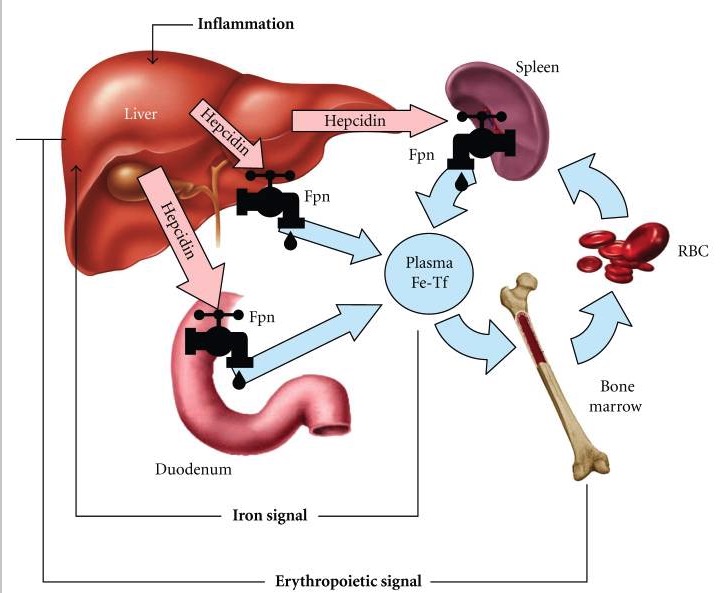
  • Peptídeo derivado do fígado que regula a concentração de ferro plasmático
  • Ações (através da ligação com Fpn Fpn Hereditary Hemochromatosis):
    • Inibe a absorção intestinal de ferro
    • Inibe a liberação de ferro dos macrófagos com eritrócitos senescentes
  • A deteção de ferro é mediada por diferentes proteínas:
    • HFE
    • Receptor Receptor Receptors are proteins located either on the surface of or within a cell that can bind to signaling molecules known as ligands (e.g., hormones) and cause some type of response within the cell. Receptors 2 (Tfr2) da transferrina (Tf)
    • Hemojuvelina
  • Afetada por:
    • ↑ Ferro: ↑ hepcidina para reduzir o ferro
    • ↑ Inflamação: ↑ hepcidina para limitar a disponibilidade de ferro para microorganismos
    • ↑ Eritropoietina: ↓ hepcidina para aumentar o ferro para hematopoiese

Mutações na via da hepcidina

  • HH HH Hereditary hemochromatosis (HH) is an autosomal recessive disorder most often associated with hfe gene mutations. Patients have increased iron intestinal absorption and iron deposition in several organs, such as the liver, heart, skin, and pancreas. The clinical presentation includes the triad of cirrhosis, diabetes, and skin bronzing. Hereditary Hemochromatosis:
    • Mutações genéticas que envolvem a proteína HFE e proteínas não HFE (Tfr2, hemojuvelina, Fpn Fpn Hereditary Hemochromatosis e hepcidina) → diminuição da libertação de hepcidina e aumento da absorção de ferro
    • Aumento da absorção de ferro → saturação de Tf e aumento progressivo da ferritina → sobrecarga de ferro → deposição de ferro
  • ↑ ferro resulta em excesso de stresse oxidativo → inflamação e lesão celular → dano ao órgão

Tipos de HH HH Hereditary hemochromatosis (HH) is an autosomal recessive disorder most often associated with hfe gene mutations. Patients have increased iron intestinal absorption and iron deposition in several organs, such as the liver, heart, skin, and pancreas. The clinical presentation includes the triad of cirrhosis, diabetes, and skin bronzing. Hereditary Hemochromatosis

  • Tipo 1 (relacionado a HFE ): forma clássica de HH HH Hereditary hemochromatosis (HH) is an autosomal recessive disorder most often associated with hfe gene mutations. Patients have increased iron intestinal absorption and iron deposition in several organs, such as the liver, heart, skin, and pancreas. The clinical presentation includes the triad of cirrhosis, diabetes, and skin bronzing. Hereditary Hemochromatosis
  • Tipo 2: hemocromatose juvenil:
    • Tipo 2a: mutações do gene Gene A category of nucleic acid sequences that function as units of heredity and which code for the basic instructions for the development, reproduction, and maintenance of organisms. Basic Terms of Genetics da hemojuvelina
    • Tipo 2b: mutações do gene Gene A category of nucleic acid sequences that function as units of heredity and which code for the basic instructions for the development, reproduction, and maintenance of organisms. Basic Terms of Genetics da hepcidina
  • Tipo 3: mutações do gene Gene A category of nucleic acid sequences that function as units of heredity and which code for the basic instructions for the development, reproduction, and maintenance of organisms. Basic Terms of Genetics do receptor Receptor Receptors are proteins located either on the surface of or within a cell that can bind to signaling molecules known as ligands (e.g., hormones) and cause some type of response within the cell. Receptors Tf-2
  • Tipo 4: mutações do gene Gene A category of nucleic acid sequences that function as units of heredity and which code for the basic instructions for the development, reproduction, and maintenance of organisms. Basic Terms of Genetics Fpn Fpn Hereditary Hemochromatosis

Apresentação Clínica

Achados gerais

  • As manifestações dependem do grau de acumulação de ferro.
  • Frequentemente assintomáticos; diagnosticado incidentalmente em exames de sangue ou em triagem familiar
  • Fígado: 1º órgão a ser afetado
  • Tríade clássica (encontrada mais tardiamente na doença):
    1. Cirrose
    2. Diabetes Diabetes Diabetes mellitus (DM) is a metabolic disease characterized by hyperglycemia and dysfunction of the regulation of glucose metabolism by insulin. Type 1 DM is diagnosed mostly in children and young adults as the result of autoimmune destruction of β cells in the pancreas and the resulting lack of insulin. Type 2 DM has a significant association with obesity and is characterized by insulin resistance. Diabetes Mellitus (“ diabetes Diabetes Diabetes mellitus (DM) is a metabolic disease characterized by hyperglycemia and dysfunction of the regulation of glucose metabolism by insulin. Type 1 DM is diagnosed mostly in children and young adults as the result of autoimmune destruction of β cells in the pancreas and the resulting lack of insulin. Type 2 DM has a significant association with obesity and is characterized by insulin resistance. Diabetes Mellitus bronzeada” devido à descoloração associada)
    3. Aumento do bronzeamento/pigmentação da pele

Achados específicos e complicações

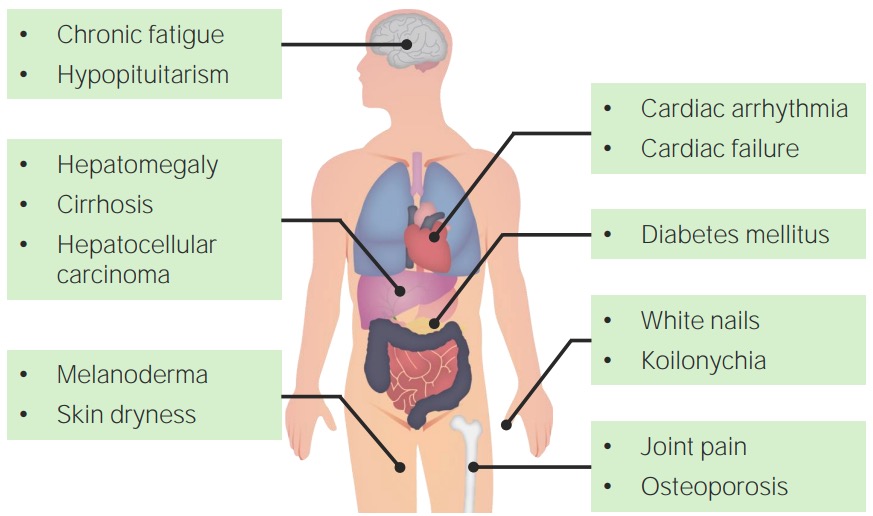
  • Fígado:
    • Alteração da função hepática
    • Hepatomegalia (em 95% dos pacientes), dor abdominal
    • Doença hepática crónica/cirrose: eritema palmar, aranhas vasculares, esplenomegalia
    • Insuficiência hepática: encefalopatia, icterícia, ascite
    • Carcinoma hepatocelular
  • Pâncreas:
    • Diabetes Diabetes Diabetes mellitus (DM) is a metabolic disease characterized by hyperglycemia and dysfunction of the regulation of glucose metabolism by insulin. Type 1 DM is diagnosed mostly in children and young adults as the result of autoimmune destruction of β cells in the pancreas and the resulting lack of insulin. Type 2 DM has a significant association with obesity and is characterized by insulin resistance. Diabetes Mellitus: glicose elevada
    • Fadiga, poliúria, polidipsia, perda de peso, infeções recorrentes
  • Pele:
    • Coloração da pele bronze/cinza-ardósia ( melanoderma Melanoderma Bronze/slate-grey skin coloration. Hereditary Hemochromatosis)
    • Proeminente na face, pescoço, antebraços e regiões genitais
    • Coiloníquia (unhas em forma de colher)
  • Coração:
    • Cardiomiopatia dilatada, insuficiência cardíaca
    • Arritmias
  • Articulações:
    • Artralgia: pequenas articulações das mãos, especialmente a 1ª, 2ª e 3ª articulações metacarpofalângicas
    • Outros: joelhos, pulsos
    • Sem calor Calor Inflammation articular, vermelhidão ou deformidade
    • Osteoporose
  • Glândula pituitária:
    • Hipogonadismo (disfunção pituitária mais MAIS Androgen Insensitivity Syndrome comum): infertilidade, perda de libido, amenorreia
    • Insuficiência da suprarrenal
    • Hipotiroidismo
    • Hipoparatiroidismo
  • Defesas do hospedeiro diminuídas:
    • Fagocitose prejudicada e proliferação de linfócitos reduzida, com ferro prontamente disponível para microorganismos
    • ↑ Risco de infeção por Listeria Listeria Listeria spp. are motile, flagellated, gram-positive, facultative intracellular bacilli. The major pathogenic species is Listeria monocytogenes. Listeria are part of the normal gastrointestinal flora of domestic mammals and poultry and are transmitted to humans through the ingestion of contaminated food, especially unpasteurized dairy products. Listeria Monocytogenes/Listeriosis monocytogenes, Yersinia enterocolitica Yersinia enterocolitica A species of the genus yersinia, isolated from both man and animal. It is a frequent cause of bacterial gastroenteritis in children. Yersinia spp./Yersiniosis e Vibrio vulnificus Vibrio vulnificus A species of halophilic bacteria in the genus vibrio, which lives in warm seawater. It can cause infections in those who eat raw contaminated seafood or have open wounds exposed to seawater. Vibrio
Características clínicas da hemocromatose

Características clínicas da hemocromatose

Imagem por Lecturio.
Diagnóstico

Análises laboratoriais

  • Saturação de Tf (SATT): razão entre ferro sérico e capacidade total de ligação de ferro (CTFF):
    • Se > 45% → testar para hemocromatose
    • Se > 60% (homens) e > 50% (mulheres) → altamente específico para diagnóstico
  • Ferro sérico:> 150 mcg/dL
  • CTFF: 200–300 mcg/dL
  • Ferritina sérica:
    • Um reagente de fase aguda
    • Menos sensível, porque a ferritina sérica pode ser ↑ em outras doenças hepáticas e inflamatórias
    • Indicativo de doença quando:
      • > 200 mcg/L em mulheres na pré-menopausa
      • > 300 mcg/L em homens e em mulheres na pós-menopausa
      • Se > 1.000 mcg/L → aumento do risco de lesão de órgãos
  • Testes Testes Gonadal Hormones de função hepática anormais: ↑ alanina transaminase Transaminase A subclass of enzymes of the transferase class that catalyze the transfer of an amino group from a donor (generally an amino acid) to an acceptor (generally a 2-keto acid). Most of these enzymes are pyridoxyl phosphate proteins. Catabolism of Amino Acids ( ALT ALT An enzyme that catalyzes the conversion of l-alanine and 2-oxoglutarate to pyruvate and l-glutamate. Liver Function Tests), ↑ aspartato transaminase Transaminase A subclass of enzymes of the transferase class that catalyze the transfer of an amino group from a donor (generally an amino acid) to an acceptor (generally a 2-keto acid). Most of these enzymes are pyridoxyl phosphate proteins. Catabolism of Amino Acids ( AST AST Enzymes of the transferase class that catalyze the conversion of l-aspartate and 2-ketoglutarate to oxaloacetate and l-glutamate. Liver Function Tests)
  • Testes Testes Gonadal Hormones adicionais:
    • Testes Testes Gonadal Hormones hormonais em casos consistentes com distúrbios hipofisários
    • Hemoglobina A1c e painel metabólico em pessoas com diabetes Diabetes Diabetes mellitus (DM) is a metabolic disease characterized by hyperglycemia and dysfunction of the regulation of glucose metabolism by insulin. Type 1 DM is diagnosed mostly in children and young adults as the result of autoimmune destruction of β cells in the pancreas and the resulting lack of insulin. Type 2 DM has a significant association with obesity and is characterized by insulin resistance. Diabetes Mellitus

Testes Testes Gonadal Hormones genéticos

  • Mutações C282Y e H63D no gene Gene A category of nucleic acid sequences that function as units of heredity and which code for the basic instructions for the development, reproduction, and maintenance of organisms. Basic Terms of Genetics HFE
  • Homozigotia para C282Y ou heterozigotia para C282Y/H63D: indicativo de HH HH Hereditary hemochromatosis (HH) is an autosomal recessive disorder most often associated with hfe gene mutations. Patients have increased iron intestinal absorption and iron deposition in several organs, such as the liver, heart, skin, and pancreas. The clinical presentation includes the triad of cirrhosis, diabetes, and skin bronzing. Hereditary Hemochromatosis
  • Faça a triagem de todos os familiares de 1º grau.

Imagiologia

  • Radiografia: pode ver-se cardiomegalia e vascularização pulmonar
  • Ressonância magnética (RM) hepática:
    • Avalia danos no fígado e desenvolvimento de tumores
    • Forma não invasiva de estimar as reservas de ferro
  • RM cardíaca: realizada para aqueles com insuficiência cardíaca
  • Ecocardiograma: mostra cardiomiopatia dilatada, disfunção diastólica

Biópsia

  • Pele: pode se amostra de qualquer local, exceto nos membros inferiores (pode ser inespecífica devido à estase)
  • Biópsia hepática:
    • Realizado quando a abordagem inicial produz resultados incertos
    • Indicações:
      • Alteração dos exames de função hepática
      • Ferritina > 1.000 mcg/L
      • Suspeita-se de outra doença hepática.
    • Ajuda a determinar a extensão do dano hepático e a concentração de ferro
    • Fibrose hepática: fator prognóstico mais MAIS Androgen Insensitivity Syndrome importante
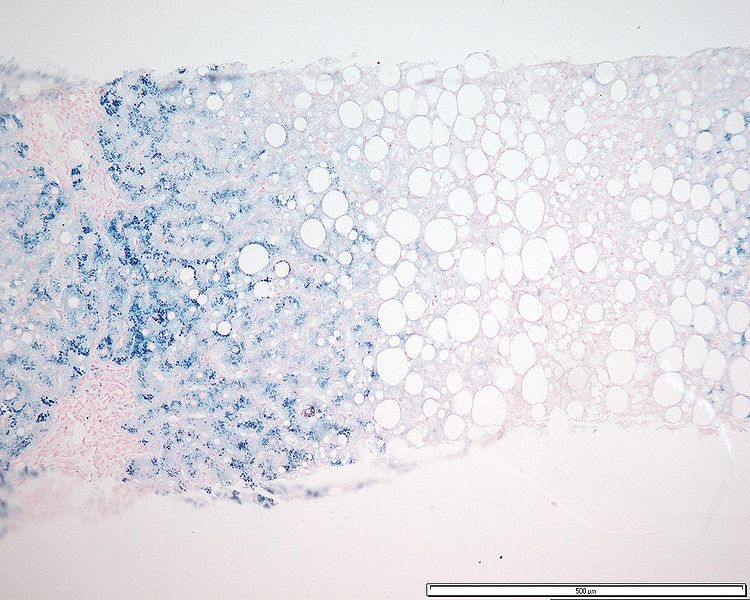
Biópsia hepática para hemocromatose de ferro

Acumulação de ferro nos hepatócitos em paciente com hemocromatose (corado com azul da Prússia)

Imagem: “Grade 3 hepatocyte iron accumulation” por Mathew, J. et al. Licença: CC BY 3.0.

Tratamento e Prognóstico

Tratamento

  • Objetivos.
    • Remover o excesso de ferro do corpo.
    • Reduzir a progressão da doença e complicações, incluindo o risco de CHC.
  • Flebotomia:
    • Tratamento de escolha
    • Realizado semanalmente ou duas vezes por semana, removendo inicialmente 500 mL e continuar até que o nível de ferritina sérica seja de aproximadamente 50–100 mcg/L
    • Depois da ferritina diminuir para os níveis alvo, este valor é mantido com flebotomia (a frequência depende dos estudos de ferro sérico e hemograma).
    • Pode melhorar ou retardar a progressão natural da doença
  • Agentes quelantes de ferro:
    • Opção terapêutica para pacientes com doença cardíaca, anemia Anemia Anemia is a condition in which individuals have low Hb levels, which can arise from various causes. Anemia is accompanied by a reduced number of RBCs and may manifest with fatigue, shortness of breath, pallor, and weakness. Subtypes are classified by the size of RBCs, chronicity, and etiology. Anemia: Overview and Types ou acesso intravenoso difícil
    • Opções:
      • Deferoxamina: intravenosa/intramuscular/subcutânea
      • Deferiprona: quelante oral (↓ sobrecarga cardíaca de ferro)
      • Deferasirox Deferasirox A triazole and benzoate derivative that acts as a selective iron chelator. It is used in the management of chronic iron overload due to blood transfusion or non-transfusion dependent thalassemia. Hereditary Hemochromatosis: quelante oral de ferro
  • Restrições alimentares:
    • Sem suplementos de ferro
    • Limitar os suplementos de vitamina C (↑ absorção de ferro).
    • Eliminar o consumo de álcool para limitar a lesão hepática
    • Eliminar da dieta marisco cru (contaminação por Vibrio vulnificus Vibrio vulnificus A species of halophilic bacteria in the genus vibrio, which lives in warm seawater. It can cause infections in those who eat raw contaminated seafood or have open wounds exposed to seawater. Vibrio sepsis Sepsis Systemic inflammatory response syndrome with a proven or suspected infectious etiology. When sepsis is associated with organ dysfunction distant from the site of infection, it is called severe sepsis. When sepsis is accompanied by hypotension despite adequate fluid infusion, it is called septic shock. Sepsis and Septic Shock)
  • Tratamento das complicações:
    • Terapêutica convencional para diabetes Diabetes Diabetes mellitus (DM) is a metabolic disease characterized by hyperglycemia and dysfunction of the regulation of glucose metabolism by insulin. Type 1 DM is diagnosed mostly in children and young adults as the result of autoimmune destruction of β cells in the pancreas and the resulting lack of insulin. Type 2 DM has a significant association with obesity and is characterized by insulin resistance. Diabetes Mellitus, cirrose e insuficiência cardíaca/arritmia
    • Reposição hormonal ou terapia com gonadotrofinas para efeitos hipofisários
    • Rastreio de CHC em pacientes de alto risco
  • Tratamento cirúrgico para complicações avançadas:
    • Transplante hepático: casos de insuficiência hepática
    • Artroplastia: para infiltração articular grave

Prognóstico

  • Com tratamento:
    • Taxa de sobrevida a 5 anos: 89%
    • Pacientes sem fibrose hepática: expectativa de uma vida normal
  • Efeitos do tratamento/flebotomia nas complicações:
    • A insuficiência cardíaca pode ser revertida.
    • A função hepática e a pigmentação da pele melhoram.
    • 40% dos pacientes com diabetes Diabetes Diabetes mellitus (DM) is a metabolic disease characterized by hyperglycemia and dysfunction of the regulation of glucose metabolism by insulin. Type 1 DM is diagnosed mostly in children and young adults as the result of autoimmune destruction of β cells in the pancreas and the resulting lack of insulin. Type 2 DM has a significant association with obesity and is characterized by insulin resistance. Diabetes Mellitus atingem um melhor controle da glicose.
    • Efeito mínimo sobre artropatia e hipogonadismo
  • Uma vez instalada, a cirrose hepática é irreversível; O CHC é uma sequela tardia.
  • Principais causas de morte:
    • Insuficiência cardíaca
    • Insuficiência hepática
    • Carcinoma hepatocelular

Diagnóstico Diferencial

  • Doença hepática alcoólica: Pacientes com histórico de alcoolismo crónico e que desenvolveram doença hepática crónica e cirrose podem manifestar-se com níveis elevados de ferro. O tratamento é a cessação do álcool.
  • Transfusões múltiplas: Em pacientes que necessitam de muitas transfusões de sangue (pacientes com talassemia, síndrome mielodisplásica), pode haver um aumento do nível de ferro, comparável aos pacientes com hemocromatose. Os níveis voltam ao normal após a interrupção das transfusões.
  • Anemia Anemia Anemia is a condition in which individuals have low Hb levels, which can arise from various causes. Anemia is accompanied by a reduced number of RBCs and may manifest with fatigue, shortness of breath, pallor, and weakness. Subtypes are classified by the size of RBCs, chronicity, and etiology. Anemia: Overview and Types crónica: uma condição de contagens de eritrócitos cronicamente baixas. Devido à adaptação do organismo à anemia Anemia Anemia is a condition in which individuals have low Hb levels, which can arise from various causes. Anemia is accompanied by a reduced number of RBCs and may manifest with fatigue, shortness of breath, pallor, and weakness. Subtypes are classified by the size of RBCs, chronicity, and etiology. Anemia: Overview and Types crónica, há aumento da eficiência da eritropoiese e da absorção de ferro. O tratamento é a reposição de ferro, além de tratar a causa subjacente.

Referências

  1. Phatak, P., & Girelli, D. (2025). Clinical manifestations and diagnosis of hereditary hemochromatosis. UpToDate. In K. D. Lindor & R. T. Means Jr. (Eds.), J. S. Tirnauer & H. Li (Deputy Eds.). Retrieved April 23, 2025, from https://www.uptodate.com/contents/clinical-manifestations-and-diagnosis-of-hereditary-hemochromatosis
  2. Duchini, A., Sfier, H., & Klachko, D. (2023). Hemochromatosis. In Roy, P. Medscape. Retrieved April 23, 2025, from https://emedicine.medscape.com/article/177216-overview
  3. Friedman, L.S. (2021). Hemochromatosis. In Papadakis M.A., & McPhee S.J., & Rabow M.W. (Eds.), Current Medical Diagnosis & Treatment 2021. McGraw-Hill.
  4. Kelley, M., Joshi, N., Xie, Y., & Borgaonkar, M. (2014). Iron overload is rare in patients homozygous for the H63D mutation. Canadian Journal of Gastroenterology and Hepatology, 28(4), 198–202. https://doi.org/10.1155/2014/468521
  5. Nemeth, E., & Ganz, T. (2009). The role of hepcidin in iron metabolism. Acta Haematologica, 122(2–3), 78–86. https://doi.org/10.1159/000243791
  6. Porter, J. L., & Rawla, P. (2024). Hemochromatosis. In StatPearls. StatPearls Publishing. Retrieved April 23, 2025, from https://www.ncbi.nlm.nih.gov/books/NBK430862/
  7. Powell, L.W. (2018). Hemochromatosis. In Jameson J., Fauci A.S., Kasper D.L., Hauser S.L., Longo D.L., & Loscalzo, J. (Eds.), Harrison’s Principles of Internal Medicine, 20e. McGraw-Hill.

Crie sua conta gratuita ou faça login para continuar lendo!

Cadastre-se agora e tenha acesso grátis ao Lecturio, com páginas de conceitos, vídeos de medicina e questões para sua educação médica.

Aprende mais com a Lecturio:

Multiple devices displaying human anatomy and health education content.

Complementa o teu estudo da faculdade com o companheiro de estudo tudo-em-um da Lecturio, através de métodos de ensino baseados em evidência.

Estuda onde quiseres

Two iPhones display medical education apps, one showing anatomy, the other Bookmatcher.

A Lecturio Medical complementa o teu estudo através de métodos de ensino baseados em evidência, vídeos de palestras, perguntas e muito mais – tudo combinado num só lugar e fácil de usar.

User Reviews

Have a holly, jolly study session 🎁 Save 50% on all plans now >>

Que tengas una sesión de estudio alegre y navideña 🎁 Ahorra 50% en todos los planes >>

Details