Domina Conceptos Médicos

Estudia para la escuela de medicina y tus examenes con Lecturio.

Virus de la Rabia

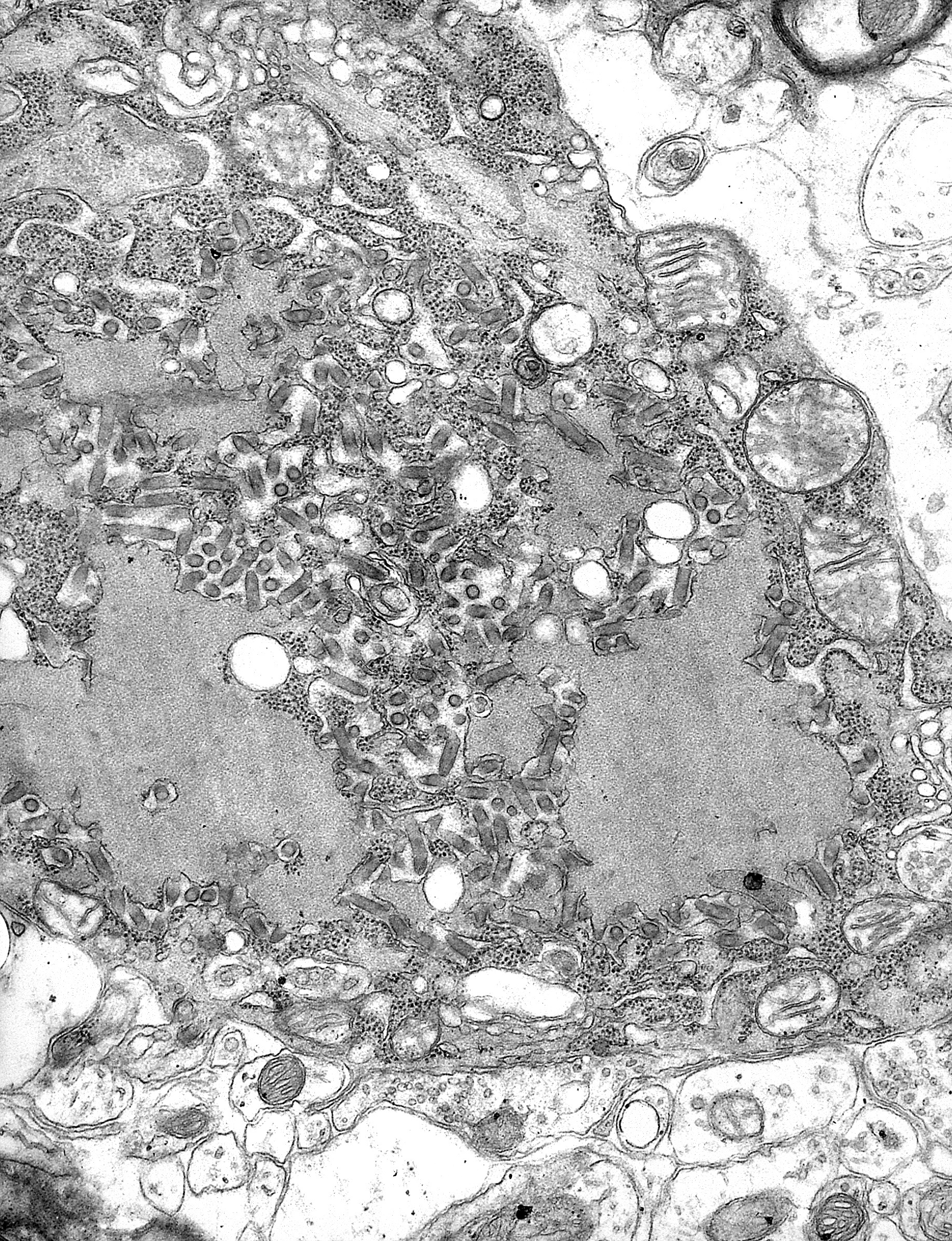
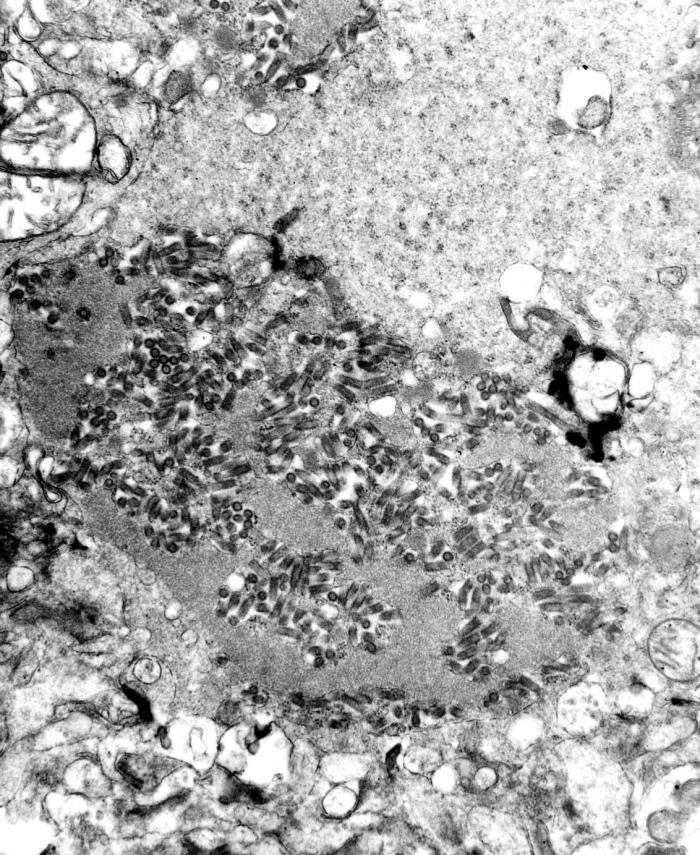
El virus Virus Viruses are infectious, obligate intracellular parasites composed of a nucleic acid core surrounded by a protein capsid. Viruses can be either naked (non-enveloped) or enveloped. The classification of viruses is complex and based on many factors, including type and structure of the nucleoid and capsid, the presence of an envelope, the replication cycle, and the host range. Virology de la rabia es un virus Virus Viruses are infectious, obligate intracellular parasites composed of a nucleic acid core surrounded by a protein capsid. Viruses can be either naked (non-enveloped) or enveloped. The classification of viruses is complex and based on many factors, including type and structure of the nucleoid and capsid, the presence of an envelope, the replication cycle, and the host range. Virology de ácido ribonucleico (ARN) monocatenario de sentido negativo. Este virus Virus Viruses are infectious, obligate intracellular parasites composed of a nucleic acid core surrounded by a protein capsid. Viruses can be either naked (non-enveloped) or enveloped. The classification of viruses is complex and based on many factors, including type and structure of the nucleoid and capsid, the presence of an envelope, the replication cycle, and the host range. Virology en EN Erythema nodosum is an immune-mediated panniculitis (inflammation of the subcutaneous fat) caused by a type IV (delayed-type) hypersensitivity reaction. It commonly manifests in young women as tender, erythematous nodules on the shins. Erythema Nodosum forma de bala pertenece a la familia Rhabdoviridae Rhabdoviridae A family of bullet-shaped viruses of the order mononegavirales, infecting vertebrates, arthropods, protozoa, and plants. Genera include vesiculovirus; lyssavirus; ephemerovirus; novirhabdovirus; cytorhabdovirus; and nucleorhabdovirus. Rabies Virus y al AL Amyloidosis género Lyssavirus Lyssavirus A genus of the family rhabdoviridae that includes rabies virus and other rabies-like viruses. Rabies Virus. La rabia es una enfermedad prevenible que con mayor frecuencia se transmite a los LOS Neisseria humanos a través de la mordedura de un animal infectado (e.g., murciélagos, mapaches, zorrillos y zorros). Esta enfermedad potencialmente mortal afecta el sistema nervioso central (SNC) y produce manifestaciones neurológicas graves. Hay 5 etapas de la enfermedad en EN Erythema nodosum is an immune-mediated panniculitis (inflammation of the subcutaneous fat) caused by a type IV (delayed-type) hypersensitivity reaction. It commonly manifests in young women as tender, erythematous nodules on the shins. Erythema Nodosum los LOS Neisseria seres humanos: incubación, pródromo, período neurológico agudo, coma Coma Coma is defined as a deep state of unarousable unresponsiveness, characterized by a score of 3 points on the GCS. A comatose state can be caused by a multitude of conditions, making the precise epidemiology and prognosis of coma difficult to determine. Coma y muerte. El diagnóstico se realiza mediante la detección de anticuerpos, antígenos o ARN viral en EN Erythema nodosum is an immune-mediated panniculitis (inflammation of the subcutaneous fat) caused by a type IV (delayed-type) hypersensitivity reaction. It commonly manifests in young women as tender, erythematous nodules on the shins. Erythema Nodosum biopsia de tejido, suero, líquido cefalorraquídeo (LCR) y saliva Saliva The clear, viscous fluid secreted by the salivary glands and mucous glands of the mouth. It contains mucins, water, organic salts, and ptyalin. Salivary Glands: Anatomy. No existe un tratamiento eficaz para la enfermedad sintomática, por lo que la prevención con inmunoglobulina antirrábica humana y la vacunación son el pilar del tratamiento.

Last updated: Dec 15, 2025
Editorial responsibility: Stanley Oiseth, Lindsay Jones, Evelin Maza

Clasificación

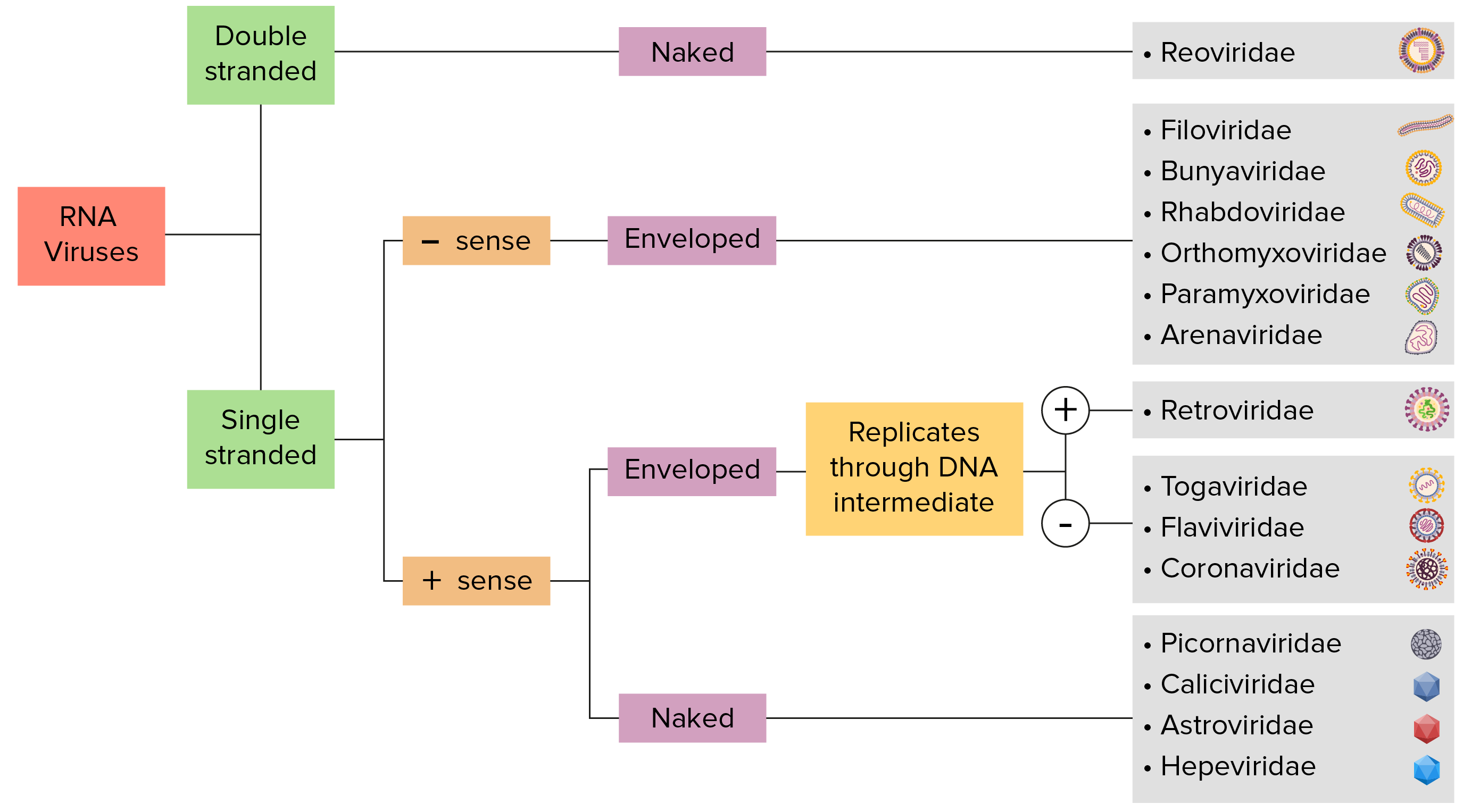
Diagrama de flujo de la clasificación de virus de ARN

Identificación de virus de ARN:
Los virus se pueden clasificar de muchas formas. La mayoría de los virus, sin embargo, tendrán un genoma formado por ácido desoxirribonucleico (ADN) o ARN. Los virus del genoma de ARN pueden caracterizarse además por ARN monocatenario o bicatenario. Los virus “envueltos” están cubiertos por una fina capa de membrana celular (generalmente extraída de la célula huésped). Si la envoltura está ausente, los virus se denominan virus “desnudos”. Los virus con genomas monocatenarios son virus de “sentido positivo” si el genoma se emplea directamente como ARN mensajero (ARNm), que se traduce en proteínas. Los virus monocatenarios de “sentido negativo” emplean la ARN polimerasa dependiente de ARN, una enzima viral, para transcribir su genoma en ARN mensajero.
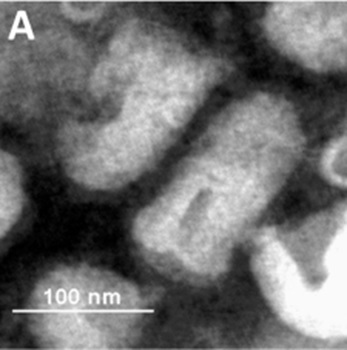
Imagen por Lecturio. Licencia: CC BY-NC-SA 4.0

Características Generales y Epidemiología

Características básicas del virus Virus Viruses are infectious, obligate intracellular parasites composed of a nucleic acid core surrounded by a protein capsid. Viruses can be either naked (non-enveloped) or enveloped. The classification of viruses is complex and based on many factors, including type and structure of the nucleoid and capsid, the presence of an envelope, the replication cycle, and the host range. Virology de la rabia

  • Taxonomía:
    • Familia: Rhabdoviridae Rhabdoviridae A family of bullet-shaped viruses of the order mononegavirales, infecting vertebrates, arthropods, protozoa, and plants. Genera include vesiculovirus; lyssavirus; ephemerovirus; novirhabdovirus; cytorhabdovirus; and nucleorhabdovirus. Rabies Virus
    • Género: Lyssavirus Lyssavirus A genus of the family rhabdoviridae that includes rabies virus and other rabies-like viruses. Rabies Virus
  • Tamaño medio:
    • 180 nm de largo
    • 75 nm de ancho
  • Genoma de ARN:
    • Monocatenario
    • Lineal
    • Sentido negativo
  • Estructura:
    • En EN Erythema nodosum is an immune-mediated panniculitis (inflammation of the subcutaneous fat) caused by a type IV (delayed-type) hypersensitivity reaction. It commonly manifests in young women as tender, erythematous nodules on the shins. Erythema Nodosum forma de bala
    • Núcleo helicoidal de ribonucleoproteína
    • Envuelto
    • Picos de glicoproteína en EN Erythema nodosum is an immune-mediated panniculitis (inflammation of the subcutaneous fat) caused by a type IV (delayed-type) hypersensitivity reaction. It commonly manifests in young women as tender, erythematous nodules on the shins. Erythema Nodosum la superficie del virus Virus Viruses are infectious, obligate intracellular parasites composed of a nucleic acid core surrounded by a protein capsid. Viruses can be either naked (non-enveloped) or enveloped. The classification of viruses is complex and based on many factors, including type and structure of the nucleoid and capsid, the presence of an envelope, the replication cycle, and the host range. Virology
  • Transporta ARN polimerasa dependiente de ARN

Enfermedad asociada

El virus Virus Viruses are infectious, obligate intracellular parasites composed of a nucleic acid core surrounded by a protein capsid. Viruses can be either naked (non-enveloped) or enveloped. The classification of viruses is complex and based on many factors, including type and structure of the nucleoid and capsid, the presence of an envelope, the replication cycle, and the host range. Virology de la rabia causa la enfermedad de la rabia.

Epidemiología

  • La rabia está presente en EN Erythema nodosum is an immune-mediated panniculitis (inflammation of the subcutaneous fat) caused by a type IV (delayed-type) hypersensitivity reaction. It commonly manifests in young women as tender, erythematous nodules on the shins. Erythema Nodosum casi todos los LOS Neisseria países.
    • Los LOS Neisseria países en EN Erythema nodosum is an immune-mediated panniculitis (inflammation of the subcutaneous fat) caused by a type IV (delayed-type) hypersensitivity reaction. It commonly manifests in young women as tender, erythematous nodules on the shins. Erythema Nodosum vía de desarrollo se ven más afectados:
    • Las vacunas para animales en EN Erythema nodosum is an immune-mediated panniculitis (inflammation of the subcutaneous fat) caused by a type IV (delayed-type) hypersensitivity reaction. It commonly manifests in young women as tender, erythematous nodules on the shins. Erythema Nodosum los LOS Neisseria Estados Unidos y Europa han eliminado en EN Erythema nodosum is an immune-mediated panniculitis (inflammation of the subcutaneous fat) caused by a type IV (delayed-type) hypersensitivity reaction. It commonly manifests in young women as tender, erythematous nodules on the shins. Erythema Nodosum gran medida la rabia en EN Erythema nodosum is an immune-mediated panniculitis (inflammation of the subcutaneous fat) caused by a type IV (delayed-type) hypersensitivity reaction. It commonly manifests in young women as tender, erythematous nodules on the shins. Erythema Nodosum los LOS Neisseria animales domésticos.
  • Aproximadamente 59 000 muertes cada año a nivel mundial
  • 2–3 casos por año en EN Erythema nodosum is an immune-mediated panniculitis (inflammation of the subcutaneous fat) caused by a type IV (delayed-type) hypersensitivity reaction. It commonly manifests in young women as tender, erythematous nodules on the shins. Erythema Nodosum los LOS Neisseria Estados Unidos
  • Los LOS Neisseria niños (niños > niñas) tienen 4 veces más probabilidades que los LOS Neisseria adultos de contraer rabia.

Patogénesis

Reservorio

Especies de mamíferos sirven como huéspedes. En EN Erythema nodosum is an immune-mediated panniculitis (inflammation of the subcutaneous fat) caused by a type IV (delayed-type) hypersensitivity reaction. It commonly manifests in young women as tender, erythematous nodules on the shins. Erythema Nodosum Estados Unidos, estos pueden incluir:

  • Murciélago
  • Zorrillo
  • Mapache
  • Zorro
  • Mangosta
  • Coyote
  • Lobo
  • Perros no vacunados

Transmisión

La infección de humanos casi siempre se debe a la mordedura de un mamífero infectado.

  • Más común: saliva Saliva The clear, viscous fluid secreted by the salivary glands and mucous glands of the mouth. It contains mucins, water, organic salts, and ptyalin. Salivary Glands: Anatomy de animales infectados.
  • Raro:
    • Trasplante de órgano
    • Transplacentario
    • Inhalación de virus Virus Viruses are infectious, obligate intracellular parasites composed of a nucleic acid core surrounded by a protein capsid. Viruses can be either naked (non-enveloped) or enveloped. The classification of viruses is complex and based on many factors, including type and structure of the nucleoid and capsid, the presence of an envelope, the replication cycle, and the host range. Virology en EN Erythema nodosum is an immune-mediated panniculitis (inflammation of the subcutaneous fat) caused by a type IV (delayed-type) hypersensitivity reaction. It commonly manifests in young women as tender, erythematous nodules on the shins. Erythema Nodosum aerosol

Factores de riesgo del huésped

La susceptibilidad a infecciones letales está relacionada con:

  • Especies animales
  • Variante viral
  • Concentración de inóculo
  • Lugar de exposición
    • Mordida de cabeza y cuello versus parte distal del cuerpo
    • Cantidad de inervación en EN Erythema nodosum is an immune-mediated panniculitis (inflammation of the subcutaneous fat) caused by a type IV (delayed-type) hypersensitivity reaction. It commonly manifests in young women as tender, erythematous nodules on the shins. Erythema Nodosum el sitio de la mordedura
  • Severidad de la exposición
  • Estado inmunológico del huésped

Ciclo de replicación viral

  • El virus Virus Viruses are infectious, obligate intracellular parasites composed of a nucleic acid core surrounded by a protein capsid. Viruses can be either naked (non-enveloped) or enveloped. The classification of viruses is complex and based on many factors, including type and structure of the nucleoid and capsid, the presence of an envelope, the replication cycle, and the host range. Virology de la rabia se une a receptores en EN Erythema nodosum is an immune-mediated panniculitis (inflammation of the subcutaneous fat) caused by a type IV (delayed-type) hypersensitivity reaction. It commonly manifests in young women as tender, erythematous nodules on the shins. Erythema Nodosum las células externas del huésped → ingresa a las células del huésped por la vía de transporte endosomal
  • pH pH The quantitative measurement of the acidity or basicity of a solution. Acid-Base Balance en EN Erythema nodosum is an immune-mediated panniculitis (inflammation of the subcutaneous fat) caused by a type IV (delayed-type) hypersensitivity reaction. It commonly manifests in young women as tender, erythematous nodules on the shins. Erythema Nodosum el endosoma causa la fusión de la membrana → el genoma viral alcanza el citosol → el ARN viral se descubre en EN Erythema nodosum is an immune-mediated panniculitis (inflammation of the subcutaneous fat) caused by a type IV (delayed-type) hypersensitivity reaction. It commonly manifests in young women as tender, erythematous nodules on the shins. Erythema Nodosum el citoplasma de las células infectadas
  • Transcripción del genoma por una ARN polimerasa dependiente de ARN asociada a virión → el ARN viral se traduce en EN Erythema nodosum is an immune-mediated panniculitis (inflammation of the subcutaneous fat) caused by a type IV (delayed-type) hypersensitivity reaction. It commonly manifests in young women as tender, erythematous nodules on the shins. Erythema Nodosum proteínas virales
  • La replicación se produce con la síntesis de moldes de ARN de cadena positiva para la producción de ARN de cadena negativa.
  • Los LOS Neisseria viriones se ensamblan → gemación de virus Virus Viruses are infectious, obligate intracellular parasites composed of a nucleic acid core surrounded by a protein capsid. Viruses can be either naked (non-enveloped) or enveloped. The classification of viruses is complex and based on many factors, including type and structure of the nucleoid and capsid, the presence of an envelope, the replication cycle, and the host range. Virology de la membrana celular
Ciclo de replicación del virus de la rabia

Ciclo de replicación del virus de la rabia

Imagen por Lecturio. Licencia: CC BY-NC-SA 4.0

Fisiopatología

  • Inoculación → el virus Virus Viruses are infectious, obligate intracellular parasites composed of a nucleic acid core surrounded by a protein capsid. Viruses can be either naked (non-enveloped) or enveloped. The classification of viruses is complex and based on many factors, including type and structure of the nucleoid and capsid, the presence of an envelope, the replication cycle, and the host range. Virology tiene predilección por el tejido neural → entra en EN Erythema nodosum is an immune-mediated panniculitis (inflammation of the subcutaneous fat) caused by a type IV (delayed-type) hypersensitivity reaction. It commonly manifests in young women as tender, erythematous nodules on the shins. Erythema Nodosum los LOS Neisseria nervios motores y sensoriales locales
  • Viaja a través de nervios periféricos → migra a la médula espinal → cerebro
  • El mecanismo de la encefalitis no está claro.
  • Se propaga a través de los LOS Neisseria nervios periféricos → se disemina a otras partes del cuerpo

Presentación Clínica

Se reconocen 5 estadios generales en EN Erythema nodosum is an immune-mediated panniculitis (inflammation of the subcutaneous fat) caused by a type IV (delayed-type) hypersensitivity reaction. It commonly manifests in young women as tender, erythematous nodules on the shins. Erythema Nodosum humanos: incubación → pródromo → período neurológico agudo → coma Coma Coma is defined as a deep state of unarousable unresponsiveness, characterized by a score of 3 points on the GCS. A comatose state can be caused by a multitude of conditions, making the precise epidemiology and prognosis of coma difficult to determine. Coma → muerte

Incubación

  • Variable Variable Variables represent information about something that can change. The design of the measurement scales, or of the methods for obtaining information, will determine the data gathered and the characteristics of that data. As a result, a variable can be qualitative or quantitative, and may be further classified into subgroups. Types of Variables de 10 días–2 años, pero generalmente de 20–90 días
  • Más corto en EN Erythema nodosum is an immune-mediated panniculitis (inflammation of the subcutaneous fat) caused by a type IV (delayed-type) hypersensitivity reaction. It commonly manifests in young women as tender, erythematous nodules on the shins. Erythema Nodosum niños y con mordeduras más cercanas al AL Amyloidosis SNC

Pródromo

  • El período prodrómico dura de 0–10 días.
  • Los LOS Neisseria síntomas son inespecíficos
    • Malestar general
    • Fiebre
    • Fatiga
    • Dolor Dolor Inflammation de garganta
    • Tos TOS Thoracic outlet syndrome (TOS) is a broad term used for a spectrum of syndromes related to the general region of the thoracic outlet, which involves the compression or irritation of elements of the brachial plexus, subclavian artery, or subclavian vein. Thoracic Outlet Syndrome
    • Disnea
    • Náuseas y vómitos
    • Cefalea
    • Dolor Dolor Inflammation o parestesias en EN Erythema nodosum is an immune-mediated panniculitis (inflammation of the subcutaneous fat) caused by a type IV (delayed-type) hypersensitivity reaction. It commonly manifests in young women as tender, erythematous nodules on the shins. Erythema Nodosum el sitio de la mordedura

Período neurológico agudo

El período neurológico agudo dura de 2–7 días.

Forma encefalítica (más común):

  • Hiperactividad y agitación
  • Estado mental alterado
    • Confusión
    • Alucinaciones
  • Espasmos de los LOS Neisseria músculos faríngeos
    • Hidrofobia
    • Aerofobia
    • Asfixia
    • Tos TOS Thoracic outlet syndrome (TOS) is a broad term used for a spectrum of syndromes related to the general region of the thoracic outlet, which involves the compression or irritation of elements of the brachial plexus, subclavian artery, or subclavian vein. Thoracic Outlet Syndrome
  • Rigidez nucal
  • Fasciculaciones y contracciones musculares
    • Muecas faciales
    • Hiperextensión de espalda y cuello
  • Aumento de los LOS Neisseria reflejos tendinosos profundos
  • Inestabilidad autonómica
    • Hipersalivación
    • Transpiración
    • Lagrimeo
    • Dilatación de pupila
    • Fiebre
    • Taquicardia
  • Convulsiones

Forma paralítica:

  • Fiebre
  • Cefalea
  • Parálisis flácida ascendente
  • Fasciculaciones musculares
  • Ausencia de reflejos tendinosos profundos
  • Disfunción de la vejiga
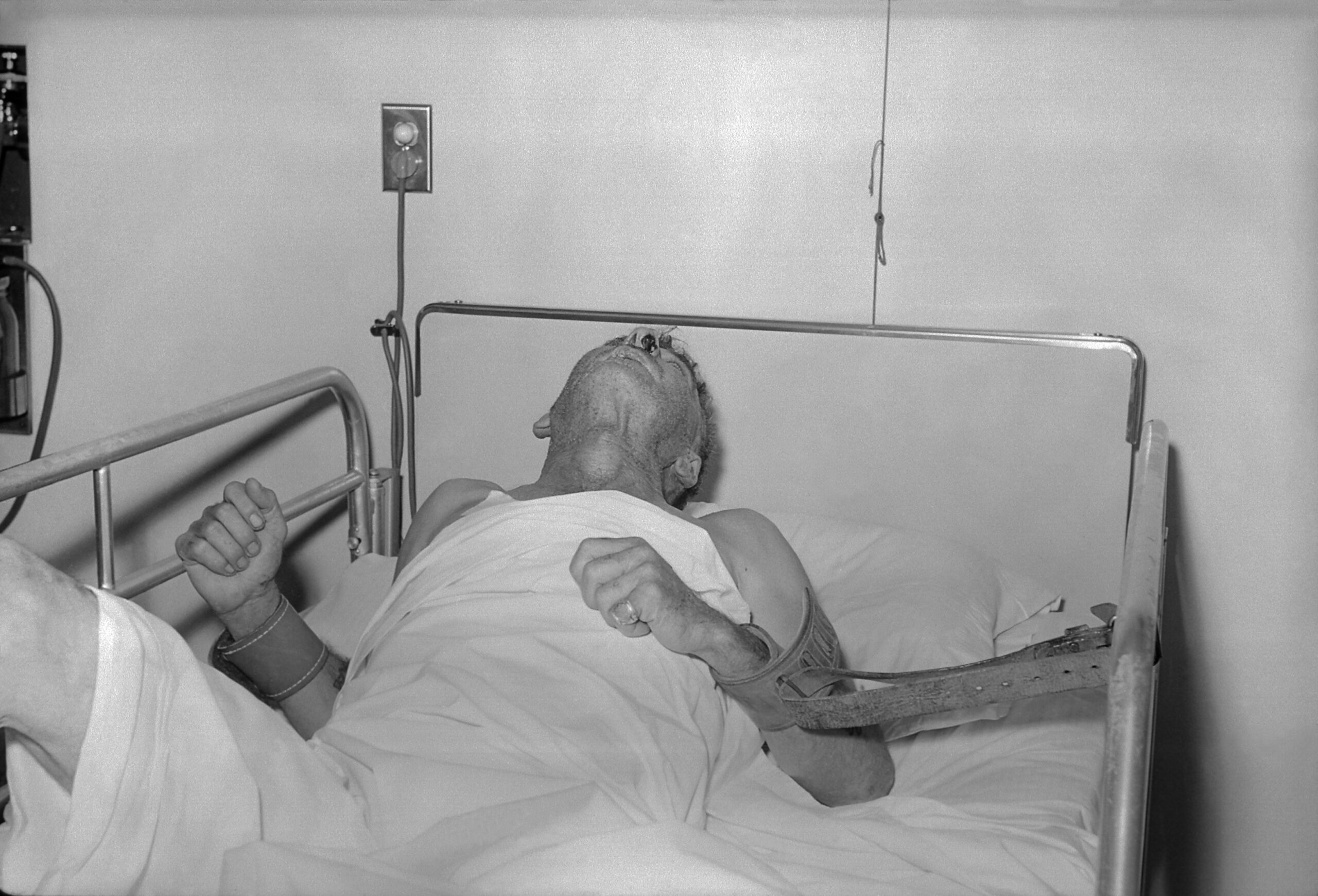
Hombre con virus de la rabia

Un hombre con rabia en 1959.

Imagen: “Rabies patient” por CDC. Licencia: Dominio Público

Coma Coma Coma is defined as a deep state of unarousable unresponsiveness, characterized by a score of 3 points on the GCS. A comatose state can be caused by a multitude of conditions, making the precise epidemiology and prognosis of coma difficult to determine. Coma

  • No hay respuesta
  • Períodos de respiración rápida e irregular
  • Apnea
  • Parálisis

Muerte

  • La muerte suele ocurrir 2–14 días después de que aparecen los LOS Neisseria primeros síntomas.
  • A menudo es resultado de:
    • Paro respiratorio
    • Convulsiones incontroladas
    • Arritmia cardíaca

Diagnóstico y Tratamiento

Diagnóstico

El diagnóstico debe sospecharse en EN Erythema nodosum is an immune-mediated panniculitis (inflammation of the subcutaneous fat) caused by a type IV (delayed-type) hypersensitivity reaction. It commonly manifests in young women as tender, erythematous nodules on the shins. Erythema Nodosum casos de encefalitis viral inexplicable con antecedentes de mordedura de animal.

Métodos de diagnóstico:

  • Títulos de anticuerpos
  • Reacción en EN Erythema nodosum is an immune-mediated panniculitis (inflammation of the subcutaneous fat) caused by a type IV (delayed-type) hypersensitivity reaction. It commonly manifests in young women as tender, erythematous nodules on the shins. Erythema Nodosum cadena de polimerasa ( PCR PCR Polymerase chain reaction (PCR) is a technique that amplifies DNA fragments exponentially for analysis. The process is highly specific, allowing for the targeting of specific genomic sequences, even with minuscule sample amounts. The PCR cycles multiple times through 3 phases: denaturation of the template DNA, annealing of a specific primer to the individual DNA strands, and synthesis/elongation of new DNA molecules. Polymerase Chain Reaction (PCR), por sus siglas en EN Erythema nodosum is an immune-mediated panniculitis (inflammation of the subcutaneous fat) caused by a type IV (delayed-type) hypersensitivity reaction. It commonly manifests in young women as tender, erythematous nodules on the shins. Erythema Nodosum inglés) para detectar ARN viral
  • Aislamiento de virus Virus Viruses are infectious, obligate intracellular parasites composed of a nucleic acid core surrounded by a protein capsid. Viruses can be either naked (non-enveloped) or enveloped. The classification of viruses is complex and based on many factors, including type and structure of the nucleoid and capsid, the presence of an envelope, the replication cycle, and the host range. Virology (cultivo viral)
  • Tinción inmunofluorescente de muestras de biopsia para antígeno viral

Muestras que se pueden analizar:

  • Saliva Saliva The clear, viscous fluid secreted by the salivary glands and mucous glands of the mouth. It contains mucins, water, organic salts, and ptyalin. Salivary Glands: Anatomy
  • LCR
  • Suero
  • Tejido (piel de la nuca o cerebro)

Tratamiento

No existe un tratamiento eficaz para la rabia sintomática y pocos pacientes sobreviven.

  • Cuidados paliativos
  • Las medidas de soporte vital pueden prolongar el curso clínico, pero rara vez afectan el resultado.

Prevención

La prevención es el pilar de la atención.

  • Vacunar especies susceptibles (perros y gatos).
  • La profilaxis previa a la exposición con vacuna antirrábica está indicada para:
    • Viajar a zonas endémicas
    • Veterinarios
    • Manipuladores de animales
  • Profilaxis posterior a la exposición:
    • Limpieza local de heridas
    • Inmunoglobulina antirrábica humana
      • Se administra solo una vez a personas no vacunadas previamente.
      • Proporciona anticuerpos inmediatos
      • Inyectar tanto como sea posible en EN Erythema nodosum is an immune-mediated panniculitis (inflammation of the subcutaneous fat) caused by a type IV (delayed-type) hypersensitivity reaction. It commonly manifests in young women as tender, erythematous nodules on the shins. Erythema Nodosum el sitio de la mordedura (infiltrar en EN Erythema nodosum is an immune-mediated panniculitis (inflammation of the subcutaneous fat) caused by a type IV (delayed-type) hypersensitivity reaction. It commonly manifests in young women as tender, erythematous nodules on the shins. Erythema Nodosum las heridas).
      • El volumen restante debe inyectarse por vía intramuscular en EN Erythema nodosum is an immune-mediated panniculitis (inflammation of the subcutaneous fat) caused by a type IV (delayed-type) hypersensitivity reaction. It commonly manifests in young women as tender, erythematous nodules on the shins. Erythema Nodosum un lugar alejado de la administración de la vacuna.
    • Vacuna contra la rabia:
      • Primera dosis administrada lo antes posible después de la exposición.
      • Se administran dosis adicionales los LOS Neisseria días 3, 7 y 14 después de la primera vacunación.

Diagnóstico Diferencial

  • Meningitis Meningitis Meningitis is inflammation of the meninges, the protective membranes of the brain, and spinal cord. The causes of meningitis are varied, with the most common being bacterial or viral infection. The classic presentation of meningitis is a triad of fever, altered mental status, and nuchal rigidity. Meningitis bacteriana: infección aguda de las meninges Meninges The brain and the spinal cord are enveloped by 3 overlapping layers of connective tissue called the meninges. The layers are, from the most external layer to the most internal layer, the dura mater, arachnoid mater, and pia mater. Between these layers are 3 potential spaces called the epidural, subdural, and subarachnoid spaces. Meninges: Anatomy. Los LOS Neisseria pacientes se presentan con cefalea, fiebre, rigidez nucal y rápido deterioro clínico. Se realiza una punción lumbar para hacer el diagnóstico. A diferencia de la meningitis Meningitis Meningitis is inflammation of the meninges, the protective membranes of the brain, and spinal cord. The causes of meningitis are varied, with the most common being bacterial or viral infection. The classic presentation of meningitis is a triad of fever, altered mental status, and nuchal rigidity. Meningitis viral, los LOS Neisseria estudios de LCR mostrarán líquido turbio, glucosa baja y leucocitos altos con predominio de neutrófilos. La tinción de Gram y el cultivo determinarán las bacterias causantes. El tratamiento incluye antibióticos y corticosteroides.
  • Encefalitis por herpes simple: infección grave del SNC causada por virus Virus Viruses are infectious, obligate intracellular parasites composed of a nucleic acid core surrounded by a protein capsid. Viruses can be either naked (non-enveloped) or enveloped. The classification of viruses is complex and based on many factors, including type and structure of the nucleoid and capsid, the presence of an envelope, the replication cycle, and the host range. Virology del herpes simple. Los LOS Neisseria pacientes desarrollan fiebre de inicio rápido, cefalea, alteración del nivel de conciencia, déficits neurológicos focales y convulsiones. El diagnóstico se confirma con la prueba de PCR PCR Polymerase chain reaction (PCR) is a technique that amplifies DNA fragments exponentially for analysis. The process is highly specific, allowing for the targeting of specific genomic sequences, even with minuscule sample amounts. The PCR cycles multiple times through 3 phases: denaturation of the template DNA, annealing of a specific primer to the individual DNA strands, and synthesis/elongation of new DNA molecules. Polymerase Chain Reaction (PCR) de LCR. La resonancia magnética (RM) puede mostrar lesiones hiperintensas en EN Erythema nodosum is an immune-mediated panniculitis (inflammation of the subcutaneous fat) caused by a type IV (delayed-type) hypersensitivity reaction. It commonly manifests in young women as tender, erythematous nodules on the shins. Erythema Nodosum los LOS Neisseria lóbulos temporales. El aciclovir intravenoso es el tratamiento de elección.
  • Virus Virus Viruses are infectious, obligate intracellular parasites composed of a nucleic acid core surrounded by a protein capsid. Viruses can be either naked (non-enveloped) or enveloped. The classification of viruses is complex and based on many factors, including type and structure of the nucleoid and capsid, the presence of an envelope, the replication cycle, and the host range. Virology de la encefalitis transmitida por garrapatas: miembro del género Flavivirus Flavivirus A genus of flaviviridae containing several subgroups and many species. Most are arboviruses transmitted by mosquitoes or ticks. The type species is yellow fever virus. Tick-borne Encephalitis Virus transmitido principalmente por garrapatas Ixodes. La mayoría de los LOS Neisseria pacientes infectados con el virus Virus Viruses are infectious, obligate intracellular parasites composed of a nucleic acid core surrounded by a protein capsid. Viruses can be either naked (non-enveloped) or enveloped. The classification of viruses is complex and based on many factors, including type and structure of the nucleoid and capsid, the presence of an envelope, the replication cycle, and the host range. Virology de la encefalitis transmitida por garrapatas son asintomáticos; sin embargo, los LOS Neisseria individuos sintomáticos pueden experimentar una enfermedad bifásica. Después de recuperarse de síntomas inespecíficos, los LOS Neisseria pacientes pueden desarrollar manifestaciones neurológicas, como meningitis Meningitis Meningitis is inflammation of the meninges, the protective membranes of the brain, and spinal cord. The causes of meningitis are varied, with the most common being bacterial or viral infection. The classic presentation of meningitis is a triad of fever, altered mental status, and nuchal rigidity. Meningitis, encefalitis o meningoencefalitis. La serología o la PCR PCR Polymerase chain reaction (PCR) is a technique that amplifies DNA fragments exponentially for analysis. The process is highly specific, allowing for the targeting of specific genomic sequences, even with minuscule sample amounts. The PCR cycles multiple times through 3 phases: denaturation of the template DNA, annealing of a specific primer to the individual DNA strands, and synthesis/elongation of new DNA molecules. Polymerase Chain Reaction (PCR) pueden confirmar el diagnóstico. El tratamiento es de soporte.
  • Virus Virus Viruses are infectious, obligate intracellular parasites composed of a nucleic acid core surrounded by a protein capsid. Viruses can be either naked (non-enveloped) or enveloped. The classification of viruses is complex and based on many factors, including type and structure of the nucleoid and capsid, the presence of an envelope, the replication cycle, and the host range. Virology del Nilo Occidental: miembro del género Flavivirus Flavivirus A genus of flaviviridae containing several subgroups and many species. Most are arboviruses transmitted by mosquitoes or ticks. The type species is yellow fever virus. Tick-borne Encephalitis Virus transmitido por mosquitos Culex. La mayoría de los LOS Neisseria pacientes infectados con el virus Virus Viruses are infectious, obligate intracellular parasites composed of a nucleic acid core surrounded by a protein capsid. Viruses can be either naked (non-enveloped) or enveloped. The classification of viruses is complex and based on many factors, including type and structure of the nucleoid and capsid, the presence of an envelope, the replication cycle, and the host range. Virology del Nilo Occidental son asintomáticos. Una proporción muy pequeña de pacientes desarrolla enfermedad neuroinvasiva, que incluye meningitis Meningitis Meningitis is inflammation of the meninges, the protective membranes of the brain, and spinal cord. The causes of meningitis are varied, with the most common being bacterial or viral infection. The classic presentation of meningitis is a triad of fever, altered mental status, and nuchal rigidity. Meningitis, encefalitis y parálisis flácida aguda. El diagnóstico se confirma con serología en EN Erythema nodosum is an immune-mediated panniculitis (inflammation of the subcutaneous fat) caused by a type IV (delayed-type) hypersensitivity reaction. It commonly manifests in young women as tender, erythematous nodules on the shins. Erythema Nodosum suero o LCR o PCR PCR Polymerase chain reaction (PCR) is a technique that amplifies DNA fragments exponentially for analysis. The process is highly specific, allowing for the targeting of specific genomic sequences, even with minuscule sample amounts. The PCR cycles multiple times through 3 phases: denaturation of the template DNA, annealing of a specific primer to the individual DNA strands, and synthesis/elongation of new DNA molecules. Polymerase Chain Reaction (PCR). El tratamiento es de soporte.
  • Virus Virus Viruses are infectious, obligate intracellular parasites composed of a nucleic acid core surrounded by a protein capsid. Viruses can be either naked (non-enveloped) or enveloped. The classification of viruses is complex and based on many factors, including type and structure of the nucleoid and capsid, the presence of an envelope, the replication cycle, and the host range. Virology de la encefalitis de Saint Louis: miembro del género Flavivirus Flavivirus A genus of flaviviridae containing several subgroups and many species. Most are arboviruses transmitted by mosquitoes or ticks. The type species is yellow fever virus. Tick-borne Encephalitis Virus transmitido por mosquitos Culex. Los LOS Neisseria individuos sintomáticos pueden tener presentaciones variadas, con síntomas similares a los LOS Neisseria de la gripe, meningitis Meningitis Meningitis is inflammation of the meninges, the protective membranes of the brain, and spinal cord. The causes of meningitis are varied, with the most common being bacterial or viral infection. The classic presentation of meningitis is a triad of fever, altered mental status, and nuchal rigidity. Meningitis aséptica, encefalitis o meningoencefalitis. El diagnóstico se confirma con serología. El tratamiento es de soporte.
  • Virus Virus Viruses are infectious, obligate intracellular parasites composed of a nucleic acid core surrounded by a protein capsid. Viruses can be either naked (non-enveloped) or enveloped. The classification of viruses is complex and based on many factors, including type and structure of the nucleoid and capsid, the presence of an envelope, the replication cycle, and the host range. Virology de la encefalitis equina: miembros de la familia Togaviridae Togaviridae A family of RNA viruses, mainly arboviruses, consisting of two genera: alphavirus (group A arboviruses), and rubivirus. Virions are spherical, 60-70 nm in diameter, with a lipoprotein envelope tightly applied to the icosahedral nucleocapsid. Rubella Virus. Los LOS Neisseria virus Virus Viruses are infectious, obligate intracellular parasites composed of a nucleic acid core surrounded by a protein capsid. Viruses can be either naked (non-enveloped) or enveloped. The classification of viruses is complex and based on many factors, including type and structure of the nucleoid and capsid, the presence of an envelope, the replication cycle, and the host range. Virology de la encefalitis equina son arbovirus transmitidos por mosquitos que pueden causar enfermedades virales leves o encefalitis ( en EN Erythema nodosum is an immune-mediated panniculitis (inflammation of the subcutaneous fat) caused by a type IV (delayed-type) hypersensitivity reaction. It commonly manifests in young women as tender, erythematous nodules on the shins. Erythema Nodosum casos graves). El diagnóstico se realiza mediante evaluación del LCR, serología o PCR PCR Polymerase chain reaction (PCR) is a technique that amplifies DNA fragments exponentially for analysis. The process is highly specific, allowing for the targeting of specific genomic sequences, even with minuscule sample amounts. The PCR cycles multiple times through 3 phases: denaturation of the template DNA, annealing of a specific primer to the individual DNA strands, and synthesis/elongation of new DNA molecules. Polymerase Chain Reaction (PCR). El tratamiento es de soporte.
  • Síndrome de Guillain-Barré: neuropatía aguda inflamatoria adquirida, rápidamente progresiva, que puede ser desencadenada por patógenos infecciosos. Los LOS Neisseria pacientes desarrollan debilidad muscular progresiva y simétrica y pérdida sensorial. A diferencia de la rabia, la fiebre es poco común en EN Erythema nodosum is an immune-mediated panniculitis (inflammation of the subcutaneous fat) caused by a type IV (delayed-type) hypersensitivity reaction. It commonly manifests in young women as tender, erythematous nodules on the shins. Erythema Nodosum el síndrome de Guillain-Barré. El diagnóstico es clínico. Una punción lumbar mostrará un recuento de células normal y proteínas elevadas. El tratamiento requiere soporte de cuidados intensivos, inmunoglobulina intravenosa e intercambio de plasma Plasma The residual portion of blood that is left after removal of blood cells by centrifugation without prior blood coagulation. Transfusion Products.
  • Botulismo: síndrome neuroparalítico raro causado por una neurotoxina liberada por Clostridium botulinum Clostridium botulinum A species of anaerobic, gram-positive, rod-shaped bacteria in the family clostridiaceae that produces proteins with characteristic neurotoxicity. It is the etiologic agent of botulism in humans, wild fowl, horses; and cattle. Seven subtypes (sometimes called antigenic types, or strains) exist, each producing a different botulinum toxin (botulinum toxins). The organism and its spores are widely distributed in nature. Clostridia. El botulismo se presenta con visión borrosa, insuficiencia respiratoria y parálisis flácida descendente simétrica. A diferencia de la rabia, no hay fiebre. El diagnóstico se basa en EN Erythema nodosum is an immune-mediated panniculitis (inflammation of the subcutaneous fat) caused by a type IV (delayed-type) hypersensitivity reaction. It commonly manifests in young women as tender, erythematous nodules on the shins. Erythema Nodosum criterios clínicos y puede confirmarse mediante el aislamiento de bacterias o toxinas de las heces, muestras de heridas o fuentes de alimentos. El tratamiento requiere el manejo inmediato de la insuficiencia respiratoria, la administración de antitoxina y cuidados de soporte para la parálisis.
  • Tétano: infección bacteriana causada por Clostridium tetani Clostridium tetani The cause of tetanus in humans and domestic animals. It is a common inhabitant of human and horse intestines as well as soil. Two components make up its potent exotoxin activity, a neurotoxin and a hemolytic toxin. Tetanus, una bacteria Bacteria Bacteria are prokaryotic single-celled microorganisms that are metabolically active and divide by binary fission. Some of these organisms play a significant role in the pathogenesis of diseases. Bacteriology anaeróbica obligada Gram-positiva que se encuentra comúnmente en EN Erythema nodosum is an immune-mediated panniculitis (inflammation of the subcutaneous fat) caused by a type IV (delayed-type) hypersensitivity reaction. It commonly manifests in young women as tender, erythematous nodules on the shins. Erythema Nodosum el suelo y que ingresa al AL Amyloidosis cuerpo a través de una herida contaminada. El tétano se presenta con trismo, rigidez nucal, opistótonos, abdomen rígido y espasmos musculares intensos y dolorosos. El diagnóstico se basa en EN Erythema nodosum is an immune-mediated panniculitis (inflammation of the subcutaneous fat) caused by a type IV (delayed-type) hypersensitivity reaction. It commonly manifests in young women as tender, erythematous nodules on the shins. Erythema Nodosum criterios clínicos, ya que rara vez es posible aislar el agente infeccioso de la herida. El tétano se trata con terapia con antibióticos y la antitoxina tetánica humana.

Referencias:

  1. Baron, S., Rupprecht, C. (1996). Rhabdoviruses: rabies virus. Chapter 61 of Medical microbiology, 4th ed. University of Texas Medical Branch at Galveston.  
  2. Centers for Disease Control: Rabies prevention (1991). Recommendations of the Immunization Practices Advisory Committee (ACIP). MMWR 40(RR-3):1.
  3. Centers for Disease Control: Compendium of animal rabies control (1995). MMWR 44(RR-2):1.
  4. Centers for Disease Control: Human rabies (1995). MMWR 44:269.
  5. Charlton KM. (1994). The pathogenesis of rabies and other lyssaviral infections: recent studies. Curr Top Microbiol Immunol 187:95.
  6. DeMaria, A., Jr., Brown, C. (2025). Clinical manifestations and diagnosis of rabies. UpToDate. Retrieved March 12, 2025, from https://www.uptodate.com/contents/clinical-manifestations-and-diagnosis-of-rabies
  7. Brown, C.M., DeMaria, A., Jr. (2025). Indications for post-exposure rabies prophylaxis. UpToDate. Retrieved March 12, 2025, from https://www.uptodate.com/contents/indications-for-post-exposure-rabies-prophylaxis
  8. Jackson, A.C. (2025). Treatment of rabies. UpToDate. Retrieved March 12, 2025, from  https://www.uptodate.com/contents/treatment-of-rabies
  9. Koury, R., Warrington, S.J. (2022). Rabies. [online] StatPearls. Retrieved March 12, 2025, from https://www.ncbi.nlm.nih.gov/books/NBK448076/
  10. Greenlee, J.E. (2024). Rabies. MSD Manual Professional Version. https://www.msdmanuals.com/professional/neurologic-disorders/brain-infections/rabies
  11. Gompf, S. (2024). Rabies. Emedicine. Retrieved March 12, 2025, from: https://emedicine.medscape.com/article/220967-overview

¡Crea tu cuenta gratis o inicia una sesión para seguir leyendo!

Regístrate ahora y obtén acceso gratuito a Lecturio con páginas de concepto, videos médicos y cuestionarios para tu educación médica.

User Reviews

Que tengas una sesión de estudio alegre y navideña 🎁 Ahorra 50% en todos los planes >>

Details