Domina Conceptos Médicos

Estudia para la escuela de medicina y tus examenes con Lecturio.

Sistema de Drenaje Linfático: Anatomía

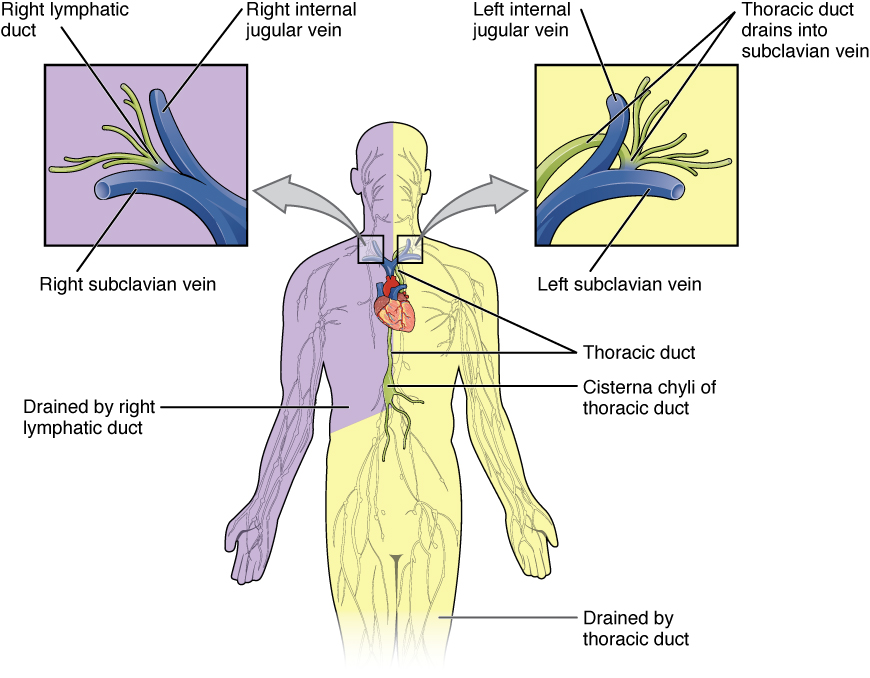
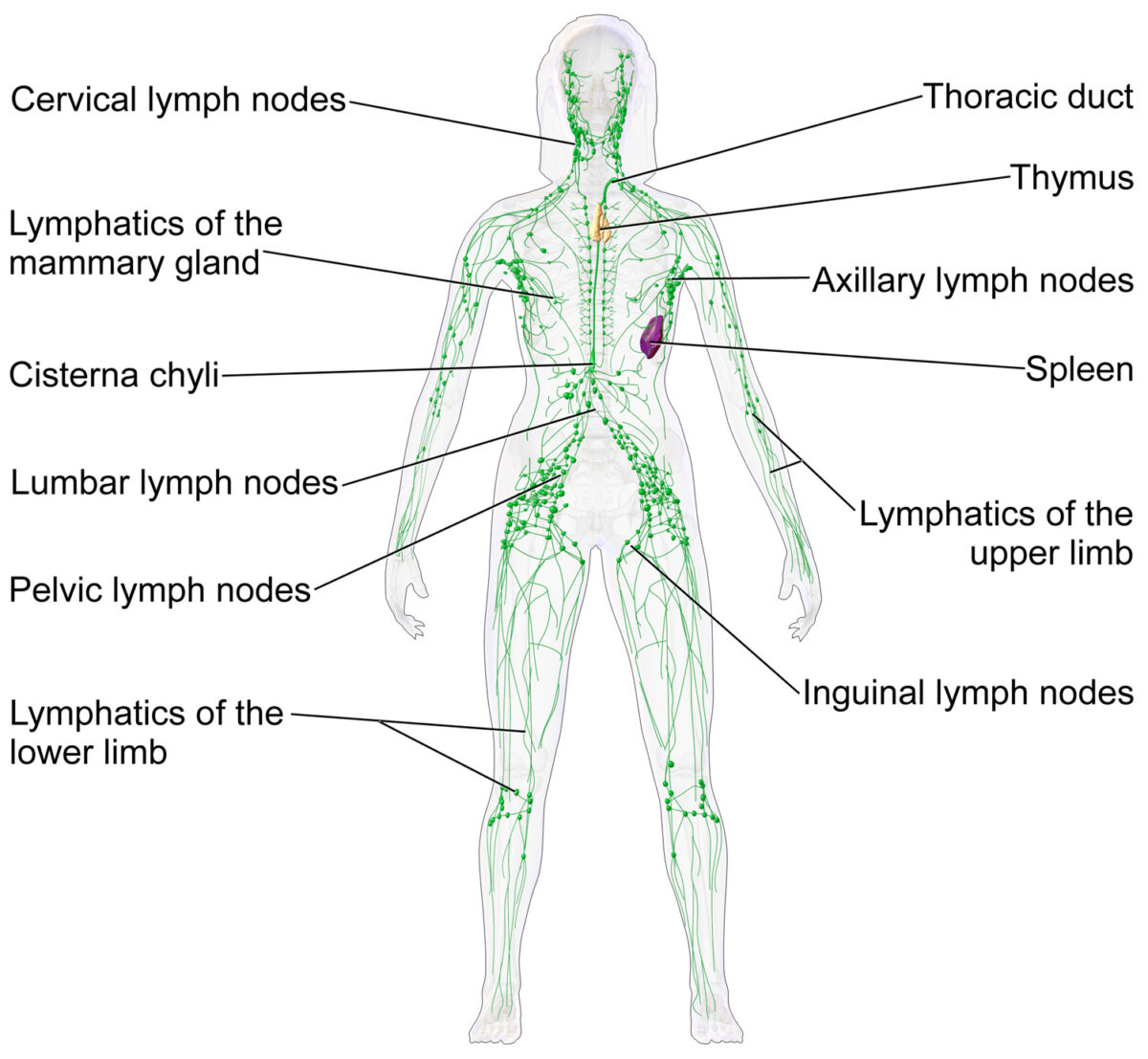
El sistema linfático consta de los LOS Neisseria órganos linfoides que contienen las células del sistema inmunitario y los LOS Neisseria vasos linfáticos, que transportan el líquido intersticial (como linfa) de regreso a la circulación venosa. Los LOS Neisseria vasos linfáticos se distribuyen ampliamente por todo el cuerpo, drenando y filtrando la linfa, facilitando la homeostasis Homeostasis The processes whereby the internal environment of an organism tends to remain balanced and stable. Cell Injury and Death y ayudando en EN Erythema nodosum is an immune-mediated panniculitis (inflammation of the subcutaneous fat) caused by a type IV (delayed-type) hypersensitivity reaction. It commonly manifests in young women as tender, erythematous nodules on the shins. Erythema Nodosum la defensa contra los LOS Neisseria patógenos circulantes. El flujo de líquido es unidireccional, habilitado por válvulas en EN Erythema nodosum is an immune-mediated panniculitis (inflammation of the subcutaneous fat) caused by a type IV (delayed-type) hypersensitivity reaction. It commonly manifests in young women as tender, erythematous nodules on the shins. Erythema Nodosum los LOS Neisseria vasos linfáticos colectores. En EN Erythema nodosum is an immune-mediated panniculitis (inflammation of the subcutaneous fat) caused by a type IV (delayed-type) hypersensitivity reaction. It commonly manifests in young women as tender, erythematous nodules on the shins. Erythema Nodosum los LOS Neisseria vasos sin válvulas, la contracción muscular de los LOS Neisseria órganos y los LOS Neisseria vasos sanguíneos adyacentes ayudan al AL Amyloidosis movimiento del fluido. Para regresar a la circulación venosa, la linfa es recolectada por los LOS Neisseria principales conductos linfáticos: conducto linfático derecho (recolecta del lado derecho de la cabeza y el cuello, el lado derecho del tórax y la extremidad superior derecha) y el conducto torácico (recolecta del resto del cuerpo). Las afecciones patológicas que involucran el sistema linfático están asociadas con infecciones, daño linfático o lesiones y tumores malignos.

Last updated: Apr 2, 2025

Editorial responsibility: Stanley Oiseth, Lindsay Jones, Evelin Maza

Descripción General

Sistema inmunitario

  • El sistema inmunitario proporciona defensa (inmunidad) contra patógenos invasores, desde virus Virus Viruses are infectious, obligate intracellular parasites composed of a nucleic acid core surrounded by a protein capsid. Viruses can be either naked (non-enveloped) or enveloped. The classification of viruses is complex and based on many factors, including type and structure of the nucleoid and capsid, the presence of an envelope, the replication cycle, and the host range. Virology hasta parásitos, y sus componentes están interconectados por la circulación sanguínea y linfática.
  • 2 líneas de defensa (que se superponen):
    • La inmunidad innata (que no es específica) involucra las siguientes células:
      • Células asesinas naturales
      • Monocitos/macrófagos
      • Células dendríticas
      • Neutrófilos, basófilos, eosinófilos
      • Mastocitos tisulares
    • La inmunidad adaptativa (basada en EN Erythema nodosum is an immune-mediated panniculitis (inflammation of the subcutaneous fat) caused by a type IV (delayed-type) hypersensitivity reaction. It commonly manifests in young women as tender, erythematous nodules on the shins. Erythema Nodosum el reconocimiento de antígenos específicos) implica:
      • Linfocitos T y B (derivados de órganos linfoides)
      • Células presentadoras de antígenos

Sistema linfático

El sistema linfático (vasos linfáticos, líquido linfático y órganos linfoides) es parte del sistema inmunológico del cuerpo.
  • Órganos linfoides:
    • Primarios:
      • Lugares donde se desarrollan los LOS Neisseria linfocitos a partir de células progenitoras (formación inicial)
      • Incluye la médula ósea y el timo
    • Secundarios:
      • Sitios donde los LOS Neisseria linfocitos experimentan activación, proliferación y maduración adicional
      • Incluye el bazo, los LOS Neisseria ganglios linfáticos y tejido linfoide asociado a mucosa (e.g., amígdalas)
  • Vasos y conductos linfáticos:
    • Una red, similar a los LOS Neisseria vasos sanguíneos, que se extiende por todo el cuerpo humano
    • Conectan órganos linfoides y transportan líquido intersticial (linfa)
    • Juegan papeles cruciales en EN Erythema nodosum is an immune-mediated panniculitis (inflammation of the subcutaneous fat) caused by a type IV (delayed-type) hypersensitivity reaction. It commonly manifests in young women as tender, erythematous nodules on the shins. Erythema Nodosum la respuesta inmune y el equilibrio de líquidos
Anatomía del sistema linfático

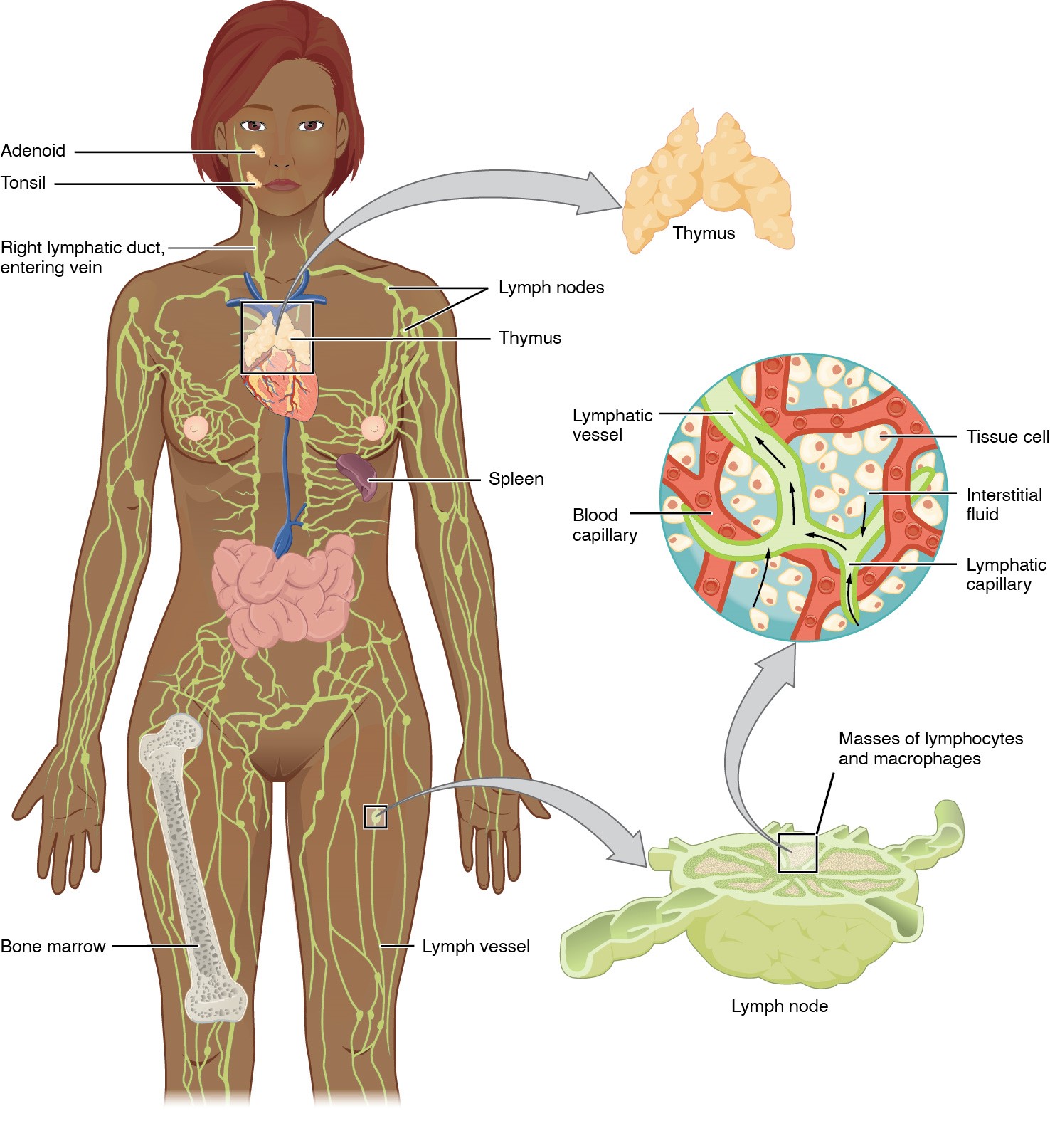
Anatomía del sistema linfático: incluye los órganos linfoides primarios (médula ósea, timo) y secundarios (bazo, ganglios linfáticos y tejido linfoide asociado a mucosa).
Los vasos linfáticos transportan linfa a los vasos linfáticos más grandes del torso, transportando líquido de vuelta a la circulación venosa.

Imagen: “Anatomy of the Lymphatic System” por OpenStax. Licencia: CC BY 4.0

Linfa y Vasos Linfáticos

Estructuras

  • Linfa:
    • Líquido que entra en EN Erythema nodosum is an immune-mediated panniculitis (inflammation of the subcutaneous fat) caused by a type IV (delayed-type) hypersensitivity reaction. It commonly manifests in young women as tender, erythematous nodules on the shins. Erythema Nodosum los LOS Neisseria vasos linfáticos
    • Se origina a partir del líquido extracelular y contiene productos del metabolismo y catabolismo tisular, células apoptóticas, desechos y células inmunitarias
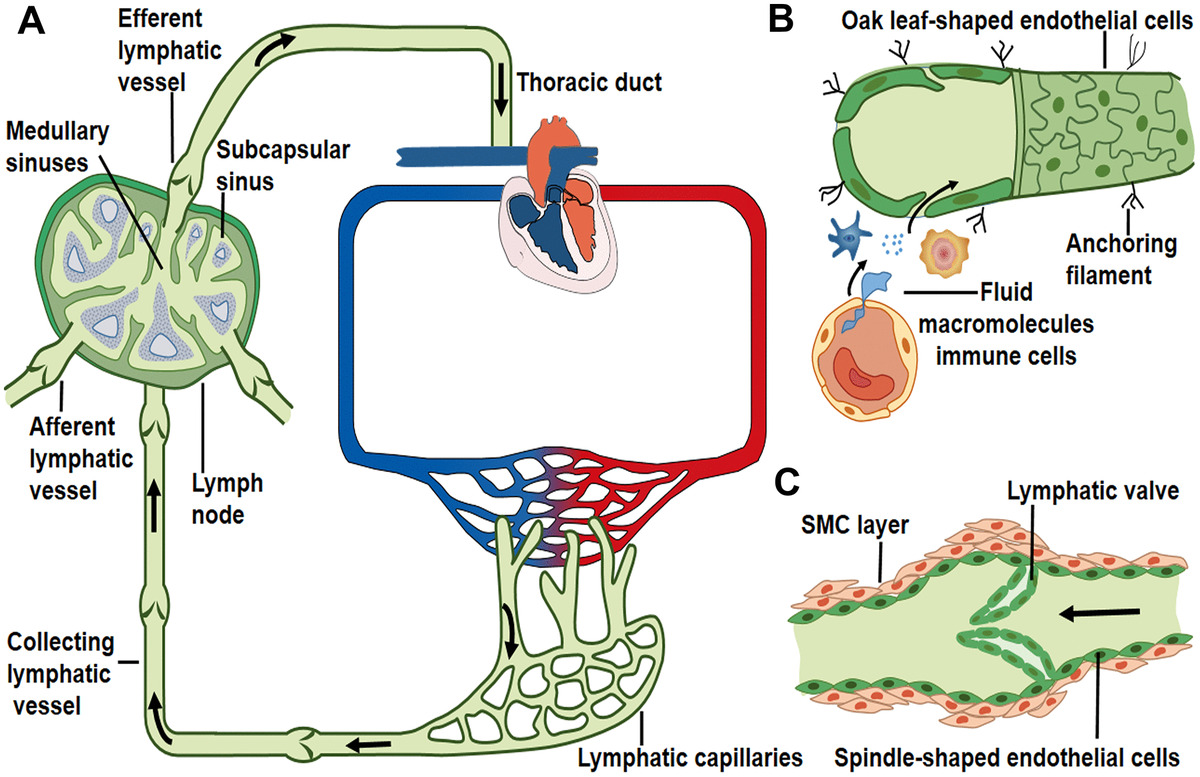
  • Capilares linfáticos:
    • Vasos permeables con extremos ciegos (las células endoteliales no están estrechamente unidas)
    • Transportan la linfa desde los LOS Neisseria tejidos hasta los LOS Neisseria ganglios linfáticos a través de los LOS Neisseria vasos linfáticos
    • Mayor diámetro (tan ancho como 100 μm) que los LOS Neisseria capilares sanguíneos
    • Las células endoteliales se superponen entre sí, formando miniválvulas que pueden abrirse fácilmente.
    • Las proteínas intersticiales no pueden entrar en EN Erythema nodosum is an immune-mediated panniculitis (inflammation of the subcutaneous fat) caused by a type IV (delayed-type) hypersensitivity reaction. It commonly manifests in young women as tender, erythematous nodules on the shins. Erythema Nodosum los LOS Neisseria capilares sanguíneos, pero pueden entrar en EN Erythema nodosum is an immune-mediated panniculitis (inflammation of the subcutaneous fat) caused by a type IV (delayed-type) hypersensitivity reaction. It commonly manifests in young women as tender, erythematous nodules on the shins. Erythema Nodosum los LOS Neisseria capilares linfáticos.
  • Vasos linfáticos (tipos):
    • Linfáticos iniciales:
      • Sin válvulas
      • Sin músculos lisos en EN Erythema nodosum is an immune-mediated panniculitis (inflammation of the subcutaneous fat) caused by a type IV (delayed-type) hypersensitivity reaction. It commonly manifests in young women as tender, erythematous nodules on the shins. Erythema Nodosum las paredes
      • Se encuentran en EN Erythema nodosum is an immune-mediated panniculitis (inflammation of the subcutaneous fat) caused by a type IV (delayed-type) hypersensitivity reaction. It commonly manifests in young women as tender, erythematous nodules on the shins. Erythema Nodosum regiones como los LOS Neisseria intestinos y los LOS Neisseria músculos esqueléticos
      • El líquido ingresa a través de las uniones de las células endoteliales y las contracciones musculares (de órganos y vasos sanguíneos) estimulan el flujo de líquido.
      • Drenan en EN Erythema nodosum is an immune-mediated panniculitis (inflammation of the subcutaneous fat) caused by a type IV (delayed-type) hypersensitivity reaction. It commonly manifests in young women as tender, erythematous nodules on the shins. Erythema Nodosum los LOS Neisseria vasos linfáticos colectores
    • Linfáticos colectores:
      • Con válvulas (la apariencia de cuentas de los LOS Neisseria conductos y vasos linfáticos refleja la presencia de válvulas)
      • Con músculos lisos en EN Erythema nodosum is an immune-mediated panniculitis (inflammation of the subcutaneous fat) caused by a type IV (delayed-type) hypersensitivity reaction. It commonly manifests in young women as tender, erythematous nodules on the shins. Erythema Nodosum las paredes
      • Las contracciones musculares en EN Erythema nodosum is an immune-mediated panniculitis (inflammation of the subcutaneous fat) caused by a type IV (delayed-type) hypersensitivity reaction. It commonly manifests in young women as tender, erythematous nodules on the shins. Erythema Nodosum los LOS Neisseria vasos linfáticos mueven el líquido a lo largo de los LOS Neisseria vasos.
    • Sistema glinfático: un sistema pseudolinfático del sistema nervioso central (SNC) que elimina los LOS Neisseria desechos y distribuye compuestos esenciales al AL Amyloidosis cerebro.

Funciones principales

  • Transporte linfático y vigilancia inmunológica:
    • Los LOS Neisseria patógenos, las células tumorales y los LOS Neisseria desechos viajan a través de la linfa.
    • La linfa se filtra y la respuesta inmunitaria adecuada se monta en EN Erythema nodosum is an immune-mediated panniculitis (inflammation of the subcutaneous fat) caused by a type IV (delayed-type) hypersensitivity reaction. It commonly manifests in young women as tender, erythematous nodules on the shins. Erythema Nodosum los LOS Neisseria ganglios linfáticos.
  • Homeostasis Homeostasis The processes whereby the internal environment of an organism tends to remain balanced and stable. Cell Injury and Death de fluidos:
    • El aumento del volumen de líquido intersticial y las moléculas de proteína filtradas provocarán la acumulación de líquido en EN Erythema nodosum is an immune-mediated panniculitis (inflammation of the subcutaneous fat) caused by a type IV (delayed-type) hypersensitivity reaction. It commonly manifests in young women as tender, erythematous nodules on the shins. Erythema Nodosum los LOS Neisseria espacios tisulares ( edema Edema Edema is a condition in which excess serous fluid accumulates in the body cavity or interstitial space of connective tissues. Edema is a symptom observed in several medical conditions. It can be categorized into 2 types, namely, peripheral (in the extremities) and internal (in an organ or body cavity). Edema).
    • Los LOS Neisseria capilares linfáticos recogen el líquido sobrante o extravasado (lo que obliga a las miniválvulas a abrirse) y las proteínas, lo que permite el retorno a la circulación.
  • Transporte de grasa:
    • Se absorben las grasas y las vitaminas liposolubles del aparato digestivo.
    • Capilares linfáticos especiales en EN Erythema nodosum is an immune-mediated panniculitis (inflammation of the subcutaneous fat) caused by a type IV (delayed-type) hypersensitivity reaction. It commonly manifests in young women as tender, erythematous nodules on the shins. Erythema Nodosum las vellosidades del intestino delgado (lácteos) facilitan el transporte a la circulación venosa.
    • Linfa en EN Erythema nodosum is an immune-mediated panniculitis (inflammation of the subcutaneous fat) caused by a type IV (delayed-type) hypersensitivity reaction. It commonly manifests in young women as tender, erythematous nodules on the shins. Erythema Nodosum lácteos: también llamada quilo (aspecto lechoso debido al AL Amyloidosis contenido de grasa)

Vía de drenaje linfático

  • Unidireccional
  • Capilares linfáticos → vasos linfáticos (entran en EN Erythema nodosum is an immune-mediated panniculitis (inflammation of the subcutaneous fat) caused by a type IV (delayed-type) hypersensitivity reaction. It commonly manifests in young women as tender, erythematous nodules on the shins. Erythema Nodosum los LOS Neisseria ganglios linfáticos a través de los LOS Neisseria vasos aferentes y salen a través de los LOS Neisseria vasos eferentes) → conductos linfáticos
  • 1 conducto linfático principal a cada lado del cuerpo:
    • El conducto linfático derecho drena de:
      • Lado derecho del cuerpo por encima del diafragma (el lado derecho de la cabeza y el cuello, el lado derecho del tórax y la extremidad superior derecha)
      • Drena en EN Erythema nodosum is an immune-mediated panniculitis (inflammation of the subcutaneous fat) caused by a type IV (delayed-type) hypersensitivity reaction. It commonly manifests in young women as tender, erythematous nodules on the shins. Erythema Nodosum la unión de la vena yugular interna y subclavia derecha
    • El conducto torácico (más grande) drena del resto (75%) del cuerpo.
      • Drena la linfa de ambas extremidades inferiores, extremidad superior izquierda y mitad izquierda de la cabeza y el cuello
      • Comienza en EN Erythema nodosum is an immune-mediated panniculitis (inflammation of the subcutaneous fat) caused by a type IV (delayed-type) hypersensitivity reaction. It commonly manifests in young women as tender, erythematous nodules on the shins. Erythema Nodosum la cisterna del quilo, saco linfático a nivel de la vértebra L2
      • Asciende al AL Amyloidosis tórax, atravesando el hiato aórtico del diafragma
      • Continúa hacia arriba en EN Erythema nodosum is an immune-mediated panniculitis (inflammation of the subcutaneous fat) caused by a type IV (delayed-type) hypersensitivity reaction. It commonly manifests in young women as tender, erythematous nodules on the shins. Erythema Nodosum el mediastino posterior a la derecha y luego se desplaza hacia la izquierda en EN Erythema nodosum is an immune-mediated panniculitis (inflammation of the subcutaneous fat) caused by a type IV (delayed-type) hypersensitivity reaction. It commonly manifests in young women as tender, erythematous nodules on the shins. Erythema Nodosum la vértebra T5
      • Drena en EN Erythema nodosum is an immune-mediated panniculitis (inflammation of the subcutaneous fat) caused by a type IV (delayed-type) hypersensitivity reaction. It commonly manifests in young women as tender, erythematous nodules on the shins. Erythema Nodosum la convergencia entre la subclavia izquierda y venas yugulares internas

El sistema glinfático

El sistema glinfático es una red especializada de canales perivasculares en EN Erythema nodosum is an immune-mediated panniculitis (inflammation of the subcutaneous fat) caused by a type IV (delayed-type) hypersensitivity reaction. It commonly manifests in young women as tender, erythematous nodules on the shins. Erythema Nodosum el SNC, responsable del intercambio entre el líquido cefalorraquídeo (LCR) y el líquido intersticial (LSI) dentro del cerebro.
  • Desempeña un papel importante en EN Erythema nodosum is an immune-mediated panniculitis (inflammation of the subcutaneous fat) caused by a type IV (delayed-type) hypersensitivity reaction. It commonly manifests in young women as tender, erythematous nodules on the shins. Erythema Nodosum la función restauradora del sueño
  • Utiliza túneles perivasculares formados por células astrogliales para eliminar proteínas solubles y metabolitos.
  • Compuesto por 2 componentes principales:
    • Espacios perivasculares: canales llenos de líquido que rodean los LOS Neisseria vasos sanguíneos del cerebro
    • Canales de agua de acuaporina-4 (AQP4): se encuentran en EN Erythema nodosum is an immune-mediated panniculitis (inflammation of the subcutaneous fat) caused by a type IV (delayed-type) hypersensitivity reaction. It commonly manifests in young women as tender, erythematous nodules on the shins. Erythema Nodosum las puntas de los LOS Neisseria astrocitos y facilitan el movimiento de líquidos
  • Funciones fisiológicas:
    • Eliminación de desechos: elimina beta-amiloide, tau y otros metabolitos
    • Intercambio LCR-LSI: aporta nutrientes y elimina desechos
    • Homeostasis Homeostasis The processes whereby the internal environment of an organism tends to remain balanced and stable. Cell Injury and Death: mantiene un entorno neuroquímico estable
    • Dependiente del sueño: la actividad glinfática aumenta durante el sueño
  • Vía de flujo: entrada paraarterial de LCR, facilitada por los LOS Neisseria canales AQP4 → mezcla de LCR y LSI en EN Erythema nodosum is an immune-mediated panniculitis (inflammation of the subcutaneous fat) caused by a type IV (delayed-type) hypersensitivity reaction. It commonly manifests in young women as tender, erythematous nodules on the shins. Erythema Nodosum el parénquima cerebral → eliminación paravenosa de desechos hacia los LOS Neisseria vasos linfáticos o la circulación sistémica
  • La disfunción del sistema glinfático se ha HA Hemolytic anemia (HA) is the term given to a large group of anemias that are caused by the premature destruction/hemolysis of circulating red blood cells (RBCs). Hemolysis can occur within (intravascular hemolysis) or outside the blood vessels (extravascular hemolysis). Hemolytic Anemia asociado con:
    • Enfermedad de Alzheimer: alteración de la depuración de beta-amiloide
    • Traumatismo craneoencefálico: alteración de las vías de eliminación de desechos
    • Hidrocefalia normotensiva: alteración de la dinámica del LCR
    • Deterioro cognitivo relacionado con la edad: disminución de la función glinfática

Asociaciones de Drenaje Linfático

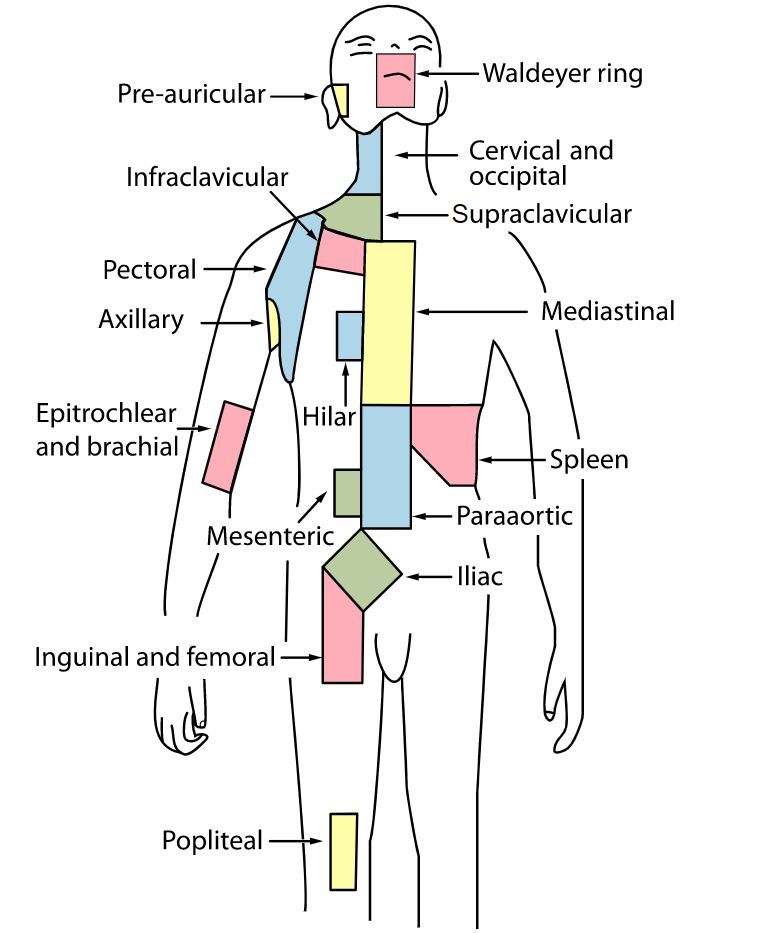
La linfadenopatía es causada por varias etiologías, y un enfoque para determinar la etiología se basa en EN Erythema nodosum is an immune-mediated panniculitis (inflammation of the subcutaneous fat) caused by a type IV (delayed-type) hypersensitivity reaction. It commonly manifests in young women as tender, erythematous nodules on the shins. Erythema Nodosum la(s) ubicación(es) y las áreas drenadas por el( los LOS Neisseria) ganglio(s) linfático(s).

Tabla: Asociaciones de drenaje linfático
Grupo de ganglios linfáticos Áreas drenadas Enfermedades asociadas
Ganglios linfáticos cervicales Cabeza y cuello
  • Infecciones:
    • Virus Virus Viruses are infectious, obligate intracellular parasites composed of a nucleic acid core surrounded by a protein capsid. Viruses can be either naked (non-enveloped) or enveloped. The classification of viruses is complex and based on many factors, including type and structure of the nucleoid and capsid, the presence of an envelope, the replication cycle, and the host range. Virology del Ebstein-Barr
    • Infección por citomegalovirus
    • Toxoplasmosis Toxoplasmosis Toxoplasmosis is an infectious disease caused by Toxoplasma gondii, an obligate intracellular protozoan parasite. Felines are the definitive host, but transmission to humans can occur through contact with cat feces or the consumption of contaminated foods. The clinical presentation and complications depend on the host’s immune status. Toxoplasma/Toxoplasmosis
    • Tuberculosis Tuberculosis Tuberculosis (TB) is an infectious disease caused by Mycobacterium tuberculosis complex bacteria. The bacteria usually attack the lungs but can also damage other parts of the body. Approximately 30% of people around the world are infected with this pathogen, with the majority harboring a latent infection. Tuberculosis spreads through the air when a person with active pulmonary infection coughs or sneezes. Tuberculosis
  • Enfermedad de Kawasaki
  • Neoplasia maligna de cabeza y cuello
Ganglios linfáticos preauriculares
  • Conjuntiva
  • Canal auditivo
  • Cuero cabelludo anterior y temporal
Infecciones en EN Erythema nodosum is an immune-mediated panniculitis (inflammation of the subcutaneous fat) caused by a type IV (delayed-type) hypersensitivity reaction. It commonly manifests in young women as tender, erythematous nodules on the shins. Erythema Nodosum áreas drenadas
Ganglios linfáticos postauriculares Cuero cabelludo parietotemporal Infecciones (común en EN Erythema nodosum is an immune-mediated panniculitis (inflammation of the subcutaneous fat) caused by a type IV (delayed-type) hypersensitivity reaction. It commonly manifests in young women as tender, erythematous nodules on the shins. Erythema Nodosum la rubéola)
Ganglios linfáticos supraclaviculares
  • Derecha:
    • Mediastino
    • Pulmones
  • Izquierda: abdomen
  • Derecha: cáncer en EN Erythema nodosum is an immune-mediated panniculitis (inflammation of the subcutaneous fat) caused by a type IV (delayed-type) hypersensitivity reaction. It commonly manifests in young women as tender, erythematous nodules on the shins. Erythema Nodosum el mediastino, pulmones o esófago
  • Izquierda: malignidad abdominal (nódulo de Virchow)
Ganglios linfáticos axilares
  • Brazo
  • Pared torácica
  • Mamas
  • Infecciones (como la enfermedad por arañazo de gato)
  • Cáncer de mama
  • Metástasis (nódulo axilar izquierdo o “nódulo irlandés” en EN Erythema nodosum is an immune-mediated panniculitis (inflammation of the subcutaneous fat) caused by a type IV (delayed-type) hypersensitivity reaction. It commonly manifests in young women as tender, erythematous nodules on the shins. Erythema Nodosum el cáncer gástrico)
Ganglios linfáticos epitrocleares Lado medial del brazo por debajo del codo
  • Infecciones (tularemia, sífilis secundaria)
  • Linfoma
  • Sarcoidosis Sarcoidosis Sarcoidosis is a multisystem inflammatory disease that causes noncaseating granulomas. The exact etiology is unknown. Sarcoidosis usually affects the lungs and thoracic lymph nodes, but it can also affect almost every system in the body, including the skin, heart, and eyes, most commonly. Sarcoidosis
Ganglios linfáticos mediastínicos
  • Tráquea
  • Esófago
  • Infecciones ( tuberculosis Tuberculosis Tuberculosis (TB) is an infectious disease caused by Mycobacterium tuberculosis complex bacteria. The bacteria usually attack the lungs but can also damage other parts of the body. Approximately 30% of people around the world are infected with this pathogen, with the majority harboring a latent infection. Tuberculosis spreads through the air when a person with active pulmonary infection coughs or sneezes. Tuberculosis)
  • Enfermedad granulomatosa
  • Cáncer de pulmón
Ganglios linfáticos hiliares Pulmones
Ganglios linfáticos celíacos
  • Hígado
  • Estómago
  • Bazo
  • Páncreas
  • Duodeno superior
  • Linfadenitis mesentérica
  • Fiebre tifoidea
  • Colitis Colitis Inflammation of the colon section of the large intestine, usually with symptoms such as diarrhea (often with blood and mucus), abdominal pain, and fever. Pseudomembranous Colitis ulcerosa
  • Metástasis
  • “Nódulo de la hermana María José”: nódulo periumbilical que se cree que es una extensión maligna a través de la diseminación linfática y hematógena (cánceres gastrointestinales y genitourinarios)
Ganglios linfáticos mesentéricos superiores
  • Duodeno inferior a íleon
  • Colon Colon The large intestines constitute the last portion of the digestive system. The large intestine consists of the cecum, appendix, colon (with ascending, transverse, descending, and sigmoid segments), rectum, and anal canal. The primary function of the colon is to remove water and compact the stool prior to expulsion from the body via the rectum and anal canal. Colon, Cecum, and Appendix: Anatomy a flexura esplénica
Ganglios linfáticos mesentéricos inferiores Colon Colon The large intestines constitute the last portion of the digestive system. The large intestine consists of the cecum, appendix, colon (with ascending, transverse, descending, and sigmoid segments), rectum, and anal canal. The primary function of the colon is to remove water and compact the stool prior to expulsion from the body via the rectum and anal canal. Colon, Cecum, and Appendix: Anatomy desde la flexura esplénica hasta el recto superior
Ganglios linfáticos paraaórticos (lumbares)
  • Ovarios/testículos
  • Riñones
  • Útero
Ganglios linfáticos ilíacos (externos e internos)
  • Externos:
    • Cuello uterino
    • Vejiga superior
    • Útero (también recibe linfa de los LOS Neisseria ganglios linfáticos inguinales)
  • Internos:
    • Recto inferior al AL Amyloidosis canal anal (por encima de la línea pectínea)
    • Vejiga
    • Vagina Vagina The vagina is the female genital canal, extending from the vulva externally to the cervix uteri internally. The structures have sexual, reproductive, and urinary functions and a rich blood supply, mainly arising from the internal iliac artery. Vagina, Vulva, and Pelvic Floor: Anatomy
    • Cuello uterino
    • Próstata
  • Infecciones: enfermedad de transmisión sexual (ETS)
  • Malignidad y metástasis
Ganglios linfáticos inguinales
  • Extremidad inferior
  • Genitales
  • Glúteo
  • Pared abdominal debajo del ombligo
  • Infección de la extremidad inferior
  • ETS (como chancroide, linfogranuloma venéreo, herpes genital, sífilis)
  • Cáncer
Ganglios linfáticos poplíteos Parte inferior de la pierna Infección (celulitis)

Relevancia Clínica

  • Linfedema: aumenta la presión osmótica coloidal del líquido intersticial, lo que resulta en EN Erythema nodosum is an immune-mediated panniculitis (inflammation of the subcutaneous fat) caused by a type IV (delayed-type) hypersensitivity reaction. It commonly manifests in young women as tender, erythematous nodules on the shins. Erythema Nodosum linfedema. El drenaje linfático sirve como vía principal para la eliminación del líquido intersticial. La disfunción de los LOS Neisseria vasos linfáticos da como resultado el desarrollo de edema Edema Edema is a condition in which excess serous fluid accumulates in the body cavity or interstitial space of connective tissues. Edema is a symptom observed in several medical conditions. It can be categorized into 2 types, namely, peripheral (in the extremities) and internal (in an organ or body cavity). Edema. Los LOS Neisseria pacientes pueden presentar cambios en EN Erythema nodosum is an immune-mediated panniculitis (inflammation of the subcutaneous fat) caused by a type IV (delayed-type) hypersensitivity reaction. It commonly manifests in young women as tender, erythematous nodules on the shins. Erythema Nodosum piel de naranja y elefantiasis. Las causas ocurren por hipoplasia congénita de los LOS Neisseria linfáticos (enfermedad de Milroy), malignidad, obesidad o cirugía.
  • Quilotórax: afección en EN Erythema nodosum is an immune-mediated panniculitis (inflammation of the subcutaneous fat) caused by a type IV (delayed-type) hypersensitivity reaction. It commonly manifests in young women as tender, erythematous nodules on the shins. Erythema Nodosum la que el conducto torácico se rompe y el quilo se escapa hacia el espacio pleural. La afección comúnmente es causada por un traumatismo (e.g., cirugía torácica), pero también surge de tumores. La presentación incluye disnea y derrame pleural en EN Erythema nodosum is an immune-mediated panniculitis (inflammation of the subcutaneous fat) caused by a type IV (delayed-type) hypersensitivity reaction. It commonly manifests in young women as tender, erythematous nodules on the shins. Erythema Nodosum la radiografía de tórax. En EN Erythema nodosum is an immune-mediated panniculitis (inflammation of the subcutaneous fat) caused by a type IV (delayed-type) hypersensitivity reaction. It commonly manifests in young women as tender, erythematous nodules on the shins. Erythema Nodosum la toracocentesis, se observa un líquido pleural lechoso con un nivel elevado de triglicéridos. La evaluación se realiza mediante linfangiograma y una tomografía computarizada (TC) del mediastino.
  • Linfangitis: inflamación de los LOS Neisseria vasos linfáticos, a menudo causada por la propagación bacteriana. La etiología más común es el estreptococo β-hemolítico del grupo A. Los LOS Neisseria vasos están dilatados y llenos de exudado. En EN Erythema nodosum is an immune-mediated panniculitis (inflammation of the subcutaneous fat) caused by a type IV (delayed-type) hypersensitivity reaction. It commonly manifests in young women as tender, erythematous nodules on the shins. Erythema Nodosum el examen, se ven rayas subcutáneas rojas que representan linfáticos inflamados. Esto se acompaña de ganglios linfáticos agrandados y dolorosos (linfadenitis).

Referencias

  1. Benjamin, J., Maldonado, F., & Wahidi, M. M. (2023). Imaging and interventions for lymphatic and lymphatic-related disorders. Radiology, 307(3), e220231. https://doi.org/10.1148/radiol.220231
  2. Bertino, F. J., & Fung, K. F. K. (2025). Advances and techniques in medical imaging and minimally invasive interventions for disorders of the central conducting and mesenteric lymphatic system. Lymphatics, 3(1), 8. https://doi.org/10.3390/lymphatics3010008
  3. Bustos, V. P., Forte, A. J., Lentz, N. L., Sisti, A., Ciudad, P., Patel, K. M., & Bello, R. J. (2024). Mapping the anatomy of the human lymphatic system. Journal of Reconstructive Microsurgery, 40(9), 672-679. https://doi.org/10.1055/s-0044-1782670
  4. Ghanizada, H., & Nedergaard, M. (2025). The glymphatic system. In A. Verkhratsky, M. J. Carson, & R. C. C. Chang (Eds.), Handbook of clinical neurology (Vol. 209, pp. 161-170). Elsevier. https://doi.org/10.1016/B978-0-443-19104-6.00006-1
  5. Hu, Z., Wu, D., Yang, X., Luo, Y., Fu, J., Chung, H., Wu, T., Hui, G., Hu, F., Chen, Y., Huang, X., & Chen, Z. (2024). Lymphatic vessel: Origin, heterogeneity, biological functions and therapeutic targets. Signal Transduction and Targeted Therapy, 9(1), 1-37. https://doi.org/10.1038/s41392-023-01723-x
  6. Kanavaros, P., Karatzias, G., Papoudou-Bai, A., Barbouti, A., & Troupis, T. (2024). The right lymphatic duct: Basic anatomy and clinical relevance. Vasa, 53(4), 238-245. https://doi.org/10.1024/0301-1526/a001146
  7. Karakousi, T., Bhardwaj, P., Kokkonen, N., Vuorio, T., Petrova, T. V., & Alitalo, K. (2024). Lymphatic vessels in the age of cancer immunotherapy. Nature Reviews Cancer, 24(6), 363-381. https://doi.org/10.1038/s41568-024-00681-y
  8. Plutecki, D., Płomiński, J., & Mazurek, M. (2024). The anatomy of the thoracic duct and cisterna chyli: A meta-analysis with surgical implications. Journal of Clinical Medicine, 13(15), 4285. https://doi.org/10.3390/jcm13154285
  9. Rama, A., Jayakar, A., Jayakar, A., Priyadharsini, R. P., Kanchana, A., & Krishnakumar, K. (2024). Drug delivery to the lymphatic system: The road less travelled. Journal of Applied Pharmaceutical Science. https://doi.org/10.7324/JAPS.2024.180277
  10. Standring, S. (2020). Gray’s anatomy: The anatomical basis of clinical practice (42nd ed.). Elsevier.

¡Crea tu cuenta gratis o inicia una sesión para seguir leyendo!

Regístrate ahora y obtén acceso gratuito a Lecturio con páginas de concepto, videos médicos y cuestionarios para tu educación médica.

User Reviews

Que tengas una sesión de estudio alegre y navideña 🎁 Ahorra 50% en todos los planes >>

Details