
Domina Conceptos Médicos

Estudia para la escuela de medicina y tus examenes con Lecturio.

Rotavirus

Rotavirus Rotavirus A genus of Reoviridae, causing acute gastroenteritis in birds and mammals, including humans. Transmission is horizontal and by environmental contamination. Seven species (rotaviruses A through G) are recognized. Rotavirus pertenece a la familia Reoviridae Reoviridae A family of non enveloped RNA viruses with cubic symmetry. The twelve genera include orthoreovirus; orbivirus; coltivirus; rotavirus; aquareovirus, cypovirus, phytoreovirus, fijivirus, seadornavirus, idnoreovirus, mycoreovirus, and oryzavirus. Rotavirus y es un virus Virus Viruses are infectious, obligate intracellular parasites composed of a nucleic acid core surrounded by a protein capsid. Viruses can be either naked (non-enveloped) or enveloped. The classification of viruses is complex and based on many factors, including type and structure of the nucleoid and capsid, the presence of an envelope, the replication cycle, and the host range. Virology de ácido ribonucleico (ARN) de doble cadena no envuelto. La transmisión se produce por vía fecal-oral. El rotavirus Rotavirus A genus of Reoviridae, causing acute gastroenteritis in birds and mammals, including humans. Transmission is horizontal and by environmental contamination. Seven species (rotaviruses A through G) are recognized. Rotavirus es una causa frecuente de gastroenteritis Gastroenteritis Gastroenteritis is inflammation of the stomach and intestines, commonly caused by infections from bacteria, viruses, or parasites. Transmission may be foodborne, fecal-oral, or through animal contact. Common clinical features include abdominal pain, diarrhea, vomiting, fever, and dehydration. Gastroenteritis grave en EN Erythema nodosum is an immune-mediated panniculitis (inflammation of the subcutaneous fat) caused by a type IV (delayed-type) hypersensitivity reaction. It commonly manifests in young women as tender, erythematous nodules on the shins. Erythema Nodosum los LOS Neisseria niños. Las infecciones graves pueden provocar deshidratación y muerte. Por lo general, no se requieren pruebas de diagnóstico, pero el virus Virus Viruses are infectious, obligate intracellular parasites composed of a nucleic acid core surrounded by a protein capsid. Viruses can be either naked (non-enveloped) or enveloped. The classification of viruses is complex and based on many factors, including type and structure of the nucleoid and capsid, the presence of an envelope, the replication cycle, and the host range. Virology se puede detectar en EN Erythema nodosum is an immune-mediated panniculitis (inflammation of the subcutaneous fat) caused by a type IV (delayed-type) hypersensitivity reaction. It commonly manifests in young women as tender, erythematous nodules on the shins. Erythema Nodosum muestras de heces mediante ensayo inmunoabsorbente ligado a enzimas ( ELISA ELISA An immunoassay utilizing an antibody labeled with an enzyme marker such as horseradish peroxidase. While either the enzyme or the antibody is bound to an immunosorbent substrate, they both retain their biologic activity; the change in enzyme activity as a result of the enzyme-antibody-antigen reaction is proportional to the concentration of the antigen and can be measured spectrophotometrically or with the naked eye. Many variations of the method have been developed. St. Louis Encephalitis Virus, por sus siglas en EN Erythema nodosum is an immune-mediated panniculitis (inflammation of the subcutaneous fat) caused by a type IV (delayed-type) hypersensitivity reaction. It commonly manifests in young women as tender, erythematous nodules on the shins. Erythema Nodosum inglés) o reacción en EN Erythema nodosum is an immune-mediated panniculitis (inflammation of the subcutaneous fat) caused by a type IV (delayed-type) hypersensitivity reaction. It commonly manifests in young women as tender, erythematous nodules on the shins. Erythema Nodosum cadena de polimerasa ( PCR PCR Polymerase chain reaction (PCR) is a technique that amplifies DNA fragments exponentially for analysis. The process is highly specific, allowing for the targeting of specific genomic sequences, even with minuscule sample amounts. The PCR cycles multiple times through 3 phases: denaturation of the template DNA, annealing of a specific primer to the individual DNA strands, and synthesis/elongation of new DNA molecules. Polymerase Chain Reaction (PCR), por sus siglas en EN Erythema nodosum is an immune-mediated panniculitis (inflammation of the subcutaneous fat) caused by a type IV (delayed-type) hypersensitivity reaction. It commonly manifests in young women as tender, erythematous nodules on the shins. Erythema Nodosum inglés). La terapia de rehidratación oral es el pilar del tratamiento. Se dispone de una vacuna viva atenuada para prevenir las infecciones por rotavirus Rotavirus A genus of Reoviridae, causing acute gastroenteritis in birds and mammals, including humans. Transmission is horizontal and by environmental contamination. Seven species (rotaviruses A through G) are recognized. Rotavirus.

Last updated: Feb 18, 2025
Editorial responsibility: Stanley Oiseth, Lindsay Jones, Evelin Maza

Clasificación

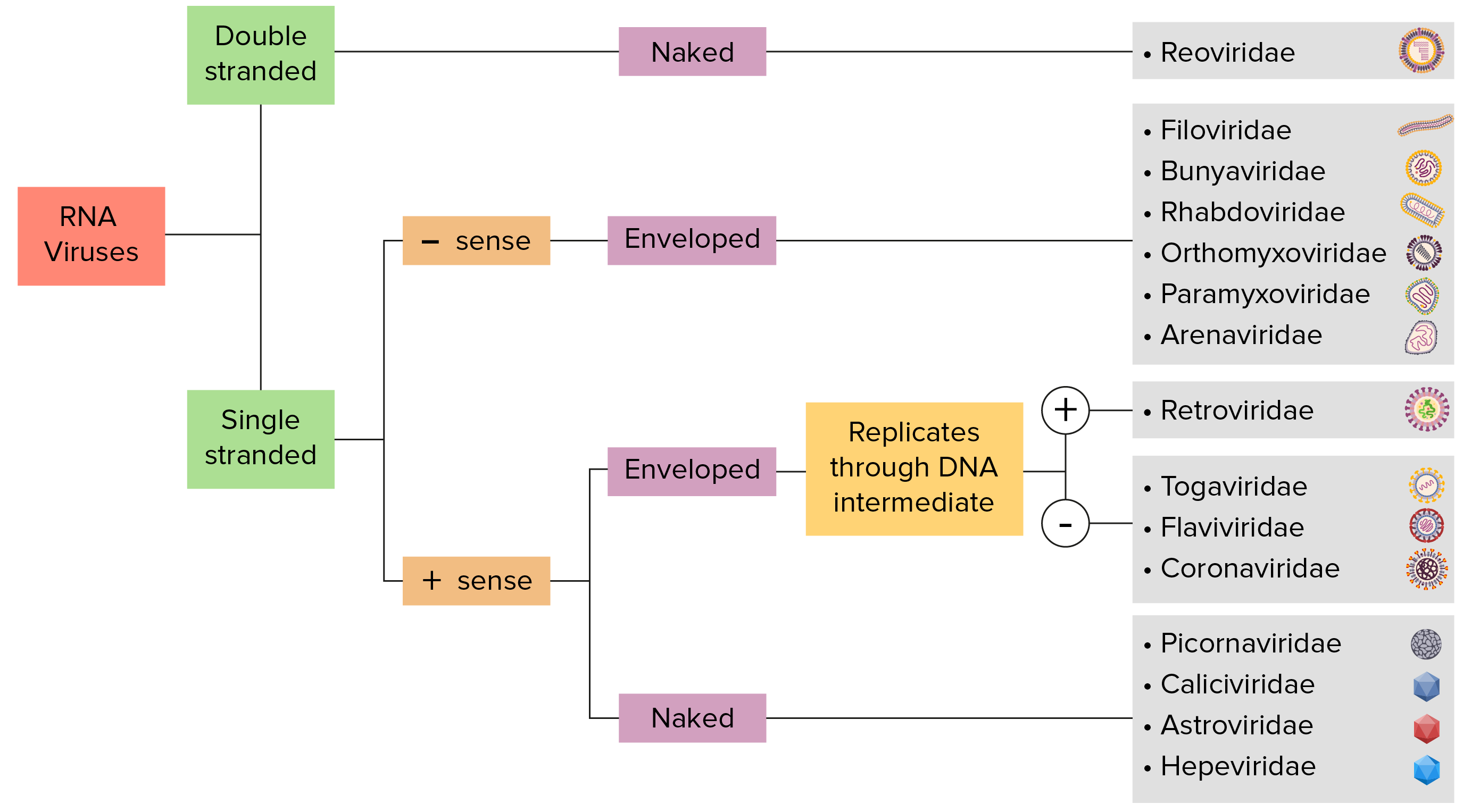
Diagrama de flujo de la clasificación de los virus de ARN

Identificación de los virus ARN:
Los virus pueden clasificarse de muchas maneras. Sin embargo, la mayoría de los virus tienen un genoma formado por ácido desoxirribonucleico (ADN) o ARN. Los virus con genoma ARN pueden caracterizarse además por tener ARN monocatenario o bicatenario. Los virus “envueltos” están cubiertos por una fina capa de membrana celular (normalmente tomada de la célula huésped). Si la envoltura está ausente, los virus se denominan “desnudos”. Los virus con genomas monocatenarios son de “sentido positivo” si el genoma se emplea directamente como ARN mensajero (ARNm), que se traduce en proteínas. Los virus monocatenarios de “sentido negativo” emplean la ARN polimerasa, una enzima viral, para transcribir su genoma en ARN mensajero.
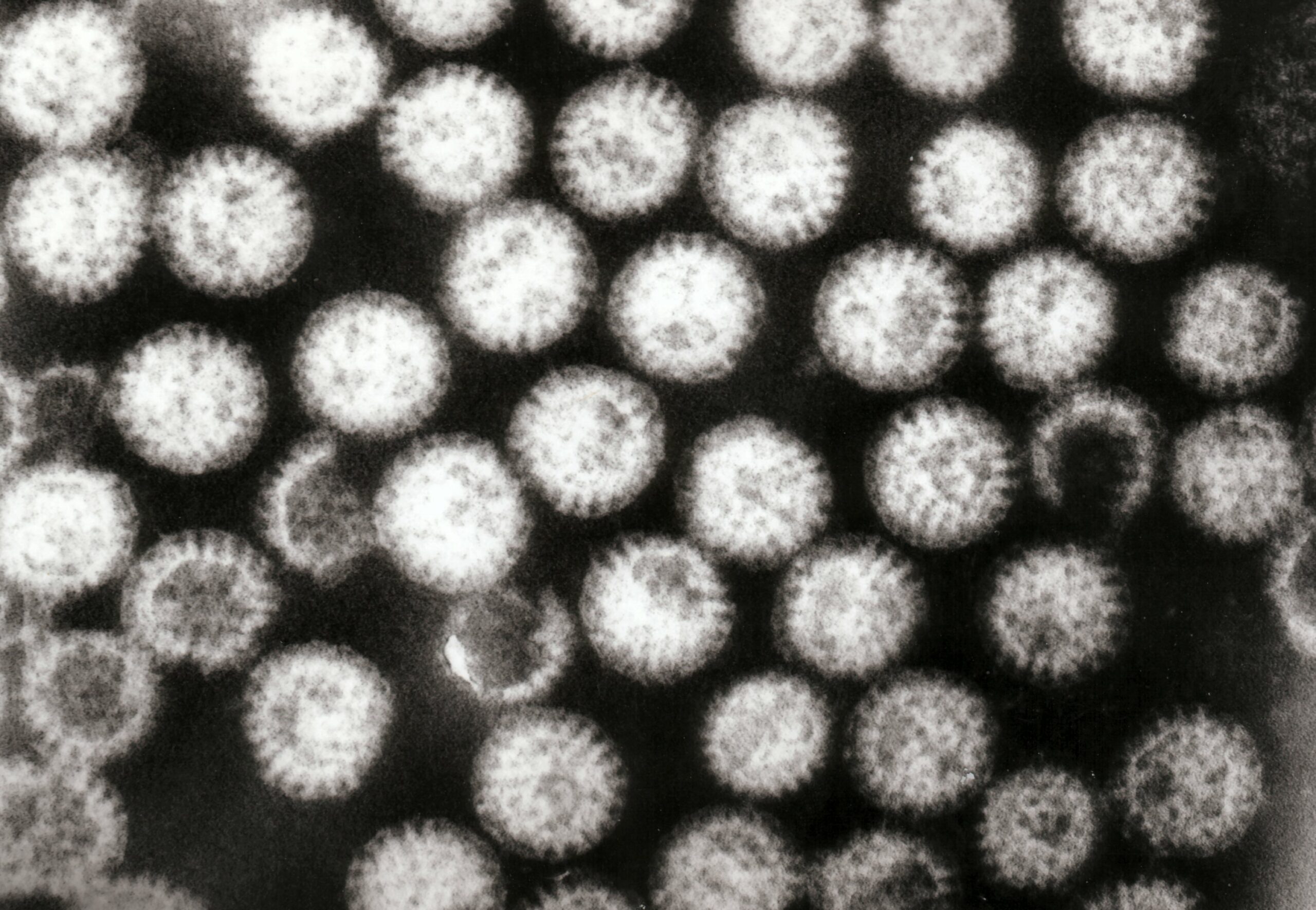
Imagen por Lecturio. Licencia: CC BY-NC-SA 4.0

Características Generales y Epidemiología

Características básicas del Rotavirus Rotavirus A genus of Reoviridae, causing acute gastroenteritis in birds and mammals, including humans. Transmission is horizontal and by environmental contamination. Seven species (rotaviruses A through G) are recognized. Rotavirus

  • Taxonomía:
    • Familia: Reoviridae Reoviridae A family of non enveloped RNA viruses with cubic symmetry. The twelve genera include orthoreovirus; orbivirus; coltivirus; rotavirus; aquareovirus, cypovirus, phytoreovirus, fijivirus, seadornavirus, idnoreovirus, mycoreovirus, and oryzavirus. Rotavirus
    • Género: Rotavirus Rotavirus A genus of Reoviridae, causing acute gastroenteritis in birds and mammals, including humans. Transmission is horizontal and by environmental contamination. Seven species (rotaviruses A through G) are recognized. Rotavirus
  • Virus Virus Viruses are infectious, obligate intracellular parasites composed of a nucleic acid core surrounded by a protein capsid. Viruses can be either naked (non-enveloped) or enveloped. The classification of viruses is complex and based on many factors, including type and structure of the nucleoid and capsid, the presence of an envelope, the replication cycle, and the host range. Virology de ARN:
    • Doble cadena
    • Hebras de sentido positivo y negativo
    • Lineal
    • Segmentado (11 segmentos)
  • Estructura:
    • “Apariencia de rueda”
    • Virus Virus Viruses are infectious, obligate intracellular parasites composed of a nucleic acid core surrounded by a protein capsid. Viruses can be either naked (non-enveloped) or enveloped. The classification of viruses is complex and based on many factors, including type and structure of the nucleoid and capsid, the presence of an envelope, the replication cycle, and the host range. Virology no envuelto
    • Cápside icosaédrica de 3 capas
    • Espículas de proteína
  • Puede permanecer viable durante semanas o meses en EN Erythema nodosum is an immune-mediated panniculitis (inflammation of the subcutaneous fat) caused by a type IV (delayed-type) hypersensitivity reaction. It commonly manifests in young women as tender, erythematous nodules on the shins. Erythema Nodosum el medio ambiente
Micrografía electrónica de transmisión de múltiples viriones de rotavirus

Micrografía electrónica de transmisión de múltiples viriones de rotavirus

Imagen:Transmission electron micrograph of multiple rotavirus particles” por Dr. Graham Beards. Licencia: CC BY 3.0

Enfermedades asociadas

Los LOS Neisseria rotavirus Rotavirus A genus of Reoviridae, causing acute gastroenteritis in birds and mammals, including humans. Transmission is horizontal and by environmental contamination. Seven species (rotaviruses A through G) are recognized. Rotavirus causan gastroenteritis Gastroenteritis Gastroenteritis is inflammation of the stomach and intestines, commonly caused by infections from bacteria, viruses, or parasites. Transmission may be foodborne, fecal-oral, or through animal contact. Common clinical features include abdominal pain, diarrhea, vomiting, fever, and dehydration. Gastroenteritis.

Epidemiología

  • Principal causa de gastroenteritis Gastroenteritis Gastroenteritis is inflammation of the stomach and intestines, commonly caused by infections from bacteria, viruses, or parasites. Transmission may be foodborne, fecal-oral, or through animal contact. Common clinical features include abdominal pain, diarrhea, vomiting, fever, and dehydration. Gastroenteritis aguda en EN Erythema nodosum is an immune-mediated panniculitis (inflammation of the subcutaneous fat) caused by a type IV (delayed-type) hypersensitivity reaction. It commonly manifests in young women as tender, erythematous nodules on the shins. Erythema Nodosum niños < 5 años
  • Distribución a nivel mundial
  • Los LOS Neisseria niños tienen una enfermedad clínicamente más evidente que los LOS Neisseria adultos.
  • Más común durante el invierno en EN Erythema nodosum is an immune-mediated panniculitis (inflammation of the subcutaneous fat) caused by a type IV (delayed-type) hypersensitivity reaction. It commonly manifests in young women as tender, erythematous nodules on the shins. Erythema Nodosum climas templados
  • Causa aproximadamente el 39 % de las muertes mundiales por diarrea, principalmente en EN Erythema nodosum is an immune-mediated panniculitis (inflammation of the subcutaneous fat) caused by a type IV (delayed-type) hypersensitivity reaction. It commonly manifests in young women as tender, erythematous nodules on the shins. Erythema Nodosum países con acceso limitado a la atención médica
  • A menudo conduce a una hospitalización prolongada (> 7 días), especialmente en EN Erythema nodosum is an immune-mediated panniculitis (inflammation of the subcutaneous fat) caused by a type IV (delayed-type) hypersensitivity reaction. It commonly manifests in young women as tender, erythematous nodules on the shins. Erythema Nodosum bebés menores de 6 meses, lo que plantea importantes desafíos para la atención médica

Patogénesis

Reservorio

Los LOS Neisseria humanos son el reservorio primario.

Transmisión

La transmisión se produce por vía fecal-oral:

  • Ingestión de agua o alimentos contaminados
  • Contacto con superficies/fómites contaminados

Factores de riesgo del huésped

  • Niños pequeños
  • Individuos que no han sido vacunados
  • Individuos inmunocomprometidos
  • Individuos que viven en EN Erythema nodosum is an immune-mediated panniculitis (inflammation of the subcutaneous fat) caused by a type IV (delayed-type) hypersensitivity reaction. It commonly manifests in young women as tender, erythematous nodules on the shins. Erythema Nodosum centros de cuidado a largo plazo

Fisiopatología

  • Los LOS Neisseria viriones penetran las células de las vellosidades del intestino delgado.
  • Producción de proteínas similares a la toxina del cólera → destrucción y embotamiento de las microvellosidades → interrupción en EN Erythema nodosum is an immune-mediated panniculitis (inflammation of the subcutaneous fat) caused by a type IV (delayed-type) hypersensitivity reaction. It commonly manifests in young women as tender, erythematous nodules on the shins. Erythema Nodosum la absorción de electrolitos y agua
  • ↓ Actividad disacaridasa → malabsorción de lactosa y D-xilosa → entrada osmótica en EN Erythema nodosum is an immune-mediated panniculitis (inflammation of the subcutaneous fat) caused by a type IV (delayed-type) hypersensitivity reaction. It commonly manifests in young women as tender, erythematous nodules on the shins. Erythema Nodosum el intestino
  • Secreción activa de agua y alteración de la absorción → diarrea acuosa
  • Los LOS Neisseria viriones se liberan en EN Erythema nodosum is an immune-mediated panniculitis (inflammation of the subcutaneous fat) caused by a type IV (delayed-type) hypersensitivity reaction. It commonly manifests in young women as tender, erythematous nodules on the shins. Erythema Nodosum las heces → permite la transmisión
diagrama de flujo de la patogenia de la infeccion por rotavirus

Diagrama de flujo que resume la patogenia de la infección por rotavirus

Imagen por Lecturio. Licencia: CC BY-NC-SA 4.0

Presentación Clínica

Cronología:

  • Período de incubación < 48 horas
  • Duración: 4–5 días

Síntomas:

  • Fiebre
  • Malestar
  • Dolor Dolor Inflammation abdominal
  • Vómitos
  • Diarrea
    • Acuosa
    • No inflamatoria
    • No sanguinolenta
    • Puede ser grave y conducir a una deshidratación grave

Signos de deshidratación:

  • Taquicardia
  • Membranas mucosas secas
  • ↓ Diuresis
  • ↓ Turgencia de la piel
  • Ojos hundidos

Diagnóstico y Tratamiento

Diagnóstico

Las infecciones por rotavirus Rotavirus A genus of Reoviridae, causing acute gastroenteritis in birds and mammals, including humans. Transmission is horizontal and by environmental contamination. Seven species (rotaviruses A through G) are recognized. Rotavirus son difíciles de distinguir de otras enfermedades diarreicas basándose únicamente en EN Erythema nodosum is an immune-mediated panniculitis (inflammation of the subcutaneous fat) caused by a type IV (delayed-type) hypersensitivity reaction. It commonly manifests in young women as tender, erythematous nodules on the shins. Erythema Nodosum el examen clínico.

  • Por lo general, no se necesitan pruebas de laboratorio.
  • La detección de rotavirus Rotavirus A genus of Reoviridae, causing acute gastroenteritis in birds and mammals, including humans. Transmission is horizontal and by environmental contamination. Seven species (rotaviruses A through G) are recognized. Rotavirus en EN Erythema nodosum is an immune-mediated panniculitis (inflammation of the subcutaneous fat) caused by a type IV (delayed-type) hypersensitivity reaction. It commonly manifests in young women as tender, erythematous nodules on the shins. Erythema Nodosum las heces se puede realizar (si es necesario):
    • ELISA ELISA An immunoassay utilizing an antibody labeled with an enzyme marker such as horseradish peroxidase. While either the enzyme or the antibody is bound to an immunosorbent substrate, they both retain their biologic activity; the change in enzyme activity as a result of the enzyme-antibody-antigen reaction is proportional to the concentration of the antigen and can be measured spectrophotometrically or with the naked eye. Many variations of the method have been developed. St. Louis Encephalitis Virus
    • PCR PCR Polymerase chain reaction (PCR) is a technique that amplifies DNA fragments exponentially for analysis. The process is highly specific, allowing for the targeting of specific genomic sequences, even with minuscule sample amounts. The PCR cycles multiple times through 3 phases: denaturation of the template DNA, annealing of a specific primer to the individual DNA strands, and synthesis/elongation of new DNA molecules. Polymerase Chain Reaction (PCR)

Tratamiento

  • La enfermedad es autolimitada.
  • Terapia sintomática
  • Rehidratación oral
  • Líquidos intravenosos en EN Erythema nodosum is an immune-mediated panniculitis (inflammation of the subcutaneous fat) caused by a type IV (delayed-type) hypersensitivity reaction. It commonly manifests in young women as tender, erythematous nodules on the shins. Erythema Nodosum pacientes con deshidratación severa

Prevención

Se han desarrollado vacunas vivas atenuadas para prevenir las infecciones por rotavirus Rotavirus A genus of Reoviridae, causing acute gastroenteritis in birds and mammals, including humans. Transmission is horizontal and by environmental contamination. Seven species (rotaviruses A through G) are recognized. Rotavirus:

  • Administradas a todos los LOS Neisseria niños antes de los LOS Neisseria 8 meses de edad
  • Contraindicaciones:
    • Inmunodeficiencia combinada severa
    • Antecedentes de intususcepción
    • Alergia a los LOS Neisseria componentes de la vacuna

Diagnóstico Diferencial

  • Norovirus Norovirus Norovirus is a nonenveloped, single-stranded, positive-sense RNA virus belonging to the Caliciviridae family. Norovirus infections are transmitted via the fecal-oral route or by aerosols from vomiting. The virus is one of the most common causes of nonbacterial gastroenteritis epidemic worldwide. Symptoms include watery and nonbloody diarrhea, nausea, vomiting, and low-grade fever. Norovirus: un virus Virus Viruses are infectious, obligate intracellular parasites composed of a nucleic acid core surrounded by a protein capsid. Viruses can be either naked (non-enveloped) or enveloped. The classification of viruses is complex and based on many factors, including type and structure of the nucleoid and capsid, the presence of an envelope, the replication cycle, and the host range. Virology de ARN monocatenario de sentido positivo, no envuelto que pertenece a la familia Caliciviridae Caliciviridae A family of RNA viruses infecting a broad range of animals. Most individual species are restricted to their natural hosts. They possess a characteristic six-pointed starlike shape whose surfaces have cup-shaped (chalice) indentions. Transmission is by contaminated food, water, fomites, and occasionally aerosolization of secretions. Genera include lagovirus; norwalk-like viruses; sapporo-like viruses; and vesivirus. Norovirus. El norovirus Norovirus Norovirus is a nonenveloped, single-stranded, positive-sense RNA virus belonging to the Caliciviridae family. Norovirus infections are transmitted via the fecal-oral route or by aerosols from vomiting. The virus is one of the most common causes of nonbacterial gastroenteritis epidemic worldwide. Symptoms include watery and nonbloody diarrhea, nausea, vomiting, and low-grade fever. Norovirus es una causa común de diarrea aguda a nivel mundial. La transmisión es por vía fecal-oral. Los LOS Neisseria pacientes con infecciones por norovirus Norovirus Norovirus is a nonenveloped, single-stranded, positive-sense RNA virus belonging to the Caliciviridae family. Norovirus infections are transmitted via the fecal-oral route or by aerosols from vomiting. The virus is one of the most common causes of nonbacterial gastroenteritis epidemic worldwide. Symptoms include watery and nonbloody diarrhea, nausea, vomiting, and low-grade fever. Norovirus presentan náusea, vómitos y diarrea. El diagnóstico suele basarse en EN Erythema nodosum is an immune-mediated panniculitis (inflammation of the subcutaneous fat) caused by a type IV (delayed-type) hypersensitivity reaction. It commonly manifests in young women as tender, erythematous nodules on the shins. Erythema Nodosum la sospecha clínica. El tratamiento es sintomático.
  • Campylobacter jejuni Campylobacter jejuni A species of bacteria that resemble small tightly coiled spirals. Its organisms are known to cause abortion in sheep and fever and enteritis in man and may be associated with enteric diseases of calves, lambs, and other animals. Campylobacter: bacilos Gram-negativos curvados. Los LOS Neisseria síntomas comunes de infección son fiebre, cefalea, dolor Dolor Inflammation abdominal intenso, mialgias y diarrea, que a veces es sanguinolenta. En EN Erythema nodosum is an immune-mediated panniculitis (inflammation of the subcutaneous fat) caused by a type IV (delayed-type) hypersensitivity reaction. It commonly manifests in young women as tender, erythematous nodules on the shins. Erythema Nodosum raras ocasiones, los LOS Neisseria pacientes pueden presentar artritis, endocarditis Endocarditis Endocarditis is an inflammatory disease involving the inner lining (endometrium) of the heart, most commonly affecting the cardiac valves. Both infectious and noninfectious etiologies lead to vegetations on the valve leaflets. Patients may present with nonspecific symptoms such as fever and fatigue. Endocarditis o meningitis Meningitis Meningitis is inflammation of the meninges, the protective membranes of the brain, and spinal cord. The causes of meningitis are varied, with the most common being bacterial or viral infection. The classic presentation of meningitis is a triad of fever, altered mental status, and nuchal rigidity. Meningitis. El diagnóstico se puede hacer con un coprocultivo. El tratamiento incluye terapia de rehidratación y antibióticos (e.g., macrólidos o fluoroquinolonas).
  • Shigellosis Shigellosis Shigella: una infección bacteriana aguda del tracto gastrointestinal causada por la especie gram-negativa Shigella Shigella Shigella is a genus of gram-negative, non-lactose-fermenting facultative intracellular bacilli. Infection spreads most commonly via person-to-person contact or through contaminated food and water. Humans are the only known reservoir. Shigella. Los LOS Neisseria pacientes desarrollan síntomas de fiebre, tenesmo y diarrea sanguinolenta. La shigellosis Shigellosis Shigella se diagnostica clínicamente y se confirma mediante coprocultivo. El tratamiento puede incluir terapia de rehidratación y antibióticos ( en EN Erythema nodosum is an immune-mediated panniculitis (inflammation of the subcutaneous fat) caused by a type IV (delayed-type) hypersensitivity reaction. It commonly manifests in young women as tender, erythematous nodules on the shins. Erythema Nodosum casos graves o en EN Erythema nodosum is an immune-mediated panniculitis (inflammation of the subcutaneous fat) caused by a type IV (delayed-type) hypersensitivity reaction. It commonly manifests in young women as tender, erythematous nodules on the shins. Erythema Nodosum pacientes de alto riesgo).
  • Salmonella Salmonella Salmonellae are gram-negative bacilli of the family Enterobacteriaceae. Salmonellae are flagellated, non-lactose-fermenting, and hydrogen sulfide-producing microbes. Salmonella enterica, the most common disease-causing species in humans, is further classified based on serotype as typhoidal (S. typhi and paratyphi) and nontyphoidal (S. enteritidis and typhimurium). Salmonella no tifoidea: una infección causada por los LOS Neisseria bacilos gram-negativos, S. enteritidis S. enteritidis A serotype of Salmonella enterica which is an etiologic agent of gastroenteritis in man and other animals. Salmonella o S. typhimurium S. typhimurium A serotype of Salmonella enterica that is a frequent agent of Salmonella gastroenteritis in humans. It also causes paratyphoid fever. Salmonella. Pueden presentarse vómitos, cólicos abdominales, fiebre y diarrea inflamatoria. Los LOS Neisseria coprocultivos pueden proporcionar el diagnóstico. El tratamiento es de soporte y los LOS Neisseria antibióticos solo se usan para manifestaciones sistémicas o diarrea severa.
  • Giardiasis Giardiasis An infection of the small intestine caused by the flagellated protozoan giardia. It is spread via contaminated food and water and by direct person-to-person contact. Giardia/Giardiasis: una infección del tracto intestinal causada por Giardia Giardia A genus of flagellate intestinal eukaryotes parasitic in various vertebrates, including humans. Characteristics include the presence of four pairs of flagella arising from a complicated system of axonemes and cysts that are ellipsoidal to ovoidal in shape. Nitroimidazoles lamblia, un protozoo flagelado. El síntoma característico de la giardiasis Giardiasis An infection of the small intestine caused by the flagellated protozoan giardia. It is spread via contaminated food and water and by direct person-to-person contact. Giardia/Giardiasis es la esteatorrea maloliente. Los LOS Neisseria pacientes que desarrollan infecciones crónicas pueden experimentar pérdida de peso, retraso en EN Erythema nodosum is an immune-mediated panniculitis (inflammation of the subcutaneous fat) caused by a type IV (delayed-type) hypersensitivity reaction. It commonly manifests in young women as tender, erythematous nodules on the shins. Erythema Nodosum el crecimiento y deficiencias vitamínicas como resultado de la malabsorción. El diagnóstico se realiza mediante la detección de organismos, antígenos o ADN de Giardia Giardia A genus of flagellate intestinal eukaryotes parasitic in various vertebrates, including humans. Characteristics include the presence of four pairs of flagella arising from a complicated system of axonemes and cysts that are ellipsoidal to ovoidal in shape. Nitroimidazoles en EN Erythema nodosum is an immune-mediated panniculitis (inflammation of the subcutaneous fat) caused by a type IV (delayed-type) hypersensitivity reaction. It commonly manifests in young women as tender, erythematous nodules on the shins. Erythema Nodosum las heces. El tratamiento incluye terapia de soporte y terapia antimicrobiana con metronidazol, tinidazol o nitazoxanida.

Referencias:

  1. Hallowell, B.D., Parashar, U.D., Curns, A., DeGroote, N.P., Tate, J.E. (2019). Trends in the Laboratory Detection of Rotavirus Before and After Implementation of Routine Rotavirus Vaccination. MMWR, 68(24), 539–543. https://www.cdc.gov/mmwr/volumes/68/wr/mm6824a2.htm?s_cid=mm6824a2_w
  2. Dennehy, P.H. (2015). Rotavirus Infection: A Disease of the Past? Infectious Disease Clinics of North America. 29(4):617–635. https://pubmed.ncbi.nlm.nih.gov/26337738
  3. Burke, R.M., Tate, J.E., Barin, N., et al. (2018). Three Rotavirus Outbreaks in the Post Vaccine Era. MMWR 67:470–472.
  4. Grimwood, K., Lambert, S.B. (2009). Rotavirus Vaccines: Opportunities and Challenges. Human Vaccines. 5(2):57–69.
  5. Tate, J.E., Burton, A.H., Boschi-Pinto, C., Parashar, U.D. (2016). Global, Regional, and National Estimates of Rotavirus Mortality in Children < 5 Years of Age, 2000–2013. https://doi.org/10.1093%2Fcid%2Fciv1013
  6. Aliabadi, N., Tate, J.E., Haynes, A.K., Parashar, U.D. (2015). Sustained Decrease in Laboratory Detection of Rotavirus After Implementation of Routine Vaccination-United States, 2000–2014. MMWR, 64(13):337–342. https://www.ncbi.nlm.nih.gov/pubmed/25856253
  7. Centers for Disease Control and Prevention. (2011). Rotavirus surveillance—Worldwide, 2009. MMWR, 60(16):514-516. https://www.cdc.gov/mmwr/preview/mmwrhtml/mm6016a5.htm
  8. Crotese, M.M., Parashar, U. (2009). Prevention of Rotavirus Gastroenteritis Among Infants and Children: Recommendations of the Advisory Committee on Immunization Practices (ACIP). MMWR, 64(13):337–342. https://www.cdc.gov/mmwr/preview/mmwrhtml/rr5802a1.htm
  9. Payne, D.C., Englund, J.A., Weinberg, G.A., et al. (2019). Association of Rotavirus Vaccination With Inpatient and Emergency Department Visits Among Children Seeking Care for Acute Gastroenteritis, 2010–2016. https://jamanetwork.com/journals/jamanetworkopen/fullarticle/2752101
  10. Cortese, M.M., et al. (2013). Effectiveness of Monovalent and Pentavalent Rotavirus Vaccine. Pediatrics, 132(1):e25–33. https://www.ncbi.nlm.nih.gov/pubmed/23776114
  11. Bishop, R. (2009). Discovery of Rotavirus: Implications for Child Health. Journal of Gastroenterology and Hepatology. 24 (Suppl 3): S81–S85. https://doi.org/10.1111%2Fj.1440-1746.2009.06076.x
  12. Ruiz-Palacios, G., et al. (2006). Safety and Efficacy of an Attenuated Vaccine Against Severe Rotavirus Gastroenteritis. The New England Journal of Medicine. 354(1):11–22. http://www.nejm.org/doi/full/10.1056/NEJMoa052434
  13. Vesikari, T., et al. (2006). Safety and Efficacy of a Pentavalent Human-Bovine (WC3) Reassortant Rotavirus Vaccine. The New England Journal of Medicine. 354(1):23–33. http://www.nejm.org/doi/full/10.1056/NEJMoa052664
  14. O’Ryan, M.G. (2025). Clinical Manifestations and Diagnosis of Rotavirus Infection. UpToDate. Retrieved February 18, 2025, from https://www.uptodate.com/contents/clinical-manifestations-and-diagnosis-of-rotavirus-infection
  15. LeClair, C.E., and Budh, D.P. (2023). Rotavirus. StatPearls. Retrieved February 18, 2025, from https://www.ncbi.nlm.nih.gov/books/NBK558951/
  16. Nguyen, D.D., Henin, S.S., and King, B.R. (2023). Rotavirus. Medscape. Retrieved February 18, 2025, from https://emedicine.medscape.com/article/803885-overview
  17. Centers for Disease Control and Prevention. (2024). Rotavirus. Retrieved February 18, 2025, from https://www.cdc.gov/rotavirus/index.html
  18. Verma, S. K., Soni, S., Sharma, S., & Gupta, P. (2024). Epidemiology & genotyping of rotavirus gastroenteritis and rotavirus-associated intussusception in preschool children in central Uttar Pradesh. Clinical Epidemiology and Global Health, 31, 101900. Retrieved June 24, 2025, from https://www.ceghonline.com/article/S2213-3984(24)00397-X/fulltext

¡Crea tu cuenta gratis o inicia una sesión para seguir leyendo!

Regístrate ahora y obtén acceso gratuito a Lecturio con páginas de concepto, videos médicos y cuestionarios para tu educación médica.

User Reviews

Que tengas una sesión de estudio alegre y navideña 🎁 Ahorra 50% en todos los planes >>

Details