Domina Conceptos Médicos

Estudia para la escuela de medicina y tus examenes con Lecturio.

Pupila: Fisiología y Anormalías

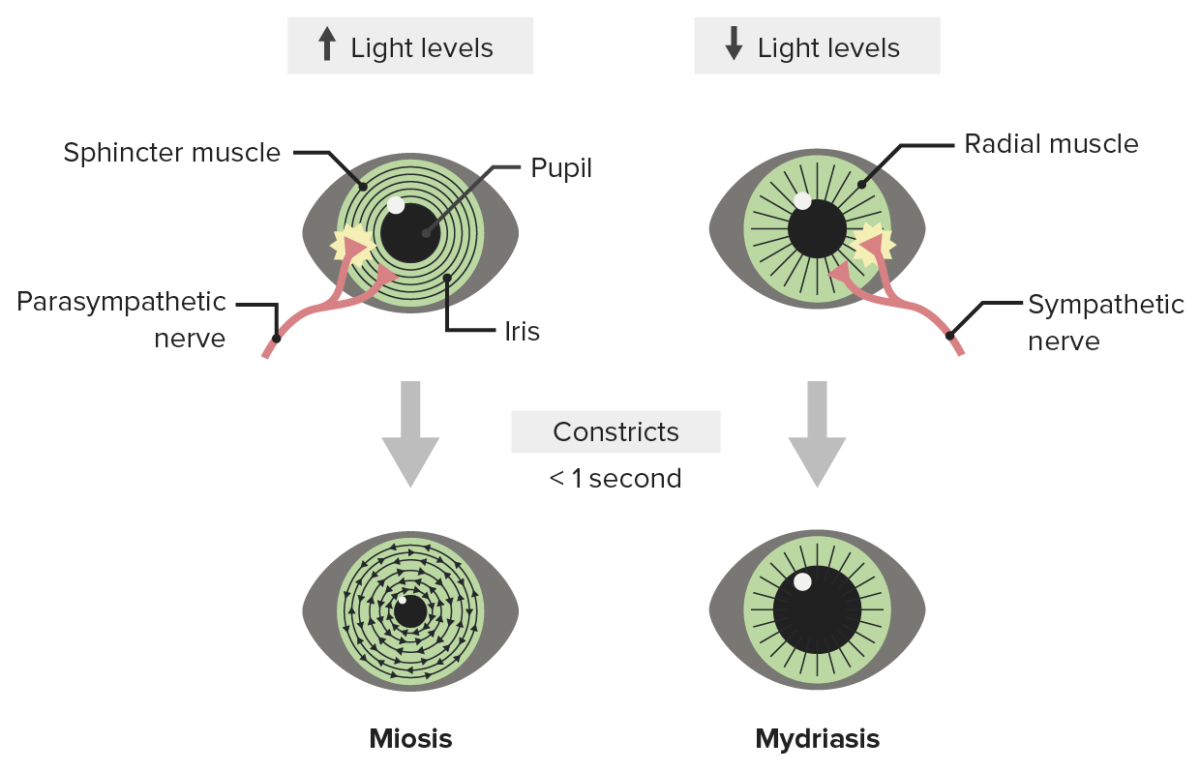
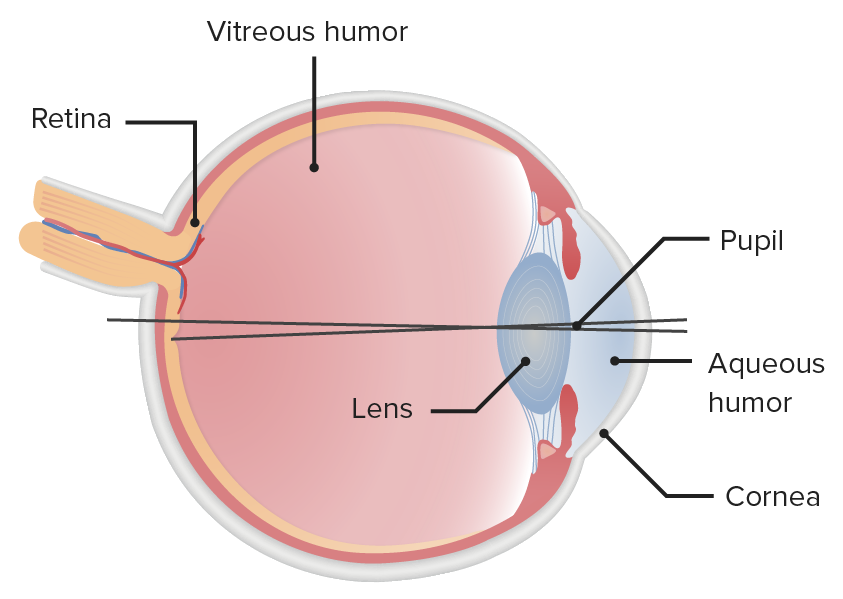
La pupila es el espacio dentro del ojo que permite que la luz se proyecte sobre la retina Retina The ten-layered nervous tissue membrane of the eye. It is continuous with the optic nerve and receives images of external objects and transmits visual impulses to the brain. Its outer surface is in contact with the choroid and the inner surface with the vitreous body. The outermost layer is pigmented, whereas the inner nine layers are transparent. Eye: Anatomy. Situada anatómicamente delante del cristalino, el tamaño de la pupila está controlado por el iris que la rodea. La pupila proporciona información sobre la función de los LOS Neisseria sistemas nerviosos central y autónomo. La vía aferente para la función visual parte de la retina Retina The ten-layered nervous tissue membrane of the eye. It is continuous with the optic nerve and receives images of external objects and transmits visual impulses to the brain. Its outer surface is in contact with the choroid and the inner surface with the vitreous body. The outermost layer is pigmented, whereas the inner nine layers are transparent. Eye: Anatomy y se desplaza por los LOS Neisseria tractos ópticos y los LOS Neisseria núcleos geniculados laterales, para terminar en EN Erythema nodosum is an immune-mediated panniculitis (inflammation of the subcutaneous fat) caused by a type IV (delayed-type) hypersensitivity reaction. It commonly manifests in young women as tender, erythematous nodules on the shins. Erythema Nodosum la corteza visual. El estímulo luminoso es conducido por el sistema parasimpático al AL Amyloidosis mesencéfalo, mientras que la reacción psicosensorial es procesada por el sistema simpático. Las vías eferentes producen la respuesta pertinente: miosis Miosis Pupil: Physiology and Abnormalities y midriasis Midriasis Pupil: Physiology and Abnormalities a partir de las inervaciones parasimpática y simpática, respectivamente. Los LOS Neisseria trastornos pupilares son el resultado de defectos en EN Erythema nodosum is an immune-mediated panniculitis (inflammation of the subcutaneous fat) caused by a type IV (delayed-type) hypersensitivity reaction. It commonly manifests in young women as tender, erythematous nodules on the shins. Erythema Nodosum áreas de las vías ópticas aferentes y eferentes. La presentación varía según el tamaño de la pupila en EN Erythema nodosum is an immune-mediated panniculitis (inflammation of the subcutaneous fat) caused by a type IV (delayed-type) hypersensitivity reaction. It commonly manifests in young women as tender, erythematous nodules on the shins. Erythema Nodosum conjunto con la respuesta a la luz y a los LOS Neisseria medicamentos.

Last updated: Dec 25, 2022
Editorial responsibility: Stanley Oiseth, Lindsay Jones, Evelin Maza

Descripción General

Pupila

  • Apertura en EN Erythema nodosum is an immune-mediated panniculitis (inflammation of the subcutaneous fat) caused by a type IV (delayed-type) hypersensitivity reaction. It commonly manifests in young women as tender, erythematous nodules on the shins. Erythema Nodosum el centro del iris
  • Espacio dentro del ojo que permite que la luz entre y estimule la retina Retina The ten-layered nervous tissue membrane of the eye. It is continuous with the optic nerve and receives images of external objects and transmits visual impulses to the brain. Its outer surface is in contact with the choroid and the inner surface with the vitreous body. The outermost layer is pigmented, whereas the inner nine layers are transparent. Eye: Anatomy

Estructuras adyacentes

  • Córnea:
    • Frente a la pupila
    • Estructura transparente que proporciona una refracción fija para enfocar la luz en EN Erythema nodosum is an immune-mediated panniculitis (inflammation of the subcutaneous fat) caused by a type IV (delayed-type) hypersensitivity reaction. It commonly manifests in young women as tender, erythematous nodules on the shins. Erythema Nodosum la retina Retina The ten-layered nervous tissue membrane of the eye. It is continuous with the optic nerve and receives images of external objects and transmits visual impulses to the brain. Its outer surface is in contact with the choroid and the inner surface with the vitreous body. The outermost layer is pigmented, whereas the inner nine layers are transparent. Eye: Anatomy
    • Sitio primario de refracción
  • Cristalino:
    • Detrás de la pupila
    • Estructura transparente que proporciona una refracción ajustable para enfocar la luz en EN Erythema nodosum is an immune-mediated panniculitis (inflammation of the subcutaneous fat) caused by a type IV (delayed-type) hypersensitivity reaction. It commonly manifests in young women as tender, erythematous nodules on the shins. Erythema Nodosum la retina Retina The ten-layered nervous tissue membrane of the eye. It is continuous with the optic nerve and receives images of external objects and transmits visual impulses to the brain. Its outer surface is in contact with the choroid and the inner surface with the vitreous body. The outermost layer is pigmented, whereas the inner nine layers are transparent. Eye: Anatomy
  • Iris:
    • Rodea la pupila
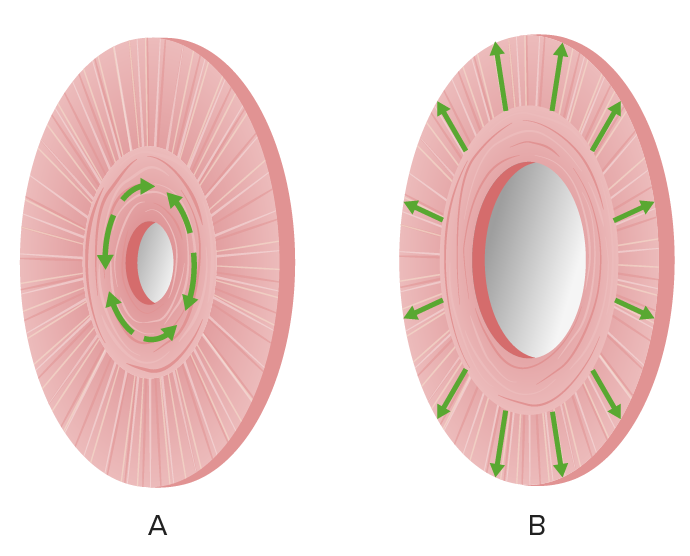
    • Porción coloreada del ojo, compuesta por músculo liso contráctil para controlar el tamaño de la pupila
    • Grupo muscular circular:
    • Grupo muscular radial:

Fisiología de la Pupila

Vía óptica

Vía aferente

De los LOS Neisseria estímulos a la corteza visual primaria:
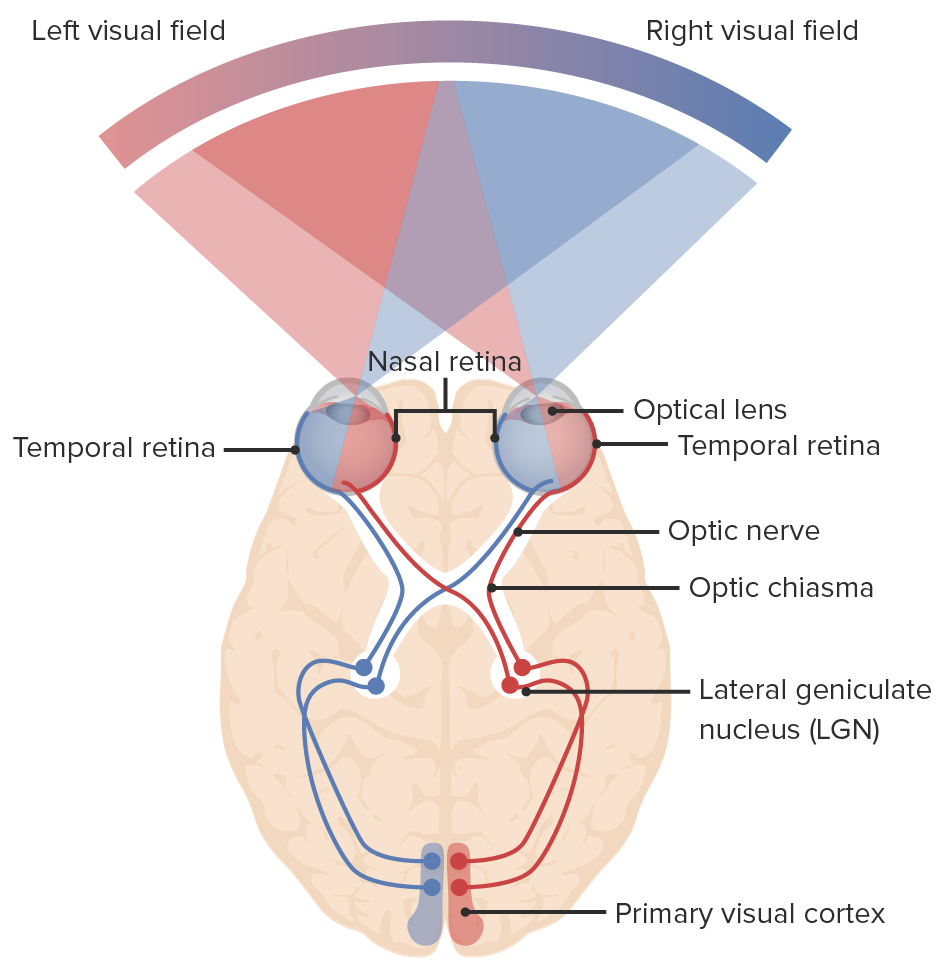
  • Retina Retina The ten-layered nervous tissue membrane of the eye. It is continuous with the optic nerve and receives images of external objects and transmits visual impulses to the brain. Its outer surface is in contact with the choroid and the inner surface with the vitreous body. The outermost layer is pigmented, whereas the inner nine layers are transparent. Eye: Anatomy
    • Fotorreceptores y células bipolares
    • La luz estimula los LOS Neisseria fotorreceptores de la retina Retina The ten-layered nervous tissue membrane of the eye. It is continuous with the optic nerve and receives images of external objects and transmits visual impulses to the brain. Its outer surface is in contact with the choroid and the inner surface with the vitreous body. The outermost layer is pigmented, whereas the inner nine layers are transparent. Eye: Anatomy → la señal va VA Ventilation: Mechanics of Breathing a las células bipolares y luego llega a las células ganglionares
  • Nervio óptico al AL Amyloidosis tracto óptico
    • Nervio óptico: Los LOS Neisseria axones de las células ganglionares convergen, formando el nervio óptico.
    • Quiasma óptico: donde se produce la hemidecusación de las fibras del nervio óptico
    • Tracto óptico:
      • Las fibras nasales del ojo izquierdo se decusan para unirse a las fibras temporales del ojo derecho → tracto óptico derecho
      • Las fibras nasales del ojo derecho se decusan para unirse a las fibras temporales del ojo izquierdo → tracto óptico izquierdo
  • Núcleo geniculado lateral: relevo sináptico en EN Erythema nodosum is an immune-mediated panniculitis (inflammation of the subcutaneous fat) caused by a type IV (delayed-type) hypersensitivity reaction. It commonly manifests in young women as tender, erythematous nodules on the shins. Erythema Nodosum el diencéfalo
    • La mayoría de las fibras pasan posteriormente → tractos geniculocalcarinos → terminan en EN Erythema nodosum is an immune-mediated panniculitis (inflammation of the subcutaneous fat) caused by a type IV (delayed-type) hypersensitivity reaction. It commonly manifests in young women as tender, erythematous nodules on the shins. Erythema Nodosum la corteza visual primaria
    • Una minoría de fibras pasa al AL Amyloidosis colículo superior y a los LOS Neisseria núcleos de Edinger-Westphal (para la inervación parasimpática de la pupila).
Sistema visual

Diagrama de la vía óptica y de los campos visuales: la luz entra en el ojo, enviando señales a la retina y a través del nervio óptico. Las fibras nasales de cada ojo se decusan en el quiasma óptico, continuando hacia el tracto óptico con las fibras temporales: las fibras nasales derechas se unen a las fibras temporales izquierdas (líneas azules) y las fibras nasales izquierdas se unen a las fibras temporales derechas (líneas rojas). Las neuronas hacen sinapsis en el núcleo geniculado lateral. Las radiaciones ópticas conectan el núcleo geniculado lateral con la corteza visual primaria del lóbulo occipital, donde se procesa la información visual.

Imagen por Lecturio.
Vía de inervación parasimpática (reflejo fotomotor)

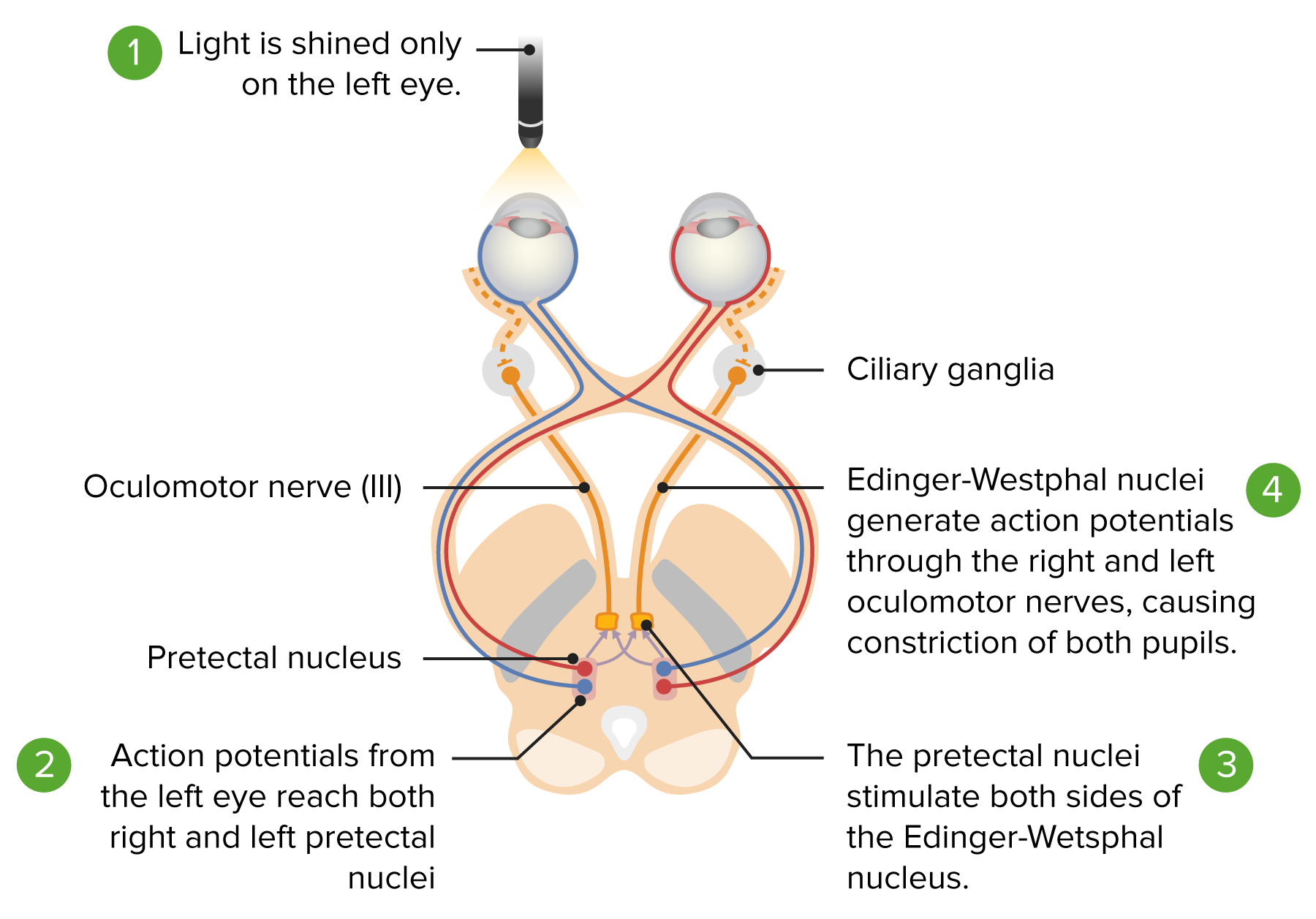
  • Estímulos luminosos → inicia la vía aferente desde la retina Retina The ten-layered nervous tissue membrane of the eye. It is continuous with the optic nerve and receives images of external objects and transmits visual impulses to the brain. Its outer surface is in contact with the choroid and the inner surface with the vitreous body. The outermost layer is pigmented, whereas the inner nine layers are transparent. Eye: Anatomy, con impulsos que van al AL Amyloidosis núcleo pretectal (a nivel del colículo superior)
  • Protección contra el aumento de la intensidad de la luz disminuyendo la cantidad de luz que entra en EN Erythema nodosum is an immune-mediated panniculitis (inflammation of the subcutaneous fat) caused by a type IV (delayed-type) hypersensitivity reaction. It commonly manifests in young women as tender, erythematous nodules on the shins. Erythema Nodosum el ojo
  • Parte de la respuesta de “descansar y digerir”
  • Vía eferente:
    • Neurona de 1er orden:
      • El núcleo pretectal se proyecta bilateralmente al AL Amyloidosis núcleo de Edinger-Westphal, donde comienza la rama eferente (parasimpática preganglionar) → fibras parasimpáticas del par PAR The PAR is the attributable risk for an entire population. It represents the fraction of cases that would not occur in a population if the exposure was eliminated. Measures of Risk craneal III → ganglio ciliar
    • Neurona de 2do orden:
      • Desde el ganglio ciliar (postganglionar) → fibras nerviosas ciliares cortas hacen sinapsis en EN Erythema nodosum is an immune-mediated panniculitis (inflammation of the subcutaneous fat) caused by a type IV (delayed-type) hypersensitivity reaction. It commonly manifests in young women as tender, erythematous nodules on the shins. Erythema Nodosum el esfínter pupilar → miosis Miosis Pupil: Physiology and Abnormalities
  • Reflejo luminoso consensual:
    • El núcleo pretectal inerva bilateralmente al AL Amyloidosis núcleo de Edinger-Westphal.
    • Aplicar una fuente luminosa en EN Erythema nodosum is an immune-mediated panniculitis (inflammation of the subcutaneous fat) caused by a type IV (delayed-type) hypersensitivity reaction. It commonly manifests in young women as tender, erythematous nodules on the shins. Erythema Nodosum 1 ojo → constricción bilateral de las pupilas ( miosis Miosis Pupil: Physiology and Abnormalities)
Vías del reflejo pupilar

Vía del reflejo fotomotor: de la estimulación lumínica de la retina al mesencéfalo. Vía aferente (líneas roja y azul): El estímulo luminoso izquierdo va de la retina izquierda al quiasma óptico y al tracto óptico, terminando en el núcleo pretectal ipsilateral. El núcleo pretectal inerva a los núcleos de Edinger-Westphal izquierdo y derecho. Las líneas amarillas muestran el impulso de ambos núcleos que llega a los dos ganglios ciliares y da lugar a la miosis bilateral.

Imagen por Lecturio.
Vía de inervación simpática

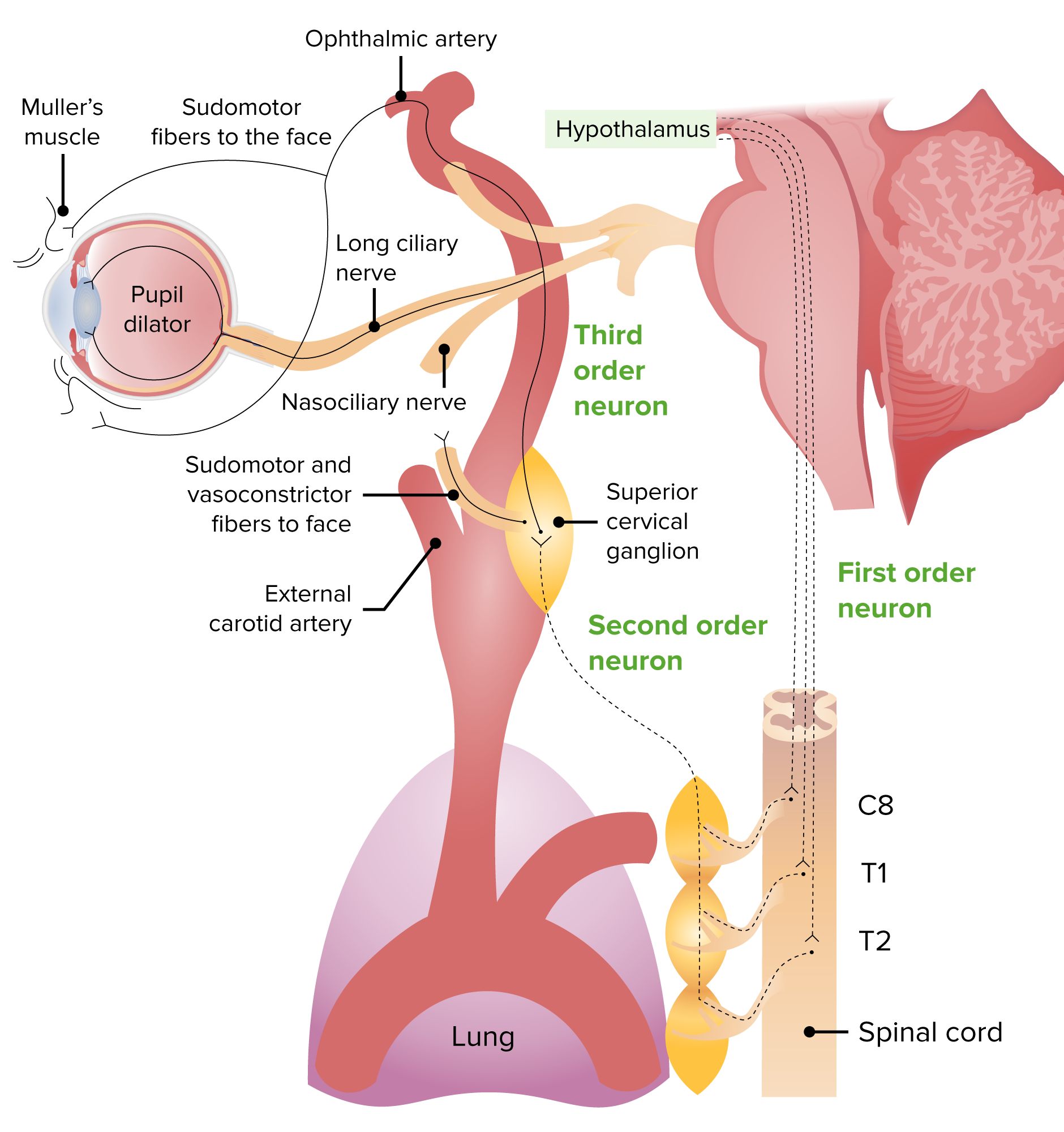
  • Estímulos psicosensoriales o físicos (oscuridad) → respuesta simpática, estimulando la retina Retina The ten-layered nervous tissue membrane of the eye. It is continuous with the optic nerve and receives images of external objects and transmits visual impulses to the brain. Its outer surface is in contact with the choroid and the inner surface with the vitreous body. The outermost layer is pigmented, whereas the inner nine layers are transparent. Eye: Anatomy y los LOS Neisseria tractos ópticos para enviar la señal al AL Amyloidosis hipotálamo
  • Parte de la respuesta de “lucha o huida”
  • Vía eferente:
    • Cadena de 3 neuronas que se origina en EN Erythema nodosum is an immune-mediated panniculitis (inflammation of the subcutaneous fat) caused by a type IV (delayed-type) hypersensitivity reaction. It commonly manifests in young women as tender, erythematous nodules on the shins. Erythema Nodosum el hipotálamo
    • De 1er orden (neurona central):
      • Neuronas del hipotálamo posterior → médula espinal en EN Erythema nodosum is an immune-mediated panniculitis (inflammation of the subcutaneous fat) caused by a type IV (delayed-type) hypersensitivity reaction. It commonly manifests in young women as tender, erythematous nodules on the shins. Erythema Nodosum C8–T2 (centro cilioespinal de Budge)
    • De 2do orden (neurona preganglionar):
      • Sale de la médula espinal → cadena simpática cervical (a través del plexo braquial, sobre el vértice pulmonar)
      • De la cadena simpática (dirigiéndose hacia arriba) → ganglio cervical superior
    • De 3er orden (neurona postganglionar):
      • Desde el ganglio cervical superior → la vía oculosimpática se une a la división oftálmica del nervio trigémino ( par PAR The PAR is the attributable risk for an entire population. It represents the fraction of cases that would not occur in a population if the exposure was eliminated. Measures of Risk craneal V)
      • Las fibras oculosimpáticas hacen sinapsis en EN Erythema nodosum is an immune-mediated panniculitis (inflammation of the subcutaneous fat) caused by a type IV (delayed-type) hypersensitivity reaction. It commonly manifests in young women as tender, erythematous nodules on the shins. Erythema Nodosum el músculo dilatador de la pupila ( midriasis Midriasis Pupil: Physiology and Abnormalities) y en EN Erythema nodosum is an immune-mediated panniculitis (inflammation of the subcutaneous fat) caused by a type IV (delayed-type) hypersensitivity reaction. It commonly manifests in young women as tender, erythematous nodules on the shins. Erythema Nodosum el músculo tarsal superior/músculo de Müller (elevación del párpado superior).
Vía de inervación simpática

Imagen de la vía de inervación simpática:
Neurona de 1er orden: parte del hipotálamo hacia el centro de Budge (médula espinal C8–T2)
Neurona de 2do orden: sale de la médula espinal dirigiéndose hacia el ganglio cervical superior
Neurona de 3er orden: se une al nervio trigémino y a las fibras oculosimpáticas, hace sinapsis en el músculo dilatador de la pupila y en el músculo de Müller, provocando midriasis y apertura de los párpados.

Imagen por Lecturio.

Reflejo de acomodación

Consta de 3 respuestas:

  • Convergencia
    • Movimiento ocular medial para seguir el objeto
    • El núcleo oculomotor estimula la contracción bilateral de los LOS Neisseria músculos rectos mediales.
  • Contracción de los LOS Neisseria músculos ciliares
    • Alteración de la forma del cristalino para mantener el enfoque en EN Erythema nodosum is an immune-mediated panniculitis (inflammation of the subcutaneous fat) caused by a type IV (delayed-type) hypersensitivity reaction. It commonly manifests in young women as tender, erythematous nodules on the shins. Erythema Nodosum la retina Retina The ten-layered nervous tissue membrane of the eye. It is continuous with the optic nerve and receives images of external objects and transmits visual impulses to the brain. Its outer surface is in contact with the choroid and the inner surface with the vitreous body. The outermost layer is pigmented, whereas the inner nine layers are transparent. Eye: Anatomy
    • Inicialmente, los LOS Neisseria músculos ciliares están relajados, con los LOS Neisseria ojos enfocados en EN Erythema nodosum is an immune-mediated panniculitis (inflammation of the subcutaneous fat) caused by a type IV (delayed-type) hypersensitivity reaction. It commonly manifests in young women as tender, erythematous nodules on the shins. Erythema Nodosum objetos lejanos.
    • Con los LOS Neisseria objetos cercanos, la vía parasimpática estimula los LOS Neisseria músculos ciliares → engrosamiento del cristalino → ↑ poder de refracción (acomodación del cristalino)
  • Constricción de las pupilas
    • Ajuste de la luz para enfocar objetos cercanos
    • La vía parasimpática estimula el esfínter pupilar

Examen de la Pupila

Respuesta a la luz y a la cercanía

  • Examen con luz tenue
    • Respuesta directa: La pupila se contrae con la iluminación directa.
    • Respuesta consensual: constricción al AL Amyloidosis iluminar el ojo contralateral
    • Sin luz o en EN Erythema nodosum is an immune-mediated panniculitis (inflammation of the subcutaneous fat) caused by a type IV (delayed-type) hypersensitivity reaction. It commonly manifests in young women as tender, erythematous nodules on the shins. Erythema Nodosum la oscuridad: Las pupilas se dilatan.
    • Respuesta anormal: La pupila no se dilata ante la oscuridad o no se contrae ante la luz u objetos cercanos (reflejo de acomodación).
  • Observe la velocidad de respuesta:
    • 4 +: respuesta rápida
    • 3 +: respuesta moderada
    • 2 +: respuesta pequeña y lenta
    • 1 +: representa una respuesta mínima/apenas visible
    • 0: indica que las pupilas no responden

Tamaño de las pupilas

  • Normal: 2–4 mm (luz), 4–8 mm (oscuridad)
  • Isocoria: Pupilas del mismo tamaño
  • Anisocoria Anisocoria Unequal pupil size, which may represent a benign physiologic variant or a manifestation of disease. Pathologic anisocoria reflects an abnormality in the musculature of the iris (iris diseases) or in the parasympathetic or sympathetic pathways that innervate the pupil. Physiologic anisocoria refers to an asymmetry of pupil diameter, usually less than 2mm, that is not associated with disease. Pupil: Physiology and Abnormalities: Pupilas de diferente tamaño

Prueba de luz alternante

  • En EN Erythema nodosum is an immune-mediated panniculitis (inflammation of the subcutaneous fat) caused by a type IV (delayed-type) hypersensitivity reaction. It commonly manifests in young women as tender, erythematous nodules on the shins. Erythema Nodosum una habitación oscura, el paciente se fija en EN Erythema nodosum is an immune-mediated panniculitis (inflammation of the subcutaneous fat) caused by a type IV (delayed-type) hypersensitivity reaction. It commonly manifests in young women as tender, erythematous nodules on the shins. Erythema Nodosum un objeto lejano.
  • Con la fuente de luz por debajo de la línea de visión, confirmar que las pupilas son isocóricas.
  • Cambia la iluminación después de 3 segundos de un ojo a otro.
  • Respuesta normal:
    • Iluminación en EN Erythema nodosum is an immune-mediated panniculitis (inflammation of the subcutaneous fat) caused by a type IV (delayed-type) hypersensitivity reaction. It commonly manifests in young women as tender, erythematous nodules on the shins. Erythema Nodosum 1 ojo → constricción bilateral igual.
    • Durante la transferencia, se produce dilatación.
    • Alternar la luz hacia el otro ojo → constricción bilateral similar e igual.
    • Se espera en EN Erythema nodosum is an immune-mediated panniculitis (inflammation of the subcutaneous fat) caused by a type IV (delayed-type) hypersensitivity reaction. It commonly manifests in young women as tender, erythematous nodules on the shins. Erythema Nodosum una retina Retina The ten-layered nervous tissue membrane of the eye. It is continuous with the optic nerve and receives images of external objects and transmits visual impulses to the brain. Its outer surface is in contact with the choroid and the inner surface with the vitreous body. The outermost layer is pigmented, whereas the inner nine layers are transparent. Eye: Anatomy y/o nervio óptico intactos

Examen con lámpara de hendidura

  • Examina la superficie del iris y el margen pupilar
  • Pueden observarse irregularidades, lesiones elevadas y anomalías de pigmentación.

Pruebas farmacológicas

  • Agentes farmacológicos (cocaína tópica, apraclonidina, pilocarpina o hidroxianfetamina) utilizados para comprobar la reactividad pupilar
  • Evaluación del síndrome de Horner, de la pupila tónica o de la midriasis Midriasis Pupil: Physiology and Abnormalities farmacológica

Trastornos de la Vía Aferente

Defecto pupilar aferente relativo

  • También llamado pupila de Marcus Gunn
  • Fisiopatología: causada por una enfermedad unilateral o asimétrica del nervio óptico o de la retina Retina The ten-layered nervous tissue membrane of the eye. It is continuous with the optic nerve and receives images of external objects and transmits visual impulses to the brain. Its outer surface is in contact with the choroid and the inner surface with the vitreous body. The outermost layer is pigmented, whereas the inner nine layers are transparent. Eye: Anatomy
  • Presentación:
    • Reflejo pupilar directo alterado en EN Erythema nodosum is an immune-mediated panniculitis (inflammation of the subcutaneous fat) caused by a type IV (delayed-type) hypersensitivity reaction. It commonly manifests in young women as tender, erythematous nodules on the shins. Erythema Nodosum el ojo afectado y reflejo pupilar indirecto alterado en EN Erythema nodosum is an immune-mediated panniculitis (inflammation of the subcutaneous fat) caused by a type IV (delayed-type) hypersensitivity reaction. It commonly manifests in young women as tender, erythematous nodules on the shins. Erythema Nodosum el ojo normal
  • Prueba de luz alternante:
    • Respuesta anormal: dilatación paradójica o constricción débil cuando la luz incide en EN Erythema nodosum is an immune-mediated panniculitis (inflammation of the subcutaneous fat) caused by a type IV (delayed-type) hypersensitivity reaction. It commonly manifests in young women as tender, erythematous nodules on the shins. Erythema Nodosum el ojo afectado (pupila de Marcus Gunn)
  • Condiciones asociadas:
    • Neuritis óptica
    • Neuropatía óptica traumática
    • Enfermedad óptica isquémica o enfermedades isquémicas de la retina Retina The ten-layered nervous tissue membrane of the eye. It is continuous with the optic nerve and receives images of external objects and transmits visual impulses to the brain. Its outer surface is in contact with the choroid and the inner surface with the vitreous body. The outermost layer is pigmented, whereas the inner nine layers are transparent. Eye: Anatomy
    • Glaucoma Glaucoma Glaucoma is an optic neuropathy characterized by typical visual field defects and optic nerve atrophy seen as optic disc cupping on examination. The acute form of glaucoma is a medical emergency. Glaucoma is often, but not always, caused by increased intraocular pressure (IOP). Glaucoma que provoca daños en EN Erythema nodosum is an immune-mediated panniculitis (inflammation of the subcutaneous fat) caused by a type IV (delayed-type) hypersensitivity reaction. It commonly manifests in young women as tender, erythematous nodules on the shins. Erythema Nodosum el nervio óptico
    • Desprendimiento de retina Retina The ten-layered nervous tissue membrane of the eye. It is continuous with the optic nerve and receives images of external objects and transmits visual impulses to the brain. Its outer surface is in contact with the choroid and the inner surface with the vitreous body. The outermost layer is pigmented, whereas the inner nine layers are transparent. Eye: Anatomy
    • Degeneración macular severa
    • Retinitis (citomegalovirus (CMV), herpes)
    • Tumores del nervio óptico
    • Otras neuropatías ópticas

Anisocoria

Anisocoria Anisocoria Unequal pupil size, which may represent a benign physiologic variant or a manifestation of disease. Pathologic anisocoria reflects an abnormality in the musculature of the iris (iris diseases) or in the parasympathetic or sympathetic pathways that innervate the pupil. Physiologic anisocoria refers to an asymmetry of pupil diameter, usually less than 2mm, that is not associated with disease. Pupil: Physiology and Abnormalities fisiológica

  • La diferencia entre el tamaño de la pupila sigue siendo la misma independientemente de la iluminación.
  • Afecta al AL Amyloidosis 20% de los LOS Neisseria individuos normales
  • Diferencia de tamaño: normalmente < 1 mm
  • No hay daños en EN Erythema nodosum is an immune-mediated panniculitis (inflammation of the subcutaneous fat) caused by a type IV (delayed-type) hypersensitivity reaction. It commonly manifests in young women as tender, erythematous nodules on the shins. Erythema Nodosum la inervación del esfínter ni el dilatador pupilar
  • Reacciones pupilares normales a la luz y a la oscuridad
  • La revisión de fotografías antiguas o de la licencia de conducir ayuda al AL Amyloidosis diagnóstico.

Anisocoria Anisocoria Unequal pupil size, which may represent a benign physiologic variant or a manifestation of disease. Pathologic anisocoria reflects an abnormality in the musculature of the iris (iris diseases) or in the parasympathetic or sympathetic pathways that innervate the pupil. Physiologic anisocoria refers to an asymmetry of pupil diameter, usually less than 2mm, that is not associated with disease. Pupil: Physiology and Abnormalities patológica

  • Fisiopatología:
    • Defecto neuronal de las vías eferentes pupilomotoras que inervan los LOS Neisseria músculos del iris en EN Erythema nodosum is an immune-mediated panniculitis (inflammation of the subcutaneous fat) caused by a type IV (delayed-type) hypersensitivity reaction. It commonly manifests in young women as tender, erythematous nodules on the shins. Erythema Nodosum 1 o ambos ojos
    • Defecto estructural de 1 o ambos iris
  • Presentación:
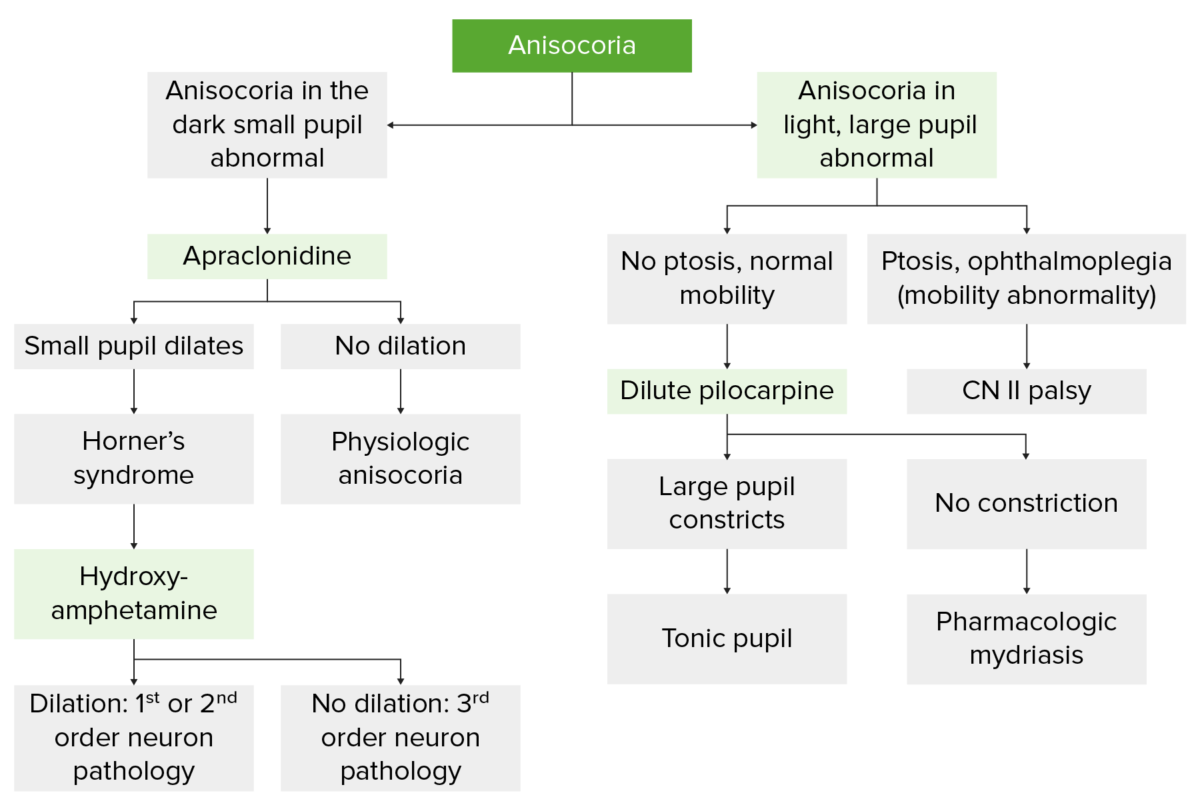
    • Pupila patológicamente pequeña: en EN Erythema nodosum is an immune-mediated panniculitis (inflammation of the subcutaneous fat) caused by a type IV (delayed-type) hypersensitivity reaction. It commonly manifests in young women as tender, erythematous nodules on the shins. Erythema Nodosum la oscuridad, suele permanecer pequeña mientras que la pupila normal se dilata
    • Pupila patológicamente grande: con luz brillante, permanece grande mientras que la pupila normal se contrae
    • Diferencia generalmente > 1 mm
  • Condiciones asociadas:
    • Síndrome de Horner
    • Parálisis del par PAR The PAR is the attributable risk for an entire population. It represents the fraction of cases that would not occur in a population if the exposure was eliminated. Measures of Risk craneal III con afectación pupilar
    • Pupila tónica de Adie
    • Uveítis anterior
    • Glaucoma Glaucoma Glaucoma is an optic neuropathy characterized by typical visual field defects and optic nerve atrophy seen as optic disc cupping on examination. The acute form of glaucoma is a medical emergency. Glaucoma is often, but not always, caused by increased intraocular pressure (IOP). Glaucoma de ángulo cerrado agudo
    • Traumatismo o cirugía
    • Defectos congénitos ( coloboma Coloboma Congenital anomaly in which some of the structures of the eye are absent due to incomplete fusion of the fetal intraocular fissure during gestation. Esophageal Atresia and Tracheoesophageal Fistula o heterocromía iridiana)
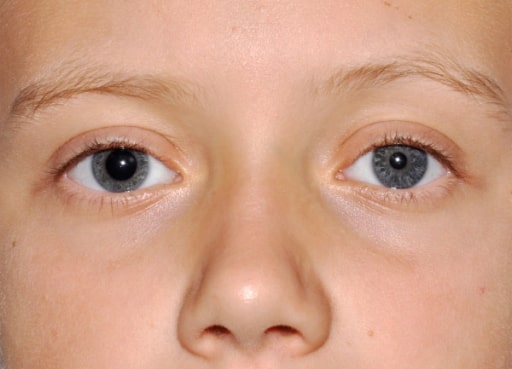
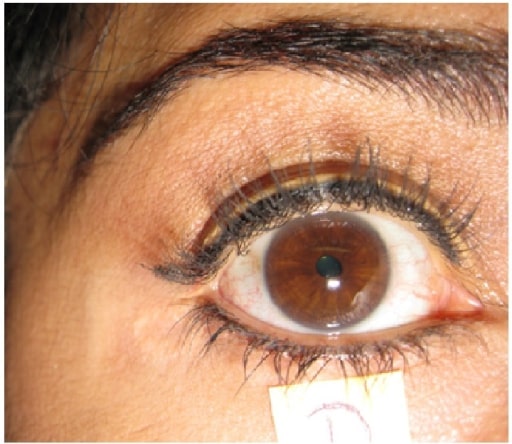
Evidente midriasis derecha

Anisocoria con midriasis derecha

Imagen: “Evident right mydriasis” por U,O,C Pediatria Generale Dipartimento di Medicina Pediatrica, Ospedale Pediatrico Bambino Gesù, Piazza Sant’Onofrio 4, 00165 Roma, Italy. Licencia: CC BY 2.0
Trastornos de la Vía Eferente

Pupila tónica de Adie

  • Pupila grande, reacción a la luz alterada
  • Presentación:
    • Midriasis Midriasis Pupil: Physiology and Abnormalities tónica, generalmente unilateral
    • Tiene disociación luz-cerca
      • Hay nula o pobre constricción con la iluminación
      • Reflejo de acomodación positivo (constricción), pero redilatación lenta
    • Más frecuente en EN Erythema nodosum is an immune-mediated panniculitis (inflammation of the subcutaneous fat) caused by a type IV (delayed-type) hypersensitivity reaction. It commonly manifests in young women as tender, erythematous nodules on the shins. Erythema Nodosum mujeres de 30–40 años
    • Síndrome de Holmes-Adie: pérdida de los LOS Neisseria reflejos tendinosos profundos
  • Fisiopatología: degeneración del ganglio ciliar y denervación parasimpática postganglionar de la pupila afectada
  • Condiciones asociadas:
    • Idiopática (mayoría de los LOS Neisseria casos)
    • Infección (viral o bacteriana)
    • Traumatismo o cirugía
    • Tumores
    • Síndrome de Ross: pupila tónica, hiporreflexia, alteraciones sudomotoras
  • Prueba de pilocarpina:
    • Pupila tónica:
      • Tiene hipersensibilidad colinérgica
      • Se contrae; respuesta miótica más intensa que la pupila normal
Pupila derecha tónica

Pupila derecha tónica: no responde a la estimulación lumínica

Imagen: “Holmes-Adie’s Syndrome” por US National Library of Medicine. Licencia: CC BY 4.0
Pupila de Argyll Robertson

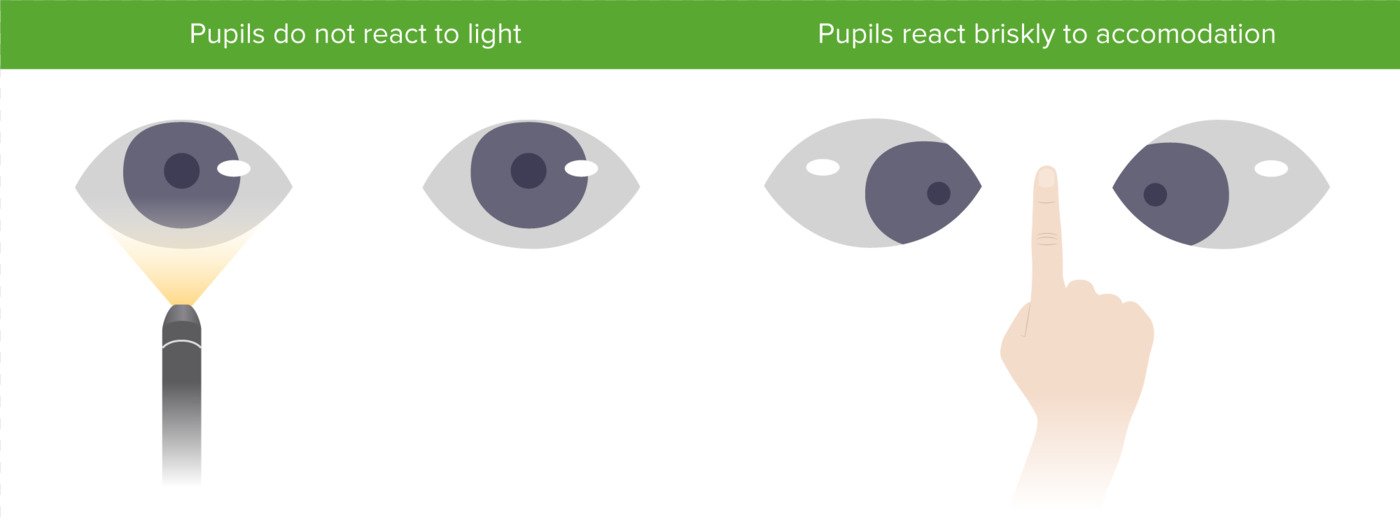
  • Pupilas bilaterales pequeñas, reacción a la luz alterada
  • Presentación:
    • Siempre bilateral, puede ser asimétrica
    • Disociación luz-cerca:
      • Las pupilas no se contraen a la iluminación
      • Contracción positiva a la acomodación
  • Fisiopatología: resultado de una lesión dorsal del mesencéfalo (daña las fibras nerviosas que controlan el reflejo pupilar, pero no afecta a las fibras nerviosas más ventrales que controlan el reflejo de acomodación)
  • Asociado a sífilis tardía:
    • Otros síntomas: ataxia Ataxia Impairment of the ability to perform smoothly coordinated voluntary movements. This condition may affect the limbs, trunk, eyes, pharynx, larynx, and other structures. Ataxia may result from impaired sensory or motor function. Sensory ataxia may result from posterior column injury or peripheral nerve diseases. Motor ataxia may be associated with cerebellar diseases; cerebral cortex diseases; thalamic diseases; basal ganglia diseases; injury to the red nucleus; and other conditions. Ataxia-telangiectasia sensorial y dolores lancinantes en EN Erythema nodosum is an immune-mediated panniculitis (inflammation of the subcutaneous fat) caused by a type IV (delayed-type) hypersensitivity reaction. It commonly manifests in young women as tender, erythematous nodules on the shins. Erythema Nodosum la tabes dorsal
    • Tratamiento: régimen de penicilina para neurosífilis
Pupila de Argyll Robertson

Pupila de Argyll Robertson con miosis bilateral que no se contrae a la luz, pero sí a la acomodación

Imagen por Lecturio.
Síndrome de Horner

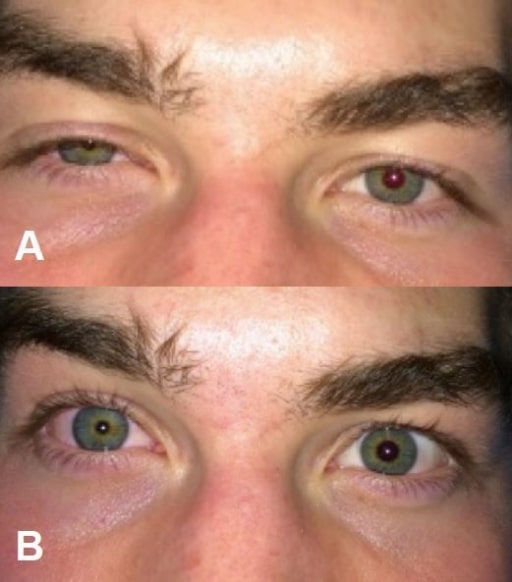
  • Pupila pequeña, reacción normal a la luz
  • Anisocoria Anisocoria Unequal pupil size, which may represent a benign physiologic variant or a manifestation of disease. Pathologic anisocoria reflects an abnormality in the musculature of the iris (iris diseases) or in the parasympathetic or sympathetic pathways that innervate the pupil. Physiologic anisocoria refers to an asymmetry of pupil diameter, usually less than 2mm, that is not associated with disease. Pupil: Physiology and Abnormalities más notoria en EN Erythema nodosum is an immune-mediated panniculitis (inflammation of the subcutaneous fat) caused by a type IV (delayed-type) hypersensitivity reaction. It commonly manifests in young women as tender, erythematous nodules on the shins. Erythema Nodosum la oscuridad (pupila anormal con retraso en EN Erythema nodosum is an immune-mediated panniculitis (inflammation of the subcutaneous fat) caused by a type IV (delayed-type) hypersensitivity reaction. It commonly manifests in young women as tender, erythematous nodules on the shins. Erythema Nodosum la dilatación)
  • Presentación:
  • Fisiopatología: resulta de la interrupción de la cadena simpática
  • Condiciones asociadas:
    • Neurona de 1er orden: síndrome medular lateral (síndrome de Wallenberg) o tumores o accidentes cerebrovasculares que afectan al AL Amyloidosis tracto simpático de primer orden
    • Neurona de 2do orden: traumatismos o tumores en EN Erythema nodosum is an immune-mediated panniculitis (inflammation of the subcutaneous fat) caused by a type IV (delayed-type) hypersensitivity reaction. It commonly manifests in young women as tender, erythematous nodules on the shins. Erythema Nodosum la médula espinal, en EN Erythema nodosum is an immune-mediated panniculitis (inflammation of the subcutaneous fat) caused by a type IV (delayed-type) hypersensitivity reaction. It commonly manifests in young women as tender, erythematous nodules on the shins. Erythema Nodosum la salida torácica o en EN Erythema nodosum is an immune-mediated panniculitis (inflammation of the subcutaneous fat) caused by a type IV (delayed-type) hypersensitivity reaction. It commonly manifests in young women as tender, erythematous nodules on the shins. Erythema Nodosum el vértice pulmonar ( tumor Tumor Inflammation de Pancoast)
    • Neurona de 3er orden: disección carotídea, trombosis, aneurisma del seno cavernoso
  • Pruebas farmacológicas:
    • Solución de cocaína:
      • Bloquea la recaptación de norepinefrina y dilata el ojo con inervación simpática intacta
      • Síndrome de Horner: poca o ninguna dilatación (alteración de la inervación simpática)
    • Apraclonidina (solución 0,5%–1%):
      • Un agonista alfa-1 débil y un agonista alfa-2 fuerte
      • Síndrome de Horner (hipersensibilidad dominante al AL Amyloidosis receptor Receptor Receptors are proteins located either on the surface of or within a cell that can bind to signaling molecules known as ligands (e.g., hormones) and cause some type of response within the cell. Receptors alfa-1): La pupila afectada se dilata.
    • Localización con hidroxianfetamina tópica:
      • La hidroxianfetamina libera norepinefrina de las fibras postganglionares intactas (esta prueba ayuda a localizar la lesión).
      • Síndrome de Horner con fibras postganglionares intactas: dilatación de la pupila afectada ≥ pupila normal
      • Síndrome de Horner con fibras postganglionares dañadas: no hay dilatación de la pupila

Farmacología y Efectos Pupilares

Table: Efectos pupilares de medicamentos
Medicamento Midriasis Midriasis Pupil: Physiology and Abnormalities Miosis Miosis Pupil: Physiology and Abnormalities
Medicamentos oftálmicos
  • Anticolinérgico
    • Atropina
    • Ciclopentolato
  • Midriático
    • Tropicamida
  • Agonista alfa-adrenérgico
    • Fenilefrina
    • Clonidina
    • Apraclonidina
  • Miótico/antiglaucoma
    • Pilocarpina
    • Carbacol
  • Anticolinesterasa
    • Fisostigmina
Drogas ilícitas
  • Cocaína
  • Anfetamina
  • Dietilamida de ácido lisérgico (LSD, por sus siglas en EN Erythema nodosum is an immune-mediated panniculitis (inflammation of the subcutaneous fat) caused by a type IV (delayed-type) hypersensitivity reaction. It commonly manifests in young women as tender, erythematous nodules on the shins. Erythema Nodosum inglés)
Heroína
Otros medicamentos
  • Antihistamínicos
    • Difenhidramina
  • Anticolinérgicos
    • Ipratropio
    • Escopolamina
  • Antidepresivos tricíclicos
    • Desipramina
  • Antiparkinsonianos
    • Carbidopa-levodopa
Opioides
  • Morfina
  • Codeína
  • Hidrocodona
Hierbas Estramonio (con propiedades anticolinérgicas)

Diagnóstico Diferencial

  • Glaucoma Glaucoma Glaucoma is an optic neuropathy characterized by typical visual field defects and optic nerve atrophy seen as optic disc cupping on examination. The acute form of glaucoma is a medical emergency. Glaucoma is often, but not always, caused by increased intraocular pressure (IOP). Glaucoma: una neuropatía óptica con cambios distintivos en EN Erythema nodosum is an immune-mediated panniculitis (inflammation of the subcutaneous fat) caused by a type IV (delayed-type) hypersensitivity reaction. It commonly manifests in young women as tender, erythematous nodules on the shins. Erythema Nodosum la copa óptica y defecto del campo visual. El glaucoma Glaucoma Glaucoma is an optic neuropathy characterized by typical visual field defects and optic nerve atrophy seen as optic disc cupping on examination. The acute form of glaucoma is a medical emergency. Glaucoma is often, but not always, caused by increased intraocular pressure (IOP). Glaucoma suele estar asociado a un aumento de la presión en EN Erythema nodosum is an immune-mediated panniculitis (inflammation of the subcutaneous fat) caused by a type IV (delayed-type) hypersensitivity reaction. It commonly manifests in young women as tender, erythematous nodules on the shins. Erythema Nodosum el interior del globo ocular (normalmente en EN Erythema nodosum is an immune-mediated panniculitis (inflammation of the subcutaneous fat) caused by a type IV (delayed-type) hypersensitivity reaction. It commonly manifests in young women as tender, erythematous nodules on the shins. Erythema Nodosum las cámaras anterior y posterior), lo que provoca una pérdida gradual de la visión. Esto puede ocurrir de forma aguda debido a una obstrucción del drenaje del humor Humor Defense Mechanisms acuoso ( glaucoma Glaucoma Glaucoma is an optic neuropathy characterized by typical visual field defects and optic nerve atrophy seen as optic disc cupping on examination. The acute form of glaucoma is a medical emergency. Glaucoma is often, but not always, caused by increased intraocular pressure (IOP). Glaucoma agudo de ángulo cerrado) y se presenta como una pupila de dilatación media. El diagnóstico es fundamental, ya que el glaucoma Glaucoma Glaucoma is an optic neuropathy characterized by typical visual field defects and optic nerve atrophy seen as optic disc cupping on examination. The acute form of glaucoma is a medical emergency. Glaucoma is often, but not always, caused by increased intraocular pressure (IOP). Glaucoma de ángulo cerrado agudo es una emergencia. La gonioscopia se utiliza para visualizar el ángulo. El tratamiento de elección es la iridotomía periférica.
  • Esclerosis múltiple: una enfermedad desmielinizante inflamatoria crónica del sistema nervioso central. La esclerosis múltiple provoca una neuropatía óptica desmielinizante aguda. Los LOS Neisseria pacientes refieren pérdida de visión aguda o subaguda con dolor Dolor Inflammation a la movilización ocular. La detección de un defecto pupilar aferente relativo sugiere una neuropatía óptica. La oftalmoplejia internuclear también puede ser consecuencia de la esclerosis múltiple, y se manifiesta como diplopía, nistagmo y pérdida de la percepción de la profundidad. La resonancia magnética ayuda a detectar las placas desmielinizantes en EN Erythema nodosum is an immune-mediated panniculitis (inflammation of the subcutaneous fat) caused by a type IV (delayed-type) hypersensitivity reaction. It commonly manifests in young women as tender, erythematous nodules on the shins. Erythema Nodosum el sistema nervioso afectado. El tratamiento consiste en EN Erythema nodosum is an immune-mediated panniculitis (inflammation of the subcutaneous fat) caused by a type IV (delayed-type) hypersensitivity reaction. It commonly manifests in young women as tender, erythematous nodules on the shins. Erythema Nodosum la inmunomodulación y el alivio sintomático.
  • Parálisis del 3er par PAR The PAR is the attributable risk for an entire population. It represents the fraction of cases that would not occur in a population if the exposure was eliminated. Measures of Risk craneal: déficit neurológico caracterizado por una pupila grande, de reacción lenta a no reactiva, ptosis Ptosis Cranial Nerve Palsies y parálisis del movimiento ocular (aducción, elevación y depresión) resultante de lesiones a lo largo de su recorrido desde el núcleo oculomotor en EN Erythema nodosum is an immune-mediated panniculitis (inflammation of the subcutaneous fat) caused by a type IV (delayed-type) hypersensitivity reaction. It commonly manifests in young women as tender, erythematous nodules on the shins. Erythema Nodosum el mesencéfalo hasta la órbita. Las causas incluyen aneurisma, isquemia y traumatismo. La resonancia magnética con angiografía ayuda a evaluar la etiología. El tratamiento se dirige a la condición subyacente que causa la parálisis.
  • Desprendimiento de retina: Separación de la retina del epitelio pigmentario de la retina que provoca un rápido daño de los fotorreceptores. Los síntomas incluyen cambios indoloros en la visión, como destellos repentinos de luz, miodesopsias, empeoramiento de la visión periférica o presencia de una sombra en el campo visual. La visión se describe como una “cortina”. La afectación macular se presentaría como un rápido defecto pupilar aferente debido a la degeneración de los LOS Neisseria fotorreceptores causada por el desprendimiento. La pérdida visual aguda por desprendimiento de retina Retina The ten-layered nervous tissue membrane of the eye. It is continuous with the optic nerve and receives images of external objects and transmits visual impulses to the brain. Its outer surface is in contact with the choroid and the inner surface with the vitreous body. The outermost layer is pigmented, whereas the inner nine layers are transparent. Eye: Anatomy es una emergencia que requiere cirugía correctiva.
  • Pupila de Hutchinson: pupila dilatada que se produce debido a la compresión del 3er nervio craneal ipsilateral derivada de un traumatismo, un tumor Tumor Inflammation o un aneurisma. La irritación del nervio provoca inicialmente una constricción pupilar del ojo afectado. Al AL Amyloidosis comprimir mecánicamente el nervio, se paralizan las fibras nerviosas parasimpáticas localizadas superficialmente en EN Erythema nodosum is an immune-mediated panniculitis (inflammation of the subcutaneous fat) caused by a type IV (delayed-type) hypersensitivity reaction. It commonly manifests in young women as tender, erythematous nodules on the shins. Erythema Nodosum el nervio oculomotor, por lo que entonces se produce una midriasis Midriasis Pupil: Physiology and Abnormalities aislada. Un mayor aumento de la presión intracraneal provoca una dilatación pupilar bilateral. Esta dilatación está asociada a una hernia Hernia Protrusion of tissue, structure, or part of an organ through the bone, muscular tissue, or the membrane by which it is normally contained. Hernia may involve tissues such as the abdominal wall or the respiratory diaphragm. Hernias may be internal, external, congenital, or acquired. Abdominal Hernias uncal. Es necesaria la imagenología encefálica para determinar la etiología.

Referencias

  1. Belliveau, A., Somani, A., Dossani R. (2023) Pupillary light reflex. StatPearls. Retrieved on August 3, 2025, from https://www.ncbi.nlm.nih.gov/books/NBK537180/#_NBK537180_pubdet
  2. Cohen, A., Pless, M. (2007). Neuro-ophthalmology: Disorders of the Efferent Visual Pathway. Hospital Physician. Hospital Physician Neurology Board Review Manual. Turner-White, PA.
  3. Dichter, S., Shubert, G. (2024). Argyll Robertson Pupil. StatPearls. Retrieved on August 3, 2025, from https://www.ncbi.nlm.nih.gov/books/NBK537179/
  4. Gupta, M., Bordoni, B. (2022). Neuroanatomy, Visual Pathway. StatPearls. Retrieved on August 3, 2025, from https://www.statpearls.com/articlelibrary/viewarticle/31204/
  5. Kawasaki, A. (2005). Disorders of Pupillary Function, Accommodation and Lacrimation in Walsh in Miller, N., Walsh, F., Hoyt, W. Walsh and Hoyt’s Clinical Neuro-ophthalmology (6th ed., pp. 739-805). Lippincott Williams & Wilkins.
  6. Kedar, S., Biousse, V., Newman, N. (2024). Horner Syndrome. UpToDate. Retrieved on August 3, 2025, from https://www.uptodate.com/contents/horner-syndrome
  7. LaRoche, M. (2017). Anisocoria and an Array of Neurologic Symptoms in an Adult with Ewing Sarcoma. Journal of the Advanced Practitioner in Oncology 8 (1). https://www.researchgate.net/publication/313146824_Anisocoria_and_an_Array_of_Neurologic_Symptoms_in_an_Adult_With_Ewing_Sarcoma
  8. Motlagh, M., Geetha, R. (2022). Physiology, Accommodation. StatPearls. Retrieved on August 3, 2025, from https://www.ncbi.nlm.nih.gov/books/NBK542189/
  9. Somani, A., Kini, A. Lee, A. Othman, B., Zenden,J., Ponce, C. (2024) Reflexes and the Eye. https://eyewiki.org/Reflexes_and_the_Eye
  10. Wilhelm, H., Wilhelm, B. (2007). Diagnosis of Pupillary Disorders in Schiefer, U., Wilhelm H., Hart, W. (Eds.) Clinical Neuro-ophthalmology. ( pp. 55-76) Springer.
  11. Yoo, M., Mihaila, D. (2023). Neuroanatomy, Visual System, Pupillary Light Reflexes and Pathway. Retrieved on August 3, 2025, from https://www.ncbi.nlm.nih.gov/books/NBK553169/#_NBK553169_pubdet

¡Crea tu cuenta gratis o inicia una sesión para seguir leyendo!

Regístrate ahora y obtén acceso gratuito a Lecturio con páginas de concepto, videos médicos y cuestionarios para tu educación médica.

User Reviews

Que tengas una sesión de estudio alegre y navideña 🎁 Ahorra 50% en todos los planes >>

Details