Domina Conceptos Médicos

Estudia para la escuela de medicina y tus examenes con Lecturio.

Osteoporosis

La osteoporosis Osteoporosis Osteoporosis refers to a decrease in bone mass and density leading to an increased number of fractures. There are 2 forms of osteoporosis: primary, which is commonly postmenopausal or senile; and secondary, which is a manifestation of immobilization, underlying medical disorders, or long-term use of certain medications. Osteoporosis se refiere a la disminución de la masa y densidad ósea, la alteración de la microarquitectura y el aumento de la fragilidad esquelética, lo que provoca una reducción de la resistencia del hueso que conlleva un mayor riesgo de fracturas. Existen dos formas de osteoporosis Osteoporosis Osteoporosis refers to a decrease in bone mass and density leading to an increased number of fractures. There are 2 forms of osteoporosis: primary, which is commonly postmenopausal or senile; and secondary, which is a manifestation of immobilization, underlying medical disorders, or long-term use of certain medications. Osteoporosis: la primaria, que suele ser posmenopáusica o senil, y la secundaria, que es una manifestación de la inmovilización, los LOS Neisseria trastornos médicos subyacentes o el uso prolongado de ciertos medicamentos. La osteoporosis Osteoporosis Osteoporosis refers to a decrease in bone mass and density leading to an increased number of fractures. There are 2 forms of osteoporosis: primary, which is commonly postmenopausal or senile; and secondary, which is a manifestation of immobilization, underlying medical disorders, or long-term use of certain medications. Osteoporosis suele presentarse clínicamente como fracturas frecuentes y pérdida de los LOS Neisseria espacios intervertebrales. El diagnóstico se establece midiendo la densidad mineral ósea. El tratamiento incluye modificaciones en EN Erythema nodosum is an immune-mediated panniculitis (inflammation of the subcutaneous fat) caused by a type IV (delayed-type) hypersensitivity reaction. It commonly manifests in young women as tender, erythematous nodules on the shins. Erythema Nodosum el estilo de vida, el mantenimiento de niveles adecuados de calcio y vitamina D y la utilización de bifosfonatos.

Last updated: Dec 15, 2025

Editorial responsibility: Stanley Oiseth, Lindsay Jones, Evelin Maza

Descripción General

Definición

La osteoporosis Osteoporosis Osteoporosis refers to a decrease in bone mass and density leading to an increased number of fractures. There are 2 forms of osteoporosis: primary, which is commonly postmenopausal or senile; and secondary, which is a manifestation of immobilization, underlying medical disorders, or long-term use of certain medications. Osteoporosis es un trastorno óseo metabólico que se caracteriza por una disminución de la masa ósea y una mayor fragilidad de los LOS Neisseria huesos.

Epidemiología

  • Es la enfermedad metabólica ósea más común
  • Afecta a 200 millones de personas en EN Erythema nodosum is an immune-mediated panniculitis (inflammation of the subcutaneous fat) caused by a type IV (delayed-type) hypersensitivity reaction. It commonly manifests in young women as tender, erythematous nodules on the shins. Erythema Nodosum todo el mundo
  • Más frecuente en EN Erythema nodosum is an immune-mediated panniculitis (inflammation of the subcutaneous fat) caused by a type IV (delayed-type) hypersensitivity reaction. It commonly manifests in young women as tender, erythematous nodules on the shins. Erythema Nodosum las personas mayores (> 50 años)
  • Más común en EN Erythema nodosum is an immune-mediated panniculitis (inflammation of the subcutaneous fat) caused by a type IV (delayed-type) hypersensitivity reaction. It commonly manifests in young women as tender, erythematous nodules on the shins. Erythema Nodosum las mujeres que en EN Erythema nodosum is an immune-mediated panniculitis (inflammation of the subcutaneous fat) caused by a type IV (delayed-type) hypersensitivity reaction. It commonly manifests in young women as tender, erythematous nodules on the shins. Erythema Nodosum los LOS Neisseria hombres, proporción de 4:1
  • Más común en EN Erythema nodosum is an immune-mediated panniculitis (inflammation of the subcutaneous fat) caused by a type IV (delayed-type) hypersensitivity reaction. It commonly manifests in young women as tender, erythematous nodules on the shins. Erythema Nodosum las mujeres posmenopáusicas

Clasificación

  • Osteoporosis Osteoporosis Osteoporosis refers to a decrease in bone mass and density leading to an increased number of fractures. There are 2 forms of osteoporosis: primary, which is commonly postmenopausal or senile; and secondary, which is a manifestation of immobilization, underlying medical disorders, or long-term use of certain medications. Osteoporosis primaria:
    • Inicio en EN Erythema nodosum is an immune-mediated panniculitis (inflammation of the subcutaneous fat) caused by a type IV (delayed-type) hypersensitivity reaction. It commonly manifests in young women as tender, erythematous nodules on the shins. Erythema Nodosum la adultez:
      • Tipo 1: posmenopáusica
      • Tipo 2: senil (relacionada con la edad)
    • Juvenil: normalmente entre 8 y 14 años de edad
  • Osteoporosis Osteoporosis Osteoporosis refers to a decrease in bone mass and density leading to an increased number of fractures. There are 2 forms of osteoporosis: primary, which is commonly postmenopausal or senile; and secondary, which is a manifestation of immobilization, underlying medical disorders, or long-term use of certain medications. Osteoporosis secundaria:
    • Puede ocurrir a cualquier edad
    • Causada por una enfermedad, una deficiencia o por medicamentos

Etiología

Osteoporosis Osteoporosis Osteoporosis refers to a decrease in bone mass and density leading to an increased number of fractures. There are 2 forms of osteoporosis: primary, which is commonly postmenopausal or senile; and secondary, which is a manifestation of immobilization, underlying medical disorders, or long-term use of certain medications. Osteoporosis primaria:

  • Tipo I: deficiencia de estrógenos
  • Tipo II: pérdida de densidad mineral ósea (DMO) relacionada con la edad
  • Factores de riesgo:
    • Edad
    • Sexo femenino
    • Origen étnico blanco o asiático
    • Historia familiar
    • Estatura pequeña/contextura delgada
    • Amenorrea
    • Menarca tardía
    • Menopausia precoz
    • Inactividad física
    • Consumo de alcohol o tabaco

Osteoporosis Osteoporosis Osteoporosis refers to a decrease in bone mass and density leading to an increased number of fractures. There are 2 forms of osteoporosis: primary, which is commonly postmenopausal or senile; and secondary, which is a manifestation of immobilization, underlying medical disorders, or long-term use of certain medications. Osteoporosis secundaria:

  • Trastornos endocrinos (hipertiroidismo, hiperparatiroidismo, síndrome de Cushing, hipogonadismo, deficiencia/resistencia a la vitamina D)
  • Trastornos de la médula ósea (mieloma múltiple, leucemia, linfoma)
  • Trastornos gastrointestinales (gastrectomía, síndromes de malabsorción intestinal, enfermedad de Crohn)
  • Trastornos del tejido conectivo (artritis reumatoide, osteogénesis imperfecta, síndrome de Ehlers-Danlos, síndrome de Marfan)
  • Inducido por fármacos (glucocorticoides, anticonvulsivos, ciclosporina, heparina, terapia antirretroviral, inhibidores de la aromatasa, inhibidores de la bomba de protones, litio, inhibidores de la calcineurina)

Fisiopatología

Fisiología ósea normal

  • El hueso sufre una remodelación continua a lo largo de la vida.
  • A la resorción ósea (por los LOS Neisseria osteoclastos) le sigue la formación ósea (por los LOS Neisseria osteoblastos), un proceso denominado remodelación.
    • El remodelado está influenciado por:
      • Carga mecánica
      • El nivel de actividad física
      • La nutrición (especialmente la ingesta de calcio)
      • Hormonas
      • Citoquinas
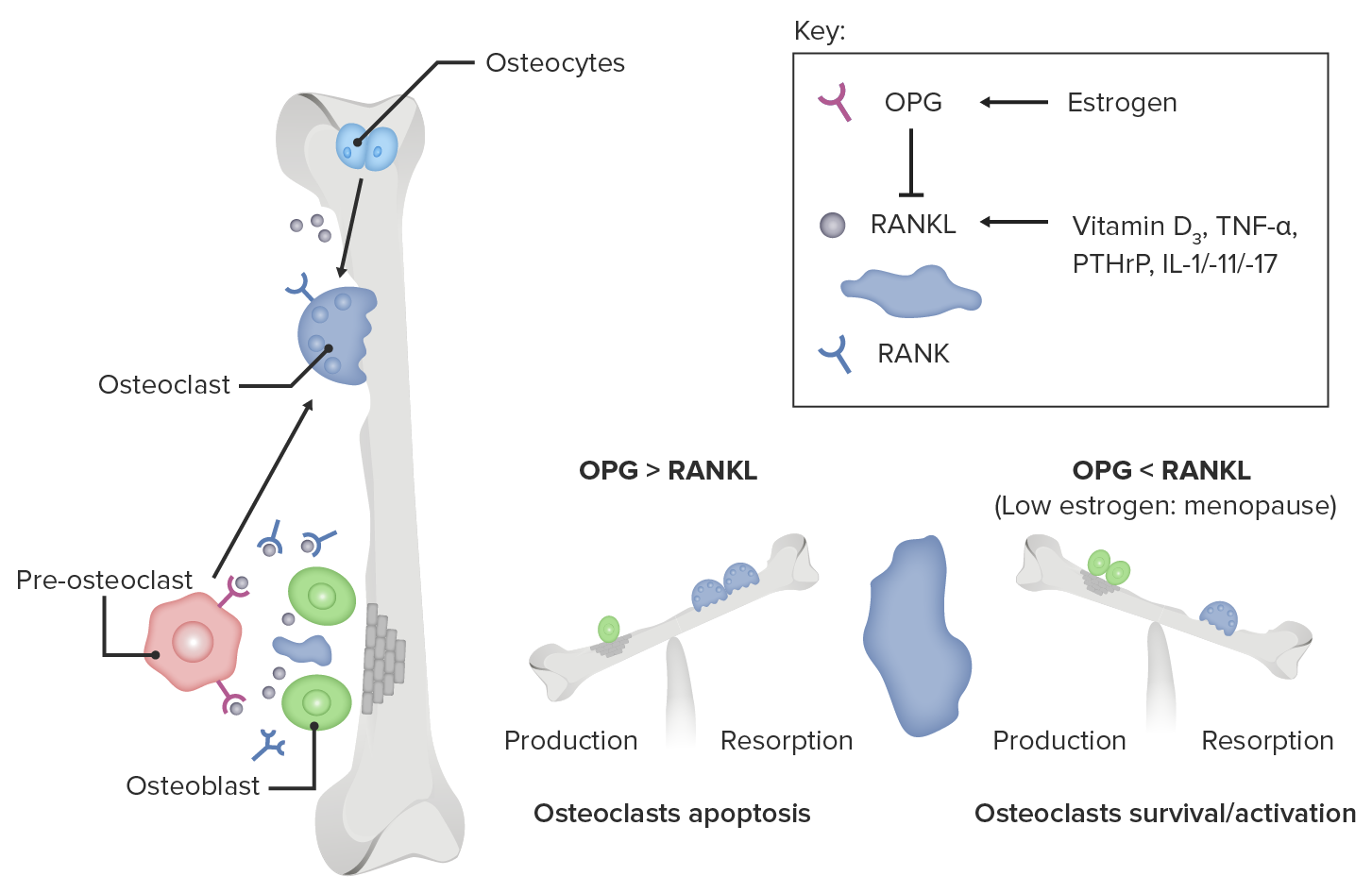
    • El reclutamiento y la actividad de los LOS Neisseria osteoclastos están relacionados con la interacción de 3 factores:
      • RANKL RANKL A tumor necrosis factor receptor family member that is specific for rank ligand and plays a role in bone homeostasis by regulating osteoclastogenesis. It is also expressed on dendritic cells where it plays a role in regulating dendritic cell survival. Signaling by the activated receptor occurs through its association with tnf receptor-associated factors. Paget Disease of Bone ( Receptor Receptor Receptors are proteins located either on the surface of or within a cell that can bind to signaling molecules known as ligands (e.g., hormones) and cause some type of response within the cell. Receptors activador del factor nuclear kappa-Β Ligando), una citoquina secretada por osteocitos, osteoblastos y algunas células del sistema inmunitario)
      • Receptor Receptor Receptors are proteins located either on the surface of or within a cell that can bind to signaling molecules known as ligands (e.g., hormones) and cause some type of response within the cell. Receptors RANK ( en EN Erythema nodosum is an immune-mediated panniculitis (inflammation of the subcutaneous fat) caused by a type IV (delayed-type) hypersensitivity reaction. It commonly manifests in young women as tender, erythematous nodules on the shins. Erythema Nodosum los LOS Neisseria osteoclastos)
      • Osteoprotegerina (OPG), una citoquina que se une al AL Amyloidosis RANKL RANKL A tumor necrosis factor receptor family member that is specific for rank ligand and plays a role in bone homeostasis by regulating osteoclastogenesis. It is also expressed on dendritic cells where it plays a role in regulating dendritic cell survival. Signaling by the activated receptor occurs through its association with tnf receptor-associated factors. Paget Disease of Bone e interfiere con él
    • Proceso:
      • La activación de RANK por RANKL RANKL A tumor necrosis factor receptor family member that is specific for rank ligand and plays a role in bone homeostasis by regulating osteoclastogenesis. It is also expressed on dendritic cells where it plays a role in regulating dendritic cell survival. Signaling by the activated receptor occurs through its association with tnf receptor-associated factors. Paget Disease of Bone es una vía final común en EN Erythema nodosum is an immune-mediated panniculitis (inflammation of the subcutaneous fat) caused by a type IV (delayed-type) hypersensitivity reaction. It commonly manifests in young women as tender, erythematous nodules on the shins. Erythema Nodosum el desarrollo y activación de los LOS Neisseria osteoclastos.
      • RANKL RANKL A tumor necrosis factor receptor family member that is specific for rank ligand and plays a role in bone homeostasis by regulating osteoclastogenesis. It is also expressed on dendritic cells where it plays a role in regulating dendritic cell survival. Signaling by the activated receptor occurs through its association with tnf receptor-associated factors. Paget Disease of Bone es inhibida por OPG (también secretada por osteoblastos)
  • La resorción suele durar semanas, mientras que la formación de hueso puede durar meses.
  • Durante la remodelación activa, el hueso tiene un mayor riesgo de fractura:
  • La tasa de remodelación se duplica en EN Erythema nodosum is an immune-mediated panniculitis (inflammation of the subcutaneous fat) caused by a type IV (delayed-type) hypersensitivity reaction. It commonly manifests in young women as tender, erythematous nodules on the shins. Erythema Nodosum la menopausia y se triplica 13 años después.
  • La masa ósea alcanza su punto máximo durante la tercera década de la vida y luego disminuye gradualmente.

Patogénesis de la osteoporosis Osteoporosis Osteoporosis refers to a decrease in bone mass and density leading to an increased number of fractures. There are 2 forms of osteoporosis: primary, which is commonly postmenopausal or senile; and secondary, which is a manifestation of immobilization, underlying medical disorders, or long-term use of certain medications. Osteoporosis

  • Multifactorial
  • Generalmente causada por el desequilibrio entre la resorción y la formación de hueso
  • Incluso un ligero aumento de la pérdida ósea aumenta el riesgo de fracturas relacionadas con la osteoporosis Osteoporosis Osteoporosis refers to a decrease in bone mass and density leading to an increased number of fractures. There are 2 forms of osteoporosis: primary, which is commonly postmenopausal or senile; and secondary, which is a manifestation of immobilization, underlying medical disorders, or long-term use of certain medications. Osteoporosis.
    • La pérdida ósea leve aumenta el riesgo porque se producen cambios arquitectónicos.
    • La arquitectura esquelética desordenada es la razón principal de la fragilidad ósea, no solo la masa ósea, por lo que esa medición (por DXA) es una medida imperfecta del riesgo.
  • Si la resorción ósea predomina sobre la formación ósea, puede producirse una osteoporosis Osteoporosis Osteoporosis refers to a decrease in bone mass and density leading to an increased number of fractures. There are 2 forms of osteoporosis: primary, which is commonly postmenopausal or senile; and secondary, which is a manifestation of immobilization, underlying medical disorders, or long-term use of certain medications. Osteoporosis.
  • Papel de la deficiencia de estrógenos:
    • Aumenta el número de osteoclastos
    • Disminuye el número de osteoblastos
    • Aumenta las citoquinas críticas para el reclutamiento de osteoclastos:
      • Interleucina-1 (IL-1)
      • Interleucina-6 (IL-6)
      • Factor de necrosis Necrosis The death of cells in an organ or tissue due to disease, injury or failure of the blood supply. Ischemic Cell Damage tumoral (TNF-α, por sus siglas en EN Erythema nodosum is an immune-mediated panniculitis (inflammation of the subcutaneous fat) caused by a type IV (delayed-type) hypersensitivity reaction. It commonly manifests in young women as tender, erythematous nodules on the shins. Erythema Nodosum inglés)
      • Receptor Receptor Receptors are proteins located either on the surface of or within a cell that can bind to signaling molecules known as ligands (e.g., hormones) and cause some type of response within the cell. Receptors activador del ligando del factor nuclear-κB ( RANKL RANKL A tumor necrosis factor receptor family member that is specific for rank ligand and plays a role in bone homeostasis by regulating osteoclastogenesis. It is also expressed on dendritic cells where it plays a role in regulating dendritic cell survival. Signaling by the activated receptor occurs through its association with tnf receptor-associated factors. Paget Disease of Bone)
    • Disminuye la OPG (osteoprotegerina), una citoquina que protege el hueso
Papel de la deficiencia de estrógenos en la activación de los osteoclastos (1)

Papel de la deficiencia de estrógenos en la activación de los osteoclastos

Imagen por Lecturio.
Presentación Clínica

  • Clínicamente silencioso, hasta que se produce la fractura
  • Fractura vertebral:
    • La más común
    • Comúnmente asintomática
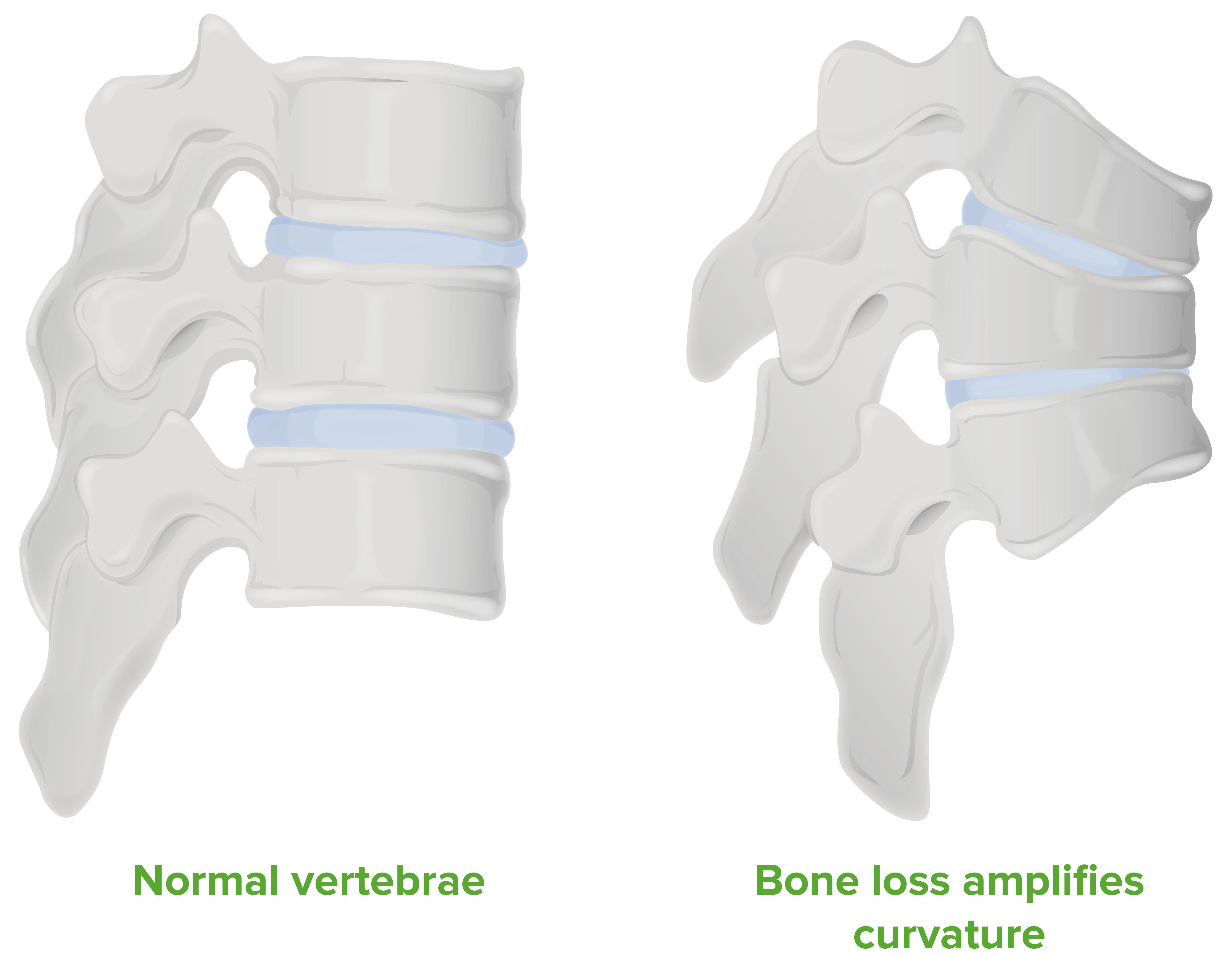
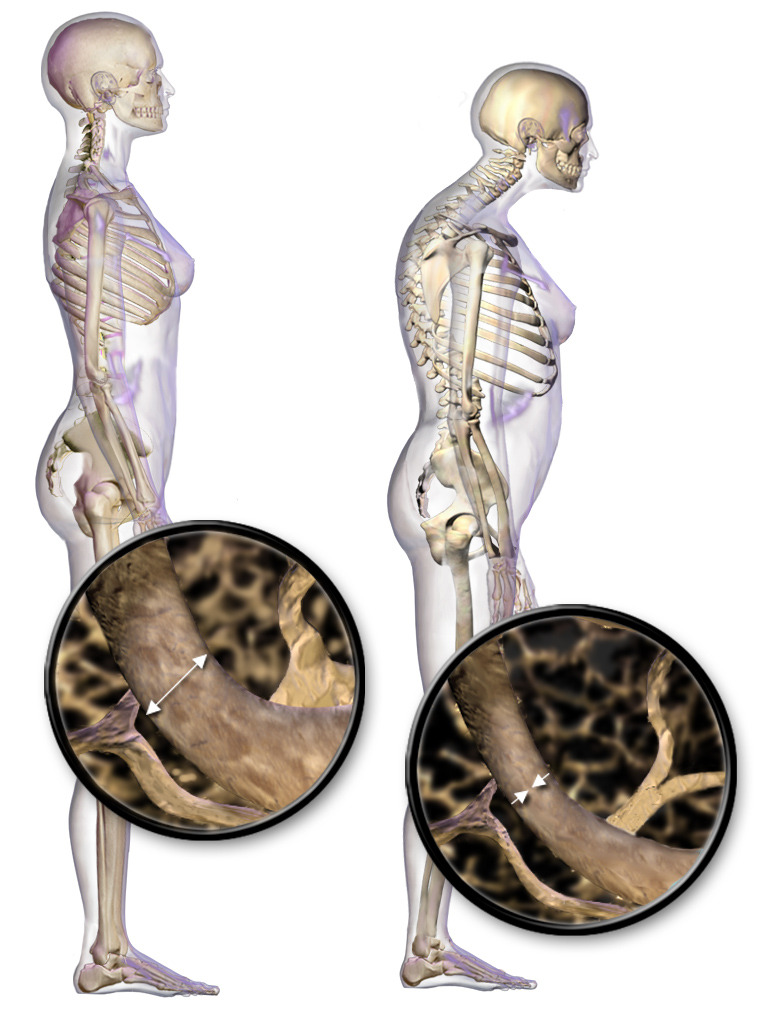
    • Puede llevar a la pérdida de altura
    • Xifosis angular (puede provocar enfermedad pulmonar restrictiva y disnea)
    • Dolor Dolor Inflammation de espalda difuso
  • Fractura de cadera: afecta hasta el 15% de las mujeres y el 5% de los LOS Neisseria hombres a los LOS Neisseria 80 años de edad
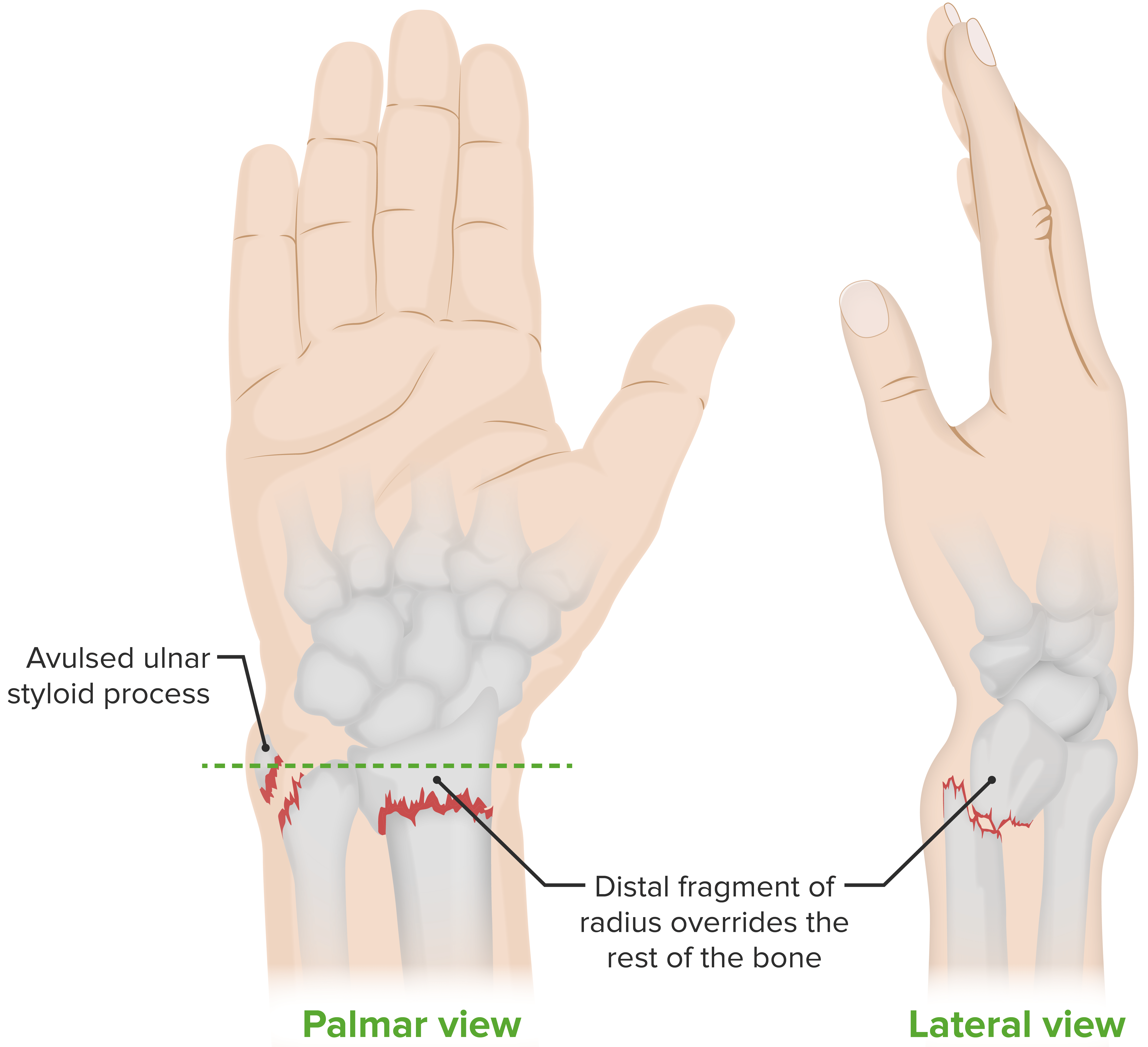
  • Fractura del radio distal (e.g., fractura de Colles, el segundo tipo más común de fractura por fragilidad, después de las fracturas vertebrales)
  • Otras fracturas:
    • Costillas
    • Húmero
    • Pelvis Pelvis The pelvis consists of the bony pelvic girdle, the muscular and ligamentous pelvic floor, and the pelvic cavity, which contains viscera, vessels, and multiple nerves and muscles. The pelvic girdle, composed of 2 “hip” bones and the sacrum, is a ring-like bony structure of the axial skeleton that links the vertebral column with the lower extremities. Pelvis: Anatomy

Diagnóstico

Historia clínica

  • Fumar/alcohol
  • Mala nutrición
  • Actividad física
  • Historia familiar
  • Presencia de ciertas enfermedades (e.g., enfermedad de Crohn, artritis reumatoide)
  • Medicamentos (e.g., esteroides)

Examen físico

  • Medidas de altura y peso
  • Baja estatura + cifosis

Criterios clínicos

  • Presencia de fractura por fragilidad
  • FRAX FRAX Osteoporosis (herramienta de evaluación del riesgo de fractura, por sus siglas en EN Erythema nodosum is an immune-mediated panniculitis (inflammation of the subcutaneous fat) caused by a type IV (delayed-type) hypersensitivity reaction. It commonly manifests in young women as tender, erythematous nodules on the shins. Erythema Nodosum inglés):
    • Calculadora computarizada
    • Estima el riesgo a 10 años de fractura de cadera y de fractura osteoporótica mayor
    • Para los LOS Neisseria pacientes no tratados de entre 40 y 90 años de edad según los LOS Neisseria factores de riesgo

Estudios de laboratorio

  • Calcio/fósforo
  • Proteínas totales/albúmina
  • Fosfatasa alcalina
  • Creatinina
  • 25-hidroxivitamina D
  • Hemograma

Absorción de rayos X de doble energía (DXA, por sus siglas en EN Erythema nodosum is an immune-mediated panniculitis (inflammation of the subcutaneous fat) caused by a type IV (delayed-type) hypersensitivity reaction. It commonly manifests in young women as tender, erythematous nodules on the shins. Erythema Nodosum inglés)

  • Método de elección para evaluar la densidad mineral ósea (DMO)
  • Criterios aplicables a las mujeres posmenopáusicas y a los LOS Neisseria hombres de más de 50 años:
    • T-score T-score Standard deviation difference between the patient’s bone mass density and the reference bone mass density of a young population. Osteoporosis:
      • Desviación estándar diferencia entre la densidad mineral ósea del paciente y la densidad mineral ósea de referencia de una población joven.
      • Una densidad de masa ósea normal es una puntuación T ≥ -1 (o dentro de 1 desviación estándar de la densidad mineral ósea media de un adulto joven).
      • Una puntuación T < -1 pero > -2,5 (1-2,5 desviación estándar por debajo de la media del adulto joven) indica osteopenia Osteopenia Osteoporosis.
      • Una puntuación T ≤ -2,5 (≥ 2,5 desviación estándar por debajo de la densidad mineral ósea media del adulto joven) indica osteoporosis Osteoporosis Osteoporosis refers to a decrease in bone mass and density leading to an increased number of fractures. There are 2 forms of osteoporosis: primary, which is commonly postmenopausal or senile; and secondary, which is a manifestation of immobilization, underlying medical disorders, or long-term use of certain medications. Osteoporosis.
      • Una puntuación T ≤ -2,5 con fractura(s) por fragilidad indica osteoporosis Osteoporosis Osteoporosis refers to a decrease in bone mass and density leading to an increased number of fractures. There are 2 forms of osteoporosis: primary, which is commonly postmenopausal or senile; and secondary, which is a manifestation of immobilization, underlying medical disorders, or long-term use of certain medications. Osteoporosis grave (o establecida).
    • Z-score Z-score Standard deviation difference between patient’s bone mass density and that of age-matched population. Osteoporosis:
      • Diferencia de desviación estándar entre la densidad ósea del paciente y la de la población emparejada por edad
      • < -2,0 indica osteoporosis Osteoporosis Osteoporosis refers to a decrease in bone mass and density leading to an increased number of fractures. There are 2 forms of osteoporosis: primary, which is commonly postmenopausal or senile; and secondary, which is a manifestation of immobilization, underlying medical disorders, or long-term use of certain medications. Osteoporosis.
  • Indicaciones para tamizaje de prevención:
    • Las mujeres posmenopáusicas deben empezar a realizarse tamizaje de prevención a partir de los LOS Neisseria 65 años.
    • Las mujeres posmenopáusicas con factores de riesgo deben comenzar el tamizaje de prevención a los LOS Neisseria 50 años:
      • Fumar tabaco
      • Artritis reumatoide
      • Fractura de cadera en EN Erythema nodosum is an immune-mediated panniculitis (inflammation of the subcutaneous fat) caused by a type IV (delayed-type) hypersensitivity reaction. It commonly manifests in young women as tender, erythematous nodules on the shins. Erythema Nodosum un familiar de primer grado (padres)
      • Indice de masa corporal (IMC) < 21 kg/m2
      • Fractura posterior a la menopausia

Tratamiento

Prevención/modificaciones del estilo de vida

  • Ejercicio regular Regular Insulin con pesas
  • Ingesta adecuada de calcio y vitamina D
  • Dejar de fumar
  • Evitar el consumo excesivo de alcohol
  • Prevención de caídas

Indicaciones de tratamiento farmacológico en EN Erythema nodosum is an immune-mediated panniculitis (inflammation of the subcutaneous fat) caused by a type IV (delayed-type) hypersensitivity reaction. It commonly manifests in young women as tender, erythematous nodules on the shins. Erythema Nodosum mujeres posmenopáusicas

  • Antecedentes de fractura por fragilidad
  • T- score de DXA < -1
  • Elevado riesgo de fractura a 10 años según la calculadora de riesgo online FRAX FRAX Osteoporosis

Indicaciones de tratamiento en EN Erythema nodosum is an immune-mediated panniculitis (inflammation of the subcutaneous fat) caused by a type IV (delayed-type) hypersensitivity reaction. It commonly manifests in young women as tender, erythematous nodules on the shins. Erythema Nodosum hombres y pacientes jóvenes

  • Menos definido
  • Fracturas por fragilidad
  • Se pueden utilizar estimaciones de FRAX FRAX Osteoporosis y mediciones de densidad ósea

Medicamentos

  • Los LOS Neisseria niveles de calcio y vitamina D deben normalizarse antes de comenzar con medicamentos
  • Bifosfonatos: 1ra línea (alendronato, risedronato)
  • Sustitución hormonal:
    • Estrógeno + progesterona en EN Erythema nodosum is an immune-mediated panniculitis (inflammation of the subcutaneous fat) caused by a type IV (delayed-type) hypersensitivity reaction. It commonly manifests in young women as tender, erythematous nodules on the shins. Erythema Nodosum mujeres posmenopáusicas:
      • No está indicado de forma rutinaria debido a los LOS Neisseria riesgos asociados
      • Puede utilizarse en EN Erythema nodosum is an immune-mediated panniculitis (inflammation of the subcutaneous fat) caused by a type IV (delayed-type) hypersensitivity reaction. It commonly manifests in young women as tender, erythematous nodules on the shins. Erythema Nodosum mujeres con síntomas perimenopáusicos
    • Reemplazo de testosterona en EN Erythema nodosum is an immune-mediated panniculitis (inflammation of the subcutaneous fat) caused by a type IV (delayed-type) hypersensitivity reaction. It commonly manifests in young women as tender, erythematous nodules on the shins. Erythema Nodosum hombres hipogonadales
  • Otras terapias:
    • Denosumab Denosumab A humanized monoclonal antibody and an inhibitor of the rank ligand, which regulates osteoclast differentiation and bone remodeling. It is used as a bone density conservation agent in the treatment of osteoporosis. Other Antiresorptive Drugs (anticuerpo monoclonal contra el receptor Receptor Receptors are proteins located either on the surface of or within a cell that can bind to signaling molecules known as ligands (e.g., hormones) and cause some type of response within the cell. Receptors activador de RANKL RANKL A tumor necrosis factor receptor family member that is specific for rank ligand and plays a role in bone homeostasis by regulating osteoclastogenesis. It is also expressed on dendritic cells where it plays a role in regulating dendritic cell survival. Signaling by the activated receptor occurs through its association with tnf receptor-associated factors. Paget Disease of Bone)
    • Agentes anabólicos (teriparatida, romosozumab)
    • Moduladores selectivos de los LOS Neisseria receptores de estrógenos
    • Calcitonina

Pronóstico

  • Bueno con tratamientos adecuados que eviten la pérdida de la densidad ósea.
  • Las fracturas osteoporóticas disminuyen la calidad de vida, la longevidad y la independencia de la población anciana.
  • El 50% de los LOS Neisseria pacientes previamente independientes que sufren una fractura de cadera pasan a ser al AL Amyloidosis menos parcialmente dependientes.
  • Una fractura osteoporótica aumenta el riesgo de fracturas posteriores.

Diagnóstico Diferencial

  • Osteomalacia Osteomalacia Disorder caused by an interruption of the mineralization of organic bone matrix leading to bone softening, bone pain, and weakness. It is the adult form of rickets resulting from disruption of vitamin d; phosphorus; or calcium homeostasis. Osteomalacia and Rickets: reblandecimiento de los LOS Neisseria huesos causado por una alteración del metabolismo óseo debido principalmente a niveles inadecuados de fosfato, calcio y vitamina D disponibles, o por la reabsorción de calcio. La alteración del metabolismo óseo provoca una mineralización ósea inadecuada. Suele presentarse con dolores óseos y fracturas. Tratada con suplementos de calcio y vitamina D.
  • Hiperparatiroidismo: condiciones de niveles patológicamente elevados de la hormona paratiroidea. Según la patogénesis, se pueden distinguir 3 formas: hiperparatiroidismo primario, secundario y terciario. En EN Erythema nodosum is an immune-mediated panniculitis (inflammation of the subcutaneous fat) caused by a type IV (delayed-type) hypersensitivity reaction. It commonly manifests in young women as tender, erythematous nodules on the shins. Erythema Nodosum casos avanzados, el hiperparatiroidismo puede presentar una osteítis fibrosa quística caracterizada por fracturas óseas patológicas. El diagnóstico se basa en EN Erythema nodosum is an immune-mediated panniculitis (inflammation of the subcutaneous fat) caused by a type IV (delayed-type) hypersensitivity reaction. It commonly manifests in young women as tender, erythematous nodules on the shins. Erythema Nodosum los LOS Neisseria niveles elevados de PTH (hormona paratiroidea, por sus siglas en EN Erythema nodosum is an immune-mediated panniculitis (inflammation of the subcutaneous fat) caused by a type IV (delayed-type) hypersensitivity reaction. It commonly manifests in young women as tender, erythematous nodules on the shins. Erythema Nodosum inglés), y el tratamiento depende de la causa subyacente.
  • Tumores óseos malignos: tumores cancerosos que afectan a los LOS Neisseria huesos o a la médula ósea. Puede manifestarse con dolor Dolor Inflammation y fracturas óseas patológicas. El diagnóstico se establece con imágenes y biopsias. El tratamiento puede incluir la resección quirúrgica, radiación y quimioterapia.
  • La enfermedad de Paget ósea: es un trastorno del metabolismo óseo. Más común en EN Erythema nodosum is an immune-mediated panniculitis (inflammation of the subcutaneous fat) caused by a type IV (delayed-type) hypersensitivity reaction. It commonly manifests in young women as tender, erythematous nodules on the shins. Erythema Nodosum pacientes de más de 55 años de edad. Este trastorno suele ser asintomático, pero puede incluir manifestaciones como artritis, dolor Dolor Inflammation de huesos y fracturas. El diagnóstico se establece con estudios de imagen. El tratamiento incluye bifosfonatos y calcitonina.
  • Osteogénesis imperfecta: es un trastorno genético del tejido conectivo caracterizado por la fragilidad de los LOS Neisseria huesos. Se manifiesta en EN Erythema nodosum is an immune-mediated panniculitis (inflammation of the subcutaneous fat) caused by a type IV (delayed-type) hypersensitivity reaction. It commonly manifests in young women as tender, erythematous nodules on the shins. Erythema Nodosum la infancia y la niñez temprana. Pueden producirse múltiples fracturas y, en EN Erythema nodosum is an immune-mediated panniculitis (inflammation of the subcutaneous fat) caused by a type IV (delayed-type) hypersensitivity reaction. It commonly manifests in young women as tender, erythematous nodules on the shins. Erythema Nodosum algunos casos, estas fracturas pueden producirse antes del nacimiento. Existen diferentes tipos de esta enfermedad que varían en EN Erythema nodosum is an immune-mediated panniculitis (inflammation of the subcutaneous fat) caused by a type IV (delayed-type) hypersensitivity reaction. It commonly manifests in young women as tender, erythematous nodules on the shins. Erythema Nodosum gravedad y pronóstico. El diagnóstico se establece clínicamente y se confirma con pruebas genéticas. El tratamiento incluye bifosfonatos y medidas de apoyo.
  • Maltrato físico: debe descartarse en EN Erythema nodosum is an immune-mediated panniculitis (inflammation of the subcutaneous fat) caused by a type IV (delayed-type) hypersensitivity reaction. It commonly manifests in young women as tender, erythematous nodules on the shins. Erythema Nodosum cualquier paciente que presente fracturas múltiples, especialmente en EN Erythema nodosum is an immune-mediated panniculitis (inflammation of the subcutaneous fat) caused by a type IV (delayed-type) hypersensitivity reaction. It commonly manifests in young women as tender, erythematous nodules on the shins. Erythema Nodosum poblaciones vulnerables como los LOS Neisseria ancianos, los LOS Neisseria niños pequeños y los LOS Neisseria pacientes con enfermedades o retrasos mentales.
  • Osteopenia Osteopenia Osteoporosis: baja densidad ósea, como la osteoporosis Osteoporosis Osteoporosis refers to a decrease in bone mass and density leading to an increased number of fractures. There are 2 forms of osteoporosis: primary, which is commonly postmenopausal or senile; and secondary, which is a manifestation of immobilization, underlying medical disorders, or long-term use of certain medications. Osteoporosis, pero no tan grave. La osteopenia Osteopenia Osteoporosis tiene una densidad ósea entre 1 y 2,5 desviaciones estándar por debajo de la referencia (es decir, una puntuación T entre -1,0 y -2,5), mientras que la osteoporosis Osteoporosis Osteoporosis refers to a decrease in bone mass and density leading to an increased number of fractures. There are 2 forms of osteoporosis: primary, which is commonly postmenopausal or senile; and secondary, which is a manifestation of immobilization, underlying medical disorders, or long-term use of certain medications. Osteoporosis tiene una puntuación T ≤ -2,5.
  • Osteoporosis Osteoporosis Osteoporosis refers to a decrease in bone mass and density leading to an increased number of fractures. There are 2 forms of osteoporosis: primary, which is commonly postmenopausal or senile; and secondary, which is a manifestation of immobilization, underlying medical disorders, or long-term use of certain medications. Osteoporosis transitoria de la cadera: enfermedad rara, autolimitada y dolorosa en EN Erythema nodosum is an immune-mediated panniculitis (inflammation of the subcutaneous fat) caused by a type IV (delayed-type) hypersensitivity reaction. It commonly manifests in young women as tender, erythematous nodules on the shins. Erythema Nodosum la que la cabeza del fémur (y ocasionalmente otras articulaciones de la pierna) pierde densidad ósea. Esta afección también se caracteriza por un edema Edema Edema is a condition in which excess serous fluid accumulates in the body cavity or interstitial space of connective tissues. Edema is a symptom observed in several medical conditions. It can be categorized into 2 types, namely, peripheral (in the extremities) and internal (in an organ or body cavity). Edema de la médula ósea. Se da en EN Erythema nodosum is an immune-mediated panniculitis (inflammation of the subcutaneous fat) caused by a type IV (delayed-type) hypersensitivity reaction. It commonly manifests in young women as tender, erythematous nodules on the shins. Erythema Nodosum hombres de 30 a 60 años y en EN Erythema nodosum is an immune-mediated panniculitis (inflammation of the subcutaneous fat) caused by a type IV (delayed-type) hypersensitivity reaction. It commonly manifests in young women as tender, erythematous nodules on the shins. Erythema Nodosum mujeres en EN Erythema nodosum is an immune-mediated panniculitis (inflammation of the subcutaneous fat) caused by a type IV (delayed-type) hypersensitivity reaction. It commonly manifests in young women as tender, erythematous nodules on the shins. Erythema Nodosum las últimas fases del embarazo (o que han dado a luz recientemente). Los LOS Neisseria síntomas suelen desaparecer en EN Erythema nodosum is an immune-mediated panniculitis (inflammation of the subcutaneous fat) caused by a type IV (delayed-type) hypersensitivity reaction. It commonly manifests in young women as tender, erythematous nodules on the shins. Erythema Nodosum 6-12 meses.
  • Escorbuto: debido a la carencia de vitamina C, que provoca una biosíntesis defectuosa del colágeno. Se impide la formación de hueso nuevo y el hueso viejo se vuelve quebradizo debido a la falta de colágeno y a su mala calidad. Las radiografías muestran un adelgazamiento cortical y una disminución de las trabéculas, lo que provoca una disminución de la radiopacidad. Esto provoca un aspecto transparente de los huesos, o la llamada “osteopenia en vidrio deslustrado”.

Referencias

  1. Finkelstein J.S., Yu E.W. (2025). Treatment of osteoporosis in men. Retrieved November 15, 2025, from https://www.uptodate.com/contents/treatment-of-osteoporosis-in-men
  2. Johnston CB, Dagar M. (2020). Osteoporosis in Older Adults. Med Clin North Am. 2020 Sep. 104 (5):873-884.
  3. Porter J.L., Varacallo M. (2023). Osteoporosis. Retrieved November 15, 2025, from https://www.ncbi.nlm.nih.gov/books/NBK441901/#article-26408.s1
  4. Rosen H. N., Dresner M. K. (2024). Clinical manifestations, diagnosis, and evaluation of osteoporosis in postmenopausal women. Retrieved November 15, 2025, from https://www.uptodate.com/contents/clinical-manifestations-diagnosis-and-evaluation-of-osteoporosis-in-postmenopausal-women
  5. Rosen, H. N., & Lewiecki, E. M. (2025). Overview of the management of low bone mass and osteoporosis in postmenopausal women. UpToDate. Retrieved November 15, 2025, from https://www.uptodate.com/contents/overview-of-the-management-of-low-bone-mass-and-osteoporosis-in-postmenopausal-women
  6. Svedbom A., Hernlund E., Ivergård M., Compston J., Cooper C., Stenmark J., McCloskey E.V., Jönsson B., Kanis J.A., EU Review Panel of IOF. (2013). Osteoporosis in the European Union: a compendium of country-specific reports. Arch Osteoporos. 2013;8(1-2):137. Epub 2013 Oct 11. 
  7. Whitaker Elam R.E. (2024). Osteoporosis. Retrieved November 15, 2025, from https://emedicine.medscape.com/article/330598-overview

¡Crea tu cuenta gratis o inicia una sesión para seguir leyendo!

Regístrate ahora y obtén acceso gratuito a Lecturio con páginas de concepto, videos médicos y cuestionarios para tu educación médica.

User Reviews

Que tengas una sesión de estudio alegre y navideña 🎁 Ahorra 50% en todos los planes >>

Details