Domina Conceptos Médicos

Estudia para la escuela de medicina y tus examenes con Lecturio.

Órganos Linfáticos Secundarios

Los LOS Neisseria órganos linfoides secundarios, también llamados órganos linfoides/linfáticos periféricos, incluyen el tejido linfoide asociado a mucosas ( MALT MALT Colon, Cecum, and Appendix: Anatomy, por sus siglas en EN Erythema nodosum is an immune-mediated panniculitis (inflammation of the subcutaneous fat) caused by a type IV (delayed-type) hypersensitivity reaction. It commonly manifests in young women as tender, erythematous nodules on the shins. Erythema Nodosum inglés), los LOS Neisseria nódulos linfáticos y el bazo. Estas colecciones de tejidos linfoides proporcionan una vigilancia constante de los LOS Neisseria patógenos. En EN Erythema nodosum is an immune-mediated panniculitis (inflammation of the subcutaneous fat) caused by a type IV (delayed-type) hypersensitivity reaction. It commonly manifests in young women as tender, erythematous nodules on the shins. Erythema Nodosum sus distintos sitios, estos tejidos están llenos de células inmunitarias listas para montar una respuesta cuando se detectan antígenos. Los LOS Neisseria nódulos linfáticos se ven a lo largo de los LOS Neisseria vasos linfáticos y se presentan en EN Erythema nodosum is an immune-mediated panniculitis (inflammation of the subcutaneous fat) caused by a type IV (delayed-type) hypersensitivity reaction. It commonly manifests in young women as tender, erythematous nodules on the shins. Erythema Nodosum cadenas o grupos (cuello, ingle, axilas, mesenterios, abdomen). Los LOS Neisseria MALT MALT Colon, Cecum, and Appendix: Anatomy actúan como sensores inmunitarios situados en EN Erythema nodosum is an immune-mediated panniculitis (inflammation of the subcutaneous fat) caused by a type IV (delayed-type) hypersensitivity reaction. It commonly manifests in young women as tender, erythematous nodules on the shins. Erythema Nodosum lugares donde la luz está expuesta al AL Amyloidosis entorno externo (orofaringe, tracto gastrointestinal, tracto genitourinario). El bazo es el sitio de producción de anticuerpos y linfocitos, pero también ayuda en EN Erythema nodosum is an immune-mediated panniculitis (inflammation of the subcutaneous fat) caused by a type IV (delayed-type) hypersensitivity reaction. It commonly manifests in young women as tender, erythematous nodules on the shins. Erythema Nodosum la descomposición de plaquetas y eritrocitos.

Last updated: Dec 15, 2025

Editorial responsibility: Stanley Oiseth, Lindsay Jones, Evelin Maza

Descripción General

Sistema inmunológico

  • El sistema inmunológico proporciona defensa (inmunidad) contra patógenos invasores que van desde virus Virus Viruses are infectious, obligate intracellular parasites composed of a nucleic acid core surrounded by a protein capsid. Viruses can be either naked (non-enveloped) or enveloped. The classification of viruses is complex and based on many factors, including type and structure of the nucleoid and capsid, the presence of an envelope, the replication cycle, and the host range. Virology hasta parásitos. Los LOS Neisseria componentes del sistema inmunológico están interconectados por la circulación sanguínea y linfática.
  • 2 líneas de defensa superpuestas:
    • Inmunidad innata (no específica), que involucra las siguientes células:
      • Células asesinas naturales
      • Monocitos/macrófagos
      • Células dendríticas
      • Neutrófilos, basófilos, eosinófilos
      • Mastocitos tisulares
    • Inmunidad adaptativa (basada en EN Erythema nodosum is an immune-mediated panniculitis (inflammation of the subcutaneous fat) caused by a type IV (delayed-type) hypersensitivity reaction. It commonly manifests in young women as tender, erythematous nodules on the shins. Erythema Nodosum el reconocimiento de antígenos específicos) involucra las siguientes células:
      • Linfocitos T y B (derivados de órganos linfoides)
      • Células presentadoras de antígenos

Sistema linfático

El sistema linfático (vasos linfáticos, líquido linfático y órganos linfoides) es parte del sistema inmunológico del cuerpo.
  • Órganos linfoides:
    • Primarios:
      • Sitios donde se desarrollan los LOS Neisseria linfocitos a partir de células progenitoras (formación inicial)
      • Incluye la médula ósea y el timo
    • Secundarios:
  • Vasos y conductos linfáticos:
    • Una red, similar a los LOS Neisseria vasos sanguíneos, que se extiende por todo el cuerpo humano.
    • Conectan órganos linfoides y transportan líquido intersticial (linfa)
    • Juegan papeles importantes en EN Erythema nodosum is an immune-mediated panniculitis (inflammation of the subcutaneous fat) caused by a type IV (delayed-type) hypersensitivity reaction. It commonly manifests in young women as tender, erythematous nodules on the shins. Erythema Nodosum la respuesta inmune y el equilibrio hídrico
Anatomía del sistema linfático

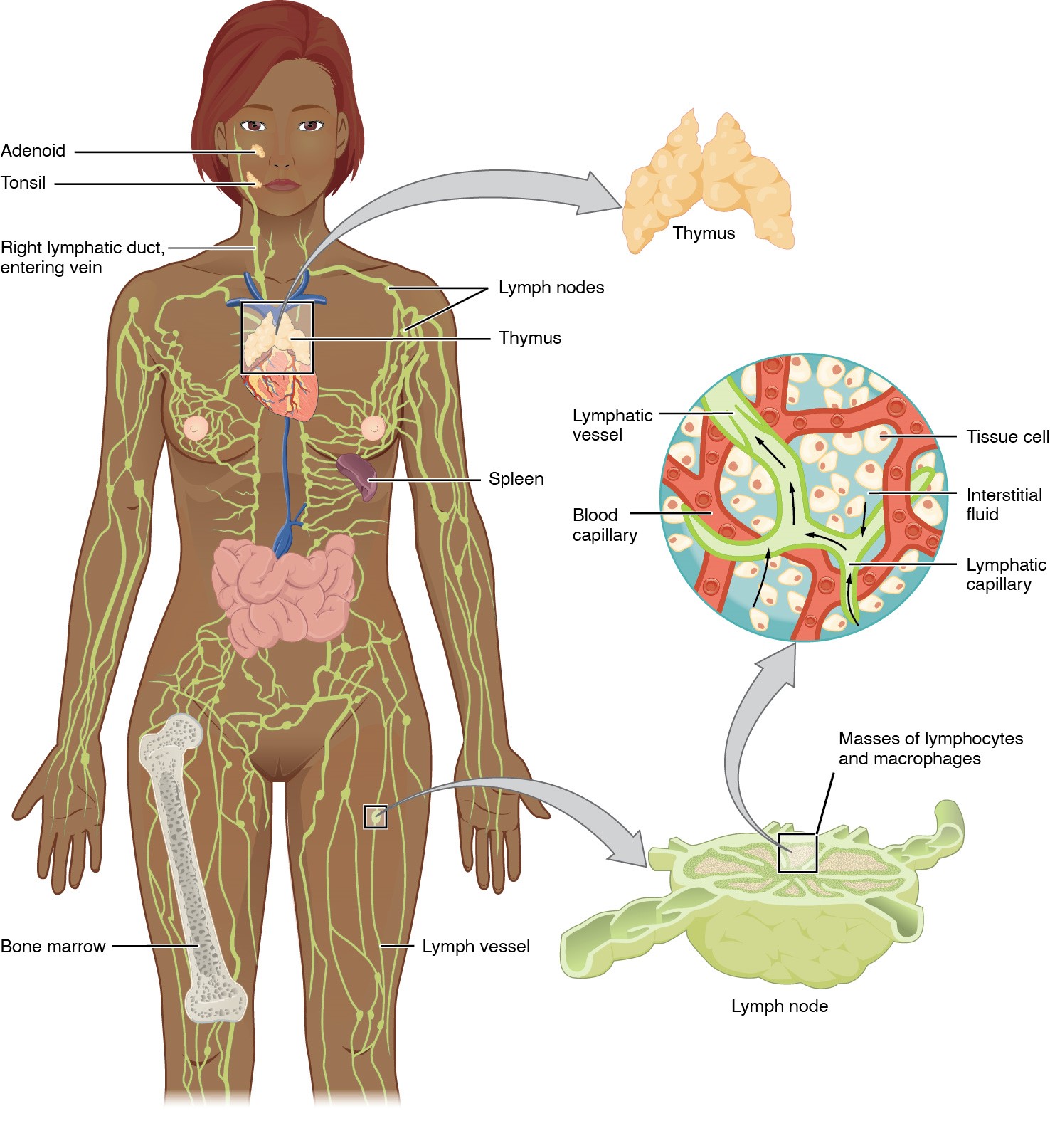
Anatomía del sistema linfático:
Incluye los órganos linfoides primarios (médula ósea, timo) y secundarios (bazo, ganglios linfáticos y MALT)
Los vasos linfáticos transportan linfa a los vasos linfáticos más grandes del tórax, transportando líquido de vuelta a la circulación venosa.
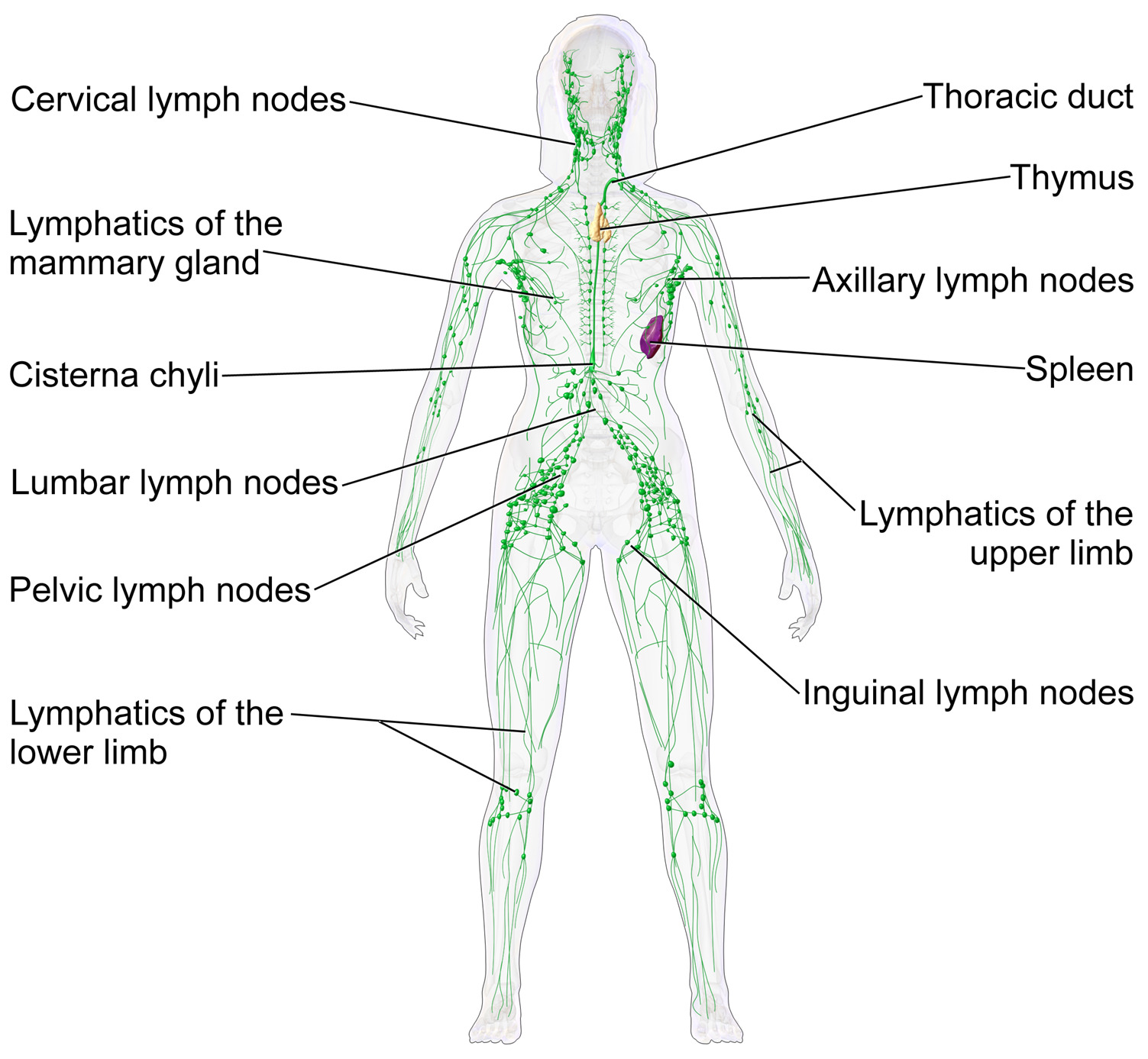
Imagen: “Anatomy of the Lymphatic System” por OpenStax. Licencia: CC BY 4.0

Nódulos Linfáticos

Anatomía

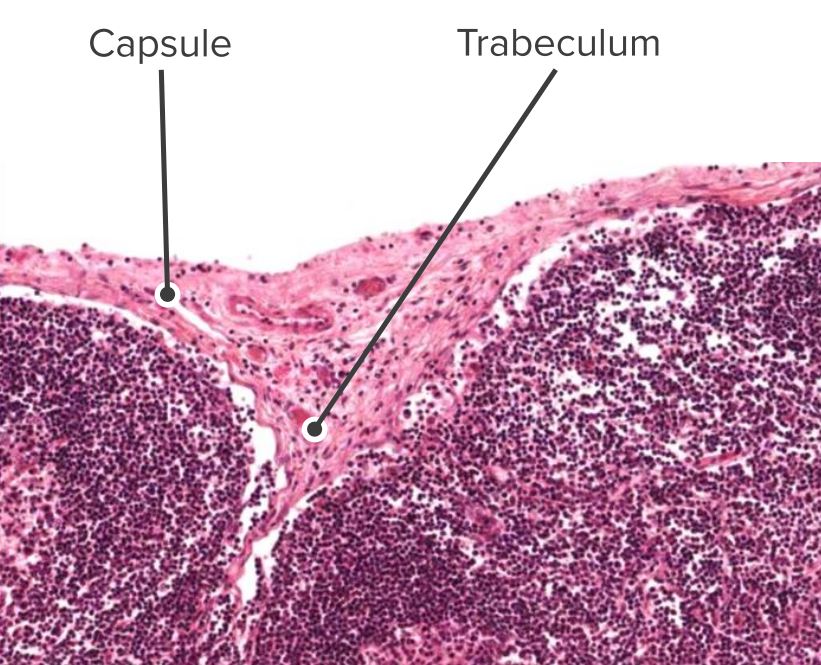
  • Los LOS Neisseria nódulos linfáticos son órganos linfoides encapsulados con forma de riñón:
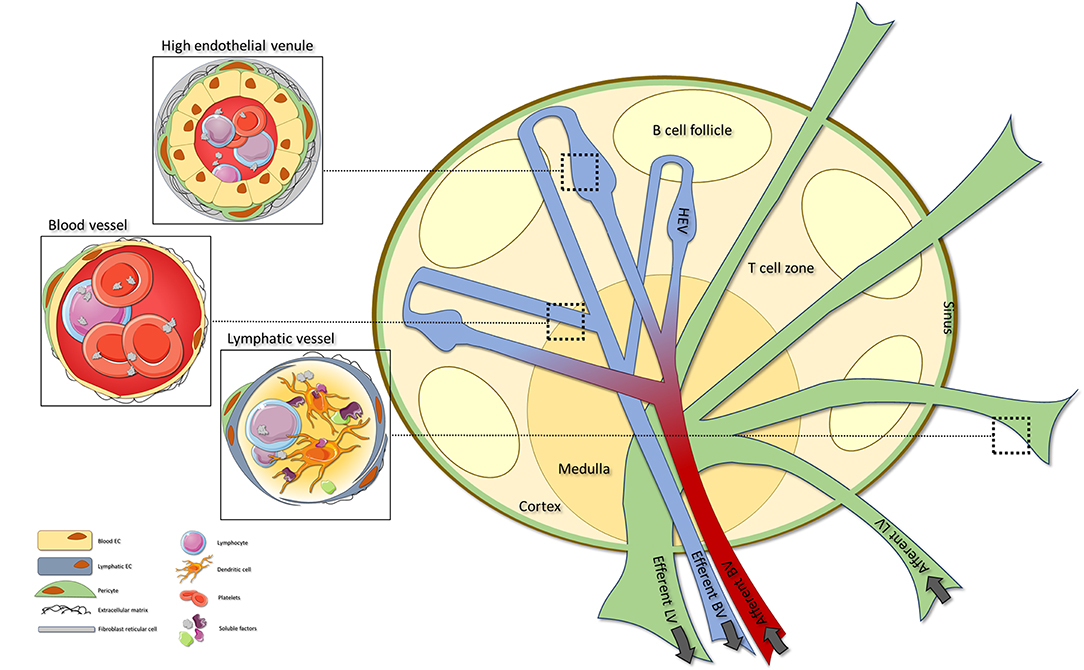
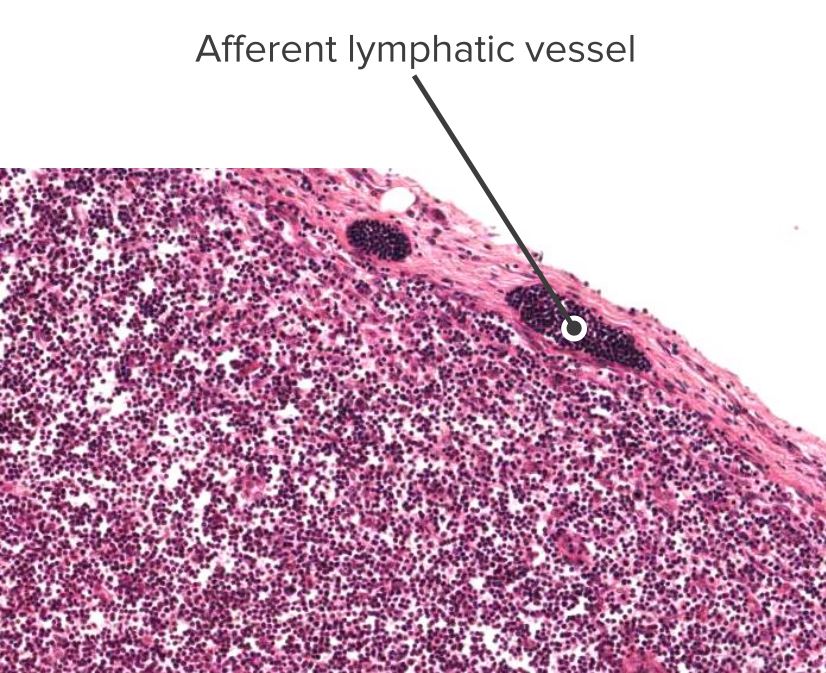
    • Los LOS Neisseria linfáticos aferentes entran en EN Erythema nodosum is an immune-mediated panniculitis (inflammation of the subcutaneous fat) caused by a type IV (delayed-type) hypersensitivity reaction. It commonly manifests in young women as tender, erythematous nodules on the shins. Erythema Nodosum la superficie convexa.
    • A través de la depresión cóncava (hilio):
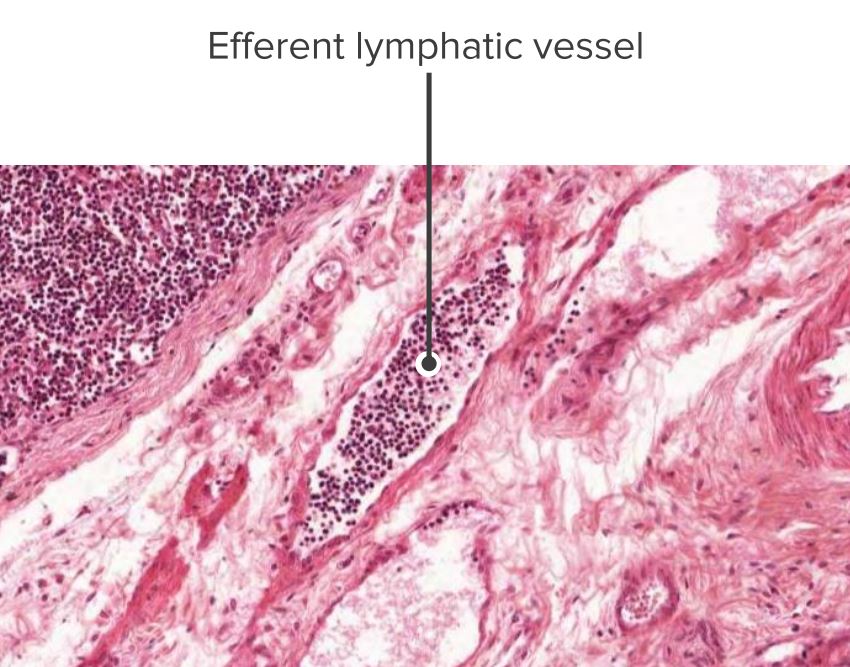
      • Los LOS Neisseria linfáticos eferentes salen del nódulo linfático.
      • Una arteria, una vena y un nervio penetran en EN Erythema nodosum is an immune-mediated panniculitis (inflammation of the subcutaneous fat) caused by a type IV (delayed-type) hypersensitivity reaction. It commonly manifests in young women as tender, erythematous nodules on the shins. Erythema Nodosum el nódulo linfático.
  • 2–20 mm de diámetro
  • 500–600 nódulos linfáticos en EN Erythema nodosum is an immune-mediated panniculitis (inflammation of the subcutaneous fat) caused by a type IV (delayed-type) hypersensitivity reaction. It commonly manifests in young women as tender, erythematous nodules on the shins. Erythema Nodosum el cuerpo
  • Se ven a lo largo de los LOS Neisseria vasos linfáticos, se forman en EN Erythema nodosum is an immune-mediated panniculitis (inflammation of the subcutaneous fat) caused by a type IV (delayed-type) hypersensitivity reaction. It commonly manifests in young women as tender, erythematous nodules on the shins. Erythema Nodosum cadenas o grupos (cuello, ingle, axilas, mesentéricos, abdomen)
Los ganglios linfáticos y el sistema linfático

Nódulos linfáticos y el sistema linfático

Imagen: “Blausen 0623 LymphaticSystem Female” por Blausen Licencia: CC BY 3.0

Funciones principales

La función principal de los LOS Neisseria nódulos linfáticos es la defensa contra la propagación de microorganismos y células tumorales:
  • Filtración de la linfa
  • Producción y recirculación de linfocitos
  • Desarrollo de células plasmáticas secretoras de anticuerpos
  • Crear entornos cerrados para la presentación de antígenos

Estructura general

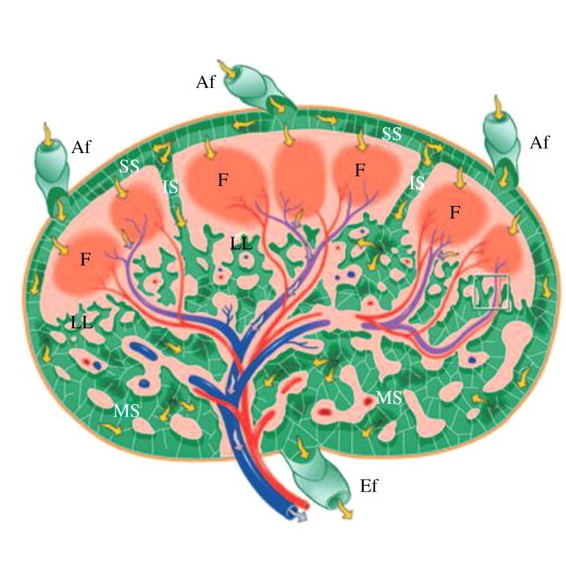
  • Cápsula externa (tejido conectivo denso):
    • Los LOS Neisseria vasos linfáticos aferentes penetran en EN Erythema nodosum is an immune-mediated panniculitis (inflammation of the subcutaneous fat) caused by a type IV (delayed-type) hypersensitivity reaction. It commonly manifests in young women as tender, erythematous nodules on the shins. Erythema Nodosum la cápsula.
    • Las trabéculas se extienden desde la cápsula exterior hacia el centro de los LOS Neisseria nódulos.
    • Los LOS Neisseria vasos sanguíneos penetran a través de las trabéculas.
  • Dentro de la cápsula:
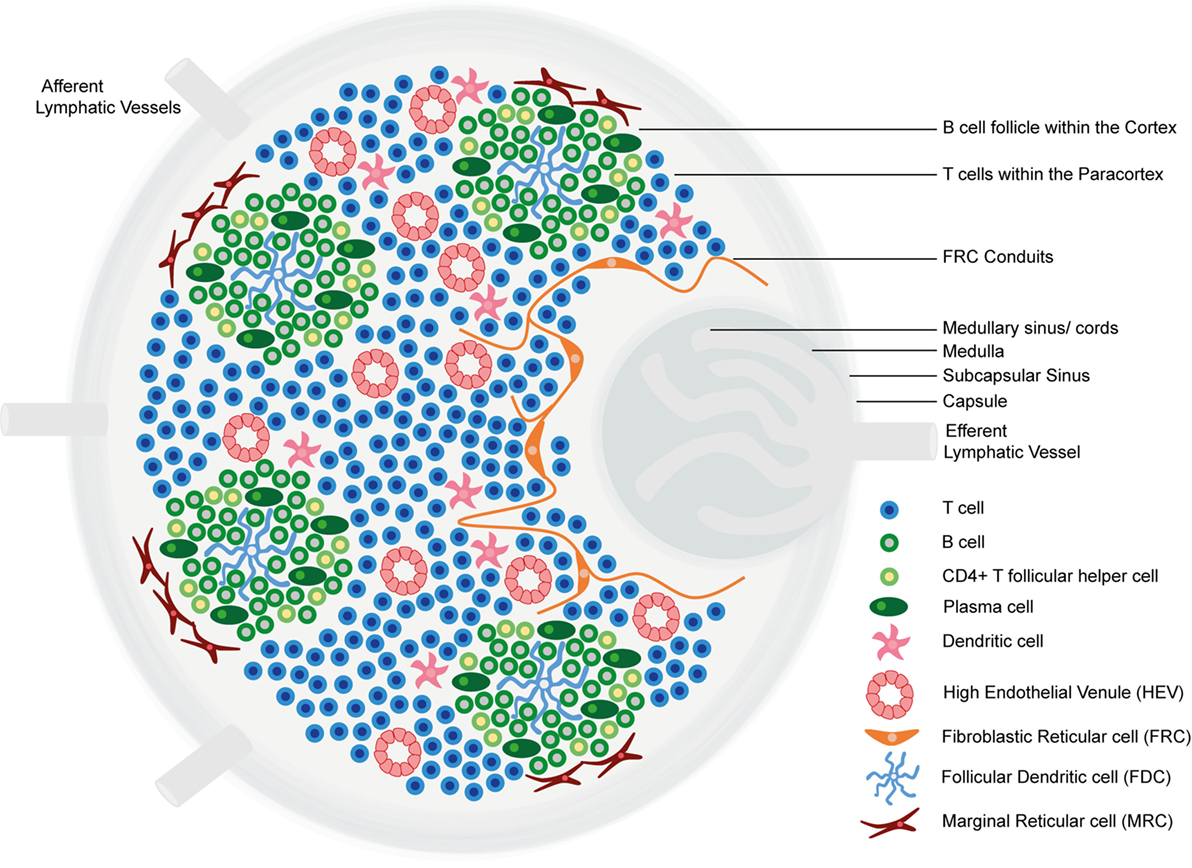
    • Células:
      • Linfocitos
      • Células plasmáticas
      • Células dendríticas
      • Macrófagos
      • Otras células presentadoras de antígenos
      • Células dendríticas foliculares
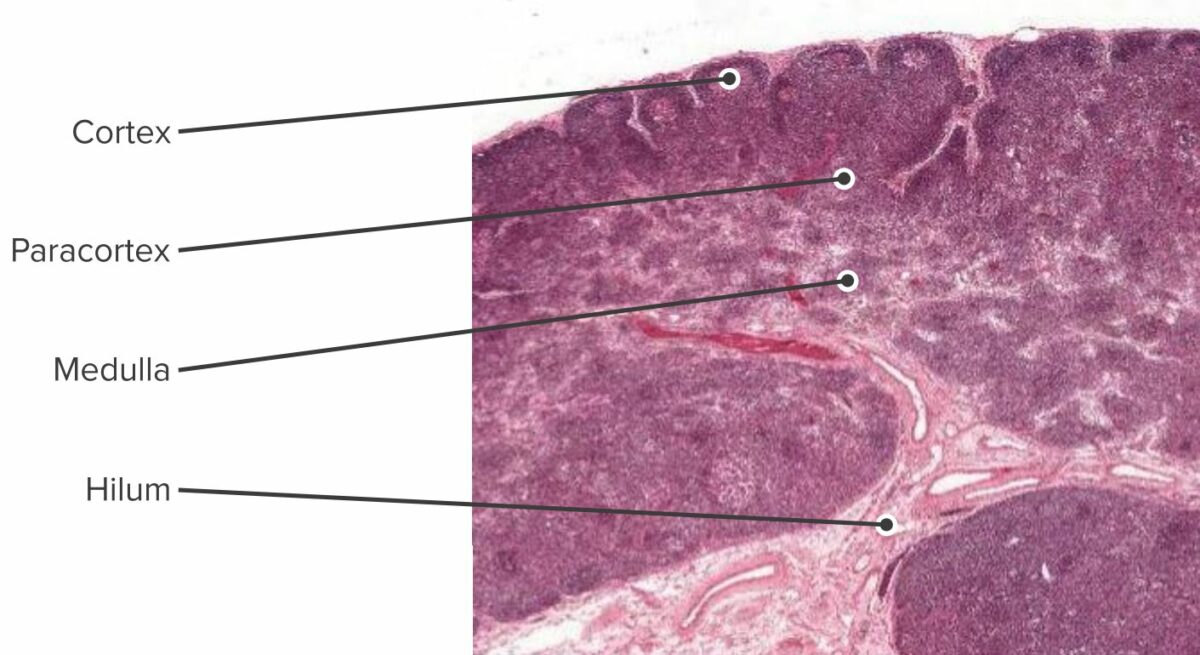
    • Las regiones están formadas por los LOS Neisseria arreglos celulares en EN Erythema nodosum is an immune-mediated panniculitis (inflammation of the subcutaneous fat) caused by a type IV (delayed-type) hypersensitivity reaction. It commonly manifests in young women as tender, erythematous nodules on the shins. Erythema Nodosum el estroma de las fibras de reticulina y las células reticulares: corteza, paracorteza y médula.
Corte histológico de un ganglio linfático identificando la cápsula y las trabéculas

Corte histológico de un nódulo linfático, identificando la cápsula y las trabéculas

Imagen por Geoffrey Meyer, editado por Lecturio.
Regiones funcionales

  • Corteza:
    • Seno subcapsular:
      • Estructura inmediatamente dentro de la cápsula
      • Los LOS Neisseria senos corticales (o senos trabeculares) penetran y se ramifican internamente a lo largo de las trabéculas.
      • A través de estos senos, la linfa (con antígenos, células presentadoras de antígenos y linfocitos) pasa y se filtra en EN Erythema nodosum is an immune-mediated panniculitis (inflammation of the subcutaneous fat) caused by a type IV (delayed-type) hypersensitivity reaction. It commonly manifests in young women as tender, erythematous nodules on the shins. Erythema Nodosum el tejido linfoide.
    • Nódulos linfoides (folículos):
      • Folículos primarios (inactivos): células B muy empaquetadas en EN Erythema nodosum is an immune-mediated panniculitis (inflammation of the subcutaneous fat) caused by a type IV (delayed-type) hypersensitivity reaction. It commonly manifests in young women as tender, erythematous nodules on the shins. Erythema Nodosum fibras reticulares
      • Folículos secundarios (activos): tienen centros germinales pálidos (sitio de proliferación de células B; contienen linfocitos, linfoblastos y células dendríticas foliculares)
  • Paracorteza:
    • Zona de células T
    • Región dentro de la corteza
    • Sin límites evidentes pero carece de folículos
    • Vénulas endoteliales altas:
      • El punto de entrada a los LOS Neisseria ganglios linfáticos para la mayoría de los LOS Neisseria linfocitos circulantes
      • Se encuentran principalmente en EN Erythema nodosum is an immune-mediated panniculitis (inflammation of the subcutaneous fat) caused by a type IV (delayed-type) hypersensitivity reaction. It commonly manifests in young women as tender, erythematous nodules on the shins. Erythema Nodosum la paracorteza
  • Médula:
    • Cordones medulares:
      • Masas compactas de linfocitos y células plasmáticas
      • Se extienden desde la paracorteza
    • Senos medulares:
      • Espacios dilatados que se continúan con los LOS Neisseria senos corticales
      • Contienen macrófagos y una malla de células reticulares (filtro final)
      • Convergen en EN Erythema nodosum is an immune-mediated panniculitis (inflammation of the subcutaneous fat) caused by a type IV (delayed-type) hypersensitivity reaction. It commonly manifests in young women as tender, erythematous nodules on the shins. Erythema Nodosum el hilio, convirtiéndose en EN Erythema nodosum is an immune-mediated panniculitis (inflammation of the subcutaneous fat) caused by a type IV (delayed-type) hypersensitivity reaction. It commonly manifests in young women as tender, erythematous nodules on the shins. Erythema Nodosum el vaso linfático eferente

Irrigación

  • La linfa viaja desde los LOS Neisseria linfáticos aferentes → seno subcapsular → senos trabeculares → senos medulares → linfáticos eferentes
  • Vénulas endoteliales altas:
    • El endotelio en EN Erythema nodosum is an immune-mediated panniculitis (inflammation of the subcutaneous fat) caused by a type IV (delayed-type) hypersensitivity reaction. It commonly manifests in young women as tender, erythematous nodules on the shins. Erythema Nodosum las vénulas endoteliales altas tiene moléculas de adhesión celular que ayudan en EN Erythema nodosum is an immune-mediated panniculitis (inflammation of the subcutaneous fat) caused by a type IV (delayed-type) hypersensitivity reaction. It commonly manifests in young women as tender, erythematous nodules on the shins. Erythema Nodosum la diapédesis de las células T.
    • Estas vénulas orquestan la extravasación de linfocitos hacia el ganglio linfático.
    • Después de ingresar al AL Amyloidosis tejido linfoide, las células T permanecen en EN Erythema nodosum is an immune-mediated panniculitis (inflammation of the subcutaneous fat) caused by a type IV (delayed-type) hypersensitivity reaction. It commonly manifests in young women as tender, erythematous nodules on the shins. Erythema Nodosum la paracorteza y las células B migran hacia los LOS Neisseria nódulos.

MALT

Anatomía

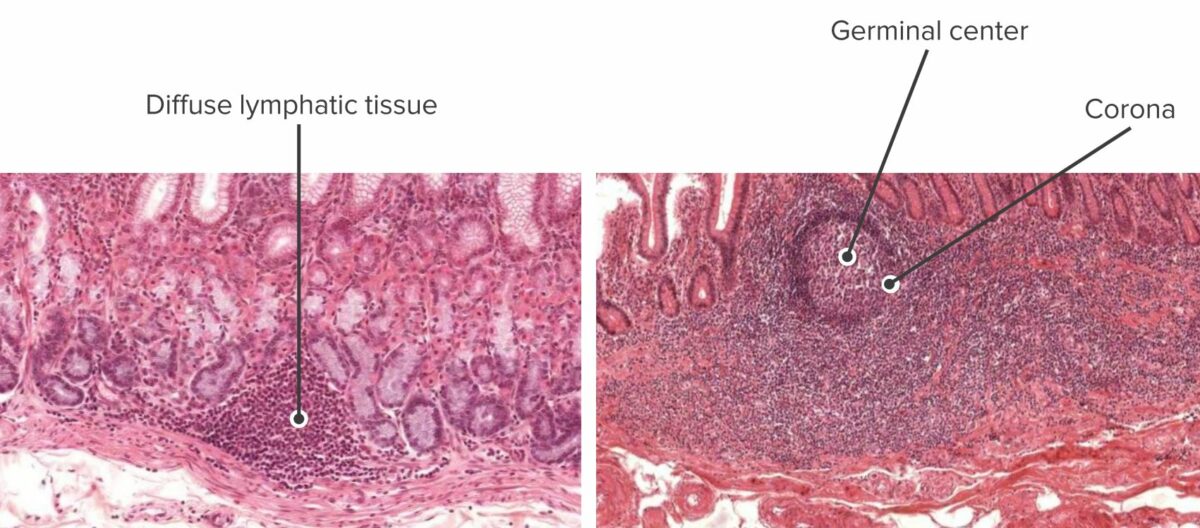
  • Colecciones de folículos linfoides debajo de los LOS Neisseria revestimientos mucosos que protegen contra los LOS Neisseria antígenos
  • Los LOS Neisseria folículos linfoides, similares a los LOS Neisseria ganglios linfáticos, tienen centros germinales.
  • Situado en EN Erythema nodosum is an immune-mediated panniculitis (inflammation of the subcutaneous fat) caused by a type IV (delayed-type) hypersensitivity reaction. It commonly manifests in young women as tender, erythematous nodules on the shins. Erythema Nodosum la mucosa digestiva, respiratoria o urogenital:
    • Tejido linfoide asociado al AL Amyloidosis tubo digestivo o intestino ( GALT GALT Secondary Lymphatic Organs, por sus siglas en EN Erythema nodosum is an immune-mediated panniculitis (inflammation of the subcutaneous fat) caused by a type IV (delayed-type) hypersensitivity reaction. It commonly manifests in young women as tender, erythematous nodules on the shins. Erythema Nodosum inglés): amígdalas, placas de Peyer, apéndice e infiltraciones linfocíticas a lo largo del tracto gastrointestinal
    • Respiratorio: tejido linfoide asociado a bronquios/tráquea ( BALT BALT Secondary Lymphatic Organs, por sus siglas en EN Erythema nodosum is an immune-mediated panniculitis (inflammation of the subcutaneous fat) caused by a type IV (delayed-type) hypersensitivity reaction. It commonly manifests in young women as tender, erythematous nodules on the shins. Erythema Nodosum inglés), tejido linfoide asociado a la nariz ( NALT NALT Secondary Lymphatic Organs, por sus siglas en EN Erythema nodosum is an immune-mediated panniculitis (inflammation of the subcutaneous fat) caused by a type IV (delayed-type) hypersensitivity reaction. It commonly manifests in young women as tender, erythematous nodules on the shins. Erythema Nodosum inglés)
    • Genitourinario: tejido linfoide asociado a vulvovaginal ( VALT VALT Secondary Lymphatic Organs, por sus siglas en EN Erythema nodosum is an immune-mediated panniculitis (inflammation of the subcutaneous fat) caused by a type IV (delayed-type) hypersensitivity reaction. It commonly manifests in young women as tender, erythematous nodules on the shins. Erythema Nodosum inglés)
  • Áreas comúnmente invadidas por patógenos debido a la fácil entrada a través de lúmenes abiertos al AL Amyloidosis ambiente externo
  • Contiene el 70% de las células inmunitarias del cuerpo; los LOS Neisseria linfocitos B son la población celular predominante.

Función principal

Montar una respuesta inmune contra los LOS Neisseria patógenos que se encuentran en EN Erythema nodosum is an immune-mediated panniculitis (inflammation of the subcutaneous fat) caused by a type IV (delayed-type) hypersensitivity reaction. It commonly manifests in young women as tender, erythematous nodules on the shins. Erythema Nodosum la mucosa de los LOS Neisseria tractos gastrointestinal, respiratorio y genitourinario.
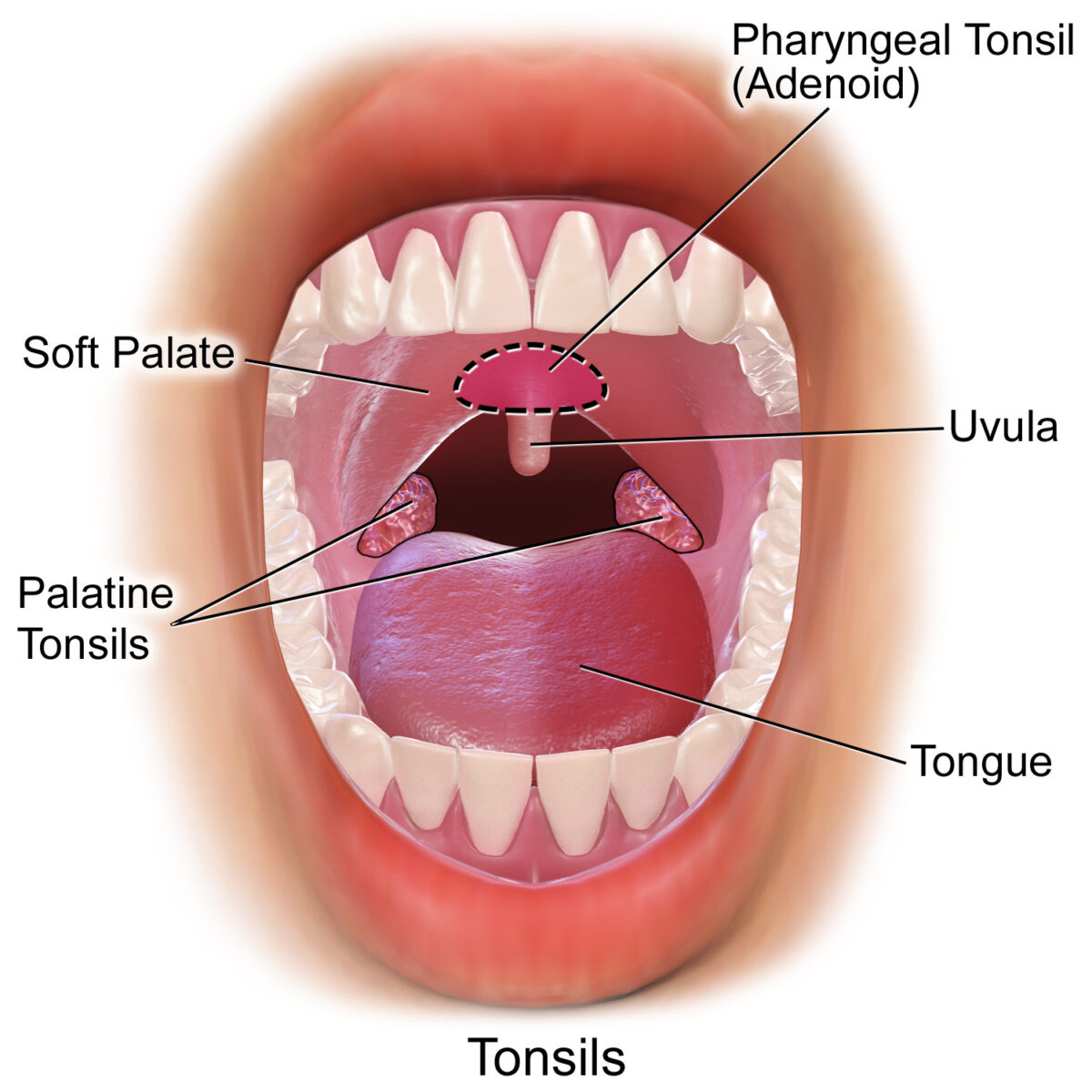
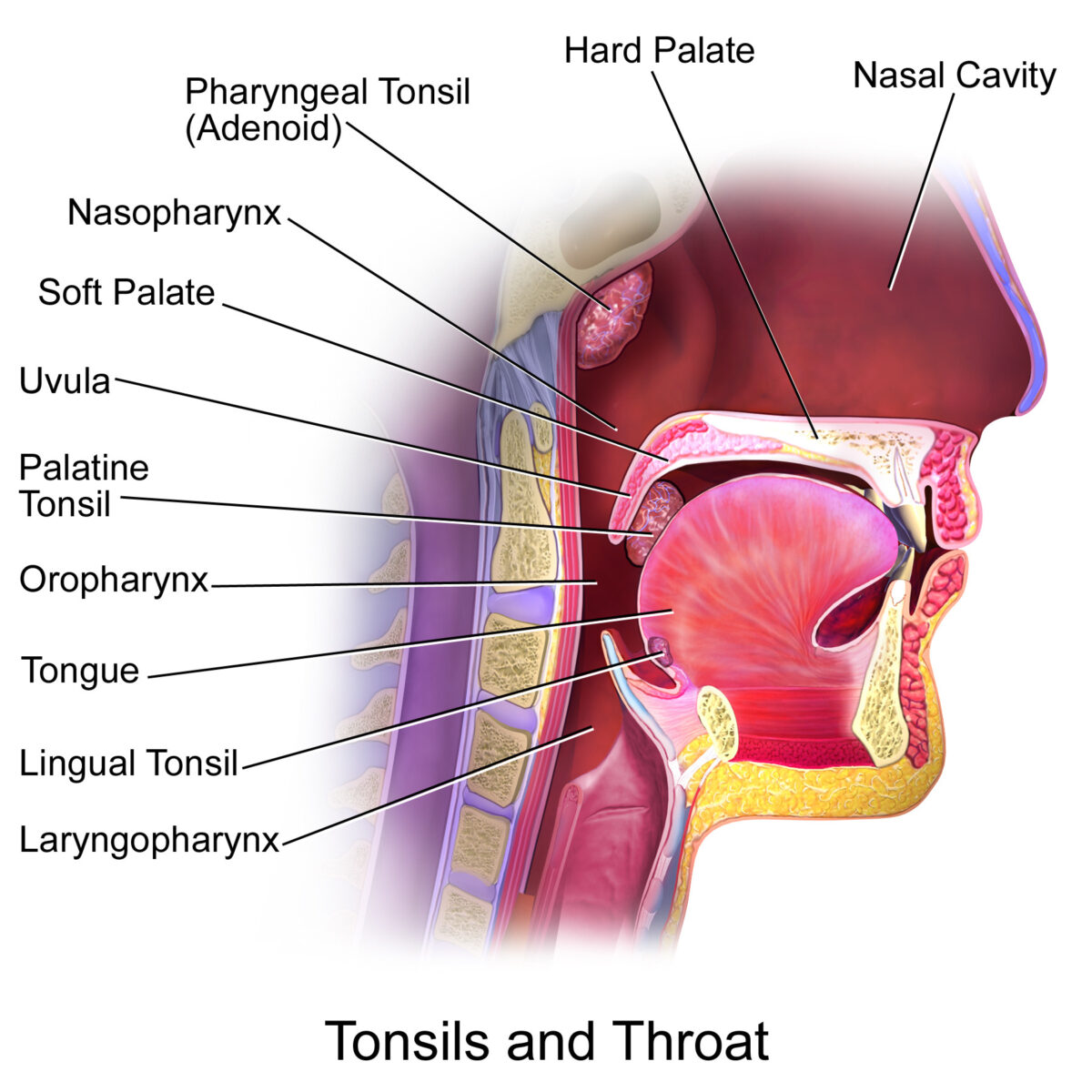
Estructura de las amígdalas

  • Colecciones grandes e irregulares de tejido linfoide dentro de la cavidad orofaríngea
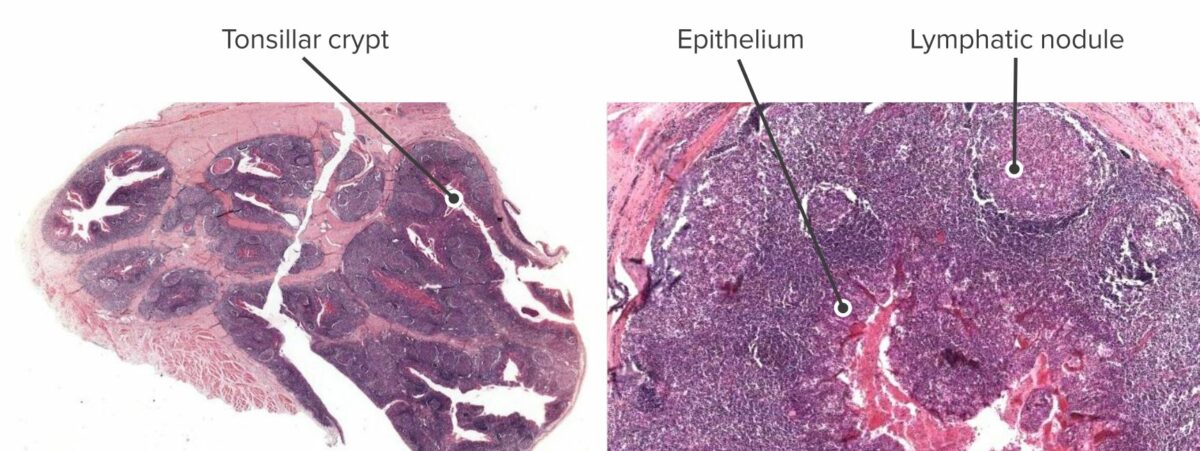
  • Presentan una pseudocápsula (formada de tejido conectivo condensado)
  • Superficies epiteliales variables, con depresiones profundas (criptas)
  • Anillo Waldeyer:
    • Grupo de tejidos linfoides en EN Erythema nodosum is an immune-mediated panniculitis (inflammation of the subcutaneous fat) caused by a type IV (delayed-type) hypersensitivity reaction. It commonly manifests in young women as tender, erythematous nodules on the shins. Erythema Nodosum la orofaringe que brindan protección inicial a los LOS Neisseria patógenos que ingresan por la boca
    • Amígdalas faríngeas:
      • Situadas en EN Erythema nodosum is an immune-mediated panniculitis (inflammation of the subcutaneous fat) caused by a type IV (delayed-type) hypersensitivity reaction. It commonly manifests in young women as tender, erythematous nodules on the shins. Erythema Nodosum la pared posterior de la nasofaringe
      • Revestidas por epitelio cilíndrico ciliado pseudoestratificado (epitelio respiratorio)
      • No tienen criptas
      • La inflamación crónica puede conducir a amígdalas (y adenoides) hipertrofiadas.
    • Amígdalas palatinas (amígdalas de las fauces):
      • Amígdalas pares en EN Erythema nodosum is an immune-mediated panniculitis (inflammation of the subcutaneous fat) caused by a type IV (delayed-type) hypersensitivity reaction. It commonly manifests in young women as tender, erythematous nodules on the shins. Erythema Nodosum la orofaringe lateral, posteriormente en EN Erythema nodosum is an immune-mediated panniculitis (inflammation of the subcutaneous fat) caused by a type IV (delayed-type) hypersensitivity reaction. It commonly manifests in young women as tender, erythematous nodules on the shins. Erythema Nodosum el paladar blando
      • Cubiertas por epitelio escamoso estratificado no queratinizado infiltrado con linfocitos
      • Con superficie lisa e invaginaciones (criptas) en EN Erythema nodosum is an immune-mediated panniculitis (inflammation of the subcutaneous fat) caused by a type IV (delayed-type) hypersensitivity reaction. It commonly manifests in young women as tender, erythematous nodules on the shins. Erythema Nodosum el parénquima amigdalino
      • Los LOS Neisseria folículos/nódulos se encuentran alrededor de las criptas.
    • Amígdalas tubáricas:
      • Pared lateral de la nasofaringe (alrededor de la abertura de la trompa de Eustaquio)
      • Forman la cara lateral superior del anillo de Waldeyer
      • Cubiertas por epitelio cilíndrico ciliado pseudoestratificado
      • Sin criptas
    • Amígdalas linguales:
      • Superficie del 3cio posterior de la lengua
      • Revestidas por epitelio escamoso estratificado no queratinizado

Estructura de las placas de Peyer y MALT MALT Colon, Cecum, and Appendix: Anatomy en EN Erythema nodosum is an immune-mediated panniculitis (inflammation of the subcutaneous fat) caused by a type IV (delayed-type) hypersensitivity reaction. It commonly manifests in young women as tender, erythematous nodules on the shins. Erythema Nodosum el apéndice

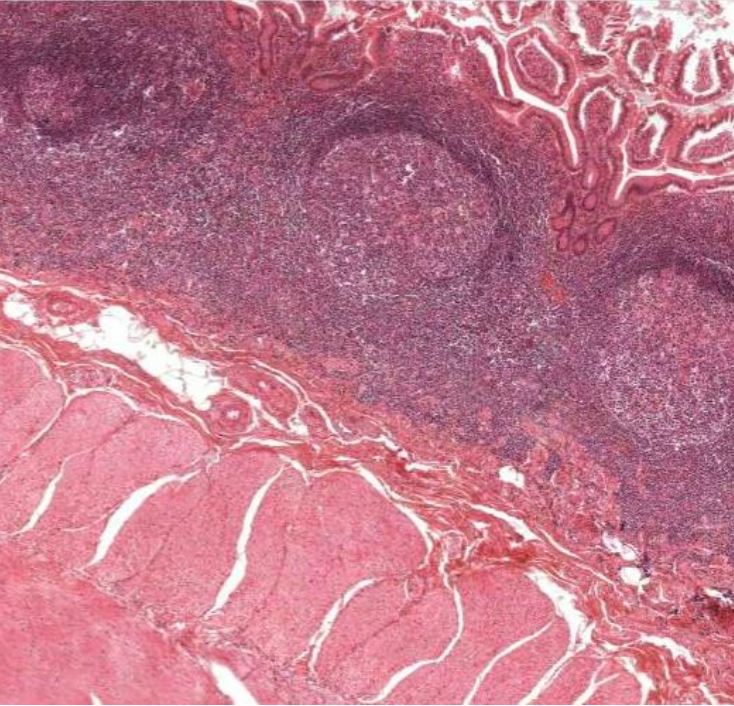
  • Placas de Peyer:
    • La mucosa del intestino delgado tiene muchas vellosidades salientes.
    • Grandes agregados de nódulos linfoides en EN Erythema nodosum is an immune-mediated panniculitis (inflammation of the subcutaneous fat) caused by a type IV (delayed-type) hypersensitivity reaction. It commonly manifests in young women as tender, erythematous nodules on the shins. Erythema Nodosum la lámina propia de la parte distal del intestino delgado (íleon)
    • Cubiertas por epitelio cilíndrico simple
    • Contienen células endoteliales especializadas llamadas células M (o con micropliegues):
      • Tienen una bolsa intraepitelial en EN Erythema nodosum is an immune-mediated panniculitis (inflammation of the subcutaneous fat) caused by a type IV (delayed-type) hypersensitivity reaction. It commonly manifests in young women as tender, erythematous nodules on the shins. Erythema Nodosum la superficie basolateral, que es claramente porosa para las poblaciones de linfocitos y células dendríticas.
      • Recogen antígenos del epitelio intestinal
      • Las células M se unen a los LOS Neisseria antígenos, que luego se someten a transcitosis, lo que expone los LOS Neisseria antígenos a las células inmunitarias.
      • Los LOS Neisseria antígenos son absorbidos por las células dendríticas y se presentan a las células T colaboradoras.
      • Las células T colaboradoras desencadenan que las células B se diferencien en EN Erythema nodosum is an immune-mediated panniculitis (inflammation of the subcutaneous fat) caused by a type IV (delayed-type) hypersensitivity reaction. It commonly manifests in young women as tender, erythematous nodules on the shins. Erythema Nodosum células plasmáticas (que producen anticuerpos inmunoglobulina A ( IgA IgA Represents 15-20% of the human serum immunoglobulins, mostly as the 4-chain polymer in humans or dimer in other mammals. Secretory iga is the main immunoglobulin in secretions. Immunoglobulins: Types and Functions)).
      • La IgA IgA Represents 15-20% of the human serum immunoglobulins, mostly as the 4-chain polymer in humans or dimer in other mammals. Secretory iga is the main immunoglobulin in secretions. Immunoglobulins: Types and Functions entra en EN Erythema nodosum is an immune-mediated panniculitis (inflammation of the subcutaneous fat) caused by a type IV (delayed-type) hypersensitivity reaction. It commonly manifests in young women as tender, erythematous nodules on the shins. Erythema Nodosum la luz intestinal, donde el antígeno se une y se neutraliza.
  • Apéndice:
    • Proyección cerrada, angosta y corta del ciego
    • Lleno de MALT MALT Colon, Cecum, and Appendix: Anatomy en EN Erythema nodosum is an immune-mediated panniculitis (inflammation of the subcutaneous fat) caused by a type IV (delayed-type) hypersensitivity reaction. It commonly manifests in young women as tender, erythematous nodules on the shins. Erythema Nodosum la mucosa
    • Pueden ocurrir casos de apendicitis con obstrucciones debidas a hiperplasia linfoide.

Bazo

Anatomía

  • El bazo es un órgano con forma de grano de café ubicado en EN Erythema nodosum is an immune-mediated panniculitis (inflammation of the subcutaneous fat) caused by a type IV (delayed-type) hypersensitivity reaction. It commonly manifests in young women as tender, erythematous nodules on the shins. Erythema Nodosum el cuadrante superior izquierdo del abdomen, debajo del diafragma.
  • Anterolateral al AL Amyloidosis riñón izquierdo
  • Protegido por las costillas 9na–11va
  • Aproximadamente 12 x 7 x 3 cm de tamaño
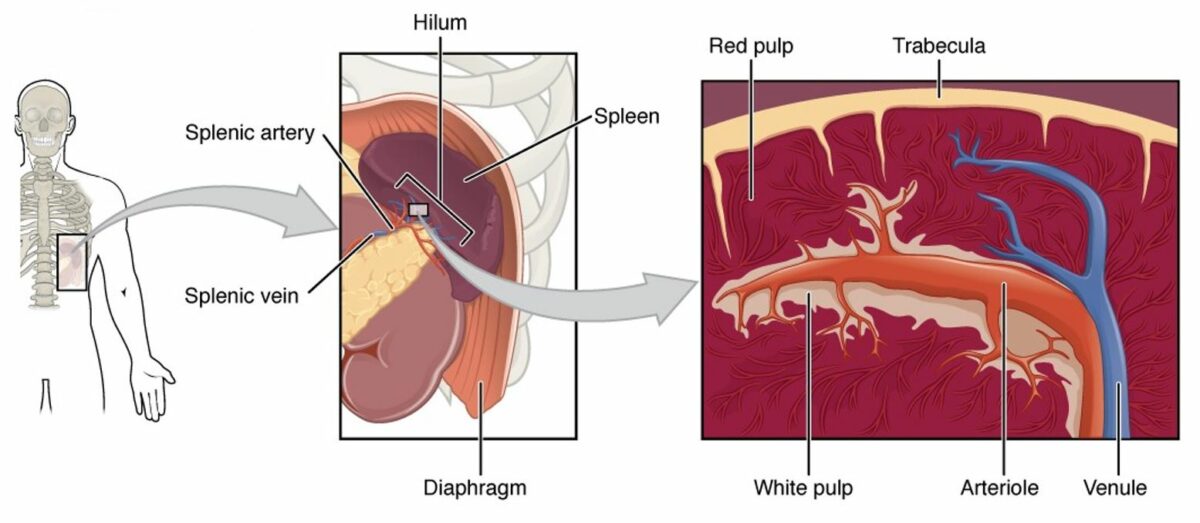
  • Hilio (superficie medial del bazo): donde entran la arteria esplénica y los LOS Neisseria nervios y salen la vena esplénica y los LOS Neisseria vasos linfáticos

Funciones principales

  • Sitio de producción de anticuerpos y linfocitos activados
  • Almacenamiento y descomposición de plaquetas
  • Almacena fagocitos mononucleares, filtrando gérmenes que se encuentran en EN Erythema nodosum is an immune-mediated panniculitis (inflammation of the subcutaneous fat) caused by a type IV (delayed-type) hypersensitivity reaction. It commonly manifests in young women as tender, erythematous nodules on the shins. Erythema Nodosum el torrente sanguíneo
  • Sitio de destrucción de eritrocitos viejos

Estructura

  • Cápsula:
    • Rodea el bazo
    • Tejido conectivo denso externo
    • Las trabéculas emergen y penetran en EN Erythema nodosum is an immune-mediated panniculitis (inflammation of the subcutaneous fat) caused by a type IV (delayed-type) hypersensitivity reaction. It commonly manifests in young women as tender, erythematous nodules on the shins. Erythema Nodosum el parénquima esplénico o pulpa esplénica.
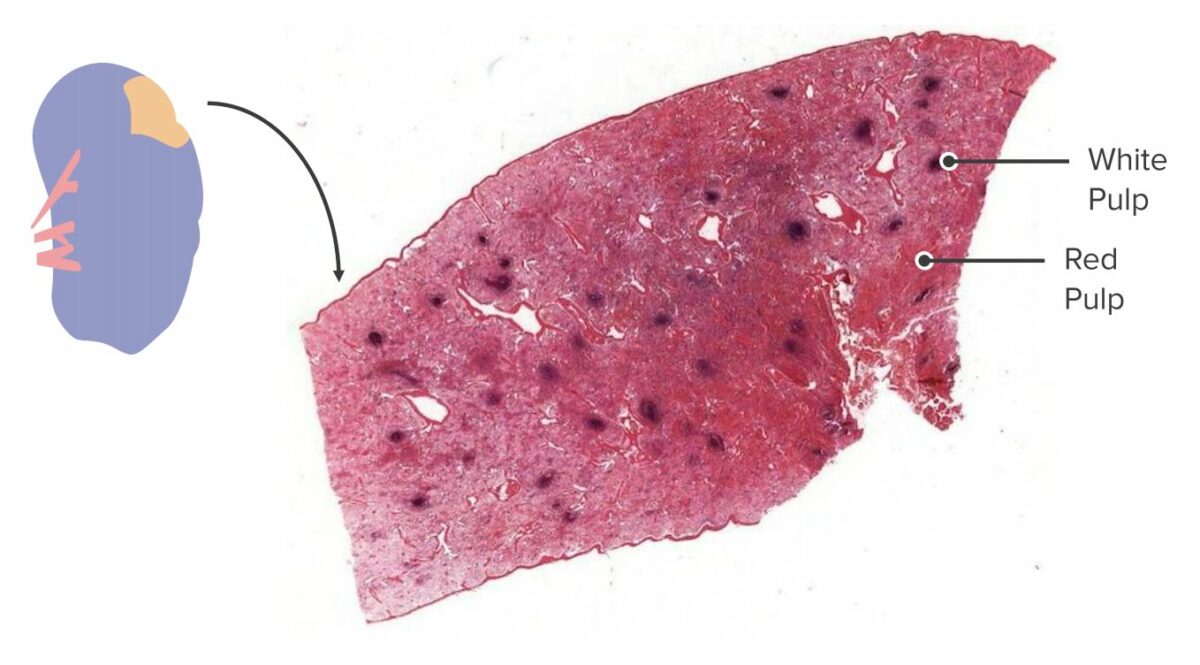
  • Pulpa roja:
    • Ocupa la mayor parte del órgano
    • Su color es debido al AL Amyloidosis alto contenido de células sanguíneas de todo tipo
    • Contiene principalmente cordones esplénicos llenos de sangre (de Billroth) y sinusoides
    • Cordones esplénicos:
      • Contienen tejido reticular con abundantes linfocitos T y B, macrófagos, otros leucocitos y eritrocitos
      • Separados por los LOS Neisseria sinusoides
    • Sinusoides esplénicos:
      • Canales vasculares largos
      • Revestidos por células endoteliales alargadas (separan los LOS Neisseria eritrocitos sanos de los LOS Neisseria ineficaces)
      • Las células que no pueden pasar entre las células endoteliales son eliminadas por los LOS Neisseria macrófagos.
  • Pulpa blanca:
    • Consiste principalmente en EN Erythema nodosum is an immune-mediated panniculitis (inflammation of the subcutaneous fat) caused by a type IV (delayed-type) hypersensitivity reaction. It commonly manifests in young women as tender, erythematous nodules on the shins. Erythema Nodosum nódulos linfoides y vainas linfoides periarteriolares
    • Vainas linfoides periarteriolares:
      • Células T con algunos macrófagos, células dendríticas y células plasmáticas que rodean las arteriolas centrales
      • Las arteriolas centrales son pequeñas ramas formadas a partir de la arteria trabecular.
    • Nódulos linfoides:
      • Se forman cuando las células B son activadas por antígenos en EN Erythema nodosum is an immune-mediated panniculitis (inflammation of the subcutaneous fat) caused by a type IV (delayed-type) hypersensitivity reaction. It commonly manifests in young women as tender, erythematous nodules on the shins. Erythema Nodosum la sangre.
      • Pueden desplazar la arteriola central hacia la periferia
  • La zona marginal es la región entre la pulpa blanca y la roja donde las células presentadoras de antígenos y los LOS Neisseria macrófagos capturan los LOS Neisseria antígenos.

Irrigación

  • Irrigación arterial:
    • Arteria esplénica (hilio) → arterias trabeculares → arteriolas centrales (pulpa blanca)
    • Las ramas salen de la pulpa blanca → entran en EN Erythema nodosum is an immune-mediated panniculitis (inflammation of the subcutaneous fat) caused by a type IV (delayed-type) hypersensitivity reaction. It commonly manifests in young women as tender, erythematous nodules on the shins. Erythema Nodosum la pulpa roja (arteriolas peniciladas) y pierden la vaina de linfocitos → capilares (algunos tienen una vaina de células presentadoras de antígenos)
    • Algunos capilares de las arteriolas peniciladas vierten sangre en EN Erythema nodosum is an immune-mediated panniculitis (inflammation of the subcutaneous fat) caused by a type IV (delayed-type) hypersensitivity reaction. It commonly manifests in young women as tender, erythematous nodules on the shins. Erythema Nodosum el estroma de los LOS Neisseria cordones esplénicos:
      • El plasma Plasma The residual portion of blood that is left after removal of blood cells by centrifugation without prior blood coagulation. Transfusion Products y otros elementos de la sangre regresan a la irrigación pasando a través de las células endoteliales hacia los LOS Neisseria sinusoides.
      • Las plaquetas funcionales, los LOS Neisseria leucocitos o los LOS Neisseria eritrocitos (que son flexibles) no tienen problemas para volver a entrar en EN Erythema nodosum is an immune-mediated panniculitis (inflammation of the subcutaneous fat) caused by a type IV (delayed-type) hypersensitivity reaction. It commonly manifests in young women as tender, erythematous nodules on the shins. Erythema Nodosum el vaso sanguíneo.
      • Los LOS Neisseria eritrocitos debilitados no pueden entrar y son eliminados por los LOS Neisseria macrófagos.
  • Posteriormente, la sangre sale del bazo a través de la vena esplénica.

Related videos

Relevancia Clínica

  • Linfoma de Hodgkin: malignidad de los LOS Neisseria linfocitos B que se origina en EN Erythema nodosum is an immune-mediated panniculitis (inflammation of the subcutaneous fat) caused by a type IV (delayed-type) hypersensitivity reaction. It commonly manifests in young women as tender, erythematous nodules on the shins. Erythema Nodosum los LOS Neisseria nódulos linfáticos. El hallazgo histológico patognomónico del linfoma de Hodgkin es la célula de Hodgkin Reed-Sternberg (célula B multinucleada gigante con inclusiones eosinofílicas). La enfermedad se presenta más comúnmente con linfadenopatía, sudores nocturnos, pérdida de peso, fiebre y, en EN Erythema nodosum is an immune-mediated panniculitis (inflammation of the subcutaneous fat) caused by a type IV (delayed-type) hypersensitivity reaction. It commonly manifests in young women as tender, erythematous nodules on the shins. Erythema Nodosum ocasiones, esplenomegalia y hepatomegalia. Las pruebas de diagnóstico incluyen análisis histológicos de los LOS Neisseria ganglios linfáticos que muestran células Hodgkin Reed-Sternberg. El linfoma de Hodgkin se trata con quimioterapia y radioterapia.
  • Amigdalitis: inflamación de la faringe o de las amígdalas faríngeas, por lo que también se denomina faringitis. Una etiología infecciosa en EN Erythema nodosum is an immune-mediated panniculitis (inflammation of the subcutaneous fat) caused by a type IV (delayed-type) hypersensitivity reaction. It commonly manifests in young women as tender, erythematous nodules on the shins. Erythema Nodosum el contexto de la amigdalitis se conoce como faringitis infecciosa, causada por virus Virus Viruses are infectious, obligate intracellular parasites composed of a nucleic acid core surrounded by a protein capsid. Viruses can be either naked (non-enveloped) or enveloped. The classification of viruses is complex and based on many factors, including type and structure of the nucleoid and capsid, the presence of an envelope, the replication cycle, and the host range. Virology (más común), bacterias u hongos. Entre las bacterias, el estreptococo hemolítico del grupo A es la causa más frecuente. La prueba de infección por estreptococos del grupo A en EN Erythema nodosum is an immune-mediated panniculitis (inflammation of the subcutaneous fat) caused by a type IV (delayed-type) hypersensitivity reaction. It commonly manifests in young women as tender, erythematous nodules on the shins. Erythema Nodosum el contexto de la amigdalitis es esencial, ya que esta infección puede provocar fiebre reumática y glomerulonefritis en EN Erythema nodosum is an immune-mediated panniculitis (inflammation of the subcutaneous fat) caused by a type IV (delayed-type) hypersensitivity reaction. It commonly manifests in young women as tender, erythematous nodules on the shins. Erythema Nodosum niños y adolescentes. Se recomienda el tratamiento con antibióticos en EN Erythema nodosum is an immune-mediated panniculitis (inflammation of the subcutaneous fat) caused by a type IV (delayed-type) hypersensitivity reaction. It commonly manifests in young women as tender, erythematous nodules on the shins. Erythema Nodosum una infección por estreptococos del grupo A confirmada para esta población.
  • Esplenomegalia: agrandamiento del bazo. La esplenomegalia es un hallazgo clínico que se puede observar en EN Erythema nodosum is an immune-mediated panniculitis (inflammation of the subcutaneous fat) caused by a type IV (delayed-type) hypersensitivity reaction. It commonly manifests in young women as tender, erythematous nodules on the shins. Erythema Nodosum trastornos como el linfoma, mononucleosis Mononucleosis Infectious mononucleosis (IM), also known as “the kissing disease,” is a highly contagious viral infection caused by the Epstein-Barr virus. Its common name is derived from its main method of transmission: the spread of infected saliva via kissing. Clinical manifestations of IM include fever, tonsillar pharyngitis, and lymphadenopathy. Mononucleosis infecciosa, sepsis Sepsis Systemic inflammatory response syndrome with a proven or suspected infectious etiology. When sepsis is associated with organ dysfunction distant from the site of infection, it is called severe sepsis. When sepsis is accompanied by hypotension despite adequate fluid infusion, it is called septic shock. Sepsis and Septic Shock y enfermedades reumáticas. La congestión esplénica (que puede ocurrir en EN Erythema nodosum is an immune-mediated panniculitis (inflammation of the subcutaneous fat) caused by a type IV (delayed-type) hypersensitivity reaction. It commonly manifests in young women as tender, erythematous nodules on the shins. Erythema Nodosum el contexto de la cirrosis hepática) y los LOS Neisseria tumores esplénicos son posibles causas de esplenomegalia.
  • Apendicitis: inflamación del apéndice vermiforme. En EN Erythema nodosum is an immune-mediated panniculitis (inflammation of the subcutaneous fat) caused by a type IV (delayed-type) hypersensitivity reaction. It commonly manifests in young women as tender, erythematous nodules on the shins. Erythema Nodosum pacientes jóvenes, el tejido linfoide debajo de la mucosa sufre un proceso de hiperplasia (aumento del número de células) que puede causar la obstrucción de la luz e iniciar la inflamación.

Referencias

  1. Ademokun, A., & Dunn-Walters, D. K. (2024). Age-related changes in lymphoid tissues: Implications for immune responses. Nature Reviews Immunology, 24(1), 45-57.
  2. Beltman, J. B., & Marée, A. F. M. (2023). Computational models of lymph node organization and function. Frontiers in Immunology, 14, 1123648.
  3. Bhattacharya, K., & Randall, T. D. (2025). Tertiary lymphoid structures in chronic inflammation and cancer. Journal of Experimental Medicine, 222(1), e20241867.
  4. Huang, Y., & Mebius, R. E. (2023). Development and function of secondary lymphoid organs. Annual Review of Immunology, 41, 433-458.
  5. Mescher, A. L. (Ed.). (2024). The immune system & lymphoid organs. In: Junqueira’s Basic Histology Text and Atlas (17th ed.). McGraw-Hill.
  6. Panneerselvam, D., & Budh, D. P. (2023). Peyer Patches. StatPearls. https://www.ncbi.nlm.nih.gov/books/NBK557457/
  7. Petrova, T. V., & Koh, G. Y. (2024). Lymphatic vessels in health and disease. Nature Reviews Molecular Cell Biology, 25(2), 112-125.
  8. Radtke, A. J., Chu, V. T., & Germain, R. N. (2024). High-dimensional imaging of immune cell dynamics in secondary lymphoid organs. Cell, 186(4), 729-743.
  9. Scoville, S., & Caligiuri, M. A. (2023). The organization and structure of lymphoid tissues. In: Kaushansky, K., et al. (Eds.), Williams Hematology (11th ed.). McGraw-Hill.
  10. Thieblemont, C., Molina, T., & Davi, F. (2023). Mucosa-associated lymphoid tissue lymphoma: From pathogenesis to therapy. Nature Reviews Clinical Oncology, 20(5), 319-335.
  11. Walker, J. A., & Spencer, S. C. (2025). Stromal cell networks in lymph node development and function. Trends in Immunology, 47(1), 18-31.
  12. Willard-Mack, C. L., Elmore, S. A., Hall, W. C., Harleman, J., Kuper, C. F., Losco, P., Rehg, J. E., Ruehl-Fehlert, C., Ward, J. M., & Weinstock, D. (2024). Best practices for evaluation of the immune system in nonclinical toxicity studies. Toxicologic Pathology, 52(1), 13-29.

¡Crea tu cuenta gratis o inicia una sesión para seguir leyendo!

Regístrate ahora y obtén acceso gratuito a Lecturio con páginas de concepto, videos médicos y cuestionarios para tu educación médica.

User Reviews

Que tengas una sesión de estudio alegre y navideña 🎁 Ahorra 50% en todos los planes >>

Details