Domina Conceptos Médicos

Estudia para la escuela de medicina y tus examenes con Lecturio.

Neurofibromatosis Tipo 2

La neurofibromatosis tipo 2 es un trastorno neurocutáneo que puede surgir de las mutaciones en EN Erythema nodosum is an immune-mediated panniculitis (inflammation of the subcutaneous fat) caused by a type IV (delayed-type) hypersensitivity reaction. It commonly manifests in young women as tender, erythematous nodules on the shins. Erythema Nodosum el gen NF2 NF2 Neurofibromatosis type 2 is a neurocutaneous disorder that can arise from mutations in the NF2 gene located in chromosome 22 and may be inherited in an autosomal dominant fashion or occur from de novo mutations. The main clinical features are bilateral vestibular schwannomas, intracranial/spinal meningioma, and intramedullary and extramedullary spinal tumors. Neurofibromatosis Type 2 localizado en EN Erythema nodosum is an immune-mediated panniculitis (inflammation of the subcutaneous fat) caused by a type IV (delayed-type) hypersensitivity reaction. It commonly manifests in young women as tender, erythematous nodules on the shins. Erythema Nodosum el cromosoma 22 y puede heredarse de forma autosómica dominante o deberse a mutaciones de novo. Las características clínicas principales son los LOS Neisseria schwannomas vestibulares bilaterales, el meningioma Meningioma Meningiomas are slow-growing tumors that arise from the meninges of the brain and spinal cord. The vast majority are benign. These tumors commonly occur in individuals with a history of high doses of skull radiation, head trauma, and neurofibromatosis 2. Meningioma intracraneal/espinal y los LOS Neisseria tumores espinales intramedulares y extramedulares. Otras características pueden incluir lesiones oculares como cataratas, lesiones cutáneas y neuropatía periférica. El diagnóstico se realiza clínicamente a partir de los LOS Neisseria antecedentes y el examen físico y se confirma con resonancia magnética (RM), pruebas moleculares e histopatología. Se recomienda la vigilancia del tumor Tumor Inflammation y el seguimiento con tamizaje cuando se detecta en EN Erythema nodosum is an immune-mediated panniculitis (inflammation of the subcutaneous fat) caused by a type IV (delayed-type) hypersensitivity reaction. It commonly manifests in young women as tender, erythematous nodules on the shins. Erythema Nodosum familiares en EN Erythema nodosum is an immune-mediated panniculitis (inflammation of the subcutaneous fat) caused by a type IV (delayed-type) hypersensitivity reaction. It commonly manifests in young women as tender, erythematous nodules on the shins. Erythema Nodosum riesgo. El tratamiento incluye intervenciones quirúrgicas, radioterapia y/o terapia de anticuerpos monoclonales con bevacizumab Bevacizumab An anti-vegf humanized murine monoclonal antibody. It inhibits vegf receptors and helps to prevent pathologic angiogenesis. Targeted and Other Nontraditional Antineoplastic Therapy.

Last updated: Dec 15, 2025

Editorial responsibility: Stanley Oiseth, Lindsay Jones, Evelin Maza

Descripción General

Epidemiología

  • La incidencia de la neurofibromatosis tipo 2 es de 1 en EN Erythema nodosum is an immune-mediated panniculitis (inflammation of the subcutaneous fat) caused by a type IV (delayed-type) hypersensitivity reaction. It commonly manifests in young women as tender, erythematous nodules on the shins. Erythema Nodosum 25 000.
  • Los LOS Neisseria schwannomas vestibulares bilaterales están presentes en EN Erythema nodosum is an immune-mediated panniculitis (inflammation of the subcutaneous fat) caused by a type IV (delayed-type) hypersensitivity reaction. It commonly manifests in young women as tender, erythematous nodules on the shins. Erythema Nodosum el 90%–95% de los LOS Neisseria individuos afectados.
  • Los LOS Neisseria meningiomas están presentes en EN Erythema nodosum is an immune-mediated panniculitis (inflammation of the subcutaneous fat) caused by a type IV (delayed-type) hypersensitivity reaction. It commonly manifests in young women as tender, erythematous nodules on the shins. Erythema Nodosum el 50% de los LOS Neisseria individuos afectados.
  • Las mutaciones de novo que ocurren en EN Erythema nodosum is an immune-mediated panniculitis (inflammation of the subcutaneous fat) caused by a type IV (delayed-type) hypersensitivity reaction. It commonly manifests in young women as tender, erythematous nodules on the shins. Erythema Nodosum ausencia de antecedentes familiares positivos están presentes en EN Erythema nodosum is an immune-mediated panniculitis (inflammation of the subcutaneous fat) caused by a type IV (delayed-type) hypersensitivity reaction. It commonly manifests in young women as tender, erythematous nodules on the shins. Erythema Nodosum > 50% de los LOS Neisseria individuos afectados.
  • Las mutaciones del gen NF2 NF2 Neurofibromatosis type 2 is a neurocutaneous disorder that can arise from mutations in the NF2 gene located in chromosome 22 and may be inherited in an autosomal dominant fashion or occur from de novo mutations. The main clinical features are bilateral vestibular schwannomas, intracranial/spinal meningioma, and intramedullary and extramedullary spinal tumors. Neurofibromatosis Type 2 se detectan en EN Erythema nodosum is an immune-mediated panniculitis (inflammation of the subcutaneous fat) caused by a type IV (delayed-type) hypersensitivity reaction. It commonly manifests in young women as tender, erythematous nodules on the shins. Erythema Nodosum > 93% de las familias, con varios miembros afectados con neurofibromatosis tipo 2.

Etiología

  • Causada por mutación del gen NF2 NF2 Neurofibromatosis type 2 is a neurocutaneous disorder that can arise from mutations in the NF2 gene located in chromosome 22 and may be inherited in an autosomal dominant fashion or occur from de novo mutations. The main clinical features are bilateral vestibular schwannomas, intracranial/spinal meningioma, and intramedullary and extramedullary spinal tumors. Neurofibromatosis Type 2 localizado en EN Erythema nodosum is an immune-mediated panniculitis (inflammation of the subcutaneous fat) caused by a type IV (delayed-type) hypersensitivity reaction. It commonly manifests in young women as tender, erythematous nodules on the shins. Erythema Nodosum el cromosoma 22
  • El gen anormal:
    • Puede transmitirse de 1 padre (autosómico dominante)
    • Puede ocurrir a través de mutaciones de novo
  • El riesgo de transmisión genética de padres a hijos es del 50%.

Patogénesis

  • Las mutaciones ocurren en EN Erythema nodosum is an immune-mediated panniculitis (inflammation of the subcutaneous fat) caused by a type IV (delayed-type) hypersensitivity reaction. It commonly manifests in young women as tender, erythematous nodules on the shins. Erythema Nodosum el gen NF2 NF2 Neurofibromatosis type 2 is a neurocutaneous disorder that can arise from mutations in the NF2 gene located in chromosome 22 and may be inherited in an autosomal dominant fashion or occur from de novo mutations. The main clinical features are bilateral vestibular schwannomas, intracranial/spinal meningioma, and intramedullary and extramedullary spinal tumors. Neurofibromatosis Type 2, localizado en EN Erythema nodosum is an immune-mediated panniculitis (inflammation of the subcutaneous fat) caused by a type IV (delayed-type) hypersensitivity reaction. It commonly manifests in young women as tender, erythematous nodules on the shins. Erythema Nodosum el cromosoma 22.
  • El gen NF2 NF2 Neurofibromatosis type 2 is a neurocutaneous disorder that can arise from mutations in the NF2 gene located in chromosome 22 and may be inherited in an autosomal dominant fashion or occur from de novo mutations. The main clinical features are bilateral vestibular schwannomas, intracranial/spinal meningioma, and intramedullary and extramedullary spinal tumors. Neurofibromatosis Type 2 codifica para merlina (schwannomina):
    • Proteína relacionada con la membrana celular
    • Actúa como un supresor tumoral
    • Se encuentra en EN Erythema nodosum is an immune-mediated panniculitis (inflammation of the subcutaneous fat) caused by a type IV (delayed-type) hypersensitivity reaction. It commonly manifests in young women as tender, erythematous nodules on the shins. Erythema Nodosum las células de Schwann
  • Las mutaciones conducen a la pérdida de la expresión de merlina, lo que permite la aparición de tumores en EN Erythema nodosum is an immune-mediated panniculitis (inflammation of the subcutaneous fat) caused by a type IV (delayed-type) hypersensitivity reaction. It commonly manifests in young women as tender, erythematous nodules on the shins. Erythema Nodosum el sistema nervioso central y sistema nervioso periférico
  • Hipótesis de 2 impactos:
    • Schwannomas y otros tumores ocurren solo después de la inactivación de ambos alelos NF2 NF2 Neurofibromatosis type 2 is a neurocutaneous disorder that can arise from mutations in the NF2 gene located in chromosome 22 and may be inherited in an autosomal dominant fashion or occur from de novo mutations. The main clinical features are bilateral vestibular schwannomas, intracranial/spinal meningioma, and intramedullary and extramedullary spinal tumors. Neurofibromatosis Type 2:
      • Los LOS Neisseria individuos afectados nacen con 1 alelo anormal.
      • Se adquieren anomalías del 2do alelo.
    • La pérdida de función adquirida en EN Erythema nodosum is an immune-mediated panniculitis (inflammation of the subcutaneous fat) caused by a type IV (delayed-type) hypersensitivity reaction. It commonly manifests in young women as tender, erythematous nodules on the shins. Erythema Nodosum todo el gen NF2 NF2 Neurofibromatosis type 2 is a neurocutaneous disorder that can arise from mutations in the NF2 gene located in chromosome 22 and may be inherited in an autosomal dominant fashion or occur from de novo mutations. The main clinical features are bilateral vestibular schwannomas, intracranial/spinal meningioma, and intramedullary and extramedullary spinal tumors. Neurofibromatosis Type 2 o en EN Erythema nodosum is an immune-mediated panniculitis (inflammation of the subcutaneous fat) caused by a type IV (delayed-type) hypersensitivity reaction. It commonly manifests in young women as tender, erythematous nodules on the shins. Erythema Nodosum el cromosoma 22 es la más común.
    • Las mutaciones puntuales del alelo de tipo salvaje ocurren con menor frecuencia.

Presentación Clínica

La presentación clínica de la neurofibromatosis tipo 2 puede variar ampliamente entre los LOS Neisseria individuos con mutaciones de novo y familias portadoras de mutaciones genéticas. Las edades de inicio a menor edad a menudo se asocian con una presentación atípica con síntomas más graves.
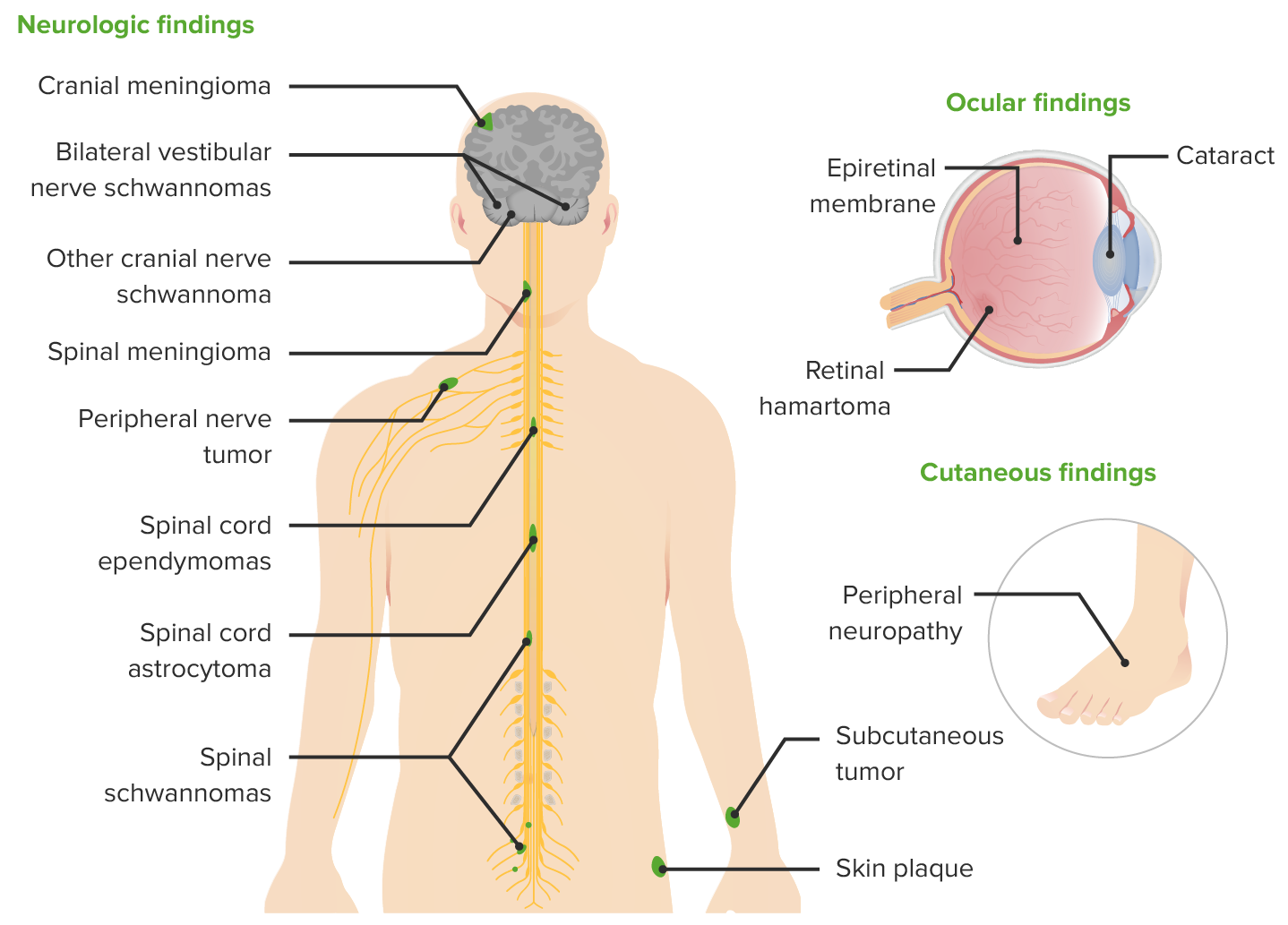
Manifestaciones clínicas de la NF2

Manifestaciones clínicas de la neurofibromatosis tipo 2

Imagen por Lecturio.
Edad de inicio

  • Inicio en EN Erythema nodosum is an immune-mediated panniculitis (inflammation of the subcutaneous fat) caused by a type IV (delayed-type) hypersensitivity reaction. It commonly manifests in young women as tender, erythematous nodules on the shins. Erythema Nodosum la infancia:
    • Manifestaciones visuales/oculares
    • Dolor Dolor Inflammation
    • Debilidad
    • Mononeuropatía
    • Tumores cutáneos
    • Convulsiones
  • Inicio en EN Erythema nodosum is an immune-mediated panniculitis (inflammation of the subcutaneous fat) caused by a type IV (delayed-type) hypersensitivity reaction. It commonly manifests in young women as tender, erythematous nodules on the shins. Erythema Nodosum la adultez (más comúnmente alrededor de los LOS Neisseria 20 años):
    • Pérdida de la audición
    • Tinnitus Tinnitus A nonspecific symptom of hearing disorder characterized by the sensation of buzzing, ringing, clicking, pulsations, and other noises in the ear. Objective tinnitus refers to noises generated from within the ear or adjacent structures that can be heard by other individuals. The term subjective tinnitus is used when the sound is audible only to the affected individual. Tinnitus may occur as a manifestation of cochlear diseases; vestibulocochlear nerve diseases; intracranial hypertension; craniocerebral trauma; and other conditions. Cranial Nerve Palsies

Lesiones neurológicas

  • Schwannomas vestibulares (nervio craneal VIII):
    • Presentes en EN Erythema nodosum is an immune-mediated panniculitis (inflammation of the subcutaneous fat) caused by a type IV (delayed-type) hypersensitivity reaction. It commonly manifests in young women as tender, erythematous nodules on the shins. Erythema Nodosum aproximadamente el 95% de los LOS Neisseria individuos afectados por neurofibromatosis tipo 2
    • Se desarrollan a los LOS Neisseria 30 años de edad
    • Típicamente bilaterales
    • Típicamente benignos
    • Síntomas:
      • Tinnitus Tinnitus A nonspecific symptom of hearing disorder characterized by the sensation of buzzing, ringing, clicking, pulsations, and other noises in the ear. Objective tinnitus refers to noises generated from within the ear or adjacent structures that can be heard by other individuals. The term subjective tinnitus is used when the sound is audible only to the affected individual. Tinnitus may occur as a manifestation of cochlear diseases; vestibulocochlear nerve diseases; intracranial hypertension; craniocerebral trauma; and other conditions. Cranial Nerve Palsies
      • Pérdida de la audición
      • Pérdida del balance/equilibrio
  • Schwannomas de otros nervios craneales:
    • Presentes en EN Erythema nodosum is an immune-mediated panniculitis (inflammation of the subcutaneous fat) caused by a type IV (delayed-type) hypersensitivity reaction. It commonly manifests in young women as tender, erythematous nodules on the shins. Erythema Nodosum 25%–50% de los LOS Neisseria individuos afectados por neurofibromatosis tipo 2
    • No se observan en EN Erythema nodosum is an immune-mediated panniculitis (inflammation of the subcutaneous fat) caused by a type IV (delayed-type) hypersensitivity reaction. It commonly manifests in young women as tender, erythematous nodules on the shins. Erythema Nodosum el nervio craneal I o nervio craneal II (ausencia de células de Schwann)
    • Causan parálisis compresivas de los LOS Neisseria nervios craneales
    • Se observan más comúnmente en EN Erythema nodosum is an immune-mediated panniculitis (inflammation of the subcutaneous fat) caused by a type IV (delayed-type) hypersensitivity reaction. It commonly manifests in young women as tender, erythematous nodules on the shins. Erythema Nodosum:
      • Nervio craneal III (oculomotor)
      • Nervio craneal V (trigémino)
      • Nervio craneal VII (facial)
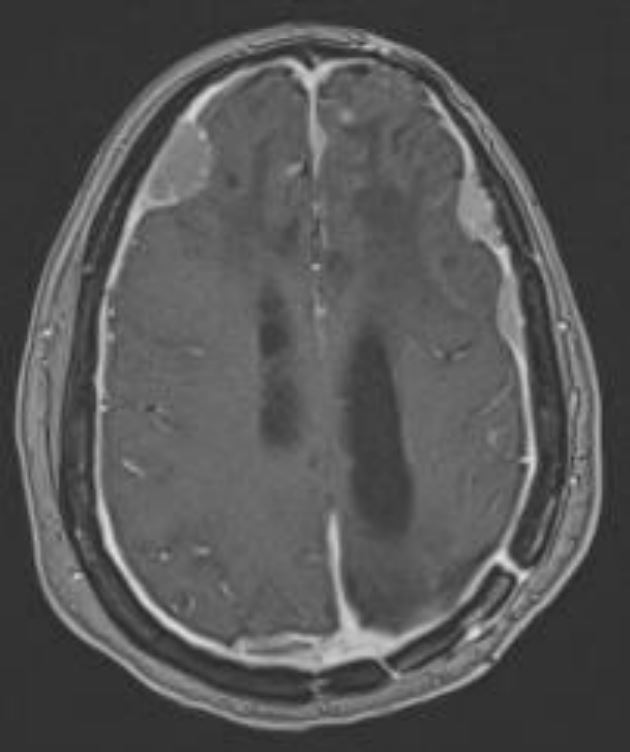
  • Meningioma Meningioma Meningiomas are slow-growing tumors that arise from the meninges of the brain and spinal cord. The vast majority are benign. These tumors commonly occur in individuals with a history of high doses of skull radiation, head trauma, and neurofibromatosis 2. Meningioma intracraneal:
    • Presente en EN Erythema nodosum is an immune-mediated panniculitis (inflammation of the subcutaneous fat) caused by a type IV (delayed-type) hypersensitivity reaction. It commonly manifests in young women as tender, erythematous nodules on the shins. Erythema Nodosum un 45%–60% de los LOS Neisseria individuos afectados por neurofibromatosis tipo 2
    • A menudo son múltiples
    • Se desarrolla en EN Erythema nodosum is an immune-mediated panniculitis (inflammation of the subcutaneous fat) caused by a type IV (delayed-type) hypersensitivity reaction. It commonly manifests in young women as tender, erythematous nodules on the shins. Erythema Nodosum la neurofibromatosis tipo 2 a una edad más temprana que en EN Erythema nodosum is an immune-mediated panniculitis (inflammation of the subcutaneous fat) caused by a type IV (delayed-type) hypersensitivity reaction. It commonly manifests in young women as tender, erythematous nodules on the shins. Erythema Nodosum los LOS Neisseria casos esporádicos
    • Los LOS Neisseria síntomas dependen de la localización y el tamaño:
      • Déficits neurológicos focales
      • Obstrucción del flujo de líquido cefalorraquídeo (LCR)
      • Convulsiones
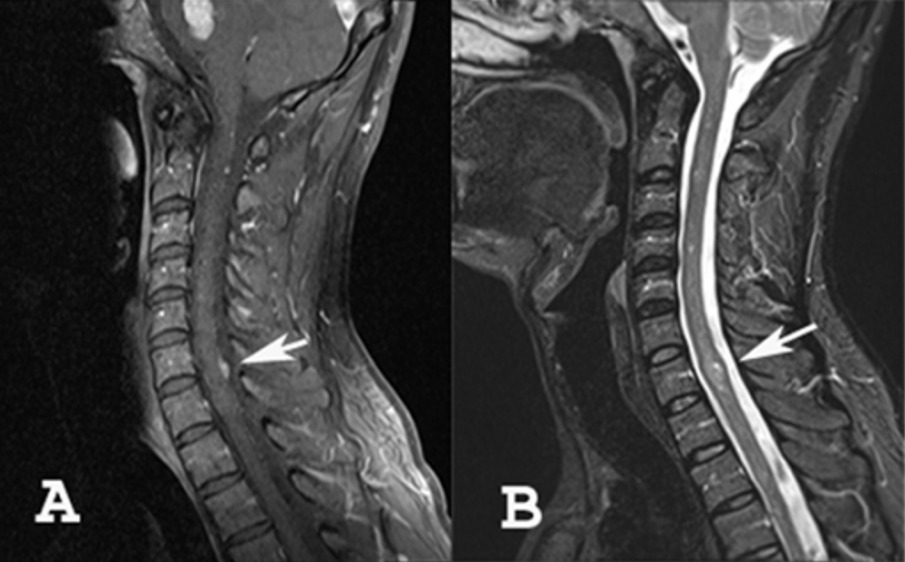
  • Meningioma Meningioma Meningiomas are slow-growing tumors that arise from the meninges of the brain and spinal cord. The vast majority are benign. These tumors commonly occur in individuals with a history of high doses of skull radiation, head trauma, and neurofibromatosis 2. Meningioma espinal:
    • Presente en EN Erythema nodosum is an immune-mediated panniculitis (inflammation of the subcutaneous fat) caused by a type IV (delayed-type) hypersensitivity reaction. It commonly manifests in young women as tender, erythematous nodules on the shins. Erythema Nodosum aproximadamente el 20% de los LOS Neisseria individuos afectados por neurofibromatosis tipo 2
    • Surge del espacio extramedular
    • Los LOS Neisseria síntomas dependen de la localización y el tamaño:
      • Dolor Dolor Inflammation de espalda
      • Dolor Dolor Inflammation en EN Erythema nodosum is an immune-mediated panniculitis (inflammation of the subcutaneous fat) caused by a type IV (delayed-type) hypersensitivity reaction. It commonly manifests in young women as tender, erythematous nodules on the shins. Erythema Nodosum las raíces nerviosas/parestesia
      • Debilidad/parálisis muscular
      • Obstrucción del flujo de LCR
  • Ependimomas espinales:
    • Presentes en EN Erythema nodosum is an immune-mediated panniculitis (inflammation of the subcutaneous fat) caused by a type IV (delayed-type) hypersensitivity reaction. It commonly manifests in young women as tender, erythematous nodules on the shins. Erythema Nodosum el 20%–50% de los LOS Neisseria individuos afectados por neurofibromatosis tipo 2
    • Típicamente surgen del espacio intramedular
    • Los LOS Neisseria síntomas dependen de la localización y el tamaño:
      • Dolor Dolor Inflammation de espalda
      • Dolor Dolor Inflammation en EN Erythema nodosum is an immune-mediated panniculitis (inflammation of the subcutaneous fat) caused by a type IV (delayed-type) hypersensitivity reaction. It commonly manifests in young women as tender, erythematous nodules on the shins. Erythema Nodosum las raíces nerviosas/parestesia
      • Debilidad/parálisis muscular
      • Obstrucción del flujo de LCR
  • Neuropatía periférica:
    • Presente en EN Erythema nodosum is an immune-mediated panniculitis (inflammation of the subcutaneous fat) caused by a type IV (delayed-type) hypersensitivity reaction. It commonly manifests in young women as tender, erythematous nodules on the shins. Erythema Nodosum > 65% de los LOS Neisseria individuos afectados por neurofibromatosis tipo 2
    • Puede presentarse como una neuropatía por compresión (mononeuropatía)
    • Puede presentarse como una mononeuropatía múltiple
    • Puede presentarse como una neuropatía sensitivomotora sistémica (no focal)
    • Los LOS Neisseria síntomas de la mononeuropatía dependen del nervio o nervios afectados.
    • Síntomas de la polineuropatía sistémica:
      • Dolor Dolor Inflammation neuropático/parestesias/pérdida sensorial en EN Erythema nodosum is an immune-mediated panniculitis (inflammation of the subcutaneous fat) caused by a type IV (delayed-type) hypersensitivity reaction. It commonly manifests in young women as tender, erythematous nodules on the shins. Erythema Nodosum una distribución de guante y calcetín
      • Pérdida de fuerza, coordinación, destreza en EN Erythema nodosum is an immune-mediated panniculitis (inflammation of the subcutaneous fat) caused by a type IV (delayed-type) hypersensitivity reaction. It commonly manifests in young women as tender, erythematous nodules on the shins. Erythema Nodosum una distribución de guante y calcetín

Lesiones oculares

  • Cataratas:
    • Presentes en EN Erythema nodosum is an immune-mediated panniculitis (inflammation of the subcutaneous fat) caused by a type IV (delayed-type) hypersensitivity reaction. It commonly manifests in young women as tender, erythematous nodules on the shins. Erythema Nodosum el 60%–80% de los LOS Neisseria individuos afectados por neurofibromatosis tipo 2
    • Se presentan con pérdida visual, opacidad del cristalino
  • Membranas epirretinianas:
    • Presentes en EN Erythema nodosum is an immune-mediated panniculitis (inflammation of the subcutaneous fat) caused by a type IV (delayed-type) hypersensitivity reaction. It commonly manifests in young women as tender, erythematous nodules on the shins. Erythema Nodosum aproximadamente el 80% de los LOS Neisseria individuos afectados por neurofibromatosis tipo 2
    • Membranas blancas/grises con bordes blancos distintivos
    • Pueden ser translúcidas o semitranslúcidas
    • Típicamente, no interfieren con la visión
  • Hamartomas de retina Retina The ten-layered nervous tissue membrane of the eye. It is continuous with the optic nerve and receives images of external objects and transmits visual impulses to the brain. Its outer surface is in contact with the choroid and the inner surface with the vitreous body. The outermost layer is pigmented, whereas the inner nine layers are transparent. Eye: Anatomy:
    • Presentes en EN Erythema nodosum is an immune-mediated panniculitis (inflammation of the subcutaneous fat) caused by a type IV (delayed-type) hypersensitivity reaction. It commonly manifests in young women as tender, erythematous nodules on the shins. Erythema Nodosum el 5%–20% de los LOS Neisseria individuos afectados por neurofibromatosis tipo 2
    • Afectan la mácula
    • Se presentan con pérdida visual

Lesiones de la piel

  • Pueden ocurrir en EN Erythema nodosum is an immune-mediated panniculitis (inflammation of the subcutaneous fat) caused by a type IV (delayed-type) hypersensitivity reaction. It commonly manifests in young women as tender, erythematous nodules on the shins. Erythema Nodosum cualquier lugar, sin área particular de predilección
  • Los LOS Neisseria tumores de piel más comunes son los LOS Neisseria schwannomas, aunque se pueden observar neurofibromas o histología mixta.
  • Placas en EN Erythema nodosum is an immune-mediated panniculitis (inflammation of the subcutaneous fat) caused by a type IV (delayed-type) hypersensitivity reaction. It commonly manifests in young women as tender, erythematous nodules on the shins. Erythema Nodosum la piel:
    • Presentes en EN Erythema nodosum is an immune-mediated panniculitis (inflammation of the subcutaneous fat) caused by a type IV (delayed-type) hypersensitivity reaction. It commonly manifests in young women as tender, erythematous nodules on the shins. Erythema Nodosum el 40%–50% de los LOS Neisseria individuos afectados por neurofibromatosis tipo 2
    • Lesiones circunscritas, ligeramente elevadas, ligeramente hiperpigmentadas, escamosas y ásperas
    • Típicamente < 2 cm de diámetro
  • Tumores subcutáneos:
    • Presentes en EN Erythema nodosum is an immune-mediated panniculitis (inflammation of the subcutaneous fat) caused by a type IV (delayed-type) hypersensitivity reaction. It commonly manifests in young women as tender, erythematous nodules on the shins. Erythema Nodosum el 40%–50% de los LOS Neisseria individuos afectados por neurofibromatosis tipo 2
    • Se desarrollan como inflamación a lo largo de los LOS Neisseria nervios periféricos
    • Pueden palparse como tumefacciones fusiformes o nodulares
    • Puede notarse hipersensibilidad a la palpación.
  • Tumores intradérmicos:
    • Presentes en EN Erythema nodosum is an immune-mediated panniculitis (inflammation of the subcutaneous fat) caused by a type IV (delayed-type) hypersensitivity reaction. It commonly manifests in young women as tender, erythematous nodules on the shins. Erythema Nodosum el 60%–70% de los LOS Neisseria individuos afectados por neurofibromatosis tipo 2
    • Lesiones superficiales bien delimitadas de coloración azul/morada
    • Suaves a la palpación

Diagnóstico

Criterios clínicos para la neurofibromatosis tipo 2 (criterios de Manchester revisados)

  • 1 Cualquiera de los LOS Neisseria siguientes:
    • Schwannoma Schwannoma Schwannomas (also known as neurilemmomas) are benign nerve sheath tumors in the peripheral nervous system (PNS), arising from Schwann cells that encase the peripheral nerves. Schwannomas are the most common tumors in the PNS. Schwannoma vestibular bilateral < 70 años
    • Schwannoma Schwannoma Schwannomas (also known as neurilemmomas) are benign nerve sheath tumors in the peripheral nervous system (PNS), arising from Schwann cells that encase the peripheral nerves. Schwannomas are the most common tumors in the PNS. Schwannoma vestibular unilateral < 70 años y familiar de 1er grado (no un hermano) con neurofibromatosis tipo 2
  • 2 Cualquiera de los LOS Neisseria siguientes:
    • Meningioma Meningioma Meningiomas are slow-growing tumors that arise from the meninges of the brain and spinal cord. The vast majority are benign. These tumors commonly occur in individuals with a history of high doses of skull radiation, head trauma, and neurofibromatosis 2. Meningioma, schwannoma Schwannoma Schwannomas (also known as neurilemmomas) are benign nerve sheath tumors in the peripheral nervous system (PNS), arising from Schwann cells that encase the peripheral nerves. Schwannomas are the most common tumors in the PNS. Schwannoma no vestibular, ependimoma, cataratas; y
    • Familiar de 1er grado con neurofibromatosis tipo 2 o schwannoma Schwannoma Schwannomas (also known as neurilemmomas) are benign nerve sheath tumors in the peripheral nervous system (PNS), arising from Schwann cells that encase the peripheral nerves. Schwannomas are the most common tumors in the PNS. Schwannoma vestibular unilateral y prueba LZTR1 negativa (si ≥ 2 schwannomas no intradérmicos)
  • Otros criterios:
    • Meningioma Meningioma Meningiomas are slow-growing tumors that arise from the meninges of the brain and spinal cord. The vast majority are benign. These tumors commonly occur in individuals with a history of high doses of skull radiation, head trauma, and neurofibromatosis 2. Meningioma múltiple y:
      • Schwannoma Schwannoma Schwannomas (also known as neurilemmomas) are benign nerve sheath tumors in the peripheral nervous system (PNS), arising from Schwann cells that encase the peripheral nerves. Schwannomas are the most common tumors in the PNS. Schwannoma vestibular unilateral o
      • 2 Criterios cualquiera de los LOS Neisseria siguientes: schwannoma Schwannoma Schwannomas (also known as neurilemmomas) are benign nerve sheath tumors in the peripheral nervous system (PNS), arising from Schwann cells that encase the peripheral nerves. Schwannomas are the most common tumors in the PNS. Schwannoma no vestibular, ependimoma, cataratas
    • Mutación del gen NF2 NF2 Neurofibromatosis type 2 is a neurocutaneous disorder that can arise from mutations in the NF2 gene located in chromosome 22 and may be inherited in an autosomal dominant fashion or occur from de novo mutations. The main clinical features are bilateral vestibular schwannomas, intracranial/spinal meningioma, and intramedullary and extramedullary spinal tumors. Neurofibromatosis Type 2 patogénica constitucional o mosaicismo de la sangre o por la identificación de una mutación idéntica en EN Erythema nodosum is an immune-mediated panniculitis (inflammation of the subcutaneous fat) caused by a type IV (delayed-type) hypersensitivity reaction. It commonly manifests in young women as tender, erythematous nodules on the shins. Erythema Nodosum 2 tumores distintos en EN Erythema nodosum is an immune-mediated panniculitis (inflammation of the subcutaneous fat) caused by a type IV (delayed-type) hypersensitivity reaction. It commonly manifests in young women as tender, erythematous nodules on the shins. Erythema Nodosum el mismo individuo

Diagnóstico clínico

  • Antecedentes clínicos y familiares detallados
  • Examen físico:
    • Evaluación auditiva
    • Evaluación oftálmica
    • Examen neurológico
    • Examen de la piel

Pruebas moleculares

  • Indicaciones:
    • Familiar de 1er grado con neurofibromatosis tipo 2
    • Presencia de múltiples tumores espinales
    • Presencia de schwannomas cutáneos
    • Presencia de schwannoma Schwannoma Schwannomas (also known as neurilemmomas) are benign nerve sheath tumors in the peripheral nervous system (PNS), arising from Schwann cells that encase the peripheral nerves. Schwannomas are the most common tumors in the PNS. Schwannoma vestibular a < 30 años de edad
    • Presencia de meningioma Meningioma Meningiomas are slow-growing tumors that arise from the meninges of the brain and spinal cord. The vast majority are benign. These tumors commonly occur in individuals with a history of high doses of skull radiation, head trauma, and neurofibromatosis 2. Meningioma o schwannoma Schwannoma Schwannomas (also known as neurilemmomas) are benign nerve sheath tumors in the peripheral nervous system (PNS), arising from Schwann cells that encase the peripheral nerves. Schwannomas are the most common tumors in the PNS. Schwannoma (no vestibular) a < 25 años de edad
  • Se debe comenzar con el análisis del ácido desoxirribonucleico (ADN) del tumor Tumor Inflammation con la secuenciación de las anomalías de la NF2 NF2 Neurofibromatosis type 2 is a neurocutaneous disorder that can arise from mutations in the NF2 gene located in chromosome 22 and may be inherited in an autosomal dominant fashion or occur from de novo mutations. The main clinical features are bilateral vestibular schwannomas, intracranial/spinal meningioma, and intramedullary and extramedullary spinal tumors. Neurofibromatosis Type 2, seguido del análisis de los LOS Neisseria linfocitos sanguíneos para detectar la misma anomalía de la NF2 NF2 Neurofibromatosis type 2 is a neurocutaneous disorder that can arise from mutations in the NF2 gene located in chromosome 22 and may be inherited in an autosomal dominant fashion or occur from de novo mutations. The main clinical features are bilateral vestibular schwannomas, intracranial/spinal meningioma, and intramedullary and extramedullary spinal tumors. Neurofibromatosis Type 2.
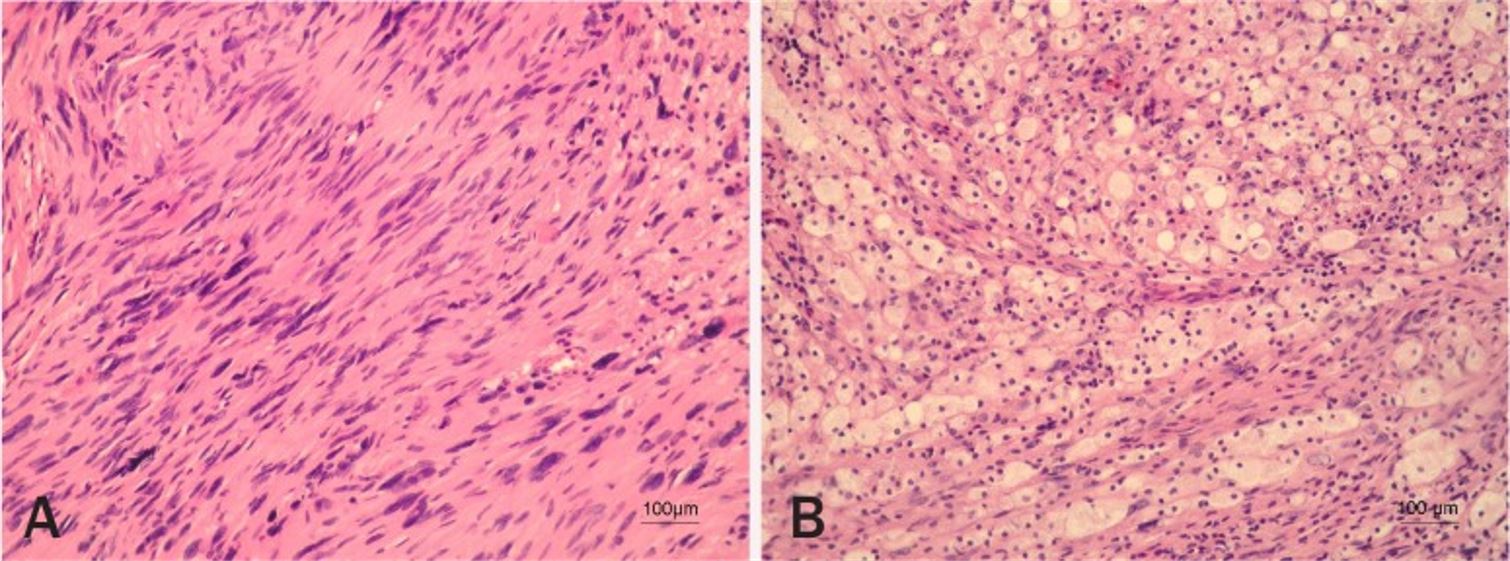
Histopatología del schwannoma vestibular

Histopatología del schwannoma vestibular

Imagen: “Vestibular schwannoma” por Pećina-Slaus N, Zeljko M, Pećina HI, Nikuseva Martić T, Bacić N, Tomas D, Hrasćan R. Licencia: CC BY 2.5
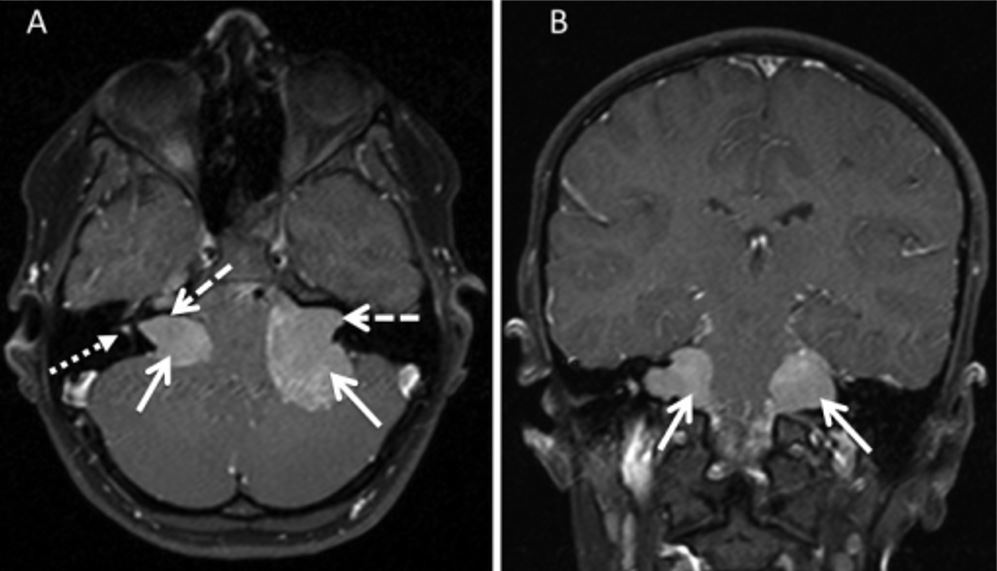
Imagenología

  • La resonancia magnética (RM) con contraste es el método de elección.
  • Se recomienda un escaneo completo del cerebro y de toda la columna vertebral para evaluar la presencia de tumores intracraneales/espinales.

Tratamiento

El tratamiento de la neurofibromatosis tipo 2 es multidisciplinario y, a menudo, involucra contribuciones de múltiples especialistas.

  • Consultas con las siguientes especialidades:
    • Oncología
    • Neurología
    • Neurorradiología
    • Oftalmología
    • Dermatología
    • Audiología
    • Genética/asesoramiento genético
    • Neurocirugía/cirugía de la base del cráneo
  • Vigilancia y seguimiento de los LOS Neisseria tumores:
    • Antecedentes y exámenes físicos anuales (audiología, evaluación oftálmica, examen neurológico y cutáneo)
    • RM cerebral cada 12 meses a partir de los LOS Neisseria 10 años de edad
    • RM espinal cada 24–36 meses a partir de los LOS Neisseria 10 años de edad
  • Schwannoma Schwannoma Schwannomas (also known as neurilemmomas) are benign nerve sheath tumors in the peripheral nervous system (PNS), arising from Schwann cells that encase the peripheral nerves. Schwannomas are the most common tumors in the PNS. Schwannoma(s) vestibular(es):
    • Cirugía:
      • Consulta de neurocirugía o cirugía de la base del cráneo
      • La cirugía puede ser compleja y de alto riesgo según sea el tamaño, localización y la multifocalidad.
    • Bevacizumab Bevacizumab An anti-vegf humanized murine monoclonal antibody. It inhibits vegf receptors and helps to prevent pathologic angiogenesis. Targeted and Other Nontraditional Antineoplastic Therapy:
      • Anticuerpo monoclonal contra el factor de crecimiento del endotelio vascular
      • Induce la reducción del tumor Tumor Inflammation y la mejora de la audición.
    • Otras terapias dirigidas:
      • Everólimus: inhibidor quimioterapéutico de la quinasa que disminuye la irrigación al AL Amyloidosis tumor Tumor Inflammation.
      • Lapatinib Lapatinib A quinazoline derivative that inhibits epidermal growth factor receptor and HER2 tyrosine kinases. It is used for the treatment of advanced or metastatic breast cancer, where tumors overexpress HER2. Targeted and Other Nontraditional Antineoplastic Therapy: inhibidor quimioterapéutico de la tirosina quinasa que interrumpe las vías del receptor Receptor Receptors are proteins located either on the surface of or within a cell that can bind to signaling molecules known as ligands (e.g., hormones) and cause some type of response within the cell. Receptors del factor de crecimiento epidérmico.
    • Discapacidad auditiva:
      • Implantes cocleares
      • Implantes del tronco cerebral
  • Meningioma Meningioma Meningiomas are slow-growing tumors that arise from the meninges of the brain and spinal cord. The vast majority are benign. These tumors commonly occur in individuals with a history of high doses of skull radiation, head trauma, and neurofibromatosis 2. Meningioma:
    • Cirugía:
      • Tumores de crecimiento rápido
      • Tumores que amenazan con pérdida funcional
    • Radioterapia:
      • Tumores que son quirúrgicamente inaccesibles o para los LOS Neisseria que solo es posible una resección parcial
      • Se debe tener en EN Erythema nodosum is an immune-mediated panniculitis (inflammation of the subcutaneous fat) caused by a type IV (delayed-type) hypersensitivity reaction. It commonly manifests in young women as tender, erythematous nodules on the shins. Erythema Nodosum cuenta el desarrollo de neoplasias secundarias
    • Se está investigando la terapia dirigida con lapatinib Lapatinib A quinazoline derivative that inhibits epidermal growth factor receptor and HER2 tyrosine kinases. It is used for the treatment of advanced or metastatic breast cancer, where tumors overexpress HER2. Targeted and Other Nontraditional Antineoplastic Therapy.
  • Tumores espinales intramedulares:
    • Generalmente, crecen muy lentamente, sin síntomas durante un período prolongado
    • La vigilancia por RM suele ser adecuada.
    • Bevacizumab Bevacizumab An anti-vegf humanized murine monoclonal antibody. It inhibits vegf receptors and helps to prevent pathologic angiogenesis. Targeted and Other Nontraditional Antineoplastic Therapy es la terapia de 1ra línea.
    • Se recomienda la cirugía si los LOS Neisseria síntomas requieren intervención.
  • Evaluación genética:
    • Identificación de mutación específica del gen NF2 NF2 Neurofibromatosis type 2 is a neurocutaneous disorder that can arise from mutations in the NF2 gene located in chromosome 22 and may be inherited in an autosomal dominant fashion or occur from de novo mutations. The main clinical features are bilateral vestibular schwannomas, intracranial/spinal meningioma, and intramedullary and extramedullary spinal tumors. Neurofibromatosis Type 2
    • Tamizaje de familiares en EN Erythema nodosum is an immune-mediated panniculitis (inflammation of the subcutaneous fat) caused by a type IV (delayed-type) hypersensitivity reaction. It commonly manifests in young women as tender, erythematous nodules on the shins. Erythema Nodosum riesgo

Diagnóstico Diferencial

  • Schwannomas vestibulares esporádicos: también conocidos como neurinomas del acústico. En EN Erythema nodosum is an immune-mediated panniculitis (inflammation of the subcutaneous fat) caused by a type IV (delayed-type) hypersensitivity reaction. It commonly manifests in young women as tender, erythematous nodules on the shins. Erythema Nodosum la población general, los LOS Neisseria schwannomas vestibulares esporádicos son relativamente comunes. A diferencia de la neurofibromatosis tipo 2, los LOS Neisseria schwannomas vestibulares esporádicos suelen ser unilaterales y se presentan en EN Erythema nodosum is an immune-mediated panniculitis (inflammation of the subcutaneous fat) caused by a type IV (delayed-type) hypersensitivity reaction. It commonly manifests in young women as tender, erythematous nodules on the shins. Erythema Nodosum > 30 años de edad. La presentación es con perdida de la audición y problemas de equilibrio. Estas lesiones se diagnostican ante la sospecha clínica y se confirman mediante neuroimagenología. Las opciones terapéuticas conservadoras y quirúrgicas son similares a las descritas para la neurofibromatosis tipo 2.
  • Schwannomatosis: rara forma esporádica o familiar de la neurofibromatosis asociada a mutaciones en EN Erythema nodosum is an immune-mediated panniculitis (inflammation of the subcutaneous fat) caused by a type IV (delayed-type) hypersensitivity reaction. It commonly manifests in young women as tender, erythematous nodules on the shins. Erythema Nodosum los LOS Neisseria genes Genes A category of nucleic acid sequences that function as units of heredity and which code for the basic instructions for the development, reproduction, and maintenance of organisms. DNA Types and Structure SMARCB1 y LZTR1 localizados en EN Erythema nodosum is an immune-mediated panniculitis (inflammation of the subcutaneous fat) caused by a type IV (delayed-type) hypersensitivity reaction. It commonly manifests in young women as tender, erythematous nodules on the shins. Erythema Nodosum el cromosoma 22. La schwannomatosis se caracteriza por múltiples schwannomas periféricos e intracraneales no cutáneos en EN Erythema nodosum is an immune-mediated panniculitis (inflammation of the subcutaneous fat) caused by a type IV (delayed-type) hypersensitivity reaction. It commonly manifests in young women as tender, erythematous nodules on the shins. Erythema Nodosum ausencia de schwannomas vestibulares bilaterales. El diagnóstico se realiza con evaluación clínica y se confirma con biopsia. El tratamiento es sintomático y se debe tratar el dolor Dolor Inflammation crónico que ocurre en EN Erythema nodosum is an immune-mediated panniculitis (inflammation of the subcutaneous fat) caused by a type IV (delayed-type) hypersensitivity reaction. It commonly manifests in young women as tender, erythematous nodules on the shins. Erythema Nodosum aproximadamente la mitad de todos los LOS Neisseria pacientes con schwannomatosis.
  • Neurofibromatosis tipo 1: trastorno autosómico dominante causado por mutaciones en EN Erythema nodosum is an immune-mediated panniculitis (inflammation of the subcutaneous fat) caused by a type IV (delayed-type) hypersensitivity reaction. It commonly manifests in young women as tender, erythematous nodules on the shins. Erythema Nodosum el gen NF1 NF1 Neurofibromatosis type 1 (NF1), also known as phakomatosis, is a neurocutaneous disorder that is most commonly of autosomal dominant inheritance due to mutations in the NF1 gene. Neurofibromatosis type 1 presents a range of clinical manifestations with the most prominent features being various pigmented skin lesions called café au lait macules (CALMs), neurofibromas, freckling of the inguinal and axillary regions, and iris hamartomas. Neurofibromatosis Type 1 localizado en EN Erythema nodosum is an immune-mediated panniculitis (inflammation of the subcutaneous fat) caused by a type IV (delayed-type) hypersensitivity reaction. It commonly manifests in young women as tender, erythematous nodules on the shins. Erythema Nodosum el cromosoma 17q11.2. Las manifestaciones clínicas pueden superponerse con las de la neurofibromatosis tipo 2, pero las diferencias clave incluyen que los LOS Neisseria nódulos de Lisch se observan en EN Erythema nodosum is an immune-mediated panniculitis (inflammation of the subcutaneous fat) caused by a type IV (delayed-type) hypersensitivity reaction. It commonly manifests in young women as tender, erythematous nodules on the shins. Erythema Nodosum pocas cantidades en EN Erythema nodosum is an immune-mediated panniculitis (inflammation of the subcutaneous fat) caused by a type IV (delayed-type) hypersensitivity reaction. It commonly manifests in young women as tender, erythematous nodules on the shins. Erythema Nodosum la neurofibromatosis tipo 2, los LOS Neisseria schwannomas rara vez experimentan una transformación maligna en EN Erythema nodosum is an immune-mediated panniculitis (inflammation of the subcutaneous fat) caused by a type IV (delayed-type) hypersensitivity reaction. It commonly manifests in young women as tender, erythematous nodules on the shins. Erythema Nodosum un neurofibrosarcoma, los LOS Neisseria tumores de la raíz espinal en EN Erythema nodosum is an immune-mediated panniculitis (inflammation of the subcutaneous fat) caused by a type IV (delayed-type) hypersensitivity reaction. It commonly manifests in young women as tender, erythematous nodules on the shins. Erythema Nodosum “forma de pesa” que se observan tanto en EN Erythema nodosum is an immune-mediated panniculitis (inflammation of the subcutaneous fat) caused by a type IV (delayed-type) hypersensitivity reaction. It commonly manifests in young women as tender, erythematous nodules on the shins. Erythema Nodosum la neurofibromatosis tipo 2 como en EN Erythema nodosum is an immune-mediated panniculitis (inflammation of the subcutaneous fat) caused by a type IV (delayed-type) hypersensitivity reaction. It commonly manifests in young women as tender, erythematous nodules on the shins. Erythema Nodosum la neurofibromatosis tipo 1 son schwannomas en EN Erythema nodosum is an immune-mediated panniculitis (inflammation of the subcutaneous fat) caused by a type IV (delayed-type) hypersensitivity reaction. It commonly manifests in young women as tender, erythematous nodules on the shins. Erythema Nodosum la neurofibromatosis tipo 2 y neurofibromas en EN Erythema nodosum is an immune-mediated panniculitis (inflammation of the subcutaneous fat) caused by a type IV (delayed-type) hypersensitivity reaction. It commonly manifests in young women as tender, erythematous nodules on the shins. Erythema Nodosum la neurofibromatosis tipo 1 y la neurofibromatosis tipo 2 no está asociada con el deterioro cognitivo observado en EN Erythema nodosum is an immune-mediated panniculitis (inflammation of the subcutaneous fat) caused by a type IV (delayed-type) hypersensitivity reaction. It commonly manifests in young women as tender, erythematous nodules on the shins. Erythema Nodosum neurofibromatosis tipo 1. El tratamiento se basa en EN Erythema nodosum is an immune-mediated panniculitis (inflammation of the subcutaneous fat) caused by a type IV (delayed-type) hypersensitivity reaction. It commonly manifests in young women as tender, erythematous nodules on the shins. Erythema Nodosum las características clínicas y puede variar desde la extirpación quirúrgica hasta la quimioterapia/radioterapia para los LOS Neisseria tumores, terapia física y ocupacional para las deficiencias motoras y tratamiento con hormona del crecimiento y corrección en EN Erythema nodosum is an immune-mediated panniculitis (inflammation of the subcutaneous fat) caused by a type IV (delayed-type) hypersensitivity reaction. It commonly manifests in young women as tender, erythematous nodules on the shins. Erythema Nodosum las anomalías óseas.
  • Esclerosis tuberosa: trastorno autosómico dominante con síntomas principalmente neurocutáneos. La mutación en EN Erythema nodosum is an immune-mediated panniculitis (inflammation of the subcutaneous fat) caused by a type IV (delayed-type) hypersensitivity reaction. It commonly manifests in young women as tender, erythematous nodules on the shins. Erythema Nodosum los LOS Neisseria genes Genes A category of nucleic acid sequences that function as units of heredity and which code for the basic instructions for the development, reproduction, and maintenance of organisms. DNA Types and Structure TSC TSC Tuberous sclerosis or tuberous sclerosis complex (TSC) is an autosomal dominant disorder with mainly neurocutaneous symptoms. Mutation in the tsc genes causes excessive tumor-like growths in the brain, eyes, heart, kidney, and lungs. Cutaneous manifestations include hypopigmentation (i.e., ash leaf spots, confetti lesions) or excessive growth (i.e., angiofibroma, shagreen patch). Tuberous Sclerosis provoca crecimientos excesivos similares a tumores en EN Erythema nodosum is an immune-mediated panniculitis (inflammation of the subcutaneous fat) caused by a type IV (delayed-type) hypersensitivity reaction. It commonly manifests in young women as tender, erythematous nodules on the shins. Erythema Nodosum el cerebro, ojos, corazón, riñones y pulmones. Las manifestaciones cutáneas incluyen hipopigmentación (i.e., manchas en EN Erythema nodosum is an immune-mediated panniculitis (inflammation of the subcutaneous fat) caused by a type IV (delayed-type) hypersensitivity reaction. It commonly manifests in young women as tender, erythematous nodules on the shins. Erythema Nodosum hojas de fresno, lesiones en EN Erythema nodosum is an immune-mediated panniculitis (inflammation of the subcutaneous fat) caused by a type IV (delayed-type) hypersensitivity reaction. It commonly manifests in young women as tender, erythematous nodules on the shins. Erythema Nodosum confeti) o crecimiento excesivo (i.e, angiofibroma Angiofibroma A benign neoplasm of fibrous tissue in which there are numerous small and large, frequently dilated, vascular channels. Tuberous Sclerosis, parche de Shagreen). El diagnóstico se realiza ante la sospecha clínica y se confirma mediante pruebas genéticas. El tratamiento implica un enfoque multidisciplinario que se enfoca en EN Erythema nodosum is an immune-mediated panniculitis (inflammation of the subcutaneous fat) caused by a type IV (delayed-type) hypersensitivity reaction. It commonly manifests in young women as tender, erythematous nodules on the shins. Erythema Nodosum el seguimiento y tratamiento de las diversas manifestaciones del trastorno.

Referencias

  1. Jordan, J. T., & Evans, G. (2025). NF2‑related schwannomatosis (NF2‑SWN; formerly neurofibromatosis type 2). In J. de Groot & H. A. Shih (Eds.), UpToDate. Retrieved June 17, 2025, from https://www.uptodate.com/contents/nf2-related-schwannomatosis-nf2-swn-formerly-neurofibromatosis-type-2
  2. Park, J.K. et al. (2025). Vestibular schwannoma (acoustic neuroma). UpToDate. Retrieved June 17, 2025, from https://www.uptodate.com/contents/vestibular-schwannoma-acoustic-neuroma
  3. Victorio, M.C. (2023). Neurofibromatosis. MSD Manual Professional Version. Retrieved June 17, 2025, from https://www.msdmanuals.com/professional/pediatrics/neurocutaneous-syndromes/neurofibromatosis
  4. Hsieh, D.T. (2022). Neurofibromatosis type 2. Medscape. Retrieved June 17, 2025, from https://emedicine.medscape.com/article/1178283
  5. Tiwari, R., Singh, A.K. (2022). Neurofibromatosis Type 2. StatPearls. Retrieved June 17, 2025, from https://www.ncbi.nlm.nih.gov/books/NBK470350/
  6. Asthagiri, A.R., et al. (2009). Neurofibromatosis type 2. Lancet 373:1974–1986. https://doi.org/10.1016/S0140-6736(09)60259-2

¡Crea tu cuenta gratis o inicia una sesión para seguir leyendo!

Regístrate ahora y obtén acceso gratuito a Lecturio con páginas de concepto, videos médicos y cuestionarios para tu educación médica.

User Reviews

Que tengas una sesión de estudio alegre y navideña 🎁 Ahorra 50% en todos los planes >>

Details