Domina Conceptos Médicos

Estudia para la escuela de medicina y tus examenes con Lecturio.

Líquidos Intravenosos

Los LOS Neisseria líquidos intravenosos son una de las intervenciones más comunes administradas en EN Erythema nodosum is an immune-mediated panniculitis (inflammation of the subcutaneous fat) caused by a type IV (delayed-type) hypersensitivity reaction. It commonly manifests in young women as tender, erythematous nodules on the shins. Erythema Nodosum medicina para aproximarse a los LOS Neisseria líquidos corporales fisiológicos. Los LOS Neisseria líquidos intravenosos se dividen en EN Erythema nodosum is an immune-mediated panniculitis (inflammation of the subcutaneous fat) caused by a type IV (delayed-type) hypersensitivity reaction. It commonly manifests in young women as tender, erythematous nodules on the shins. Erythema Nodosum 2 categorías: soluciones cristaloides y coloides. Los LOS Neisseria líquidos intravenosos tienen una amplia variedad de indicaciones, incluida la expansión del volumen intravascular, la manipulación de electrolitos y los LOS Neisseria líquidos de mantenimiento. Los LOS Neisseria cristaloides y los LOS Neisseria coloides tienen diferentes composiciones generales, que afectan las distribuciones a través de los LOS Neisseria compartimentos de líquidos del cuerpo y guían el uso clínico. Las soluciones cristaloides generalmente se usan para pacientes hipovolémicos, deshidratados o que tienen pérdidas continuas de líquidos. Las soluciones coloidales se pueden utilizar en EN Erythema nodosum is an immune-mediated panniculitis (inflammation of the subcutaneous fat) caused by a type IV (delayed-type) hypersensitivity reaction. It commonly manifests in young women as tender, erythematous nodules on the shins. Erythema Nodosum casos de baja presión oncótica. Los LOS Neisseria proveedores de salud deben elegir los LOS Neisseria tipos de líquidos según el escenario clínico y la mejor evidencia disponible. Todos los LOS Neisseria pacientes que reciben líquidos intravenosos deben ser monitoreados de cerca para determinar el objetivo y el estado de la terapia de líquidos.

Last updated: Dec 15, 2025

Editorial responsibility: Stanley Oiseth, Lindsay Jones, Evelin Maza

Descripción General

Compartimentos de líquidos del cuerpo

  • Líquido intracelular (LIC):
    • Todo el líquido encerrado en EN Erythema nodosum is an immune-mediated panniculitis (inflammation of the subcutaneous fat) caused by a type IV (delayed-type) hypersensitivity reaction. It commonly manifests in young women as tender, erythematous nodules on the shins. Erythema Nodosum las células por las membranas plasmáticas.
    • Aproximadamente 60%–65% (⅔) del agua corporal total (ACT)
    • El volumen de líquido tiende a ser muy estable porque la cantidad de agua en EN Erythema nodosum is an immune-mediated panniculitis (inflammation of the subcutaneous fat) caused by a type IV (delayed-type) hypersensitivity reaction. It commonly manifests in young women as tender, erythematous nodules on the shins. Erythema Nodosum las células vivas está estrechamente regulada.
  • Líquido extracelular (LEC):
    • Líquido fuera de las células.
    • 2 constituyentes primarios:
      • Plasma Plasma The residual portion of blood that is left after removal of blood cells by centrifugation without prior blood coagulation. Transfusion Products (el componente líquido de la sangre): aproximadamente el 10% del ACT
      • Líquido intersticial que rodea todas las células: aproximadamente el 25% del ACT
  • ACT = 60% del peso corporal total = LIC + LEC
Distribución del agua corporal total

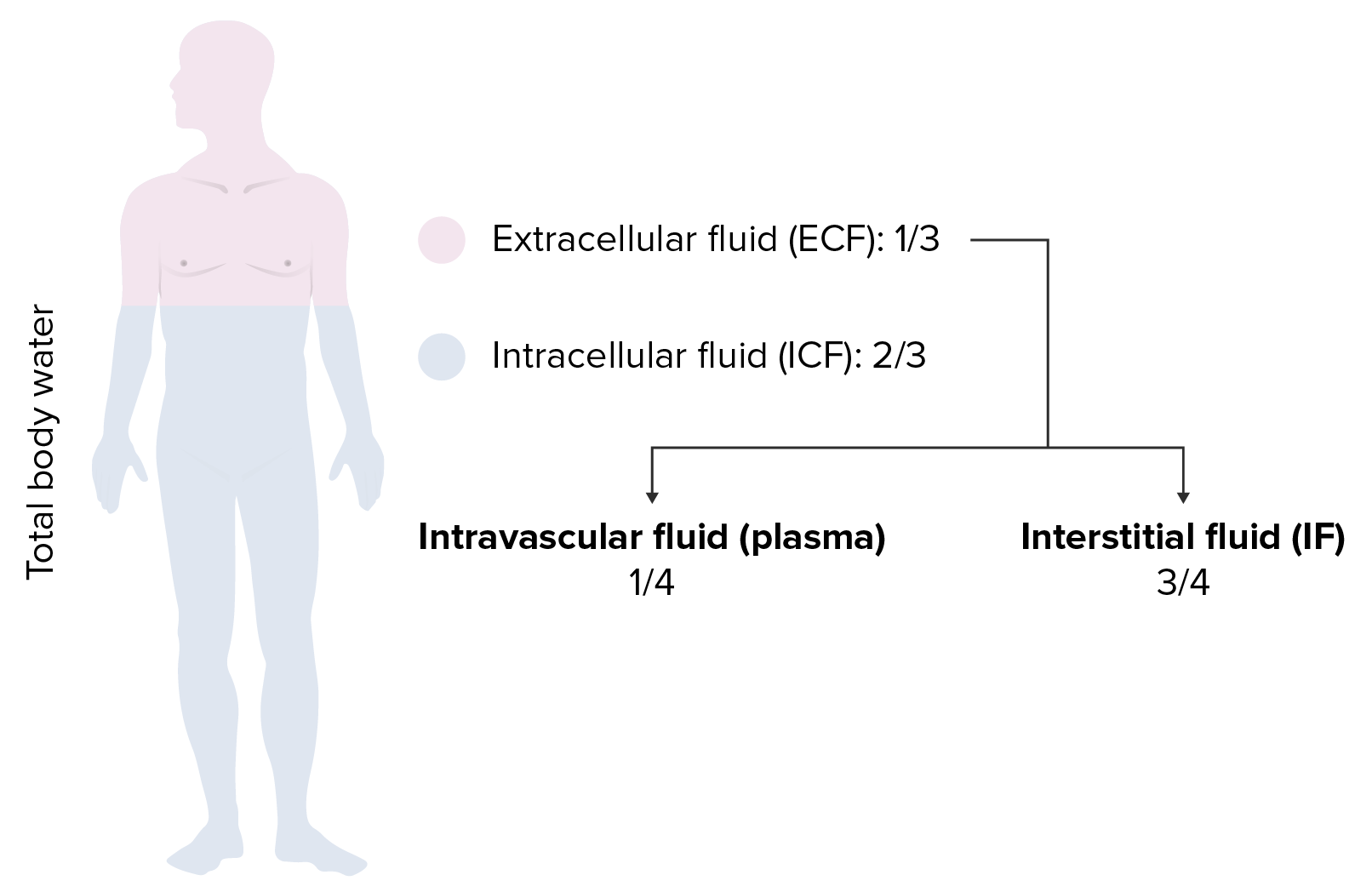
Distribución del agua corporal total:
⅔ del agua del cuerpo es líquido intracelular (ICF, por sus siglas en inglés) y ⅓ es líquido extracelular (ECF , por sus siglas en inglés). Del ECF, ¾ es líquido intersticial y solo ¼ es líquido intravascular.
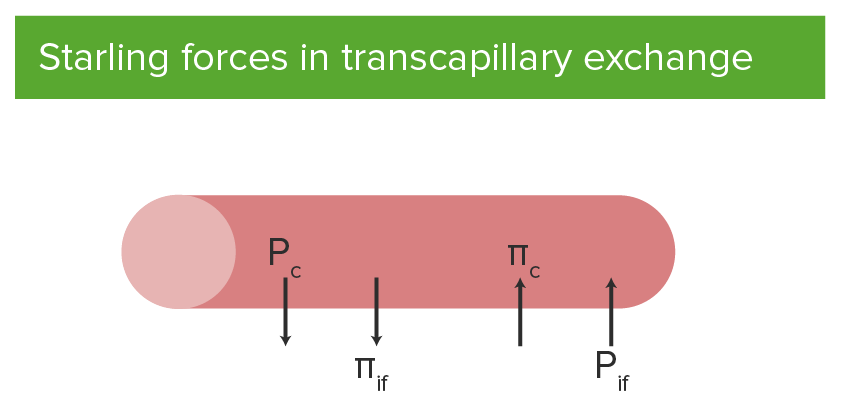
Imagen por Lecturio.

Movimiento del agua a través de los LOS Neisseria compartimentos

  • Del plasma Plasma The residual portion of blood that is left after removal of blood cells by centrifugation without prior blood coagulation. Transfusion Products a intersticio:
    • Ocurre a través de las fuerzas de Starling que actúan a través de la membrana capilar
    • La presión capilar (Pc) empuja el líquido fuera del capilar.
    • La presión del líquido intersticial (Pif) empuja el líquido hacia el capilar.
    • La presión coloidal osmótica (oncótica) del plasma Plasma The residual portion of blood that is left after removal of blood cells by centrifugation without prior blood coagulation. Transfusion Products (πc) atrae el líquido hacia el capilar.
    • La presión osmótica coloidal del líquido intersticial (πif) extrae líquido del capilar.
  • Del LIC a LEC:
    • Ocurre por ósmosis a través de la membrana celular selectivamente permeable
    • Flujo de agua: de una solución menos concentrada a una más concentrada
Fuerzas de Starling y ecuación en el intercambio transcapilar

Fuerzas de Starling en el intercambio transcapilar:
Las fuerzas hacia afuera del capilar incluyen la presión hidrostática de la sangre en el capilar (Pc) y la presión osmótica coloidal del líquido intersticial (πif). Las fuerzas hacia adentro del capilar incluyen la presión hidrostática del líquido intersticial (Pif) y la presión coloidosmótica del plasma (πc) del capilar.
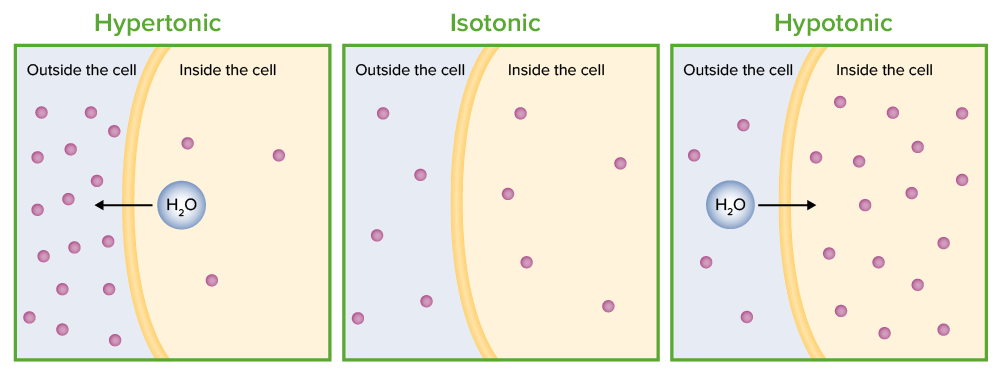
Imagen por Lecturio.

Osmolaridad, osmolalidad y tonicidad

  • Ósmosis:
    • Movimiento espontáneo del agua a través de una membrana semipermeable
    • El agua se mueve desde una región de ↓ concentración de soluto → una región de ↑ concentración de soluto
    • Tiende a igualar las concentraciones de soluto a ambos lados de la membrana
  • Presión osmótica: la presión hidrostática es necesaria para contrarrestar el proceso de ósmosis.
  • Osmolalidad y osmolaridad:
    • Concentración osmolar de una solución
    • En EN Erythema nodosum is an immune-mediated panniculitis (inflammation of the subcutaneous fat) caused by a type IV (delayed-type) hypersensitivity reaction. It commonly manifests in young women as tender, erythematous nodules on the shins. Erythema Nodosum medicina, la osmolaridad y la osmolalidad se pueden usar indistintamente:
      • No necesariamente al AL Amyloidosis igual que tonicidad.
      • Rango normal: 275–295 mOsm/kg
    • El 80% de la osmolaridad total del líquido intersticial y plasma Plasma The residual portion of blood that is left after removal of blood cells by centrifugation without prior blood coagulation. Transfusion Products se debe a los LOS Neisseria iones de Na y Cl
    • ½ de la osmolaridad total del LIC se debe a los LOS Neisseria iones K; el resto se debe a otras sustancias intracelulares.
  • Gradiente osmótico: la diferencia en EN Erythema nodosum is an immune-mediated panniculitis (inflammation of the subcutaneous fat) caused by a type IV (delayed-type) hypersensitivity reaction. It commonly manifests in young women as tender, erythematous nodules on the shins. Erythema Nodosum la osmolaridad de 2 soluciones a cada lado de una membrana semipermeable
  • Tonicidad:
    • La medida del gradiente osmótico efectivo entre 2 líquidos separados por una membrana semipermeable
    • Solo tiene en EN Erythema nodosum is an immune-mediated panniculitis (inflammation of the subcutaneous fat) caused by a type IV (delayed-type) hypersensitivity reaction. It commonly manifests in young women as tender, erythematous nodules on the shins. Erythema Nodosum cuenta los LOS Neisseria solutos osmóticamente activos (no pueden cruzar una membrana semipermeable)
    • La glucosa es osmóticamente activa, pero el efecto es temporal:
      • La glucosa se metaboliza rápidamente dentro de la célula → elimina la actividad osmótica
      • El resultado neto es la adición de agua libre de solutos.
      • Los LOS Neisseria osmoles de glucosa temporales no se tienen en EN Erythema nodosum is an immune-mediated panniculitis (inflammation of the subcutaneous fat) caused by a type IV (delayed-type) hypersensitivity reaction. It commonly manifests in young women as tender, erythematous nodules on the shins. Erythema Nodosum cuenta en EN Erythema nodosum is an immune-mediated panniculitis (inflammation of the subcutaneous fat) caused by a type IV (delayed-type) hypersensitivity reaction. It commonly manifests in young women as tender, erythematous nodules on the shins. Erythema Nodosum la tonicidad neta de la solución.
    • Ejemplos de disincronía entre osmolaridad/osmolaridad y tonicidad:
      • Dextrosa al AL Amyloidosis 5% en EN Erythema nodosum is an immune-mediated panniculitis (inflammation of the subcutaneous fat) caused by a type IV (delayed-type) hypersensitivity reaction. It commonly manifests in young women as tender, erythematous nodules on the shins. Erythema Nodosum agua: isoosmolar pero hipotónica
      • Dextrosa al AL Amyloidosis 5% NaCl al AL Amyloidosis 0,9%: hiperosmolar pero isotónica
      • Dextrosa al AL Amyloidosis 5% NaCl al AL Amyloidosis 0,45%: hiperosmolar pero hipotónico
Tonicity the movement of water

Tonicidad: el movimiento de agua debido a la ósmosis de una célula (mostrado en 3 soluciones diferentes):
En la solución hipertónica, el agua sale de la célula. En la solución isotónica, no hay movimiento neto de agua. En la solución hipotónica, el agua entra en la célula.

Imagen por Lecturio.

Líquidos Cristaloides

  • Líquidos intravenosos más utilizados en EN Erythema nodosum is an immune-mediated panniculitis (inflammation of the subcutaneous fat) caused by a type IV (delayed-type) hypersensitivity reaction. It commonly manifests in young women as tender, erythematous nodules on the shins. Erythema Nodosum un entorno hospitalario
  • Consisten en EN Erythema nodosum is an immune-mediated panniculitis (inflammation of the subcutaneous fat) caused by a type IV (delayed-type) hypersensitivity reaction. It commonly manifests in young women as tender, erythematous nodules on the shins. Erythema Nodosum soluciones electrolíticas acuosas
  • No atraviesan fácilmente las membranas plasmáticas, pero sí las membranas capilares
  • Permanecen solo en EN Erythema nodosum is an immune-mediated panniculitis (inflammation of the subcutaneous fat) caused by a type IV (delayed-type) hypersensitivity reaction. It commonly manifests in young women as tender, erythematous nodules on the shins. Erythema Nodosum el LEC y no entran en EN Erythema nodosum is an immune-mediated panniculitis (inflammation of the subcutaneous fat) caused by a type IV (delayed-type) hypersensitivity reaction. It commonly manifests in young women as tender, erythematous nodules on the shins. Erythema Nodosum el LIC
  • Dentro del LEC, la distribución es ¼ en EN Erythema nodosum is an immune-mediated panniculitis (inflammation of the subcutaneous fat) caused by a type IV (delayed-type) hypersensitivity reaction. It commonly manifests in young women as tender, erythematous nodules on the shins. Erythema Nodosum el volumen intravascular y ¾ en EN Erythema nodosum is an immune-mediated panniculitis (inflammation of the subcutaneous fat) caused by a type IV (delayed-type) hypersensitivity reaction. It commonly manifests in young women as tender, erythematous nodules on the shins. Erythema Nodosum el espacio intersticial.

Solución salina normal (0,9% NaCl)

  • La osmolaridad se aproxima al AL Amyloidosis plasma Plasma The residual portion of blood that is left after removal of blood cells by centrifugation without prior blood coagulation. Transfusion Products normal (275–295 mmol/L):
    • 0,9% = 9 g NaCl en EN Erythema nodosum is an immune-mediated panniculitis (inflammation of the subcutaneous fat) caused by a type IV (delayed-type) hypersensitivity reaction. It commonly manifests in young women as tender, erythematous nodules on the shins. Erythema Nodosum 1 000 g H2O (equivale a 1 L de H2O)
    • 154 mmol/L Na + 154 mmol/L Cl = 308 mmol/L en EN Erythema nodosum is an immune-mediated panniculitis (inflammation of the subcutaneous fat) caused by a type IV (delayed-type) hypersensitivity reaction. It commonly manifests in young women as tender, erythematous nodules on the shins. Erythema Nodosum total
  • Plasma Plasma The residual portion of blood that is left after removal of blood cells by centrifugation without prior blood coagulation. Transfusion Products isotónico a normal

Lactato de Ringer

  • La osmolaridad se aproxima al AL Amyloidosis plasma Plasma The residual portion of blood that is left after removal of blood cells by centrifugation without prior blood coagulation. Transfusion Products normal
  • Plasma Plasma The residual portion of blood that is left after removal of blood cells by centrifugation without prior blood coagulation. Transfusion Products isotónico a normal
  • Contiene:
    • 130 mmol/L Na
    • 109 mmol/L Cl
    • 4 mmol/L K
    • 3 mmol/L Ca CA Condylomata acuminata are a clinical manifestation of genital HPV infection. Condylomata acuminata are described as raised, pearly, flesh-colored, papular, cauliflower-like lesions seen in the anogenital region that may cause itching, pain, or bleeding. Condylomata Acuminata (Genital Warts)2
    • 28 mmol/L lactato
  • Se distribuye a lo largo de los LOS Neisseria compartimentos de líquidos como solución salina normal

Plasma-Lyte©

  • La osmolaridad se aproxima al AL Amyloidosis plasma Plasma The residual portion of blood that is left after removal of blood cells by centrifugation without prior blood coagulation. Transfusion Products normal
  • Plasma Plasma The residual portion of blood that is left after removal of blood cells by centrifugation without prior blood coagulation. Transfusion Products isotónico a normal
  • Contiene:
    • 140 mmol/L Na
    • 98 mmol/l Cl
    • 5 mmol/L K
    • 3 mmol/l Mg
    • 23 mmol/L gluconato
    • 27 mmol/L acetato
  • Se distribuye a lo largo de los LOS Neisseria compartimentos de líquidos como una solución salina normal

Solución salina medio normal (0,45 % NaCl)

  • La osmolaridad es aproximadamente la ½ del plasma Plasma The residual portion of blood that is left after removal of blood cells by centrifugation without prior blood coagulation. Transfusion Products normal:
    • 0,45% = 4,5 g de NaCl en EN Erythema nodosum is an immune-mediated panniculitis (inflammation of the subcutaneous fat) caused by a type IV (delayed-type) hypersensitivity reaction. It commonly manifests in young women as tender, erythematous nodules on the shins. Erythema Nodosum 1 000 g de H2O
    • 77 mmol/L Na + 77 mmol/L Cl = 154 mmol/L en EN Erythema nodosum is an immune-mediated panniculitis (inflammation of the subcutaneous fat) caused by a type IV (delayed-type) hypersensitivity reaction. It commonly manifests in young women as tender, erythematous nodules on the shins. Erythema Nodosum total
  • Hipotónico al AL Amyloidosis plasma Plasma The residual portion of blood that is left after removal of blood cells by centrifugation without prior blood coagulation. Transfusion Products
  • Ejemplo: 1 L 0,45% NaCl:
    • Igual a 500 mL agua libre de solutos + 500 mL 0,9% NaCl
    • 500 ml de NaCl al AL Amyloidosis 0,9 % quedan solo en EN Erythema nodosum is an immune-mediated panniculitis (inflammation of the subcutaneous fat) caused by a type IV (delayed-type) hypersensitivity reaction. It commonly manifests in young women as tender, erythematous nodules on the shins. Erythema Nodosum el LEC:
      • 125 ml (¼) en EN Erythema nodosum is an immune-mediated panniculitis (inflammation of the subcutaneous fat) caused by a type IV (delayed-type) hypersensitivity reaction. It commonly manifests in young women as tender, erythematous nodules on the shins. Erythema Nodosum volumen intravascular
      • 375 ml (¾) en EN Erythema nodosum is an immune-mediated panniculitis (inflammation of the subcutaneous fat) caused by a type IV (delayed-type) hypersensitivity reaction. It commonly manifests in young women as tender, erythematous nodules on the shins. Erythema Nodosum el espacio intersticial
    • 500 ml de agua libre de solutos se distribuyen por todo el agua corporal total (LIC + LEC):
      • 333 ml (⅔) en EN Erythema nodosum is an immune-mediated panniculitis (inflammation of the subcutaneous fat) caused by a type IV (delayed-type) hypersensitivity reaction. It commonly manifests in young women as tender, erythematous nodules on the shins. Erythema Nodosum el LIC
      • 167 ml (⅓) en EN Erythema nodosum is an immune-mediated panniculitis (inflammation of the subcutaneous fat) caused by a type IV (delayed-type) hypersensitivity reaction. It commonly manifests in young women as tender, erythematous nodules on the shins. Erythema Nodosum el LEC (42 ml en EN Erythema nodosum is an immune-mediated panniculitis (inflammation of the subcutaneous fat) caused by a type IV (delayed-type) hypersensitivity reaction. It commonly manifests in young women as tender, erythematous nodules on the shins. Erythema Nodosum el espacio intravascular + 125 ml en EN Erythema nodosum is an immune-mediated panniculitis (inflammation of the subcutaneous fat) caused by a type IV (delayed-type) hypersensitivity reaction. It commonly manifests in young women as tender, erythematous nodules on the shins. Erythema Nodosum el espacio intersticial)
    • Combinado: solo 167 ml en EN Erythema nodosum is an immune-mediated panniculitis (inflammation of the subcutaneous fat) caused by a type IV (delayed-type) hypersensitivity reaction. It commonly manifests in young women as tender, erythematous nodules on the shins. Erythema Nodosum el espacio intravascular

Solución salina un cuarto normal (0,225 % NaCl)

  • La osmolaridad es aproximadamente ¼ del plasma Plasma The residual portion of blood that is left after removal of blood cells by centrifugation without prior blood coagulation. Transfusion Products normal:
    • 0,225% = 2,25 g de NaCl en EN Erythema nodosum is an immune-mediated panniculitis (inflammation of the subcutaneous fat) caused by a type IV (delayed-type) hypersensitivity reaction. It commonly manifests in young women as tender, erythematous nodules on the shins. Erythema Nodosum 1 000 g de H2O
    • 38,5 mmol/L Na + 38,5 mmol/L Cl = 77 mmol/L en EN Erythema nodosum is an immune-mediated panniculitis (inflammation of the subcutaneous fat) caused by a type IV (delayed-type) hypersensitivity reaction. It commonly manifests in young women as tender, erythematous nodules on the shins. Erythema Nodosum total
  • Hipotónico al AL Amyloidosis plasma Plasma The residual portion of blood that is left after removal of blood cells by centrifugation without prior blood coagulation. Transfusion Products
  • Ejemplo: 1 L de NaCl al AL Amyloidosis 0,225 % infundido:
    • Igual a 750 mL agua libre de solutos + 250 mL 0,9% NaCl
    • Quedan 250 ml de NaCl al AL Amyloidosis 0,9% solo en EN Erythema nodosum is an immune-mediated panniculitis (inflammation of the subcutaneous fat) caused by a type IV (delayed-type) hypersensitivity reaction. It commonly manifests in young women as tender, erythematous nodules on the shins. Erythema Nodosum el LEC:
      • 62,5 ml (¼) en EN Erythema nodosum is an immune-mediated panniculitis (inflammation of the subcutaneous fat) caused by a type IV (delayed-type) hypersensitivity reaction. It commonly manifests in young women as tender, erythematous nodules on the shins. Erythema Nodosum el volumen intravascular
      • 187,5 ml (¾) en EN Erythema nodosum is an immune-mediated panniculitis (inflammation of the subcutaneous fat) caused by a type IV (delayed-type) hypersensitivity reaction. It commonly manifests in young women as tender, erythematous nodules on the shins. Erythema Nodosum el espacio intersticial
    • 750 ml de agua libre de solutos se distribuyen por todo el agua corporal total (LIC + LEC):
      • 500 ml (⅔) en EN Erythema nodosum is an immune-mediated panniculitis (inflammation of the subcutaneous fat) caused by a type IV (delayed-type) hypersensitivity reaction. It commonly manifests in young women as tender, erythematous nodules on the shins. Erythema Nodosum el LIC
      • 250 ml (⅓) en EN Erythema nodosum is an immune-mediated panniculitis (inflammation of the subcutaneous fat) caused by a type IV (delayed-type) hypersensitivity reaction. It commonly manifests in young women as tender, erythematous nodules on the shins. Erythema Nodosum el LEC (62,5 ml en EN Erythema nodosum is an immune-mediated panniculitis (inflammation of the subcutaneous fat) caused by a type IV (delayed-type) hypersensitivity reaction. It commonly manifests in young women as tender, erythematous nodules on the shins. Erythema Nodosum el volumen intravascular + 187,5 ml en EN Erythema nodosum is an immune-mediated panniculitis (inflammation of the subcutaneous fat) caused by a type IV (delayed-type) hypersensitivity reaction. It commonly manifests in young women as tender, erythematous nodules on the shins. Erythema Nodosum el espacio intersticial)
    • Combinado: solo 125 ml en EN Erythema nodosum is an immune-mediated panniculitis (inflammation of the subcutaneous fat) caused by a type IV (delayed-type) hypersensitivity reaction. It commonly manifests in young women as tender, erythematous nodules on the shins. Erythema Nodosum el espacio intravascular

Dextrosa en EN Erythema nodosum is an immune-mediated panniculitis (inflammation of the subcutaneous fat) caused by a type IV (delayed-type) hypersensitivity reaction. It commonly manifests in young women as tender, erythematous nodules on the shins. Erythema Nodosum agua al AL Amyloidosis 5%

  • La osmolaridad se aproxima al AL Amyloidosis plasma Plasma The residual portion of blood that is left after removal of blood cells by centrifugation without prior blood coagulation. Transfusion Products normal: 50 g de dextrosa en EN Erythema nodosum is an immune-mediated panniculitis (inflammation of the subcutaneous fat) caused by a type IV (delayed-type) hypersensitivity reaction. It commonly manifests in young women as tender, erythematous nodules on the shins. Erythema Nodosum 1 L de H20 = 252 mmol/L
  • Hipotónico con relación al AL Amyloidosis plasma Plasma The residual portion of blood that is left after removal of blood cells by centrifugation without prior blood coagulation. Transfusion Products
  • La dextrosa es necesaria para prevenir la hemólisis:
    • Los LOS Neisseria líquidos extremadamente hipotónicos (agua pura) no se pueden administrar de forma segura por vía intravenosa.
    • Si se administra agua pura por vía intravenosa, el agua se trasladará muy rápidamente a las células → hemólisis
    • La dextrosa agrega suficientes solutos para ralentizar los LOS Neisseria cambios de agua → previene la hemólisis
    • La dextrosa solo es osmóticamente activa durante un corto tiempo después de la infusión (el efecto se disipa porque la dextrosa se metaboliza rápidamente).
    • El efecto neto es la adición de agua libre de solutos.
  • Ejemplo: 1 L de dextrosa en EN Erythema nodosum is an immune-mediated panniculitis (inflammation of the subcutaneous fat) caused by a type IV (delayed-type) hypersensitivity reaction. It commonly manifests in young women as tender, erythematous nodules on the shins. Erythema Nodosum agua al AL Amyloidosis 5% infundida:
    • Equivale a 1 L de agua libre de solutos
    • Se distribuye en EN Erythema nodosum is an immune-mediated panniculitis (inflammation of the subcutaneous fat) caused by a type IV (delayed-type) hypersensitivity reaction. It commonly manifests in young women as tender, erythematous nodules on the shins. Erythema Nodosum todo el agua corporal total (LIC + LEC):
      • 667 ml (⅔) en EN Erythema nodosum is an immune-mediated panniculitis (inflammation of the subcutaneous fat) caused by a type IV (delayed-type) hypersensitivity reaction. It commonly manifests in young women as tender, erythematous nodules on the shins. Erythema Nodosum LIC
      • 333 mL (⅓) en EN Erythema nodosum is an immune-mediated panniculitis (inflammation of the subcutaneous fat) caused by a type IV (delayed-type) hypersensitivity reaction. It commonly manifests in young women as tender, erythematous nodules on the shins. Erythema Nodosum LEC (83 mL en EN Erythema nodosum is an immune-mediated panniculitis (inflammation of the subcutaneous fat) caused by a type IV (delayed-type) hypersensitivity reaction. It commonly manifests in young women as tender, erythematous nodules on the shins. Erythema Nodosum volumen intravascular + 250 mL en EN Erythema nodosum is an immune-mediated panniculitis (inflammation of the subcutaneous fat) caused by a type IV (delayed-type) hypersensitivity reaction. It commonly manifests in young women as tender, erythematous nodules on the shins. Erythema Nodosum espacio intersticial)
    • Únicamente 83 mL de cada 1 L de dextrosa en EN Erythema nodosum is an immune-mediated panniculitis (inflammation of the subcutaneous fat) caused by a type IV (delayed-type) hypersensitivity reaction. It commonly manifests in young women as tender, erythematous nodules on the shins. Erythema Nodosum agua al AL Amyloidosis 5% contribuyen al AL Amyloidosis volumen intravascular.

Soluciones combinadas

  • La osmolaridad es > plasma Plasma The residual portion of blood that is left after removal of blood cells by centrifugation without prior blood coagulation. Transfusion Products normal, la tonicidad no lo es.
  • Ejemplo: Dextrosa al AL Amyloidosis 5%-NaCl al AL Amyloidosis 0,9% = 252 mmol (dextrosa en EN Erythema nodosum is an immune-mediated panniculitis (inflammation of the subcutaneous fat) caused by a type IV (delayed-type) hypersensitivity reaction. It commonly manifests in young women as tender, erythematous nodules on the shins. Erythema Nodosum agua al AL Amyloidosis 5%) + 308 mmol (NaCl al AL Amyloidosis 0,9%) = 560 mmol/L
  • La tonicidad no se ve VE Ventilation: Mechanics of Breathing afectada porque los LOS Neisseria solutos de la dextrosa se metabolizan rápidamente.

Soluciones con bicarbonato (HCO3)

  • Soluciones cristaloides confeccionadas por la farmacia del hospital (incluyen cantidades variables de HCO3 y generalmente no se producen comercialmente)
  • HCO3: ↑ el pH pH The quantitative measurement of the acidity or basicity of a solution. Acid-Base Balance de la solución a niveles fisiológicos o suprafisiológicos
  • La osmolaridad y la tonicidad de las soluciones resultantes se pueden ajustar en EN Erythema nodosum is an immune-mediated panniculitis (inflammation of the subcutaneous fat) caused by a type IV (delayed-type) hypersensitivity reaction. It commonly manifests in young women as tender, erythematous nodules on the shins. Erythema Nodosum función de la combinación del líquido de partida (normalmente dextrosa en EN Erythema nodosum is an immune-mediated panniculitis (inflammation of the subcutaneous fat) caused by a type IV (delayed-type) hypersensitivity reaction. It commonly manifests in young women as tender, erythematous nodules on the shins. Erythema Nodosum agua al AL Amyloidosis 5% o NaCl al AL Amyloidosis 0,45%) y la cantidad de HCO3 añadida.
  • Ejemplo: HCO3 isotónico:
    • 3 ampollas de NaHCO3 en EN Erythema nodosum is an immune-mediated panniculitis (inflammation of the subcutaneous fat) caused by a type IV (delayed-type) hypersensitivity reaction. It commonly manifests in young women as tender, erythematous nodules on the shins. Erythema Nodosum 1 L de dextrosa en EN Erythema nodosum is an immune-mediated panniculitis (inflammation of the subcutaneous fat) caused by a type IV (delayed-type) hypersensitivity reaction. It commonly manifests in young women as tender, erythematous nodules on the shins. Erythema Nodosum agua al AL Amyloidosis 5%
    • 3 ampollas NaHCO3 = 150 mmol Na + 150 mmol HCO3 = 300 mmol/L

Solución salina hipertónica al AL Amyloidosis 3% (NaCl al AL Amyloidosis 3%)

  • La osmolaridad y la tonicidad son significativamente ↑ que el plasma Plasma The residual portion of blood that is left after removal of blood cells by centrifugation without prior blood coagulation. Transfusion Products normal:
    • NaCl al AL Amyloidosis 3% = 30 g de NaCl + 1 000 g de H2O
    • 513 mmol Na + 513 mmol Cl = 1 026 mmol/L en EN Erythema nodosum is an immune-mediated panniculitis (inflammation of the subcutaneous fat) caused by a type IV (delayed-type) hypersensitivity reaction. It commonly manifests in young women as tender, erythematous nodules on the shins. Erythema Nodosum total
  • Ejemplo: 1 L de NaCl al AL Amyloidosis 3% infundido:
    • La carga de soluto es equivalente a 3,33 L de NaCl al AL Amyloidosis 0,9% (3%/0.9%).
    • La hipertonicidad da como resultado la movilización de aproximadamente 2,33 L de agua libre de solutos desde el LIC al AL Amyloidosis LEC (a través de cambios osmóticos) y 1 L de líquido infundido en EN Erythema nodosum is an immune-mediated panniculitis (inflammation of the subcutaneous fat) caused by a type IV (delayed-type) hypersensitivity reaction. It commonly manifests in young women as tender, erythematous nodules on the shins. Erythema Nodosum el LEC como NaCl al AL Amyloidosis 3%:
      • ¼ en EN Erythema nodosum is an immune-mediated panniculitis (inflammation of the subcutaneous fat) caused by a type IV (delayed-type) hypersensitivity reaction. It commonly manifests in young women as tender, erythematous nodules on the shins. Erythema Nodosum volumen intravascular = 832,5 ml
      • ¾ en EN Erythema nodosum is an immune-mediated panniculitis (inflammation of the subcutaneous fat) caused by a type IV (delayed-type) hypersensitivity reaction. It commonly manifests in young women as tender, erythematous nodules on the shins. Erythema Nodosum el espacio intersticial = 2 500 ml

Descripción general de la composición de soluciones cristaloides comunes

Tabla: Composición de soluciones cristaloides comunes
Líquido Na mEq/L Cl mEq/L K mEq/L Ca CA Condylomata acuminata are a clinical manifestation of genital HPV infection. Condylomata acuminata are described as raised, pearly, flesh-colored, papular, cauliflower-like lesions seen in the anogenital region that may cause itching, pain, or bleeding. Condylomata Acuminata (Genital Warts) 2 mEq/L Glucosa g/L Tampón mEq/L Osmolaridad mOsm/L Tonicidad
Plasma Plasma The residual portion of blood that is left after removal of blood cells by centrifugation without prior blood coagulation. Transfusion Products normal 140 100 4 2,4 0,85 HCO3 24 290 N / A
Solución salina al AL Amyloidosis 0,9% 154 154 0 0 0 0 308 Isotónica
Solución salina al AL Amyloidosis 0,45% 77 77 0 0 0 0 154 Hipotónica
Lactato de Ringer 130 109 4 3 0 Lactato 28 273 Isotónico
Dextrosa en EN Erythema nodosum is an immune-mediated panniculitis (inflammation of the subcutaneous fat) caused by a type IV (delayed-type) hypersensitivity reaction. It commonly manifests in young women as tender, erythematous nodules on the shins. Erythema Nodosum agua al AL Amyloidosis 5% 0 0 0 0 50 0 252 Hipotónica

Líquidos Coloides

  • Las soluciones coloides incluyen proteínas o células grandes.
  • No cruzan fácilmente las membranas capilares
  • Permanecen en EN Erythema nodosum is an immune-mediated panniculitis (inflammation of the subcutaneous fat) caused by a type IV (delayed-type) hypersensitivity reaction. It commonly manifests in young women as tender, erythematous nodules on the shins. Erythema Nodosum el LEC y no se distribuyen en EN Erythema nodosum is an immune-mediated panniculitis (inflammation of the subcutaneous fat) caused by a type IV (delayed-type) hypersensitivity reaction. It commonly manifests in young women as tender, erythematous nodules on the shins. Erythema Nodosum el LIC (similar a los LOS Neisseria cristaloides)
  • A diferencia de los LOS Neisseria cristaloides, los LOS Neisseria coloides no se distribuyen por todo el LEC:
    • Permanecen dentro del espacio intravascular
    • No entran en EN Erythema nodosum is an immune-mediated panniculitis (inflammation of the subcutaneous fat) caused by a type IV (delayed-type) hypersensitivity reaction. It commonly manifests in young women as tender, erythematous nodules on the shins. Erythema Nodosum el espacio intersticial
  • Los LOS Neisseria productos sanguíneos también son ejemplos de soluciones coloidales.

Albúmina

  • Un coloide natural y la proteína más abundante en EN Erythema nodosum is an immune-mediated panniculitis (inflammation of the subcutaneous fat) caused by a type IV (delayed-type) hypersensitivity reaction. It commonly manifests in young women as tender, erythematous nodules on the shins. Erythema Nodosum el plasma Plasma The residual portion of blood that is left after removal of blood cells by centrifugation without prior blood coagulation. Transfusion Products
  • Responsable del 80% de la presión oncótica del plasma Plasma The residual portion of blood that is left after removal of blood cells by centrifugation without prior blood coagulation. Transfusion Products
  • ↑ Presión oncótica plasmática → desplazamiento osmótico de líquido desde el espacio intersticial hacia el volumen intravascular
  • La duración del efecto de expansión de volumen es de 12–24 horas.
  • La albúmina es el único coloide de uso común en EN Erythema nodosum is an immune-mediated panniculitis (inflammation of the subcutaneous fat) caused by a type IV (delayed-type) hypersensitivity reaction. It commonly manifests in young women as tender, erythematous nodules on the shins. Erythema Nodosum la práctica clínica:
    • Se utiliza principalmente para indicaciones específicas en EN Erythema nodosum is an immune-mediated panniculitis (inflammation of the subcutaneous fat) caused by a type IV (delayed-type) hypersensitivity reaction. It commonly manifests in young women as tender, erythematous nodules on the shins. Erythema Nodosum lugar de expansión de volumen
    • Más costoso que los LOS Neisseria cristaloides y sin beneficio proporcional

Coloides sintéticos

  • Hidroxietilalmidones, dextranos y gelatinas
  • Desarrollados para su uso como expansores de volumen debido al AL Amyloidosis beneficio hipotético de permanecer dentro del volumen intravascular
  • No se usan comúnmente en EN Erythema nodosum is an immune-mediated panniculitis (inflammation of the subcutaneous fat) caused by a type IV (delayed-type) hypersensitivity reaction. It commonly manifests in young women as tender, erythematous nodules on the shins. Erythema Nodosum la práctica:
    • Las soluciones coloides no son clínicamente superiores a las soluciones cristaloides para la expansión de volumen (a pesar de permanecer exclusivamente en EN Erythema nodosum is an immune-mediated panniculitis (inflammation of the subcutaneous fat) caused by a type IV (delayed-type) hypersensitivity reaction. It commonly manifests in young women as tender, erythematous nodules on the shins. Erythema Nodosum el espacio intravascular).
    • Costosas
    • Los LOS Neisseria hidroxietilalmidones se han asociado con lesión renal aguda.
    • A diferencia de la albúmina, los LOS Neisseria coloides sintéticos no tienen otras indicaciones específicas de uso.

Comparación de cristaloides y coloides

Tabla: Comparación de cristaloides y coloides
Cristaloides Coloides
Ventajas De bajo costo Vida media más larga
Accesibles Se requiere un volumen más pequeño para expandir el volumen intravascular.
Desventajas Vida media más corta Costosos
Se requiere un volumen mayor para expandir el volumen intravascular. Riesgo de reacción alérgica

Indicaciones

Expansión del volumen intravascular

  • Líquidos cristaloides isotónicos:
    • Líquidos intravenosos preferidos para la expansión de volumen
    • Lactato de Ringer y Plasma-Lyte© se consideran soluciones “balanceadas”:
      • Se aproximan al AL Amyloidosis pH pH The quantitative measurement of the acidity or basicity of a solution. Acid-Base Balance y la composición de electrolitos del plasma Plasma The residual portion of blood that is left after removal of blood cells by centrifugation without prior blood coagulation. Transfusion Products normal más que el NaCl al AL Amyloidosis 0,9%
      • Evitan la acidosis Acidosis A pathologic condition of acid accumulation or depletion of base in the body. The two main types are respiratory acidosis and metabolic acidosis, due to metabolic acid build up. Respiratory Acidosis metabólica hiperclorémica asociada con NaCl al AL Amyloidosis 0,9%
      • La solución salina normal o Lactato de Ringer se prefieren a Plasma-Lyte© debido al AL Amyloidosis costo.
  • Líquidos coloides:
    • No es una terapia de 1ra línea para la expansión de volumen
    • A veces se usa en EN Erythema nodosum is an immune-mediated panniculitis (inflammation of the subcutaneous fat) caused by a type IV (delayed-type) hypersensitivity reaction. It commonly manifests in young women as tender, erythematous nodules on the shins. Erythema Nodosum un estado hipervolémico con ↓ volumen sanguíneo arterial efectivo
  • Hemoderivados: solo se utiliza para la expansión de volumen en EN Erythema nodosum is an immune-mediated panniculitis (inflammation of the subcutaneous fat) caused by a type IV (delayed-type) hypersensitivity reaction. It commonly manifests in young women as tender, erythematous nodules on the shins. Erythema Nodosum circunstancias específicas:
    • Concentrados de eritrocitos: hemorragia aguda o anemia Anemia Anemia is a condition in which individuals have low Hb levels, which can arise from various causes. Anemia is accompanied by a reduced number of RBCs and may manifest with fatigue, shortness of breath, pallor, and weakness. Subtypes are classified by the size of RBCs, chronicity, and etiology. Anemia: Overview and Types grave
    • Plaquetas: sangrado relacionado con ↓ recuento de plaquetas o disfunción plaquetaria
    • Plasma Plasma The residual portion of blood that is left after removal of blood cells by centrifugation without prior blood coagulation. Transfusion Products fresco congelado: sangrado relacionado con la deficiencia del factor de coagulación

Líquidos de mantenimiento

  • Los LOS Neisseria líquidos de mantenimiento están indicados para personas que no pueden nutrirse por vía oral.
  • Más comúnmente, consisten en EN Erythema nodosum is an immune-mediated panniculitis (inflammation of the subcutaneous fat) caused by a type IV (delayed-type) hypersensitivity reaction. It commonly manifests in young women as tender, erythematous nodules on the shins. Erythema Nodosum un líquido cristaloide con o sin dextrosa, bicarbonato y/o potasio agregados
  • Objetivo: aproximar el contenido de líquido perdido y reemplazar el líquido a un ritmo similar al AL Amyloidosis de la pérdida
  • Dosis diaria normal de mantenimiento:
    • Adultos: 1 500 mL + 20 mL/kg por cada kg por encima de 20 kg
    • Neonatos: 150 ml/kg
  • Condiciones que modifican la cantidad de líquidos de mantenimiento:
    • ↑ Líquidos de mantenimiento: fiebre y taquipnea
    • ↓ Líquidos de mantenimiento: insuficiencia cardiaca congestiva e insuficiencia renal por bajo gasto

Trastornos específicos del sodio

  • Hipernatremia:
    • Se administran líquidos hipotónicos (generalmente dextrosa en EN Erythema nodosum is an immune-mediated panniculitis (inflammation of the subcutaneous fat) caused by a type IV (delayed-type) hypersensitivity reaction. It commonly manifests in young women as tender, erythematous nodules on the shins. Erythema Nodosum agua al AL Amyloidosis 5% o NaCl al AL Amyloidosis 0,45%) para reponer el déficit de agua libre.
    • La tasa de administración del líquido debe ajustarse para apuntar a una ↓ gradual en EN Erythema nodosum is an immune-mediated panniculitis (inflammation of the subcutaneous fat) caused by a type IV (delayed-type) hypersensitivity reaction. It commonly manifests in young women as tender, erythematous nodules on the shins. Erythema Nodosum la hipernatremia crónica.
    • La corrección demasiado rápida de la hipernatremia puede causar edema Edema Edema is a condition in which excess serous fluid accumulates in the body cavity or interstitial space of connective tissues. Edema is a symptom observed in several medical conditions. It can be categorized into 2 types, namely, peripheral (in the extremities) and internal (in an organ or body cavity). Edema cerebral.
  • Hiponatremia:
    • Se pueden administrar líquidos isotónicos (por lo general, NaCl al AL Amyloidosis 0,9%) para los LOS Neisseria casos leves a moderados.
    • Los LOS Neisseria líquidos hipertónicos (generalmente NaCl al AL Amyloidosis 3%) están indicados para casos graves, en EN Erythema nodosum is an immune-mediated panniculitis (inflammation of the subcutaneous fat) caused by a type IV (delayed-type) hypersensitivity reaction. It commonly manifests in young women as tender, erythematous nodules on the shins. Erythema Nodosum especial con síntomas neurológicos.
    • La corrección demasiado rápida de la hiponatremia puede provocar el síndrome de desmielinización osmótica.

Edema Edema Edema is a condition in which excess serous fluid accumulates in the body cavity or interstitial space of connective tissues. Edema is a symptom observed in several medical conditions. It can be categorized into 2 types, namely, peripheral (in the extremities) and internal (in an organ or body cavity). Edema cerebral

  • Se pueden usar líquidos hipertónicos (generalmente solución salina hipertónica) para inducir la hipernatremia.
  • El resultado es el movimiento de agua fuera de las células → ↓ presión intracraneal

Soluciones de bicarbonato (HCO3)

HCO3 puede estar indicado para:

  • Acidemia Acidemia Respiratory Acidosis severa ( pH pH The quantitative measurement of the acidity or basicity of a solution. Acid-Base Balance < 7,2)
  • Alcalinización urinaria (e.g., intoxicación por antidepresivos tricíclicos o ciertas quimioterapias)
  • Envenenamiento por metanol o etilenglicol

Nutrición

  • Para individuos que estén en EN Erythema nodosum is an immune-mediated panniculitis (inflammation of the subcutaneous fat) caused by a type IV (delayed-type) hypersensitivity reaction. It commonly manifests in young women as tender, erythematous nodules on the shins. Erythema Nodosum nada por boca
  • Nutrición parenteral parcial (NPP):
    • Solo proteína
    • Puede administrarse a través de una vía periférica o central
    • Para individuos con indicación de no recibir nada por via oral por un corto período de tiempo (2–3 días).
  • Nutrición parenteral total (NPT):
    • Nutrición completa: carbohidratos, proteínas y grasas
    • Dado a través de una línea central
    • Para individuos en EN Erythema nodosum is an immune-mediated panniculitis (inflammation of the subcutaneous fat) caused by a type IV (delayed-type) hypersensitivity reaction. It commonly manifests in young women as tender, erythematous nodules on the shins. Erythema Nodosum nada por boca por un largo período de tiempo.
    • ↑ Riesgo de infección por bacteriemia o fungemia Fungemia The presence of fungi circulating in the blood. Opportunistic fungal sepsis is seen most often in immunosuppressed patients with severe neutropenia or in postoperative patients with intravenous catheters and usually follows prolonged antibiotic therapy. Chronic Granulomatous Disease

Albúmina

La albúmina se utiliza para fines específicos:

  • Expansión de volumen en EN Erythema nodosum is an immune-mediated panniculitis (inflammation of the subcutaneous fat) caused by a type IV (delayed-type) hypersensitivity reaction. It commonly manifests in young women as tender, erythematous nodules on the shins. Erythema Nodosum estados hipervolémicos con ↓ volumen sanguíneo arterial efectivo (i.e., cirrosis por hipoalbuminemia)
  • Tratamiento del síndrome hepatorrenal
  • Tratamiento de la lesión renal aguda relacionada con peritonitis Peritonitis Inflammation of the peritoneum lining the abdominal cavity as the result of infectious, autoimmune, or chemical processes. Primary peritonitis is due to infection of the peritoneal cavity via hematogenous or lymphatic spread and without intra-abdominal source. Secondary peritonitis arises from the abdominal cavity itself through rupture or abscess of intra-abdominal organs. Penetrating Abdominal Injury bacteriana espontánea
  • Prevención de la lesión renal aguda relacionada con paracentesis Paracentesis A procedure in which fluid is withdrawn from a body cavity or organ via a trocar and cannula, needle, or other hollow instrument. Portal Hypertension de gran volumen
  • Tratamiento del edema Edema Edema is a condition in which excess serous fluid accumulates in the body cavity or interstitial space of connective tissues. Edema is a symptom observed in several medical conditions. It can be categorized into 2 types, namely, peripheral (in the extremities) and internal (in an organ or body cavity). Edema refractario (agregado a diuréticos de asa ASA Anterior Cord Syndrome)
  • Intercambio de líquido por plasmaféresis
  • Tratamiento de quemaduras graves

Efectos Secundarios

Volver a evaluar con frecuencia los LOS Neisseria objetivos de la terapia con líquido intravenosos y adaptar el tratamiento para evitar efectos secundarios:

Sobrecarga de volumen

  • Factores de riesgo:
    • Grandes volúmenes de líquido administrado
    • Problemas cardíacos subyacentes
    • Deterioro hepático
    • Disfuncion renal
  • Presentación clínica:
    • Ganancia de peso
    • Edema Edema Edema is a condition in which excess serous fluid accumulates in the body cavity or interstitial space of connective tissues. Edema is a symptom observed in several medical conditions. It can be categorized into 2 types, namely, peripheral (in the extremities) and internal (in an organ or body cavity). Edema con fóvea
    • Derrames en EN Erythema nodosum is an immune-mediated panniculitis (inflammation of the subcutaneous fat) caused by a type IV (delayed-type) hypersensitivity reaction. It commonly manifests in young women as tender, erythematous nodules on the shins. Erythema Nodosum cavidades corporales:
      • Ascitis
      • Derrame pleural
    • Dificultad respiratoria
    • Empeoramiento del requerimiento de oxígeno suplementario
  • Diagnóstico:
    • Pesos corporales seriados
    • Radiografía de tórax
    • Nivel sérico de péptido natriurético tipo B ( BNP BNP A peptide that is secreted by the brain and the heart atria, stored mainly in cardiac ventricular myocardium. It can cause natriuresis; diuresis; vasodilation; and inhibits secretion of renin and aldosterone. It improves heart function. It contains 32 amino acids. Renal Sodium and Water Regulation, por sus siglas en EN Erythema nodosum is an immune-mediated panniculitis (inflammation of the subcutaneous fat) caused by a type IV (delayed-type) hypersensitivity reaction. It commonly manifests in young women as tender, erythematous nodules on the shins. Erythema Nodosum inglés)
  • Tratamiento:

Anomalías metabólicas

Anomalías ácido-base:

  • Acidosis Acidosis A pathologic condition of acid accumulation or depletion of base in the body. The two main types are respiratory acidosis and metabolic acidosis, due to metabolic acid build up. Respiratory Acidosis metabólica hiperclorémica:
    • Acidosis Acidosis A pathologic condition of acid accumulation or depletion of base in the body. The two main types are respiratory acidosis and metabolic acidosis, due to metabolic acid build up. Respiratory Acidosis metabólica sin brecha aniónica causada por la infusión de grandes cantidades de líquidos ricos en EN Erythema nodosum is an immune-mediated panniculitis (inflammation of the subcutaneous fat) caused by a type IV (delayed-type) hypersensitivity reaction. It commonly manifests in young women as tender, erythematous nodules on the shins. Erythema Nodosum cloruro (e.g., solución salina normal)
    • Puede causar peores resultados clínicos (estudios contradictorios)
    • Diagnosticado por:
      • ↑ Cl sérico
      • ↓ HCO3 sérico
      • pH pH The quantitative measurement of the acidity or basicity of a solution. Acid-Base Balance sérico
      • Brecha aniónica sérica normal
    • El tratamiento incluye:
      • ↓ Líquidos intravenosos ricos en EN Erythema nodosum is an immune-mediated panniculitis (inflammation of the subcutaneous fat) caused by a type IV (delayed-type) hypersensitivity reaction. It commonly manifests in young women as tender, erythematous nodules on the shins. Erythema Nodosum cloruros
      • Cambio a soluciones cristaloides equilibradas (e.g., Plasma-Lyte© o lactato de Ringer)
  • Alcalosis metabólica:
    • El HCO3 sérico y el pH pH The quantitative measurement of the acidity or basicity of a solution. Acid-Base Balance sérico deben controlarse con frecuencia cuando se administre cualquier líquido intravenoso que contenga HCO3.
    • Tratamiento:
      • Suspender o ↓ soluciones de HCO3.
      • Dar NaCl al AL Amyloidosis 0,9% para ↓ el pH pH The quantitative measurement of the acidity or basicity of a solution. Acid-Base Balance (induce una acidosis Acidosis A pathologic condition of acid accumulation or depletion of base in the body. The two main types are respiratory acidosis and metabolic acidosis, due to metabolic acid build up. Respiratory Acidosis metabólica ligeramente hiperclorémica).
  • Acidosis Acidosis A pathologic condition of acid accumulation or depletion of base in the body. The two main types are respiratory acidosis and metabolic acidosis, due to metabolic acid build up. Respiratory Acidosis metabólica con brecha aniónica alta:
    • Puede ocurrir si se administra lactato de Ringer o Plasma-Lyte© en EN Erythema nodosum is an immune-mediated panniculitis (inflammation of the subcutaneous fat) caused by a type IV (delayed-type) hypersensitivity reaction. It commonly manifests in young women as tender, erythematous nodules on the shins. Erythema Nodosum caso de insuficiencia hepática
    • Función hepática adecuada: necesaria para metabolizar el lactato, gluconato y/o acetato a HCO3
    • Tratamiento: suspender lactato de Ringer o Plasma-Lyte©.

La hipernatremia puede resultar de:

Hiponatremia:

  • Puede ocurrir por la administración de cualquier líquido hipotónico, dependiendo de:
    • Volumen dado
    • Agua corporal total inicial del individuo
  • Comúnmente ocurre con líquidos hipotónicos administrados por largos periodos de tiempo

Hiperpotasemia:

  • Lactato de Ringer y Plasma-Lyte© contienen K añadido
  • Puede ocurrir si se administran grandes volúmenes de estos líquidos en EN Erythema nodosum is an immune-mediated panniculitis (inflammation of the subcutaneous fat) caused by a type IV (delayed-type) hypersensitivity reaction. It commonly manifests in young women as tender, erythematous nodules on the shins. Erythema Nodosum caso de disfunción renal
  • Puede ocurrir si se administran grandes volúmenes de concentrados de eritrocitos

Hiperglucemia:

  • Puede ocurrir con soluciones que contienen dextrosa
  • La tasa de administración de líquidos intravenosos supera la capacidad del cuerpo para metabolizar la carga de dextrosa.
  • Es más probable que ocurra en EN Erythema nodosum is an immune-mediated panniculitis (inflammation of the subcutaneous fat) caused by a type IV (delayed-type) hypersensitivity reaction. It commonly manifests in young women as tender, erythematous nodules on the shins. Erythema Nodosum personas diabéticas, pero también puede ocurrir en EN Erythema nodosum is an immune-mediated panniculitis (inflammation of the subcutaneous fat) caused by a type IV (delayed-type) hypersensitivity reaction. It commonly manifests in young women as tender, erythematous nodules on the shins. Erythema Nodosum personas no diabéticas

Referencias

  1. Annane, D., et al. (2013). Effects of fluid resuscitation with colloids vs crystalloids on mortality in critically ill patients presenting with hypovolemic shock: The CRISTAL randomized trial. JAMA. 310(17), 1809–1817. https://pubmed.ncbi.nlm.nih.gov/24108515/
  2. Antequera Martín, A. M., et al. (2019). Buffered solutions versus 0.9% saline for resuscitation in critically ill adults and children. The Cochrane Database of Systematic Reviews. 7, CD012247. https://pubmed.ncbi.nlm.nih.gov/31334842/
  3. Finger, S., et al. (2004). A comparison of albumin and saline for fluid resuscitation in the intensive care unit. The New England Journal of Medicine, 350(22), 2247–2256. https://doi.org/10.1056/NEJMoa040232
  4. Krajewski, M. L., et al. (2015). Meta-analysis of high- versus low-chloride content in perioperative and critical care fluid resuscitation. The British Journal of Surgery, 102(1), 24–36. https://pubmed.ncbi.nlm.nih.gov/25357011/
  5. Perel, P., Roberts, I., & Ker, K. (2013). Colloids versus crystalloids for fluid resuscitation in critically ill patients. Cochrane Database of Systematic Reviews. 28(2), CD000567. https://pubmed.ncbi.nlm.nih.gov/23450531/
  6. SAFE Study Investigators, et al. (2011). Impact of albumin compared to saline on organ function and mortality of patients with severe sepsis. Intensive Care Medicine, 37(1), 86–96. https://pubmed.ncbi.nlm.nih.gov/20924555/
  7. Schierhout, G., & Roberts, I. (1998). Fluid resuscitation with colloid or crystalloid solutions in critically ill patients: A systematic review of randomised trials. BMJ (Clinical Research Ed.), 316(7136), 961–964. https://pubmed.ncbi.nlm.nih.gov/9550953/
  8. Semler, M. W., Self, W. H., Wanderer, J. P., Ehrenfeld, J. M., et al. (2018). Balanced crystalloids versus saline in critically ill adults. The New England Journal of Medicine, 378(9), 829–839. https://pubmed.ncbi.nlm.nih.gov/29485925/
  9. Semler, M. W., et al. (2017). Balanced crystalloids versus saline in the intensive care unit. The salt randomized trial. American Journal of Respiratory and Critical Care Medicine, 195(10), 1362–1372. https://pubmed.ncbi.nlm.nih.gov/27749094/
  10. Taylor, C., et al. (2021). An international comparison of the cost of fluid resuscitation therapies. Australian Critical Care, 34(1), 23–32. https://pubmed.ncbi.nlm.nih.gov/32828672/
  11. Young, P., et al. (2015). Effect of a buffered crystalloid solution vs saline on acute kidney injury among patients in the intensive care unit: The split randomized clinical trial. JAMA, 314(16), 1701–1710. https://pubmed.ncbi.nlm.nih.gov/26444692/
  12. Yunos, N. M. Et al. (2015). Chloride-liberal vs. chloride-restrictive intravenous fluid administration and acute kidney injury: an extended analysis. Intensive Care Medicine, 41(2), 257–264. https://pubmed.ncbi.nlm.nih.gov/25518951/
  13. Yunos, N. M., et al. (2012). Association between a chloride-liberal vs chloride-restrictive intravenous fluid administration strategy and kidney injury in critically ill adults. JAMA, 308(15), 1566–1572. https://pubmed.ncbi.nlm.nih.gov/23073953/
  14. Sterns, R. (2020). Maintenance and replacement fluid therapy in adults. UpToDate. Retrieved September 21, 2021, from https://www.uptodate.com/contents/maintenance-and-replacement-fluid-therapy-in-adults
  15. Martin, S. (2020). An Update on Intravenous Fluids. Medscape. Retrieved September 20, 2021, from https://www.medscape.org/viewarticle/503138
  16. Davis, G. (2019). Volume Resuscitation Technique. Emedicine. Retrieved September 19, 2021, from https://emedicine.medscape.com/article/2049105-technique#c4

¡Crea tu cuenta gratis o inicia una sesión para seguir leyendo!

Regístrate ahora y obtén acceso gratuito a Lecturio con páginas de concepto, videos médicos y cuestionarios para tu educación médica.

User Reviews

Details