Domina Conceptos Médicos

Estudia para la escuela de medicina y tus examenes con Lecturio.

Infarto de Miocardio

El infarto de miocardio es la isquemia y muerte de un área de tejido miocárdico debido a un flujo sanguíneo y oxigenación insuficientes, generalmente debido a la formación de trombos en EN Erythema nodosum is an immune-mediated panniculitis (inflammation of the subcutaneous fat) caused by a type IV (delayed-type) hypersensitivity reaction. It commonly manifests in young women as tender, erythematous nodules on the shins. Erythema Nodosum una placa aterosclerótica rota en EN Erythema nodosum is an immune-mediated panniculitis (inflammation of the subcutaneous fat) caused by a type IV (delayed-type) hypersensitivity reaction. It commonly manifests in young women as tender, erythematous nodules on the shins. Erythema Nodosum las arterias epicárdicas. La presentación clínica es más comúnmente con dolor Dolor Inflammation torácico, pero las mujeres y los LOS Neisseria pacientes con diabetes Diabetes Diabetes mellitus (DM) is a metabolic disease characterized by hyperglycemia and dysfunction of the regulation of glucose metabolism by insulin. Type 1 DM is diagnosed mostly in children and young adults as the result of autoimmune destruction of β cells in the pancreas and the resulting lack of insulin. Type 2 DM has a significant association with obesity and is characterized by insulin resistance. Diabetes Mellitus pueden tener síntomas atípicos. El diagnóstico se basa en EN Erythema nodosum is an immune-mediated panniculitis (inflammation of the subcutaneous fat) caused by a type IV (delayed-type) hypersensitivity reaction. It commonly manifests in young women as tender, erythematous nodules on the shins. Erythema Nodosum los LOS Neisseria antecedentes clínicos, cambios en EN Erythema nodosum is an immune-mediated panniculitis (inflammation of the subcutaneous fat) caused by a type IV (delayed-type) hypersensitivity reaction. It commonly manifests in young women as tender, erythematous nodules on the shins. Erythema Nodosum el electrocardiograma ( ECG ECG An electrocardiogram (ECG) is a graphic representation of the electrical activity of the heart plotted against time. Adhesive electrodes are affixed to the skin surface allowing measurement of cardiac impulses from many angles. The ECG provides 3-dimensional information about the conduction system of the heart, the myocardium, and other cardiac structures. Electrocardiogram (ECG)), aumento de las enzimas cardíacas y la evidencia de anomalías en EN Erythema nodosum is an immune-mediated panniculitis (inflammation of the subcutaneous fat) caused by a type IV (delayed-type) hypersensitivity reaction. It commonly manifests in young women as tender, erythematous nodules on the shins. Erythema Nodosum el movimiento de la pared en EN Erythema nodosum is an immune-mediated panniculitis (inflammation of the subcutaneous fat) caused by a type IV (delayed-type) hypersensitivity reaction. It commonly manifests in young women as tender, erythematous nodules on the shins. Erythema Nodosum la imagenología. El tratamiento depende del momento de la presentación y de los LOS Neisseria recursos locales con respecto a la terapia trombolítica versus la intervención percutánea. Todos los LOS Neisseria pacientes reciben nitratos, control del dolor Dolor Inflammation, aspirina, anticoagulantes y betabloqueadores (a menos que estén contraindicados).

Last updated: Feb 18, 2025

Editorial responsibility: Stanley Oiseth, Lindsay Jones, Evelin Maza

Descripción General

Definición

El infarto de miocardio (IM), comúnmente conocido como “ataque cardíaco”, se define como una lesión miocárdica aguda y la muerte del tejido como resultado de la isquemia.

Epidemiología

  • Una de las principales causas de muerte en EN Erythema nodosum is an immune-mediated panniculitis (inflammation of the subcutaneous fat) caused by a type IV (delayed-type) hypersensitivity reaction. It commonly manifests in young women as tender, erythematous nodules on the shins. Erythema Nodosum los LOS Neisseria Estados Unidos
  • Prevalencia: 3% en EN Erythema nodosum is an immune-mediated panniculitis (inflammation of the subcutaneous fat) caused by a type IV (delayed-type) hypersensitivity reaction. It commonly manifests in young women as tender, erythematous nodules on the shins. Erythema Nodosum estadounidenses > 20 años de edad
  • Incidencia en EN Erythema nodosum is an immune-mediated panniculitis (inflammation of the subcutaneous fat) caused by a type IV (delayed-type) hypersensitivity reaction. It commonly manifests in young women as tender, erythematous nodules on the shins. Erythema Nodosum los LOS Neisseria Estados Unidos:
    • 600 casos por cada 100 000 habitantes
    • 1,5 millones de casos al AL Amyloidosis año
  • Más común en EN Erythema nodosum is an immune-mediated panniculitis (inflammation of the subcutaneous fat) caused by a type IV (delayed-type) hypersensitivity reaction. It commonly manifests in young women as tender, erythematous nodules on the shins. Erythema Nodosum pacientes mayores:
    • Aproximadamente 60%–65% de los LOS Neisseria IM ocurren en EN Erythema nodosum is an immune-mediated panniculitis (inflammation of the subcutaneous fat) caused by a type IV (delayed-type) hypersensitivity reaction. It commonly manifests in young women as tender, erythematous nodules on the shins. Erythema Nodosum pacientes > 65 años de edad.
    • Aproximadamente el 33% de los LOS Neisseria IM ocurren en EN Erythema nodosum is an immune-mediated panniculitis (inflammation of the subcutaneous fat) caused by a type IV (delayed-type) hypersensitivity reaction. It commonly manifests in young women as tender, erythematous nodules on the shins. Erythema Nodosum pacientes > 75 años de edad.
    • El 80% de todas las muertes relacionadas con IM ocurren en EN Erythema nodosum is an immune-mediated panniculitis (inflammation of the subcutaneous fat) caused by a type IV (delayed-type) hypersensitivity reaction. It commonly manifests in young women as tender, erythematous nodules on the shins. Erythema Nodosum pacientes > 65 años de edad.
  • Hombres > mujeres

Factores de riesgo

Los LOS Neisseria riesgos de IM aumentan proporcionalmente con el aumento de los LOS Neisseria factores de riesgo de aterosclerosis coronaria (también conocida como coronariopatía).

  • Hipertensión
  • Hiperlipidemia
  • Tabaquismo
  • Edad: los LOS Neisseria pacientes de edad avanzada son más propensos a:
    • Tener infarto agudo al AL Amyloidosis miocardio con elevación del ST (IAMCEST) que infarto agudo al AL Amyloidosis miocardio sin elevación del ST (IAMSEST)
    • Tener un IM silencioso o no reconocido
    • Presentar síntomas atípicos (e.g., debilidad, confusión, síncope)
    • Tener mayor mortalidad hospitalaria
    • Tener insuficiencia cardíaca asociada con un IM
  • Antecedentes familiares de enfermedad coronaria prematura, definida como:
    • Un familiar hombre de 1er grado < 45 años de edad
    • Un familiar mujer de 1er grado < 55 años de edad

Clasificación

Clasificación del IM según la causa supuesta:

  • Tipo 1: trombo agudo en EN Erythema nodosum is an immune-mediated panniculitis (inflammation of the subcutaneous fat) caused by a type IV (delayed-type) hypersensitivity reaction. It commonly manifests in young women as tender, erythematous nodules on the shins. Erythema Nodosum una placa aterosclerótica rota
  • Tipo 2: ↑ demanda de oxígeno en EN Erythema nodosum is an immune-mediated panniculitis (inflammation of the subcutaneous fat) caused by a type IV (delayed-type) hypersensitivity reaction. It commonly manifests in young women as tender, erythematous nodules on the shins. Erythema Nodosum el miocardio sin suministro adecuado de oxígeno (ya sea que exista o no una enfermedad aterosclerótica de las arterias coronarias subyacente)
  • Tipo 3: síntomas clínicos de IM con cambios en EN Erythema nodosum is an immune-mediated panniculitis (inflammation of the subcutaneous fat) caused by a type IV (delayed-type) hypersensitivity reaction. It commonly manifests in young women as tender, erythematous nodules on the shins. Erythema Nodosum el ECG ECG An electrocardiogram (ECG) is a graphic representation of the electrical activity of the heart plotted against time. Adhesive electrodes are affixed to the skin surface allowing measurement of cardiac impulses from many angles. The ECG provides 3-dimensional information about the conduction system of the heart, the myocardium, and other cardiac structures. Electrocardiogram (ECG), pero con muerte del paciente antes de que se realicen las pruebas de laboratorio
  • Tipo 4a: IM asociado con intervención coronaria percutánea o por complicaciones relacionadas con el procedimiento asociadas con ↓ flujo sanguíneo coronario.
  • Tipo 4b: IM relacionado con la intervención con trombosis de stent/andamio
  • Tipo 4c: IM relacionado con la intervención con reestenosis después de una angioplastia con stent o balón
  • Tipo 5: IM relacionado con cirugía de injerto de bypass de arteria coronaria

Clasificación del IM según los LOS Neisseria hallazgos del ECG ECG An electrocardiogram (ECG) is a graphic representation of the electrical activity of the heart plotted against time. Adhesive electrodes are affixed to the skin surface allowing measurement of cardiac impulses from many angles. The ECG provides 3-dimensional information about the conduction system of the heart, the myocardium, and other cardiac structures. Electrocardiogram (ECG) y la patología:
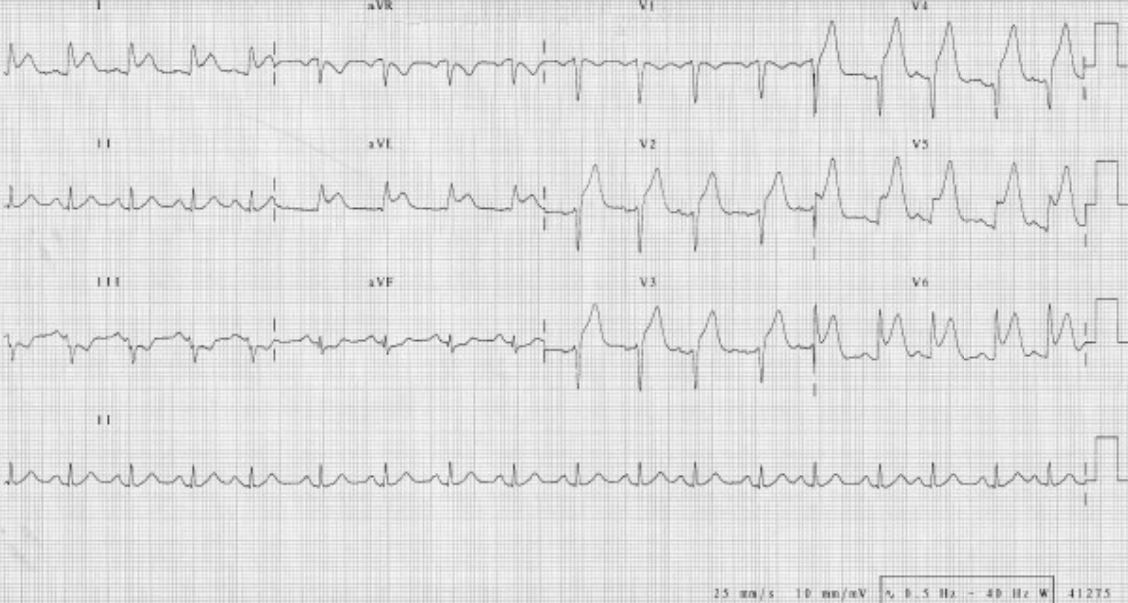
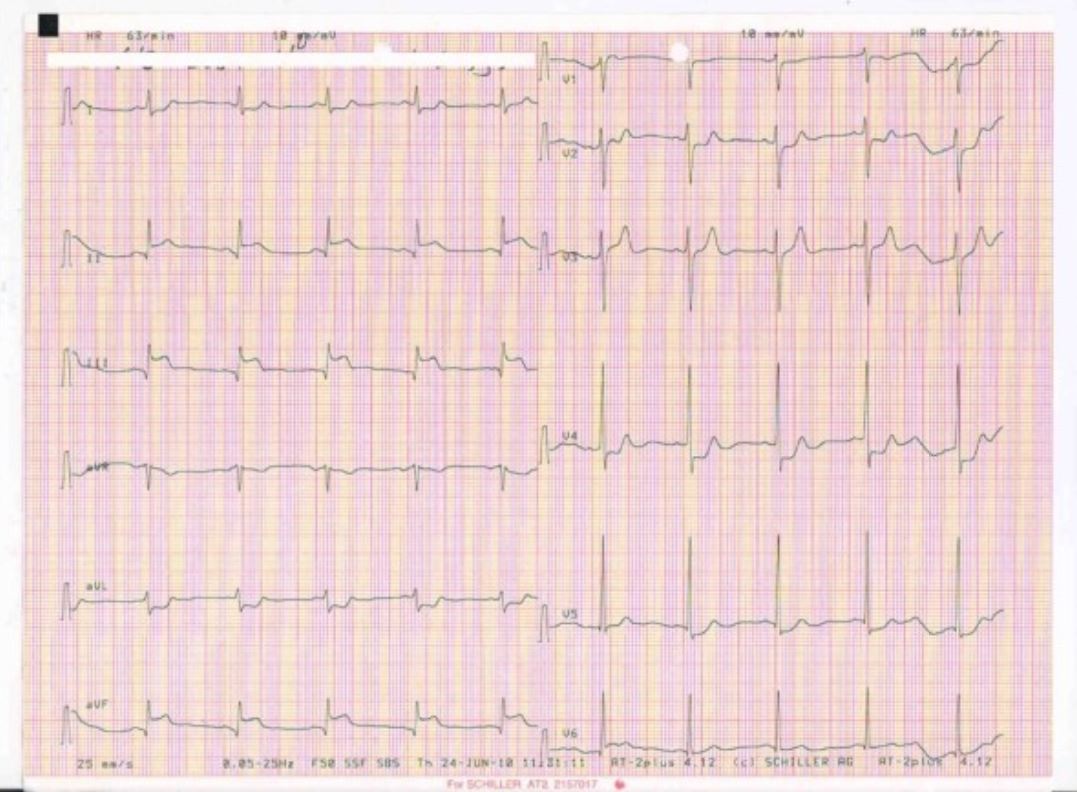
  • IAMCEST:
    • Debido a una oclusión importante de una arteria coronaria, causando un infarto transmural (a través de la pared del músculo cardíaco)
    • Produce cambios en EN Erythema nodosum is an immune-mediated panniculitis (inflammation of the subcutaneous fat) caused by a type IV (delayed-type) hypersensitivity reaction. It commonly manifests in young women as tender, erythematous nodules on the shins. Erythema Nodosum el ECG ECG An electrocardiogram (ECG) is a graphic representation of the electrical activity of the heart plotted against time. Adhesive electrodes are affixed to the skin surface allowing measurement of cardiac impulses from many angles. The ECG provides 3-dimensional information about the conduction system of the heart, the myocardium, and other cardiac structures. Electrocardiogram (ECG) con elevación del ST y ondas Q
  • IAMSEST:
    • Debido a una oclusión menos grave de una arteria coronaria, lo que provoca un IM subendocárdico (no a través de toda la pared del músculo cardíaco)
    • El ECG ECG An electrocardiogram (ECG) is a graphic representation of the electrical activity of the heart plotted against time. Adhesive electrodes are affixed to the skin surface allowing measurement of cardiac impulses from many angles. The ECG provides 3-dimensional information about the conduction system of the heart, the myocardium, and other cardiac structures. Electrocardiogram (ECG) no muestra elevación del ST

Fisiopatología

  • Características de la placa inestable frente a la estable:
    • Placa inestable:
      • Capa fibrosa delgada
      • Infiltrado masivo de células inflamatorias
      • ↑ Actividad de las enzimas metaloproteinasas (debilita la capa fibrosa)
      • ↑ Contenido de lípidos
      • Angiogénesis
      • Ruptura de placa inestable en EN Erythema nodosum is an immune-mediated panniculitis (inflammation of the subcutaneous fat) caused by a type IV (delayed-type) hypersensitivity reaction. It commonly manifests in young women as tender, erythematous nodules on the shins. Erythema Nodosum una arteria coronaria → trombosis
    • Placa estable:
      • Gorro fibroso grueso
      • Estrechamiento de una arteria → incapacidad para satisfacer la demanda de oxígeno con ↑ esfuerzo
      • Puede provocar angina estable (síntomas solo con el esfuerzo)
  • Oclusión de la arteria coronaria → isquemia → muerte del tejido (infarto) en EN Erythema nodosum is an immune-mediated panniculitis (inflammation of the subcutaneous fat) caused by a type IV (delayed-type) hypersensitivity reaction. It commonly manifests in young women as tender, erythematous nodules on the shins. Erythema Nodosum el área del corazón irrigada por esa arteria:
    • Oclusión parcial de la arteria coronaria → afecta el miocardio interno (subendocardio) → puede causar:
      • IAMSEST
      • Angina inestable (si la isquemia no produce muerte celular)
    • Oclusión completa → infarto transmural → IAMCEST
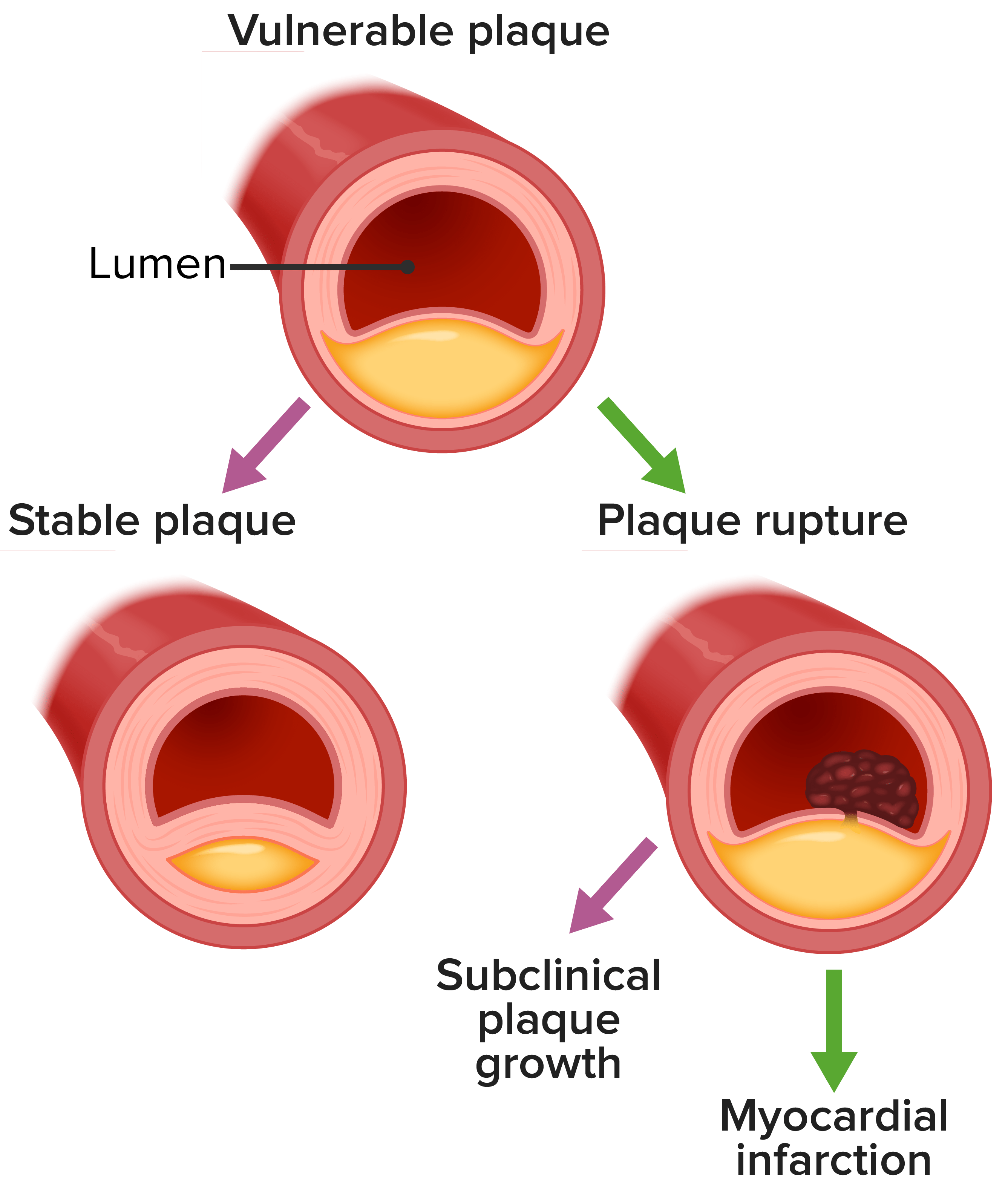
Myocardial infarction

Historia natural de la placa vulnerable/inestable:
Se cree que las placas ateroscleróticas inestables representan la mayoría de los IM. Se caracterizan por inflamación por macrófagos, una cubierta fibrosa delgada, remodelación, microcalcificación y angiogénesis.

Imagen por Lecturio.

Presentación Clínica

El síntoma clásico de IM en EN Erythema nodosum is an immune-mediated panniculitis (inflammation of the subcutaneous fat) caused by a type IV (delayed-type) hypersensitivity reaction. It commonly manifests in young women as tender, erythematous nodules on the shins. Erythema Nodosum la mayoría de los LOS Neisseria pacientes es el dolor Dolor Inflammation torácico agudo. Sin embargo, algunos pacientes pueden presentar síntomas más vagos.

Síntomas

  • Típicos:
    • Dolor Dolor Inflammation en EN Erythema nodosum is an immune-mediated panniculitis (inflammation of the subcutaneous fat) caused by a type IV (delayed-type) hypersensitivity reaction. It commonly manifests in young women as tender, erythematous nodules on the shins. Erythema Nodosum el pecho:
      • Retroesternal
      • Dolor Dolor Inflammation sordo, opresivo/similar a la presión
      • Puede irradiarse al AL Amyloidosis brazo, hombro o mandíbula izquierdos
      • Por lo general, constante, con una duración de ≥ 20–30 minutos
    • Diaforesis
    • Disnea
    • Náuseas
  • Síntomas asociados:
    • Mareo
    • “Indigestión” y/o vómitos
    • Síncope
    • Dolor Dolor Inflammation epigástrico (con IM de la pared inferior)
    • Palpitaciones
  • Presentación atípica más común en EN Erythema nodosum is an immune-mediated panniculitis (inflammation of the subcutaneous fat) caused by a type IV (delayed-type) hypersensitivity reaction. It commonly manifests in young women as tender, erythematous nodules on the shins. Erythema Nodosum mujeres, ancianos o pacientes con diabetes Diabetes Diabetes mellitus (DM) is a metabolic disease characterized by hyperglycemia and dysfunction of the regulation of glucose metabolism by insulin. Type 1 DM is diagnosed mostly in children and young adults as the result of autoimmune destruction of β cells in the pancreas and the resulting lack of insulin. Type 2 DM has a significant association with obesity and is characterized by insulin resistance. Diabetes Mellitus:
    • Ausencia de dolor Dolor Inflammation torácico o localizaciones/calidad atípicas
    • Puede presentarse solo con los LOS Neisseria síntomas habituales asociados

Examen físico

  • Signos vitales:
    • Taquicardia
    • Bradicardia con oclusión de la arteria coronaria derecha (que irriga los LOS Neisseria nódulos sinoauricular (SA) y auriculoventricular (AV))
    • Hipotensión
  • Cardiovascular:
    • Sonido cardíaco S3 S3 Heart Sounds (sonido diastólico temprano que se escucha al AL Amyloidosis final del llenado ventricular rápido)
    • Sonido cardíaco S4 S4 Heart Sounds (sonido diastólico tardío que se escucha al AL Amyloidosis inicio de la contracción auricular)
    • Distensión venosa yugular: oclusión de la arteria coronaria derecha → insuficiencia cardíaca del lado derecho
    • Congestión hepática: oclusión de arteria coronaria derecha → insuficiencia cardíaca del lado derecho
  • Edema Edema Edema is a condition in which excess serous fluid accumulates in the body cavity or interstitial space of connective tissues. Edema is a symptom observed in several medical conditions. It can be categorized into 2 types, namely, peripheral (in the extremities) and internal (in an organ or body cavity). Edema pulmonar: oclusión de la arteria coronaria izquierda → insuficiencia cardíaca del lado izquierdo
    • Crepitantes
    • Sibilancias
  • Piel:
    • Fría
    • Pálida o cianótica
    • Diaforética

Diagnóstico

Los LOS Neisseria pacientes que presentan antecedentes de dolor Dolor Inflammation torácico agudo o síntomas atípicos sospechosos se evalúan con ECG ECG An electrocardiogram (ECG) is a graphic representation of the electrical activity of the heart plotted against time. Adhesive electrodes are affixed to the skin surface allowing measurement of cardiac impulses from many angles. The ECG provides 3-dimensional information about the conduction system of the heart, the myocardium, and other cardiac structures. Electrocardiogram (ECG). Los LOS Neisseria niveles de troponina cardíaca deben obtenerse dentro de los LOS Neisseria 10 minutos posteriores a la llegada del paciente al AL Amyloidosis servicio de urgencias. Las anomalías en EN Erythema nodosum is an immune-mediated panniculitis (inflammation of the subcutaneous fat) caused by a type IV (delayed-type) hypersensitivity reaction. It commonly manifests in young women as tender, erythematous nodules on the shins. Erythema Nodosum ambos confirman el diagnóstico de IM.

ECG ECG An electrocardiogram (ECG) is a graphic representation of the electrical activity of the heart plotted against time. Adhesive electrodes are affixed to the skin surface allowing measurement of cardiac impulses from many angles. The ECG provides 3-dimensional information about the conduction system of the heart, the myocardium, and other cardiac structures. Electrocardiogram (ECG)

  • Hallazgos en EN Erythema nodosum is an immune-mediated panniculitis (inflammation of the subcutaneous fat) caused by a type IV (delayed-type) hypersensitivity reaction. It commonly manifests in young women as tender, erythematous nodules on the shins. Erythema Nodosum IAMCEST y su evolución:
    • Las ondas T altas, puntiagudas (hiperagudas) se pueden ver al AL Amyloidosis principio del curso.
    • Elevación del ST ≥ 1 mm en EN Erythema nodosum is an immune-mediated panniculitis (inflammation of the subcutaneous fat) caused by a type IV (delayed-type) hypersensitivity reaction. It commonly manifests in young women as tender, erythematous nodules on the shins. Erythema Nodosum ≥ 2 derivaciones contiguas
    • Depresión recíproca del ST
    • Nuevo bloqueo de rama izquierda y síntomas → IAMCEST hasta que se demuestre lo contrario
    • Las ondas Q patológicas típicamente emergen entre 6 y 16 horas después del inicio de los LOS Neisseria síntomas
    • Sigue la inversión de la onda T
    • Normalización del segmento ST
    • Normalización de la onda T durante varias horas o días
  • Hallazgos en EN Erythema nodosum is an immune-mediated panniculitis (inflammation of the subcutaneous fat) caused by a type IV (delayed-type) hypersensitivity reaction. It commonly manifests in young women as tender, erythematous nodules on the shins. Erythema Nodosum IAMSEST:
    • Depresión del ST (no elevaciones)
    • Cambios no específicos
    • Ondas T invertidas
Tabla: Localización del IAMCEST en EN Erythema nodosum is an immune-mediated panniculitis (inflammation of the subcutaneous fat) caused by a type IV (delayed-type) hypersensitivity reaction. It commonly manifests in young women as tender, erythematous nodules on the shins. Erythema Nodosum ECG ECG An electrocardiogram (ECG) is a graphic representation of the electrical activity of the heart plotted against time. Adhesive electrodes are affixed to the skin surface allowing measurement of cardiac impulses from many angles. The ECG provides 3-dimensional information about the conduction system of the heart, the myocardium, and other cardiac structures. Electrocardiogram (ECG)
Arteria ocluida Derivaciones con elevación ST Localización del IM
LAD proximal V1–V2 Septal
LAD V3–V4 Anterior
LAD distal V5–V6 Apical
LCX o LAD I, aVL Lateral
RCA (más común) o LCX II, III, aVF Inferior
RCA o LCX V7–V9 (depresiones ST en EN Erythema nodosum is an immune-mediated panniculitis (inflammation of the subcutaneous fat) caused by a type IV (delayed-type) hypersensitivity reaction. It commonly manifests in young women as tender, erythematous nodules on the shins. Erythema Nodosum V1–V3) Posterolateral
LAD: arteria descendente anterior izquierda
LCX: arteria circunfleja izquierda
RCA: arteria coronaria derecha

Estudios de laboratorio

Enzimas cardíacas:

  • Proteínas estructurales en EN Erythema nodosum is an immune-mediated panniculitis (inflammation of the subcutaneous fat) caused by a type IV (delayed-type) hypersensitivity reaction. It commonly manifests in young women as tender, erythematous nodules on the shins. Erythema Nodosum el corazón que se liberan como resultado de una lesión miocárdica
  • Troponina I:
    • Niveles séricos:
      • Comienza a ↑ dentro de las 2–3 horas posteriores al AL Amyloidosis inicio del dolor Dolor Inflammation torácico
      • Niveles máximos a las 12–48 horas
      • Vuelta a la línea de base en EN Erythema nodosum is an immune-mediated panniculitis (inflammation of the subcutaneous fat) caused by a type IV (delayed-type) hypersensitivity reaction. It commonly manifests in young women as tender, erythematous nodules on the shins. Erythema Nodosum 4–10 días
    • Máxima sensibilidad y especificidad ( en EN Erythema nodosum is an immune-mediated panniculitis (inflammation of the subcutaneous fat) caused by a type IV (delayed-type) hypersensitivity reaction. It commonly manifests in young women as tender, erythematous nodules on the shins. Erythema Nodosum comparación con otras enzimas cardíacas)
    • Los LOS Neisseria exámenes de laboratorio seriados se utilizan para evaluar el aumento y la disminución de los LOS Neisseria niveles (volver a verificar en EN Erythema nodosum is an immune-mediated panniculitis (inflammation of the subcutaneous fat) caused by a type IV (delayed-type) hypersensitivity reaction. It commonly manifests in young women as tender, erythematous nodules on the shins. Erythema Nodosum 1–3 horas).
    • El grado de ↑ se correlaciona con el tamaño del infarto.
    • Puede estar ↑ como resultado de causas de isquemia coronaria distintas del IM agudo:
      • Arritmia
      • Cocaína
      • Intervención coronaria percutánea
      • Embolismo coronario
      • Disección aórtica
    • Puede estar ↑ con isquemia no coronaria o lesión miocárdica:
      • Choque eléctrico
      • Hipoxia
      • Miocarditis
      • Miocardiopatía de Takotsubo: debilitamiento repentino y temporal del músculo cardíaco (generalmente relacionado con un factor estresante)
    • Pacientes con enfermedad renal crónica (ERC):
      • Pueden tener niveles ↑ estables en EN Erythema nodosum is an immune-mediated panniculitis (inflammation of the subcutaneous fat) caused by a type IV (delayed-type) hypersensitivity reaction. It commonly manifests in young women as tender, erythematous nodules on the shins. Erythema Nodosum ausencia de daño miocárdico
      • Un aumento o disminución del valor de troponina I > 20% durante 6–9 horas es indicativo de IM agudo en EN Erythema nodosum is an immune-mediated panniculitis (inflammation of the subcutaneous fat) caused by a type IV (delayed-type) hypersensitivity reaction. It commonly manifests in young women as tender, erythematous nodules on the shins. Erythema Nodosum pacientes con ERC en EN Erythema nodosum is an immune-mediated panniculitis (inflammation of the subcutaneous fat) caused by a type IV (delayed-type) hypersensitivity reaction. It commonly manifests in young women as tender, erythematous nodules on the shins. Erythema Nodosum etapa terminal.
  • Isoenzima creatina quinasa muscular-cerebral (CK-MB, por sus siglas en EN Erythema nodosum is an immune-mediated panniculitis (inflammation of the subcutaneous fat) caused by a type IV (delayed-type) hypersensitivity reaction. It commonly manifests in young women as tender, erythematous nodules on the shins. Erythema Nodosum inglés):
    • Menos sensible y específica que la troponina
      • ↑ Dentro de las 3–6 horas posteriores al AL Amyloidosis dolor Dolor Inflammation torácico
      • Picos dentro de 12–24 horas
      • Se normaliza 48–72 horas después del IM
    • ↑ Continuado después de 72 horas es diagnóstico de reinfarto.
    • El grado de ↑ en EN Erythema nodosum is an immune-mediated panniculitis (inflammation of the subcutaneous fat) caused by a type IV (delayed-type) hypersensitivity reaction. It commonly manifests in young women as tender, erythematous nodules on the shins. Erythema Nodosum CK-MB se correlaciona con el tamaño del infarto.

Laboratorios de soporte:

  • Lactato deshidrogenasa ( LDH LDH Osteosarcoma) y aspartato aminotransferasa ( AST AST Enzymes of the transferase class that catalyze the conversion of l-aspartate and 2-ketoglutarate to oxaloacetate and l-glutamate. Liver Function Tests) → pueden estar ↑, pero ya no se usan en EN Erythema nodosum is an immune-mediated panniculitis (inflammation of the subcutaneous fat) caused by a type IV (delayed-type) hypersensitivity reaction. It commonly manifests in young women as tender, erythematous nodules on the shins. Erythema Nodosum el diagnóstico de IM.
  • Péptido natriurético tipo B ( BNP BNP A peptide that is secreted by the brain and the heart atria, stored mainly in cardiac ventricular myocardium. It can cause natriuresis; diuresis; vasodilation; and inhibits secretion of renin and aldosterone. It improves heart function. It contains 32 amino acids. Renal Sodium and Water Regulation, por sus siglas en EN Erythema nodosum is an immune-mediated panniculitis (inflammation of the subcutaneous fat) caused by a type IV (delayed-type) hypersensitivity reaction. It commonly manifests in young women as tender, erythematous nodules on the shins. Erythema Nodosum inglés) → ↑ en EN Erythema nodosum is an immune-mediated panniculitis (inflammation of the subcutaneous fat) caused by a type IV (delayed-type) hypersensitivity reaction. It commonly manifests in young women as tender, erythematous nodules on the shins. Erythema Nodosum insuficiencia cardiaca
  • Los LOS Neisseria niveles de potasio y magnesio deben optimizarse durante el tratamiento.
  • Tamizaje de drogas para evaluar el uso de cocaína o metanfetamina.

Comparación dentro del síndrome coronario agudo

La siguiente tabla compara la angina inestable, IAMSEST e IAMCEST sobre la base de las características clínicas, ECG ECG An electrocardiogram (ECG) is a graphic representation of the electrical activity of the heart plotted against time. Adhesive electrodes are affixed to the skin surface allowing measurement of cardiac impulses from many angles. The ECG provides 3-dimensional information about the conduction system of the heart, the myocardium, and other cardiac structures. Electrocardiogram (ECG) y los LOS Neisseria hallazgos de laboratorio.

Tabla: Comparación dentro del síndrome coronario agudo
Diagnóstico Características clínicas Hallazgos del ECG ECG An electrocardiogram (ECG) is a graphic representation of the electrical activity of the heart plotted against time. Adhesive electrodes are affixed to the skin surface allowing measurement of cardiac impulses from many angles. The ECG provides 3-dimensional information about the conduction system of the heart, the myocardium, and other cardiac structures. Electrocardiogram (ECG) Hallazgos de laboratorio
Angina inestable Dolor Dolor Inflammation torácico isquémico que ocurre en EN Erythema nodosum is an immune-mediated panniculitis (inflammation of the subcutaneous fat) caused by a type IV (delayed-type) hypersensitivity reaction. It commonly manifests in young women as tender, erythematous nodules on the shins. Erythema Nodosum reposo o con niveles de esfuerzo previamente tolerados
  • Ninguno
  • Depresión del segmento ST
  • TWI
Troponina normal
IAMSEST Dolor Dolor Inflammation torácico isquémico prolongado en EN Erythema nodosum is an immune-mediated panniculitis (inflammation of the subcutaneous fat) caused by a type IV (delayed-type) hypersensitivity reaction. It commonly manifests in young women as tender, erythematous nodules on the shins. Erythema Nodosum cualquier situación
  • Ninguno
  • Depresión del segmento ST
  • TWI
Troponina elevada
IAMCEST Dolor Dolor Inflammation torácico isquémico prolongado en EN Erythema nodosum is an immune-mediated panniculitis (inflammation of the subcutaneous fat) caused by a type IV (delayed-type) hypersensitivity reaction. It commonly manifests in young women as tender, erythematous nodules on the shins. Erythema Nodosum cualquier situación Troponina elevada
LBBB: bloqueo de rama izquierda

TWI: inversión de onda T

Imagenología

  • Radiografía de tórax:
    • Debe hacerse para evaluar otras causas de dolor Dolor Inflammation en EN Erythema nodosum is an immune-mediated panniculitis (inflammation of the subcutaneous fat) caused by a type IV (delayed-type) hypersensitivity reaction. It commonly manifests in young women as tender, erythematous nodules on the shins. Erythema Nodosum el tórax, como:
      • Neumonía
      • Neumotórax
      • Ensanchamiento mediastínico → disección aórtica
    • Puede mostrar edema Edema Edema is a condition in which excess serous fluid accumulates in the body cavity or interstitial space of connective tissues. Edema is a symptom observed in several medical conditions. It can be categorized into 2 types, namely, peripheral (in the extremities) and internal (in an organ or body cavity). Edema pulmonar → insuficiencia cardíaca
  • Angiografía coronaria:
    • Prueba estándar de oro
    • Hallazgos:
      • Localiza arterias coronarias estrechadas u ocluidas
      • Nuevas anomalías regionales del movimiento de la pared compatibles con un infarto isquémico
      • La ventriculografía izquierda puede evaluar la función del ventrículo izquierdo.
  • Determina la necesidad de intervención con stent o cirugía
  • Ecocardiografía transtorácica:
    • La fracción de eyección del ventrículo izquierdo (FEVI) es el mejor predictor de supervivencia en EN Erythema nodosum is an immune-mediated panniculitis (inflammation of the subcutaneous fat) caused by a type IV (delayed-type) hypersensitivity reaction. It commonly manifests in young women as tender, erythematous nodules on the shins. Erythema Nodosum el IAMCEST.
    • Se pueden visualizar nuevas anomalías regionales del movimiento de la pared
    • Puede evaluar las complicaciones del IM:
      • Ruptura de pared libre
      • Ruptura del séptum ventricular
      • Regurgitación mitral
      • Formación de aneurisma
      • Presencia de un trombo

Tratamiento

Terapia inicial

El reconocimiento rápido del diagnóstico de IM agudo es imperativo para obtener el beneficio de la terapia de reperfusión.

  • Oxígeno: utilizado anteriormente con todos los LOS Neisseria pacientes, utilizado actualmente solo si:
    • Saturación de O2 < 90%
    • Dificultad respiratoria presente
    • Insuficiencia cardiaca presente
    • Otras características de alto riesgo de la hipoxia
  • Tratar las arritmias ventriculares (si las hay).
  • Aspirina:
    • Previene la formación/expansión de trombos
    • ↓ Mortalidad
  • Nitroglicerina (sublingual):
    • Comenzar si el paciente todavía tiene dolor Dolor Inflammation en EN Erythema nodosum is an immune-mediated panniculitis (inflammation of the subcutaneous fat) caused by a type IV (delayed-type) hypersensitivity reaction. It commonly manifests in young women as tender, erythematous nodules on the shins. Erythema Nodosum el pecho, hipertensión o insuficiencia cardíaca
    • Vasodilatación → precarga → ↓ demanda de oxígeno → ↓ síntomas
    • Agregar nitratos intravenosos si los LOS Neisseria síntomas persisten después de 3 dosis sublinguales
    • Evitar en EN Erythema nodosum is an immune-mediated panniculitis (inflammation of the subcutaneous fat) caused by a type IV (delayed-type) hypersensitivity reaction. It commonly manifests in young women as tender, erythematous nodules on the shins. Erythema Nodosum pacientes con:
      • Hipotensión
      • Infarto del ventrículo derecho (IM de la pared inferior) → ↓ precarga en EN Erythema nodosum is an immune-mediated panniculitis (inflammation of the subcutaneous fat) caused by a type IV (delayed-type) hypersensitivity reaction. It commonly manifests in young women as tender, erythematous nodules on the shins. Erythema Nodosum el ventrículo derecho puede ↓ el gasto cardíaco aún más
  • Betabloqueadores:
    • ↓ Frecuencia cardíaca y contractilidad → ↓ demanda de oxígeno → ↓ síntomas
    • ↓ Mortalidad
    • Contraindicados si el paciente tiene:
      • Insuficiencia cardíaca
      • Bradicardia
      • Enfermedad reactiva grave de las vías respiratorias
      • IM inducido por cocaína
  • Morfina:
    • Proporciona alivio del dolor Dolor Inflammation isquémico (↓ precarga)
    • ↓ Ansiedad y el impulso adrenérgico que provoca una mayor vasoconstricción
    • Puede ↑ mortalidad
    • Puede causar depresión respiratoria
  • Tratar la insuficiencia cardíaca con diuréticos (si está presente).
  • Iniciar el tratamiento con estatinas en EN Erythema nodosum is an immune-mediated panniculitis (inflammation of the subcutaneous fat) caused by a type IV (delayed-type) hypersensitivity reaction. It commonly manifests in young women as tender, erythematous nodules on the shins. Erythema Nodosum dosis altas (e.g., atorvastatina) lo antes posible y antes de la intervención coronaria percutánea.
  • Solución salina intravenosa para ↑ gasto cardíaco y perfusión con IM ventricular derecho
  • Las recomendaciones de anticoagulación varían según la situación clínica y el plan de intervención coronaria percutánea o terapia trombolítica:
    • Heparina
    • Heparina de bajo peso molecular (HBPM)

Estratificación del riesgo

  • Importante para el pronóstico:
    • Los LOS Neisseria pacientes con mayor riesgo de eventos cardíacos adicionales pueden beneficiarse de un enfoque terapéutico más agresivo:
      • Las puntuaciones de riesgo como TIMI (Thrombolysis in Myocardial Infarction Myocardial infarction MI is ischemia and death of an area of myocardial tissue due to insufficient blood flow and oxygenation, usually from thrombus formation on a ruptured atherosclerotic plaque in the epicardial arteries. Clinical presentation is most commonly with chest pain, but women and patients with diabetes may have atypical symptoms. Myocardial Infarction), Global Registry of Acute Coronary Events (GRACE) o Platelet Glycoprotein IIb/IIIa in Unstable Angina Unstable angina Precordial pain at rest, which may precede a myocardial infarction. Stable and Unstable Angina: Receptor Receptor Receptors are proteins located either on the surface of or within a cell that can bind to signaling molecules known as ligands (e.g., hormones) and cause some type of response within the cell. Receptors Suppression Suppression Defense Mechanisms Using Integrilin Integrilin Cyclic peptide that acts as a platelet glycoprotein iib-iiia antagonist, reversibly inhibiting the binding of fibrinogen; von Willebrand factor; and other adhesive molecules to the gpiib-iiia receptors of platelets. It is used in the management of unstable angina and in patients undergoing coronary angioplasty and stenting procedures. Antiplatelet Drugs Therapy (PURSUIT) tienen una buena capacidad predictiva.
      • Estos sistemas de puntuación tienen en EN Erythema nodosum is an immune-mediated panniculitis (inflammation of the subcutaneous fat) caused by a type IV (delayed-type) hypersensitivity reaction. It commonly manifests in young women as tender, erythematous nodules on the shins. Erythema Nodosum cuenta marcadores de resultados predictivos para el pronóstico.
    • Puntos finales para el resultado predictivo:
      • Muerte
      • IM futuro
      • Necesidad de revascularización urgente
  • Los LOS Neisseria puntajes de riesgo TIMI ayudan en EN Erythema nodosum is an immune-mediated panniculitis (inflammation of the subcutaneous fat) caused by a type IV (delayed-type) hypersensitivity reaction. It commonly manifests in young women as tender, erythematous nodules on the shins. Erythema Nodosum la toma de decisiones para la revascularización urgente:
    • Basado en EN Erythema nodosum is an immune-mediated panniculitis (inflammation of the subcutaneous fat) caused by a type IV (delayed-type) hypersensitivity reaction. It commonly manifests in young women as tender, erythematous nodules on the shins. Erythema Nodosum:
      • Características del ECG ECG An electrocardiogram (ECG) is a graphic representation of the electrical activity of the heart plotted against time. Adhesive electrodes are affixed to the skin surface allowing measurement of cardiac impulses from many angles. The ECG provides 3-dimensional information about the conduction system of the heart, the myocardium, and other cardiac structures. Electrocardiogram (ECG)
      • Enzimas cardíacas elevadas
      • Evidencia de inestabilidad hemodinámica
      • Dolor Dolor Inflammation torácico persistente a pesar del tratamiento médico adecuado
      • Edad
      • Comorbilidades (otros factores de riesgo de cardiopatía coronaria)
      • Uso reciente de aspirina
    • Para puntaje TIMI > 3 con IAMSEST o angina inestable, se recomienda la revascularización con intervención coronaria percutánea:
      • Riesgo bajo: puntuación de 0–2
      • Riesgo intermedio: puntuación de 3–4
      • Alto riesgo: puntuación de 5–7

Reperfusión

  • Intervención coronaria percutánea:
    • Indicaciones:
      • IAMCEST
      • IAMSEST con puntuación TIMI > 3
    • ↓ Cantidad de daño miocárdico
    • ↓ Mortalidad
    • Para pacientes que presentan ≤ 2 horas después del inicio de los LOS Neisseria síntomas → intervención coronaria percutánea con stent liberador de medicamentos para prevenir la reestenosis, si está disponible:
      • Mejora la supervivencia
      • ↓ Tasa de hemorragia intracraneal e IM recurrente en EN Erythema nodosum is an immune-mediated panniculitis (inflammation of the subcutaneous fat) caused by a type IV (delayed-type) hypersensitivity reaction. It commonly manifests in young women as tender, erythematous nodules on the shins. Erythema Nodosum comparación con la fibrinólisis
  • Si la intervención coronaria percutánea no está fácilmente disponible, se recomiendan agentes trombolíticos para la reperfusión:
    • Se prefieren tenecteplasa y reteplasa (específicos de fibrina).
    • La estreptoquinasa y la alteplasa son otras opciones.
    • Considerar la terapia fibrinolítica en EN Erythema nodosum is an immune-mediated panniculitis (inflammation of the subcutaneous fat) caused by a type IV (delayed-type) hypersensitivity reaction. It commonly manifests in young women as tender, erythematous nodules on the shins. Erythema Nodosum pacientes con ≤ 12 horas de síntomas.
    • Todos están contraindicados con hemorragia activa, accidente cerebrovascular reciente o sospecha de disección aórtica.
  • Para pacientes con síntomas > 2–3 horas:
    • Transferencia para intervención coronaria percutánea principal si está disponible dentro de los LOS Neisseria 120 minutos (incluido el tiempo de transferencia).
    • Iniciar terapia antiplaquetaria dual: aspirina más inhibidores P2Y12 ( clopidogrel Clopidogrel A ticlopidine analog and platelet purinergic p2y receptor antagonist that inhibits adenosine diphosphate-mediated platelet aggregation. It is used to prevent thromboembolism in patients with arterial occlusive diseases; myocardial infarction; stroke; or atrial fibrillation. Antiplatelet Drugs, prasugrel Prasugrel A piperazine derivative and platelet aggregation inhibitor that is used to prevent thrombosis in patients with acute coronary syndrome; unstable angina and myocardial infarction, as well as in those undergoing percutaneous coronary interventions. Antiplatelet Drugs, ticagrelor Ticagrelor An adenosine triphosphate analogue and reversible p2y12 purinoceptor antagonist that inhibits adp-mediated platelet aggregation. It is used for the prevention of thromboembolism by patients with acute coronary syndrome or a history of myocardial infarction. Antiplatelet Drugs).
    • Inhibidores de la glicoproteína IIb/IIIa (e.g., abciximab)
  • Indicaciones para la cirugía de bypass coronario después de un IM:
    • Fracaso de los LOS Neisseria trombolíticos o intervención coronaria percutánea para reperfundir el miocardio dañado
    • Complicaciones mecánicas hemodinámicamente importantes (e.g., ruptura)
    • Anatomía no susceptible de intervención coronaria percutánea

Atención post-IM

Se observa un mejor pronóstico a largo plazo con:

  • Terapia antiplaquetaria para ↓ el riesgo de trombosis arterial coronaria recurrente o, con intervención coronaria percutánea, trombosis del stent arterial coronario
  • Terapia con inhibidores de la enzima convertidora de angiotensina (IECA) para prevenir la remodelación del ventrículo izquierdo
  • Terapia con estatinas
  • Anticoagulación en EN Erythema nodosum is an immune-mediated panniculitis (inflammation of the subcutaneous fat) caused by a type IV (delayed-type) hypersensitivity reaction. It commonly manifests in young women as tender, erythematous nodules on the shins. Erythema Nodosum presencia de trombo ventricular izquierdo o fibrilación auricular crónica para prevenir la embolización

Complicaciones

Después de un IM, se desarrollan diferentes riesgos a medida que pasa el tiempo después del evento agudo. Los LOS Neisseria pacientes con IM tipo 2 tienen una mayor prevalencia de insuficiencia cardíaca, enfermedad renal como complicación del IM y fibrilación auricular.

  • Muerte: 1 de 3 pacientes no sobrevive al AL Amyloidosis IM inicial.
  • Posibles complicaciones en EN Erythema nodosum is an immune-mediated panniculitis (inflammation of the subcutaneous fat) caused by a type IV (delayed-type) hypersensitivity reaction. It commonly manifests in young women as tender, erythematous nodules on the shins. Erythema Nodosum los LOS Neisseria primeros 1–3 días posteriores al AL Amyloidosis IM:
    • Arritmia ventricular (la causa más común de muerte)
    • Insuficiencia cardiaca aguda
    • Shock Shock Shock is a life-threatening condition associated with impaired circulation that results in tissue hypoxia. The different types of shock are based on the underlying cause: distributive (↑ cardiac output (CO), ↓ systemic vascular resistance (SVR)), cardiogenic (↓ CO, ↑ SVR), hypovolemic (↓ CO, ↑ SVR), obstructive (↓ CO), and mixed. Types of Shock cardiogénico
    • Pericarditis Pericarditis Pericarditis is an inflammation of the pericardium, often with fluid accumulation. It can be caused by infection (often viral), myocardial infarction, drugs, malignancies, metabolic disorders, autoimmune disorders, or trauma. Acute, subacute, and chronic forms exist. Pericarditis:
      • Dolor Dolor Inflammation torácico pleurítico que aumenta al AL Amyloidosis acostarse en EN Erythema nodosum is an immune-mediated panniculitis (inflammation of the subcutaneous fat) caused by a type IV (delayed-type) hypersensitivity reaction. It commonly manifests in young women as tender, erythematous nodules on the shins. Erythema Nodosum decúbito supino
      • Frote pericárdico en EN Erythema nodosum is an immune-mediated panniculitis (inflammation of the subcutaneous fat) caused by a type IV (delayed-type) hypersensitivity reaction. It commonly manifests in young women as tender, erythematous nodules on the shins. Erythema Nodosum la auscultación
      • Fiebre
      • Tos TOS Thoracic outlet syndrome (TOS) is a broad term used for a spectrum of syndromes related to the general region of the thoracic outlet, which involves the compression or irritation of elements of the brachial plexus, subclavian artery, or subclavian vein. Thoracic Outlet Syndrome seca
      • ECG ECG An electrocardiogram (ECG) is a graphic representation of the electrical activity of the heart plotted against time. Adhesive electrodes are affixed to the skin surface allowing measurement of cardiac impulses from many angles. The ECG provides 3-dimensional information about the conduction system of the heart, the myocardium, and other cardiac structures. Electrocardiogram (ECG) que muestra elevaciones difusas de ST
      • Derrame pericárdico visto en EN Erythema nodosum is an immune-mediated panniculitis (inflammation of the subcutaneous fat) caused by a type IV (delayed-type) hypersensitivity reaction. It commonly manifests in young women as tender, erythematous nodules on the shins. Erythema Nodosum ecocardiograma
  • 3–14 días después del IM:
    • Ruptura de pared libre:
      • Puede resultar en EN Erythema nodosum is an immune-mediated panniculitis (inflammation of the subcutaneous fat) caused by a type IV (delayed-type) hypersensitivity reaction. It commonly manifests in young women as tender, erythematous nodules on the shins. Erythema Nodosum taponamiento cardíaco o formación de pseudoaneurismas
      • La incidencia es máxima durante la eliminación del miocardio necrótico mediada por macrófagos.
    • Ruptura del músculo papilar:
      • Ruptura del músculo papilar posteromedial por oclusión de la arteria descendente posterior
      • Ruptura de la pared posteromedial → regurgitación mitral aguda
      • Soplo holosistólico sobre el 5to espacio intercostal en EN Erythema nodosum is an immune-mediated panniculitis (inflammation of the subcutaneous fat) caused by a type IV (delayed-type) hypersensitivity reaction. It commonly manifests in young women as tender, erythematous nodules on the shins. Erythema Nodosum la línea medioclavicular
      • Puede presentarse con signos de insuficiencia cardíaca del lado izquierdo ( edema Edema Edema is a condition in which excess serous fluid accumulates in the body cavity or interstitial space of connective tissues. Edema is a symptom observed in several medical conditions. It can be categorized into 2 types, namely, peripheral (in the extremities) and internal (in an organ or body cavity). Edema pulmonar, crepitantes, disnea)
    • Ruptura del séptum ventricular:
      • Causada por oclusión de la arteria descendente anterior izquierda
      • Coincide con la infiltración de macrófagos de la pared
      • Puede presentarse como un soplo holosistólico sobre el borde esternal izquierdo
      • Puede presentarse con signos de insuficiencia cardíaca del lado derecho (e.g., distensión venosa yugular, edema Edema Edema is a condition in which excess serous fluid accumulates in the body cavity or interstitial space of connective tissues. Edema is a symptom observed in several medical conditions. It can be categorized into 2 types, namely, peripheral (in the extremities) and internal (in an organ or body cavity). Edema periférico) o insuficiencia biventricular
      • Puede progresar a shock Shock Shock is a life-threatening condition associated with impaired circulation that results in tissue hypoxia. The different types of shock are based on the underlying cause: distributive (↑ cardiac output (CO), ↓ systemic vascular resistance (SVR)), cardiogenic (↓ CO, ↑ SVR), hypovolemic (↓ CO, ↑ SVR), obstructive (↓ CO), and mixed. Types of Shock cardiogénico por ↓ del gasto cardíaco
    • La formación de trombos murales con posible embolización del coágulo puede provocar:
      • Isquemia de extremidades
      • Accidente cerebrovascular
      • Isquemia mesentérica
      • Infarto renal
  • > 14 días después del IM:
    • Síndrome de Dressler:
      • Sensibilización autoinmune a antígenos liberados durante la muerte de cardiomiocitos
      • Se presenta con signos de pericarditis Pericarditis Pericarditis is an inflammation of the pericardium, often with fluid accumulation. It can be caused by infection (often viral), myocardial infarction, drugs, malignancies, metabolic disorders, autoimmune disorders, or trauma. Acute, subacute, and chronic forms exist. Pericarditis (e.g., dolor Dolor Inflammation pleurítico, roce, fiebre)
      • Puede resultar en EN Erythema nodosum is an immune-mediated panniculitis (inflammation of the subcutaneous fat) caused by a type IV (delayed-type) hypersensitivity reaction. It commonly manifests in young women as tender, erythematous nodules on the shins. Erythema Nodosum elevación de troponinas y leucocitosis
      • El ECG ECG An electrocardiogram (ECG) is a graphic representation of the electrical activity of the heart plotted against time. Adhesive electrodes are affixed to the skin surface allowing measurement of cardiac impulses from many angles. The ECG provides 3-dimensional information about the conduction system of the heart, the myocardium, and other cardiac structures. Electrocardiogram (ECG) muestra elevaciones difusas del ST
      • Derrame pericárdico: cantidad anormal de líquido en EN Erythema nodosum is an immune-mediated panniculitis (inflammation of the subcutaneous fat) caused by a type IV (delayed-type) hypersensitivity reaction. It commonly manifests in young women as tender, erythematous nodules on the shins. Erythema Nodosum la cavidad pericárdica del corazón
      • Puede complicarse con taponamiento cardíaco/hemopericardio
    • Aneurisma ventricular que se presenta con:
      • Elevaciones persistentes del ST e inversiones de la onda T > 3 semanas después del IM
      • Signos de angina (e.g., disnea de esfuerzo)
      • Soplo sistólico y/o sonidos S3 S3 Heart Sounds/ S4 S4 Heart Sounds

Diagnóstico Diferencial

  • Angina inestable: se presenta con dolor Dolor Inflammation torácico debido a una isquemia miocárdica transitoria y puede ser una señal de advertencia del riesgo de un IM en EN Erythema nodosum is an immune-mediated panniculitis (inflammation of the subcutaneous fat) caused by a type IV (delayed-type) hypersensitivity reaction. It commonly manifests in young women as tender, erythematous nodules on the shins. Erythema Nodosum el futuro. El diagnóstico se basa en EN Erythema nodosum is an immune-mediated panniculitis (inflammation of the subcutaneous fat) caused by a type IV (delayed-type) hypersensitivity reaction. It commonly manifests in young women as tender, erythematous nodules on the shins. Erythema Nodosum los LOS Neisseria antecedentes y el examen fisico, ECG ECG An electrocardiogram (ECG) is a graphic representation of the electrical activity of the heart plotted against time. Adhesive electrodes are affixed to the skin surface allowing measurement of cardiac impulses from many angles. The ECG provides 3-dimensional information about the conduction system of the heart, the myocardium, and other cardiac structures. Electrocardiogram (ECG) y pruebas de esfuerzo, con posible imagenología adicional de medicina nuclear, ecocardiografía o angiografía coronaria. La troponina será normal. El tratamiento incluye medicamentos antiplaquetarios, nitratos, estatinas, betabloqueadores e intervención coronaria percutánea.
  • Angina vasoespástica: causa infrecuente de dolor Dolor Inflammation torácico debido a espasmos transitorios de las arterias coronarias. La presentación clínica de la angina vasoespástica se caracteriza por episodios espontáneos de dolor Dolor Inflammation torácico debido a una disminución transitoria del flujo sanguíneo a las arterias epicárdicas. El diagnóstico se realiza mediante los LOS Neisseria antecedentes clínicos, el examen normal y ECG ECG An electrocardiogram (ECG) is a graphic representation of the electrical activity of the heart plotted against time. Adhesive electrodes are affixed to the skin surface allowing measurement of cardiac impulses from many angles. The ECG provides 3-dimensional information about the conduction system of the heart, the myocardium, and other cardiac structures. Electrocardiogram (ECG). Las enzimas cardíacas y la intervención coronaria percutánea suelen ser normales. El tratamiento incluye la prevención del vasoespasmo con bloqueadores de los LOS Neisseria canales de calcio y el alivio de la angina con nitratos.
  • Disección aórtica: debido al AL Amyloidosis esfuerzo cortante de la presión pulsátil que provoca un desgarro en EN Erythema nodosum is an immune-mediated panniculitis (inflammation of the subcutaneous fat) caused by a type IV (delayed-type) hypersensitivity reaction. It commonly manifests in young women as tender, erythematous nodules on the shins. Erythema Nodosum la túnica íntima de la pared aórtica, a menudo asociado con hipertensión. Los LOS Neisseria pacientes con disección aórtica a menudo se presentan con dolor Dolor Inflammation torácico o de espalda agudo y desgarrante. El diagnóstico se realiza mediante imágenes de tomografía computarizada (TC). Las disecciones tipo A ( en EN Erythema nodosum is an immune-mediated panniculitis (inflammation of the subcutaneous fat) caused by a type IV (delayed-type) hypersensitivity reaction. It commonly manifests in young women as tender, erythematous nodules on the shins. Erythema Nodosum la aorta Aorta The main trunk of the systemic arteries. Mediastinum and Great Vessels: Anatomy ascendente) son una urgencia quirúrgica por el riesgo de ruptura inminente. Las disecciones de tipo B ( en EN Erythema nodosum is an immune-mediated panniculitis (inflammation of the subcutaneous fat) caused by a type IV (delayed-type) hypersensitivity reaction. It commonly manifests in young women as tender, erythematous nodules on the shins. Erythema Nodosum la aorta Aorta The main trunk of the systemic arteries. Mediastinum and Great Vessels: Anatomy descendente) a menudo se pueden tratar médicamente con betabloqueadores y bloqueadores de los LOS Neisseria canales de calcio.
  • Embolismo pulmonar: se presenta con dolor Dolor Inflammation pleurítico, disnea, taquicardia y ocasionalmente dolor Dolor Inflammation torácico. Los LOS Neisseria factores de riesgo para el embolismo pulmonar son la inmovilización prolongada, anticonceptivos orales o terapia con estrógenos, tabaquismo y obesidad. El diagnóstico de tromboembolismo venoso se realiza mediante TC. El ECG ECG An electrocardiogram (ECG) is a graphic representation of the electrical activity of the heart plotted against time. Adhesive electrodes are affixed to the skin surface allowing measurement of cardiac impulses from many angles. The ECG provides 3-dimensional information about the conduction system of the heart, the myocardium, and other cardiac structures. Electrocardiogram (ECG) puede ser normal o puede mostrar cambios en EN Erythema nodosum is an immune-mediated panniculitis (inflammation of the subcutaneous fat) caused by a type IV (delayed-type) hypersensitivity reaction. It commonly manifests in young women as tender, erythematous nodules on the shins. Erythema Nodosum el segmento ST. El tratamiento es urgente, con anticoagulación para evitar una mayor propagación del coágulo.
  • Pericarditis Pericarditis Pericarditis is an inflammation of the pericardium, often with fluid accumulation. It can be caused by infection (often viral), myocardial infarction, drugs, malignancies, metabolic disorders, autoimmune disorders, or trauma. Acute, subacute, and chronic forms exist. Pericarditis: trastorno inflamatorio del pericardio que provoca dolor Dolor Inflammation torácico que suele ser constante y puede manifestarse con elevación difusa del segmento ST en EN Erythema nodosum is an immune-mediated panniculitis (inflammation of the subcutaneous fat) caused by a type IV (delayed-type) hypersensitivity reaction. It commonly manifests in young women as tender, erythematous nodules on the shins. Erythema Nodosum el ECG ECG An electrocardiogram (ECG) is a graphic representation of the electrical activity of the heart plotted against time. Adhesive electrodes are affixed to the skin surface allowing measurement of cardiac impulses from many angles. The ECG provides 3-dimensional information about the conduction system of the heart, the myocardium, and other cardiac structures. Electrocardiogram (ECG). Las etiologías pueden ser infecciosas (generalmente virales), posterior a un IM, debido a medicamentos o debido a una neoplasia maligna. El tratamiento es de soporte si es viral o con tratamiento de la causa subyacente.
  • Costocondritis: debido a la inflamación del cartílago en EN Erythema nodosum is an immune-mediated panniculitis (inflammation of the subcutaneous fat) caused by a type IV (delayed-type) hypersensitivity reaction. It commonly manifests in young women as tender, erythematous nodules on the shins. Erythema Nodosum la caja torácica. La costocondritis se presenta con dolor Dolor Inflammation torácico reproducible a la palpación. Puede deberse a un traumatismo, tensión o infección viral. El diagnóstico se realiza clínicamente y mediante la exclusión de enfermedad coronaria con las pruebas adecuadas. El tratamiento es con medidas locales y antiinflamatorios no esteroideos (AINE).
  • Espasmo esofágico: contracción dolorosa del esófago que puede presentarse con dolor Dolor Inflammation torácico intenso e intermitente. El diagnóstico se realiza descartando causas cardíacas del dolor Dolor Inflammation torácico, manometría esofágica y estudio con deglución de bario. El tratamiento puede incluir medicamentos antiespasmódicos y, en EN Erythema nodosum is an immune-mediated panniculitis (inflammation of the subcutaneous fat) caused by a type IV (delayed-type) hypersensitivity reaction. It commonly manifests in young women as tender, erythematous nodules on the shins. Erythema Nodosum algunos casos, cirugía.
  • Miocardiopatía de Takotsubo: tipo de miocardiopatía no isquémica en EN Erythema nodosum is an immune-mediated panniculitis (inflammation of the subcutaneous fat) caused by a type IV (delayed-type) hypersensitivity reaction. It commonly manifests in young women as tender, erythematous nodules on the shins. Erythema Nodosum la que existe una disfunción sistólica regional transitoria del ventrículo izquierdo. Los LOS Neisseria pacientes presentan síntomas de síndrome coronario agudo, que incluyen presión en EN Erythema nodosum is an immune-mediated panniculitis (inflammation of the subcutaneous fat) caused by a type IV (delayed-type) hypersensitivity reaction. It commonly manifests in young women as tender, erythematous nodules on the shins. Erythema Nodosum el pecho y dificultad para respirar. El ECG ECG An electrocardiogram (ECG) is a graphic representation of the electrical activity of the heart plotted against time. Adhesive electrodes are affixed to the skin surface allowing measurement of cardiac impulses from many angles. The ECG provides 3-dimensional information about the conduction system of the heart, the myocardium, and other cardiac structures. Electrocardiogram (ECG) puede mostrar elevaciones del segmento ST. La angiografía coronaria no mostrará arterias obstruidas. La ecocardiografía demostrará anomalías características del movimiento de la pared apical. El tratamiento incluye betabloqueadores y la eliminación de factores estresantes incitantes.
  • Miocarditis: enfermedad inflamatoria del miocardio que puede simular un IM agudo, especialmente en EN Erythema nodosum is an immune-mediated panniculitis (inflammation of the subcutaneous fat) caused by a type IV (delayed-type) hypersensitivity reaction. It commonly manifests in young women as tender, erythematous nodules on the shins. Erythema Nodosum pacientes más jóvenes (< 45 años). Puede ocurrir sola o en EN Erythema nodosum is an immune-mediated panniculitis (inflammation of the subcutaneous fat) caused by a type IV (delayed-type) hypersensitivity reaction. It commonly manifests in young women as tender, erythematous nodules on the shins. Erythema Nodosum asociación con un proceso sistémico. Existen numerosas etiologías, pero todas conducen a inflamación y lesión de los LOS Neisseria miocitos. El diagnóstico se soporta en EN Erythema nodosum is an immune-mediated panniculitis (inflammation of the subcutaneous fat) caused by a type IV (delayed-type) hypersensitivity reaction. It commonly manifests in young women as tender, erythematous nodules on the shins. Erythema Nodosum los LOS Neisseria hallazgos clínicos, la evaluación de laboratorio y la imagenología cardíaca. El tratamiento es de soporte y está dirigido a abordar las complicaciones.

Referencias

  1. Reeder, G.S., Kennedy, H.L. (2021). Diagnosis of acute myocardial infarction. UpToDate. Retrieved May 24, 2021, from https://www.uptodate.com/contents/diagnosis-of-acute-myocardial-infarction
  2. Thygesen, K., et al. (2018). Fourth universal definition of myocardial infarction (2018). Journal of the American College of Cardiology 72:2231–2264. https://doi.org/10.1016/j.jacc.2018.08.1038
  3. Simons, M., Breall, J.A. (2021). Overview of the acute management of non-ST-elevation acute coronary syndromes. UpToDate. Retrieved May 24, 2021, from https://www.uptodate.com/contents/overview-of-the-acute-management-of-non-st-elevation-acute-coronary-syndromes
  4. Reeder, G.S., Kennedy, H.L. (2021). Overview of the acute management of ST-elevation myocardial infarction. UpToDate. Retrieved May 24, 2021, from https://www.uptodate.com/contents/overview-of-the-acute-management-of-st-elevation-myocardial-infarction
  5. Rafla, S., Kamal, A. (2020). Localization of the occluded vessel in acute myocardial infarction. Journal of Cardiology and Cardiovascular Medicine 5:29–33. https://doi.org/10.29328/journal.jccm.1001082
  6. Sweis, R.N., Jivan, A. (2020). Acute myocardial infarction (MI). MSD Manual Professional Version. Retrieved June 12, 2021, from https://www.msdmanuals.com/professional/cardiovascular-disorders/coronary-artery-disease/acute-myocardial-infarction-mi
  7. Ojha, N., Dhamoon, A.S. (2020). Myocardial infarction. StatPearls. Retrieved June 12, 2021, from https://www.ncbi.nlm.nih.gov/books/NBK537076/
  8. Patibandla, S., Gupta, K., Alsayouri, K. (2020). Cardiac enzymes. StatPearls. Retrieved June 12, 2021, from https://www.ncbi.nlm.nih.gov/books/NBK545216/
  9. Stark, M., Kerndt, C.C., Sharma, S. (2021). Troponin. StatPearls. Retrieved June 12, 2021, from https://www.ncbi.nlm.nih.gov/books/NBK507805/
  10. Zafari, A.M., Abdou, M.H. (2019). Myocardial infarction. In Yang, E.H. (Ed.), Medscape. Retrieved June 12, 2021, from https://emedicine.medscape.com/article/155919-overview
  11. Thygesen, K., Alpert, J. S., Jaffe, A. S., Chaitman, B. R., Bax, J. J., Morrow, D. A., White, H. D., & Executive Group on behalf of the Joint European Society of Cardiology (ESC)/American College of Cardiology (ACC)/American Heart Association (AHA)/World Heart Federation (WHF) Task Force for the Universal Definition of Myocardial Infarction (2018). Fourth Universal Definition of Myocardial Infarction (2018). Circulation138(20), e618–e651. https://doi.org/10.1161/CIR.0000000000000617

¡Crea tu cuenta gratis o inicia una sesión para seguir leyendo!

Regístrate ahora y obtén acceso gratuito a Lecturio con páginas de concepto, videos médicos y cuestionarios para tu educación médica.

User Reviews

Que tengas una sesión de estudio alegre y navideña 🎁 Ahorra 50% en todos los planes >>

Details