Domina Conceptos Médicos

Estudia para la escuela de medicina y tus examenes con Lecturio.

Hemorragia Uterina Anormal

La hemorragia uterina anormal es el término médico empleado para anomalías en EN Erythema nodosum is an immune-mediated panniculitis (inflammation of the subcutaneous fat) caused by a type IV (delayed-type) hypersensitivity reaction. It commonly manifests in young women as tender, erythematous nodules on the shins. Erythema Nodosum la frecuencia, el volumen, la duración y la regularidad del ciclo menstrual. La hemorragia uterina anormal se clasifica mediante el acrónimo PALM-COEIN PALM-COEIN Abnormal uterine bleeding is the medical term for abnormalities in the frequency, volume, duration, and regularity of the menstrual cycle. Abnormal uterine bleeding is classified using the acronym palm-coein, with palm representing the structural causes and coein indicating the non-structural causes. Abnormal Uterine Bleeding, en EN Erythema nodosum is an immune-mediated panniculitis (inflammation of the subcutaneous fat) caused by a type IV (delayed-type) hypersensitivity reaction. It commonly manifests in young women as tender, erythematous nodules on the shins. Erythema Nodosum el que PALM representa las causas estructurales y COEIN indica las causas no estructurales. Las etiologías incluyen pólipo (P), adenomiosis (A), leiomioma (L), malignidad/hiperplasia (M), coagulopatía (C), disfunción ovulatoria (O); patología endometrial incluyendo endometritis Endometritis Endometritis is an inflammation of the endometrium, the inner layer of the uterus. The most common subtype is postpartum endometritis, resulting from the ascension of normal vaginal flora to the previously aseptic uterus. Postpartum Endometritis y atrofia (E), causas iatrogénicas (I) y etiologías no clasificadas (N). El diagnóstico suele requerir una anamnesis y un examen físico minuciosos, pruebas de laboratorio básicas, un ultrasonido transvaginal y una biopsia endometrial en EN Erythema nodosum is an immune-mediated panniculitis (inflammation of the subcutaneous fat) caused by a type IV (delayed-type) hypersensitivity reaction. It commonly manifests in young women as tender, erythematous nodules on the shins. Erythema Nodosum función de la edad y los LOS Neisseria factores de riesgo. El tratamiento depende de la etiología subyacente, pero suele incluir anticonceptivos orales, dispositivos intrauterinos que contienen levonorgestrel Levonorgestrel A synthetic progestational hormone with actions similar to those of progesterone and about twice as potent as its racemic or (+-)-isomer (norgestrel). It is used for contraception, control of menstrual disorders, and treatment of endometriosis. Hormonal Contraceptives y cirugía.

Last updated: Dec 15, 2025

Editorial responsibility: Stanley Oiseth, Lindsay Jones, Evelin Maza

Epidemiología y Definiciones

Epidemiología

Hemorragia uterina anormal (HUA):

  • Incidencia a lo largo de la vida: Afecta 10%–35% de las mujeres en EN Erythema nodosum is an immune-mediated panniculitis (inflammation of the subcutaneous fat) caused by a type IV (delayed-type) hypersensitivity reaction. It commonly manifests in young women as tender, erythematous nodules on the shins. Erythema Nodosum edad reproductiva.
  • Representa ⅓ de las consultas externas de ginecología.
  • Entre el 21%–67% de los LOS Neisseria casos desarrollan anemia Anemia Anemia is a condition in which individuals have low Hb levels, which can arise from various causes. Anemia is accompanied by a reduced number of RBCs and may manifest with fatigue, shortness of breath, pallor, and weakness. Subtypes are classified by the size of RBCs, chronicity, and etiology. Anemia: Overview and Types ferropénica.

Sangrado menstrual normal

  • Frecuencia normal (duración del ciclo): ≥ 24 días a ≤ 38 días
  • Duración normal: ≤ 8 días
  • Volumen de flujo normal: No hay estrés físico, social o emocional causado por el flujo.
    • Determinado por la paciente
    • El flujo promedio es de aproximadamente 30 mL.
  • Regularidad normal: La variación entre los LOS Neisseria ciclos más cortos y más largos es de ≤ 7–9 días (o una duración promedio del ciclo ± 4 días)
    • 18–25 y 42–45 años: ≤ 9 días
    • 26–41 años: ≤ 7 días

Hemorragia uterina anormal

  • Anomalías sintomáticas en EN Erythema nodosum is an immune-mediated panniculitis (inflammation of the subcutaneous fat) caused by a type IV (delayed-type) hypersensitivity reaction. It commonly manifests in young women as tender, erythematous nodules on the shins. Erythema Nodosum la regularidad, duración, frecuencia y volumen de la menstruación
  • También incluye el sangrado intermenstrual (sangrado entre menstruaciones normales).
  • La variación puede ser:
    • HUA aguda: hemorragia en EN Erythema nodosum is an immune-mediated panniculitis (inflammation of the subcutaneous fat) caused by a type IV (delayed-type) hypersensitivity reaction. It commonly manifests in young women as tender, erythematous nodules on the shins. Erythema Nodosum cantidad suficiente que justifica una intervención inmediata para evitar una mayor pérdida de sangre
    • HUA crónica: anomalías en EN Erythema nodosum is an immune-mediated panniculitis (inflammation of the subcutaneous fat) caused by a type IV (delayed-type) hypersensitivity reaction. It commonly manifests in young women as tender, erythematous nodules on the shins. Erythema Nodosum el sangrado uterino presentes durante la mayor parte de los LOS Neisseria últimos 6 meses

Nomenclatura actualizada

Debido a la anterior falta de coherencia en EN Erythema nodosum is an immune-mediated panniculitis (inflammation of the subcutaneous fat) caused by a type IV (delayed-type) hypersensitivity reaction. It commonly manifests in young women as tender, erythematous nodules on the shins. Erythema Nodosum las terminologías en EN Erythema nodosum is an immune-mediated panniculitis (inflammation of the subcutaneous fat) caused by a type IV (delayed-type) hypersensitivity reaction. It commonly manifests in young women as tender, erythematous nodules on the shins. Erythema Nodosum torno a las HUA, en EN Erythema nodosum is an immune-mediated panniculitis (inflammation of the subcutaneous fat) caused by a type IV (delayed-type) hypersensitivity reaction. It commonly manifests in young women as tender, erythematous nodules on the shins. Erythema Nodosum 2011 se desarrolló un nuevo sistema para describir y clasificar las HUA.

  • Anomalías en EN Erythema nodosum is an immune-mediated panniculitis (inflammation of the subcutaneous fat) caused by a type IV (delayed-type) hypersensitivity reaction. It commonly manifests in young women as tender, erythematous nodules on the shins. Erythema Nodosum la frecuencia:
    • Sangrado uterino infrecuente:
      • Intervalo menstrual > 38 días
      • Anteriormente llamado oligomenorrea
    • Sangrado uterino frecuente:
      • Intervalo menstrual < 24 días
      • Anteriormente llamado polimenorrea
  • Anomalías en EN Erythema nodosum is an immune-mediated panniculitis (inflammation of the subcutaneous fat) caused by a type IV (delayed-type) hypersensitivity reaction. It commonly manifests in young women as tender, erythematous nodules on the shins. Erythema Nodosum el volumen:
    • HUA/sangrado menstrual abundante:
      • Pérdida excesiva de sangre menstrual (definida objetivamente como > 80 mL de pérdida de sangre/ciclo)
      • Puede basarse en EN Erythema nodosum is an immune-mediated panniculitis (inflammation of the subcutaneous fat) caused by a type IV (delayed-type) hypersensitivity reaction. It commonly manifests in young women as tender, erythematous nodules on the shins. Erythema Nodosum un flujo abundante, según lo determine la paciente.
      • Interfiere en EN Erythema nodosum is an immune-mediated panniculitis (inflammation of the subcutaneous fat) caused by a type IV (delayed-type) hypersensitivity reaction. It commonly manifests in young women as tender, erythematous nodules on the shins. Erythema Nodosum la calidad de vida física, social, emocional y/o material.
      • Independiente de la duración, frecuencia o regularidad del ciclo (aunque pueden coexistir anomalías)
      • Anteriormente llamada menorragia
    • Sangrado menstrual ligero:
      • < 5 mL de pérdida de sangre/ciclo
      • Poco frecuente
      • Aunque es raro, puede ser el resultado de una estenosis cervical o de una sinequia intrauterina.
  • Anomalías en EN Erythema nodosum is an immune-mediated panniculitis (inflammation of the subcutaneous fat) caused by a type IV (delayed-type) hypersensitivity reaction. It commonly manifests in young women as tender, erythematous nodules on the shins. Erythema Nodosum la regularidad:
    • Sangrado uterino irregular: La variación entre los LOS Neisseria ciclos más cortos y los LOS Neisseria más largos es ≥ 8–10 días.
    • En EN Erythema nodosum is an immune-mediated panniculitis (inflammation of the subcutaneous fat) caused by a type IV (delayed-type) hypersensitivity reaction. It commonly manifests in young women as tender, erythematous nodules on the shins. Erythema Nodosum algunas mujeres jóvenes, los LOS Neisseria ciclos largos evolucionan y finalmente se ajustan a la variación habitual.
  • Anomalías en EN Erythema nodosum is an immune-mediated panniculitis (inflammation of the subcutaneous fat) caused by a type IV (delayed-type) hypersensitivity reaction. It commonly manifests in young women as tender, erythematous nodules on the shins. Erythema Nodosum la duración:
    • Sangrado uterino prolongado: menstruación que dura > 8 días
    • No hay consenso sobre el límite inferior: Una duración ↓ no está específicamente relacionada con una condición clínica, excepto por la amenorrea.
  • Sangrado intermenstrual:
    • Sangrado entre inicios cíclicos y regulares de la menstruación que puede ser:
      • Al AL Amyloidosis azar
      • Cíclico (ciclo temprano, medio o tardío)
    • Anteriormente llamado metrorragia
    • Incluye las hemorragias periovulatorias (por administración de hormonas) y las hemorragias poscoitales.
  • Ausencia de la menstruación:
    • Amenorrea primaria:
      • Sin menstruación a los LOS Neisseria 13 años en EN Erythema nodosum is an immune-mediated panniculitis (inflammation of the subcutaneous fat) caused by a type IV (delayed-type) hypersensitivity reaction. It commonly manifests in young women as tender, erythematous nodules on the shins. Erythema Nodosum ausencia de caracteres sexuales secundarios
      • Sin menstruación a los LOS Neisseria 15 años de edad, independientemente de los LOS Neisseria caracteres sexuales secundarios
      • Los LOS Neisseria caracteres sexuales secundarios incluyen el desarrollo mamario, vello axilar y vello púbico.
    • Amenorrea secundaria:
      • Ausencia de menstruación durante 3 meses después de ciclos menstruales previos regulares
      • Ausencia de menstruación durante 6 meses después de ciclos menstruales previos irregulares
      • Ausencia de menstruación durante 3 ciclos ( en EN Erythema nodosum is an immune-mediated panniculitis (inflammation of the subcutaneous fat) caused by a type IV (delayed-type) hypersensitivity reaction. It commonly manifests in young women as tender, erythematous nodules on the shins. Erythema Nodosum mujeres con sangrado menstrual poco frecuente)
Tabla: Terminología tradicional y actualizada
Término antiguo Nuevo término preferido
Oligomenorrea Sangrado uterino infrecuente
Polimenorrea Sangrado uterino frecuente
Menorragia Hemorragia uterina anormal (HUA)/sangrado menstrual abundante
Metrorragia Hemorragia uterina anormal (HUA)/sangrado intermenstrual
Amenorrea Amenorrea (sin cambios)
Sangrado uterino disfuncional Utilizar trastornos específicos (o los LOS Neisseria nuevos términos)

Etiologías

Las causas de HUA se clasifican según el sistema PALM-COEIN PALM-COEIN Abnormal uterine bleeding is the medical term for abnormalities in the frequency, volume, duration, and regularity of the menstrual cycle. Abnormal uterine bleeding is classified using the acronym palm-coein, with palm representing the structural causes and coein indicating the non-structural causes. Abnormal Uterine Bleeding, que es un acrónimo.
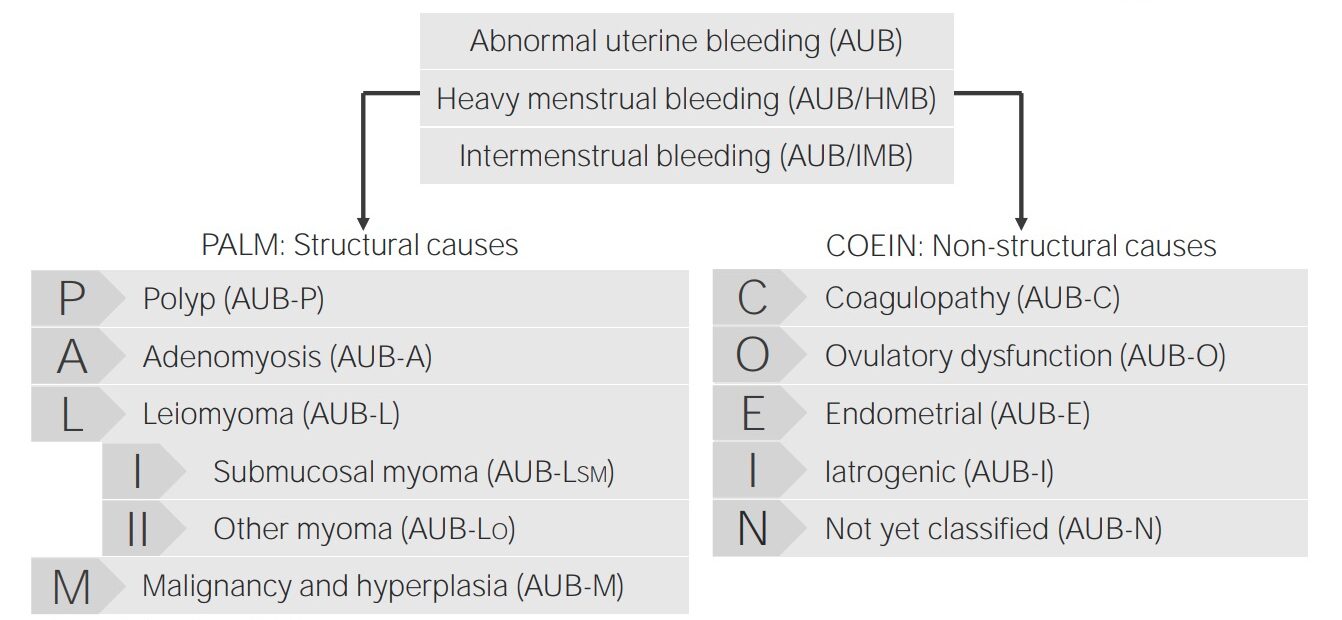
Causas de HUA

Clasificación de la hemorragia uterina anormal y sus causas

Imagen por Lecturio.
PALM (causas estructurales)

  • Pólipo (HUA-P):
    • Sobrecrecimiento de las células epiteliales que surgen del endometrio
    • Factores de riesgo: obesidad, uso de tamoxifeno, ↑ edad
  • Adenomiosis (HUA-A):
    • Presencia de endometrio (estroma y tejido glandular) dentro del miometrio uterino
    • A menudo se asocia con endometriosis Endometriosis Endometriosis is a common disease in which patients have endometrial tissue implanted outside of the uterus. Endometrial implants can occur anywhere in the pelvis, including the ovaries, the broad and uterosacral ligaments, the pelvic peritoneum, and the urinary and gastrointestinal tracts. Endometriosis.
  • Leiomioma (HUA-L):
    • Leiomioma submucoso: SUA-L(SM)
    • Leiomioma-otro: SUA-L(O)
  • Malignidad e hiperplasia (HUA-M):
    • Endometrial
    • Sarcomas uterinos
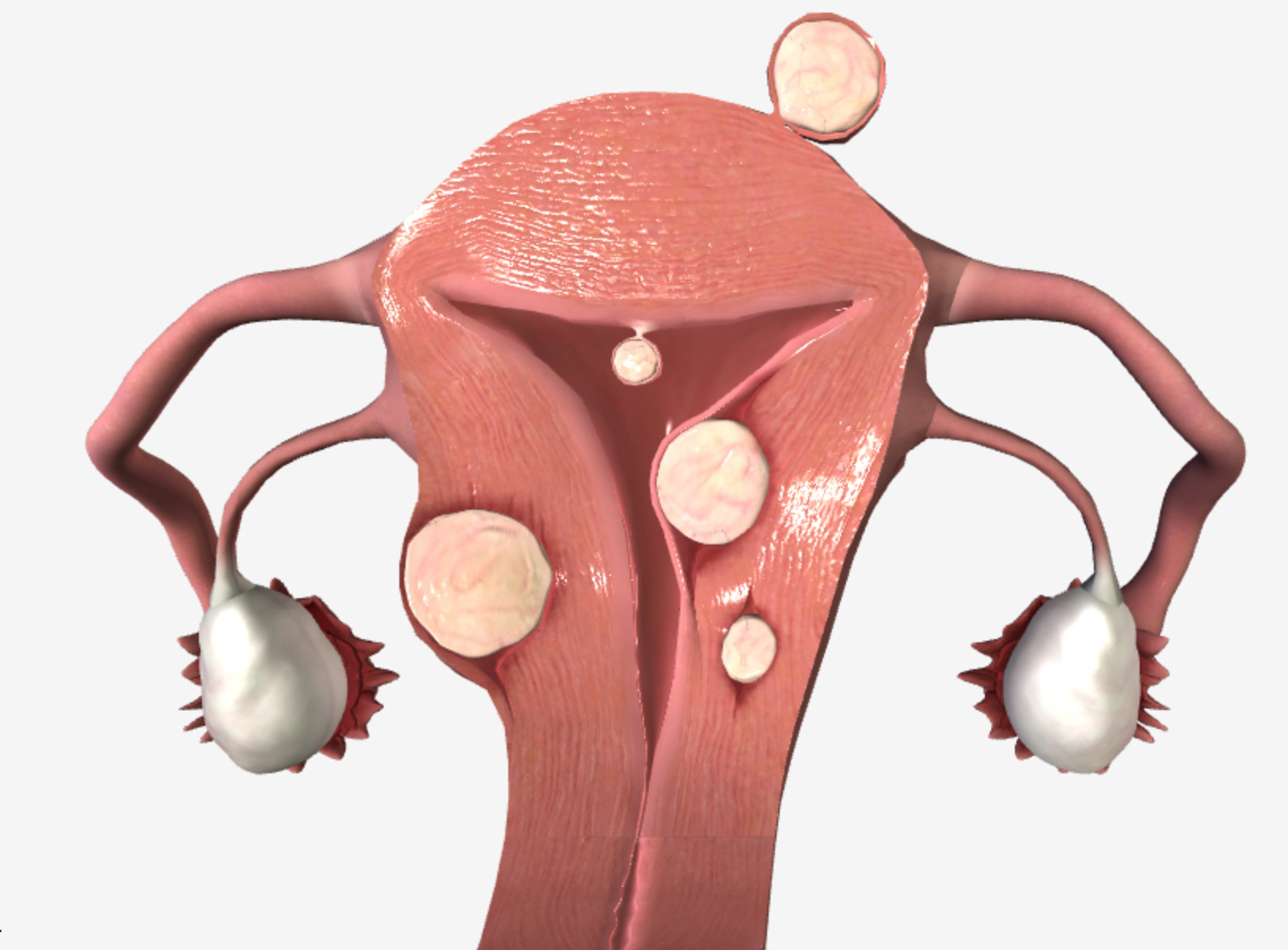
Fibromas uterinos

Miomas uterinos (localización): mioma subseroso (por debajo de la serosa), mioma submucoso (por debajo del endometrio), mioma intramural (en la pared miometrial), mioma pedunculado (que crece del cuerpo uterino en un pedúnculo)

Imagen por Lecturio.

COEIN (causas no estructurales)

  • Coagulopatía (HUA-C):
    • Se ve VE Ventilation: Mechanics of Breathing en EN Erythema nodosum is an immune-mediated panniculitis (inflammation of the subcutaneous fat) caused by a type IV (delayed-type) hypersensitivity reaction. It commonly manifests in young women as tender, erythematous nodules on the shins. Erythema Nodosum el 20% de las adolescentes con HUA.
    • HUA-C comunes: trastornos de la función plaquetaria, enfermedad de Von Willebrand
    • Factores de coagulación deficientes (V, VII, VIII, IX, XI, XII)
  • Disfunción ovulatoria (HUA-O):
    • Síndrome de ovario poliquístico (SOP): causa más común de disfunción ovárica
    • Amenorrea hipotalámica funcional (estrés, exceso de ejercicio, trastornos alimentarios)
    • Insuficiencia ovárica primaria
    • Otros trastornos endocrinos
    • Anovulación relacionada con la edad cerca de la menarquia o la menopausia
  • Endometrial (HUA-E):
    • Endometritis Endometritis Endometritis is an inflammation of the endometrium, the inner layer of the uterus. The most common subtype is postpartum endometritis, resulting from the ascension of normal vaginal flora to the previously aseptic uterus. Postpartum Endometritis o enfermedad inflamatoria pélvica: comúnmente clamidia
    • Atrofia endometrial (tejido endometrial delgado y frágil) en EN Erythema nodosum is an immune-mediated panniculitis (inflammation of the subcutaneous fat) caused by a type IV (delayed-type) hypersensitivity reaction. It commonly manifests in young women as tender, erythematous nodules on the shins. Erythema Nodosum mujeres posmenopáusicas
  • Iatrogénica (HUA-I):
    • Anticonceptivos (incluidos los LOS Neisseria dispositivos intrauterinos (DIU))
    • Anticoagulantes
    • Quimioterapia
    • Moduladores selectivos de los LOS Neisseria receptores de estrógenos
    • Psicotrópicos (p. ej., antipsicóticos por hiperprolactinemia; ISRS por disfunción plaquetaria)
  • Aún no clasificado (HUA-N)

Presentación Clínica

Presentación de PALM (causas estructurales)

Tabla: Presentación de las causas estructurales de HUA (PALM)
Etiología Presentación de la hemorragia Otros hallazgos clínicos
Pólipo (HUA-P) Sangrado menstrual abundante, sangrado intermenstrual y/o sangrado uterino prolongado
  • Puede ser asintomático o un hallazgo incidental.
  • Generalmente (pero no siempre) benigno
Adenomiosis (HUA-A) Sangrado menstrual abundante, sangrado intermenstrual y/o sangrado uterino prolongado
  • Dismenorrea (a menudo severa)
  • Útero endurecido, globular, simétricamente agrandado
  • A menudo se asocia con endometriosis Endometriosis Endometriosis is a common disease in which patients have endometrial tissue implanted outside of the uterus. Endometrial implants can occur anywhere in the pelvis, including the ovaries, the broad and uterosacral ligaments, the pelvic peritoneum, and the urinary and gastrointestinal tracts. Endometriosis.
Leiomioma (HUA-L) Sangrado menstrual abundante, sangrado intermenstrual y/o sangrado uterino prolongado
  • Dismenorrea o dolor Dolor Inflammation pélvico
  • Agrandamiento uterino asimétrico
  • Otros síntomas: ↑ frecuencia urinaria, presión pélvica, estreñimiento
Malignidad e hiperplasia (HUA-M)
  • Sangrado menstrual abundante, sangrado intermenstrual y/o sangrado uterino prolongado
  • Hemorragia posmenopáusica
HUA: hemorragia uterina anormal

Presentación de COEIN (causas no estructurales)

Tabla: Presentación de las causas no estructurales de HUA (COEIN)
Etiología Presentación de la hemorragia Otros hallazgos clínicos
Coagulopatía (HUA-C) HUA/sangrado menstrual abundante desde la menarquia Antecedente de sangrado fácil (e.g., sangrado dental, hemorragia posparto)
Disfunción ovulatoria (HUA-O) Sangrado infrecuente Amenorrea hipotalámica funcional (trastorno de la alimentación): pérdida de peso
  • Sangrado frecuente
  • HUA/sangrado menstrual abundante
Amenorrea hipotalámica funcional (estrés): factores psicológicos
  • Sangrado irregular
  • Sangrado uterino infrecuente (con o sin HUA/sangrado menstrual abundante)
  • Amenorrea
Síndrome de ovario poliquístico (SOP):
  • ↑ Andrógenos: hirsutismo, acné, caída del cabello
  • Asociado a síndrome metabólico
Amenorrea Insuficiencia ovárica primaria:
  • Cese de la función ovárica antes de los LOS Neisseria 40 años
  • Infertilidad
  • Sangrado irregular
  • HUA/sangrado menstrual abundante
Signos y síntomas de otros trastornos endocrinos que afectan a la ovulación (e.g., hipertiroidismo, hipotiroidismo, hiperprolactinemia)
Sangrado irregular Anovulación relacionada con la edad cerca de la menarquia o la menopausia
Endometrial (HUA-E) Sangrado menstrual abundante, sangrado intermenstrual, o sangrado prolongado EIP:
Sangrado intermenstrual Atrofia endometrial: acompañada de atrofia vaginal
Iatrogénica (HUA-I) HUA/sangrado intermenstrual Depende de los LOS Neisseria agentes
No clasificada (HUA-N) Mal definidas o extremadamente raras (e.g., malformación arteriovenosa, istmocele)
HUA: hemorragia uterina anormal
EIP: enfermedad inflamatoria pélvica

Diagnóstico

Antecedentes y examen físico

  • Antecedentes menstruales para clasificar la HUA
  • Descartar HUA-C sobre la base de los LOS Neisseria antecedentes (cualquiera de los LOS Neisseria siguientes requiere evaluación de laboratorio):
    • Sangrado menstrual abundante desde la menarquia
    • 1 de los LOS Neisseria siguientes:
      • Hemorragia posparto
      • Hemorragias relacionadas con la cirugía
      • Sangrado severo con intervenciones dentales
    • 2 o más de los LOS Neisseria siguientes:
  • Anomalías uterinas en EN Erythema nodosum is an immune-mediated panniculitis (inflammation of the subcutaneous fat) caused by a type IV (delayed-type) hypersensitivity reaction. It commonly manifests in young women as tender, erythematous nodules on the shins. Erythema Nodosum el examen físico:
    • Agrandamiento simétrico → sospechar:
      • HUA-A
      • HUA-M
      • Embarazo
    • Agrandamiento asimétrico → sospechar HUA-L
    • Dolor Dolor Inflammation severo → considerar EIP (HUA-E)

Pruebas de laboratorio

  • Prueba de embarazo: si es positiva → complicaciones obstétricas (e.g., ectópico)
  • Hemograma completo:
    • ↓ Hemoglobina o hematocrito → anemia Anemia Anemia is a condition in which individuals have low Hb levels, which can arise from various causes. Anemia is accompanied by a reduced number of RBCs and may manifest with fatigue, shortness of breath, pallor, and weakness. Subtypes are classified by the size of RBCs, chronicity, and etiology. Anemia: Overview and Types relacionada con HUA/sangrado menstrual abudante
    • ↓ Plaquetas → mayor evaluación para HUA-C
    • ↑ Leucocitos → presentes en EN Erythema nodosum is an immune-mediated panniculitis (inflammation of the subcutaneous fat) caused by a type IV (delayed-type) hypersensitivity reaction. It commonly manifests in young women as tender, erythematous nodules on the shins. Erythema Nodosum EIP → considerar HUA-E (especialmente con sensibilidad pélvica)
  • Pruebas de coagulación (si los LOS Neisseria antecedentes son positivos durante la anamnesis):
    • TP, TTP TTP Thrombotic thrombocytopenic purpura (TTP) is a life-threatening condition due to either a congenital or an acquired deficiency of adamts-13, a metalloproteinase that cleaves multimers of von Willebrand factor (vWF). The large multimers then aggregate excessive platelets resulting in microvascular thrombosis and an increase in consumption of platelets. Thrombotic Thrombocytopenic Purpura, INR
    • Tamizaje de la enfermedad de Von Willebrand:
      • Prueba del antígeno del factor Von Willebrand
      • Ensayo funcional del factor de Von Willebrand
      • Actividad del factor VIII Factor VIII Factor VIII of blood coagulation. Antihemophilic factor that is part of the factor viii/von Willebrand factor complex. Factor VIII is produced in the liver and acts in the intrinsic pathway of blood coagulation. It serves as a cofactor in factor X activation and this action is markedly enhanced by small amounts of thrombin. Hemostasis
  • Pruebas endocrinas para HUA-O:
    • Ordenar para pacientes con hemorragias infrecuentes o amenorrea:
      • Hormona estimulante de la tiroides (TSH)
      • Prolactina
      • Hormona foliculoestimulante ( FSH FSH A major gonadotropin secreted by the adenohypophysis. Follicle-stimulating hormone stimulates gametogenesis and the supporting cells such as the ovarian granulosa cells, the testicular sertoli cells, and leydig cells. Fsh consists of two noncovalently linked subunits, alpha and beta. Within a species, the alpha subunit is common in the three pituitary glycoprotein hormones (TSH, LH, and FSH), but the beta subunit is unique and confers its biological specificity. Menstrual Cycle)
      • Estradiol Estradiol The 17-beta-isomer of estradiol, an aromatized C18 steroid with hydroxyl group at 3-beta- and 17-beta-position. Estradiol-17-beta is the most potent form of mammalian estrogenic steroids. Noncontraceptive Estrogen and Progestins
      • Niveles de andrógenos
    • Interpretación:
      • ↑/↓ TSH: enfermedad tiroidea
      • ↑ Prolactina: hiperprolactinemia
      • FSH FSH A major gonadotropin secreted by the adenohypophysis. Follicle-stimulating hormone stimulates gametogenesis and the supporting cells such as the ovarian granulosa cells, the testicular sertoli cells, and leydig cells. Fsh consists of two noncovalently linked subunits, alpha and beta. Within a species, the alpha subunit is common in the three pituitary glycoprotein hormones (TSH, LH, and FSH), but the beta subunit is unique and confers its biological specificity. Menstrual Cycle con ↓ estradiol Estradiol The 17-beta-isomer of estradiol, an aromatized C18 steroid with hydroxyl group at 3-beta- and 17-beta-position. Estradiol-17-beta is the most potent form of mammalian estrogenic steroids. Noncontraceptive Estrogen and Progestins: insuficiencia ovárica primaria
      • FSH FSH A major gonadotropin secreted by the adenohypophysis. Follicle-stimulating hormone stimulates gametogenesis and the supporting cells such as the ovarian granulosa cells, the testicular sertoli cells, and leydig cells. Fsh consists of two noncovalently linked subunits, alpha and beta. Within a species, the alpha subunit is common in the three pituitary glycoprotein hormones (TSH, LH, and FSH), but the beta subunit is unique and confers its biological specificity. Menstrual Cycle con ↓ estradiol Estradiol The 17-beta-isomer of estradiol, an aromatized C18 steroid with hydroxyl group at 3-beta- and 17-beta-position. Estradiol-17-beta is the most potent form of mammalian estrogenic steroids. Noncontraceptive Estrogen and Progestins: amenorrea hipotalámica funcional
      • ↑ Andrógenos: SOP
  • Tamizaje de clamidia:
    • Endometritis Endometritis Endometritis is an inflammation of the endometrium, the inner layer of the uterus. The most common subtype is postpartum endometritis, resulting from the ascension of normal vaginal flora to the previously aseptic uterus. Postpartum Endometritis/EIP → HUA-E
    • Cervicitis Cervicitis Inflammation of the uterine cervix. Gonorrhea → sangrado vaginal sin HUA

Citología y biopsia

  • Biopsia endometrial:
    • Para descartar HUA-M
    • Desde los LOS Neisseria 45 años hasta la menopausia con cualquier HUA
    • < 45 años de edad con HUA y otros factores de riesgo:
      • Exposición a estrógenos sin oposición (obesidad, ≥ 6 meses de disfunción ovárica)
      • Uso de tamoxifeno
      • Síndromes de Lynch o Cowden
  • Frotis de Papanicolaou:
    • Asegurarse del frecuente tamizaje de cáncer de cuello uterino
    • Una hemorragia poscoital constante sugiere una patología cervical.

Imagenología

  • Ultrasonido transvaginal:
    • Modalidad de imagen de 1era línea para HUA
    • HUA-P: engrosamiento del revestimiento endometrial
    • HUA-L: masa hipoecoica, bien circunscrita y redonda
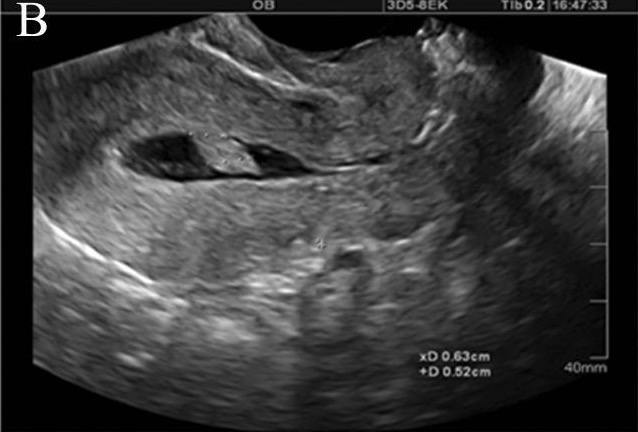
    • HUA-A: útero agrandado con textura ecogénica heterogénea
    • HUA-M: engrosamiento del revestimiento endometrial en EN Erythema nodosum is an immune-mediated panniculitis (inflammation of the subcutaneous fat) caused by a type IV (delayed-type) hypersensitivity reaction. It commonly manifests in young women as tender, erythematous nodules on the shins. Erythema Nodosum mujeres posmenopáusicas
  • Ultrasonido con infusión de solución salina:
    • Inyección de solución salina en EN Erythema nodosum is an immune-mediated panniculitis (inflammation of the subcutaneous fat) caused by a type IV (delayed-type) hypersensitivity reaction. It commonly manifests in young women as tender, erythematous nodules on the shins. Erythema Nodosum la cavidad uterina para la distensión durante el ultrasonido
    • Prueba ideal para el diagnóstico de:
      • HUA-P
      • HUA-L submucosa
      • Otras patologías uterinas que contribuyen a la infertilidad: tabiques, sinequias
  • RM pélvica:
    • Modalidad de 2da línea si el ultrasonido transvaginal no puede proporcionar suficiente información
    • Rara vez se requiere.
  • Histeroscopia:
    • Alternativa quirúrgica al AL Amyloidosis ultrasonido con infusión de solución salina
    • Permite simultáneamente el diagnóstico (visualización con biopsia) y tratamiento de la HUA-P y de la HUA-L submucosa.
Pólipo endometrial

Ultrasonido con infusión de solución salina que demuestra una lesión intracavitaria pedunculada, probablemente un pólipo endometrial:

La inyección de líquido estéril en la cavidad endometrial distiende la cavidad y permite descartar patología endometrial estructural, incluyendo pólipos, fibromas submucosos y sinequias.

Imagen: “Endometrial polyp” por Department of Reproductive Imaging at Reproductive Biomedicine Research Center, Royan Institute for Reproductive Biomedicine, ACECR, Tehran, Iran. Licencia: CC BY 2.5, recortado por Lecturio.

Tratamiento

Enfoque del tratamiento

  • Depende de la estabilidad hemodinámica:
    • Medidas generales de soporte en EN Erythema nodosum is an immune-mediated panniculitis (inflammation of the subcutaneous fat) caused by a type IV (delayed-type) hypersensitivity reaction. It commonly manifests in young women as tender, erythematous nodules on the shins. Erythema Nodosum las hemorragias:
      • Estabilización (reanimación con líquidos)
      • Transfusión, de ser necesaria
    • Hemorragia uterina aguda abundante:
      • Estrógeno conjugado IV
      • Anticonceptivos orales combinados (ACO) de dosis alta o progestágenos orales de dosis alta (alternativa al AL Amyloidosis estrógeno)
      • Se puede añadir ácido tranexámico como terapia complementaria
      • Dilatación y legrado
  • Depende de la etiología subyacente:
    • Causas estructurales (PALM) → resección quirúrgica (a menudo, pero no siempre).
    • HUA-O → manejo médico
    • Infecciones → antibióticos
    • HUA-C → manejo médico

Tratamiento médico

  • Minimizar el sangrado menstrual abundante con terapia de progestina:
    • Anticonceptivos orales (ACO)
    • DIU con levonorgestrel Levonorgestrel A synthetic progestational hormone with actions similar to those of progesterone and about twice as potent as its racemic or (+-)-isomer (norgestrel). It is used for contraception, control of menstrual disorders, and treatment of endometriosis. Hormonal Contraceptives
    • Dosis altas de progestágenos orales: noretindrona, acetato de medroxiprogesterona
  • Minimizar el sangrado menstrual abundante con antifibrinolíticos: ácido tranexámico (alternativa a la terapia hormonal)
  • Tratar trastornos endocrinos subyacentes:
    • Bromocriptina o cabergolina (hiperprolactinemia)
    • Levotiroxina (hipotiroidismo)
    • Espironolactona (hiperandrogenismo observado en EN Erythema nodosum is an immune-mediated panniculitis (inflammation of the subcutaneous fat) caused by a type IV (delayed-type) hypersensitivity reaction. It commonly manifests in young women as tender, erythematous nodules on the shins. Erythema Nodosum el SOP)
  • Suplemento de hierro en EN Erythema nodosum is an immune-mediated panniculitis (inflammation of the subcutaneous fat) caused by a type IV (delayed-type) hypersensitivity reaction. It commonly manifests in young women as tender, erythematous nodules on the shins. Erythema Nodosum la anemia Anemia Anemia is a condition in which individuals have low Hb levels, which can arise from various causes. Anemia is accompanied by a reduced number of RBCs and may manifest with fatigue, shortness of breath, pallor, and weakness. Subtypes are classified by the size of RBCs, chronicity, and etiology. Anemia: Overview and Types
  • Analgesia Analgesia Methods of pain relief that may be used with or in place of analgesics. Anesthesiology: History and Basic Concepts para la dismenorrea o el dolor Dolor Inflammation pélvico (AINE)

Tratamiento quirúrgico

  • Mujeres que desean una futura fertilidad:
    • Resección quirúrgica de pólipos (polipectomía)
    • Resección quirúrgica de los LOS Neisseria leiomas (miomectomía)
  • Después de haber dado a luz:
    • Ablación endometrial
    • Embolización de la arteria uterina (solo para leiomiomas grandes)
    • Histerectomía (tratamiento definitivo de la HUA)

Diagnóstico Diferencial

  • Hemorragia del tracto genital inferior no uterina: Hemorragia vaginal que puede surgir del cuello uterino debido a una cervicitis Cervicitis Inflammation of the uterine cervix. Gonorrhea o a una vaginitis, que irrita el cuello uterino. También pueden producirse hemorragias cervicales, vaginales o vulvares debidas a laceraciones secundarias a traumatismos. El diagnóstico se realiza a partir de un examen pélvico, la detección de infecciones por gonorrea y clamidia y el uso de un frotis de montaje húmedo e hidróxido de potasio en EN Erythema nodosum is an immune-mediated panniculitis (inflammation of the subcutaneous fat) caused by a type IV (delayed-type) hypersensitivity reaction. It commonly manifests in young women as tender, erythematous nodules on the shins. Erythema Nodosum el flujo vaginal para confirmar vaginitis. Además, la paciente debe someterse nuevamente a un frotis de Papanicolaou y a una biopsia de cualquier lesión vulvovaginal sospechosa.
  • Infección del tracto urinario (ITU): Una condición que puede presentarse con sangrado vaginal y que a veces puede confundirse con hematuria Hematuria Presence of blood in the urine. Renal Cell Carcinoma. Si la paciente solo nota HUA al AL Amyloidosis orinar, y/o tiene algún síntoma vesical, se debe solicitar un análisis de orina y un urocultivo. El tratamiento es con antibióticos.

Referencias

  1. Kaunitz, A. M. (2024). Abnormal uterine bleeding in nonpregnant reproductive-age patients: Terminology, evaluation, and approach to diagnosis. In R. Barbieri & M. M. Rafique (Eds.), UpToDate. Wolters Kluwer. Retrieved October 22, 2025, from https://www.uptodate.com/contents/abnormal-uterine-bleeding-in-nonpregnant-reproductive-age-patients-terminology-evaluation-and-approach-to-diagnosis
  2. Hoffman B.L., & Schorge J.O., & Halvorson L.M., & Hamid C.A., & Corton M.M., & Schaffer J.I.(Eds.), (2020). Abnormal uterine bleeding. Williams Gynecology, 4e. McGraw-Hill. 
  3. Kaunitz, A. M. (2025). Abnormal uterine bleeding in nonpregnant reproductive-age patients: Terminology, evaluation, and approach to diagnosis. UpToDate. Retrieved October 22, 2025, from https://www.uptodate.com/contents/abnormal-uterine-bleeding-in-nonpregnant-reproductive-age-patients-terminology-evaluation-and-approach-to-diagnosis
  4. Kaunitz, A. M. (2025). Abnormal uterine bleeding in nonpregnant reproductive-age patients: Management. UpToDate. Retrieved October 22, 2025, from https://www.uptodate.com/contents/abnormal-uterine-bleeding-in-nonpregnant-reproductive-age-patients-management
  5. Munro, M.G., Critchley, H.O.D., and Fraser, I. S. (2018). The two FIGO systems for normal and abnormal uterine bleeding symptoms and classification of causes of abnormal uterine bleeding in the reproductive years: 2018 revisions. Int J Gynecol Obstet. 143: 393-408. 
  6. Sun, Y., Wang, Y., Mao, L., Wen, J., & Bai, W. (2018). Prevalence of abnormal uterine bleeding according to new International Federation of Gynecology and Obstetrics classification in Chinese women of reproductive age: A cross-sectional study. https://doi.org/10.1097/MD.0000000000011457

¡Crea tu cuenta gratis o inicia una sesión para seguir leyendo!

Regístrate ahora y obtén acceso gratuito a Lecturio con páginas de concepto, videos médicos y cuestionarios para tu educación médica.

User Reviews

Que tengas una sesión de estudio alegre y navideña 🎁 Ahorra 50% en todos los planes >>

Details